
A English
Electronegativity Questions in English
Class 11 Chemistry · Classification of Elements and Periodicity in Properties · Electronegativity
124+
Questions
English
Language
100%
With Solutions
Showing 50 of 124 questions in English
1
EasyMCQ
The covalent compound $HCl$ exhibits ionic character because:
A
The electronegativity of hydrogen is greater than that of chlorine.
B
The electronegativity of hydrogen is equal to that of chlorine.
C
The electronegativity of chlorine is greater than that of hydrogen.
D
Hydrogen and chlorine are both gases.
Solution
(C) The $HCl$ molecule is a covalent compound that exhibits partial ionic character.
This occurs because the electronegativity of chlorine $(3.0)$ is significantly greater than that of hydrogen $(2.1)$.
As a result,the shared electron pair is pulled more strongly towards the chlorine atom,creating a dipole moment where chlorine acquires a partial negative charge $(\delta^-)$ and hydrogen acquires a partial positive charge $(\delta^+)$.
This occurs because the electronegativity of chlorine $(3.0)$ is significantly greater than that of hydrogen $(2.1)$.
As a result,the shared electron pair is pulled more strongly towards the chlorine atom,creating a dipole moment where chlorine acquires a partial negative charge $(\delta^-)$ and hydrogen acquires a partial positive charge $(\delta^+)$.
0 likes
View Solution2
EasyMCQ
The polarity of a covalent bond between two atoms depends upon
A
Atomic size
B
Electronegativity
C
Ionic size
D
None of the above
Solution
(B) The polarity of a covalent bond is determined by the difference in the electronegativities of the two atoms forming the bond.
Greater the difference in electronegativity between the bonded atoms,the greater is the polarity of the bond due to the unequal sharing of the shared electron pair.
Greater the difference in electronegativity between the bonded atoms,the greater is the polarity of the bond due to the unequal sharing of the shared electron pair.
0 likes
View Solution3
MediumMCQ
Bond polarity of a diatomic molecule is because of
A
Difference in electron affinities of the two atoms
B
Difference in electronegativities of the two atoms
C
Difference in ionisation potential
D
All of these
Solution
(B) The polarity of a bond in a diatomic molecule arises due to the difference in electronegativity between the two bonded atoms. When two atoms with different electronegativities form a covalent bond,the shared electron pair is attracted more towards the more electronegative atom,creating a partial positive charge $(\delta^+)$ on one atom and a partial negative charge $(\delta^-)$ on the other.
0 likes
View Solution4
DifficultMCQ
The values of electronegativity of atoms $A$ and $B$ are $1.20$ and $4.0$ respectively. The percentage of ionic character of $A-B$ bond is ............. $\%$
A
$50$
B
$43$
C
$55.3$
D
$72.24$
Solution
(D) The percentage of ionic character can be calculated using the Hannay-Smith equation:
Percentage of ionic character $= 16|E_A - E_B| + 3.5|E_A - E_B|^2$
Given,electronegativity of $A$ $(E_A)$ $= 1.20$ and electronegativity of $B$ $(E_B)$ $= 4.0$.
Difference in electronegativity $= |1.20 - 4.0| = 2.8$.
Substituting the values in the formula:
Percentage of ionic character $= 16(2.8) + 3.5(2.8)^2$
$= 44.8 + 3.5(7.84)$
$= 44.8 + 27.44$
$= 72.24\%$
Percentage of ionic character $= 16|E_A - E_B| + 3.5|E_A - E_B|^2$
Given,electronegativity of $A$ $(E_A)$ $= 1.20$ and electronegativity of $B$ $(E_B)$ $= 4.0$.
Difference in electronegativity $= |1.20 - 4.0| = 2.8$.
Substituting the values in the formula:
Percentage of ionic character $= 16(2.8) + 3.5(2.8)^2$
$= 44.8 + 3.5(7.84)$
$= 44.8 + 27.44$
$= 72.24\%$
0 likes
View Solution5
EasyMCQ
An element which never has a positive oxidation number in any of its compounds is:
A
Boron
B
Oxygen
C
Chlorine
D
Fluorine
Solution
(D) Fluorine is the most electronegative element in the periodic table. Due to its highest electronegativity,it always exhibits a $-1$ oxidation state in all its compounds.
0 likes
View Solution6
MediumMCQ
Which of the following elements never shows a positive oxidation number?
A
$O$
B
$Fe$
C
$Ga$
D
$F$
Solution
(D) Fluorine $(F)$ is the most electronegative element in the periodic table.
Due to its highest electronegativity,it always attracts electrons towards itself in chemical bonds and never exhibits a positive oxidation state.
Due to its highest electronegativity,it always attracts electrons towards itself in chemical bonds and never exhibits a positive oxidation state.
0 likes
View Solution7
MediumMCQ
On going from right to left in a period in the periodic table,the electronegativity of the elements:
A
Increases
B
Decreases
C
Remains unchanged
D
Decreases first then increases
Solution
(B) In a period,as we move from left to right,the atomic size decreases and the effective nuclear charge increases,leading to an increase in electronegativity. \\ Conversely,on going from right to left in a period,the atomic size increases and the effective nuclear charge decreases,which causes the electronegativity to decrease. \\ Therefore,the correct option is $(B)$.
0 likes
View Solution8
MediumMCQ
On the Pauling scale,which of the following elements does not have an electronegativity value $\ge 3.0$?
A
Oxygen
B
Nitrogen
C
Chlorine
D
Bromine
Solution
(D) The electronegativity values on the Pauling scale are as follows:
$O = 3.44$
$N = 3.04$
$Cl = 3.16$
$Br = 2.96$
Since the electronegativity of $Br$ is $2.96$,which is less than $3.0$,the correct option is $D$.
$O = 3.44$
$N = 3.04$
$Cl = 3.16$
$Br = 2.96$
Since the electronegativity of $Br$ is $2.96$,which is less than $3.0$,the correct option is $D$.
0 likes
View Solution9
MediumMCQ
Which element has the highest electronegativity?
A
$F$
B
$He$
C
$Ne$
D
$Na$
Solution
(A) The correct answer is $A$.
Fluorine $(F)$ has the highest electronegativity among all elements in the periodic table.
This is due to its small atomic size and high effective nuclear charge,which allows it to attract shared electrons in a covalent bond most strongly.
Fluorine $(F)$ has the highest electronegativity among all elements in the periodic table.
This is due to its small atomic size and high effective nuclear charge,which allows it to attract shared electrons in a covalent bond most strongly.
0 likes
View Solution10
MediumMCQ
Which element has the highest electronegativity?
A
$C$
B
$Mg$
C
$O$
D
$S$
Solution
(C) The correct answer is $C$ (Oxygen).
Electronegativity increases across a period from left to right and decreases down a group.
Among the given elements ($C$,$Mg$,$O$,$S$),$O$ (Oxygen) is located in the second period and group $16$,making it the most electronegative due to its small atomic size and high effective nuclear charge.
Electronegativity increases across a period from left to right and decreases down a group.
Among the given elements ($C$,$Mg$,$O$,$S$),$O$ (Oxygen) is located in the second period and group $16$,making it the most electronegative due to its small atomic size and high effective nuclear charge.
0 likes
View Solution11
MediumMCQ
Keeping in view the periodic law and the periodic table,suggest which of the following elements should have the maximum electronegative character.
A
$P$
B
$As$
C
$Bi$
D
$Sb$
Solution
(A) Electronegativity is defined as the tendency of an atom to attract a shared pair of electrons towards itself.
In the periodic table,electronegativity generally decreases as we move down a group due to an increase in atomic size and shielding effect.
All the given elements $(P, As, Sb, Bi)$ belong to Group $15$ of the periodic table.
The order of these elements in the group is $P > As > Sb > Bi$.
Therefore,$P$ (Phosphorus) is at the top of this group among the given options and possesses the maximum electronegative character.
In the periodic table,electronegativity generally decreases as we move down a group due to an increase in atomic size and shielding effect.
All the given elements $(P, As, Sb, Bi)$ belong to Group $15$ of the periodic table.
The order of these elements in the group is $P > As > Sb > Bi$.
Therefore,$P$ (Phosphorus) is at the top of this group among the given options and possesses the maximum electronegative character.
0 likes
View Solution12
EasyMCQ
The outermost electronic configuration of the most electronegative element is
A
$ns^2 np^3$
B
$ns^2 np^4$
C
$ns^2 np^5$
D
$ns^2 np^6$
Solution
(C) The most electronegative element in the periodic table is Fluorine $(F)$.
Fluorine belongs to the halogen group (Group $17$),which has the general valence shell electronic configuration of $ns^2 np^5$.
Therefore,the correct option is $(C)$.
Fluorine belongs to the halogen group (Group $17$),which has the general valence shell electronic configuration of $ns^2 np^5$.
Therefore,the correct option is $(C)$.
0 likes
View Solution13
MediumMCQ
Going from fluorine to chlorine,bromine and iodine,the electronegativity
A
Increases
B
Decreases
C
First decreases then increases
D
Changes randomly
Solution
(B) Electronegativity decreases down the group as the atomic size increases and the valence electrons are further away from the nucleus.
0 likes
View Solution14
MediumMCQ
Of the following elements,which one has the highest electronegativity?
A
$I$
B
$Br$
C
$Cl$
D
$F$
Solution
(D) The correct answer is $(D)$.
Electronegativity generally increases across a period from left to right and decreases down a group.
Among the halogens $(F, Cl, Br, I)$,fluorine $(F)$ is at the top of the group.
Due to its smallest atomic size and highest effective nuclear charge,$F$ has the highest electronegativity among all elements in the periodic table.
Electronegativity generally increases across a period from left to right and decreases down a group.
Among the halogens $(F, Cl, Br, I)$,fluorine $(F)$ is at the top of the group.
Due to its smallest atomic size and highest effective nuclear charge,$F$ has the highest electronegativity among all elements in the periodic table.
0 likes
View Solution15
MediumMCQ
Which of the following is most electronegative?
A
Carbon
B
Silicon
C
Lead
D
Tin
Solution
(A) The elements given belong to Group $14$ of the periodic table.
Electronegativity generally decreases as we move down a group due to an increase in atomic size and shielding effect.
The order of electronegativity for Group $14$ elements is $C > Si > Ge > Sn > Pb$.
Therefore,$Carbon$ $(C)$ is the most electronegative element among the given options.
Electronegativity generally decreases as we move down a group due to an increase in atomic size and shielding effect.
The order of electronegativity for Group $14$ elements is $C > Si > Ge > Sn > Pb$.
Therefore,$Carbon$ $(C)$ is the most electronegative element among the given options.
0 likes
View Solution16
MediumMCQ
The property of attracting electrons by the halogen atom in a molecule is called
A
Ionisation potential
B
Electron affinity
C
Electronegativity
D
Electronic attraction
Solution
(C) Electronegativity is defined as the tendency of an atom in a chemical compound to attract a shared pair of electrons towards itself.
Since the question specifies the attraction of electrons by an atom within a molecule,it refers to electronegativity.
Electron affinity,on the other hand,is the energy change when an electron is added to a neutral gaseous atom.
Since the question specifies the attraction of electrons by an atom within a molecule,it refers to electronegativity.
Electron affinity,on the other hand,is the energy change when an electron is added to a neutral gaseous atom.
0 likes
View Solution17
MediumMCQ
In the third row of the periodic table,from $Na$ to $Cl$:
A
Electronegativity increases
B
Electronegativity decreases
C
Ionization energy decreases
D
Atomic volume increases
Solution
(A) . Electronegativity increases as we move from left to right across a period because the atomic size decreases and the effective nuclear charge increases.
0 likes
View Solution18
MediumMCQ
Which of the following sets of atoms is arranged in order of increasing electronegativity?
A
$Si < P < S$
B
$S < P < Si$
C
$Si < P < S$
D
$Si < S < P$
Solution
(A) The correct order of increasing electronegativity is $Si < P < S$.
Across a period in the periodic table,the effective nuclear charge increases while the atomic radius decreases,which leads to an increase in electronegativity.
Since $Si$,$P$,and $S$ belong to the same period ($3^{rd}$ period) and are arranged in the order of increasing atomic number,their electronegativity increases in the order $Si < P < S$.
Across a period in the periodic table,the effective nuclear charge increases while the atomic radius decreases,which leads to an increase in electronegativity.
Since $Si$,$P$,and $S$ belong to the same period ($3^{rd}$ period) and are arranged in the order of increasing atomic number,their electronegativity increases in the order $Si < P < S$.
0 likes
View Solution19
MediumMCQ
Which of the following properties displays a progressive increase with the rise in atomic number across a period in the periodic table?
A
Electronegativity
B
Electron affinity
C
Ionization potential
D
Size of the atom
Solution
(A) Across a period,the atomic size decreases due to an increase in effective nuclear charge.
As a result,the attraction for electrons increases,leading to an increase in both $Electronegativity$ and $Ionization \text{ } Potential$.
$Electronegativity$ increases continuously across a period from left to right.
While $Electron \text{ } affinity$ generally increases,it does not show a perfectly progressive increase due to stable electronic configurations (e.g.,noble gases).
Therefore,$Electronegativity$ is the most accurate answer for a progressive increase.
As a result,the attraction for electrons increases,leading to an increase in both $Electronegativity$ and $Ionization \text{ } Potential$.
$Electronegativity$ increases continuously across a period from left to right.
While $Electron \text{ } affinity$ generally increases,it does not show a perfectly progressive increase due to stable electronic configurations (e.g.,noble gases).
Therefore,$Electronegativity$ is the most accurate answer for a progressive increase.
0 likes
View Solution20
MediumMCQ
With respect to chlorine,hydrogen will be:
A
Electropositive
B
Electronegative
C
Neutral
D
None of the above
Solution
(A) The electronegativity of chlorine $(Cl)$ is $3.16$ on the Pauling scale,while the electronegativity of hydrogen $(H)$ is $2.20$.
Since the electronegativity of $Cl$ is greater than that of $H$,the shared pair of electrons in the $H-Cl$ bond is shifted towards $Cl$.
Therefore,$H$ carries a partial positive charge $(\delta+)$ and $Cl$ carries a partial negative charge $(\delta-)$.
Thus,with respect to chlorine,hydrogen acts as the electropositive element.
Since the electronegativity of $Cl$ is greater than that of $H$,the shared pair of electrons in the $H-Cl$ bond is shifted towards $Cl$.
Therefore,$H$ carries a partial positive charge $(\delta+)$ and $Cl$ carries a partial negative charge $(\delta-)$.
Thus,with respect to chlorine,hydrogen acts as the electropositive element.
0 likes
View Solution21
MediumMCQ
Electronegativity is a measure of the capacity of an atom to
A
Attract electrons
B
Attract protons
C
Repel electrons
D
Repel protons
Solution
(A) Electronegativity is defined as the tendency of an atom in a chemical compound to attract a shared pair of electrons towards itself.
0 likes
View Solution22
EasyMCQ
With increasing atomic number in a certain period:
A
The chemical reactivity decreases
B
The chemical reactivity increases
C
The electropositive character increases
D
The electronegative character increases
Solution
(D) As we move from left to right in a period,the atomic size decreases due to an increase in effective nuclear charge.
Consequently,the tendency to attract shared electrons increases,which means the electronegative character increases.
Consequently,the tendency to attract shared electrons increases,which means the electronegative character increases.
0 likes
View Solution23
MediumMCQ
Which of the following elements has the maximum electronegativity?
A
$Al$
B
$S$
C
$Si$
D
$P$
Solution
(B) The electronegativity of elements increases as we move from left to right across a period in the periodic table.
All the given elements ($Al$,$Si$,$P$,and $S$) belong to the $3^{rd}$ period.
The order of electronegativity for these elements is $Al < Si < P < S$.
Therefore,$S$ (Sulfur) has the maximum electronegativity among the given options.
All the given elements ($Al$,$Si$,$P$,and $S$) belong to the $3^{rd}$ period.
The order of electronegativity for these elements is $Al < Si < P < S$.
Therefore,$S$ (Sulfur) has the maximum electronegativity among the given options.
0 likes
View Solution24
MediumMCQ
Which element has the lowest electronegativity?
A
$Li$
B
$F$
C
$Fe$
D
$Cl$
Solution
(A) Electronegativity is the tendency of an atom to attract a shared pair of electrons towards itself.
Among the given elements,$Li$ (Lithium) is an alkali metal located in Group $1$.
Alkali metals have the lowest electronegativity values in their respective periods because they have a strong tendency to lose their valence electron to achieve a stable noble gas configuration.
$F$ (Fluorine) is the most electronegative element in the periodic table.
Therefore,$Li$ has the lowest electronegativity among the options provided.
Among the given elements,$Li$ (Lithium) is an alkali metal located in Group $1$.
Alkali metals have the lowest electronegativity values in their respective periods because they have a strong tendency to lose their valence electron to achieve a stable noble gas configuration.
$F$ (Fluorine) is the most electronegative element in the periodic table.
Therefore,$Li$ has the lowest electronegativity among the options provided.
0 likes
View Solution25
MediumMCQ
The attraction that an atom exerts on a pair of electrons that are being shared between that atom and another atom to which it is bonded by a covalent bond is referred to as its
A
Electron affinity
B
Electronegativity
C
Ionisation energy
D
Valence
Solution
(B) The tendency of an atom in a chemical compound to attract a shared pair of electrons towards itself is defined as $Electronegativity$.
$Electron \ affinity$ refers to the energy released when an electron is added to a neutral gaseous atom.
$Ionisation \ energy$ is the energy required to remove an electron from a neutral gaseous atom.
$Valence$ refers to the combining capacity of an element.
Therefore,the correct term is $Electronegativity$.
$Electron \ affinity$ refers to the energy released when an electron is added to a neutral gaseous atom.
$Ionisation \ energy$ is the energy required to remove an electron from a neutral gaseous atom.
$Valence$ refers to the combining capacity of an element.
Therefore,the correct term is $Electronegativity$.
0 likes
View Solution26
MediumMCQ
The electronegativity of the following elements increases in the order:
A
$C, N, Si, P$
B
$N, Si, C, P$
C
$Si, P, C, N$
D
$P, Si, N, C$
Solution
(C) The electronegativity values (Pauling scale) for the given elements are approximately: $Si (1.90) < P (2.19) < C (2.55) < N (3.04)$.
In the periodic table,electronegativity increases from left to right across a period and decreases down a group.
Comparing the elements: $Si$ and $P$ are in the $3^{rd}$ period,while $C$ and $N$ are in the $2^{nd}$ period.
Since $Si$ and $P$ are below $C$ and $N$,they have lower electronegativity values.
Within the same period,electronegativity increases from left to right ($Si < P$ and $C < N$).
Therefore,the correct order is $Si < P < C < N$.
In the periodic table,electronegativity increases from left to right across a period and decreases down a group.
Comparing the elements: $Si$ and $P$ are in the $3^{rd}$ period,while $C$ and $N$ are in the $2^{nd}$ period.
Since $Si$ and $P$ are below $C$ and $N$,they have lower electronegativity values.
Within the same period,electronegativity increases from left to right ($Si < P$ and $C < N$).
Therefore,the correct order is $Si < P < C < N$.
0 likes
View Solution27
MediumMCQ
Choose the correct statement.
A
Electronegativity increases down a group.
B
Electronegativity decreases down a group.
C
Electronegativity decreases from left to right along a period.
D
Electronegativity changes along a group but remains constant along a period.
Solution
(B) The correct statement is $(B)$.
Electronegativity decreases down a group because the atomic radius increases,which leads to a decrease in the attraction between the nucleus and the shared pair of electrons.
Electronegativity decreases down a group because the atomic radius increases,which leads to a decrease in the attraction between the nucleus and the shared pair of electrons.
0 likes
View Solution28
MediumMCQ
In $C$,$N$,$O$,and $F$,the electronegativity:
A
Decreases from carbon to fluorine
B
Increases from carbon to fluorine
C
Increases from carbon to oxygen and then decreases
D
Decreases from carbon to oxygen and then increases
Solution
(B) Electronegativity increases across a period from left to right due to an increase in effective nuclear charge and a decrease in atomic size.
For the elements $C$,$N$,$O$,and $F$,which belong to the same period ($2^{nd}$ period),the electronegativity increases as we move from $C$ to $F$.
Therefore,the order is $C < N < O < F$.
For the elements $C$,$N$,$O$,and $F$,which belong to the same period ($2^{nd}$ period),the electronegativity increases as we move from $C$ to $F$.
Therefore,the order is $C < N < O < F$.
0 likes
View Solution29
MediumMCQ
Which is the correct order of electronegativities?
A
$F > O > N > C$
B
$F > N > O > C$
C
$F < N < O < C$
D
$F > N > O < C$
Solution
(A) The electronegativity values on the Pauling scale for the given elements are: $F (4.0) > O (3.5) > N (3.0) > C (2.5)$.
Therefore,the correct order of electronegativity is $F > O > N > C$.
Therefore,the correct order of electronegativity is $F > O > N > C$.
0 likes
View Solution30
EasyMCQ
Which one of the following has the highest electronegativity?
A
$Br$
B
$Cl$
C
$P$
D
$Si$
Solution
(B) The electronegativity of elements increases across a period from left to right and decreases down a group.
Comparing the given elements: $Si$ (Group $14$,Period $3$),$P$ (Group $15$,Period $3$),$Cl$ (Group $17$,Period $3$),and $Br$ (Group $17$,Period $4$).
Among these,$Cl$ is in the same period as $Si$ and $P$ but further to the right,and it is in the same group as $Br$ but in a higher period (smaller atomic size).
Therefore,$Cl$ has the highest electronegativity.
Comparing the given elements: $Si$ (Group $14$,Period $3$),$P$ (Group $15$,Period $3$),$Cl$ (Group $17$,Period $3$),and $Br$ (Group $17$,Period $4$).
Among these,$Cl$ is in the same period as $Si$ and $P$ but further to the right,and it is in the same group as $Br$ but in a higher period (smaller atomic size).
Therefore,$Cl$ has the highest electronegativity.
0 likes
View Solution31
MediumMCQ
Which of these has no unit?
A
Electronegativity
B
Electron affinity
C
Ionisation energy
D
Excitation potential
Solution
(A) Electronegativity is a relative measure of the tendency of an atom to attract a shared pair of electrons towards itself in a chemical bond. Since it is a relative value,it is a dimensionless quantity and has no unit.
$B$,$C$,and $D$ represent energy or potential values,which are measured in units like $kJ \ mol^{-1}$ or $eV$.
$B$,$C$,and $D$ represent energy or potential values,which are measured in units like $kJ \ mol^{-1}$ or $eV$.
0 likes
View Solution32
EasyMCQ
The increasing order of electronegativity is:
A
$Bi < P < S < Cl$
B
$P < Bi < S < Cl$
C
$S < Bi < P < Cl$
D
$Cl < S < Bi < P$
Solution
(A) The electronegativity of elements generally increases across a period from left to right and decreases down a group.
Comparing the given elements:
$Bi$ (Bismuth) is in Group $15$,Period $6$.
$P$ (Phosphorus) is in Group $15$,Period $3$.
$S$ (Sulfur) is in Group $16$,Period $3$.
$Cl$ (Chlorine) is in Group $17$,Period $3$.
Since $Bi$ is at the bottom of Group $15$,it has the lowest electronegativity.
In Period $3$,the order of electronegativity is $P < S < Cl$.
Therefore,the overall increasing order is $Bi < P < S < Cl$.
Comparing the given elements:
$Bi$ (Bismuth) is in Group $15$,Period $6$.
$P$ (Phosphorus) is in Group $15$,Period $3$.
$S$ (Sulfur) is in Group $16$,Period $3$.
$Cl$ (Chlorine) is in Group $17$,Period $3$.
Since $Bi$ is at the bottom of Group $15$,it has the lowest electronegativity.
In Period $3$,the order of electronegativity is $P < S < Cl$.
Therefore,the overall increasing order is $Bi < P < S < Cl$.
0 likes
View Solution33
MediumMCQ
Arrange $F$,$Cl$,$O$,and $N$ in the decreasing order of electronegativity.
A
$O > F > N > Cl$
B
$F > N > Cl > O$
C
$Cl > F > N > O$
D
$F > O > N > Cl$
Solution
(D) The electronegativity values on the Pauling scale are: $F = 4.0$,$O = 3.5$,$N = 3.0$,and $Cl = 3.0$.
However,considering the periodic trends and specific values,$F$ is the most electronegative element.
Comparing $O$ $(3.5)$ and $N$ $(3.0)$,$O > N$.
Comparing $N$ and $Cl$,both are approximately $3.0$,but $N$ is generally considered slightly more electronegative or equal in some scales,while $Cl$ is less electronegative than $O$ and $N$ in the context of these specific elements.
The correct decreasing order is $F > O > N > Cl$.
However,considering the periodic trends and specific values,$F$ is the most electronegative element.
Comparing $O$ $(3.5)$ and $N$ $(3.0)$,$O > N$.
Comparing $N$ and $Cl$,both are approximately $3.0$,but $N$ is generally considered slightly more electronegative or equal in some scales,while $Cl$ is less electronegative than $O$ and $N$ in the context of these specific elements.
The correct decreasing order is $F > O > N > Cl$.
0 likes
View Solution34
EasyMCQ
Electronegativity of beryllium $(Be)$ is approximately equal to that of
A
Aluminium $(Al)$
B
Boron $(B)$
C
Magnesium $(Mg)$
D
Sodium $(Na)$
Solution
(A) The electronegativity of beryllium $(Be)$ is $1.5$ on the Pauling scale. Among the given options,aluminium $(Al)$ also has an electronegativity value of approximately $1.5$. This similarity is due to the diagonal relationship between $Be$ and $Al$ in the periodic table.
| Element | Electronegativity |
|---|---|
| $Be$ | $1.5$ |
| $Al$ | $1.5$ |
0 likes
View Solution35
MediumMCQ
Which of the following is most electronegative?
A
$O$
B
$S$
C
$Te$
D
$Se$
Solution
(A) The correct answer is $A$. Electronegativity decreases down a group in the periodic table as the atomic size increases and the valence electrons are further from the nucleus. For Group $16$ elements,the electronegativity values are as follows:
Thus,$O$ (Oxygen) has the highest electronegativity.
| Element | Electronegativity |
| $O$ | $3.5$ |
| $S$ | $2.5$ |
| $Se$ | $2.4$ |
| $Te$ | $2.1$ |
| $Po$ | $2.0$ |
Thus,$O$ (Oxygen) has the highest electronegativity.
0 likes
View Solution36
EasyMCQ
Fluorine is a better oxidising agent than $Br_{2}$. It is due to
A
Small size of fluorine
B
More electron repulsion in fluorine
C
More electronegativity of fluorine
D
Non-metallic nature of fluorine
Solution
(C) The oxidising power of halogens depends on their ability to gain electrons,which is determined by the standard electrode potential $(E^{\circ})$.
Fluorine $(F_{2})$ has a very high positive standard reduction potential due to its high electronegativity,low dissociation energy of the $F-F$ bond,and high hydration energy of the $F^{-}$ ion.
Therefore,$F_{2}$ is a stronger oxidising agent than $Br_{2}$.
Fluorine $(F_{2})$ has a very high positive standard reduction potential due to its high electronegativity,low dissociation energy of the $F-F$ bond,and high hydration energy of the $F^{-}$ ion.
Therefore,$F_{2}$ is a stronger oxidising agent than $Br_{2}$.
0 likes
View Solution37
EasyMCQ
The Pauling electronegativity values of elements are important in predicting which of the following?
A
Polarity of bonds in a molecule
B
Position of elements in the electromotive series
C
Coordination number
D
Dipole moment of various molecules
Solution
(A) The Pauling electronegativity values of elements are primarily used to predict the polarity of covalent bonds in a molecule. $A$ difference in electronegativity between two bonded atoms leads to an unequal sharing of electrons,resulting in bond polarity.
0 likes
View Solution38
EasyMCQ
An atom with high electronegativity has:
A
$A$ large size.
B
High ionization energy.
C
Low electron affinity.
D
Low ionization energy.
Solution
(B) Electronegativity is the tendency of an atom to attract a shared pair of electrons towards itself. Atoms with high electronegativity generally have a small atomic size and a high effective nuclear charge,which results in a high ionization energy.
0 likes
View Solution39
EasyMCQ
Which of the following is correct for the order of electronegativity?
A
$P > Si$
B
$C > N$
C
$Br > Cl$
D
$Sr > Ca$
Solution
(A) Electronegativity increases as we move from left to right across a period in the periodic table.
$Si$ (Group $14$) and $P$ (Group $15$) are in the same period.
Since $P$ is to the right of $Si$,its electronegativity is higher than that of $Si$.
Therefore,the correct order is $P > Si$.
$Si$ (Group $14$) and $P$ (Group $15$) are in the same period.
Since $P$ is to the right of $Si$,its electronegativity is higher than that of $Si$.
Therefore,the correct order is $P > Si$.
0 likes
View Solution40
MediumMCQ
Which of the following is the correct increasing order of electronegativity for the given elements?
A
$C < N < Si < P$
B
$Si < P < C < N$
C
$N < C < P < Si$
D
$C < Si < N < P$
Solution
(B) In the periodic table,electronegativity increases from left to right across a period and decreases from top to bottom down a group.
Comparing the elements: $Si$ (Group $14$,Period $3$),$P$ (Group $15$,Period $3$),$C$ (Group $14$,Period $2$),and $N$ (Group $15$,Period $2$).
Electronegativity values are approximately: $Si (1.9) < P (2.1) < C (2.5) < N (3.0)$.
Therefore,the correct increasing order is $Si < P < C < N$.
Comparing the elements: $Si$ (Group $14$,Period $3$),$P$ (Group $15$,Period $3$),$C$ (Group $14$,Period $2$),and $N$ (Group $15$,Period $2$).
Electronegativity values are approximately: $Si (1.9) < P (2.1) < C (2.5) < N (3.0)$.
Therefore,the correct increasing order is $Si < P < C < N$.
0 likes
View Solution41
MediumMCQ
The electronegativity values of $F, Cl, Br,$ and $I$ are $4.0, 3.0, 2.8,$ and $2.5$ respectively. Which hydrogen halide has the highest percentage of ionic character?
A
$HF$
B
$HCl$
C
$HBr$
D
$HI$
Solution
(A) The ionic character of a bond is directly proportional to the difference in electronegativity between the bonded atoms.
Electronegativity of $H$ is $2.1$.
The electronegativity differences are:
$HF: |4.0 - 2.1| = 1.9$
$HCl: |3.0 - 2.1| = 0.9$
$HBr: |2.8 - 2.1| = 0.7$
$HI: |2.5 - 2.1| = 0.4$
Since $HF$ has the largest electronegativity difference,it possesses the highest percentage of ionic character.
Electronegativity of $H$ is $2.1$.
The electronegativity differences are:
$HF: |4.0 - 2.1| = 1.9$
$HCl: |3.0 - 2.1| = 0.9$
$HBr: |2.8 - 2.1| = 0.7$
$HI: |2.5 - 2.1| = 0.4$
Since $HF$ has the largest electronegativity difference,it possesses the highest percentage of ionic character.
0 likes
View Solution42
MediumMCQ
The nature of the bond formed between two elements depends on the
A
Oxidation potential
B
Electronegativity
C
Ionization potential
D
Electron affinity
Solution
(B) If the two elements have similar electronegativities,the bond between them will be covalent,while a large difference in electronegativities leads to an ionic bond.
0 likes
View Solution43
MediumMCQ
The electronegativity of $C$,$H$,$O$,$N$ and $S$ are $2.5$,$2.1$,$3.5$,$3.0$ and $2.5$ respectively. Which of the following bonds is most polar?
A
$O-H$
B
$S-H$
C
$N-H$
D
$C-H$
Solution
(A) The polarity of a bond depends on the difference in electronegativity between the two bonded atoms. The greater the difference,the more polar the bond.
$1$. For $O-H$: $\Delta EN = |3.5 - 2.1| = 1.4$
$2$. For $S-H$: $\Delta EN = |2.5 - 2.1| = 0.4$
$3$. For $N-H$: $\Delta EN = |3.0 - 2.1| = 0.9$
$4$. For $C-H$: $\Delta EN = |2.5 - 2.1| = 0.4$
Since the electronegativity difference is highest for the $O-H$ bond,it is the most polar bond.
$1$. For $O-H$: $\Delta EN = |3.5 - 2.1| = 1.4$
$2$. For $S-H$: $\Delta EN = |2.5 - 2.1| = 0.4$
$3$. For $N-H$: $\Delta EN = |3.0 - 2.1| = 0.9$
$4$. For $C-H$: $\Delta EN = |2.5 - 2.1| = 0.4$
Since the electronegativity difference is highest for the $O-H$ bond,it is the most polar bond.
0 likes
View Solution44
MediumMCQ
Which of the following bonds has the most polar character?
A
$C-O$
B
$C-Br$
C
$C-S$
D
$C-F$
Solution
(D) The polarity of a covalent bond depends on the difference in electronegativity between the two bonded atoms.
Greater the difference in electronegativity,higher is the polarity of the bond.
The electronegativity values of the atoms involved are: $C = 2.55$,$O = 3.44$,$Br = 2.96$,$S = 2.58$,and $F = 3.98$.
The differences in electronegativity are:
$C-O: |3.44 - 2.55| = 0.89$
$C-Br: |2.96 - 2.55| = 0.41$
$C-S: |2.58 - 2.55| = 0.03$
$C-F: |3.98 - 2.55| = 1.43$
Since the difference in electronegativity is highest for the $C-F$ bond,it has the most polar character.
Therefore,the correct option is $(D)$.
Greater the difference in electronegativity,higher is the polarity of the bond.
The electronegativity values of the atoms involved are: $C = 2.55$,$O = 3.44$,$Br = 2.96$,$S = 2.58$,and $F = 3.98$.
The differences in electronegativity are:
$C-O: |3.44 - 2.55| = 0.89$
$C-Br: |2.96 - 2.55| = 0.41$
$C-S: |2.58 - 2.55| = 0.03$
$C-F: |3.98 - 2.55| = 1.43$
Since the difference in electronegativity is highest for the $C-F$ bond,it has the most polar character.
Therefore,the correct option is $(D)$.
0 likes
View Solution45
MediumMCQ
If the difference in electronegativities of two elements is very large,then
A
The bond is $50\%$ ionic
B
The bond is $100\%$ covalent
C
The bond is more covalent than ionic
D
The bond is more ionic than covalent
Solution
(D) The nature of a chemical bond depends on the electronegativity difference between the bonded atoms.
If the difference in electronegativities of two elements is very large,the electron pair is shifted significantly towards the more electronegative atom,resulting in a bond that is more ionic than covalent.
If the difference in electronegativities of two elements is very large,the electron pair is shifted significantly towards the more electronegative atom,resulting in a bond that is more ionic than covalent.
0 likes
View Solution46
DifficultMCQ
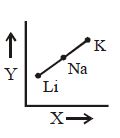
If coordinate $X$ is atomic number,then select the best option for the $Y$ coordinate based on the given graph for $Li$,$Na$,and $K$.
A
$IE_1$
B
Electron affinity
C
$Z_{eff}$ (using Slater rule)
D
$\frac{1}{\text{electronegativity}}$
Solution
(D) The graph shows that the value of $Y$ increases as the atomic number $(X)$ increases for the alkali metals $Li$,$Na$,and $K$.
$1$. $IE_1$ (first ionization energy) decreases down the group as atomic size increases.
$2$. Electron affinity generally decreases down the group.
$3$. $Z_{eff}$ (effective nuclear charge) calculated using Slater's rule for valence electrons in alkali metals remains approximately constant ($Z_{eff} \approx 1.30$ for $Li$,$Na$,$K$).
$4$. Electronegativity decreases down the group,so $\frac{1}{\text{electronegativity}}$ increases down the group.
Therefore,the value of $\frac{1}{\text{electronegativity}}$ increases as we move from $Li$ to $Na$ to $K$.
$1$. $IE_1$ (first ionization energy) decreases down the group as atomic size increases.
$2$. Electron affinity generally decreases down the group.
$3$. $Z_{eff}$ (effective nuclear charge) calculated using Slater's rule for valence electrons in alkali metals remains approximately constant ($Z_{eff} \approx 1.30$ for $Li$,$Na$,$K$).
$4$. Electronegativity decreases down the group,so $\frac{1}{\text{electronegativity}}$ increases down the group.
Therefore,the value of $\frac{1}{\text{electronegativity}}$ increases as we move from $Li$ to $Na$ to $K$.
0 likes
View Solution47
DifficultMCQ
Aqueous solutions of two compounds $M_1-OH$ and $M_2-OH$ are prepared in two different beakers. If the electronegativity of $M_1 = 3.4$,$M_2 = 1.2$,$O = 3.5$,and $H = 2.1$,then the nature of the two solutions will be respectively:
A
Acidic,basic
B
Acidic,acidic
C
Basic,acidic
D
Basic,basic
Solution
(A) The nature of a hydroxide $M-OH$ depends on the electronegativity difference between the metal/non-metal $M$ and oxygen $O$,or the electronegativity of $M$ itself.
According to the rule,if the electronegativity of $M$ is greater than $1.7$,the $O-H$ bond breaks,making the solution acidic.
If the electronegativity of $M$ is less than $1.7$,the $M-O$ bond breaks,releasing $OH^-$ ions,making the solution basic.
For $M_1-OH$: Electronegativity of $M_1 = 3.4 > 1.7$,so it is acidic.
For $M_2-OH$: Electronegativity of $M_2 = 1.2 < 1.7$,so it is basic.
Therefore,the nature of the solutions is acidic and basic respectively.
According to the rule,if the electronegativity of $M$ is greater than $1.7$,the $O-H$ bond breaks,making the solution acidic.
If the electronegativity of $M$ is less than $1.7$,the $M-O$ bond breaks,releasing $OH^-$ ions,making the solution basic.
For $M_1-OH$: Electronegativity of $M_1 = 3.4 > 1.7$,so it is acidic.
For $M_2-OH$: Electronegativity of $M_2 = 1.2 < 1.7$,so it is basic.
Therefore,the nature of the solutions is acidic and basic respectively.
0 likes
View Solution48
DifficultMCQ
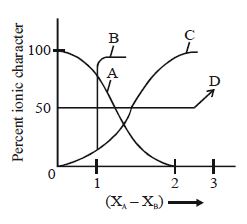
For $AB$ bond,if percent ionic character is plotted against electronegativity difference $(X_A - X_B)$,the shape of the curve would look like. The correct curve is:
A
$A$
B
$B$
C
$C$
D
$D$
Solution
(C) $50 \,\%$ ionic character occurs when the electronegativity difference between the atoms is equal to $1.7$.
This is evident from curve $C$,which shows that as the electronegativity difference increases,the percent ionic character increases,reaching $50 \,\%$ at $\Delta E.N. = 1.7$.
$\Delta E.N. = 1.7 \Rightarrow 50 \,\% \text{ ionic and } 50 \,\% \text{ covalent}$
$\Delta E.N. > 1.7 \Rightarrow \text{more than } 50 \,\% \text{ ionic and less than } 50 \,\% \text{ covalent}$
$\Delta E.N. < 1.7 \Rightarrow \text{less than } 50 \,\% \text{ ionic and more than } 50 \,\% \text{ covalent}$
This is evident from curve $C$,which shows that as the electronegativity difference increases,the percent ionic character increases,reaching $50 \,\%$ at $\Delta E.N. = 1.7$.
$\Delta E.N. = 1.7 \Rightarrow 50 \,\% \text{ ionic and } 50 \,\% \text{ covalent}$
$\Delta E.N. > 1.7 \Rightarrow \text{more than } 50 \,\% \text{ ionic and less than } 50 \,\% \text{ covalent}$
$\Delta E.N. < 1.7 \Rightarrow \text{less than } 50 \,\% \text{ ionic and more than } 50 \,\% \text{ covalent}$
0 likes
View Solution49
MediumMCQ
Pauling's electronegativity values for elements are useful in predicting:
A
Polarity of bonds in molecules
B
Position of elements in electrochemical series
C
Coordination number
D
Dipole moment of various molecules
Solution
(A) Pauling introduced the concept of electronegativity to quantify the tendency of an atom to attract shared electrons in a chemical bond.
He established that the ionic character of a bond is directly related to the difference in electronegativity between the bonded atoms.
$A$ large difference in electronegativity leads to a bond with a high degree of polar character,meaning the bond is predominantly ionic,whereas a small difference results in a covalent bond.
Therefore,Pauling's values are primarily used to predict the polarity of bonds in molecules.
He established that the ionic character of a bond is directly related to the difference in electronegativity between the bonded atoms.
$A$ large difference in electronegativity leads to a bond with a high degree of polar character,meaning the bond is predominantly ionic,whereas a small difference results in a covalent bond.
Therefore,Pauling's values are primarily used to predict the polarity of bonds in molecules.
0 likes
View Solution50
MediumMCQ
In which of the following pairs of elements is the electronegativity of the first element less than that of the second element?
A
$Zr, Hf$
B
$K, Rb$
C
$Cl, S$
D
None of the above
Solution
(A) Electronegativity $(EN)$ generally decreases down a group and increases across a period.
For $K$ and $Rb$,$K$ is above $Rb$ in Group $1$,so $EN(K) > EN(Rb)$.
For $Cl$ and $S$,$Cl$ is to the right of $S$ in Period $3$,so $EN(Cl) > EN(S)$.
For $Zr$ and $Hf$,due to lanthanoid contraction,the $EN$ of $Hf$ $(1.3)$ is slightly higher than that of $Zr$ $(1.22)$.
Therefore,the pair where the first element has lower $EN$ than the second is $Zr, Hf$.
For $K$ and $Rb$,$K$ is above $Rb$ in Group $1$,so $EN(K) > EN(Rb)$.
For $Cl$ and $S$,$Cl$ is to the right of $S$ in Period $3$,so $EN(Cl) > EN(S)$.
For $Zr$ and $Hf$,due to lanthanoid contraction,the $EN$ of $Hf$ $(1.3)$ is slightly higher than that of $Zr$ $(1.22)$.
Therefore,the pair where the first element has lower $EN$ than the second is $Zr, Hf$.
0 likes
View SolutionClassification of Elements and Periodicity in Properties — Electronegativity · Frequently Asked Questions
1Are these Classification of Elements and Periodicity in Properties questions useful for JEE and NEET?
Yes. All questions in this section are mapped to JEE Main and NEET exam patterns. Previous year questions from JEE Main, NEET, GUJCET and state-level exams are included with full solutions.
2Can I switch to Hindi or Gujarati for these questions?
Yes. Use the language tabs in the hero section or the sidebar to view the same questions and solutions in English, Hindi or Gujarati.
3How do I generate a question paper from this subtopic?
Use the Vedclass Exam Paper Generator — select the chapter and subtopic, set difficulty, and generate Sets A, B, C, D automatically. First 3 chapters of every subject are free.
Vedclass Products
For Students
Vedclass Test Series
Mock tests in real JEE/NEET style with performance analysis. 5-day free trial.
Start Free TrialFor Teachers
Exam Paper Generator
Generate Set A/B/C/D papers from this chapter in 2 minutes. 3 chapters free.
Try FreeFor Institutes
Online Exam Module
Live online exams with unlimited students, 360° analytics & white-label branding.
See DemoFor Teachers & Institutes
Generate a Classification of Elements and Periodicity in Properties Exam Paper in 2 Minutes
Select subtopic & difficulty — Sets A, B, C, D auto-generated with No Repeat logic.
First 3 chapters of every subject are free — no payment required.