
A English
Electronegativity Questions in English
Class 11 Chemistry · Classification of Elements and Periodicity in Properties · Electronegativity
124+
Questions
English
Language
100%
With Solutions
Showing 21 of 124 questions in English
101
EasyMCQ
Which among the following elements has the lowest value of electronegativity?
A
$Bi$
B
$As$
C
$Sb$
D
$N$
Solution
(A) Electronegativity generally decreases down a group in the periodic table due to the increase in atomic size and shielding effect.
Group $15$ elements are $N, P, As, Sb, Bi$.
As we move from $N$ to $Bi$,the electronegativity decreases.
Therefore,$Bi$ (Bismuth) has the lowest electronegativity among the given elements.
Group $15$ elements are $N, P, As, Sb, Bi$.
As we move from $N$ to $Bi$,the electronegativity decreases.
Therefore,$Bi$ (Bismuth) has the lowest electronegativity among the given elements.
0 likes
View Solution102
DifficultMCQ
What is the value of electronegativity of oxygen?
A
$4$
B
$3.5$
C
$2.48$
D
$3.2$
Solution
(B) According to the Pauling scale,the electronegativity of oxygen is $3.5$.
0 likes
View Solution103
EasyMCQ
The correct order of electronegativities of $N$,$O$,$F$,and $P$ is
A
$F > O > P > N$
B
$F > O > N > P$
C
$N > O > F > P$
D
$F > N > P > O$
Solution
(B) Electronegativity increases across a period from left to right and decreases down a group.
Comparing the elements:
$F$ $(Z=9)$ is in period $2$,group $17$.
$O$ $(Z=8)$ is in period $2$,group $16$.
$N$ $(Z=7)$ is in period $2$,group $15$.
$P$ $(Z=15)$ is in period $3$,group $15$.
Since $F$,$O$,and $N$ are in the same period $(2)$,their electronegativity follows the order $F > O > N$.
$P$ is below $N$ in group $15$,so its electronegativity is lower than $N$.
Thus,the correct order is $F > O > N > P$.
Comparing the elements:
$F$ $(Z=9)$ is in period $2$,group $17$.
$O$ $(Z=8)$ is in period $2$,group $16$.
$N$ $(Z=7)$ is in period $2$,group $15$.
$P$ $(Z=15)$ is in period $3$,group $15$.
Since $F$,$O$,and $N$ are in the same period $(2)$,their electronegativity follows the order $F > O > N$.
$P$ is below $N$ in group $15$,so its electronegativity is lower than $N$.
Thus,the correct order is $F > O > N > P$.
0 likes
View Solution104
DifficultMCQ
The electronegativities of $C, N, Si$ and $P$ are in the order of
A
$P < Si < C < N$
B
$Si < P < N < C$
C
$Si < P < C < N$
D
$P < Si < N < C$
Solution
(C) Electronegativity generally increases across a period from left to right and decreases down a group from top to bottom.
In the periodic table,$C$ and $N$ belong to the $2^{nd}$ period,while $Si$ and $P$ belong to the $3^{rd}$ period.
Comparing the values: $Si$ $(1.90)$ < $P$ $(2.19)$ < $C$ $(2.55)$ < $N$ $(3.04)$.
Thus,the correct increasing order of electronegativity is $Si < P < C < N$.
In the periodic table,$C$ and $N$ belong to the $2^{nd}$ period,while $Si$ and $P$ belong to the $3^{rd}$ period.
Comparing the values: $Si$ $(1.90)$ < $P$ $(2.19)$ < $C$ $(2.55)$ < $N$ $(3.04)$.
Thus,the correct increasing order of electronegativity is $Si < P < C < N$.
0 likes
View Solution105
EasyMCQ
The period and group numbers of the element having maximum electronegativity in the long form of the periodic table,respectively,are
A
$2, 17$
B
$3, 17$
C
$1, 18$
D
$2, 16$
Solution
(A) The element with the highest electronegativity in the periodic table is Fluorine $(F)$.
Fluorine has an atomic number of $9$,and its electronic configuration is $1s^2, 2s^2, 2p^5$.
Since the highest principal quantum number is $n = 2$,it belongs to the $2^{nd}$ period.
It has $7$ valence electrons $(2s^2, 2p^5)$,which places it in Group $17$ (the Halogen group).
Therefore,the period and group numbers are $2$ and $17$ respectively.
Fluorine has an atomic number of $9$,and its electronic configuration is $1s^2, 2s^2, 2p^5$.
Since the highest principal quantum number is $n = 2$,it belongs to the $2^{nd}$ period.
It has $7$ valence electrons $(2s^2, 2p^5)$,which places it in Group $17$ (the Halogen group).
Therefore,the period and group numbers are $2$ and $17$ respectively.
0 likes
View Solution106
EasyMCQ
Identify the pair of elements with the highest and lowest electronegativity respectively.
A
$K$ and $Rb$
B
$I$ and $F$
C
$F$ and $Fr$
D
$Fr$ and $Li$
Solution
(C) Fluorine $(F)$ is the element with the highest electronegativity,as it is located at the extreme right of the second period in the periodic table.
Francium $(Fr)$ is the most electropositive or least electronegative element,as it is located at the bottom left of the periodic table.
Francium $(Fr)$ is the most electropositive or least electronegative element,as it is located at the bottom left of the periodic table.
0 likes
View Solution107
EasyMCQ
The element with the highest electronegativity value after fluorine $(F)$ is:
A
Nitrogen $(N)$
B
Oxygen $(O)$
C
Chlorine $(Cl)$
D
Bromine $(Br)$
Solution
(B) Electronegativity is the tendency of an atom to attract a shared pair of electrons towards itself.
According to the Pauling scale,fluorine $(F)$ is the most electronegative element with a value of $4.0$.
Oxygen $(O)$ is the second most electronegative element with a value of $3.5$.
According to the Pauling scale,fluorine $(F)$ is the most electronegative element with a value of $4.0$.
Oxygen $(O)$ is the second most electronegative element with a value of $3.5$.
0 likes
View Solution108
EasyMCQ
Given that the ionization potential and electron gain enthalpy of chlorine are $13 \ eV$ and $4 \ eV$ respectively. The electronegativity of chlorine on the Mulliken scale is approximately equal to: (in $eV$)
A
$8.5$
B
$6.0$
C
$3.0$
D
$1.5$
Solution
(A) According to the Mulliken scale,the electronegativity $(\chi)$ of an element is given by the average of its ionization potential $(IP)$ and electron gain enthalpy $(EA)$:
$\chi = \frac{IP + EA}{2}$
Given $IP = 13 \ eV$ and $EA = 4 \ eV$.
Substituting the values:
$\chi = \frac{13 + 4}{2} = \frac{17}{2} = 8.5 \ eV$.
Note: The formula $\chi = \frac{IP + EA}{5.6}$ is used to convert Mulliken electronegativity to the Pauling scale. Since the question asks for the value on the Mulliken scale,the correct calculation is $\frac{IP + EA}{2} = 8.5 \ eV$.
$\chi = \frac{IP + EA}{2}$
Given $IP = 13 \ eV$ and $EA = 4 \ eV$.
Substituting the values:
$\chi = \frac{13 + 4}{2} = \frac{17}{2} = 8.5 \ eV$.
Note: The formula $\chi = \frac{IP + EA}{5.6}$ is used to convert Mulliken electronegativity to the Pauling scale. Since the question asks for the value on the Mulliken scale,the correct calculation is $\frac{IP + EA}{2} = 8.5 \ eV$.
0 likes
View Solution109
MediumMCQ
The electronegativity of the given elements increases in the order
A
$Si < P < C < N$
B
$N < Si < C < P$
C
$Si < C < P < N$
D
$P < Si < N < C$
Solution
(A) Electronegativity generally increases across a period from left to right and decreases down a group in the periodic table.
Comparing the elements $Si$,$P$,$C$,and $N$:
$1$. In the second period,the order is $C < N$.
$2$. In the third period,the order is $Si < P$.
$3$. Comparing groups,$C > Si$ and $N > P$.
Combining these trends,the overall order of increasing electronegativity is $Si < P < C < N$.
Comparing the elements $Si$,$P$,$C$,and $N$:
$1$. In the second period,the order is $C < N$.
$2$. In the third period,the order is $Si < P$.
$3$. Comparing groups,$C > Si$ and $N > P$.
Combining these trends,the overall order of increasing electronegativity is $Si < P < C < N$.
0 likes
View Solution110
MediumMCQ
Consider the following.
Statement-$I$ : The order of electronegativity of $B, Al, In, Tl$ is $B > Tl > Al > In$.
Statement-$II$ : Boric acid is a weak protonic acid.
The correct answer is
Statement-$I$ : The order of electronegativity of $B, Al, In, Tl$ is $B > Tl > Al > In$.
Statement-$II$ : Boric acid is a weak protonic acid.
The correct answer is
A
Both statement-$I$ and statement-$II$ are correct
B
Both statement-$I$ and statement-$II$ are not correct
C
Statement-$I$ is correct,but statement-$II$ is not correct
D
Statement-$I$ is not correct,but statement-$II$ is correct
Solution
(C) Statement-$I$ is correct. Due to the poor shielding effect of $d$ and $f$ electrons in $Tl$,the effective nuclear charge increases,resulting in a higher electronegativity for $Tl$ compared to $Al$ and $In$. The order is $B (2.04) > Tl (1.8) > Al (1.61) > In (1.5)$.
Statement-$II$ is incorrect. Boric acid ($H_3BO_3$ or $B(OH)_3$) is not a protonic acid (it does not release $H^+$ ions). Instead,it acts as a Lewis acid by accepting an $OH^-$ ion from water to form $[B(OH)_4]^-$,releasing $H^+$ ions from the water molecule.
Statement-$II$ is incorrect. Boric acid ($H_3BO_3$ or $B(OH)_3$) is not a protonic acid (it does not release $H^+$ ions). Instead,it acts as a Lewis acid by accepting an $OH^-$ ion from water to form $[B(OH)_4]^-$,releasing $H^+$ ions from the water molecule.
0 likes
View Solution111
EasyMCQ
The correct order of electronegativity of group $13$ elements is
A
$B > Ga > Al > Tl > In$
B
$B > Al > Tl > Ga > In$
C
$B > Al > Ga > In > Tl$
D
$B > Tl > In > Ga > Al$
Solution
(A) The electronegativity values for group $13$ elements are: $B (2.04)$,$Al (1.61)$,$Ga (1.81)$,$In (1.78)$,and $Tl (1.62)$.
Comparing these values,the order is $B > Ga > In > Tl > Al$.
However,considering the general trend and the specific values provided in standard textbooks,the electronegativity decreases from $B$ to $Al$,then increases slightly due to poor shielding of $d$ and $f$ electrons in $Ga$,$In$,and $Tl$.
The correct order is $B > Ga > In > Tl > Al$.
Comparing these values,the order is $B > Ga > In > Tl > Al$.
However,considering the general trend and the specific values provided in standard textbooks,the electronegativity decreases from $B$ to $Al$,then increases slightly due to poor shielding of $d$ and $f$ electrons in $Ga$,$In$,and $Tl$.
The correct order is $B > Ga > In > Tl > Al$.
0 likes
View Solution112
EasyMCQ
The relative order of electronegativity of $C$,$Ge$,and $Pb$ is
A
$C > Ge > Pb$
B
$Ge > C > Pb$
C
$Pb > C > Ge$
D
$C > Pb > Ge$
Solution
(D) In group $14$ (carbon family),electronegativity generally decreases down the group due to the increase in atomic size.
However,due to the poor shielding effect of $d$ and $f$ orbitals,the effective nuclear charge increases,leading to an anomaly in the trend.
The electronegativity values are approximately: $C$ $(2.55)$,$Si$ $(1.90)$,$Ge$ $(2.01)$,$Sn$ $(1.96)$,and $Pb$ $(2.33)$.
Comparing the given elements $C$,$Ge$,and $Pb$,the order is $C > Pb > Ge$.
However,due to the poor shielding effect of $d$ and $f$ orbitals,the effective nuclear charge increases,leading to an anomaly in the trend.
The electronegativity values are approximately: $C$ $(2.55)$,$Si$ $(1.90)$,$Ge$ $(2.01)$,$Sn$ $(1.96)$,and $Pb$ $(2.33)$.
Comparing the given elements $C$,$Ge$,and $Pb$,the order is $C > Pb > Ge$.
0 likes
View Solution113
MediumMCQ
The correct increasing order of the electronegativity is
A
$C < N < O < F$
B
$N < C < O < F$
C
$O < N < F < C$
D
$C < O < N < F$
Solution
(A) Electronegativity is the tendency of an atom to attract a shared pair of electrons towards itself in a chemical bond.
Across a period in the periodic table,from left to right,the effective nuclear charge increases and the atomic size decreases,leading to an increase in electronegativity.
The elements $C$,$N$,$O$,and $F$ belong to the second period of the periodic table.
Their positions from left to right are $C$ (Group $14$),$N$ (Group $15$),$O$ (Group $16$),and $F$ (Group $17$).
Therefore,the increasing order of electronegativity is $C < N < O < F$.
Across a period in the periodic table,from left to right,the effective nuclear charge increases and the atomic size decreases,leading to an increase in electronegativity.
The elements $C$,$N$,$O$,and $F$ belong to the second period of the periodic table.
Their positions from left to right are $C$ (Group $14$),$N$ (Group $15$),$O$ (Group $16$),and $F$ (Group $17$).
Therefore,the increasing order of electronegativity is $C < N < O < F$.
0 likes
View Solution114
EasyMCQ
The electronegativity order of the following elements is:
A
$N > S > Te > I$
B
$I > N > S > Te$
C
$N > I > S > Te$
D
$N > S > I > Te$
Solution
(C) Electronegativity is inversely proportional to the atomic size. Smaller the size,greater is the electronegativity.
Nitrogen $(N)$ is in the second period,so it has the smallest size and the highest electronegativity.
Iodine $(I)$ is a halogen,which are generally highly electronegative.
For sulfur $(S)$ and tellurium $(Te)$,as we move down the group,the atomic size increases,so the electronegativity decreases $(S > Te)$.
Comparing these,the electronegativity values are approximately: $N (3.04) > I (2.66) > S (2.58) > Te (2.10)$.
Thus,the correct order is $N > I > S > Te$.
Nitrogen $(N)$ is in the second period,so it has the smallest size and the highest electronegativity.
Iodine $(I)$ is a halogen,which are generally highly electronegative.
For sulfur $(S)$ and tellurium $(Te)$,as we move down the group,the atomic size increases,so the electronegativity decreases $(S > Te)$.
Comparing these,the electronegativity values are approximately: $N (3.04) > I (2.66) > S (2.58) > Te (2.10)$.
Thus,the correct order is $N > I > S > Te$.
0 likes
View Solution115
EasyMCQ
Which of the following atoms is the most electronegative?
A
$O$
B
$F$
C
$N$
D
$Cl$
Solution
(B) The ability of an atom to attract the shared pair of electrons towards itself is called electronegativity.
Fluorine $(F)$ has the highest electronegativity among the given species.
Due to its small atomic size and seven electrons in its outermost shell,it exhibits the highest electronegativity.
On the Pauling scale,its value is considered to be $4.0$.
Hence,option $(B)$ is the correct answer.
Fluorine $(F)$ has the highest electronegativity among the given species.
Due to its small atomic size and seven electrons in its outermost shell,it exhibits the highest electronegativity.
On the Pauling scale,its value is considered to be $4.0$.
Hence,option $(B)$ is the correct answer.
0 likes
View Solution116
EasyMCQ
Among the following,the pairs of elements having approximately the same electronegativity values are:
$I$. $H$ and $P$
$II$. $Be$ and $Al$
$III$. $N$ and $Cl$
$IV$. $C$ and $P$
$I$. $H$ and $P$
$II$. $Be$ and $Al$
$III$. $N$ and $Cl$
$IV$. $C$ and $P$
A
$I, II$ and $III$
B
$II, III$ and $IV$
C
$I, III$ and $IV$
D
$I, II, III$ and $IV$
Solution
(A) Electronegativity is the tendency of an atom to attract a shared pair of electrons.
Based on the Pauling scale values:
$I$. $H (2.20)$ and $P (2.19)$ have similar values.
$II$. $Be (1.57)$ and $Al (1.61)$ have similar values.
$III$. $N (3.04)$ and $Cl (3.16)$ have similar values.
$IV$. $C (2.55)$ and $P (2.19)$ have different values.
Thus,the pairs $I, II,$ and $III$ have approximately the same electronegativity values.
Based on the Pauling scale values:
$I$. $H (2.20)$ and $P (2.19)$ have similar values.
$II$. $Be (1.57)$ and $Al (1.61)$ have similar values.
$III$. $N (3.04)$ and $Cl (3.16)$ have similar values.
$IV$. $C (2.55)$ and $P (2.19)$ have different values.
Thus,the pairs $I, II,$ and $III$ have approximately the same electronegativity values.
0 likes
View Solution117
MediumMCQ
Which one of the following correctly represents the variation of electronegativity $(EN)$ with atomic number $(Z)$ of group $13$ elements?
A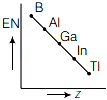
B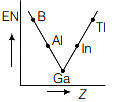
C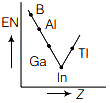
D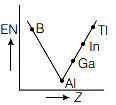
Solution
(D) For group $13$ elements,electronegativity $(EN)$ decreases from $B$ to $Al$ due to the increase in atomic size.
From $Al$ to $Tl$,the electronegativity increases gradually due to the poor shielding effect of $d$ and $f$ orbitals,which increases the effective nuclear charge.
The values of $EN$ (on the Pauling scale) are: $B (2.0)$,$Al (1.5)$,$Ga (1.6)$,$In (1.7)$,and $Tl (1.8)$.
Thus,the correct variation shows a decrease from $B$ to $Al$ followed by an increase from $Al$ to $Tl$.
From $Al$ to $Tl$,the electronegativity increases gradually due to the poor shielding effect of $d$ and $f$ orbitals,which increases the effective nuclear charge.
The values of $EN$ (on the Pauling scale) are: $B (2.0)$,$Al (1.5)$,$Ga (1.6)$,$In (1.7)$,and $Tl (1.8)$.
Thus,the correct variation shows a decrease from $B$ to $Al$ followed by an increase from $Al$ to $Tl$.
0 likes
View Solution118
MediumMCQ
Which one of the following represents the correct order of electronegativity?
A
$P > O > N$
B
$N > P > O$
C
$O > N > P$
D
$N > O > P$
Solution
(C) Electronegativity generally increases across a period from left to right and decreases down a group.
Comparing the elements $N$ (Nitrogen),$O$ (Oxygen),and $P$ (Phosphorus):
$1$. $N$ and $O$ are in the $2^{nd}$ period,while $P$ is in the $3^{rd}$ period.
$2$. In the $2^{nd}$ period,electronegativity increases as $N < O$.
$3$. $P$ is below $N$ in the same group ($15^{th}$ group),so $N > P$.
$4$. Combining these,the electronegativity values on the Pauling scale are approximately: $O (3.44) > N (3.04) > P (2.19)$.
Therefore,the correct order is $O > N > P$.
Comparing the elements $N$ (Nitrogen),$O$ (Oxygen),and $P$ (Phosphorus):
$1$. $N$ and $O$ are in the $2^{nd}$ period,while $P$ is in the $3^{rd}$ period.
$2$. In the $2^{nd}$ period,electronegativity increases as $N < O$.
$3$. $P$ is below $N$ in the same group ($15^{th}$ group),so $N > P$.
$4$. Combining these,the electronegativity values on the Pauling scale are approximately: $O (3.44) > N (3.04) > P (2.19)$.
Therefore,the correct order is $O > N > P$.
0 likes
View Solution119
EasyMCQ
Let electronegativity,ionisation energy and electron affinity be represented as $EN$,$IP$ and $EA$ respectively. Which one of the following equations is correct according to Mulliken?
A
$EN = IP \times EA$
B
$EN = \frac{IP}{EA}$
C
$EN = \frac{IP + EA}{2}$
D
$EN = IP - EA$
Solution
(C) According to the Mulliken scale,the electronegativity $(EN)$ of an element is defined as the arithmetic mean of its ionisation potential $(IP)$ and electron affinity $(EA)$.
Mathematically,this is expressed as: $EN = \frac{IP + EA}{2}$.
Mathematically,this is expressed as: $EN = \frac{IP + EA}{2}$.
0 likes
View Solution120
MediumMCQ
Among $Me_{3}N$,$C_{5}H_{5}N$ and $MeCN$ $(Me = \text{methyl group})$,the electronegativity of $N$ is in the order:
A
$MeCN > C_{5}H_{5}N > Me_{3}N$
B
$C_{5}H_{5}N > Me_{3}N > MeCN$
C
$Me_{3}N > MeCN > C_{5}H_{5}N$
D
Electronegativity is the same in all
Solution
(A) The electronegativity of an atom depends on the percentage of $s$-character in its hybrid orbitals. Higher $s$-character leads to higher electronegativity.
In $Me_{3}N$,the nitrogen atom is $sp^{3}$-hybridized ($25\% \ s$-character).
In $C_{5}H_{5}N$ (pyridine),the nitrogen atom is $sp^{2}$-hybridized ($33.3\% \ s$-character).
In $MeCN$ (acetonitrile),the nitrogen atom is $sp$-hybridized ($50\% \ s$-character).
Therefore,the order of electronegativity of the nitrogen atom is $MeCN > C_{5}H_{5}N > Me_{3}N$.
In $Me_{3}N$,the nitrogen atom is $sp^{3}$-hybridized ($25\% \ s$-character).
In $C_{5}H_{5}N$ (pyridine),the nitrogen atom is $sp^{2}$-hybridized ($33.3\% \ s$-character).
In $MeCN$ (acetonitrile),the nitrogen atom is $sp$-hybridized ($50\% \ s$-character).
Therefore,the order of electronegativity of the nitrogen atom is $MeCN > C_{5}H_{5}N > Me_{3}N$.
0 likes
View Solution121
MediumMCQ
Given below are two statements:
Statement $I$: The correct order of electronegativity of fluorine,oxygen and nitrogen is $F > O > N$.
Statement $II$: The oxidation state of oxygen in $OF_2$ is $+2$ and in $Na_2O$ is $-2$.
Statement $I$: The correct order of electronegativity of fluorine,oxygen and nitrogen is $F > O > N$.
Statement $II$: The oxidation state of oxygen in $OF_2$ is $+2$ and in $Na_2O$ is $-2$.
A
Both Statement $I$ and Statement $II$ are true
B
Both Statement $I$ and Statement $II$ are false
C
Statement $I$ is true but Statement $II$ is false
D
Statement $I$ is false but Statement $II$ is true
Solution
(A) $1$. Electronegativity trend: According to the Pauling scale,the electronegativity values are $F$ $(4.0)$,$O$ $(3.5)$,and $N$ $(3.0)$. Thus,the order $F > O > N$ is correct. Statement $I$ is true.
$2$. Oxidation states: In $OF_2$,fluorine is more electronegative than oxygen,so oxygen is $+2$. In $Na_2O$,sodium is $+1$,so oxygen is $-2$. Statement $II$ is true.
Therefore,both statements are true.
$2$. Oxidation states: In $OF_2$,fluorine is more electronegative than oxygen,so oxygen is $+2$. In $Na_2O$,sodium is $+1$,so oxygen is $-2$. Statement $II$ is true.
Therefore,both statements are true.
0 likes
View SolutionClassification of Elements and Periodicity in Properties — Electronegativity · Frequently Asked Questions
1Are these Classification of Elements and Periodicity in Properties questions useful for JEE and NEET?
Yes. All questions in this section are mapped to JEE Main and NEET exam patterns. Previous year questions from JEE Main, NEET, GUJCET and state-level exams are included with full solutions.
2Can I switch to Hindi or Gujarati for these questions?
Yes. Use the language tabs in the hero section or the sidebar to view the same questions and solutions in English, Hindi or Gujarati.
3How do I generate a question paper from this subtopic?
Use the Vedclass Exam Paper Generator — select the chapter and subtopic, set difficulty, and generate Sets A, B, C, D automatically. First 3 chapters of every subject are free.
Vedclass Products
For Students
Vedclass Test Series
Mock tests in real JEE/NEET style with performance analysis. 5-day free trial.
Start Free TrialFor Teachers
Exam Paper Generator
Generate Set A/B/C/D papers from this chapter in 2 minutes. 3 chapters free.
Try FreeFor Institutes
Online Exam Module
Live online exams with unlimited students, 360° analytics & white-label branding.
See DemoFor Teachers & Institutes
Generate a Classification of Elements and Periodicity in Properties Exam Paper in 2 Minutes
Select subtopic & difficulty — Sets A, B, C, D auto-generated with No Repeat logic.
First 3 chapters of every subject are free — no payment required.