
A English
VSEPR Theory Questions in English
Class 11 Chemistry · Chemical Bonding and Molecular Structure · VSEPR Theory
702+
Questions
English
Language
100%
With Solutions
Showing 50 of 702 questions in English
401
Difficult
Discuss the shape of the following molecules using the $VSEPR$ model: $BeCl_{2}, BCl_{3}, SiCl_{4}, AsF_{5}, H_{2}S, PH_{3}$
Solution
(N/A) The $VSEPR$ theory predicts the shapes based on the number of bonding and non-bonding electron pairs around the central atom:
$1$. $BeCl_{2}$: Central atom $Be$ has $2$ bonding pairs and $0$ lone pairs. Geometry: Linear $(180^{\circ})$.
$2$. $BCl_{3}$: Central atom $B$ has $3$ bonding pairs and $0$ lone pairs. Geometry: Trigonal planar $(120^{\circ})$.
$3$. $SiCl_{4}$: Central atom $Si$ has $4$ bonding pairs and $0$ lone pairs. Geometry: Tetrahedral $(109.5^{\circ})$.
$4$. $AsF_{5}$: Central atom $As$ has $5$ bonding pairs and $0$ lone pairs. Geometry: Trigonal bipyramidal $(90^{\circ}, 120^{\circ})$.
$5$. $H_{2}S$: Central atom $S$ has $2$ bonding pairs and $2$ lone pairs. Geometry: Bent (Angular).
$6$. $PH_{3}$: Central atom $P$ has $3$ bonding pairs and $1$ lone pair. Geometry: Trigonal pyramidal.
$1$. $BeCl_{2}$: Central atom $Be$ has $2$ bonding pairs and $0$ lone pairs. Geometry: Linear $(180^{\circ})$.
$2$. $BCl_{3}$: Central atom $B$ has $3$ bonding pairs and $0$ lone pairs. Geometry: Trigonal planar $(120^{\circ})$.
$3$. $SiCl_{4}$: Central atom $Si$ has $4$ bonding pairs and $0$ lone pairs. Geometry: Tetrahedral $(109.5^{\circ})$.
$4$. $AsF_{5}$: Central atom $As$ has $5$ bonding pairs and $0$ lone pairs. Geometry: Trigonal bipyramidal $(90^{\circ}, 120^{\circ})$.
$5$. $H_{2}S$: Central atom $S$ has $2$ bonding pairs and $2$ lone pairs. Geometry: Bent (Angular).
$6$. $PH_{3}$: Central atom $P$ has $3$ bonding pairs and $1$ lone pair. Geometry: Trigonal pyramidal.
0 likes
View Solution402
Difficult
Although the geometries of $NH_{3}$ and $H_{2}O$ molecules are based on a distorted tetrahedral arrangement,the bond angle in water is less than that of ammonia. Discuss.
Solution
(N/A) In $NH_{3}$,the central $N$ atom has one lone pair and three $N-H$ bonding pairs,making it an $AB_{3}E$ type molecule.
In $H_{2}O$,the central $O$ atom has two lone pairs and two $O-H$ bonding pairs,making it an $AB_{2}E_{2}$ type molecule.
According to the $VSEPR$ theory,the order of repulsion is: $lp-lp > lp-bp > bp-bp$.
$H_{2}O$ has two lone pairs on the oxygen atom,which exert strong $lp-lp$ repulsion,pushing the $O-H$ bonds closer together,resulting in a bond angle of $104.5^{\circ}$.
$NH_{3}$ has only one lone pair on the nitrogen atom,which exerts less repulsion compared to the two lone pairs in water,resulting in a bond angle of $107^{\circ}$.
In $H_{2}O$,the central $O$ atom has two lone pairs and two $O-H$ bonding pairs,making it an $AB_{2}E_{2}$ type molecule.
According to the $VSEPR$ theory,the order of repulsion is: $lp-lp > lp-bp > bp-bp$.
$H_{2}O$ has two lone pairs on the oxygen atom,which exert strong $lp-lp$ repulsion,pushing the $O-H$ bonds closer together,resulting in a bond angle of $104.5^{\circ}$.
$NH_{3}$ has only one lone pair on the nitrogen atom,which exerts less repulsion compared to the two lone pairs in water,resulting in a bond angle of $107^{\circ}$.
0 likes
View Solution403
Difficult
Explain: The geometry of $NH_3$ molecule is trigonal pyramidal.
Solution
(N/A) This geometry is explained by the $sp^3$ hybridization of $N$ in $NH_3$ and the $VSEPR$ theory.
In $NH_3$,the valence shell electronic configuration of Nitrogen is $2s^2 2p_x^1 2p_y^1 2p_z^1$. It undergoes $sp^3$ hybridization to form four $sp^3$ hybrid orbitals,three of which contain unpaired electrons and one contains a lone pair of electrons.
These three hybrid orbitals overlap with $1s$ orbitals of three hydrogen atoms to form three $N-H$ sigma bonds. One $sp^3$ orbital remains occupied by a non-bonding lone pair.
According to $VSEPR$ theory,the force of repulsion between a lone pair and a bond pair is greater than the force of repulsion between two bond pairs.
Due to this lone pair-bond pair repulsion,the molecule gets distorted from the ideal tetrahedral geometry,and the bond angle is reduced from $109.5^{\circ}$ to $107^{\circ}$. Thus,the geometry of the $NH_3$ molecule becomes trigonal pyramidal.
In $NH_3$,the valence shell electronic configuration of Nitrogen is $2s^2 2p_x^1 2p_y^1 2p_z^1$. It undergoes $sp^3$ hybridization to form four $sp^3$ hybrid orbitals,three of which contain unpaired electrons and one contains a lone pair of electrons.
These three hybrid orbitals overlap with $1s$ orbitals of three hydrogen atoms to form three $N-H$ sigma bonds. One $sp^3$ orbital remains occupied by a non-bonding lone pair.
According to $VSEPR$ theory,the force of repulsion between a lone pair and a bond pair is greater than the force of repulsion between two bond pairs.
Due to this lone pair-bond pair repulsion,the molecule gets distorted from the ideal tetrahedral geometry,and the bond angle is reduced from $109.5^{\circ}$ to $107^{\circ}$. Thus,the geometry of the $NH_3$ molecule becomes trigonal pyramidal.
0 likes
View Solution404
Difficult
Explain: The shape of $H_2O$ is $V$ (angular).
Solution
(N/A) The structure of the $H_2O$ molecule can be explained using $sp^3$ hybridization of oxygen and the $VSEPR$ theory.
In $H_2O$,the valence shell electronic configuration of oxygen in the ground state is $2s^2 2p_x^2 2p_y^1 2p_z^1$,having two paired electrons and two half-filled orbitals.
These four orbitals undergo $sp^3$ hybridization,resulting in two half-filled orbitals and two completely filled orbitals.
The two half-filled $sp^3$ orbitals overlap with the $1s$ orbital of $H$ to form two $O-H$ sigma bonds. The two fully filled $sp^3$ orbitals contain lone pairs.
According to the $VSEPR$ theory,the repulsion between lone pairs is greater than the repulsion between bond pairs. Due to this increased repulsion,the two $O-H$ bonds are pushed closer together,resulting in a bond angle of $104.5^{\circ}$. Thus,$H_2O$ adopts a $V$-shape (angular geometry).
In $H_2O$,the valence shell electronic configuration of oxygen in the ground state is $2s^2 2p_x^2 2p_y^1 2p_z^1$,having two paired electrons and two half-filled orbitals.
These four orbitals undergo $sp^3$ hybridization,resulting in two half-filled orbitals and two completely filled orbitals.
The two half-filled $sp^3$ orbitals overlap with the $1s$ orbital of $H$ to form two $O-H$ sigma bonds. The two fully filled $sp^3$ orbitals contain lone pairs.
According to the $VSEPR$ theory,the repulsion between lone pairs is greater than the repulsion between bond pairs. Due to this increased repulsion,the two $O-H$ bonds are pushed closer together,resulting in a bond angle of $104.5^{\circ}$. Thus,$H_2O$ adopts a $V$-shape (angular geometry).
0 likes
View Solution405
Easy
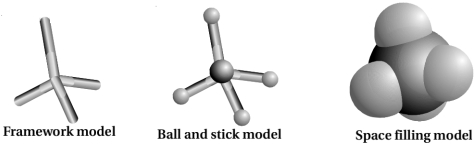
Draw the figure of framework model,ball and stick model and space filling model of methane $(CH_4)$.
Solution
(N/A) The three-dimensional representations of methane $(CH_4)$ are as follows:
$1$. Framework model: Represents the molecular skeleton using lines to show bonds.
$2$. Ball and stick model: Uses balls to represent atoms and sticks to represent bonds.
$3$. Space filling model: Emphasizes the actual size and shape of the molecule by showing the van der Waals radii of the atoms.
$1$. Framework model: Represents the molecular skeleton using lines to show bonds.
$2$. Ball and stick model: Uses balls to represent atoms and sticks to represent bonds.
$3$. Space filling model: Emphasizes the actual size and shape of the molecule by showing the van der Waals radii of the atoms.
0 likes
View Solution406
EasyMCQ
What is the shape of the ammonia $(NH_3)$ molecule?
A
Linear
B
Trigonal planar
C
Pyramidal
D
Tetrahedral
Solution
(C) In the ammonia $(NH_3)$ molecule,the central nitrogen atom is $sp^3$ hybridized.
It has three bond pairs and one lone pair of electrons.
According to $VSEPR$ theory,the presence of one lone pair causes a distortion in the geometry,resulting in a trigonal pyramidal shape with a bond angle of $107.8^{\circ}$.
It has three bond pairs and one lone pair of electrons.
According to $VSEPR$ theory,the presence of one lone pair causes a distortion in the geometry,resulting in a trigonal pyramidal shape with a bond angle of $107.8^{\circ}$.
0 likes
View Solution407
EasyMCQ
How many bonding and lone pairs of electrons are present in the structure of ammonia $(NH_3)$?
A
$3$ bonding pairs and $1$ lone pair
B
$2$ bonding pairs and $2$ lone pairs
C
$4$ bonding pairs and $0$ lone pairs
D
$1$ bonding pair and $3$ lone pairs
Solution
(A) The central atom in ammonia $(NH_3)$ is nitrogen $(N)$.
Nitrogen has $5$ valence electrons.
In $NH_3$,nitrogen forms $3$ covalent bonds with $3$ hydrogen atoms,which accounts for $3$ bonding pairs of electrons.
After forming these $3$ bonds,$2$ electrons remain on the nitrogen atom,which constitute $1$ lone pair of electrons.
Therefore,the structure of ammonia contains $3$ bonding pairs and $1$ lone pair.
Nitrogen has $5$ valence electrons.
In $NH_3$,nitrogen forms $3$ covalent bonds with $3$ hydrogen atoms,which accounts for $3$ bonding pairs of electrons.
After forming these $3$ bonds,$2$ electrons remain on the nitrogen atom,which constitute $1$ lone pair of electrons.
Therefore,the structure of ammonia contains $3$ bonding pairs and $1$ lone pair.
0 likes
View Solution408
MediumMCQ
Describe the difference in the structures of $PCl_5$ and $PCl_3$.
A
$PCl_5$ is trigonal bipyramidal,$PCl_3$ is pyramidal.
B
$PCl_5$ is square pyramidal,$PCl_3$ is trigonal planar.
C
$PCl_5$ is tetrahedral,$PCl_3$ is trigonal bipyramidal.
D
$PCl_5$ is octahedral,$PCl_3$ is tetrahedral.
Solution
(A) In $PCl_3$,the phosphorus atom is $sp^3$ hybridized,resulting in a pyramidal geometry with one lone pair of electrons on the phosphorus atom.
In $PCl_5$,the phosphorus atom is $sp^3d$ hybridized,resulting in a trigonal bipyramidal geometry where all five valence electrons of phosphorus are involved in bonding with chlorine atoms.
In $PCl_5$,the phosphorus atom is $sp^3d$ hybridized,resulting in a trigonal bipyramidal geometry where all five valence electrons of phosphorus are involved in bonding with chlorine atoms.
0 likes
View Solution409
EasyMCQ
What is the shape of the $SO_2$ molecule?
A
Linear
B
Bent ($V$-shaped)
C
Trigonal planar
D
Tetrahedral
Solution
(B) In the $SO_2$ molecule,the sulfur atom is $sp^2$ hybridized. It has two bond pairs and one lone pair of electrons on the sulfur atom. According to $VSEPR$ theory,the presence of one lone pair causes repulsion,resulting in a bent or $V$-shaped geometry with a bond angle of approximately $119.5^{\circ}$.
0 likes
View Solution410
Easy
Draw the structure of chlorous acid $(HClO_2)$.
Solution
(N/A) The chemical formula for chlorous acid is $HClO_2$.
In this molecule,the central chlorine atom is bonded to one hydroxyl group $(-OH)$ and one double-bonded oxygen atom $(=O)$.
The structure can be represented as $H-O-Cl=O$.
The chlorine atom has two lone pairs of electrons.
In this molecule,the central chlorine atom is bonded to one hydroxyl group $(-OH)$ and one double-bonded oxygen atom $(=O)$.
The structure can be represented as $H-O-Cl=O$.
The chlorine atom has two lone pairs of electrons.
0 likes
View Solution411
MediumMCQ
What are the shapes of $XeF_2$ and $XeF_4$?
A
$XeF_2$: Linear,$XeF_4$: Square planar
B
$XeF_2$: Bent,$XeF_4$: Tetrahedral
C
$XeF_2$: Linear,$XeF_4$: Tetrahedral
D
$XeF_2$: Trigonal bipyramidal,$XeF_4$: Square pyramidal
Solution
(A) For $XeF_2$: The central atom $Xe$ has $8$ valence electrons. It forms $2$ bonds with $F$ atoms and has $3$ lone pairs. According to $VSEPR$ theory,the steric number is $2 + 3 = 5$,which corresponds to $sp^3d$ hybridization. The geometry is trigonal bipyramidal,but due to the presence of $3$ lone pairs in the equatorial positions,the shape is $Linear$.
For $XeF_4$: The central atom $Xe$ has $8$ valence electrons. It forms $4$ bonds with $F$ atoms and has $2$ lone pairs. The steric number is $4 + 2 = 6$,which corresponds to $sp^3d^2$ hybridization. The geometry is octahedral,but due to the presence of $2$ lone pairs in the axial positions,the shape is $Square \ planar$.
For $XeF_4$: The central atom $Xe$ has $8$ valence electrons. It forms $4$ bonds with $F$ atoms and has $2$ lone pairs. The steric number is $4 + 2 = 6$,which corresponds to $sp^3d^2$ hybridization. The geometry is octahedral,but due to the presence of $2$ lone pairs in the axial positions,the shape is $Square \ planar$.
0 likes
View Solution412
MediumMCQ
Out of $H_2O$ and $H_2S$,which one has a higher bond angle and why?
A
$H_2O$ due to higher electronegativity of $O$.
B
$H_2S$ due to larger size of $S$.
C
$H_2O$ due to $sp^3$ hybridization and smaller size of $O$.
D
$H_2S$ due to $sp^3$ hybridization.
Solution
(A) In $H_2O$ and $H_2S$,the central atoms $O$ and $S$ are $sp^3$ hybridized.
Moving down the group,the atomic size of the central atom increases and its electronegativity decreases.
As the electronegativity of the central atom decreases,the bond pair electrons move further away from the central atom.
This results in a decrease in the bond pair-bond pair repulsion,leading to a smaller bond angle in $H_2S$ $(92^\circ)$ compared to $H_2O$ $(104.5^\circ)$.
Therefore,$H_2O$ has a higher bond angle.
Moving down the group,the atomic size of the central atom increases and its electronegativity decreases.
As the electronegativity of the central atom decreases,the bond pair electrons move further away from the central atom.
This results in a decrease in the bond pair-bond pair repulsion,leading to a smaller bond angle in $H_2S$ $(92^\circ)$ compared to $H_2O$ $(104.5^\circ)$.
Therefore,$H_2O$ has a higher bond angle.
0 likes
View Solution413
Medium
Explain the non-linear shape of $H_2S$ and the non-planar shape of $PCl_3$ using the Valence Shell Electron Pair Repulsion $(VSEPR)$ theory.
Solution
(N/A) For $H_2S$: The central atom is $S$. It has $6$ electrons in its valence shell $(_{16}S = 2, 8, 6)$.
Two electrons are shared with two $H$-atoms,and the remaining four electrons form two lone pairs.
There are a total of four electron pairs ($2$ bonding pairs and $2$ lone pairs) around the central atom.
Due to the presence of $2$ lone pairs,the electron geometry is tetrahedral,but the molecular shape is distorted,angular,or bent (non-linear).
For $PCl_3$: The central atom is $P$. It has $5$ electrons in its valence shell $(_{15}P = 2, 8, 5)$.
Three electrons are shared with three $Cl$-atoms,and the remaining two electrons form one lone pair.
There are a total of four electron pairs ($3$ bonding pairs and $1$ lone pair) around the central atom.
Due to the presence of one lone pair,the molecular shape is pyramidal (non-planar).
Two electrons are shared with two $H$-atoms,and the remaining four electrons form two lone pairs.
There are a total of four electron pairs ($2$ bonding pairs and $2$ lone pairs) around the central atom.
Due to the presence of $2$ lone pairs,the electron geometry is tetrahedral,but the molecular shape is distorted,angular,or bent (non-linear).
For $PCl_3$: The central atom is $P$. It has $5$ electrons in its valence shell $(_{15}P = 2, 8, 5)$.
Three electrons are shared with three $Cl$-atoms,and the remaining two electrons form one lone pair.
There are a total of four electron pairs ($3$ bonding pairs and $1$ lone pair) around the central atom.
Due to the presence of one lone pair,the molecular shape is pyramidal (non-planar).
0 likes
View Solution414
Medium
Explain the shape of $BrF_{5}$.
Solution
(N/A) The central atom $Br$ has $7$ electrons in the valence shell.
$5$ of these electrons form bonds with $5$ fluorine atoms,and the remaining $2$ electrons exist as $1$ lone pair.
Thus,the total number of electron pairs is $6$ ($5$ bond pairs and $1$ lone pair).
According to the $VSEPR$ theory,to minimize the repulsion between the lone pair and the bond pairs,the molecule adopts a square pyramidal geometry.
$5$ of these electrons form bonds with $5$ fluorine atoms,and the remaining $2$ electrons exist as $1$ lone pair.
Thus,the total number of electron pairs is $6$ ($5$ bond pairs and $1$ lone pair).
According to the $VSEPR$ theory,to minimize the repulsion between the lone pair and the bond pairs,the molecule adopts a square pyramidal geometry.
0 likes
View Solution415
Medium
Explain why $PCl_5$ is trigonal bipyramidal whereas $IF_5$ is square pyramidal.
Solution
(N/A) $PCl_5$: Phosphorus $(Z=15)$ has the ground state electronic configuration $[Ne] 3s^2 3p^3$. In the excited state,one $3s$ electron is promoted to the $3d$ orbital,resulting in five unpaired electrons. Phosphorus undergoes $sp^3d$ hybridisation,leading to a trigonal bipyramidal geometry.
$IF_5$: Iodine $(Z=53)$ has the ground state valence shell configuration $5s^2 5p^5$. In the excited state,two electrons from the $5p$ orbitals are promoted to the $5d$ orbitals,creating five unpaired electrons for bonding and one lone pair. Iodine undergoes $sp^3d^2$ hybridisation. Due to the presence of one lone pair and five bond pairs,the geometry is square pyramidal.
$IF_5$: Iodine $(Z=53)$ has the ground state valence shell configuration $5s^2 5p^5$. In the excited state,two electrons from the $5p$ orbitals are promoted to the $5d$ orbitals,creating five unpaired electrons for bonding and one lone pair. Iodine undergoes $sp^3d^2$ hybridisation. Due to the presence of one lone pair and five bond pairs,the geometry is square pyramidal.
0 likes
View Solution416
Medium
In both water $(H_{2}O)$ and dimethyl ether $((CH_{3})_{2}O)$,the oxygen atom is the central atom and has the same hybridization,yet they have different bond angles. Which one has a greater bond angle? Give a reason.
Solution
(N/A) Dimethyl ether has a greater bond angle than water. In both molecules,the central oxygen atom is $sp^{3}$ hybridized with two lone pairs.
In dimethyl ether,the bond angle is greater $(111.7^{\circ})$ compared to water $(104.5^{\circ})$ due to the greater repulsive interaction between the two bulky methyl $(-CH_{3})$ groups than that between the two small $H$-atoms.
The $C$ atom of the $-CH_{3}$ group is attached to three $H$-atoms through $\sigma$-bonds,and the electron density of the $C-H$ bond pairs increases the steric repulsion,pushing the $C-O-C$ bond angle wider.
In dimethyl ether,the bond angle is greater $(111.7^{\circ})$ compared to water $(104.5^{\circ})$ due to the greater repulsive interaction between the two bulky methyl $(-CH_{3})$ groups than that between the two small $H$-atoms.
The $C$ atom of the $-CH_{3}$ group is attached to three $H$-atoms through $\sigma$-bonds,and the electron density of the $C-H$ bond pairs increases the steric repulsion,pushing the $C-O-C$ bond angle wider.
0 likes
View Solution417
Medium
Group the following as linear and non-linear molecules: $H_2O$,$HOCl$,$BeCl_2$,$Cl_2O$.
Solution
(N/A) The structures of the given molecules are:
$1$. $H_2O$: Bent (non-linear) due to two lone pairs on the oxygen atom.
$2$. $HOCl$: Bent (non-linear) due to two lone pairs on the oxygen atom.
$3$. $BeCl_2$: Linear due to the absence of lone pairs on the central $Be$ atom.
$4$. $Cl_2O$: Bent (non-linear) due to two lone pairs on the oxygen atom.
Therefore,only $BeCl_2$ is linear and the rest of the molecules ($H_2O$,$HOCl$,$Cl_2O$) are non-linear.
$1$. $H_2O$: Bent (non-linear) due to two lone pairs on the oxygen atom.
$2$. $HOCl$: Bent (non-linear) due to two lone pairs on the oxygen atom.
$3$. $BeCl_2$: Linear due to the absence of lone pairs on the central $Be$ atom.
$4$. $Cl_2O$: Bent (non-linear) due to two lone pairs on the oxygen atom.
Therefore,only $BeCl_2$ is linear and the rest of the molecules ($H_2O$,$HOCl$,$Cl_2O$) are non-linear.
0 likes
View Solution418
Medium
Provide the structure of the $SO_{2}$ molecule and calculate the formal charge on each atom.
Solution
(N/A) The $SO_{2}$ molecule has a bent structure with $sp^{2}$ hybridization at the sulfur atom.
$1$. The Lewis structure involves a double bond between $S$ and one $O$ atom,and a single bond between $S$ and the other $O$ atom,with a lone pair on the $S$ atom.
$2$. Formal charge formula: $FC = V - L - \frac{1}{2}B$,where $V$ is valence electrons,$L$ is lone pair electrons,and $B$ is bonding electrons.
$3$. For the central $S$ atom: $V=6, L=2, B=6$. $FC = 6 - 2 - \frac{1}{2}(6) = +1$.
$4$. For the double-bonded $O$ atom: $V=6, L=4, B=4$. $FC = 6 - 4 - \frac{1}{2}(4) = 0$.
$5$. For the single-bonded $O$ atom: $V=6, L=6, B=2$. $FC = 6 - 6 - \frac{1}{2}(2) = -1$.
$1$. The Lewis structure involves a double bond between $S$ and one $O$ atom,and a single bond between $S$ and the other $O$ atom,with a lone pair on the $S$ atom.
$2$. Formal charge formula: $FC = V - L - \frac{1}{2}B$,where $V$ is valence electrons,$L$ is lone pair electrons,and $B$ is bonding electrons.
$3$. For the central $S$ atom: $V=6, L=2, B=6$. $FC = 6 - 2 - \frac{1}{2}(6) = +1$.
$4$. For the double-bonded $O$ atom: $V=6, L=4, B=4$. $FC = 6 - 4 - \frac{1}{2}(4) = 0$.
$5$. For the single-bonded $O$ atom: $V=6, L=6, B=2$. $FC = 6 - 6 - \frac{1}{2}(2) = -1$.
0 likes
View Solution419
Medium
Calculate the formal charge on each atom in the linear structure of $N_2O$ shown in the figure.

Solution
(N/A) The formula for formal charge $(FC)$ is: $FC = \text{Total valence electrons} - \text{Total non-bonding electrons} - \frac{1}{2} \times \text{Total bonding electrons}$.
For the structure $:N=N=O:$,the atoms are labeled as $N_1$ (terminal),$N_2$ (central),and $O$ (terminal).
$1$. For $N_1$ (terminal nitrogen): Valence electrons = $5$,non-bonding electrons = $4$,bonding electrons = $4$. $FC = 5 - 4 - (4/2) = 5 - 4 - 2 = -1$.
$2$. For $N_2$ (central nitrogen): Valence electrons = $5$,non-bonding electrons = $0$,bonding electrons = $8$. $FC = 5 - 0 - (8/2) = 5 - 4 = +1$.
$3$. For $O$ (terminal oxygen): Valence electrons = $6$,non-bonding electrons = $4$,bonding electrons = $4$. $FC = 6 - 4 - (4/2) = 6 - 4 - 2 = 0$.
Thus,the formal charges are $N_1 = -1$,$N_2 = +1$,and $O = 0$.
For the structure $:N=N=O:$,the atoms are labeled as $N_1$ (terminal),$N_2$ (central),and $O$ (terminal).
$1$. For $N_1$ (terminal nitrogen): Valence electrons = $5$,non-bonding electrons = $4$,bonding electrons = $4$. $FC = 5 - 4 - (4/2) = 5 - 4 - 2 = -1$.
$2$. For $N_2$ (central nitrogen): Valence electrons = $5$,non-bonding electrons = $0$,bonding electrons = $8$. $FC = 5 - 0 - (8/2) = 5 - 4 = +1$.
$3$. For $O$ (terminal oxygen): Valence electrons = $6$,non-bonding electrons = $4$,bonding electrons = $4$. $FC = 6 - 4 - (4/2) = 6 - 4 - 2 = 0$.
Thus,the formal charges are $N_1 = -1$,$N_2 = +1$,and $O = 0$.
0 likes
View Solution420
Easy
What is the difference between $NO_2$ and $NO_2^-$? Explain.
Solution
(N/A) The total number of valence electrons in $NO_2$ is $5 + (2 \times 6) = 17$.
The total number of valence electrons in $NO_2^-$ is $5 + (2 \times 6) + 1 = 18$.
Since $NO_2$ has an odd number of electrons $(17)$,it violates the octet rule (it is a free radical),whereas $NO_2^-$ has an even number of electrons $(18)$ and follows the octet rule for the central nitrogen atom.
The total number of valence electrons in $NO_2^-$ is $5 + (2 \times 6) + 1 = 18$.
Since $NO_2$ has an odd number of electrons $(17)$,it violates the octet rule (it is a free radical),whereas $NO_2^-$ has an even number of electrons $(18)$ and follows the octet rule for the central nitrogen atom.
0 likes
View Solution421
EasyMCQ
Which of the following triatomic molecules are linear? How is this determined?
$H_2O, F_2O, BeH_2, BeCl_2, H_2S, CO_2$
$H_2O, F_2O, BeH_2, BeCl_2, H_2S, CO_2$
A
$H_2O, F_2O$
B
$BeH_2, BeCl_2, CO_2$
C
$H_2S, CO_2$
D
$BeH_2, H_2O, CO_2$
Solution
(B) The molecules $BeH_2$,$BeCl_2$,and $CO_2$ are linear.
This is determined by their dipole moment,which is experimentally found to be zero.
$A$ zero dipole moment indicates a symmetric,linear geometry for these triatomic molecules.
This is determined by their dipole moment,which is experimentally found to be zero.
$A$ zero dipole moment indicates a symmetric,linear geometry for these triatomic molecules.
0 likes
View Solution422
MediumMCQ
The dipole moment $\mu$ of $CH_4$ and $CCl_4$ is $0$. Predict their shapes. Provide the correct shape with reasons.
A
Linear
B
Square planar
C
Tetrahedral
D
Trigonal bipyramidal
Solution
(C) Both $CH_4$ and $CCl_4$ have a dipole moment $\mu = 0$,which indicates that they are non-polar molecules.
In these molecules,the central atom $(C)$ is $sp^3$ hybridized.
The four bonds are arranged symmetrically in space to minimize electron-pair repulsion.
This arrangement results in a tetrahedral geometry with a bond angle of $109^{\circ} 28^{\prime}$.
Because of this high symmetry,the individual bond dipoles cancel each other out,resulting in a net dipole moment of zero.
In these molecules,the central atom $(C)$ is $sp^3$ hybridized.
The four bonds are arranged symmetrically in space to minimize electron-pair repulsion.
This arrangement results in a tetrahedral geometry with a bond angle of $109^{\circ} 28^{\prime}$.
Because of this high symmetry,the individual bond dipoles cancel each other out,resulting in a net dipole moment of zero.
0 likes
View Solution423
EasyMCQ
Who gave the principle of $VSEPR$?
A
Sidgwick and Powell
B
Gillespie and Nyholm
C
Lewis and Langmuir
D
Pauling and Slater
Solution
(A) The $VSEPR$ (Valence Shell Electron Pair Repulsion) theory was originally proposed by $Sidgwick$ and $Powell$ in $1940$. Later,it was further developed and refined by $Gillespie$ and $Nyholm$ in $1957$ to predict the shapes of molecules.
0 likes
View Solution424
EasyMCQ
What is the meaning of $VSEPR$?
A
$Valence$ $Shell$ $Electron$ $Pair$ $Repulsion$
B
$Valence$ $Shell$ $Electron$ $Pair$ $Resonance$
C
$Valence$ $Shell$ $Energy$ $Pair$ $Repulsion$
D
$Valence$ $Subshell$ $Electron$ $Pair$ $Repulsion$
Solution
(A) The $VSEPR$ theory stands for $Valence$ $Shell$ $Electron$ $Pair$ $Repulsion$ theory.
It is a model used in chemistry to predict the geometry of individual molecules from the number of electron pairs surrounding their central atoms.
It is a model used in chemistry to predict the geometry of individual molecules from the number of electron pairs surrounding their central atoms.
0 likes
View Solution425
EasyMCQ
What is the type of molecule for $SF_4$ among $AB_4$,$AB_4E$,and $AB_3E_2$?
A
$AB_4$
B
$AB_4E$
C
$AB_3E_2$
D
None of these
Solution
(B) The central atom $S$ has $6$ valence electrons.
In $SF_4$,$S$ forms $4$ bonds with $F$ atoms,utilizing $4$ valence electrons.
This leaves $2$ electrons,which form $1$ lone pair $(E)$.
Therefore,the molecule is of the type $AB_4E$.
In $SF_4$,$S$ forms $4$ bonds with $F$ atoms,utilizing $4$ valence electrons.
This leaves $2$ electrons,which form $1$ lone pair $(E)$.
Therefore,the molecule is of the type $AB_4E$.
0 likes
View Solution426
EasyMCQ
To which type does $ClF_3$ belong among $AB_4$,$AB_4E$,and $AB_3E_2$? Explain.
A
$AB_4$
B
$AB_4E$
C
$AB_3E_2$
D
None of these
Solution
(C) $1$. The central atom in $ClF_3$ is Chlorine $(Cl)$.
$2$. The valence shell configuration of $Cl$ is $ns^2 np^5$,having $7$ valence electrons.
$3$. In $ClF_3$,$Cl$ forms $3$ single bonds with $3$ Fluorine $(F)$ atoms,utilizing $3$ valence electrons.
$4$. The remaining $4$ electrons form $2$ lone pairs $(E_2)$.
$5$. Thus,the molecule follows the $AB_3E_2$ type,where $A$ is the central atom,$B$ is the bonded atom,and $E$ represents the lone pair.
$6$. The geometry is $T$-shaped due to the presence of $2$ lone pairs.
$2$. The valence shell configuration of $Cl$ is $ns^2 np^5$,having $7$ valence electrons.
$3$. In $ClF_3$,$Cl$ forms $3$ single bonds with $3$ Fluorine $(F)$ atoms,utilizing $3$ valence electrons.
$4$. The remaining $4$ electrons form $2$ lone pairs $(E_2)$.
$5$. Thus,the molecule follows the $AB_3E_2$ type,where $A$ is the central atom,$B$ is the bonded atom,and $E$ represents the lone pair.
$6$. The geometry is $T$-shaped due to the presence of $2$ lone pairs.
0 likes
View Solution427
Medium
What are the structures and shapes of $SF_4$ and $ClF_3$?
Solution
(N/A) For $SF_4$: The central atom $S$ has $5$ electron pairs ($4$ bond pairs and $1$ lone pair),resulting in a trigonal bipyramidal electron geometry and a see-saw molecular shape.
For $ClF_3$: The central atom $Cl$ has $5$ electron pairs ($3$ bond pairs and $2$ lone pairs),resulting in a trigonal bipyramidal electron geometry and a $T$-shaped molecular geometry.
For $ClF_3$: The central atom $Cl$ has $5$ electron pairs ($3$ bond pairs and $2$ lone pairs),resulting in a trigonal bipyramidal electron geometry and a $T$-shaped molecular geometry.
0 likes
View Solution428
Easy
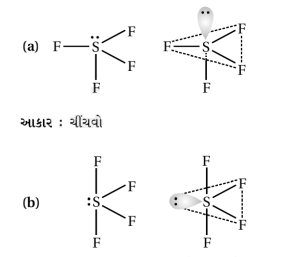
Provide the different spatial arrangements of $SF_4$ including its electron pairs.
Solution
(N/A) The central sulfur atom in $SF_4$ has $5$ electron pairs ($4$ bond pairs and $1$ lone pair),resulting in a trigonal bipyramidal electron geometry.
According to $VSEPR$ theory,the lone pair occupies the equatorial position to minimize repulsion.
The resulting molecular shape is known as a seesaw shape.
According to $VSEPR$ theory,the lone pair occupies the equatorial position to minimize repulsion.
The resulting molecular shape is known as a seesaw shape.
0 likes
View Solution429
MediumMCQ
What is the correct order of electron pair repulsion strength in a covalent molecule according to $VSEPR$ theory?
A
$lone \ pair - lone \ pair > lone \ pair - bond \ pair > bond \ pair - bond \ pair$
B
$bond \ pair - bond \ pair > lone \ pair - bond \ pair > lone \ pair - lone \ pair$
C
$lone \ pair - lone \ pair > bond \ pair - bond \ pair > lone \ pair - bond \ pair$
D
$lone \ pair - bond \ pair > lone \ pair - lone \ pair > bond \ pair - bond \ pair$
Solution
(A) According to the $VSEPR$ theory,the repulsion between electron pairs follows the order:
$lone \ pair - lone \ pair (lp-lp) > lone \ pair - bond \ pair (lp-bp) > bond \ pair - bond \ pair (bp-bp)$.
This is because a lone pair is under the influence of only one nucleus,whereas a bond pair is shared between two nuclei.
Therefore,lone pairs occupy more space and exert greater repulsion.
$lone \ pair - lone \ pair (lp-lp) > lone \ pair - bond \ pair (lp-bp) > bond \ pair - bond \ pair (bp-bp)$.
This is because a lone pair is under the influence of only one nucleus,whereas a bond pair is shared between two nuclei.
Therefore,lone pairs occupy more space and exert greater repulsion.
0 likes
View Solution430
Medium
Provide the different spatial arrangements of $ClF_3$ including its lone pairs.
Solution
(A) The central atom $Cl$ in $ClF_3$ has $7$ valence electrons. It forms $3$ single bonds with $F$ atoms and has $2$ lone pairs,resulting in a total of $5$ electron pairs ($sp^3d$ hybridization). According to $VSEPR$ theory,the lone pairs occupy equatorial positions to minimize repulsion,leading to a $T$-shaped molecular geometry as shown in arrangement $(a)$.
0 likes
View Solution431
Medium
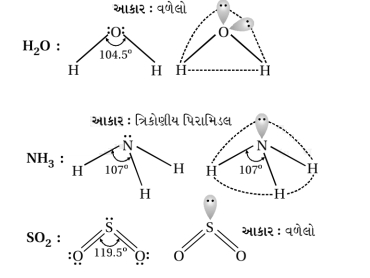
Provide the shapes of $H_2O$,$NH_3$,and $SO_2$ including their lone pairs of electrons.
Solution
(N/A) The shapes of the molecules are determined by the $VSEPR$ theory,considering both bonding and lone pairs of electrons:
$1$. $H_2O$: The central oxygen atom has $2$ bond pairs and $2$ lone pairs. The geometry is tetrahedral,but the shape is bent (or $V$-shaped) with a bond angle of $104.5^{\circ}$.
$2$. $NH_3$: The central nitrogen atom has $3$ bond pairs and $1$ lone pair. The geometry is tetrahedral,but the shape is trigonal pyramidal with a bond angle of $107^{\circ}$.
$3$. $SO_2$: The central sulfur atom has $2$ bond pairs (double bonds) and $1$ lone pair. The shape is bent (or $V$-shaped) with a bond angle of $119.5^{\circ}$.
$1$. $H_2O$: The central oxygen atom has $2$ bond pairs and $2$ lone pairs. The geometry is tetrahedral,but the shape is bent (or $V$-shaped) with a bond angle of $104.5^{\circ}$.
$2$. $NH_3$: The central nitrogen atom has $3$ bond pairs and $1$ lone pair. The geometry is tetrahedral,but the shape is trigonal pyramidal with a bond angle of $107^{\circ}$.
$3$. $SO_2$: The central sulfur atom has $2$ bond pairs (double bonds) and $1$ lone pair. The shape is bent (or $V$-shaped) with a bond angle of $119.5^{\circ}$.
0 likes
View Solution432
Medium
What information does the $VSEPR$ theory provide about chemically bonded molecules,and what are its limitations?
Solution
(N/A) The $VSEPR$ theory provides information about the geometry of simple molecules based on the repulsion between electron pairs in the valence shell.
Its main limitation is that it does not explain the geometry of complex molecules or the nature of bonding in transition metal complexes.
Its main limitation is that it does not explain the geometry of complex molecules or the nature of bonding in transition metal complexes.
0 likes
View Solution433
MediumMCQ
Which has a larger bond angle between $PH_3$ and $PH_4^+$? Why?
A
$PH_3$
B
$PH_4^+$
C
Both are equal
D
Cannot be determined
Solution
(B) The bond angle in $PH_4^+$ is larger than in $PH_3$.
In $PH_4^+$,the phosphorus atom is $sp^3$ hybridized with a tetrahedral geometry,resulting in a bond angle of approximately $109.5^{\circ}$.
In $PH_3$,the phosphorus atom is also $sp^3$ hybridized,but it contains one lone pair of electrons. According to $VSEPR$ theory,the lone pair-bond pair repulsion is greater than bond pair-bond pair repulsion,which compresses the bond angle to approximately $93.6^{\circ}$.
In $PH_4^+$,the phosphorus atom is $sp^3$ hybridized with a tetrahedral geometry,resulting in a bond angle of approximately $109.5^{\circ}$.
In $PH_3$,the phosphorus atom is also $sp^3$ hybridized,but it contains one lone pair of electrons. According to $VSEPR$ theory,the lone pair-bond pair repulsion is greater than bond pair-bond pair repulsion,which compresses the bond angle to approximately $93.6^{\circ}$.
0 likes
View Solution434
MediumMCQ
Match the following List-$A$ and List-$B$ correctly.
| List-$A$ | List-$B$ |
| $(1)$ $AB_3E_2$ | $(A)$ $BrF_5$ |
| $(2)$ $AB_2E_2$ | $(B)$ $NH_3$ |
| $(3)$ $AB_5E$ | $(C)$ $H_2O$ |
| $(4)$ $AB_3E$ | $(D)$ $ClF_3$ |
A
$(1-C), (2-D), (3-A), (4-B)$
B
$(1-D), (2-C), (3-A), (4-B)$
C
$(1-C), (2-D), (3-B), (4-A)$
D
$(1-D), (2-C), (3-B), (4-A)$
Solution
(B) The $VSEPR$ theory classifies molecules based on the number of bonding pairs $(B)$ and lone pairs $(E)$ around the central atom $(A)$:
$(1)$ $AB_3E_2$: This corresponds to a $T$-shaped geometry,e.g.,$ClF_3$. However,based on the provided options,$AB_3E_2$ is often associated with $ClF_3$. Let's re-evaluate the mapping:
$(1)$ $AB_3E_2$ corresponds to $ClF_3$ (if $E$ represents lone pairs,$ClF_3$ has $3$ bond pairs and $2$ lone pairs).
$(2)$ $AB_2E_2$ corresponds to $H_2O$ ($2$ bond pairs,$2$ lone pairs).
$(3)$ $AB_5E$ corresponds to $BrF_5$ ($5$ bond pairs,$1$ lone pair).
$(4)$ $AB_3E$ corresponds to $NH_3$ ($3$ bond pairs,$1$ lone pair).
Thus,the correct matching is $(1-D), (2-C), (3-A), (4-B)$.
$(1)$ $AB_3E_2$: This corresponds to a $T$-shaped geometry,e.g.,$ClF_3$. However,based on the provided options,$AB_3E_2$ is often associated with $ClF_3$. Let's re-evaluate the mapping:
$(1)$ $AB_3E_2$ corresponds to $ClF_3$ (if $E$ represents lone pairs,$ClF_3$ has $3$ bond pairs and $2$ lone pairs).
$(2)$ $AB_2E_2$ corresponds to $H_2O$ ($2$ bond pairs,$2$ lone pairs).
$(3)$ $AB_5E$ corresponds to $BrF_5$ ($5$ bond pairs,$1$ lone pair).
$(4)$ $AB_3E$ corresponds to $NH_3$ ($3$ bond pairs,$1$ lone pair).
Thus,the correct matching is $(1-D), (2-C), (3-A), (4-B)$.
0 likes
View Solution435
Medium
Match the molecular shapes given in List-$I$ with the examples given in List-$II$.
| List-$I$ (Shape) | List-$II$ (Example) |
| $(1)$ Linear $(B-A-B)$ | $(A)$ $PCl_5$ |
| $(2)$ Trigonal planar | $(B)$ $CH_4$ |
| $(3)$ Tetrahedral | $(C)$ $HgCl_2$ |
| $(4)$ Trigonal bipyramidal | $(D)$ $BF_3$ |
Solution
(C) The molecular shapes correspond to the following geometries:
$(1)$ Linear $(B-A-B)$: $HgCl_2$ (sp hybridization).
$(2)$ Trigonal planar: $BF_3$ ($sp^2$ hybridization).
$(3)$ Tetrahedral: $CH_4$ ($sp^3$ hybridization).
$(4)$ Trigonal bipyramidal: $PCl_5$ ($sp^3d$ hybridization).
Therefore,the correct matching is $(1-C, 2-D, 3-B, 4-A)$.
$(1)$ Linear $(B-A-B)$: $HgCl_2$ (sp hybridization).
$(2)$ Trigonal planar: $BF_3$ ($sp^2$ hybridization).
$(3)$ Tetrahedral: $CH_4$ ($sp^3$ hybridization).
$(4)$ Trigonal bipyramidal: $PCl_5$ ($sp^3d$ hybridization).
Therefore,the correct matching is $(1-C, 2-D, 3-B, 4-A)$.
0 likes
View Solution436
MediumMCQ
Match the species given in List-$I$ with their correct geometric shapes given in List-$II$.
| List-$I$ | List-$II$ |
| $(1)$ ${H_3O^+}$ | $(A)$ Linear |
| $(2)$ ${HC \equiv CH}$ | $(B)$ Angular |
| $(3)$ ${ClO_2^-}$ | $(C)$ Tetrahedral |
| $(4)$ ${NH_4^+}$ | $(D)$ Trigonal bipyramidal |
| $(E)$ Pyramidal |
A
$1-E, 2-A, 3-B, 4-C$
B
$1-B, 2-A, 3-E, 4-C$
C
$1-E, 2-A, 3-C, 4-B$
D
$1-A, 2-E, 3-B, 4-C$
Solution
(A) The correct matching is: $1-E, 2-A, 3-B, 4-C$.
$1$. ${H_3O^+}$: It has $3$ bond pairs and $1$ lone pair,resulting in a Pyramidal shape $(E)$.
$2$. ${HC \equiv CH}$: It has $sp$ hybridization,resulting in a Linear shape $(A)$.
$3$. ${ClO_2^-}$: It has $2$ bond pairs and $2$ lone pairs,resulting in an Angular (bent) shape $(B)$.
$4$. ${NH_4^+}$: It has $4$ bond pairs and $0$ lone pairs,resulting in a Tetrahedral shape $(C)$.
$1$. ${H_3O^+}$: It has $3$ bond pairs and $1$ lone pair,resulting in a Pyramidal shape $(E)$.
$2$. ${HC \equiv CH}$: It has $sp$ hybridization,resulting in a Linear shape $(A)$.
$3$. ${ClO_2^-}$: It has $2$ bond pairs and $2$ lone pairs,resulting in an Angular (bent) shape $(B)$.
$4$. ${NH_4^+}$: It has $4$ bond pairs and $0$ lone pairs,resulting in a Tetrahedral shape $(C)$.
0 likes
View Solution437
Easy
How will you account for the $104.5^{\circ}$ bond angle in water?
Solution
(N/A) In water $(H_2O)$,the oxygen atom undergoes $sp^3$ hybridization,which theoretically predicts a tetrahedral geometry with a bond angle of $109^{\circ} 28^{\prime}$.
However,the oxygen atom in water is bonded to two hydrogen atoms and also possesses two lone pairs of electrons.
According to the $VSEPR$ theory,the repulsion between lone pair-lone pair $(lp-lp)$ is stronger than the repulsion between lone pair-bond pair $(lp-bp)$,which in turn is stronger than bond pair-bond pair $(bp-bp)$ repulsion.
Due to the strong repulsion exerted by the two lone pairs on the two $O-H$ bond pairs,the bond angle is compressed from the ideal tetrahedral angle of $109^{\circ} 28^{\prime}$ to $104.5^{\circ}$.
However,the oxygen atom in water is bonded to two hydrogen atoms and also possesses two lone pairs of electrons.
According to the $VSEPR$ theory,the repulsion between lone pair-lone pair $(lp-lp)$ is stronger than the repulsion between lone pair-bond pair $(lp-bp)$,which in turn is stronger than bond pair-bond pair $(bp-bp)$ repulsion.
Due to the strong repulsion exerted by the two lone pairs on the two $O-H$ bond pairs,the bond angle is compressed from the ideal tetrahedral angle of $109^{\circ} 28^{\prime}$ to $104.5^{\circ}$.

0 likes
View Solution438
MediumMCQ
The molecular geometry of $SF_6$ is octahedral. What is the geometry of $SF_4$ (including lone pair$(s)$ of electrons,if any)?
A
Trigonal bipyramidal
B
Square planar
C
Tetrahedral
D
Pyramidal
Solution
(A) For $SF_4$,the central sulfur atom has $6$ valence electrons.
It forms $4$ $\sigma$ bonds with fluorine atoms and has $1$ lone pair of electrons.
Total electron pairs = $4 + 1 = 5$.
According to $VSEPR$ theory,a steric number of $5$ corresponds to a trigonal bipyramidal electron geometry.
It forms $4$ $\sigma$ bonds with fluorine atoms and has $1$ lone pair of electrons.
Total electron pairs = $4 + 1 = 5$.
According to $VSEPR$ theory,a steric number of $5$ corresponds to a trigonal bipyramidal electron geometry.
0 likes
View Solution439
MediumMCQ
If $AB_{4}$ molecule is a polar molecule,a possible geometry of $AB_{4}$ is :
A
Square pyramidal
B
Tetrahedral
C
Square planar
D
Rectangular planar
Solution
(A) molecule is polar if its net dipole moment is non-zero.
$(1)$ Square pyramidal geometry: This geometry typically involves $5$ electron pairs ($4$ bond pairs and $1$ lone pair). The presence of a lone pair on the central atom $A$ creates an asymmetric charge distribution,resulting in a non-zero net dipole moment. Thus,it is polar.
$(2)$ Tetrahedral geometry: This is a highly symmetric structure with no lone pairs on the central atom. The bond dipoles cancel each other out,making the molecule non-polar.
$(3)$ Square planar geometry: This is a symmetric structure where the bond dipoles cancel each other out,making the molecule non-polar.
$(4)$ Rectangular planar geometry: Similar to square planar,the symmetry in this arrangement leads to the cancellation of bond dipoles,making the molecule non-polar.
Therefore,the only polar geometry among the given options is square pyramidal.
$(1)$ Square pyramidal geometry: This geometry typically involves $5$ electron pairs ($4$ bond pairs and $1$ lone pair). The presence of a lone pair on the central atom $A$ creates an asymmetric charge distribution,resulting in a non-zero net dipole moment. Thus,it is polar.
$(2)$ Tetrahedral geometry: This is a highly symmetric structure with no lone pairs on the central atom. The bond dipoles cancel each other out,making the molecule non-polar.
$(3)$ Square planar geometry: This is a symmetric structure where the bond dipoles cancel each other out,making the molecule non-polar.
$(4)$ Rectangular planar geometry: Similar to square planar,the symmetry in this arrangement leads to the cancellation of bond dipoles,making the molecule non-polar.
Therefore,the only polar geometry among the given options is square pyramidal.
0 likes
View Solution440
DifficultMCQ
The compound that has the largest $H-M-H$ bond angle $(M = N, O, S, C)$ is :
A
$H_{2}O$
B
$CH_{4}$
C
$NH_{3}$
D
$H_{2}S$
Solution
(B) To determine the largest $H-M-H$ bond angle,we analyze the hybridization and lone pairs of the central atom in each molecule:
$1$. In $H_{2}O$ ($O$ is central atom),the hybridization is $sp^{3}$ with $2$ lone pairs,resulting in a bond angle of $104^{\circ}5'$.
$2$. In $CH_{4}$ ($C$ is central atom),the hybridization is $sp^{3}$ with $0$ lone pairs,resulting in a perfect tetrahedral geometry with a bond angle of $109^{\circ}28'$.
$3$. In $NH_{3}$ ($N$ is central atom),the hybridization is $sp^{3}$ with $1$ lone pair,resulting in a bond angle of $107^{\circ}$.
$4$. In $H_{2}S$ ($S$ is central atom),the central atom is in the $3rd$ period,and the bond angle is close to $90^{\circ}$ due to the lack of hybridization (Drago's rule).
Comparing these values,$CH_{4}$ has the largest bond angle of $109^{\circ}28'$.
Thus,the correct option is $B$.
$1$. In $H_{2}O$ ($O$ is central atom),the hybridization is $sp^{3}$ with $2$ lone pairs,resulting in a bond angle of $104^{\circ}5'$.
$2$. In $CH_{4}$ ($C$ is central atom),the hybridization is $sp^{3}$ with $0$ lone pairs,resulting in a perfect tetrahedral geometry with a bond angle of $109^{\circ}28'$.
$3$. In $NH_{3}$ ($N$ is central atom),the hybridization is $sp^{3}$ with $1$ lone pair,resulting in a bond angle of $107^{\circ}$.
$4$. In $H_{2}S$ ($S$ is central atom),the central atom is in the $3rd$ period,and the bond angle is close to $90^{\circ}$ due to the lack of hybridization (Drago's rule).
Comparing these values,$CH_{4}$ has the largest bond angle of $109^{\circ}28'$.
Thus,the correct option is $B$.
0 likes
View Solution441
MediumMCQ
Among the compounds shown below,which one reveals a linear structure?
A
$N_2O$
B
$NO_2$
C
$HOCl$
D
$O_3$
Solution
(A) To determine the geometry of the molecules,we look at their hybridization and the number of lone pairs on the central atom:
$1$. $N_2O$ (Nitrous oxide): The structure is $N \equiv N-O$ or $N=N=O$. The central nitrogen atom is $sp$ hybridized and has no lone pairs,resulting in a linear geometry.
$2$. $NO_2$ (Nitrogen dioxide): The nitrogen atom has one unpaired electron and is $sp^2$ hybridized,leading to a bent (angular) geometry.
$3$. $HOCl$ (Hypochlorous acid): The oxygen atom is $sp^3$ hybridized with two lone pairs,resulting in a bent geometry.
$4$. $O_3$ (Ozone): The central oxygen atom is $sp^2$ hybridized with one lone pair,resulting in a bent geometry.
Therefore,$N_2O$ is the only linear molecule among the given options.
$1$. $N_2O$ (Nitrous oxide): The structure is $N \equiv N-O$ or $N=N=O$. The central nitrogen atom is $sp$ hybridized and has no lone pairs,resulting in a linear geometry.
$2$. $NO_2$ (Nitrogen dioxide): The nitrogen atom has one unpaired electron and is $sp^2$ hybridized,leading to a bent (angular) geometry.
$3$. $HOCl$ (Hypochlorous acid): The oxygen atom is $sp^3$ hybridized with two lone pairs,resulting in a bent geometry.
$4$. $O_3$ (Ozone): The central oxygen atom is $sp^2$ hybridized with one lone pair,resulting in a bent geometry.
Therefore,$N_2O$ is the only linear molecule among the given options.
0 likes
View Solution442
MediumMCQ
Identify the wrongly matched pair.
Molecule $\quad$ $\quad$ Shape or geometry of molecule
Molecule $\quad$ $\quad$ Shape or geometry of molecule
A
$NH_3$ $\quad$ $\quad$ Trigonal pyramidal
B
$PCl_5$ $\quad$ $\quad$ Trigonal planar
C
$SF_6$ $\quad$ $\quad$ Octahedral
D
$BeCl_2$ $\quad$ $\quad$ Linear
Solution
(B) $1$. $NH_3$: The central atom $N$ has $3$ bond pairs and $1$ lone pair,resulting in a trigonal pyramidal shape.
$2$. $PCl_5$: The central atom $P$ has $5$ bond pairs and $0$ lone pairs,resulting in a trigonal bipyramidal geometry.
$3$. $SF_6$: The central atom $S$ has $6$ bond pairs and $0$ lone pairs,resulting in an octahedral geometry.
$4$. $BeCl_2$: The central atom $Be$ has $2$ bond pairs and $0$ lone pairs,resulting in a linear geometry.
Therefore,the pair $PCl_5$ - Trigonal planar is incorrectly matched,as it should be trigonal bipyramidal.
$2$. $PCl_5$: The central atom $P$ has $5$ bond pairs and $0$ lone pairs,resulting in a trigonal bipyramidal geometry.
$3$. $SF_6$: The central atom $S$ has $6$ bond pairs and $0$ lone pairs,resulting in an octahedral geometry.
$4$. $BeCl_2$: The central atom $Be$ has $2$ bond pairs and $0$ lone pairs,resulting in a linear geometry.
Therefore,the pair $PCl_5$ - Trigonal planar is incorrectly matched,as it should be trigonal bipyramidal.
0 likes
View Solution443
MediumMCQ
Which of the following compounds have the number of lone pairs on the central $Xe$ atom equal to zero?
$XeO_{3}, XeO_{2}F_{2}, XeO_{4}, XeO_{3}F_{2}, Ba_{2}XeF_{4}$
$XeO_{3}, XeO_{2}F_{2}, XeO_{4}, XeO_{3}F_{2}, Ba_{2}XeF_{4}$
A
$2$
B
$3$
C
$4$
D
$0$
Solution
(A) To determine the number of lone pairs on the central $Xe$ atom,we use the formula: $\text{Lone pairs} = \frac{1}{2} \times (V - M - C + A)$,where $V$ is the number of valence electrons of the central atom,$M$ is the number of monovalent atoms,$C$ is the cationic charge,and $A$ is the anionic charge.
$1$. $XeO_{3}$: $Xe$ has $8$ valence electrons. $O$ is divalent,so $M=0$. Lone pairs = $\frac{1}{2} \times (8 - 0) = 4$ electrons = $1$ lone pair.
$2$. $XeO_{2}F_{2}$: $Xe$ has $8$ valence electrons. $F$ is monovalent,so $M=2$. Lone pairs = $\frac{1}{2} \times (8 - 2) = 3$ electrons = $1$ lone pair.
$3$. $XeO_{4}$: $Xe$ has $8$ valence electrons. $O$ is divalent,so $M=0$. Lone pairs = $\frac{1}{2} \times (8 - 0) = 4$ electrons = $0$ lone pairs.
$4$. $XeO_{3}F_{2}$: $Xe$ has $8$ valence electrons. $F$ is monovalent,so $M=2$. Lone pairs = $\frac{1}{2} \times (8 - 2) = 3$ electrons = $0$ lone pairs.
$5$. $Ba_{2}XeF_{4}$ contains the $[XeF_{6}]^{2-}$ ion (as $Ba^{2+}$ is the cation). For $[XeF_{6}]^{2-}$,$Xe$ has $8$ valence electrons,$F$ is monovalent $(M=6)$,and anionic charge is $2$ $(A=2)$. Lone pairs = $\frac{1}{2} \times (8 - 6 + 2) = 2$ electrons = $1$ lone pair.
Thus,$XeO_{4}$ and $XeO_{3}F_{2}$ have zero lone pairs on the central $Xe$ atom. The count is $2$.
$1$. $XeO_{3}$: $Xe$ has $8$ valence electrons. $O$ is divalent,so $M=0$. Lone pairs = $\frac{1}{2} \times (8 - 0) = 4$ electrons = $1$ lone pair.
$2$. $XeO_{2}F_{2}$: $Xe$ has $8$ valence electrons. $F$ is monovalent,so $M=2$. Lone pairs = $\frac{1}{2} \times (8 - 2) = 3$ electrons = $1$ lone pair.
$3$. $XeO_{4}$: $Xe$ has $8$ valence electrons. $O$ is divalent,so $M=0$. Lone pairs = $\frac{1}{2} \times (8 - 0) = 4$ electrons = $0$ lone pairs.
$4$. $XeO_{3}F_{2}$: $Xe$ has $8$ valence electrons. $F$ is monovalent,so $M=2$. Lone pairs = $\frac{1}{2} \times (8 - 2) = 3$ electrons = $0$ lone pairs.
$5$. $Ba_{2}XeF_{4}$ contains the $[XeF_{6}]^{2-}$ ion (as $Ba^{2+}$ is the cation). For $[XeF_{6}]^{2-}$,$Xe$ has $8$ valence electrons,$F$ is monovalent $(M=6)$,and anionic charge is $2$ $(A=2)$. Lone pairs = $\frac{1}{2} \times (8 - 6 + 2) = 2$ electrons = $1$ lone pair.
Thus,$XeO_{4}$ and $XeO_{3}F_{2}$ have zero lone pairs on the central $Xe$ atom. The count is $2$.
0 likes
View Solution444
MediumMCQ
Select the correct statement regarding the shapes of $PCl_5$,$BrF_5$,and $IF_7$.
A
All are square pyramidal
B
All are trigonal bipyramidal
C
One of the following is square pyramidal
D
One of the following is tetrahedral
Solution
(C) $PCl_5$: Bond pairs $(bp)$ = $5$,Lone pairs $(lp)$ = $0$. Total = $5$. Hybridization = $sp^3d$. Shape = Trigonal bipyramidal.
$BrF_5$: Bond pairs $(bp)$ = $5$,Lone pairs $(lp)$ = $1$. Total = $6$. Hybridization = $sp^3d^2$. Shape = Square pyramidal.
$IF_7$: Bond pairs $(bp)$ = $7$,Lone pairs $(lp)$ = $0$. Total = $7$. Hybridization = $sp^3d^3$. Shape = Pentagonal bipyramidal.
Thus,the correct statement is that one of the following $(BrF_5)$ is square pyramidal.
$BrF_5$: Bond pairs $(bp)$ = $5$,Lone pairs $(lp)$ = $1$. Total = $6$. Hybridization = $sp^3d^2$. Shape = Square pyramidal.
$IF_7$: Bond pairs $(bp)$ = $7$,Lone pairs $(lp)$ = $0$. Total = $7$. Hybridization = $sp^3d^3$. Shape = Pentagonal bipyramidal.
Thus,the correct statement is that one of the following $(BrF_5)$ is square pyramidal.
0 likes
View Solution445
MediumMCQ
Given below are two statements: one is labelled as Assertion $A$ and the other is labelled as Reason $R$ :
Assertion $A$ : The $H-O-H$ bond angle in water molecule is $104.5^{\circ}$.
Reason $R$ : The lone pair $-$ lone pair repulsion of electrons is higher than the bond pair $-$ bond pair repulsion.
Assertion $A$ : The $H-O-H$ bond angle in water molecule is $104.5^{\circ}$.
Reason $R$ : The lone pair $-$ lone pair repulsion of electrons is higher than the bond pair $-$ bond pair repulsion.
A
$A$ is false but $R$ is true
B
Both $A$ and $R$ are true,but $R$ is not the correct explanation of $A$
C
$A$ is true but $R$ is false
D
Both $A$ and $R$ are true,and $R$ is the correct explanation of $A$
Solution
(D) The hybridization of oxygen in the water molecule $(H_2O)$ is $sp^3$.
According to $VSEPR$ theory,the electron geometry of the water molecule is tetrahedral,and the bond angle should ideally be $109^{\circ} 28^{\prime}$.
However,the water molecule contains two lone pairs on the oxygen atom.
According to $VSEPR$ theory,the order of repulsion is: lone pair $-$ lone pair $>$ lone pair $-$ bond pair $>$ bond pair $-$ bond pair.
Due to the strong lone pair $-$ lone pair repulsion,the bond pairs are pushed closer together,which decreases the $H-O-H$ bond angle from the ideal tetrahedral angle to $104.5^{\circ}$.
Therefore,both Assertion $A$ and Reason $R$ are true,and $R$ is the correct explanation of $A$.
According to $VSEPR$ theory,the electron geometry of the water molecule is tetrahedral,and the bond angle should ideally be $109^{\circ} 28^{\prime}$.
However,the water molecule contains two lone pairs on the oxygen atom.
According to $VSEPR$ theory,the order of repulsion is: lone pair $-$ lone pair $>$ lone pair $-$ bond pair $>$ bond pair $-$ bond pair.
Due to the strong lone pair $-$ lone pair repulsion,the bond pairs are pushed closer together,which decreases the $H-O-H$ bond angle from the ideal tetrahedral angle to $104.5^{\circ}$.
Therefore,both Assertion $A$ and Reason $R$ are true,and $R$ is the correct explanation of $A$.
0 likes
View Solution446
MediumMCQ
$A$ central atom in a molecule has two lone pairs of electrons and forms three single bonds. The shape of this molecule is
A
see-saw
B
planar triangular
C
$T$-shaped
D
trigonal pyramidal
Solution
(C) The total number of electron pairs around the central atom is the sum of the number of bond pairs and lone pairs.
Total electron pairs = $3$ (bond pairs) + $2$ (lone pairs) = $5$.
According to $VSEPR$ theory,a total of $5$ electron pairs corresponds to $sp^3d$ hybridization with a trigonal bipyramidal electron geometry.
When there are $3$ bond pairs and $2$ lone pairs,the lone pairs occupy the equatorial positions to minimize repulsion.
This results in a $T$-shaped molecular geometry.
Total electron pairs = $3$ (bond pairs) + $2$ (lone pairs) = $5$.
According to $VSEPR$ theory,a total of $5$ electron pairs corresponds to $sp^3d$ hybridization with a trigonal bipyramidal electron geometry.
When there are $3$ bond pairs and $2$ lone pairs,the lone pairs occupy the equatorial positions to minimize repulsion.
This results in a $T$-shaped molecular geometry.
0 likes
View Solution447
MediumMCQ
Amongst the following,the linear species is:
A
$NO_2$
B
$Cl_2O$
C
$O_3$
D
$N_3^-$
Solution
(D) To determine the shape of the given species,we analyze their structures based on $VSEPR$ theory:
$1$. $NO_2$: The nitrogen atom has one unpaired electron and two oxygen atoms attached,resulting in a bent shape due to the lone electron and repulsion.
$2$. $Cl_2O$: The central oxygen atom has two lone pairs and two bonded chlorine atoms,resulting in a bent shape (similar to $H_2O$).
$3$. $O_3$: The central oxygen atom has one lone pair and is bonded to two other oxygen atoms,resulting in a bent shape.
$4$. $N_3^-$ (Azide ion): The central nitrogen atom is $sp$ hybridized and bonded to two other nitrogen atoms with no lone pairs on the central atom,resulting in a linear shape.
Thus,the linear species is $N_3^-$.
$1$. $NO_2$: The nitrogen atom has one unpaired electron and two oxygen atoms attached,resulting in a bent shape due to the lone electron and repulsion.
$2$. $Cl_2O$: The central oxygen atom has two lone pairs and two bonded chlorine atoms,resulting in a bent shape (similar to $H_2O$).
$3$. $O_3$: The central oxygen atom has one lone pair and is bonded to two other oxygen atoms,resulting in a bent shape.
$4$. $N_3^-$ (Azide ion): The central nitrogen atom is $sp$ hybridized and bonded to two other nitrogen atoms with no lone pairs on the central atom,resulting in a linear shape.
Thus,the linear species is $N_3^-$.
0 likes
View Solution448
MediumMCQ
The number of species below that have two lone pairs of electrons on their central atom is ..... . (Round off to the nearest integer)
$SF_{4}, BF_{4}^{-}, ClF_{3}, AsF_{3}, PCl_{5}, BrF_{5}, XeF_{4}, SF_{6}$
$SF_{4}, BF_{4}^{-}, ClF_{3}, AsF_{3}, PCl_{5}, BrF_{5}, XeF_{4}, SF_{6}$
A
$6$
B
$4$
C
$2$
D
$3$
Solution
(C) To determine the number of lone pairs $(l.p.)$ on the central atom,we use the formula: $l.p. = \frac{1}{2} (V - N)$,where $V$ is the number of valence electrons of the central atom and $N$ is the number of monovalent atoms bonded to it.
$1$. $SF_{4}$: $S$ has $6$ valence electrons,$4$ bonded atoms. $l.p. = \frac{1}{2}(6 - 4) = 1$.
$2$. $BF_{4}^{-}$: $B$ has $3$ valence electrons,$4$ bonded atoms,plus $1$ negative charge. $l.p. = \frac{1}{2}(3 + 1 - 4) = 0$.
$3$. $ClF_{3}$: $Cl$ has $7$ valence electrons,$3$ bonded atoms. $l.p. = \frac{1}{2}(7 - 3) = 2$.
$4$. $AsF_{3}$: $As$ has $5$ valence electrons,$3$ bonded atoms. $l.p. = \frac{1}{2}(5 - 3) = 1$.
$5$. $PCl_{5}$: $P$ has $5$ valence electrons,$5$ bonded atoms. $l.p. = \frac{1}{2}(5 - 5) = 0$.
$6$. $BrF_{5}$: $Br$ has $7$ valence electrons,$5$ bonded atoms. $l.p. = \frac{1}{2}(7 - 5) = 1$.
$7$. $XeF_{4}$: $Xe$ has $8$ valence electrons,$4$ bonded atoms. $l.p. = \frac{1}{2}(8 - 4) = 2$.
$8$. $SF_{6}$: $S$ has $6$ valence electrons,$6$ bonded atoms. $l.p. = \frac{1}{2}(6 - 6) = 0$.
The species with two lone pairs are $ClF_{3}$ and $XeF_{4}$.
Therefore,the total number of such species is $2$.
$1$. $SF_{4}$: $S$ has $6$ valence electrons,$4$ bonded atoms. $l.p. = \frac{1}{2}(6 - 4) = 1$.
$2$. $BF_{4}^{-}$: $B$ has $3$ valence electrons,$4$ bonded atoms,plus $1$ negative charge. $l.p. = \frac{1}{2}(3 + 1 - 4) = 0$.
$3$. $ClF_{3}$: $Cl$ has $7$ valence electrons,$3$ bonded atoms. $l.p. = \frac{1}{2}(7 - 3) = 2$.
$4$. $AsF_{3}$: $As$ has $5$ valence electrons,$3$ bonded atoms. $l.p. = \frac{1}{2}(5 - 3) = 1$.
$5$. $PCl_{5}$: $P$ has $5$ valence electrons,$5$ bonded atoms. $l.p. = \frac{1}{2}(5 - 5) = 0$.
$6$. $BrF_{5}$: $Br$ has $7$ valence electrons,$5$ bonded atoms. $l.p. = \frac{1}{2}(7 - 5) = 1$.
$7$. $XeF_{4}$: $Xe$ has $8$ valence electrons,$4$ bonded atoms. $l.p. = \frac{1}{2}(8 - 4) = 2$.
$8$. $SF_{6}$: $S$ has $6$ valence electrons,$6$ bonded atoms. $l.p. = \frac{1}{2}(6 - 6) = 0$.
The species with two lone pairs are $ClF_{3}$ and $XeF_{4}$.
Therefore,the total number of such species is $2$.
0 likes
View Solution449
EasyMCQ
The correct shape and $I-I-I$ bond angle respectively in $I_{3}^{-}$ ion are :-
A
Distorted trigonal planar; $135^{\circ}$ and $90^{\circ}$
B
$T$-shaped; $180^{\circ}$ and $90^{\circ}$
C
Trigonal planar; $120^{\circ}$
D
Linear; $180^{\circ}$
Solution
(D) In $I_{3}^{-}$ ion,the central iodine atom has $7$ valence electrons. It forms $2$ bonds with other iodine atoms and has $3$ lone pairs of electrons.
Total electron pairs = $2$ (bond pairs) + $3$ (lone pairs) = $5$.
According to $VSEPR$ theory,the hybridization is $sp^{3}d$ and the electron geometry is trigonal bipyramidal.
The $3$ lone pairs occupy the equatorial positions to minimize repulsion.
Therefore,the $2$ iodine atoms occupy the axial positions,resulting in a linear shape with an $I-I-I$ bond angle of $180^{\circ}$.
Total electron pairs = $2$ (bond pairs) + $3$ (lone pairs) = $5$.
According to $VSEPR$ theory,the hybridization is $sp^{3}d$ and the electron geometry is trigonal bipyramidal.
The $3$ lone pairs occupy the equatorial positions to minimize repulsion.
Therefore,the $2$ iodine atoms occupy the axial positions,resulting in a linear shape with an $I-I-I$ bond angle of $180^{\circ}$.
0 likes
View Solution450
MediumMCQ
Which among the following species has unequal bond lengths?
A
$BF_{4}^{-}$
B
$XeF_{4}$
C
$SF_{4}$
D
$SiF_{4}$
Solution
(C) . In $SF_{4}$,the central atom $S$ undergoes $sp^{3}d$ hybridization,resulting in a see-saw geometry. Due to the presence of a lone pair in the equatorial position,the axial $S-F$ bonds are longer than the equatorial $S-F$ bonds. In contrast,$BF_{4}^{-}$,$XeF_{4}$,and $SiF_{4}$ have symmetric geometries where all bond lengths are equal.
| Species | Hybridization and Bond Length Characteristics |
|---|---|
| $BF_{4}^{-}$ | $sp^{3}$ (Tetrahedral); All bond lengths are equal |
| $XeF_{4}$ | $sp^{3}d^{2}$ (Square planar); All bond lengths are equal |
| $SF_{4}$ | $sp^{3}d$ (See-saw); Axial bond lengths > Equatorial bond lengths |
| $SiF_{4}$ | $sp^{3}$ (Tetrahedral); All bond lengths are equal |
0 likes
View SolutionChemical Bonding and Molecular Structure — VSEPR Theory · Frequently Asked Questions
1Are these Chemical Bonding and Molecular Structure questions useful for JEE and NEET?
Yes. All questions in this section are mapped to JEE Main and NEET exam patterns. Previous year questions from JEE Main, NEET, GUJCET and state-level exams are included with full solutions.
2Can I switch to Hindi or Gujarati for these questions?
Yes. Use the language tabs in the hero section or the sidebar to view the same questions and solutions in English, Hindi or Gujarati.
3How do I generate a question paper from this subtopic?
Use the Vedclass Exam Paper Generator — select the chapter and subtopic, set difficulty, and generate Sets A, B, C, D automatically. First 3 chapters of every subject are free.
Vedclass Products
For Students
Vedclass Test Series
Mock tests in real JEE/NEET style with performance analysis. 5-day free trial.
Start Free TrialFor Teachers
Exam Paper Generator
Generate Set A/B/C/D papers from this chapter in 2 minutes. 3 chapters free.
Try FreeFor Institutes
Online Exam Module
Live online exams with unlimited students, 360° analytics & white-label branding.
See DemoFor Teachers & Institutes
Generate a Chemical Bonding and Molecular Structure Exam Paper in 2 Minutes
Select subtopic & difficulty — Sets A, B, C, D auto-generated with No Repeat logic.
First 3 chapters of every subject are free — no payment required.