
A English
Hybridisation Questions in English
Class 11 Chemistry · Chemical Bonding and Molecular Structure · Hybridisation
538+
Questions
English
Language
100%
With Solutions
Showing 50 of 538 questions in English
351
Difficult
What is $sp^{3}$ hybridization? Give its characteristics.
Solution
(N/A) Definition: The process of mixing one $ns$ orbital and three $np$ orbitals of an atom,having comparable energy,to form four equivalent hybrid orbitals with similar shape and energy is called $sp^{3}$ hybridization. The resulting orbitals are known as $sp^{3}$ hybrid orbitals.
Characteristics:
- Each $sp^{3}$ hybrid orbital has $25\%$ $s$-character and $75\%$ $p$-character.
- The four $sp^{3}$ hybrid orbitals are directed towards the four corners of a regular tetrahedron.
- The bond angle between any two $sp^{3}$ hybrid orbitals is $109^{\circ} 28^{\prime}$ (or $109.5^{\circ}$).
- These orbitals overlap with $s$,$p$,or other hybrid orbitals of different atoms along the interatomic axis to form sigma $(\sigma)$ bonds,resulting in a tetrahedral geometry.
Characteristics:
- Each $sp^{3}$ hybrid orbital has $25\%$ $s$-character and $75\%$ $p$-character.
- The four $sp^{3}$ hybrid orbitals are directed towards the four corners of a regular tetrahedron.
- The bond angle between any two $sp^{3}$ hybrid orbitals is $109^{\circ} 28^{\prime}$ (or $109.5^{\circ}$).
- These orbitals overlap with $s$,$p$,or other hybrid orbitals of different atoms along the interatomic axis to form sigma $(\sigma)$ bonds,resulting in a tetrahedral geometry.
0 likes
View Solution352
Difficult
Explain the formation of four sigma bonds by $sp^3$ hybrid orbitals with an example.
Solution
(N/A) In methane $(CH_4)$,the ground state electron configuration of carbon is $[He] \ 2s^2 \ 2p^2$. In the excited state,one electron from the $2s$ orbital is promoted to the $2p_z$ orbital. The energy required for this excitation is compensated by the energy released during bond formation.
Carbon ground state: $C: [He] \ 2s^2 \ 2p_x^1 \ 2p_y^1 \ 2p_z^0$
Carbon excited state: $C^*: [He] \ 2s^1 \ 2p_x^1 \ 2p_y^1 \ 2p_z^1$
The four atomic orbitals $(2s, 2p_x, 2p_y, 2p_z)$ of the excited carbon atom undergo $sp^3$ hybridization to form four equivalent $sp^3$ hybrid orbitals.
These four $sp^3$ hybrid orbitals are directed towards the four corners of a regular tetrahedron,with an inter-orbital angle of $109.5^{\circ}$.
Each of these four $sp^3$ hybrid orbitals overlaps axially with the $1s$ orbital of a hydrogen atom to form four $C-H$ sigma $(\sigma)$ bonds.
As a result,the $CH_4$ molecule adopts a tetrahedral geometry with $H-C-H$ bond angles of $109.5^{\circ}$.
Carbon ground state: $C: [He] \ 2s^2 \ 2p_x^1 \ 2p_y^1 \ 2p_z^0$
Carbon excited state: $C^*: [He] \ 2s^1 \ 2p_x^1 \ 2p_y^1 \ 2p_z^1$
The four atomic orbitals $(2s, 2p_x, 2p_y, 2p_z)$ of the excited carbon atom undergo $sp^3$ hybridization to form four equivalent $sp^3$ hybrid orbitals.
These four $sp^3$ hybrid orbitals are directed towards the four corners of a regular tetrahedron,with an inter-orbital angle of $109.5^{\circ}$.
Each of these four $sp^3$ hybrid orbitals overlaps axially with the $1s$ orbital of a hydrogen atom to form four $C-H$ sigma $(\sigma)$ bonds.
As a result,the $CH_4$ molecule adopts a tetrahedral geometry with $H-C-H$ bond angles of $109.5^{\circ}$.
0 likes
View Solution353
Difficult
Explain the tetrahedral structure of $CH_4$ (methane) using its bonding structure.
Solution
(N/A) In $CH_4$,the ground state electronic configuration of $C$ is $[He] 2s^2 2p^2$. One electron from $2s^2$ is promoted to the empty $2p$ orbital to form an excited state carbon atom $(C^*)$. The energy required for this excitation is compensated by the energy released during bond formation.
This excited carbon atom has four half-filled orbitals. These four half-filled orbitals $(2s, 2p_x, 2p_y, 2p_z)$ undergo $sp^3$ hybridization to form four $sp^3$ hybrid orbitals.
The four $sp^3$ hybrid orbitals are arranged in a tetrahedral orientation at an angle of $109.5^{\circ}$ pointing towards the four corners of a tetrahedron.
These four half-filled hybrid orbitals overlap with the half-filled $1s$ orbitals of four $H$ atoms along the internuclear axis to form four $C-H$ $\sigma$ bonds.
As a result,in $CH_4$,all four $C-H$ bonds are arranged in a tetrahedral geometry in three-dimensional space with a bond angle of $109.5^{\circ}$. Thus,$CH_4$ has a tetrahedral shape.
This excited carbon atom has four half-filled orbitals. These four half-filled orbitals $(2s, 2p_x, 2p_y, 2p_z)$ undergo $sp^3$ hybridization to form four $sp^3$ hybrid orbitals.
The four $sp^3$ hybrid orbitals are arranged in a tetrahedral orientation at an angle of $109.5^{\circ}$ pointing towards the four corners of a tetrahedron.
These four half-filled hybrid orbitals overlap with the half-filled $1s$ orbitals of four $H$ atoms along the internuclear axis to form four $C-H$ $\sigma$ bonds.
As a result,in $CH_4$,all four $C-H$ bonds are arranged in a tetrahedral geometry in three-dimensional space with a bond angle of $109.5^{\circ}$. Thus,$CH_4$ has a tetrahedral shape.
0 likes
View Solution354
Medium
Which hybrid orbitals are used by carbon atom in the following molecules?
$(a)$ $CH_3-CH_3$
$(b)$ $CH_3-CH=CH_2$
$(c)$ $CH_3-CH_2-OH$
$(d)$ $CH_3-CHO$
$(e)$ $CH_3COOH$
$(a)$ $CH_3-CH_3$
$(b)$ $CH_3-CH=CH_2$
$(c)$ $CH_3-CH_2-OH$
$(d)$ $CH_3-CHO$
$(e)$ $CH_3COOH$
Solution
(N/A) The hybridization of a carbon atom depends on the number of sigma bonds and lone pairs attached to it.
$(a)$ $CH_3-CH_3$: Both carbons are bonded to $4$ atoms ($3$ $H$ and $1$ $C$),so both are $sp^3$ hybridized.
$(b)$ $CH_3-CH=CH_2$: The terminal $CH_2$ carbon is bonded to $3$ atoms ($2$ $H$ and $1$ $C$) and has a double bond,so it is $sp^2$ hybridized. The central $CH$ carbon is also bonded to $3$ atoms ($1$ $H$ and $2$ $C$) and has a double bond,so it is $sp^2$ hybridized. The $CH_3$ carbon is bonded to $4$ atoms,so it is $sp^3$ hybridized.
$(c)$ $CH_3-CH_2-OH$: Both carbons are bonded to $4$ atoms,so both are $sp^3$ hybridized.
$(d)$ $CH_3-CHO$: The carbonyl carbon $(C=O)$ is bonded to $3$ atoms ($1$ $C$,$1$ $O$,$1$ $H$),so it is $sp^2$ hybridized. The $CH_3$ carbon is bonded to $4$ atoms,so it is $sp^3$ hybridized.
$(e)$ $CH_3COOH$: The carboxyl carbon $(C=O)$ is bonded to $3$ atoms ($1$ $C$,$1$ $O$,$1$ $O$),so it is $sp^2$ hybridized. The $CH_3$ carbon is bonded to $4$ atoms,so it is $sp^3$ hybridized.
$(a)$ $CH_3-CH_3$: Both carbons are bonded to $4$ atoms ($3$ $H$ and $1$ $C$),so both are $sp^3$ hybridized.
$(b)$ $CH_3-CH=CH_2$: The terminal $CH_2$ carbon is bonded to $3$ atoms ($2$ $H$ and $1$ $C$) and has a double bond,so it is $sp^2$ hybridized. The central $CH$ carbon is also bonded to $3$ atoms ($1$ $H$ and $2$ $C$) and has a double bond,so it is $sp^2$ hybridized. The $CH_3$ carbon is bonded to $4$ atoms,so it is $sp^3$ hybridized.
$(c)$ $CH_3-CH_2-OH$: Both carbons are bonded to $4$ atoms,so both are $sp^3$ hybridized.
$(d)$ $CH_3-CHO$: The carbonyl carbon $(C=O)$ is bonded to $3$ atoms ($1$ $C$,$1$ $O$,$1$ $H$),so it is $sp^2$ hybridized. The $CH_3$ carbon is bonded to $4$ atoms,so it is $sp^3$ hybridized.
$(e)$ $CH_3COOH$: The carboxyl carbon $(C=O)$ is bonded to $3$ atoms ($1$ $C$,$1$ $O$,$1$ $O$),so it is $sp^2$ hybridized. The $CH_3$ carbon is bonded to $4$ atoms,so it is $sp^3$ hybridized.
0 likes
View Solution355
Medium
Explain the hybridization and bond structure of the ethane $\left( C_2H_6 \right)$ molecule.
Solution
(N/A) $sp^3$ hybridization of carbon: The ground state of carbon is $[He] 2s^2 2p^2$. One electron from the $2s$ orbital is promoted to an empty $2p$ orbital to form the excited state of carbon $(C^*)$. The electronic configuration of $C^*$ is $[He] 2s^1 2p_x^1 2p_y^1 2p_z^1$.
The four half-filled orbitals of the excited carbon atom undergo $sp^3$ hybridization to form four equivalent $sp^3$ hybrid orbitals. These orbitals are arranged in a tetrahedral geometry with a bond angle of $109.5^{\circ}$ to minimize inter-electronic repulsion.
Bonding in $C_2H_6$: Each carbon atom uses its four $sp^3$ hybrid orbitals for bonding.
One $sp^3$ orbital from each carbon atom overlaps axially to form a $C-C$ sigma $(\sigma)$ bond. The remaining three $sp^3$ hybrid orbitals on each carbon atom overlap axially with the $1s$ orbital of three hydrogen atoms to form six $C-H$ sigma $(\sigma)$ bonds.
Thus,the ethane molecule contains a total of seven sigma $(\sigma)$ bonds ($1$ $C-C$ and $6$ $C-H$) and exhibits a tetrahedral geometry around each carbon atom.
The four half-filled orbitals of the excited carbon atom undergo $sp^3$ hybridization to form four equivalent $sp^3$ hybrid orbitals. These orbitals are arranged in a tetrahedral geometry with a bond angle of $109.5^{\circ}$ to minimize inter-electronic repulsion.
Bonding in $C_2H_6$: Each carbon atom uses its four $sp^3$ hybrid orbitals for bonding.
One $sp^3$ orbital from each carbon atom overlaps axially to form a $C-C$ sigma $(\sigma)$ bond. The remaining three $sp^3$ hybrid orbitals on each carbon atom overlap axially with the $1s$ orbital of three hydrogen atoms to form six $C-H$ sigma $(\sigma)$ bonds.
Thus,the ethane molecule contains a total of seven sigma $(\sigma)$ bonds ($1$ $C-C$ and $6$ $C-H$) and exhibits a tetrahedral geometry around each carbon atom.
0 likes
View Solution356
Medium
Explain the hybridization of carbon and the bond structure in the ethyne $(C_2H_2)$ molecule.
Solution
(N/A) In ethyne $(C_2H_2)$,each carbon atom undergoes $sp$ hybridization.
$1$. $sp$ Hybridization of Carbon:
In the excited state,the carbon atom has one $2s$ orbital and three half-filled $2p$ orbitals $(2p_x, 2p_y, 2p_z)$. The $2s$ and $2p_z$ orbitals undergo $sp$ hybridization to form two equivalent $sp$ hybrid orbitals,which are oriented linearly at an angle of $180^{\circ}$. The other two $2p$ orbitals ($2p_x$ and $2p_y$) remain unhybridized and are perpendicular to the axis of the $sp$ hybrid orbitals.
$2$. Bond Structure in Ethyne:
- The two carbon atoms are linked by a $C-C$ sigma $(\sigma)$ bond formed by the axial overlap of one $sp$ hybrid orbital from each carbon atom.
- The remaining $sp$ hybrid orbital on each carbon atom overlaps axially with the half-filled $1s$ orbital of a hydrogen atom to form a $C-H$ $\sigma$ bond.
- The unhybridized $2p_x$ and $2p_y$ orbitals on each carbon atom overlap laterally (sideways) with the corresponding $2p_x$ and $2p_y$ orbitals of the other carbon atom,forming two $\pi$ bonds.
- Thus,the ethyne molecule has a linear geometry with a triple bond $(C \equiv C)$ between the two carbon atoms.
$1$. $sp$ Hybridization of Carbon:
In the excited state,the carbon atom has one $2s$ orbital and three half-filled $2p$ orbitals $(2p_x, 2p_y, 2p_z)$. The $2s$ and $2p_z$ orbitals undergo $sp$ hybridization to form two equivalent $sp$ hybrid orbitals,which are oriented linearly at an angle of $180^{\circ}$. The other two $2p$ orbitals ($2p_x$ and $2p_y$) remain unhybridized and are perpendicular to the axis of the $sp$ hybrid orbitals.
$2$. Bond Structure in Ethyne:
- The two carbon atoms are linked by a $C-C$ sigma $(\sigma)$ bond formed by the axial overlap of one $sp$ hybrid orbital from each carbon atom.
- The remaining $sp$ hybrid orbital on each carbon atom overlaps axially with the half-filled $1s$ orbital of a hydrogen atom to form a $C-H$ $\sigma$ bond.
- The unhybridized $2p_x$ and $2p_y$ orbitals on each carbon atom overlap laterally (sideways) with the corresponding $2p_x$ and $2p_y$ orbitals of the other carbon atom,forming two $\pi$ bonds.
- Thus,the ethyne molecule has a linear geometry with a triple bond $(C \equiv C)$ between the two carbon atoms.
0 likes
View Solution357
Medium
Which hybridization is possible with $d$-orbitals? And which are not possible? Explain.
Solution
(N/A) The elements present in the third period contain $d$-orbitals in addition to $s$ and $p$ orbitals. The hybridization is possible between orbitals of comparable energy.
$(i)$ The energy of the $3d$ orbitals is comparable to the energy of the $3s$ and $3p$ orbitals. So,hybridization involving $3s$,$3p$,and $3d$ orbitals is possible.
$(ii)$ The energy of the $3d$ orbitals is comparable to the energy of the $4s$ and $4p$ orbitals. So,hybridization involving $3d$,$4s$,and $4p$ orbitals is possible.
Since the difference in energies of $3p$ and $4s$ orbitals is significant,no hybridization involving $3p$,$3d$,and $4s$ orbitals is possible.
$(i)$ The energy of the $3d$ orbitals is comparable to the energy of the $3s$ and $3p$ orbitals. So,hybridization involving $3s$,$3p$,and $3d$ orbitals is possible.
$(ii)$ The energy of the $3d$ orbitals is comparable to the energy of the $4s$ and $4p$ orbitals. So,hybridization involving $3d$,$4s$,and $4p$ orbitals is possible.
Since the difference in energies of $3p$ and $4s$ orbitals is significant,no hybridization involving $3p$,$3d$,and $4s$ orbitals is possible.
0 likes
View Solution358
Difficult
Give examples of hybridization involving $s$,$p$,and $d$ orbitals.
Solution
(A) Hybridization involving $s$,$p$,and $d$ orbitals is summarized in the table below:
| Hybridization Type | Shape and Bond Angle | Atomic Orbitals | Examples (Molecules/Ions) |
| :--- | :--- | :--- | :--- |
| $dsp^2$ ($d$ is $d_{x^2-y^2}$) | Square planar,$90^{\circ}$ | $d + s + 2p$ | $[Ni(CN)_4]^{2-}$,$[Pt(Cl)_4]^{2-}$ |
| $sp^3d$ ($d$ is $d_{z^2}$) | Trigonal bipyramidal,$90^{\circ}, 120^{\circ}$ | $s + 3p + d$ | $PF_5$,$PCl_5$ |
| $dsp^3$ ($d$ is $d_{z^2}$) | Square pyramidal,$90^{\circ}$ | $d + s + 3p$ | $BrF_5$,$XeOF_4$,$IF_5$ |
| $sp^3d^2$ or $d^2sp^3$ ($d$ are $d_{x^2-y^2}$ and $d_{z^2}$) | Octahedral,$90^{\circ}$ | $s + 3p + 2d$ | $SF_6$,$[CrF_6]^{3-}$,$[Co(NH_3)_6]^{3+}$ |
| Hybridization Type | Shape and Bond Angle | Atomic Orbitals | Examples (Molecules/Ions) |
| :--- | :--- | :--- | :--- |
| $dsp^2$ ($d$ is $d_{x^2-y^2}$) | Square planar,$90^{\circ}$ | $d + s + 2p$ | $[Ni(CN)_4]^{2-}$,$[Pt(Cl)_4]^{2-}$ |
| $sp^3d$ ($d$ is $d_{z^2}$) | Trigonal bipyramidal,$90^{\circ}, 120^{\circ}$ | $s + 3p + d$ | $PF_5$,$PCl_5$ |
| $dsp^3$ ($d$ is $d_{z^2}$) | Square pyramidal,$90^{\circ}$ | $d + s + 3p$ | $BrF_5$,$XeOF_4$,$IF_5$ |
| $sp^3d^2$ or $d^2sp^3$ ($d$ are $d_{x^2-y^2}$ and $d_{z^2}$) | Octahedral,$90^{\circ}$ | $s + 3p + 2d$ | $SF_6$,$[CrF_6]^{3-}$,$[Co(NH_3)_6]^{3+}$ |
0 likes
View Solution359
Difficult
Describe the hybridization in $PCl_{5}$. Why are the axial bonds longer as compared to equatorial bonds?
Solution
(N/A) $1$. Hybridization: In $PCl_{5}$,the central phosphorus atom $(P)$ undergoes $sp^{3}d$ hybridization. In the excited state,one $3s$ electron is promoted to the $3d$ orbital,resulting in five half-filled orbitals $(3s, 3p_{x}, 3p_{y}, 3p_{z}, 3d_{z^{2}})$ which hybridize to form five equivalent $sp^{3}d$ hybrid orbitals.
$2$. Geometry: These five $sp^{3}d$ hybrid orbitals are directed towards the corners of a trigonal bipyramid,forming five $P-Cl$ $\sigma$-bonds.
$3$. Bond Lengths: The axial $P-Cl$ bonds are longer than the equatorial $P-Cl$ bonds because the three equatorial $Cl$ atoms exert greater repulsive forces on the two axial $Cl$ atoms. To minimize this repulsion,the axial bonds are pushed slightly away,resulting in a longer bond length compared to the equatorial bonds.
$2$. Geometry: These five $sp^{3}d$ hybrid orbitals are directed towards the corners of a trigonal bipyramid,forming five $P-Cl$ $\sigma$-bonds.
$3$. Bond Lengths: The axial $P-Cl$ bonds are longer than the equatorial $P-Cl$ bonds because the three equatorial $Cl$ atoms exert greater repulsive forces on the two axial $Cl$ atoms. To minimize this repulsion,the axial bonds are pushed slightly away,resulting in a longer bond length compared to the equatorial bonds.
0 likes
View Solution360
Difficult
Explain $sp^{3}d$ hybridization by a suitable example.
Solution
(N/A) The $sp^{3}d$ hybridization involves the mixing of one $s$,three $p$,and one $d$ orbital to form five equivalent $sp^{3}d$ hybrid orbitals.
Example: Formation of $PCl_{5}$ molecule.
$1$. Electronic configuration of Phosphorus ($P$,atomic number $15$): Ground state: $[Ne] 3s^{2} 3p^{3} 3d^{0}$.
$2$. In the excited state,one electron from the $3s$ orbital is promoted to the $3d$ orbital: Excited state: $[Ne] 3s^{1} 3p^{3} 3d^{1}$.
$3$. These five orbitals $(3s, 3p_{x}, 3p_{y}, 3p_{z}, 3d_{z^{2}})$ undergo $sp^{3}d$ hybridization to form five equivalent $sp^{3}d$ hybrid orbitals.
$4$. These hybrid orbitals are directed towards the corners of a trigonal bipyramid,resulting in a trigonal bipyramidal geometry.
$5$. The bond angles are $120^{\circ}$ (equatorial) and $90^{\circ}$ (axial).
$6$. Each of these five $sp^{3}d$ hybrid orbitals overlaps with the half-filled $p$-orbital of a chlorine atom to form five $P-Cl$ $\sigma$-bonds.
Example: Formation of $PCl_{5}$ molecule.
$1$. Electronic configuration of Phosphorus ($P$,atomic number $15$): Ground state: $[Ne] 3s^{2} 3p^{3} 3d^{0}$.
$2$. In the excited state,one electron from the $3s$ orbital is promoted to the $3d$ orbital: Excited state: $[Ne] 3s^{1} 3p^{3} 3d^{1}$.
$3$. These five orbitals $(3s, 3p_{x}, 3p_{y}, 3p_{z}, 3d_{z^{2}})$ undergo $sp^{3}d$ hybridization to form five equivalent $sp^{3}d$ hybrid orbitals.
$4$. These hybrid orbitals are directed towards the corners of a trigonal bipyramid,resulting in a trigonal bipyramidal geometry.
$5$. The bond angles are $120^{\circ}$ (equatorial) and $90^{\circ}$ (axial).
$6$. Each of these five $sp^{3}d$ hybrid orbitals overlaps with the half-filled $p$-orbital of a chlorine atom to form five $P-Cl$ $\sigma$-bonds.
0 likes
View Solution361
Easy
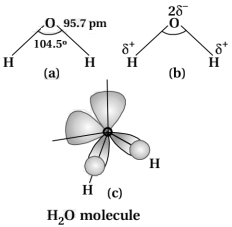
Write the bond angle and hybridization type of the water molecule.
Solution
(N/A) In the water molecule $(H_2O)$,the oxygen atom is $sp^3$ hybridized.
It has two bond pairs and two lone pairs of electrons,resulting in a bent ($V$-shaped) geometry.
Due to the presence of two lone pairs on the oxygen atom,the bond angle is compressed from the ideal tetrahedral angle of $109.5^{\circ}$ to $104.5^{\circ}$.
It has two bond pairs and two lone pairs of electrons,resulting in a bent ($V$-shaped) geometry.
Due to the presence of two lone pairs on the oxygen atom,the bond angle is compressed from the ideal tetrahedral angle of $109.5^{\circ}$ to $104.5^{\circ}$.
0 likes
View Solution362
Easy
Write the bond angle and type of hybridization of the water molecule.
Solution
(N/A) In a water molecule $(H_2O)$,the oxygen atom is $sp^3$ hybridized.
Due to the presence of two lone pairs on the oxygen atom,the bond angle is compressed from the ideal tetrahedral angle of $109.5^{\circ}$ to $104.5^{\circ}$.
Due to the presence of two lone pairs on the oxygen atom,the bond angle is compressed from the ideal tetrahedral angle of $109.5^{\circ}$ to $104.5^{\circ}$.
0 likes
View Solution363
Medium
Why does boron trifluoride behave as a Lewis acid?
Solution
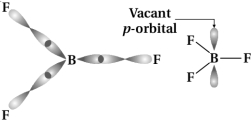
The electronic configuration of boron is $ns^{2} np^{1}$.
It has three electrons in its valence shell.
Thus,it can form only three covalent bonds.
This means that there are only $6$ electrons around boron,and its octet remains incomplete.
When one atom of boron combines with three fluorine atoms,its octet remains incomplete.
Hence,boron trifluoride remains electron-deficient and acts as a Lewis acid.
It has three electrons in its valence shell.
Thus,it can form only three covalent bonds.
This means that there are only $6$ electrons around boron,and its octet remains incomplete.
When one atom of boron combines with three fluorine atoms,its octet remains incomplete.
Hence,boron trifluoride remains electron-deficient and acts as a Lewis acid.
0 likes
View Solution364
Medium
Describe the shapes of $BF_3$ and $BH_4^-$. Assign the hybridisation of boron in these species.
Solution
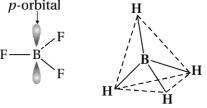
(N/A) $(i)$ $BF_3$: Due to its small size and high electronegativity,boron forms monomeric covalent halides. These halides have a planar triangular geometry.
This triangular shape is formed by the overlap of three $sp^2$ hybridised orbitals of boron with the $p$ orbitals of three fluorine atoms. Boron is $sp^2$ hybridised in $BF_3$.
$(ii)$ $BH_4^-$: The borohydride ion $(BH_4^-)$ is formed by the $sp^3$ hybridisation of boron orbitals. Therefore,it has a tetrahedral structure.
This triangular shape is formed by the overlap of three $sp^2$ hybridised orbitals of boron with the $p$ orbitals of three fluorine atoms. Boron is $sp^2$ hybridised in $BF_3$.
$(ii)$ $BH_4^-$: The borohydride ion $(BH_4^-)$ is formed by the $sp^3$ hybridisation of boron orbitals. Therefore,it has a tetrahedral structure.
0 likes
View Solution365
Medium
Suggest reasons why the $B-F$ bond lengths in $BF_3\ (130\ pm)$ and $BF_4^-\ (143\ pm)$ differ.
Solution
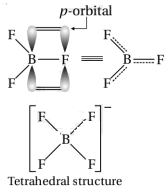
(N/A) The $B-F$ bond length in $BF_3$ is shorter than the $B-F$ bond length in $BF_4^-$. $BF_3$ is an electron-deficient species.
With a vacant $p$-orbital on boron, the fluorine and boron atoms undergo $p\pi-p\pi$ back-bonding to remove this deficiency. This imparts a double-bond character to the $B-F$ bond.
This double-bond character causes the bond length to shorten in $BF_3\ (130\ pm)$. However, when $BF_3$ coordinates with the fluoride ion, a change in hybridization from $sp^2$ (in $BF_3$) to $sp^3$ (in $BF_4^-$) occurs.
Boron now forms $4\ \sigma$ bonds and the double-bond character is lost. This accounts for a $B-F$ bond length of $143\ pm$ in the $BF_4^-$ ion.
With a vacant $p$-orbital on boron, the fluorine and boron atoms undergo $p\pi-p\pi$ back-bonding to remove this deficiency. This imparts a double-bond character to the $B-F$ bond.
This double-bond character causes the bond length to shorten in $BF_3\ (130\ pm)$. However, when $BF_3$ coordinates with the fluoride ion, a change in hybridization from $sp^2$ (in $BF_3$) to $sp^3$ (in $BF_4^-$) occurs.
Boron now forms $4\ \sigma$ bonds and the double-bond character is lost. This accounts for a $B-F$ bond length of $143\ pm$ in the $BF_4^-$ ion.
0 likes
View Solution366
Easy
What is the state of hybridisation of carbon in $(a)$ $CO_3^{2-}$,$(b)$ diamond,and $(c)$ graphite?
Solution
(N/A) $CO_3^{2-}$: The carbon atom in $CO_3^{2-}$ is $sp^2$ hybridised,forming three sigma bonds with oxygen atoms.
$(b)$ Diamond: Each carbon atom in diamond is $sp^3$ hybridised,forming four sigma bonds with four other carbon atoms in a tetrahedral geometry.
$(c)$ Graphite: Each carbon atom in graphite is $sp^2$ hybridised,forming three sigma bonds with three other carbon atoms in a planar hexagonal layer structure.
$(b)$ Diamond: Each carbon atom in diamond is $sp^3$ hybridised,forming four sigma bonds with four other carbon atoms in a tetrahedral geometry.
$(c)$ Graphite: Each carbon atom in graphite is $sp^2$ hybridised,forming three sigma bonds with three other carbon atoms in a planar hexagonal layer structure.
0 likes
View Solution367
EasyMCQ
What is the hybridization of the central atom in $SiF_6^{2-}$ and $[Sn(OH)_6]^{2-}$?
A
$sp^3$
B
$dsp^2$
C
$sp^3d^2$
D
$d^2sp^3$
Solution
(C) In both $SiF_6^{2-}$ and $[Sn(OH)_6]^{2-}$,the central atom ($Si$ and $Sn$ respectively) is bonded to $6$ atoms/groups.
Since the coordination number is $6$,the hybridization is $sp^3d^2$ (octahedral geometry).
Thus,the correct hybridization is $sp^3d^2$.
Since the coordination number is $6$,the hybridization is $sp^3d^2$ (octahedral geometry).
Thus,the correct hybridization is $sp^3d^2$.
0 likes
View Solution368
Easy
What is the proportion of $s$-character in $sp^3$,$sp^2$,and $sp$ hybrid orbitals? What is the order of electronegativity in it?
Solution
(N/A) The $s$-character in hybrid orbitals is calculated as follows:
$sp^3$: $1/4 = 25 \%$,$sp^2$: $1/3 = 33.3 \%$,$sp$: $1/2 = 50 \%$.
Electronegativity is directly proportional to the $s$-character because $s$-orbitals are closer to the nucleus.
Therefore,the order of electronegativity is $sp > sp^2 > sp^3$.
$sp^3$: $1/4 = 25 \%$,$sp^2$: $1/3 = 33.3 \%$,$sp$: $1/2 = 50 \%$.
Electronegativity is directly proportional to the $s$-character because $s$-orbitals are closer to the nucleus.
Therefore,the order of electronegativity is $sp > sp^2 > sp^3$.
| Hybrid Orbital | $s$-character |
|---|---|
| $sp^3$ | $25 \%$ |
| $sp^2$ | $33.3 \%$ |
| $sp$ | $50 \%$ |
0 likes
View Solution369
EasyMCQ
The shape of a molecule depends on which factor?
A
Number of electrons
B
Type of hybridisation
C
Atomic mass
D
Electronegativity
Solution
(B) To determine the shape or geometry of an organic compound,it is necessary to know the type of hybridisation of the central atom.
| Hybridisation | $sp, sp^{2}, sp^{3}$ |
| Shape | $Linear, Trigonal \text{ planar}, Tetrahedral$ |
0 likes
View Solution370
Medium
Provide the orbital structure of ethene showing: $(i)$ $\sigma$-bond $(ii)$ $\pi$-bond $(iii)$ The number of $\sigma$ and $\pi$-bonds $(iv)$ The hybridization.
Solution
(N/A) $(i)$ The $\sigma$-bond in ethene is formed by the $sp^{2}-sp^{2}$ head-on overlap between two carbon atoms and $sp^{2}-s$ overlap between carbon and hydrogen atoms.
$(ii)$ The $\pi$-bond is formed by the lateral (sideways) overlap of unhybridized $2p$-orbitals of the two carbon atoms.
$(iii)$ Ethene $(C_{2}H_{4})$ contains $5$ $\sigma$-bonds ($4$ $C-H$ and $1$ $C-C$) and $1$ $\pi$-bond.
$(iv)$ Both carbon atoms in ethene are $sp^{2}$ hybridized.
$(ii)$ The $\pi$-bond is formed by the lateral (sideways) overlap of unhybridized $2p$-orbitals of the two carbon atoms.
$(iii)$ Ethene $(C_{2}H_{4})$ contains $5$ $\sigma$-bonds ($4$ $C-H$ and $1$ $C-C$) and $1$ $\pi$-bond.
$(iv)$ Both carbon atoms in ethene are $sp^{2}$ hybridized.
0 likes
View Solution371
Medium
State the hybridization and draw the structures of $PCl_3$ and $PCl_5$.
Solution
(N/A) For $PCl_3$: The central phosphorus atom is $sp^3$ hybridized. It has $3$ bond pairs and $1$ lone pair,resulting in a trigonal pyramidal geometry.
For $PCl_5$: The central phosphorus atom is $sp^3d$ hybridized. It has $5$ bond pairs and $0$ lone pairs,resulting in a trigonal bipyramidal geometry.
For $PCl_5$: The central phosphorus atom is $sp^3d$ hybridized. It has $5$ bond pairs and $0$ lone pairs,resulting in a trigonal bipyramidal geometry.
0 likes
View Solution372
Medium
In $PCl_5$, phosphorus is in $sp^3d$ hybridised state but all its five bonds are not equivalent. Justify your answer with reason.
Solution
(N/A) In $PCl_5$, the molecule adopts a trigonal bipyramidal geometry.
The three equatorial $P-Cl$ bonds are equivalent, making an angle of $120^{\circ}$ with each other.
The remaining two $P-Cl$ bonds are axial, which experience greater repulsion from the equatorial bond pairs.
Consequently, the axial $P-Cl$ bonds are longer $(240 \ pm)$ than the equatorial $P-Cl$ bonds $(202 \ pm)$, making all five bonds non-equivalent.
The three equatorial $P-Cl$ bonds are equivalent, making an angle of $120^{\circ}$ with each other.
The remaining two $P-Cl$ bonds are axial, which experience greater repulsion from the equatorial bond pairs.
Consequently, the axial $P-Cl$ bonds are longer $(240 \ pm)$ than the equatorial $P-Cl$ bonds $(202 \ pm)$, making all five bonds non-equivalent.
0 likes
View Solution373
Medium
When $BCl_3$ is treated with water,it hydrolyses and forms $[B(OH)_4]^-$ only,whereas $AlCl_3$ in acidified aqueous solution forms $[Al(H_2O)_6]^{3+}$ ion. Explain what are the hybridizations of boron and aluminum in these species?
Solution
(N/A) In the trivalent state,most compounds are covalent and undergo hydrolysis in water. For example,trichlorides on hydrolysis in water form tetrahedral $[M(OH)_4]^-$ species; the hybridization state of element $M$ is $sp^3$.
$BCl_3 + 3H_2O \rightarrow B(OH)_3 + 3HCl$
$B(OH)_3 + H_2O \rightarrow [B(OH)_4]^- + H^+$
In $[B(OH)_4]^-$,boron is $sp^3$ hybridized.
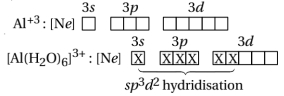
Aluminum chloride in acidified aqueous solution forms the octahedral $[Al(H_2O)_6]^{3+}$ ion. In this complex ion,the $3d$-orbitals of $Al$ are involved and the hybridization state of $Al$ is $sp^3d^2$.
$AlCl_3 + 6H_2O \xrightarrow{HCl} [Al(H_2O)_6]^{3+} + 3Cl^-$
$BCl_3 + 3H_2O \rightarrow B(OH)_3 + 3HCl$
$B(OH)_3 + H_2O \rightarrow [B(OH)_4]^- + H^+$
In $[B(OH)_4]^-$,boron is $sp^3$ hybridized.
Aluminum chloride in acidified aqueous solution forms the octahedral $[Al(H_2O)_6]^{3+}$ ion. In this complex ion,the $3d$-orbitals of $Al$ are involved and the hybridization state of $Al$ is $sp^3d^2$.
$AlCl_3 + 6H_2O \xrightarrow{HCl} [Al(H_2O)_6]^{3+} + 3Cl^-$
0 likes
View Solution374
Medium
Match the species given in Column-$I$ with the hybridizations given in Column-$II$.
| Column-$I$ | Column-$II$ |
|---|---|
| $A$. Boron in $[B(OH)_4]^-$ | $1$. $sp^2$ |
| $B$. Aluminum in $[Al(H_2O)_6]^{3+}$ | $2$. $sp^3$ |
| $C$. Boron in $B_2H_6$ | $3$. $sp^3d^2$ |
| $D$. Carbon in Buckminsterfullerene | |
| $E$. $Si$ in $SiO_4^{4-}$ | |
| $F$. $Ge$ in $[GeCl_6]^{2-}$ |
Solution
(A-2, B-3, C-2, D-1, E-2, F-3) $A-2, B-3, C-2, D-1, E-2, F-3$
$A$. Boron is the central atom and is surrounded by $4$ bond pairs only,hence it is $sp^3$ hybridized.
$B$. In $[Al(H_2O)_6]^{3+}$,the coordination number of $Al$ is $6$ and the geometry is octahedral,which corresponds to $sp^3d^2$ hybridization.
$C$. In $B_2H_6$,each $B$ atom is bonded to $4$ other atoms (two terminal $H$ and two bridging $H$),using $sp^3$ hybrid orbitals.
$D$. In Buckminsterfullerene $(C_{60})$,each carbon atom is bonded to three other carbon atoms and undergoes $sp^2$ hybridization.
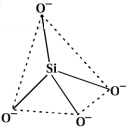
$E$. The basic structural unit of silicates is $SiO_4^{4-}$,in which the silicon atom is bonded to four oxygen atoms in a tetrahedral fashion,indicating $sp^3$ hybridization.
$F$. In $[GeCl_6]^{2-}$,$Ge$ has a coordination number of $6$,resulting in octahedral geometry and $sp^3d^2$ hybridization.
$A$. Boron is the central atom and is surrounded by $4$ bond pairs only,hence it is $sp^3$ hybridized.
$B$. In $[Al(H_2O)_6]^{3+}$,the coordination number of $Al$ is $6$ and the geometry is octahedral,which corresponds to $sp^3d^2$ hybridization.
$C$. In $B_2H_6$,each $B$ atom is bonded to $4$ other atoms (two terminal $H$ and two bridging $H$),using $sp^3$ hybrid orbitals.
$D$. In Buckminsterfullerene $(C_{60})$,each carbon atom is bonded to three other carbon atoms and undergoes $sp^2$ hybridization.
$E$. The basic structural unit of silicates is $SiO_4^{4-}$,in which the silicon atom is bonded to four oxygen atoms in a tetrahedral fashion,indicating $sp^3$ hybridization.
$F$. In $[GeCl_6]^{2-}$,$Ge$ has a coordination number of $6$,resulting in octahedral geometry and $sp^3d^2$ hybridization.
0 likes
View Solution375
MediumMCQ
What is the bond angle observed in the $H-C-H$ bond of ethane (in $^{\circ}$)?
A
$109.5$
B
$120$
C
$180$
D
$107$
Solution
(A) In ethane $(CH_3-CH_3)$,each carbon atom is $sp^3$ hybridized.
Due to $sp^3$ hybridization,the geometry around each carbon atom is tetrahedral.
The bond angle in a perfect tetrahedral geometry is $109.5^{\circ}$.
Due to $sp^3$ hybridization,the geometry around each carbon atom is tetrahedral.
The bond angle in a perfect tetrahedral geometry is $109.5^{\circ}$.
0 likes
View Solution376
MediumMCQ
What are the bond angle and bond length of methane $(CH_4)$?
A
$109.5^{\circ}$ and $109 \ pm$
B
$107^{\circ}$ and $110 \ pm$
C
$104.5^{\circ}$ and $105 \ pm$
D
$120^{\circ}$ and $134 \ pm$
Solution
(A) Methane $(CH_4)$ has a tetrahedral geometry due to $sp^3$ hybridization of the carbon atom.
In this structure, the $H-C-H$ bond angle is $109.5^{\circ}$.
The $C-H$ bond length in methane is approximately $109 \ pm$.
In this structure, the $H-C-H$ bond angle is $109.5^{\circ}$.
The $C-H$ bond length in methane is approximately $109 \ pm$.
0 likes
View Solution377
Medium
Methane is tetrahedral but not square planar in nature,prove it.
Solution
(N/A) The electronic configuration of carbon in its ground state is $1s^2 2s^2 2p_x^1 2p_y^1$. In the excited state,one electron from the $2s$ orbital is promoted to the $2p_z$ orbital,resulting in $1s^2 2s^1 2p_x^1 2p_y^1 2p_z^1$. These four orbitals undergo $sp^3$ hybridization to form four equivalent $sp^3$ hybrid orbitals directed towards the corners of a regular tetrahedron. If methane were square planar,the $H-C-H$ bond angles would be $90^{\circ}$. However,$X$-ray diffraction studies confirm that the $H-C-H$ bond angle in methane is $109.5^{\circ}$,which is characteristic of a tetrahedral geometry.
0 likes
View Solution378
Difficult
Discuss the hybridization and shape of $PCl_5$.
Solution
(N/A) The ground state electron configuration of phosphorus $(P=15)$ is $[Ne] 3s^2 3p^3$.
In the excited state,one electron from the $3s$ orbital is promoted to the $3d$ orbital,resulting in the configuration $[Ne] 3s^1 3p^3 3d^1$.
Hybridization: One $3s$,three $3p$,and one $3d_{z^2}$ orbital mix together to form five equivalent $sp^3d$ hybrid orbitals.
Geometry: These five $sp^3d$ hybrid orbitals are directed towards the corners of a trigonal bipyramid,resulting in a trigonal bipyramidal geometry with bond angles of $120^{\circ}$ and $90^{\circ}$.
Bond Formation: Each of the five $sp^3d$ hybrid orbitals overlaps with the half-filled $p$ orbital of a chlorine atom to form five $P-Cl$ $\sigma$-bonds.
In the excited state,one electron from the $3s$ orbital is promoted to the $3d$ orbital,resulting in the configuration $[Ne] 3s^1 3p^3 3d^1$.
Hybridization: One $3s$,three $3p$,and one $3d_{z^2}$ orbital mix together to form five equivalent $sp^3d$ hybrid orbitals.
Geometry: These five $sp^3d$ hybrid orbitals are directed towards the corners of a trigonal bipyramid,resulting in a trigonal bipyramidal geometry with bond angles of $120^{\circ}$ and $90^{\circ}$.
Bond Formation: Each of the five $sp^3d$ hybrid orbitals overlaps with the half-filled $p$ orbital of a chlorine atom to form five $P-Cl$ $\sigma$-bonds.
0 likes
View Solution379
Difficult
Explain $sp^3d^2$ hybridization with a suitable example.
Solution
(N/A) Example: $SF_6$ molecule.
$1$. Electronic configuration of Sulphur $(S)$: Atomic number $Z=16$,configuration is $[Ne] 3s^2 3p^4$.
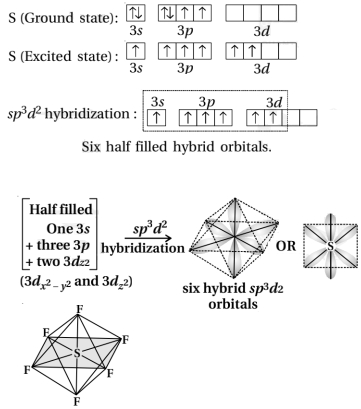
$2$. Excited state: In the excited state,electrons from $3s$ and $3p$ orbitals are promoted to $3d$ orbitals to provide six half-filled orbitals: one $3s$,three $3p$,and two $3d$ orbitals.
$3$. $sp^3d^2$ hybridization: These six half-filled orbitals undergo hybridization to form six equivalent $sp^3d^2$ hybrid orbitals. These orbitals are directed towards the corners of an octahedron with bond angles of $90^{\circ}$.
$4$. Bond formation: Each of the six $sp^3d^2$ hybrid orbitals of $S$ overlaps with the half-filled $2p$ orbital of a Fluorine $(F)$ atom $([He] 2s^2 2p^5)$ to form six $S-F$ sigma bonds.
$1$. Electronic configuration of Sulphur $(S)$: Atomic number $Z=16$,configuration is $[Ne] 3s^2 3p^4$.
$2$. Excited state: In the excited state,electrons from $3s$ and $3p$ orbitals are promoted to $3d$ orbitals to provide six half-filled orbitals: one $3s$,three $3p$,and two $3d$ orbitals.
$3$. $sp^3d^2$ hybridization: These six half-filled orbitals undergo hybridization to form six equivalent $sp^3d^2$ hybrid orbitals. These orbitals are directed towards the corners of an octahedron with bond angles of $90^{\circ}$.
$4$. Bond formation: Each of the six $sp^3d^2$ hybrid orbitals of $S$ overlaps with the half-filled $2p$ orbital of a Fluorine $(F)$ atom $([He] 2s^2 2p^5)$ to form six $S-F$ sigma bonds.
0 likes
View Solution380
Difficult
Explain the geometry of $SF_{6}$.
Solution
(N/A) The electronic configuration of sulphur ($S$,$Z=16$) is $[Ne] 3s^{2} 3p^{4}$.
In the excited state,one electron from $3s$ and one from $3p$ are promoted to the $3d$ orbitals,resulting in six half-filled orbitals ($3s$,$3p_{x}$,$3p_{y}$,$3p_{z}$,$3d_{x^{2}-y^{2}}$,and $3d_{z^{2}}$).
These six orbitals undergo $sp^{3}d^{2}$ hybridization to form six equivalent $sp^{3}d^{2}$ hybrid orbitals.
These hybrid orbitals are directed towards the corners of an octahedron,resulting in an octahedral geometry with bond angles of $90^{\circ}$.
In $SF_{6}$,each of the six fluorine atoms ($F$,$[He] 2s^{2} 2p^{5}$) uses its half-filled $2p$ orbital to overlap axially with one of the $sp^{3}d^{2}$ hybrid orbitals of sulphur,forming six $S-F$ sigma bonds.
In the excited state,one electron from $3s$ and one from $3p$ are promoted to the $3d$ orbitals,resulting in six half-filled orbitals ($3s$,$3p_{x}$,$3p_{y}$,$3p_{z}$,$3d_{x^{2}-y^{2}}$,and $3d_{z^{2}}$).
These six orbitals undergo $sp^{3}d^{2}$ hybridization to form six equivalent $sp^{3}d^{2}$ hybrid orbitals.
These hybrid orbitals are directed towards the corners of an octahedron,resulting in an octahedral geometry with bond angles of $90^{\circ}$.
In $SF_{6}$,each of the six fluorine atoms ($F$,$[He] 2s^{2} 2p^{5}$) uses its half-filled $2p$ orbital to overlap axially with one of the $sp^{3}d^{2}$ hybrid orbitals of sulphur,forming six $S-F$ sigma bonds.
0 likes
View Solution381
Medium
Explain the structure and bonding in $SF_6$.
Solution
(N/A) In $SF_6$,the central sulfur atom $(S)$ has an atomic number of $16$ and an electronic configuration of $[Ne] 3s^2 3p^4$.
In the ground state,$S$ has two unpaired electrons in the $3p$ orbitals.
To form $6$ bonds with $F$ atoms,$S$ undergoes excitation where one electron from the $3s$ orbital and one from the $3p$ orbital are promoted to the vacant $3d$ orbitals.
This results in $6$ unpaired electrons in the $3s, 3p,$ and $3d$ subshells.
These $6$ orbitals ($1$ $s$,$3$ $p$,and $2$ $d$) undergo $sp^3d^2$ hybridization to form $6$ equivalent $sp^3d^2$ hybrid orbitals.
These $6$ hybrid orbitals overlap with the $2p$ orbitals of $6$ fluorine atoms to form $6$ $S-F$ sigma bonds.
The geometry of $SF_6$ is octahedral,with all $S-F$ bond lengths being equal and bond angles of $90^{\circ}$.
In the ground state,$S$ has two unpaired electrons in the $3p$ orbitals.
To form $6$ bonds with $F$ atoms,$S$ undergoes excitation where one electron from the $3s$ orbital and one from the $3p$ orbital are promoted to the vacant $3d$ orbitals.
This results in $6$ unpaired electrons in the $3s, 3p,$ and $3d$ subshells.
These $6$ orbitals ($1$ $s$,$3$ $p$,and $2$ $d$) undergo $sp^3d^2$ hybridization to form $6$ equivalent $sp^3d^2$ hybrid orbitals.
These $6$ hybrid orbitals overlap with the $2p$ orbitals of $6$ fluorine atoms to form $6$ $S-F$ sigma bonds.
The geometry of $SF_6$ is octahedral,with all $S-F$ bond lengths being equal and bond angles of $90^{\circ}$.
0 likes
View Solution382
Easy
Predict the hybridization of each carbon in the molecule of the organic compound given below. Also,indicate the total number of sigma $(\sigma)$ and pi $(\pi)$ bonds in this molecule.
$HC \equiv C-CO-CH_2-COOH$
$HC \equiv C-CO-CH_2-COOH$
Solution
(N/A) The given molecule is $HC \equiv C-CO-CH_2-COOH$.
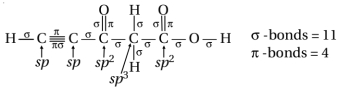
$1$. The first carbon (from left) is bonded to one $H$ atom and triple bonded to the second carbon. It has two $\sigma$ bonds and two $\pi$ bonds,so it is $sp$ hybridized.
$2$. The second carbon is triple bonded to the first carbon and single bonded to the third carbon. It has two $\sigma$ bonds and two $\pi$ bonds,so it is $sp$ hybridized.
$3$. The third carbon is part of a carbonyl group $(C=O)$. It is bonded to the second carbon,the fourth carbon,and double bonded to an oxygen atom. It has three $\sigma$ bonds and one $\pi$ bond,so it is $sp^2$ hybridized.
$4$. The fourth carbon is bonded to the third carbon,two $H$ atoms,and the fifth carbon. It has four $\sigma$ bonds,so it is $sp^3$ hybridized.
$5$. The fifth carbon is part of a carboxyl group $(-COOH)$. It is bonded to the fourth carbon,an oxygen atom (double bond),and an $OH$ group. It has three $\sigma$ bonds and one $\pi$ bond,so it is $sp^2$ hybridized.
Total number of $\sigma$ bonds = $11$
Total number of $\pi$ bonds = $4$
$1$. The first carbon (from left) is bonded to one $H$ atom and triple bonded to the second carbon. It has two $\sigma$ bonds and two $\pi$ bonds,so it is $sp$ hybridized.
$2$. The second carbon is triple bonded to the first carbon and single bonded to the third carbon. It has two $\sigma$ bonds and two $\pi$ bonds,so it is $sp$ hybridized.
$3$. The third carbon is part of a carbonyl group $(C=O)$. It is bonded to the second carbon,the fourth carbon,and double bonded to an oxygen atom. It has three $\sigma$ bonds and one $\pi$ bond,so it is $sp^2$ hybridized.
$4$. The fourth carbon is bonded to the third carbon,two $H$ atoms,and the fifth carbon. It has four $\sigma$ bonds,so it is $sp^3$ hybridized.
$5$. The fifth carbon is part of a carboxyl group $(-COOH)$. It is bonded to the fourth carbon,an oxygen atom (double bond),and an $OH$ group. It has three $\sigma$ bonds and one $\pi$ bond,so it is $sp^2$ hybridized.
Total number of $\sigma$ bonds = $11$
Total number of $\pi$ bonds = $4$
0 likes
View Solution383
Medium
Predict the shapes of the following molecules on the basis of hybridization:
$BCl_3, CH_4, CO_2, NH_3$
$BCl_3, CH_4, CO_2, NH_3$
Solution
(N/A) The shapes of the molecules based on hybridization are as follows:
$1$. $BCl_3$: The central boron atom undergoes $sp^2$ hybridization. It forms three $\sigma$-bonds with chlorine atoms,resulting in a trigonal planar geometry.
$2$. $CH_4$: The central carbon atom undergoes $sp^3$ hybridization. It forms four $\sigma$-bonds with hydrogen atoms,resulting in a tetrahedral geometry.
$3$. $CO_2$: The central carbon atom undergoes $sp$ hybridization. It forms two $\sigma$-bonds with oxygen atoms,resulting in a linear geometry $(: \ddot{O} = C = \ddot{O} :)$.
$4$. $NH_3$: The central nitrogen atom undergoes $sp^3$ hybridization. It has three $\sigma$-bonds and one lone pair,resulting in a pyramidal shape.
$1$. $BCl_3$: The central boron atom undergoes $sp^2$ hybridization. It forms three $\sigma$-bonds with chlorine atoms,resulting in a trigonal planar geometry.
$2$. $CH_4$: The central carbon atom undergoes $sp^3$ hybridization. It forms four $\sigma$-bonds with hydrogen atoms,resulting in a tetrahedral geometry.
$3$. $CO_2$: The central carbon atom undergoes $sp$ hybridization. It forms two $\sigma$-bonds with oxygen atoms,resulting in a linear geometry $(: \ddot{O} = C = \ddot{O} :)$.
$4$. $NH_3$: The central nitrogen atom undergoes $sp^3$ hybridization. It has three $\sigma$-bonds and one lone pair,resulting in a pyramidal shape.
0 likes
View Solution384
Advanced
Describe hybridization in the case of $PCl_5$ and $SF_6$. The axial bonds are longer as compared to equatorial bonds in $PCl_5$ whereas in $SF_6$ both axial bonds and equatorial bonds have the same bond length. Explain.
Solution
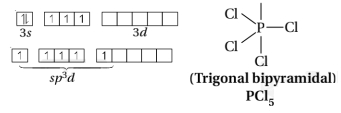
(N/A) Formation of $PCl_5$: In $PCl_5$,phosphorus is $sp^3d$ hybridized to produce a set of five $sp^3d$ hybrid orbitals which are directed towards the five corners of a trigonal bipyramid. These five $sp^3d$ hybrid orbitals overlap with singly occupied $p$-orbitals of $Cl$ atoms to form five $P-Cl$ sigma bonds.
Three $P-Cl$ bonds are in one plane and make an angle of $120^{\circ}$ with each other. These bonds are called equatorial bonds.
The remaining two $P-Cl$ bonds,one lying above and the other lying below the plane,make an angle of $90^{\circ}$ with the equatorial plane. These bonds are called axial bonds. Axial bonds are slightly longer than equatorial bonds because axial bond pairs suffer more repulsive interaction from the equatorial bond pairs.
Formation of $SF_6$: In $SF_6$,sulfur is $sp^3d^2$ hybridized to produce a set of six $sp^3d^2$ hybrid orbitals which are directed towards the six corners of a regular octahedron. These six $sp^3d^2$ hybrid orbitals overlap with singly occupied orbitals of fluorine atoms to form six $S-F$ sigma bonds. Thus,the $SF_6$ molecule has a regular octahedral geometry and all $S-F$ bonds have the same bond length.
Three $P-Cl$ bonds are in one plane and make an angle of $120^{\circ}$ with each other. These bonds are called equatorial bonds.
The remaining two $P-Cl$ bonds,one lying above and the other lying below the plane,make an angle of $90^{\circ}$ with the equatorial plane. These bonds are called axial bonds. Axial bonds are slightly longer than equatorial bonds because axial bond pairs suffer more repulsive interaction from the equatorial bond pairs.
Formation of $SF_6$: In $SF_6$,sulfur is $sp^3d^2$ hybridized to produce a set of six $sp^3d^2$ hybrid orbitals which are directed towards the six corners of a regular octahedron. These six $sp^3d^2$ hybrid orbitals overlap with singly occupied orbitals of fluorine atoms to form six $S-F$ sigma bonds. Thus,the $SF_6$ molecule has a regular octahedral geometry and all $S-F$ bonds have the same bond length.
0 likes
View Solution385
Medium
On what factor does the direction of a bond around the central atom depend?
Solution
(N/A) The direction of a bond around the central atom depends on the spatial orientation of the hybrid or atomic orbitals of the central atom before bond formation.
This is because the overlapping of atomic orbitals occurs along the axis where the electron density is concentrated,which determines the direction of the resulting covalent bond.
This is because the overlapping of atomic orbitals occurs along the axis where the electron density is concentrated,which determines the direction of the resulting covalent bond.
0 likes
View Solution386
EasyMCQ
Why is the bond angle in $CH_4$ not $90^{\circ}$,even though the outermost $p$-orbitals of carbon are at $90^{\circ}$ to each other?
A
Due to $sp$ hybridization
B
Due to $sp^2$ hybridization
C
Due to $sp^3$ hybridization
D
Due to $dsp^2$ hybridization
Solution
(C) In $CH_4$,before bond formation,the $2s$ orbital and three $2p$ orbitals of carbon undergo $sp^3$ hybridization.
This results in the formation of four equivalent $sp^3$ hybrid orbitals directed towards the corners of a regular tetrahedron.
Therefore,the bonds are not formed using the original $p$-orbitals at $90^{\circ}$,but rather through these $sp^3$ hybrid orbitals,resulting in a bond angle of $109.5^{\circ}$.
This results in the formation of four equivalent $sp^3$ hybrid orbitals directed towards the corners of a regular tetrahedron.
Therefore,the bonds are not formed using the original $p$-orbitals at $90^{\circ}$,but rather through these $sp^3$ hybrid orbitals,resulting in a bond angle of $109.5^{\circ}$.
0 likes
View Solution387
MediumMCQ
What is the type of hybridization of the central atom in the following molecules: $NH_3, PCl_5, SF_6, CCl_4$?
A
$NH_3: sp^3, PCl_5: sp^3d, SF_6: sp^3d^2, CCl_4: sp^3$
B
$NH_3: sp^2, PCl_5: sp^3d^2, SF_6: sp^3d, CCl_4: sp^3$
C
$NH_3: sp^3, PCl_5: sp^3d^2, SF_6: sp^3d, CCl_4: sp^2$
D
$NH_3: sp^2, PCl_5: sp^3d, SF_6: sp^3d^2, CCl_4: sp^2$
Solution
(A) The hybridization is determined by the formula: $H = \frac{1}{2}(V + M - C + A)$,where $V$ is the number of valence electrons,$M$ is the number of monovalent atoms,$C$ is the cationic charge,and $A$ is the anionic charge.
$1. NH_3: H = \frac{1}{2}(5 + 3) = 4 \rightarrow sp^3$ hybridization.
$2. PCl_5: H = \frac{1}{2}(5 + 5) = 5 \rightarrow sp^3d$ hybridization.
$3. SF_6: H = \frac{1}{2}(6 + 6) = 6 \rightarrow sp^3d^2$ hybridization.
$4. CCl_4: H = \frac{1}{2}(4 + 4) = 4 \rightarrow sp^3$ hybridization.
Therefore,the correct hybridization sequence is $NH_3: sp^3, PCl_5: sp^3d, SF_6: sp^3d^2, CCl_4: sp^3$.
$1. NH_3: H = \frac{1}{2}(5 + 3) = 4 \rightarrow sp^3$ hybridization.
$2. PCl_5: H = \frac{1}{2}(5 + 5) = 5 \rightarrow sp^3d$ hybridization.
$3. SF_6: H = \frac{1}{2}(6 + 6) = 6 \rightarrow sp^3d^2$ hybridization.
$4. CCl_4: H = \frac{1}{2}(4 + 4) = 4 \rightarrow sp^3$ hybridization.
Therefore,the correct hybridization sequence is $NH_3: sp^3, PCl_5: sp^3d, SF_6: sp^3d^2, CCl_4: sp^3$.
0 likes
View Solution388
Medium
Define the following terms:
$(i)$ Hybridisation
$(ii)$ $sp$ Hybridisation
$(iii)$ $sp^2$ Hybridisation
$(iv)$ $sp^3$ Hybridisation
$(v)$ Hydrogen bonding
$(i)$ Hybridisation
$(ii)$ $sp$ Hybridisation
$(iii)$ $sp^2$ Hybridisation
$(iv)$ $sp^3$ Hybridisation
$(v)$ Hydrogen bonding
Solution
(N/A) $(i)$ Hybridisation: The process of intermixing of the orbitals of slightly different energies so as to redistribute their energies,resulting in the formation of a new set of orbitals of equivalent energies and shape.
$(ii)$ $sp$ Hybridisation: The mixing of one $s$ and one $p$ orbital to form two equivalent $sp$ hybrid orbitals,resulting in a linear geometry with a bond angle of $180^{\circ}$.
$(iii)$ $sp^2$ Hybridisation: The mixing of one $s$ and two $p$ orbitals to form three equivalent $sp^2$ hybrid orbitals,resulting in a trigonal planar geometry with a bond angle of $120^{\circ}$.
$(iv)$ $sp^3$ Hybridisation: The mixing of one $s$ and three $p$ orbitals to form four equivalent $sp^3$ hybrid orbitals,resulting in a tetrahedral geometry with a bond angle of $109.5^{\circ}$.
$(v)$ Hydrogen bonding: The attractive force which binds a hydrogen atom of one molecule with an electronegative atom (like $F, O, N$) of another molecule.
$(ii)$ $sp$ Hybridisation: The mixing of one $s$ and one $p$ orbital to form two equivalent $sp$ hybrid orbitals,resulting in a linear geometry with a bond angle of $180^{\circ}$.
$(iii)$ $sp^2$ Hybridisation: The mixing of one $s$ and two $p$ orbitals to form three equivalent $sp^2$ hybrid orbitals,resulting in a trigonal planar geometry with a bond angle of $120^{\circ}$.
$(iv)$ $sp^3$ Hybridisation: The mixing of one $s$ and three $p$ orbitals to form four equivalent $sp^3$ hybrid orbitals,resulting in a tetrahedral geometry with a bond angle of $109.5^{\circ}$.
$(v)$ Hydrogen bonding: The attractive force which binds a hydrogen atom of one molecule with an electronegative atom (like $F, O, N$) of another molecule.
0 likes
View Solution389
Easy
What are the shapes of $sp$,$sp^2$,and $sp^3$ hybrid orbitals?
Solution
(N/A) All these hybrid orbitals have a shape consisting of a large lobe (positive phase) on one side and a small lobe on the other side,resembling a teardrop or a dumbbell-like structure.
0 likes
View Solution390
EasyMCQ
What type of covalent bond is formed by hybrid orbitals?
A
Sigma bond
B
Pi bond
C
Hydrogen bond
D
Metallic bond
Solution
(A) . Hybrid orbitals are formed by the mixing of atomic orbitals of similar energy.
These hybrid orbitals overlap head-on to form a $\sigma$ (sigma) bond.
Therefore,the type of covalent bond formed by hybrid orbitals is a $\sigma$ bond.
These hybrid orbitals overlap head-on to form a $\sigma$ (sigma) bond.
Therefore,the type of covalent bond formed by hybrid orbitals is a $\sigma$ bond.
0 likes
View Solution391
MediumMCQ
Which orbital is more electronegative among $sp$,$sp^2$,and $sp^3$? Why?
A
$sp$
B
$sp^2$
C
$sp^3$
D
All are equal
Solution
(A) The electronegativity order is $sp > sp^2 > sp^3$.
This is because the electronegativity of an orbital is directly proportional to its $s$-character.
Since the $sp$ hybrid orbital has the highest $s$-character $(50\%)$,it is the most electronegative.
This is because the electronegativity of an orbital is directly proportional to its $s$-character.
| Hybridization | $s$-character (%) |
| $sp$ | $50\%$ |
| $sp^2$ | $33.3\%$ |
| $sp^3$ | $25\%$ |
Since the $sp$ hybrid orbital has the highest $s$-character $(50\%)$,it is the most electronegative.
0 likes
View Solution392
Medium
How is the hybridization of an atom determined as $sp$,$sp^2$,or $sp^3$?
Solution
(N/A) The hybridization of an atom is determined by the bond angle and the molecular geometry.
$1.$ If the bond angle is $180^{\circ}$ and the geometry is linear,the hybridization is $sp$.
$2.$ If the bond angle is $120^{\circ}$ and the geometry is trigonal planar,the hybridization is $sp^2$.
$3.$ If the bond angle is $109.5^{\circ}$ and the geometry is tetrahedral,the hybridization is $sp^3$.
$1.$ If the bond angle is $180^{\circ}$ and the geometry is linear,the hybridization is $sp$.
$2.$ If the bond angle is $120^{\circ}$ and the geometry is trigonal planar,the hybridization is $sp^2$.
$3.$ If the bond angle is $109.5^{\circ}$ and the geometry is tetrahedral,the hybridization is $sp^3$.
0 likes
View Solution393
Medium
Fill in the blanks:
$(i)$ Based on the type of overlapping,covalent bonds are classified into ........ and .......... .
$(ii)$ The bond formation involving hybrid orbitals is called ............. .
$(iii)$ The type of hybridization observed in the $C_2H_6$ molecule is ........... .
$(iv)$ The type of hybridization observed in the $BrF_5$ complex is ............... .
$(i)$ Based on the type of overlapping,covalent bonds are classified into ........ and .......... .
$(ii)$ The bond formation involving hybrid orbitals is called ............. .
$(iii)$ The type of hybridization observed in the $C_2H_6$ molecule is ........... .
$(iv)$ The type of hybridization observed in the $BrF_5$ complex is ............... .
Solution
(N/A) $(i)$ Sigma bond $(\sigma)$ and Pi bond $(\pi)$.
$(ii)$ Hybridization.
$(iii)$ $sp^3$ hybridization.
$(iv)$ $sp^3d^2$ hybridization.
$(ii)$ Hybridization.
$(iii)$ $sp^3$ hybridization.
$(iv)$ $sp^3d^2$ hybridization.
0 likes
View Solution394
Medium
Match the species in List-$I$ with their correct hybrid orbitals in List-$II$.
| List-$I$ | List-$II$ |
| $(1)$ $SF_4$ | $(A)$ $sp^3d^2$ |
| $(2)$ $IF_5$ | $(B)$ $d^2sp^3$ |
| $(3)$ $NO_2^+$ | $(C)$ $sp^3d$ |
| $(4)$ $NH_4^+$ | $(D)$ $sp^3$ |
| $(E)$ $sp$ |
Solution
(C) The hybridization is calculated using the formula: $H = \frac{1}{2}(V + M - C + A)$,where $V$ is the number of valence electrons,$M$ is the number of monovalent atoms,$C$ is the cationic charge,and $A$ is the anionic charge.
$(1)$ $SF_4$: $H = \frac{1}{2}(6 + 4) = 5 \rightarrow sp^3d$ (Matches $C$)
$(2)$ $IF_5$: $H = \frac{1}{2}(7 + 5) = 6 \rightarrow sp^3d^2$ (Matches $A$)
$(3)$ $NO_2^+$: $H = \frac{1}{2}(5 + 0 - 1) = 2 \rightarrow sp$ (Matches $E$)
$(4)$ $NH_4^+$: $H = \frac{1}{2}(5 + 4 - 1) = 4 \rightarrow sp^3$ (Matches $D$)
Correct matching: $(1-C, 2-A, 3-E, 4-D)$.
$(1)$ $SF_4$: $H = \frac{1}{2}(6 + 4) = 5 \rightarrow sp^3d$ (Matches $C$)
$(2)$ $IF_5$: $H = \frac{1}{2}(7 + 5) = 6 \rightarrow sp^3d^2$ (Matches $A$)
$(3)$ $NO_2^+$: $H = \frac{1}{2}(5 + 0 - 1) = 2 \rightarrow sp$ (Matches $E$)
$(4)$ $NH_4^+$: $H = \frac{1}{2}(5 + 4 - 1) = 4 \rightarrow sp^3$ (Matches $D$)
Correct matching: $(1-C, 2-A, 3-E, 4-D)$.
0 likes
View Solution395
EasyMCQ
Match the shapes of the compounds given in List-$I$ with the types of hybridization given in List-$II$.
| List-$I$ | List-$II$ |
| $(1)$ Tetrahedral | $(A)$ $sp^2$ |
| $(2)$ Trigonal planar | $(B)$ $sp$ |
| $(3)$ Linear | $(C)$ $sp^3$ |
A
$1-C, 2-A, 3-B$
B
$1-A, 2-B, 3-C$
C
$1-B, 2-C, 3-A$
D
$1-C, 2-B, 3-A$
Solution
(A) The hybridization determines the geometry of the molecule:
$(1)$ Tetrahedral geometry corresponds to $sp^3$ hybridization (e.g.,$CH_4$).
$(2)$ Trigonal planar geometry corresponds to $sp^2$ hybridization (e.g.,$BF_3$).
$(3)$ Linear geometry corresponds to $sp$ hybridization (e.g.,$BeCl_2$).
Therefore,the correct matching is $1-C, 2-A, 3-B$.
$(1)$ Tetrahedral geometry corresponds to $sp^3$ hybridization (e.g.,$CH_4$).
$(2)$ Trigonal planar geometry corresponds to $sp^2$ hybridization (e.g.,$BF_3$).
$(3)$ Linear geometry corresponds to $sp$ hybridization (e.g.,$BeCl_2$).
Therefore,the correct matching is $1-C, 2-A, 3-B$.
0 likes
View Solution396
MediumMCQ
What is the type of hybridization of the central atom in the following molecules: $BeCl_2, CO_2, BH_3, BCl_3$?
A
$sp, sp, sp^2, sp^2$
B
$sp^2, sp^2, sp, sp$
C
$sp, sp^2, sp^2, sp^3$
D
$sp^3, sp^2, sp, sp^2$
Solution
(A) $1$. For $BeCl_2$: The central atom $Be$ has $2$ valence electrons and forms $2$ bonds with $Cl$. Steric number = $2 + 0 = 2$,so hybridization is $sp$.
$2$. For $CO_2$: The central atom $C$ has $4$ valence electrons and forms $2$ double bonds with $O$. Steric number = $2 + 0 = 2$,so hybridization is $sp$.
$3$. For $BH_3$: The central atom $B$ has $3$ valence electrons and forms $3$ bonds with $H$. Steric number = $3 + 0 = 3$,so hybridization is $sp^2$.
$4$. For $BCl_3$: The central atom $B$ has $3$ valence electrons and forms $3$ bonds with $Cl$. Steric number = $3 + 0 = 3$,so hybridization is $sp^2$.
Thus,the hybridization sequence is $sp, sp, sp^2, sp^2$.
$2$. For $CO_2$: The central atom $C$ has $4$ valence electrons and forms $2$ double bonds with $O$. Steric number = $2 + 0 = 2$,so hybridization is $sp$.
$3$. For $BH_3$: The central atom $B$ has $3$ valence electrons and forms $3$ bonds with $H$. Steric number = $3 + 0 = 3$,so hybridization is $sp^2$.
$4$. For $BCl_3$: The central atom $B$ has $3$ valence electrons and forms $3$ bonds with $Cl$. Steric number = $3 + 0 = 3$,so hybridization is $sp^2$.
Thus,the hybridization sequence is $sp, sp, sp^2, sp^2$.
0 likes
View Solution397
Easy
What is the hybridisation of each carbon in $H_2C = C = CH_2$?
Solution
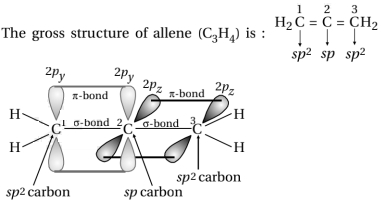
(N/A) The carbon atoms $1$ and $3$ are $sp^2$ hybridized because each is bonded to three atoms (two $H$ atoms and one $C$ atom) and participates in one double bond.
The central carbon atom $(C_2)$ is $sp$-hybridized because it is bonded to two carbon atoms via two double bonds.
In the structure of allene $(H_2C=C=CH_2)$,the two $\pi$ bonds are perpendicular to each other. The $2p_y$ and $2p_z$ orbitals of the central carbon atom $(C_2)$ are involved in the formation of $\pi$ bonds with the adjacent carbon atoms,leaving only the $2s$ and one $2p$ orbital for hybridization,resulting in $sp$ hybridization for $C_2$.
The central carbon atom $(C_2)$ is $sp$-hybridized because it is bonded to two carbon atoms via two double bonds.
In the structure of allene $(H_2C=C=CH_2)$,the two $\pi$ bonds are perpendicular to each other. The $2p_y$ and $2p_z$ orbitals of the central carbon atom $(C_2)$ are involved in the formation of $\pi$ bonds with the adjacent carbon atoms,leaving only the $2s$ and one $2p$ orbital for hybridization,resulting in $sp$ hybridization for $C_2$.
0 likes
View Solution398
Medium
What is meant by hybridisation? The compound $CH_2 = C = CH_2$ contains $sp$ and $sp^2$ hybridised carbon atoms. Will it be a planar molecule?
Solution
(N/A) Hybridisation is the phenomenon of mixing of atomic orbitals of the same atom having comparable energies to form an equal number of new hybrid orbitals with similar energies and shapes.
In the allene molecule $(CH_2=C=CH_2)$:
- The terminal carbon atoms ($C_1$ and $C_3$) are bonded to two hydrogen atoms and one carbon atom via $\sigma$-bonds. They are $sp^2$ hybridised.
- The central carbon atom $(C_2)$ is bonded to two carbon atoms via $\sigma$-bonds. It is $sp$ hybridised.
Regarding planarity:
- The $C_1$ carbon and its attached hydrogen atoms lie in one plane.
- The $C_3$ carbon and its attached hydrogen atoms lie in a plane perpendicular to the plane of the $C_1$ hydrogen atoms.
- This is because the two $\pi$-bonds formed by the central $sp$-hybridised carbon involve different sets of $p$-orbitals ($2p_y$ and $2p_z$),which are mutually perpendicular.
- Therefore,the allene molecule is non-planar.
In the allene molecule $(CH_2=C=CH_2)$:
- The terminal carbon atoms ($C_1$ and $C_3$) are bonded to two hydrogen atoms and one carbon atom via $\sigma$-bonds. They are $sp^2$ hybridised.
- The central carbon atom $(C_2)$ is bonded to two carbon atoms via $\sigma$-bonds. It is $sp$ hybridised.
Regarding planarity:
- The $C_1$ carbon and its attached hydrogen atoms lie in one plane.
- The $C_3$ carbon and its attached hydrogen atoms lie in a plane perpendicular to the plane of the $C_1$ hydrogen atoms.
- This is because the two $\pi$-bonds formed by the central $sp$-hybridised carbon involve different sets of $p$-orbitals ($2p_y$ and $2p_z$),which are mutually perpendicular.
- Therefore,the allene molecule is non-planar.
0 likes
View Solution399
MediumMCQ
The reaction in which the hybridisation of the underlined atom is affected is
A
$\underline{N}H_3 \xrightarrow{H^{+}} [NH_4]^+$
B
$\underline{Xe}F_4 + SbF_5 \rightarrow [XeF_3]^+ [SbF_6]^-$
C
$H_2 \underline{S}O_4 + NaCl \xrightarrow{420 \ K} NaHSO_4 + HCl$
D
$H_3 \underline{P}O_2 \xrightarrow{\text{Disproportionation}} PH_3 + H_3PO_3$
Solution
(B) In the reaction $\underline{Xe}F_4 + SbF_5 \rightarrow [XeF_3]^+ [SbF_6]^-$,the hybridisation of $Xe$ changes from $sp^3d^2$ in $XeF_4$ to $sp^3d$ in the $[XeF_3]^+$ cation.
In $NH_3$,$N$ is $sp^3$ and in $[NH_4]^+$,$N$ is $sp^3$.
In $H_2SO_4$,$S$ is $sp^3$ and in $NaHSO_4$,$S$ remains $sp^3$.
In $H_3PO_2$,$P$ is $sp^3$ and in $PH_3$ and $H_3PO_3$,$P$ remains $sp^3$.
In $NH_3$,$N$ is $sp^3$ and in $[NH_4]^+$,$N$ is $sp^3$.
In $H_2SO_4$,$S$ is $sp^3$ and in $NaHSO_4$,$S$ remains $sp^3$.
In $H_3PO_2$,$P$ is $sp^3$ and in $PH_3$ and $H_3PO_3$,$P$ remains $sp^3$.
0 likes
View Solution400
MediumMCQ
The structure of $IF_{7}$ is
A
Square pyramidal
B
Trigonal bipyramidal
C
Octahedral
D
Pentagonal bipyramidal
Solution
(D) The central iodine atom $(I)$ in $IF_{7}$ has $7$ valence electrons. It forms $7$ bonds with $7$ fluorine atoms.
The steric number is calculated as:
$\text{Steric Number} = \frac{1}{2} \times (V + M - C + A) = \frac{1}{2} \times (7 + 7) = 7$.
$A$ steric number of $7$ corresponds to $sp^{3}d^{3}$ hybridization,which results in a pentagonal bipyramidal geometry.
In this structure,five fluorine atoms lie in a pentagonal plane with $I-F$ bond angles of $72^{\circ}$,and two fluorine atoms are positioned above and below the plane at $90^{\circ}$ to the equatorial plane.
The steric number is calculated as:
$\text{Steric Number} = \frac{1}{2} \times (V + M - C + A) = \frac{1}{2} \times (7 + 7) = 7$.
$A$ steric number of $7$ corresponds to $sp^{3}d^{3}$ hybridization,which results in a pentagonal bipyramidal geometry.
In this structure,five fluorine atoms lie in a pentagonal plane with $I-F$ bond angles of $72^{\circ}$,and two fluorine atoms are positioned above and below the plane at $90^{\circ}$ to the equatorial plane.
0 likes
View SolutionChemical Bonding and Molecular Structure — Hybridisation · Frequently Asked Questions
1Are these Chemical Bonding and Molecular Structure questions useful for JEE and NEET?
Yes. All questions in this section are mapped to JEE Main and NEET exam patterns. Previous year questions from JEE Main, NEET, GUJCET and state-level exams are included with full solutions.
2Can I switch to Hindi or Gujarati for these questions?
Yes. Use the language tabs in the hero section or the sidebar to view the same questions and solutions in English, Hindi or Gujarati.
3How do I generate a question paper from this subtopic?
Use the Vedclass Exam Paper Generator — select the chapter and subtopic, set difficulty, and generate Sets A, B, C, D automatically. First 3 chapters of every subject are free.
Vedclass Products
For Students
Vedclass Test Series
Mock tests in real JEE/NEET style with performance analysis. 5-day free trial.
Start Free TrialFor Teachers
Exam Paper Generator
Generate Set A/B/C/D papers from this chapter in 2 minutes. 3 chapters free.
Try FreeFor Institutes
Online Exam Module
Live online exams with unlimited students, 360° analytics & white-label branding.
See DemoFor Teachers & Institutes
Generate a Chemical Bonding and Molecular Structure Exam Paper in 2 Minutes
Select subtopic & difficulty — Sets A, B, C, D auto-generated with No Repeat logic.
First 3 chapters of every subject are free — no payment required.