
A English
Hybridisation Questions in English
Class 11 Chemistry · Chemical Bonding and Molecular Structure · Hybridisation
538+
Questions
English
Language
100%
With Solutions
Showing 50 of 538 questions in English
251
MediumMCQ
Which bonds are formed by a carbon atom with $sp^{2}$-hybridisation?
A
$4$ $\pi$-bonds
B
$2$ $\pi$-bonds and $2$ $\sigma$-bonds
C
$1$ $\pi$-bond and $3$ $\sigma$-bonds
D
$4$ $\sigma$-bonds
Solution
(C) In $sp^{2}$-hybridisation,one $s$ and two $p$ orbitals mix to form three equivalent $sp^{2}$ hybrid orbitals.
These three $sp^{2}$ hybrid orbitals form $3$ $\sigma$-bonds.
The remaining unhybridised $p$ orbital forms $1$ $\pi$-bond.
Therefore,a carbon atom with $sp^{2}$-hybridisation forms $3$ $\sigma$-bonds and $1$ $\pi$-bond.
These three $sp^{2}$ hybrid orbitals form $3$ $\sigma$-bonds.
The remaining unhybridised $p$ orbital forms $1$ $\pi$-bond.
Therefore,a carbon atom with $sp^{2}$-hybridisation forms $3$ $\sigma$-bonds and $1$ $\pi$-bond.
0 likes
View Solution252
MediumMCQ
The $H-O-H$ bond angles in $H_3O^+$ are approximately $107^\circ$. The orbitals used by oxygen in these bonds are best described as
A
$p-$ orbitals
B
$sp-$ hybrid orbitals
C
$sp^2-$ hybrid orbital
D
$sp^3-$ hybrid orbital
Solution
(D) In $H_3O^+$,the oxygen atom is bonded to three hydrogen atoms and has one lone pair of electrons.
Using the formula for steric number: $Steric \ Number = \frac{1}{2} [V + M - C + A] = \frac{1}{2} [6 + 3 - 1 + 0] = 4$.
$A$ steric number of $4$ corresponds to $sp^3$ hybridization.
The geometry is pyramidal with a bond angle of approximately $107^\circ$ due to the presence of one lone pair,which causes repulsion.
Therefore,the orbitals used by oxygen are $sp^3$ hybrid orbitals.
Using the formula for steric number: $Steric \ Number = \frac{1}{2} [V + M - C + A] = \frac{1}{2} [6 + 3 - 1 + 0] = 4$.
$A$ steric number of $4$ corresponds to $sp^3$ hybridization.
The geometry is pyramidal with a bond angle of approximately $107^\circ$ due to the presence of one lone pair,which causes repulsion.
Therefore,the orbitals used by oxygen are $sp^3$ hybrid orbitals.
0 likes
View Solution253
DifficultMCQ
Which of the following statements is correct in the context of the allene molecule,$C_3H_4$?
A
The central carbon is $sp$ hybridized
B
The terminal carbon atoms are $sp^2$ hybridized
C
The planes containing the $CH_2$ groups are mutually perpendicular to permit the formation of two separate $\pi-$ bonds
D
All are correct
Solution
(D) In the allene molecule $(CH_2=C=CH_2)$:
$1$. The central carbon atom is bonded to two other carbon atoms by double bonds,making it $sp$ hybridized.
$2$. The two terminal carbon atoms are each bonded to two hydrogen atoms and one central carbon atom by a double bond,making them $sp^2$ hybridized.
$3$. To form two separate $\pi-$ bonds,the $p-$ orbitals on the central carbon must be perpendicular to each other. Consequently,the two $CH_2$ groups at the ends must lie in mutually perpendicular planes.
Therefore,all the given statements are correct.
$1$. The central carbon atom is bonded to two other carbon atoms by double bonds,making it $sp$ hybridized.
$2$. The two terminal carbon atoms are each bonded to two hydrogen atoms and one central carbon atom by a double bond,making them $sp^2$ hybridized.
$3$. To form two separate $\pi-$ bonds,the $p-$ orbitals on the central carbon must be perpendicular to each other. Consequently,the two $CH_2$ groups at the ends must lie in mutually perpendicular planes.
Therefore,all the given statements are correct.
0 likes
View Solution254
DifficultMCQ
Choose the correct code of characteristics for the given order of hybrid orbitals of the same atom,$sp < sp^2 < sp^3$:
$(i)$ Electronegativity
$(ii)$ Bond angle between same hybrid orbitals
$(iii)$ Size
$(iv)$ Energy level
$(i)$ Electronegativity
$(ii)$ Bond angle between same hybrid orbitals
$(iii)$ Size
$(iv)$ Energy level
A
$(ii)$,$(iii)$ and $(iv)$
B
$(iii)$,$(iv)$
C
$(ii)$ and $(iv)$
D
$(i)$,$(ii)$,$(iii)$ and $(iv)$
Solution
(B) The given order is $sp < sp^2 < sp^3$.
$(i)$ Electronegativity: It is directly proportional to $s$-character. Since $sp$ $(50\% \ s)$ $> sp^2$ $(33.3\% \ s)$ $> sp^3$ $(25\% \ s)$,the order is $sp > sp^2 > sp^3$.
$(ii)$ Bond angle: $sp$ $(180^{\circ})$ $> sp^2$ $(120^{\circ})$ $> sp^3$ $(109.5^{\circ})$.
$(iii)$ Size: Higher $s$-character leads to more compact orbitals,hence smaller size. Thus,$sp < sp^2 < sp^3$ is the correct order.
$(iv)$ Energy level: $s$-orbitals are lower in energy than $p$-orbitals. Higher $p$-character leads to higher energy. Thus,$sp < sp^2 < sp^3$ is the correct order.
Therefore,$(iii)$ and $(iv)$ follow the given order.
$(i)$ Electronegativity: It is directly proportional to $s$-character. Since $sp$ $(50\% \ s)$ $> sp^2$ $(33.3\% \ s)$ $> sp^3$ $(25\% \ s)$,the order is $sp > sp^2 > sp^3$.
$(ii)$ Bond angle: $sp$ $(180^{\circ})$ $> sp^2$ $(120^{\circ})$ $> sp^3$ $(109.5^{\circ})$.
$(iii)$ Size: Higher $s$-character leads to more compact orbitals,hence smaller size. Thus,$sp < sp^2 < sp^3$ is the correct order.
$(iv)$ Energy level: $s$-orbitals are lower in energy than $p$-orbitals. Higher $p$-character leads to higher energy. Thus,$sp < sp^2 < sp^3$ is the correct order.
Therefore,$(iii)$ and $(iv)$ follow the given order.
0 likes
View Solution255
AdvancedMCQ
Which is the correct statement?
As the $s$-character of a hybrid orbital decreases:
$(I)$ The bond angle decreases
$(II)$ The bond strength increases
$(III)$ The bond length increases
$(IV)$ Size of orbitals increases
As the $s$-character of a hybrid orbital decreases:
$(I)$ The bond angle decreases
$(II)$ The bond strength increases
$(III)$ The bond length increases
$(IV)$ Size of orbitals increases
A
$(I)$,$(III)$ and $(IV)$
B
$(II)$,$(III)$ and $(IV)$
C
$(I)$ and $(II)$
D
All are correct
Solution
(A) The $s$-character in hybrid orbitals is related to the hybridization as follows: $sp$ $(50\% \ s)$,$sp^2$ $(33.3\% \ s)$,and $sp^3$ $(25\% \ s)$.
$(I)$ As $s$-character decreases,the bond angle decreases (e.g.,$180^{\circ}$ $\rightarrow 120^{\circ}$ $\rightarrow 109.5^{\circ}$),so $(I)$ is correct.
$(II)$ Bond strength is directly proportional to $s$-character. As $s$-character decreases,bond strength decreases,so $(II)$ is incorrect.
$(III)$ Bond length is inversely proportional to $s$-character. As $s$-character decreases,bond length increases,so $(III)$ is correct.
$(IV)$ Orbitals with higher $p$-character (lower $s$-character) are larger in size because $p$-orbitals are more diffuse than $s$-orbitals. Thus,as $s$-character decreases,the size of the orbital increases,so $(IV)$ is correct.
Therefore,statements $(I)$,$(III)$,and $(IV)$ are correct.
$(I)$ As $s$-character decreases,the bond angle decreases (e.g.,$180^{\circ}$ $\rightarrow 120^{\circ}$ $\rightarrow 109.5^{\circ}$),so $(I)$ is correct.
$(II)$ Bond strength is directly proportional to $s$-character. As $s$-character decreases,bond strength decreases,so $(II)$ is incorrect.
$(III)$ Bond length is inversely proportional to $s$-character. As $s$-character decreases,bond length increases,so $(III)$ is correct.
$(IV)$ Orbitals with higher $p$-character (lower $s$-character) are larger in size because $p$-orbitals are more diffuse than $s$-orbitals. Thus,as $s$-character decreases,the size of the orbital increases,so $(IV)$ is correct.
Therefore,statements $(I)$,$(III)$,and $(IV)$ are correct.
0 likes
View Solution256
MediumMCQ
Which of the following is incorrectly matched?
Hybridisation $\to$ Geometry $\to$ Orbitals used
Hybridisation $\to$ Geometry $\to$ Orbitals used
A
$sp^3d \to$ Trigonal bipyramidal $\to$ $s + P_x + P_y + P_z + d_{z^2}$
B
$sp^3d^3 \to$ Pentagonal bipyramidal $\to$ $s + P_x + P_y + P_z + d_{x^2-y^2} + d_{z^2} + d_{xy}$
C
$sp^3d^3 \to$ Capped octahedral $\to$ $s + P_x + P_y + P_z + d_{x^2-y^2} + d_{z^2}$
D
$sp^3 \to$ Tetrahedral $\to$ $s + P_x + P_y + P_z$
Solution
(C) For $sp^3d^3$ hybridization,the steric number is $7$,which requires $7$ orbitals $(s + 3p + 3d)$.
Option $C$ lists only $6$ orbitals $(s + P_x + P_y + P_z + d_{x^2-y^2} + d_{z^2})$,which corresponds to $sp^3d^2$ hybridization,not $sp^3d^3$.
Therefore,option $C$ is incorrectly matched.
Option $C$ lists only $6$ orbitals $(s + P_x + P_y + P_z + d_{x^2-y^2} + d_{z^2})$,which corresponds to $sp^3d^2$ hybridization,not $sp^3d^3$.
Therefore,option $C$ is incorrectly matched.
0 likes
View Solution257
DifficultMCQ
In which of the following molecular shapes must the $d_{z^2}$ orbital not be involved in bonding?
A
Pentagonal planar
B
Trigonal planar
C
Linear
D
Square planar
Solution
(B) The involvement of $d$-orbitals in hybridization depends on the geometry of the molecule:
$(a)$ Pentagonal planar geometry involves $sp^3d^3$ hybridization,which utilizes the $d_{z^2}$ orbital.
$(b)$ Trigonal planar geometry involves $sp^2$ hybridization,which uses only $s$ and two $p$ orbitals $(p_x, p_y)$. Thus,the $d_{z^2}$ orbital is not involved.
$(c)$ Linear geometry can involve $sp$ $(s+p_z)$,$sp^3d$ $(s+p_x+p_y+p_z+d_{z^2})$,or $sp^3d^2$ hybridization depending on the central atom's coordination.
$(d)$ Square planar geometry typically involves $dsp^2$ or $sp^3d^2$ hybridization,where the $d_{x^2-y^2}$ or $d_{z^2}$ orbitals are involved.
Therefore,the $d_{z^2}$ orbital is not required for the $sp^2$ hybridization of a trigonal planar molecule.
$(a)$ Pentagonal planar geometry involves $sp^3d^3$ hybridization,which utilizes the $d_{z^2}$ orbital.
$(b)$ Trigonal planar geometry involves $sp^2$ hybridization,which uses only $s$ and two $p$ orbitals $(p_x, p_y)$. Thus,the $d_{z^2}$ orbital is not involved.
$(c)$ Linear geometry can involve $sp$ $(s+p_z)$,$sp^3d$ $(s+p_x+p_y+p_z+d_{z^2})$,or $sp^3d^2$ hybridization depending on the central atom's coordination.
$(d)$ Square planar geometry typically involves $dsp^2$ or $sp^3d^2$ hybridization,where the $d_{x^2-y^2}$ or $d_{z^2}$ orbitals are involved.
Therefore,the $d_{z^2}$ orbital is not required for the $sp^2$ hybridization of a trigonal planar molecule.
0 likes
View Solution258
DifficultMCQ
In which of the following pairs,both the species have the same hybridisation?
$I$. $SF_4, XeF_4$
$II$. $I_3^-, XeF_2$
$III$. $ICl_4^+, SiCl_4$
$IV$. $ClO_3^-, PO_4^{3-}$
$I$. $SF_4, XeF_4$
$II$. $I_3^-, XeF_2$
$III$. $ICl_4^+, SiCl_4$
$IV$. $ClO_3^-, PO_4^{3-}$
A
$I, II$
B
$II, III$
C
$II, IV$
D
$I, II, III$
Solution
(C) $I$. $SF_4$ has $sp^3d$ hybridisation and $XeF_4$ has $sp^3d^2$ hybridisation.
$II$. $I_3^-$ has $sp^3d$ hybridisation and $XeF_2$ has $sp^3d$ hybridisation.
$III$. $ICl_4^+$ has $sp^3d$ hybridisation and $SiCl_4$ has $sp^3$ hybridisation.
$IV$. $ClO_3^-$ has $sp^3$ hybridisation and $PO_4^{3-}$ has $sp^3$ hybridisation.
Thus,pairs $II$ and $IV$ have the same hybridisation.
$II$. $I_3^-$ has $sp^3d$ hybridisation and $XeF_2$ has $sp^3d$ hybridisation.
$III$. $ICl_4^+$ has $sp^3d$ hybridisation and $SiCl_4$ has $sp^3$ hybridisation.
$IV$. $ClO_3^-$ has $sp^3$ hybridisation and $PO_4^{3-}$ has $sp^3$ hybridisation.
Thus,pairs $II$ and $IV$ have the same hybridisation.
0 likes
View Solution259
MediumMCQ
Which of the following compounds has the maximum $C-C$ single bond length?
A
$CH_2=CH-C \equiv CH$
B
$HC \equiv C-C \equiv CH$
C
$CH_3-CH=CH_2$
D
$CH_2=CH-CH=CH_2$
Solution
(C) The bond length of a $C-C$ single bond depends on the hybridization of the carbon atoms involved. The bond length decreases as the $s$-character of the hybrid orbitals increases.
$sp^3-sp^3$ bond length $\approx 1.54 \ \mathring{A}$
$sp^3-sp^2$ bond length $\approx 1.50 \ \mathring{A}$
$sp^3-sp$ bond length $\approx 1.46 \ \mathring{A}$
$sp^2-sp^2$ bond length $\approx 1.48 \ \mathring{A}$
$sp^2-sp$ bond length $\approx 1.43 \ \mathring{A}$
$sp-sp$ bond length $\approx 1.37 \ \mathring{A}$
Analyzing the options:
$(a)$ $CH_2=CH-C \equiv CH$: $sp^2-sp$ bond.
$(b)$ $HC \equiv C-C \equiv CH$: $sp-sp$ bond.
$(c)$ $CH_3-CH=CH_2$: $sp^3-sp^2$ bond.
$(d)$ $CH_2=CH-CH=CH_2$: $sp^2-sp^2$ bond.
Comparing the $s$-character:
$(c)$ involves $sp^3-sp^2$ ($25$% $s$ and $33.3$% $s$),which has the lowest total $s$-character among the options,resulting in the longest bond length.
$sp^3-sp^3$ bond length $\approx 1.54 \ \mathring{A}$
$sp^3-sp^2$ bond length $\approx 1.50 \ \mathring{A}$
$sp^3-sp$ bond length $\approx 1.46 \ \mathring{A}$
$sp^2-sp^2$ bond length $\approx 1.48 \ \mathring{A}$
$sp^2-sp$ bond length $\approx 1.43 \ \mathring{A}$
$sp-sp$ bond length $\approx 1.37 \ \mathring{A}$
Analyzing the options:
$(a)$ $CH_2=CH-C \equiv CH$: $sp^2-sp$ bond.
$(b)$ $HC \equiv C-C \equiv CH$: $sp-sp$ bond.
$(c)$ $CH_3-CH=CH_2$: $sp^3-sp^2$ bond.
$(d)$ $CH_2=CH-CH=CH_2$: $sp^2-sp^2$ bond.
Comparing the $s$-character:
$(c)$ involves $sp^3-sp^2$ ($25$% $s$ and $33.3$% $s$),which has the lowest total $s$-character among the options,resulting in the longest bond length.
0 likes
View Solution260
AdvancedMCQ
Assuming pure $2s$ and $2p$ orbitals of carbon are used in forming $CH_4$ molecule,which of the following statements is false?
A
Three $C-H$ bonds will be at right angles.
B
One $C-H$ bond will be weaker than the other three $C-H$ bonds.
C
The shape of the molecule will be tetrahedral.
D
The angle of the $C-H$ bond formed by $s-s$ overlapping will be uncertain with respect to the other three bonds.
Solution
(C) If we assume no hybridization,carbon in its excited state has one $2s$ orbital and three $2p$ orbitals $(2p_x, 2p_y, 2p_z)$.
Three $C-H$ bonds are formed by the overlap of three $2p$ orbitals of carbon with the $1s$ orbitals of three hydrogen atoms. These three bonds are at $90^{\circ}$ to each other.
The fourth $C-H$ bond is formed by the overlap of the $2s$ orbital of carbon with the $1s$ orbital of the fourth hydrogen atom.
Since the $2s$ orbital is spherical (non-directional),this bond will have different characteristics compared to the other three bonds.
Because the bond angles are $90^{\circ}$ and the bond types are different,the molecule cannot have a tetrahedral geometry.
Therefore,the statement that the shape of the molecule will be tetrahedral is false.
Three $C-H$ bonds are formed by the overlap of three $2p$ orbitals of carbon with the $1s$ orbitals of three hydrogen atoms. These three bonds are at $90^{\circ}$ to each other.
The fourth $C-H$ bond is formed by the overlap of the $2s$ orbital of carbon with the $1s$ orbital of the fourth hydrogen atom.
Since the $2s$ orbital is spherical (non-directional),this bond will have different characteristics compared to the other three bonds.
Because the bond angles are $90^{\circ}$ and the bond types are different,the molecule cannot have a tetrahedral geometry.
Therefore,the statement that the shape of the molecule will be tetrahedral is false.
0 likes
View Solution261
EasyMCQ
$C_2H_2$ is isostructural with
A
$H_2O_2$
B
$NO_2$
C
$SnCl_2$
D
$CO_2$
Solution
(D) The structure of $C_2H_2$ (acetylene) is linear,with a bond angle of $180^{\circ}$ and $sp$ hybridization of carbon atoms.
To be isostructural,the molecule must have the same geometry and hybridization.
$CO_2$ has the structure $O=C=O$,which is linear with $sp$ hybridization at the central carbon atom.
Therefore,$C_2H_2$ and $CO_2$ are isostructural.
To be isostructural,the molecule must have the same geometry and hybridization.
$CO_2$ has the structure $O=C=O$,which is linear with $sp$ hybridization at the central carbon atom.
Therefore,$C_2H_2$ and $CO_2$ are isostructural.
0 likes
View Solution262
MediumMCQ
Two hybrid orbitals have a bond angle of $120^o$. The percentage of $s-$ character in the hybrid orbital is nearly ............. $\%$
A
$25$
B
$33$
C
$50$
D
$66$
Solution
(B) The bond angle of $120^o$ corresponds to $sp^2$ hybridization.
In $sp^2$ hybridization,one $s$ orbital and two $p$ orbitals are mixed.
The total number of orbitals involved is $3$.
The fraction of $s-$ character is $\frac{1}{3}$.
The percentage of $s-$ character is $\frac{1}{3} \times 100 \approx 33.33 \%$,which is nearly $33 \%$.
In $sp^2$ hybridization,one $s$ orbital and two $p$ orbitals are mixed.
The total number of orbitals involved is $3$.
The fraction of $s-$ character is $\frac{1}{3}$.
The percentage of $s-$ character is $\frac{1}{3} \times 100 \approx 33.33 \%$,which is nearly $33 \%$.
0 likes
View Solution263
DifficultMCQ
The state of hybridisation of the central atom in the dimer of $BH_3$ and $BeH_2$ is
A
$sp^2, sp^2$
B
$sp^3, sp^2$
C
$sp^3, sp^3$
D
$sp^2, sp^3$
Solution
(B) In the dimer of $BH_3$,which is diborane $(B_2H_6)$,each Boron atom is bonded to four hydrogen atoms (two terminal and two bridging). Thus,the Boron atom undergoes $sp^3$ hybridisation.
In the dimer of $BeH_2$ $(Be_2H_4)$,each Beryllium atom is bonded to three hydrogen atoms (one terminal and two bridging). Thus,the Beryllium atom undergoes $sp^2$ hybridisation.
Therefore,the hybridisation states are $sp^3$ for $B$ in $B_2H_6$ and $sp^2$ for $Be$ in $Be_2H_4$.
In the dimer of $BeH_2$ $(Be_2H_4)$,each Beryllium atom is bonded to three hydrogen atoms (one terminal and two bridging). Thus,the Beryllium atom undergoes $sp^2$ hybridisation.
Therefore,the hybridisation states are $sp^3$ for $B$ in $B_2H_6$ and $sp^2$ for $Be$ in $Be_2H_4$.
0 likes
View Solution264
EasyMCQ
In $NO_2$ molecule,the $N$ atom undergoes which type of hybridization?
A
$sp^3$ hybridization
B
$sp^2$ hybridization
C
$sp$ hybridization
D
$sp^2d$ hybridization
Solution
(B) $NO_2$ involves $sp^2$ hybridization.
To determine the hybridization of the $N$ atom in $NO_2$,we look at the Lewis structure.
The $N$ atom is bonded to two $O$ atoms via one sigma bond each and possesses one odd electron (radical) on the nitrogen atom.
The total number of electron domains around the $N$ atom is calculated as: $(\text{Number of sigma bonds}) + (\text{Number of lone pairs}) + (\text{Number of odd electrons}) = 2 + 0 + 1 = 3$.
Since the sum is $3$,the hybridization of the $N$ atom is $sp^2$.
To determine the hybridization of the $N$ atom in $NO_2$,we look at the Lewis structure.
The $N$ atom is bonded to two $O$ atoms via one sigma bond each and possesses one odd electron (radical) on the nitrogen atom.
The total number of electron domains around the $N$ atom is calculated as: $(\text{Number of sigma bonds}) + (\text{Number of lone pairs}) + (\text{Number of odd electrons}) = 2 + 0 + 1 = 3$.
Since the sum is $3$,the hybridization of the $N$ atom is $sp^2$.
0 likes
View Solution265
AdvancedMCQ
Consider the following reaction: $MX_4 + X'_2 \to MX_4X'_2$. If the atomic number of $M$ is $52$ and $X$ and $X'$ are halogens and $X'$ is more electronegative than $X$. Then choose the correct statement regarding the given information.
A
Both $X'$ atoms occupy axial positions which are formed by overlapping of $p$ and $d-$ orbitals only.
B
All $M-X$ bond lengths are identical in both $MX_4$ and $MX_4X'_2$ compounds.
C
Central atom $M$ does not use any valence non-axial set of $d-$ orbital in hybridization of final product.
D
Hybridization of central atom $M$ remains same in both reactant and final product.
Solution
(C) The central atom $M$ is Tellurium ($Te$,atomic number $52$).
In $MX_4$ (e.g.,$TeCl_4$),the hybridization of $Te$ is $sp^3d$,which involves the $d_{z^2}$ orbital. The structure is a see-saw shape with one lone pair.
In $MX_4X'_2$ (e.g.,$TeCl_4F_2$),the hybridization of $Te$ is $sp^3d^2$,which involves $d_{x^2-y^2}$ and $d_{z^2}$ orbitals.
The axial positions in the octahedral geometry of $MX_4X'_2$ are formed by hybrid orbitals $(sp^3d^2)$.
Since $X'$ is more electronegative,it occupies the axial positions to minimize repulsion.
In $sp^3d^2$ hybridization,the $d-$ orbitals used are $d_{x^2-y^2}$ and $d_{z^2}$. Both are axial $d-$ orbitals. Therefore,the central atom does not use any non-axial $d-$ orbitals (like $d_{xy}, d_{yz}, d_{zx}$) in the hybridization of the final product.
Thus,statement $C$ is correct.
In $MX_4$ (e.g.,$TeCl_4$),the hybridization of $Te$ is $sp^3d$,which involves the $d_{z^2}$ orbital. The structure is a see-saw shape with one lone pair.
In $MX_4X'_2$ (e.g.,$TeCl_4F_2$),the hybridization of $Te$ is $sp^3d^2$,which involves $d_{x^2-y^2}$ and $d_{z^2}$ orbitals.
The axial positions in the octahedral geometry of $MX_4X'_2$ are formed by hybrid orbitals $(sp^3d^2)$.
Since $X'$ is more electronegative,it occupies the axial positions to minimize repulsion.
In $sp^3d^2$ hybridization,the $d-$ orbitals used are $d_{x^2-y^2}$ and $d_{z^2}$. Both are axial $d-$ orbitals. Therefore,the central atom does not use any non-axial $d-$ orbitals (like $d_{xy}, d_{yz}, d_{zx}$) in the hybridization of the final product.
Thus,statement $C$ is correct.
0 likes
View Solution266
DifficultMCQ
In which of the following species,$d$-orbitals having $xz$ and $yz$ two nodal planes involved in hybridization of central atom?
A
$IO_2F_2^-$
B
$ClF_4^-$
C
$IF_7$
D
None of these
Solution
(C) The $d$-orbital having $xz$ and $yz$ as nodal planes is the $d_{xy}$ orbital.
$1$. $IO_2F_2^-$: Hybridization is $sp^3d$,involving $d_{z^2}$ orbital.
$2$. $ClF_4^-$: Hybridization is $sp^3d^2$,involving $d_{x^2-y^2}$ and $d_{z^2}$ orbitals.
$3$. $IF_7$: Hybridization is $sp^3d^3$,involving $d_{x^2-y^2}$,$d_{xy}$,and $d_{z^2}$ orbitals.
Since $IF_7$ involves the $d_{xy}$ orbital in its hybridization,it is the correct species.
$1$. $IO_2F_2^-$: Hybridization is $sp^3d$,involving $d_{z^2}$ orbital.
$2$. $ClF_4^-$: Hybridization is $sp^3d^2$,involving $d_{x^2-y^2}$ and $d_{z^2}$ orbitals.
$3$. $IF_7$: Hybridization is $sp^3d^3$,involving $d_{x^2-y^2}$,$d_{xy}$,and $d_{z^2}$ orbitals.
Since $IF_7$ involves the $d_{xy}$ orbital in its hybridization,it is the correct species.
0 likes
View Solution267
DifficultMCQ
In which of the following cases $C-C$ bond length will be highest?
A
$CH_3-CF_3$
B
$FCH_2-CH_2F$
C
$F_2CH-CHF_2$
D
$CF_3-CF_3$
Solution
(D) According to Bent's Rule,more electronegative substituents prefer to be attached to a hybrid orbital that has more $p-$character.
As the number of fluorine atoms increases on the carbon atoms,the $p-$character in the $C-C$ bond increases.
Greater $p-$character in the hybrid orbitals forming the $C-C$ bond leads to a longer bond length.
In $CH_3-CF_3$,the $C-C$ bond is formed by $sp^3-sp^3$ hybridization.
In $CF_3-CF_3$,the $C-C$ bond has the highest $p-$character due to the presence of the most electronegative fluorine atoms,resulting in the longest $C-C$ bond length.
As the number of fluorine atoms increases on the carbon atoms,the $p-$character in the $C-C$ bond increases.
Greater $p-$character in the hybrid orbitals forming the $C-C$ bond leads to a longer bond length.
In $CH_3-CF_3$,the $C-C$ bond is formed by $sp^3-sp^3$ hybridization.
In $CF_3-CF_3$,the $C-C$ bond has the highest $p-$character due to the presence of the most electronegative fluorine atoms,resulting in the longest $C-C$ bond length.
0 likes
View Solution268
AdvancedMCQ
"Hybridisation of central atom does not always change due to back bonding". This statement is valid for which of the following compounds?
$(i)$ $CCl_3^-$ $(ii)$ $CCl_2$ $(iii)$ $(SiH_3)_2O$ $(iv)$ $N(SiH_3)_3$
$(i)$ $CCl_3^-$ $(ii)$ $CCl_2$ $(iii)$ $(SiH_3)_2O$ $(iv)$ $N(SiH_3)_3$
A
$(i), (ii)$
B
$(i), (iii)$
C
$(ii), (iii)$
D
All
Solution
(B) Back bonding occurs when a lone pair from one atom is donated into a vacant orbital of an adjacent atom. This often leads to a change in the hybridisation of the central atom to maximize stability.
$(i)$ $CCl_3^-$: The carbon atom has a lone pair,but chlorine does not have a vacant orbital available for back bonding. Thus,hybridisation remains $sp^3$.
$(ii)$ $CCl_2$: This is a carbene where carbon has a lone pair and a vacant $p$-orbital. Back bonding from $Cl$ to $C$ occurs,but the hybridisation of $C$ remains $sp^2$.
$(iii)$ $(SiH_3)_2O$: Oxygen has lone pairs and silicon has vacant $d$-orbitals. Back bonding occurs,changing the geometry,but the hybridisation of $O$ is often considered $sp^3$ in the context of bond angle changes.
$(iv)$ $N(SiH_3)_3$: Nitrogen has a lone pair and silicon has vacant $d$-orbitals. Back bonding occurs,changing the hybridisation of $N$ from $sp^3$ to $sp^2$.
Therefore,for $(i)$ and $(iii)$,the hybridisation does not change significantly or is not driven by the back bonding mechanism in the same way as $(iv)$.
$(i)$ $CCl_3^-$: The carbon atom has a lone pair,but chlorine does not have a vacant orbital available for back bonding. Thus,hybridisation remains $sp^3$.
$(ii)$ $CCl_2$: This is a carbene where carbon has a lone pair and a vacant $p$-orbital. Back bonding from $Cl$ to $C$ occurs,but the hybridisation of $C$ remains $sp^2$.
$(iii)$ $(SiH_3)_2O$: Oxygen has lone pairs and silicon has vacant $d$-orbitals. Back bonding occurs,changing the geometry,but the hybridisation of $O$ is often considered $sp^3$ in the context of bond angle changes.
$(iv)$ $N(SiH_3)_3$: Nitrogen has a lone pair and silicon has vacant $d$-orbitals. Back bonding occurs,changing the hybridisation of $N$ from $sp^3$ to $sp^2$.
Therefore,for $(i)$ and $(iii)$,the hybridisation does not change significantly or is not driven by the back bonding mechanism in the same way as $(iv)$.
0 likes
View Solution269
AdvancedMCQ
The incorrect statement regarding the $BF_2NH_2$ molecule is:
A
$FBF$ bond angle $< 120^{\circ}$
B
$HNH$ bond angle $> 109^{\circ}28'$
C
Exhibits intermolecular $H$-bonding
D
Hybridization of $N$ atom is $sp^3$
Solution
(D) $1$. The molecule $BF_2NH_2$ exhibits back bonding from $N$ to $B$,which gives the $B-N$ bond partial double bond character.
$2$. Both boron and nitrogen atoms are $sp^2$ hybridized to maintain planarity and facilitate back bonding.
$3$. The $FBF$ bond angle is less than $120^{\circ}$ due to the presence of the $B=N$ double bond character,which exerts more repulsion than single bonds.
$4$. The $HNH$ bond angle is greater than $109^{\circ}28'$ because the nitrogen atom is $sp^2$ hybridized (ideal angle $120^{\circ}$).
$5$. Since the nitrogen atom is $sp^2$ hybridized,option $D$ is incorrect.
$6$. The molecule contains $N-H$ bonds,which allows for intermolecular hydrogen bonding.
$2$. Both boron and nitrogen atoms are $sp^2$ hybridized to maintain planarity and facilitate back bonding.
$3$. The $FBF$ bond angle is less than $120^{\circ}$ due to the presence of the $B=N$ double bond character,which exerts more repulsion than single bonds.
$4$. The $HNH$ bond angle is greater than $109^{\circ}28'$ because the nitrogen atom is $sp^2$ hybridized (ideal angle $120^{\circ}$).
$5$. Since the nitrogen atom is $sp^2$ hybridized,option $D$ is incorrect.
$6$. The molecule contains $N-H$ bonds,which allows for intermolecular hydrogen bonding.
0 likes
View Solution270
AdvancedMCQ
Consider the following reactions:
$(i)$ $PCl_3 + 3H_2O \to H_3PO_3 + 3HCl$
$(ii)$ $SF_4 + 3H_2O \to H_2SO_3 + 4HF$
$(iii)$ $BCl_3 + 3H_2O \to H_3BO_3 + 3HCl$
$(iv)$ $XeF_6 + 3H_2O \to XeO_3 + 6HF$
Then according to given information the incorrect statement is
$(i)$ $PCl_3 + 3H_2O \to H_3PO_3 + 3HCl$
$(ii)$ $SF_4 + 3H_2O \to H_2SO_3 + 4HF$
$(iii)$ $BCl_3 + 3H_2O \to H_3BO_3 + 3HCl$
$(iv)$ $XeF_6 + 3H_2O \to XeO_3 + 6HF$
Then according to given information the incorrect statement is
A
During the $(i)$ reaction the hybridisation of $15^{th}$ group element does not change
B
During the $(ii)$ reaction the hybridisation of $16^{th}$ group element has been changed
C
During the $(iii)$ reaction the hybridisation of $13^{th}$ group element does not change
D
During the $(iv)$ reaction the hybridisation of $18^{th}$ group element does not change
Solution
(D) Let us analyze the hybridization of the central atom in each reaction:
$(i)$ $PCl_3$ $(sp^3)$ $\to$ $H_3PO_3$ $(sp^3)$. The hybridization remains unchanged.
$(ii)$ $SF_4$ $(sp^3d)$ $\to$ $H_2SO_3$ $(sp^3)$. The hybridization changes from $sp^3d$ to $sp^3$.
$(iii)$ $BCl_3$ $(sp^2)$ $\to$ $H_3BO_3$ $(sp^2)$. The hybridization remains unchanged.
$(iv)$ $XeF_6$ $(sp^3d^3)$ $\to$ $XeO_3$ $(sp^3)$. The hybridization changes from $sp^3d^3$ to $sp^3$.
Therefore,the statement in option $(D)$ is incorrect because the hybridization of $Xe$ changes from $sp^3d^3$ to $sp^3$.
$(i)$ $PCl_3$ $(sp^3)$ $\to$ $H_3PO_3$ $(sp^3)$. The hybridization remains unchanged.
$(ii)$ $SF_4$ $(sp^3d)$ $\to$ $H_2SO_3$ $(sp^3)$. The hybridization changes from $sp^3d$ to $sp^3$.
$(iii)$ $BCl_3$ $(sp^2)$ $\to$ $H_3BO_3$ $(sp^2)$. The hybridization remains unchanged.
$(iv)$ $XeF_6$ $(sp^3d^3)$ $\to$ $XeO_3$ $(sp^3)$. The hybridization changes from $sp^3d^3$ to $sp^3$.
Therefore,the statement in option $(D)$ is incorrect because the hybridization of $Xe$ changes from $sp^3d^3$ to $sp^3$.
0 likes
View Solution271
AdvancedMCQ
In $Cl_2O_{6(l)} + HF \to P + Q$. If $H$ of acid $HF$ attaches with $Q$,then identify the correct option for hybridization of $Cl$ atom and $\angle OClO$ in the $P$ and $Q$ ions.
A
$P: sp^2; < 120^\circ$
B
$Q: sp^3; 109^\circ 28'$
C
$P: sp^3; > 109^\circ 28'$
D
$Q: sp^3; > 109^\circ 28'$
Solution
(B) The reaction is $Cl_2O_6 + HF \to [ClO_2]^+[ClO_4]^- + HF \to [ClO_2]^+ + [ClO_4]^-$.
Given that $H$ of $HF$ attaches to $Q$,$Q$ must be the $[ClO_4]^-$ ion,making $P$ the $[ClO_2]^+$ ion.
For $P$ $([ClO_2]^+)$: The $Cl$ atom is $sp^2$ hybridized with one lone pair,resulting in a bent shape with $\angle OClO < 120^\circ$.
For $Q$ $([ClO_4]^-)$: The $Cl$ atom is $sp^3$ hybridized with a tetrahedral geometry,resulting in $\angle OClO = 109^\circ 28'$.
Comparing with the given options,$B$ is the correct statement regarding $Q$.
Given that $H$ of $HF$ attaches to $Q$,$Q$ must be the $[ClO_4]^-$ ion,making $P$ the $[ClO_2]^+$ ion.
For $P$ $([ClO_2]^+)$: The $Cl$ atom is $sp^2$ hybridized with one lone pair,resulting in a bent shape with $\angle OClO < 120^\circ$.
For $Q$ $([ClO_4]^-)$: The $Cl$ atom is $sp^3$ hybridized with a tetrahedral geometry,resulting in $\angle OClO = 109^\circ 28'$.
Comparing with the given options,$B$ is the correct statement regarding $Q$.
0 likes
View Solution272
EasyMCQ
What is the hybridization of sulfur in $SO_2$?
A
$sp$
B
$sp^3$
C
$sp^2$
D
$dsp^2$
Solution
(C) In $SO_2$,the sulfur atom is bonded to two oxygen atoms and has one lone pair of electrons.
Using the formula for hybridization: $H = \frac{1}{2} (V + M - C + A)$,where $V = 6$ (valence electrons of $S$),$M = 0$ (monovalent atoms),$C = 0$,and $A = 0$.
$H = \frac{1}{2} (6 + 0) = 3$.
$A$ value of $3$ corresponds to $sp^2$ hybridization.
Using the formula for hybridization: $H = \frac{1}{2} (V + M - C + A)$,where $V = 6$ (valence electrons of $S$),$M = 0$ (monovalent atoms),$C = 0$,and $A = 0$.
$H = \frac{1}{2} (6 + 0) = 3$.
$A$ value of $3$ corresponds to $sp^2$ hybridization.
0 likes
View Solution273
EasyMCQ
What is the shape of the $SF_3Cl_3$ molecule?
A
Trigonal bipyramidal
B
Cubic
C
Octahedral
D
Tetrahedral
Solution
(C) In $SF_3Cl_3$,the central sulfur atom undergoes $sp^3d^2$ hybridization.
Since there are no lone pairs on the central atom,the molecule adopts an octahedral geometry.
Since there are no lone pairs on the central atom,the molecule adopts an octahedral geometry.
0 likes
View Solution274
EasyMCQ
What is the type of hybridization of $S$ in $SF_4$?
A
$sp^3d^2$
B
$sp^3d$
C
$sp^3d^3$
D
$sp^3$
Solution
(B) The central atom $S$ in $SF_4$ has $6$ valence electrons.
It forms $4$ bond pairs with $F$ atoms and has $1$ lone pair.
Total electron pairs = $4 + 1 = 5$.
Therefore,the hybridization is $sp^3d$.
It forms $4$ bond pairs with $F$ atoms and has $1$ lone pair.
Total electron pairs = $4 + 1 = 5$.
Therefore,the hybridization is $sp^3d$.
0 likes
View Solution275
EasyMCQ
What is the type of hybridization in $SO_3$?
A
$sp^2$
B
$sp^3$
C
$sp^2d$
D
$sp^2d^2$
Solution
(A) In $SO_3$,the central sulfur atom is bonded to three oxygen atoms with no lone pairs.
Using the formula: $\text{Hybridization} = \frac{1}{2} (V + M - C + A)$,where $V = 6$ (valence electrons of $S$),$M = 0$ (monovalent atoms),$C = 0$,and $A = 0$.
$\text{Hybridization} = \frac{1}{2} (6 + 0) = 3$,which corresponds to $sp^2$ hybridization.
Using the formula: $\text{Hybridization} = \frac{1}{2} (V + M - C + A)$,where $V = 6$ (valence electrons of $S$),$M = 0$ (monovalent atoms),$C = 0$,and $A = 0$.
$\text{Hybridization} = \frac{1}{2} (6 + 0) = 3$,which corresponds to $sp^2$ hybridization.
0 likes
View Solution276
EasyMCQ
Which of the following compounds has $sp^2$ hybridization?
A
$CO_2$
B
$SO_2$
C
$N_2O$
D
$CO$
Solution
(B) In $SO_2$,the sulfur atom is bonded to two oxygen atoms and has one lone pair of electrons. The steric number is $2 + 1 = 3$,which corresponds to $sp^2$ hybridization.
0 likes
View Solution277
MediumMCQ
What is the hybridization of the iodine atom in $ICl_2^-$?
A
$d^2sp^3$
B
$dsp^2$
C
$sp^2$
D
$sp^3d$
Solution
(D) The central iodine atom in $ICl_2^-$ has $7$ valence electrons.
It forms $2$ single bonds with chlorine atoms and has $3$ lone pairs of electrons.
Total electron pairs = $2 \text{ (bond pairs)} + 3 \text{ (lone pairs)} = 5$.
For $5$ electron pairs,the hybridization is $sp^3d$.
It forms $2$ single bonds with chlorine atoms and has $3$ lone pairs of electrons.
Total electron pairs = $2 \text{ (bond pairs)} + 3 \text{ (lone pairs)} = 5$.
For $5$ electron pairs,the hybridization is $sp^3d$.
0 likes
View Solution278
MediumMCQ
What are the hybridization type and molecular shape of the central atom in $BrF_5$,respectively?
A
$sp^3d, T$-shaped
B
$sp^3d^2$,Octahedral
C
$sp^3d^2$,Square pyramidal
D
$sp^3d^3$,Pentagonal bipyramidal
Solution
(C) The central atom $Br$ in $BrF_5$ has $7$ valence electrons.
It forms $5$ bonds with $F$ atoms and has $1$ lone pair.
Total electron pairs = $5 + 1 = 6$,which corresponds to $sp^3d^2$ hybridization.
Due to the presence of one lone pair,the geometry is octahedral,but the molecular shape is square pyramidal.
It forms $5$ bonds with $F$ atoms and has $1$ lone pair.
Total electron pairs = $5 + 1 = 6$,which corresponds to $sp^3d^2$ hybridization.
Due to the presence of one lone pair,the geometry is octahedral,but the molecular shape is square pyramidal.
0 likes
View Solution279
MediumMCQ
What is the type of hybridization of the central atom in $I_3^-$,$ICl_2^-$,and $ICl_4^-$ respectively?
A
$sp^2, dsp^2, sp^3d$
B
$sp^3d, sp^3d, sp^3d^2$
C
$sp^3d, sp^3d, dsp^2$
D
$sp, sp, dsp^2$
Solution
(B) The hybridization of the central atom is calculated using the formula: $H = \frac{1}{2}(V + M - C + A)$,where $V$ is the number of valence electrons,$M$ is the number of monovalent atoms,$C$ is the cationic charge,and $A$ is the anionic charge.
For $I_3^-$: $H = \frac{1}{2}(7 + 2 + 1) = 5$,which corresponds to $sp^3d$ hybridization.
For $ICl_2^-$: $H = \frac{1}{2}(7 + 2 + 1) = 5$,which corresponds to $sp^3d$ hybridization.
For $ICl_4^-$: $H = \frac{1}{2}(7 + 4 + 1) = 6$,which corresponds to $sp^3d^2$ hybridization.
Thus,the correct sequence is $sp^3d, sp^3d, sp^3d^2$.
For $I_3^-$: $H = \frac{1}{2}(7 + 2 + 1) = 5$,which corresponds to $sp^3d$ hybridization.
For $ICl_2^-$: $H = \frac{1}{2}(7 + 2 + 1) = 5$,which corresponds to $sp^3d$ hybridization.
For $ICl_4^-$: $H = \frac{1}{2}(7 + 4 + 1) = 6$,which corresponds to $sp^3d^2$ hybridization.
Thus,the correct sequence is $sp^3d, sp^3d, sp^3d^2$.
0 likes
View Solution280
EasyMCQ
What is the hybridization state of the chlorine atom in $ClO_4^-$,$ClO_3^-$,and $ClO_2^-$ ions,respectively?
A
$sp^3, sp^3, sp^3$
B
$sp^3, sp^2, sp$
C
$sp^3$ in all species
D
$sp^2, sp^3, sp^3$
Solution
(C) The hybridization of the central atom is calculated using the formula: $H = \frac{1}{2}(V + M - C + A)$,where $V$ is the number of valence electrons,$M$ is the number of monovalent atoms,$C$ is the cationic charge,and $A$ is the anionic charge.
For $ClO_4^-$: $H = \frac{1}{2}(7 + 0 - 0 + 1) = 4$ ($sp^3$ hybridization).
For $ClO_3^-$: $H = \frac{1}{2}(7 + 0 - 0 + 1) = 4$ ($sp^3$ hybridization).
For $ClO_2^-$: $H = \frac{1}{2}(7 + 0 - 0 + 1) = 4$ ($sp^3$ hybridization).
Thus,the chlorine atom in all these ions is $sp^3$ hybridized.
For $ClO_4^-$: $H = \frac{1}{2}(7 + 0 - 0 + 1) = 4$ ($sp^3$ hybridization).
For $ClO_3^-$: $H = \frac{1}{2}(7 + 0 - 0 + 1) = 4$ ($sp^3$ hybridization).
For $ClO_2^-$: $H = \frac{1}{2}(7 + 0 - 0 + 1) = 4$ ($sp^3$ hybridization).
Thus,the chlorine atom in all these ions is $sp^3$ hybridized.
0 likes
View Solution281
MediumMCQ
What is the type of hybridization in $ICl_7$?
A
$sp^3d^3$
B
$d^2sp^3$
C
$sp^3d$
D
$sp^3$
Solution
(A) In $ICl_7$,the central iodine atom is bonded to $7$ chlorine atoms.
Using the formula for steric number: $Steric \ Number = \frac{1}{2} [V + M - C + A]$,where $V$ is the number of valence electrons of the central atom,$M$ is the number of monovalent atoms,$C$ is the cationic charge,and $A$ is the anionic charge.
For $ICl_7$: $V = 7$ (iodine),$M = 7$ (chlorine atoms),$C = 0$,$A = 0$.
$Steric \ Number = \frac{1}{2} [7 + 7] = 7$.
$A$ steric number of $7$ corresponds to $sp^3d^3$ hybridization,which results in a pentagonal bipyramidal geometry.
Using the formula for steric number: $Steric \ Number = \frac{1}{2} [V + M - C + A]$,where $V$ is the number of valence electrons of the central atom,$M$ is the number of monovalent atoms,$C$ is the cationic charge,and $A$ is the anionic charge.
For $ICl_7$: $V = 7$ (iodine),$M = 7$ (chlorine atoms),$C = 0$,$A = 0$.
$Steric \ Number = \frac{1}{2} [7 + 7] = 7$.
$A$ steric number of $7$ corresponds to $sp^3d^3$ hybridization,which results in a pentagonal bipyramidal geometry.
0 likes
View Solution282
EasyMCQ
What is the type of hybridization in $ClO_2^-$?
A
$sp^3$
B
$sp^2$
C
$sp$
D
None of these
Solution
(A) In the chlorite ion $(ClO_2^-)$,the central chlorine atom is bonded to two oxygen atoms and has two lone pairs of electrons.
Using the formula for steric number: $Steric \ Number = \frac{1}{2} \times (V + M - C + A)$,where $V = 7$ (valence electrons of $Cl$),$M = 0$,$C = 0$,$A = 1$ (charge on ion).
$Steric \ Number = \frac{1}{2} \times (7 + 0 - 0 + 1) = 4$.
$A$ steric number of $4$ corresponds to $sp^3$ hybridization.
Using the formula for steric number: $Steric \ Number = \frac{1}{2} \times (V + M - C + A)$,where $V = 7$ (valence electrons of $Cl$),$M = 0$,$C = 0$,$A = 1$ (charge on ion).
$Steric \ Number = \frac{1}{2} \times (7 + 0 - 0 + 1) = 4$.
$A$ steric number of $4$ corresponds to $sp^3$ hybridization.
0 likes
View Solution283
EasyMCQ
What is the hybridization of $Xe$ in $XeF_2$?
A
$sp^3$
B
$sp^3d^2$
C
$sp^3d$
D
$sp^2d$
Solution
(C) The hybridization of $Xe$ in $XeF_2$ is calculated using the formula: $H = \frac{1}{2} (V + M - C + A)$,where $V$ is the number of valence electrons of the central atom,$M$ is the number of monovalent atoms,$C$ is the cationic charge,and $A$ is the anionic charge.
For $XeF_2$,$V = 8$ (valence electrons of $Xe$),$M = 2$ (two $F$ atoms).
$H = \frac{1}{2} (8 + 2) = 5$.
$A$ value of $5$ corresponds to $sp^3d$ hybridization.
For $XeF_2$,$V = 8$ (valence electrons of $Xe$),$M = 2$ (two $F$ atoms).
$H = \frac{1}{2} (8 + 2) = 5$.
$A$ value of $5$ corresponds to $sp^3d$ hybridization.
0 likes
View Solution284
EasyMCQ
What is the hybridization and structure of $XeF_4$?
A
$sp^3d$,Trigonal bipyramidal
B
$sp^3$,Tetrahedral
C
$sp^3d^2$,Square planar
D
$sp^3d^2$,Octahedral
Solution
(C) In $XeF_4$,the central atom $Xe$ has $8$ valence electrons.
It forms $4$ bonds with $F$ atoms and has $2$ lone pairs.
Total electron pairs = $4 \text{ (bond pairs)} + 2 \text{ (lone pairs)} = 6$.
Therefore,the hybridization is $sp^3d^2$.
According to $VSEPR$ theory,with $4$ bond pairs and $2$ lone pairs,the geometry is octahedral,but the shape is square planar.
It forms $4$ bonds with $F$ atoms and has $2$ lone pairs.
Total electron pairs = $4 \text{ (bond pairs)} + 2 \text{ (lone pairs)} = 6$.
Therefore,the hybridization is $sp^3d^2$.
According to $VSEPR$ theory,with $4$ bond pairs and $2$ lone pairs,the geometry is octahedral,but the shape is square planar.
0 likes
View Solution285
EasyMCQ
Which of the following has $sp^3$ hybridization?
A
$XeO_3$
B
$BCl_3$
C
$XeF_4$
D
$BBr_3$
Solution
(A) In $XeO_3$,the central atom $Xe$ has $8$ valence electrons. It forms $3$ double bonds with $O$ atoms and has $1$ lone pair. The steric number is $3 + 1 = 4$,which corresponds to $sp^3$ hybridization and a pyramidal geometry.
$BCl_3$ and $BBr_3$ have $sp^2$ hybridization.
$XeF_4$ has $sp^3d^2$ hybridization.
$BCl_3$ and $BBr_3$ have $sp^2$ hybridization.
$XeF_4$ has $sp^3d^2$ hybridization.
0 likes
View Solution286
MediumMCQ
How many $sp^2$ and $sp$ hybridized carbon atoms are present respectively in the following compound? (The structure is $1,2-didehydrobenzene$ or $benzyne$ derivative,specifically $1,2-didehydrocyclohexadiene$ structure shown in the image).
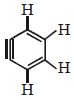
A
$4, 2$
B
$6, 0$
C
$3, 3$
D
$5, 1$
Solution
(A) The given structure is a six-membered ring with two double bonds and one triple bond (benzyne-like system).
In the ring,the two carbon atoms involved in the triple bond are $sp$ hybridized.
The remaining four carbon atoms in the ring are $sp^2$ hybridized.
Thus,there are $4$ $sp^2$ hybridized carbon atoms and $2$ $sp$ hybridized carbon atoms.
Therefore,the correct option is $A$.
In the ring,the two carbon atoms involved in the triple bond are $sp$ hybridized.
The remaining four carbon atoms in the ring are $sp^2$ hybridized.
Thus,there are $4$ $sp^2$ hybridized carbon atoms and $2$ $sp$ hybridized carbon atoms.
Therefore,the correct option is $A$.
0 likes
View Solution287
MediumMCQ
What is the hybridization of the central $I$ atom in the $I_3^-$ ion?
A
$sp$
B
$sp^2$
C
$sp^3$
D
$sp^3d$
Solution
(D) To determine the hybridization of the triiodide ion $(I_3^-)$,we use the formula:
$\text{Number of Hybrid Orbitals} = \frac{1}{2} \times (V + M - C + A)$
Where:
$V = \text{Number of valence electrons of the central atom} = 7$
$M = \text{Number of monovalent atoms attached} = 2$
$C = \text{Cationic charge} = 0$
$A = \text{Anionic charge} = 1$
Substituting the values:
$\text{Number of Hybrid Orbitals} = \frac{1}{2} \times (7 + 2 - 0 + 1) = \frac{10}{2} = 5$
$A$ hybridization number of $5$ corresponds to $sp^3d$ hybridization.
$\text{Number of Hybrid Orbitals} = \frac{1}{2} \times (V + M - C + A)$
Where:
$V = \text{Number of valence electrons of the central atom} = 7$
$M = \text{Number of monovalent atoms attached} = 2$
$C = \text{Cationic charge} = 0$
$A = \text{Anionic charge} = 1$
Substituting the values:
$\text{Number of Hybrid Orbitals} = \frac{1}{2} \times (7 + 2 - 0 + 1) = \frac{10}{2} = 5$
$A$ hybridization number of $5$ corresponds to $sp^3d$ hybridization.
0 likes
View Solution288
MediumMCQ
The hybridization states of the central atoms of the ions $I_3^-$,$ICl_4^-$ and $ICl_2^-$ are respectively
A
$sp^2, dsp^2, sp^3$
B
$sp^3d, sp^3d^2, sp^3d$
C
$sp^3d, sp^3d, dsp^2$
D
$sp, sp, dsp^2$
Solution
(B) To determine the hybridization,we use the formula: $H = \frac{1}{2}(V + M - C + A)$,where $V$ is the number of valence electrons of the central atom,$M$ is the number of monovalent atoms,$C$ is the cationic charge,and $A$ is the anionic charge.
$1$. For $I_3^-$: Central atom $I$ has $V=7$,$M=2$,$A=1$. $H = \frac{1}{2}(7 + 2 + 1) = 5$. Hybridization is $sp^3d$.
$2$. For $ICl_4^-$: Central atom $I$ has $V=7$,$M=4$,$A=1$. $H = \frac{1}{2}(7 + 4 + 1) = 6$. Hybridization is $sp^3d^2$.
$3$. For $ICl_2^-$: Central atom $I$ has $V=7$,$M=2$,$A=1$. $H = \frac{1}{2}(7 + 2 + 1) = 5$. Hybridization is $sp^3d$.
Thus,the hybridization states are $sp^3d, sp^3d^2, sp^3d$.
$1$. For $I_3^-$: Central atom $I$ has $V=7$,$M=2$,$A=1$. $H = \frac{1}{2}(7 + 2 + 1) = 5$. Hybridization is $sp^3d$.
$2$. For $ICl_4^-$: Central atom $I$ has $V=7$,$M=4$,$A=1$. $H = \frac{1}{2}(7 + 4 + 1) = 6$. Hybridization is $sp^3d^2$.
$3$. For $ICl_2^-$: Central atom $I$ has $V=7$,$M=2$,$A=1$. $H = \frac{1}{2}(7 + 2 + 1) = 5$. Hybridization is $sp^3d$.
Thus,the hybridization states are $sp^3d, sp^3d^2, sp^3d$.
0 likes
View Solution289
AdvancedMCQ
Consider the species $NO_3^-$,$NO_2^+$,and $NO_2^-$. Pick the correct statement:
A
The hybridisation state of $N$ in all the species is the same.
B
The shape of $NO_2^-$ is bent while $NO_3^-$ is pyramidal.
C
The hybridisation state of $N$ in $NO_3^-$ and $NO_2^-$ is the same.
D
The hybridisation state of $N$ in $NO_2^+$ is $sp^3$.
Solution
(C) To determine the hybridisation of the central atom $N$,we use the formula: $\text{Hybridisation} = \frac{1}{2} [V + M - C + A]$,where $V$ is the number of valence electrons,$M$ is the number of monovalent atoms,$C$ is the cationic charge,and $A$ is the anionic charge.
$1$. For $NO_3^-$: $N = \frac{1}{2} [5 + 0 - 0 + 1] = 3$. This corresponds to $sp^2$ hybridisation.
$2$. For $NO_2^+$: $N = \frac{1}{2} [5 + 0 - 1 + 0] = 2$. This corresponds to $sp$ hybridisation.
$3$. For $NO_2^-$: $N = \frac{1}{2} [5 + 0 - 0 + 1] = 3$. This corresponds to $sp^2$ hybridisation.
Comparing these,both $NO_3^-$ and $NO_2^-$ have $sp^2$ hybridisation. Therefore,statement $C$ is correct.
$1$. For $NO_3^-$: $N = \frac{1}{2} [5 + 0 - 0 + 1] = 3$. This corresponds to $sp^2$ hybridisation.
$2$. For $NO_2^+$: $N = \frac{1}{2} [5 + 0 - 1 + 0] = 2$. This corresponds to $sp$ hybridisation.
$3$. For $NO_2^-$: $N = \frac{1}{2} [5 + 0 - 0 + 1] = 3$. This corresponds to $sp^2$ hybridisation.
Comparing these,both $NO_3^-$ and $NO_2^-$ have $sp^2$ hybridisation. Therefore,statement $C$ is correct.
0 likes
View Solution290
MediumMCQ
Consider the following statements for $\dot{CH_3} = X$ and $\dot{CF_3} = Y$:
$I$. When $X$ dimerises,the bond angle decreases.
$II$. When $X$ dimerises,the bond angle increases.
$III$. In the $X-Y$ molecule,the $C-C$ bond length is less than that in the $Y-Y$ molecule.
$IV$. The bond angle in $X$ is greater than that in $Y$.
$I$. When $X$ dimerises,the bond angle decreases.
$II$. When $X$ dimerises,the bond angle increases.
$III$. In the $X-Y$ molecule,the $C-C$ bond length is less than that in the $Y-Y$ molecule.
$IV$. The bond angle in $X$ is greater than that in $Y$.
A
$II, III$
B
$I, II, III$
C
$I, IV$
D
$II, III, IV$
Solution
(C) $X$ is the methyl radical $(\dot{CH_3})$,which is $sp^2$ hybridized (planar,bond angle $120^{\circ}$). $Y$ is the trifluoromethyl radical $(\dot{CF_3})$,which is $sp^3$ hybridized (pyramidal,bond angle $\approx 110^{\circ}$).
$I$. Dimerization of $X$ gives $CH_3-CH_3$ (ethane),where $C$ is $sp^3$ hybridized (bond angle $109.5^{\circ}$). Since $120^{\circ} > 109.5^{\circ}$,the bond angle decreases. Statement $I$ is correct.
$II$. Incorrect,as shown above.
$III$. In $X-Y$ $(CH_3-CF_3)$,the $C-C$ bond length is shorter than in $Y-Y$ $(CF_3-CF_3)$ due to less steric repulsion and electronegativity effects. Statement $III$ is correct.
$IV$. Bond angle in $X$ $(120^{\circ})$ is greater than in $Y$ $(\approx 110^{\circ})$. Statement $IV$ is correct.
Since statements $I, III,$ and $IV$ are correct,and the closest provided option is $C$ $(I, IV)$,we select $C$.
$I$. Dimerization of $X$ gives $CH_3-CH_3$ (ethane),where $C$ is $sp^3$ hybridized (bond angle $109.5^{\circ}$). Since $120^{\circ} > 109.5^{\circ}$,the bond angle decreases. Statement $I$ is correct.
$II$. Incorrect,as shown above.
$III$. In $X-Y$ $(CH_3-CF_3)$,the $C-C$ bond length is shorter than in $Y-Y$ $(CF_3-CF_3)$ due to less steric repulsion and electronegativity effects. Statement $III$ is correct.
$IV$. Bond angle in $X$ $(120^{\circ})$ is greater than in $Y$ $(\approx 110^{\circ})$. Statement $IV$ is correct.
Since statements $I, III,$ and $IV$ are correct,and the closest provided option is $C$ $(I, IV)$,we select $C$.
0 likes
View Solution291
DifficultMCQ
If the dipole moment of an $MX_3$ molecule is zero,then the orbitals used by $M$ $(atomic\ number < 21)$ in sigma bonding are ....
A
$p$
B
$sp$ hybridized
C
$sp^2$ hybridized
D
$sp^3$ hybridized
Solution
(C) For an $MX_3$ molecule to have a dipole moment of zero,it must have a trigonal planar geometry.
This geometry corresponds to $sp^2$ hybridization of the central atom $M$.
Since the atomic number of $M$ is less than $21$,it belongs to the $s$ or $p$ block elements (e.g.,$BF_3$ where $B$ has atomic number $5$).
Therefore,the central atom $M$ uses $sp^2$ hybridized orbitals for sigma bonding.
This geometry corresponds to $sp^2$ hybridization of the central atom $M$.
Since the atomic number of $M$ is less than $21$,it belongs to the $s$ or $p$ block elements (e.g.,$BF_3$ where $B$ has atomic number $5$).
Therefore,the central atom $M$ uses $sp^2$ hybridized orbitals for sigma bonding.
0 likes
View Solution292
EasyMCQ
As the $s$-character of the hybrid orbital decreases,the bond angle ...........
A
remains the same
B
increases
C
decreases
D
none of the above
0 likes
View Solution293
MediumMCQ
The hybridization of nitrogen atoms in $NO^{+}_2$,$NO^{-}_3$,and $NH^{+}_4$ respectively is:
A
$sp, sp^2, sp^3$
B
$sp, sp^3, sp^2$
C
$sp^2, sp, sp^3$
D
$sp^2, sp^3, sp$
Solution
(A) To determine the hybridization,we use the formula: $\text{Steric Number} = \frac{1}{2} [V + M - C + A]$,where $V$ is the number of valence electrons of the central atom,$M$ is the number of monovalent atoms,$C$ is the cationic charge,and $A$ is the anionic charge.
$1$. For $NO^{+}_2$: $V=5, M=0, C=1, A=0$. $\text{Steric Number} = \frac{1}{2} [5 + 0 - 1 + 0] = 2$. Hybridization is $sp$.
$2$. For $NO^{-}_3$: $V=5, M=0, C=0, A=1$. $\text{Steric Number} = \frac{1}{2} [5 + 0 - 0 + 1] = 3$. Hybridization is $sp^2$.
$3$. For $NH^{+}_4$: $V=5, M=4, C=1, A=0$. $\text{Steric Number} = \frac{1}{2} [5 + 4 - 1 + 0] = 4$. Hybridization is $sp^3$.
Thus,the hybridization is $sp, sp^2, sp^3$.
$1$. For $NO^{+}_2$: $V=5, M=0, C=1, A=0$. $\text{Steric Number} = \frac{1}{2} [5 + 0 - 1 + 0] = 2$. Hybridization is $sp$.
$2$. For $NO^{-}_3$: $V=5, M=0, C=0, A=1$. $\text{Steric Number} = \frac{1}{2} [5 + 0 - 0 + 1] = 3$. Hybridization is $sp^2$.
$3$. For $NH^{+}_4$: $V=5, M=4, C=1, A=0$. $\text{Steric Number} = \frac{1}{2} [5 + 4 - 1 + 0] = 4$. Hybridization is $sp^3$.
Thus,the hybridization is $sp, sp^2, sp^3$.
0 likes
View Solution294
MediumMCQ
What is the hybridization of the $Cl$ atom in $ClO^{-}_2$?
A
$sp^3$
B
$sp^2$
C
$sp$
D
None of these
Solution
(A) The hybridization of the central atom is calculated using the formula: $H = \frac{1}{2} (V + M - C + A)$,where $V$ is the number of valence electrons of the central atom,$M$ is the number of monovalent atoms,$C$ is the cationic charge,and $A$ is the anionic charge.
For $ClO^{-}_2$:
$V = 7$ (for $Cl$),
$M = 0$ (oxygen is divalent),
$C = 0$,
$A = 1$ (for $-1$ charge).
$H = \frac{1}{2} (7 + 0 - 0 + 1) = \frac{8}{2} = 4$.
$A$ value of $4$ corresponds to $sp^3$ hybridization.
For $ClO^{-}_2$:
$V = 7$ (for $Cl$),
$M = 0$ (oxygen is divalent),
$C = 0$,
$A = 1$ (for $-1$ charge).
$H = \frac{1}{2} (7 + 0 - 0 + 1) = \frac{8}{2} = 4$.
$A$ value of $4$ corresponds to $sp^3$ hybridization.
0 likes
View Solution295
MediumMCQ
Which of the following molecules has a central atom with $sp^2$ hybridization?
A
$CO_2$
B
$SO_2$
C
$N_2O$
D
$CO$
Solution
(B) To determine the hybridization of the central atom,we use the formula: $H = \frac{1}{2}(V + M - C + A)$,where $V$ is the number of valence electrons,$M$ is the number of monovalent atoms,$C$ is the cationic charge,and $A$ is the anionic charge.
For $CO_2$: $H = \frac{1}{2}(4 + 0) = 2$ ($sp$ hybridization).
For $SO_2$: The central $S$ atom has $6$ valence electrons. It forms two double bonds with $O$ atoms and has one lone pair. $H = \frac{1}{2}(6 + 0) = 3$ ($sp^2$ hybridization).
For $N_2O$: The central $N$ atom is $sp$ hybridized.
For $CO$: The central $C$ atom is $sp$ hybridized.
Thus,$SO_2$ is the correct answer.
For $CO_2$: $H = \frac{1}{2}(4 + 0) = 2$ ($sp$ hybridization).
For $SO_2$: The central $S$ atom has $6$ valence electrons. It forms two double bonds with $O$ atoms and has one lone pair. $H = \frac{1}{2}(6 + 0) = 3$ ($sp^2$ hybridization).
For $N_2O$: The central $N$ atom is $sp$ hybridized.
For $CO$: The central $C$ atom is $sp$ hybridized.
Thus,$SO_2$ is the correct answer.
0 likes
View Solution296
DifficultMCQ
During the conversion of $PCl_3$ to $PCl_5$,the hybridisation of the $P$ atom changes from .......
A
$sp^2 \to sp^3$
B
$sp^3 \to sp^2$
C
$sp^3 \to sp^3d$
D
$sp^3 \to dsp^2$
Solution
(C) In $PCl_3$,the phosphorus atom has $3$ bond pairs and $1$ lone pair,resulting in a steric number of $4$,which corresponds to $sp^3$ hybridisation.
In $PCl_5$,the phosphorus atom has $5$ bond pairs and $0$ lone pairs,resulting in a steric number of $5$,which corresponds to $sp^3d$ hybridisation.
Therefore,the hybridisation changes from $sp^3$ to $sp^3d$.
In $PCl_5$,the phosphorus atom has $5$ bond pairs and $0$ lone pairs,resulting in a steric number of $5$,which corresponds to $sp^3d$ hybridisation.
Therefore,the hybridisation changes from $sp^3$ to $sp^3d$.
0 likes
View Solution297
DifficultMCQ
Which of the following has $sp^3$ hybridization?
A
$BBr_3$
B
$XeF_4$
C
$BCl_3$
D
$XeO_3$
Solution
(D) To determine the hybridization,we use the formula: $\text{Steric Number} = \frac{1}{2} [V + M - C + A]$,where $V$ is the number of valence electrons of the central atom,$M$ is the number of monovalent atoms,$C$ is the cationic charge,and $A$ is the anionic charge.
$A) \ BBr_3$: $\text{Steric Number} = \frac{1}{2} [3 + 3] = 3$ ($sp^2$ hybridization).
$B) \ XeF_4$: $\text{Steric Number} = \frac{1}{2} [8 + 4] = 6$ ($sp^3d^2$ hybridization).
$C) \ BCl_3$: $\text{Steric Number} = \frac{1}{2} [3 + 3] = 3$ ($sp^2$ hybridization).
$D) \ XeO_3$: $\text{Steric Number} = \frac{1}{2} [8 + 0] = 4$ ($sp^3$ hybridization). Note: Oxygen is a divalent atom,so it is not included in the $M$ count.
Therefore,$XeO_3$ has $sp^3$ hybridization.
$A) \ BBr_3$: $\text{Steric Number} = \frac{1}{2} [3 + 3] = 3$ ($sp^2$ hybridization).
$B) \ XeF_4$: $\text{Steric Number} = \frac{1}{2} [8 + 4] = 6$ ($sp^3d^2$ hybridization).
$C) \ BCl_3$: $\text{Steric Number} = \frac{1}{2} [3 + 3] = 3$ ($sp^2$ hybridization).
$D) \ XeO_3$: $\text{Steric Number} = \frac{1}{2} [8 + 0] = 4$ ($sp^3$ hybridization). Note: Oxygen is a divalent atom,so it is not included in the $M$ count.
Therefore,$XeO_3$ has $sp^3$ hybridization.
0 likes
View Solution298
MediumMCQ
The increasing order of electronegativity of hybrid orbitals is ..........
A
$sp < sp^2 < sp^3$
B
$sp^2 < sp < sp^3$
C
$sp^3 < sp^2 < sp$
D
$sp^2 < sp^3 < sp$
Solution
(C) Electronegativity is directly proportional to the $s$-character in the hybrid orbital.
$sp$ hybrid orbital has $50\%$ $s$-character.
$sp^2$ hybrid orbital has $33.3\%$ $s$-character.
$sp^3$ hybrid orbital has $25\%$ $s$-character.
Since the $s$-character increases in the order $sp^3 < sp^2 < sp$,the electronegativity also increases in the same order: $sp^3 < sp^2 < sp$.
$sp$ hybrid orbital has $50\%$ $s$-character.
$sp^2$ hybrid orbital has $33.3\%$ $s$-character.
$sp^3$ hybrid orbital has $25\%$ $s$-character.
Since the $s$-character increases in the order $sp^3 < sp^2 < sp$,the electronegativity also increases in the same order: $sp^3 < sp^2 < sp$.
0 likes
View Solution299
MediumMCQ
The angle between two hybrid orbitals is $105^o$. The $s-$character of the hybrid orbitals will be ..............
A
$50 - 55 \%$
B
$9 - 12 \%$
C
$22 - 23 \%$
D
$11 - 12 \%$
Solution
(C) The relationship between the bond angle $(\theta)$ and the $s-$character $(s)$ in hybrid orbitals is given by the formula: $\cos \theta = \frac{s}{s-1}$.
Given $\theta = 105^o$,we have $\cos(105^o) = -0.2588$.
Substituting this into the equation: $-0.2588 = \frac{s}{s-1}$.
$-0.2588(s-1) = s$.
$-0.2588s + 0.2588 = s$.
$1.2588s = 0.2588$.
$s = \frac{0.2588}{1.2588} \approx 0.2056$.
Converting to percentage,$s \approx 20.56 \%$.
Among the given options,the value closest to this result is $22 - 23 \%$.
Given $\theta = 105^o$,we have $\cos(105^o) = -0.2588$.
Substituting this into the equation: $-0.2588 = \frac{s}{s-1}$.
$-0.2588(s-1) = s$.
$-0.2588s + 0.2588 = s$.
$1.2588s = 0.2588$.
$s = \frac{0.2588}{1.2588} \approx 0.2056$.
Converting to percentage,$s \approx 20.56 \%$.
Among the given options,the value closest to this result is $22 - 23 \%$.
0 likes
View Solution300
DifficultMCQ
Which of the following sets of species have the same hybridisation state but different shapes?
A
$NO_2^+, NO_2, NO_2^-$
B
$ClO_4^-, SF_4, XeF_4$
C
$NH_4^+, H_3O^+, OF_2$
D
$SO_4^{2-}, PO_4^{3-}, ClO_4^-$
Solution
(C) To determine the hybridisation state,we calculate the steric number $(SN)$ using the formula: $SN = \frac{1}{2} (V + M - C + A)$,where $V$ is the number of valence electrons of the central atom,$M$ is the number of monovalent atoms,$C$ is the cationic charge,and $A$ is the anionic charge.
For option $C$:
$1$. $NH_4^+$: $SN = \frac{1}{2} (5 + 4 - 1 + 0) = 4$ ($sp^3$ hybridisation). Shape: Tetrahedral.
$2$. $H_3O^+$: $SN = \frac{1}{2} (6 + 3 - 1 + 0) = 4$ ($sp^3$ hybridisation). Shape: Pyramidal.
$3$. $OF_2$: $SN = \frac{1}{2} (6 + 2 - 0 + 0) = 4$ ($sp^3$ hybridisation). Shape: Bent.
All three species have $sp^3$ hybridisation but different shapes due to the presence of different numbers of lone pairs on the central atom.
For option $C$:
$1$. $NH_4^+$: $SN = \frac{1}{2} (5 + 4 - 1 + 0) = 4$ ($sp^3$ hybridisation). Shape: Tetrahedral.
$2$. $H_3O^+$: $SN = \frac{1}{2} (6 + 3 - 1 + 0) = 4$ ($sp^3$ hybridisation). Shape: Pyramidal.
$3$. $OF_2$: $SN = \frac{1}{2} (6 + 2 - 0 + 0) = 4$ ($sp^3$ hybridisation). Shape: Bent.
All three species have $sp^3$ hybridisation but different shapes due to the presence of different numbers of lone pairs on the central atom.
0 likes
View SolutionChemical Bonding and Molecular Structure — Hybridisation · Frequently Asked Questions
1Are these Chemical Bonding and Molecular Structure questions useful for JEE and NEET?
Yes. All questions in this section are mapped to JEE Main and NEET exam patterns. Previous year questions from JEE Main, NEET, GUJCET and state-level exams are included with full solutions.
2Can I switch to Hindi or Gujarati for these questions?
Yes. Use the language tabs in the hero section or the sidebar to view the same questions and solutions in English, Hindi or Gujarati.
3How do I generate a question paper from this subtopic?
Use the Vedclass Exam Paper Generator — select the chapter and subtopic, set difficulty, and generate Sets A, B, C, D automatically. First 3 chapters of every subject are free.
Vedclass Products
For Students
Vedclass Test Series
Mock tests in real JEE/NEET style with performance analysis. 5-day free trial.
Start Free TrialFor Teachers
Exam Paper Generator
Generate Set A/B/C/D papers from this chapter in 2 minutes. 3 chapters free.
Try FreeFor Institutes
Online Exam Module
Live online exams with unlimited students, 360° analytics & white-label branding.
See DemoFor Teachers & Institutes
Generate a Chemical Bonding and Molecular Structure Exam Paper in 2 Minutes
Select subtopic & difficulty — Sets A, B, C, D auto-generated with No Repeat logic.
First 3 chapters of every subject are free — no payment required.