
A English
Hybridisation Questions in English
Class 11 Chemistry · Chemical Bonding and Molecular Structure · Hybridisation
538+
Questions
English
Language
100%
With Solutions
Showing 50 of 538 questions in English
301
MediumMCQ
Which of the following molecular geometries is not produced by $sp^3$ hybridisation?
A
Triangular planar
B
See-Saw
C
$T$-shape
D
Linear
Solution
(A) $sp^3$ hybridisation involves the mixing of one $s$ and three $p$ orbitals to form four equivalent $sp^3$ hybrid orbitals directed towards the corners of a tetrahedron.
Common geometries resulting from $sp^3$ hybridisation include tetrahedral (e.g.,$CH_4$),trigonal pyramidal (e.g.,$NH_3$),and bent/angular (e.g.,$H_2O$).
Triangular planar,See-Saw,$T$-shape,and linear geometries are associated with other hybridisation types (such as $sp^2$,$sp^3d$,or $sp^3d^2$) and are not produced by $sp^3$ hybridisation.
Therefore,all the given options are not produced by $sp^3$ hybridisation,but in the context of standard multiple-choice questions,this question is often flawed as multiple options are correct.
Common geometries resulting from $sp^3$ hybridisation include tetrahedral (e.g.,$CH_4$),trigonal pyramidal (e.g.,$NH_3$),and bent/angular (e.g.,$H_2O$).
Triangular planar,See-Saw,$T$-shape,and linear geometries are associated with other hybridisation types (such as $sp^2$,$sp^3d$,or $sp^3d^2$) and are not produced by $sp^3$ hybridisation.
Therefore,all the given options are not produced by $sp^3$ hybridisation,but in the context of standard multiple-choice questions,this question is often flawed as multiple options are correct.
0 likes
View Solution302
MediumMCQ
Which of the following can have a structure with $sp^3$ $C$ atoms only?
A
Acetic acid
B
$C_3H_6$
C
Acetonitrile
D
$C_2H_3Cl$
Solution
(B) $1$. Acetic acid $(CH_3COOH)$ contains a carbonyl group $(C=O)$,which involves an $sp^2$ hybridized carbon atom.
$2$. $C_3H_6$ can exist as propene $(CH_3-CH=CH_2)$,which contains $sp^2$ hybridized carbon atoms,or cyclopropane,where all carbons are $sp^3$ hybridized.
$3$. Acetonitrile $(CH_3CN)$ contains a cyano group $(-C \equiv N)$,where the carbon atom is $sp$ hybridized.
$4$. $C_2H_3Cl$ (vinyl chloride,$CH_2=CHCl$) contains $sp^2$ hybridized carbon atoms.
$5$. Cyclopropane $(C_3H_6)$ is a cyclic alkane where each carbon atom is bonded to two other carbons and two hydrogens,resulting in $sp^3$ hybridization for all carbon atoms.
$2$. $C_3H_6$ can exist as propene $(CH_3-CH=CH_2)$,which contains $sp^2$ hybridized carbon atoms,or cyclopropane,where all carbons are $sp^3$ hybridized.
$3$. Acetonitrile $(CH_3CN)$ contains a cyano group $(-C \equiv N)$,where the carbon atom is $sp$ hybridized.
$4$. $C_2H_3Cl$ (vinyl chloride,$CH_2=CHCl$) contains $sp^2$ hybridized carbon atoms.
$5$. Cyclopropane $(C_3H_6)$ is a cyclic alkane where each carbon atom is bonded to two other carbons and two hydrogens,resulting in $sp^3$ hybridization for all carbon atoms.
0 likes
View Solution303
MediumMCQ
Which of the following statements is incorrect?
A
$BeCl_2$ is a covalent compound
B
$BeCl_2$ is an electron-deficient molecule
C
$BeCl_2$ can form a dimer
D
The hybrid state of $Be$ in solid $BeCl_2$ is $sp^2$
Solution
(D) $A)$ Due to the small size and high charge density of $Be^{2+}$,its polarizing power is high,which leads to the sharing of electrons between $Be$ and $Cl$. This gives $BeCl_2$ significant covalent character.
$B)$ The $Be$ atom has only $4$ electrons in its valence shell,which does not satisfy the octet rule. Therefore,it is an electron-deficient molecule.
$C)$ $BeCl_2$ exists as a polymeric chain in the solid state and can form a dimer in the vapor phase.
$D)$ In solid $BeCl_2$,the $Be$ atom is $sp^3$ hybridized (due to coordinate bonding in the polymeric structure),and in the monomeric gaseous state,it is $sp$ hybridized. Thus,the statement that it is $sp^2$ is incorrect.
$B)$ The $Be$ atom has only $4$ electrons in its valence shell,which does not satisfy the octet rule. Therefore,it is an electron-deficient molecule.
$C)$ $BeCl_2$ exists as a polymeric chain in the solid state and can form a dimer in the vapor phase.
$D)$ In solid $BeCl_2$,the $Be$ atom is $sp^3$ hybridized (due to coordinate bonding in the polymeric structure),and in the monomeric gaseous state,it is $sp$ hybridized. Thus,the statement that it is $sp^2$ is incorrect.
0 likes
View Solution304
MediumMCQ
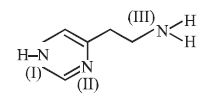
Which of the following is true for the geometry of different nitrogen atoms $(N)$ present in histamine as labeled in the structure?
A
$I$: Trigonal planar
B
$II$: Trigonal planar
C
$III$: Tetrahedral
D
All of the above
Solution
(D) In histamine,there are three nitrogen atoms labeled as $(I)$,$(II)$,and $(III)$:
$1$. Nitrogen $(I)$ is part of the imidazole ring and is bonded to one $H$ atom and two $C$ atoms. It has one lone pair. Its hybridization is $sp^2$,resulting in a trigonal planar geometry.
$2$. Nitrogen $(II)$ is part of the imidazole ring and is double-bonded to a $C$ atom. It has one lone pair. Its hybridization is $sp^2$,resulting in a trigonal planar geometry.
$3$. Nitrogen $(III)$ is an aliphatic primary amine nitrogen bonded to two $H$ atoms and one $C$ atom. It has one lone pair. Its hybridization is $sp^3$,resulting in a pyramidal (tetrahedral electron geometry) shape.
Since all statements $(A)$,$(B)$,and $(C)$ are correct,the correct option is $(D)$.
$1$. Nitrogen $(I)$ is part of the imidazole ring and is bonded to one $H$ atom and two $C$ atoms. It has one lone pair. Its hybridization is $sp^2$,resulting in a trigonal planar geometry.
$2$. Nitrogen $(II)$ is part of the imidazole ring and is double-bonded to a $C$ atom. It has one lone pair. Its hybridization is $sp^2$,resulting in a trigonal planar geometry.
$3$. Nitrogen $(III)$ is an aliphatic primary amine nitrogen bonded to two $H$ atoms and one $C$ atom. It has one lone pair. Its hybridization is $sp^3$,resulting in a pyramidal (tetrahedral electron geometry) shape.
Since all statements $(A)$,$(B)$,and $(C)$ are correct,the correct option is $(D)$.
0 likes
View Solution305
DifficultMCQ
Hybrid state of Aluminium in acidified aqueous solution of $AlCl_3$ is
A
$sp^3$
B
$sp^3d$
C
$sp^3d^2$
D
$sp^3d^3$
Solution
(C) $AlCl_3 + 6H_2O \to [Al(H_2O)_6]^{3+} + 3Cl^-$
In the complex ion $[Al(H_2O)_6]^{3+}$,the Aluminium ion is coordinated to $6$ water molecules.
The hybridization of $Al^{3+}$ in this octahedral complex is $sp^3d^2$.
In the complex ion $[Al(H_2O)_6]^{3+}$,the Aluminium ion is coordinated to $6$ water molecules.
The hybridization of $Al^{3+}$ in this octahedral complex is $sp^3d^2$.
0 likes
View Solution306
MediumMCQ
Choose the molecules in which hybridization occurs in the ground state?
$(i)$ $BCl_3$ $(ii)$ $NH_3$
$(iii)$ $PCl_3$ $(iv)$ $BeF_2$
The correct answer is
$(i)$ $BCl_3$ $(ii)$ $NH_3$
$(iii)$ $PCl_3$ $(iv)$ $BeF_2$
The correct answer is
A
$(i), (ii), (iv)$
B
$(i), (ii), (iii)$
C
$(ii), (iii)$
D
$(iii), (iv)$
Solution
(C) Hybridization is a concept used to explain the geometry of molecules by mixing atomic orbitals.
$(i)$ $BCl_3$: Boron $(Z=5)$ has ground state configuration $1s^2 2s^2 2p^1$. To form $3$ bonds,it promotes an electron to $2p$ to form $sp^2$ hybrid orbitals.
$(ii)$ $NH_3$: Nitrogen $(Z=7)$ has $1s^2 2s^2 2p^3$. It uses $sp^3$ hybridization in the ground state to form $3$ bonds and hold a lone pair.
$(iii)$ $PCl_3$: Phosphorus $(Z=15)$ has $3s^2 3p^3$. It uses $sp^3$ hybridization in the ground state to form $3$ bonds and hold a lone pair.
$(iv)$ $BeF_2$: Beryllium $(Z=4)$ has $1s^2 2s^2$. It promotes an electron to $2p$ to form $sp$ hybrid orbitals.
Therefore,$(ii)$ and $(iii)$ undergo hybridization in their ground state electronic configurations without needing promotion of electrons to higher energy subshells.
$(i)$ $BCl_3$: Boron $(Z=5)$ has ground state configuration $1s^2 2s^2 2p^1$. To form $3$ bonds,it promotes an electron to $2p$ to form $sp^2$ hybrid orbitals.
$(ii)$ $NH_3$: Nitrogen $(Z=7)$ has $1s^2 2s^2 2p^3$. It uses $sp^3$ hybridization in the ground state to form $3$ bonds and hold a lone pair.
$(iii)$ $PCl_3$: Phosphorus $(Z=15)$ has $3s^2 3p^3$. It uses $sp^3$ hybridization in the ground state to form $3$ bonds and hold a lone pair.
$(iv)$ $BeF_2$: Beryllium $(Z=4)$ has $1s^2 2s^2$. It promotes an electron to $2p$ to form $sp$ hybrid orbitals.
Therefore,$(ii)$ and $(iii)$ undergo hybridization in their ground state electronic configurations without needing promotion of electrons to higher energy subshells.
0 likes
View Solution307
MediumMCQ
Which of the following statements are true about the $S_8$ molecule?
$I.$ There are no $p_{\pi}-p_{\pi}$ bonds present in the molecule.
$II.$ There are eight lone pairs of electrons in total.
$III.$ Each $S$ atom is $sp^3$ hybridized.
$I.$ There are no $p_{\pi}-p_{\pi}$ bonds present in the molecule.
$II.$ There are eight lone pairs of electrons in total.
$III.$ Each $S$ atom is $sp^3$ hybridized.
A
$I, III$
B
$II, III$
C
$I, II, III$
D
only $II$
Solution
(A) The $S_8$ molecule has a crown-shaped puckered ring structure.
$I.$ Since all $S-S$ bonds are single covalent bonds,there are no $p_{\pi}-p_{\pi}$ multiple bonds present.
$II.$ Each sulfur atom has $6$ valence electrons. It forms $2$ single bonds with adjacent $S$ atoms,leaving $4$ electrons as $2$ lone pairs per $S$ atom. With $8$ sulfur atoms,the total number of lone pairs is $8 \times 2 = 16$. Thus,statement $II$ is incorrect.
$III.$ Each sulfur atom is bonded to $2$ other sulfur atoms and possesses $2$ lone pairs,resulting in a steric number of $4$. Therefore,each $S$ atom is $sp^3$ hybridized. This statement is correct.
Thus,statements $I$ and $III$ are true.
$I.$ Since all $S-S$ bonds are single covalent bonds,there are no $p_{\pi}-p_{\pi}$ multiple bonds present.
$II.$ Each sulfur atom has $6$ valence electrons. It forms $2$ single bonds with adjacent $S$ atoms,leaving $4$ electrons as $2$ lone pairs per $S$ atom. With $8$ sulfur atoms,the total number of lone pairs is $8 \times 2 = 16$. Thus,statement $II$ is incorrect.
$III.$ Each sulfur atom is bonded to $2$ other sulfur atoms and possesses $2$ lone pairs,resulting in a steric number of $4$. Therefore,each $S$ atom is $sp^3$ hybridized. This statement is correct.
Thus,statements $I$ and $III$ are true.
0 likes
View Solution308
MediumMCQ
The bond angle and $\%$ $d-$character in $S$ atom in $SF_6$ are
A
$120^{\circ}, 20\%$
B
$90^{\circ}, 33\%$
C
$105^{\circ}, 25\%$
D
$90^{\circ}, 25\%$
Solution
(B) In $SF_6$,the sulfur atom undergoes $sp^3d^2$ hybridization.
This hybridization involves one $s$,three $p$,and two $d$ orbitals.
The total number of orbitals involved is $1+3+2 = 6$.
The percentage of $d-$character is calculated as $\frac{\text{number of } d \text{ orbitals}}{\text{total number of orbitals}} \times 100 = \frac{2}{6} \times 100 = 33.33\% \approx 33\%$.
The geometry of $SF_6$ is octahedral,where all bond angles between adjacent $F-S-F$ bonds are $90^{\circ}$.
This hybridization involves one $s$,three $p$,and two $d$ orbitals.
The total number of orbitals involved is $1+3+2 = 6$.
The percentage of $d-$character is calculated as $\frac{\text{number of } d \text{ orbitals}}{\text{total number of orbitals}} \times 100 = \frac{2}{6} \times 100 = 33.33\% \approx 33\%$.
The geometry of $SF_6$ is octahedral,where all bond angles between adjacent $F-S-F$ bonds are $90^{\circ}$.
0 likes
View Solution309
MediumMCQ
From left to right, $sp^2, sp^2, sp, sp$ hybridisation is present in
A
$CH_2=CH-C\equiv N$
B
$CH_2=C=CH-CH_3$
C
$HC\equiv C-C\equiv CH$
D
$CH\equiv C-CH=CH_2$
Solution
$(A)$ To determine the hybridisation of carbon atoms, we count the number of sigma bonds and lone pairs (steric number).
$1$. $sp^3$ hybridisation: $4$ sigma bonds.
$2$. $sp^2$ hybridisation: $3$ sigma bonds.
$3$. $sp$ hybridisation: $2$ sigma bonds.
In option $A$, $CH_2=CH-C\equiv N$:
- The first carbon $(CH_2=)$ has $3$ sigma bonds $\rightarrow sp^2$.
- The second carbon $(-CH-)$ has $3$ sigma bonds $\rightarrow sp^2$.
- The third carbon $(-C\equiv)$ has $2$ sigma bonds $\rightarrow sp$.
- The fourth carbon $(\equiv N)$ is nitrogen, but the carbon atom attached to nitrogen has $2$ sigma bonds $\rightarrow sp$.
Thus, the sequence is $sp^2, sp^2, sp, sp$.
$1$. $sp^3$ hybridisation: $4$ sigma bonds.
$2$. $sp^2$ hybridisation: $3$ sigma bonds.
$3$. $sp$ hybridisation: $2$ sigma bonds.
In option $A$, $CH_2=CH-C\equiv N$:
- The first carbon $(CH_2=)$ has $3$ sigma bonds $\rightarrow sp^2$.
- The second carbon $(-CH-)$ has $3$ sigma bonds $\rightarrow sp^2$.
- The third carbon $(-C\equiv)$ has $2$ sigma bonds $\rightarrow sp$.
- The fourth carbon $(\equiv N)$ is nitrogen, but the carbon atom attached to nitrogen has $2$ sigma bonds $\rightarrow sp$.
Thus, the sequence is $sp^2, sp^2, sp, sp$.
0 likes
View Solution310
DifficultMCQ
In the formation of a certain compound,the central atom uses its hybrid orbitals and has a bond angle around it of $105^o$. The percentage of $s-$ character in the hybrid orbitals is likely to be
A
$50 - 55\%$
B
$30 - 40\%$
C
$10 - 15\%$
D
$23 - 25\%$
Solution
(D) The relationship between the bond angle $(\theta)$ and the percentage of $s-$ character $(s\%)$ in hybrid orbitals is given by the formula: $\cos \theta = \frac{s}{s-1}$.
For a bond angle of $105^o$,$\cos(105^o) \approx -0.2588$.
Substituting this into the formula: $-0.2588 = \frac{s}{s-1}$.
Solving for $s$: $-0.2588(s-1) = s \implies -0.2588s + 0.2588 = s \implies 1.2588s = 0.2588 \implies s \approx 0.2056$.
This corresponds to approximately $20.56\%$ $s-$ character.
Among the given options,the range $23 - 25\%$ is the closest to the calculated value,as bond angles in molecules like $H_2O$ $(104.5^o)$ involve $sp^3$ hybridization with slightly less than $25\%$ $s-$ character due to Bent's rule.
For a bond angle of $105^o$,$\cos(105^o) \approx -0.2588$.
Substituting this into the formula: $-0.2588 = \frac{s}{s-1}$.
Solving for $s$: $-0.2588(s-1) = s \implies -0.2588s + 0.2588 = s \implies 1.2588s = 0.2588 \implies s \approx 0.2056$.
This corresponds to approximately $20.56\%$ $s-$ character.
Among the given options,the range $23 - 25\%$ is the closest to the calculated value,as bond angles in molecules like $H_2O$ $(104.5^o)$ involve $sp^3$ hybridization with slightly less than $25\%$ $s-$ character due to Bent's rule.
0 likes
View Solution311
EasyMCQ
Which of the following has been arranged in increasing order of size of the hybrid orbitals?
A
$sp < sp^2 < sp^3$
B
$sp^3 < sp^2 < sp$
C
$sp^2 < sp^3 < sp$
D
$sp^2 < sp < sp^3$
Solution
(A) The size of a hybrid orbital depends on the percentage of $s$ and $p$ character.
As the $p-$character increases,the size of the hybrid orbital increases.
The $p-$character in $sp$ is $50\%$,in $sp^2$ is $66.6\%$,and in $sp^3$ is $75\%$.
Therefore,the increasing order of size is $sp < sp^2 < sp^3$.
As the $p-$character increases,the size of the hybrid orbital increases.
The $p-$character in $sp$ is $50\%$,in $sp^2$ is $66.6\%$,and in $sp^3$ is $75\%$.
Therefore,the increasing order of size is $sp < sp^2 < sp^3$.
0 likes
View Solution312
DifficultMCQ
The $d-$ orbitals which are involved in the hybridization of the central atom in $ICl_4^-$ are:
A
$d_{z^2}, d_{x^2-y^2}$
B
$d_{x^2-y^2}, d_{xy}, d_{yz}, d_{zx}$
C
$d_{z^2}, d_{xy}, d_{yz}, d_{xz}$
D
$d_{xy}, d_{xz}, d_{yz}$
Solution
(A) $1$. The central atom in $ICl_4^-$ is Iodine $(I)$.
$2$. The valence shell configuration of $I$ is $5s^2 5p^5$.
$3$. The number of electron pairs around $I$ is calculated as: $\frac{1}{2} \times (7 + 4 + 1) = 6$.
$4$. This corresponds to $sp^3d^2$ hybridization.
$5$. In $sp^3d^2$ hybridization,the two $d-$ orbitals involved are $d_{z^2}$ and $d_{x^2-y^2}$ to accommodate the square planar geometry with two lone pairs in the axial positions.
$2$. The valence shell configuration of $I$ is $5s^2 5p^5$.
$3$. The number of electron pairs around $I$ is calculated as: $\frac{1}{2} \times (7 + 4 + 1) = 6$.
$4$. This corresponds to $sp^3d^2$ hybridization.
$5$. In $sp^3d^2$ hybridization,the two $d-$ orbitals involved are $d_{z^2}$ and $d_{x^2-y^2}$ to accommodate the square planar geometry with two lone pairs in the axial positions.
0 likes
View Solution313
MediumMCQ
Which type of hybridization occurs in diborane $(B_2H_6)$?
A
$sp$
B
$sp^2$
C
$sp^3$
D
$sp^3d^2$
Solution
(C) In diborane $(B_2H_6)$,each boron atom is bonded to four hydrogen atoms.
Two hydrogen atoms are terminal,while two are bridging hydrogen atoms.
Each boron atom undergoes $sp^3$ hybridization to form four $sp^3$ hybrid orbitals.
Three of these orbitals contain one electron each,and one is empty,which helps in forming the $3c-2e$ (three-center two-electron) bonds.
Two hydrogen atoms are terminal,while two are bridging hydrogen atoms.
Each boron atom undergoes $sp^3$ hybridization to form four $sp^3$ hybrid orbitals.
Three of these orbitals contain one electron each,and one is empty,which helps in forming the $3c-2e$ (three-center two-electron) bonds.
0 likes
View Solution314
MediumMCQ
What is the structure and hybridization of $Si(CH_3)_4$?
A
Bent,$sp$
B
Trigonal,$sp^2$
C
Octahedral,$d^2sp^3$
D
Tetrahedral,$sp^3$
Solution
(D) In $Si(CH_3)_4$ (tetramethylsilane),the central silicon atom is bonded to four methyl groups.
Silicon has $4$ valence electrons and forms $4$ sigma bonds with the methyl groups.
The steric number is $4 + 0 = 4$,which corresponds to $sp^3$ hybridization.
$A$ molecule with $4$ bonding pairs and no lone pairs on the central atom adopts a tetrahedral geometry.
Silicon has $4$ valence electrons and forms $4$ sigma bonds with the methyl groups.
The steric number is $4 + 0 = 4$,which corresponds to $sp^3$ hybridization.
$A$ molecule with $4$ bonding pairs and no lone pairs on the central atom adopts a tetrahedral geometry.
0 likes
View Solution315
EasyMCQ
The hybridization of carbon in graphite and diamond is respectively ........
A
$sp, sp^2$
B
$sp^2, sp^3$
C
$sp^3, sp^2$
D
$sp^3, sp^3$
Solution
(B) In graphite,each carbon atom is bonded to three other carbon atoms in a hexagonal planar structure,resulting in $sp^2$ hybridization.
In diamond,each carbon atom is bonded to four other carbon atoms in a tetrahedral geometry,resulting in $sp^3$ hybridization.
Therefore,the hybridization of carbon in graphite and diamond is $sp^2$ and $sp^3$ respectively.
In diamond,each carbon atom is bonded to four other carbon atoms in a tetrahedral geometry,resulting in $sp^3$ hybridization.
Therefore,the hybridization of carbon in graphite and diamond is $sp^2$ and $sp^3$ respectively.
0 likes
View Solution316
MediumMCQ
Which of the following is true for carbon suboxide $(C_3O_2)$?
A
Distorted tetrahedral structure
B
Trigonal planar structure
C
Bent structure
D
Linear structure
Solution
(D) Carbon suboxide $(C_3O_2)$ has the chemical structure $O=C=C=C=O$.
In this molecule,each carbon atom is $sp$ hybridized.
The central carbon atom is bonded to two other carbon atoms,and the terminal carbon atoms are bonded to one carbon and one oxygen atom.
Due to $sp$ hybridization,the bond angle is $180^{\circ}$,which results in a linear structure.
In this molecule,each carbon atom is $sp$ hybridized.
The central carbon atom is bonded to two other carbon atoms,and the terminal carbon atoms are bonded to one carbon and one oxygen atom.
Due to $sp$ hybridization,the bond angle is $180^{\circ}$,which results in a linear structure.
0 likes
View Solution317
EasyMCQ
What is the hybridization of the central atom in $NH_4^+$?
A
$sp$
B
$sp^3$
C
$sp^2$
D
$dsp^2$
Solution
(B) The hybridization of the central atom can be calculated using the formula: $H = \frac{1}{2} (V + M - C + A)$,where $V$ is the number of valence electrons of the central atom,$M$ is the number of monovalent atoms,$C$ is the cationic charge,and $A$ is the anionic charge.
For $NH_4^+$,the central atom is $N$ $(V = 5)$,$M = 4$ (four $H$ atoms),$C = 1$,and $A = 0$.
$H = \frac{1}{2} (5 + 4 - 1 + 0) = \frac{8}{2} = 4$.
$A$ value of $4$ corresponds to $sp^3$ hybridization.
For $NH_4^+$,the central atom is $N$ $(V = 5)$,$M = 4$ (four $H$ atoms),$C = 1$,and $A = 0$.
$H = \frac{1}{2} (5 + 4 - 1 + 0) = \frac{8}{2} = 4$.
$A$ value of $4$ corresponds to $sp^3$ hybridization.
0 likes
View Solution318
EasyMCQ
Which of the following does not have $sp^3$ hybridization?
A
$SO_2$
B
$CH_4$
C
$NH_3$
D
$SO_4^{2-}$
Solution
(A) $1$. In $SO_2$,the central atom $S$ has one lone pair and two bond pairs (double bonds). The steric number is $1 + 2 = 3$,which corresponds to $sp^2$ hybridization.
$2$. In $CH_4$,the central atom $C$ has four bond pairs. The steric number is $4$,which corresponds to $sp^3$ hybridization.
$3$. In $NH_3$,the central atom $N$ has one lone pair and three bond pairs. The steric number is $1 + 3 = 4$,which corresponds to $sp^3$ hybridization.
$4$. In $SO_4^{2-}$,the central atom $S$ has four bond pairs. The steric number is $4$,which corresponds to $sp^3$ hybridization.
Therefore,$SO_2$ does not have $sp^3$ hybridization.
$2$. In $CH_4$,the central atom $C$ has four bond pairs. The steric number is $4$,which corresponds to $sp^3$ hybridization.
$3$. In $NH_3$,the central atom $N$ has one lone pair and three bond pairs. The steric number is $1 + 3 = 4$,which corresponds to $sp^3$ hybridization.
$4$. In $SO_4^{2-}$,the central atom $S$ has four bond pairs. The steric number is $4$,which corresponds to $sp^3$ hybridization.
Therefore,$SO_2$ does not have $sp^3$ hybridization.
0 likes
View Solution319
EasyMCQ
Determine the hybridization of the sulfur atom in $SO_2$.
A
$sp$
B
$sp^2$
C
$sp^3$
D
$dsp^2$
Solution
(B) The hybridization of an atom can be calculated using the formula: $H = \frac{1}{2} (V + M - C + A)$,where $V$ is the number of valence electrons of the central atom,$M$ is the number of monovalent atoms,$C$ is the cationic charge,and $A$ is the anionic charge.
For $SO_2$,the central atom is sulfur $(S)$.
Valence electrons of $S = 6$.
Number of monovalent atoms ($O$ is divalent) = $0$.
$H = \frac{1}{2} (6 + 0 - 0 + 0) = 3$.
$A$ steric number of $3$ corresponds to $sp^2$ hybridization.
In $SO_2$,sulfur has one lone pair and two sigma bonds,resulting in $sp^2$ hybridization.
For $SO_2$,the central atom is sulfur $(S)$.
Valence electrons of $S = 6$.
Number of monovalent atoms ($O$ is divalent) = $0$.
$H = \frac{1}{2} (6 + 0 - 0 + 0) = 3$.
$A$ steric number of $3$ corresponds to $sp^2$ hybridization.
In $SO_2$,sulfur has one lone pair and two sigma bonds,resulting in $sp^2$ hybridization.
0 likes
View Solution320
EasyMCQ
Determine the hybridization of the sulfur atom in the $SO_3$ molecule.
A
$sp^2$
B
$sp^3$
C
$sp^3d$
D
$sp^3d^2$
Solution
(A) The hybridization of an atom can be calculated using the formula: $H = \frac{1}{2}(V + M - C + A)$,where $V$ is the number of valence electrons of the central atom,$M$ is the number of monovalent atoms,$C$ is the charge on the cation,and $A$ is the charge on the anion.
For $SO_3$,the central atom is sulfur $(S)$.
Valence electrons of $S$ $(V)$ = $6$.
Number of monovalent atoms $(M)$ = $0$ (since oxygen is divalent).
$H = \frac{1}{2}(6 + 0) = 3$.
$A$ hybridization value of $3$ corresponds to $sp^2$ hybridization.
Thus,the sulfur atom in $SO_3$ is $sp^2$ hybridized.
For $SO_3$,the central atom is sulfur $(S)$.
Valence electrons of $S$ $(V)$ = $6$.
Number of monovalent atoms $(M)$ = $0$ (since oxygen is divalent).
$H = \frac{1}{2}(6 + 0) = 3$.
$A$ hybridization value of $3$ corresponds to $sp^2$ hybridization.
Thus,the sulfur atom in $SO_3$ is $sp^2$ hybridized.
0 likes
View Solution321
DifficultMCQ
The hybridization states of the chlorine atom in $ClO_4^-$,$ClO_3^-$,and $ClO_2^-$ are respectively .....
A
$sp^3, sp^3, sp^3$
B
$sp^3, sp^2, sp$
C
$sp^3, sp^3, sp^2$
D
$sp^2, sp^3, sp^3$
Solution
(A) The hybridization of the central atom can be calculated using the formula: $H = \frac{1}{2} [V + M - C + A]$,where $V$ is the number of valence electrons,$M$ is the number of monovalent atoms,$C$ is the cationic charge,and $A$ is the anionic charge.
For $ClO_4^-$: $H = \frac{1}{2} [7 + 0 - 0 + 1] = 4$,which corresponds to $sp^3$ hybridization.
For $ClO_3^-$: $H = \frac{1}{2} [7 + 0 - 0 + 1] = 4$,which corresponds to $sp^3$ hybridization.
For $ClO_2^-$: $H = \frac{1}{2} [7 + 0 - 0 + 1] = 4$,which corresponds to $sp^3$ hybridization.
In all three ions,the chlorine atom is $sp^3$ hybridized due to the presence of lone pairs and bonding pairs.
For $ClO_4^-$: $H = \frac{1}{2} [7 + 0 - 0 + 1] = 4$,which corresponds to $sp^3$ hybridization.
For $ClO_3^-$: $H = \frac{1}{2} [7 + 0 - 0 + 1] = 4$,which corresponds to $sp^3$ hybridization.
For $ClO_2^-$: $H = \frac{1}{2} [7 + 0 - 0 + 1] = 4$,which corresponds to $sp^3$ hybridization.
In all three ions,the chlorine atom is $sp^3$ hybridized due to the presence of lone pairs and bonding pairs.
0 likes
View Solution322
MediumMCQ
Which of the following statements is correct regarding the molecular formula and the hybridization of Xenon in its compound?
A
$XeF_4, sp^3$
B
$XeF_2, sp$
C
$XeF_2, sp^3d$
D
$XeF_4, sp^2$
Solution
(C) In $XeF_2$,the central atom $Xe$ has $8$ valence electrons. It forms $2$ bonds with $F$ atoms and has $3$ lone pairs of electrons.
Total electron pairs = $2$ (bond pairs) + $3$ (lone pairs) = $5$.
For $5$ electron pairs,the hybridization is $sp^3d$.
In $XeF_4$,the central atom $Xe$ forms $4$ bonds with $F$ atoms and has $2$ lone pairs of electrons.
Total electron pairs = $4$ (bond pairs) + $2$ (lone pairs) = $6$.
For $6$ electron pairs,the hybridization is $sp^3d^2$.
Therefore,the correct statement is $XeF_2, sp^3d$.
Total electron pairs = $2$ (bond pairs) + $3$ (lone pairs) = $5$.
For $5$ electron pairs,the hybridization is $sp^3d$.
In $XeF_4$,the central atom $Xe$ forms $4$ bonds with $F$ atoms and has $2$ lone pairs of electrons.
Total electron pairs = $4$ (bond pairs) + $2$ (lone pairs) = $6$.
For $6$ electron pairs,the hybridization is $sp^3d^2$.
Therefore,the correct statement is $XeF_2, sp^3d$.
0 likes
View Solution323
AdvancedMCQ
Sulphur reacts with chlorine in $1:2$ ratio and forms $X$. Hydrolysis of $X$ gives a sulphur compound $Y$. What is the structure and hybridisation of the anion of $Y$?
A
tetrahedral,$sp^3$
B
linear,$sp$
C
pyramidal,$sp^3$
D
trigonal planar,$sp^2$
Solution
(C) $S + 2Cl_2 \to SCl_4$
Hydrolysis of $SCl_4$ gives $H_2SO_3$ $(Y)$.
$SCl_4 + 3H_2O \to H_2SO_3 + 4HCl$
The anion of $Y$ is $SO_3^{2-}$.
In $SO_3^{2-}$,the central $S$ atom has $1$ lone pair and $3$ bond pairs,resulting in $sp^3$ hybridisation.
Due to the presence of one lone pair,the shape of $SO_3^{2-}$ is pyramidal.
Hydrolysis of $SCl_4$ gives $H_2SO_3$ $(Y)$.
$SCl_4 + 3H_2O \to H_2SO_3 + 4HCl$
The anion of $Y$ is $SO_3^{2-}$.
In $SO_3^{2-}$,the central $S$ atom has $1$ lone pair and $3$ bond pairs,resulting in $sp^3$ hybridisation.
Due to the presence of one lone pair,the shape of $SO_3^{2-}$ is pyramidal.
0 likes
View Solution324
EasyMCQ
Hybridisation states of $C$ in $CH_3^+$ and $CH_4$ are
A
$sp^2$ and $sp^3$
B
$sp^3$ and $sp^2$
C
$sp^2$ and $sp^2$
D
$sp^3$ and $sp^3$
Solution
(A) In $CH_3^+$,the carbon atom is bonded to $3$ hydrogen atoms and has a positive charge,resulting in $3$ sigma bonds and $0$ lone pairs. The steric number is $3$,which corresponds to $sp^2$ hybridisation.
In $CH_4$,the carbon atom is bonded to $4$ hydrogen atoms,resulting in $4$ sigma bonds and $0$ lone pairs. The steric number is $4$,which corresponds to $sp^3$ hybridisation.
In $CH_4$,the carbon atom is bonded to $4$ hydrogen atoms,resulting in $4$ sigma bonds and $0$ lone pairs. The steric number is $4$,which corresponds to $sp^3$ hybridisation.
0 likes
View Solution325
AdvancedMCQ
The number of $sp^{2}$ hybrid orbitals in a molecule of benzene is
A
$24$
B
$6$
C
$12$
D
$18$
Solution
(D) Benzene $(C_{6}H_{6})$ consists of $6$ carbon atoms,each of which is $sp^{2}$ hybridized.
Each $sp^{2}$ hybridized carbon atom forms $3$ $sp^{2}$ hybrid orbitals.
Therefore,the total number of $sp^{2}$ hybrid orbitals in a molecule of benzene is $6 \times 3 = 18$.
Each $sp^{2}$ hybridized carbon atom forms $3$ $sp^{2}$ hybrid orbitals.
Therefore,the total number of $sp^{2}$ hybrid orbitals in a molecule of benzene is $6 \times 3 = 18$.
0 likes
View Solution326
Medium
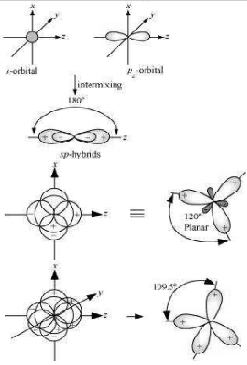
What is meant by hybridisation of atomic orbitals? Describe the shapes of $sp$,$sp^{2}$,$sp^{3}$ hybrid orbitals.
Solution
(N/A) Hybridization is defined as the process of intermixing of atomic orbitals of slightly different energies,thereby forming a new set of orbitals having equivalent energies and shapes.
$1$. Shape of $sp$ hybrid orbitals: $sp$ hybrid orbitals are formed by the intermixing of one $s$ and one $p$ orbital. They have a linear shape with a bond angle of $180^{\circ}$.
$2$. Shape of $sp^{2}$ hybrid orbitals: $sp^{2}$ hybrid orbitals are formed by the intermixing of one $s$ and two $p$ orbitals. They are oriented in a trigonal planar arrangement with bond angles of $120^{\circ}$.
$3$. Shape of $sp^{3}$ hybrid orbitals: $sp^{3}$ hybrid orbitals are formed by the intermixing of one $s$ and three $p$ orbitals. They are arranged in a tetrahedral geometry with bond angles of $109.5^{\circ}$.
$1$. Shape of $sp$ hybrid orbitals: $sp$ hybrid orbitals are formed by the intermixing of one $s$ and one $p$ orbital. They have a linear shape with a bond angle of $180^{\circ}$.
$2$. Shape of $sp^{2}$ hybrid orbitals: $sp^{2}$ hybrid orbitals are formed by the intermixing of one $s$ and two $p$ orbitals. They are oriented in a trigonal planar arrangement with bond angles of $120^{\circ}$.
$3$. Shape of $sp^{3}$ hybrid orbitals: $sp^{3}$ hybrid orbitals are formed by the intermixing of one $s$ and three $p$ orbitals. They are arranged in a tetrahedral geometry with bond angles of $109.5^{\circ}$.
0 likes
View Solution327
Medium
Describe the change in hybridisation (if any) of the $Al$ atom in the following reaction.
$AlCl_{3} + Cl^{-} \longrightarrow AlCl_{4}^{-}$
$AlCl_{3} + Cl^{-} \longrightarrow AlCl_{4}^{-}$
Solution
(N/A) In $AlCl_{3}$,the aluminium atom is in the $sp^{2}$ hybridised state,resulting in a trigonal planar geometry.
When $AlCl_{3}$ reacts with $Cl^{-}$ to form $AlCl_{4}^{-}$,the lone pair from the chloride ion is donated into the empty $3p_{z}$ orbital of the aluminium atom.
Consequently,the hybridisation of the $Al$ atom changes from $sp^{2}$ to $sp^{3}$,and the geometry changes from trigonal planar to tetrahedral.
When $AlCl_{3}$ reacts with $Cl^{-}$ to form $AlCl_{4}^{-}$,the lone pair from the chloride ion is donated into the empty $3p_{z}$ orbital of the aluminium atom.
Consequently,the hybridisation of the $Al$ atom changes from $sp^{2}$ to $sp^{3}$,and the geometry changes from trigonal planar to tetrahedral.
0 likes
View Solution328
Medium
Is there any change in the hybridisation of $B$ and $N$ atoms as a result of the following reaction?
$BF_{3} + NH_{3} \rightarrow F_{3}B \cdot NH_{3}$
$BF_{3} + NH_{3} \rightarrow F_{3}B \cdot NH_{3}$
Solution
(N/A) In $BF_{3}$,the Boron atom is $sp^{2}$ hybridized. It has an empty $2p_{z}$ orbital.
In $NH_{3}$,the Nitrogen atom is $sp^{3}$ hybridized,possessing one lone pair of electrons.
During the reaction,the lone pair from the Nitrogen atom is donated to the empty $2p_{z}$ orbital of the Boron atom to form a coordinate covalent bond.
As a result,the Boron atom changes its hybridization from $sp^{2}$ to $sp^{3}$ to accommodate the four bonding pairs.
The hybridization of the Nitrogen atom remains $sp^{3}$ as it still maintains four electron domains (three bonding pairs and one lone pair).
In $NH_{3}$,the Nitrogen atom is $sp^{3}$ hybridized,possessing one lone pair of electrons.
During the reaction,the lone pair from the Nitrogen atom is donated to the empty $2p_{z}$ orbital of the Boron atom to form a coordinate covalent bond.
As a result,the Boron atom changes its hybridization from $sp^{2}$ to $sp^{3}$ to accommodate the four bonding pairs.
The hybridization of the Nitrogen atom remains $sp^{3}$ as it still maintains four electron domains (three bonding pairs and one lone pair).
0 likes
View Solution329
Medium
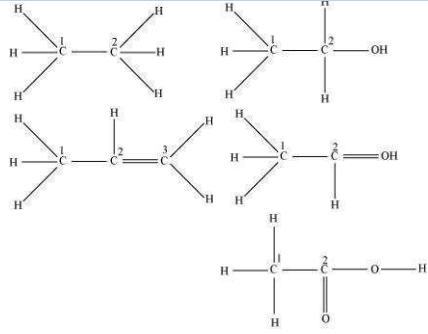
Which hybrid orbitals are used by carbon atoms in the following molecules?
$(a)$ $CH_3-CH_3$
$(b)$ $CH_3-CH=CH_2$
$(c)$ $CH_3-CH_2-OH$
$(d)$ $CH_3-CHO$
$(e)$ $CH_3COOH$
$(a)$ $CH_3-CH_3$
$(b)$ $CH_3-CH=CH_2$
$(c)$ $CH_3-CH_2-OH$
$(d)$ $CH_3-CHO$
$(e)$ $CH_3COOH$
Solution
(N/A) Both $C_1$ and $C_2$ are $sp^3$ hybridized.
$(b)$ $C_1$ is $sp^3$ hybridized,while $C_2$ and $C_3$ are $sp^2$ hybridized.
$(c)$ Both $C_1$ and $C_2$ are $sp^3$ hybridized.
$(d)$ $C_1$ is $sp^3$ hybridized and $C_2$ is $sp^2$ hybridized.
$(e)$ $C_1$ is $sp^3$ hybridized and $C_2$ is $sp^2$ hybridized.
$(b)$ $C_1$ is $sp^3$ hybridized,while $C_2$ and $C_3$ are $sp^2$ hybridized.
$(c)$ Both $C_1$ and $C_2$ are $sp^3$ hybridized.
$(d)$ $C_1$ is $sp^3$ hybridized and $C_2$ is $sp^2$ hybridized.
$(e)$ $C_1$ is $sp^3$ hybridized and $C_2$ is $sp^2$ hybridized.
0 likes
View Solution330
Medium
Describe the hybridisation in case of $PCl_{5}$. Why are the axial bonds longer as compared to equatorial bonds?
Solution
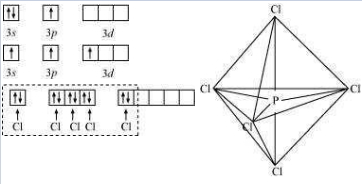
(N/A) The ground state and excited state outer electronic configurations of phosphorus $(Z=15)$ are:
Ground state: $3s^{2} 3p^{3}$
Excited state: $3s^{1} 3p^{3} 3d^{1}$
Phosphorus atom is $sp^{3}d$ hybridized in the excited state. These orbitals are filled by the electron pairs donated by five $Cl$ atoms to form $PCl_{5}$.
The five $sp^{3}d$ hybrid orbitals are directed towards the five corners of a trigonal bipyramid.
There are five $P-Cl$ sigma bonds in $PCl_{5}$. Three $P-Cl$ bonds lie in one plane and make an angle of $120^{\circ}$ with each other. These are called equatorial bonds.
The remaining two $P-Cl$ bonds lie above and below the equatorial plane and make an angle of $90^{\circ}$ with the plane. These are called axial bonds.
As the axial bond pairs suffer more repulsion from the three equatorial bond pairs,the axial bonds are slightly longer than the equatorial bonds.
Ground state: $3s^{2} 3p^{3}$
Excited state: $3s^{1} 3p^{3} 3d^{1}$
Phosphorus atom is $sp^{3}d$ hybridized in the excited state. These orbitals are filled by the electron pairs donated by five $Cl$ atoms to form $PCl_{5}$.
The five $sp^{3}d$ hybrid orbitals are directed towards the five corners of a trigonal bipyramid.
There are five $P-Cl$ sigma bonds in $PCl_{5}$. Three $P-Cl$ bonds lie in one plane and make an angle of $120^{\circ}$ with each other. These are called equatorial bonds.
The remaining two $P-Cl$ bonds lie above and below the equatorial plane and make an angle of $90^{\circ}$ with the plane. These are called axial bonds.
As the axial bond pairs suffer more repulsion from the three equatorial bond pairs,the axial bonds are slightly longer than the equatorial bonds.
0 likes
View Solution331
Medium
Describe the shapes of $BF_3$ and $BH_4^-$. Assign the hybridisation of boron in these species.
Solution
(N/A) $(i)$ $BF_3$: Boron in $BF_3$ is $sp^2$ hybridised. It has a planar triangular geometry. The three $sp^2$ hybrid orbitals of boron overlap with the $p$-orbitals of three fluorine atoms.
$(ii)$ $BH_4^-$: Boron in $BH_4^-$ is $sp^3$ hybridised. It has a tetrahedral geometry,where the four $sp^3$ hybrid orbitals of boron overlap with the $1s$ orbitals of four hydrogen atoms.
$(ii)$ $BH_4^-$: Boron in $BH_4^-$ is $sp^3$ hybridised. It has a tetrahedral geometry,where the four $sp^3$ hybrid orbitals of boron overlap with the $1s$ orbitals of four hydrogen atoms.
0 likes
View Solution332
MediumMCQ
What is the state of hybridisation of carbon in $(a)$ $CO_3^{2-}$,$(b)$ diamond,and $(c)$ graphite?
A
$sp^2, sp^3, sp^2$
B
$sp^3, sp^2, sp^3$
C
$sp^2, sp^2, sp^3$
D
$sp, sp^3, sp^2$
Solution
(A) The state of hybridisation of carbon is determined by the number of sigma bonds and lone pairs around the carbon atom.
$(a)$ In $CO_3^{2-}$,the carbon atom is bonded to three oxygen atoms with one double bond and two single bonds (resonance hybrid). It has $3$ sigma bonds and $0$ lone pairs,resulting in $sp^2$ hybridisation.
$(b)$ In diamond,each carbon atom is bonded to four other carbon atoms via single covalent bonds. It has $4$ sigma bonds and $0$ lone pairs,resulting in $sp^3$ hybridisation.
$(c)$ In graphite,each carbon atom is bonded to three other carbon atoms in a hexagonal planar layer. It has $3$ sigma bonds and $0$ lone pairs,resulting in $sp^2$ hybridisation.
$(a)$ In $CO_3^{2-}$,the carbon atom is bonded to three oxygen atoms with one double bond and two single bonds (resonance hybrid). It has $3$ sigma bonds and $0$ lone pairs,resulting in $sp^2$ hybridisation.
$(b)$ In diamond,each carbon atom is bonded to four other carbon atoms via single covalent bonds. It has $4$ sigma bonds and $0$ lone pairs,resulting in $sp^3$ hybridisation.
$(c)$ In graphite,each carbon atom is bonded to three other carbon atoms in a hexagonal planar layer. It has $3$ sigma bonds and $0$ lone pairs,resulting in $sp^2$ hybridisation.
0 likes
View Solution333
Medium
Suggest reasons why the $B-F$ bond lengths in $BF_{3}$ $(130 \ pm)$ and $BF_{4}^{-}$ $(143 \ pm)$ differ.
Solution
(N/A) The $B-F$ bond length in $BF_{3}$ is shorter than the $B-F$ bond length in $BF_{4}^{-}$.
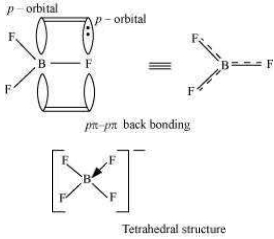
$BF_{3}$ is an electron-deficient species. With a vacant $p$-orbital on boron, the fluorine and boron atoms undergo $p\pi-p\pi$ back-bonding to remove this deficiency. This imparts a partial double bond character to the $B-F$ bond.
This double-bond character causes the bond length to shorten in $BF_{3}$ $(130 \ pm)$.
However, when $BF_{3}$ coordinates with the fluoride ion, a change in hybridisation from $sp^{2}$ (in $BF_{3}$) to $sp^{3}$ (in $BF_{4}^{-}$) occurs.
Boron now forms $4 \sigma$ bonds and the double-bond character is lost. This accounts for a $B-F$ bond length of $143 \ pm$ in the $BF_{4}^{-}$ ion.
$BF_{3}$ is an electron-deficient species. With a vacant $p$-orbital on boron, the fluorine and boron atoms undergo $p\pi-p\pi$ back-bonding to remove this deficiency. This imparts a partial double bond character to the $B-F$ bond.
This double-bond character causes the bond length to shorten in $BF_{3}$ $(130 \ pm)$.
However, when $BF_{3}$ coordinates with the fluoride ion, a change in hybridisation from $sp^{2}$ (in $BF_{3}$) to $sp^{3}$ (in $BF_{4}^{-}$) occurs.
Boron now forms $4 \sigma$ bonds and the double-bond character is lost. This accounts for a $B-F$ bond length of $143 \ pm$ in the $BF_{4}^{-}$ ion.
0 likes
View Solution334
Medium
Write the state of hybridisation of carbon in the following compounds and the shapes of each of the molecules:
$(a)$ $H_2C=O$
$(b)$ $CH_3F$
$(c)$ $HC \equiv N$
$(a)$ $H_2C=O$
$(b)$ $CH_3F$
$(c)$ $HC \equiv N$
Solution
(N/A) $H_2C=O$: The carbon atom is bonded to two hydrogen atoms and one oxygen atom via a double bond. It has $3$ sigma bonds and $0$ lone pairs,resulting in $sp^2$ hybridisation. The shape is trigonal planar.
$(b)$ $CH_3F$: The carbon atom is bonded to three hydrogen atoms and one fluorine atom via single bonds. It has $4$ sigma bonds and $0$ lone pairs,resulting in $sp^3$ hybridisation. The shape is tetrahedral.
$(c)$ $HC \equiv N$: The carbon atom is bonded to one hydrogen atom via a single bond and one nitrogen atom via a triple bond. It has $2$ sigma bonds and $0$ lone pairs,resulting in $sp$ hybridisation. The shape is linear.
$(b)$ $CH_3F$: The carbon atom is bonded to three hydrogen atoms and one fluorine atom via single bonds. It has $4$ sigma bonds and $0$ lone pairs,resulting in $sp^3$ hybridisation. The shape is tetrahedral.
$(c)$ $HC \equiv N$: The carbon atom is bonded to one hydrogen atom via a single bond and one nitrogen atom via a triple bond. It has $2$ sigma bonds and $0$ lone pairs,resulting in $sp$ hybridisation. The shape is linear.
0 likes
View Solution335
EasyMCQ
What is the hybridization of $C$ atoms in graphite?
A
$sp^3$
B
$sp^2$
C
$sp$
D
$dsp^2$
Solution
(B) In graphite,each carbon atom is covalently bonded to three other carbon atoms in a hexagonal planar arrangement.
Each carbon atom forms three sigma bonds using $sp^2$ hybrid orbitals.
The fourth valence electron of each carbon atom remains in an unhybridized $p$-orbital,which participates in $\pi$-bonding.
Therefore,the hybridization of $C$ atoms in graphite is $sp^2$.
Each carbon atom forms three sigma bonds using $sp^2$ hybrid orbitals.
The fourth valence electron of each carbon atom remains in an unhybridized $p$-orbital,which participates in $\pi$-bonding.
Therefore,the hybridization of $C$ atoms in graphite is $sp^2$.
0 likes
View Solution336
Medium
Explain the directional properties of bonds using $VB$ theory.
Solution
(N/A) The covalent bond is formed by the overlapping of atomic orbitals.
The molecule of hydrogen is formed due to the overlap of $1s$ orbitals of two $H$ atoms.
In the case of polyatomic molecules like $CH_4$,$NH_3$,and $H_2O$,the geometry of the molecules is also important in addition to the bond formation.
In $CH_4$,the shape is tetrahedral and the $H-C-H$ bond angle is $109.5^{\circ}$. $NH_3$ has a pyramidal shape.
To explain these directional properties,the concept of hybridization of atomic orbitals is required.
The molecule of hydrogen is formed due to the overlap of $1s$ orbitals of two $H$ atoms.
In the case of polyatomic molecules like $CH_4$,$NH_3$,and $H_2O$,the geometry of the molecules is also important in addition to the bond formation.
In $CH_4$,the shape is tetrahedral and the $H-C-H$ bond angle is $109.5^{\circ}$. $NH_3$ has a pyramidal shape.
To explain these directional properties,the concept of hybridization of atomic orbitals is required.
0 likes
View Solution337
Medium
Give an example and explain the meaning of hybridization.
Solution
(N/A) In order to explain the characteristic geometrical shapes of polyatomic molecules like $CH_{4}$,$NH_{3}$,and $H_{2}O$,Pauling introduced the concept of hybridization.
Definition: The process of intermixing of atomic orbitals of slightly different energies to redistribute their energies,resulting in the formation of a new set of orbitals of equivalent energies and shape,is known as hybridization.
Example: In $CH_{4}$,the carbon atom undergoes $sp^{3}$ hybridization,where one $2s$ orbital and three $2p$ orbitals mix to form four equivalent $sp^{3}$ hybrid orbitals,resulting in a tetrahedral geometry.
Definition: The process of intermixing of atomic orbitals of slightly different energies to redistribute their energies,resulting in the formation of a new set of orbitals of equivalent energies and shape,is known as hybridization.
Example: In $CH_{4}$,the carbon atom undergoes $sp^{3}$ hybridization,where one $2s$ orbital and three $2p$ orbitals mix to form four equivalent $sp^{3}$ hybrid orbitals,resulting in a tetrahedral geometry.
0 likes
View Solution338
Medium
What is the meaning of hybridization of atomic orbitals?
Solution
(N/A) To explain the characteristic geometric shapes of polyatomic molecules like $CH_4$,$NH_3$,and $H_2O$,Pauling introduced the concept of hybridization of atomic orbitals.
Pauling's definition: According to him,atomic orbitals combine to form a set of equivalent orbitals,which are known as 'hybrid orbitals'.
These hybrid orbitals are used in bond formation instead of pure atomic orbitals. The process of forming a new set of orbitals with equal energy and identical shape is called 'hybridization'.
Example: One $2s$ and three $2p$ orbitals of carbon mix and hybridize to form four new equivalent $sp^3$ hybrid orbitals of identical shape.
Pauling's definition: According to him,atomic orbitals combine to form a set of equivalent orbitals,which are known as 'hybrid orbitals'.
These hybrid orbitals are used in bond formation instead of pure atomic orbitals. The process of forming a new set of orbitals with equal energy and identical shape is called 'hybridization'.
Example: One $2s$ and three $2p$ orbitals of carbon mix and hybridize to form four new equivalent $sp^3$ hybrid orbitals of identical shape.
0 likes
View Solution339
Medium
Give the main characteristics of hybridization.
Solution
(N/A) The main characteristics of hybridization are as follows:
$i$. The number of hybrid orbitals is equal to the number of the atomic orbitals that get hybridized.
$ii$. The hybridized orbitals are always equivalent in energy and shape.
$iii$. The hybrid orbitals are more effective in forming stable bonds than the pure atomic orbitals.
$iv$. These hybrid orbitals are directed in space in some preferred direction to have minimum repulsion between electron pairs and thus a stable arrangement.
Therefore,the type of hybridization indicates the geometry of the molecules.
$i$. The number of hybrid orbitals is equal to the number of the atomic orbitals that get hybridized.
$ii$. The hybridized orbitals are always equivalent in energy and shape.
$iii$. The hybrid orbitals are more effective in forming stable bonds than the pure atomic orbitals.
$iv$. These hybrid orbitals are directed in space in some preferred direction to have minimum repulsion between electron pairs and thus a stable arrangement.
Therefore,the type of hybridization indicates the geometry of the molecules.
0 likes
View Solution340
MediumMCQ
What are the requirements for the formation of hybrid orbitals?
A
Only half-filled orbitals can participate in hybridization.
B
The orbitals undergoing hybridization must have nearly equal energy.
C
Promotion of an electron to a higher energy level is mandatory.
D
Only valence shell orbitals can participate in hybridization.
Solution
(B) The requirements for hybridization are as follows:
$1$. The orbitals present in the valence shell of the atom undergo hybridization.
$2$. The orbitals undergoing hybridization should have almost equal energy.
$3$. Promotion of an electron is not an essential condition prior to hybridization.
$4$. It is not necessary that only half-filled orbitals participate in hybridization; in some cases,even fully filled orbitals of the valence shell take part in hybridization.
$1$. The orbitals present in the valence shell of the atom undergo hybridization.
$2$. The orbitals undergoing hybridization should have almost equal energy.
$3$. Promotion of an electron is not an essential condition prior to hybridization.
$4$. It is not necessary that only half-filled orbitals participate in hybridization; in some cases,even fully filled orbitals of the valence shell take part in hybridization.
0 likes
View Solution341
Difficult
Differentiate between atomic orbitals and hybrid orbitals.
Solution
(N/A)
| Atomic orbitals | Hybrid orbitals |
|---|---|
| Atomic orbitals have different energies. | Hybrid orbitals are of the same type and have the same energy. |
| Atomic orbitals have different shapes. | Hybrid orbitals have the same shape. |
| Atomic orbitals can form both $\sigma$ and $\pi$ bonds. | Hybrid orbitals form only $\sigma$ bonds. |
| Atomic orbitals undergo hybridization before bond formation. | Hybrid orbitals directly participate in bond formation. |
| Atomic orbitals may contain lone pairs or unpaired electrons. | Hybrid orbitals can contain lone pairs or participate in bonding. |
| Rearrangement of electrons in atomic orbitals is possible in the excited state. | After hybridization,the electron configuration remains stable. |
0 likes
View Solution342
Easy
Explain the shape of $sp$,$sp^2$,and $sp^3$ hybrid orbitals.
Solution
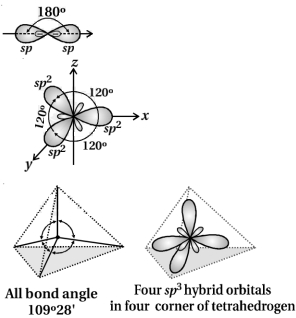
(N/A) $sp$ orbital: The two $sp$ hybrid orbitals are oriented in opposite directions along a straight line with an angle of $180^{\circ}$ between them.
$sp^2$ orbital: These three $sp^2$ hybrid orbitals are oriented in a trigonal planar arrangement,symmetrically at an angle of $120^{\circ}$ between them.
$sp^3$ hybridization: The four $sp^3$ hybrid orbitals are directed towards the four corners of a regular tetrahedron. The angle between any two $sp^3$ hybrid orbitals is $109^{\circ} 28^{\prime}$.
$sp^2$ orbital: These three $sp^2$ hybrid orbitals are oriented in a trigonal planar arrangement,symmetrically at an angle of $120^{\circ}$ between them.
$sp^3$ hybridization: The four $sp^3$ hybrid orbitals are directed towards the four corners of a regular tetrahedron. The angle between any two $sp^3$ hybrid orbitals is $109^{\circ} 28^{\prime}$.
0 likes
View Solution343
Medium
Describe the change in hybridization (if any) of the $Al$ atom in the following reaction:
$AlCl_3 + Cl^{-} \to AlCl_4^-$
$AlCl_3 + Cl^{-} \to AlCl_4^-$
Solution
(N/A) In the gaseous state,$AlCl_3$ exists as a dimer $Al_2Cl_6$,where each $Al$ atom is $sp^3$ hybridized.
In the reaction $AlCl_3 + Cl^{-} \to AlCl_4^-$,the $Al$ atom in the product $AlCl_4^-$ also exhibits $sp^3$ hybridization.
Therefore,there is no change in the hybridization of the $Al$ atom during this reaction.
In the reaction $AlCl_3 + Cl^{-} \to AlCl_4^-$,the $Al$ atom in the product $AlCl_4^-$ also exhibits $sp^3$ hybridization.
Therefore,there is no change in the hybridization of the $Al$ atom during this reaction.
0 likes
View Solution344
Medium
Is there any change in the hybridization of $B$ and $N$ atoms as a result of the following reaction? $BF_3 + NH_3 \to F_3B \cdot NH_3$
Solution
(N/A) In $BF_3$,the hybridization of $B$ is $sp^2$,but in the adduct $F_3B \cdot NH_3$,the hybridization of $B$ changes to $sp^3$.
In $NH_3$,the hybridization of $N$ is $sp^3$,and it remains $sp^3$ in the adduct $F_3B \cdot NH_3$.
Therefore,the hybridization of the $B$ atom changes from $sp^2$ to $sp^3$,while the hybridization of the $N$ atom remains $sp^3$.
In $NH_3$,the hybridization of $N$ is $sp^3$,and it remains $sp^3$ in the adduct $F_3B \cdot NH_3$.
Therefore,the hybridization of the $B$ atom changes from $sp^2$ to $sp^3$,while the hybridization of the $N$ atom remains $sp^3$.
0 likes
View Solution345
Difficult
What is $sp$ hybridization? Give its characteristics.
Solution
Definition: The process of mixing one $s$ orbital and one $p$ orbital of the same atom to form two equivalent hybrid orbitals is called $sp$-hybridization.
Characteristics:
- In each $sp$-hybrid orbital,$50\%$ $s$-character and $50\%$ $p$-character is observed.
- Both equivalent $sp$-hybrid orbitals are arranged along the $Z$-axis at an angle of $180^{\circ}$ in opposite directions to each other.
- The two $sp$-hybrid orbitals point in opposite directions along the $Z$-axis with large positive lobes and small negative lobes. This provides more effective overlapping,resulting in the formation of stronger bonds.
- $A$ molecule in which the central atom is $sp$-hybridized and is linked directly to two other atoms possesses a linear geometry.
Characteristics:
- In each $sp$-hybrid orbital,$50\%$ $s$-character and $50\%$ $p$-character is observed.
- Both equivalent $sp$-hybrid orbitals are arranged along the $Z$-axis at an angle of $180^{\circ}$ in opposite directions to each other.
- The two $sp$-hybrid orbitals point in opposite directions along the $Z$-axis with large positive lobes and small negative lobes. This provides more effective overlapping,resulting in the formation of stronger bonds.
- $A$ molecule in which the central atom is $sp$-hybridized and is linked directly to two other atoms possesses a linear geometry.
0 likes
View Solution346
Medium
Explain the bond formation by $sp$ orbitals.
Solution
(N/A) In $BeCl_{2}$,the electronic configuration of $Be$ is $[He] 2s^{2}$.
It forms an excited state $Be^{*}: [He] 2s^{1} 2p^{1}$.
The divalency of $Be$ in the excited state occurs with one electron in the $2s$ orbital and one in the $2p$ orbital.
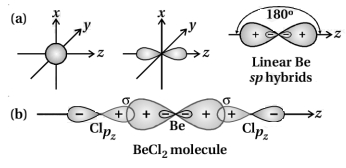
One $2s$ and one $2p$ orbital of the excited $Be$ atom undergo hybridization to form two $sp$ hybrid orbitals.
These two $sp$ hybrid orbitals are oriented in opposite directions,forming an angle of $180^{\circ}$.
The $Cl$ atom has the configuration $[Ne] 3s^{2} 3p_{x}^{2} 3p_{y}^{2} 3p_{z}^{1}$.
Each $sp$ hybrid orbital of $Be$ overlaps with the $3p_{z}$ orbital of a chlorine $(Cl)$ atom along the $z$-axis to form two $Be-Cl$ $\sigma$ bonds.
This axial overlapping results in a linear shape for the $BeCl_{2}$ molecule.
It forms an excited state $Be^{*}: [He] 2s^{1} 2p^{1}$.
The divalency of $Be$ in the excited state occurs with one electron in the $2s$ orbital and one in the $2p$ orbital.
One $2s$ and one $2p$ orbital of the excited $Be$ atom undergo hybridization to form two $sp$ hybrid orbitals.
These two $sp$ hybrid orbitals are oriented in opposite directions,forming an angle of $180^{\circ}$.
The $Cl$ atom has the configuration $[Ne] 3s^{2} 3p_{x}^{2} 3p_{y}^{2} 3p_{z}^{1}$.
Each $sp$ hybrid orbital of $Be$ overlaps with the $3p_{z}$ orbital of a chlorine $(Cl)$ atom along the $z$-axis to form two $Be-Cl$ $\sigma$ bonds.
This axial overlapping results in a linear shape for the $BeCl_{2}$ molecule.
0 likes
View Solution347
Difficult
Explain the bond formation in $BeCl_{2}$ and explain why $BeCl_{2}$ is linear.
Solution
(N/A) In $BeCl_{2}$,the ground state electronic configuration of $Be$ is $[He] 2s^{2}$.
To form two bonds,$Be$ undergoes excitation to $Be^{*}$ with configuration $[He] 2s^{1} 2p^{1}$.
One $2s$ and one $2p$ orbital of the excited $Be$ atom undergo $sp$ hybridization to form two equivalent $sp$ hybrid orbitals.
These two $sp$ hybrid orbitals are oriented in opposite directions to minimize repulsion,resulting in a bond angle of $180^{\circ}$.
Each $sp$ hybrid orbital of $Be$ overlaps axially with the half-filled $3p_{z}$ orbital of a chlorine $(Cl)$ atom,forming two $Be-Cl$ $\sigma$ bonds.
Due to this linear arrangement of the two $sp$ hybrid orbitals,the $BeCl_{2}$ molecule adopts a linear geometry.
To form two bonds,$Be$ undergoes excitation to $Be^{*}$ with configuration $[He] 2s^{1} 2p^{1}$.
One $2s$ and one $2p$ orbital of the excited $Be$ atom undergo $sp$ hybridization to form two equivalent $sp$ hybrid orbitals.
These two $sp$ hybrid orbitals are oriented in opposite directions to minimize repulsion,resulting in a bond angle of $180^{\circ}$.
Each $sp$ hybrid orbital of $Be$ overlaps axially with the half-filled $3p_{z}$ orbital of a chlorine $(Cl)$ atom,forming two $Be-Cl$ $\sigma$ bonds.
Due to this linear arrangement of the two $sp$ hybrid orbitals,the $BeCl_{2}$ molecule adopts a linear geometry.
0 likes
View Solution348
Difficult
What is $sp^{2}$ hybridization? Give its characteristics.
Solution
(N/A) Definition: The process of mixing one $ns$ orbital and two $np$ orbitals of an atom with comparable energies to form three equivalent new orbitals is called $sp^{2}$ hybridization. The resulting orbitals are known as $sp^{2}$ hybrid orbitals.
Characteristics:
$1$. Each $sp^{2}$ hybrid orbital has $33.3\%$ $s$-character and $66.6\%$ $p$-character.
$2$. The three $sp^{2}$ hybrid orbitals are oriented in space at an angle of $120^{\circ}$ to minimize repulsion,resulting in a trigonal planar geometry.
$3$. Each $sp^{2}$ hybrid orbital consists of a large positive lobe and a small negative lobe.
$4$. These hybrid orbitals overlap with $s$,$p$,or other hybrid orbitals of adjacent atoms to form $\sigma$ bonds.
$5$. The three $\sigma$ bonds formed by these orbitals lie in the same plane at an angle of $120^{\circ}$.
Characteristics:
$1$. Each $sp^{2}$ hybrid orbital has $33.3\%$ $s$-character and $66.6\%$ $p$-character.
$2$. The three $sp^{2}$ hybrid orbitals are oriented in space at an angle of $120^{\circ}$ to minimize repulsion,resulting in a trigonal planar geometry.
$3$. Each $sp^{2}$ hybrid orbital consists of a large positive lobe and a small negative lobe.
$4$. These hybrid orbitals overlap with $s$,$p$,or other hybrid orbitals of adjacent atoms to form $\sigma$ bonds.
$5$. The three $\sigma$ bonds formed by these orbitals lie in the same plane at an angle of $120^{\circ}$.
0 likes
View Solution349
Difficult
Explain the formation of bonds using $sp^2$ hybrid orbitals with an example.
Solution
(N/A) In $sp^2$ hybridization,one $s$ orbital and two $p$ orbitals of the same shell mix to form three equivalent $sp^2$ hybrid orbitals.
Example: $BCl_3$ molecule.
The electronic configuration of Boron $(Z=5)$ in the ground state is $[He] 2s^2 2p^1$. In the excited state,one $2s$ electron is promoted to the $2p$ orbital,resulting in $[He] 2s^1 2p_x^1 2p_y^1$.
These three orbitals $(2s, 2p_x, 2p_y)$ undergo $sp^2$ hybridization to form three $sp^2$ hybrid orbitals. These orbitals are oriented in a trigonal planar geometry at an angle of $120^{\circ}$.
Each of these three $sp^2$ hybrid orbitals overlaps with the half-filled $3p$ orbital of a Chlorine atom to form three $B-Cl$ $\sigma$ bonds. Thus,$BCl_3$ has a trigonal planar geometry with $Cl-B-Cl$ bond angles of $120^{\circ}$.
Example: $BCl_3$ molecule.
The electronic configuration of Boron $(Z=5)$ in the ground state is $[He] 2s^2 2p^1$. In the excited state,one $2s$ electron is promoted to the $2p$ orbital,resulting in $[He] 2s^1 2p_x^1 2p_y^1$.
These three orbitals $(2s, 2p_x, 2p_y)$ undergo $sp^2$ hybridization to form three $sp^2$ hybrid orbitals. These orbitals are oriented in a trigonal planar geometry at an angle of $120^{\circ}$.
Each of these three $sp^2$ hybrid orbitals overlaps with the half-filled $3p$ orbital of a Chlorine atom to form three $B-Cl$ $\sigma$ bonds. Thus,$BCl_3$ has a trigonal planar geometry with $Cl-B-Cl$ bond angles of $120^{\circ}$.
0 likes
View Solution350
Advanced
Explain bond formation in $BCl_{3}$. It is a symmetrical trigonal molecule.
Solution
(N/A) In the ground state,the electron configuration of Boron $(Z=5)$ is $B: [He] 2s^{2} 2p^{1}$.
In the excited state,one electron from the $2s$ orbital is promoted to the $2p$ orbital,resulting in the configuration $B^{*}: [He] 2s^{1} 2p_{x}^{1} 2p_{y}^{1}$.
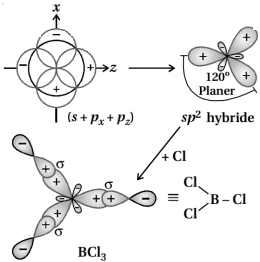
Boron now has three half-filled orbitals $(2s, 2p_{x}, 2p_{y})$,which undergo $sp^{2}$ hybridization to form three equivalent $sp^{2}$ hybrid orbitals.
These three $sp^{2}$ hybrid orbitals are arranged in a trigonal planar geometry with a bond angle of $120^{\circ}$.
Each of these three $sp^{2}$ hybrid orbitals overlaps with a half-filled $3p$ orbital of a Chlorine atom to form three $B-Cl$ $\sigma$ bonds.
Thus,$BCl_{3}$ has a trigonal planar shape with $Cl-B-Cl$ bond angles of $120^{\circ}$.
In the excited state,one electron from the $2s$ orbital is promoted to the $2p$ orbital,resulting in the configuration $B^{*}: [He] 2s^{1} 2p_{x}^{1} 2p_{y}^{1}$.
Boron now has three half-filled orbitals $(2s, 2p_{x}, 2p_{y})$,which undergo $sp^{2}$ hybridization to form three equivalent $sp^{2}$ hybrid orbitals.
These three $sp^{2}$ hybrid orbitals are arranged in a trigonal planar geometry with a bond angle of $120^{\circ}$.
Each of these three $sp^{2}$ hybrid orbitals overlaps with a half-filled $3p$ orbital of a Chlorine atom to form three $B-Cl$ $\sigma$ bonds.
Thus,$BCl_{3}$ has a trigonal planar shape with $Cl-B-Cl$ bond angles of $120^{\circ}$.
0 likes
View SolutionChemical Bonding and Molecular Structure — Hybridisation · Frequently Asked Questions
1Are these Chemical Bonding and Molecular Structure questions useful for JEE and NEET?
Yes. All questions in this section are mapped to JEE Main and NEET exam patterns. Previous year questions from JEE Main, NEET, GUJCET and state-level exams are included with full solutions.
2Can I switch to Hindi or Gujarati for these questions?
Yes. Use the language tabs in the hero section or the sidebar to view the same questions and solutions in English, Hindi or Gujarati.
3How do I generate a question paper from this subtopic?
Use the Vedclass Exam Paper Generator — select the chapter and subtopic, set difficulty, and generate Sets A, B, C, D automatically. First 3 chapters of every subject are free.
Vedclass Products
For Students
Vedclass Test Series
Mock tests in real JEE/NEET style with performance analysis. 5-day free trial.
Start Free TrialFor Teachers
Exam Paper Generator
Generate Set A/B/C/D papers from this chapter in 2 minutes. 3 chapters free.
Try FreeFor Institutes
Online Exam Module
Live online exams with unlimited students, 360° analytics & white-label branding.
See DemoFor Teachers & Institutes
Generate a Chemical Bonding and Molecular Structure Exam Paper in 2 Minutes
Select subtopic & difficulty — Sets A, B, C, D auto-generated with No Repeat logic.
First 3 chapters of every subject are free — no payment required.