
A English
Hybridisation Questions in English
Class 11 Chemistry · Chemical Bonding and Molecular Structure · Hybridisation
538+
Questions
English
Language
100%
With Solutions
Showing 48 of 538 questions in English
151
EasyMCQ
What is the type of hybridization of $N$ in $NH_3$?
A
$sp^2$
B
$sp^3$
C
$dsp^2$
D
$sp$
Solution
(B) The total number of valence electrons in $NH_3$ is $5 + (3 \times 1) = 8$.
Using the formula for steric number $X = \frac{1}{2} (V + M - C + A)$,where $V = 5$ (valence electrons of $N$),$M = 3$ (monovalent atoms),$C = 0$,and $A = 0$.
$X = \frac{8}{2} = 4$.
Since the steric number is $4$,the hybridization is $sp^3$.
Using the formula for steric number $X = \frac{1}{2} (V + M - C + A)$,where $V = 5$ (valence electrons of $N$),$M = 3$ (monovalent atoms),$C = 0$,and $A = 0$.
$X = \frac{8}{2} = 4$.
Since the steric number is $4$,the hybridization is $sp^3$.
0 likes
View Solution152
MediumMCQ
Which of the following species has a regular tetrahedral structure?
A
$XeF_4$
B
$Ni(CN)_4^{2-}$
C
$BF_4^-$
D
$SF_4$ (Atomic numbers: $B=5, S=16, Ni=28, Xe=54$)
Solution
(C) In $BF_4^-$,the central boron atom undergoes $sp^3$ hybridization.
Since there are no lone pairs of electrons on the central atom,the molecule adopts a regular tetrahedral geometry.
Since there are no lone pairs of electrons on the central atom,the molecule adopts a regular tetrahedral geometry.
0 likes
View Solution153
DifficultMCQ
In which of the following hybridizations is the maximum bond angle of $90^\circ$ observed between bond pair-bond pair electrons?
A
$dsp^3$
B
$sp^3d^2$
C
$dsp^2$
D
$sp^2d$
Solution
(B) The $sp^3d^2$ hybridization corresponds to an octahedral geometry where all bond angles between adjacent bond pairs are $90^\circ$. In $dsp^2$ (square planar),the bond angles are also $90^\circ$,but $sp^3d^2$ is the standard octahedral case where this geometry is defined by the presence of $90^\circ$ angles in three dimensions.
0 likes
View Solution154
MediumMCQ
If the dipole moment of an $MX_3$ molecule is zero,which orbital is used by the $M$ atom to form sigma bonds? (Atomic number of $M < 21$)
A
Pure $p$
B
$sp$ hybrid orbital
C
$sp^2$ hybrid orbital
D
$sp^3$ hybrid orbital
Solution
(C) For an $MX_3$ molecule to have a dipole moment of zero $(\mu = 0)$,the molecule must be symmetric with a trigonal planar geometry.
This geometry is achieved when the central atom $M$ undergoes $sp^2$ hybridization.
This geometry is achieved when the central atom $M$ undergoes $sp^2$ hybridization.
0 likes
View Solution155
MediumMCQ
In which of the following compounds does the $C$ atom use $sp^3$ hybrid orbitals for bonding?
A
$HCOOH$
B
$(H_2N)_2CO$
C
$HCHO$
D
$CH_3CHO$
Solution
(D) To determine the hybridization of the $C$ atom,we count the number of sigma bonds and lone pairs attached to it.
$1$. In $HCOOH$ (formic acid),the $C$ atom is bonded to $H$,$OH$,and double-bonded to $O$. It is $sp^2$ hybridized.
$2$. In $(H_2N)_2CO$ (urea),the $C$ atom is bonded to two $NH_2$ groups and double-bonded to $O$. It is $sp^2$ hybridized.
$3$. In $HCHO$ (formaldehyde),the $C$ atom is bonded to two $H$ atoms and double-bonded to $O$. It is $sp^2$ hybridized.
$4$. In $CH_3CHO$ (acetaldehyde),the methyl carbon $(CH_3)$ is bonded to three $H$ atoms and one $C$ atom. Since it has four sigma bonds,it is $sp^3$ hybridized.
$1$. In $HCOOH$ (formic acid),the $C$ atom is bonded to $H$,$OH$,and double-bonded to $O$. It is $sp^2$ hybridized.
$2$. In $(H_2N)_2CO$ (urea),the $C$ atom is bonded to two $NH_2$ groups and double-bonded to $O$. It is $sp^2$ hybridized.
$3$. In $HCHO$ (formaldehyde),the $C$ atom is bonded to two $H$ atoms and double-bonded to $O$. It is $sp^2$ hybridized.
$4$. In $CH_3CHO$ (acetaldehyde),the methyl carbon $(CH_3)$ is bonded to three $H$ atoms and one $C$ atom. Since it has four sigma bonds,it is $sp^3$ hybridized.
0 likes
View Solution156
DifficultMCQ
Which of the following hybrid orbitals is used by the chlorine atom in the $ClO_2^-$ ion?
A
$sp^3$
B
$sp^2$
C
$sp$
D
$dsp^2$
Solution
(A) To determine the hybridization of the central atom $Cl$ in $ClO_2^-$,we calculate the steric number $(X)$:
$X = \frac{1}{2} [V + M - C + A]$
Where $V$ is the number of valence electrons of the central atom $(Cl = 7)$,
$M$ is the number of monovalent atoms attached ($O$ is divalent,so $M = 0$),
$C$ is the cationic charge $(0)$,
$A$ is the anionic charge $(1)$.
$X = \frac{1}{2} [7 + 0 - 0 + 1] = \frac{8}{2} = 4$.
$A$ steric number of $4$ corresponds to $sp^3$ hybridization.
Thus,the chlorine atom in $ClO_2^-$ undergoes $sp^3$ hybridization.
$X = \frac{1}{2} [V + M - C + A]$
Where $V$ is the number of valence electrons of the central atom $(Cl = 7)$,
$M$ is the number of monovalent atoms attached ($O$ is divalent,so $M = 0$),
$C$ is the cationic charge $(0)$,
$A$ is the anionic charge $(1)$.
$X = \frac{1}{2} [7 + 0 - 0 + 1] = \frac{8}{2} = 4$.
$A$ steric number of $4$ corresponds to $sp^3$ hybridization.
Thus,the chlorine atom in $ClO_2^-$ undergoes $sp^3$ hybridization.
0 likes
View Solution157
MediumMCQ
Identify the compound which is polar and has the central atom in $sp^2$ hybridization.
A
$H_2CO_3$
B
$SiF_4$
C
$BF_3$
D
$HClO_2$
Solution
(A) In $H_2CO_3$,the central carbon atom is $sp^2$ hybridized and the molecule is polar due to the presence of different electronegative atoms ($O$ and $OH$ groups) attached to the central carbon.
In $BF_3$,the central boron atom is $sp^2$ hybridized,but it has a trigonal planar geometry,making it non-polar.
$SiF_4$ has $sp^3$ hybridization.
$HClO_2$ has $sp^3$ hybridization.
Therefore,$H_2CO_3$ is the correct answer.
In $BF_3$,the central boron atom is $sp^2$ hybridized,but it has a trigonal planar geometry,making it non-polar.
$SiF_4$ has $sp^3$ hybridization.
$HClO_2$ has $sp^3$ hybridization.
Therefore,$H_2CO_3$ is the correct answer.
0 likes
View Solution158
MediumMCQ
Which of the following compounds exhibits $sp^2$ hybridization?
A
$CO_2$
B
$SO_2$
C
$N_2O$
D
$CO$
Solution
(B) In $SO_2$,the central sulfur atom is bonded to two oxygen atoms and has one lone pair. The steric number is $2 + 1 = 3$,which corresponds to $sp^2$ hybridization.
0 likes
View Solution159
DifficultMCQ
What is the hybridization of the nitrogen atomic orbitals in $NO_2^+$,$NO_3^-$,and $NH_4^+$ respectively?
A
$sp^2, sp^3, sp^2$
B
$sp, sp^2, sp^3$
C
$sp^2, sp, sp^3$
D
$sp^2, sp^3, sp$
Solution
(B) To determine the hybridization,we calculate the steric number $(X)$ using the formula: $X = \frac{1}{2}(V + M - C + A)$,where $V$ is the number of valence electrons of the central atom,$M$ is the number of monovalent atoms,$C$ is the cationic charge,and $A$ is the anionic charge.
$1$. For $NO_2^+$: $V = 5$,$M = 0$,$C = 1$,$A = 0$. $X = \frac{1}{2}(5 + 0 - 1 + 0) = 2$. Hybridization is $sp$.
$2$. For $NO_3^-$: $V = 5$,$M = 0$,$C = 0$,$A = 1$. $X = \frac{1}{2}(5 + 0 - 0 + 1) = 3$. Hybridization is $sp^2$.
$3$. For $NH_4^+$: $V = 5$,$M = 4$,$C = 1$,$A = 0$. $X = \frac{1}{2}(5 + 4 - 1 + 0) = 4$. Hybridization is $sp^3$.
Thus,the hybridization states are $sp, sp^2, sp^3$ respectively.
$1$. For $NO_2^+$: $V = 5$,$M = 0$,$C = 1$,$A = 0$. $X = \frac{1}{2}(5 + 0 - 1 + 0) = 2$. Hybridization is $sp$.
$2$. For $NO_3^-$: $V = 5$,$M = 0$,$C = 0$,$A = 1$. $X = \frac{1}{2}(5 + 0 - 0 + 1) = 3$. Hybridization is $sp^2$.
$3$. For $NH_4^+$: $V = 5$,$M = 4$,$C = 1$,$A = 0$. $X = \frac{1}{2}(5 + 4 - 1 + 0) = 4$. Hybridization is $sp^3$.
Thus,the hybridization states are $sp, sp^2, sp^3$ respectively.
0 likes
View Solution160
MediumMCQ
Which of the following compounds shows the hybridization mode $sp^2 - sp^2 - sp - sp$ from left to right?
A
$H_2C = CH - C \equiv N$
B
$HC \equiv C - C \equiv CH$
C
$H_2C = C = C = CH_2$
D
$HC \equiv C - C \equiv CH_2$
Solution
(A) In the molecule $H_2C = CH - C \equiv N$:
$1$. The first carbon atom $(CH_2)$ is bonded to two hydrogens and one double bond,so it is $sp^2$ hybridized.
$2$. The second carbon atom $(CH)$ is bonded to one hydrogen,one double bond,and one single bond,so it is $sp^2$ hybridized.
$3$. The third carbon atom $(C)$ is bonded to one single bond and one triple bond,so it is $sp$ hybridized.
$4$. The nitrogen atom $(N)$ is bonded to one triple bond and has one lone pair,so it is $sp$ hybridized.
Thus,the hybridization sequence is $sp^2 - sp^2 - sp - sp$.
$1$. The first carbon atom $(CH_2)$ is bonded to two hydrogens and one double bond,so it is $sp^2$ hybridized.
$2$. The second carbon atom $(CH)$ is bonded to one hydrogen,one double bond,and one single bond,so it is $sp^2$ hybridized.
$3$. The third carbon atom $(C)$ is bonded to one single bond and one triple bond,so it is $sp$ hybridized.
$4$. The nitrogen atom $(N)$ is bonded to one triple bond and has one lone pair,so it is $sp$ hybridized.
Thus,the hybridization sequence is $sp^2 - sp^2 - sp - sp$.
0 likes
View Solution161
MediumMCQ
The shape of the $C_2H_4$ (ethene) molecule is.......
A
Linear
B
Tetrahedral
C
Planar triangular
D
Octahedral
Solution
(C) In the $C_2H_4$ molecule,each carbon atom is $sp^2$ hybridized.
Each carbon atom forms three $sp^2$ sigma bonds (two with hydrogen atoms and one with the other carbon atom) and one $\pi$ bond.
The $sp^2$ hybridization results in a trigonal planar geometry around each carbon atom,making the entire molecule planar with a bond angle of approximately $120^{\circ}$.
Each carbon atom forms three $sp^2$ sigma bonds (two with hydrogen atoms and one with the other carbon atom) and one $\pi$ bond.
The $sp^2$ hybridization results in a trigonal planar geometry around each carbon atom,making the entire molecule planar with a bond angle of approximately $120^{\circ}$.
0 likes
View Solution162
EasyMCQ
What type of bonds can the given electronic configuration of the excited state of $C$ form?
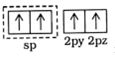
A
Only two sigma $(\sigma)$ bonds
B
Only two pi $(\pi)$ bonds
C
Two sigma $(\sigma)$ bonds and two pi $(\pi)$ bonds
D
One sigma $(\sigma)$ bond and three pi $(\pi)$ bonds
Solution
(C) The given electronic configuration shows two $sp$ hybrid orbitals and two unhybridized $p$ orbitals ($2p_y$ and $2p_z$).
Each of these four orbitals contains one unpaired electron.
The two $sp$ hybrid orbitals will form two sigma $(\sigma)$ bonds.
The two unhybridized $p$ orbitals ($2p_y$ and $2p_z$) will form two pi $(\pi)$ bonds.
Therefore,the configuration can form two sigma $(\sigma)$ bonds and two pi $(\pi)$ bonds.
Each of these four orbitals contains one unpaired electron.
The two $sp$ hybrid orbitals will form two sigma $(\sigma)$ bonds.
The two unhybridized $p$ orbitals ($2p_y$ and $2p_z$) will form two pi $(\pi)$ bonds.
Therefore,the configuration can form two sigma $(\sigma)$ bonds and two pi $(\pi)$ bonds.
0 likes
View Solution163
DifficultMCQ
What is the decreasing order of carbon-carbon single bond length in the following compounds?
$(I) CH_2 = CH - C \equiv CH$
$(II) CH \equiv C - C \equiv CH$
$(III) CH_3 - CH = CH_2$
$(IV) CH_2 = CH - CH = CH_2$
$(I) CH_2 = CH - C \equiv CH$
$(II) CH \equiv C - C \equiv CH$
$(III) CH_3 - CH = CH_2$
$(IV) CH_2 = CH - CH = CH_2$
A
$III > I > IV > II$
B
$I > III > II > IV$
C
$III > IV > I > II$
D
$II > IV > I > III$
Solution
(C) The bond length of a $C-C$ single bond depends on the hybridization of the carbon atoms involved.
As the percentage of $s$-character increases,the electronegativity of the carbon atom increases,and the bond length decreases.
Hybridization states for the $C-C$ single bond in each compound:
$(I) CH_2 = CH - C \equiv CH$: The $C-C$ single bond is between $sp^2$ and $sp$ hybridized carbons.
$(II) CH \equiv C - C \equiv CH$: The $C-C$ single bond is between $sp$ and $sp$ hybridized carbons.
$(III) CH_3 - CH = CH_2$: The $C-C$ single bond is between $sp^3$ and $sp^2$ hybridized carbons.
$(IV) CH_2 = CH - CH = CH_2$: The $C-C$ single bond is between $sp^2$ and $sp^2$ hybridized carbons.
Comparing the $s$-character:
$sp^3-sp^2$ (lowest $s$-character) > $sp^2-sp^2$ > $sp^2-sp$ > $sp-sp$ (highest $s$-character).
Therefore,the order of bond length is: $(III) > (IV) > (I) > (II)$.
As the percentage of $s$-character increases,the electronegativity of the carbon atom increases,and the bond length decreases.
Hybridization states for the $C-C$ single bond in each compound:
$(I) CH_2 = CH - C \equiv CH$: The $C-C$ single bond is between $sp^2$ and $sp$ hybridized carbons.
$(II) CH \equiv C - C \equiv CH$: The $C-C$ single bond is between $sp$ and $sp$ hybridized carbons.
$(III) CH_3 - CH = CH_2$: The $C-C$ single bond is between $sp^3$ and $sp^2$ hybridized carbons.
$(IV) CH_2 = CH - CH = CH_2$: The $C-C$ single bond is between $sp^2$ and $sp^2$ hybridized carbons.
Comparing the $s$-character:
$sp^3-sp^2$ (lowest $s$-character) > $sp^2-sp^2$ > $sp^2-sp$ > $sp-sp$ (highest $s$-character).
Therefore,the order of bond length is: $(III) > (IV) > (I) > (II)$.
0 likes
View Solution164
MediumMCQ
Which of the following contains an $sp^2$ hybridized carbon?
A
Acetone
B
Acetic acid
C
Acetonitrile
D
Acetamide
Solution
(A) In $Acetone$ $(CH_3COCH_3)$,the carbonyl carbon is $sp^2$ hybridized.
In $Acetic$ $acid$ $(CH_3COOH)$,the carboxyl carbon is $sp^2$ hybridized.
In $Acetamide$ $(CH_3CONH_2)$,the carbonyl carbon is $sp^2$ hybridized.
In $Acetonitrile$ $(CH_3CN)$,the carbon in the $CN$ group is $sp$ hybridized.
Since options $A$,$B$,and $D$ all contain $sp^2$ hybridized carbons,this question is ambiguous. However,typically in such multiple-choice questions,if one must choose,all three carbonyl-containing compounds listed ($Acetone$,$Acetic$ $acid$,$Acetamide$) possess $sp^2$ hybridized carbons.
In $Acetic$ $acid$ $(CH_3COOH)$,the carboxyl carbon is $sp^2$ hybridized.
In $Acetamide$ $(CH_3CONH_2)$,the carbonyl carbon is $sp^2$ hybridized.
In $Acetonitrile$ $(CH_3CN)$,the carbon in the $CN$ group is $sp$ hybridized.
Since options $A$,$B$,and $D$ all contain $sp^2$ hybridized carbons,this question is ambiguous. However,typically in such multiple-choice questions,if one must choose,all three carbonyl-containing compounds listed ($Acetone$,$Acetic$ $acid$,$Acetamide$) possess $sp^2$ hybridized carbons.
0 likes
View Solution165
MediumMCQ
What is the shape of the molecule $CH_2 = CH - CH = CH_2$?
A
Tetrahedral
B
Linear
C
Planar
D
Pyramidal
Solution
(C) In $CH_2 = CH - CH = CH_2$ ($1$,$3$-butadiene),all four carbon atoms are $sp^2$ hybridized.
$sp^2$ hybridized carbon atoms have a trigonal planar geometry.
Since all carbon atoms are connected in a conjugated system,the entire molecule lies in a single plane.
Therefore,the shape of the molecule is planar.
$sp^2$ hybridized carbon atoms have a trigonal planar geometry.
Since all carbon atoms are connected in a conjugated system,the entire molecule lies in a single plane.
Therefore,the shape of the molecule is planar.
0 likes
View Solution166
MediumMCQ
What is the correct order of carbon-carbon bond length in the following molecules?
A
$C_2H_6 > C_6H_6 > C_2H_4 > C_2H_2$
B
$C_2H_2 > C_2H_4 > C_6H_6 > C_2H_6$
C
$C_2H_6 > C_2H_4 > C_6H_6 > C_2H_2$
D
$C_2H_4 > C_2H_6 > C_2H_2 > C_6H_6$
Solution
(A) The bond length depends on the hybridization of the carbon atoms involved in the bond.
$1$. $C_2H_6$ (Ethane): $sp^3-sp^3$ hybridization, bond length $\approx 154 \ pm$.
$2$. $C_6H_6$ (Benzene): $sp^2-sp^2$ hybridization with resonance, bond length $\approx 139 \ pm$.
$3$. $C_2H_4$ (Ethene): $sp^2-sp^2$ hybridization, bond length $\approx 134 \ pm$.
$4$. $C_2H_2$ (Ethyne): $sp-sp$ hybridization, bond length $\approx 120 \ pm$.
As the $s$-character increases, the bond length decreases.
Therefore, the order of bond length is $C_2H_6 (154 \ pm) > C_6H_6 (139 \ pm) > C_2H_4 (134 \ pm) > C_2H_2 (120 \ pm)$.
$1$. $C_2H_6$ (Ethane): $sp^3-sp^3$ hybridization, bond length $\approx 154 \ pm$.
$2$. $C_6H_6$ (Benzene): $sp^2-sp^2$ hybridization with resonance, bond length $\approx 139 \ pm$.
$3$. $C_2H_4$ (Ethene): $sp^2-sp^2$ hybridization, bond length $\approx 134 \ pm$.
$4$. $C_2H_2$ (Ethyne): $sp-sp$ hybridization, bond length $\approx 120 \ pm$.
As the $s$-character increases, the bond length decreases.
Therefore, the order of bond length is $C_2H_6 (154 \ pm) > C_6H_6 (139 \ pm) > C_2H_4 (134 \ pm) > C_2H_2 (120 \ pm)$.
0 likes
View Solution167
MediumMCQ
The hybridization in sulphur dioxide is
A
$sp$
B
$sp^3$
C
$sp^2$
D
$dsp^2$
Solution
(C) The central atom in $SO_2$ is sulphur $(S)$.
Sulphur has $6$ valence electrons.
In $SO_2$,sulphur forms two double bonds with two oxygen atoms.
Number of electron pairs around sulphur = $2$ (bonding pairs) + $1$ (lone pair) = $3$.
Since the steric number is $3$,the hybridization is $sp^2$.
Sulphur has $6$ valence electrons.
In $SO_2$,sulphur forms two double bonds with two oxygen atoms.
Number of electron pairs around sulphur = $2$ (bonding pairs) + $1$ (lone pair) = $3$.
Since the steric number is $3$,the hybridization is $sp^2$.
0 likes
View Solution168
MediumMCQ
The hybridization of atomic orbitals of nitrogen in $NO_2^+$,$NO_3^-$,and $NH_4^+$ are:
A
$sp$,$sp^3$,and $sp^2$ respectively
B
$sp$,$sp^2$,and $sp^3$ respectively
C
$sp^2$,$sp$,and $sp^3$ respectively
D
$sp^2$,$sp^3$,and $sp$ respectively
Solution
(B) To determine the hybridization,we use the formula: $\text{Hybridization} = \frac{1}{2} [V + M - C + A]$,where $V$ is the number of valence electrons,$M$ is the number of monovalent atoms,$C$ is the cationic charge,and $A$ is the anionic charge.
$1$. For $NO_2^+$: $\text{Hybridization} = \frac{1}{2} [5 + 0 - 1 + 0] = 2$,which corresponds to $sp$ hybridization.
$2$. For $NO_3^-$: $\text{Hybridization} = \frac{1}{2} [5 + 0 - 0 + 1] = 3$,which corresponds to $sp^2$ hybridization.
$3$. For $NH_4^+$: $\text{Hybridization} = \frac{1}{2} [5 + 4 - 1 + 0] = 4$,which corresponds to $sp^3$ hybridization.
Thus,the correct order is $sp$,$sp^2$,and $sp^3$ respectively.
$1$. For $NO_2^+$: $\text{Hybridization} = \frac{1}{2} [5 + 0 - 1 + 0] = 2$,which corresponds to $sp$ hybridization.
$2$. For $NO_3^-$: $\text{Hybridization} = \frac{1}{2} [5 + 0 - 0 + 1] = 3$,which corresponds to $sp^2$ hybridization.
$3$. For $NH_4^+$: $\text{Hybridization} = \frac{1}{2} [5 + 4 - 1 + 0] = 4$,which corresponds to $sp^3$ hybridization.
Thus,the correct order is $sp$,$sp^2$,and $sp^3$ respectively.
0 likes
View Solution169
EasyMCQ
In which hybridization is the bond angle the highest?
A
$sp^3$
B
$sp^2$
C
$sp$
D
$sp^3d$
Solution
(C) The correct answer is $C$ ($sp$ hybridization).
As shown in the table,$sp$ hybridization corresponds to a linear geometry with a bond angle of $180^\circ$,which is the highest among the given options.
| Hybridization Type | Bond Angle |
|---|---|
| $sp^3$ | $109.5^\circ$ |
| $sp^2$ | $120^\circ$ |
| $sp^3d$ | $90^\circ$ and $120^\circ$ |
| $sp$ | $180^\circ$ |
As shown in the table,$sp$ hybridization corresponds to a linear geometry with a bond angle of $180^\circ$,which is the highest among the given options.
0 likes
View Solution170
MediumMCQ
The species having bond angles of $120^{\circ}$ is
A
$ClF_3$
B
$NCl_3$
C
$BCl_3$
D
$PH_3$
Solution
(C) To determine the species with a bond angle of $120^{\circ}$,we analyze the hybridization and geometry of each molecule:
$1$. $ClF_3$: The central atom $Cl$ has $7$ valence electrons. It forms $3$ bonds with $F$ atoms and has $2$ lone pairs. The hybridization is $sp^3d$,and the geometry is $T$-shaped with bond angles less than $90^{\circ}$.
$2$. $NCl_3$: The central atom $N$ has $5$ valence electrons. It forms $3$ bonds with $Cl$ atoms and has $1$ lone pair. The hybridization is $sp^3$,and the geometry is pyramidal with bond angles approximately $107^{\circ}$.
$3$. $BCl_3$: The central atom $B$ has $3$ valence electrons. It forms $3$ bonds with $Cl$ atoms and has no lone pairs. The hybridization is $sp^2$,and the geometry is trigonal planar with bond angles of $120^{\circ}$.
$4$. $PH_3$: The central atom $P$ has $5$ valence electrons. It forms $3$ bonds with $H$ atoms and has $1$ lone pair. The geometry is pyramidal with bond angles close to $93^{\circ}$.
Therefore,$BCl_3$ is the correct species.
$1$. $ClF_3$: The central atom $Cl$ has $7$ valence electrons. It forms $3$ bonds with $F$ atoms and has $2$ lone pairs. The hybridization is $sp^3d$,and the geometry is $T$-shaped with bond angles less than $90^{\circ}$.
$2$. $NCl_3$: The central atom $N$ has $5$ valence electrons. It forms $3$ bonds with $Cl$ atoms and has $1$ lone pair. The hybridization is $sp^3$,and the geometry is pyramidal with bond angles approximately $107^{\circ}$.
$3$. $BCl_3$: The central atom $B$ has $3$ valence electrons. It forms $3$ bonds with $Cl$ atoms and has no lone pairs. The hybridization is $sp^2$,and the geometry is trigonal planar with bond angles of $120^{\circ}$.
$4$. $PH_3$: The central atom $P$ has $5$ valence electrons. It forms $3$ bonds with $H$ atoms and has $1$ lone pair. The geometry is pyramidal with bond angles close to $93^{\circ}$.
Therefore,$BCl_3$ is the correct species.
0 likes
View Solution171
MediumMCQ
The hybridizations of atomic orbitals of nitrogen in $NO_2^+$,$NO_3^-$ and $NH_4^+$ respectively are
A
$sp$,$sp^3$ and $sp^2$
B
$sp^2$,$sp^3$ and $sp$
C
$sp$,$sp^2$ and $sp^3$
D
$sp^2$,$sp$ and $sp^3$
Solution
(C) To determine the hybridization of the central nitrogen atom,we use the formula: $\text{Number of hybrid orbitals} = \frac{1}{2} [V + M - C + A]$,where $V$ is the number of valence electrons of the central atom,$M$ is the number of monovalent atoms,$C$ is the cationic charge,and $A$ is the anionic charge.
$1)$ For $NO_2^+$: $V = 5$,$M = 0$,$C = 1$,$A = 0$. $\text{Hybrid orbitals} = \frac{1}{2} [5 + 0 - 1 + 0] = 2$. Hence,$sp$ hybridization.
$2)$ For $NO_3^-$: $V = 5$,$M = 0$,$C = 0$,$A = 1$. $\text{Hybrid orbitals} = \frac{1}{2} [5 + 0 - 0 + 1] = 3$. Hence,$sp^2$ hybridization.
$3)$ For $NH_4^+$: $V = 5$,$M = 4$,$C = 1$,$A = 0$. $\text{Hybrid orbitals} = \frac{1}{2} [5 + 4 - 1 + 0] = 4$. Hence,$sp^3$ hybridization.
Therefore,the hybridizations are $sp$,$sp^2$,and $sp^3$ respectively.
$1)$ For $NO_2^+$: $V = 5$,$M = 0$,$C = 1$,$A = 0$. $\text{Hybrid orbitals} = \frac{1}{2} [5 + 0 - 1 + 0] = 2$. Hence,$sp$ hybridization.
$2)$ For $NO_3^-$: $V = 5$,$M = 0$,$C = 0$,$A = 1$. $\text{Hybrid orbitals} = \frac{1}{2} [5 + 0 - 0 + 1] = 3$. Hence,$sp^2$ hybridization.
$3)$ For $NH_4^+$: $V = 5$,$M = 4$,$C = 1$,$A = 0$. $\text{Hybrid orbitals} = \frac{1}{2} [5 + 4 - 1 + 0] = 4$. Hence,$sp^3$ hybridization.
Therefore,the hybridizations are $sp$,$sp^2$,and $sp^3$ respectively.
0 likes
View Solution172
MediumMCQ
The correct geometry and hybridization for $XeF_4$ are
A
octahedral,$sp^3d^2$
B
trigonal bipyramidal,$sp^3d$
C
planar triangle,$sp^3d^3$
D
square planar,$sp^3d^2$
Solution
(D) In $XeF_4$,the central atom $Xe$ has $8$ valence electrons.
It forms $4$ single bonds with $F$ atoms and has $2$ lone pairs of electrons.
Total electron pairs = $4 \text{ (bond pairs)} + 2 \text{ (lone pairs)} = 6$.
This corresponds to $sp^3d^2$ hybridization.
Due to the presence of $2$ lone pairs,the geometry is square planar.
It forms $4$ single bonds with $F$ atoms and has $2$ lone pairs of electrons.
Total electron pairs = $4 \text{ (bond pairs)} + 2 \text{ (lone pairs)} = 6$.
This corresponds to $sp^3d^2$ hybridization.
Due to the presence of $2$ lone pairs,the geometry is square planar.
0 likes
View Solution173
MediumMCQ
The outer orbitals of $C$ in ethene molecule can be considered to be hybridized to give three equivalent $sp^2$ orbitals. The total number of sigma $(\sigma)$ and pi $(\pi)$ bonds in ethene molecule is
A
$3$ sigma $(\sigma)$ and $2$ pi $(\pi)$ bonds
B
$4$ sigma $(\sigma)$ and $1$ pi $(\pi)$ bonds
C
$5$ sigma $(\sigma)$ and $1$ pi $(\pi)$ bonds
D
$1$ sigma $(\sigma)$ and $2$ pi $(\pi)$ bonds
Solution
(C) The chemical formula of ethene is $CH_2=CH_2$.
In this molecule,there are $4$ $C-H$ sigma $(\sigma)$ bonds and $1$ $C-C$ sigma $(\sigma)$ bond,making a total of $5$ sigma $(\sigma)$ bonds.
Additionally,there is $1$ $C-C$ pi $(\pi)$ bond.
Therefore,the total number of bonds is $5$ sigma $(\sigma)$ and $1$ pi $(\pi)$ bonds.
In this molecule,there are $4$ $C-H$ sigma $(\sigma)$ bonds and $1$ $C-C$ sigma $(\sigma)$ bond,making a total of $5$ sigma $(\sigma)$ bonds.
Additionally,there is $1$ $C-C$ pi $(\pi)$ bond.
Therefore,the total number of bonds is $5$ sigma $(\sigma)$ and $1$ pi $(\pi)$ bonds.
0 likes
View Solution174
MediumMCQ
Which one of the following pairs is isostructural ($i.e.$,having the same shape and hybridization)?
A
[$BCl_3$ and $BrCl_3$]
B
[$NH_3$ and $NO_3^-$]
C
[$NF_3$ and $BF_3$]
D
[$BF_4^-$ and $NH_4^+$]
Solution
(D) In $BF_4^-$,the central atom $B$ has $4$ bond pairs and $0$ lone pairs,resulting in $sp^3$ hybridization and a tetrahedral shape.
In $NH_4^+$,the central atom $N$ has $4$ bond pairs and $0$ lone pairs,resulting in $sp^3$ hybridization and a tetrahedral shape.
Since both species have the same hybridization and shape,they are isostructural.
In $NH_4^+$,the central atom $N$ has $4$ bond pairs and $0$ lone pairs,resulting in $sp^3$ hybridization and a tetrahedral shape.
Since both species have the same hybridization and shape,they are isostructural.
0 likes
View Solution175
DifficultMCQ
Which of the two ions from the list given below have the geometry that is explained by the same hybridization of orbitals: $NO_2^-$,$NO_3^-$,$NH_2^-$,$NH_4^+$,$SCN^-$?
A
$NO_2^-$ and $NO_3^-$
B
$NH_4^+$ and $NO_3^-$
C
$SCN^-$ and $NH_2^-$
D
$NO_2^-$ and $NH_2^-$
Solution
(A) To determine the hybridization,we calculate the steric number $(SN)$ using the formula: $SN = \frac{1}{2} (V + M - C + A)$,where $V$ is the number of valence electrons of the central atom,$M$ is the number of monovalent atoms,$C$ is the cationic charge,and $A$ is the anionic charge.
$1. NO_2^-: SN = \frac{1}{2} (5 + 0 - 0 + 1) = 3 \rightarrow sp^2$ hybridization.
$2. NO_3^-: SN = \frac{1}{2} (5 + 0 - 0 + 1) = 3 \rightarrow sp^2$ hybridization.
$3. NH_2^-: SN = \frac{1}{2} (5 + 2 - 0 + 1) = 4 \rightarrow sp^3$ hybridization.
$4. NH_4^+: SN = \frac{1}{2} (5 + 4 - 1 + 0) = 4 \rightarrow sp^3$ hybridization.
$5. SCN^-: SN = \frac{1}{2} (4 + 0 - 0 + 1) = 2 \rightarrow sp$ hybridization.
Comparing the results,$NO_2^-$ and $NO_3^-$ both exhibit $sp^2$ hybridization.
$1. NO_2^-: SN = \frac{1}{2} (5 + 0 - 0 + 1) = 3 \rightarrow sp^2$ hybridization.
$2. NO_3^-: SN = \frac{1}{2} (5 + 0 - 0 + 1) = 3 \rightarrow sp^2$ hybridization.
$3. NH_2^-: SN = \frac{1}{2} (5 + 2 - 0 + 1) = 4 \rightarrow sp^3$ hybridization.
$4. NH_4^+: SN = \frac{1}{2} (5 + 4 - 1 + 0) = 4 \rightarrow sp^3$ hybridization.
$5. SCN^-: SN = \frac{1}{2} (4 + 0 - 0 + 1) = 2 \rightarrow sp$ hybridization.
Comparing the results,$NO_2^-$ and $NO_3^-$ both exhibit $sp^2$ hybridization.
0 likes
View Solution176
DifficultMCQ
In which of the following pairs of molecules/ions,the central atoms have $sp^{2}$ hybridisation?
A
$NO_{2}^{-}$ and $NH_{3}$
B
$BF_{3}$ and $NO_{2}^{-}$
C
$NH_{2}^{-}$ and $H_{2}O$
D
$BF_{3}$ and $NH_{2}^{-}$
Solution
(B) For $sp^{2}$ hybridisation,the steric number (sum of $\sigma$-bonds and lone pairs) must be $3$.
$(I)$ $NO_{2}^{-}$: Central $N$ atom has $2$ $\sigma$-bonds and $1$ lone pair,so steric number $= 3$,which corresponds to $sp^{2}$ hybridisation.
$(II)$ $NH_{3}$: Central $N$ atom has $3$ $\sigma$-bonds and $1$ lone pair,so steric number $= 4$,which corresponds to $sp^{3}$ hybridisation.
$(III)$ $BF_{3}$: Central $B$ atom has $3$ $\sigma$-bonds and $0$ lone pairs,so steric number $= 3$,which corresponds to $sp^{2}$ hybridisation.
$(IV)$ $NH_{2}^{-}$: Central $N$ atom has $2$ $\sigma$-bonds and $2$ lone pairs,so steric number $= 4$,which corresponds to $sp^{3}$ hybridisation.
$(V)$ $H_{2}O$: Central $O$ atom has $2$ $\sigma$-bonds and $2$ lone pairs,so steric number $= 4$,which corresponds to $sp^{3}$ hybridisation.
Thus,the pair $BF_{3}$ and $NO_{2}^{-}$ both exhibit $sp^{2}$ hybridisation.
$(I)$ $NO_{2}^{-}$: Central $N$ atom has $2$ $\sigma$-bonds and $1$ lone pair,so steric number $= 3$,which corresponds to $sp^{2}$ hybridisation.
$(II)$ $NH_{3}$: Central $N$ atom has $3$ $\sigma$-bonds and $1$ lone pair,so steric number $= 4$,which corresponds to $sp^{3}$ hybridisation.
$(III)$ $BF_{3}$: Central $B$ atom has $3$ $\sigma$-bonds and $0$ lone pairs,so steric number $= 3$,which corresponds to $sp^{2}$ hybridisation.
$(IV)$ $NH_{2}^{-}$: Central $N$ atom has $2$ $\sigma$-bonds and $2$ lone pairs,so steric number $= 4$,which corresponds to $sp^{3}$ hybridisation.
$(V)$ $H_{2}O$: Central $O$ atom has $2$ $\sigma$-bonds and $2$ lone pairs,so steric number $= 4$,which corresponds to $sp^{3}$ hybridisation.
Thus,the pair $BF_{3}$ and $NO_{2}^{-}$ both exhibit $sp^{2}$ hybridisation.
0 likes
View Solution177
DifficultMCQ
In which one of the following species does the central atom have a type of hybridization that is not the same as that present in the other three?
A
$SF_4$
B
$I_3^-$
C
$SbCl_5^{2-}$
D
$PCl_5$
Solution
(C) The hybridization of the central atom can be determined using the formula $H = \frac{1}{2} [V + X - C + A]$,where $V$ is the number of valence electrons,$X$ is the number of monovalent atoms,$C$ is the cationic charge,and $A$ is the anionic charge.
$1. SF_4: H = \frac{1}{2} [6 + 4] = 5 \rightarrow sp^3d$
$2. I_3^-: H = \frac{1}{2} [7 + 2 + 1] = 5 \rightarrow sp^3d$
$3. PCl_5: H = \frac{1}{2} [5 + 5] = 5 \rightarrow sp^3d$
$4. SbCl_5^{2-}: H = \frac{1}{2} [5 + 5 + 2] = 6 \rightarrow sp^3d^2$
Thus,$SbCl_5^{2-}$ has a different hybridization $(sp^3d^2)$ compared to the others $(sp^3d)$.
$1. SF_4: H = \frac{1}{2} [6 + 4] = 5 \rightarrow sp^3d$
$2. I_3^-: H = \frac{1}{2} [7 + 2 + 1] = 5 \rightarrow sp^3d$
$3. PCl_5: H = \frac{1}{2} [5 + 5] = 5 \rightarrow sp^3d$
$4. SbCl_5^{2-}: H = \frac{1}{2} [5 + 5 + 2] = 6 \rightarrow sp^3d^2$
Thus,$SbCl_5^{2-}$ has a different hybridization $(sp^3d^2)$ compared to the others $(sp^3d)$.
0 likes
View Solution178
DifficultMCQ
In which of the following molecules the central atom does not have $sp^3$ hybridization?
A
$CH_4$
B
$SF_4$
C
$BF_4^-$
D
$NH_4^+$
Solution
(B) The number of hybrid orbitals $(H)$ is calculated using the formula: $H = \frac{1}{2} [V + M - C + A]$,where $V$ is the number of valence electrons of the central atom,$M$ is the number of monovalent atoms,$C$ is the total positive charge,and $A$ is the negative charge.
For $CH_4$: $H = \frac{1}{2} [4 + 4 - 0 + 0] = 4$,which corresponds to $sp^3$ hybridization.
For $SF_4$: $H = \frac{1}{2} [6 + 4 - 0 + 0] = 5$,which corresponds to $sp^3d$ hybridization.
For $BF_4^-$: $H = \frac{1}{2} [3 + 4 - 0 + 1] = 4$,which corresponds to $sp^3$ hybridization.
For $NH_4^+$: $H = \frac{1}{2} [5 + 4 - 1 + 0] = 4$,which corresponds to $sp^3$ hybridization.
Thus,the central atom in $SF_4$ does not have $sp^3$ hybridization.
For $CH_4$: $H = \frac{1}{2} [4 + 4 - 0 + 0] = 4$,which corresponds to $sp^3$ hybridization.
For $SF_4$: $H = \frac{1}{2} [6 + 4 - 0 + 0] = 5$,which corresponds to $sp^3d$ hybridization.
For $BF_4^-$: $H = \frac{1}{2} [3 + 4 - 0 + 1] = 4$,which corresponds to $sp^3$ hybridization.
For $NH_4^+$: $H = \frac{1}{2} [5 + 4 - 1 + 0] = 4$,which corresponds to $sp^3$ hybridization.
Thus,the central atom in $SF_4$ does not have $sp^3$ hybridization.
0 likes
View Solution179
DifficultMCQ
In which of the following molecules/ions $BF_3$,$NO_2^-$,$NH_2^-$ and $H_2O$,the central atom is $sp^2$ hybridised?
A
$NH_2^-$ and $H_2O$
B
$NO_2^-$ and $H_2O$
C
$BF_3$ and $NO_2^-$
D
$NO_2^-$ and $NH_2^-$
Solution
(C) For $sp^2$ hybridization,the steric number should be $3$.
In $BF_3$ molecule,the central atom $B$ is bonded to $3$ atoms and has $0$ lone pairs,so steric number $= 3 + 0 = 3$. Hence,it is $sp^2$ hybridized.
In $NO_2^-$ ion,the central atom $N$ is bonded to $2$ oxygen atoms and has $1$ lone pair,so steric number $= 2 + 1 = 3$. Hence,it is $sp^2$ hybridized.
In $NH_2^-$ ion,the central atom $N$ is bonded to $2$ hydrogen atoms and has $2$ lone pairs,so steric number $= 2 + 2 = 4$. Hence,it is $sp^3$ hybridized.
In $H_2O$ molecule,the central atom $O$ is bonded to $2$ hydrogen atoms and has $2$ lone pairs,so steric number $= 2 + 2 = 4$. Hence,it is $sp^3$ hybridized.
Thus,in $BF_3$ and $NO_2^-$,the central atom is $sp^2$ hybridised.
In $BF_3$ molecule,the central atom $B$ is bonded to $3$ atoms and has $0$ lone pairs,so steric number $= 3 + 0 = 3$. Hence,it is $sp^2$ hybridized.
In $NO_2^-$ ion,the central atom $N$ is bonded to $2$ oxygen atoms and has $1$ lone pair,so steric number $= 2 + 1 = 3$. Hence,it is $sp^2$ hybridized.
In $NH_2^-$ ion,the central atom $N$ is bonded to $2$ hydrogen atoms and has $2$ lone pairs,so steric number $= 2 + 2 = 4$. Hence,it is $sp^3$ hybridized.
In $H_2O$ molecule,the central atom $O$ is bonded to $2$ hydrogen atoms and has $2$ lone pairs,so steric number $= 2 + 2 = 4$. Hence,it is $sp^3$ hybridized.
Thus,in $BF_3$ and $NO_2^-$,the central atom is $sp^2$ hybridised.
0 likes
View Solution180
MediumMCQ
The correct order regarding the electronegativity of hybrid orbitals of carbon is
A
$sp < sp^2 < sp^3$
B
$sp > sp^2 < sp^3$
C
$sp > sp^2 > sp^3$
D
$sp < sp^2 > sp^3$
Solution
(C) The electronegativity of hybrid orbitals depends on the $s$-character present in the orbital.
As the $s$-character increases,the electron-attracting tendency (electronegativity) increases.
The $s$-character in different hybrid orbitals is as follows:
$sp$: $50\%$
$sp^2$: $33.3\%$
$sp^3$: $25\%$
Therefore,the correct order of electronegativity is $sp > sp^2 > sp^3$.
As the $s$-character increases,the electron-attracting tendency (electronegativity) increases.
The $s$-character in different hybrid orbitals is as follows:
$sp$: $50\%$
$sp^2$: $33.3\%$
$sp^3$: $25\%$
Therefore,the correct order of electronegativity is $sp > sp^2 > sp^3$.
0 likes
View Solution181
MediumMCQ
Considering the state of hybridization of carbon atoms,find out the molecule among the following which is linear?
A
$CH_3 - CH = CH - CH_3$
B
$CH_3 - C \equiv C - CH_3$
C
$CH_2 = CH - CH_2 - C \equiv CH$
D
$CH_3 - CH_2 - CH_2 - CH_3$
Solution
(B) The geometry of a molecule depends on the hybridization of its carbon atoms.
$sp^{3}$ hybridized carbon atoms have a tetrahedral geometry with a bond angle of $109^{\circ} 28^{\prime}$.
$sp^{2}$ hybridized carbon atoms have a trigonal planar geometry with a bond angle of $120^{\circ}$.
$sp$ hybridized carbon atoms have a linear geometry with a bond angle of $180^{\circ}$.
In $CH_3 - C \equiv C - CH_3$ (but$-2-$yne),the two central carbon atoms are $sp$ hybridized,making the central part of the molecule linear.
$sp^{3}$ hybridized carbon atoms have a tetrahedral geometry with a bond angle of $109^{\circ} 28^{\prime}$.
$sp^{2}$ hybridized carbon atoms have a trigonal planar geometry with a bond angle of $120^{\circ}$.
$sp$ hybridized carbon atoms have a linear geometry with a bond angle of $180^{\circ}$.
In $CH_3 - C \equiv C - CH_3$ (but$-2-$yne),the two central carbon atoms are $sp$ hybridized,making the central part of the molecule linear.
0 likes
View Solution182
MediumMCQ
Match the compounds given in $Column\, I$ with the hybridisation and shape given in $Column\, II$ and mark the correct option.
| $Column\, I$ | $Column\, II$ |
|---|---|
| $(A)\, XeF_6$ | $(i)\, \text{Distorted octahedral}$ |
| $(B)\, XeO_3$ | $(ii)\, \text{Square planar}$ |
| $(C)\, XeOF_4$ | $(iii)\, \text{Pyramidal}$ |
| $(D)\, XeF_4$ | $(iv)\, \text{Square pyramidal}$ |
A
$A-(iv), B-(iii), C-(i), D-(ii)$
B
$A-(iv), B-(i), C-(ii), D-(iii)$
C
$A-(i), B-(iii), C-(iv), D-(ii)$
D
$A-(i), B-(ii), C-(iv), D-(iii)$
Solution
(C) $XeF_6$ has $sp^3d^3$ hybridization and distorted octahedral shape due to $6$ bond pairs and $1$ lone pair.
$(B)$ $XeO_3$ has $sp^3$ hybridization and pyramidal shape due to $3$ bond pairs and $1$ lone pair.
$(C)$ $XeOF_4$ has $sp^3d^2$ hybridization and square pyramidal shape due to $5$ bond pairs and $1$ lone pair.
$(D)$ $XeF_4$ has $sp^3d^2$ hybridization and square planar shape due to $4$ bond pairs and $2$ lone pairs.
Therefore,the correct matching is $A-(i), B-(iii), C-(iv), D-(ii)$.
$(B)$ $XeO_3$ has $sp^3$ hybridization and pyramidal shape due to $3$ bond pairs and $1$ lone pair.
$(C)$ $XeOF_4$ has $sp^3d^2$ hybridization and square pyramidal shape due to $5$ bond pairs and $1$ lone pair.
$(D)$ $XeF_4$ has $sp^3d^2$ hybridization and square planar shape due to $4$ bond pairs and $2$ lone pairs.
Therefore,the correct matching is $A-(i), B-(iii), C-(iv), D-(ii)$.
0 likes
View Solution183
MediumMCQ
The hybridization of orbitals of $N$ atom in $NO_{3}^{-}$,$NO_{2}^{+}$ and $NH_{4}^{+}$ are respectively $:$
A
$sp, sp^{2}, sp^{3}$
B
$sp^{2}, sp, sp^{3}$
C
$sp, sp^{3}, sp^{2}$
D
$sp^{2}, sp^{3}, sp$
Solution
(B) The hybridization of the central atom can be calculated using the formula: $H = \frac{1}{2} [V + M - C + A]$,where $V$ is the number of valence electrons,$M$ is the number of monovalent atoms,$C$ is the cationic charge,and $A$ is the anionic charge.
For $NO_{3}^{-}$: $H = \frac{1}{2} [5 + 0 - 0 + 1] = 3$,which corresponds to $sp^{2}$ hybridization.
For $NO_{2}^{+}$: $H = \frac{1}{2} [5 + 0 - 1 + 0] = 2$,which corresponds to $sp$ hybridization.
For $NH_{4}^{+}$: $H = \frac{1}{2} [5 + 4 - 1 + 0] = 4$,which corresponds to $sp^{3}$ hybridization.
Thus,the hybridization states are $sp^{2}, sp, sp^{3}$ respectively.
For $NO_{3}^{-}$: $H = \frac{1}{2} [5 + 0 - 0 + 1] = 3$,which corresponds to $sp^{2}$ hybridization.
For $NO_{2}^{+}$: $H = \frac{1}{2} [5 + 0 - 1 + 0] = 2$,which corresponds to $sp$ hybridization.
For $NH_{4}^{+}$: $H = \frac{1}{2} [5 + 4 - 1 + 0] = 4$,which corresponds to $sp^{3}$ hybridization.
Thus,the hybridization states are $sp^{2}, sp, sp^{3}$ respectively.
0 likes
View Solution184
MediumMCQ
The species in which the $N$ atom is in a state of $sp$ hybridization is:
A
$NO_{3}^{-}$
B
$NO_{2}$
C
$NO_{2}^{+}$
D
$NO_{2}^{-}$
Solution
(C) To determine the hybridization of the $N$ atom,we use the formula: $\text{Steric Number} = \frac{1}{2} [V + M - C + A]$,where $V$ is the number of valence electrons,$M$ is the number of monovalent atoms,$C$ is the cationic charge,and $A$ is the anionic charge.
For $NO_{2}^{+}$: $\text{Steric Number} = \frac{1}{2} [5 + 0 - 1 + 0] = \frac{4}{2} = 2$. $A$ steric number of $2$ corresponds to $sp$ hybridization.
For $NO_{3}^{-}$: $\text{Steric Number} = \frac{1}{2} [5 + 0 - 0 + 1] = 3$ ($sp^2$ hybridization).
For $NO_{2}$: The $N$ atom has one unpaired electron and is $sp^2$ hybridized.
For $NO_{2}^{-}$: $\text{Steric Number} = \frac{1}{2} [5 + 0 - 0 + 1] = 3$ ($sp^2$ hybridization).
Thus,the $N$ atom is $sp$ hybridized in $NO_{2}^{+}$.
Therefore,the correct option is $C$.
For $NO_{2}^{+}$: $\text{Steric Number} = \frac{1}{2} [5 + 0 - 1 + 0] = \frac{4}{2} = 2$. $A$ steric number of $2$ corresponds to $sp$ hybridization.
For $NO_{3}^{-}$: $\text{Steric Number} = \frac{1}{2} [5 + 0 - 0 + 1] = 3$ ($sp^2$ hybridization).
For $NO_{2}$: The $N$ atom has one unpaired electron and is $sp^2$ hybridized.
For $NO_{2}^{-}$: $\text{Steric Number} = \frac{1}{2} [5 + 0 - 0 + 1] = 3$ ($sp^2$ hybridization).
Thus,the $N$ atom is $sp$ hybridized in $NO_{2}^{+}$.
Therefore,the correct option is $C$.
0 likes
View Solution185
AdvancedMCQ
Which of the following pairs have the same type of hybridization but different shapes?
A
$H_2O, NH_3$
B
$Ni(CO)_4, [Ni(CN)_4]^{4-}$
C
$XeF_4, [Fe(CO)_4]^{2-}$
D
$SF_4, CF_4$
Solution
(A) $H_2O$: Central atom $O$ is $sp^3$ hybridized with $2$ lone pairs,resulting in a bent ($V$-shape) geometry.
$NH_3$: Central atom $N$ is $sp^3$ hybridized with $1$ lone pair,resulting in a trigonal pyramidal geometry.
Since both $H_2O$ and $NH_3$ are $sp^3$ hybridized but have different shapes (bent vs pyramidal),option $A$ is correct.
$Ni(CO)_4$ is $sp^3$ (tetrahedral) and $[Ni(CN)_4]^{4-}$ is $dsp^2$ (square planar).
$XeF_4$ is $sp^3d^2$ (square planar) and $[Fe(CO)_4]^{2-}$ is $sp^3$ (tetrahedral).
$SF_4$ is $sp^3d$ (see-saw) and $CF_4$ is $sp^3$ (tetrahedral).
$NH_3$: Central atom $N$ is $sp^3$ hybridized with $1$ lone pair,resulting in a trigonal pyramidal geometry.
Since both $H_2O$ and $NH_3$ are $sp^3$ hybridized but have different shapes (bent vs pyramidal),option $A$ is correct.
$Ni(CO)_4$ is $sp^3$ (tetrahedral) and $[Ni(CN)_4]^{4-}$ is $dsp^2$ (square planar).
$XeF_4$ is $sp^3d^2$ (square planar) and $[Fe(CO)_4]^{2-}$ is $sp^3$ (tetrahedral).
$SF_4$ is $sp^3d$ (see-saw) and $CF_4$ is $sp^3$ (tetrahedral).
0 likes
View Solution186
AdvancedMCQ
$A + 2Cl^{-} \rightarrow B$
Where $A$ is $PCl_4^+$ and $B$ is $PCl_6^-$.
Which of the following statements is $INCORRECT$:
$(I)$ From $B$ to $A$,the number of $d$-orbitals involved in hybridization increases.
$(II)$ From $A$ to $B$,the percentage of $p$-character in the $P-Cl$ bond increases.
$(III)$ The number of covalent bonds in $A$ and $B$ are the same.
$(IV)$ $B$ is a product of Lewis acid-base interaction,which is associated with super-octet molecules only.
Where $A$ is $PCl_4^+$ and $B$ is $PCl_6^-$.
Which of the following statements is $INCORRECT$:
$(I)$ From $B$ to $A$,the number of $d$-orbitals involved in hybridization increases.
$(II)$ From $A$ to $B$,the percentage of $p$-character in the $P-Cl$ bond increases.
$(III)$ The number of covalent bonds in $A$ and $B$ are the same.
$(IV)$ $B$ is a product of Lewis acid-base interaction,which is associated with super-octet molecules only.
A
Only $I, II$ and $III$
B
Only $II$ and $III$
C
Only $III$ and $IV$
D
$I, III$ and $IV$
Solution
(A) $1$. Analyze the hybridization of $A$ $(PCl_4^+)$: The central atom $P$ has $5 + 4 - 1 = 8$ valence electrons,forming $4$ bonds. Hybridization is $sp^3$ ($0$ $d$-orbitals).
$2$. Analyze the hybridization of $B$ $(PCl_6^-)$: The central atom $P$ has $5 + 6 + 1 = 12$ valence electrons,forming $6$ bonds. Hybridization is $sp^3d^2$ ($2$ $d$-orbitals).
$3$. Evaluate $(I)$: From $B$ $(sp^3d^2)$ to $A$ $(sp^3)$,the number of $d$-orbitals involved decreases from $2$ to $0$. Thus,statement $(I)$ is $INCORRECT$.
$4$. Evaluate $(II)$: In $A$ $(sp^3)$,$p$-character is $75\%$. In $B$ $(sp^3d^2)$,$p$-character is $3/6 = 50\%$. Thus,from $A$ to $B$,$p$-character decreases. Statement $(II)$ is $INCORRECT$.
$5$. Evaluate $(III)$: $A$ has $4$ covalent bonds; $B$ has $6$ covalent bonds. They are not the same. Statement $(III)$ is $INCORRECT$.
$6$. Evaluate $(IV)$: $PCl_6^-$ is formed by $PCl_5 + Cl^- \rightarrow PCl_6^-$. $PCl_5$ acts as a Lewis acid. This is a super-octet molecule. Statement $(IV)$ is $CORRECT$.
$7$. Since $(I), (II),$ and $(III)$ are incorrect,the answer is $A$.
$2$. Analyze the hybridization of $B$ $(PCl_6^-)$: The central atom $P$ has $5 + 6 + 1 = 12$ valence electrons,forming $6$ bonds. Hybridization is $sp^3d^2$ ($2$ $d$-orbitals).
$3$. Evaluate $(I)$: From $B$ $(sp^3d^2)$ to $A$ $(sp^3)$,the number of $d$-orbitals involved decreases from $2$ to $0$. Thus,statement $(I)$ is $INCORRECT$.
$4$. Evaluate $(II)$: In $A$ $(sp^3)$,$p$-character is $75\%$. In $B$ $(sp^3d^2)$,$p$-character is $3/6 = 50\%$. Thus,from $A$ to $B$,$p$-character decreases. Statement $(II)$ is $INCORRECT$.
$5$. Evaluate $(III)$: $A$ has $4$ covalent bonds; $B$ has $6$ covalent bonds. They are not the same. Statement $(III)$ is $INCORRECT$.
$6$. Evaluate $(IV)$: $PCl_6^-$ is formed by $PCl_5 + Cl^- \rightarrow PCl_6^-$. $PCl_5$ acts as a Lewis acid. This is a super-octet molecule. Statement $(IV)$ is $CORRECT$.
$7$. Since $(I), (II),$ and $(III)$ are incorrect,the answer is $A$.
0 likes
View Solution187
DifficultMCQ
Which of the following processes involves a change in bond angle along with a change in hybridization?
A
$BF_3 + F^- \to BF_4^-$
B
$BF_3 + BCl_3 \to BF_2Cl + BFCl_2$
C
$BF_3 + NH_3 \to F_3B \cdot NH_3$
D
$NH_3 + HCl \to NH_4^+ Cl^-$
Solution
(A) In $BF_3$,the boron atom is $sp^2$ hybridized with a bond angle of $120^\circ$. In $BF_4^-$,the boron atom is $sp^3$ hybridized with a bond angle of $109^\circ 28'$. Thus,this process involves a change in both hybridization and bond angle.
In $NH_3$,the nitrogen atom is $sp^3$ hybridized with a bond angle of $107^\circ$. In $NH_4^+$,the nitrogen atom is $sp^3$ hybridized with a bond angle of $109^\circ 28'$. While the bond angle changes,the hybridization remains $sp^3$.
In $BF_3 \cdot NH_3$,boron changes from $sp^2$ to $sp^3$ and nitrogen remains $sp^3$ (but its geometry changes from pyramidal to tetrahedral). However,$BF_3 + F^- \to BF_4^-$ is the most direct example of a change in hybridization from $sp^2$ to $sp^3$ accompanied by a change in bond angle.
In $NH_3$,the nitrogen atom is $sp^3$ hybridized with a bond angle of $107^\circ$. In $NH_4^+$,the nitrogen atom is $sp^3$ hybridized with a bond angle of $109^\circ 28'$. While the bond angle changes,the hybridization remains $sp^3$.
In $BF_3 \cdot NH_3$,boron changes from $sp^2$ to $sp^3$ and nitrogen remains $sp^3$ (but its geometry changes from pyramidal to tetrahedral). However,$BF_3 + F^- \to BF_4^-$ is the most direct example of a change in hybridization from $sp^2$ to $sp^3$ accompanied by a change in bond angle.
0 likes
View Solution188
MediumMCQ
Which of the following molecules has $sp^3d^2$ hybridisation and a square planar shape?
A
$SF_4$
B
$BF_4^-$
C
$ICl_4^-$
D
$XeO_2F_2$
Solution
(C) To determine the hybridisation and shape,we calculate the steric number $(SN)$ using the formula: $SN = \frac{1}{2}(V + M - C + A)$,where $V$ is the number of valence electrons of the central atom,$M$ is the number of monovalent atoms,$C$ is the cationic charge,and $A$ is the anionic charge.
For $ICl_4^-$:
$V = 7$ (for $I$),$M = 4$ (for $Cl$),$A = 1$.
$SN = \frac{1}{2}(7 + 4 + 1) = 6$.
$A$ steric number of $6$ corresponds to $sp^3d^2$ hybridisation.
With $4$ bond pairs and $2$ lone pairs,the geometry is octahedral and the shape is square planar.
For $ICl_4^-$:
$V = 7$ (for $I$),$M = 4$ (for $Cl$),$A = 1$.
$SN = \frac{1}{2}(7 + 4 + 1) = 6$.
$A$ steric number of $6$ corresponds to $sp^3d^2$ hybridisation.
With $4$ bond pairs and $2$ lone pairs,the geometry is octahedral and the shape is square planar.
| Chemical species | Hybridisation |
| $SF_4$ | $sp^3d$ |
| $BF_4^-$ | $sp^3$ |
| $ICl_4^-$ | $sp^3d^2$ |
| $XeO_2F_2$ | $sp^3d$ |
0 likes
View Solution189
DifficultMCQ
The mean values for the radial distance for different phosphorus orbitals are $3s: 0.47 \ \mathring{A}$,$3p: 0.55 \ \mathring{A}$,$3d: 2.4 \ \mathring{A}$. When $P$ is going to form $PF_5$,then these radial distances are going to become arbitrarily . . . . . . , . . . . . . and . . . . . . respectively.
A
$0.47 \ \mathring{A}$,$0.50 \ \mathring{A}$,$0.75 \ \mathring{A}$
B
$0.40 \ \mathring{A}$,$0.48 \ \mathring{A}$,$0.85 \ \mathring{A}$
C
$0.47 \ \mathring{A}$,$0.55 \ \mathring{A}$,$0.95 \ \mathring{A}$
D
$0.47 \ \mathring{A}$,$0.55 \ \mathring{A}$,$2.4 \ \mathring{A}$
Solution
(B) In the formation of $PF_5$,phosphorus undergoes $sp^3d$ hybridization.
During hybridization,the orbitals involved ($3s$,$3p$,and $3d$) undergo mixing to form five equivalent $sp^3d$ hybrid orbitals.
The $3d$ orbital,which is initially very diffuse (large radial distance of $2.4 \ \mathring{A}$),contracts significantly to participate in bonding with the electronegative fluorine atoms.
The $3s$ and $3p$ orbitals remain relatively unchanged in their radial distribution compared to the $3d$ orbital.
Therefore,the radial distances become approximately $0.40 \ \mathring{A}$,$0.48 \ \mathring{A}$,and $0.85 \ \mathring{A}$ respectively,reflecting the contraction of the $3d$ orbital.
During hybridization,the orbitals involved ($3s$,$3p$,and $3d$) undergo mixing to form five equivalent $sp^3d$ hybrid orbitals.
The $3d$ orbital,which is initially very diffuse (large radial distance of $2.4 \ \mathring{A}$),contracts significantly to participate in bonding with the electronegative fluorine atoms.
The $3s$ and $3p$ orbitals remain relatively unchanged in their radial distribution compared to the $3d$ orbital.
Therefore,the radial distances become approximately $0.40 \ \mathring{A}$,$0.48 \ \mathring{A}$,and $0.85 \ \mathring{A}$ respectively,reflecting the contraction of the $3d$ orbital.
0 likes
View Solution190
AdvancedMCQ
$KI + MnO_2 + H_2SO_4 \to$ Vapours $(B) +$ other products
Vapours $(B) + K_2S_2O_8 \to (C) + (D)$
$(D) \xrightarrow{(B)}$ Brown $(E)$
Hybridisation of central atom in $(E)$ is
Vapours $(B) + K_2S_2O_8 \to (C) + (D)$
$(D) \xrightarrow{(B)}$ Brown $(E)$
Hybridisation of central atom in $(E)$ is
A
$sp^3d$
B
$sp^3d^2$
C
$sp^3d^3$
D
$sp^3$
Solution
(A) Step $1$: $2KI + MnO_2 + 2H_2SO_4 \to K_2SO_4 + MnSO_4 + 2H_2O + I_2(g)$. Thus,$(B) = I_2$.
Step $2$: $I_2 + K_2S_2O_8 \to K_2SO_4 + I_2(SO_4)$ (or similar oxidation reaction). Here $(D)$ is $I_2$.
Step $3$: $I_2 + KI \to KI_3$. The brown complex $(E)$ is $KI_3$,which contains the triiodide ion $I_3^-$.
Step $4$: In $I_3^-$,the central iodine atom has $3$ lone pairs and $2$ bond pairs,resulting in $5$ electron pairs. The hybridisation is $sp^3d$.
Step $2$: $I_2 + K_2S_2O_8 \to K_2SO_4 + I_2(SO_4)$ (or similar oxidation reaction). Here $(D)$ is $I_2$.
Step $3$: $I_2 + KI \to KI_3$. The brown complex $(E)$ is $KI_3$,which contains the triiodide ion $I_3^-$.
Step $4$: In $I_3^-$,the central iodine atom has $3$ lone pairs and $2$ bond pairs,resulting in $5$ electron pairs. The hybridisation is $sp^3d$.
0 likes
View Solution191
MediumMCQ
Total number of nodal planes present in the $d-$orbital which is used in the hybridisation of $XeF_2$.
A
$1$
B
$2$
C
$3$
D
$0$
Solution
(D) In $XeF_2$,the central atom $Xe$ undergoes $sp^3d$ hybridisation.
The $d-$orbital involved in $sp^3d$ hybridisation is the $d_{z^2}$ orbital.
The $d_{z^2}$ orbital has $0$ nodal planes because it consists of a lobe along the $z-$axis and a ring of electron density in the $xy-$plane,meaning it does not have planar nodes passing through the nucleus like other $d-$orbitals.
Therefore,the number of nodal planes is $0$.
The $d-$orbital involved in $sp^3d$ hybridisation is the $d_{z^2}$ orbital.
The $d_{z^2}$ orbital has $0$ nodal planes because it consists of a lobe along the $z-$axis and a ring of electron density in the $xy-$plane,meaning it does not have planar nodes passing through the nucleus like other $d-$orbitals.
Therefore,the number of nodal planes is $0$.
0 likes
View Solution192
MediumMCQ
What is the $CORRECT$ geometry and hybridisation for $SF_4$?
A
Trigonal bipyramidal,$sp^3d$
B
Tetrahedral,$sp^3$
C
See-Saw,$sp^3d$
D
Square planar,$dsp^2$
Solution
(C) To determine the geometry and hybridisation of $SF_4$,we first calculate the number of valence electrons: $S$ $(6)$ + $4 \times F$ $(7)$ = $34$ electrons.
Using the steric number formula: $SN = \frac{1}{2} (V + M - C + A)$,where $V = 6$ (valence electrons of $S$),$M = 4$ (monovalent atoms),$C = 0$,and $A = 0$.
$SN = \frac{1}{2} (6 + 4) = 5$.
$A$ steric number of $5$ corresponds to $sp^3d$ hybridisation.
The molecule has $4$ bonding pairs and $1$ lone pair on the sulfur atom.
According to $VSEPR$ theory,the presence of one lone pair in a trigonal bipyramidal electron geometry results in a $See-Saw$ molecular geometry.
Using the steric number formula: $SN = \frac{1}{2} (V + M - C + A)$,where $V = 6$ (valence electrons of $S$),$M = 4$ (monovalent atoms),$C = 0$,and $A = 0$.
$SN = \frac{1}{2} (6 + 4) = 5$.
$A$ steric number of $5$ corresponds to $sp^3d$ hybridisation.
The molecule has $4$ bonding pairs and $1$ lone pair on the sulfur atom.
According to $VSEPR$ theory,the presence of one lone pair in a trigonal bipyramidal electron geometry results in a $See-Saw$ molecular geometry.
0 likes
View Solution193
MediumMCQ
How many $sp^{2}$ and $sp-$ hybridised carbon atoms are present respectively in the following compound?
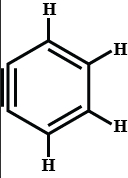
A
$4, 2$
B
$6, 0$
C
$3, 3$
D
$5, 1$
Solution
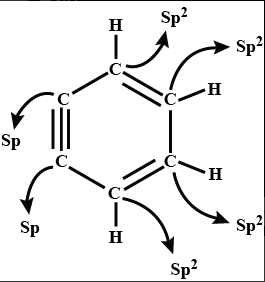
(A) In the given structure (dehydrobenzene derivative),there are $4$ carbon atoms involved in double bonds,which are $sp^{2}$ hybridized.
There are $2$ carbon atoms involved in a triple bond,which are $sp$ hybridized.
Therefore,the number of $sp^{2}$ and $sp$ hybridized carbon atoms are $4$ and $2$ respectively.
The correct option is $A$.
There are $2$ carbon atoms involved in a triple bond,which are $sp$ hybridized.
Therefore,the number of $sp^{2}$ and $sp$ hybridized carbon atoms are $4$ and $2$ respectively.
The correct option is $A$.
0 likes
View Solution194
DifficultMCQ
Number of hybrid orbitals of $C$ atoms in $C(CN)_4$ which have $33\%$ $P$ character :-
A
$4$
B
$1$
C
$0$
D
$2$
Solution
(C) In $C(CN)_4$,the central carbon atom is $sp^3$ hybridized,meaning it has four $sp^3$ hybrid orbitals. Each $sp^3$ orbital has $25\%$ $s$ character and $75\%$ $P$ character.
Each of the four cyano group carbon atoms is $sp$ hybridized,meaning each has two $sp$ hybrid orbitals. Each $sp$ orbital has $50\%$ $s$ character and $50\%$ $P$ character.
$33\%$ $P$ character corresponds to $sp^2$ hybridization (where $P$ character is $2/3 \approx 66.6\%$ is incorrect,actually $sp^2$ has $66.6\%$ $P$ character,$sp^3$ has $75\%$ $P$ character,and $sp$ has $50\%$ $P$ character).
Since there are no $sp^2$ hybridized carbon atoms in $C(CN)_4$,the number of hybrid orbitals with $33\%$ $P$ character is $0$.
Each of the four cyano group carbon atoms is $sp$ hybridized,meaning each has two $sp$ hybrid orbitals. Each $sp$ orbital has $50\%$ $s$ character and $50\%$ $P$ character.
$33\%$ $P$ character corresponds to $sp^2$ hybridization (where $P$ character is $2/3 \approx 66.6\%$ is incorrect,actually $sp^2$ has $66.6\%$ $P$ character,$sp^3$ has $75\%$ $P$ character,and $sp$ has $50\%$ $P$ character).
Since there are no $sp^2$ hybridized carbon atoms in $C(CN)_4$,the number of hybrid orbitals with $33\%$ $P$ character is $0$.
0 likes
View Solution195
MediumMCQ
If pure unhybridised orbitals are used in forming $CH_4$ then which statement is incorrect :-
A
Three bond angles will be at $90^o$.
B
Three bond lengths are identical and fourth is smaller than other three.
C
Geometry will be tetrahedral.
D
Position of fourth bond cannot be predicted.
Solution
(C) In $CH_4$,if we use pure unhybridised orbitals,the $3$ $p$-orbitals of carbon $(p_x, p_y, p_z)$ would overlap with $1s$ orbitals of $3$ hydrogen atoms at $90^o$ angles.
The $4^{th}$ hydrogen atom would overlap with the $2s$ orbital of carbon.
Since $p$-orbitals are directional and $s$-orbitals are spherical,the bond lengths and bond angles would not be equivalent to the observed tetrahedral geometry.
Specifically,the geometry would not be tetrahedral,as the $3$ $p$-bonds would be at $90^o$ to each other,and the $4^{th}$ bond would be different in nature.
Therefore,the statement that the geometry will be tetrahedral is incorrect.
The $4^{th}$ hydrogen atom would overlap with the $2s$ orbital of carbon.
Since $p$-orbitals are directional and $s$-orbitals are spherical,the bond lengths and bond angles would not be equivalent to the observed tetrahedral geometry.
Specifically,the geometry would not be tetrahedral,as the $3$ $p$-bonds would be at $90^o$ to each other,and the $4^{th}$ bond would be different in nature.
Therefore,the statement that the geometry will be tetrahedral is incorrect.
0 likes
View Solution196
MediumMCQ
On the transformation $PCl_5 \to PCl_6^-$,what changes will take place?
A
Hybridisation of $P$ will change
B
Molecular geometry changes
C
Shape of molecule changes
D
All of the above
Solution
(D) In $PCl_5$,the phosphorus atom is $sp^3d$ hybridized,and the molecular geometry is trigonal bipyramidal.
In $PCl_6^-$,the phosphorus atom is $sp^3d^2$ hybridized,and the molecular geometry is octahedral.
Since both the hybridization and the geometry change,the shape of the molecule also changes.
Therefore,all the given statements are correct.
In $PCl_6^-$,the phosphorus atom is $sp^3d^2$ hybridized,and the molecular geometry is octahedral.
Since both the hybridization and the geometry change,the shape of the molecule also changes.
Therefore,all the given statements are correct.
0 likes
View Solution197
DifficultMCQ
Which of the following is an incorrect relation based on Bent's rule?
A
$a > c$
B
$f < h$
C
$b < d$
D
$a > e$
Solution
(A) According to Bent's rule,more electronegative elements prefer to occupy orbitals with less $s$-character (i.e.,more $p$-character).
Conversely,less electronegative elements prefer to occupy orbitals with more $s$-character.
As the $s$-character increases,the bond angle increases.
Therefore,the bond angle is directly proportional to the $s$-character of the hybrid orbital involved in the bond.
Conversely,less electronegative elements prefer to occupy orbitals with more $s$-character.
As the $s$-character increases,the bond angle increases.
Therefore,the bond angle is directly proportional to the $s$-character of the hybrid orbital involved in the bond.
0 likes
View Solution198
MediumMCQ
If $p_x$ and $p_y$ orbitals participate in $sp^2$ hybridisation of the sulphur atom in $SO_3$,then the $d$ orbitals which are used in $p\pi-d\pi$ bonds are
A
$d_{x^2-y^2}, d_{z^2}$
B
$d_{x^2-y^2}, d_{xy}$
C
$d_{xz}, d_{yz}$
D
$d_{z^2}, d_{xy}$
Solution
(C) In $SO_3$,the sulphur atom undergoes $sp^2$ hybridisation. The orbitals involved in $sp^2$ hybridisation are $s$,$p_x$,and $p_y$.
Since the molecule is planar (lying in the $xy$-plane),the $p_z$ orbital remains unhybridised and is involved in $p\pi-p\pi$ bonding.
To form $p\pi-d\pi$ bonds,the $d$ orbitals must have the correct symmetry to overlap with the remaining $p$ orbitals of oxygen.
Given the $sp^2$ hybridisation uses $p_x$ and $p_y$,the $d$ orbitals that can participate in $\pi$-bonding with the $p_z$ orbital of oxygen are $d_{xz}$ and $d_{yz}$.
Since the molecule is planar (lying in the $xy$-plane),the $p_z$ orbital remains unhybridised and is involved in $p\pi-p\pi$ bonding.
To form $p\pi-d\pi$ bonds,the $d$ orbitals must have the correct symmetry to overlap with the remaining $p$ orbitals of oxygen.
Given the $sp^2$ hybridisation uses $p_x$ and $p_y$,the $d$ orbitals that can participate in $\pi$-bonding with the $p_z$ orbital of oxygen are $d_{xz}$ and $d_{yz}$.
0 likes
View SolutionChemical Bonding and Molecular Structure — Hybridisation · Frequently Asked Questions
1Are these Chemical Bonding and Molecular Structure questions useful for JEE and NEET?
Yes. All questions in this section are mapped to JEE Main and NEET exam patterns. Previous year questions from JEE Main, NEET, GUJCET and state-level exams are included with full solutions.
2Can I switch to Hindi or Gujarati for these questions?
Yes. Use the language tabs in the hero section or the sidebar to view the same questions and solutions in English, Hindi or Gujarati.
3How do I generate a question paper from this subtopic?
Use the Vedclass Exam Paper Generator — select the chapter and subtopic, set difficulty, and generate Sets A, B, C, D automatically. First 3 chapters of every subject are free.
Vedclass Products
For Students
Vedclass Test Series
Mock tests in real JEE/NEET style with performance analysis. 5-day free trial.
Start Free TrialFor Teachers
Exam Paper Generator
Generate Set A/B/C/D papers from this chapter in 2 minutes. 3 chapters free.
Try FreeFor Institutes
Online Exam Module
Live online exams with unlimited students, 360° analytics & white-label branding.
See DemoFor Teachers & Institutes
Generate a Chemical Bonding and Molecular Structure Exam Paper in 2 Minutes
Select subtopic & difficulty — Sets A, B, C, D auto-generated with No Repeat logic.
First 3 chapters of every subject are free — no payment required.