
A English
Optical isomerism Questions in English
Class 11 Chemistry · 8-2.Organic Chemistry : Isomerism · Optical isomerism
338+
Questions
English
Language
100%
With Solutions
Showing 49 of 338 questions in English
101
EasyMCQ
Which type of isomerism is exhibited by $2,3-$dichlorobutane?
A
Structural
B
Geometrical
C
Optical
D
Diastereomerism
Solution
(C) $2,3-$dichlorobutane has two chiral carbon atoms at positions $2$ and $3$.
It can exist in different stereoisomeric forms,including enantiomers and a meso form.
Since it possesses chiral centers and can exhibit non-superimposable mirror images as well as a meso form,it primarily exhibits optical isomerism.
It can exist in different stereoisomeric forms,including enantiomers and a meso form.
Since it possesses chiral centers and can exhibit non-superimposable mirror images as well as a meso form,it primarily exhibits optical isomerism.
0 likes
View Solution102
EasyMCQ
The optical rotation of a racemic mixture is always......
A
Positive
B
Negative
C
Zero
D
Cannot be determined
Solution
(C) racemic mixture is an equimolar mixture of two enantiomers.
Since the two enantiomers rotate the plane of plane-polarized light in opposite directions by the same magnitude,their effects cancel each other out.
Therefore,the net optical rotation of a racemic mixture is $0$ (zero).
Since the two enantiomers rotate the plane of plane-polarized light in opposite directions by the same magnitude,their effects cancel each other out.
Therefore,the net optical rotation of a racemic mixture is $0$ (zero).
0 likes
View Solution103
EasyMCQ
Which of the following molecules with the molecular formula $C_4H_8O$ exhibits optical isomerism?
A
$CH_3COCH_2CH_3$
B
$CH_3CH_2CH_2CHO$
C
$(CH_3)_2CHCHO$
D
$CH_2=CHCH(OH)CH_3$
Solution
(D) Optical isomerism is exhibited by molecules that possess a chiral center (a carbon atom bonded to four different groups).
In the given options,let us analyze the structure of $CH_2=CHCH(OH)CH_3$:
This molecule is $but-3-en-2-ol$.
The carbon atom at position $2$ is bonded to four different groups: $-H$,$-OH$,$-CH_3$,and $-CH=CH_2$.
Since this carbon is chiral,the molecule exhibits optical isomerism.
Other options like $CH_3COCH_2CH_3$ (butanone),$CH_3CH_2CH_2CHO$ (butanal),and $(CH_3)_2CHCHO$ ($2$-methylpropanal) do not contain a chiral carbon atom.
In the given options,let us analyze the structure of $CH_2=CHCH(OH)CH_3$:
This molecule is $but-3-en-2-ol$.
The carbon atom at position $2$ is bonded to four different groups: $-H$,$-OH$,$-CH_3$,and $-CH=CH_2$.
Since this carbon is chiral,the molecule exhibits optical isomerism.
Other options like $CH_3COCH_2CH_3$ (butanone),$CH_3CH_2CH_2CHO$ (butanal),and $(CH_3)_2CHCHO$ ($2$-methylpropanal) do not contain a chiral carbon atom.
0 likes
View Solution104
MediumMCQ
Which type of isomerism is exhibited by the given compound?
$(CH_3)_2C=CH-CH(CH_3)COOH$
$(CH_3)_2C=CH-CH(CH_3)COOH$
A
Tautomerism
B
Stereoisomerism
C
Geometrical isomerism
D
Geometrical and optical isomerism
Solution
(B) The given compound is $4-methylpent-3-enoic acid$ with the structure $(CH_3)_2C=CH-CH(CH_3)COOH$.
$1$. Geometrical Isomerism: The double bond is between $C_3$ and $C_4$. At $C_4$,there are two identical methyl groups attached,so it does not show geometrical isomerism.
$2$. Optical Isomerism: There is a chiral carbon atom at the $C_2$ position (the carbon attached to $-H$,$-CH_3$,$-COOH$,and the $-CH=C(CH_3)_2$ group). Since it has a chiral center,it exhibits optical isomerism.
$3$. Stereoisomerism: Since optical isomerism is a type of stereoisomerism,the compound exhibits stereoisomerism.
$1$. Geometrical Isomerism: The double bond is between $C_3$ and $C_4$. At $C_4$,there are two identical methyl groups attached,so it does not show geometrical isomerism.
$2$. Optical Isomerism: There is a chiral carbon atom at the $C_2$ position (the carbon attached to $-H$,$-CH_3$,$-COOH$,and the $-CH=C(CH_3)_2$ group). Since it has a chiral center,it exhibits optical isomerism.
$3$. Stereoisomerism: Since optical isomerism is a type of stereoisomerism,the compound exhibits stereoisomerism.
0 likes
View Solution105
MediumMCQ
Which of the following alkenes exhibits optical isomerism?
A
$2-$Methyl$-2-$pentene
B
$3-$Methyl$-2-$pentene
C
$4-$Methyl$-1-$pentene
D
$3-$Methyl$-1-$pentene
Solution
(D) For a molecule to exhibit optical isomerism,it must contain at least one chiral center (an asymmetric carbon atom bonded to four different groups).
Let us analyze the structures:
$A$: $CH_3-C(CH_3)=CH-CH_2-CH_3$ ($2-$Methyl$-2-$pentene) - No chiral center.
$B$: $CH_3-CH=C(CH_3)-CH_2-CH_3$ ($3-$Methyl$-2-$pentene) - No chiral center.
$C$: $CH_2=CH-CH_2-CH(CH_3)-CH_3$ ($4-$Methyl$-1-$pentene) - No chiral center.
$D$: $CH_2=CH-CH(CH_3)-CH_2-CH_3$ ($3-$Methyl$-1-$pentene) - The carbon at position $3$ is bonded to a hydrogen atom,a methyl group,an ethyl group,and a vinyl group $(-CH=CH_2)$. Since all four groups are different,it is a chiral center.
Therefore,$3-$Methyl$-1-$pentene exhibits optical isomerism.
Let us analyze the structures:
$A$: $CH_3-C(CH_3)=CH-CH_2-CH_3$ ($2-$Methyl$-2-$pentene) - No chiral center.
$B$: $CH_3-CH=C(CH_3)-CH_2-CH_3$ ($3-$Methyl$-2-$pentene) - No chiral center.
$C$: $CH_2=CH-CH_2-CH(CH_3)-CH_3$ ($4-$Methyl$-1-$pentene) - No chiral center.
$D$: $CH_2=CH-CH(CH_3)-CH_2-CH_3$ ($3-$Methyl$-1-$pentene) - The carbon at position $3$ is bonded to a hydrogen atom,a methyl group,an ethyl group,and a vinyl group $(-CH=CH_2)$. Since all four groups are different,it is a chiral center.
Therefore,$3-$Methyl$-1-$pentene exhibits optical isomerism.
0 likes
View Solution106
EasyMCQ
An alkene with the molecular formula $C_4H_8$ does not exhibit which of the following?
A
Chain isomerism
B
Geometrical isomerism
C
Positional isomerism
D
Optical isomerism
Solution
(D) The molecular formula $C_4H_8$ corresponds to butene isomers.
$1$-butene and $2$-butene exhibit chain and positional isomerism.
$2$-butene exhibits geometrical isomerism.
However,none of the isomers of $C_4H_8$ contain a chiral carbon atom,therefore they do not exhibit optical isomerism.
$1$-butene and $2$-butene exhibit chain and positional isomerism.
$2$-butene exhibits geometrical isomerism.
However,none of the isomers of $C_4H_8$ contain a chiral carbon atom,therefore they do not exhibit optical isomerism.
0 likes
View Solution107
MediumMCQ
Find the number of optical isomers for $CH_3-CH(OH)-CH(OH)-CH(OH)-CH_3$.
A
$1$
B
$2$
C
$3$
D
$4$
Solution
(D) The given molecule is $CH_3-CH(OH)-CH(OH)-CH(OH)-CH_3$.
It has $n = 3$ chiral centers.
The molecule is unsymmetrical.
The number of optically active isomers $(a)$ is given by $a = 2^{n-1} = 2^{3-1} = 2^2 = 4$.
The number of meso isomers $(m)$ is given by $m = 2^{(n-2)/2} = 2^{(3-1)/2} = 2^1 = 2$.
Wait,for an unsymmetrical molecule with $n$ chiral centers,the total number of stereoisomers is $2^n = 2^3 = 8$.
However,the question asks for optical isomers.
For $CH_3-CH(OH)-CH(OH)-CH(OH)-CH_3$,the number of stereoisomers is $2^n = 2^3 = 8$.
These consist of $4$ pairs of enantiomers (optically active).
Thus,the total number of optical isomers is $8$.
It has $n = 3$ chiral centers.
The molecule is unsymmetrical.
The number of optically active isomers $(a)$ is given by $a = 2^{n-1} = 2^{3-1} = 2^2 = 4$.
The number of meso isomers $(m)$ is given by $m = 2^{(n-2)/2} = 2^{(3-1)/2} = 2^1 = 2$.
Wait,for an unsymmetrical molecule with $n$ chiral centers,the total number of stereoisomers is $2^n = 2^3 = 8$.
However,the question asks for optical isomers.
For $CH_3-CH(OH)-CH(OH)-CH(OH)-CH_3$,the number of stereoisomers is $2^n = 2^3 = 8$.
These consist of $4$ pairs of enantiomers (optically active).
Thus,the total number of optical isomers is $8$.
0 likes
View Solution108
EasyMCQ
How many enantiomers does $CH_3CH(Br)CH(Br)COOH$ have?
A
$0$
B
$1$
C
$2$
D
$4$
Solution
(D) The molecule $CH_3CH(Br)CH(Br)COOH$ contains $2$ chiral carbon atoms $(n = 2)$.
Since the molecule is unsymmetrical,the number of optical isomers is $2^n = 2^2 = 4$.
These $4$ optical isomers consist of $2$ pairs of enantiomers.
Since the molecule is unsymmetrical,the number of optical isomers is $2^n = 2^2 = 4$.
These $4$ optical isomers consist of $2$ pairs of enantiomers.
0 likes
View Solution109
DifficultMCQ
Which of the following compounds can exist as a racemic mixture?
A
$CH_3CH_2CH(OH)CH_2CH_3$
B
$CH_3CH(OH)COOH$
C
$CH_3CH_2NHCH_2CH_3$
D
$CH_3CH_2CHDCl$
Solution
(B) racemic mixture is an equimolar mixture of two enantiomers. For a compound to exist as a racemic mixture,it must possess at least one chiral center (an asymmetric carbon atom bonded to four different groups).
$1$. $CH_3CH_2CH(OH)CH_2CH_3$ (Pentan$-3-$ol): The central carbon is bonded to two identical ethyl groups $(-CH_2CH_3)$,so it is achiral.
$2$. $CH_3CH(OH)COOH$ (Lactic acid): The central carbon is bonded to $-H$,$-OH$,$-CH_3$,and $-COOH$. Since all four groups are different,it is chiral and can exist as a racemic mixture.
$3$. $CH_3CH_2NHCH_2CH_3$ (Diethylamine): The nitrogen is bonded to two identical ethyl groups,making it achiral.
$4$. $CH_3CH_2CHDCl$ ($1$-chloro$-1-$deuteropropane): While this is chiral,lactic acid is the standard textbook example for a simple racemic mixture.
$1$. $CH_3CH_2CH(OH)CH_2CH_3$ (Pentan$-3-$ol): The central carbon is bonded to two identical ethyl groups $(-CH_2CH_3)$,so it is achiral.
$2$. $CH_3CH(OH)COOH$ (Lactic acid): The central carbon is bonded to $-H$,$-OH$,$-CH_3$,and $-COOH$. Since all four groups are different,it is chiral and can exist as a racemic mixture.
$3$. $CH_3CH_2NHCH_2CH_3$ (Diethylamine): The nitrogen is bonded to two identical ethyl groups,making it achiral.
$4$. $CH_3CH_2CHDCl$ ($1$-chloro$-1-$deuteropropane): While this is chiral,lactic acid is the standard textbook example for a simple racemic mixture.
0 likes
View Solution110
MediumMCQ
Find the number of stereoisomers for $CH_3-CH(OH)-CH(OH)-CH_3$.
A
$1$
B
$2$
C
$3$
D
$4$
Solution
(C) The given molecule is $CH_3-CH(OH)-CH(OH)-CH_3$,which is $2,3-butanediol$.
It has $n = 2$ chiral centers.
The molecule is symmetric because the groups attached to both chiral centers are identical.
For a symmetric molecule with an even number of chiral centers $(n=2)$:
Number of optically active isomers $(a)$ = $2^{n-1} = 2^{2-1} = 2^1 = 2$.
Number of meso isomers $(m)$ = $2^{(n/2)-1} = 2^{(2/2)-1} = 2^0 = 1$.
Total number of stereoisomers = $a + m = 2 + 1 = 3$.
It has $n = 2$ chiral centers.
The molecule is symmetric because the groups attached to both chiral centers are identical.
For a symmetric molecule with an even number of chiral centers $(n=2)$:
Number of optically active isomers $(a)$ = $2^{n-1} = 2^{2-1} = 2^1 = 2$.
Number of meso isomers $(m)$ = $2^{(n/2)-1} = 2^{(2/2)-1} = 2^0 = 1$.
Total number of stereoisomers = $a + m = 2 + 1 = 3$.
0 likes
View Solution111
EasyMCQ
$A$ molecule is divided into two identical halves and contains $n$ asymmetric carbon atoms. What is the total number of stereoisomers?
A
$2^n$
B
$2^{n-1}$
C
$2^{(n/2-1)}$
D
$2^{n-1} + 2^{(n/2-1)}$
Solution
(D) When a molecule has $n$ asymmetric carbon atoms and can be divided into two identical halves,it possesses a plane of symmetry.
For such molecules,the number of optically active isomers (enantiomeric pairs) is $2^{(n/2-1)}$.
The number of meso forms is $2^{(n/2-1)}$.
The total number of stereoisomers is the sum of optically active forms and meso forms,which is $2^{(n-1)} + 2^{(n/2-1)}$.
For such molecules,the number of optically active isomers (enantiomeric pairs) is $2^{(n/2-1)}$.
The number of meso forms is $2^{(n/2-1)}$.
The total number of stereoisomers is the sum of optically active forms and meso forms,which is $2^{(n-1)} + 2^{(n/2-1)}$.
0 likes
View Solution112
EasyMCQ
Which of the following capital letters is chiral?
A
$A$
B
$B$
C
$Y$
D
$P$
Solution
(D) molecule or object is chiral if it is non-superimposable on its mirror image.
Among the given letters,the letter $P$ does not have a plane of symmetry,making its mirror image non-superimposable on itself.
Therefore,$P$ is chiral.
Among the given letters,the letter $P$ does not have a plane of symmetry,making its mirror image non-superimposable on itself.
Therefore,$P$ is chiral.
0 likes
View Solution113
MediumMCQ
Which of the following isomers of butanol has a chiral structure?
A
$(CH_3)_3COH$
B
$(CH_3)_2CHCH_2OH$
C
$CH_3CH(OH)CH_2CH_3$
D
$CH_3CH_2CH_2CH_2OH$
Solution
(C) chiral molecule is one that contains a chiral center,which is a carbon atom bonded to four different groups.
In $CH_3CH(OH)CH_2CH_3$ (butan$-2-$ol),the second carbon atom is bonded to four different groups: $-H$,$-OH$,$-CH_3$,and $-CH_2CH_3$.
Therefore,it is a chiral molecule.
In $CH_3CH(OH)CH_2CH_3$ (butan$-2-$ol),the second carbon atom is bonded to four different groups: $-H$,$-OH$,$-CH_3$,and $-CH_2CH_3$.
Therefore,it is a chiral molecule.
0 likes
View Solution114
MediumMCQ
How many optically active stereoisomers are there for butane-$2,3$-diol?
A
$1$
B
$2$
C
$3$
D
$4$
Solution
(B) Butane-$2,3$-diol has two chiral centers at $C-2$ and $C-3$.
The structure is $CH_3-CH(OH)-CH(OH)-CH_3$.
It exists in three stereoisomeric forms:
$1$. $(2R, 3R)$-butane-$2,3$-diol (optically active)
$2$. $(2S, 3S)$-butane-$2,3$-diol (optically active)
$3$. $(2R, 3S)$-butane-$2,3$-diol (meso form,optically inactive due to internal compensation).
Thus,there are $2$ optically active stereoisomers.
The structure is $CH_3-CH(OH)-CH(OH)-CH_3$.
It exists in three stereoisomeric forms:
$1$. $(2R, 3R)$-butane-$2,3$-diol (optically active)
$2$. $(2S, 3S)$-butane-$2,3$-diol (optically active)
$3$. $(2R, 3S)$-butane-$2,3$-diol (meso form,optically inactive due to internal compensation).
Thus,there are $2$ optically active stereoisomers.
0 likes
View Solution115
MediumMCQ
Which of the following compounds is optically active?
A
$(CH_3)_2CHOH$
B
$CH_3CH_2CH_2CH_3$
C
$CH_3CHClCOOH$
D
$(CH_3)_3CCl$
Solution
(C) compound is optically active if it contains at least one chiral carbon atom (a carbon atom bonded to four different groups).
In $CH_3CHClCOOH$,the central carbon atom is bonded to a $-CH_3$ group,a $-Cl$ atom,a $-COOH$ group,and an $-H$ atom.
Since all four groups are different,this carbon is chiral,making the molecule optically active.
In $CH_3CHClCOOH$,the central carbon atom is bonded to a $-CH_3$ group,a $-Cl$ atom,a $-COOH$ group,and an $-H$ atom.
Since all four groups are different,this carbon is chiral,making the molecule optically active.
0 likes
View Solution116
MediumMCQ
Which of the following exhibits optical isomerism?
A
Butan$-1-$ol
B
Butan$-2-$ol
C
But$-1-$ene
D
But$-2-$ene
Solution
(B) The correct answer is $(b)$.
Butan$-2-$ol,represented as $CH_3-CH(OH)-CH_2-CH_3$,exhibits optical isomerism.
This is because the carbon atom at the $C-2$ position is a chiral center,meaning it is bonded to four different groups: a hydrogen atom $(-H)$,a hydroxyl group $(-OH)$,a methyl group $(-CH_3)$,and an ethyl group $(-CH_2CH_3)$.
Butan$-2-$ol,represented as $CH_3-CH(OH)-CH_2-CH_3$,exhibits optical isomerism.
This is because the carbon atom at the $C-2$ position is a chiral center,meaning it is bonded to four different groups: a hydrogen atom $(-H)$,a hydroxyl group $(-OH)$,a methyl group $(-CH_3)$,and an ethyl group $(-CH_2CH_3)$.
0 likes
View Solution117
MediumMCQ
Which of the following is optically active?
A
Butane
B
$4-$methylheptane
C
$3-$methylheptane
D
$2-$methylheptane
Solution
(C) molecule is optically active if it contains a chiral carbon atom (a carbon atom bonded to four different groups).
In $3-$methylheptane,the carbon at position $3$ is bonded to a hydrogen atom,a methyl group,an ethyl group,and a butyl group.
Since all four groups are different,the carbon at position $3$ is chiral.
Therefore,$3-$methylheptane is optically active.
In $3-$methylheptane,the carbon at position $3$ is bonded to a hydrogen atom,a methyl group,an ethyl group,and a butyl group.
Since all four groups are different,the carbon at position $3$ is chiral.
Therefore,$3-$methylheptane is optically active.
0 likes
View Solution118
MediumMCQ
Which type of isomerism is shown by $2,3-$dichlorobutane?
A
Diastereomerism
B
Optical
C
Geometric
D
Structural
Solution
(B) $2,3-$dichlorobutane has two chiral carbon atoms at positions $2$ and $3$.
It exists in three stereoisomeric forms: a pair of enantiomers and a meso compound.
Since it exhibits enantiomerism and meso-form formation,it is a classic example of optical isomerism.
Therefore,the correct option is $B$.
It exists in three stereoisomeric forms: a pair of enantiomers and a meso compound.
Since it exhibits enantiomerism and meso-form formation,it is a classic example of optical isomerism.
Therefore,the correct option is $B$.
0 likes
View Solution119
DifficultMCQ
$CH_3 - CHCl - CH_2 - CH_3$ has a chiral center. Which one of the following represents its $R$-configuration?
A
$C_2H_5 - C(H)(CH_3) - Cl$
B
$C_2H_5 - C(Cl)(CH_3) - H$
C
$CH_3 - C(H)(CH_3) - C_2H_5$
D
$C_2H_5 - C(CH_3)(Cl) - H$
Solution
(B) To determine the $R$-configuration,we assign priorities to the groups attached to the chiral carbon based on the Cahn-Ingold-Prelog $(CIP)$ rules: $Cl(1) > C_2H_5(2) > CH_3(3) > H(4)$.
In the Fischer projection,the configuration is $R$ if the sequence $1$ $\rightarrow 2$ $\rightarrow 3$ is clockwise,provided the lowest priority group $(H)$ is on a vertical bond.
Analyzing the structures,the configuration $R$ corresponds to the arrangement where the priority sequence is clockwise. Based on the provided image,the third structure shows the $R$-configuration where $Cl$ is on the left,$C_2H_5$ is on top,$CH_3$ is on the right,and $H$ is at the bottom. This corresponds to the structure $C_2H_5 - C(Cl)(CH_3) - H$ (Option $B$).
In the Fischer projection,the configuration is $R$ if the sequence $1$ $\rightarrow 2$ $\rightarrow 3$ is clockwise,provided the lowest priority group $(H)$ is on a vertical bond.
Analyzing the structures,the configuration $R$ corresponds to the arrangement where the priority sequence is clockwise. Based on the provided image,the third structure shows the $R$-configuration where $Cl$ is on the left,$C_2H_5$ is on top,$CH_3$ is on the right,and $H$ is at the bottom. This corresponds to the structure $C_2H_5 - C(Cl)(CH_3) - H$ (Option $B$).
0 likes
View Solution120
MediumMCQ
Which of the following acids does not exhibit optical isomerism?
A
Maleic acid
B
$\alpha$-amino acids
C
Lactic acid
D
Tartaric acid
Solution
(A) Optical isomerism requires the presence of at least one chiral carbon atom (a carbon atom bonded to four different groups).
Maleic acid $(HOOC-CH=CH-COOH)$ contains $sp^2$ hybridized carbons in a double bond and lacks a chiral carbon atom,so it does not exhibit optical isomerism.
Tartaric acid,lactic acid,and $\alpha$-amino acids all contain at least one chiral carbon atom (indicated by $*$ in the structure),allowing them to exhibit optical isomerism.
Maleic acid $(HOOC-CH=CH-COOH)$ contains $sp^2$ hybridized carbons in a double bond and lacks a chiral carbon atom,so it does not exhibit optical isomerism.
Tartaric acid,lactic acid,and $\alpha$-amino acids all contain at least one chiral carbon atom (indicated by $*$ in the structure),allowing them to exhibit optical isomerism.
0 likes
View Solution121
MediumMCQ
Two possible stereo-structures of $CH_3CH(OH)COOH$,which are optically active,are called
A
atropisomers
B
enantiomers
C
mesomers
D
diastereomers
Solution
(B) The molecule $CH_3CH(OH)COOH$ (lactic acid) contains a chiral carbon atom bonded to four different groups: $-H$,$-OH$,$-CH_3$,and $-COOH$.
Stereoisomers that are non-superimposable mirror images of each other are known as enantiomers.
Since the two structures of lactic acid are non-superimposable mirror images and are both optically active,they are classified as enantiomers.
Stereoisomers that are non-superimposable mirror images of each other are known as enantiomers.
Since the two structures of lactic acid are non-superimposable mirror images and are both optically active,they are classified as enantiomers.
0 likes
View Solution122
MediumMCQ
If there is no rotation of plane polarised light by a compound in a specific solvent,though thought to be chiral,it may mean that
A
the compound is certainly meso
B
there is no compound in the solvent
C
the compound may be a racemic mixture
D
the compound is certainly achiral
Solution
(C) compound that does not rotate plane polarised light is optically inactive.
If a compound is thought to be chiral but shows no optical rotation,it could be a racemic mixture (an equimolar mixture of two enantiomers where the rotation of one is cancelled by the other,i.e.,externally compensated) or it could be a meso compound (which contains chiral centers but is achiral due to an internal plane of symmetry,i.e.,internally compensated).
Therefore,the observation of no rotation does not definitively prove the compound is meso; it could also be a racemic mixture.
If a compound is thought to be chiral but shows no optical rotation,it could be a racemic mixture (an equimolar mixture of two enantiomers where the rotation of one is cancelled by the other,i.e.,externally compensated) or it could be a meso compound (which contains chiral centers but is achiral due to an internal plane of symmetry,i.e.,internally compensated).
Therefore,the observation of no rotation does not definitively prove the compound is meso; it could also be a racemic mixture.
0 likes
View Solution123
MediumMCQ
Which of the following is not chiral?
A
$2-$Hydroxypropanoic acid
B
$2-$Butanol
C
$2,3-$Dibromopentane
D
$3-$Bromopentane
Solution
(D) molecule is chiral if it contains at least one chiral carbon atom,which is a carbon atom bonded to four different groups.
$1$. $2-$Hydroxypropanoic acid: $CH_3-CH(OH)-COOH$. The $C-2$ atom is bonded to $-H$,$-OH$,$-CH_3$,and $-COOH$. It is chiral.
$2$. $2-$Butanol: $CH_3-CH(OH)-CH_2-CH_3$. The $C-2$ atom is bonded to $-H$,$-OH$,$-CH_3$,and $-CH_2CH_3$. It is chiral.
$3$. $2,3-$Dibromopentane: $CH_3-CH(Br)-CH(Br)-CH_2-CH_3$. Both $C-2$ and $C-3$ are bonded to four different groups. It is chiral.
$4$. $3-$Bromopentane: $CH_3-CH_2-CH(Br)-CH_2-CH_3$. The $C-3$ atom is bonded to $-H$,$-Br$,and two identical $-CH_2CH_3$ groups. Since it is bonded to two identical groups,it is achiral.
Therefore,$3-$Bromopentane is not chiral.
$1$. $2-$Hydroxypropanoic acid: $CH_3-CH(OH)-COOH$. The $C-2$ atom is bonded to $-H$,$-OH$,$-CH_3$,and $-COOH$. It is chiral.
$2$. $2-$Butanol: $CH_3-CH(OH)-CH_2-CH_3$. The $C-2$ atom is bonded to $-H$,$-OH$,$-CH_3$,and $-CH_2CH_3$. It is chiral.
$3$. $2,3-$Dibromopentane: $CH_3-CH(Br)-CH(Br)-CH_2-CH_3$. Both $C-2$ and $C-3$ are bonded to four different groups. It is chiral.
$4$. $3-$Bromopentane: $CH_3-CH_2-CH(Br)-CH_2-CH_3$. The $C-3$ atom is bonded to $-H$,$-Br$,and two identical $-CH_2CH_3$ groups. Since it is bonded to two identical groups,it is achiral.
Therefore,$3-$Bromopentane is not chiral.
0 likes
View Solution124
DifficultMCQ
Which of the following molecules is expected to rotate the plane of plane-polarised light?
A
Glycine $(H_2N-CH_2-COOH)$
B
Glyceraldehyde $(HOCH_2-CH(OH)-CHO)$
C
Butane$-2-$thiol $(CH_3-CH(SH)-CH_2-CH_3)$
D
$1,2-$Diphenylethane$-1,2-$diamine $(Ph-CH(NH_2)-CH(NH_2)-Ph)$
Solution
(B) molecule is expected to rotate the plane of plane-polarised light if it is optically active.
Optically active molecules must be chiral,meaning they lack a plane of symmetry or center of inversion.
$1$. Glycine $(H_2N-CH_2-COOH)$ has a plane of symmetry and is achiral.
$2$. Glyceraldehyde $(HOCH_2-CH(OH)-CHO)$ has a chiral carbon atom bonded to four different groups $(-H, -OH, -CHO, -CH_2OH)$ and is optically active.
$3$. Butane-$2$-thiol $(CH_3-CH(SH)-CH_2-CH_3)$ has a chiral carbon atom bonded to four different groups $(-H, -SH, -CH_3, -CH_2CH_3)$ and is optically active.
$4$. $1,2$-Diphenylethane-$1,2$-diamine can exist as a meso compound (optically inactive) or as chiral enantiomers depending on the configuration.
In the context of standard chemistry questions,both Glyceraldehyde and Butane-$2$-thiol are classic examples of chiral molecules. However,Glyceraldehyde is the most fundamental example of a chiral molecule in carbohydrates. Given the options,both $B$ and $C$ are chiral. Assuming a single choice is required,Glyceraldehyde is the standard textbook example.
Optically active molecules must be chiral,meaning they lack a plane of symmetry or center of inversion.
$1$. Glycine $(H_2N-CH_2-COOH)$ has a plane of symmetry and is achiral.
$2$. Glyceraldehyde $(HOCH_2-CH(OH)-CHO)$ has a chiral carbon atom bonded to four different groups $(-H, -OH, -CHO, -CH_2OH)$ and is optically active.
$3$. Butane-$2$-thiol $(CH_3-CH(SH)-CH_2-CH_3)$ has a chiral carbon atom bonded to four different groups $(-H, -SH, -CH_3, -CH_2CH_3)$ and is optically active.
$4$. $1,2$-Diphenylethane-$1,2$-diamine can exist as a meso compound (optically inactive) or as chiral enantiomers depending on the configuration.
In the context of standard chemistry questions,both Glyceraldehyde and Butane-$2$-thiol are classic examples of chiral molecules. However,Glyceraldehyde is the most fundamental example of a chiral molecule in carbohydrates. Given the options,both $B$ and $C$ are chiral. Assuming a single choice is required,Glyceraldehyde is the standard textbook example.
0 likes
View Solution125
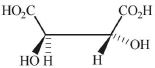
MediumMCQ
The absolute configuration of the given molecule is:
A
$S, S$
B
$R, R$
C
$R, S$
D
$S, R$
Solution
(B) To determine the absolute configuration,we assign priorities to the groups attached to each chiral center using the Cahn-Ingold-Prelog $(CIP)$ rules.
For the first chiral center (left): The groups are $-OH$ $(1)$,$-COOH$ $(2)$,$-CH(OH)COOH$ $(3)$,and $-H$ $(4)$. Since $-H$ is on a dashed bond (pointing away),the sequence $1$ $\rightarrow 2$ $\rightarrow 3$ is clockwise,which corresponds to the $R$ configuration.
For the second chiral center (right): The groups are $-OH$ $(1)$,$-COOH$ $(2)$,$-CH(OH)COOH$ $(3)$,and $-H$ $(4)$. Since $-H$ is on a dashed bond (pointing away),the sequence $1$ $\rightarrow 2$ $\rightarrow 3$ is clockwise,which corresponds to the $R$ configuration.
Thus,the absolute configuration is $R, R$.
For the first chiral center (left): The groups are $-OH$ $(1)$,$-COOH$ $(2)$,$-CH(OH)COOH$ $(3)$,and $-H$ $(4)$. Since $-H$ is on a dashed bond (pointing away),the sequence $1$ $\rightarrow 2$ $\rightarrow 3$ is clockwise,which corresponds to the $R$ configuration.
For the second chiral center (right): The groups are $-OH$ $(1)$,$-COOH$ $(2)$,$-CH(OH)COOH$ $(3)$,and $-H$ $(4)$. Since $-H$ is on a dashed bond (pointing away),the sequence $1$ $\rightarrow 2$ $\rightarrow 3$ is clockwise,which corresponds to the $R$ configuration.
Thus,the absolute configuration is $R, R$.
0 likes
View Solution126
DifficultMCQ
Identify the compound which rotates the plane-polarized light.
A
$1,3-$dichlorocyclobutane (trans-isomer)
B
$(2S, 3S)-2,3$-dichlorobutane
C
$1-$bromo$-2-$fluoro$-3-$chlorobenzene
D
$CH_2ClF$
Solution
(B) compound is optically active if it is chiral,meaning it lacks a plane of symmetry,center of inversion,or an improper axis of rotation.
$A$: Trans$-1,3-$dichlorocyclobutane has a plane of symmetry,so it is achiral.
$B$: $(2S, 3S)-2,3$-dichlorobutane is a chiral molecule because it lacks any internal plane of symmetry or center of inversion. Therefore,it is optically active and will rotate plane-polarized light.
$C$: $1-$bromo$-2-$fluoro$-3-$chlorobenzene is a planar aromatic molecule,which is achiral.
$D$: $CH_2ClF$ is achiral because it has a plane of symmetry (the plane containing the $C, Cl, F$ atoms).
$A$: Trans$-1,3-$dichlorocyclobutane has a plane of symmetry,so it is achiral.
$B$: $(2S, 3S)-2,3$-dichlorobutane is a chiral molecule because it lacks any internal plane of symmetry or center of inversion. Therefore,it is optically active and will rotate plane-polarized light.
$C$: $1-$bromo$-2-$fluoro$-3-$chlorobenzene is a planar aromatic molecule,which is achiral.
$D$: $CH_2ClF$ is achiral because it has a plane of symmetry (the plane containing the $C, Cl, F$ atoms).
0 likes
View Solution127
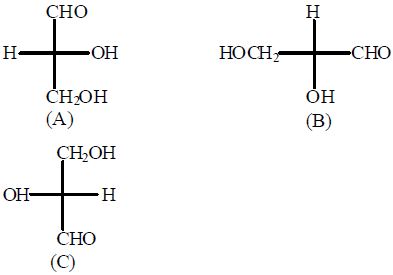
DifficultMCQ
Which of the following statements is not correct about $(A)$,$(B)$ and $(C)$?
A
$A$ and $B$ are enantiomers
B
$A$ and $C$ are identical
C
$B$ and $C$ are enantiomers
D
$A$ and $C$ are enantiomers
Solution
(B) Assigning $R/S$ configurations using Cahn-Ingold-Prelog priority rules:
For $(A)$: Priority is $-OH (1) > -CHO (2) > -CH_2OH (3) > -H (4)$. With $-H$ on the horizontal axis,the clockwise arrangement $1$ $\rightarrow 2$ $\rightarrow 3$ corresponds to $S$ configuration.
For $(B)$: Priority is $-OH (1) > -CHO (2) > -CH_2OH (3) > -H (4)$. With $-H$ on the vertical axis,the clockwise arrangement $1$ $\rightarrow 2$ $\rightarrow 3$ corresponds to $R$ configuration.
For $(C)$: Priority is $-OH (1) > -CHO (2) > -CH_2OH (3) > -H (4)$. With $-H$ on the horizontal axis,the counter-clockwise arrangement $1$ $\rightarrow 2$ $\rightarrow 3$ corresponds to $R$ configuration.
Comparing configurations: $(A)$ is $S$,$(B)$ is $R$,$(C)$ is $R$. Therefore,$(B)$ and $(C)$ are identical,while $(A)$ and $(B)$ are enantiomers,and $(A)$ and $(C)$ are enantiomers. The statement '$A$ and $C$ are identical' is incorrect.
For $(A)$: Priority is $-OH (1) > -CHO (2) > -CH_2OH (3) > -H (4)$. With $-H$ on the horizontal axis,the clockwise arrangement $1$ $\rightarrow 2$ $\rightarrow 3$ corresponds to $S$ configuration.
For $(B)$: Priority is $-OH (1) > -CHO (2) > -CH_2OH (3) > -H (4)$. With $-H$ on the vertical axis,the clockwise arrangement $1$ $\rightarrow 2$ $\rightarrow 3$ corresponds to $R$ configuration.
For $(C)$: Priority is $-OH (1) > -CHO (2) > -CH_2OH (3) > -H (4)$. With $-H$ on the horizontal axis,the counter-clockwise arrangement $1$ $\rightarrow 2$ $\rightarrow 3$ corresponds to $R$ configuration.
Comparing configurations: $(A)$ is $S$,$(B)$ is $R$,$(C)$ is $R$. Therefore,$(B)$ and $(C)$ are identical,while $(A)$ and $(B)$ are enantiomers,and $(A)$ and $(C)$ are enantiomers. The statement '$A$ and $C$ are identical' is incorrect.
0 likes
View Solution128
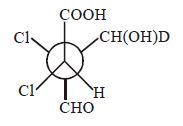
MediumMCQ
The following compound contains how many chiral centres?
A
$3$
B
$2$
C
$1$
D
$4$
Solution
(A) chiral centre is a carbon atom that is bonded to four different groups.
In the given Newman projection,we can convert it into a Fischer projection to identify the chiral centres.
The structure has two main carbon atoms in the backbone and a side chain containing a chiral carbon.
$1$. The carbon atom attached to $-COOH$,$-H$,$-Cl$,and the rest of the chain is chiral.
$2$. The carbon atom attached to $-CHO$,$-Cl$,$-H$,and the rest of the chain is chiral.
$3$. The carbon atom in the side chain $-CH(OH)D$ is attached to $-H$,$-OH$,$-D$,and the main chain,making it chiral.
Thus,there are $3$ chiral centres in the molecule.
In the given Newman projection,we can convert it into a Fischer projection to identify the chiral centres.
The structure has two main carbon atoms in the backbone and a side chain containing a chiral carbon.
$1$. The carbon atom attached to $-COOH$,$-H$,$-Cl$,and the rest of the chain is chiral.
$2$. The carbon atom attached to $-CHO$,$-Cl$,$-H$,and the rest of the chain is chiral.
$3$. The carbon atom in the side chain $-CH(OH)D$ is attached to $-H$,$-OH$,$-D$,and the main chain,making it chiral.
Thus,there are $3$ chiral centres in the molecule.
0 likes
View Solution129
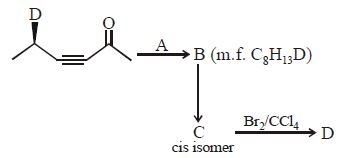
AdvancedMCQ
In the reaction sequence shown below,determine the total number of stereoisomers formed as the final product $D$. The starting material is $CH_3-CD(CH_3)-C \equiv C-CO-CH_3$. The reaction $A$ is $LiAlH_4$ (or similar reducing agent to reduce the alkyne to a cis-alkene),$C$ is the cis-isomer,and the final step is the addition of $Br_2/CCl_4$.
A
$2$
B
$3$
C
$4$
D
$8$
Solution
(D) $1$. The starting material is a chiral ketone with an alkyne group: $CH_3-CD(CH_3)-C \equiv C-CO-CH_3$. The chiral center at the $CD(CH_3)$ position is fixed as $(R)$ or $(S)$.
$2$. Reaction $A$ involves the reduction of the alkyne to a $cis$-alkene. This creates a new double bond,but since the geometry is fixed as $cis$,no new stereocenter is formed at the alkene carbons.
$3$. Compound $C$ is the $cis$-alkene: $CH_3-CD(CH_3)-CH=CH-CO-CH_3$. It has one chiral center.
$4$. The final step is the addition of $Br_2/CCl_4$ to the $cis$-alkene. This is an anti-addition reaction across the double bond.
$5$. The addition of $Br_2$ to the $cis$-alkene creates two new chiral centers at the carbons where $Br$ atoms are added.
$6$. Since the molecule already has one chiral center,and two new ones are formed,the total number of stereoisomers is $2^n$,where $n$ is the number of chiral centers. Here,$n=3$. Total stereoisomers = $2^3 = 8$.
$2$. Reaction $A$ involves the reduction of the alkyne to a $cis$-alkene. This creates a new double bond,but since the geometry is fixed as $cis$,no new stereocenter is formed at the alkene carbons.
$3$. Compound $C$ is the $cis$-alkene: $CH_3-CD(CH_3)-CH=CH-CO-CH_3$. It has one chiral center.
$4$. The final step is the addition of $Br_2/CCl_4$ to the $cis$-alkene. This is an anti-addition reaction across the double bond.
$5$. The addition of $Br_2$ to the $cis$-alkene creates two new chiral centers at the carbons where $Br$ atoms are added.
$6$. Since the molecule already has one chiral center,and two new ones are formed,the total number of stereoisomers is $2^n$,where $n$ is the number of chiral centers. Here,$n=3$. Total stereoisomers = $2^3 = 8$.
0 likes
View Solution130
MediumMCQ
How many optically active isomers are possible for $2,3-$dibromobutane-$1,4-$dioic acid?
A
$2$
B
$3$
C
$4$
D
$1$
Solution
(A) The structure of $2,3-$dibromobutane-$1,4-$dioic acid is $HOOC-CH(Br)-CH(Br)-COOH$.
This molecule contains two chiral centers at $C2$ and $C3$.
Since the molecule is symmetric (the two ends are identical),we can determine the number of stereoisomers using the formula for symmetric molecules.
For a symmetric molecule with an even number of chiral centers $(n=2)$,the number of optically active isomers (enantiomers) is $2^{(n-1)} = 2^{(2-1)} = 2^1 = 2$.
The two optically active isomers are the $(2R, 3R)$ and $(2S, 3S)$ forms.
The other isomer is the meso form $(2R, 3S)$,which is optically inactive due to an internal plane of symmetry.
Therefore,there are $2$ optically active isomers.
This molecule contains two chiral centers at $C2$ and $C3$.
Since the molecule is symmetric (the two ends are identical),we can determine the number of stereoisomers using the formula for symmetric molecules.
For a symmetric molecule with an even number of chiral centers $(n=2)$,the number of optically active isomers (enantiomers) is $2^{(n-1)} = 2^{(2-1)} = 2^1 = 2$.
The two optically active isomers are the $(2R, 3R)$ and $(2S, 3S)$ forms.
The other isomer is the meso form $(2R, 3S)$,which is optically inactive due to an internal plane of symmetry.
Therefore,there are $2$ optically active isomers.
0 likes
View Solution131
MediumMCQ
Which pairs of the salts should have identical solubilities in methanol?
A
$I$ and $IV$
B
$I$ and $III$
C
$I$ and $II$
D
$II$ and $IV$
Solution
(A) Enantiomers are non-superimposable mirror images of each other.
They possess identical physical properties,such as boiling point,melting point,and solubility in a given solvent,in an achiral environment like methanol.
Therefore,the pair consisting of enantiomers will exhibit identical solubilities.
They possess identical physical properties,such as boiling point,melting point,and solubility in a given solvent,in an achiral environment like methanol.
Therefore,the pair consisting of enantiomers will exhibit identical solubilities.
0 likes
View Solution132
DifficultMCQ
Which of the following is optically active?
A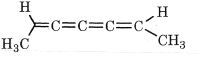
B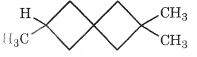
C
D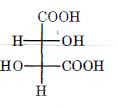
Solution
(D) For a molecule to be optically active,it must lack a plane of symmetry $(P.O.S.)$ and a center of symmetry $(C.O.S.)$.
$A$: This is a substituted allene with an odd number of double bonds. The terminal groups are in the same plane,and it possesses a plane of symmetry. Thus,it is optically inactive.
$B$: This is a bicyclic compound with a plane of symmetry passing through the molecule. Thus,it is optically inactive.
$C$: This is $cis-1,3-dimethylcyclopentane$. It has a plane of symmetry passing through the $C_2$ and $C_5$ atoms. Thus,it is optically inactive.
$D$: This is a tartaric acid derivative. In the given configuration,there is no plane of symmetry or center of symmetry. Therefore,it is chiral and optically active.
$A$: This is a substituted allene with an odd number of double bonds. The terminal groups are in the same plane,and it possesses a plane of symmetry. Thus,it is optically inactive.
$B$: This is a bicyclic compound with a plane of symmetry passing through the molecule. Thus,it is optically inactive.
$C$: This is $cis-1,3-dimethylcyclopentane$. It has a plane of symmetry passing through the $C_2$ and $C_5$ atoms. Thus,it is optically inactive.
$D$: This is a tartaric acid derivative. In the given configuration,there is no plane of symmetry or center of symmetry. Therefore,it is chiral and optically active.
0 likes
View Solution133
DifficultMCQ
How many stereoisomeric (Lactide) product$(s)$ are formed in the given reaction?
$CH_3-CH(OH)-COOH \xrightarrow{\Delta}$
$CH_3-CH(OH)-COOH \xrightarrow{\Delta}$
A
$2$
B
$4$
C
$3$
D
$1$
Solution
(C) Lactic acid $(CH_3-CH(OH)-COOH)$ on heating undergoes intermolecular esterification to form a cyclic diester known as lactide.
The lactide molecule contains two chiral centers.
The possible stereoisomers are $(R,R)$,$(S,S)$,and $(R,S)$ (meso form).
Therefore,a total of $3$ stereoisomeric products are formed.
The lactide molecule contains two chiral centers.
The possible stereoisomers are $(R,R)$,$(S,S)$,and $(R,S)$ (meso form).
Therefore,a total of $3$ stereoisomeric products are formed.
0 likes
View Solution134
DifficultMCQ
$A$ natural product was isolated in the laboratory and its observed rotation was $+10^{\circ}$. When measured in a $1 \ dm$ sample tube containing $1 \ g$ of compound in $10 \ mL$ of water. What is the specific rotation of this compound?
A
$(+) 100^{\circ}$
B
$(-) 100^{\circ}$
C
$(+) 1^{\circ}$
D
$(-) 1^{\circ}$
Solution
(A) The formula for specific rotation $[\alpha]$ is given by: $[\alpha] = \frac{\alpha}{l \times c}$
Where:
$\alpha$ is the observed rotation = $+10^{\circ}$
$l$ is the path length in $dm$ = $1 \ dm$
$c$ is the concentration in $g/mL$ = $\frac{1 \ g}{10 \ mL} = 0.1 \ g/mL$
Substituting the values:
$[\alpha] = \frac{10}{1 \times 0.1} = \frac{10}{0.1} = +100^{\circ}$
Therefore,the specific rotation is $+100^{\circ}$.
Where:
$\alpha$ is the observed rotation = $+10^{\circ}$
$l$ is the path length in $dm$ = $1 \ dm$
$c$ is the concentration in $g/mL$ = $\frac{1 \ g}{10 \ mL} = 0.1 \ g/mL$
Substituting the values:
$[\alpha] = \frac{10}{1 \times 0.1} = \frac{10}{0.1} = +100^{\circ}$
Therefore,the specific rotation is $+100^{\circ}$.
0 likes
View Solution135
MediumMCQ
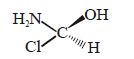
What is the correct configuration of the following molecule?
A
$R$
B
$S$
C
$Z$
D
$E$
Solution
(B) To determine the configuration,we assign priorities to the groups attached to the chiral carbon atom using the Cahn-Ingold-Prelog $(CIP)$ rules based on atomic number:
$1$. $-OH$ (Oxygen,$Z=8$)
$2$. $-Cl$ (Chlorine,$Z=17$)
$3$. $-NH_2$ (Nitrogen,$Z=7$)
$4$. $-H$ (Hydrogen,$Z=1$)
Wait,re-evaluating priorities:
$1$. $-Cl$ $(Z=17)$
$2$. $-OH$ $(Z=8)$
$3$. $-NH_2$ $(Z=7)$
$4$. $-H$ $(Z=1)$
In the given structure,the lowest priority group $(-H)$ is on a dashed bond (pointing away).
Tracing the path from priority $1$ $\rightarrow 2$ $\rightarrow 3$:
$Cl$ $\rightarrow OH$ $\rightarrow NH_2$
This path is counter-clockwise.
Therefore,the configuration is $S$.
$1$. $-OH$ (Oxygen,$Z=8$)
$2$. $-Cl$ (Chlorine,$Z=17$)
$3$. $-NH_2$ (Nitrogen,$Z=7$)
$4$. $-H$ (Hydrogen,$Z=1$)
Wait,re-evaluating priorities:
$1$. $-Cl$ $(Z=17)$
$2$. $-OH$ $(Z=8)$
$3$. $-NH_2$ $(Z=7)$
$4$. $-H$ $(Z=1)$
In the given structure,the lowest priority group $(-H)$ is on a dashed bond (pointing away).
Tracing the path from priority $1$ $\rightarrow 2$ $\rightarrow 3$:
$Cl$ $\rightarrow OH$ $\rightarrow NH_2$
This path is counter-clockwise.
Therefore,the configuration is $S$.
0 likes
View Solution136
MediumMCQ
Total number of stereoisomers of the compound $1-$bromo$-3-$chlorocyclobutane.
A
$2$
B
$4$
C
$3$
D
$1$
Solution
(C) The compound $1-$bromo$-3-$chlorocyclobutane has two chiral centers at positions $1$ and $3$ of the cyclobutane ring.
Since the ring is symmetric,we must consider the geometric configurations (cis and trans) and the optical activity.
For the $cis-$isomer,the molecule has a plane of symmetry,making it achiral (meso form).
For the $trans-$isomer,the molecule exists as a pair of enantiomers because it lacks a plane of symmetry.
Thus,the total number of stereoisomers is $1$ (cis-meso) $+ 2$ (trans-enantiomers) $= 3$ stereoisomers.
Since the ring is symmetric,we must consider the geometric configurations (cis and trans) and the optical activity.
For the $cis-$isomer,the molecule has a plane of symmetry,making it achiral (meso form).
For the $trans-$isomer,the molecule exists as a pair of enantiomers because it lacks a plane of symmetry.
Thus,the total number of stereoisomers is $1$ (cis-meso) $+ 2$ (trans-enantiomers) $= 3$ stereoisomers.
0 likes
View Solution137
DifficultMCQ
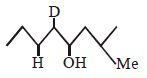
How many chiral carbon atoms are present in the following compound?
A
$2$
B
$4$
C
$1$
D
$3$
Solution
(D) chiral carbon atom is a carbon atom that is bonded to four different groups.
Let us analyze the structure:
$1$. The carbon atom attached to the $H$ atom is bonded to an ethyl group,a $D$ atom,the rest of the chain,and an $H$ atom. Since all four groups are different,this is a chiral center.
$2$. The carbon atom attached to the $D$ atom is bonded to the previous chiral carbon,a $D$ atom,the carbon with the $OH$ group,and an $H$ atom (implied). This is a chiral center.
$3$. The carbon atom attached to the $OH$ group is bonded to the carbon with the $D$ atom,an $OH$ group,an $H$ atom (implied),and the rest of the chain. This is a chiral center.
$4$. The carbon atom attached to the $Me$ group is bonded to the rest of the chain,an $H$ atom (implied),a methyl group,and another methyl group (the terminal $Me$ and the branch $Me$). Since it is bonded to two identical methyl groups,it is not a chiral center.
Thus,there are $3$ chiral carbon atoms in the given compound.
Let us analyze the structure:
$1$. The carbon atom attached to the $H$ atom is bonded to an ethyl group,a $D$ atom,the rest of the chain,and an $H$ atom. Since all four groups are different,this is a chiral center.
$2$. The carbon atom attached to the $D$ atom is bonded to the previous chiral carbon,a $D$ atom,the carbon with the $OH$ group,and an $H$ atom (implied). This is a chiral center.
$3$. The carbon atom attached to the $OH$ group is bonded to the carbon with the $D$ atom,an $OH$ group,an $H$ atom (implied),and the rest of the chain. This is a chiral center.
$4$. The carbon atom attached to the $Me$ group is bonded to the rest of the chain,an $H$ atom (implied),a methyl group,and another methyl group (the terminal $Me$ and the branch $Me$). Since it is bonded to two identical methyl groups,it is not a chiral center.
Thus,there are $3$ chiral carbon atoms in the given compound.
0 likes
View Solution138
EasyMCQ
Which of the following is optically active?
A
$CH_3-CH(OH)-COOH$
B
$CH_3-CH_2-CH_3$
C
Cyclohexane
D
None
Solution
(A) molecule is optically active if it contains at least one chiral center (a carbon atom bonded to four different groups).
$A$. Lactic acid $(CH_3-CH(OH)-COOH)$ has a chiral carbon atom bonded to $-H$,$-OH$,$-CH_3$,and $-COOH$ groups. Thus,it is optically active.
$B$. Propane $(CH_3-CH_2-CH_3)$ has no chiral center.
$C$. Cyclohexane is a symmetric molecule and does not possess a chiral center.
Therefore,the correct option is $A$.
$A$. Lactic acid $(CH_3-CH(OH)-COOH)$ has a chiral carbon atom bonded to $-H$,$-OH$,$-CH_3$,and $-COOH$ groups. Thus,it is optically active.
$B$. Propane $(CH_3-CH_2-CH_3)$ has no chiral center.
$C$. Cyclohexane is a symmetric molecule and does not possess a chiral center.
Therefore,the correct option is $A$.
0 likes
View Solution139
DifficultMCQ
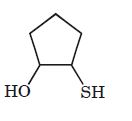
How many stereoisomers are possible for $2$-hydroxycyclopentanethiol?
A
$2$
B
$3$
C
$4$
D
$5$
Solution
(C) The molecule $2$-hydroxycyclopentanethiol has two chiral centers at the $C_1$ and $C_2$ positions of the cyclopentane ring.
Since the two chiral centers are attached to different groups (one to $-OH$ and one to $-SH$),the molecule does not possess a plane of symmetry in any configuration.
The number of stereoisomers for a molecule with $n$ chiral centers and no internal symmetry is given by $2^n$.
Here,$n = 2$,so the number of stereoisomers is $2^2 = 4$.
These consist of two pairs of enantiomers: $(1R, 2R)$,$(1S, 2S)$,$(1R, 2S)$,and $(1S, 2R)$.
Since the two chiral centers are attached to different groups (one to $-OH$ and one to $-SH$),the molecule does not possess a plane of symmetry in any configuration.
The number of stereoisomers for a molecule with $n$ chiral centers and no internal symmetry is given by $2^n$.
Here,$n = 2$,so the number of stereoisomers is $2^2 = 4$.
These consist of two pairs of enantiomers: $(1R, 2R)$,$(1S, 2S)$,$(1R, 2S)$,and $(1S, 2R)$.
0 likes
View Solution140
DifficultMCQ
Which of the following represent a pair of enantiomers?
A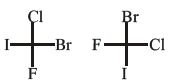
B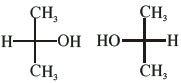
C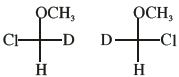
D
None
Solution
(C) Enantiomers are non-superimposable mirror images of each other.
In option $C$,the two structures are mirror images of each other and are non-superimposable because the central carbon is chiral (bonded to four different groups: $-OCH_3, -Cl, -D, -H$).
Therefore,the pair in option $C$ represents enantiomers.
In option $C$,the two structures are mirror images of each other and are non-superimposable because the central carbon is chiral (bonded to four different groups: $-OCH_3, -Cl, -D, -H$).
Therefore,the pair in option $C$ represents enantiomers.
0 likes
View Solution141
MediumMCQ
What is the configuration of the two chiral centers in the given molecule?
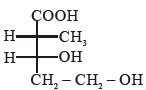
A
$2R, 3R$
B
$2R, 3S$
C
$2S, 3R$
D
$2S, 3S$
Solution
(C) To determine the configuration of the chiral centers,we use the Cahn-Ingold-Prelog $(CIP)$ priority rules.
For the chiral center at $C-2$ (the upper one attached to $COOH$,$CH_3$,$H$,and the rest of the chain):
$1$. Priority $1$: $-COOH$ $(-C(=O)OH)$
$2$. Priority $2$: $-CH(OH)CH_2CH_2OH$ (the lower chiral center group)
$3$. Priority $3$: $-CH_3$
$4$. Priority $4$: $-H$
Since the lowest priority group $(-H)$ is on a horizontal bond,we reverse the result. The sequence $1$ $\rightarrow 2$ $\rightarrow 3$ is clockwise $(R)$,so reversing it gives $S$. Thus,$C-2$ is $2S$.
For the chiral center at $C-3$ (the lower one attached to $OH$,$H$,$CH_2CH_2OH$,and the upper group):
$1$. Priority $1$: $-OH$
$2$. Priority $2$: $-CH(CH_3)COOH$ (the upper chiral center group)
$3$. Priority $3$: $-CH_2CH_2OH$
$4$. Priority $4$: $-H$
Since the lowest priority group $(-H)$ is on a horizontal bond,we reverse the result. The sequence $1$ $\rightarrow 2$ $\rightarrow 3$ is counter-clockwise $(S)$,so reversing it gives $R$. Thus,$C-3$ is $3R$.
Therefore,the configuration is $2S, 3R$.
For the chiral center at $C-2$ (the upper one attached to $COOH$,$CH_3$,$H$,and the rest of the chain):
$1$. Priority $1$: $-COOH$ $(-C(=O)OH)$
$2$. Priority $2$: $-CH(OH)CH_2CH_2OH$ (the lower chiral center group)
$3$. Priority $3$: $-CH_3$
$4$. Priority $4$: $-H$
Since the lowest priority group $(-H)$ is on a horizontal bond,we reverse the result. The sequence $1$ $\rightarrow 2$ $\rightarrow 3$ is clockwise $(R)$,so reversing it gives $S$. Thus,$C-2$ is $2S$.
For the chiral center at $C-3$ (the lower one attached to $OH$,$H$,$CH_2CH_2OH$,and the upper group):
$1$. Priority $1$: $-OH$
$2$. Priority $2$: $-CH(CH_3)COOH$ (the upper chiral center group)
$3$. Priority $3$: $-CH_2CH_2OH$
$4$. Priority $4$: $-H$
Since the lowest priority group $(-H)$ is on a horizontal bond,we reverse the result. The sequence $1$ $\rightarrow 2$ $\rightarrow 3$ is counter-clockwise $(S)$,so reversing it gives $R$. Thus,$C-3$ is $3R$.
Therefore,the configuration is $2S, 3R$.
0 likes
View Solution142
EasyMCQ
Identify the relationship between the given pair of molecules.
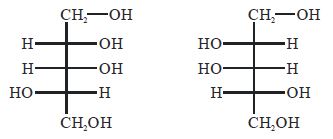
A
Enantiomer
B
Diastereomers
C
Epimer
D
Identical
Solution
(A) The given structures are Fischer projections of polyhydroxy compounds. Let us analyze the configuration at each chiral center.
For the first molecule (left): The chiral centers from top to bottom have configurations (assuming standard priority rules): $C_2$ ($OH$ on right),$C_3$ ($OH$ on right),$C_4$ ($OH$ on left).
For the second molecule (right): The chiral centers from top to bottom have configurations: $C_2$ ($OH$ on left),$C_3$ ($OH$ on left),$C_4$ ($OH$ on right).
Since the configurations at all chiral centers are inverted,the two molecules are non-superimposable mirror images of each other.
Therefore,they are enantiomers.
For the first molecule (left): The chiral centers from top to bottom have configurations (assuming standard priority rules): $C_2$ ($OH$ on right),$C_3$ ($OH$ on right),$C_4$ ($OH$ on left).
For the second molecule (right): The chiral centers from top to bottom have configurations: $C_2$ ($OH$ on left),$C_3$ ($OH$ on left),$C_4$ ($OH$ on right).
Since the configurations at all chiral centers are inverted,the two molecules are non-superimposable mirror images of each other.
Therefore,they are enantiomers.
0 likes
View Solution143
MediumMCQ
The total number of stereoisomers of the product formed in the reaction $CH_3-CH=CH-COOH \xrightarrow{Br_2} \text{Product}$ is:
A
$1$
B
$2$
C
$3$
D
$4$
Solution
(D) The reaction of $CH_3-CH=CH-COOH$ (crotonic acid) with $Br_2$ is an electrophilic addition reaction.
This reaction involves the anti-addition of bromine across the double bond.
The product formed is $CH_3-CH(Br)-CH(Br)-COOH$ ($2$,$3$-dibromobutanoic acid).
This molecule contains two chiral centers at $C_2$ and $C_3$.
For a molecule with two chiral centers where the groups attached to the chiral carbons are different,the number of stereoisomers is $2^n$,where $n$ is the number of chiral centers.
Here,$n = 2$,so the number of stereoisomers is $2^2 = 4$.
This reaction involves the anti-addition of bromine across the double bond.
The product formed is $CH_3-CH(Br)-CH(Br)-COOH$ ($2$,$3$-dibromobutanoic acid).
This molecule contains two chiral centers at $C_2$ and $C_3$.
For a molecule with two chiral centers where the groups attached to the chiral carbons are different,the number of stereoisomers is $2^n$,where $n$ is the number of chiral centers.
Here,$n = 2$,so the number of stereoisomers is $2^2 = 4$.
0 likes
View Solution144
MediumMCQ
The correct statement$(s)$ about compounds $A$,$B$,and $C$ is/are:
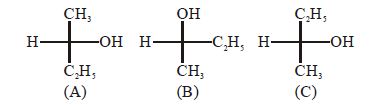
A
$A$ and $B$ are enantiomers
B
$B$ and $C$ are diastereomers
C
$A$ and $C$ are enantiomers
D
$A$ and $C$ are diastereomers
Solution
(A, C) First,determine the configuration of each chiral center using the Cahn-Ingold-Prelog $(CIP)$ priority rules: $1: -OH$,$2: -C_2H_5$,$3: -CH_3$,$4: -H$.
For compound $A$: The $-H$ is on a horizontal bond. The sequence $1$ $\rightarrow 2$ $\rightarrow 3$ is clockwise,so the configuration is $S$.
For compound $B$: The $-H$ is on a horizontal bond. The sequence $1$ $\rightarrow 2$ $\rightarrow 3$ is counter-clockwise,so the configuration is $R$.
For compound $C$: The $-H$ is on a horizontal bond. The sequence $1$ $\rightarrow 2$ $\rightarrow 3$ is counter-clockwise,so the configuration is $R$.
Comparing the configurations: $A$ $(S)$ and $B$ $(R)$ are enantiomers. $B$ $(R)$ and $C$ $(R)$ are identical (they are the same molecule). $A$ $(S)$ and $C$ $(R)$ are enantiomers.
Therefore,the correct statements are that $A$ and $B$ are enantiomers,and $A$ and $C$ are enantiomers.
For compound $A$: The $-H$ is on a horizontal bond. The sequence $1$ $\rightarrow 2$ $\rightarrow 3$ is clockwise,so the configuration is $S$.
For compound $B$: The $-H$ is on a horizontal bond. The sequence $1$ $\rightarrow 2$ $\rightarrow 3$ is counter-clockwise,so the configuration is $R$.
For compound $C$: The $-H$ is on a horizontal bond. The sequence $1$ $\rightarrow 2$ $\rightarrow 3$ is counter-clockwise,so the configuration is $R$.
Comparing the configurations: $A$ $(S)$ and $B$ $(R)$ are enantiomers. $B$ $(R)$ and $C$ $(R)$ are identical (they are the same molecule). $A$ $(S)$ and $C$ $(R)$ are enantiomers.
Therefore,the correct statements are that $A$ and $B$ are enantiomers,and $A$ and $C$ are enantiomers.
0 likes
View Solution145
MediumMCQ
Total possible stereoisomers from the given compound $CH_3-CH=CH-CH(OH)-CH(OH)-CH_3$ will be:
A
$6$
B
$8$
C
$4$
D
$10$
Solution
(B) The given compound is $CH_3-CH=CH-CH(OH)-CH(OH)-CH_3$.
It contains $3$ stereogenic centers:
$1.$ One carbon-carbon double bond $(CH=CH)$ which exhibits geometrical isomerism $(cis/trans)$.
$2.$ Two chiral carbon atoms $(CH(OH))$ which exhibit optical isomerism.
Since the molecule is unsymmetrical,the total number of stereoisomers is calculated using the formula $2^n$,where $n$ is the total number of stereogenic centers.
Here,$n = 3$.
Therefore,the total number of stereoisomers $= 2^3 = 8$.
It contains $3$ stereogenic centers:
$1.$ One carbon-carbon double bond $(CH=CH)$ which exhibits geometrical isomerism $(cis/trans)$.
$2.$ Two chiral carbon atoms $(CH(OH))$ which exhibit optical isomerism.
Since the molecule is unsymmetrical,the total number of stereoisomers is calculated using the formula $2^n$,where $n$ is the total number of stereogenic centers.
Here,$n = 3$.
Therefore,the total number of stereoisomers $= 2^3 = 8$.
0 likes
View Solution146
MediumMCQ
Which of the following is optically active?
A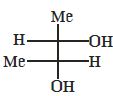
B
C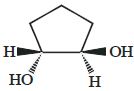
D
Solution
(B) molecule is optically active if it lacks a plane of symmetry,center of inversion,or improper axis of rotation (i.e.,it is chiral).
$A$: The structure is $2,3$-butanediol in a Fischer projection. It has a plane of symmetry passing through the center,making it a meso compound (optically inactive).
$B$: The structure is $2$-chlorobutane. The central carbon is bonded to four different groups $(-H, -Cl, -CH_3, -CH_2CH_3)$,making it a chiral center. It lacks any plane of symmetry and is therefore optically active.
$C$: The structure is $trans$-$1,2$-cyclopentanediol. It has a $C_2$ axis of symmetry but no plane of symmetry or center of inversion,making it chiral and optically active. However,looking at the provided image,it represents $trans$-$1,2$-cyclopentanediol,which is chiral.
$D$: The structure is $cis$-$1,3$-dimethylcyclopentane. It has a plane of symmetry passing through the $C_2$ carbon,making it a meso compound (optically inactive).
Comparing the options,$B$ is a classic example of a chiral molecule with a single stereocenter.
$A$: The structure is $2,3$-butanediol in a Fischer projection. It has a plane of symmetry passing through the center,making it a meso compound (optically inactive).
$B$: The structure is $2$-chlorobutane. The central carbon is bonded to four different groups $(-H, -Cl, -CH_3, -CH_2CH_3)$,making it a chiral center. It lacks any plane of symmetry and is therefore optically active.
$C$: The structure is $trans$-$1,2$-cyclopentanediol. It has a $C_2$ axis of symmetry but no plane of symmetry or center of inversion,making it chiral and optically active. However,looking at the provided image,it represents $trans$-$1,2$-cyclopentanediol,which is chiral.
$D$: The structure is $cis$-$1,3$-dimethylcyclopentane. It has a plane of symmetry passing through the $C_2$ carbon,making it a meso compound (optically inactive).
Comparing the options,$B$ is a classic example of a chiral molecule with a single stereocenter.
0 likes
View Solution147
MediumMCQ
The number of optical isomers for the compound $CH_3-CH(OH)-CH(Cl)-CH_2-COOH$ is:
A
$2$
B
$3$
C
$4$
D
$5$
Solution
(C) The compound $CH_3-CH(OH)-CH(Cl)-CH_2-COOH$ contains two chiral carbon atoms ($C2$ and $C3$).
Since the molecule is unsymmetrical,the number of optical isomers is calculated using the formula $2^n$,where $n$ is the number of chiral centers.
Here,$n = 2$,so the number of optical isomers $= 2^2 = 4$.
Since the molecule is unsymmetrical,the number of optical isomers is calculated using the formula $2^n$,where $n$ is the number of chiral centers.
Here,$n = 2$,so the number of optical isomers $= 2^2 = 4$.
0 likes
View Solution148
EasyMCQ
The given structures are related as:
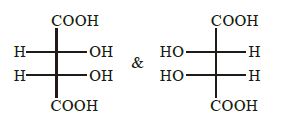
A
Enantiomers
B
Diastereomers
C
Identical
D
Geometrical isomers
Solution
(A) The given structures are Fischer projections of tartaric acid derivatives.
Let us assign the configuration to the chiral centers.
In the first structure,the top chiral carbon has $-OH$ on the right and the bottom chiral carbon has $-OH$ on the right.
In the second structure,the top chiral carbon has $-OH$ on the left and the bottom chiral carbon has $-OH$ on the left.
These two structures are non-superimposable mirror images of each other.
Therefore,they are enantiomers.
Let us assign the configuration to the chiral centers.
In the first structure,the top chiral carbon has $-OH$ on the right and the bottom chiral carbon has $-OH$ on the right.
In the second structure,the top chiral carbon has $-OH$ on the left and the bottom chiral carbon has $-OH$ on the left.
These two structures are non-superimposable mirror images of each other.
Therefore,they are enantiomers.
0 likes
View Solution149
EasyMCQ
Which of the following compounds is optically active?
A
$CH_3-CH(OH)-COOH$
B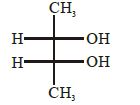
C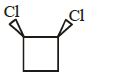
D
$CH_3-CH=CH-CH_3$
Solution
(A) compound is optically active if it lacks a plane of symmetry and contains at least one chiral carbon atom (a carbon atom bonded to four different groups).
$A$. $CH_3-CH(OH)-COOH$ (Lactic acid) has a chiral carbon atom bonded to $-H$,$-OH$,$-CH_3$,and $-COOH$. It is optically active.
$B$. The structure is $2,3$-butanediol. The meso form has a plane of symmetry and is optically inactive.
$C$. The structure is $1,2$-dichlorocyclobutane. The cis-isomer has a plane of symmetry and is optically inactive.
$D$. $CH_3-CH=CH-CH_3$ (But-$2$-ene) is a planar molecule and does not contain a chiral carbon atom; it is optically inactive.
Therefore,the correct answer is $A$.
$A$. $CH_3-CH(OH)-COOH$ (Lactic acid) has a chiral carbon atom bonded to $-H$,$-OH$,$-CH_3$,and $-COOH$. It is optically active.
$B$. The structure is $2,3$-butanediol. The meso form has a plane of symmetry and is optically inactive.
$C$. The structure is $1,2$-dichlorocyclobutane. The cis-isomer has a plane of symmetry and is optically inactive.
$D$. $CH_3-CH=CH-CH_3$ (But-$2$-ene) is a planar molecule and does not contain a chiral carbon atom; it is optically inactive.
Therefore,the correct answer is $A$.
0 likes
View Solution8-2.Organic Chemistry : Isomerism — Optical isomerism · Frequently Asked Questions
1Are these 8-2.Organic Chemistry : Isomerism questions useful for JEE and NEET?
Yes. All questions in this section are mapped to JEE Main and NEET exam patterns. Previous year questions from JEE Main, NEET, GUJCET and state-level exams are included with full solutions.
2Can I switch to Hindi or Gujarati for these questions?
Yes. Use the language tabs in the hero section or the sidebar to view the same questions and solutions in English, Hindi or Gujarati.
3How do I generate a question paper from this subtopic?
Use the Vedclass Exam Paper Generator — select the chapter and subtopic, set difficulty, and generate Sets A, B, C, D automatically. First 3 chapters of every subject are free.
Vedclass Products
For Students
Vedclass Test Series
Mock tests in real JEE/NEET style with performance analysis. 5-day free trial.
Start Free TrialFor Teachers
Exam Paper Generator
Generate Set A/B/C/D papers from this chapter in 2 minutes. 3 chapters free.
Try FreeFor Institutes
Online Exam Module
Live online exams with unlimited students, 360° analytics & white-label branding.
See DemoFor Teachers & Institutes
Generate a 8-2.Organic Chemistry : Isomerism Exam Paper in 2 Minutes
Select subtopic & difficulty — Sets A, B, C, D auto-generated with No Repeat logic.
First 3 chapters of every subject are free — no payment required.