
A English
Geometrical isomerism Questions in English
Class 11 Chemistry · 8-2.Organic Chemistry : Isomerism · Geometrical isomerism
148+
Questions
English
Language
100%
With Solutions
Showing 48 of 148 questions in English
1
MediumMCQ
Geometrical isomerism is shown by
A
$2-$butene
B
$2-$butyne
C
$2-$butanol
D
Butanal
Solution
(A) Geometrical isomerism is shown by compounds that have restricted rotation around a double bond and where each carbon atom of the double bond is attached to two different groups.
In $2-$butene $(CH_3-CH=CH-CH_3)$,the carbon atoms of the double bond are each bonded to a hydrogen atom $(H)$ and a methyl group $(CH_3)$.
Thus,it exists as cis-$2-$butene and trans-$2-$butene,which are geometrical isomers.
In $2-$butene $(CH_3-CH=CH-CH_3)$,the carbon atoms of the double bond are each bonded to a hydrogen atom $(H)$ and a methyl group $(CH_3)$.
Thus,it exists as cis-$2-$butene and trans-$2-$butene,which are geometrical isomers.
0 likes
View Solution2
MediumMCQ
Which one of the following exhibits geometrical isomerism?
A
$CH_3-CH=CH-CH_3$ (But$-2-$ene)
B
$C_2H_5-CH=CH_2$ (But$-1-$ene)
C
$(CH_3)_2C=CH_2$ ($2$-Methylpropene)
D
$CH_3-CH_2-CH=CH_2$ (But$-1-$ene isomer)
Solution
(A) For a molecule to exhibit geometrical isomerism,each carbon atom of the double bond must be attached to two different groups.
In $CH_3-CH=CH-CH_3$ (But$-2-$ene),the first carbon is attached to $-H$ and $-CH_3$,and the second carbon is also attached to $-H$ and $-CH_3$. Since both carbons have different substituents,it exhibits $cis$- and $trans$-isomerism.
In the other options,at least one carbon of the double bond is attached to two identical groups (e.g.,two $-H$ atoms),which prevents geometrical isomerism.
In $CH_3-CH=CH-CH_3$ (But$-2-$ene),the first carbon is attached to $-H$ and $-CH_3$,and the second carbon is also attached to $-H$ and $-CH_3$. Since both carbons have different substituents,it exhibits $cis$- and $trans$-isomerism.
In the other options,at least one carbon of the double bond is attached to two identical groups (e.g.,two $-H$ atoms),which prevents geometrical isomerism.
0 likes
View Solution3
MediumMCQ
Which of the following can exhibit cis-trans isomerism?
A
$HC \equiv CH$
B
$ClCH=CHCl$
C
$CH_3-CHCl-COOH$
D
$ClCH_2-CH_2Cl$
Solution
(B) Cis-trans isomerism (geometrical isomerism) occurs in compounds containing a carbon-carbon double bond where each carbon atom is attached to two different groups.
In $ClCH=CHCl$ ($1$,$2$-dichloroethene),each carbon atom of the double bond is attached to one $H$ atom and one $Cl$ atom.
Since the groups attached to each carbon are different,it can exist in two forms: cis$-1,2-$dichloroethene and trans$-1,2-$dichloroethene.
Therefore,option $(B)$ is correct.
In $ClCH=CHCl$ ($1$,$2$-dichloroethene),each carbon atom of the double bond is attached to one $H$ atom and one $Cl$ atom.
Since the groups attached to each carbon are different,it can exist in two forms: cis$-1,2-$dichloroethene and trans$-1,2-$dichloroethene.
Therefore,option $(B)$ is correct.
0 likes
View Solution4
MediumMCQ
The number of geometrical isomers in case of a compound with the structure $CH_3-CH=CH-CH=CH-C_2H_5$ is
A
$4$
B
$3$
C
$2$
D
$5$
Solution
(A) The given compound is $CH_3-CH=CH-CH=CH-C_2H_5$.
Since the molecule is unsymmetrical,the number of geometrical isomers is given by the formula $2^n$,where $n$ is the number of double bonds capable of showing geometrical isomerism.
Here,both double bonds are capable of showing geometrical isomerism,so $n = 2$.
Therefore,the number of geometrical isomers = $2^2 = 4$.
The four isomers are:
$1$. $cis, cis$
$2$. $trans, trans$
$3$. $cis, trans$
$4$. $trans, cis$
Since the molecule is unsymmetrical,the number of geometrical isomers is given by the formula $2^n$,where $n$ is the number of double bonds capable of showing geometrical isomerism.
Here,both double bonds are capable of showing geometrical isomerism,so $n = 2$.
Therefore,the number of geometrical isomers = $2^2 = 4$.
The four isomers are:
$1$. $cis, cis$
$2$. $trans, trans$
$3$. $cis, trans$
$4$. $trans, cis$
0 likes
View Solution5
MediumMCQ
Which compound does not show geometrical isomerism?
A
$2-$butene
B
$2-$pentene
C
$2,3-$dibromo$-2-$butene
D
$2-$methyl propene
Solution
(D) Geometrical isomerism is shown by alkenes where each carbon atom of the double bond is attached to two different groups.
$A$. $CH_3-CH=CH-CH_3$ ($2-$butene) shows geometrical isomerism (cis and trans).
$B$. $CH_3-CH=CH-CH_2-CH_3$ ($2-$pentene) shows geometrical isomerism.
$C$. $CH_3-C(Br)=C(Br)-CH_3$ ($2,3-$dibromo$-2-$butene) shows geometrical isomerism.
$D$. $CH_3-C(CH_3)=CH_2$ ($2-$methyl propene) has two identical hydrogen atoms on one of the double-bonded carbon atoms,therefore it does not show geometrical isomerism.
$A$. $CH_3-CH=CH-CH_3$ ($2-$butene) shows geometrical isomerism (cis and trans).
$B$. $CH_3-CH=CH-CH_2-CH_3$ ($2-$pentene) shows geometrical isomerism.
$C$. $CH_3-C(Br)=C(Br)-CH_3$ ($2,3-$dibromo$-2-$butene) shows geometrical isomerism.
$D$. $CH_3-C(CH_3)=CH_2$ ($2-$methyl propene) has two identical hydrogen atoms on one of the double-bonded carbon atoms,therefore it does not show geometrical isomerism.
0 likes
View Solution6
EasyMCQ
$cis$ and $trans-2-butene$ are:
A
Conformational isomers
B
Optical isomers
C
Position isomers
D
Geometrical isomers
Solution
(D) $cis$ and $trans-2-butene$ are geometrical isomers.
Geometrical isomerism arises due to restricted rotation around the $C=C$ double bond,leading to different spatial arrangements of the substituent groups.
Geometrical isomerism arises due to restricted rotation around the $C=C$ double bond,leading to different spatial arrangements of the substituent groups.
0 likes
View Solution7
MediumMCQ
Which pair shows $cis-trans$ isomerism?
A
Maleic-fumaric acid
B
Lactic-tartaric acid
C
Malonic-succinic acid
D
Crotonic-acrylic acid
Solution
(A) $Cis-trans$ isomerism (geometrical isomerism) occurs in compounds containing a $C=C$ double bond where each carbon atom is attached to two different groups.
Maleic acid is the $cis$-isomer (both $-COOH$ groups on the same side) and fumaric acid is the $trans$-isomer (both $-COOH$ groups on opposite sides) of butenedioic acid $(HOOC-CH=CH-COOH)$.
Therefore,the pair that shows $cis-trans$ isomerism is maleic-fumaric acid.
Maleic acid is the $cis$-isomer (both $-COOH$ groups on the same side) and fumaric acid is the $trans$-isomer (both $-COOH$ groups on opposite sides) of butenedioic acid $(HOOC-CH=CH-COOH)$.
Therefore,the pair that shows $cis-trans$ isomerism is maleic-fumaric acid.
0 likes
View Solution8
EasyMCQ
$1, 2-Dichloroethene$ shows:
A
Geometrical isomerism
B
Optical isomerism
C
Ring-chain isomerism
D
Resonance
Solution
(A) $1, 2-Dichloroethene$ $(ClHC=CHCl)$ has restricted rotation around the $C=C$ double bond.
Because each carbon atom is bonded to two different groups ($H$ and $Cl$),it can exist in two distinct spatial arrangements: the $cis$-isomer (where similar groups are on the same side) and the $trans$-isomer (where similar groups are on opposite sides).
This phenomenon is known as geometrical isomerism.
Because each carbon atom is bonded to two different groups ($H$ and $Cl$),it can exist in two distinct spatial arrangements: the $cis$-isomer (where similar groups are on the same side) and the $trans$-isomer (where similar groups are on opposite sides).
This phenomenon is known as geometrical isomerism.
0 likes
View Solution9
EasyMCQ
Geometrical isomerism is not possible in:
A
Propene
B
$3-$Hexene
C
Butenedioic acid
D
$1,2-$Dimethylcyclopropane
Solution
(A) Geometrical isomerism requires restricted rotation around a double bond or a ring structure,where each carbon atom of the double bond is attached to two different groups.
In $CH_3-CH=CH_2$ (Propene),one of the double-bonded carbons is attached to two identical hydrogen atoms,so it cannot exhibit geometrical isomerism.
In $3-$Hexene $(CH_3-CH_2-CH=CH-CH_2-CH_3)$,the groups on each double-bonded carbon are different,allowing for $cis$ and $trans$ isomers.
Butenedioic acid (Maleic and Fumaric acid) exhibits geometrical isomerism.
Cyclic compounds like $1,2-$dimethylcyclopropane can also exhibit geometrical isomerism due to restricted rotation.
In $CH_3-CH=CH_2$ (Propene),one of the double-bonded carbons is attached to two identical hydrogen atoms,so it cannot exhibit geometrical isomerism.
In $3-$Hexene $(CH_3-CH_2-CH=CH-CH_2-CH_3)$,the groups on each double-bonded carbon are different,allowing for $cis$ and $trans$ isomers.
Butenedioic acid (Maleic and Fumaric acid) exhibits geometrical isomerism.
Cyclic compounds like $1,2-$dimethylcyclopropane can also exhibit geometrical isomerism due to restricted rotation.
0 likes
View Solution10
MediumMCQ
The reason for geometrical isomerism in $2-butene$ is:
A
Chiral carbon
B
Free rotation about single bond
C
Free rotation about double bond
D
Restricted rotation about double bond
Solution
(D) Restricted rotation about the $C=C$ double bond is an essential condition for the existence of geometrical isomerism in alkenes like $2-butene$.
0 likes
View Solution11
MediumMCQ
Which of the following will show geometrical isomerism?
A
$CH_3-CH=CH-CH_3$
B
$(CH_3)_2C=C(CH_3)_2$
C
$N_2O \cdot FeSO_4$
D
$CH_3-CH=C(CH_3)_2$
Solution
(A) For a molecule to exhibit geometrical isomerism,each carbon atom of the double bond must be attached to two different groups.
In $CH_3-CH=CH-CH_3$ (but$-2-$ene),each carbon of the double bond is attached to a hydrogen atom and a methyl group. Thus,it exists as cis and trans isomers.
In $(CH_3)_2C=C(CH_3)_2$,each carbon is attached to two identical methyl groups,so it does not show geometrical isomerism.
In $CH_3-CH=C(CH_3)_2$,one carbon is attached to two identical methyl groups,so it does not show geometrical isomerism.
Therefore,the correct option is $A$.
In $CH_3-CH=CH-CH_3$ (but$-2-$ene),each carbon of the double bond is attached to a hydrogen atom and a methyl group. Thus,it exists as cis and trans isomers.
In $(CH_3)_2C=C(CH_3)_2$,each carbon is attached to two identical methyl groups,so it does not show geometrical isomerism.
In $CH_3-CH=C(CH_3)_2$,one carbon is attached to two identical methyl groups,so it does not show geometrical isomerism.
Therefore,the correct option is $A$.
0 likes
View Solution12
AdvancedMCQ
The number of isomers for the compound with molecular formula $C_2BrClFI$ is
A
$3$
B
$4$
C
$5$
D
$6$
Solution
(D) The molecular formula $C_2BrClFI$ corresponds to a haloalkene where each carbon of the double bond is substituted with two different halogens.
For a general alkene $C(ab)=C(cd)$,if $a \neq b$ and $c \neq d$,the molecule exhibits geometrical isomerism ($E$ and $Z$ forms).
In the case of $C_2BrClFI$,we can arrange the four different halogens $(Br, Cl, F, I)$ on the two carbons in different ways.
There are $3$ possible structural skeletons based on the relative positions of the halogens:
$1$. $Br-C(Cl)=C(F)-I$
$2$. $Br-C(F)=C(Cl)-I$
$3$. $Br-C(I)=C(Cl)-F$
Each of these $3$ structural isomers can exist as a pair of geometrical isomers ($E$ and $Z$).
Therefore,the total number of stereoisomers is $3 \times 2 = 6$.
For a general alkene $C(ab)=C(cd)$,if $a \neq b$ and $c \neq d$,the molecule exhibits geometrical isomerism ($E$ and $Z$ forms).
In the case of $C_2BrClFI$,we can arrange the four different halogens $(Br, Cl, F, I)$ on the two carbons in different ways.
There are $3$ possible structural skeletons based on the relative positions of the halogens:
$1$. $Br-C(Cl)=C(F)-I$
$2$. $Br-C(F)=C(Cl)-I$
$3$. $Br-C(I)=C(Cl)-F$
Each of these $3$ structural isomers can exist as a pair of geometrical isomers ($E$ and $Z$).
Therefore,the total number of stereoisomers is $3 \times 2 = 6$.
0 likes
View Solution13
MediumMCQ
Which of the following does not show geometrical isomerism?
A
$1, 2-$dichloro$-1-$pentene
B
$1, 3-$dichloro$-2-$pentene
C
$1, 1-$dichloro$-1-$pentene
D
$1, 4-$dichloro$-2-$pentene
Solution
(C) For a compound to exhibit geometrical isomerism,each carbon atom of the double bond must be attached to two different groups.
In $1, 1-$dichloro$-1-$pentene $(Cl_2C=CH-CH_2-CH_2-CH_3)$,the first carbon atom of the double bond is attached to two identical chlorine atoms.
Therefore,it cannot show geometrical isomerism.
In $1, 1-$dichloro$-1-$pentene $(Cl_2C=CH-CH_2-CH_2-CH_3)$,the first carbon atom of the double bond is attached to two identical chlorine atoms.
Therefore,it cannot show geometrical isomerism.
0 likes
View Solution14
MediumMCQ
Identify the type of isomerism exhibited by the following structures:
$H_3C-CH=CH-CH_3$ (cis-but$-2-$ene) and $H_3C-CH=CH-CH_3$ (trans-but$-2-$ene).
$H_3C-CH=CH-CH_3$ (cis-but$-2-$ene) and $H_3C-CH=CH-CH_3$ (trans-but$-2-$ene).
A
$Position$ isomerism
B
$Geometrical$ isomerism
C
$Optical$ isomerism
D
$Functional$ isomerism
Solution
(B) The given structures represent $cis-but-2-ene$ and $trans-but-2-ene$.
These isomers differ in the spatial arrangement of groups around the restricted rotation of the $C=C$ double bond.
This type of stereoisomerism is known as $Geometrical$ isomerism.
Therefore,the correct option is $(B)$.
These isomers differ in the spatial arrangement of groups around the restricted rotation of the $C=C$ double bond.
This type of stereoisomerism is known as $Geometrical$ isomerism.
Therefore,the correct option is $(B)$.
0 likes
View Solution15
EasyMCQ
Which compound shows $cis-trans$ isomerism?
A
$1-butene$
B
$2-propene$
C
$2-butene$
D
$Benzene$
Solution
(C) $Cis-trans$ isomerism is exhibited by compounds containing a double bond that restricts rotation around the bond axis.
In $2-butene$ $(CH_3-CH=CH-CH_3)$,each carbon atom of the double bond is attached to two different groups (a hydrogen atom and a methyl group),which allows for the existence of $cis$ and $trans$ isomers.
Therefore,$2-butene$ shows $cis-trans$ isomerism.
In $2-butene$ $(CH_3-CH=CH-CH_3)$,each carbon atom of the double bond is attached to two different groups (a hydrogen atom and a methyl group),which allows for the existence of $cis$ and $trans$ isomers.
Therefore,$2-butene$ shows $cis-trans$ isomerism.
0 likes
View Solution16
DifficultMCQ
Geometrical isomers differ in
A
Position of atoms
B
Length of carbon
C
Spatial arrangement of atoms
D
Position of functional group
Solution
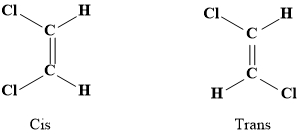
(C) Geometrical isomers have the same molecular formula and the same connectivity of atoms but differ in the spatial arrangement of groups around the double bond.
Geometrical isomerism is observed due to restricted rotation around the carbon-carbon double bond.
In geometrical isomerism,there is no change in the position of the double bond or the $C=C$ bond length; there is only a change in the spatial arrangement of the groups across the double bond.
Geometrical isomerism is observed due to restricted rotation around the carbon-carbon double bond.
In geometrical isomerism,there is no change in the position of the double bond or the $C=C$ bond length; there is only a change in the spatial arrangement of the groups across the double bond.
0 likes
View Solution17
MediumMCQ
Which one of the following will not show geometrical isomerism?
A
$H_3C-CH=C(Cl)Br$
B
$H_3C-C(CH_3)=C(Cl)Br$
C
$H-CH=C(D)Br$
D
$Cl-CH=C(Cl)Br$
Solution
(B) For a molecule to exhibit geometrical isomerism,each carbon atom of the $C=C$ double bond must be attached to two different groups.
In option $B$,the structure is $H_3C-C(CH_3)=C(Cl)Br$.
The first carbon atom is attached to two identical methyl $(-CH_3)$ groups.
Since the groups attached to the same carbon atom are not different,this molecule cannot show geometrical isomerism.
In option $B$,the structure is $H_3C-C(CH_3)=C(Cl)Br$.
The first carbon atom is attached to two identical methyl $(-CH_3)$ groups.
Since the groups attached to the same carbon atom are not different,this molecule cannot show geometrical isomerism.
0 likes
View Solution18
DifficultMCQ
Which of the following compounds shows geometrical isomerism?
A
B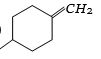
C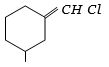
D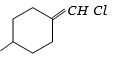
Solution
(C) For a compound to exhibit geometrical isomerism,the atoms or groups attached to each carbon atom of the double bond must be different.
In the given structures,the double bond is exocyclic to a cyclohexane ring.
In options $A$,$B$,and $D$,the exocyclic double bond is $C=CH_2$. Since the two groups attached to the terminal carbon of the double bond are both hydrogen atoms ($-H$ and $-H$),these compounds cannot show geometrical isomerism.
In option $C$,the exocyclic double bond is $C=CHCl$. Here,the terminal carbon of the double bond is attached to one hydrogen atom $(-H)$ and one chlorine atom $(-Cl)$. Since these two groups are different,this compound can exhibit geometrical isomerism (cis-trans isomerism).
In the given structures,the double bond is exocyclic to a cyclohexane ring.
In options $A$,$B$,and $D$,the exocyclic double bond is $C=CH_2$. Since the two groups attached to the terminal carbon of the double bond are both hydrogen atoms ($-H$ and $-H$),these compounds cannot show geometrical isomerism.
In option $C$,the exocyclic double bond is $C=CHCl$. Here,the terminal carbon of the double bond is attached to one hydrogen atom $(-H)$ and one chlorine atom $(-Cl)$. Since these two groups are different,this compound can exhibit geometrical isomerism (cis-trans isomerism).
0 likes
View Solution19
MediumMCQ
Which of the following shows geometrical isomerism?
A
$C_2H_5Br$
B
$(CH_2)(COOH)_2$
C
$(CH)_2(COOH)_2$
D
$C_2H_6$
Solution
(C) Geometrical isomerism is shown by compounds that have a restricted rotation around a double bond and where each carbon atom of the double bond is attached to two different groups.
In $(CH)_2(COOH)_2$,which is but$-2-$enedioic acid (maleic acid and fumaric acid),the structure is $HOOC-CH=CH-COOH$.
Each carbon atom of the $C=C$ double bond is attached to a hydrogen atom $(-H)$ and a carboxylic acid group $(-COOH)$.
Since both carbons have different groups attached,it exhibits geometrical isomerism (cis-trans isomerism).
In $(CH)_2(COOH)_2$,which is but$-2-$enedioic acid (maleic acid and fumaric acid),the structure is $HOOC-CH=CH-COOH$.
Each carbon atom of the $C=C$ double bond is attached to a hydrogen atom $(-H)$ and a carboxylic acid group $(-COOH)$.
Since both carbons have different groups attached,it exhibits geometrical isomerism (cis-trans isomerism).
0 likes
View Solution20
MediumMCQ
Which kind of isomerism is possible for $1-$chloro$-2-$nitroethene?
A
Functional group isomerism
B
Position isomerism
C
$E/Z$ isomerism
D
Optical isomerism
Solution
(C) The structure of $1-$chloro$-2-$nitroethene is $O_2N-CH=CH-Cl$.
In this molecule,the carbon-carbon double bond has different groups attached to each carbon atom ($H$ and $NO_2$ on one side,$H$ and $Cl$ on the other).
Since there is restricted rotation around the $C=C$ bond and different substituents are present on each carbon,the molecule exhibits geometrical isomerism.
For highly substituted alkenes,the $E/Z$ system of nomenclature is used,which is based on the priority system developed by Cahn,Ingold,and Prelog ($CIP$ rules).
In this molecule,the carbon-carbon double bond has different groups attached to each carbon atom ($H$ and $NO_2$ on one side,$H$ and $Cl$ on the other).
Since there is restricted rotation around the $C=C$ bond and different substituents are present on each carbon,the molecule exhibits geometrical isomerism.
For highly substituted alkenes,the $E/Z$ system of nomenclature is used,which is based on the priority system developed by Cahn,Ingold,and Prelog ($CIP$ rules).
0 likes
View Solution21
MediumMCQ
Which of the following will have geometrical isomers?
A
$2-$methylpropene
B
$2-$butene
C
$1-$butene
D
Propene
Solution
(B) Geometrical isomerism is shown by alkenes where each carbon atom of the double bond is attached to two different groups.
In $2-$butene $(CH_3-CH=CH-CH_3)$,each carbon of the double bond is attached to a hydrogen atom and a methyl group. Thus,it exists as $cis$ and $trans$ isomers.
In $2-$methylpropene,$1-$butene,and propene,at least one carbon of the double bond is attached to two identical groups (hydrogen atoms),so they do not show geometrical isomerism.
In $2-$butene $(CH_3-CH=CH-CH_3)$,each carbon of the double bond is attached to a hydrogen atom and a methyl group. Thus,it exists as $cis$ and $trans$ isomers.
In $2-$methylpropene,$1-$butene,and propene,at least one carbon of the double bond is attached to two identical groups (hydrogen atoms),so they do not show geometrical isomerism.
0 likes
View Solution22
MediumMCQ
Which of the following compounds will show geometrical isomerism?
A
$2-$butene
B
Propene
C
$1-$phenylpropene
D
Both $(a)$ and $(c)$
Solution
(D) Geometrical isomerism is shown by alkenes where each carbon atom of the double bond is attached to two different groups.
For $2-$butene $(CH_3-CH=CH-CH_3)$,each double-bonded carbon is attached to a $-H$ and a $-CH_3$ group,thus it shows cis-trans isomerism.
For $1-$phenylpropene $(CH_3-CH=CH-C_6H_5)$,each double-bonded carbon is attached to two different groups ($-H$ and $-CH_3$ on one carbon; $-H$ and $-C_6H_5$ on the other),thus it also shows geometrical isomerism.
Propene $(CH_3-CH=CH_2)$ does not show geometrical isomerism because one of the double-bonded carbons is attached to two identical hydrogen atoms.
Therefore,both $(a)$ and $(c)$ show geometrical isomerism.
For $2-$butene $(CH_3-CH=CH-CH_3)$,each double-bonded carbon is attached to a $-H$ and a $-CH_3$ group,thus it shows cis-trans isomerism.
For $1-$phenylpropene $(CH_3-CH=CH-C_6H_5)$,each double-bonded carbon is attached to two different groups ($-H$ and $-CH_3$ on one carbon; $-H$ and $-C_6H_5$ on the other),thus it also shows geometrical isomerism.
Propene $(CH_3-CH=CH_2)$ does not show geometrical isomerism because one of the double-bonded carbons is attached to two identical hydrogen atoms.
Therefore,both $(a)$ and $(c)$ show geometrical isomerism.
0 likes
View Solution23
MediumMCQ
Which kind of isomerism will butene-$2$ show?
A
Geometrical
B
Optical
C
Position
D
None of these
Solution
(A) . Butene-$2$ $(CH_3-CH=CH-CH_3)$ shows geometrical isomerism because each carbon atom of the double bond is attached to two different groups ($H$ and $CH_3$).
It exists as $cis$-butene-$2$ and $trans$-butene-$2$.
It exists as $cis$-butene-$2$ and $trans$-butene-$2$.
0 likes
View Solution24
MediumMCQ
Indigo shows $cis-trans$ isomerism. Which is the stable form of Indigo?
A
$Cis$
B
$Trans$
C
Either $cis$ or $trans$
D
Both of the above
Solution
(B) The $trans$ form of Indigo is more stable due to the minimization of steric hindrance between the bulky groups across the double bond.
0 likes
View Solution25
MediumMCQ
The compound that exhibits geometrical isomerism is .......
A
Propene
B
$1$-Phenyl-$1$-propene
C
$2$-Methyl-$2$-butene
D
$2$-Butene
Solution
(B) Geometrical isomerism occurs in alkenes when each carbon atom of the double bond is attached to two different groups.
In $1$-phenyl-$1$-propene $(C_6H_5-CH=CH-CH_3)$,the first carbon is attached to a phenyl group and a hydrogen atom,and the second carbon is attached to a methyl group and a hydrogen atom.
Since both carbons have two different groups attached,it exhibits geometrical isomerism (cis and trans forms).
Propene $(CH_3-CH=CH_2)$ has two identical hydrogen atoms on the terminal carbon.
$2$-Methyl-$2$-butene $((CH_3)_2C=CH-CH_3)$ has two identical methyl groups on the first carbon of the double bond.
$2$-Butene $(CH_3-CH=CH-CH_3)$ also exhibits geometrical isomerism,but in many standard multiple-choice contexts,$1$-phenyl-$1$-propene is a classic example of a substituted alkene showing this property clearly.
In $1$-phenyl-$1$-propene $(C_6H_5-CH=CH-CH_3)$,the first carbon is attached to a phenyl group and a hydrogen atom,and the second carbon is attached to a methyl group and a hydrogen atom.
Since both carbons have two different groups attached,it exhibits geometrical isomerism (cis and trans forms).
Propene $(CH_3-CH=CH_2)$ has two identical hydrogen atoms on the terminal carbon.
$2$-Methyl-$2$-butene $((CH_3)_2C=CH-CH_3)$ has two identical methyl groups on the first carbon of the double bond.
$2$-Butene $(CH_3-CH=CH-CH_3)$ also exhibits geometrical isomerism,but in many standard multiple-choice contexts,$1$-phenyl-$1$-propene is a classic example of a substituted alkene showing this property clearly.
0 likes
View Solution26
MediumMCQ
$2$-Butene exhibits geometrical isomerism due to:
A
Restricted rotation around the double bond
B
Free rotation around the double bond
C
Free rotation around the single bond
D
Presence of a chiral carbon
Solution
(A) Geometrical isomerism in alkenes like $2$-butene $(CH_3-CH=CH-CH_3)$ arises because the carbon-carbon double bond consists of a $\sigma$-bond and a $\pi$-bond.
The presence of the $\pi$-bond prevents free rotation around the $C=C$ axis,resulting in restricted rotation.
This restricted rotation allows for the existence of distinct spatial arrangements of atoms or groups attached to the double-bonded carbons,leading to $cis$ and $trans$ isomers.
The presence of the $\pi$-bond prevents free rotation around the $C=C$ axis,resulting in restricted rotation.
This restricted rotation allows for the existence of distinct spatial arrangements of atoms or groups attached to the double-bonded carbons,leading to $cis$ and $trans$ isomers.
0 likes
View Solution27
MediumMCQ
The alkene that exhibits geometrical isomerism is ...... .
A
$But-2-ene$
B
$2-Methylbut-2-ene$
C
$Propene$
D
$2-Methylpropene$
Solution
(A) Geometrical isomerism in alkenes occurs when each carbon atom of the double bond is attached to two different groups.
In $But-2-ene$ $(CH_3-CH=CH-CH_3)$,each double-bonded carbon is attached to a hydrogen atom and a methyl group.
Since these groups are different,$But-2-ene$ can exist as $cis$ and $trans$ isomers.
Other options like $2-Methylbut-2-ene$,$Propene$,and $2-Methylpropene$ have at least one carbon atom in the double bond attached to two identical groups (e.g.,two $H$ atoms or two $CH_3$ groups),so they do not show geometrical isomerism.
In $But-2-ene$ $(CH_3-CH=CH-CH_3)$,each double-bonded carbon is attached to a hydrogen atom and a methyl group.
Since these groups are different,$But-2-ene$ can exist as $cis$ and $trans$ isomers.
Other options like $2-Methylbut-2-ene$,$Propene$,and $2-Methylpropene$ have at least one carbon atom in the double bond attached to two identical groups (e.g.,two $H$ atoms or two $CH_3$ groups),so they do not show geometrical isomerism.
0 likes
View Solution28
MediumMCQ
Which of the following compounds exhibits geometrical isomerism?
A
$3-$methylcyclohexylidene methane
B
$4-$methylcyclohexylidene methane
C
$1-$chloro$-4-$methylcyclohexylidene methane
D
$1-$chloro$-3-$methylcyclohexylidene methane
0 likes
View Solution29
DifficultMCQ
Which of the following does not show geometrical isomerism?

A
$1$
B
$2$
C
$3$
D
$4$
Solution
(B) Geometrical isomerism in cyclic compounds requires that at least two carbons in the ring have different groups attached to them.
In structure $(1)$,the $1,2$-dichlorocyclopropane has two different groups on each of the two carbons,allowing for cis and trans forms.
In structure $(2)$,the $1,1$-dichlorocyclopropane has two identical $Cl$ atoms on the same carbon atom,which prevents the existence of geometrical isomers.
In structure $(3)$,the $1,2$-dibromo-$1,2$-dichlorocyclobutane has different groups on the carbons,allowing for geometrical isomerism.
In structure $(4)$,the $1,2,3$-trimethylcyclohexane has different groups on the carbons,allowing for geometrical isomerism.
Therefore,structure $(2)$ does not show geometrical isomerism.
In structure $(1)$,the $1,2$-dichlorocyclopropane has two different groups on each of the two carbons,allowing for cis and trans forms.
In structure $(2)$,the $1,1$-dichlorocyclopropane has two identical $Cl$ atoms on the same carbon atom,which prevents the existence of geometrical isomers.
In structure $(3)$,the $1,2$-dibromo-$1,2$-dichlorocyclobutane has different groups on the carbons,allowing for geometrical isomerism.
In structure $(4)$,the $1,2,3$-trimethylcyclohexane has different groups on the carbons,allowing for geometrical isomerism.
Therefore,structure $(2)$ does not show geometrical isomerism.
0 likes
View Solution30
EasyMCQ
Which of the following compounds does not exhibit geometrical isomerism?
A
$1,2$-dichloro-$1$-pentene
B
$1,3$-dichloro-$3$-pentene
C
$1,1$-dichloro-$2$-pentene
D
$1,4$-dichloro-$2$-pentene
Solution
(C) For a compound to exhibit geometrical isomerism,each carbon atom of the double bond must be attached to two different groups.
$1$. $1,2$-dichloro-$1$-pentene: $CHCl=CCl-CH_2-CH_2-CH_3$. The first carbon has $H$ and $Cl$,the second has $Cl$ and $propyl$. Both carbons have different groups. It exhibits geometrical isomerism.
$2$. $1,3$-dichloro-$3$-pentene: $CH_2Cl-CH_2-CCl=CH-CH_3$. The third carbon has $Cl$ and $ethyl$,the fourth has $H$ and $methyl$. Both carbons have different groups. It exhibits geometrical isomerism.
$3$. $1,1$-dichloro-$2$-pentene: $CHCl_2-CH=CH-CH_2-CH_3$. The first carbon of the double bond is attached to two identical $Cl$ atoms (in $CHCl_2$ group,but here the structure is $Cl_2CH-CH=CH-CH_2-CH_3$). Wait,let's re-evaluate: $1,1$-dichloro-$2$-pentene is $Cl_2CH-CH=CH-CH_2-CH_3$. The second carbon is attached to $H$ and $CHCl_2$. The third carbon is attached to $H$ and $ethyl$. This exhibits geometrical isomerism.
$4$. Let's re-examine $1,1$-dichloro-$2$-pentene: $Cl_2CH-CH=CH-CH_2-CH_3$. Actually,$1,1$-dichloro-$1$-pentene would be $Cl_2C=CH-CH_2-CH_2-CH_3$. This does not show geometrical isomerism because the first carbon has two identical $Cl$ atoms.
Given the options,$1,1$-dichloro-$2$-pentene is $Cl_2CH-CH=CH-CH_2-CH_3$,which does show it. However,if the question implies $1,1$-dichloro-$1$-pentene,that would be the answer. Re-checking $1,1$-dichloro-$2$-pentene: $C_1$ is $CH_2Cl$,$C_2$ is $CH$,$C_3$ is $CH$. The structure is $Cl_2CH-CH=CH-CH_2-CH_3$. This has different groups on both ends of the double bond.
Actually,$1,1$-dichloro-$2$-pentene is $Cl_2CH-CH=CH-CH_2-CH_3$. This is incorrect nomenclature for the intended answer. The compound $1,1$-dichloro-$1$-pentene $(Cl_2C=CH-CH_2-CH_2-CH_3)$ is the one that does not show geometrical isomerism.
$1$. $1,2$-dichloro-$1$-pentene: $CHCl=CCl-CH_2-CH_2-CH_3$. The first carbon has $H$ and $Cl$,the second has $Cl$ and $propyl$. Both carbons have different groups. It exhibits geometrical isomerism.
$2$. $1,3$-dichloro-$3$-pentene: $CH_2Cl-CH_2-CCl=CH-CH_3$. The third carbon has $Cl$ and $ethyl$,the fourth has $H$ and $methyl$. Both carbons have different groups. It exhibits geometrical isomerism.
$3$. $1,1$-dichloro-$2$-pentene: $CHCl_2-CH=CH-CH_2-CH_3$. The first carbon of the double bond is attached to two identical $Cl$ atoms (in $CHCl_2$ group,but here the structure is $Cl_2CH-CH=CH-CH_2-CH_3$). Wait,let's re-evaluate: $1,1$-dichloro-$2$-pentene is $Cl_2CH-CH=CH-CH_2-CH_3$. The second carbon is attached to $H$ and $CHCl_2$. The third carbon is attached to $H$ and $ethyl$. This exhibits geometrical isomerism.
$4$. Let's re-examine $1,1$-dichloro-$2$-pentene: $Cl_2CH-CH=CH-CH_2-CH_3$. Actually,$1,1$-dichloro-$1$-pentene would be $Cl_2C=CH-CH_2-CH_2-CH_3$. This does not show geometrical isomerism because the first carbon has two identical $Cl$ atoms.
Given the options,$1,1$-dichloro-$2$-pentene is $Cl_2CH-CH=CH-CH_2-CH_3$,which does show it. However,if the question implies $1,1$-dichloro-$1$-pentene,that would be the answer. Re-checking $1,1$-dichloro-$2$-pentene: $C_1$ is $CH_2Cl$,$C_2$ is $CH$,$C_3$ is $CH$. The structure is $Cl_2CH-CH=CH-CH_2-CH_3$. This has different groups on both ends of the double bond.
Actually,$1,1$-dichloro-$2$-pentene is $Cl_2CH-CH=CH-CH_2-CH_3$. This is incorrect nomenclature for the intended answer. The compound $1,1$-dichloro-$1$-pentene $(Cl_2C=CH-CH_2-CH_2-CH_3)$ is the one that does not show geometrical isomerism.
0 likes
View Solution31
MediumMCQ
Which of the following compounds does not exhibit $cis-trans$ isomerism?
A
$(CH_3)_2CHCH = CHC_2H_5$
B
$(CH_3)_2C = CHC_2H_5$
C
$CH_3CH = CHCH_3$
D
$C_2H_5CH = CHC_2H_5$
Solution
(B) For a compound to exhibit $cis-trans$ (geometrical) isomerism,each carbon atom of the double bond must be attached to two different groups.
In option $B$,$(CH_3)_2C = CHC_2H_5$,the first carbon atom of the double bond is attached to two identical methyl groups $(-CH_3)$.
Therefore,it cannot show $cis-trans$ isomerism.
In option $B$,$(CH_3)_2C = CHC_2H_5$,the first carbon atom of the double bond is attached to two identical methyl groups $(-CH_3)$.
Therefore,it cannot show $cis-trans$ isomerism.
0 likes
View Solution32
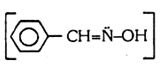
MediumMCQ
Which type of isomerism is exhibited by benzaldoxime?
A
Optical
B
Functional
C
Metamerism
D
Geometrical
Solution
(D) Benzaldoxime has the structure $C_6H_5-CH=N-OH$.
In oximes,the $C=N$ double bond restricts rotation.
Since the nitrogen atom has a lone pair and the carbon atom is attached to two different groups (a phenyl group and a hydrogen atom),it exhibits geometrical isomerism.
The two isomers are known as $syn$ and $anti$ forms.
In oximes,the $C=N$ double bond restricts rotation.
Since the nitrogen atom has a lone pair and the carbon atom is attached to two different groups (a phenyl group and a hydrogen atom),it exhibits geometrical isomerism.
The two isomers are known as $syn$ and $anti$ forms.
0 likes
View Solution33
EasyMCQ
For which of the following compounds are geometrical isomers possible?
A
$Cl_2C = CBr_2$
B
$ClBrC = CBrCl$
C
$ClCH = CBr_2$
D
$(CH_3)_2C = CBrCl$
Solution
(B) Geometrical isomerism occurs in alkenes when each carbon atom of the double bond is attached to two different groups.
In $ClBrC = CBrCl$ ($1$,$2$-dichloro$-1,2-$dibromoethene),each carbon is bonded to a $Cl$ atom and a $Br$ atom,which are different.
Therefore,it can exhibit geometrical isomerism (cis and trans forms).
In the other options,at least one carbon atom is bonded to two identical groups (e.g.,$Cl_2C=$,$CBr_2=$,or $(CH_3)_2C=$),which prevents geometrical isomerism.
In $ClBrC = CBrCl$ ($1$,$2$-dichloro$-1,2-$dibromoethene),each carbon is bonded to a $Cl$ atom and a $Br$ atom,which are different.
Therefore,it can exhibit geometrical isomerism (cis and trans forms).
In the other options,at least one carbon atom is bonded to two identical groups (e.g.,$Cl_2C=$,$CBr_2=$,or $(CH_3)_2C=$),which prevents geometrical isomerism.
0 likes
View Solution34
EasyMCQ
Which of the following compounds does not exhibit geometrical isomerism?
A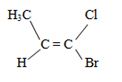
B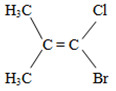
C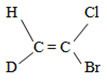
D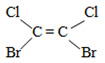
Solution
(B) For a compound to exhibit geometrical isomerism,the two groups attached to each carbon atom of the double bond must be different.
In option $B$,the carbon atom on the left is attached to two identical methyl groups $(-CH_3)$.
Since the two groups on one of the carbon atoms are identical,it cannot exhibit geometrical isomerism.
In option $B$,the carbon atom on the left is attached to two identical methyl groups $(-CH_3)$.
Since the two groups on one of the carbon atoms are identical,it cannot exhibit geometrical isomerism.
0 likes
View Solution35
MediumMCQ
Which of the following compounds exhibits geometrical isomerism?
A
$1, 1-\text{diphenyl}-1-\text{butene}$
B
$1, 1-\text{diphenyl}-2-\text{butene}$
C
$2, 3-\text{diphenyl}-2-\text{butene}$
D
$3-\text{phenyl}-1-\text{butene}$
Solution
(B) Geometrical isomerism occurs in alkenes when each carbon atom of the double bond is attached to two different groups.
In $1, 1-\text{diphenyl}-1-\text{butene}$ $(Ph_2C=CH-CH_2-CH_3)$,the first carbon is attached to two identical phenyl groups,so it does not show geometrical isomerism.
In $1, 1-\text{diphenyl}-2-\text{butene}$ $(Ph_2CH-CH=CH-CH_3)$,the second carbon is attached to $H$ and $CH_3$,and the third carbon is attached to $H$ and $CH(Ph)_2$. Since both carbons of the double bond have different groups attached,it exhibits geometrical isomerism.
In $2, 3-\text{diphenyl}-2-\text{butene}$ $(CH_3-C(Ph)=C(Ph)-CH_3)$,although it can show isomerism,the question asks for the standard case; however,$1, 1-\text{diphenyl}-2-\text{butene}$ is the classic example of a terminal-like substituted alkene showing this property.
Therefore,the correct option is $B$.
In $1, 1-\text{diphenyl}-1-\text{butene}$ $(Ph_2C=CH-CH_2-CH_3)$,the first carbon is attached to two identical phenyl groups,so it does not show geometrical isomerism.
In $1, 1-\text{diphenyl}-2-\text{butene}$ $(Ph_2CH-CH=CH-CH_3)$,the second carbon is attached to $H$ and $CH_3$,and the third carbon is attached to $H$ and $CH(Ph)_2$. Since both carbons of the double bond have different groups attached,it exhibits geometrical isomerism.
In $2, 3-\text{diphenyl}-2-\text{butene}$ $(CH_3-C(Ph)=C(Ph)-CH_3)$,although it can show isomerism,the question asks for the standard case; however,$1, 1-\text{diphenyl}-2-\text{butene}$ is the classic example of a terminal-like substituted alkene showing this property.
Therefore,the correct option is $B$.
0 likes
View Solution36
MediumMCQ
Which of the following compounds exists as geometric isomers?
A
$2-$pentyne
B
$2-$pentene
C
$2-$methylpropene
D
$2-$methyl$-2-$butene
Solution
(B) For a compound to exhibit geometric isomerism,each carbon atom of the double bond must be attached to two different groups.
$2-$pentene has the structure $CH_3-CH=CH-CH_2-CH_3$.
In this molecule,the first carbon of the double bond is attached to a $-H$ and a $-CH_3$ group,and the second carbon is attached to a $-H$ and a $-CH_2CH_3$ group.
Since both carbons have different groups attached,it can exist as $cis$ and $trans$ isomers.
$2-$pentyne is an alkyne,$2-$methylpropene has two identical $-CH_3$ groups on one carbon,and $2-$methyl$-2-$butene also has two identical $-CH_3$ groups on one carbon,so they do not show geometric isomerism.
$2-$pentene has the structure $CH_3-CH=CH-CH_2-CH_3$.
In this molecule,the first carbon of the double bond is attached to a $-H$ and a $-CH_3$ group,and the second carbon is attached to a $-H$ and a $-CH_2CH_3$ group.
Since both carbons have different groups attached,it can exist as $cis$ and $trans$ isomers.
$2-$pentyne is an alkyne,$2-$methylpropene has two identical $-CH_3$ groups on one carbon,and $2-$methyl$-2-$butene also has two identical $-CH_3$ groups on one carbon,so they do not show geometric isomerism.
0 likes
View Solution37
MediumMCQ
Which of the following alkanes can exhibit geometrical isomerism?
A
$2-$Butene
B
$2-$Methyl$-2-$butene
C
Propane
D
$2-$Methylpropane
Solution
(A) Geometrical isomerism is exhibited by alkenes where each carbon atom of the double bond is attached to two different groups.
$2-$Butene $(CH_3-CH=CH-CH_3)$ satisfies this condition as each double-bonded carbon is attached to a hydrogen atom and a methyl group.
Therefore,it exists as $cis$ and $trans$ isomers.
Other options like $2-$methyl$-2-$butene,propane,and $2-$methylpropane do not satisfy the structural requirements for geometrical isomerism.
$2-$Butene $(CH_3-CH=CH-CH_3)$ satisfies this condition as each double-bonded carbon is attached to a hydrogen atom and a methyl group.
Therefore,it exists as $cis$ and $trans$ isomers.
Other options like $2-$methyl$-2-$butene,propane,and $2-$methylpropane do not satisfy the structural requirements for geometrical isomerism.
1 likes
View Solution38
EasyMCQ
What is the number of carbon atoms present in the smallest acyclic hydrocarbon capable of exhibiting cis-trans isomerism?
A
$3$
B
$4$
C
$5$
D
$6$
Solution
(B) For a hydrocarbon to exhibit cis-trans (geometrical) isomerism,there must be a restricted rotation around a double bond $(C=C)$.
Each carbon atom of the double bond must be attached to two different groups.
The smallest acyclic alkene is but$-2-$ene $(CH_3-CH=CH-CH_3)$.
In but$-2-$ene,each carbon of the double bond is attached to a hydrogen atom and a methyl group,which are different.
Counting the carbon atoms in but$-2-$ene $(CH_3-CH=CH-CH_3)$,we find there are $4$ carbon atoms.
Therefore,the smallest acyclic hydrocarbon exhibiting cis-trans isomerism has $4$ carbon atoms.
Each carbon atom of the double bond must be attached to two different groups.
The smallest acyclic alkene is but$-2-$ene $(CH_3-CH=CH-CH_3)$.
In but$-2-$ene,each carbon of the double bond is attached to a hydrogen atom and a methyl group,which are different.
Counting the carbon atoms in but$-2-$ene $(CH_3-CH=CH-CH_3)$,we find there are $4$ carbon atoms.
Therefore,the smallest acyclic hydrocarbon exhibiting cis-trans isomerism has $4$ carbon atoms.
0 likes
View Solution39
MediumMCQ
Maleic acid and fumaric acid are .......
A
Tautomers
B
Chain isomers
C
Geometrical isomers
D
Functional isomers
Solution
(C) Maleic acid and fumaric acid are stereoisomers of $HOOC-CH=CH-COOH$.
Maleic acid is the $cis$-isomer,where both carboxylic acid groups are on the same side of the double bond.
Fumaric acid is the $trans$-isomer,where the carboxylic acid groups are on opposite sides of the double bond.
Since they differ in the spatial arrangement of atoms around the double bond,they are classified as geometrical isomers.
Maleic acid is the $cis$-isomer,where both carboxylic acid groups are on the same side of the double bond.
Fumaric acid is the $trans$-isomer,where the carboxylic acid groups are on opposite sides of the double bond.
Since they differ in the spatial arrangement of atoms around the double bond,they are classified as geometrical isomers.
0 likes
View Solution40
MediumMCQ
Which of the following compounds has an $E$-configuration?
A
$CH_3-CH=CH-C_2H_5$
B
$BrCH_2-C(CH_3)=C(CH_3)-C_2H_5$
C
$Br-C(HOCH_2)=C(CH(CH_3)_2)-CH_2CH_3$
D
$Cl-C(Br)=CH-D$
Solution
(B) To determine the $E/Z$ configuration,we use the Cahn-Ingold-Prelog $(CIP)$ priority rules based on atomic number.
$1$. For option $A$: The groups on the left carbon are $-CH_3$ and $-H$ (priority: $-CH_3 > -H$). The groups on the right carbon are $-C_2H_5$ and $-H$ (priority: $-C_2H_5 > -H$). Since the higher priority groups are on the same side,it is $Z$-but$-2-$ene.
$2$. For option $B$: The left carbon has $-BrCH_2$ and $-CH_3$ (priority: $-BrCH_2 > -CH_3$). The right carbon has $-CH_3$ and $-C_2H_5$ (priority: $-C_2H_5 > -CH_3$). The higher priority groups are on opposite sides,thus it is $E$.
$3$. For option $C$: The left carbon has $-Br$ and $-HOCH_2$ (priority: $-Br > -HOCH_2$). The right carbon has $-CH(CH_3)_2$ and $-CH_2CH_3$ (priority: $-CH(CH_3)_2 > -CH_2CH_3$). The higher priority groups are on the same side,thus it is $Z$.
$4$. For option $D$: The left carbon has $-Br$ and $-Cl$ (priority: $-Br > -Cl$). The right carbon has $-D$ and $-H$ (priority: $-D > -H$). The higher priority groups are on the same side,thus it is $Z$.
Therefore,option $B$ represents the $E$-configuration.
$1$. For option $A$: The groups on the left carbon are $-CH_3$ and $-H$ (priority: $-CH_3 > -H$). The groups on the right carbon are $-C_2H_5$ and $-H$ (priority: $-C_2H_5 > -H$). Since the higher priority groups are on the same side,it is $Z$-but$-2-$ene.
$2$. For option $B$: The left carbon has $-BrCH_2$ and $-CH_3$ (priority: $-BrCH_2 > -CH_3$). The right carbon has $-CH_3$ and $-C_2H_5$ (priority: $-C_2H_5 > -CH_3$). The higher priority groups are on opposite sides,thus it is $E$.
$3$. For option $C$: The left carbon has $-Br$ and $-HOCH_2$ (priority: $-Br > -HOCH_2$). The right carbon has $-CH(CH_3)_2$ and $-CH_2CH_3$ (priority: $-CH(CH_3)_2 > -CH_2CH_3$). The higher priority groups are on the same side,thus it is $Z$.
$4$. For option $D$: The left carbon has $-Br$ and $-Cl$ (priority: $-Br > -Cl$). The right carbon has $-D$ and $-H$ (priority: $-D > -H$). The higher priority groups are on the same side,thus it is $Z$.
Therefore,option $B$ represents the $E$-configuration.
0 likes
View Solution41
EasyMCQ
What is the number of stereoisomers formed by the bromination of $trans-2-butene$?
A
$1$
B
$2$
C
$3$
D
$4$
Solution
(A) The bromination of $trans-2-butene$ proceeds via an anti-addition mechanism.
Since $trans-2-butene$ is a symmetric alkene,the anti-addition of bromine to it results in the formation of a $meso$ compound.
$A$ $meso$ compound is optically inactive due to an internal plane of symmetry.
Therefore,only $1$ stereoisomer (the $meso$ form) is produced.
Since $trans-2-butene$ is a symmetric alkene,the anti-addition of bromine to it results in the formation of a $meso$ compound.
$A$ $meso$ compound is optically inactive due to an internal plane of symmetry.
Therefore,only $1$ stereoisomer (the $meso$ form) is produced.
0 likes
View Solution42
EasyMCQ
Geometric isomers show inequality in .......?
A
Position of functional group
B
Position of atoms
C
Spatial arrangement of atoms
D
Length of carbon chain
Solution
(C) Geometric isomerism is a type of stereoisomerism where isomers have the same molecular formula and the same connectivity of atoms,but differ in the spatial arrangement of atoms or groups around a double bond or a ring structure. Therefore,they show inequality in the spatial arrangement of atoms.
0 likes
View Solution43
MediumMCQ
Which of the following compounds exhibits geometrical isomerism?
A
$1-$phenyl$-2-$butene
B
$3-$phenyl$-1-$butene
C
$2-$phenyl$-1-$butene
D
$1,1-$diphenyl$-1-$propene
Solution
(A) For a compound to exhibit geometrical isomerism,the carbon atoms involved in the double bond must each be attached to two different groups.
$1-$phenyl$-2-$butene has the structure $C_6H_5-CH_2-CH=CH-CH_3$.
In this molecule,the carbon atoms of the double bond are attached to different groups:
Carbon-$2$ is attached to $H$ and $CH_3$.
Carbon-$3$ is attached to $H$ and $CH_2C_6H_5$.
Since both carbons of the double bond have two different groups attached,it exhibits geometrical isomerism (cis-trans isomerism).
$1-$phenyl$-2-$butene has the structure $C_6H_5-CH_2-CH=CH-CH_3$.
In this molecule,the carbon atoms of the double bond are attached to different groups:
Carbon-$2$ is attached to $H$ and $CH_3$.
Carbon-$3$ is attached to $H$ and $CH_2C_6H_5$.
Since both carbons of the double bond have two different groups attached,it exhibits geometrical isomerism (cis-trans isomerism).
0 likes
View Solution44
MediumMCQ
Which of the following compounds will exhibit $cis-trans$ (geometrical) isomerism?
A
Butanol
B
$2-$Butyne
C
$2-$Butenol
D
$2-$Butene
Solution
(D) Compounds that exhibit geometrical isomerism must have a restricted rotation,such as a double bond $(C=C)$,where each carbon atom of the double bond is attached to two different groups.
For $2-$Butene $(CH_3-CH=CH-CH_3)$,each double-bonded carbon is attached to a hydrogen atom and a methyl group. Since these groups are different,it exhibits $cis-trans$ isomerism.
$1.$ $cis-2-$Butene: Both methyl groups are on the same side of the double bond.
$2.$ $trans-2-$Butene: Both methyl groups are on opposite sides of the double bond.
For $2-$Butene $(CH_3-CH=CH-CH_3)$,each double-bonded carbon is attached to a hydrogen atom and a methyl group. Since these groups are different,it exhibits $cis-trans$ isomerism.
$1.$ $cis-2-$Butene: Both methyl groups are on the same side of the double bond.
$2.$ $trans-2-$Butene: Both methyl groups are on opposite sides of the double bond.
0 likes
View Solution45
MediumMCQ
The alkene that exhibits geometrical isomerism is:
A
$2-$Methylpropene
B
$2-$Butene
C
$2-$Methyl$-2-$butene
D
Propene
Solution
(B) The alkene that exhibits geometrical isomerism is $2-$butene.
$2-$Butene exists as $cis$ and $trans$ isomers.
In the $cis$-isomer,the two methyl groups are on the same side of the double bond,while in the $trans$-isomer,they are on opposite sides.
Due to the restricted rotation around the $C=C$ double bond,it exhibits geometrical isomerism.
$2-$Butene exists as $cis$ and $trans$ isomers.
In the $cis$-isomer,the two methyl groups are on the same side of the double bond,while in the $trans$-isomer,they are on opposite sides.
Due to the restricted rotation around the $C=C$ double bond,it exhibits geometrical isomerism.
0 likes
View Solution46
MediumMCQ
Which of the following compounds will exhibit geometrical isomerism?
A
$2-$Phenyl$-1-$butene
B
$1,1-$Diphenyl$-1-$propene
C
$1-$Phenyl$-2-$butene
D
$3-$Phenyl$-1-$butene
Solution
(C) For a compound to exhibit geometrical isomerism,each carbon atom of the $C=C$ double bond must be attached to two different groups.
In $1-$Phenyl$-2-$butene $(C_6H_5-CH_2-CH=CH-CH_3)$,the carbon atoms of the double bond are attached to different groups ($H$ and $CH_3$ on one side; $H$ and $CH_2C_6H_5$ on the other).
Therefore,it can exist as $cis-$ and $trans-$ isomers.
In $1-$Phenyl$-2-$butene $(C_6H_5-CH_2-CH=CH-CH_3)$,the carbon atoms of the double bond are attached to different groups ($H$ and $CH_3$ on one side; $H$ and $CH_2C_6H_5$ on the other).
Therefore,it can exist as $cis-$ and $trans-$ isomers.
0 likes
View Solution47
MediumMCQ
Which of the following compounds can show stereoisomerism?
A
$2-$Chloropropane
B
$2-$Chloro$-3-$methylbut$-2-$ene
C
$3-$Ethylpent$-2-$ene
D
$1-$Chlorobut$-1-$ene
Solution
(D) Stereoisomerism includes both geometrical and optical isomerism.
$1-$Chlorobut$-1-$ene $(CH_3-CH_2-CH=CH-Cl)$ can show geometrical isomerism because the carbon atoms of the double bond are attached to different groups ($H$ and $Cl$ on $C_1$,$H$ and $CH_2CH_3$ on $C_2$).
$2-$Chloropropane is achiral and does not have a double bond for geometrical isomerism.
$2-$Chloro$-3-$methylbut$-2-$ene and $3-$Ethylpent$-2-$ene do not satisfy the conditions for geometrical or optical isomerism in the given structures.
$1-$Chlorobut$-1-$ene $(CH_3-CH_2-CH=CH-Cl)$ can show geometrical isomerism because the carbon atoms of the double bond are attached to different groups ($H$ and $Cl$ on $C_1$,$H$ and $CH_2CH_3$ on $C_2$).
$2-$Chloropropane is achiral and does not have a double bond for geometrical isomerism.
$2-$Chloro$-3-$methylbut$-2-$ene and $3-$Ethylpent$-2-$ene do not satisfy the conditions for geometrical or optical isomerism in the given structures.
0 likes
View Solution48
AdvancedMCQ
In the given reaction: $C_6H_5-CH=O \xrightarrow{NH_2OH/H^{+}} [X]$. $[X]$ will be:
A
Only syn oxime
B
Only anti oxime
C
Mixture of syn and anti oxime
D
Secondary amide
Solution
(C) The reaction of benzaldehyde $(C_6H_5-CHO)$ with hydroxylamine $(NH_2OH)$ in an acidic medium produces benzaldoxime $(C_6H_5-CH=N-OH)$.
Since the carbon atom in the $C=N$ bond is attached to two different groups ($H$ and $C_6H_5$),the resulting oxime exhibits geometrical isomerism.
Therefore,the product $[X]$ is a mixture of syn and anti oximes.
Since the carbon atom in the $C=N$ bond is attached to two different groups ($H$ and $C_6H_5$),the resulting oxime exhibits geometrical isomerism.
Therefore,the product $[X]$ is a mixture of syn and anti oximes.
0 likes
View Solution8-2.Organic Chemistry : Isomerism — Geometrical isomerism · Frequently Asked Questions
1Are these 8-2.Organic Chemistry : Isomerism questions useful for JEE and NEET?
Yes. All questions in this section are mapped to JEE Main and NEET exam patterns. Previous year questions from JEE Main, NEET, GUJCET and state-level exams are included with full solutions.
2Can I switch to Hindi or Gujarati for these questions?
Yes. Use the language tabs in the hero section or the sidebar to view the same questions and solutions in English, Hindi or Gujarati.
3How do I generate a question paper from this subtopic?
Use the Vedclass Exam Paper Generator — select the chapter and subtopic, set difficulty, and generate Sets A, B, C, D automatically. First 3 chapters of every subject are free.
Vedclass Products
For Students
Vedclass Test Series
Mock tests in real JEE/NEET style with performance analysis. 5-day free trial.
Start Free TrialFor Teachers
Exam Paper Generator
Generate Set A/B/C/D papers from this chapter in 2 minutes. 3 chapters free.
Try FreeFor Institutes
Online Exam Module
Live online exams with unlimited students, 360° analytics & white-label branding.
See DemoFor Teachers & Institutes
Generate a 8-2.Organic Chemistry : Isomerism Exam Paper in 2 Minutes
Select subtopic & difficulty — Sets A, B, C, D auto-generated with No Repeat logic.
First 3 chapters of every subject are free — no payment required.