
A English
Optical isomerism Questions in English
Class 11 Chemistry · 8-2.Organic Chemistry : Isomerism · Optical isomerism
338+
Questions
English
Language
100%
With Solutions
Showing 49 of 338 questions in English
1
DifficultMCQ
Which of the following compounds is not chiral?
A
$1-$chloropentane
B
$2-$chloropentane
C
$1-$chloro$-2-$methylpentane
D
$3-$chloro$-2-$methylpentane
Solution
(A) compound is chiral if it contains at least one chiral carbon atom (a carbon atom bonded to four different groups).
$1-$chloropentane: $CH_2(Cl)-CH_2-CH_2-CH_2-CH_3$. The carbon atom bonded to chlorine is attached to two identical hydrogen atoms,so it is achiral.
$2-$chloropentane: $CH_3-CH(Cl)-CH_2-CH_2-CH_3$. The $C-2$ atom is bonded to $-H, -Cl, -CH_3, \text{ and } -CH_2CH_2CH_3$. Since all four groups are different,it is chiral.
$1-$chloro$-2-$methylpentane: $CH_2(Cl)-CH(CH_3)-CH_2-CH_2-CH_3$. The $C-2$ atom is bonded to $-H, -CH_3, -CH_2Cl, \text{ and } -CH_2CH_2CH_3$. Since all four groups are different,it is chiral.
$3-$chloro$-2-$methylpentane: $CH_3-CH(CH_3)-CH(Cl)-CH_2-CH_3$. The $C-3$ atom is bonded to $-H, -Cl, -CH(CH_3)_2, \text{ and } -CH_2CH_3$. Since all four groups are different,it is chiral.
Therefore,$1-$chloropentane is the only achiral compound.
$1-$chloropentane: $CH_2(Cl)-CH_2-CH_2-CH_2-CH_3$. The carbon atom bonded to chlorine is attached to two identical hydrogen atoms,so it is achiral.
$2-$chloropentane: $CH_3-CH(Cl)-CH_2-CH_2-CH_3$. The $C-2$ atom is bonded to $-H, -Cl, -CH_3, \text{ and } -CH_2CH_2CH_3$. Since all four groups are different,it is chiral.
$1-$chloro$-2-$methylpentane: $CH_2(Cl)-CH(CH_3)-CH_2-CH_2-CH_3$. The $C-2$ atom is bonded to $-H, -CH_3, -CH_2Cl, \text{ and } -CH_2CH_2CH_3$. Since all four groups are different,it is chiral.
$3-$chloro$-2-$methylpentane: $CH_3-CH(CH_3)-CH(Cl)-CH_2-CH_3$. The $C-3$ atom is bonded to $-H, -Cl, -CH(CH_3)_2, \text{ and } -CH_2CH_3$. Since all four groups are different,it is chiral.
Therefore,$1-$chloropentane is the only achiral compound.
0 likes
View Solution2
MediumMCQ
Which one of the following shows optical activity?
A
$HO-CH_2-COOH$
B
$CH_3-CH(Cl)-COOH$
C
$CH_3-C(OH)(CH_3)-COOH$
D
$CH_3-C(Cl)(CH_3)-COOH$
Solution
(B) The correct answer is $(B)$ $CH_3-CH(Cl)-COOH$.
Optical activity is shown by molecules that possess a chiral center,which is a carbon atom bonded to four different groups.
In $CH_3-CH(Cl)-COOH$,the central carbon atom is bonded to $-H$,$-CH_3$,$-Cl$,and $-COOH$ groups.
Since all four groups are different,the carbon is chiral,making the molecule optically active.
Optical activity is shown by molecules that possess a chiral center,which is a carbon atom bonded to four different groups.
In $CH_3-CH(Cl)-COOH$,the central carbon atom is bonded to $-H$,$-CH_3$,$-Cl$,and $-COOH$ groups.
Since all four groups are different,the carbon is chiral,making the molecule optically active.
0 likes
View Solution3
MediumMCQ
Which of the following may exist in enantiomorphs?
A
$CH_3-CH(CH_3)-COOH$
B
$CH_2=CH-CH_2-CH_2-CH_3$
C
$CH_3-CH(NH_2)-CH_3$
D
$CH_3-CH_2-CH(NH_2)-CH_3$
Solution
(D) An enantiomorph (or enantiomer) exists if a molecule contains at least one chiral center (a carbon atom bonded to four different groups).
In $CH_3-CH_2-CH^*(NH_2)-CH_3$,the carbon atom marked with an asterisk $(*)$ is bonded to four different groups: $-H$,$-NH_2$,$-CH_3$,and $-CH_2CH_3$.
Since it possesses a chiral center,it can exist as a pair of non-superimposable mirror images,known as enantiomorphs.
In $CH_3-CH_2-CH^*(NH_2)-CH_3$,the carbon atom marked with an asterisk $(*)$ is bonded to four different groups: $-H$,$-NH_2$,$-CH_3$,and $-CH_2CH_3$.
Since it possesses a chiral center,it can exist as a pair of non-superimposable mirror images,known as enantiomorphs.
0 likes
View Solution4
MediumMCQ
Which of the following compounds may not exist as enantiomers?
A
$CH_3CH(OH)CO_2H$
B
$CH_3CH_2CH(CH_3)CH_2OH$
C
$C_6H_5CH_2CH_3$
D
$C_6H_5CHClCH_3$
Solution
(C) The condition for a compound to exist as enantiomers is the presence of at least one chiral center (an asymmetric carbon atom bonded to four different groups).
$A$. $CH_3CH(OH)CO_2H$ has a chiral center at the $C_2$ position.
$B$. $CH_3CH_2CH(CH_3)CH_2OH$ has a chiral center at the $C_3$ position.
$C$. $C_6H_5CH_2CH_3$ (ethylbenzene) does not have any chiral center,as the $CH_2$ group is bonded to two identical hydrogen atoms.
$D$. $C_6H_5CHClCH_3$ has a chiral center at the $C_1$ position.
Therefore,$C_6H_5CH_2CH_3$ cannot exist as enantiomers.
$A$. $CH_3CH(OH)CO_2H$ has a chiral center at the $C_2$ position.
$B$. $CH_3CH_2CH(CH_3)CH_2OH$ has a chiral center at the $C_3$ position.
$C$. $C_6H_5CH_2CH_3$ (ethylbenzene) does not have any chiral center,as the $CH_2$ group is bonded to two identical hydrogen atoms.
$D$. $C_6H_5CHClCH_3$ has a chiral center at the $C_1$ position.
Therefore,$C_6H_5CH_2CH_3$ cannot exist as enantiomers.
0 likes
View Solution5
MediumMCQ
Lactic acid shows which type of isomerism?
A
Geometrical isomerism
B
Tautomerism
C
Optical isomerism
D
Metamerism
Solution
(C) Lactic acid $(CH_3CH(OH)COOH)$ contains a chiral carbon atom,which is bonded to four different groups: $-H$,$-OH$,$-CH_3$,and $-COOH$.
Because of the presence of this chiral center,lactic acid exists as two non-superimposable mirror images (enantiomers).
Therefore,it exhibits optical isomerism.
Because of the presence of this chiral center,lactic acid exists as two non-superimposable mirror images (enantiomers).
Therefore,it exhibits optical isomerism.
0 likes
View Solution6
MediumMCQ
Which one of the following is an optically active compound?
A
$n-$propanol
B
$2-$chlorobutane
C
$n-$butanol
D
$4-$hydroxyheptane
Solution
(B) An optically active compound must contain at least one chiral carbon atom (a carbon atom bonded to four different groups).
In $2-$chlorobutane $(CH_3-CH(Cl)-CH_2-CH_3)$,the second carbon atom is bonded to a hydrogen atom,a chlorine atom,a methyl group,and an ethyl group.
Since all four groups are different,$2-$chlorobutane is chiral and thus optically active.
The other options ($n-$propanol,$n-$butanol,and $4-$hydroxyheptane) do not contain a chiral carbon atom.
In $2-$chlorobutane $(CH_3-CH(Cl)-CH_2-CH_3)$,the second carbon atom is bonded to a hydrogen atom,a chlorine atom,a methyl group,and an ethyl group.
Since all four groups are different,$2-$chlorobutane is chiral and thus optically active.
The other options ($n-$propanol,$n-$butanol,and $4-$hydroxyheptane) do not contain a chiral carbon atom.
0 likes
View Solution7
MediumMCQ
Which one of the following compounds shows optical isomerism?
A
$CH_3-CHCl-CH_2-CH_3$
B
$CH_3-CH_2-CHCl-CH_2-CH_3$
C
$Cl-CH_2-CH_2-CH_2-CH_3$
D
$Cl-CH_2-CH_2-CH_3$
Solution
(A) compound exhibits optical isomerism if it contains at least one chiral carbon atom (a carbon atom bonded to four different groups).
In $CH_3-CHCl-CH_2-CH_3$ ($2$-chlorobutane),the $C-2$ atom is bonded to $-H$,$-Cl$,$-CH_3$,and $-C_2H_5$ groups.
Since all four groups are different,the $C-2$ atom is chiral,and thus the compound shows optical isomerism.
In $CH_3-CHCl-CH_2-CH_3$ ($2$-chlorobutane),the $C-2$ atom is bonded to $-H$,$-Cl$,$-CH_3$,and $-C_2H_5$ groups.
Since all four groups are different,the $C-2$ atom is chiral,and thus the compound shows optical isomerism.
0 likes
View Solution8
EasyMCQ
Which one of the following objects is 'achiral'?
A
Letter $P$
B
Letter $F$
C
Ball
D
$A$ pair of hands
Solution
(C) An object is considered 'achiral' if it is superimposable on its mirror image.
$1$. The letters $P$ and $F$ are chiral because their mirror images are non-superimposable on the original letters.
$2$. $A$ pair of hands is chiral because the left hand cannot be superimposed on the right hand.
$3$. $A$ ball is achiral because it is symmetrical and its mirror image is superimposable on the original object.
Therefore,the correct option is $(C)$.
$1$. The letters $P$ and $F$ are chiral because their mirror images are non-superimposable on the original letters.
$2$. $A$ pair of hands is chiral because the left hand cannot be superimposed on the right hand.
$3$. $A$ ball is achiral because it is symmetrical and its mirror image is superimposable on the original object.
Therefore,the correct option is $(C)$.
0 likes
View Solution9
EasyMCQ
Separating of $d$ and $l$ enantiomorphs from a racemic mixture is called
A
Resolution
B
Dehydration
C
Rotation
D
Dehydrohalogenation
Solution
(A) The process of separating a racemic mixture into its individual $d$ and $l$ enantiomers is known as resolution.
0 likes
View Solution10
EasyMCQ
The number of optical isomers of lactic acid is
A
$1$
B
$2$
C
$3$
D
$4$
Solution
(B) Lactic acid is $CH_3-CH(OH)-COOH$.
It contains only one chiral center.
Hence,two optical isomers (enantiomers) are possible.
The number of optical isomers is given by the formula $2^n$,where $n$ is the number of chiral carbon atoms.
For lactic acid,$n = 1$,so the number of optical isomers = $2^1 = 2$.
It contains only one chiral center.
Hence,two optical isomers (enantiomers) are possible.
The number of optical isomers is given by the formula $2^n$,where $n$ is the number of chiral carbon atoms.
For lactic acid,$n = 1$,so the number of optical isomers = $2^1 = 2$.
0 likes
View Solution11
MediumMCQ
Which one of the following contains an asymmetric carbon atom?
A
$CH_2Cl-CH_2Br$
B
$CH_3-CHCl_2$
C
$CH_3-CH_3$
D
$CH_3-CH(OH)-CH_2Br$
Solution
(D) An asymmetric carbon atom (chiral center) is a carbon atom bonded to four different groups.
In $CH_3-CH(OH)-CH_2Br$,the second carbon atom is bonded to four different groups: $-H$,$-OH$,$-CH_3$,and $-CH_2Br$.
Therefore,it is an asymmetric carbon atom.
In $CH_3-CH(OH)-CH_2Br$,the second carbon atom is bonded to four different groups: $-H$,$-OH$,$-CH_3$,and $-CH_2Br$.
Therefore,it is an asymmetric carbon atom.
0 likes
View Solution12
MediumMCQ
Which of the following has a chiral structure?
A
$CH_3-CH(CH_3)-CH_2-COOH$
B
$CH_3-CH=CH-CH_3$
C
$CH_3-CH(CH_3)-CH_2-OH$
D
$CH_3-CH(OH)-CH_2-CH_3$
Solution
(D) The correct answer is $(D)$ $CH_3-CH(OH)-CH_2-CH_3$.
$A$ chiral structure is one in which a central carbon atom is bonded to $4$ different atoms or groups.
In $CH_3-CH(OH)-CH_2-CH_3$,the second carbon atom is bonded to $-H$,$-OH$,$-CH_3$,and $-CH_2CH_3$ groups.
Since all $4$ groups are different,this carbon is a chiral center.
$A$ chiral structure is one in which a central carbon atom is bonded to $4$ different atoms or groups.
In $CH_3-CH(OH)-CH_2-CH_3$,the second carbon atom is bonded to $-H$,$-OH$,$-CH_3$,and $-CH_2CH_3$ groups.
Since all $4$ groups are different,this carbon is a chiral center.
0 likes
View Solution13
EasyMCQ
An organic compound exhibits optical isomerism when:
A
Four groups linked to the carbon atom are different.
B
Three groups linked to the carbon atom are different.
C
Two groups linked to the carbon atom are different.
D
All the groups linked to the carbon atom are the same.
Solution
(A) An organic compound exhibits optical isomerism if it contains a chiral center.
$A$ carbon atom is considered chiral (or asymmetric) when it is bonded to four different groups or atoms.
Therefore,the correct condition is that all four groups linked to the carbon atom must be different.
$A$ carbon atom is considered chiral (or asymmetric) when it is bonded to four different groups or atoms.
Therefore,the correct condition is that all four groups linked to the carbon atom must be different.
0 likes
View Solution14
MediumMCQ
Rotation of plane polarised light is measured by
A
Manometer
B
Polarimeter
C
Viscometer
D
Refractometer
Solution
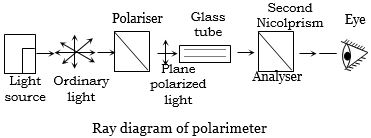
(B) . Polarimeter is an instrument used for measuring the optical rotation.
It consists of two Nicol prisms,one called the polarizer (near the light source) and the other called the analyser (near the eye).
In between the polarizer and analyser,a glass tube containing the solution of an optically active compound is placed.
It consists of two Nicol prisms,one called the polarizer (near the light source) and the other called the analyser (near the eye).
In between the polarizer and analyser,a glass tube containing the solution of an optically active compound is placed.
0 likes
View Solution15
MediumMCQ
The property by virtue of which a compound can rotate the plane of plane-polarized light is known as:
A
Photolysis
B
Phosphorescence
C
Optical activity
D
Polarization
Solution
(C) Plane-polarized light consists of light waves in which the vibrations occur in a single plane.
When this light passes through certain compounds,they rotate the plane of the plane-polarized light by a specific angle.
This property,where a compound rotates the plane of plane-polarized light,is known as $Optical \ activity$.
When this light passes through certain compounds,they rotate the plane of the plane-polarized light by a specific angle.
This property,where a compound rotates the plane of plane-polarized light,is known as $Optical \ activity$.
0 likes
View Solution16
DifficultMCQ
Meso-tartaric acid is optically inactive due to the presence of
A
Molecular symmetry
B
Molecular asymmetry
C
External compensation
D
Two asymmetric $C$-atoms
Solution
(A) Meso-tartaric acid contains a plane of symmetry which divides the molecule into two identical halves.
The optical rotation caused by one half is cancelled by the other half within the same molecule.
This is known as internal compensation or molecular symmetry.
The optical rotation caused by one half is cancelled by the other half within the same molecule.
This is known as internal compensation or molecular symmetry.
0 likes
View Solution17
MediumMCQ
The maximum number of stereoisomers possible for $2-$hydroxy$-2-$methylbutanoic acid is
A
$1$
B
$2$
C
$3$
D
$4$
Solution
(B) The structure of $2-$hydroxy$-2-$methylbutanoic acid is $CH_3-CH_2-C(OH)(CH_3)-COOH$.
In this molecule,the carbon atom at position $2$ is bonded to four different groups: $-OH$,$-CH_3$,$-COOH$,and $-CH_2CH_3$.
Since there is $1$ chiral center,the number of stereoisomers is given by $2^n$,where $n$ is the number of chiral centers.
Here,$n = 1$,so the number of stereoisomers is $2^1 = 2$.
In this molecule,the carbon atom at position $2$ is bonded to four different groups: $-OH$,$-CH_3$,$-COOH$,and $-CH_2CH_3$.
Since there is $1$ chiral center,the number of stereoisomers is given by $2^n$,where $n$ is the number of chiral centers.
Here,$n = 1$,so the number of stereoisomers is $2^1 = 2$.
0 likes
View Solution18
EasyMCQ
It is possible to distinguish between optical isomers by
A
Infrared spectroscopy
B
Mass spectrometry
C
Melting point determination
D
Polarimetry
Solution
(D) Optical isomers are non-superimposable mirror images of each other. They possess identical physical and chemical properties in an achiral environment. However,they differ in their interaction with plane-polarized light. Optical isomers rotate the plane of plane-polarized light in opposite directions (one rotates it clockwise,the other counter-clockwise). Polarimetry is the experimental technique used to measure this rotation,thereby allowing us to distinguish between optical isomers.
0 likes
View Solution19
MediumMCQ
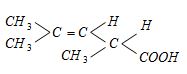
The following compound can exhibit:
A
Tautomerism
B
Optical isomerism
C
Geometrical isomerism
D
Geometrical and optical isomerisms
Solution
(B) The given compound is $(CH_3)_2C=CH-CH(CH_3)-COOH$.
$1$. Geometrical isomerism: The double bond is $(CH_3)_2C=CH-$. Since one of the carbons of the double bond (the left one) is attached to two identical groups (two $CH_3$ groups),it cannot exhibit geometrical isomerism.
$2$. Optical isomerism: The molecule contains a chiral carbon atom at the $CH(CH_3)$ position (the carbon attached to $H$,$CH_3$,$COOH$,and the $-CH=C(CH_3)_2$ group). Since all four groups attached to this carbon are different,it is a chiral center.
Therefore,the compound exhibits optical isomerism.
$1$. Geometrical isomerism: The double bond is $(CH_3)_2C=CH-$. Since one of the carbons of the double bond (the left one) is attached to two identical groups (two $CH_3$ groups),it cannot exhibit geometrical isomerism.
$2$. Optical isomerism: The molecule contains a chiral carbon atom at the $CH(CH_3)$ position (the carbon attached to $H$,$CH_3$,$COOH$,and the $-CH=C(CH_3)_2$ group). Since all four groups attached to this carbon are different,it is a chiral center.
Therefore,the compound exhibits optical isomerism.
0 likes
View Solution20
MediumMCQ
Optically active isomers that are not mirror images of each other are called:
A
Enantiomers
B
Mesomers
C
Tautomers
D
Diastereoisomers
Solution
(D) . Diastereoisomers are stereoisomers that are not mirror images of each other.
Optical isomers that lack a mirror-image relationship are classified as diastereoisomers.
Optical isomers that lack a mirror-image relationship are classified as diastereoisomers.
0 likes
View Solution21
MediumMCQ
Which of the following contains an asymmetric centre?
A
$2-$butene
B
$2, 2-$dimethylpropane
C
$2-$hexyne
D
Lactic acid
Solution
(D) An asymmetric centre (chiral centre) is a carbon atom bonded to four different groups.
In $Lactic$ $acid$ $(CH_3-CH(OH)-COOH)$,the central carbon atom is bonded to a $-H$,$-OH$,$-CH_3$,and $-COOH$ group.
Since all four groups are different,it contains an asymmetric centre.
In $Lactic$ $acid$ $(CH_3-CH(OH)-COOH)$,the central carbon atom is bonded to a $-H$,$-OH$,$-CH_3$,and $-COOH$ group.
Since all four groups are different,it contains an asymmetric centre.
0 likes
View Solution22
EasyMCQ
Which of the following cannot be given to exemplify a chiral structure?
A
$A$. $A$ shoe
B
$B$. $A$ screw
C
$C$. $A$ screwdriver
D
$D$. All of these
Solution
(C) chiral object is one that is non-superimposable on its mirror image.
$A$. $A$ shoe is chiral because its mirror image cannot be superimposed on the original.
$B$. $A$ screw is chiral because it has a specific handedness (right-handed or left-handed).
$C$. $A$ screwdriver,specifically a standard one with a symmetrical handle and shaft,possesses a plane of symmetry and is superimposable on its mirror image,making it achiral.
Therefore,a screwdriver cannot be used to exemplify a chiral structure.
$A$. $A$ shoe is chiral because its mirror image cannot be superimposed on the original.
$B$. $A$ screw is chiral because it has a specific handedness (right-handed or left-handed).
$C$. $A$ screwdriver,specifically a standard one with a symmetrical handle and shaft,possesses a plane of symmetry and is superimposable on its mirror image,making it achiral.
Therefore,a screwdriver cannot be used to exemplify a chiral structure.
0 likes
View Solution23
MediumMCQ
Which of the following is expected to be optically active?
A
$ (CH_3)_4C $
B
$ C_2H_5CH(CH_3)C_3H_7 $
C
$ (C_2H_5)_2CHCH_3 $
D
$ CH_3CH = CHCH_3 $
Solution
(B) molecule is optically active if it is chiral,meaning it contains at least one carbon atom bonded to four different groups (a chiral center).
In $C_2H_5CH(CH_3)C_3H_7$,the central carbon atom is bonded to four different groups: $-H$,$-CH_3$,$-C_2H_5$,and $-C_3H_7$.
Since all four substituents are different,the molecule is chiral and therefore optically active.
In $C_2H_5CH(CH_3)C_3H_7$,the central carbon atom is bonded to four different groups: $-H$,$-CH_3$,$-C_2H_5$,and $-C_3H_7$.
Since all four substituents are different,the molecule is chiral and therefore optically active.
0 likes
View Solution24
MediumMCQ
The number of stereoisomers of the compound $CH_3CHBrCHBrCOOH$ is
A
$0$
B
$1$
C
$3$
D
$4$
Solution
(D) The compound $CH_3CH(Br)CH(Br)COOH$ contains $n = 2$ chiral carbon atoms.
Since the molecule is unsymmetrical,the number of stereoisomers is given by the formula $2^n$.
Here,$n = 2$,so the number of stereoisomers = $2^2 = 4$.
These $4$ stereoisomers consist of $2$ pairs of enantiomers.
Since the molecule is unsymmetrical,the number of stereoisomers is given by the formula $2^n$.
Here,$n = 2$,so the number of stereoisomers = $2^2 = 4$.
These $4$ stereoisomers consist of $2$ pairs of enantiomers.
0 likes
View Solution25
MediumMCQ
Which of the following compounds is not chiral?
A
$DCH_2CH_2CH_2Cl$
B
$CH_3CH_2CHDCl$
C
$CH_3CHDCH_2CH_2Cl$
D
$CH_2DCHClCH_3$
Solution
(A) compound is chiral if it contains at least one chiral center (a carbon atom bonded to four different groups).
$(A)$ $DCH_2-CH_2-CH_2-Cl$: This molecule has no chiral center because the carbon atoms are bonded to identical hydrogen atoms or are not bonded to four distinct groups.
$(B)$ $CH_3-CH_2-CHD-Cl$: The carbon atom attached to $D$ and $Cl$ is bonded to $H$,$D$,$Cl$,and an ethyl group $(-CH_2CH_3)$. Since these four groups are different,it is chiral.
$(C)$ $CH_3-CHD-CH_2-CH_2-Cl$: The carbon atom attached to $D$ is bonded to $H$,$D$,$CH_3$,and $-CH_2CH_2Cl$. Since these four groups are different,it is chiral.
$(D)$ $CH_2D-CHCl-CH_3$: The carbon atom attached to $Cl$ is bonded to $H$,$Cl$,$CH_2D$,and $CH_3$. Since these four groups are different,it is chiral.
Therefore,the correct option is $A$.
$(A)$ $DCH_2-CH_2-CH_2-Cl$: This molecule has no chiral center because the carbon atoms are bonded to identical hydrogen atoms or are not bonded to four distinct groups.
$(B)$ $CH_3-CH_2-CHD-Cl$: The carbon atom attached to $D$ and $Cl$ is bonded to $H$,$D$,$Cl$,and an ethyl group $(-CH_2CH_3)$. Since these four groups are different,it is chiral.
$(C)$ $CH_3-CHD-CH_2-CH_2-Cl$: The carbon atom attached to $D$ is bonded to $H$,$D$,$CH_3$,and $-CH_2CH_2Cl$. Since these four groups are different,it is chiral.
$(D)$ $CH_2D-CHCl-CH_3$: The carbon atom attached to $Cl$ is bonded to $H$,$Cl$,$CH_2D$,and $CH_3$. Since these four groups are different,it is chiral.
Therefore,the correct option is $A$.
0 likes
View Solution26
EasyMCQ
Which one of the following is a chiral molecule?
A
$CH_3Cl$
B
$CH_2Cl_2$
C
$CHBr_3$
D
$CHClBrI$
Solution
(D) . $CHClBrI$
$A$ chiral molecule is one that contains at least one chiral center,which is a carbon atom bonded to four different atoms or groups.
In $CHClBrI$,the central carbon atom is bonded to four distinct groups: $H$,$Cl$,$Br$,and $I$.
Since all four substituents are different,the molecule is chiral and lacks a plane of symmetry.
$A$ chiral molecule is one that contains at least one chiral center,which is a carbon atom bonded to four different atoms or groups.
In $CHClBrI$,the central carbon atom is bonded to four distinct groups: $H$,$Cl$,$Br$,and $I$.
Since all four substituents are different,the molecule is chiral and lacks a plane of symmetry.
0 likes
View Solution27
EasyMCQ
Which of the following compounds is an optically active compound?
A
$1-$butanol
B
$2-$butanol
C
$3-$butanol
D
$4-$heptanol
Solution
(B) The correct answer is $(B)$.
$2-$butanol $(CH_3-CH(OH)-CH_2-CH_3)$ is an optically active compound because it contains a chiral (asymmetric) carbon atom,which is bonded to four different groups: a hydrogen atom,a hydroxyl group,a methyl group,and an ethyl group.
$1-$butanol and $3-$butanol do not possess a chiral center,and $4-$heptanol is a symmetric molecule.
$2-$butanol $(CH_3-CH(OH)-CH_2-CH_3)$ is an optically active compound because it contains a chiral (asymmetric) carbon atom,which is bonded to four different groups: a hydrogen atom,a hydroxyl group,a methyl group,and an ethyl group.
$1-$butanol and $3-$butanol do not possess a chiral center,and $4-$heptanol is a symmetric molecule.
0 likes
View Solution28
MediumMCQ
$d-$tartaric acid and $l-$tartaric acid are
A
Enantiomers
B
Tautomers
C
Diastereoisomers
D
Structural isomers
Solution
(A) $d-$tartaric acid and $l-$tartaric acid are non-superimposable mirror images of each other.
An enantiomer is one of two stereoisomers that are mirror images of each other and are non-superimposable (not identical),much as one's left and right hands are the same except for being reversed along one axis (the hands cannot be made to appear identical simply by reorientation).
Since $d-$tartaric acid and $l-$tartaric acid are non-superimposable mirror images,they are classified as enantiomers.
An enantiomer is one of two stereoisomers that are mirror images of each other and are non-superimposable (not identical),much as one's left and right hands are the same except for being reversed along one axis (the hands cannot be made to appear identical simply by reorientation).
Since $d-$tartaric acid and $l-$tartaric acid are non-superimposable mirror images,they are classified as enantiomers.
0 likes
View Solution29
EasyMCQ
Optical isomerism arises due to the presence of
A
An asymmetric carbon atom
B
Centre of symmetry
C
Axis of symmetry
D
Plane of symmetry
Solution
(A) Optical isomerism arises due to the presence of an asymmetric carbon atom (chiral center). For a molecule to be optically active,it must be chiral,meaning it lacks any internal symmetry elements such as a plane of symmetry,a center of symmetry,or an alternating axis of symmetry.
0 likes
View Solution30
EasyMCQ
On bromination,propionic acid yields two isomeric $2$-bromopropionic acids. This pair is an important example of
A
Chain isomers
B
Optical isomers
C
Cis-trans isomers
D
Position isomers
Solution
(B) The bromination of propionic acid $(CH_3CH_2COOH)$ at the $\alpha$-carbon produces $2$-bromopropionic acid $(CH_3CH(Br)COOH)$.
In $2$-bromopropionic acid,the carbon atom attached to the bromine atom is a chiral center because it is bonded to four different groups: $-H$,$-CH_3$,$-Br$,and $-COOH$.
Due to the presence of this chiral center,$2$-bromopropionic acid exists as two non-superimposable mirror images,which are known as enantiomers.
Enantiomers are a type of optical isomer.
Therefore,the pair of $2$-bromopropionic acids formed are optical isomers.
In $2$-bromopropionic acid,the carbon atom attached to the bromine atom is a chiral center because it is bonded to four different groups: $-H$,$-CH_3$,$-Br$,and $-COOH$.
Due to the presence of this chiral center,$2$-bromopropionic acid exists as two non-superimposable mirror images,which are known as enantiomers.
Enantiomers are a type of optical isomer.
Therefore,the pair of $2$-bromopropionic acids formed are optical isomers.
0 likes
View Solution31
EasyMCQ
Lactic acid,in which a methyl group,a hydroxyl group,a carboxylic acid group,and a hydrogen atom are attached to a central carbon atom,shows optical isomerism due to the molecular geometry at the:
A
Central carbon atom
B
Carbon atom of the methyl group
C
Carbon atom of the carboxylic acid group
D
Oxygen of the hydroxyl group
Solution
(A) Optical isomerism is exhibited by compounds that possess a chiral (asymmetric) carbon atom.
In lactic acid $(CH_3CH(OH)COOH)$,the central carbon atom is bonded to four different groups: a methyl group $(-CH_3)$,a hydroxyl group $(-OH)$,a carboxylic acid group $(-COOH)$,and a hydrogen atom $(-H)$.
Because this central carbon atom is asymmetric,it creates a chiral center,which is responsible for the optical activity of the molecule.
In lactic acid $(CH_3CH(OH)COOH)$,the central carbon atom is bonded to four different groups: a methyl group $(-CH_3)$,a hydroxyl group $(-OH)$,a carboxylic acid group $(-COOH)$,and a hydrogen atom $(-H)$.
Because this central carbon atom is asymmetric,it creates a chiral center,which is responsible for the optical activity of the molecule.
0 likes
View Solution32
EasyMCQ
Stereoisomers which are not the mirror images of one another are called
A
Enantiomers
B
Mesomers
C
Tautomers
D
Diastereoisomers
Solution
(D) Stereoisomers that are not mirror images of each other are known as diastereomers.
$1$. Enantiomers are stereoisomers that are non-superimposable mirror images of each other.
$2$. Diastereomers are stereoisomers that are not mirror images of each other.
$3$. Meso compounds (or mesomers) are achiral molecules that contain multiple stereocenters but are optically inactive due to an internal plane of symmetry.
$4$. Tautomers are structural isomers that exist in dynamic equilibrium with each other.
$1$. Enantiomers are stereoisomers that are non-superimposable mirror images of each other.
$2$. Diastereomers are stereoisomers that are not mirror images of each other.
$3$. Meso compounds (or mesomers) are achiral molecules that contain multiple stereocenters but are optically inactive due to an internal plane of symmetry.
$4$. Tautomers are structural isomers that exist in dynamic equilibrium with each other.
0 likes
View Solution33
MediumMCQ
Which of the following compounds is optically active?
A
$CH_2Cl_2$
B
$CHCl_3$
C
Meso form of tartaric acid
D
Glyceraldehyde
Solution
(D) compound is optically active if it lacks a plane of symmetry or center of symmetry,making it chiral.
$CH_2Cl_2$ and $CHCl_3$ are achiral due to the presence of planes of symmetry.
Meso-tartaric acid is achiral because it contains an internal plane of symmetry,making it optically inactive.
Glyceraldehyde $(CH_2(OH)CH(OH)CHO)$ contains a chiral carbon atom (the central carbon is bonded to four different groups: $-H, -OH, -CHO, -CH_2OH$),which makes it optically active.
$CH_2Cl_2$ and $CHCl_3$ are achiral due to the presence of planes of symmetry.
Meso-tartaric acid is achiral because it contains an internal plane of symmetry,making it optically inactive.
Glyceraldehyde $(CH_2(OH)CH(OH)CHO)$ contains a chiral carbon atom (the central carbon is bonded to four different groups: $-H, -OH, -CHO, -CH_2OH$),which makes it optically active.
0 likes
View Solution34
MediumMCQ
Which of the following statements is not true about enantiomers?
A
They have same physical properties
B
They have different biological properties
C
They have same chemical properties towards chiral compounds
D
None of these
Solution
(A) Enantiomers have identical physical properties (except for the direction of rotation of plane-polarized light) and identical chemical properties in an achiral environment. However,they exhibit different chemical properties when interacting with other chiral molecules and often show different biological activities. Therefore,the statement that they have the same physical properties is incorrect.
0 likes
View Solution35
MediumMCQ
Meso-tartaric acid is
A
Optically inactive
B
Optically active because of molecular symmetry
C
Optically inactive due to external compensation
D
Optically active because of asymmetric carbon atom
Solution
(A) $Meso$-tartaric acid contains two chiral carbon atoms.
Due to the presence of a plane of symmetry within the molecule,the optical rotation caused by one half of the molecule is cancelled by the other half.
This phenomenon is known as internal compensation.
Therefore,$meso$-tartaric acid is optically inactive.
Due to the presence of a plane of symmetry within the molecule,the optical rotation caused by one half of the molecule is cancelled by the other half.
This phenomenon is known as internal compensation.
Therefore,$meso$-tartaric acid is optically inactive.
0 likes
View Solution36
MediumMCQ
Which of the following molecules contains an asymmetric carbon atom?
A
$CH_3CHClCOOH$
B
$CH_3CH_2COOH$
C
$ClCH_2CH_2COOH$
D
$Cl_2CHCOOH$
Solution
(A) An asymmetric carbon atom (chiral center) is a carbon atom bonded to four different groups.
In $CH_3CHClCOOH$,the central carbon is attached to four different groups: $-H$,$-Cl$,$-CH_3$,and $-COOH$.
Therefore,it is an asymmetric carbon atom.
In $CH_3CHClCOOH$,the central carbon is attached to four different groups: $-H$,$-Cl$,$-CH_3$,and $-COOH$.
Therefore,it is an asymmetric carbon atom.
0 likes
View Solution37
MediumMCQ
$A$ racemic mixture is formed by mixing two
A
Isomeric compounds
B
Enantiomers
C
Meso compounds
D
Diastereomers
Solution
(B) $ (b) $ $A$ racemic mixture is an equimolar mixture of two enantiomers,which are non-superimposable mirror images of each other.
Because the rotation caused by one enantiomer is cancelled by the other,the resulting mixture is optically inactive.
Because the rotation caused by one enantiomer is cancelled by the other,the resulting mixture is optically inactive.
0 likes
View Solution38
MediumMCQ
Which compound is chiral?
A
butane
B
$1-$chloro$-2-$methylbutane
C
$2-$methylbutane
D
$2-$methylpropane
Solution
(B) chiral compound is one that contains at least one chiral carbon atom (a carbon atom bonded to four different groups).
In $1-$chloro$-2-$methylbutane $(CH_3-CH_2-CH(CH_3)-CH_2Cl)$,the carbon atom at position $2$ is bonded to four different groups: $-H$,$-CH_3$,$-CH_2CH_3$,and $-CH_2Cl$.
Therefore,it is a chiral molecule.
In $1-$chloro$-2-$methylbutane $(CH_3-CH_2-CH(CH_3)-CH_2Cl)$,the carbon atom at position $2$ is bonded to four different groups: $-H$,$-CH_3$,$-CH_2CH_3$,and $-CH_2Cl$.
Therefore,it is a chiral molecule.
0 likes
View Solution39
MediumMCQ
$A$ disymmetric object is one which is:
A
Superimposable on its mirror image
B
Non-superimposable on its mirror image
C
Optically inactive
D
Achiral
Solution
(B) disymmetric object is defined as an object that lacks any element of symmetry (like a plane of symmetry or center of inversion). Such objects are non-superimposable on their mirror images and are referred to as chiral. Therefore,the correct option is $(B)$.
0 likes
View Solution40
DifficultMCQ
Which of the following is a chiral compound?
A
Hexane
B
Methane
C
$n-$butane
D
$2,3,4-$trimethyl hexane
Solution
(D) chiral compound is one that contains at least one chiral carbon atom (a carbon atom bonded to four different groups).
In $2,3,4-$trimethyl hexane,the carbon atom at position $3$ is bonded to a hydrogen atom,a methyl group,an ethyl group,and a $sec-$butyl group.
Since all four groups attached to the $C-3$ atom are different,it is a chiral center.
Therefore,$2,3,4-$trimethyl hexane is a chiral compound.
In $2,3,4-$trimethyl hexane,the carbon atom at position $3$ is bonded to a hydrogen atom,a methyl group,an ethyl group,and a $sec-$butyl group.
Since all four groups attached to the $C-3$ atom are different,it is a chiral center.
Therefore,$2,3,4-$trimethyl hexane is a chiral compound.
0 likes
View Solution41
MediumMCQ
What is the possible number of optical isomers for a compound containing $2$ dissimilar asymmetric carbon atoms?
A
$2$
B
$4$
C
$6$
D
$8$
Solution
(B) The number of optical isomers for a compound with $n$ dissimilar asymmetric carbon atoms is given by the formula $2^n$.
Given $n = 2$,the number of optical isomers $= 2^2 = 4$.
Given $n = 2$,the number of optical isomers $= 2^2 = 4$.
0 likes
View Solution42
MediumMCQ
Which of the following compounds is optically active?
A
$3-$chloropentane
B
$2-$chlorobutane
C
$2-$chloropropane
D
None of these
Solution
(B) compound is optically active if it contains at least one chiral carbon atom (a carbon atom bonded to four different groups).
In $2-$chlorobutane $(CH_3-CHCl-CH_2-CH_3)$,the second carbon is bonded to a hydrogen atom,a chlorine atom,a methyl group,and an ethyl group.
Since all four groups are different,$2-$chlorobutane is chiral and thus optically active.
$3-$chloropentane and $2-$chloropropane do not contain any chiral carbon atoms.
In $2-$chlorobutane $(CH_3-CHCl-CH_2-CH_3)$,the second carbon is bonded to a hydrogen atom,a chlorine atom,a methyl group,and an ethyl group.
Since all four groups are different,$2-$chlorobutane is chiral and thus optically active.
$3-$chloropentane and $2-$chloropropane do not contain any chiral carbon atoms.
0 likes
View Solution43
DifficultMCQ
An enantiomerically pure acid is treated with a racemic mixture of an alcohol having one chiral carbon. The ester formed will be
A
$A$ racemic mixture
B
$A$ pure enantiomer
C
$A$ meso compound
D
$A$ mixture of diastereomers
Solution
(D) An enantiomerically pure acid (let it be $R-COOH$) reacts with a racemic mixture of an alcohol (let it be $R'-OH$ and $S'-OH$).
The reaction produces two esters: $R-COOR'$ and $R-COOS'$.
Since $R'$ and $S'$ are enantiomers,the resulting esters $R-COOR'$ and $R-COOS'$ are diastereomers.
Therefore,the product is a mixture of diastereomers.
The reaction produces two esters: $R-COOR'$ and $R-COOS'$.
Since $R'$ and $S'$ are enantiomers,the resulting esters $R-COOR'$ and $R-COOS'$ are diastereomers.
Therefore,the product is a mixture of diastereomers.
0 likes
View Solution44
EasyMCQ
Which of the following compounds exhibits optical isomerism?
A
$CH_3CH_2OH$
B
$CH_3CHClBr$
C
$CCl_2BrF$
D
$CCl_2F_2$
Solution
(B) compound exhibits optical isomerism if it contains at least one chiral carbon atom (a carbon atom bonded to four different groups).
In $CH_3CHClBr$,the central carbon atom is bonded to four different groups: $-H$,$-CH_3$,$-Cl$,and $-Br$.
Therefore,$CH_3CHClBr$ is a chiral molecule and exhibits optical isomerism.
In $CH_3CHClBr$,the central carbon atom is bonded to four different groups: $-H$,$-CH_3$,$-Cl$,and $-Br$.
Therefore,$CH_3CHClBr$ is a chiral molecule and exhibits optical isomerism.
0 likes
View Solution45
EasyMCQ
Which of the following compounds exhibits stereoisomerism?
A
$2-$methylbutane
B
$3-$methylbutanoic acid
C
$3-$methylbutyne
D
$2-$methylbutanoic acid
Solution
(D) $2-$methylbutanoic acid $(CH_3-CH_2-CH(CH_3)-COOH)$ contains a chiral carbon atom at the $C-2$ position.
This carbon is bonded to four different groups: $-H$,$-CH_3$,$-CH_2CH_3$,and $-COOH$.
Due to the presence of this chiral center,the molecule is optically active and exhibits optical isomerism,which is a type of stereoisomerism.
This carbon is bonded to four different groups: $-H$,$-CH_3$,$-CH_2CH_3$,and $-COOH$.
Due to the presence of this chiral center,the molecule is optically active and exhibits optical isomerism,which is a type of stereoisomerism.
0 likes
View Solution46
MediumMCQ
Determine the chirality of the given compound.

A
$R$
B
$S$
C
$Z$
D
$E$
Solution
(A) To determine the chirality ($R/S$ configuration) of the chiral center,we assign priorities to the groups attached to the central carbon atom based on the Cahn-Ingold-Prelog $(CIP)$ sequence rules based on atomic number:
$1$. $-Br$ (atomic number $35$) is priority $1$.
$2$. $-Cl$ (atomic number $17$) is priority $2$.
$3$. $-CH_3$ (atomic number $6$ for $C$) is priority $3$.
$4$. $-H$ (atomic number $1$) is priority $4$.
Since the lowest priority group $(-H)$ is on a dashed bond (pointing away from the viewer),we look at the sequence $1$ $\rightarrow 2$ $\rightarrow 3$.
The sequence $Br$ $\rightarrow Cl$ $\rightarrow CH_3$ follows a clockwise direction.
Therefore,the configuration is $R$.
$1$. $-Br$ (atomic number $35$) is priority $1$.
$2$. $-Cl$ (atomic number $17$) is priority $2$.
$3$. $-CH_3$ (atomic number $6$ for $C$) is priority $3$.
$4$. $-H$ (atomic number $1$) is priority $4$.
Since the lowest priority group $(-H)$ is on a dashed bond (pointing away from the viewer),we look at the sequence $1$ $\rightarrow 2$ $\rightarrow 3$.
The sequence $Br$ $\rightarrow Cl$ $\rightarrow CH_3$ follows a clockwise direction.
Therefore,the configuration is $R$.
0 likes
View Solution47
MediumMCQ
Which of the following is most likely to show optical isomerism?
A
$HC \equiv C - CH(Cl) - C \equiv CH$
B
$HC \equiv C - CH(Cl) - CH_3$
C
$HC \equiv C - CH_2Cl$
D
$HC \equiv C - C(Cl) = CH_2$
Solution
(B) Optical isomerism is exhibited by molecules that possess a chiral center,which is a carbon atom bonded to four different groups.
In the molecule $HC \equiv C - CH(Cl) - CH_3$,the central carbon atom is bonded to four distinct groups: a hydrogen atom $(-H)$,a chlorine atom $(-Cl)$,a methyl group $(-CH_3)$,and an ethynyl group $(-C \equiv CH)$.
Since all four groups attached to this carbon are different,the molecule is chiral and will exhibit optical isomerism.
In the molecule $HC \equiv C - CH(Cl) - CH_3$,the central carbon atom is bonded to four distinct groups: a hydrogen atom $(-H)$,a chlorine atom $(-Cl)$,a methyl group $(-CH_3)$,and an ethynyl group $(-C \equiv CH)$.
Since all four groups attached to this carbon are different,the molecule is chiral and will exhibit optical isomerism.
0 likes
View Solution48
EasyMCQ
$CH_3-CH(OH)-COOH$ shows
A
Geometrical isomerism
B
Optical isomerism
C
Both
D
None
Solution
(B) $CH_3-CH(OH)-COOH$ (Lactic acid) contains a chiral carbon atom (asymmetric carbon) attached to four different groups: $-H$,$-OH$,$-CH_3$,and $-COOH$.
Therefore,it exhibits optical isomerism.
It does not have a double bond with restricted rotation,so it does not show geometrical isomerism.
Therefore,it exhibits optical isomerism.
It does not have a double bond with restricted rotation,so it does not show geometrical isomerism.
0 likes
View Solution49
EasyMCQ
Chirality of a carbon compound is because of its
A
Tetrahedral nature of carbon
B
Monovalent nature of carbon
C
Divalent nature of carbon
D
Trivalent nature of carbon
Solution
(A) . Chirality in a carbon compound arises due to the $sp^3$ hybridized,tetrahedral geometry of the carbon atom,which allows for the attachment of four different groups to a single carbon center,creating a non-superimposable mirror image.
0 likes
View Solution8-2.Organic Chemistry : Isomerism — Optical isomerism · Frequently Asked Questions
1Are these 8-2.Organic Chemistry : Isomerism questions useful for JEE and NEET?
Yes. All questions in this section are mapped to JEE Main and NEET exam patterns. Previous year questions from JEE Main, NEET, GUJCET and state-level exams are included with full solutions.
2Can I switch to Hindi or Gujarati for these questions?
Yes. Use the language tabs in the hero section or the sidebar to view the same questions and solutions in English, Hindi or Gujarati.
3How do I generate a question paper from this subtopic?
Use the Vedclass Exam Paper Generator — select the chapter and subtopic, set difficulty, and generate Sets A, B, C, D automatically. First 3 chapters of every subject are free.
Vedclass Products
For Students
Vedclass Test Series
Mock tests in real JEE/NEET style with performance analysis. 5-day free trial.
Start Free TrialFor Teachers
Exam Paper Generator
Generate Set A/B/C/D papers from this chapter in 2 minutes. 3 chapters free.
Try FreeFor Institutes
Online Exam Module
Live online exams with unlimited students, 360° analytics & white-label branding.
See DemoFor Teachers & Institutes
Generate a 8-2.Organic Chemistry : Isomerism Exam Paper in 2 Minutes
Select subtopic & difficulty — Sets A, B, C, D auto-generated with No Repeat logic.
First 3 chapters of every subject are free — no payment required.