
A English
Optical isomerism Questions in English
Class 11 Chemistry · 8-2.Organic Chemistry : Isomerism · Optical isomerism
338+
Questions
English
Language
100%
With Solutions
Showing 50 of 338 questions in English
201
MediumMCQ
Which of the following can show optical activity?
A
$CH_3-CH_2-CH_2-CH_2-OH$
B
$CH_3-CH_2-CH(OH)-CH_3$
C
$CH_3-CH(CH_3)-CH_2-OH$
D
$(CH_3)_3C-OH$
Solution
(B) Optical activity is shown by molecules that contain at least one chiral carbon atom (a carbon atom bonded to four different groups).
In $CH_3-CH_2-CH(OH)-CH_3$ (Butan-$2$-ol),the second carbon atom is chiral as it is attached to four different groups: $-H$,$-OH$,$-CH_3$,and $-C_2H_5$.
In $CH_3-CH_2-CH(OH)-CH_3$ (Butan-$2$-ol),the second carbon atom is chiral as it is attached to four different groups: $-H$,$-OH$,$-CH_3$,and $-C_2H_5$.
0 likes
View Solution202
MediumMCQ
Which among the following compounds shows optical activity?
A
$1,4-$dimethylcyclohexane
B
$1,3-$dimethylbenzene
C
$1,3-$dioxan$-5-$ol
D
$2-$(hydroxymethyl)tetrahydro-2H-pyran$-4-$ol
Solution
(D) compound is optically active if it lacks both a plane of symmetry and a center of symmetry.
Option $D$ represents a chiral molecule (a substituted tetrahydropyran derivative) that does not possess any plane of symmetry or center of symmetry,making it optically active.
The other options ($A$,$B$,and $C$) possess planes of symmetry,rendering them optically inactive.
Option $D$ represents a chiral molecule (a substituted tetrahydropyran derivative) that does not possess any plane of symmetry or center of symmetry,making it optically active.
The other options ($A$,$B$,and $C$) possess planes of symmetry,rendering them optically inactive.
0 likes
View Solution203
DifficultMCQ
Which of the following will not show optical isomerism?
A
$Cl-CH=C=CH-Cl$
B
$Br-CH=C=CH-Br$
C
$CH_3-CH=C=CH-CH_3$
D
$CH_3-CH=C=CH-Cl$
Solution
(D) For an allene $(>C=C=C < )$ to exhibit optical isomerism,the substituents on each terminal carbon atom must be different.
In the given options:
$A$) $Cl-CH=C=CH-Cl$: The terminal carbons have substituents $(H, Cl)$ and $(H, Cl)$. This molecule has a plane of symmetry if the groups are in the same plane,but allenes are non-planar. However,if the terminal groups are identical ($Cl, H$ on both sides),it can show geometrical isomerism,but it is achiral due to a plane of symmetry in the planar conformation or center of symmetry. Wait,for allenes $abC=C=Cab$,if $a \neq b$,it is optically active. Here,$a=Cl, b=H$. Both sides have $Cl$ and $H$. This molecule is achiral.
$B$) $Br-CH=C=CH-Br$: Similar to $A$,this is achiral.
$C$) $CH_3-CH=C=CH-CH_3$: Similar to $A$ and $B$,this is achiral.
$D$) $CH_3-CH=C=CH-Cl$: Here,one terminal carbon has $(CH_3, H)$ and the other has $(Cl, H)$. Since the groups on each terminal carbon are different ($CH_3 \neq H$ and $Cl \neq H$),this molecule is chiral and will show optical isomerism.
Re-evaluating the question: The question asks which will $NOT$ show optical isomerism. Options $A, B,$ and $C$ all have identical groups on the terminal carbons,making them achiral. This suggests a potential error in the question or options. Assuming the question intended to ask which one $DOES$ show optical isomerism,the answer is $D$.
In the given options:
$A$) $Cl-CH=C=CH-Cl$: The terminal carbons have substituents $(H, Cl)$ and $(H, Cl)$. This molecule has a plane of symmetry if the groups are in the same plane,but allenes are non-planar. However,if the terminal groups are identical ($Cl, H$ on both sides),it can show geometrical isomerism,but it is achiral due to a plane of symmetry in the planar conformation or center of symmetry. Wait,for allenes $abC=C=Cab$,if $a \neq b$,it is optically active. Here,$a=Cl, b=H$. Both sides have $Cl$ and $H$. This molecule is achiral.
$B$) $Br-CH=C=CH-Br$: Similar to $A$,this is achiral.
$C$) $CH_3-CH=C=CH-CH_3$: Similar to $A$ and $B$,this is achiral.
$D$) $CH_3-CH=C=CH-Cl$: Here,one terminal carbon has $(CH_3, H)$ and the other has $(Cl, H)$. Since the groups on each terminal carbon are different ($CH_3 \neq H$ and $Cl \neq H$),this molecule is chiral and will show optical isomerism.
Re-evaluating the question: The question asks which will $NOT$ show optical isomerism. Options $A, B,$ and $C$ all have identical groups on the terminal carbons,making them achiral. This suggests a potential error in the question or options. Assuming the question intended to ask which one $DOES$ show optical isomerism,the answer is $D$.
0 likes
View Solution204
MediumMCQ
Which of the following will not show optical activity?
A
$Cl-CH=C=CH-Cl$
B
$Br-CH=C=CH-Br$
C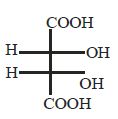
D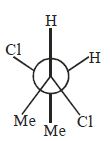
Solution
(C) Optical activity requires a molecule to be chiral,meaning it lacks a plane of symmetry,center of inversion,or improper axis of rotation.
$A$. $Cl-CH=C=CH-Cl$ is an allene with different groups on each terminal carbon,making it chiral and optically active.
$B$. $Br-CH=C=CH-Br$ is an allene with different groups on each terminal carbon,making it chiral and optically active.
$C$. Meso-tartaric acid has a plane of symmetry passing through the molecule,making it achiral and optically inactive.
$D$. The Newman projection shows a molecule that lacks a plane of symmetry and is chiral,thus it is optically active.
Therefore,the correct answer is $C$.
$A$. $Cl-CH=C=CH-Cl$ is an allene with different groups on each terminal carbon,making it chiral and optically active.
$B$. $Br-CH=C=CH-Br$ is an allene with different groups on each terminal carbon,making it chiral and optically active.
$C$. Meso-tartaric acid has a plane of symmetry passing through the molecule,making it achiral and optically inactive.
$D$. The Newman projection shows a molecule that lacks a plane of symmetry and is chiral,thus it is optically active.
Therefore,the correct answer is $C$.
0 likes
View Solution205
MediumMCQ
Which of the following compounds are optically active?
$(I)$ $1,1-$dimethyl$-4-$chlorocyclohexane
$(II)$ $4-$chlorocyclohex$-1-$ene
$(III)$ penta$-2,3-$diene
$(I)$ $1,1-$dimethyl$-4-$chlorocyclohexane
$(II)$ $4-$chlorocyclohex$-1-$ene
$(III)$ penta$-2,3-$diene
A
$I$ and $III$
B
$I$ and $II$
C
$II$ and $III$
D
$I$,$II$,and $III$
Solution
(C) compound is optically active if it lacks a plane of symmetry and a center of inversion (i.e.,it is chiral).
$(I)$ $1,1$-dimethyl-$4$-chlorocyclohexane: This molecule has a plane of symmetry passing through the $C1$ and $C4$ atoms. Therefore,it is achiral and optically inactive.
$(II)$ $4$-chlorocyclohex-$1$-ene: The $C4$ atom is bonded to four different groups ($-H$,$-Cl$,and two different paths around the ring). Thus,$C4$ is a chiral center. The molecule lacks a plane of symmetry and is optically active.
$(III)$ Penta-$2,3$-diene: This is an allene with an even number of double bonds. The terminal carbons are substituted such that the molecule lacks a plane of symmetry and a center of inversion. It is axially chiral and optically active.
Therefore,compounds $(II)$ and $(III)$ are optically active.
$(I)$ $1,1$-dimethyl-$4$-chlorocyclohexane: This molecule has a plane of symmetry passing through the $C1$ and $C4$ atoms. Therefore,it is achiral and optically inactive.
$(II)$ $4$-chlorocyclohex-$1$-ene: The $C4$ atom is bonded to four different groups ($-H$,$-Cl$,and two different paths around the ring). Thus,$C4$ is a chiral center. The molecule lacks a plane of symmetry and is optically active.
$(III)$ Penta-$2,3$-diene: This is an allene with an even number of double bonds. The terminal carbons are substituted such that the molecule lacks a plane of symmetry and a center of inversion. It is axially chiral and optically active.
Therefore,compounds $(II)$ and $(III)$ are optically active.
0 likes
View Solution206
MediumMCQ
Number of chiral centers in the given compound is

A
$2$
B
$3$
C
$4$
D
$5$
Solution
(C) chiral center is a carbon atom that is bonded to four different groups.
In the given structure,we analyze each carbon atom:
$1$. The two carbons in the cyclohexane ring attached to the side chain are chiral because they are bonded to different groups (the ring path clockwise vs. counter-clockwise,the side chain,and the hydrogen atom).
$2$. The carbon atom attached to the chlorine atom is chiral as it is bonded to a hydrogen,a chlorine,the cyclohexane ring,and the carbon with the bromine.
$3$. The carbon atom attached to the bromine atom is chiral as it is bonded to a hydrogen,a bromine,a methyl group,and the carbon with the chlorine.
Thus,there are $4$ chiral centers in the compound.
In the given structure,we analyze each carbon atom:
$1$. The two carbons in the cyclohexane ring attached to the side chain are chiral because they are bonded to different groups (the ring path clockwise vs. counter-clockwise,the side chain,and the hydrogen atom).
$2$. The carbon atom attached to the chlorine atom is chiral as it is bonded to a hydrogen,a chlorine,the cyclohexane ring,and the carbon with the bromine.
$3$. The carbon atom attached to the bromine atom is chiral as it is bonded to a hydrogen,a bromine,a methyl group,and the carbon with the chlorine.
Thus,there are $4$ chiral centers in the compound.
0 likes
View Solution207
MediumMCQ
Which of the following compounds is optically inactive?
A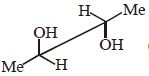
B
C
D
All of the above.
Solution
(D) An optically inactive compound is one that does not rotate the plane of polarized light.
$A$: $A$ meso-compound contains chiral centers but possesses an internal plane of symmetry,making the molecule achiral and optically inactive.
$B$: cis$-1,2-$cyclohexanediol has a plane of symmetry passing through the molecule,making it achiral and optically inactive.
$C$: $A$ chiral molecule with a single stereocenter is always optically active.
Since both $A$ and $B$ are optically inactive,the option 'All' is incorrect. However,based on the provided options,if the question implies identifying which of the given structures are inactive,both $A$ and $B$ qualify. Given the standard nature of such questions,if the options are meant to be specific structures,we evaluate them individually. Since $A$ and $B$ are both inactive,the most appropriate answer is that the question might be flawed or intended to select multiple. Assuming the question asks for an example,both $A$ and $B$ are correct.
$A$: $A$ meso-compound contains chiral centers but possesses an internal plane of symmetry,making the molecule achiral and optically inactive.
$B$: cis$-1,2-$cyclohexanediol has a plane of symmetry passing through the molecule,making it achiral and optically inactive.
$C$: $A$ chiral molecule with a single stereocenter is always optically active.
Since both $A$ and $B$ are optically inactive,the option 'All' is incorrect. However,based on the provided options,if the question implies identifying which of the given structures are inactive,both $A$ and $B$ qualify. Given the standard nature of such questions,if the options are meant to be specific structures,we evaluate them individually. Since $A$ and $B$ are both inactive,the most appropriate answer is that the question might be flawed or intended to select multiple. Assuming the question asks for an example,both $A$ and $B$ are correct.
0 likes
View Solution208
MediumMCQ
Which of the following would be optically active?
A
$CH_2=C=CH_2$
B
$4$,$4$'-difluorobiphenyl
C
$CH_3-CH=C=CH-CH_3$
D
$2,3-$dihydroxybutane (as shown in the structure)
Solution
(C) molecule is optically active if it lacks a plane of symmetry,a center of symmetry,and an alternating axis of symmetry.
$1$. $CH_2=C=CH_2$ (allene) is achiral because it has a plane of symmetry.
$2$. $4,4'$-difluorobiphenyl is achiral due to the presence of a plane of symmetry.
$3$. $CH_3-CH=C=CH-CH_3$ (penta$-2,3-$diene) is chiral because the two terminal carbons have different groups attached,and the molecule lacks a plane of symmetry.
$4$. The structure shown in option $D$ is $2,3$-dihydroxybutane. Depending on the configuration (e.g.,the $(2R, 3R)$ or $(2S, 3S)$ isomers),it can be optically active. However,in the context of comparing these specific choices,the allene derivative in $C$ is a classic example of axial chirality,while the structure in $D$ is a meso compound if it has an internal plane of symmetry. Given the specific Fischer projection provided,it represents a chiral molecule (specifically,the $(2R, 3R)$ or $(2S, 3S)$ form). Both $C$ and $D$ are optically active. Typically,in such multiple-choice questions,the most distinct example of chirality is sought. $C$ is definitely chiral. $D$ as drawn is also chiral.
$1$. $CH_2=C=CH_2$ (allene) is achiral because it has a plane of symmetry.
$2$. $4,4'$-difluorobiphenyl is achiral due to the presence of a plane of symmetry.
$3$. $CH_3-CH=C=CH-CH_3$ (penta$-2,3-$diene) is chiral because the two terminal carbons have different groups attached,and the molecule lacks a plane of symmetry.
$4$. The structure shown in option $D$ is $2,3$-dihydroxybutane. Depending on the configuration (e.g.,the $(2R, 3R)$ or $(2S, 3S)$ isomers),it can be optically active. However,in the context of comparing these specific choices,the allene derivative in $C$ is a classic example of axial chirality,while the structure in $D$ is a meso compound if it has an internal plane of symmetry. Given the specific Fischer projection provided,it represents a chiral molecule (specifically,the $(2R, 3R)$ or $(2S, 3S)$ form). Both $C$ and $D$ are optically active. Typically,in such multiple-choice questions,the most distinct example of chirality is sought. $C$ is definitely chiral. $D$ as drawn is also chiral.
0 likes
View Solution209
DifficultMCQ
Which of the following is optically active?
A
$2,2'-dibromo-6,6'-diiodobiphenyl$
B
$butan-2-ol$
C
$N,N-methylethylisopropylammonium \ hydroxide$
D
All of the above
Solution
(D) $1$. $2,2'-dibromo-6,6'-diiodobiphenyl$ is optically active due to restricted rotation around the single bond connecting the two benzene rings (atropisomerism) caused by bulky ortho-substituents.
$2$. $Butan-2-ol$ $(CH_3CH(OH)CH_2CH_3)$ contains a chiral carbon atom bonded to four different groups,making it optically active.
$3$. $N,N-methylethylisopropylammonium \ hydroxide$ contains a chiral nitrogen atom (quaternary ammonium salt) bonded to four different groups,making it optically active.
$4$. Since all three compounds are optically active,the correct option is $D$.
$2$. $Butan-2-ol$ $(CH_3CH(OH)CH_2CH_3)$ contains a chiral carbon atom bonded to four different groups,making it optically active.
$3$. $N,N-methylethylisopropylammonium \ hydroxide$ contains a chiral nitrogen atom (quaternary ammonium salt) bonded to four different groups,making it optically active.
$4$. Since all three compounds are optically active,the correct option is $D$.
0 likes
View Solution210
DifficultMCQ
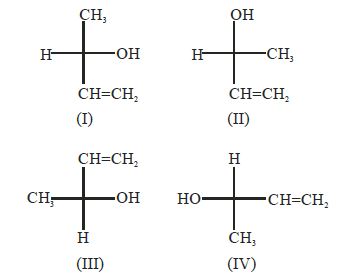
Which of the following combinations amongst the four Fischer projections represents the enantiomers?
A
$I$ and $II$
B
$I$ and $III$
C
$II$ and $IV$
D
None
Solution
(A) To determine if two Fischer projections are enantiomers,we assign the $R/S$ configuration to the chiral center in each structure.
For structure $I$,the priority order is: $-OH (1) > -CH=CH_2 (2) > -CH_3 (3) > -H (4)$. With $-H$ on a horizontal bond,the clockwise direction corresponds to the $S$ configuration.
For structure $II$,the priority order is: $-OH (1) > -CH=CH_2 (2) > -CH_3 (3) > -H (4)$. With $-H$ on a horizontal bond,the counter-clockwise direction corresponds to the $R$ configuration.
Since $I$ and $II$ are non-superimposable mirror images of each other,they are enantiomers.
Therefore,the correct combination is $I$ and $II$.
For structure $I$,the priority order is: $-OH (1) > -CH=CH_2 (2) > -CH_3 (3) > -H (4)$. With $-H$ on a horizontal bond,the clockwise direction corresponds to the $S$ configuration.
For structure $II$,the priority order is: $-OH (1) > -CH=CH_2 (2) > -CH_3 (3) > -H (4)$. With $-H$ on a horizontal bond,the counter-clockwise direction corresponds to the $R$ configuration.
Since $I$ and $II$ are non-superimposable mirror images of each other,they are enantiomers.
Therefore,the correct combination is $I$ and $II$.
0 likes
View Solution211
EasyMCQ
Dichloroethene cannot exhibit ............
A
Geometrical isomerism
B
Optical isomerism
C
Both
D
None
Solution
(B) Dichloroethene $(C_2H_2Cl_2)$ exists in three isomeric forms: $1,1$-dichloroethene,$cis$-$1,2$-dichloroethene,and $trans$-$1,2$-dichloroethene.
$1,2$-dichloroethene exhibits geometrical isomerism due to restricted rotation around the $C=C$ double bond.
However,all isomers of dichloroethene are planar molecules.
Since they possess a plane of symmetry,they are achiral and cannot exhibit optical isomerism.
$1,2$-dichloroethene exhibits geometrical isomerism due to restricted rotation around the $C=C$ double bond.
However,all isomers of dichloroethene are planar molecules.
Since they possess a plane of symmetry,they are achiral and cannot exhibit optical isomerism.
0 likes
View Solution212
EasyMCQ
$A$ substance that can rotate the plane of plane-polarized light is called........
A
Optically active
B
Geometrical isomer
C
Tautomers
D
Enantiomers
Solution
(A) substance that can rotate the plane of plane-polarized light is known as an $Optically \ active$ substance.
This property is known as optical activity,which arises due to the presence of a chiral center in the molecule.
This property is known as optical activity,which arises due to the presence of a chiral center in the molecule.
0 likes
View Solution213
MediumMCQ
The number of stereoisomers for a compound containing $n$ different asymmetric carbon atoms will be .............
A
$2^n$
B
$2n^2$
C
$2n^{1/2}$
D
$2^{n+1}$
Solution
(A) For a molecule containing $n$ chiral centers (asymmetric carbon atoms) where the molecule is not symmetrical,the total number of stereoisomers is given by the formula $2^n$.
0 likes
View Solution214
MediumMCQ
The type of isomerism shown by $CH_3CH(OH)COOH$ is ......
A
Positional isomerism
B
Functional isomerism
C
Optical isomerism
D
Cis-trans isomerism
Solution
(C) The given compound is $CH_3CH(OH)COOH$ (lactic acid).
In this molecule,the central carbon atom is bonded to four different groups: a hydrogen atom $(-H)$,a hydroxyl group $(-OH)$,a methyl group $(-CH_3)$,and a carboxylic acid group $(-COOH)$.
Since the central carbon is a chiral center,the molecule can exist as two non-superimposable mirror images.
Therefore,it exhibits optical isomerism.
In this molecule,the central carbon atom is bonded to four different groups: a hydrogen atom $(-H)$,a hydroxyl group $(-OH)$,a methyl group $(-CH_3)$,and a carboxylic acid group $(-COOH)$.
Since the central carbon is a chiral center,the molecule can exist as two non-superimposable mirror images.
Therefore,it exhibits optical isomerism.
0 likes
View Solution215
MediumMCQ
Which of the following compounds will exhibit optical isomerism?
A
$1, 1-$ Dichloropropane
B
$2, 2-$ Dichloropropane
C
$1, 3-$ Dibromopropane
D
$1, 2-$ Dichloropropane
Solution
(D) For a compound to exhibit optical isomerism,it must contain at least one chiral carbon atom (a carbon atom bonded to four different groups).
$1, 1-$ Dichloropropane: $CH_3-CH_2-CHCl_2$ (No chiral carbon)
$2, 2-$ Dichloropropane: $CH_3-CCl_2-CH_3$ (No chiral carbon)
$1, 3-$ Dibromopropane: $Br-CH_2-CH_2-CH_2-Br$ (No chiral carbon)
$1, 2-$ Dichloropropane: $CH_3-CHCl-CH_2Cl$. Here,the $C-2$ atom is bonded to a methyl group $(-CH_3)$,a hydrogen atom $(-H)$,a chlorine atom $(-Cl)$,and a chloromethyl group $(-CH_2Cl)$. Since all four groups are different,$C-2$ is a chiral center.
Therefore,$1, 2-$ Dichloropropane exhibits optical isomerism.
$1, 1-$ Dichloropropane: $CH_3-CH_2-CHCl_2$ (No chiral carbon)
$2, 2-$ Dichloropropane: $CH_3-CCl_2-CH_3$ (No chiral carbon)
$1, 3-$ Dibromopropane: $Br-CH_2-CH_2-CH_2-Br$ (No chiral carbon)
$1, 2-$ Dichloropropane: $CH_3-CHCl-CH_2Cl$. Here,the $C-2$ atom is bonded to a methyl group $(-CH_3)$,a hydrogen atom $(-H)$,a chlorine atom $(-Cl)$,and a chloromethyl group $(-CH_2Cl)$. Since all four groups are different,$C-2$ is a chiral center.
Therefore,$1, 2-$ Dichloropropane exhibits optical isomerism.
0 likes
View Solution216
MediumMCQ
Which of the following properties is incorrect for enantiomers?
A
They have identical physical properties except for the rotation of plane-polarized light.
B
They have identical biological properties.
C
They have identical chemical properties,but react differently with other optically active substances.
D
An equimolar mixture of $d$ and $l$ isomers is called a racemic mixture.
Solution
(B) Enantiomers are non-superimposable mirror images of each other.
They possess identical physical properties (like melting point,boiling point,refractive index) except for the direction in which they rotate plane-polarized light.
They exhibit identical chemical properties in an achiral environment,but they react differently with other optically active substances (chiral reagents).
Crucially,enantiomers often exhibit different biological properties because biological systems (enzymes,receptors) are chiral and interact differently with specific enantiomers.
Therefore,the statement that they have identical biological properties is incorrect.
They possess identical physical properties (like melting point,boiling point,refractive index) except for the direction in which they rotate plane-polarized light.
They exhibit identical chemical properties in an achiral environment,but they react differently with other optically active substances (chiral reagents).
Crucially,enantiomers often exhibit different biological properties because biological systems (enzymes,receptors) are chiral and interact differently with specific enantiomers.
Therefore,the statement that they have identical biological properties is incorrect.
0 likes
View Solution217
EasyMCQ
The isomers whose structures are non-superimposable mirror images of each other are called .....
A
Diastereomers
B
Mesomers
C
Enantiomers
D
Metamers
Solution
(C) Isomers that are non-superimposable mirror images of each other are known as $Enantiomers$.
$Diastereomers$ are stereoisomers that are not mirror images of each other.
$Metamers$ are isomers resulting from the unequal distribution of carbon atoms on either side of a functional group.
$Mesomers$ (or $Meso$ compounds) are optically inactive compounds that possess chiral centers but have an internal plane of symmetry.
$Diastereomers$ are stereoisomers that are not mirror images of each other.
$Metamers$ are isomers resulting from the unequal distribution of carbon atoms on either side of a functional group.
$Mesomers$ (or $Meso$ compounds) are optically inactive compounds that possess chiral centers but have an internal plane of symmetry.
0 likes
View Solution218
EasyMCQ
The necessary and sufficient condition for the existence of enantiomers is ...........
A
Presence of a double bond in the molecule
B
Asymmetry in the molecule
C
Presence of an asymmetric carbon
D
Tendency to form mirror images
0 likes
View Solution219
MediumMCQ
Which of the following compounds will exhibit a meso form?
A
$CH_3-CH(OH)-CH(OH)-COOH$
B
$CH_3-CH_2-CHCl-CHCl-CH_3$
C
$CH_3-CH(OH)-CH(OH)-CH_3$
D
$CH_3-CH(OH)-COOH$
Solution
(C) meso compound is an optically inactive molecule that contains two or more stereocenters but also has an internal plane of symmetry.
In $CH_3-CH(OH)-CH(OH)-CH_3$ ($2$,$3$-butanediol),the molecule can exist in a meso form where the two chiral carbons have opposite configurations ($R,S$ configuration),leading to an internal plane of symmetry.
Thus,the correct option is $C$.
In $CH_3-CH(OH)-CH(OH)-CH_3$ ($2$,$3$-butanediol),the molecule can exist in a meso form where the two chiral carbons have opposite configurations ($R,S$ configuration),leading to an internal plane of symmetry.
Thus,the correct option is $C$.
0 likes
View Solution220
MediumMCQ
What is the number of optically active isomers for the compound with the molecular formula $C_7H_{16}$?
A
$2$
B
$4$
C
$5$
D
$6$
Solution
(D) The molecular formula $C_7H_{16}$ corresponds to an alkane $(C_nH_{2n+2})$.
To find optically active isomers,we look for chiral centers in the branched isomers of heptane.
The isomers of heptane are:
$1$. $n$-Heptane (achiral)
$2$. $2$-Methylhexane: $CH_3-CH(CH_3)-CH_2-CH_2-CH_2-CH_3$. The $C_2$ carbon is chiral. It has $2$ enantiomers.
$3$. $3$-Methylhexane: $CH_3-CH_2-CH(CH_3)-CH_2-CH_2-CH_3$. The $C_3$ carbon is chiral. It has $2$ enantiomers.
$4$. $3$-Ethylpentane (achiral)
$5$. $2,2$-Dimethylpentane (achiral)
$6$. $2,3$-Dimethylpentane: $CH_3-CH(CH_3)-CH(CH_3)-CH_2-CH_3$. The $C_3$ carbon is chiral. It has $2$ enantiomers.
$7$. $2,4$-Dimethylpentane (achiral)
$8$. $3,3$-Dimethylpentane (achiral)
$9$. $2,2,3$-Trimethylbutane (achiral)
Total optically active isomers = $2$ (from $2$-methylhexane) + $2$ (from $3$-methylhexane) + $2$ (from $2,3$-dimethylpentane) = $6$.
To find optically active isomers,we look for chiral centers in the branched isomers of heptane.
The isomers of heptane are:
$1$. $n$-Heptane (achiral)
$2$. $2$-Methylhexane: $CH_3-CH(CH_3)-CH_2-CH_2-CH_2-CH_3$. The $C_2$ carbon is chiral. It has $2$ enantiomers.
$3$. $3$-Methylhexane: $CH_3-CH_2-CH(CH_3)-CH_2-CH_2-CH_3$. The $C_3$ carbon is chiral. It has $2$ enantiomers.
$4$. $3$-Ethylpentane (achiral)
$5$. $2,2$-Dimethylpentane (achiral)
$6$. $2,3$-Dimethylpentane: $CH_3-CH(CH_3)-CH(CH_3)-CH_2-CH_3$. The $C_3$ carbon is chiral. It has $2$ enantiomers.
$7$. $2,4$-Dimethylpentane (achiral)
$8$. $3,3$-Dimethylpentane (achiral)
$9$. $2,2,3$-Trimethylbutane (achiral)
Total optically active isomers = $2$ (from $2$-methylhexane) + $2$ (from $3$-methylhexane) + $2$ (from $2,3$-dimethylpentane) = $6$.
0 likes
View Solution221
DifficultMCQ
Which of the following compounds will exhibit optical isomerism?
A
Butan-$1$-ol
B
Butan-$2$-ol
C
But-$1$-ene
D
But-$2$-ene
Solution
(B) For a compound to exhibit optical isomerism,it must contain at least one chiral carbon atom (a carbon atom bonded to four different groups).
In Butan-$2$-ol $(CH_3-CH(OH)-CH_2-CH_3)$,the second carbon atom is bonded to a hydrogen atom,a hydroxyl group $(-OH)$,a methyl group $(-CH_3)$,and an ethyl group $(-CH_2CH_3)$.
Since all four groups attached to the $C-2$ atom are different,it is a chiral center.
Therefore,Butan-$2$-ol exhibits optical isomerism.
In Butan-$2$-ol $(CH_3-CH(OH)-CH_2-CH_3)$,the second carbon atom is bonded to a hydrogen atom,a hydroxyl group $(-OH)$,a methyl group $(-CH_3)$,and an ethyl group $(-CH_2CH_3)$.
Since all four groups attached to the $C-2$ atom are different,it is a chiral center.
Therefore,Butan-$2$-ol exhibits optical isomerism.
0 likes
View Solution222
DifficultMCQ
The process of conversion of the $d$-form of an optically active compound into its $l$-form or vice versa is known as ......
A
Resolution
B
Walden Inversion
C
Racemisation
D
External compensation
Solution
(C) The process of converting one enantiomer (e.g.,$d$-form) into a mixture containing both enantiomers ($d$ and $l$ forms) in equal proportions is known as $Racemisation$.
If the question refers specifically to the inversion of configuration at a chiral center during a reaction (like $S_N2$),it is called $Walden \text{ } Inversion$.
However,the conversion of a pure optical isomer into a racemic mixture is defined as $Racemisation$.
If the question refers specifically to the inversion of configuration at a chiral center during a reaction (like $S_N2$),it is called $Walden \text{ } Inversion$.
However,the conversion of a pure optical isomer into a racemic mixture is defined as $Racemisation$.
0 likes
View Solution223
DifficultMCQ
Which of the following forms of tartaric acid is optically active?
A
$m-$ tartaric acid
B
$\gamma -$ tartaric acid
C
$d-$ tartaric acid
D
$dl-$ tartaric acid
Solution
(C) Tartaric acid exists in different stereoisomeric forms.
$m-$ tartaric acid (meso-tartaric acid) is optically inactive due to an internal plane of symmetry.
$dl-$ tartaric acid (racemic mixture) is also optically inactive because the rotation caused by the $d-$ form is cancelled by the $l-$ form.
$d-$ tartaric acid (dextrorotatory) is optically active as it rotates plane-polarized light to the right.
Therefore,the correct answer is $d-$ tartaric acid.
$m-$ tartaric acid (meso-tartaric acid) is optically inactive due to an internal plane of symmetry.
$dl-$ tartaric acid (racemic mixture) is also optically inactive because the rotation caused by the $d-$ form is cancelled by the $l-$ form.
$d-$ tartaric acid (dextrorotatory) is optically active as it rotates plane-polarized light to the right.
Therefore,the correct answer is $d-$ tartaric acid.
0 likes
View Solution224
MediumMCQ
Chiral molecules are those which ...........
A
are non-superimposable on their mirror images
B
are superimposable on their mirror images
C
possess internal compensation of optical activity
D
exhibit geometrical isomerism
Solution
(A) molecule is defined as chiral if it lacks a plane of symmetry or a center of inversion,making it non-superimposable on its mirror image. This property is the fundamental requirement for optical activity.
0 likes
View Solution225
MediumMCQ
Which of the following does not exhibit optical isomerism?
A
$HOOC-CH(OH)-CH(OH)-COOH$
B
$CH_3-CH(OH)-COOH$
C
$HOOC-CH_2-CH(CH_3)-C_2H_5$
D
$CH_3-CH=CH_2$
Solution
(D) Optical isomerism is exhibited by compounds that possess a chiral center (an asymmetric carbon atom bonded to four different groups).
$A$: Tartaric acid $(HOOC-CH(OH)-CH(OH)-COOH)$ has chiral carbons and can exhibit optical isomerism.
$B$: Lactic acid $(CH_3-CH(OH)-COOH)$ has a chiral carbon atom at the $C-2$ position.
$C$: $2$-methylbutanoic acid $(HOOC-CH_2-CH(CH_3)-C_2H_5)$ has a chiral carbon atom at the $C-3$ position.
$D$: Propene $(CH_3-CH=CH_2)$ does not have any chiral carbon atom because the $sp^2$ hybridized carbons are bonded to identical hydrogen atoms,and the $sp^3$ carbon is bonded to three identical hydrogen atoms. Thus,it does not exhibit optical isomerism.
$A$: Tartaric acid $(HOOC-CH(OH)-CH(OH)-COOH)$ has chiral carbons and can exhibit optical isomerism.
$B$: Lactic acid $(CH_3-CH(OH)-COOH)$ has a chiral carbon atom at the $C-2$ position.
$C$: $2$-methylbutanoic acid $(HOOC-CH_2-CH(CH_3)-C_2H_5)$ has a chiral carbon atom at the $C-3$ position.
$D$: Propene $(CH_3-CH=CH_2)$ does not have any chiral carbon atom because the $sp^2$ hybridized carbons are bonded to identical hydrogen atoms,and the $sp^3$ carbon is bonded to three identical hydrogen atoms. Thus,it does not exhibit optical isomerism.
0 likes
View Solution226
MediumMCQ
How many chiral carbons are present in $1, 2-$dichlorocyclohexane?
A
$1$
B
$2$
C
$3$
D
$4$
Solution
(B) In $1, 2-$dichlorocyclohexane,the carbon atoms at positions $1$ and $2$ are bonded to four different groups: a hydrogen atom,a chlorine atom,the rest of the cyclohexane ring,and the adjacent carbon atom.
Since each of these two carbons is bonded to four distinct groups,they are chiral centers.
Therefore,there are $2$ chiral carbons in $1, 2-$dichlorocyclohexane.
Since each of these two carbons is bonded to four distinct groups,they are chiral centers.
Therefore,there are $2$ chiral carbons in $1, 2-$dichlorocyclohexane.
0 likes
View Solution227
MediumMCQ
Meso-tartaric acid is optically inactive due to which of the following?
A
Lack of chirality
B
Racemization of $d$ and $l$ forms
C
External compensation
D
Internal compensation
Solution
(D) Meso-tartaric acid contains two chiral carbon atoms but possesses a plane of symmetry within the molecule.
Due to this plane of symmetry,the optical rotation caused by one half of the molecule is cancelled by the other half.
This phenomenon is known as internal compensation.
Therefore,meso-tartaric acid is optically inactive.
Due to this plane of symmetry,the optical rotation caused by one half of the molecule is cancelled by the other half.
This phenomenon is known as internal compensation.
Therefore,meso-tartaric acid is optically inactive.
0 likes
View Solution228
DifficultMCQ
Which of the following is optically active?
A
Succinic acid
B
Lactic acid
C
Meso tartaric acid
D
Chloro acetic acid
Solution
(B) molecule is optically active if it contains at least one chiral center (an asymmetric carbon atom) and lacks a plane of symmetry or center of symmetry.
$1$. Succinic acid $(HOOC-CH_2-CH_2-COOH)$ has no chiral center.
$2$. Lactic acid $(CH_3-CH(OH)-COOH)$ has one chiral carbon atom attached to four different groups $(-H, -OH, -CH_3, -COOH)$,making it optically active.
$3$. Meso tartaric acid has chiral centers but possesses a plane of symmetry,making it optically inactive (meso compound).
$4$. Chloro acetic acid $(ClCH_2-COOH)$ has no chiral center.
Therefore,Lactic acid is the correct answer.
$1$. Succinic acid $(HOOC-CH_2-CH_2-COOH)$ has no chiral center.
$2$. Lactic acid $(CH_3-CH(OH)-COOH)$ has one chiral carbon atom attached to four different groups $(-H, -OH, -CH_3, -COOH)$,making it optically active.
$3$. Meso tartaric acid has chiral centers but possesses a plane of symmetry,making it optically inactive (meso compound).
$4$. Chloro acetic acid $(ClCH_2-COOH)$ has no chiral center.
Therefore,Lactic acid is the correct answer.
0 likes
View Solution229
EasyMCQ
Optical activity is measured by .................
A
Refractometer
B
Spectrograph
C
Polarimeter
D
Tracer technique
Solution
(C) Optical activity refers to the ability of a chiral molecule to rotate the plane of plane-polarized light. This rotation is measured using an instrument called a $Polarimeter$.
0 likes
View Solution230
MediumMCQ
What is the number of optical isomers for $2, 3-$dibromobutanoic acid?
A
$0$
B
$2$
C
$3$
D
$4$
Solution
(D) The structure of $2, 3-$dibromobutanoic acid is $CH_3-CH(Br)-CH(Br)-COOH$.
This molecule contains two chiral centers at $C_2$ and $C_3$.
The number of stereoisomers is given by $2^n$,where $n$ is the number of chiral centers.
Here,$n = 2$,so the total number of stereoisomers is $2^2 = 4$.
These four stereoisomers consist of two pairs of enantiomers,which are optically active.
Therefore,the number of optical isomers is $4$.
This molecule contains two chiral centers at $C_2$ and $C_3$.
The number of stereoisomers is given by $2^n$,where $n$ is the number of chiral centers.
Here,$n = 2$,so the total number of stereoisomers is $2^2 = 4$.
These four stereoisomers consist of two pairs of enantiomers,which are optically active.
Therefore,the number of optical isomers is $4$.
0 likes
View Solution231
MediumMCQ
The number of possible stereoisomers for a compound containing three different chiral centers is .............
A
$3$
B
$6$
C
$8$
D
$27$
Solution
(C) For a compound with $n$ different chiral centers,the total number of stereoisomers is given by the formula $2^n$.
Given that the compound has $n = 3$ different chiral centers.
Therefore,the number of stereoisomers = $2^3 = 8$.
Given that the compound has $n = 3$ different chiral centers.
Therefore,the number of stereoisomers = $2^3 = 8$.
0 likes
View Solution232
DifficultMCQ
Which of the following is achiral?
A
$2-$bromocyclohexanol
B
$2-$chlorohexane
C
$1,4-$dimethylcyclohexane
D
$1-$chloro$-2-$deuterocyclohexane
Solution
(C) molecule is achiral if it possesses a plane of symmetry or a center of inversion.
$(a)$ $2$-bromocyclohexanol has chiral centers and no plane of symmetry,so it is chiral.
$(b)$ $2$-chlorohexane has a chiral carbon at the $C2$ position,so it is chiral.
$(c)$ $1,4$-dimethylcyclohexane (specifically the cis-isomer) has a plane of symmetry passing through $C1$ and $C4$,making it achiral.
$(d)$ $1$-chloro-$2$-deuterocyclohexane has chiral centers and no plane of symmetry,so it is chiral.
Therefore,the correct option is $C$.
$(a)$ $2$-bromocyclohexanol has chiral centers and no plane of symmetry,so it is chiral.
$(b)$ $2$-chlorohexane has a chiral carbon at the $C2$ position,so it is chiral.
$(c)$ $1,4$-dimethylcyclohexane (specifically the cis-isomer) has a plane of symmetry passing through $C1$ and $C4$,making it achiral.
$(d)$ $1$-chloro-$2$-deuterocyclohexane has chiral centers and no plane of symmetry,so it is chiral.
Therefore,the correct option is $C$.
0 likes
View Solution233
MediumMCQ
The number of optically active isomers of tartaric acid is .....
A
$2$
B
$3$
C
$4$
D
$5$
Solution
(A) Tartaric acid is $HOOC-CH(OH)-CH(OH)-COOH$.
It contains two chiral carbon atoms.
The total number of stereoisomers is given by $2^n$ where $n$ is the number of chiral centers,but since the molecule is symmetric,we use the formula for meso compounds.
For tartaric acid,there are two optically active enantiomers ($d$ and $l$ forms) and one optically inactive meso form.
Thus,the number of optically active isomers is $2$.
It contains two chiral carbon atoms.
The total number of stereoisomers is given by $2^n$ where $n$ is the number of chiral centers,but since the molecule is symmetric,we use the formula for meso compounds.
For tartaric acid,there are two optically active enantiomers ($d$ and $l$ forms) and one optically inactive meso form.
Thus,the number of optically active isomers is $2$.
0 likes
View Solution234
MediumMCQ
Which of the following is not optically active?
A
Alanine
B
Lactic acid
C
Malic acid
D
$2, 2-$Dimethylbutanoic acid
Solution
(D) molecule is optically active if it contains at least one chiral center (a carbon atom bonded to four different groups).
$1$. Alanine $(CH_3CH(NH_2)COOH)$ has a chiral carbon.
$2$. Lactic acid $(CH_3CH(OH)COOH)$ has a chiral carbon.
$3$. Malic acid $(HOOCCH_2CH(OH)COOH)$ has a chiral carbon.
$4$. $2, 2-$Dimethylbutanoic acid $(CH_3CH_2C(CH_3)_2COOH)$ has no chiral carbon because the $C-2$ atom is bonded to two identical methyl groups. Therefore,it is not optically active.
$1$. Alanine $(CH_3CH(NH_2)COOH)$ has a chiral carbon.
$2$. Lactic acid $(CH_3CH(OH)COOH)$ has a chiral carbon.
$3$. Malic acid $(HOOCCH_2CH(OH)COOH)$ has a chiral carbon.
$4$. $2, 2-$Dimethylbutanoic acid $(CH_3CH_2C(CH_3)_2COOH)$ has no chiral carbon because the $C-2$ atom is bonded to two identical methyl groups. Therefore,it is not optically active.
0 likes
View Solution235
DifficultMCQ
Which of the following compounds is achiral?
A
$CH_3CH(Br)CH=CH_2$
B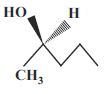
C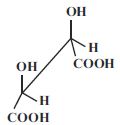
D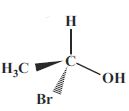
Solution
(C) molecule is achiral if it possesses a plane of symmetry or a center of symmetry,or if it lacks a stereocenter.
$A$: $CH_3CH(Br)CH=CH_2$ has a chiral carbon at the second position (bonded to $-H$,$-CH_3$,$-Br$,and $-CH=CH_2$),so it is chiral.
$B$: The structure shows a carbon bonded to four different groups ($-OH$,$-H$,$-CH_3$,and $-CH_2CH_2CH_3$),so it is chiral.
$C$: The structure represents a meso compound (specifically a form of tartaric acid derivative). It contains a plane of symmetry passing through the center of the molecule,making it achiral.
$D$: The structure shows a carbon bonded to four different groups ($-H$,$-CH_3$,$-OH$,and $-Br$),so it is chiral.
Therefore,the achiral compound is $C$.
$A$: $CH_3CH(Br)CH=CH_2$ has a chiral carbon at the second position (bonded to $-H$,$-CH_3$,$-Br$,and $-CH=CH_2$),so it is chiral.
$B$: The structure shows a carbon bonded to four different groups ($-OH$,$-H$,$-CH_3$,and $-CH_2CH_2CH_3$),so it is chiral.
$C$: The structure represents a meso compound (specifically a form of tartaric acid derivative). It contains a plane of symmetry passing through the center of the molecule,making it achiral.
$D$: The structure shows a carbon bonded to four different groups ($-H$,$-CH_3$,$-OH$,and $-Br$),so it is chiral.
Therefore,the achiral compound is $C$.
0 likes
View Solution236
DifficultMCQ
Non-superimposable mirror images are called.........
A
Non-superimposable non-mirror image stereoisomers
B
Non-superimposable mirror image stereoisomers
C
Isomers that differ only in rotation around a single bond
D
Isomers that differ only in the connectivity of atoms
Solution
(B) Non-superimposable mirror images are known as enantiomers. Enantiomers are a type of stereoisomer that are mirror images of each other but cannot be superimposed on one another.
0 likes
View Solution237
MediumMCQ
The number of stereoisomers for the compound $CH_3-CHBr-CHBr-COOH$ is ......... .
A
$1$
B
$2$
C
$3$
D
$4$
Solution
(D) The given compound is $CH_3-CHBr-CHBr-COOH$.
It contains two chiral carbon atoms at positions $C_2$ and $C_3$.
The molecule is unsymmetrical because the groups attached to the chiral carbons are different ($CH_3$ and $COOH$).
For an unsymmetrical molecule with $n$ chiral centers,the number of stereoisomers is given by $2^n$.
Here,$n = 2$,so the number of stereoisomers = $2^2 = 4$.
It contains two chiral carbon atoms at positions $C_2$ and $C_3$.
The molecule is unsymmetrical because the groups attached to the chiral carbons are different ($CH_3$ and $COOH$).
For an unsymmetrical molecule with $n$ chiral centers,the number of stereoisomers is given by $2^n$.
Here,$n = 2$,so the number of stereoisomers = $2^2 = 4$.
0 likes
View Solution238
DifficultMCQ
The specific rotation of $(+)$-Mandelic acid is $+158^o$. What will be the specific rotation of a mixture containing $25\%$ $(-)$-Mandelic acid and $75\%$ $(+)$-Mandelic acid?
A
$+79$
B
$-118.5$
C
$-79$
D
$+118.5$
0 likes
View Solution239
DifficultMCQ
How many optical isomers are possible for the compound $CH_3CH(COOH)-CH(COOH)CH_2CH_3$?
A
$3$
B
$2$
C
$4$
D
$0$
Solution
(C) The given compound is $CH_3-CH(COOH)-CH(COOH)-CH_2CH_3$.
It contains two chiral carbon atoms (marked with *): $CH_3-CH^*(COOH)-CH^*(COOH)-CH_2CH_3$.
Since the two chiral carbons are attached to different groups (one is attached to $-CH_3$ and $-H$,the other to $-CH_2CH_3$ and $-H$),the molecule is asymmetric.
The number of optical isomers is given by the formula $2^n$,where $n$ is the number of chiral centers.
Here,$n = 2$,so the number of optical isomers = $2^2 = 4$.
It contains two chiral carbon atoms (marked with *): $CH_3-CH^*(COOH)-CH^*(COOH)-CH_2CH_3$.
Since the two chiral carbons are attached to different groups (one is attached to $-CH_3$ and $-H$,the other to $-CH_2CH_3$ and $-H$),the molecule is asymmetric.
The number of optical isomers is given by the formula $2^n$,where $n$ is the number of chiral centers.
Here,$n = 2$,so the number of optical isomers = $2^2 = 4$.
0 likes
View Solution240
DifficultMCQ
Which of the following molecules contains stereogenic $C-$ atoms?
A
$1,2-$ dibromobutane
B
$1-$ bromo $-2-$ methylcyclopentane
C
$1,1,2-$ tribromopropane
D
All of these
Solution
(D) stereogenic $C-$ atom (chiral center) is a carbon atom bonded to four different groups.
$1$. In $1,2-$ dibromobutane $(CH_3-CH_2-CH(Br)-CH_2Br)$,the $C-2$ atom is bonded to $-H, -Br, -CH_2CH_3,$ and $-CH_2Br$. Thus,it is chiral.
$2$. In $1-$ bromo $-2-$ methylcyclopentane,the $C-1$ and $C-2$ atoms are bonded to four different groups,making them chiral centers.
$3$. In $1,1,2-$ tribromopropane $(CH_3-CH(Br)-CHBr_2)$,the $C-2$ atom is bonded to $-H, -Br, -CH_3,$ and $-CHBr_2$. Thus,it is chiral.
Since all the given molecules contain at least one stereogenic carbon atom,the correct answer is $D$.
$1$. In $1,2-$ dibromobutane $(CH_3-CH_2-CH(Br)-CH_2Br)$,the $C-2$ atom is bonded to $-H, -Br, -CH_2CH_3,$ and $-CH_2Br$. Thus,it is chiral.
$2$. In $1-$ bromo $-2-$ methylcyclopentane,the $C-1$ and $C-2$ atoms are bonded to four different groups,making them chiral centers.
$3$. In $1,1,2-$ tribromopropane $(CH_3-CH(Br)-CHBr_2)$,the $C-2$ atom is bonded to $-H, -Br, -CH_3,$ and $-CHBr_2$. Thus,it is chiral.
Since all the given molecules contain at least one stereogenic carbon atom,the correct answer is $D$.
0 likes
View Solution241
MediumMCQ
Which of the following can show optical activity?
A
$CH_3-CH_2-CH_2-CH_2-OH$
B
$CH_3-CH_2-CH(OH)-CH_3$
C
$CH_3-CH(CH_3)-CH_2-OH$
D
$CH_3-C(OH)(CH_3)-CH_3$
Solution
(B) Optical activity is shown by molecules containing at least one chiral carbon atom (a carbon atom attached to four different groups).
In $CH_3-CH_2-CH(OH)-CH_3$ $(\text{Butan-2-ol})$,the second carbon atom is chiral because it is bonded to four different groups: $-H$,$-OH$,$-CH_3$,and $-CH_2CH_3$.
Thus,it is optically active.
In $CH_3-CH_2-CH(OH)-CH_3$ $(\text{Butan-2-ol})$,the second carbon atom is chiral because it is bonded to four different groups: $-H$,$-OH$,$-CH_3$,and $-CH_2CH_3$.
Thus,it is optically active.
0 likes
View Solution242
MediumMCQ
Which one among the following cannot exhibit enantiomerism?
A
Diphenyl methanol
B
$1-$Bromo$-2-$chlorobutane
C
$2-$Butanol
D
Tartaric acid
Solution
(A) Enantiomerism is exhibited by molecules that are chiral,meaning they possess at least one chiral carbon atom (a carbon atom bonded to four different groups).
$1.$ Diphenyl methanol: The central carbon is bonded to one $H$ atom,one $OH$ group,and two identical phenyl groups. Since it has two identical groups,it is achiral and cannot exhibit enantiomerism.
$2.$ $1-$Bromo$-2-$chlorobutane: The carbon at position $2$ is bonded to $H$,$Cl$,$CH_3$,and $CH_2Br$. All four groups are different,so it is chiral.
$3.$ $2-$Butanol: The carbon at position $2$ is bonded to $H$,$OH$,$CH_3$,and $CH_2CH_3$. All four groups are different,so it is chiral.
$4.$ Tartaric acid: It contains two chiral carbon atoms and can exist as enantiomers (e.g.,$(+)-$ and $(-)-$tartaric acid).
Therefore,Diphenyl methanol cannot exhibit enantiomerism.
$1.$ Diphenyl methanol: The central carbon is bonded to one $H$ atom,one $OH$ group,and two identical phenyl groups. Since it has two identical groups,it is achiral and cannot exhibit enantiomerism.
$2.$ $1-$Bromo$-2-$chlorobutane: The carbon at position $2$ is bonded to $H$,$Cl$,$CH_3$,and $CH_2Br$. All four groups are different,so it is chiral.
$3.$ $2-$Butanol: The carbon at position $2$ is bonded to $H$,$OH$,$CH_3$,and $CH_2CH_3$. All four groups are different,so it is chiral.
$4.$ Tartaric acid: It contains two chiral carbon atoms and can exist as enantiomers (e.g.,$(+)-$ and $(-)-$tartaric acid).
Therefore,Diphenyl methanol cannot exhibit enantiomerism.
0 likes
View Solution243
MediumMCQ
Among the following,which one can have a meso form?
A
$CH_3CH(OH)CH(Cl)C_2H_5$
B
$CH_3CH(OH)CH(OH)CH_3$
C
$C_2H_5CH(OH)CH(OH)CH_3$
D
$HOCH_2CH(Cl)CH_3$
Solution
(B) meso compound is an optically inactive molecule that contains chiral centers but also possesses an internal plane of symmetry or a center of symmetry.
For a molecule to exhibit a meso form,it must have at least two identical chiral centers and a symmetric structure.
In $CH_3CH(OH)CH(OH)CH_3$ (butane$-2,3-$diol),the two central carbons are chiral and identical. In the eclipsed conformation,it can have a plane of symmetry,making it a meso compound.
For a molecule to exhibit a meso form,it must have at least two identical chiral centers and a symmetric structure.
In $CH_3CH(OH)CH(OH)CH_3$ (butane$-2,3-$diol),the two central carbons are chiral and identical. In the eclipsed conformation,it can have a plane of symmetry,making it a meso compound.
0 likes
View Solution


245
Medium
Identify chiral and achiral molecules in each of the following pairs of compounds.
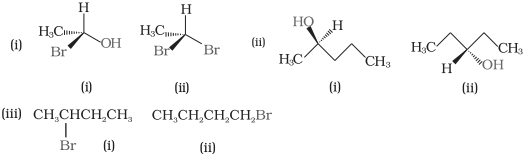
Solution
(A) molecule is chiral if it has a chiral center (a carbon atom bonded to four different groups). Otherwise,it is achiral.
$(i)$ $(i)$ $CH_3CH(Br)OH$: The central carbon is bonded to $-H$,$-CH_3$,$-Br$,and $-OH$. Since all four groups are different,it is chiral.
(ii) $CH_3CH(Br)_2$: The central carbon is bonded to two identical $-Br$ atoms. Thus,it is achiral.
(ii) $(i)$ $CH_3CH(OH)CH_2CH_2CH_3$: The carbon bonded to $-OH$ is attached to $-H$,$-CH_3$,$-OH$,and $-CH_2CH_2CH_3$. All four groups are different,so it is chiral.
(ii) $CH_3CH_2CH(OH)CH_2CH_3$: The carbon bonded to $-OH$ is attached to $-H$,$-OH$,and two identical $-CH_2CH_3$ groups. Since two groups are identical,it is achiral.
(iii) $(i)$ $CH_3CH(Br)CH_2CH_3$: The carbon bonded to $-Br$ is attached to $-H$,$-CH_3$,$-Br$,and $-CH_2CH_3$. All four groups are different,so it is chiral.
(ii) $CH_3CH_2CH_2CH_2Br$: The carbon bonded to $-Br$ is attached to two $-H$ atoms. Since two groups are identical,it is achiral.
$(i)$ $(i)$ $CH_3CH(Br)OH$: The central carbon is bonded to $-H$,$-CH_3$,$-Br$,and $-OH$. Since all four groups are different,it is chiral.
(ii) $CH_3CH(Br)_2$: The central carbon is bonded to two identical $-Br$ atoms. Thus,it is achiral.
(ii) $(i)$ $CH_3CH(OH)CH_2CH_2CH_3$: The carbon bonded to $-OH$ is attached to $-H$,$-CH_3$,$-OH$,and $-CH_2CH_2CH_3$. All four groups are different,so it is chiral.
(ii) $CH_3CH_2CH(OH)CH_2CH_3$: The carbon bonded to $-OH$ is attached to $-H$,$-OH$,and two identical $-CH_2CH_3$ groups. Since two groups are identical,it is achiral.
(iii) $(i)$ $CH_3CH(Br)CH_2CH_3$: The carbon bonded to $-Br$ is attached to $-H$,$-CH_3$,$-Br$,and $-CH_2CH_3$. All four groups are different,so it is chiral.
(ii) $CH_3CH_2CH_2CH_2Br$: The carbon bonded to $-Br$ is attached to two $-H$ atoms. Since two groups are identical,it is achiral.
0 likes
View Solution246
EasyMCQ
What is a chiral molecule?
A
$A$ molecule that is superimposable on its mirror image.
B
$A$ molecule that is non-superimposable on its mirror image.
C
$A$ molecule that contains a plane of symmetry.
D
$A$ molecule that has a center of inversion.
Solution
(B) chiral molecule is defined as a molecule that is non-superimposable on its mirror image.
This property is known as chirality.
Such molecules lack any internal plane of symmetry or center of inversion,which makes them optically active.
This property is known as chirality.
Such molecules lack any internal plane of symmetry or center of inversion,which makes them optically active.
0 likes
View Solution247
Difficult
What is meant by configuration in an organic compound? What is meant by the reflection of a configuration?
Solution
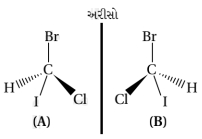
(N/A) Configuration: The spatial arrangement of functional groups (atoms) around a carbon atom is called the spatial configuration of that carbon.
Below are two spatial structures of the same compound $CHClBrI$.
The arrangement of groups (atoms) attached to the carbon in structure $(A)$ and structure $(B)$ is not the same. These structures $(A)$ and $(B)$ are mirror images of each other,which is called the reflection of a configuration.
The reflection of $(A)$ is $(B)$ and the reflection of $(B)$ is $(A)$. The configuration of carbon in structure $(A)$ is the reflection of the configuration of carbon in structure $(B)$. If $(A)$ and $(B)$ are different,then the optical activity of $(A)$ and $(B)$ is opposite,and their chirality is also opposite.
Below are two spatial structures of the same compound $CHClBrI$.
The arrangement of groups (atoms) attached to the carbon in structure $(A)$ and structure $(B)$ is not the same. These structures $(A)$ and $(B)$ are mirror images of each other,which is called the reflection of a configuration.
The reflection of $(A)$ is $(B)$ and the reflection of $(B)$ is $(A)$. The configuration of carbon in structure $(A)$ is the reflection of the configuration of carbon in structure $(B)$. If $(A)$ and $(B)$ are different,then the optical activity of $(A)$ and $(B)$ is opposite,and their chirality is also opposite.
0 likes
View Solution248
Medium
Explain or define the following terms:
$(i)$ Optical activity
$(ii)$ Polarimeter
$(iii)$ Dextrorotatory isomer
$(i)$ Optical activity
$(ii)$ Polarimeter
$(iii)$ Dextrorotatory isomer
Solution
(N/A) Optical activity: When ordinary light is passed through a Nicol prism,it produces plane-polarized light. When this plane-polarized light is passed through a solution of a compound in a polarimeter,if the compound rotates the plane of polarized light,it is called an optically active compound. They are denoted as $(+)$ or $(-)$.
Polarimeter: It is an instrument used to measure optical activity. The angle of rotation of plane-polarized light is measured using this instrument.
$Dextrorotatory$ $(d)$ or $(+)$ isomer: $A$ compound that rotates the plane of polarized light to the right,i.e.,in the clockwise direction,is called a dextrorotatory or $d$-form. This rotation is indicated by a $(+)$ sign before the angle of rotation.
Polarimeter: It is an instrument used to measure optical activity. The angle of rotation of plane-polarized light is measured using this instrument.
$Dextrorotatory$ $(d)$ or $(+)$ isomer: $A$ compound that rotates the plane of polarized light to the right,i.e.,in the clockwise direction,is called a dextrorotatory or $d$-form. This rotation is indicated by a $(+)$ sign before the angle of rotation.
0 likes
View Solution249
Medium
Explain/Define the following terms:
$(i)$ Laevorotatory isomer
$(ii)$ Optical isomers
$(i)$ Laevorotatory isomer
$(ii)$ Optical isomers
Solution
(N/A) $(i)$ Laevorotatory isomer:
$A$ compound is called laevorotatory $(l)$ or $(-)$ if its solution rotates the plane of plane-polarized light to the left (anticlockwise direction). The $l$-rotation is indicated by placing a $(-)$ sign before the value of the angle of rotation.
$(ii)$ Optical isomers:
The $(+)$ and $(-)$ isomers of a compound are known as optical isomers,and this phenomenon is called optical isomerism.
$A$ compound is called laevorotatory $(l)$ or $(-)$ if its solution rotates the plane of plane-polarized light to the left (anticlockwise direction). The $l$-rotation is indicated by placing a $(-)$ sign before the value of the angle of rotation.
$(ii)$ Optical isomers:
The $(+)$ and $(-)$ isomers of a compound are known as optical isomers,and this phenomenon is called optical isomerism.
0 likes
View Solution250
Medium
Describe the observation of optical activity made by Louis Pasteur.
Solution
(N/A) Louis Pasteur laid the foundation of modern stereochemistry in $1848$.
$(i)$ He observed that crystals of certain compounds exist as mirror images.
$(ii)$ He demonstrated that aqueous solutions of equal concentration of these two types of crystals show equal but opposite optical rotation.
$(iii)$ He believed that the difference in optical activity is related to the three-dimensional arrangement (configuration) of atoms in the crystals.
Note: Configuration refers to the three-dimensional arrangement of atoms around the carbon atom.
$(i)$ He observed that crystals of certain compounds exist as mirror images.
$(ii)$ He demonstrated that aqueous solutions of equal concentration of these two types of crystals show equal but opposite optical rotation.
$(iii)$ He believed that the difference in optical activity is related to the three-dimensional arrangement (configuration) of atoms in the crystals.
Note: Configuration refers to the three-dimensional arrangement of atoms around the carbon atom.
0 likes
View Solution8-2.Organic Chemistry : Isomerism — Optical isomerism · Frequently Asked Questions
1Are these 8-2.Organic Chemistry : Isomerism questions useful for JEE and NEET?
Yes. All questions in this section are mapped to JEE Main and NEET exam patterns. Previous year questions from JEE Main, NEET, GUJCET and state-level exams are included with full solutions.
2Can I switch to Hindi or Gujarati for these questions?
Yes. Use the language tabs in the hero section or the sidebar to view the same questions and solutions in English, Hindi or Gujarati.
3How do I generate a question paper from this subtopic?
Use the Vedclass Exam Paper Generator — select the chapter and subtopic, set difficulty, and generate Sets A, B, C, D automatically. First 3 chapters of every subject are free.
Vedclass Products
For Students
Vedclass Test Series
Mock tests in real JEE/NEET style with performance analysis. 5-day free trial.
Start Free TrialFor Teachers
Exam Paper Generator
Generate Set A/B/C/D papers from this chapter in 2 minutes. 3 chapters free.
Try FreeFor Institutes
Online Exam Module
Live online exams with unlimited students, 360° analytics & white-label branding.
See DemoFor Teachers & Institutes
Generate a 8-2.Organic Chemistry : Isomerism Exam Paper in 2 Minutes
Select subtopic & difficulty — Sets A, B, C, D auto-generated with No Repeat logic.
First 3 chapters of every subject are free — no payment required.