
A English
Optical isomerism Questions in English
Class 11 Chemistry · 8-2.Organic Chemistry : Isomerism · Optical isomerism
338+
Questions
English
Language
100%
With Solutions
Showing 50 of 338 questions in English
51
MediumMCQ
Which of the following molecules will be chiral?
A
$CH_3-CHCl_2$
B
$CH_3-CHBrCl$
C
$CD_2Cl_2$
D
$CH_2ClBr$
Solution
(B) molecule is chiral if it contains a carbon atom bonded to four different groups or atoms.
In $CH_3-CHBrCl$,the central carbon atom is bonded to $-H$,$-CH_3$,$-Br$,and $-Cl$.
Since all four groups are different,this carbon is chiral,making the molecule chiral.
In $CH_3-CHBrCl$,the central carbon atom is bonded to $-H$,$-CH_3$,$-Br$,and $-Cl$.
Since all four groups are different,this carbon is chiral,making the molecule chiral.
0 likes
View Solution52
EasyMCQ
$A$ compound has $3$ chiral carbon atoms. The number of possible optical isomers it can have is:
A
$3$
B
$2$
C
$8$
D
$4$
Solution
(C) The number of possible optical isomers for a compound with $n$ chiral carbon atoms is given by the formula $2^n$.
Given that the number of chiral carbon atoms $n = 3$.
Therefore,the number of optical isomers $= 2^3 = 8$.
Given that the number of chiral carbon atoms $n = 3$.
Therefore,the number of optical isomers $= 2^3 = 8$.
0 likes
View Solution53
MediumMCQ
How many chiral isomers can be drawn from $2-$bromo,$3-$chloro butane?
A
$2$
B
$3$
C
$4$
D
$5$
Solution
(C) $2-$bromo,$3-$chloro-butane has $2$ chiral carbon atoms at positions $2$ and $3$.
Since the molecule is unsymmetrical,the number of optical isomers is given by $2^n$,where $n$ is the number of chiral centers.
Here,$n = 2$,so the number of optical isomers is $2^2 = 4$.
The structure is $CH_3-CH(Br)-CH(Cl)-CH_3$.
Since the molecule is unsymmetrical,the number of optical isomers is given by $2^n$,where $n$ is the number of chiral centers.
Here,$n = 2$,so the number of optical isomers is $2^2 = 4$.
The structure is $CH_3-CH(Br)-CH(Cl)-CH_3$.
0 likes
View Solution54
AdvancedMCQ
The optically active tartaric acid is named as $D-(+)-$ tartaric acid because it has a positive
A
Optical rotation and is derived from $D-$ glucose
B
$pH$ in organic solvent
C
Optical rotation and is derived from $D-(+)$ glyceraldehyde
D
Optical rotation only when substituted by deuterium
Solution
(C) $D-(+)-$ tartaric acid is named based on its configuration relative to $D-(+)$ glyceraldehyde and its positive optical rotation.
0 likes
View Solution55
EasyMCQ
Which of the following compounds contains an asymmetric carbon atom?
A
$CH_3-CH_2-CH_2Br$
B
$CH_3-CH(Br)-CH(CH_3)-CH_3$
C
$CH_3-CH_2-CH(Br)-CH_3$
D
Both $(b)$ and $(c)$
Solution
(D) An asymmetric carbon atom is a carbon atom bonded to four different groups.
In option $(b)$,$CH_3-CH^*(Br)-CH(CH_3)-CH_3$,the carbon marked with $*$ is bonded to $-H$,$-Br$,$-CH_3$,and $-CH(CH_3)_2$. Since all four groups are different,it is asymmetric.
In option $(c)$,$CH_3-CH_2-CH^*(Br)-CH_3$,the carbon marked with $*$ is bonded to $-H$,$-Br$,$-CH_2CH_3$,and $-CH_3$. Since all four groups are different,it is asymmetric.
Therefore,both $(b)$ and $(c)$ contain an asymmetric carbon atom.
In option $(b)$,$CH_3-CH^*(Br)-CH(CH_3)-CH_3$,the carbon marked with $*$ is bonded to $-H$,$-Br$,$-CH_3$,and $-CH(CH_3)_2$. Since all four groups are different,it is asymmetric.
In option $(c)$,$CH_3-CH_2-CH^*(Br)-CH_3$,the carbon marked with $*$ is bonded to $-H$,$-Br$,$-CH_2CH_3$,and $-CH_3$. Since all four groups are different,it is asymmetric.
Therefore,both $(b)$ and $(c)$ contain an asymmetric carbon atom.
0 likes
View Solution56
MediumMCQ
How many carbon atoms in the molecule $HCOO-(CHOH)_2-COOH$ are asymmetric?
A
$1$
B
$2$
C
$3$
D
None of these
Solution
(B) The structure of the molecule is $HCOO-CH(OH)-CH(OH)-COOH$.
An asymmetric carbon atom (chiral center) is a carbon atom bonded to four different groups.
In the given molecule,the two central carbon atoms are each bonded to a hydrogen atom $(-H)$,a hydroxyl group $(-OH)$,a carboxylate/carboxylic acid group,and the other central carbon atom.
Since these two central carbon atoms are bonded to four distinct groups,they are both asymmetric.
Therefore,there are $2$ asymmetric carbon atoms in the molecule.
An asymmetric carbon atom (chiral center) is a carbon atom bonded to four different groups.
In the given molecule,the two central carbon atoms are each bonded to a hydrogen atom $(-H)$,a hydroxyl group $(-OH)$,a carboxylate/carboxylic acid group,and the other central carbon atom.
Since these two central carbon atoms are bonded to four distinct groups,they are both asymmetric.
Therefore,there are $2$ asymmetric carbon atoms in the molecule.
0 likes
View Solution57
EasyMCQ
The number of optical isomers of an organic compound having $n$ asymmetric carbon atoms will be
A
$2^{n + 1}$
B
$n^2$
C
$2^n$
D
$2^{n - 1}$
Solution
(C) The number of optical isomers for a compound with $n$ asymmetric carbon atoms (chiral centers) is given by the formula $2^n$,provided that the molecule does not possess any internal symmetry (i.e.,it is not a meso compound).
Thus,the correct option is $(C)$.
Thus,the correct option is $(C)$.
0 likes
View Solution58
MediumMCQ
Which of the following is optically active?
A
Ethylene glycol
B
Oxalic acid
C
Glycerol
D
Tartaric acid
Solution
(D) The correct answer is $(D)$.
An optically active compound must possess at least one chiral center and lack a plane of symmetry or center of inversion.
$(A)$ Ethylene glycol $(HO-CH_2-CH_2-OH)$ has no chiral carbon.
$(B)$ Oxalic acid $(HOOC-COOH)$ has no chiral carbon.
$(C)$ Glycerol $(HO-CH_2-CH(OH)-CH_2-OH)$ has no chiral carbon.
$(D)$ Tartaric acid $(HOOC-CH(OH)-CH(OH)-COOH)$ contains two chiral carbon atoms. While the meso-form is optically inactive due to internal compensation,the $d$- and $l$-isomers are optically active. Thus,tartaric acid is the only compound listed that can exhibit optical activity.
An optically active compound must possess at least one chiral center and lack a plane of symmetry or center of inversion.
$(A)$ Ethylene glycol $(HO-CH_2-CH_2-OH)$ has no chiral carbon.
$(B)$ Oxalic acid $(HOOC-COOH)$ has no chiral carbon.
$(C)$ Glycerol $(HO-CH_2-CH(OH)-CH_2-OH)$ has no chiral carbon.
$(D)$ Tartaric acid $(HOOC-CH(OH)-CH(OH)-COOH)$ contains two chiral carbon atoms. While the meso-form is optically inactive due to internal compensation,the $d$- and $l$-isomers are optically active. Thus,tartaric acid is the only compound listed that can exhibit optical activity.
0 likes
View Solution59
MediumMCQ
The lactic acid molecule has:
A
One chiral carbon atom
B
Two chiral carbon atoms
C
No chiral carbon atom
D
An asymmetric molecule
Solution
(A) The structure of lactic acid is $CH_3-CH(OH)-COOH$.
In this molecule,the central carbon atom is bonded to four different groups: $-H$,$-OH$,$-CH_3$,and $-COOH$.
Therefore,it contains one chiral (asymmetric) carbon atom,which is indicated by the asterisk $(*)$ in the structure.
Hence,option $(A)$ is correct.
In this molecule,the central carbon atom is bonded to four different groups: $-H$,$-OH$,$-CH_3$,and $-COOH$.
Therefore,it contains one chiral (asymmetric) carbon atom,which is indicated by the asterisk $(*)$ in the structure.
Hence,option $(A)$ is correct.
0 likes
View Solution60
EasyMCQ
Which of the following signs indicates that the sugar is actually 'dextrorotatory'?
A
$-$
B
$+$
C
$R-$
D
All of these
Solution
(B) dextrorotatory compound is one that rotates the plane of plane-polarized light to the right.
In chemical nomenclature,this property is indicated by the prefix $(+)-$,whereas a levorotatory compound is indicated by the prefix $(-)-$.
In chemical nomenclature,this property is indicated by the prefix $(+)-$,whereas a levorotatory compound is indicated by the prefix $(-)-$.
0 likes
View Solution61
EasyMCQ
What is a substance called that can rotate the plane of plane-polarized light?
A
Opaque
B
Amorphous
C
Optically active
D
Optically inactive
Solution
(C) substance that can rotate the plane of plane-polarized light is known as an $ \text{optically active} $ substance.
This property is known as $ \text{optical activity} $.
This property is known as $ \text{optical activity} $.
0 likes
View Solution62
EasyMCQ
What are the optical isomers called that are optically active but are not mirror images of each other?
A
Enantiomers
B
Diastereomers
C
Racemates
D
Mesomers
Solution
(B) Optical isomers that are not mirror images of each other are known as $Diastereomers$.
$Enantiomers$ are non-superimposable mirror images of each other.
$Racemates$ are equimolar mixtures of two enantiomers.
$Mesomers$ (or $Meso$ compounds) are optically inactive due to an internal plane of symmetry.
$Enantiomers$ are non-superimposable mirror images of each other.
$Racemates$ are equimolar mixtures of two enantiomers.
$Mesomers$ (or $Meso$ compounds) are optically inactive due to an internal plane of symmetry.
0 likes
View Solution63
EasyMCQ
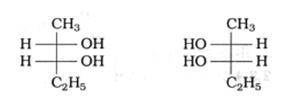
What is the relationship between the two given compounds?
A
Enantiomers
B
Diastereomers
C
Identical
D
None of these
Solution
(A) The given structures are Fischer projections of two chiral molecules.
Let's assign the configuration $(R/S)$ to the chiral centers.
For the first structure (left): The chiral centers are at $C_2$ and $C_3$.
At $C_2$: The priority order is $-OH > -CH(OH)C_2H_5 > -CH_3 > -H$. The configuration is $S$.
At $C_3$: The priority order is $-OH > -CH(OH)CH_3 > -C_2H_5 > -H$. The configuration is $S$.
For the second structure (right): The chiral centers are at $C_2$ and $C_3$.
At $C_2$: The configuration is $R$.
At $C_3$: The configuration is $R$.
Since the configurations are $(2S, 3S)$ and $(2R, 3R)$,they are non-superimposable mirror images of each other.
Therefore,they are enantiomers.
Let's assign the configuration $(R/S)$ to the chiral centers.
For the first structure (left): The chiral centers are at $C_2$ and $C_3$.
At $C_2$: The priority order is $-OH > -CH(OH)C_2H_5 > -CH_3 > -H$. The configuration is $S$.
At $C_3$: The priority order is $-OH > -CH(OH)CH_3 > -C_2H_5 > -H$. The configuration is $S$.
For the second structure (right): The chiral centers are at $C_2$ and $C_3$.
At $C_2$: The configuration is $R$.
At $C_3$: The configuration is $R$.
Since the configurations are $(2S, 3S)$ and $(2R, 3R)$,they are non-superimposable mirror images of each other.
Therefore,they are enantiomers.
0 likes
View Solution64
EasyMCQ
Which instrument is used to measure optical activity?
A
Polarimeter
B
Refractometer
C
Spectrograph
D
Tracer technique
Solution
(A) Optical activity is the ability of a chiral molecule to rotate the plane of plane-polarized light. The instrument used to measure the angle of rotation of plane-polarized light by an optically active substance is called a $Polarimeter$.
0 likes
View Solution65
MediumMCQ
Which of the following compounds will exhibit optical isomerism?
A
$CH(OH)(COOH)(H)$ (Glycolic acid derivative)
B
$CH_3-C(OH)(H)-COOH$ (Lactic acid)
C
$CH_3-C(CH_3)(H)-COOH$ (Isobutyric acid)
D
$CH_3-C(Cl)(CH_3)-COOH$ ($2$-chloro$-2-$methylpropanoic acid)
Solution
(B) compound exhibits optical isomerism if it contains a chiral center,which is a carbon atom bonded to four different groups.
In option $B$,the central carbon atom is bonded to $-H$,$-OH$,$-CH_3$,and $-COOH$ groups.
Since all four groups are different,the central carbon is chiral,and therefore,lactic acid exhibits optical isomerism.
In option $B$,the central carbon atom is bonded to $-H$,$-OH$,$-CH_3$,and $-COOH$ groups.
Since all four groups are different,the central carbon is chiral,and therefore,lactic acid exhibits optical isomerism.
0 likes
View Solution66
EasyMCQ
When does a given organic compound exhibit optical activity?
A
The four groups/atoms attached to the carbon are different.
B
The three groups/atoms attached to the carbon are different.
C
The two groups/atoms attached to the carbon are different.
D
The four groups/atoms attached to the carbon are identical.
Solution
(A) An organic compound exhibits optical activity when it contains a chiral center. $A$ chiral center is a carbon atom that is bonded to four different groups or atoms. This lack of symmetry allows the molecule to exist as non-superimposable mirror images,which rotate plane-polarized light.
0 likes
View Solution67
EasyMCQ
Which of the following are enantiomers?
A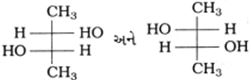
B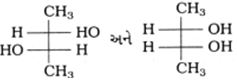
C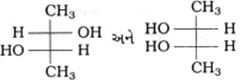
D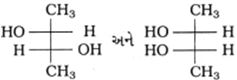
Solution
(A) Enantiomers are non-superimposable mirror images of each other.
In option $A$,the first structure is $(2S, 3S)-butane-2,3-diol$ and the second is $(2R, 3R)-butane-2,3-diol$.
These two structures are non-superimposable mirror images of each other,hence they are enantiomers.
In option $A$,the first structure is $(2S, 3S)-butane-2,3-diol$ and the second is $(2R, 3R)-butane-2,3-diol$.
These two structures are non-superimposable mirror images of each other,hence they are enantiomers.
0 likes
View Solution68
DifficultMCQ
Which of the following compounds is optically active?
A
$1-butanol$
B
$1-propanol$
C
$2-chlorobutane$
D
$4-hydroxyheptane$
Solution
(C) compound is optically active if it contains a chiral carbon atom (a carbon atom bonded to four different groups).
In $2-chlorobutane$ $(CH_3-CH(Cl)-CH_2-CH_3)$,the second carbon is attached to four different groups: $-H$,$-Cl$,$-CH_3$,and $-CH_2CH_3$.
Therefore,it is a chiral molecule and exhibits optical activity.
In $2-chlorobutane$ $(CH_3-CH(Cl)-CH_2-CH_3)$,the second carbon is attached to four different groups: $-H$,$-Cl$,$-CH_3$,and $-CH_2CH_3$.
Therefore,it is a chiral molecule and exhibits optical activity.
0 likes
View Solution69
DifficultMCQ
Which of the following molecules can rotate the plane of plane-polarized light?
A
Glyceraldehyde $(HOCH_2-CH(OH)-CHO)$
B
Glycine $(H_2N-CH_2-COOH)$
C
$1,2-$diphenyl$-1,2-$diaminoethane (meso form)
D
Butane$-2-$thiol $(CH_3-CH(SH)-CH_2-CH_3)$
Solution
(A) molecule can rotate the plane of plane-polarized light if it is chiral (optically active).
$1$. Glyceraldehyde $(HOCH_2-CH(OH)-CHO)$ has a chiral carbon atom bonded to four different groups $(-H, -OH, -CHO, -CH_2OH)$,making it optically active.
$2$. Glycine $(H_2N-CH_2-COOH)$ is achiral because the central carbon is bonded to two identical hydrogen atoms.
$3$. The meso form of $1,2-$diphenyl$-1,2-$diaminoethane has an internal plane of symmetry,making it optically inactive.
$4$. Butane$-2-$thiol $(CH_3-CH(SH)-CH_2-CH_3)$ has a chiral center at the $C-2$ position,but the question asks for the molecule that can rotate plane-polarized light. While butane$-2-$thiol is chiral,glyceraldehyde is the classic example of an optically active molecule in this context. However,both $A$ and $D$ are chiral. Re-evaluating the options provided,glyceraldehyde is a standard chiral molecule. Let's check the structures again. The structure in option $A$ is glyceraldehyde,which is chiral. The structure in option $D$ is butane$-2-$thiol,which is also chiral. Given standard textbook questions,glyceraldehyde is the intended answer.
$1$. Glyceraldehyde $(HOCH_2-CH(OH)-CHO)$ has a chiral carbon atom bonded to four different groups $(-H, -OH, -CHO, -CH_2OH)$,making it optically active.
$2$. Glycine $(H_2N-CH_2-COOH)$ is achiral because the central carbon is bonded to two identical hydrogen atoms.
$3$. The meso form of $1,2-$diphenyl$-1,2-$diaminoethane has an internal plane of symmetry,making it optically inactive.
$4$. Butane$-2-$thiol $(CH_3-CH(SH)-CH_2-CH_3)$ has a chiral center at the $C-2$ position,but the question asks for the molecule that can rotate plane-polarized light. While butane$-2-$thiol is chiral,glyceraldehyde is the classic example of an optically active molecule in this context. However,both $A$ and $D$ are chiral. Re-evaluating the options provided,glyceraldehyde is a standard chiral molecule. Let's check the structures again. The structure in option $A$ is glyceraldehyde,which is chiral. The structure in option $D$ is butane$-2-$thiol,which is also chiral. Given standard textbook questions,glyceraldehyde is the intended answer.
0 likes
View Solution70
EasyMCQ
When does an organic molecule exhibit optical activity?
A
When it contains a symmetric carbon atom.
B
When it is non-superimposable on its mirror image.
C
When it is superimposable on its mirror image.
D
When it is non-polar.
Solution
(B) An organic molecule exhibits optical activity if it is chiral. $A$ molecule is chiral if it is non-superimposable on its mirror image. This property is known as chirality,which is the fundamental requirement for a molecule to rotate the plane of plane-polarized light.
0 likes
View Solution71
MediumMCQ
Which of the following compounds is a meso compound?
A
$2-$Chlorobutane
B
$2,3-$Dichlorobutane
C
$2,3-$Dichloropentane
D
$2-$Hydroxypropanoic acid
Solution
(B) meso compound is an optically inactive molecule that contains two or more stereocenters but has an internal plane of symmetry.
In the case of $2,3-$dichlorobutane,the $(2R, 3S)$ isomer possesses an internal plane of symmetry,making it a meso compound.
In the case of $2,3-$dichlorobutane,the $(2R, 3S)$ isomer possesses an internal plane of symmetry,making it a meso compound.
0 likes
View Solution72
EasyMCQ
Which of the following compounds is optically inactive?
A
$CH_3 - CH = C = CH - CH_3$
B
$CH_2 = C = CH_2$
C
$Cl(Br)C = C = C(Cl)Br$
D
$Me(Et)C = C = C(Cl)Br$
Solution
(B) For an allene $(R_1R_2C = C = CR_3R_4)$ to be optically active,the groups attached to each terminal carbon must be different,i.e.,$R_1 \neq R_2$ and $R_3 \neq R_4$.
$(A)$ $CH_3 - CH = C = CH - CH_3$: Here,$R_1 = CH_3, R_2 = H$ and $R_3 = CH_3, R_4 = H$. Since $R_1 \neq R_2$ and $R_3 \neq R_4$,it is optically active.
$(B)$ $CH_2 = C = CH_2$: Here,$R_1 = R_2 = H$. Since the terminal carbons have identical groups,it possesses a plane of symmetry and is optically inactive.
$(C)$ $Cl(Br)C = C = C(Cl)Br$: Here,$R_1 = Cl, R_2 = Br$ and $R_3 = Cl, R_4 = Br$. Although the terminal carbons have different groups,the molecule has a plane of symmetry (the plane containing the central carbon and the substituents),making it optically inactive.
$(D)$ $Me(Et)C = C = C(Cl)Br$: Here,$R_1 = Me, R_2 = Et$ and $R_3 = Cl, R_4 = Br$. Since $R_1 \neq R_2$ and $R_3 \neq R_4$,it is optically active.
Note: In many standard contexts,$CH_2 = C = CH_2$ is the simplest example of an optically inactive allene. However,option $C$ is also optically inactive due to its symmetry. Given the typical nature of such questions,$B$ is the most fundamental answer.
$(A)$ $CH_3 - CH = C = CH - CH_3$: Here,$R_1 = CH_3, R_2 = H$ and $R_3 = CH_3, R_4 = H$. Since $R_1 \neq R_2$ and $R_3 \neq R_4$,it is optically active.
$(B)$ $CH_2 = C = CH_2$: Here,$R_1 = R_2 = H$. Since the terminal carbons have identical groups,it possesses a plane of symmetry and is optically inactive.
$(C)$ $Cl(Br)C = C = C(Cl)Br$: Here,$R_1 = Cl, R_2 = Br$ and $R_3 = Cl, R_4 = Br$. Although the terminal carbons have different groups,the molecule has a plane of symmetry (the plane containing the central carbon and the substituents),making it optically inactive.
$(D)$ $Me(Et)C = C = C(Cl)Br$: Here,$R_1 = Me, R_2 = Et$ and $R_3 = Cl, R_4 = Br$. Since $R_1 \neq R_2$ and $R_3 \neq R_4$,it is optically active.
Note: In many standard contexts,$CH_2 = C = CH_2$ is the simplest example of an optically inactive allene. However,option $C$ is also optically inactive due to its symmetry. Given the typical nature of such questions,$B$ is the most fundamental answer.
0 likes
View Solution73
EasyMCQ
What is necessary for an organic molecule to exhibit optical activity?
A
It contains asymmetric carbon atoms.
B
It is non-polar.
C
It is non-superimposable on its mirror image.
D
It is superimposable on its mirror image.
Solution
(C) For an organic molecule to exhibit optical activity,it must be chiral. $A$ chiral molecule is defined as one that is non-superimposable on its mirror image. While the presence of an asymmetric carbon atom (chiral center) often leads to chirality,it is not strictly necessary (e.g.,allenes or biphenyls can be chiral without a chiral center). Therefore,the fundamental requirement is that the molecule must be non-superimposable on its mirror image.
0 likes
View Solution74
EasyMCQ
What are the optical isomers called that are not mirror images of each other?
A
Enantiomers
B
Mesomers
C
Tautomers
D
Diastereomers
Solution
(D) Optical isomers that are not mirror images of each other are known as $Diastereomers$.
Enantiomers are non-superimposable mirror images of each other.
Since the question specifies isomers that are not mirror images,the correct term is $Diastereomers$.
Enantiomers are non-superimposable mirror images of each other.
Since the question specifies isomers that are not mirror images,the correct term is $Diastereomers$.
0 likes
View Solution75
EasyMCQ
How many optical isomers are possible for the compound $CH_3CHBrCHBrCOOH$?
A
$0$
B
$1$
C
$3$
D
$4$
Solution
(D) The number of optical isomers is given by the formula $2^n$,where $n$ is the number of chiral centers.
In the compound $CH_3CHBrCHBrCOOH$,there are $2$ chiral centers (the two carbon atoms attached to the bromine atoms).
Therefore,the number of optical isomers $= 2^2 = 4$.
In the compound $CH_3CHBrCHBrCOOH$,there are $2$ chiral centers (the two carbon atoms attached to the bromine atoms).
Therefore,the number of optical isomers $= 2^2 = 4$.
0 likes
View Solution76
MediumMCQ
Which of the following compounds is optically active?
A
$(CH_3)_2CHCH_2OH$
B
$CH_3CH_2OH$
C
$CCl_2F_2$
D
$CH_3CH(OH)C_2H_5$
Solution
(D) compound is optically active if it contains at least one chiral carbon atom (a carbon atom bonded to four different groups).
In $CH_3CH(OH)C_2H_5$ (butan$-2-$ol),the second carbon atom is bonded to four different groups: $-H$,$-OH$,$-CH_3$,and $-C_2H_5$.
Since it has a chiral center,it exhibits optical isomerism.
The structure is: $CH_3-CH^*(OH)-CH_2CH_3$.
In $CH_3CH(OH)C_2H_5$ (butan$-2-$ol),the second carbon atom is bonded to four different groups: $-H$,$-OH$,$-CH_3$,and $-C_2H_5$.
Since it has a chiral center,it exhibits optical isomerism.
The structure is: $CH_3-CH^*(OH)-CH_2CH_3$.
0 likes
View Solution77
MediumMCQ
Which of the following compounds is an optically active compound?
A
$n-$propanol
B
$2-$chlorobutane
C
$n-$butanol
D
$4-$hydroxyheptane
Solution
(B) compound is optically active if it contains at least one chiral carbon atom (a carbon atom bonded to four different groups).
In $2-$chlorobutane $(CH_3-CHCl-CH_2-CH_3)$,the second carbon atom is bonded to a hydrogen atom,a chlorine atom,a methyl group,and an ethyl group.
Since all four groups are different,the carbon is chiral,making the molecule optically active.
In $2-$chlorobutane $(CH_3-CHCl-CH_2-CH_3)$,the second carbon atom is bonded to a hydrogen atom,a chlorine atom,a methyl group,and an ethyl group.
Since all four groups are different,the carbon is chiral,making the molecule optically active.
0 likes
View Solution78
MediumMCQ
The optically active tartaric acid is named $D-(+)$ tartaric acid because it is related to $D-(+)$ glyceraldehyde in terms of:
A
Optical rotation and derived from $D$-glucose.
B
The $pH$ in organic solvents.
C
Optical rotation and derived from $D-(+)$-glyceraldehyde.
D
Optical rotation when displaced by deuterium.
0 likes
View Solution79
DifficultMCQ
What does the given structure represent?
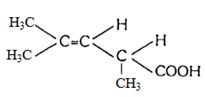
A
Geometric isomer
B
Optical isomer
C
Geometric and optical isomer
D
Tautomerism
Solution
(B) The given structure is $(CH_3)_2C=CH-CH(CH_3)COOH$ ($4$-methylpent$-3-$enoic acid).
$1$. Geometric isomerism: The molecule has a $C=C$ double bond. The carbon atom at position $3$ is bonded to two identical methyl groups $(CH_3)$. For geometric isomerism,each carbon of the double bond must be attached to two different groups. Since one carbon is attached to two identical groups,it does not exhibit geometric isomerism.
$2$. Optical isomerism: The molecule contains a chiral carbon atom at position $2$ (the carbon attached to $-H, -CH_3, -COOH$ and the $-CH=C(CH_3)_2$ group). Since it has a chiral center,it exhibits optical isomerism.
$1$. Geometric isomerism: The molecule has a $C=C$ double bond. The carbon atom at position $3$ is bonded to two identical methyl groups $(CH_3)$. For geometric isomerism,each carbon of the double bond must be attached to two different groups. Since one carbon is attached to two identical groups,it does not exhibit geometric isomerism.
$2$. Optical isomerism: The molecule contains a chiral carbon atom at position $2$ (the carbon attached to $-H, -CH_3, -COOH$ and the $-CH=C(CH_3)_2$ group). Since it has a chiral center,it exhibits optical isomerism.
0 likes
View Solution80
EasyMCQ
The given molecule has a chiral center. Determine its configuration.
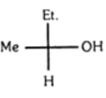
A
$R$
B
$S$
C
Both
D
None
Solution
(B) To determine the configuration ($R$ or $S$) of the chiral center,we assign priorities to the groups attached to the chiral carbon based on the Cahn-Ingold-Prelog $(CIP)$ rules:
$1$. $-OH$ group has the highest priority $(1)$.
$2$. $-Et$ $(-CH_2CH_3)$ group has priority $(2)$.
$3$. $-Me$ $(-CH_3)$ group has priority $(3)$.
$4$. $-H$ atom has the lowest priority $(4)$.
In the Fischer projection,the lowest priority group $(-H)$ is on the vertical line.
Tracing the path from priority $1$ $\rightarrow 2$ $\rightarrow 3$ gives a counter-clockwise direction.
Since the lowest priority group is on the vertical line,the counter-clockwise direction corresponds to the $S$ configuration.
$1$. $-OH$ group has the highest priority $(1)$.
$2$. $-Et$ $(-CH_2CH_3)$ group has priority $(2)$.
$3$. $-Me$ $(-CH_3)$ group has priority $(3)$.
$4$. $-H$ atom has the lowest priority $(4)$.
In the Fischer projection,the lowest priority group $(-H)$ is on the vertical line.
Tracing the path from priority $1$ $\rightarrow 2$ $\rightarrow 3$ gives a counter-clockwise direction.
Since the lowest priority group is on the vertical line,the counter-clockwise direction corresponds to the $S$ configuration.
0 likes
View Solution81
EasyMCQ
Which instrument is used to measure the rotation of plane-polarized light?
A
Manometer
B
Galvanometer
C
Polarimeter
D
Viscometer
Solution
(C) The instrument used to measure the angle of rotation of plane-polarized light by an optically active substance is called a $Polarimeter$.
0 likes
View Solution82
MediumMCQ
Which of the following compounds exhibits optical isomerism?
A
$CH_3CH_2COOH$
B
$CH_3CH(OH)COOH$
C
$CH_3CH_2CH_2OH$
D
$CH_3CH(OH)CH_3$
Solution
(B) compound exhibits optical isomerism if it contains at least one chiral carbon atom (a carbon atom bonded to four different groups).
In $CH_3CH(OH)COOH$ (lactic acid),the central carbon atom is bonded to $-H$,$-OH$,$-CH_3$,and $-COOH$ groups.
Since all four groups are different,this carbon is chiral,and the compound exhibits optical isomerism.
In $CH_3CH(OH)COOH$ (lactic acid),the central carbon atom is bonded to $-H$,$-OH$,$-CH_3$,and $-COOH$ groups.
Since all four groups are different,this carbon is chiral,and the compound exhibits optical isomerism.
0 likes
View Solution83
EasyMCQ
Which of the following molecules is optically active?
A
$C_6H_5-CO-OH$
B
$CH_3-CH(OH)-C_2H_5$
C
$C_6H_5-CH_2-OH$
D
$C_6H_5-CH(CH_3)-CH_3$
Solution
(B) molecule is optically active if it contains a chiral carbon atom,which is an $sp^3$ hybridized carbon atom bonded to four different groups.
In option $B$,the central carbon atom is bonded to $-H$,$-OH$,$-CH_3$,and $-C_2H_5$ groups.
Since all four groups are different,this carbon is chiral,making the molecule optically active.
In option $B$,the central carbon atom is bonded to $-H$,$-OH$,$-CH_3$,and $-C_2H_5$ groups.
Since all four groups are different,this carbon is chiral,making the molecule optically active.
0 likes
View Solution84
MediumMCQ
What is the total number of stereoisomers for $2, 3-$dibromobutane?
A
$2$
B
$3$
C
$4$
D
$5$
Solution
(B) The structure of $2, 3-$dibromobutane is $CH_3-CH(Br)-CH(Br)-CH_3$.
It contains $n = 2$ chiral centers.
Since the molecule is symmetrical,the number of stereoisomers is calculated using the formula $2^{n-1} + 2^{(n/2)-1}$.
Substituting $n = 2$: $2^{2-1} + 2^{(2/2)-1} = 2^1 + 2^0 = 2 + 1 = 3$.
The three stereoisomers are: one pair of enantiomers ($d$ and $l$ forms) and one meso compound.
It contains $n = 2$ chiral centers.
Since the molecule is symmetrical,the number of stereoisomers is calculated using the formula $2^{n-1} + 2^{(n/2)-1}$.
Substituting $n = 2$: $2^{2-1} + 2^{(2/2)-1} = 2^1 + 2^0 = 2 + 1 = 3$.
The three stereoisomers are: one pair of enantiomers ($d$ and $l$ forms) and one meso compound.
0 likes
View Solution85
EasyMCQ
In which property do $d$ and $l$ isomers differ?
A
Rotation of $PPL$
B
Solubility in achiral solvents
C
Chemical properties
D
Dipole moment
Solution
(A) (dextrorotatory) and $l$ (laevorotatory) isomers are enantiomers of each other.
Enantiomers have identical physical properties (like melting point,boiling point,solubility in achiral solvents,and dipole moment) and identical chemical properties in an achiral environment.
However,they differ in their interaction with plane-polarized light $(PPL)$.
$d$-isomers rotate $PPL$ to the right (clockwise),while $l$-isomers rotate $PPL$ to the left (anticlockwise) by the same magnitude.
Enantiomers have identical physical properties (like melting point,boiling point,solubility in achiral solvents,and dipole moment) and identical chemical properties in an achiral environment.
However,they differ in their interaction with plane-polarized light $(PPL)$.
$d$-isomers rotate $PPL$ to the right (clockwise),while $l$-isomers rotate $PPL$ to the left (anticlockwise) by the same magnitude.
0 likes
View Solution86
EasyMCQ
What is the process of separating a racemic mixture into pure $(+)$ and $(-)$ enantiomers called?
A
Mutarotation
B
Epimerization
C
Asymmetric synthesis
D
Resolution
Solution
(D) The process of separating a racemic mixture (a $1:1$ mixture of enantiomers) into its individual pure $(+)$ and $(-)$ enantiomers is known as resolution.
Mutarotation refers to the change in optical rotation of a solution due to the change in equilibrium between two anomers.
Epimerization is the process of converting one epimer into its chiral counterpart.
Asymmetric synthesis is a reaction that creates a new chiral center in a molecule in a way that favors one enantiomer over the other.
Mutarotation refers to the change in optical rotation of a solution due to the change in equilibrium between two anomers.
Epimerization is the process of converting one epimer into its chiral counterpart.
Asymmetric synthesis is a reaction that creates a new chiral center in a molecule in a way that favors one enantiomer over the other.
0 likes
View Solution87
EasyMCQ
How many meso isomers are possible for $2, 3, 4-\text{pentanetriol}$?
A
$1$
B
$2$
C
$3$
D
None
Solution
(B) The structure of $2, 3, 4-\text{pentanetriol}$ is $CH_3-CH(OH)-CH(OH)-CH(OH)-CH_3$.
This molecule has $3$ chiral centers at $C_2, C_3,$ and $C_4$.
The molecule is symmetric because the groups attached to $C_2$ and $C_4$ are identical ($-CH_3$ and $-OH$).
For a symmetric molecule with $n$ chiral centers,the number of meso isomers is calculated as follows:
If $n$ is odd,the number of meso isomers is $2^{(n-1)/2}$.
Here,$n = 3$,so the number of meso isomers $= 2^{(3-1)/2} = 2^1 = 2$.
The two meso isomers are the $(2R, 3s, 4S)$ and $(2S, 3s, 4R)$ configurations (where $s$ denotes the pseudo-asymmetric center).
This molecule has $3$ chiral centers at $C_2, C_3,$ and $C_4$.
The molecule is symmetric because the groups attached to $C_2$ and $C_4$ are identical ($-CH_3$ and $-OH$).
For a symmetric molecule with $n$ chiral centers,the number of meso isomers is calculated as follows:
If $n$ is odd,the number of meso isomers is $2^{(n-1)/2}$.
Here,$n = 3$,so the number of meso isomers $= 2^{(3-1)/2} = 2^1 = 2$.
The two meso isomers are the $(2R, 3s, 4S)$ and $(2S, 3s, 4R)$ configurations (where $s$ denotes the pseudo-asymmetric center).
0 likes
View Solution88
EasyMCQ
$A$ racemic mixture is formed by mixing which of the following?
A
Isomeric substances
B
Chiral substances
C
Meso substances
D
Enantiomers
Solution
(D) racemic mixture is an equimolar mixture of two enantiomers. Enantiomers are non-superimposable mirror images of each other.
0 likes
View Solution89
MediumMCQ
How many stereoisomers does butane-$2,3$-diol have?
A
$1$
B
$2$
C
$3$
D
$4$
Solution
(C) The structure of butane-$2,3$-diol is $CH_3-CH(OH)-CH(OH)-CH_3$.
This molecule has two chiral centers $(n=2)$ and a plane of symmetry.
The number of stereoisomers is calculated as follows:
Total stereoisomers = $2^{n-1} + 2^{(n/2)-1} = 2^{2-1} + 2^{(2/2)-1} = 2^1 + 2^0 = 2 + 1 = 3$.
These $3$ stereoisomers consist of one pair of enantiomers and one meso compound.
Out of these,only $2$ are optically active (the enantiomeric pair).
This molecule has two chiral centers $(n=2)$ and a plane of symmetry.
The number of stereoisomers is calculated as follows:
Total stereoisomers = $2^{n-1} + 2^{(n/2)-1} = 2^{2-1} + 2^{(2/2)-1} = 2^1 + 2^0 = 2 + 1 = 3$.
These $3$ stereoisomers consist of one pair of enantiomers and one meso compound.
Out of these,only $2$ are optically active (the enantiomeric pair).
0 likes
View Solution90
MediumMCQ
What is the total number of optical isomers for $CH_2OH(CHOH)_3CHO$?
A
$2$
B
$4$
C
$8$
D
$12$
Solution
(C) The given molecule is an aldotetrose (specifically,an aldohexose derivative with $3$ chiral centers).
The number of chiral centers $(n)$ is $3$.
The total number of optical isomers is given by the formula $2^n$.
Therefore,$2^3 = 8$.
The number of chiral centers $(n)$ is $3$.
The total number of optical isomers is given by the formula $2^n$.
Therefore,$2^3 = 8$.
0 likes
View Solution91
EasyMCQ
What is the process of conversion of a pure optical enantiomer into an optically inactive mixture of $(+)$ and $(-)$ enantiomers called?
A
Mutarotation
B
Isomerization
C
Epimerization
D
Racemization
Solution
(D) The process of converting an optically active enantiomer into a racemic mixture (an equimolar mixture of $(+)$ and $(-)$ enantiomers) is known as $Racemization$.
Since the resulting mixture contains equal amounts of both enantiomers,the optical rotations cancel each other out,making the mixture optically inactive.
Since the resulting mixture contains equal amounts of both enantiomers,the optical rotations cancel each other out,making the mixture optically inactive.
0 likes
View Solution92
EasyMCQ
$(+) -$ Tartaric acid and meso-tartaric acid are ........
A
Enantiomers
B
Diastereomers
C
Geometrical isomers
D
None of these
Solution
(B) $(+) -$ Tartaric acid is an optically active isomer,while meso-tartaric acid is an optically inactive isomer due to the presence of a plane of symmetry.
Since they are stereoisomers that are not mirror images of each other,they are classified as diastereomers.
Since they are stereoisomers that are not mirror images of each other,they are classified as diastereomers.
0 likes
View Solution93
EasyMCQ
Enantiomers cannot be distinguished by which of the following?
A
Tests
B
Melting points
C
Odour
D
Medicinal properties
0 likes
View Solution94
DifficultMCQ
Which of the following compounds is an optically active substance with a low molecular weight?
A
$CH_3 - CH_2 - C \equiv CH$
B
$CH_3 - CH_2 - CH(CH_3) - CH_3$
C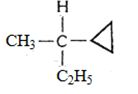
D
$CH_3 - CH_2 - CH_2 - CH_3$
Solution
(C) molecule is optically active if it contains a chiral center,which is a carbon atom bonded to four different groups.
Option $A$: $CH_3 - CH_2 - C \equiv CH$ ($1$-butyne) has no chiral center.
Option $B$: $CH_3 - CH_2 - CH(CH_3) - CH_3$ ($2$-methylbutane) has no chiral center.
Option $C$: The structure is $1$-cyclopropyl$-1-$ethanol derivative or similar,specifically $1$-cyclopropylethane. The central carbon is bonded to $H$,$CH_3$,$C_2H_5$,and a cyclopropyl group. Since all four groups are different,the carbon is chiral,making the molecule optically active.
Option $D$: $CH_3 - CH_2 - CH_2 - CH_3$ (n-butane) has no chiral center.
Therefore,the correct option is $C$.
Option $A$: $CH_3 - CH_2 - C \equiv CH$ ($1$-butyne) has no chiral center.
Option $B$: $CH_3 - CH_2 - CH(CH_3) - CH_3$ ($2$-methylbutane) has no chiral center.
Option $C$: The structure is $1$-cyclopropyl$-1-$ethanol derivative or similar,specifically $1$-cyclopropylethane. The central carbon is bonded to $H$,$CH_3$,$C_2H_5$,and a cyclopropyl group. Since all four groups are different,the carbon is chiral,making the molecule optically active.
Option $D$: $CH_3 - CH_2 - CH_2 - CH_3$ (n-butane) has no chiral center.
Therefore,the correct option is $C$.
0 likes
View Solution95
MediumMCQ
When can a molecule be called chiral?
A
It is superimposable on its mirror image.
B
It is non-superimposable on its mirror image.
C
It contains stereogenic centers.
D
It has different configurations.
Solution
(B) molecule is defined as chiral if it lacks an internal plane of symmetry or center of inversion,making it non-superimposable on its mirror image. This property is the fundamental requirement for optical activity.
0 likes
View Solution96
EasyMCQ
Why is $Meso-tartaric$ acid optically inactive?
A
Molecular symmetry
B
Molecular asymmetry
C
External compensation
D
Presence of two asymmetric carbon atoms
Solution
(A) $Meso-tartaric$ acid contains two chiral carbon atoms,but the molecule possesses a plane of symmetry (internal compensation).
Due to this internal plane of symmetry,the optical rotation caused by one half of the molecule is cancelled by the other half.
Therefore,the molecule as a whole is optically inactive.
Due to this internal plane of symmetry,the optical rotation caused by one half of the molecule is cancelled by the other half.
Therefore,the molecule as a whole is optically inactive.
0 likes
View Solution97
EasyMCQ
$A$ compound contains $3$ chiral carbons. What is the number of possible optical isomers for this compound?
A
$3$
B
$2$
C
$4$
D
$8$
Solution
(D) The number of optical isomers for a compound with $n$ chiral carbons is given by the formula $2^n$,provided the molecule is unsymmetrical.
Given $n = 3$,the number of optical isomers is $2^3 = 8$.
Therefore,the correct option is $D$.
Given $n = 3$,the number of optical isomers is $2^3 = 8$.
Therefore,the correct option is $D$.
0 likes
View Solution98
EasyMCQ
What is the absolute configuration of the given molecule?
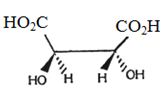
A
$S, S$
B
$R, R$
C
$R, S$
D
$S, R$
Solution
(B) To determine the absolute configuration,we assign priorities to the groups attached to each chiral center using Cahn-Ingold-Prelog $(CIP)$ rules.
For the left chiral carbon: The priorities are $1: -OH$,$2: -COOH$,$3: -CH(OH)COOH$,$4: -H$.
Since the lowest priority group $(-H)$ is on a dashed bond,we trace $1$ $\rightarrow 2$ $\rightarrow 3$. The direction is clockwise,so the configuration is $R$.
For the right chiral carbon: The priorities are $1: -OH$,$2: -COOH$,$3: -CH(OH)COOH$,$4: -H$.
Since the lowest priority group $(-H)$ is on a wedged bond,we trace $1$ $\rightarrow 2$ $\rightarrow 3$. The direction is counter-clockwise,which would be $S$,but since the lowest priority group is on a wedge,we reverse it to $R$.
Thus,the configuration is $R, R$.
For the left chiral carbon: The priorities are $1: -OH$,$2: -COOH$,$3: -CH(OH)COOH$,$4: -H$.
Since the lowest priority group $(-H)$ is on a dashed bond,we trace $1$ $\rightarrow 2$ $\rightarrow 3$. The direction is clockwise,so the configuration is $R$.
For the right chiral carbon: The priorities are $1: -OH$,$2: -COOH$,$3: -CH(OH)COOH$,$4: -H$.
Since the lowest priority group $(-H)$ is on a wedged bond,we trace $1$ $\rightarrow 2$ $\rightarrow 3$. The direction is counter-clockwise,which would be $S$,but since the lowest priority group is on a wedge,we reverse it to $R$.
Thus,the configuration is $R, R$.
0 likes
View Solution99
MediumMCQ
Which of the following compounds exhibits optical isomerism?
A
$2$-methylbut$-1$-ene
B
$3$-methylbut$-1$-ene
C
$3$-methylbutanoic acid
D
$2$-methylbutanoic acid
Solution
(D) For a compound to exhibit optical isomerism,it must contain at least one chiral carbon atom (a carbon atom bonded to four different groups).
$1$. $2$-methylbut$-1$-ene: $CH_2=C(CH_3)CH_2CH_3$. No chiral carbon.
$2$. $3$-methylbut$-1$-ene: $CH_2=CHCH(CH_3)CH_3$. No chiral carbon.
$3$. $3$-methylbutanoic acid: $(CH_3)_2CHCH_2COOH$. No chiral carbon.
$4$. $2$-methylbutanoic acid: $CH_3CH_2CH(CH_3)COOH$. The carbon at position $2$ is bonded to $-H$,$-CH_3$,$-CH_2CH_3$,and $-COOH$ groups. Since all four groups are different,this carbon is chiral. Thus,it exhibits optical isomerism.
$1$. $2$-methylbut$-1$-ene: $CH_2=C(CH_3)CH_2CH_3$. No chiral carbon.
$2$. $3$-methylbut$-1$-ene: $CH_2=CHCH(CH_3)CH_3$. No chiral carbon.
$3$. $3$-methylbutanoic acid: $(CH_3)_2CHCH_2COOH$. No chiral carbon.
$4$. $2$-methylbutanoic acid: $CH_3CH_2CH(CH_3)COOH$. The carbon at position $2$ is bonded to $-H$,$-CH_3$,$-CH_2CH_3$,and $-COOH$ groups. Since all four groups are different,this carbon is chiral. Thus,it exhibits optical isomerism.
0 likes
View Solution100
MediumMCQ
Which of the following isomers of $C_7H_{16}$ exhibits optical isomerism?
A
$2,3-$Dimethylpentane
B
$2,2-$Dimethylbutane
C
$2-$Methylhexane
D
None of these
Solution
(A) Optical isomerism requires the presence of a chiral carbon atom (a carbon atom bonded to four different groups).
In $2,3-$dimethylpentane,the carbon at position $3$ is bonded to a hydrogen atom,a methyl group,an ethyl group,and an isopropyl group.
Since all four groups attached to the $C-3$ carbon are different,it is a chiral center.
Therefore,$2,3-$dimethylpentane exhibits optical isomerism.
In $2,3-$dimethylpentane,the carbon at position $3$ is bonded to a hydrogen atom,a methyl group,an ethyl group,and an isopropyl group.
Since all four groups attached to the $C-3$ carbon are different,it is a chiral center.
Therefore,$2,3-$dimethylpentane exhibits optical isomerism.
0 likes
View Solution8-2.Organic Chemistry : Isomerism — Optical isomerism · Frequently Asked Questions
1Are these 8-2.Organic Chemistry : Isomerism questions useful for JEE and NEET?
Yes. All questions in this section are mapped to JEE Main and NEET exam patterns. Previous year questions from JEE Main, NEET, GUJCET and state-level exams are included with full solutions.
2Can I switch to Hindi or Gujarati for these questions?
Yes. Use the language tabs in the hero section or the sidebar to view the same questions and solutions in English, Hindi or Gujarati.
3How do I generate a question paper from this subtopic?
Use the Vedclass Exam Paper Generator — select the chapter and subtopic, set difficulty, and generate Sets A, B, C, D automatically. First 3 chapters of every subject are free.
Vedclass Products
For Students
Vedclass Test Series
Mock tests in real JEE/NEET style with performance analysis. 5-day free trial.
Start Free TrialFor Teachers
Exam Paper Generator
Generate Set A/B/C/D papers from this chapter in 2 minutes. 3 chapters free.
Try FreeFor Institutes
Online Exam Module
Live online exams with unlimited students, 360° analytics & white-label branding.
See DemoFor Teachers & Institutes
Generate a 8-2.Organic Chemistry : Isomerism Exam Paper in 2 Minutes
Select subtopic & difficulty — Sets A, B, C, D auto-generated with No Repeat logic.
First 3 chapters of every subject are free — no payment required.