
A English
Acids and Bases Questions in English
Class 11 Chemistry · 6-2.Equilibrium-II (Ionic Equilibrium) · Acids and Bases
477+
Questions
English
Language
100%
With Solutions
Showing 50 of 477 questions in English
351
Easy
What do you understand by the term 'auto-protolysis' of water? What is its significance?
Solution
(N/A) Auto-protolysis refers to the self-ionization of water,where water molecules react with each other to form ions.
It is represented by the equation:
$H_2O_{(l)} + H_2O_{(l)} \rightleftharpoons H_3O^{+}_{(aq)} + OH^{-}_{(aq)}$
Significance:
Due to auto-protolysis,water exhibits amphoteric nature,meaning it can act as both an acid and a base.
It acts as a base when reacting with acids stronger than itself and as an acid when reacting with bases stronger than itself.
Examples:
$1$. As an acid: $H_2O_{(l)} + NH_{3(aq)} \longrightarrow NH_{4(aq)}^{+} + OH^{-}_{(aq)}$
$2$. As a base: $H_2O_{(l)} + H_2S_{(aq)} \longrightarrow H_3O^{+}_{(aq)} + HS^{-}_{(aq)}$
It is represented by the equation:
$H_2O_{(l)} + H_2O_{(l)} \rightleftharpoons H_3O^{+}_{(aq)} + OH^{-}_{(aq)}$
Significance:
Due to auto-protolysis,water exhibits amphoteric nature,meaning it can act as both an acid and a base.
It acts as a base when reacting with acids stronger than itself and as an acid when reacting with bases stronger than itself.
Examples:
$1$. As an acid: $H_2O_{(l)} + NH_{3(aq)} \longrightarrow NH_{4(aq)}^{+} + OH^{-}_{(aq)}$
$2$. As a base: $H_2O_{(l)} + H_2S_{(aq)} \longrightarrow H_3O^{+}_{(aq)} + HS^{-}_{(aq)}$
0 likes
View Solution352
EasyMCQ
What is the nature of an aqueous solution of ammonia?
A
Acidic
B
Basic
C
Amphoteric
D
Neutral
Solution
(B) Ammonia $(NH_3)$ reacts with water to form ammonium hydroxide $(NH_4OH)$,which dissociates to provide hydroxide ions $(OH^-)$ in the solution.
$NH_3(aq) + H_2O(l) \rightleftharpoons NH_4^+(aq) + OH^-(aq)$
Due to the presence of $OH^-$ ions,the aqueous solution of ammonia is basic in nature.
$NH_3(aq) + H_2O(l) \rightleftharpoons NH_4^+(aq) + OH^-(aq)$
Due to the presence of $OH^-$ ions,the aqueous solution of ammonia is basic in nature.
0 likes
View Solution353
Difficult
Give the classification of acids on the basis of $pK_{a}$ value.
Solution
(N/A) The strength of an acid is inversely proportional to its $pK_{a}$ value,meaning a smaller $pK_{a}$ indicates a stronger acid.
$1$. Strong acids: $pK_{a} < 1$.
$2$. Moderately strong acids: $1 < pK_{a} < 5$.
$3$. Weak acids: $5 < pK_{a} < 15$.
$4$. Extremely weak acids: $pK_{a} > 15$.
$1$. Strong acids: $pK_{a} < 1$.
$2$. Moderately strong acids: $1 < pK_{a} < 5$.
$3$. Weak acids: $5 < pK_{a} < 15$.
$4$. Extremely weak acids: $pK_{a} > 15$.
0 likes
View Solution354
Medium
Between sodium hydrogencarbonate and magnesium hydroxide,which is a better antacid and why?
Solution
(N/A) Magnesium hydroxide,$Mg(OH)_{2}$,is a better antacid than sodium hydrogencarbonate,$NaHCO_{3}$.
Magnesium hydroxide is insoluble in water,so it does not cause the $pH$ of the stomach to rise above neutrality,preventing the stimulation of further acid production.
In contrast,sodium hydrogencarbonate is soluble in water. An excess of it can make the stomach environment alkaline,which triggers the stomach to produce even more acid,potentially worsening the condition.
Magnesium hydroxide is insoluble in water,so it does not cause the $pH$ of the stomach to rise above neutrality,preventing the stimulation of further acid production.
In contrast,sodium hydrogencarbonate is soluble in water. An excess of it can make the stomach environment alkaline,which triggers the stomach to produce even more acid,potentially worsening the condition.
0 likes
View Solution355
EasyMCQ
What is the aqueous solution of $HCl$ known as?
A
Hydrochloric acid
B
Chloric acid
C
Hypochlorous acid
D
Perchloric acid
Solution
(A) The aqueous solution of hydrogen chloride $(HCl)$ gas is known as $Hydrochloric \ acid$.
0 likes
View Solution356
MediumMCQ
Which type of reaction occurs between $H_{2}SO_{4}$ and $HNO_{3}$ in nitration?
A
Oxidation-reduction
B
Acid-base
C
Substitution
D
Addition
Solution
(B) The reaction between $H_{2}SO_{4}$ and $HNO_{3}$ is an acid-base reaction.
In this process,$H_{2}SO_{4}$ acts as a strong acid (proton donor) and $HNO_{3}$ acts as a base (proton acceptor).
The reaction is: $HNO_{3} + H_{2}SO_{4} \rightleftharpoons H_{2}NO_{3}^{+} + HSO_{4}^{-} \rightleftharpoons NO_{2}^{+} + H_{3}O^{+} + HSO_{4}^{-}$.
In this process,$H_{2}SO_{4}$ acts as a strong acid (proton donor) and $HNO_{3}$ acts as a base (proton acceptor).
The reaction is: $HNO_{3} + H_{2}SO_{4} \rightleftharpoons H_{2}NO_{3}^{+} + HSO_{4}^{-} \rightleftharpoons NO_{2}^{+} + H_{3}O^{+} + HSO_{4}^{-}$.
0 likes
View Solution357
Difficult
Provide one example each of an acid,a base,and a salt that are available in nature.
Solution
(N/A) Acids from nature: $(i)$ Hydrochloric acid $(HCl)$ is present in gastric juice,which is secreted by the stomach lining and is essential for digestion. $(ii)$ Citric acid is found in lemon and orange juices. $(iii)$ Tartaric acid is found in tamarind paste.
Bases from nature: $A$ common example is magnesium hydroxide $(Mg(OH)_2)$,often used as an antacid. Bases generally turn red litmus paper blue,have a bitter taste,and feel soapy to the touch.
Salts from nature: $A$ common example is sodium chloride $(NaCl)$,also known as common salt. It is an essential component of our diet and is formed by the neutralization reaction between hydrochloric acid $(HCl)$ and sodium hydroxide $(NaOH)$.
Bases from nature: $A$ common example is magnesium hydroxide $(Mg(OH)_2)$,often used as an antacid. Bases generally turn red litmus paper blue,have a bitter taste,and feel soapy to the touch.
Salts from nature: $A$ common example is sodium chloride $(NaCl)$,also known as common salt. It is an essential component of our diet and is formed by the neutralization reaction between hydrochloric acid $(HCl)$ and sodium hydroxide $(NaOH)$.
0 likes
View Solution358
Advanced
Explain the Arrhenius concept of acids and bases.
Solution
(N/A) Definition: According to the Arrhenius theory,acids are substances that dissociate in water to give hydrogen ions $(H_{(aq)}^{+})$. According to the Arrhenius theory,bases are substances that produce hydroxyl ions $(OH_{(aq)}^{-})$.
General formula for an acid is $HX$ and for a base is $MOH$.
Ionization of acid $HX$ in aqueous solution:
$HX_{(aq)} \longrightarrow H_{(aq)}^{+} + X_{(aq)}^{-}$
$OR$
$HX_{(aq)} + H_{2}O_{(l)} \longrightarrow H_{3}O_{(aq)}^{+} + X_{(aq)}^{-}$
Note: $A$ bare proton $H^{+}$ is very reactive and cannot exist freely in aqueous solutions. Thus,it bonds to the oxygen atom of a water molecule to form a hydronium ion $(H_{3}O^{+})$.
$H_{(aq)}^{+} + H_{2}O_{(l)} \longrightarrow H_{3}O_{(aq)}^{+}$
Ionization of base $MOH$ in aqueous solution:
$MOH_{(aq)} \longrightarrow M_{(aq)}^{+} + OH_{(aq)}^{-}$
Limitations of the Arrhenius concept:
$(i)$ It is applicable only to aqueous solutions.
$(ii)$ It does not account for the basicity of substances like ammonia $(NH_{3})$ which do not possess a hydroxyl group.
$(iii)$ It does not explain the stability of the $H^{+}$ ion.
General formula for an acid is $HX$ and for a base is $MOH$.
Ionization of acid $HX$ in aqueous solution:
$HX_{(aq)} \longrightarrow H_{(aq)}^{+} + X_{(aq)}^{-}$
$OR$
$HX_{(aq)} + H_{2}O_{(l)} \longrightarrow H_{3}O_{(aq)}^{+} + X_{(aq)}^{-}$
Note: $A$ bare proton $H^{+}$ is very reactive and cannot exist freely in aqueous solutions. Thus,it bonds to the oxygen atom of a water molecule to form a hydronium ion $(H_{3}O^{+})$.
$H_{(aq)}^{+} + H_{2}O_{(l)} \longrightarrow H_{3}O_{(aq)}^{+}$
Ionization of base $MOH$ in aqueous solution:
$MOH_{(aq)} \longrightarrow M_{(aq)}^{+} + OH_{(aq)}^{-}$
Limitations of the Arrhenius concept:
$(i)$ It is applicable only to aqueous solutions.
$(ii)$ It does not account for the basicity of substances like ammonia $(NH_{3})$ which do not possess a hydroxyl group.
$(iii)$ It does not explain the stability of the $H^{+}$ ion.
0 likes
View Solution359
Advanced
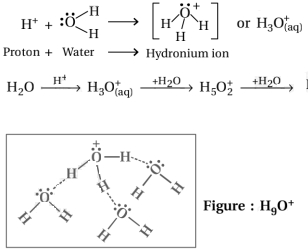
Explain the existence of hydronium ion in aqueous solution.
Solution
(N/A) hydrogen ion $(H^{+})$ by itself is a bare proton with a very small size (radius $\approx 10^{-15} \ m$) and an intense electric field.
Therefore,the proton binds itself to a water molecule at one of the two available lone pairs on the oxygen atom via a coordinate covalent bond,forming the hydronium ion $(H_{3}O^{+})$.
This hydronium ion $(H_{3}O^{+})$ species has a trigonal pyramidal geometry. The existence of $H_{3}O^{+}$ has been detected in many compounds,such as $H_{3}O^{+}Cl^{-}$ in the solid state.
Furthermore,the hydronium ion can be further hydrated to form various ionic species such as $H_{5}O_{2}^{+}$,$H_{7}O_{3}^{+}$,$H_{9}O_{4}^{+}$,etc.
Thus,a proton does not exist independently in an aqueous solution; instead,it exists as a hydronium ion or oxonium ion.
Therefore,the proton binds itself to a water molecule at one of the two available lone pairs on the oxygen atom via a coordinate covalent bond,forming the hydronium ion $(H_{3}O^{+})$.
This hydronium ion $(H_{3}O^{+})$ species has a trigonal pyramidal geometry. The existence of $H_{3}O^{+}$ has been detected in many compounds,such as $H_{3}O^{+}Cl^{-}$ in the solid state.
Furthermore,the hydronium ion can be further hydrated to form various ionic species such as $H_{5}O_{2}^{+}$,$H_{7}O_{3}^{+}$,$H_{9}O_{4}^{+}$,etc.
Thus,a proton does not exist independently in an aqueous solution; instead,it exists as a hydronium ion or oxonium ion.
0 likes
View Solution360
Difficult
Explain the Bronsted-Lowry theory for acids and bases.
Solution
(N/A) The Danish chemist,Johannes Bronsted and the English chemist,Thomas $M$. Lowry provided a more general definition of acids and bases.
Definition: According to the Bronsted-Lowry theory,an acid is a substance capable of donating a hydrogen ion $(H^{+})$ and a base is a substance capable of accepting a hydrogen ion $(H^{+})$. In short,acids are proton donors and bases are proton acceptors.
Example $1$: Consider the dissolution of $NH_{3}$ in $H_{2}O$ represented by the following equation:
$NH_{3(aq)} + H_{2}O_{(l)} \rightleftharpoons NH_{4(aq)}^{+} + OH_{(aq)}^{-}$
In this reaction,the water molecule acts as a proton donor (acid) and the ammonia molecule acts as a proton acceptor (base). In the reverse reaction,$H^{+}$ is transferred from $NH_{4}^{+}$ to $OH^{-}$. Here,$NH_{4}^{+}$ acts as a Bronsted acid and $OH^{-}$ acts as a Bronsted base.
Conjugate Acid-Base Pair: An acid-base pair that differs only by one proton is called a 'conjugate acid-base pair'.
$(i)$ $NH_{4}^{+}$ and $NH_{3}$
$(ii)$ $H_{2}O$ and $OH^{-}$
Here,$OH^{-}$ is the conjugate base of the acid $H_{2}O$,and $H_{2}O$ is the conjugate acid of $OH^{-}$. $NH_{4}^{+}$ is the conjugate acid of the base $NH_{3}$,and $NH_{3}$ is the conjugate base of $NH_{4}^{+}$.
Note: $A$ conjugate acid has one extra proton,and each conjugate base has one less proton. If a Bronsted acid is strong,its conjugate base is weak,and vice-versa.
Example $2$: Consider the ionization of hydrochloric acid in water: $HCl_{(aq)} + H_{2}O_{(l)} \rightarrow H_{3}O_{(aq)}^{+} + Cl_{(aq)}^{-}$. Here,$HCl$ acts as an acid by donating a proton to the $H_{2}O$ molecule,which acts as a base.
Definition: According to the Bronsted-Lowry theory,an acid is a substance capable of donating a hydrogen ion $(H^{+})$ and a base is a substance capable of accepting a hydrogen ion $(H^{+})$. In short,acids are proton donors and bases are proton acceptors.
Example $1$: Consider the dissolution of $NH_{3}$ in $H_{2}O$ represented by the following equation:
$NH_{3(aq)} + H_{2}O_{(l)} \rightleftharpoons NH_{4(aq)}^{+} + OH_{(aq)}^{-}$
In this reaction,the water molecule acts as a proton donor (acid) and the ammonia molecule acts as a proton acceptor (base). In the reverse reaction,$H^{+}$ is transferred from $NH_{4}^{+}$ to $OH^{-}$. Here,$NH_{4}^{+}$ acts as a Bronsted acid and $OH^{-}$ acts as a Bronsted base.
Conjugate Acid-Base Pair: An acid-base pair that differs only by one proton is called a 'conjugate acid-base pair'.
$(i)$ $NH_{4}^{+}$ and $NH_{3}$
$(ii)$ $H_{2}O$ and $OH^{-}$
Here,$OH^{-}$ is the conjugate base of the acid $H_{2}O$,and $H_{2}O$ is the conjugate acid of $OH^{-}$. $NH_{4}^{+}$ is the conjugate acid of the base $NH_{3}$,and $NH_{3}$ is the conjugate base of $NH_{4}^{+}$.
Note: $A$ conjugate acid has one extra proton,and each conjugate base has one less proton. If a Bronsted acid is strong,its conjugate base is weak,and vice-versa.
Example $2$: Consider the ionization of hydrochloric acid in water: $HCl_{(aq)} + H_{2}O_{(l)} \rightarrow H_{3}O_{(aq)}^{+} + Cl_{(aq)}^{-}$. Here,$HCl$ acts as an acid by donating a proton to the $H_{2}O$ molecule,which acts as a base.
0 likes
View Solution361
Difficult
What is meant by the conjugate acid-base pair? Find the conjugate acid/base for the following species: $HNO_2, CN^{-}, HClO_4, F^{-}, OH^{-}, CO_3^{2-}$ and $S^{2-}$
Solution
(N/A) Definition: $A$ conjugate acid-base pair is a pair of chemical species that differ by only one proton $(H^+)$. When an acid loses a proton,it forms its conjugate base,and when a base gains a proton,it forms its conjugate acid.
For the given species:
$1$. $HNO_2$: Conjugate base is $NO_2^-$.
$2$. $CN^{-}$: Conjugate acid is $HCN$.
$3$. $HClO_4$: Conjugate base is $ClO_4^-$.
$4$. $F^{-}$: Conjugate acid is $HF$.
$5$. $OH^{-}$: Conjugate acid is $H_2O$.
$6$. $CO_3^{2-}$: Conjugate acid is $HCO_3^-$.
$7$. $S^{2-}$: Conjugate acid is $HS^{-}$.
For the given species:
$1$. $HNO_2$: Conjugate base is $NO_2^-$.
$2$. $CN^{-}$: Conjugate acid is $HCN$.
$3$. $HClO_4$: Conjugate base is $ClO_4^-$.
$4$. $F^{-}$: Conjugate acid is $HF$.
$5$. $OH^{-}$: Conjugate acid is $H_2O$.
$6$. $CO_3^{2-}$: Conjugate acid is $HCO_3^-$.
$7$. $S^{2-}$: Conjugate acid is $HS^{-}$.
0 likes
View Solution362
Medium
State the Lewis acid-base principle.
Solution
(N/A) Definition: $G$.$N$. Lewis in $1923$ defined an acid as a species that accepts an electron pair and a base as a species that donates an electron pair.
Comparison of Bronsted-Lowry and Lewis Base: Regarding bases,there is little difference between the Bronsted-Lowry and Lewis concepts,as the base provides a lone pair in both cases. For example,the Lewis base $NH_{3}$ donates an electron pair to $H^{+}$ to form $NH_{4}^{+}$. Thus,$NH_{3}$ acts as a base in both principles. All Lewis bases are Bronsted-Lowry bases.
Comparison of Bronsted-Lowry and Lewis Acid: In the Bronsted-Lowry concept,an acid must contain a proton $(H^{+})$. However,in the Lewis concept,many acids do not contain a proton. Electron-deficient species like $BF_{3}$,$AlCl_{3}$,$FeCl_{3}$,$NO_{2}^{+}$,$Mg^{2+}$,and $Co^{3+}$ can act as Lewis acids. Thus,not all Lewis acids act as Bronsted-Lowry acids.
Example reaction: $BF_{3} + :NH_{3} \longrightarrow F_{3}B:NH_{3}$
Here,$BF_{3}$ is the Lewis acid and $:NH_{3}$ is the Lewis base.
Species like $H_{2}O$,$NH_{3}$,and $OH^{-}$ which can donate a pair of electrons act as Lewis bases.
Comparison of Bronsted-Lowry and Lewis Base: Regarding bases,there is little difference between the Bronsted-Lowry and Lewis concepts,as the base provides a lone pair in both cases. For example,the Lewis base $NH_{3}$ donates an electron pair to $H^{+}$ to form $NH_{4}^{+}$. Thus,$NH_{3}$ acts as a base in both principles. All Lewis bases are Bronsted-Lowry bases.
Comparison of Bronsted-Lowry and Lewis Acid: In the Bronsted-Lowry concept,an acid must contain a proton $(H^{+})$. However,in the Lewis concept,many acids do not contain a proton. Electron-deficient species like $BF_{3}$,$AlCl_{3}$,$FeCl_{3}$,$NO_{2}^{+}$,$Mg^{2+}$,and $Co^{3+}$ can act as Lewis acids. Thus,not all Lewis acids act as Bronsted-Lowry acids.
Example reaction: $BF_{3} + :NH_{3} \longrightarrow F_{3}B:NH_{3}$
Here,$BF_{3}$ is the Lewis acid and $:NH_{3}$ is the Lewis base.
Species like $H_{2}O$,$NH_{3}$,and $OH^{-}$ which can donate a pair of electrons act as Lewis bases.
0 likes
View Solution363
MediumMCQ
What will be the conjugate acid-base pair in the reaction $HCl_{(aq)} + H_2O_{(aq)} \rightleftharpoons H_3O^{+}_{(aq)} + Cl^{-}_{(aq)}$?
A
$HCl$ and $H_3O^{+}$
B
$HCl$ and $Cl^{-}$,$H_3O^{+}$ and $H_2O$
C
$H_2O$ and $Cl^{-}$
D
$HCl$ and $H_2O$
Solution
(B) conjugate acid-base pair differs by a single proton $(H^{+})$.
In the reaction $HCl_{(aq)} + H_2O_{(aq)} \rightleftharpoons H_3O^{+}_{(aq)} + Cl^{-}_{(aq)}$:
$1$. $HCl$ acts as an acid and loses a proton to form its conjugate base,$Cl^{-}$. Thus,$(HCl, Cl^{-})$ is a conjugate acid-base pair.
$2$. $H_2O$ acts as a base and accepts a proton to form its conjugate acid,$H_3O^{+}$. Thus,$(H_3O^{+}, H_2O)$ is a conjugate acid-base pair.
In the reaction $HCl_{(aq)} + H_2O_{(aq)} \rightleftharpoons H_3O^{+}_{(aq)} + Cl^{-}_{(aq)}$:
$1$. $HCl$ acts as an acid and loses a proton to form its conjugate base,$Cl^{-}$. Thus,$(HCl, Cl^{-})$ is a conjugate acid-base pair.
$2$. $H_2O$ acts as a base and accepts a proton to form its conjugate acid,$H_3O^{+}$. Thus,$(H_3O^{+}, H_2O)$ is a conjugate acid-base pair.
0 likes
View Solution364
MediumMCQ
Identify the conjugate acid-base pairs in the reaction: $NH_{3(aq)} + H_2O_{(l)} \rightleftharpoons NH_{4(aq)}^+ + OH_{(aq)}^-$
A
$NH_3 / NH_4^+$ and $H_2O / OH^-$
B
$NH_3 / OH^-$ and $H_2O / NH_4^+$
C
$NH_3 / H_2O$ and $NH_4^+ / OH^-$
D
$NH_4^+ / H_2O$ and $NH_3 / OH^-$
Solution
(A) conjugate acid-base pair differs by a single proton $(H^+)$.
In the reaction $NH_{3(aq)} + H_2O_{(l)} \rightleftharpoons NH_{4(aq)}^+ + OH_{(aq)}^-$:
$1$. $NH_3$ acts as a base and accepts a proton to form its conjugate acid $NH_4^+$. Thus,$(NH_3, NH_4^+)$ is a conjugate acid-base pair.
$2$. $H_2O$ acts as an acid and donates a proton to form its conjugate base $OH^-$. Thus,$(H_2O, OH^-)$ is a conjugate acid-base pair.
In the reaction $NH_{3(aq)} + H_2O_{(l)} \rightleftharpoons NH_{4(aq)}^+ + OH_{(aq)}^-$:
$1$. $NH_3$ acts as a base and accepts a proton to form its conjugate acid $NH_4^+$. Thus,$(NH_3, NH_4^+)$ is a conjugate acid-base pair.
$2$. $H_2O$ acts as an acid and donates a proton to form its conjugate base $OH^-$. Thus,$(H_2O, OH^-)$ is a conjugate acid-base pair.
0 likes
View Solution365
MediumMCQ
Which species acts as an acid in the reaction $CH_{3}COOH_{(aq)} + H_{2}O_{(l)} \rightleftharpoons H_{3}O^{+}_{(aq)} + CH_{3}COO^{-}_{(aq)}$?
A
$CH_{3}COOH$ and $H_{3}O^{+}$
B
$H_{2}O$ and $CH_{3}COO^{-}$
C
$CH_{3}COOH$ and $CH_{3}COO^{-}$
D
$H_{3}O^{+}$ and $H_{2}O$
Solution
(A) According to the $Br\o nsted-Lowry$ theory,an acid is a proton $(H^{+})$ donor.
In the forward reaction,$CH_{3}COOH$ donates a proton to $H_{2}O$,so $CH_{3}COOH$ is the acid.
In the reverse reaction,$H_{3}O^{+}$ donates a proton to $CH_{3}COO^{-}$,so $H_{3}O^{+}$ is the conjugate acid.
Therefore,the species acting as acids are $CH_{3}COOH$ and $H_{3}O^{+}$.
In the forward reaction,$CH_{3}COOH$ donates a proton to $H_{2}O$,so $CH_{3}COOH$ is the acid.
In the reverse reaction,$H_{3}O^{+}$ donates a proton to $CH_{3}COO^{-}$,so $H_{3}O^{+}$ is the conjugate acid.
Therefore,the species acting as acids are $CH_{3}COOH$ and $H_{3}O^{+}$.
0 likes
View Solution366
MediumMCQ
$CH_3COOH_{(aq)} + H_2O_{(l)} \rightleftharpoons H_3O^{+}_{(aq)} + CH_3COO^{-}_{(aq)}$. Between $H_2O$ and $CH_3COO^{-}$,which one is the weaker base?
A
$H_2O$
B
$CH_3COO^{-}$
C
Both are equally strong
D
None of these
Solution
(A) According to the Bronsted-Lowry theory,the conjugate base of a weak acid is relatively strong,and the conjugate base of a strong acid is weak.
$CH_3COOH$ is a weak acid,so its conjugate base,$CH_3COO^{-}$,is a relatively strong base.
$H_3O^{+}$ is a strong acid,so its conjugate base,$H_2O$,is a weak base.
Therefore,$H_2O$ is the weaker base compared to $CH_3COO^{-}$.
$CH_3COOH$ is a weak acid,so its conjugate base,$CH_3COO^{-}$,is a relatively strong base.
$H_3O^{+}$ is a strong acid,so its conjugate base,$H_2O$,is a weak base.
Therefore,$H_2O$ is the weaker base compared to $CH_3COO^{-}$.
0 likes
View Solution367
MediumMCQ
Classify the following species as Lewis acids or Lewis bases: $CO_2$,$BCl_3$,$NH_3$,$CH_3NH_2$,$NO_2^+$,and $C_6H_5NH_3^+$.
A
Acids: $CO_2, BCl_3, NH_3, CH_3NH_2$; Bases: $NO_2^+, C_6H_5NH_3^+$
B
Acids: $CO_2, BCl_3, NO_2^+, C_6H_5NH_3^+$; Bases: $NH_3, CH_3NH_2$
C
Acids: $NH_3, CH_3NH_2$; Bases: $CO_2, BCl_3, NO_2^+, C_6H_5NH_3^+$
D
Acids: $CO_2, NH_3$; Bases: $BCl_3, CH_3NH_2, NO_2^+, C_6H_5NH_3^+$
Solution
(B) Lewis acids are electron-pair acceptors,while Lewis bases are electron-pair donors.
$1$. $CO_2$: Carbon is electron-deficient in the resonance structure,acting as a Lewis acid.
$2$. $BCl_3$: Boron has an incomplete octet ($6$ electrons),acting as a Lewis acid.
$3$. $NH_3$: Nitrogen has a lone pair of electrons,acting as a Lewis base.
$4$. $CH_3NH_2$: Nitrogen has a lone pair of electrons,acting as a Lewis base.
$5$. $NO_2^+$: The positive charge makes it an electron-pair acceptor,acting as a Lewis acid.
$6$. $C_6H_5NH_3^+$: The positive charge on the nitrogen atom makes it an electron-pair acceptor,acting as a Lewis acid.
Therefore,the classification is:
Acids: $CO_2, BCl_3, NO_2^+, C_6H_5NH_3^+$
Bases: $NH_3, CH_3NH_2$
$1$. $CO_2$: Carbon is electron-deficient in the resonance structure,acting as a Lewis acid.
$2$. $BCl_3$: Boron has an incomplete octet ($6$ electrons),acting as a Lewis acid.
$3$. $NH_3$: Nitrogen has a lone pair of electrons,acting as a Lewis base.
$4$. $CH_3NH_2$: Nitrogen has a lone pair of electrons,acting as a Lewis base.
$5$. $NO_2^+$: The positive charge makes it an electron-pair acceptor,acting as a Lewis acid.
$6$. $C_6H_5NH_3^+$: The positive charge on the nitrogen atom makes it an electron-pair acceptor,acting as a Lewis acid.
Therefore,the classification is:
Acids: $CO_2, BCl_3, NO_2^+, C_6H_5NH_3^+$
Bases: $NH_3, CH_3NH_2$
0 likes
View Solution368
MediumMCQ
Which of the following species are only Lewis acids but not Bronsted acids from $CO_{2}$,$BCl_{3}$,$NH_{3}$,$CH_{3}NH_{2}$,$NO_{2}^{+}$,and $C_{6}H_{5}NH_{3}^{+}$?
A
$CO_{2}, BCl_{3}, NO_{2}^{+}$
B
$NH_{3}, CH_{3}NH_{2}$
C
$C_{6}H_{5}NH_{3}^{+}$
D
$CO_{2}, NH_{3}$
Solution
(A) Lewis acid is an electron pair acceptor,while a Bronsted acid is a proton $(H^{+})$ donor.
$1$. $CO_{2}$: It has no $H$ atom to donate,so it is not a Bronsted acid. It acts as a Lewis acid by accepting electron pairs from bases like $OH^{-}$.
$2$. $BCl_{3}$: It has an incomplete octet (electron deficient),acting as a Lewis acid. It has no $H$ atom,so it is not a Bronsted acid.
$3$. $NO_{2}^{+}$: It is electron deficient (positive charge),acting as a Lewis acid. It has no $H$ atom,so it is not a Bronsted acid.
$4$. $NH_{3}$ and $CH_{3}NH_{2}$: These are Bronsted bases (proton acceptors) and Lewis bases (electron pair donors).
$5$. $C_{6}H_{5}NH_{3}^{+}$: This is a Bronsted acid as it can donate a proton.
Therefore,the species that are only Lewis acids but not Bronsted acids are $CO_{2}, BCl_{3}$,and $NO_{2}^{+}$.
$1$. $CO_{2}$: It has no $H$ atom to donate,so it is not a Bronsted acid. It acts as a Lewis acid by accepting electron pairs from bases like $OH^{-}$.
$2$. $BCl_{3}$: It has an incomplete octet (electron deficient),acting as a Lewis acid. It has no $H$ atom,so it is not a Bronsted acid.
$3$. $NO_{2}^{+}$: It is electron deficient (positive charge),acting as a Lewis acid. It has no $H$ atom,so it is not a Bronsted acid.
$4$. $NH_{3}$ and $CH_{3}NH_{2}$: These are Bronsted bases (proton acceptors) and Lewis bases (electron pair donors).
$5$. $C_{6}H_{5}NH_{3}^{+}$: This is a Bronsted acid as it can donate a proton.
Therefore,the species that are only Lewis acids but not Bronsted acids are $CO_{2}, BCl_{3}$,and $NO_{2}^{+}$.
0 likes
View Solution369
Medium
Write the conjugate base of the following: $HF, CH_{3}NH_{3}^{+}, H_{3}PO_{4}, HPO_{4}^{2-}$
Solution
(N/A) The conjugate base is formed by removing a proton $(H^{+})$ from the acid.
$HF - H^{+} \rightarrow F^{-}$
$CH_{3}NH_{3}^{+} - H^{+} \rightarrow CH_{3}NH_{2}$
$H_{3}PO_{4} - H^{+} \rightarrow H_{2}PO_{4}^{-}$
$HPO_{4}^{2-} - H^{+} \rightarrow PO_{4}^{3-}$
$HF - H^{+} \rightarrow F^{-}$
$CH_{3}NH_{3}^{+} - H^{+} \rightarrow CH_{3}NH_{2}$
$H_{3}PO_{4} - H^{+} \rightarrow H_{2}PO_{4}^{-}$
$HPO_{4}^{2-} - H^{+} \rightarrow PO_{4}^{3-}$
0 likes
View Solution370
Medium
Give the conjugate acid of the following species: $HS^{-}, NH_{3}, C_{6}H_{5}COO^{-}, OH^{-}$
Solution
The conjugate acid is formed by adding a proton $(H^{+})$ to the given base.
$1$. For $HS^{-}$,the conjugate acid is $HS^{-} + H^{+} \rightarrow H_{2}S$.
$2$. For $NH_{3}$,the conjugate acid is $NH_{3} + H^{+} \rightarrow NH_{4}^{+}$.
$3$. For $C_{6}H_{5}COO^{-}$,the conjugate acid is $C_{6}H_{5}COO^{-} + H^{+} \rightarrow C_{6}H_{5}COOH$.
$4$. For $OH^{-}$,the conjugate acid is $OH^{-} + H^{+} \rightarrow H_{2}O$.
Therefore,the conjugate acids are $H_{2}S, NH_{4}^{+}, C_{6}H_{5}COOH, H_{2}O$.
$1$. For $HS^{-}$,the conjugate acid is $HS^{-} + H^{+} \rightarrow H_{2}S$.
$2$. For $NH_{3}$,the conjugate acid is $NH_{3} + H^{+} \rightarrow NH_{4}^{+}$.
$3$. For $C_{6}H_{5}COO^{-}$,the conjugate acid is $C_{6}H_{5}COO^{-} + H^{+} \rightarrow C_{6}H_{5}COOH$.
$4$. For $OH^{-}$,the conjugate acid is $OH^{-} + H^{+} \rightarrow H_{2}O$.
Therefore,the conjugate acids are $H_{2}S, NH_{4}^{+}, C_{6}H_{5}COOH, H_{2}O$.
0 likes
View Solution371
Medium
Give the conjugate acid and conjugate base of the following:
$(i)$ $(CH_3)_2NH$
$(ii)$ $HPO_4^{2-}$
$(iii)$ $HS^{-}$
$(i)$ $(CH_3)_2NH$
$(ii)$ $HPO_4^{2-}$
$(iii)$ $HS^{-}$
Solution
(N/A) The conjugate acid is formed by adding $H^+$ and the conjugate base is formed by removing $H^+$.
$(i)$ For $(CH_3)_2NH$: Conjugate acid is $(CH_3)_2NH_2^+$ and conjugate base is $(CH_3)_2N^-$.
$(ii)$ For $HPO_4^{2-}$: Conjugate acid is $H_2PO_4^-$ and conjugate base is $PO_4^{3-}$.
$(iii)$ For $HS^-$: Conjugate acid is $H_2S$ and conjugate base is $S^{2-}$.
$(i)$ For $(CH_3)_2NH$: Conjugate acid is $(CH_3)_2NH_2^+$ and conjugate base is $(CH_3)_2N^-$.
$(ii)$ For $HPO_4^{2-}$: Conjugate acid is $H_2PO_4^-$ and conjugate base is $PO_4^{3-}$.
$(iii)$ For $HS^-$: Conjugate acid is $H_2S$ and conjugate base is $S^{2-}$.
0 likes
View Solution372
Medium
Complete the following Acid-Base reactions and identify each reactant as an Acid or a Base:
$(i)$ $CH_3NH_2 + H_2O$
$(ii)$ $CO_2 + H_2O$
$(iii)$ $H_2PO_4^- + CO_3^{2-}$
$(iv)$ $NH_2NH_2 + H_2O$
$(v)$ $C_6H_6 + NO_2^+$
$(vi)$ $C_6H_6 + NH_2^-$
$(i)$ $CH_3NH_2 + H_2O$
$(ii)$ $CO_2 + H_2O$
$(iii)$ $H_2PO_4^- + CO_3^{2-}$
$(iv)$ $NH_2NH_2 + H_2O$
$(v)$ $C_6H_6 + NO_2^+$
$(vi)$ $C_6H_6 + NH_2^-$
Solution
(N/A) $(i)$ $CH_3NH_2$ (Base) $+ H_2O$ (Acid) $\rightleftharpoons$ $CH_3NH_3^+ + OH^-$
$(ii)$ $CO_2$ (Acid) $+ H_2O$ (Base) $\rightleftharpoons$ $H_2CO_3$
$(iii)$ $H_2PO_4^-$ (Acid) $+ CO_3^{2-}$ (Base) $\rightleftharpoons$ $HPO_4^{2-} + HCO_3^-$
$(iv)$ $NH_2NH_2$ (Base) $+ H_2O$ (Acid) $\rightleftharpoons$ $NH_2NH_3^+ + OH^-$
$(v)$ $C_6H_6$ (Base) $+ NO_2^+$ (Acid) $\rightleftharpoons$ $C_6H_5NO_2 + H^+$
$(vi)$ $C_6H_6$ (Acid) $+ NH_2^-$ (Base) $\rightleftharpoons$ $C_6H_5^- + NH_3$
$(ii)$ $CO_2$ (Acid) $+ H_2O$ (Base) $\rightleftharpoons$ $H_2CO_3$
$(iii)$ $H_2PO_4^-$ (Acid) $+ CO_3^{2-}$ (Base) $\rightleftharpoons$ $HPO_4^{2-} + HCO_3^-$
$(iv)$ $NH_2NH_2$ (Base) $+ H_2O$ (Acid) $\rightleftharpoons$ $NH_2NH_3^+ + OH^-$
$(v)$ $C_6H_6$ (Base) $+ NO_2^+$ (Acid) $\rightleftharpoons$ $C_6H_5NO_2 + H^+$
$(vi)$ $C_6H_6$ (Acid) $+ NH_2^-$ (Base) $\rightleftharpoons$ $C_6H_5^- + NH_3$
0 likes
View Solution373
Medium
Which are the conjugate bases of the strong acids $HClO_4$,$H_2SO_4$,$HNO_3$,and $HPO_4^{2-}$? Are they strong or weak?
Solution
(N/A) The conjugate bases are formed by removing a proton $(H^+)$ from the acid.
$1$. For $HClO_4$,the conjugate base is $ClO_4^-$.
$2$. For $H_2SO_4$,the conjugate base is $HSO_4^-$.
$3$. For $HNO_3$,the conjugate base is $NO_3^-$.
$4$. For $HPO_4^{2-}$,the conjugate base is $PO_4^{3-}$.
Since $HClO_4$,$H_2SO_4$,and $HNO_3$ are strong acids,their conjugate bases ($ClO_4^-$,$HSO_4^-$,$NO_3^-$) are very weak. $HPO_4^{2-}$ is a weak acid,so its conjugate base $PO_4^{3-}$ is relatively stronger.
$1$. For $HClO_4$,the conjugate base is $ClO_4^-$.
$2$. For $H_2SO_4$,the conjugate base is $HSO_4^-$.
$3$. For $HNO_3$,the conjugate base is $NO_3^-$.
$4$. For $HPO_4^{2-}$,the conjugate base is $PO_4^{3-}$.
Since $HClO_4$,$H_2SO_4$,and $HNO_3$ are strong acids,their conjugate bases ($ClO_4^-$,$HSO_4^-$,$NO_3^-$) are very weak. $HPO_4^{2-}$ is a weak acid,so its conjugate base $PO_4^{3-}$ is relatively stronger.
0 likes
View Solution374
Medium
Identify the acids in the following reaction: $HCl_{(aq)} + H_2O_{(aq)} \rightleftharpoons H_3O^{+}_{(aq)} + Cl^{-}_{(aq)}$. Which of these acids is stronger?
Solution
(A) In the given reaction,$HCl$ acts as a Bronsted-Lowry acid by donating a proton to $H_2O$. The resulting $H_3O^{+}$ ion acts as the conjugate acid of $H_2O$. Between $HCl$ and $H_3O^{+}$,$HCl$ is a strong acid because it undergoes complete dissociation in aqueous solution.
0 likes
View Solution375
MediumMCQ
Which are the bases of the above reaction $HCl_{(aq)} + H_2O_{(aq)} \rightleftharpoons H_3O^{+}_{(aq)} + Cl^{-}_{(aq)}$? Which base is weak?
A
$H_2O$ and $Cl^{-}$; $Cl^{-}$ is the weak base.
B
$HCl$ and $H_3O^{+}$; $HCl$ is the weak base.
C
$H_2O$ and $Cl^{-}$; $H_2O$ is the weak base.
D
$HCl$ and $Cl^{-}$; $Cl^{-}$ is the weak base.
Solution
(A) In the reaction $HCl_{(aq)} + H_2O_{(aq)} \rightleftharpoons H_3O^{+}_{(aq)} + Cl^{-}_{(aq)}$,$H_2O$ acts as a base by accepting a proton $(H^+)$ to form $H_3O^+$.
$Cl^-$ is the conjugate base of the strong acid $HCl$.
According to the Brønsted-Lowry theory,the conjugate base of a strong acid is always a very weak base.
Therefore,$H_2O$ and $Cl^-$ are the bases,and $Cl^-$ is the weak base.
$Cl^-$ is the conjugate base of the strong acid $HCl$.
According to the Brønsted-Lowry theory,the conjugate base of a strong acid is always a very weak base.
Therefore,$H_2O$ and $Cl^-$ are the bases,and $Cl^-$ is the weak base.
0 likes
View Solution376
Advanced
Explain acid-base and their types according to $(A)$ Arrhenius and $(B)$ Bronsted-Lowry with examples.
Solution
(A-D) Arrhenius Acid-Base Theory: Strength is determined by the degree of ionization in aqueous solution.
- Strong Acids: Acids that undergo complete ionization in aqueous solution. Examples: Perchloric acid $(HClO_4)$,Hydrochloric acid $(HCl)$,Hydrobromic acid $(HBr)$,Hydroiodic acid $(HI)$,Nitric acid $(HNO_3)$,and Sulphuric acid $(H_2SO_4)$.
- Strong Bases: Bases that undergo complete ionization in aqueous solution. Examples: Lithium hydroxide $(LiOH)$,Sodium hydroxide $(NaOH)$,Potassium hydroxide $(KOH)$,Caesium hydroxide $(CsOH)$,and Barium hydroxide $(Ba(OH)_2)$.
- Weak Acid-Base: These undergo partial ionization in aqueous solution and exist primarily as unionized molecules. Examples: $Mg(OH)_2$ and $Ca(OH)_2$ are weak bases; $HCN, H_2S, H_3PO_4$ are weak acids.
$(B)$ Bronsted-Lowry Acid-Base Theory: $A$ strong acid is a good proton donor,and a strong base is a good proton acceptor.
- Strong Acid: Strong acids donate protons readily. Their conjugate bases are very weak. Examples: $(HClO_4, HCl, HBr, HI, HNO_3, H_2SO_4)$ are strong acids because they are excellent proton donors.
- Conjugate Bases: The conjugate bases of these strong acids,such as $(ClO_4^-, Cl^-, Br^-, I^-, NO_3^-, HSO_4^-)$,are much weaker bases than water.
- Strong Acids: Acids that undergo complete ionization in aqueous solution. Examples: Perchloric acid $(HClO_4)$,Hydrochloric acid $(HCl)$,Hydrobromic acid $(HBr)$,Hydroiodic acid $(HI)$,Nitric acid $(HNO_3)$,and Sulphuric acid $(H_2SO_4)$.
- Strong Bases: Bases that undergo complete ionization in aqueous solution. Examples: Lithium hydroxide $(LiOH)$,Sodium hydroxide $(NaOH)$,Potassium hydroxide $(KOH)$,Caesium hydroxide $(CsOH)$,and Barium hydroxide $(Ba(OH)_2)$.
- Weak Acid-Base: These undergo partial ionization in aqueous solution and exist primarily as unionized molecules. Examples: $Mg(OH)_2$ and $Ca(OH)_2$ are weak bases; $HCN, H_2S, H_3PO_4$ are weak acids.
$(B)$ Bronsted-Lowry Acid-Base Theory: $A$ strong acid is a good proton donor,and a strong base is a good proton acceptor.
- Strong Acid: Strong acids donate protons readily. Their conjugate bases are very weak. Examples: $(HClO_4, HCl, HBr, HI, HNO_3, H_2SO_4)$ are strong acids because they are excellent proton donors.
- Conjugate Bases: The conjugate bases of these strong acids,such as $(ClO_4^-, Cl^-, Br^-, I^-, NO_3^-, HSO_4^-)$,are much weaker bases than water.
0 likes
View Solution377
Medium
Write the characteristics and uses of the $K_{a}$ value.
Solution
(N/A) The characteristics and uses of the $K_{a}$ value are as follows:
$(i)$ The larger the value of $K_{a}$,the stronger the acid.
$(ii)$ $K_{a}$ is a dimensionless quantity.
$(iii)$ The $[H^{+}]$ concentration of a weak acid and its $pH$ can be calculated using the value of $K_{a}$.
$(iv)$ The degree of ionization $\alpha$ can be calculated with the help of the $K_{a}$ value.
$(v)$ $pK_{a}$ is calculated using the value of $K_{a}$ as $pK_{a} = -\log(K_{a})$.
If the $pK_{a}$ value is higher,the acid becomes less strong.
$(i)$ The larger the value of $K_{a}$,the stronger the acid.
$(ii)$ $K_{a}$ is a dimensionless quantity.
$(iii)$ The $[H^{+}]$ concentration of a weak acid and its $pH$ can be calculated using the value of $K_{a}$.
$(iv)$ The degree of ionization $\alpha$ can be calculated with the help of the $K_{a}$ value.
$(v)$ $pK_{a}$ is calculated using the value of $K_{a}$ as $pK_{a} = -\log(K_{a})$.
If the $pK_{a}$ value is higher,the acid becomes less strong.
| $K_{a} = 1 \times 10^{-1}$ | $K_{a} = 1 \times 10^{-2}$ | $K_{a} = 1 \times 10^{-3}$ |
| $pK_{a} = 1$ | $pK_{a} = 2$ | $pK_{a} = 3$ |
0 likes
View Solution378
Medium
Write the characteristics and uses of the weak base equilibrium constant $K_{b}$.
Solution
(N/A) $(i)$ $A$ higher value of $K_{b}$ indicates a stronger base.
$(ii)$ $K_{b}$ is a dimensionless quantity.
$(iii)$ $K_{b}$ is used to calculate the concentration of $[OH^{-}]$ ions for a weak base,which is then used to determine the $pOH$.
$(iv)$ The degree of ionization $(\alpha)$ of a base can be calculated using the value of $K_{b}$.
$(v)$ $pK_{b}$ is calculated using the value of $K_{b}$ as $pK_{b} = -\log(K_{b})$. $A$ higher $pK_{b}$ value indicates a weaker base.
$(ii)$ $K_{b}$ is a dimensionless quantity.
$(iii)$ $K_{b}$ is used to calculate the concentration of $[OH^{-}]$ ions for a weak base,which is then used to determine the $pOH$.
$(iv)$ The degree of ionization $(\alpha)$ of a base can be calculated using the value of $K_{b}$.
$(v)$ $pK_{b}$ is calculated using the value of $K_{b}$ as $pK_{b} = -\log(K_{b})$. $A$ higher $pK_{b}$ value indicates a weaker base.
| $K_{b}$ | $1 \times 10^{-1}$ | $1 \times 10^{-2}$ | $1 \times 10^{-3}$ |
| $pK_{b}$ | $+1$ | $+2$ | $+3$ |
0 likes
View Solution379
Difficult
Write examples of weak acids and weak bases and give their ionic equilibrium in aqueous solution.
Solution
(A) Weak acids and weak bases partially dissociate in aqueous solution,establishing an equilibrium between the undissociated molecules and the ions.
| $A$. Weak Acids | Ionic Equilibriums |
| $1$. Acetic acid $(CH_{3}COOH)$ | $CH_{3}COOH_{(aq)} + H_{2}O_{(l)} \rightleftharpoons H_{3}O^{+}_{(aq)} + CH_{3}COO^{-}_{(aq)}$ |
| $2$. Benzoic acid $(C_{6}H_{5}COOH)$ | $C_{6}H_{5}COOH_{(aq)} + H_{2}O_{(l)} \rightleftharpoons H_{3}O^{+}_{(aq)} + C_{6}H_{5}COO^{-}_{(aq)}$ |
| $3$. Hydrocyanic acid $(HCN)$ | $HCN_{(aq)} + H_{2}O_{(l)} \rightleftharpoons H_{3}O^{+}_{(aq)} + CN^{-}_{(aq)}$ |
| $4$. Formic acid $(HCOOH)$ | $HCOOH_{(aq)} + H_{2}O_{(l)} \rightleftharpoons H_{3}O^{+}_{(aq)} + HCOO^{-}_{(aq)}$ |
| $B$. Weak Bases | Ionic Equilibriums |
| $1$. Ammonia $(NH_{3})$ | $NH_{3(aq)} + H_{2}O_{(l)} \rightleftharpoons N{H_{4}}^{+}_{(aq)} + OH^{-}_{(aq)}$ |
| $2$. Aniline $(C_{6}H_{5}NH_{2})$ | $C_{6}H_{5}NH_{2(aq)} + H_{2}O_{(l)} \rightleftharpoons C_{6}H_{5}N{H_{3}}^{+}_{(aq)} + OH^{-}_{(aq)}$ |
| $3$. Methylamine $(CH_{3}NH_{2})$ | $CH_{3}NH_{2(aq)} + H_{2}O_{(l)} \rightleftharpoons CH_{3}N{H_{3}}^{+}_{(aq)} + OH^{-}_{(aq)}$ |
| $4$. Dimethylamine $(CH_{3})_{2}NH$ | $(CH_{3})_{2}NH_{(aq)} + H_{2}O_{(l)} \rightleftharpoons (CH_{3})_{2}N{H_{2}}^{+}_{(aq)} + OH^{-}_{(aq)}$ |
0 likes
View Solution380
Advanced
Derive the equation $K_a \times K_b = K_w$.
Solution
(N/A) $NH_3$ (ammonia) is a weak base and its conjugate acid is $NH_4^+$. The following equilibrium is established for $NH_3$ in water:
$(i) NH_{3(aq)} + H_2O_{(l)} \rightleftharpoons NH_{4(aq)}^{+} + OH_{(aq)}^{-}$
$K_b = \frac{[NH_4^+][OH^{-}]}{[NH_3]}$
$NH_4^+$ acts as a conjugate acid. Its equilibrium in aqueous solution is:
$(ii) NH_{4(aq)}^{+} + H_2O_{(l)} \rightleftharpoons H_3O_{(aq)}^{+} + NH_{3(aq)}$
The ionization constant for the weak acid $NH_4^+$ is $K_a$:
$K_a = \frac{[H_3O^{+}][NH_3]}{[NH_4^+]}$
Adding reaction $(i)$ and $(ii)$ gives the net reaction:
$2H_2O_{(l)} \rightleftharpoons H_3O_{(aq)}^{+} + OH_{(aq)}^{-}$
This is the auto-ionization of water,where $K_w = [H_3O^{+}][OH^{-}]$.
Multiplying the equilibrium constants $K_a$ and $K_b$:
$K_a \times K_b = \frac{[H_3O^{+}][NH_3]}{[NH_4^+]} \times \frac{[NH_4^+][OH^{-}]}{[NH_3]}$
$K_a \times K_b = [H_3O^{+}][OH^{-}] = K_w$
Thus,for a conjugate acid-base pair,$K_a \times K_b = K_w$.
$(i) NH_{3(aq)} + H_2O_{(l)} \rightleftharpoons NH_{4(aq)}^{+} + OH_{(aq)}^{-}$
$K_b = \frac{[NH_4^+][OH^{-}]}{[NH_3]}$
$NH_4^+$ acts as a conjugate acid. Its equilibrium in aqueous solution is:
$(ii) NH_{4(aq)}^{+} + H_2O_{(l)} \rightleftharpoons H_3O_{(aq)}^{+} + NH_{3(aq)}$
The ionization constant for the weak acid $NH_4^+$ is $K_a$:
$K_a = \frac{[H_3O^{+}][NH_3]}{[NH_4^+]}$
Adding reaction $(i)$ and $(ii)$ gives the net reaction:
$2H_2O_{(l)} \rightleftharpoons H_3O_{(aq)}^{+} + OH_{(aq)}^{-}$
This is the auto-ionization of water,where $K_w = [H_3O^{+}][OH^{-}]$.
Multiplying the equilibrium constants $K_a$ and $K_b$:
$K_a \times K_b = \frac{[H_3O^{+}][NH_3]}{[NH_4^+]} \times \frac{[NH_4^+][OH^{-}]}{[NH_3]}$
$K_a \times K_b = [H_3O^{+}][OH^{-}] = K_w$
Thus,for a conjugate acid-base pair,$K_a \times K_b = K_w$.
0 likes
View Solution381
Advanced
Derive the equation of the relation between the weak base ionization constant $K_b$ and its conjugate acid ionization constant $K_a$.
Solution
(N/A) $NH_3$ (ammonia) is a weak base and its conjugate acid is $NH_4^+$. The following equilibrium is established for $NH_3$:
$(i) NH_{3(aq)} + H_2O_{(l)} \rightleftharpoons NH_{4(aq)}^+ + OH_{(aq)}^-$
$K_b = \frac{[NH_4^+][OH^-]}{[NH_3]}$
$NH_4^+$ is the conjugate acid of $NH_3$. Its equilibrium in aqueous solution is:
$(ii) NH_{4(aq)}^+ + H_2O_{(l)} \rightleftharpoons H_3O_{(aq)}^+ + NH_{3(aq)}$
The ionization constant of the weak acid $NH_4^+$ is $K_a$:
$K_a = \frac{[H_3O^+][NH_3]}{[NH_4^+]}$
Adding reaction $(i)$ and $(ii)$ gives the net reaction:
$(i) + (ii) = 2H_2O_{(l)} \rightleftharpoons H_3O_{(aq)}^+ + OH_{(aq)}^-$
This is the self-ionization of water,where $K_w = [H_3O^+][OH^-] = 1.0 \times 10^{-14}$.
Multiplying the equilibrium constants $K_a$ and $K_b$:
$K_a \times K_b = \frac{[H_3O^+][NH_3]}{[NH_4^+]} \times \frac{[NH_4^+][OH^-]}{[NH_3]}$
$K_a \times K_b = [H_3O^+][OH^-] = K_w$
Thus,$K_a \times K_b = K_w$.
$(i) NH_{3(aq)} + H_2O_{(l)} \rightleftharpoons NH_{4(aq)}^+ + OH_{(aq)}^-$
$K_b = \frac{[NH_4^+][OH^-]}{[NH_3]}$
$NH_4^+$ is the conjugate acid of $NH_3$. Its equilibrium in aqueous solution is:
$(ii) NH_{4(aq)}^+ + H_2O_{(l)} \rightleftharpoons H_3O_{(aq)}^+ + NH_{3(aq)}$
The ionization constant of the weak acid $NH_4^+$ is $K_a$:
$K_a = \frac{[H_3O^+][NH_3]}{[NH_4^+]}$
Adding reaction $(i)$ and $(ii)$ gives the net reaction:
$(i) + (ii) = 2H_2O_{(l)} \rightleftharpoons H_3O_{(aq)}^+ + OH_{(aq)}^-$
This is the self-ionization of water,where $K_w = [H_3O^+][OH^-] = 1.0 \times 10^{-14}$.
Multiplying the equilibrium constants $K_a$ and $K_b$:
$K_a \times K_b = \frac{[H_3O^+][NH_3]}{[NH_4^+]} \times \frac{[NH_4^+][OH^-]}{[NH_3]}$
$K_a \times K_b = [H_3O^+][OH^-] = K_w$
Thus,$K_a \times K_b = K_w$.
0 likes
View Solution382
Advanced
Derive $K_w = K_a \times K_b$ and $pK_w = pK_a + pK_b$ for a weak base $B$ and its conjugate acid $BH^{+}$.
Solution
(N/A) For a weak base $B$,the equilibrium in aqueous solution is:
$B_{(aq)} + H_2O_{(l)} \rightleftharpoons BH^{+}_{(aq)} + OH^{-}_{(aq)} \quad \dots (i)$
The base dissociation constant $K_b$ is given by:
$K_b = \frac{[BH^{+}][OH^{-}]}{[B]}$
For the conjugate acid $BH^{+}$,the dissociation equilibrium is:
$BH^{+}_{(aq)} + H_2O_{(l)} \rightleftharpoons B_{(aq)} + H_3O^{+}_{(aq)} \quad \dots (ii)$
The acid dissociation constant $K_a$ is given by:
$K_a = \frac{[B][H_3O^{+}]}{[BH^{+}]}$
Multiplying $K_a$ and $K_b$:
$K_a \times K_b = \left( \frac{[B][H_3O^{+}]}{[BH^{+}]} \right) \times \left( \frac{[BH^{+}][OH^{-}]}{[B]} \right)$
$K_a \times K_b = [H_3O^{+}][OH^{-}] = K_w$
Taking the negative logarithm on both sides:
$-\log(K_a \times K_b) = -\log(K_w)$
$-\log K_a - \log K_b = -\log K_w$
$pK_a + pK_b = pK_w$
$B_{(aq)} + H_2O_{(l)} \rightleftharpoons BH^{+}_{(aq)} + OH^{-}_{(aq)} \quad \dots (i)$
The base dissociation constant $K_b$ is given by:
$K_b = \frac{[BH^{+}][OH^{-}]}{[B]}$
For the conjugate acid $BH^{+}$,the dissociation equilibrium is:
$BH^{+}_{(aq)} + H_2O_{(l)} \rightleftharpoons B_{(aq)} + H_3O^{+}_{(aq)} \quad \dots (ii)$
The acid dissociation constant $K_a$ is given by:
$K_a = \frac{[B][H_3O^{+}]}{[BH^{+}]}$
Multiplying $K_a$ and $K_b$:
$K_a \times K_b = \left( \frac{[B][H_3O^{+}]}{[BH^{+}]} \right) \times \left( \frac{[BH^{+}][OH^{-}]}{[B]} \right)$
$K_a \times K_b = [H_3O^{+}][OH^{-}] = K_w$
Taking the negative logarithm on both sides:
$-\log(K_a \times K_b) = -\log(K_w)$
$-\log K_a - \log K_b = -\log K_w$
$pK_a + pK_b = pK_w$
0 likes
View Solution383
Difficult
Explain ionization and ionization constant in di- and polyprotic acids.
Solution
As an example,the ionization of a dibasic acid $H_2X$ in aqueous solution is represented in two steps:
$(i) \ H_2X_{(aq)} + H_2O_{(l)} \rightleftharpoons H^{+}_{(aq)} + HX^{-}_{(aq)}$
$(ii) \ HX^{-}_{(aq)} + H_2O_{(l)} \rightleftharpoons H^{+}_{(aq)} + X^{2-}_{(aq)}$
If the equilibrium constants for these steps are $K_{a1}$ and $K_{a2}$ respectively,then:
$K_{a1} = \frac{[H^{+}][HX^{-}]}{[H_2X]}$ and $K_{a2} = \frac{[H^{+}][X^{2-}]}{[HX^{-}]}$
The overall reaction is the sum of $(i)$ and $(ii)$:
$H_2X_{(aq)} + 2H_2O_{(l)} \rightleftharpoons 2H^{+}_{(aq)} + X^{2-}_{(aq)}$
The overall equilibrium constant $K_a$ is given by:
$K_a = \frac{[H^{+}]^2 [X^{2-}]}{[H_2X]} = K_{a1} \times K_{a2}$
For any polyprotic acid,the overall dissociation constant is the product of the individual ionization constants:
$K_a = K_{a1} \times K_{a2} \times K_{a3} \dots$
Generally,$K_{a1} > K_{a2} > K_{a3} \dots$ because it is progressively more difficult to remove a positively charged proton from a negatively charged ion.
$(i) \ H_2X_{(aq)} + H_2O_{(l)} \rightleftharpoons H^{+}_{(aq)} + HX^{-}_{(aq)}$
$(ii) \ HX^{-}_{(aq)} + H_2O_{(l)} \rightleftharpoons H^{+}_{(aq)} + X^{2-}_{(aq)}$
If the equilibrium constants for these steps are $K_{a1}$ and $K_{a2}$ respectively,then:
$K_{a1} = \frac{[H^{+}][HX^{-}]}{[H_2X]}$ and $K_{a2} = \frac{[H^{+}][X^{2-}]}{[HX^{-}]}$
The overall reaction is the sum of $(i)$ and $(ii)$:
$H_2X_{(aq)} + 2H_2O_{(l)} \rightleftharpoons 2H^{+}_{(aq)} + X^{2-}_{(aq)}$
The overall equilibrium constant $K_a$ is given by:
$K_a = \frac{[H^{+}]^2 [X^{2-}]}{[H_2X]} = K_{a1} \times K_{a2}$
For any polyprotic acid,the overall dissociation constant is the product of the individual ionization constants:
$K_a = K_{a1} \times K_{a2} \times K_{a3} \dots$
Generally,$K_{a1} > K_{a2} > K_{a3} \dots$ because it is progressively more difficult to remove a positively charged proton from a negatively charged ion.
0 likes
View Solution384
Advanced
What are diprotic and triprotic acids? Explain with differentiation.
Solution
Polyprotic acids are acids that have more than one ionizable proton per molecule. These are also known as polybasic acids.
$1$. Diprotic acid: An acid that has two ionizable protons per molecule. It ionizes in two steps:
$(i)$ $H_2X + H_2O \rightleftharpoons H_3O^{+} + HX^{-}, K_{a(1)}$
$(ii)$ $HX^{-} + H_2O \rightleftharpoons H_3O^{+} + X^{2-}, K_{a(2)}$
Here,$K_{a(1)} > K_{a(2)}$. Examples: $H_2SO_4$,$H_2CO_3$,$H_2C_2O_4$.
$2$. Triprotic acid: An acid that has three ionizable protons per molecule. It ionizes in three steps:
$(i)$ $H_3A + H_2O \rightleftharpoons H_3O^{+} + H_2A^{-}, K_{a(1)}$
$(ii)$ $H_2A^{-} + H_2O \rightleftharpoons H_3O^{+} + HA^{2-}, K_{a(2)}$
$(iii)$ $HA^{2-} + H_2O \rightleftharpoons H_3O^{+} + A^{3-}, K_{a(3)}$
Here,$K_{a(1)} > K_{a(2)} > K_{a(3)}$. Example: $H_3PO_4$.
$1$. Diprotic acid: An acid that has two ionizable protons per molecule. It ionizes in two steps:
$(i)$ $H_2X + H_2O \rightleftharpoons H_3O^{+} + HX^{-}, K_{a(1)}$
$(ii)$ $HX^{-} + H_2O \rightleftharpoons H_3O^{+} + X^{2-}, K_{a(2)}$
Here,$K_{a(1)} > K_{a(2)}$. Examples: $H_2SO_4$,$H_2CO_3$,$H_2C_2O_4$.
$2$. Triprotic acid: An acid that has three ionizable protons per molecule. It ionizes in three steps:
$(i)$ $H_3A + H_2O \rightleftharpoons H_3O^{+} + H_2A^{-}, K_{a(1)}$
$(ii)$ $H_2A^{-} + H_2O \rightleftharpoons H_3O^{+} + HA^{2-}, K_{a(2)}$
$(iii)$ $HA^{2-} + H_2O \rightleftharpoons H_3O^{+} + A^{3-}, K_{a(3)}$
Here,$K_{a(1)} > K_{a(2)} > K_{a(3)}$. Example: $H_3PO_4$.
0 likes
View Solution385
Advanced
What is a polyprotic acid? Give examples of polyprotic acids and explain their ionization.
Solution
Polyprotic acid: Acids that have more than one ionizable proton per molecule. These are also known as polybasic acids.
Diprotic acid: An acid that has two ionizable protons per molecule. These are also known as dibasic acids.
General ionization for a diprotic acid $(H_2X)$:
$H_2X_{(aq)} \rightleftharpoons 2H^+_{(aq)} + X^{2-}_{(aq)}$
The ionization occurs in two steps:
$(i) H_2X + H_2O \rightleftharpoons H_3O^+ + HX^- \quad K_{a1}$
$(ii) HX^- + H_2O \rightleftharpoons H_3O^+ + X^{2-} \quad K_{a2}$
Here,$K_{a1} > K_{a2}$ and the overall dissociation constant $K_a = K_{a1} \times K_{a2}$.
Examples of diprotic acids: Oxalic acid $(H_2C_2O_4)$,Sulphuric acid $(H_2SO_4)$,Carbonic acid $(H_2CO_3)$,and Sulphurous acid $(H_2SO_3)$.
Examples of triprotic acids: Phosphoric acid $(H_3PO_4)$ and Citric acid.
In a polyprotic acid solution,a mixture of various acid species like $H_2A$,$HA^-$,and $A^{2-}$ exists in equilibrium.
Diprotic acid: An acid that has two ionizable protons per molecule. These are also known as dibasic acids.
General ionization for a diprotic acid $(H_2X)$:
$H_2X_{(aq)} \rightleftharpoons 2H^+_{(aq)} + X^{2-}_{(aq)}$
The ionization occurs in two steps:
$(i) H_2X + H_2O \rightleftharpoons H_3O^+ + HX^- \quad K_{a1}$
$(ii) HX^- + H_2O \rightleftharpoons H_3O^+ + X^{2-} \quad K_{a2}$
Here,$K_{a1} > K_{a2}$ and the overall dissociation constant $K_a = K_{a1} \times K_{a2}$.
Examples of diprotic acids: Oxalic acid $(H_2C_2O_4)$,Sulphuric acid $(H_2SO_4)$,Carbonic acid $(H_2CO_3)$,and Sulphurous acid $(H_2SO_3)$.
Examples of triprotic acids: Phosphoric acid $(H_3PO_4)$ and Citric acid.
In a polyprotic acid solution,a mixture of various acid species like $H_2A$,$HA^-$,and $A^{2-}$ exists in equilibrium.
0 likes
View Solution386
Advanced
Discuss the factors affecting acid strength with examples.
Solution
(N/A) The strength of an acid is determined by its ability to donate $H^+$ ions.
$(i)$ Bond Strength: As the strength of the $H-A$ bond decreases,the energy required to break the bond decreases,making $HA$ a stronger acid.
$(ii)$ Bond Polarity: As the electronegativity difference between $H$ and $A$ increases,the bond becomes more polar,facilitating the release of $H^+$. Thus,$\text{Polarity} \propto \text{Acidity}$.
$(iii)$ Trends in a Period: Across a period,electronegativity of $A$ increases,which increases bond polarity. For example: $CH_4 < NH_3 < H_2O < HF$. Here,acid strength increases as electronegativity of $A$ increases.
$(iv)$ Trends in a Group: Down a group,the size of $A$ increases,which significantly decreases the $H-A$ bond strength. This is the dominant factor. For example: $HF < HCl < HBr < HI$. Here,acid strength increases as the size of $A$ increases.
$(i)$ Bond Strength: As the strength of the $H-A$ bond decreases,the energy required to break the bond decreases,making $HA$ a stronger acid.
$(ii)$ Bond Polarity: As the electronegativity difference between $H$ and $A$ increases,the bond becomes more polar,facilitating the release of $H^+$. Thus,$\text{Polarity} \propto \text{Acidity}$.
$(iii)$ Trends in a Period: Across a period,electronegativity of $A$ increases,which increases bond polarity. For example: $CH_4 < NH_3 < H_2O < HF$. Here,acid strength increases as electronegativity of $A$ increases.
$(iv)$ Trends in a Group: Down a group,the size of $A$ increases,which significantly decreases the $H-A$ bond strength. This is the dominant factor. For example: $HF < HCl < HBr < HI$. Here,acid strength increases as the size of $A$ increases.
0 likes
View Solution387
AdvancedMCQ
The dissociation constant of a weak acid $HA$ is $1.8 \times 10^{-4}$. Calculate the dissociation constant of its conjugate base $A^{-}$.
A
$5.5 \times 10^{-11}$
B
$1.8 \times 10^{-10}$
C
$5.5 \times 10^{-10}$
D
$1.8 \times 10^{-11}$
Solution
(A) For a conjugate acid-base pair,the relationship between the dissociation constant of the acid $(K_a)$ and the dissociation constant of its conjugate base $(K_b)$ is given by the equation: $K_a \times K_b = K_w$.
Given $K_a = 1.8 \times 10^{-4}$ and $K_w = 1.0 \times 10^{-14}$ at $298 \ K$.
Substituting the values: $K_b = \frac{K_w}{K_a} = \frac{1.0 \times 10^{-14}}{1.8 \times 10^{-4}}$.
$K_b = 0.555 \times 10^{-10} = 5.55 \times 10^{-11}$.
Given $K_a = 1.8 \times 10^{-4}$ and $K_w = 1.0 \times 10^{-14}$ at $298 \ K$.
Substituting the values: $K_b = \frac{K_w}{K_a} = \frac{1.0 \times 10^{-14}}{1.8 \times 10^{-4}}$.
$K_b = 0.555 \times 10^{-10} = 5.55 \times 10^{-11}$.
0 likes
View Solution388
MediumMCQ
The $K_a$ of $CH_3COOH$ is $1.76 \times 10^{-5}$ at $298 \ K$. Calculate the dissociation constant $(K_b)$ of its conjugate base.
A
$5.68 \times 10^{-10}$
B
$5.90 \times 10^{-10}$
C
$1.76 \times 10^{-9}$
D
$1.00 \times 10^{-14}$
Solution
(A) For a conjugate acid-base pair,the relationship between the dissociation constants is given by: $K_a \times K_b = K_w$.
Given: $K_a = 1.76 \times 10^{-5}$ and $K_w = 1.00 \times 10^{-14}$ at $298 \ K$.
$K_b = \frac{K_w}{K_a} = \frac{1.00 \times 10^{-14}}{1.76 \times 10^{-5}}$.
$K_b \approx 5.68 \times 10^{-10}$.
Given: $K_a = 1.76 \times 10^{-5}$ and $K_w = 1.00 \times 10^{-14}$ at $298 \ K$.
$K_b = \frac{K_w}{K_a} = \frac{1.00 \times 10^{-14}}{1.76 \times 10^{-5}}$.
$K_b \approx 5.68 \times 10^{-10}$.
0 likes
View Solution389
EasyMCQ
Identify the conjugate base of ${H_2}PO_3^-$ and the conjugate acid of ${HCO_3^-}$.
A
Conjugate base: ${HPO_3^{2-}}$; Conjugate acid: ${H_2CO_3}$
B
Conjugate base: ${H_3PO_3}$; Conjugate acid: ${CO_3^{2-}}$
C
Conjugate base: ${HPO_3^{2-}}$; Conjugate acid: ${CO_3^{2-}}$
D
Conjugate base: ${H_3PO_3}$; Conjugate acid: ${H_2CO_3}$
Solution
(A) The conjugate base of an acid is formed by removing one proton $({H^+})$ from the species.
For ${H_2}PO_3^-$,removing one ${H^+}$ gives ${HPO_3^{2-}}$.
The conjugate acid of a base is formed by adding one proton $({H^+})$ to the species.
For ${HCO_3^-}$,adding one ${H^+}$ gives ${H_2CO_3}$.
Therefore,the conjugate base is ${HPO_3^{2-}}$ and the conjugate acid is ${H_2CO_3}$.
For ${H_2}PO_3^-$,removing one ${H^+}$ gives ${HPO_3^{2-}}$.
The conjugate acid of a base is formed by adding one proton $({H^+})$ to the species.
For ${HCO_3^-}$,adding one ${H^+}$ gives ${H_2CO_3}$.
Therefore,the conjugate base is ${HPO_3^{2-}}$ and the conjugate acid is ${H_2CO_3}$.
0 likes
View Solution390
Difficult
Explain the statement: "$NH_3$ acts as both a Lewis base and a Brønsted-Lowry base,whereas $BF_3$ acts only as a Lewis acid but not as a Brønsted-Lowry acid."
Solution
(N/A) $1$. $A$ $Brønsted-Lowry$ base is a proton $(H^+)$ acceptor. $NH_3$ has a lone pair of electrons on the nitrogen atom,which allows it to accept a proton to form the ammonium ion $(NH_4^+)$. Thus,$NH_3 + H^+ \rightarrow NH_4^+$.
$2$. $A$ $Lewis$ base is an electron pair donor. Since $NH_3$ has a lone pair,it can donate this pair to an electron-deficient species,acting as a $Lewis$ base.
$3$. $A$ $Lewis$ acid is an electron pair acceptor. $BF_3$ has an incomplete octet (only $6$ electrons around $B$),making it electron-deficient and capable of accepting an electron pair.
$4$. $A$ $Brønsted-Lowry$ acid is a proton $(H^+)$ donor. $BF_3$ does not contain any hydrogen atoms,so it cannot donate a proton,and therefore,it cannot act as a $Brønsted-Lowry$ acid.
$2$. $A$ $Lewis$ base is an electron pair donor. Since $NH_3$ has a lone pair,it can donate this pair to an electron-deficient species,acting as a $Lewis$ base.
$3$. $A$ $Lewis$ acid is an electron pair acceptor. $BF_3$ has an incomplete octet (only $6$ electrons around $B$),making it electron-deficient and capable of accepting an electron pair.
$4$. $A$ $Brønsted-Lowry$ acid is a proton $(H^+)$ donor. $BF_3$ does not contain any hydrogen atoms,so it cannot donate a proton,and therefore,it cannot act as a $Brønsted-Lowry$ acid.
0 likes
View Solution391
MediumMCQ
If you spill a chemical toilet cleaning liquid on your hand,what would be your first aid?
A
aqueous $NH_{3}$
B
vinegar
C
aqueous $NaHCO_{3}$
D
aqueous $NaOH$
Solution
(C) Toilet cleaning liquid typically contains $HCl$ (hydrochloric acid).
To neutralize the acid on the skin,a mild base like aqueous $NaHCO_{3}$ (sodium bicarbonate) is used.
$NaOH$ is avoided because it is highly corrosive and can cause severe chemical burns.
To neutralize the acid on the skin,a mild base like aqueous $NaHCO_{3}$ (sodium bicarbonate) is used.
$NaOH$ is avoided because it is highly corrosive and can cause severe chemical burns.
0 likes
View Solution392
MediumMCQ
Which one of the following compounds will liberate $CO_{2}$ when treated with $NaHCO_{3}$?
A
$(CH_{3})_{4}N^{+}OH^{-}$
B
$(CH_{3})_{3}NH^{+}Cl^{-}$
C
$CH_{3}NH_{2}$
D
$CH_{3}CONH_{2}$
Solution
(B) Compounds that are more acidic than $H_{2}CO_{3}$ (carbonic acid) will react with $NaHCO_{3}$ to liberate $CO_{2}$.
$(CH_{3})_{3}NH^{+}Cl^{-}$ is a salt of a weak base and a strong acid,making the cation $(CH_{3})_{3}NH^{+}$ acidic enough to react with $HCO_{3}^{-}$:
$(CH_{3})_{3}NH^{+}Cl^{-} + NaHCO_{3} \longrightarrow (CH_{3})_{3}N + NaCl + H_{2}CO_{3}$
$H_{2}CO_{3} \longrightarrow H_{2}O + CO_{2} \uparrow$
Therefore,option $B$ is the correct answer.
$(CH_{3})_{3}NH^{+}Cl^{-}$ is a salt of a weak base and a strong acid,making the cation $(CH_{3})_{3}NH^{+}$ acidic enough to react with $HCO_{3}^{-}$:
$(CH_{3})_{3}NH^{+}Cl^{-} + NaHCO_{3} \longrightarrow (CH_{3})_{3}N + NaCl + H_{2}CO_{3}$
$H_{2}CO_{3} \longrightarrow H_{2}O + CO_{2} \uparrow$
Therefore,option $B$ is the correct answer.
0 likes
View Solution393
EasyMCQ
Given below are two statements,one is labelled as Assertion $A$ and the other is labelled as Reason $R:$
Assertion $A :$ The amphoteric nature of water is explained by using Lewis acid/base concept.
Reason $R :$ Water acts as an acid with $NH_{3}$ and as a base with $H_{2}S$.
In the light of the above statements,choose the correct answer from the options given below:
Assertion $A :$ The amphoteric nature of water is explained by using Lewis acid/base concept.
Reason $R :$ Water acts as an acid with $NH_{3}$ and as a base with $H_{2}S$.
In the light of the above statements,choose the correct answer from the options given below:
A
Both $A$ and $R$ are true and $R$ is the correct explanation of $A$.
B
Both $A$ and $R$ are true but $R$ is $NOT$ the correct explanation of $A$.
C
$A$ is true but $R$ is false.
D
$A$ is false but $R$ is true.
Solution
(D) The amphoteric nature of water is explained by the Brønsted-Lowry acid/base concept,not the Lewis concept.
In the reaction $H_{2}O + NH_{3} \rightleftharpoons NH_{4}^{+} + OH^{-}$,water acts as a Brønsted-Lowry acid (proton donor).
In the reaction $H_{2}S + H_{2}O \rightleftharpoons H_{3}O^{+} + HS^{-}$,water acts as a Brønsted-Lowry base (proton acceptor).
Since Assertion $A$ claims the Lewis concept explains this,$A$ is false.
Reason $R$ correctly describes the behavior of water in these reactions,so $R$ is true.
Therefore,$A$ is false but $R$ is true.
In the reaction $H_{2}O + NH_{3} \rightleftharpoons NH_{4}^{+} + OH^{-}$,water acts as a Brønsted-Lowry acid (proton donor).
In the reaction $H_{2}S + H_{2}O \rightleftharpoons H_{3}O^{+} + HS^{-}$,water acts as a Brønsted-Lowry base (proton acceptor).
Since Assertion $A$ claims the Lewis concept explains this,$A$ is false.
Reason $R$ correctly describes the behavior of water in these reactions,so $R$ is true.
Therefore,$A$ is false but $R$ is true.
0 likes
View Solution394
MediumMCQ
Among $CO_3^{2-}$,$OH^{-}$,$NH_3$ and $HCO_3^{-}$,the species that acts as a Bronsted acid as well as a Bronsted base,is
A
$CO_3^{2-}$
B
$OH^{-}$
C
$NH_3$
D
$HCO_3^{-}$
Solution
(D) Bronsted acid is a species that can donate $H^{+}$ ions,and a Bronsted base is a species that can accept $H^{+}$ ions.
$HCO_3^{-}$ can act as both:
$HCO_3^{-} + H^{+} \rightleftharpoons H_2CO_3$ (Acting as a Bronsted base)
$HCO_3^{-} \rightleftharpoons H^{+} + CO_3^{2-}$ (Acting as a Bronsted acid)
Such species are known as amphoteric species.
$HCO_3^{-}$ can act as both:
$HCO_3^{-} + H^{+} \rightleftharpoons H_2CO_3$ (Acting as a Bronsted base)
$HCO_3^{-} \rightleftharpoons H^{+} + CO_3^{2-}$ (Acting as a Bronsted acid)
Such species are known as amphoteric species.
0 likes
View Solution395
EasyMCQ
The conjugate bases for $HCO_3^-$ and $NH_3$,respectively,are
A
$H_2CO_3$ and $NH_4^+$
B
$CO_3^{2-}$ and $NH_2^-$
C
$H_2CO_3$ and $NH_2^-$
D
$CO_3^{2-}$ and $NH_4^+$
Solution
(B) conjugate base is formed by the removal of a proton $(H^+)$ from an acid.
For $HCO_3^-$,removing a proton yields $CO_3^{2-}$.
For $NH_3$,removing a proton yields $NH_2^-$.
Thus,the conjugate bases are $CO_3^{2-}$ and $NH_2^-$.
$HCO_3^- \rightleftharpoons CO_3^{2-} + H^+$
$NH_3 \rightleftharpoons NH_2^- + H^+$
For $HCO_3^-$,removing a proton yields $CO_3^{2-}$.
For $NH_3$,removing a proton yields $NH_2^-$.
Thus,the conjugate bases are $CO_3^{2-}$ and $NH_2^-$.
$HCO_3^- \rightleftharpoons CO_3^{2-} + H^+$
$NH_3 \rightleftharpoons NH_2^- + H^+$
0 likes
View Solution396
MediumMCQ
What will be the decreasing order of basic strength of the following conjugate bases?
$OH^{-}, RO^{-}, CH_3COO^{-}, Cl^{-}$
$OH^{-}, RO^{-}, CH_3COO^{-}, Cl^{-}$
A
$Cl^{-} > OH^{-} > RO^{-} > CH_3COO^{-}$
B
$RO^{-} > OH^{-} > CH_3COO^{-} > Cl^{-}$
C
$OH^{-} > RO^{-} > CH_3COO^{-} > Cl^{-}$
D
$Cl^{-} > RO^{-} > OH^{-} > CH_3COO^{-}$
Solution
(B) The basic strength of a conjugate base is inversely proportional to the acidic strength of its corresponding acid.
The order of acidic strength of the corresponding acids is:
$HCl > CH_3COOH > H_2O > ROH$
Since $HCl$ is the strongest acid,its conjugate base $Cl^{-}$ is the weakest base.
Since $ROH$ (alcohol) is a weaker acid than $H_2O$,its conjugate base $RO^{-}$ is a stronger base than $OH^{-}$.
Therefore,the decreasing order of basic strength is:
$RO^{-} > OH^{-} > CH_3COO^{-} > Cl^{-}$
The order of acidic strength of the corresponding acids is:
$HCl > CH_3COOH > H_2O > ROH$
Since $HCl$ is the strongest acid,its conjugate base $Cl^{-}$ is the weakest base.
Since $ROH$ (alcohol) is a weaker acid than $H_2O$,its conjugate base $RO^{-}$ is a stronger base than $OH^{-}$.
Therefore,the decreasing order of basic strength is:
$RO^{-} > OH^{-} > CH_3COO^{-} > Cl^{-}$
0 likes
View Solution397
AdvancedMCQ
The total number of diprotic acids among the following is:
$H_3PO_4, H_2SO_4, H_3PO_3, H_2CO_3, H_2S_2O_7, H_3BO_3, H_3PO_2, H_2CrO_4, H_2SO_3$
$H_3PO_4, H_2SO_4, H_3PO_3, H_2CO_3, H_2S_2O_7, H_3BO_3, H_3PO_2, H_2CrO_4, H_2SO_3$
A
$8$
B
$5$
C
$4$
D
$6$
Solution
(D) diprotic acid is an acid that can donate two protons ($H^+$ ions) per molecule.
$1$. $H_3PO_4$: Triprotic acid.
$2$. $H_2SO_4$: Diprotic acid.
$3$. $H_3PO_3$: Diprotic acid (contains two $P-OH$ bonds).
$4$. $H_2CO_3$: Diprotic acid.
$5$. $H_2S_2O_7$: Diprotic acid.
$6$. $H_3BO_3$: Monoprotic acid (Lewis acid).
$7$. $H_3PO_2$: Monoprotic acid (contains one $P-OH$ bond).
$8$. $H_2CrO_4$: Diprotic acid.
$9$. $H_2SO_3$: Diprotic acid.
The diprotic acids are: $H_2SO_4, H_3PO_3, H_2CO_3, H_2S_2O_7, H_2CrO_4, H_2SO_3$.
Total count = $6$.
$1$. $H_3PO_4$: Triprotic acid.
$2$. $H_2SO_4$: Diprotic acid.
$3$. $H_3PO_3$: Diprotic acid (contains two $P-OH$ bonds).
$4$. $H_2CO_3$: Diprotic acid.
$5$. $H_2S_2O_7$: Diprotic acid.
$6$. $H_3BO_3$: Monoprotic acid (Lewis acid).
$7$. $H_3PO_2$: Monoprotic acid (contains one $P-OH$ bond).
$8$. $H_2CrO_4$: Diprotic acid.
$9$. $H_2SO_3$: Diprotic acid.
The diprotic acids are: $H_2SO_4, H_3PO_3, H_2CO_3, H_2S_2O_7, H_2CrO_4, H_2SO_3$.
Total count = $6$.
0 likes
View Solution398
DifficultMCQ
Which of the following mixing of $1 \ M$ base and $1 \ M$ acid leads to the largest increase in temperature?
A
$30 \ mL \ HCl$ and $30 \ mL \ NaOH$
B
$30 \ mL \ CH_3COOH$ and $30 \ mL \ NaOH$
C
$50 \ mL \ HCl$ and $20 \ mL \ NaOH$
D
$45 \ mL \ CH_3COOH$ and $25 \ mL \ NaOH$
Solution
(A) The increase in temperature is directly proportional to the amount of heat released during the neutralization reaction. \\ The heat of neutralization is maximum for the reaction between a strong acid and a strong base. \\ In option $(A)$,$30 \ mmol$ of $HCl$ (strong acid) reacts with $30 \ mmol$ of $NaOH$ (strong base),resulting in complete neutralization. \\ In option $(B)$,$CH_3COOH$ is a weak acid,so some heat is absorbed during its dissociation,leading to a lower temperature rise compared to $(A)$. \\ Options $(C)$ and $(D)$ involve fewer moles of reaction compared to $(A)$. \\ Therefore,the largest increase in temperature occurs in option $(A)$.
0 likes
View Solution399
DifficultMCQ
Phosphoric acid ionizes in three steps with their ionization constant values $K_{a_1}, K_{a_2}$ and $K_{a_3}$ respectively,while $K$ is the overall ionization constant. Which of the following statements are true?
$A.$ $\log K = \log K_{a_1} + \log K_{a_2} + \log K_{a_3}$
$B.$ $H_3PO_4$ is a stronger acid than $H_2PO_4^{-}$ and $HPO_4^{2-}$
$C.$ $K_{a_1} > K_{a_2} > K_{a_3}$
$D.$ $K_{a_1} = \frac{K_{a_3} + K_{a_2}}{2}$
Choose the correct answer from the options given below
$A.$ $\log K = \log K_{a_1} + \log K_{a_2} + \log K_{a_3}$
$B.$ $H_3PO_4$ is a stronger acid than $H_2PO_4^{-}$ and $HPO_4^{2-}$
$C.$ $K_{a_1} > K_{a_2} > K_{a_3}$
$D.$ $K_{a_1} = \frac{K_{a_3} + K_{a_2}}{2}$
Choose the correct answer from the options given below
A
$A$ and $B$ only
B
$A$ and $C$ only
C
$B, C$ and $D$ only
D
$A, B$ and $C$ only
Solution
(D) $H_3PO_4 \rightleftharpoons H^{+} + H_2PO_4^{-}; K_{a_1}$
$H_2PO_4^{-} \rightleftharpoons H^{+} + HPO_4^{2-}; K_{a_2}$
$HPO_4^{2-} \rightleftharpoons H^{+} + PO_4^{3-}; K_{a_3}$
Adding these steps,the overall reaction is: $H_3PO_4 \rightleftharpoons 3H^{+} + PO_4^{3-}$.
The overall ionization constant is $K = K_{a_1} \times K_{a_2} \times K_{a_3}$.
Taking $\log$ on both sides: $\log K = \log K_{a_1} + \log K_{a_2} + \log K_{a_3}$. Thus,statement $A$ is true.
For polybasic acids,the order of ionization constants is $K_{a_1} > K_{a_2} > K_{a_3}$ because as the negative charge on the anion increases,the electrostatic attraction for the $H^{+}$ ion increases,making it harder to remove subsequent protons. Thus,statement $C$ is true.
Since $K_{a_1} > K_{a_2} > K_{a_3}$,$H_3PO_4$ is the strongest acid among the species,making statement $B$ true.
Statement $D$ is incorrect as there is no such relationship.
$H_2PO_4^{-} \rightleftharpoons H^{+} + HPO_4^{2-}; K_{a_2}$
$HPO_4^{2-} \rightleftharpoons H^{+} + PO_4^{3-}; K_{a_3}$
Adding these steps,the overall reaction is: $H_3PO_4 \rightleftharpoons 3H^{+} + PO_4^{3-}$.
The overall ionization constant is $K = K_{a_1} \times K_{a_2} \times K_{a_3}$.
Taking $\log$ on both sides: $\log K = \log K_{a_1} + \log K_{a_2} + \log K_{a_3}$. Thus,statement $A$ is true.
For polybasic acids,the order of ionization constants is $K_{a_1} > K_{a_2} > K_{a_3}$ because as the negative charge on the anion increases,the electrostatic attraction for the $H^{+}$ ion increases,making it harder to remove subsequent protons. Thus,statement $C$ is true.
Since $K_{a_1} > K_{a_2} > K_{a_3}$,$H_3PO_4$ is the strongest acid among the species,making statement $B$ true.
Statement $D$ is incorrect as there is no such relationship.
0 likes
View Solution400
MediumMCQ
The correct order of basic strength of the following compounds is:
$(I)$ $KOH$
$(II)$ $Zn(OH)_2$
$(III)$ $HNO_3$
$(IV)$ $Ca(OH)_2$
$(I)$ $KOH$
$(II)$ $Zn(OH)_2$
$(III)$ $HNO_3$
$(IV)$ $Ca(OH)_2$
A
$II > IV > III > I$
B
$I > IV > III > II$
C
$I > IV > II > III$
D
$II > III > I > IV$
Solution
(C) To determine the basic strength,we analyze the nature of the compounds:
$(I)$ $KOH$ is a strong base (alkali metal hydroxide).
$(II)$ $Zn(OH)_2$ is an amphoteric hydroxide.
$(III)$ $HNO_3$ is a strong acid.
$(IV)$ $Ca(OH)_2$ is a strong base (alkaline earth metal hydroxide).
Comparing the basicity: $KOH$ (Group $1$) is a stronger base than $Ca(OH)_2$ (Group $2$). $Zn(OH)_2$ is amphoteric,meaning it acts as a weak base compared to strong bases but is more basic than the strong acid $HNO_3$.
Therefore,the order of basic strength is $KOH > Ca(OH)_2 > Zn(OH)_2 > HNO_3$,which corresponds to $I > IV > II > III$.
$(I)$ $KOH$ is a strong base (alkali metal hydroxide).
$(II)$ $Zn(OH)_2$ is an amphoteric hydroxide.
$(III)$ $HNO_3$ is a strong acid.
$(IV)$ $Ca(OH)_2$ is a strong base (alkaline earth metal hydroxide).
Comparing the basicity: $KOH$ (Group $1$) is a stronger base than $Ca(OH)_2$ (Group $2$). $Zn(OH)_2$ is amphoteric,meaning it acts as a weak base compared to strong bases but is more basic than the strong acid $HNO_3$.
Therefore,the order of basic strength is $KOH > Ca(OH)_2 > Zn(OH)_2 > HNO_3$,which corresponds to $I > IV > II > III$.
0 likes
View Solution6-2.Equilibrium-II (Ionic Equilibrium) — Acids and Bases · Frequently Asked Questions
1Are these 6-2.Equilibrium-II (Ionic Equilibrium) questions useful for JEE and NEET?
Yes. All questions in this section are mapped to JEE Main and NEET exam patterns. Previous year questions from JEE Main, NEET, GUJCET and state-level exams are included with full solutions.
2Can I switch to Hindi or Gujarati for these questions?
Yes. Use the language tabs in the hero section or the sidebar to view the same questions and solutions in English, Hindi or Gujarati.
3How do I generate a question paper from this subtopic?
Use the Vedclass Exam Paper Generator — select the chapter and subtopic, set difficulty, and generate Sets A, B, C, D automatically. First 3 chapters of every subject are free.
Vedclass Products
For Students
Vedclass Test Series
Mock tests in real JEE/NEET style with performance analysis. 5-day free trial.
Start Free TrialFor Teachers
Exam Paper Generator
Generate Set A/B/C/D papers from this chapter in 2 minutes. 3 chapters free.
Try FreeFor Institutes
Online Exam Module
Live online exams with unlimited students, 360° analytics & white-label branding.
See DemoFor Teachers & Institutes
Generate a 6-2.Equilibrium-II (Ionic Equilibrium) Exam Paper in 2 Minutes
Select subtopic & difficulty — Sets A, B, C, D auto-generated with No Repeat logic.
First 3 chapters of every subject are free — no payment required.