
A English
Acids and Bases Questions in English
Class 11 Chemistry · 6-2.Equilibrium-II (Ionic Equilibrium) · Acids and Bases
477+
Questions
English
Language
100%
With Solutions
Showing 50 of 477 questions in English
301
MediumMCQ
The conjugate base of $H_2PO_4^-$ is
A
$H_3PO_4$
B
$H_2PO_4^-$
C
$HPO_4^{2-}$
D
$PO_4^{3-}$
Solution
(C) The concept of conjugate acid-base pairs was proposed by the $Lowry-Bronsted$ theory.
According to this theory,an acid is a proton $(H^+)$ donor,and a base is a proton $(H^+)$ acceptor.
To find the conjugate base of a species,we remove one proton $(H^+)$ from it.
For the given species $H_2PO_4^-$,the removal of one proton $(H^+)$ is represented as:
$H_2PO_4^- \rightarrow HPO_4^{2-} + H^+$
Thus,the conjugate base of $H_2PO_4^-$ is $HPO_4^{2-}$.
According to this theory,an acid is a proton $(H^+)$ donor,and a base is a proton $(H^+)$ acceptor.
To find the conjugate base of a species,we remove one proton $(H^+)$ from it.
For the given species $H_2PO_4^-$,the removal of one proton $(H^+)$ is represented as:
$H_2PO_4^- \rightarrow HPO_4^{2-} + H^+$
Thus,the conjugate base of $H_2PO_4^-$ is $HPO_4^{2-}$.
0 likes
View Solution302
MediumMCQ
Which one is not an acid salt?
A
$NaH_2PO_2$
B
$NaH_2PO_3$
C
$NaH_2PO_4$
D
None of these
Solution
(A) An acid salt is formed by the partial replacement of replaceable hydrogen atoms from a polyprotic acid by a metal or a positive ion.
$H_3PO_2$ (hypophosphorous acid) is a monobasic acid because it contains only one $P-OH$ bond.
Since it has only one replaceable hydrogen atom,it cannot form an acid salt.
$NaH_2PO_2$ is a normal salt of $H_3PO_2$ and $NaOH$.
Therefore,$NaH_2PO_2$ is not an acid salt.
$H_3PO_2$ (hypophosphorous acid) is a monobasic acid because it contains only one $P-OH$ bond.
Since it has only one replaceable hydrogen atom,it cannot form an acid salt.
$NaH_2PO_2$ is a normal salt of $H_3PO_2$ and $NaOH$.
Therefore,$NaH_2PO_2$ is not an acid salt.
0 likes
View Solution303
MediumMCQ
Which of the following orders of relative strength of acid is correct?
A
$CH_3COOH > HCN > HOH > C_2H_5OH$
B
$CH_3COOH < HCN < HOH < C_2H_5OH$
C
$CH_3COOH > HCN < HOH < C_2H_5OH$
D
$CH_3COOH < HCN < HOH > C_2H_5OH$
Solution
(A) The relative acidic strength depends on the stability of the conjugate base formed after the loss of a proton $(H^+)$.
The order of stability of conjugate bases is $CH_3COO^- > CN^- > OH^- > C_2H_5O^-$.
Consequently,the order of acidic strength is $CH_3COOH > HCN > HOH > C_2H_5OH$.
Thus,the correct option is $A$.
The order of stability of conjugate bases is $CH_3COO^- > CN^- > OH^- > C_2H_5O^-$.
Consequently,the order of acidic strength is $CH_3COOH > HCN > HOH > C_2H_5OH$.
Thus,the correct option is $A$.
0 likes
View Solution304
DifficultMCQ
The conjugate acid of $(A)$ is
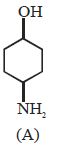
A
$4-$aminocyclohexan$-1-$ol protonated at oxygen
B
$4-$aminocyclohexan$-1-$ol protonated at nitrogen
C
$4-$aminocyclohexan$-1-$olate
D
Both $(A)$ and $(B)$
Solution
(D) conjugate acid is formed when a base accepts a proton $(H^+)$.
Compound $(A)$ is $4$-aminocyclohexan-$1$-ol,which contains two basic sites: the amino group $(-NH_2)$ and the hydroxyl group $(-OH)$.
$1$. The nitrogen atom in the $-NH_2$ group has a lone pair of electrons,making it a Lewis base. It can accept a proton to form the ammonium ion $(-NH_3^+)$.
$2$. The oxygen atom in the $-OH$ group also has lone pairs of electrons and can be protonated in the presence of a strong acid to form the oxonium ion $(-OH_2^+)$.
Therefore,both the protonated nitrogen species and the protonated oxygen species are conjugate acids of $(A)$.
Compound $(A)$ is $4$-aminocyclohexan-$1$-ol,which contains two basic sites: the amino group $(-NH_2)$ and the hydroxyl group $(-OH)$.
$1$. The nitrogen atom in the $-NH_2$ group has a lone pair of electrons,making it a Lewis base. It can accept a proton to form the ammonium ion $(-NH_3^+)$.
$2$. The oxygen atom in the $-OH$ group also has lone pairs of electrons and can be protonated in the presence of a strong acid to form the oxonium ion $(-OH_2^+)$.
Therefore,both the protonated nitrogen species and the protonated oxygen species are conjugate acids of $(A)$.
0 likes
View Solution305
EasyMCQ
The conjugate base of the strong acid in the reaction $CH_3COOH + HCl \rightleftharpoons Cl^{\Theta} + CH_3COOH_2^{\oplus}$ is:
A
$HCl$
B
$Cl^{\Theta}$
C
$CH_3COOH$
D
$CH_3COOH_2^{\oplus}$
Solution
(B) In the given reaction $CH_3COOH + HCl \rightleftharpoons Cl^{\Theta} + CH_3COOH_2^{\oplus}$,$HCl$ acts as a strong acid because it donates a proton $(H^{\oplus})$ to $CH_3COOH$.
When an acid loses a proton,the remaining species is its conjugate base.
Therefore,the conjugate base of $HCl$ is $Cl^{\Theta}$.
When an acid loses a proton,the remaining species is its conjugate base.
Therefore,the conjugate base of $HCl$ is $Cl^{\Theta}$.
0 likes
View Solution306
EasyMCQ
Conjugate acid of $HPO_4^{2-}$ is
A
$H_3PO_4$
B
$H_2PO_4^{-}$
C
$PO_4^{3-}$
D
$H_2PO_3^{-}$
Solution
(B) The conjugate acid of a base is formed by the addition of a proton $(H^{+})$ to the base.
For the base $HPO_4^{2-}$,the conjugate acid is obtained by adding one $H^{+}$ ion:
$HPO_4^{2-} + H^{+} \rightarrow H_2PO_4^{-}$
Therefore,the conjugate acid of $HPO_4^{2-}$ is $H_2PO_4^{-}$.
For the base $HPO_4^{2-}$,the conjugate acid is obtained by adding one $H^{+}$ ion:
$HPO_4^{2-} + H^{+} \rightarrow H_2PO_4^{-}$
Therefore,the conjugate acid of $HPO_4^{2-}$ is $H_2PO_4^{-}$.
0 likes
View Solution307
EasyMCQ
The strongest Bronsted base among the following anions is
A
$CN^{-}$
B
$Cl^{-}$
C
$I^{-}$
D
$Br^{-}$
Solution
(A) The strength of a conjugate base is inversely proportional to the strength of its conjugate acid.
The conjugate acids of the given anions are $HCN$,$HCl$,$HI$,and $HBr$.
Among these,$HI$ is the strongest acid and $HCN$ is the weakest acid.
Since $HCN$ is the weakest acid,its conjugate base $CN^{-}$ is the strongest Bronsted base.
The conjugate acids of the given anions are $HCN$,$HCl$,$HI$,and $HBr$.
Among these,$HI$ is the strongest acid and $HCN$ is the weakest acid.
Since $HCN$ is the weakest acid,its conjugate base $CN^{-}$ is the strongest Bronsted base.
0 likes
View Solution308
EasyMCQ
Which of the following cannot act as a Bronsted base?
A
$HCO_3^-$
B
$PH_3$
C
$BF_3$
D
$H_2O$
Solution
(C) $Bronsted$ base is defined as a substance that can accept a proton $(H^+)$.
$HCO_3^-$ can accept a proton to form $H_2CO_3$.
$PH_3$ has a lone pair on the $P$ atom and can accept a proton.
$H_2O$ can accept a proton to form $H_3O^+$.
$BF_3$ is an electron-deficient molecule with an incomplete octet (only $6$ electrons around $B$). It acts as a $Lewis$ acid by accepting an electron pair,not as a $Bronsted$ base.
$HCO_3^-$ can accept a proton to form $H_2CO_3$.
$PH_3$ has a lone pair on the $P$ atom and can accept a proton.
$H_2O$ can accept a proton to form $H_3O^+$.
$BF_3$ is an electron-deficient molecule with an incomplete octet (only $6$ electrons around $B$). It acts as a $Lewis$ acid by accepting an electron pair,not as a $Bronsted$ base.
0 likes
View Solution309
EasyMCQ
Which of the following is not a Lewis base?
A
$H_2O$
B
$NH_3$
C
$CH_4$
D
$F^{-}$
Solution
(C) Lewis base is defined as a substance that can donate a lone pair of electrons.
$H_2O$ has two lone pairs on the oxygen atom,$NH_3$ has one lone pair on the nitrogen atom,and $F^{-}$ has four lone pairs on the fluorine atom.
$CH_4$ (methane) has a stable octet configuration with all valence electrons involved in bonding,and it has no lone pairs to donate.
Therefore,$CH_4$ cannot act as a Lewis base.
$H_2O$ has two lone pairs on the oxygen atom,$NH_3$ has one lone pair on the nitrogen atom,and $F^{-}$ has four lone pairs on the fluorine atom.
$CH_4$ (methane) has a stable octet configuration with all valence electrons involved in bonding,and it has no lone pairs to donate.
Therefore,$CH_4$ cannot act as a Lewis base.
0 likes
View Solution310
EasyMCQ
$A$ $Lewis$ acid is defined as a substance that acts as a:
A
Lone pair donor
B
Proton acceptor
C
Proton donor
D
Lone pair acceptor
Solution
(D) According to the $Lewis$ acid-base theory:
$1$. $A$ $Lewis$ acid is defined as an electron pair acceptor.
$2$. $A$ $Lewis$ base is defined as an electron pair donor.
Therefore,the correct definition for a $Lewis$ acid is a lone pair acceptor.
$1$. $A$ $Lewis$ acid is defined as an electron pair acceptor.
$2$. $A$ $Lewis$ base is defined as an electron pair donor.
Therefore,the correct definition for a $Lewis$ acid is a lone pair acceptor.
0 likes
View Solution311
MediumMCQ
An amphoteric anion is capable of both accepting and donating a proton in a suitable medium. Which of the following ions exhibits this property?
A
$C_2O_4^{2-}$
B
$CH_3COO^-$
C
$NH_2^-$
D
$HCO_3^-$
Solution
(D) An amphoteric species is one that can act as both an acid (proton donor) and a base (proton acceptor).
For an anion to be amphoteric,it must contain at least one hydrogen atom that can be donated as a proton $(H^+)$ and have a negative charge to accept a proton.
In the case of $HCO_3^-$,it can donate a proton to form $CO_3^{2-}$ $(HCO_3^- \rightarrow H^+ + CO_3^{2-})$ and it can accept a proton to form $H_2CO_3$ $(HCO_3^- + H^+ \rightarrow H_2CO_3)$.
Therefore,$HCO_3^-$ is an amphoteric anion.
For an anion to be amphoteric,it must contain at least one hydrogen atom that can be donated as a proton $(H^+)$ and have a negative charge to accept a proton.
In the case of $HCO_3^-$,it can donate a proton to form $CO_3^{2-}$ $(HCO_3^- \rightarrow H^+ + CO_3^{2-})$ and it can accept a proton to form $H_2CO_3$ $(HCO_3^- + H^+ \rightarrow H_2CO_3)$.
Therefore,$HCO_3^-$ is an amphoteric anion.
0 likes
View Solution312
MediumMCQ
In the following ionic equilibrium,the conjugate acid of $H_2O_2$ is ........
$H_2O_2 + H_2O \rightleftharpoons H_3O^+ + HO_2^-$
$H_2O_2 + H_2O \rightleftharpoons H_3O^+ + HO_2^-$
A
$H_2O$
B
$H_3O^+$
C
$HO_2^-$
D
None of these
0 likes
View Solution313
MediumMCQ
When $HClO_4$ is dissolved in the weak acid $HF$,the following equilibrium is established:
$HF + HClO_4 \rightleftharpoons H_2F^+ + ClO_4^-$
Which of the following is the correct set of conjugate acid-base pairs?
$HF + HClO_4 \rightleftharpoons H_2F^+ + ClO_4^-$
Which of the following is the correct set of conjugate acid-base pairs?
A
$HF$ and $ClO_4^-$
B
$HClO_4$ and $H_2F^+$
C
$HF$ and $H_2F^+$
D
$HClO_4$ and $ClO_4^-$
0 likes
View Solution314
MediumMCQ
Identify the amphoteric species among the following:
$(I) \, H_2O$
$(II) \, NH_2^-$
$(III) \, H_2PO_4^-$
$(IV) \, HCO_3^-$
$(I) \, H_2O$
$(II) \, NH_2^-$
$(III) \, H_2PO_4^-$
$(IV) \, HCO_3^-$
A
$I, \, II$
B
$III, \, IV$
C
$I, \, III, \, IV$
D
$I, \, II, \, III, \, IV$
Solution
(C) An amphoteric species is one that can act as both a Bronsted-Lowry acid (donate a proton) and a Bronsted-Lowry base (accept a proton).
$(I) \, H_2O$: Can accept a proton to form $H_3O^+$ and donate a proton to form $OH^-$. Thus,it is amphoteric.
$(II) \, NH_2^-$: Can only accept a proton to form $NH_3$. It cannot donate a proton. Thus,it is not amphoteric.
$(III) \, H_2PO_4^-$: Can accept a proton to form $H_3PO_4$ and donate a proton to form $HPO_4^{2-}$. Thus,it is amphoteric.
$(IV) \, HCO_3^-$: Can accept a proton to form $H_2CO_3$ and donate a proton to form $CO_3^{2-}$. Thus,it is amphoteric.
Therefore,$(I), \, (III),$ and $(IV)$ are amphoteric species.
$(I) \, H_2O$: Can accept a proton to form $H_3O^+$ and donate a proton to form $OH^-$. Thus,it is amphoteric.
$(II) \, NH_2^-$: Can only accept a proton to form $NH_3$. It cannot donate a proton. Thus,it is not amphoteric.
$(III) \, H_2PO_4^-$: Can accept a proton to form $H_3PO_4$ and donate a proton to form $HPO_4^{2-}$. Thus,it is amphoteric.
$(IV) \, HCO_3^-$: Can accept a proton to form $H_2CO_3$ and donate a proton to form $CO_3^{2-}$. Thus,it is amphoteric.
Therefore,$(I), \, (III),$ and $(IV)$ are amphoteric species.
0 likes
View Solution315
MediumMCQ
What is the conjugate base of $[Al(H_2O)_3(OH)_3]$?
A
$[Al(H_2O)_3(OH)_2]^+$
B
$[Al(H_2O)_2(OH)_4]^-$
C
$[Al(H_2O)_3(OH)_3]^-$
D
$[Al(H_2O)_4(OH)_2]^+$
Solution
(B) conjugate base is formed by the removal of a proton $(H^+)$ from an acid.
For the complex $[Al(H_2O)_3(OH)_3]$,the removal of one $H^+$ ion from one of the water ligands results in the formation of an $OH^-$ group.
Reaction: $[Al(H_2O)_3(OH)_3] \rightarrow [Al(H_2O)_2(OH)_4]^- + H^+$.
Therefore,the conjugate base is $[Al(H_2O)_2(OH)_4]^-$,which corresponds to option $B$.
For the complex $[Al(H_2O)_3(OH)_3]$,the removal of one $H^+$ ion from one of the water ligands results in the formation of an $OH^-$ group.
Reaction: $[Al(H_2O)_3(OH)_3] \rightarrow [Al(H_2O)_2(OH)_4]^- + H^+$.
Therefore,the conjugate base is $[Al(H_2O)_2(OH)_4]^-$,which corresponds to option $B$.
0 likes
View Solution316
MediumMCQ
$BF_3$ acts as an acid according to .............
A
Arrhenius concept
B
Bronsted-Lowry concept
C
Lewis concept
D
Henderson concept
Solution
(C) $BF_3$ (Boron trifluoride) has an incomplete octet around the central Boron atom,making it an electron-deficient species.
According to the Lewis acid-base theory,an acid is an electron pair acceptor.
Since $BF_3$ can accept a lone pair of electrons to complete its octet,it acts as a Lewis acid.
According to the Lewis acid-base theory,an acid is an electron pair acceptor.
Since $BF_3$ can accept a lone pair of electrons to complete its octet,it acts as a Lewis acid.
0 likes
View Solution317
EasyMCQ
Which of the following is the weakest Bronsted base?
A
$H^{-}$
B
$CH_3^{-}$
C
$CH_3O^{-}$
D
$Cl^{-}$
Solution
(D) The strength of a Bronsted base is inversely proportional to the strength of its conjugate acid.
$1$. The conjugate acids of the given bases are: $H^{-} \rightarrow H_2$,$CH_3^{-} \rightarrow CH_4$,$CH_3O^{-} \rightarrow CH_3OH$,and $Cl^{-} \rightarrow HCl$.
$2$. The acid strength order is: $HCl > CH_3OH > H_2O > CH_4 > H_2$.
$3$. Since $HCl$ is the strongest acid among these,its conjugate base,$Cl^{-}$,must be the weakest Bronsted base.
Therefore,the correct option is $D$.
$1$. The conjugate acids of the given bases are: $H^{-} \rightarrow H_2$,$CH_3^{-} \rightarrow CH_4$,$CH_3O^{-} \rightarrow CH_3OH$,and $Cl^{-} \rightarrow HCl$.
$2$. The acid strength order is: $HCl > CH_3OH > H_2O > CH_4 > H_2$.
$3$. Since $HCl$ is the strongest acid among these,its conjugate base,$Cl^{-}$,must be the weakest Bronsted base.
Therefore,the correct option is $D$.
0 likes
View Solution318
EasyMCQ
The ammonium ion $(NH_4^+)$ is a/an ...........
A
Conjugate acid
B
Conjugate base
C
Neither acid nor base
D
Both acid and base
Solution
(A) According to the Bronsted-Lowry theory,an acid is a proton donor and a base is a proton acceptor.
When ammonia $(NH_3)$ accepts a proton $(H^+)$,it forms the ammonium ion $(NH_4^+)$.
Since $NH_4^+$ can donate a proton to form $NH_3$,it acts as a conjugate acid of the base $NH_3$.
When ammonia $(NH_3)$ accepts a proton $(H^+)$,it forms the ammonium ion $(NH_4^+)$.
Since $NH_4^+$ can donate a proton to form $NH_3$,it acts as a conjugate acid of the base $NH_3$.
0 likes
View Solution319
EasyMCQ
Which of the following has the highest proton-accepting capacity?
A
$H_2O$
B
$H_2S$
C
$NH_3$
D
$PH_3$
Solution
(C) The proton-accepting capacity is determined by the basicity of the molecule,which depends on the availability of the lone pair of electrons on the central atom.
$NH_3$ has a nitrogen atom with a lone pair of electrons. Nitrogen is more electronegative than phosphorus,but the lone pair in $NH_3$ is more available for donation compared to $PH_3$ because the $N-H$ bond is shorter and the lone pair is in a smaller orbital.
$H_2O$ and $H_2S$ are less basic than $NH_3$ and $PH_3$ because oxygen and sulfur are more electronegative,holding their lone pairs more tightly.
Therefore,$NH_3$ is the strongest base among the given options and has the highest proton-accepting capacity.
$NH_3$ has a nitrogen atom with a lone pair of electrons. Nitrogen is more electronegative than phosphorus,but the lone pair in $NH_3$ is more available for donation compared to $PH_3$ because the $N-H$ bond is shorter and the lone pair is in a smaller orbital.
$H_2O$ and $H_2S$ are less basic than $NH_3$ and $PH_3$ because oxygen and sulfur are more electronegative,holding their lone pairs more tightly.
Therefore,$NH_3$ is the strongest base among the given options and has the highest proton-accepting capacity.
0 likes
View Solution320
EasyMCQ
Which of the following species can act as both a $Br\text{ø}nsted$ acid and a $Br\text{ø}nsted$ base?
A
$HSO_4^-$
B
$Na_2CO_3$
C
$NH_3$
D
$OH^-$
Solution
(A) $Br\text{ø}nsted$ acid is a proton $(H^+)$ donor,and a $Br\text{ø}nsted$ base is a proton $(H^+)$ acceptor.
Species that can act as both are called amphoteric.
For $HSO_4^-$,it can donate a proton to form $SO_4^{2-}$ $(HSO_4^- \rightarrow H^+ + SO_4^{2-})$ and accept a proton to form $H_2SO_4$ $(HSO_4^- + H^+ \rightarrow H_2SO_4)$.
Therefore,$HSO_4^-$ is amphoteric.
Species that can act as both are called amphoteric.
For $HSO_4^-$,it can donate a proton to form $SO_4^{2-}$ $(HSO_4^- \rightarrow H^+ + SO_4^{2-})$ and accept a proton to form $H_2SO_4$ $(HSO_4^- + H^+ \rightarrow H_2SO_4)$.
Therefore,$HSO_4^-$ is amphoteric.
0 likes
View Solution321
MediumMCQ
For any diprotic acid of the type $H_2A$,the relationship between the first $(Ka_1)$ and second $(Ka_2)$ ionization constants is:
A
$Ka_1 = Ka_2$
B
$Ka_1 < Ka_2$
C
$Ka_2 < Ka_1$
D
Insufficient information
Solution
(C) For a diprotic acid $H_2A$,the ionization occurs in two steps:
$1$. $H_2A(aq) + H_2O(l) \rightleftharpoons H_3O^+(aq) + HA^-(aq)$ with constant $Ka_1$.
$2$. $HA^-(aq) + H_2O(l) \rightleftharpoons H_3O^+(aq) + A^{2-}(aq)$ with constant $Ka_2$.
In the second step,the removal of a proton $(H^+)$ from a negatively charged species $(HA^-)$ is much more difficult due to electrostatic attraction between the positive proton and the negative ion. Therefore,$Ka_1$ is always greater than $Ka_2$ ($Ka_1 > Ka_2$ or $Ka_2 < Ka_1$).
$1$. $H_2A(aq) + H_2O(l) \rightleftharpoons H_3O^+(aq) + HA^-(aq)$ with constant $Ka_1$.
$2$. $HA^-(aq) + H_2O(l) \rightleftharpoons H_3O^+(aq) + A^{2-}(aq)$ with constant $Ka_2$.
In the second step,the removal of a proton $(H^+)$ from a negatively charged species $(HA^-)$ is much more difficult due to electrostatic attraction between the positive proton and the negative ion. Therefore,$Ka_1$ is always greater than $Ka_2$ ($Ka_1 > Ka_2$ or $Ka_2 < Ka_1$).
0 likes
View Solution322
EasyMCQ
The process $HCN \to H^+ + CN^-$ should be ...........
A
Exothermic
B
Endothermic
C
Neutralization
D
None of the above
Solution
(B) The dissociation of a weak acid like $HCN$ requires energy to break the $H-CN$ bond. Therefore,the process is endothermic.
0 likes
View Solution323
MediumMCQ
What is the enthalpy change in $kJ$ when $1$ gram-equivalent of a strong base reacts with an excess of a strong acid?
A
$-51.46$
B
$-57.3$
C
$55.2$
D
$60.3$
Solution
(B) The enthalpy of neutralization for a strong acid and a strong base is the heat released when $1$ mole of $H^+$ ions from the acid reacts with $1$ mole of $OH^-$ ions from the base to form $1$ mole of water. This value is constant for all strong acid-strong base reactions and is equal to $-57.3 \ kJ/mol$.
0 likes
View Solution324
MediumMCQ
The enthalpies of neutralization of $HCN$ and $H_2S$ with a strong base are $12.13 \ kJ \ equi^{-1}$ and $15.9 \ kJ \ equi^{-1}$ respectively. Then:
A
$HCN$ is a stronger acid than $H_2S$
B
$pK_a$ of $HCN$ is less than $pK_a$ of $H_2S$
C
$pK_a$ of $H_2S$ and $HCN$ are equal
D
$pK_a$ of $HCN$ is greater than $pK_a$ of $H_2S$
Solution
(D) The enthalpy of neutralization of a weak acid with a strong base is given by $\Delta H_{neut} = -57.3 + \Delta H_{ion}$,where $\Delta H_{ion}$ is the enthalpy of ionization of the weak acid.
Since the enthalpy of neutralization is less exothermic for $HCN$ $(12.13 \ kJ \ equi^{-1})$ compared to $H_2S$ $(15.9 \ kJ \ equi^{-1})$,it implies that more energy is required to ionize $HCN$ than $H_2S$.
This indicates that $HCN$ is a weaker acid than $H_2S$.
Since $pK_a = -\log(K_a)$,a weaker acid has a smaller $K_a$ value and consequently a larger $pK_a$ value.
Therefore,the $pK_a$ of $HCN$ is greater than the $pK_a$ of $H_2S$.
Since the enthalpy of neutralization is less exothermic for $HCN$ $(12.13 \ kJ \ equi^{-1})$ compared to $H_2S$ $(15.9 \ kJ \ equi^{-1})$,it implies that more energy is required to ionize $HCN$ than $H_2S$.
This indicates that $HCN$ is a weaker acid than $H_2S$.
Since $pK_a = -\log(K_a)$,a weaker acid has a smaller $K_a$ value and consequently a larger $pK_a$ value.
Therefore,the $pK_a$ of $HCN$ is greater than the $pK_a$ of $H_2S$.
0 likes
View Solution325
MediumMCQ
When one equivalent of an acid is mixed with an excess of a strong base,which of the following acids will show the maximum rise in the temperature of the solution?
A
$HCN$
B
$CH_3COOH$
C
$H_2S$
D
$HNO_3$
Solution
(D) The rise in temperature of the solution during neutralization is directly proportional to the enthalpy of neutralization.
For strong acid and strong base,the enthalpy of neutralization is $-57.1 \ kJ \ mol^{-1}$.
For weak acids,some energy is consumed in the dissociation of the weak acid,resulting in a lower enthalpy of neutralization compared to strong acids.
However,the question asks for the maximum rise in temperature. Among the given options,$HNO_3$ is a strong acid,while $HCN$,$CH_3COOH$,and $H_2S$ are weak acids.
Since the enthalpy of neutralization for a strong acid $(HNO_3)$ is the highest,it will release the maximum amount of heat,leading to the maximum rise in temperature.
For strong acid and strong base,the enthalpy of neutralization is $-57.1 \ kJ \ mol^{-1}$.
For weak acids,some energy is consumed in the dissociation of the weak acid,resulting in a lower enthalpy of neutralization compared to strong acids.
However,the question asks for the maximum rise in temperature. Among the given options,$HNO_3$ is a strong acid,while $HCN$,$CH_3COOH$,and $H_2S$ are weak acids.
Since the enthalpy of neutralization for a strong acid $(HNO_3)$ is the highest,it will release the maximum amount of heat,leading to the maximum rise in temperature.
0 likes
View Solution326
MediumMCQ
Which of the following reactions releases $57.3 \ kJ$ of heat per mole?
A
$H^+ + Cl^- \to HCl$
B
$H^+ + OH^- \to H_2O$
C
$H_{2(g)} + 1/2O_{2(g)} \to H_2O_{(l)}$
D
$Na^+ + Cl^- \to NaCl$
Solution
(B) The heat of neutralization for the reaction between a strong acid and a strong base is defined as the enthalpy change when $1 \ mole$ of $H^+$ ions reacts with $1 \ mole$ of $OH^-$ ions to form $1 \ mole$ of water.
This value is constant for all strong acid-strong base neutralizations and is equal to $-57.3 \ kJ \ mol^{-1}$.
The reaction is represented as: $H^+_{(aq)} + OH^-_{(aq)} \to H_2O_{(l)}$,$\Delta H = -57.3 \ kJ \ mol^{-1}$.
This value is constant for all strong acid-strong base neutralizations and is equal to $-57.3 \ kJ \ mol^{-1}$.
The reaction is represented as: $H^+_{(aq)} + OH^-_{(aq)} \to H_2O_{(l)}$,$\Delta H = -57.3 \ kJ \ mol^{-1}$.
0 likes
View Solution327
MediumMCQ
Which of the following is not a protonic acid?
A
$SO_2(OH)_2$
B
$B(OH)_3$
C
$PO(OH)_3$
D
$SO(OH)_2$
Solution
(B) protonic acid is a substance that can donate a proton ($H^+$ ion) in an aqueous solution.
$SO_2(OH)_2$ is $H_2SO_4$,which is a strong protonic acid.
$PO(OH)_3$ is $H_3PO_4$,which is a protonic acid.
$SO(OH)_2$ is $H_2SO_3$,which is a protonic acid.
$B(OH)_3$ is boric acid $(H_3BO_3)$. It acts as a Lewis acid because it accepts a lone pair of electrons from $OH^-$ ions in water to form $[B(OH)_4]^-$,rather than donating a proton. Therefore,it is not a protonic acid.
$SO_2(OH)_2$ is $H_2SO_4$,which is a strong protonic acid.
$PO(OH)_3$ is $H_3PO_4$,which is a protonic acid.
$SO(OH)_2$ is $H_2SO_3$,which is a protonic acid.
$B(OH)_3$ is boric acid $(H_3BO_3)$. It acts as a Lewis acid because it accepts a lone pair of electrons from $OH^-$ ions in water to form $[B(OH)_4]^-$,rather than donating a proton. Therefore,it is not a protonic acid.
0 likes
View Solution328
MediumMCQ
Aqueous ammonia is used instead of aqueous $NaOH$ solution to precipitate $Al^{3+}$ ions as $Al(OH)_3$ because .................
A
$NH_4^+$ is a weak base.
B
$NaOH$ forms $[Al(OH)_4]^-$ ions.
C
$NaOH$ is a very strong base.
D
$NaOH$ forms $[Al(OH)_4]^+$ ions.
Solution
(B) $Al^{3+}$ ions react with $NaOH$ to form $Al(OH)_3$ initially.
However,$Al(OH)_3$ is amphoteric in nature and dissolves in excess $NaOH$ to form a soluble complex,$[Al(OH)_4]^-$.
To avoid the formation of this soluble complex and ensure complete precipitation of $Al(OH)_3$,a weaker base like aqueous ammonia $(NH_4OH)$ is used.
$NH_4OH$ provides a lower concentration of $OH^-$ ions,which is sufficient to precipitate $Al(OH)_3$ but not enough to dissolve it.
However,$Al(OH)_3$ is amphoteric in nature and dissolves in excess $NaOH$ to form a soluble complex,$[Al(OH)_4]^-$.
To avoid the formation of this soluble complex and ensure complete precipitation of $Al(OH)_3$,a weaker base like aqueous ammonia $(NH_4OH)$ is used.
$NH_4OH$ provides a lower concentration of $OH^-$ ions,which is sufficient to precipitate $Al(OH)_3$ but not enough to dissolve it.
0 likes
View Solution329
MediumMCQ
Which of the following is not a Lewis acid?
A
$AlCl_3$
B
$SnCl_4$
C
$FeCl_3$
D
$AlCl_3 \cdot 6H_2O$
Solution
(D) $Lewis$ acid is a substance that can accept a pair of non-bonding electrons.
$AlCl_3$,$SnCl_4$,and $FeCl_3$ are electron-deficient compounds (incomplete octet or vacant d-orbitals) and act as $Lewis$ acids.
$AlCl_3 \cdot 6H_2O$ is a hydrated salt where the $Al^{3+}$ ion is already coordinated with six water molecules,satisfying its coordination requirement. Therefore,it does not act as a $Lewis$ acid in this form.
$AlCl_3$,$SnCl_4$,and $FeCl_3$ are electron-deficient compounds (incomplete octet or vacant d-orbitals) and act as $Lewis$ acids.
$AlCl_3 \cdot 6H_2O$ is a hydrated salt where the $Al^{3+}$ ion is already coordinated with six water molecules,satisfying its coordination requirement. Therefore,it does not act as a $Lewis$ acid in this form.
0 likes
View Solution330
EasyMCQ
Heating iron sulfide produces sulfur oxide,which reacts with water to form an acid. What is the basicity of this acid?
A
$0$
B
$1$
C
$2$
D
$3$
Solution
(C) The heating of iron sulfide $(FeS_2)$ in air produces sulfur dioxide $(SO_2)$.
$4FeS_2 + 11O_2 \rightarrow 2Fe_2O_3 + 8SO_2$
Sulfur dioxide reacts with water to form sulfurous acid $(H_2SO_3)$.
$SO_2 + H_2O \rightarrow H_2SO_3$
Sulfurous acid $(H_2SO_3)$ is a diprotic acid,meaning it has two ionizable hydrogen atoms.
Therefore,the basicity of $H_2SO_3$ is $2$.
$4FeS_2 + 11O_2 \rightarrow 2Fe_2O_3 + 8SO_2$
Sulfur dioxide reacts with water to form sulfurous acid $(H_2SO_3)$.
$SO_2 + H_2O \rightarrow H_2SO_3$
Sulfurous acid $(H_2SO_3)$ is a diprotic acid,meaning it has two ionizable hydrogen atoms.
Therefore,the basicity of $H_2SO_3$ is $2$.
0 likes
View Solution331
EasyMCQ
Which of the following is both basic and a reducing agent?
A
$SO_3^{2-}$
B
$SO_4^{2-}$
C
$S_2O_4^{2-}$
D
$HSO_4^-$
Solution
(A) $1$. $A$ species is basic if it can accept a proton $(H^+)$.
$2$. $A$ species is a reducing agent if it can be oxidized to a higher oxidation state.
$3$. In $SO_3^{2-}$,the oxidation state of $S$ is $+4$. It can be oxidized to $SO_4^{2-}$ $(+6)$ and it can accept $H^+$ to form $HSO_3^-$.
$4$. $SO_4^{2-}$ is the highest oxidation state of $S$ $(+6)$,so it cannot act as a reducing agent.
$5$. $S_2O_4^{2-}$ (dithionite) is a strong reducing agent but is less commonly cited as a simple base compared to $SO_3^{2-}$.
$6$. $HSO_4^-$ is acidic in nature.
$7$. Therefore,$SO_3^{2-}$ is the correct answer.
$2$. $A$ species is a reducing agent if it can be oxidized to a higher oxidation state.
$3$. In $SO_3^{2-}$,the oxidation state of $S$ is $+4$. It can be oxidized to $SO_4^{2-}$ $(+6)$ and it can accept $H^+$ to form $HSO_3^-$.
$4$. $SO_4^{2-}$ is the highest oxidation state of $S$ $(+6)$,so it cannot act as a reducing agent.
$5$. $S_2O_4^{2-}$ (dithionite) is a strong reducing agent but is less commonly cited as a simple base compared to $SO_3^{2-}$.
$6$. $HSO_4^-$ is acidic in nature.
$7$. Therefore,$SO_3^{2-}$ is the correct answer.
0 likes
View Solution332
DifficultMCQ
Which of the following represents the correct increasing order of $pK_a$ values?
A
$HClO_4 < HNO_3 < H_2CO_3 < B(OH)_3$
B
$HNO_3 < HClO_4 < B(OH)_3 < H_2CO_3$
C
$B(OH)_3 < H_2CO_3 < HClO_4 < HNO_3$
D
$HClO_4 < HNO_3 < B(OH)_3 < H_2CO_3$
Solution
(A) The $pK_a$ value is inversely proportional to the acid strength $(pK_a = -\log K_a)$.
Stronger acids have lower $pK_a$ values.
The order of acid strength is: $HClO_4$ (strongest) $> HNO_3 > H_2CO_3 > B(OH)_3$ (weakest).
Therefore,the increasing order of $pK_a$ values is: $HClO_4 < HNO_3 < H_2CO_3 < B(OH)_3$.
Stronger acids have lower $pK_a$ values.
The order of acid strength is: $HClO_4$ (strongest) $> HNO_3 > H_2CO_3 > B(OH)_3$ (weakest).
Therefore,the increasing order of $pK_a$ values is: $HClO_4 < HNO_3 < H_2CO_3 < B(OH)_3$.
0 likes
View Solution333
EasyMCQ
Which of the following is the most basic?
A
$F^-$
B
$Cl^-$
C
$Br^-$
D
$I^-$
Solution
(A) The basicity of an anion is inversely proportional to the stability of its conjugate acid.
The conjugate acids of the given anions are $HF$,$HCl$,$HBr$,and $HI$.
Among these,$HI$ is the strongest acid because the $H-I$ bond is the weakest due to the large size of the $I^-$ ion.
Conversely,$HF$ is the weakest acid among the hydrohalic acids.
Since the strength of the conjugate acid is inversely related to the basicity of the conjugate base,the weakest acid $(HF)$ will have the strongest conjugate base $(F^-)$.
Therefore,$F^-$ is the most basic among the given options.
The conjugate acids of the given anions are $HF$,$HCl$,$HBr$,and $HI$.
Among these,$HI$ is the strongest acid because the $H-I$ bond is the weakest due to the large size of the $I^-$ ion.
Conversely,$HF$ is the weakest acid among the hydrohalic acids.
Since the strength of the conjugate acid is inversely related to the basicity of the conjugate base,the weakest acid $(HF)$ will have the strongest conjugate base $(F^-)$.
Therefore,$F^-$ is the most basic among the given options.
0 likes
View Solution334
EasyMCQ
In the reaction where $HNO_3$ acts as a base,which of the following acts as the strongest acid?
A
$HI$
B
$H_3PO_3$
C
$HF$
D
$HIO_4$
Solution
(D) For $HNO_3$ to act as a base,it must accept a proton $(H^+)$ from another substance.
This occurs in the presence of a stronger acid,such as $H_2SO_4$ or $HClO_4$.
Among the given options,$HIO_4$ (periodic acid) is the strongest acid because the iodine atom is in a high oxidation state $(+7)$ and is bonded to four highly electronegative oxygen atoms,which stabilizes the conjugate base $(IO_4^-)$ through resonance and inductive effects.
Therefore,$HIO_4$ is the strongest acid among the choices provided.
This occurs in the presence of a stronger acid,such as $H_2SO_4$ or $HClO_4$.
Among the given options,$HIO_4$ (periodic acid) is the strongest acid because the iodine atom is in a high oxidation state $(+7)$ and is bonded to four highly electronegative oxygen atoms,which stabilizes the conjugate base $(IO_4^-)$ through resonance and inductive effects.
Therefore,$HIO_4$ is the strongest acid among the choices provided.
0 likes
View Solution335
EasyMCQ
When $K_2O$ is added to water,the solution becomes basic because it contains the concentration of which of the following?
A
$O^{2-}$
B
$O^{3-}$
C
$OH^{-}$
D
$K^{+}$
Solution
(C) When potassium oxide $(K_2O)$ is added to water,it undergoes a hydrolysis reaction to form potassium hydroxide $(KOH)$.
The chemical equation is: $K_2O(s) + H_2O(l) \rightarrow 2KOH(aq)$.
Potassium hydroxide is a strong base that dissociates completely in water to produce hydroxide ions $(OH^{-})$.
The presence of these $OH^{-}$ ions makes the solution basic.
The chemical equation is: $K_2O(s) + H_2O(l) \rightarrow 2KOH(aq)$.
Potassium hydroxide is a strong base that dissociates completely in water to produce hydroxide ions $(OH^{-})$.
The presence of these $OH^{-}$ ions makes the solution basic.
0 likes
View Solution336
MediumMCQ
Conjugate base for Bronsted acids $H_{2}O$ and $HF$ are
A
$OH^{-}$ and $H_{2}F^{+}$ respectively
B
$H_{3}O^{+}$ and $F^{-}$ respectively
C
$OH^{-}$ and $F^{-}$ respectively
D
$H_{3}O^{+}$ and $H_{2}F^{+}$ respectively
Solution
(C) The conjugate base of a Bronsted acid is formed by the removal of a proton $(H^{+})$ from the acid.
For $H_{2}O$: $H_{2}O - H^{+} \rightarrow OH^{-}$.
For $HF$: $HF - H^{+} \rightarrow F^{-}$.
Therefore,the conjugate bases are $OH^{-}$ and $F^{-}$ respectively.
For $H_{2}O$: $H_{2}O - H^{+} \rightarrow OH^{-}$.
For $HF$: $HF - H^{+} \rightarrow F^{-}$.
Therefore,the conjugate bases are $OH^{-}$ and $F^{-}$ respectively.
0 likes
View Solution337
EasyMCQ
Which of the following cannot act both as Bronsted acid and as Bronsted base?
A
$HCO_3^-$
B
$NH_3$
C
$HCl$
D
$HSO_4^-$
Solution
(C) Bronsted acid is a proton donor,and a Bronsted base is a proton acceptor.
Species that can act as both are called amphoteric.
$HCO_3^-$,$NH_3$,and $HSO_4^-$ possess both a proton to donate and a lone pair/negative charge to accept a proton.
$HCl$ can only donate a proton $(HCl \rightarrow H^+ + Cl^-)$ but cannot accept a proton to form $H_2Cl^+$,thus it cannot act as a Bronsted base.
Species that can act as both are called amphoteric.
$HCO_3^-$,$NH_3$,and $HSO_4^-$ possess both a proton to donate and a lone pair/negative charge to accept a proton.
$HCl$ can only donate a proton $(HCl \rightarrow H^+ + Cl^-)$ but cannot accept a proton to form $H_2Cl^+$,thus it cannot act as a Bronsted base.
0 likes
View Solution338
MediumMCQ
What will be the conjugate bases for the following Bronsted acids: $HF$,$H_{2}SO_{4}$ and $HCO_{3}^{-}$?
A
$F^{-}, HSO_{4}^{-}, CO_{3}^{2-}$
B
$F^{+}, HSO_{4}^{+}, CO_{3}^{-}$
C
$F^{-}, H_{2}SO_{4}^{-}, CO_{3}^{-}$
D
$F^{+}, HSO_{4}^{-}, CO_{3}^{2-}$
Solution
(A) The conjugate base of a Bronsted acid is formed by removing one proton $(H^{+})$ from the acid molecule.
For $HF$: $HF - H^{+} \rightarrow F^{-}$.
For $H_{2}SO_{4}$: $H_{2}SO_{4} - H^{+} \rightarrow HSO_{4}^{-}$.
For $HCO_{3}^{-}$: $HCO_{3}^{-} - H^{+} \rightarrow CO_{3}^{2-}$.
Therefore,the corresponding conjugate bases are $F^{-}$,$HSO_{4}^{-}$,and $CO_{3}^{2-}$ respectively.
For $HF$: $HF - H^{+} \rightarrow F^{-}$.
For $H_{2}SO_{4}$: $H_{2}SO_{4} - H^{+} \rightarrow HSO_{4}^{-}$.
For $HCO_{3}^{-}$: $HCO_{3}^{-} - H^{+} \rightarrow CO_{3}^{2-}$.
Therefore,the corresponding conjugate bases are $F^{-}$,$HSO_{4}^{-}$,and $CO_{3}^{2-}$ respectively.
0 likes
View Solution339
MediumMCQ
Write the conjugate acids for the following Bronsted bases: $NH_{2}^{-}$,$NH_{3}$ and $HCOO^{-}$
A
$NH_{3}$,$NH_{4}^{+}$,$HCOOH$
B
$NH_{3}$,$NH_{4}^{+}$,$HCOO^{-}$
C
$NH_{2}$,$NH_{4}^{+}$,$HCOOH$
D
$NH_{3}$,$NH_{4}^{+}$,$HCOO_{2}^{-}$
Solution
(A) The conjugate acid is formed by adding one proton $(H^{+})$ to the given Bronsted base.
For $NH_{2}^{-}$,adding $H^{+}$ gives $NH_{3}$.
For $NH_{3}$,adding $H^{+}$ gives $NH_{4}^{+}$.
For $HCOO^{-}$,adding $H^{+}$ gives $HCOOH$.
Therefore,the corresponding conjugate acids are $NH_{3}$,$NH_{4}^{+}$ and $HCOOH$ respectively.
For $NH_{2}^{-}$,adding $H^{+}$ gives $NH_{3}$.
For $NH_{3}$,adding $H^{+}$ gives $NH_{4}^{+}$.
For $HCOO^{-}$,adding $H^{+}$ gives $HCOOH$.
Therefore,the corresponding conjugate acids are $NH_{3}$,$NH_{4}^{+}$ and $HCOOH$ respectively.
0 likes
View Solution340
Medium
The species: $H_{2}O$,$HCO_{3}^{-}$,$HSO_{4}^{-}$,and $NH_{3}$ can act both as Bronsted acids and bases. For each case,give the corresponding conjugate acid and conjugate base.
Solution
$A$ Bronsted acid is a proton $(H^{+})$ donor,and a Bronsted base is a proton $(H^{+})$ acceptor. The conjugate acid is formed by adding a proton to the species,while the conjugate base is formed by removing a proton from the species. The results are summarized in the table below:
| Species | Conjugate Acid | Conjugate Base |
| $H_{2}O$ | $H_{3}O^{+}$ | $OH^{-}$ |
| $HCO_{3}^{-}$ | $H_{2}CO_{3}$ | $CO_{3}^{2-}$ |
| $HSO_{4}^{-}$ | $H_{2}SO_{4}$ | $SO_{4}^{2-}$ |
| $NH_{3}$ | $NH_{4}^{+}$ | $NH_{2}^{-}$ |
0 likes
View Solution341
Medium
Classify the following species into Lewis acids and Lewis bases and show how these act as such:
$(a) HO^{-}$
$(b) F^{-}$
$(c) H^{+}$
$(d) BCl_{3}$
$(a) HO^{-}$
$(b) F^{-}$
$(c) H^{+}$
$(d) BCl_{3}$
Solution
(N/A) $(a) HO^{-}$ is a Lewis base because it has lone pairs of electrons that it can donate.
$(b) F^{-}$ is a Lewis base because it has lone pairs of electrons that it can donate.
$(c) H^{+}$ is a Lewis acid because it has an empty orbital and can accept a lone pair of electrons.
$(d) BCl_{3}$ is a Lewis acid because the boron atom has an incomplete octet (only $6$ electrons in its valence shell) and can accept a lone pair of electrons.
$(b) F^{-}$ is a Lewis base because it has lone pairs of electrons that it can donate.
$(c) H^{+}$ is a Lewis acid because it has an empty orbital and can accept a lone pair of electrons.
$(d) BCl_{3}$ is a Lewis acid because the boron atom has an incomplete octet (only $6$ electrons in its valence shell) and can accept a lone pair of electrons.
0 likes
View Solution342
Medium
What do you understand by the term 'auto-protolysis' of water? What is its significance?
Solution
Auto-protolysis (self-ionization) of water is a chemical reaction in which two water molecules react to produce a hydroxide ion $(OH^{-})$ and a hydronium ion $(H_{3}O^{+})$. The reaction involved can be represented as:
$H_{2}O_{(l)} + H_{2}O_{(l)} \leftrightarrow H_{3}O_{(aq)}^{+} + OH_{(aq)}^{-}$
Auto-protolysis of water indicates its amphoteric nature,i.e.,its ability to act as an acid as well as a base.
The acid-base reaction can be written as:
$(H_{2}O_{(l)})_{\text{acid}} + (H_{2}O_{(l)})_{\text{base}} \leftrightarrow (H_{3}O_{(aq)}^{+})_{\text{conjugate acid}} + (OH_{(aq)}^{-})_{\text{conjugate base}}$
$H_{2}O_{(l)} + H_{2}O_{(l)} \leftrightarrow H_{3}O_{(aq)}^{+} + OH_{(aq)}^{-}$
Auto-protolysis of water indicates its amphoteric nature,i.e.,its ability to act as an acid as well as a base.
The acid-base reaction can be written as:
$(H_{2}O_{(l)})_{\text{acid}} + (H_{2}O_{(l)})_{\text{base}} \leftrightarrow (H_{3}O_{(aq)}^{+})_{\text{conjugate acid}} + (OH_{(aq)}^{-})_{\text{conjugate base}}$
0 likes
View Solution343
Medium
Why is $K_{a_{2}} << K_{a_{1}}$ for $H_{2}SO_{4}$ in water?
Solution
(N/A) $H_{2}SO_{4(aq)} + H_{2}O_{(l)} \to H_{3}O_{(aq)}^{+} + HSO_{4(aq)}^{-}; \quad K_{a_{1}} > 10$
$HSO_{4(aq)}^{-} + H_{2}O_{(l)} \to H_{3}O_{(aq)}^{+} + SO_{4(aq)}^{2-}; \quad K_{a_{2}} = 1.2 \times 10^{-2}$
It can be observed that $K_{a_{1}} >> K_{a_{2}}$.
This is because a neutral $H_{2}SO_{4}$ molecule has a much higher tendency to lose a proton compared to the negatively charged $HSO_{4}^{-}$ ion. The electrostatic attraction between the positively charged proton and the negatively charged $HSO_{4}^{-}$ ion makes the removal of the second proton significantly more difficult.
$HSO_{4(aq)}^{-} + H_{2}O_{(l)} \to H_{3}O_{(aq)}^{+} + SO_{4(aq)}^{2-}; \quad K_{a_{2}} = 1.2 \times 10^{-2}$
It can be observed that $K_{a_{1}} >> K_{a_{2}}$.
This is because a neutral $H_{2}SO_{4}$ molecule has a much higher tendency to lose a proton compared to the negatively charged $HSO_{4}^{-}$ ion. The electrostatic attraction between the positively charged proton and the negatively charged $HSO_{4}^{-}$ ion makes the removal of the second proton significantly more difficult.
0 likes
View Solution344
Medium
What is meant by the conjugate acid-base pair? Find the conjugate acid/base for the following species:
$HNO_{2}$,$CN^{-}$,$HClO_{4}$,$F^{-}$,$OH^{-}$,$CO_{3}^{2-}$,and $S^{2-}$
$HNO_{2}$,$CN^{-}$,$HClO_{4}$,$F^{-}$,$OH^{-}$,$CO_{3}^{2-}$,and $S^{2-}$
Solution
(N/A) conjugate acid-base pair is a pair of chemical species that differ by only one proton $(H^{+})$.
When an acid loses a proton,it forms its conjugate base.
When a base gains a proton,it forms its conjugate acid.
The conjugate acid-base pairs for the given species are listed in the table below:
When an acid loses a proton,it forms its conjugate base.
When a base gains a proton,it forms its conjugate acid.
The conjugate acid-base pairs for the given species are listed in the table below:
| Species | Conjugate Acid/Base |
| $HNO_{2}$ | $NO_{2}^{-}$ (Conjugate Base) |
| $CN^{-}$ | $HCN$ (Conjugate Acid) |
| $HClO_{4}$ | $ClO_{4}^{-}$ (Conjugate Base) |
| $F^{-}$ | $HF$ (Conjugate Acid) |
| $OH^{-}$ | $H_{2}O$ (Conjugate Acid) / $O^{2-}$ (Conjugate Base) |
| $CO_{3}^{2-}$ | $HCO_{3}^{-}$ (Conjugate Acid) |
| $S^{2-}$ | $HS^{-}$ (Conjugate Acid) |
0 likes
View Solution345
EasyMCQ
Which of the following are Lewis acids? $H_2O, BF_3, H^{+}, NH_4^{+}$
A
$H_2O, BF_3$
B
$BF_3, H^{+}, NH_4^{+}$
C
$H_2O, H^{+}$
D
$BF_3, NH_4^{+}$
Solution
(B) Lewis acids are defined as chemical species that can accept a lone pair of electrons.
$BF_3$ has an incomplete octet on the Boron atom,making it an electron-deficient species.
$H^{+}$ is a proton and has an empty $1s$ orbital,allowing it to accept an electron pair.
$NH_4^{+}$ contains a nitrogen atom that has already donated its lone pair to a proton,but the species as a whole can act as a Lewis acid in certain contexts due to the positive charge and the ability to accept electrons to revert to $NH_3$ and $H^{+}$.
$H_2O$ acts as a Lewis base because it has lone pairs on the oxygen atom that it can donate.
Therefore,$BF_3, H^{+},$ and $NH_4^{+}$ are Lewis acids.
$BF_3$ has an incomplete octet on the Boron atom,making it an electron-deficient species.
$H^{+}$ is a proton and has an empty $1s$ orbital,allowing it to accept an electron pair.
$NH_4^{+}$ contains a nitrogen atom that has already donated its lone pair to a proton,but the species as a whole can act as a Lewis acid in certain contexts due to the positive charge and the ability to accept electrons to revert to $NH_3$ and $H^{+}$.
$H_2O$ acts as a Lewis base because it has lone pairs on the oxygen atom that it can donate.
Therefore,$BF_3, H^{+},$ and $NH_4^{+}$ are Lewis acids.
0 likes
View Solution346
Easy
What will be the conjugate bases for the Bronsted acids: $HF$,$H_2SO_4$,and $HCO_3^-$?
Solution
The conjugate base of a Bronsted acid is formed by the removal of a proton $(H^+)$ from the acid.
| Bronsted acid | Conjugate base |
| $HF$ | $F^-$ |
| $H_2SO_4$ | $HSO_4^-$ |
| $HCO_3^-$ | $CO_3^{2-}$ |
0 likes
View Solution347
Easy
Write the conjugate acids for the following Bronsted bases: $NH_{2}^{-}$,$NH_{3}$ and $HCOO^{-}$.
Solution
The conjugate acid of a Bronsted base is formed by adding a proton $(H^{+})$ to the base. The table below lists the conjugate acids for the given Bronsted bases:
| Bronsted base | Conjugate acid |
| $NH_{2}^{-}$ | $NH_{3}$ |
| $NH_{3}$ | $NH_{4}^{+}$ |
| $HCOO^{-}$ | $HCOOH$ |
0 likes
View Solution348
Easy
The species: $H_{2}O$,$HCO_{3}^{-}$,$HSO_{4}^{-}$,and $NH_{3}$ can act both as Bronsted acids and bases. For each case,give the corresponding conjugate acid and base.
Solution
(N/A) Bronsted acid is a proton $(H^{+})$ donor,and a Bronsted base is a proton $(H^{+})$ acceptor. The conjugate acid is formed by adding a proton $(H^{+})$ to the species,while the conjugate base is formed by removing a proton $(H^{+})$ from the species.
| Species | Conjugate Acid $(+H^{+})$ | Conjugate Base $(-H^{+})$ |
|---|---|---|
| $H_{2}O$ | $H_{3}O^{+}$ | $OH^{-}$ |
| $HCO_{3}^{-}$ | $H_{2}CO_{3}$ | $CO_{3}^{2-}$ |
| $HSO_{4}^{-}$ | $H_{2}SO_{4}$ | $SO_{4}^{2-}$ |
| $NH_{3}$ | $NH_{4}^{+}$ | $NH_{2}^{-}$ |
0 likes
View Solution349
Medium
Classify the following species into Lewis acids and Lewis bases and show how these act as Lewis acid/base:
$(a) OH^{-}$
$(b) F^{-}$
$(c) H^{+}$
$(d) BCl_{3}$
$(a) OH^{-}$
$(b) F^{-}$
$(c) H^{+}$
$(d) BCl_{3}$
Solution
(N/A) $(a) OH^{-}$ is a Lewis base because it has lone pairs of electrons that it can donate.
$(b) F^{-}$ is a Lewis base because it has lone pairs of electrons that it can donate.
$(c) H^{+}$ is a Lewis acid because it has an empty orbital and can accept a pair of electrons.
$(d) BCl_{3}$ is a Lewis acid because the boron atom has an incomplete octet and can accept a pair of electrons.
$(b) F^{-}$ is a Lewis base because it has lone pairs of electrons that it can donate.
$(c) H^{+}$ is a Lewis acid because it has an empty orbital and can accept a pair of electrons.
$(d) BCl_{3}$ is a Lewis acid because the boron atom has an incomplete octet and can accept a pair of electrons.
0 likes
View Solution350
Medium
The ionization constants of $HF$,$HCOOH$,and $HCN$ at $298 \ K$ are $6.8 \times 10^{-4}$,$1.8 \times 10^{-4}$,and $4.8 \times 10^{-9}$ respectively. Calculate the ionization constants of their corresponding conjugate bases.
Solution
The relationship between the ionization constant of an acid $(K_a)$ and its conjugate base $(K_b)$ is given by the equation: $K_a \times K_b = K_w$,where $K_w = 10^{-14}$ at $298 \ K$.
$1$. For $HF$ $(K_a = 6.8 \times 10^{-4})$,the conjugate base is $F^-$.
$K_b(F^-) = \frac{10^{-14}}{6.8 \times 10^{-4}} = 1.47 \times 10^{-11}$.
$2$. For $HCOOH$ $(K_a = 1.8 \times 10^{-4})$,the conjugate base is $HCOO^-$.
$K_b(HCOO^-) = \frac{10^{-14}}{1.8 \times 10^{-4}} = 5.56 \times 10^{-11}$.
$3$. For $HCN$ $(K_a = 4.8 \times 10^{-9})$,the conjugate base is $CN^-$.
$K_b(CN^-) = \frac{10^{-14}}{4.8 \times 10^{-9}} = 2.08 \times 10^{-6}$.
$1$. For $HF$ $(K_a = 6.8 \times 10^{-4})$,the conjugate base is $F^-$.
$K_b(F^-) = \frac{10^{-14}}{6.8 \times 10^{-4}} = 1.47 \times 10^{-11}$.
$2$. For $HCOOH$ $(K_a = 1.8 \times 10^{-4})$,the conjugate base is $HCOO^-$.
$K_b(HCOO^-) = \frac{10^{-14}}{1.8 \times 10^{-4}} = 5.56 \times 10^{-11}$.
$3$. For $HCN$ $(K_a = 4.8 \times 10^{-9})$,the conjugate base is $CN^-$.
$K_b(CN^-) = \frac{10^{-14}}{4.8 \times 10^{-9}} = 2.08 \times 10^{-6}$.
0 likes
View Solution6-2.Equilibrium-II (Ionic Equilibrium) — Acids and Bases · Frequently Asked Questions
1Are these 6-2.Equilibrium-II (Ionic Equilibrium) questions useful for JEE and NEET?
Yes. All questions in this section are mapped to JEE Main and NEET exam patterns. Previous year questions from JEE Main, NEET, GUJCET and state-level exams are included with full solutions.
2Can I switch to Hindi or Gujarati for these questions?
Yes. Use the language tabs in the hero section or the sidebar to view the same questions and solutions in English, Hindi or Gujarati.
3How do I generate a question paper from this subtopic?
Use the Vedclass Exam Paper Generator — select the chapter and subtopic, set difficulty, and generate Sets A, B, C, D automatically. First 3 chapters of every subject are free.
Vedclass Products
For Students
Vedclass Test Series
Mock tests in real JEE/NEET style with performance analysis. 5-day free trial.
Start Free TrialFor Teachers
Exam Paper Generator
Generate Set A/B/C/D papers from this chapter in 2 minutes. 3 chapters free.
Try FreeFor Institutes
Online Exam Module
Live online exams with unlimited students, 360° analytics & white-label branding.
See DemoFor Teachers & Institutes
Generate a 6-2.Equilibrium-II (Ionic Equilibrium) Exam Paper in 2 Minutes
Select subtopic & difficulty — Sets A, B, C, D auto-generated with No Repeat logic.
First 3 chapters of every subject are free — no payment required.