
A English
Mix Examples- 6-1.Equilibrium (Chemical Equilibrium) Questions in English
Class 11 Chemistry · 6-1.Equilibrium (Chemical Equilibrium) · Mix Examples- 6-1.Equilibrium (Chemical Equilibrium)
279+
Questions
English
Language
100%
With Solutions
Showing 50 of 279 questions in English
201
EasyMCQ
The incorrect expression among the following is:
A
$\frac{\Delta G_{System}}{\Delta S_{Total}} = -T$ (at constant $P$)
B
$\ln K = \frac{\Delta H^{\circ} - T \Delta S^{\circ}}{RT}$
C
$K = e^{-\Delta G^{\circ} / RT}$
D
For isothermal process $w_{reversible} = -nRT \ln \frac{V_{f}}{V_{i}}$
Solution
(B) The relationship between Gibbs free energy change and equilibrium constant is given by $\Delta G^{\circ} = -RT \ln K$.
Substituting $\Delta G^{\circ} = \Delta H^{\circ} - T \Delta S^{\circ}$ into the equation,we get $\Delta H^{\circ} - T \Delta S^{\circ} = -RT \ln K$.
Rearranging for $\ln K$,we obtain $\ln K = -\frac{\Delta H^{\circ} - T \Delta S^{\circ}}{RT} = \frac{T \Delta S^{\circ} - \Delta H^{\circ}}{RT}$.
Comparing this with option $B$,we see that $\ln K = \frac{\Delta H^{\circ} - T \Delta S^{\circ}}{RT}$ is incorrect because the signs of $\Delta H^{\circ}$ and $T \Delta S^{\circ}$ are reversed.
Substituting $\Delta G^{\circ} = \Delta H^{\circ} - T \Delta S^{\circ}$ into the equation,we get $\Delta H^{\circ} - T \Delta S^{\circ} = -RT \ln K$.
Rearranging for $\ln K$,we obtain $\ln K = -\frac{\Delta H^{\circ} - T \Delta S^{\circ}}{RT} = \frac{T \Delta S^{\circ} - \Delta H^{\circ}}{RT}$.
Comparing this with option $B$,we see that $\ln K = \frac{\Delta H^{\circ} - T \Delta S^{\circ}}{RT}$ is incorrect because the signs of $\Delta H^{\circ}$ and $T \Delta S^{\circ}$ are reversed.
0 likes
View Solution202
DifficultMCQ
For the reaction $A + B \rightleftharpoons 2C$,the value of equilibrium constant is $100$ at $298 \ K$. If the initial concentration of all the three species is $1 \ M$ each,then the equilibrium concentration of $C$ is $X \times 10^{-1} \ M$. The value of $X$ is $.....$ (Nearest integer)
A
$25$
B
$30$
C
$35$
D
$40$
Solution
(A) The reaction is $A + B \rightleftharpoons 2C$.
Initial concentrations: $[A] = 1 \ M, [B] = 1 \ M, [C] = 1 \ M$.
Let the change in concentration be $x$.
At equilibrium: $[A] = 1 - x, [B] = 1 - x, [C] = 1 + 2x$.
$K_c = \frac{[C]^2}{[A][B]} = \frac{(1+2x)^2}{(1-x)(1-x)} = 100$.
Taking the square root on both sides: $\frac{1+2x}{1-x} = 10$.
$1 + 2x = 10 - 10x$.
$12x = 9$,so $x = \frac{9}{12} = 0.75$.
Equilibrium concentration of $C = 1 + 2x = 1 + 2(0.75) = 1 + 1.5 = 2.5 \ M$.
$2.5 \ M = 25 \times 10^{-1} \ M$.
Thus,$X = 25$.
Initial concentrations: $[A] = 1 \ M, [B] = 1 \ M, [C] = 1 \ M$.
Let the change in concentration be $x$.
At equilibrium: $[A] = 1 - x, [B] = 1 - x, [C] = 1 + 2x$.
$K_c = \frac{[C]^2}{[A][B]} = \frac{(1+2x)^2}{(1-x)(1-x)} = 100$.
Taking the square root on both sides: $\frac{1+2x}{1-x} = 10$.
$1 + 2x = 10 - 10x$.
$12x = 9$,so $x = \frac{9}{12} = 0.75$.
Equilibrium concentration of $C = 1 + 2x = 1 + 2(0.75) = 1 + 1.5 = 2.5 \ M$.
$2.5 \ M = 25 \times 10^{-1} \ M$.
Thus,$X = 25$.
0 likes
View Solution203
DifficultMCQ
$PCl_{5} \rightleftharpoons PCl_{3} + Cl_{2} \quad K_{c} = 1.844$
$3.0 \ \text{moles}$ of $PCl_{5}$ is introduced in a $1 \ \text{L}$ closed reaction vessel at $380 \ \text{K}$. The number of moles of $PCl_{5}$ at equilibrium is $..... \times 10^{-3}$. (Round off to the Nearest Integer)
$3.0 \ \text{moles}$ of $PCl_{5}$ is introduced in a $1 \ \text{L}$ closed reaction vessel at $380 \ \text{K}$. The number of moles of $PCl_{5}$ at equilibrium is $..... \times 10^{-3}$. (Round off to the Nearest Integer)
A
$1500$
B
$1292$
C
$1400$
D
$5123$
Solution
(C) $PCl_{5(g)} \rightleftharpoons PCl_{3(g)} + Cl_{2(g)} \quad K_{c} = 1.844$
$\text{Initial moles at } t = 0: \quad 3.0 \ \text{moles of } PCl_{5}$
$\text{Moles at equilibrium } (t = eq): \quad (3-x) \ \text{for } PCl_{5}, \ x \ \text{for } PCl_{3}, \ x \ \text{for } Cl_{2}$
$\text{Equilibrium constant expression: } K_{c} = \frac{[PCl_{3}][Cl_{2}]}{[PCl_{5}]} = \frac{x^{2}}{3-x} = 1.844$
$x^{2} + 1.844x - 5.532 = 0$
$\text{Using quadratic formula: } x = \frac{-b + \sqrt{b^{2} - 4ac}}{2a} = \frac{-1.844 + \sqrt{(1.844)^{2} + 4(5.532)}}{2}$
$x = \frac{-1.844 + \sqrt{3.400 + 22.128}}{2} = \frac{-1.844 + 5.052}{2} \approx 1.604$
$\text{Moles of } PCl_{5} \text{ at equilibrium} = 3 - 1.604 = 1.396 \ \text{moles}$
$1.396 \ \text{moles} = 1396 \times 10^{-3} \ \text{moles} \approx 1400 \times 10^{-3} \ \text{moles}$
$\text{Initial moles at } t = 0: \quad 3.0 \ \text{moles of } PCl_{5}$
$\text{Moles at equilibrium } (t = eq): \quad (3-x) \ \text{for } PCl_{5}, \ x \ \text{for } PCl_{3}, \ x \ \text{for } Cl_{2}$
$\text{Equilibrium constant expression: } K_{c} = \frac{[PCl_{3}][Cl_{2}]}{[PCl_{5}]} = \frac{x^{2}}{3-x} = 1.844$
$x^{2} + 1.844x - 5.532 = 0$
$\text{Using quadratic formula: } x = \frac{-b + \sqrt{b^{2} - 4ac}}{2a} = \frac{-1.844 + \sqrt{(1.844)^{2} + 4(5.532)}}{2}$
$x = \frac{-1.844 + \sqrt{3.400 + 22.128}}{2} = \frac{-1.844 + 5.052}{2} \approx 1.604$
$\text{Moles of } PCl_{5} \text{ at equilibrium} = 3 - 1.604 = 1.396 \ \text{moles}$
$1.396 \ \text{moles} = 1396 \times 10^{-3} \ \text{moles} \approx 1400 \times 10^{-3} \ \text{moles}$
0 likes
View Solution204
MediumMCQ
$PCl_{5}$ dissociates as $PCl_{5(g)} \rightleftharpoons PCl_{3(g)} + Cl_{2(g)}$. $5 \, \text{moles}$ of $PCl_{5}$ are placed in a $200 \, L$ vessel which contains $2 \, \text{moles}$ of $N_{2}$ and is maintained at $600 \, K$. The equilibrium pressure is $2.46 \, atm$. The equilibrium constant $K_{p}$ for the dissociation of $PCl_{5}$ is $...... \times 10^{-3}$. (nearest integer) (Given: $R = 0.082 \, L \, atm \, K^{-1} \, mol^{-1}$: Assume ideal gas behaviour)
A
$2312$
B
$954$
C
$1107$
D
$1451$
Solution
(C) Initial moles: $n(PCl_{5}) = 5$,$n(N_{2}) = 2$. Total moles at equilibrium: $n_{total} = (5-x) + x + x + 2 = 7+x$.
Using ideal gas law $PV = nRT$ at equilibrium:
$2.46 \times 200 = (7+x) \times 0.082 \times 600$
$492 = (7+x) \times 49.2$
$7+x = 10 \implies x = 3$.
At equilibrium: $n(PCl_{5}) = 2$,$n(PCl_{3}) = 3$,$n(Cl_{2}) = 3$,$n(N_{2}) = 2$. Total moles $= 10$.
Partial pressures: $P(PCl_{5}) = (2/10) \times 2.46 = 0.492 \, atm$,$P(PCl_{3}) = (3/10) \times 2.46 = 0.738 \, atm$,$P(Cl_{2}) = (3/10) \times 2.46 = 0.738 \, atm$.
$K_{p} = \frac{P(PCl_{3}) \times P(Cl_{2})}{P(PCl_{5})} = \frac{0.738 \times 0.738}{0.492} = 1.107$.
$K_{p} = 1107 \times 10^{-3}$.
Using ideal gas law $PV = nRT$ at equilibrium:
$2.46 \times 200 = (7+x) \times 0.082 \times 600$
$492 = (7+x) \times 49.2$
$7+x = 10 \implies x = 3$.
At equilibrium: $n(PCl_{5}) = 2$,$n(PCl_{3}) = 3$,$n(Cl_{2}) = 3$,$n(N_{2}) = 2$. Total moles $= 10$.
Partial pressures: $P(PCl_{5}) = (2/10) \times 2.46 = 0.492 \, atm$,$P(PCl_{3}) = (3/10) \times 2.46 = 0.738 \, atm$,$P(Cl_{2}) = (3/10) \times 2.46 = 0.738 \, atm$.
$K_{p} = \frac{P(PCl_{3}) \times P(Cl_{2})}{P(PCl_{5})} = \frac{0.738 \times 0.738}{0.492} = 1.107$.
$K_{p} = 1107 \times 10^{-3}$.
0 likes
View Solution205
MediumMCQ
At $600 \ K$,$2 \ mol$ of $NO$ are mixed with $1 \ mol$ of $O_2$.
$2 \ NO_{(g)} + O_{2(g)} \rightleftarrows 2 \ NO_{2(g)}$
The reaction occurring as above comes to equilibrium under a total pressure of $1 \ atm$. Analysis of the system shows that $0.6 \ mol$ of oxygen are present at equilibrium. The equilibrium constant for the reaction is $.........$ (Nearest integer).
$2 \ NO_{(g)} + O_{2(g)} \rightleftarrows 2 \ NO_{2(g)}$
The reaction occurring as above comes to equilibrium under a total pressure of $1 \ atm$. Analysis of the system shows that $0.6 \ mol$ of oxygen are present at equilibrium. The equilibrium constant for the reaction is $.........$ (Nearest integer).
A
$1$
B
$0$
C
$2$
D
$3$
Solution
(C) The reaction is $2 \ NO_{(g)} + O_{2(g)} \rightleftarrows 2 \ NO_{2(g)}$.
Initial moles: $NO = 2, O_2 = 1, NO_2 = 0$.
At equilibrium,moles of $O_2 = 1 - x = 0.6$,so $x = 0.4$.
Equilibrium moles: $NO = 2 - 2(0.4) = 1.2$,$O_2 = 0.6$,$NO_2 = 2(0.4) = 0.8$.
Total moles at equilibrium = $1.2 + 0.6 + 0.8 = 2.6$.
Mole fractions: $X_{NO} = \frac{1.2}{2.6}$,$X_{O_2} = \frac{0.6}{2.6}$,$X_{NO_2} = \frac{0.8}{2.6}$.
Partial pressures $(P_{total} = 1 \ atm)$: $P_{NO} = \frac{1.2}{2.6} \ atm$,$P_{O_2} = \frac{0.6}{2.6} \ atm$,$P_{NO_2} = \frac{0.8}{2.6} \ atm$.
$K_p = \frac{(P_{NO_2})^2}{(P_{NO})^2 \times P_{O_2}} = \frac{(\frac{0.8}{2.6})^2}{(\frac{1.2}{2.6})^2 \times (\frac{0.6}{2.6})} = \frac{0.8^2 \times 2.6}{1.2^2 \times 0.6} = \frac{0.64 \times 2.6}{1.44 \times 0.6} = \frac{1.664}{0.864} \approx 1.926$.
The nearest integer is $2$.
Initial moles: $NO = 2, O_2 = 1, NO_2 = 0$.
At equilibrium,moles of $O_2 = 1 - x = 0.6$,so $x = 0.4$.
Equilibrium moles: $NO = 2 - 2(0.4) = 1.2$,$O_2 = 0.6$,$NO_2 = 2(0.4) = 0.8$.
Total moles at equilibrium = $1.2 + 0.6 + 0.8 = 2.6$.
Mole fractions: $X_{NO} = \frac{1.2}{2.6}$,$X_{O_2} = \frac{0.6}{2.6}$,$X_{NO_2} = \frac{0.8}{2.6}$.
Partial pressures $(P_{total} = 1 \ atm)$: $P_{NO} = \frac{1.2}{2.6} \ atm$,$P_{O_2} = \frac{0.6}{2.6} \ atm$,$P_{NO_2} = \frac{0.8}{2.6} \ atm$.
$K_p = \frac{(P_{NO_2})^2}{(P_{NO})^2 \times P_{O_2}} = \frac{(\frac{0.8}{2.6})^2}{(\frac{1.2}{2.6})^2 \times (\frac{0.6}{2.6})} = \frac{0.8^2 \times 2.6}{1.2^2 \times 0.6} = \frac{0.64 \times 2.6}{1.44 \times 0.6} = \frac{1.664}{0.864} \approx 1.926$.
The nearest integer is $2$.
0 likes
View Solution206
AdvancedMCQ
Consider a reaction that is first order in both directions: $A \underset{K_b}{\stackrel{K_f}{\rightleftharpoons}} B$. Initially only $A$ is present,and its concentration is $A_{0}$. Assume $A_{t}$ and $A_{\text{eq}}$ are the concentrations of $A$ at time $t$ and at equilibrium,respectively. The time $t$ at which $A_{t} = (A_{0} + A_{\text{eq}})/2$ is $....$
A
$t = \frac{\ln (3/2)}{(K_{f} + K_{b})}$
B
$t = \frac{\ln (3/2)}{(K_{f} - K_{b})}$
C
$t = \frac{\ln 2}{(K_{f} + K_{b})}$
D
$t = \frac{\ln 2}{(K_{f} - K_{b})}$
Solution
(C) For a reversible first-order reaction $A \underset{K_b}{\stackrel{K_f}{\rightleftharpoons}} B$,the rate law is given by: $-\frac{d[A]}{dt} = K_f[A] - K_b[B]$.
At equilibrium,$-\frac{d[A]}{dt} = 0$,so $K_f[A_{\text{eq}}] = K_b[B_{\text{eq}}]$. Since $[B_{\text{eq}}] = A_0 - A_{\text{eq}}$,we have $K_b = \frac{K_f A_{\text{eq}}}{A_0 - A_{\text{eq}}}$.
The integrated rate equation for this system is $(K_f + K_b)t = \ln \left( \frac{A_0 - A_{\text{eq}}}{A_t - A_{\text{eq}}} \right)$.
Given $A_t = \frac{A_0 + A_{\text{eq}}}{2}$,we substitute this into the expression:
$A_t - A_{\text{eq}} = \frac{A_0 + A_{\text{eq}}}{2} - A_{\text{eq}} = \frac{A_0 - A_{\text{eq}}}{2}$.
Substituting this into the integrated rate equation:
$(K_f + K_b)t = \ln \left( \frac{A_0 - A_{\text{eq}}}{(A_0 - A_{\text{eq}})/2} \right) = \ln(2)$.
Therefore,$t = \frac{\ln 2}{K_f + K_b}$.
At equilibrium,$-\frac{d[A]}{dt} = 0$,so $K_f[A_{\text{eq}}] = K_b[B_{\text{eq}}]$. Since $[B_{\text{eq}}] = A_0 - A_{\text{eq}}$,we have $K_b = \frac{K_f A_{\text{eq}}}{A_0 - A_{\text{eq}}}$.
The integrated rate equation for this system is $(K_f + K_b)t = \ln \left( \frac{A_0 - A_{\text{eq}}}{A_t - A_{\text{eq}}} \right)$.
Given $A_t = \frac{A_0 + A_{\text{eq}}}{2}$,we substitute this into the expression:
$A_t - A_{\text{eq}} = \frac{A_0 + A_{\text{eq}}}{2} - A_{\text{eq}} = \frac{A_0 - A_{\text{eq}}}{2}$.
Substituting this into the integrated rate equation:
$(K_f + K_b)t = \ln \left( \frac{A_0 - A_{\text{eq}}}{(A_0 - A_{\text{eq}})/2} \right) = \ln(2)$.
Therefore,$t = \frac{\ln 2}{K_f + K_b}$.
0 likes
View Solution207
MediumMCQ
Consider the following reversible first-order reaction of $X$ at an initial concentration $[X]_{0}$. The values of the rate constants are $K_{f} = 2 \ s^{-1}$ and $K_{b} = 1 \ s^{-1}$.
$X \underset{K_{b}}{\stackrel{K_{f}}{\rightleftharpoons}} Y$
Which of the following plots correctly represents the concentration of $X$ and $Y$ as a function of time?
$X \underset{K_{b}}{\stackrel{K_{f}}{\rightleftharpoons}} Y$
Which of the following plots correctly represents the concentration of $X$ and $Y$ as a function of time?
A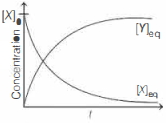
B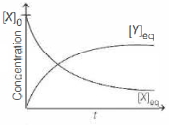
C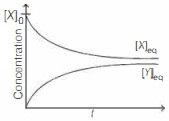
D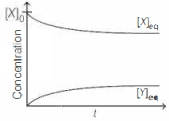
Solution
(D) For the reversible first-order reaction $X \rightleftharpoons Y$,the equilibrium constant $K_{eq}$ is given by:
$K_{eq} = \frac{K_{f}}{K_{b}} = \frac{[Y]_{eq}}{[X]_{eq}}$
Given $K_{f} = 2 \ s^{-1}$ and $K_{b} = 1 \ s^{-1}$,we have:
$K_{eq} = \frac{2}{1} = 2$
Therefore,$\frac{[Y]_{eq}}{[X]_{eq}} = 2$,which implies $[Y]_{eq} = 2[X]_{eq}$.
This means that at equilibrium,the concentration of $Y$ is twice the concentration of $X$.
As the reaction proceeds,the concentration of $X$ decreases from its initial value $[X]_{0}$ to $[X]_{eq}$,and the concentration of $Y$ increases from $0$ to $[Y]_{eq}$.
Since $[Y]_{eq} = 2[X]_{eq}$,the final concentration of $Y$ must be higher than the final concentration of $X$. Plot $(d)$ correctly shows $[Y]_{eq} > [X]_{eq}$ at equilibrium.
$K_{eq} = \frac{K_{f}}{K_{b}} = \frac{[Y]_{eq}}{[X]_{eq}}$
Given $K_{f} = 2 \ s^{-1}$ and $K_{b} = 1 \ s^{-1}$,we have:
$K_{eq} = \frac{2}{1} = 2$
Therefore,$\frac{[Y]_{eq}}{[X]_{eq}} = 2$,which implies $[Y]_{eq} = 2[X]_{eq}$.
This means that at equilibrium,the concentration of $Y$ is twice the concentration of $X$.
As the reaction proceeds,the concentration of $X$ decreases from its initial value $[X]_{0}$ to $[X]_{eq}$,and the concentration of $Y$ increases from $0$ to $[Y]_{eq}$.
Since $[Y]_{eq} = 2[X]_{eq}$,the final concentration of $Y$ must be higher than the final concentration of $X$. Plot $(d)$ correctly shows $[Y]_{eq} > [X]_{eq}$ at equilibrium.
0 likes
View Solution208
MediumMCQ
The equilibrium constants for the reactions $X \rightleftharpoons 2Y$ and $Z \rightleftharpoons P + Q$ are $K_{1}$ and $K_{2}$,respectively. If the initial concentrations and the degree of dissociation of $X$ and $Z$ are the same,the ratio $K_{1} / K_{2}$ is
A
$4$
B
$1$
C
$0.5$
D
$2$
Solution
(A) Let the initial concentration of $X$ and $Z$ be $C$ and $\alpha$ be the degree of dissociation.
For reaction $X \rightleftharpoons 2Y$:
Initial concentration: $C$ $0$
Equilibrium concentration: $C(1-\alpha)$ $2C\alpha$
$K_{1} = \frac{[2C\alpha]^2}{C(1-\alpha)} = \frac{4C^2\alpha^2}{C(1-\alpha)} = \frac{4C\alpha^2}{1-\alpha}$
For reaction $Z \rightleftharpoons P + Q$:
Initial concentration: $C$ $0$ $0$
Equilibrium concentration: $C(1-\alpha)$ $C\alpha$ $C\alpha$
$K_{2} = \frac{[C\alpha][C\alpha]}{C(1-\alpha)} = \frac{C^2\alpha^2}{C(1-\alpha)} = \frac{C\alpha^2}{1-\alpha}$
Therefore,the ratio $\frac{K_{1}}{K_{2}} = \frac{4C\alpha^2 / (1-\alpha)}{C\alpha^2 / (1-\alpha)} = 4$.
For reaction $X \rightleftharpoons 2Y$:
Initial concentration: $C$ $0$
Equilibrium concentration: $C(1-\alpha)$ $2C\alpha$
$K_{1} = \frac{[2C\alpha]^2}{C(1-\alpha)} = \frac{4C^2\alpha^2}{C(1-\alpha)} = \frac{4C\alpha^2}{1-\alpha}$
For reaction $Z \rightleftharpoons P + Q$:
Initial concentration: $C$ $0$ $0$
Equilibrium concentration: $C(1-\alpha)$ $C\alpha$ $C\alpha$
$K_{2} = \frac{[C\alpha][C\alpha]}{C(1-\alpha)} = \frac{C^2\alpha^2}{C(1-\alpha)} = \frac{C\alpha^2}{1-\alpha}$
Therefore,the ratio $\frac{K_{1}}{K_{2}} = \frac{4C\alpha^2 / (1-\alpha)}{C\alpha^2 / (1-\alpha)} = 4$.
0 likes
View Solution209
MediumMCQ
The equilibrium constants $(K_C)$ of two reactions $H_2 + I_2 \rightleftharpoons 2 HI$ and $N_2 + 3 H_2 \rightleftharpoons 2 NH_3$ are $50$ and $1000$,respectively. The equilibrium constant of the reaction $N_2 + 6 HI \rightleftharpoons 2 NH_3 + 3 I_2$ is closest to
A
$50000$
B
$20$
C
$0.008$
D
$0.005$
Solution
(C) For the reactions:
$1) \ H_2 + I_2 \rightleftharpoons 2 HI, K_{C_1} = 50$
$2) \ N_2 + 3 H_2 \rightleftharpoons 2 NH_3, K_{C_2} = 1000$
We need the equilibrium constant for the reaction:
$N_2 + 6 HI \rightleftharpoons 2 NH_3 + 3 I_2$
This reaction can be obtained by taking the second reaction and subtracting three times the first reaction:
$(N_2 + 3 H_2 \rightleftharpoons 2 NH_3) - 3 \times (H_2 + I_2 \rightleftharpoons 2 HI)$
$= N_2 + 3 H_2 - 3 H_2 - 3 I_2 \rightleftharpoons 2 NH_3 - 6 HI$
Rearranging gives: $N_2 + 6 HI \rightleftharpoons 2 NH_3 + 3 I_2$
The equilibrium constant $K_{C_3}$ is given by:
$K_{C_3} = \frac{K_{C_2}}{(K_{C_1})^3}$
$K_{C_3} = \frac{1000}{(50)^3} = \frac{1000}{125000} = \frac{1}{125} = 0.008$
$1) \ H_2 + I_2 \rightleftharpoons 2 HI, K_{C_1} = 50$
$2) \ N_2 + 3 H_2 \rightleftharpoons 2 NH_3, K_{C_2} = 1000$
We need the equilibrium constant for the reaction:
$N_2 + 6 HI \rightleftharpoons 2 NH_3 + 3 I_2$
This reaction can be obtained by taking the second reaction and subtracting three times the first reaction:
$(N_2 + 3 H_2 \rightleftharpoons 2 NH_3) - 3 \times (H_2 + I_2 \rightleftharpoons 2 HI)$
$= N_2 + 3 H_2 - 3 H_2 - 3 I_2 \rightleftharpoons 2 NH_3 - 6 HI$
Rearranging gives: $N_2 + 6 HI \rightleftharpoons 2 NH_3 + 3 I_2$
The equilibrium constant $K_{C_3}$ is given by:
$K_{C_3} = \frac{K_{C_2}}{(K_{C_1})^3}$
$K_{C_3} = \frac{1000}{(50)^3} = \frac{1000}{125000} = \frac{1}{125} = 0.008$
0 likes
View Solution210
MediumMCQ
For the reaction,$A \rightleftharpoons n B$,the concentration of $A$ decreases from $0.06 \ mol \ L^{-1}$ to $0.03 \ mol \ L^{-1}$ and that of $B$ rises from $0$ to $0.06 \ mol \ L^{-1}$ at equilibrium. The values of $n$ and the equilibrium constant for the reaction,respectively,are
A
$2$ and $0.12$
B
$2$ and $1.2$
C
$3$ and $0.12$
D
$3$ and $1.2$
Solution
(A) For the reaction $A \rightleftharpoons n B$ at equilibrium:
Initial concentration of $A = 0.06 \ mol \ L^{-1}$,$B = 0 \ mol \ L^{-1}$.
Equilibrium concentration of $A = 0.03 \ mol \ L^{-1}$,$B = 0.06 \ mol \ L^{-1}$.
Change in concentration of $A = 0.06 - 0.03 = 0.03 \ mol \ L^{-1}$.
Change in concentration of $B = 0.06 - 0 = 0.06 \ mol \ L^{-1}$.
According to stoichiometry,$n = \frac{\Delta [B]}{\Delta [A]} = \frac{0.06}{0.03} = 2$.
The reaction is $A \rightleftharpoons 2 B$.
Equilibrium constant $K_c = \frac{[B]^2}{[A]} = \frac{(0.06)^2}{0.03} = \frac{0.0036}{0.03} = 0.12$.
Initial concentration of $A = 0.06 \ mol \ L^{-1}$,$B = 0 \ mol \ L^{-1}$.
Equilibrium concentration of $A = 0.03 \ mol \ L^{-1}$,$B = 0.06 \ mol \ L^{-1}$.
Change in concentration of $A = 0.06 - 0.03 = 0.03 \ mol \ L^{-1}$.
Change in concentration of $B = 0.06 - 0 = 0.06 \ mol \ L^{-1}$.
According to stoichiometry,$n = \frac{\Delta [B]}{\Delta [A]} = \frac{0.06}{0.03} = 2$.
The reaction is $A \rightleftharpoons 2 B$.
Equilibrium constant $K_c = \frac{[B]^2}{[A]} = \frac{(0.06)^2}{0.03} = \frac{0.0036}{0.03} = 0.12$.
0 likes
View Solution211
DifficultMCQ
The equilibrium constants for the following reactions are $K_1$ and $K_2$,respectively.
$2 P_{(g)} + 3 Cl_{2(g)} \rightleftharpoons 2 PCl_{3(g)}$
$PCl_{3(g)} + Cl_{2(g)} \rightleftharpoons PCl_{5(g)}$
Then,the equilibrium constant for the reaction,$2 P_{(g)} + 5 Cl_{2(g)} \rightleftharpoons 2 PCl_{5(g)}$ is
$2 P_{(g)} + 3 Cl_{2(g)} \rightleftharpoons 2 PCl_{3(g)}$
$PCl_{3(g)} + Cl_{2(g)} \rightleftharpoons PCl_{5(g)}$
Then,the equilibrium constant for the reaction,$2 P_{(g)} + 5 Cl_{2(g)} \rightleftharpoons 2 PCl_{5(g)}$ is
A
$K_1 K_2$
B
$K_1 K_2^2$
C
$K_1^2 K_2^2$
D
$K_1^2 K_2$
Solution
(B) Given reactions:
$(i) \ 2 P_{(g)} + 3 Cl_{2(g)} \rightleftharpoons 2 PCl_{3(g)} \quad K_1$
$(ii) \ PCl_{3(g)} + Cl_{2(g)} \rightleftharpoons PCl_{5(g)} \quad K_2$
Target reaction:
$(iii) \ 2 P_{(g)} + 5 Cl_{2(g)} \rightleftharpoons 2 PCl_{5(g)}$
To obtain reaction $(iii)$,we multiply reaction $(ii)$ by $2$ and add it to reaction $(i)$:
$2 \times [PCl_{3(g)} + Cl_{2(g)} \rightleftharpoons PCl_{5(g)}] \implies 2 PCl_{3(g)} + 2 Cl_{2(g)} \rightleftharpoons 2 PCl_{5(g)} \quad K' = K_2^2$
Adding $(i)$ and the modified $(ii)$:
$(2 P_{(g)} + 3 Cl_{2(g)}) + (2 PCl_{3(g)} + 2 Cl_{2(g)}) \rightleftharpoons 2 PCl_{3(g)} + 2 PCl_{5(g)}$
Canceling common terms gives:
$2 P_{(g)} + 5 Cl_{2(g)} \rightleftharpoons 2 PCl_{5(g)}$
The equilibrium constant $K$ for the final reaction is the product of the constants:
$K = K_1 \times K_2^2 = K_1 K_2^2$
$(i) \ 2 P_{(g)} + 3 Cl_{2(g)} \rightleftharpoons 2 PCl_{3(g)} \quad K_1$
$(ii) \ PCl_{3(g)} + Cl_{2(g)} \rightleftharpoons PCl_{5(g)} \quad K_2$
Target reaction:
$(iii) \ 2 P_{(g)} + 5 Cl_{2(g)} \rightleftharpoons 2 PCl_{5(g)}$
To obtain reaction $(iii)$,we multiply reaction $(ii)$ by $2$ and add it to reaction $(i)$:
$2 \times [PCl_{3(g)} + Cl_{2(g)} \rightleftharpoons PCl_{5(g)}] \implies 2 PCl_{3(g)} + 2 Cl_{2(g)} \rightleftharpoons 2 PCl_{5(g)} \quad K' = K_2^2$
Adding $(i)$ and the modified $(ii)$:
$(2 P_{(g)} + 3 Cl_{2(g)}) + (2 PCl_{3(g)} + 2 Cl_{2(g)}) \rightleftharpoons 2 PCl_{3(g)} + 2 PCl_{5(g)}$
Canceling common terms gives:
$2 P_{(g)} + 5 Cl_{2(g)} \rightleftharpoons 2 PCl_{5(g)}$
The equilibrium constant $K$ for the final reaction is the product of the constants:
$K = K_1 \times K_2^2 = K_1 K_2^2$
0 likes
View Solution212
MediumMCQ
At $783 \, K$ in the reaction,$H_{2(g)} + I_{2(g)} \rightleftharpoons 2 HI_{(g)}$,the molar concentrations $(mol \, L^{-1})$ of $H_2, I_2$ and $HI$ at some instant of time are $0.1, 0.2$ and $0.4$,respectively. If the equilibrium constant is $46$ at the same temperature,then as the reaction proceeds:
A
the amount of $HI$ will increase
B
the amount of $HI$ will decrease
C
the amount of $H_2$ and $I_2$ will increase
D
the amount of $H_2$ and $I_2$ will not change
Solution
(A) For the reaction,$H_{2(g)} + I_{2(g)} \rightleftharpoons 2 HI_{(g)}$ with $K_C = 46$.
The reaction quotient $Q_C$ is calculated as:
$Q_C = \frac{[HI]^2}{[H_2][I_2]} = \frac{0.4 \times 0.4}{0.1 \times 0.2} = \frac{0.16}{0.02} = 8$.
Since $Q_C < K_C$ $(8 < 46)$,the reaction will proceed in the forward direction to reach equilibrium.
Therefore,the concentration of the product $HI$ will increase.
The reaction quotient $Q_C$ is calculated as:
$Q_C = \frac{[HI]^2}{[H_2][I_2]} = \frac{0.4 \times 0.4}{0.1 \times 0.2} = \frac{0.16}{0.02} = 8$.
Since $Q_C < K_C$ $(8 < 46)$,the reaction will proceed in the forward direction to reach equilibrium.
Therefore,the concentration of the product $HI$ will increase.
0 likes
View Solution213
MediumMCQ
The reaction $2 NO_{2(g)} \rightleftharpoons N_2O_{4(g)}$ is at equilibrium in a closed $15 \ L$ vessel at $300 \ K$. The total weight of the mixture of $NO_2$ and $N_2O_4$ in the vessel is $64.4 \ g$. The equilibrium constant for the reaction is $K_p = 6.67$. Assuming ideal gas behavior,the total pressure in the vessel (in $atm$) is: [Given: Gas constant $R = 0.082 \ atm \ L \ K^{-1} \ mol^{-1}$]
A
$0.78$
B
$1.34$
C
$1.96$
D
$2.25$
Solution
(B) The reaction is $2 NO_{2(g)} \rightleftharpoons N_2O_{4(g)}$.
Let the initial moles of $NO_2$ be $n_0$. At equilibrium,let $x$ moles of $N_2O_4$ be formed.
Moles at equilibrium: $n_{NO_2} = n_0 - 2x$,$n_{N_2O_4} = x$.
Total mass: $46(n_0 - 2x) + 92x = 64.4 \implies 46n_0 = 64.4 \implies n_0 = 1.4 \ mol$.
Total moles $n_T = (1.4 - 2x) + x = 1.4 - x$.
$P_{NO_2} = \frac{1.4-2x}{1.4-x} P_T$ and $P_{N_2O_4} = \frac{x}{1.4-x} P_T$.
$K_p = \frac{P_{N_2O_4}}{(P_{NO_2})^2} = \frac{x(1.4-x)}{(1.4-2x)^2 P_T} = 6.67$.
Using $P_T V = n_T RT \implies P_T = \frac{(1.4-x) \times 0.082 \times 300}{15} = 1.64(1.4-x)$.
Substituting $P_T$ into $K_p$ expression and solving for $x$ gives $x \approx 0.58 \ mol$.
Then $n_T = 1.4 - 0.58 = 0.82 \ mol$.
$P_T = \frac{0.82 \times 0.082 \times 300}{15} = 1.34 \ atm$.
Let the initial moles of $NO_2$ be $n_0$. At equilibrium,let $x$ moles of $N_2O_4$ be formed.
Moles at equilibrium: $n_{NO_2} = n_0 - 2x$,$n_{N_2O_4} = x$.
Total mass: $46(n_0 - 2x) + 92x = 64.4 \implies 46n_0 = 64.4 \implies n_0 = 1.4 \ mol$.
Total moles $n_T = (1.4 - 2x) + x = 1.4 - x$.
$P_{NO_2} = \frac{1.4-2x}{1.4-x} P_T$ and $P_{N_2O_4} = \frac{x}{1.4-x} P_T$.
$K_p = \frac{P_{N_2O_4}}{(P_{NO_2})^2} = \frac{x(1.4-x)}{(1.4-2x)^2 P_T} = 6.67$.
Using $P_T V = n_T RT \implies P_T = \frac{(1.4-x) \times 0.082 \times 300}{15} = 1.64(1.4-x)$.
Substituting $P_T$ into $K_p$ expression and solving for $x$ gives $x \approx 0.58 \ mol$.
Then $n_T = 1.4 - 0.58 = 0.82 \ mol$.
$P_T = \frac{0.82 \times 0.082 \times 300}{15} = 1.34 \ atm$.
0 likes
View Solution214
DifficultMCQ
For the ideal gas reaction,$X + Y \rightleftharpoons Z$,a mixture with $n_{X} = 1 \, mol$,$n_{Y} = 3 \, mol$ and $n_{Z} = 2 \, mol$ is at equilibrium at $300 \, K$ and $1 \, bar$. If the pressure is isothermally increased to $2 \, bar$,the number of moles of $X$ in the new equilibrium is closest to $......$
A
$2.367$
B
$0.633$
C
$1.358$
D
$0.727$
Solution
(B) For the reaction $X + Y \rightleftharpoons Z$ at $P_{T} = 1 \, bar$:
Initial moles at equilibrium: $n_{X} = 1, n_{Y} = 3, n_{Z} = 2$. Total moles $n_{T} = 6$.
Mole fractions: $x_{X} = 1/6, x_{Y} = 3/6, x_{Z} = 2/6$.
Partial pressures: $P_{X} = 1/6 \, bar, P_{Y} = 3/6 \, bar, P_{Z} = 2/6 \, bar$.
$K_{p} = \frac{P_{Z}}{P_{X} \times P_{Y}} = \frac{2/6}{(1/6) \times (3/6)} = \frac{2/6}{3/36} = \frac{2}{6} \times \frac{36}{3} = 4$.
When pressure is increased to $P_{T} = 2 \, bar$,the reaction shifts forward to maintain $K_{p} = 4$.
Let $x$ be the moles of $X$ reacted. New moles: $n_{X} = 1 - x, n_{Y} = 3 - x, n_{Z} = 2 + x$. Total moles $n_{T} = 6 - x$.
$K_{p} = \frac{P_{Z}}{P_{X} \times P_{Y}} = \frac{(n_{Z}/n_{T}) \times P_{T}}{(n_{X}/n_{T}) \times (n_{Y}/n_{T}) \times P_{T}^2} = \frac{n_{Z} \times n_{T}}{n_{X} \times n_{Y} \times P_{T}} = 4$.
$\frac{(2 + x)(6 - x)}{(1 - x)(3 - x) \times 2} = 4 \Rightarrow \frac{(2 + x)(6 - x)}{(1 - x)(3 - x)} = 8$.
$12 + 4x - x^2 = 8(3 - 4x + x^2) = 24 - 32x + 8x^2$.
$9x^2 - 36x + 12 = 0 \Rightarrow 3x^2 - 12x + 4 = 0$.
Using quadratic formula $x = \frac{12 \pm \sqrt{144 - 48}}{6} = \frac{12 \pm \sqrt{96}}{6} = 2 \pm \frac{9.798}{6} = 2 \pm 1.633$.
Since $x < 1$,$x = 2 - 1.633 = 0.367$.
$n_{X} = 1 - 0.367 = 0.633 \, mol$.
Initial moles at equilibrium: $n_{X} = 1, n_{Y} = 3, n_{Z} = 2$. Total moles $n_{T} = 6$.
Mole fractions: $x_{X} = 1/6, x_{Y} = 3/6, x_{Z} = 2/6$.
Partial pressures: $P_{X} = 1/6 \, bar, P_{Y} = 3/6 \, bar, P_{Z} = 2/6 \, bar$.
$K_{p} = \frac{P_{Z}}{P_{X} \times P_{Y}} = \frac{2/6}{(1/6) \times (3/6)} = \frac{2/6}{3/36} = \frac{2}{6} \times \frac{36}{3} = 4$.
When pressure is increased to $P_{T} = 2 \, bar$,the reaction shifts forward to maintain $K_{p} = 4$.
Let $x$ be the moles of $X$ reacted. New moles: $n_{X} = 1 - x, n_{Y} = 3 - x, n_{Z} = 2 + x$. Total moles $n_{T} = 6 - x$.
$K_{p} = \frac{P_{Z}}{P_{X} \times P_{Y}} = \frac{(n_{Z}/n_{T}) \times P_{T}}{(n_{X}/n_{T}) \times (n_{Y}/n_{T}) \times P_{T}^2} = \frac{n_{Z} \times n_{T}}{n_{X} \times n_{Y} \times P_{T}} = 4$.
$\frac{(2 + x)(6 - x)}{(1 - x)(3 - x) \times 2} = 4 \Rightarrow \frac{(2 + x)(6 - x)}{(1 - x)(3 - x)} = 8$.
$12 + 4x - x^2 = 8(3 - 4x + x^2) = 24 - 32x + 8x^2$.
$9x^2 - 36x + 12 = 0 \Rightarrow 3x^2 - 12x + 4 = 0$.
Using quadratic formula $x = \frac{12 \pm \sqrt{144 - 48}}{6} = \frac{12 \pm \sqrt{96}}{6} = 2 \pm \frac{9.798}{6} = 2 \pm 1.633$.
Since $x < 1$,$x = 2 - 1.633 = 0.367$.
$n_{X} = 1 - 0.367 = 0.633 \, mol$.
0 likes
View Solution215
DifficultMCQ
Consider the reaction,$P(aq) \rightleftharpoons Q(aq)$ with an equilibrium constant $K=1.5$. The reaction is started in a vessel with a concentration of $[P]$ of $2 \ M$ and concentration of $[Q]=0$. When the equilibrium is established,half the amount of $P$ is removed,and the reaction is allowed to re-equilibrate. The concentration of $Q$ in the vessel (in $M$) is closest to
A
$0.64$
B
$0.96$
C
$0.24$
D
$1.20$
Solution
(B) Initial equilibrium state:
$P(aq) \rightleftharpoons Q(aq)$
Initial: $[P] = 2 \ M, [Q] = 0 \ M$
At equilibrium: $[P] = 2 - x, [Q] = x$
$K = \frac{[Q]}{[P]} = \frac{x}{2 - x} = 1.5$
$x = 1.5(2 - x)$ $\Rightarrow x = 3 - 1.5x$ $\Rightarrow 2.5x = 3$ $\Rightarrow x = 1.2 \ M$
So,at initial equilibrium: $[P] = 0.8 \ M, [Q] = 1.2 \ M$.
After removing half of $P$:
New $[P] = 0.8 / 2 = 0.4 \ M$,$[Q] = 1.2 \ M$.
Reaction quotient $Q_c = \frac{[Q]}{[P]} = \frac{1.2}{0.4} = 3$.
Since $Q_c > K$ $(3 > 1.5)$,the reaction shifts backward.
Let $y$ be the amount of $Q$ converted to $P$:
New equilibrium: $[P] = 0.4 + y, [Q] = 1.2 - y$.
$K = \frac{1.2 - y}{0.4 + y} = 1.5$
$1.2 - y = 1.5(0.4 + y) \Rightarrow 1.2 - y = 0.6 + 1.5y$
$0.6 = 2.5y \Rightarrow y = 0.24 \ M$
Final concentration of $Q = 1.2 - 0.24 = 0.96 \ M$.
$P(aq) \rightleftharpoons Q(aq)$
Initial: $[P] = 2 \ M, [Q] = 0 \ M$
At equilibrium: $[P] = 2 - x, [Q] = x$
$K = \frac{[Q]}{[P]} = \frac{x}{2 - x} = 1.5$
$x = 1.5(2 - x)$ $\Rightarrow x = 3 - 1.5x$ $\Rightarrow 2.5x = 3$ $\Rightarrow x = 1.2 \ M$
So,at initial equilibrium: $[P] = 0.8 \ M, [Q] = 1.2 \ M$.
After removing half of $P$:
New $[P] = 0.8 / 2 = 0.4 \ M$,$[Q] = 1.2 \ M$.
Reaction quotient $Q_c = \frac{[Q]}{[P]} = \frac{1.2}{0.4} = 3$.
Since $Q_c > K$ $(3 > 1.5)$,the reaction shifts backward.
Let $y$ be the amount of $Q$ converted to $P$:
New equilibrium: $[P] = 0.4 + y, [Q] = 1.2 - y$.
$K = \frac{1.2 - y}{0.4 + y} = 1.5$
$1.2 - y = 1.5(0.4 + y) \Rightarrow 1.2 - y = 0.6 + 1.5y$
$0.6 = 2.5y \Rightarrow y = 0.24 \ M$
Final concentration of $Q = 1.2 - 0.24 = 0.96 \ M$.
0 likes
View Solution216
DifficultMCQ
Consider the following reaction approaching equilibrium at $27^{\circ} C$ and $1 \ atm$ pressure. Given the rate constants for the forward and backward reactions are $K_{f} = 10^{3} \ s^{-1}$ and $K_{b} = 10^{2} \ s^{-1}$ respectively,calculate the standard Gibb's energy change $(\Delta_{r} G^{\circ})$ at $27^{\circ} C$ in $kJ \ mol^{-1}$ (Nearest integer). (Given: $R = 8.3 \ J \ K^{-1} \ mol^{-1}$ and $\ln 10 = 2.3$)
A
$6$
B
$3$
C
$12$
D
$9$
Solution
(A) The equilibrium constant $K_{eq}$ is defined as the ratio of the rate constant of the forward reaction to the rate constant of the backward reaction: $K_{eq} = \frac{K_{f}}{K_{b}}$.
Given $K_{f} = 10^{3}$ and $K_{b} = 10^{2}$,we have $K_{eq} = \frac{10^{3}}{10^{2}} = 10$.
The standard Gibbs energy change is related to the equilibrium constant by the equation: $\Delta_{r} G^{\circ} = -RT \ln K_{eq}$.
Given $T = 27^{\circ} C = 300 \ K$,$R = 8.3 \ J \ K^{-1} \ mol^{-1}$,and $\ln 10 = 2.3$.
Substituting the values: $\Delta_{r} G^{\circ} = -(8.3 \times 300 \times 2.3) \ J \ mol^{-1}$.
$\Delta_{r} G^{\circ} = -5727 \ J \ mol^{-1} = -5.727 \ kJ \ mol^{-1}$.
Rounding to the nearest integer,the magnitude is $6 \ kJ \ mol^{-1}$.
Given $K_{f} = 10^{3}$ and $K_{b} = 10^{2}$,we have $K_{eq} = \frac{10^{3}}{10^{2}} = 10$.
The standard Gibbs energy change is related to the equilibrium constant by the equation: $\Delta_{r} G^{\circ} = -RT \ln K_{eq}$.
Given $T = 27^{\circ} C = 300 \ K$,$R = 8.3 \ J \ K^{-1} \ mol^{-1}$,and $\ln 10 = 2.3$.
Substituting the values: $\Delta_{r} G^{\circ} = -(8.3 \times 300 \times 2.3) \ J \ mol^{-1}$.
$\Delta_{r} G^{\circ} = -5727 \ J \ mol^{-1} = -5.727 \ kJ \ mol^{-1}$.
Rounding to the nearest integer,the magnitude is $6 \ kJ \ mol^{-1}$.
0 likes
View Solution217
DifficultMCQ
At $298 \ K$,
$N_2(g) + 3H_2(g) \rightleftharpoons 2NH_3(g), K_1 = 4 \times 10^5$
$N_2(g) + O_2(g) \rightleftharpoons 2NO(g), K_2 = 1.6 \times 10^{12}$
$H_2(g) + \frac{1}{2}O_2(g) \rightleftharpoons H_2O(g), K_3 = 1.0 \times 10^{-13}$
Based on the above equilibria,the equilibrium constant of the reaction,
$2NH_3(g) + \frac{5}{2}O_2(g) \rightleftharpoons 2NO(g) + 3H_2O(g)$
is $.......... \times 10^{-33}$ (Nearest integer).
$N_2(g) + 3H_2(g) \rightleftharpoons 2NH_3(g), K_1 = 4 \times 10^5$
$N_2(g) + O_2(g) \rightleftharpoons 2NO(g), K_2 = 1.6 \times 10^{12}$
$H_2(g) + \frac{1}{2}O_2(g) \rightleftharpoons H_2O(g), K_3 = 1.0 \times 10^{-13}$
Based on the above equilibria,the equilibrium constant of the reaction,
$2NH_3(g) + \frac{5}{2}O_2(g) \rightleftharpoons 2NO(g) + 3H_2O(g)$
is $.......... \times 10^{-33}$ (Nearest integer).
A
$2$
B
$6$
C
$4$
D
$8$
Solution
(C) The target reaction is $2NH_3(g) + \frac{5}{2}O_2(g) \rightleftharpoons 2NO(g) + 3H_2O(g)$.
This can be obtained by the operation: $(ii) + 3 \times (iii) - (i)$.
$K_{eq} = \frac{K_2 \times K_3^3}{K_1}$.
Substituting the given values:
$K_{eq} = \frac{1.6 \times 10^{12} \times (1.0 \times 10^{-13})^3}{4 \times 10^5}$.
$K_{eq} = \frac{1.6 \times 10^{12} \times 10^{-39}}{4 \times 10^5}$.
$K_{eq} = 0.4 \times 10^{12 - 39 - 5} = 0.4 \times 10^{-32} = 4 \times 10^{-33}$.
Thus,the value is $4$.
This can be obtained by the operation: $(ii) + 3 \times (iii) - (i)$.
$K_{eq} = \frac{K_2 \times K_3^3}{K_1}$.
Substituting the given values:
$K_{eq} = \frac{1.6 \times 10^{12} \times (1.0 \times 10^{-13})^3}{4 \times 10^5}$.
$K_{eq} = \frac{1.6 \times 10^{12} \times 10^{-39}}{4 \times 10^5}$.
$K_{eq} = 0.4 \times 10^{12 - 39 - 5} = 0.4 \times 10^{-32} = 4 \times 10^{-33}$.
Thus,the value is $4$.
0 likes
View Solution218
DifficultMCQ
$(i) X(g) \rightleftharpoons Y(g) + Z(g), K_{p1} = 3$
$(ii) A(g) \rightleftharpoons 2B(g), K_{p2} = 1$
If the degree of dissociation and initial concentration of both the reactants $X(g)$ and $A(g)$ are equal,then the ratio of the total pressure at equilibrium $\left( \frac{p_1}{p_2} \right)$ is equal to $x : 1$. The value of $x$ is $......$ (Nearest integer)
$(ii) A(g) \rightleftharpoons 2B(g), K_{p2} = 1$
If the degree of dissociation and initial concentration of both the reactants $X(g)$ and $A(g)$ are equal,then the ratio of the total pressure at equilibrium $\left( \frac{p_1}{p_2} \right)$ is equal to $x : 1$. The value of $x$ is $......$ (Nearest integer)
A
$12$
B
$11$
C
$10$
D
$18$
Solution
(A) For reaction $(i): X(g) \rightleftharpoons Y(g) + Z(g)$
Total moles at equilibrium $= n(1-\alpha) + n\alpha + n\alpha = n(1+\alpha)$.
Partial pressures: $p_X = \frac{1-\alpha}{1+\alpha} p_1$,$p_Y = \frac{\alpha}{1+\alpha} p_1$,$p_Z = \frac{\alpha}{1+\alpha} p_1$.
$K_{p1} = \frac{p_Y p_Z}{p_X} = \frac{\alpha^2 p_1}{1-\alpha^2} = 3$
For reaction $(ii): A(g) \rightleftharpoons 2B(g)$
Total moles at equilibrium $= n(1-\alpha) + 2n\alpha = n(1+\alpha)$.
Partial pressures: $p_A = \frac{1-\alpha}{1+\alpha} p_2$,$p_B = \frac{2\alpha}{1+\alpha} p_2$.
$K_{p2} = \frac{p_B^2}{p_A} = \frac{4\alpha^2 p_2}{1-\alpha^2} = 1$
Dividing the two expressions: $\frac{K_{p1}}{K_{p2}} = \frac{3}{1} = \frac{\alpha^2 p_1 / (1-\alpha^2)}{4\alpha^2 p_2 / (1-\alpha^2)} = \frac{p_1}{4p_2}$
Therefore,$\frac{p_1}{p_2} = 3 \times 4 = 12$.
Thus,$x = 12$.
| $Initial \ moles$ | $n$ | $0$ | $0$ |
| $Equilibrium \ moles$ | $n(1-\alpha)$ | $n\alpha$ | $n\alpha$ |
Total moles at equilibrium $= n(1-\alpha) + n\alpha + n\alpha = n(1+\alpha)$.
Partial pressures: $p_X = \frac{1-\alpha}{1+\alpha} p_1$,$p_Y = \frac{\alpha}{1+\alpha} p_1$,$p_Z = \frac{\alpha}{1+\alpha} p_1$.
$K_{p1} = \frac{p_Y p_Z}{p_X} = \frac{\alpha^2 p_1}{1-\alpha^2} = 3$
For reaction $(ii): A(g) \rightleftharpoons 2B(g)$
| $Initial \ moles$ | $n$ | $0$ |
| $Equilibrium \ moles$ | $n(1-\alpha)$ | $2n\alpha$ |
Total moles at equilibrium $= n(1-\alpha) + 2n\alpha = n(1+\alpha)$.
Partial pressures: $p_A = \frac{1-\alpha}{1+\alpha} p_2$,$p_B = \frac{2\alpha}{1+\alpha} p_2$.
$K_{p2} = \frac{p_B^2}{p_A} = \frac{4\alpha^2 p_2}{1-\alpha^2} = 1$
Dividing the two expressions: $\frac{K_{p1}}{K_{p2}} = \frac{3}{1} = \frac{\alpha^2 p_1 / (1-\alpha^2)}{4\alpha^2 p_2 / (1-\alpha^2)} = \frac{p_1}{4p_2}$
Therefore,$\frac{p_1}{p_2} = 3 \times 4 = 12$.
Thus,$x = 12$.
0 likes
View Solution219
MediumMCQ
The equilibrium composition for the reaction $PCl_3 + Cl_2 \rightleftharpoons PCl_5$ at $298 \, K$ is given below.
$[PCl_3]_{eq} = 0.2 \, mol \, L^{-1}$
$[Cl_2]_{eq} = 0.1 \, mol \, L^{-1}$
$[PCl_5]_{eq} = 0.40 \, mol \, L^{-1}$
If $0.2 \, mol$ of $Cl_2$ is added at the same temperature,the equilibrium concentration of $PCl_5$ is $.... \times 10^{-2} \, mol \, L^{-1}$. Given: $K_c$ for the reaction at $298 \, K$ is $20$.
$[PCl_3]_{eq} = 0.2 \, mol \, L^{-1}$
$[Cl_2]_{eq} = 0.1 \, mol \, L^{-1}$
$[PCl_5]_{eq} = 0.40 \, mol \, L^{-1}$
If $0.2 \, mol$ of $Cl_2$ is added at the same temperature,the equilibrium concentration of $PCl_5$ is $.... \times 10^{-2} \, mol \, L^{-1}$. Given: $K_c$ for the reaction at $298 \, K$ is $20$.
A
$49$
B
$50$
C
$48$
D
$51$
Solution
(A) The initial equilibrium constant is $K_c = \frac{[PCl_5]}{[PCl_3][Cl_2]} = \frac{0.40}{0.2 \times 0.1} = 20$.
When $0.2 \, mol$ of $Cl_2$ is added to $1 \, L$ volume,the new concentration of $Cl_2$ becomes $0.1 + 0.2 = 0.3 \, M$.
Let $x$ be the amount of $PCl_3$ and $Cl_2$ consumed to reach the new equilibrium.
The new equilibrium concentrations are: $[PCl_3] = 0.2 - x$,$[Cl_2] = 0.3 - x$,and $[PCl_5] = 0.4 + x$.
Substituting into the $K_c$ expression: $\frac{0.4 + x}{(0.2 - x)(0.3 - x)} = 20$.
$0.4 + x = 20(0.06 - 0.5x + x^2) = 1.2 - 10x + 20x^2$.
$20x^2 - 11x + 0.8 = 0$.
Using the quadratic formula $x = \frac{-b \pm \sqrt{b^2 - 4ac}}{2a}$,we get $x \approx 0.086$.
Thus,$[PCl_5]_{eq} = 0.4 + 0.086 = 0.486 \, M = 48.6 \times 10^{-2} \, mol \, L^{-1}$.
Rounding to the nearest integer,the value is $49$.
When $0.2 \, mol$ of $Cl_2$ is added to $1 \, L$ volume,the new concentration of $Cl_2$ becomes $0.1 + 0.2 = 0.3 \, M$.
Let $x$ be the amount of $PCl_3$ and $Cl_2$ consumed to reach the new equilibrium.
The new equilibrium concentrations are: $[PCl_3] = 0.2 - x$,$[Cl_2] = 0.3 - x$,and $[PCl_5] = 0.4 + x$.
Substituting into the $K_c$ expression: $\frac{0.4 + x}{(0.2 - x)(0.3 - x)} = 20$.
$0.4 + x = 20(0.06 - 0.5x + x^2) = 1.2 - 10x + 20x^2$.
$20x^2 - 11x + 0.8 = 0$.
Using the quadratic formula $x = \frac{-b \pm \sqrt{b^2 - 4ac}}{2a}$,we get $x \approx 0.086$.
Thus,$[PCl_5]_{eq} = 0.4 + 0.086 = 0.486 \, M = 48.6 \times 10^{-2} \, mol \, L^{-1}$.
Rounding to the nearest integer,the value is $49$.
0 likes
View Solution220
MediumMCQ
The number of correct statement$(s)$ involving equilibria in physical processes from the following is:
$A$. Equilibrium is possible only in a closed system at a given temperature.
$B$. Both the opposing processes occur at the same rate.
$C$. When equilibrium is attained at a given temperature,the value of all its parameters becomes constant.
$D$. For dissolution of solids in liquids,the solubility is constant at a given temperature.
$A$. Equilibrium is possible only in a closed system at a given temperature.
$B$. Both the opposing processes occur at the same rate.
$C$. When equilibrium is attained at a given temperature,the value of all its parameters becomes constant.
$D$. For dissolution of solids in liquids,the solubility is constant at a given temperature.
A
$2$
B
$3$
C
$4$
D
$1$
Solution
(C) . Equilibrium in physical processes requires a closed system to prevent the escape of matter,so it is correct.
$B$. At equilibrium,the rate of the forward process equals the rate of the backward process $(r_f = r_b)$,so it is correct.
$C$. At equilibrium,measurable properties like pressure,concentration,or density become constant at a given temperature,so it is correct.
$D$. For a saturated solution of a solid in a liquid,the concentration (solubility) remains constant at a fixed temperature,so it is correct.
Therefore,all $4$ statements are correct.
$B$. At equilibrium,the rate of the forward process equals the rate of the backward process $(r_f = r_b)$,so it is correct.
$C$. At equilibrium,measurable properties like pressure,concentration,or density become constant at a given temperature,so it is correct.
$D$. For a saturated solution of a solid in a liquid,the concentration (solubility) remains constant at a fixed temperature,so it is correct.
Therefore,all $4$ statements are correct.
0 likes
View Solution221
Advanced
Thermal decomposition of gaseous $X_2$ to gaseous $X$ at $298 \ K$ takes place according to the following equation :
$X_{2(g)} \rightleftharpoons 2 X_{(g)}$
The standard reaction Gibbs energy,$\Delta_r G^{\circ}$,of this reaction is positive. At the start of the reaction,there is one mole of $X_2$ and no $X$. As the reaction proceeds,the number of moles of $X$ formed is given by $\beta$. Thus,$\beta_{\text{equilibrium}}$ is the number of moles of $X$ formed at equilibrium. The reaction is carried out at a constant total pressure of $2 \ bar$. Consider the gases to behave ideally. (Given : $R=0.083 \ L \ bar \ K^{-1} \ mol^{-1}$)
$(1)$ The equilibrium constant $K_P$ for this reaction at $298 \ K$,in terms of $\beta_{\text{equilibrium}}$,is
$(A)$ $\frac{8 \beta_{\text{equilibrium}}^2}{2-\beta_{\text{equilibrium}}}$ $(B)$ $\frac{8 \beta_{\text{equilibrium}}^2}{4-\beta_{\text{equilibrium}}^2}$ $(C)$ $\frac{4 \beta_{\text{equilibrium}}^2}{2-\beta_{\text{equilibrium}}}$ $(D)$ $\frac{4 \beta_{\text{equilibrium}}^2}{4-\beta_{\text{equilibrium}}^2}$
$(2)$ The $INCORRECT$ statement among the following,for this reaction,is
$(A)$ Decrease in the total pressure will result in formation of more moles of gaseous $X$
$(B)$ At the start of the reaction,dissociation of gaseous $X_2$ takes place spontaneously
$(C)$ $\beta_{\text{equilibrium}}=0.7$
$(D)$ $K_c < 1$
$X_{2(g)} \rightleftharpoons 2 X_{(g)}$
The standard reaction Gibbs energy,$\Delta_r G^{\circ}$,of this reaction is positive. At the start of the reaction,there is one mole of $X_2$ and no $X$. As the reaction proceeds,the number of moles of $X$ formed is given by $\beta$. Thus,$\beta_{\text{equilibrium}}$ is the number of moles of $X$ formed at equilibrium. The reaction is carried out at a constant total pressure of $2 \ bar$. Consider the gases to behave ideally. (Given : $R=0.083 \ L \ bar \ K^{-1} \ mol^{-1}$)
$(1)$ The equilibrium constant $K_P$ for this reaction at $298 \ K$,in terms of $\beta_{\text{equilibrium}}$,is
$(A)$ $\frac{8 \beta_{\text{equilibrium}}^2}{2-\beta_{\text{equilibrium}}}$ $(B)$ $\frac{8 \beta_{\text{equilibrium}}^2}{4-\beta_{\text{equilibrium}}^2}$ $(C)$ $\frac{4 \beta_{\text{equilibrium}}^2}{2-\beta_{\text{equilibrium}}}$ $(D)$ $\frac{4 \beta_{\text{equilibrium}}^2}{4-\beta_{\text{equilibrium}}^2}$
$(2)$ The $INCORRECT$ statement among the following,for this reaction,is
$(A)$ Decrease in the total pressure will result in formation of more moles of gaseous $X$
$(B)$ At the start of the reaction,dissociation of gaseous $X_2$ takes place spontaneously
$(C)$ $\beta_{\text{equilibrium}}=0.7$
$(D)$ $K_c < 1$
Solution
(C) $1.$ The correct option is $(B)$ $\frac{8 \beta_{\text{equilibrium}}^2}{4-\beta_{\text{equilibrium}}^2}$.
$X_{2(g)} \rightleftharpoons 2 X_{(g)}$
Initial: $1 \quad 0$
Equilibrium: $1-\frac{\beta_e}{2} \quad \beta_e$
Total number of moles at equilibrium $= 1-\frac{\beta_e}{2} + \beta_e = 1+\frac{\beta_e}{2} = \frac{2+\beta_e}{2}$.
$K_p = \frac{(p_X)^2}{p_{X_2}} = \frac{\left( \frac{\beta_e}{1+\beta_e/2} \times 2 \right)^2}{\left( \frac{1-\beta_e/2}{1+\beta_e/2} \times 2 \right)} = \frac{\left( \frac{2\beta_e}{2+\beta_e} \times 2 \right)^2}{\left( \frac{2-\beta_e}{2+\beta_e} \times 2 \right)} = \frac{16\beta_e^2}{(2+\beta_e)^2} \times \frac{2+\beta_e}{2(2-\beta_e)} = \frac{8 \beta_e^2}{(2+\beta_e)(2-\beta_e)} = \frac{8 \beta_e^2}{4-\beta_e^2}$.
$2.$ $(C)$ is the incorrect statement.
$(a)$ According to Le Chatelier's principle,decreasing the pressure shifts the equilibrium towards the side with more moles (forward direction),producing more $X$.
$(b)$ At the start,$Q = 0 < K_p$,so the reaction proceeds spontaneously in the forward direction.
$(c)$ Since $\Delta_r G^{\circ} > 0$,$K_p = e^{-\Delta_r G^{\circ}/RT} < 1$. If $\beta_{eq} = 0.7$,then $K_p = \frac{8(0.7)^2}{4-(0.7)^2} = \frac{3.92}{3.51} > 1$,which contradicts $\Delta_r G^{\circ} > 0$.
$(d)$ Since $K_p = K_c(RT)^{\Delta n}$ and $\Delta n = 1$,$K_c = K_p/(RT)$. Given $K_p < 1$ and $RT \approx 24.7$,$K_c < 1$.
$X_{2(g)} \rightleftharpoons 2 X_{(g)}$
Initial: $1 \quad 0$
Equilibrium: $1-\frac{\beta_e}{2} \quad \beta_e$
Total number of moles at equilibrium $= 1-\frac{\beta_e}{2} + \beta_e = 1+\frac{\beta_e}{2} = \frac{2+\beta_e}{2}$.
$K_p = \frac{(p_X)^2}{p_{X_2}} = \frac{\left( \frac{\beta_e}{1+\beta_e/2} \times 2 \right)^2}{\left( \frac{1-\beta_e/2}{1+\beta_e/2} \times 2 \right)} = \frac{\left( \frac{2\beta_e}{2+\beta_e} \times 2 \right)^2}{\left( \frac{2-\beta_e}{2+\beta_e} \times 2 \right)} = \frac{16\beta_e^2}{(2+\beta_e)^2} \times \frac{2+\beta_e}{2(2-\beta_e)} = \frac{8 \beta_e^2}{(2+\beta_e)(2-\beta_e)} = \frac{8 \beta_e^2}{4-\beta_e^2}$.
$2.$ $(C)$ is the incorrect statement.
$(a)$ According to Le Chatelier's principle,decreasing the pressure shifts the equilibrium towards the side with more moles (forward direction),producing more $X$.
$(b)$ At the start,$Q = 0 < K_p$,so the reaction proceeds spontaneously in the forward direction.
$(c)$ Since $\Delta_r G^{\circ} > 0$,$K_p = e^{-\Delta_r G^{\circ}/RT} < 1$. If $\beta_{eq} = 0.7$,then $K_p = \frac{8(0.7)^2}{4-(0.7)^2} = \frac{3.92}{3.51} > 1$,which contradicts $\Delta_r G^{\circ} > 0$.
$(d)$ Since $K_p = K_c(RT)^{\Delta n}$ and $\Delta n = 1$,$K_c = K_p/(RT)$. Given $K_p < 1$ and $RT \approx 24.7$,$K_c < 1$.
0 likes
View Solution222
AdvancedMCQ
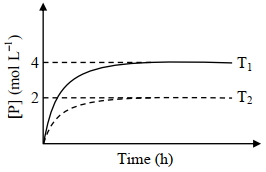
In a one-litre flask,$6$ moles of $A$ undergoes the reaction $A_{(g)} \rightleftharpoons P_{(g)}$. The progress of product formation at two temperatures (in Kelvin),$T_1$ and $T_2$,is shown in the figure:
If $T_1=2 T_2$ and $(\Delta G_2^{\Theta}-\Delta G_1^{\Theta})=R T_2 \ln x$,then the value of $x$ is. . . . .
$[\Delta G_1^{\Theta}$ and $\Delta G_2^{\Theta}$ are standard Gibb's free energy change for the reaction at temperatures $T_1$ and $T_2$,respectively.]
If $T_1=2 T_2$ and $(\Delta G_2^{\Theta}-\Delta G_1^{\Theta})=R T_2 \ln x$,then the value of $x$ is. . . . .
$[\Delta G_1^{\Theta}$ and $\Delta G_2^{\Theta}$ are standard Gibb's free energy change for the reaction at temperatures $T_1$ and $T_2$,respectively.]
A
$4$
B
$5$
C
$8$
D
$7$
Solution
(C) At $T_1 \text{ K}$: $A_{(g)} \rightleftharpoons P_{(g)}$
$t=0$: $6 \quad 0$
$t=\infty$: $6-4=2 \quad 4$ (from plot)
$\Rightarrow K_{c_1} = \frac{4}{2} = 2$
At $T_2 \text{ K}$: $A_{(g)} \rightleftharpoons P_{(g)}$
$t=0$: $6 \quad 0$
$t=\infty$: $6-2=4 \quad 2$ (from plot)
$\Rightarrow K_{c_2} = \frac{2}{4} = \frac{1}{2}$
Since $\Delta n_g = 0$,$K_p = K_c$.
$\Delta G_2^{\Theta} = -RT_2 \ln K_{p_2} = -RT_2 \ln \frac{1}{2} = RT_2 \ln 2$
$\Delta G_1^{\Theta} = -RT_1 \ln K_{p_1} = -R(2T_2) \ln 2 = -2RT_2 \ln 2$
$\Delta G_2^{\Theta} - \Delta G_1^{\Theta} = RT_2 \ln 2 - (-2RT_2 \ln 2) = 3RT_2 \ln 2 = RT_2 \ln 2^3 = RT_2 \ln 8$
Given $\Delta G_2^{\Theta} - \Delta G_1^{\Theta} = RT_2 \ln x$,therefore $x = 8$.
$t=0$: $6 \quad 0$
$t=\infty$: $6-4=2 \quad 4$ (from plot)
$\Rightarrow K_{c_1} = \frac{4}{2} = 2$
At $T_2 \text{ K}$: $A_{(g)} \rightleftharpoons P_{(g)}$
$t=0$: $6 \quad 0$
$t=\infty$: $6-2=4 \quad 2$ (from plot)
$\Rightarrow K_{c_2} = \frac{2}{4} = \frac{1}{2}$
Since $\Delta n_g = 0$,$K_p = K_c$.
$\Delta G_2^{\Theta} = -RT_2 \ln K_{p_2} = -RT_2 \ln \frac{1}{2} = RT_2 \ln 2$
$\Delta G_1^{\Theta} = -RT_1 \ln K_{p_1} = -R(2T_2) \ln 2 = -2RT_2 \ln 2$
$\Delta G_2^{\Theta} - \Delta G_1^{\Theta} = RT_2 \ln 2 - (-2RT_2 \ln 2) = 3RT_2 \ln 2 = RT_2 \ln 2^3 = RT_2 \ln 8$
Given $\Delta G_2^{\Theta} - \Delta G_1^{\Theta} = RT_2 \ln x$,therefore $x = 8$.
0 likes
View Solution223
EasyMCQ
For a reaction taking place in a container in equilibrium with its surroundings,the effect of temperature on its equilibrium constant $K$ in terms of change in entropy is described by:
A
$[A]$ With increase in temperature,the value of $K$ for exothermic reaction decreases because entropy change of the system is positive
B
$[B]$ With increase in temperature,the value of $K$ for endothermic reaction increases because unfavourable change in entropy of the surroundings decreases
C
$[C]$ With increase in temperature,the value of $K$ for endothermic reaction increases because the entropy change of the system is negative
D
$[D]$ With increase in temperature,the value of $K$ for exothermic reaction decreases because favourable change in entropy of the surrounding decreases
Solution
(B, D) The relationship between the equilibrium constant $K$ and temperature is given by the van't Hoff equation: $\ln K = -\frac{\Delta H^\circ}{RT} + \frac{\Delta S^\circ}{R}$.
For an endothermic reaction $(\Delta H > 0)$,increasing temperature increases $K$ because the entropy of the surroundings $(\Delta S_{surr} = -\frac{\Delta H}{T})$ becomes less negative (less unfavourable).
For an exothermic reaction $(\Delta H < 0)$,increasing temperature decreases $K$ because the entropy of the surroundings $(\Delta S_{surr} = -\frac{\Delta H}{T})$ becomes less positive (less favourable).
Thus,statements $[B]$ and $[D]$ correctly describe the effect of temperature on $K$ in terms of entropy changes of the surroundings.
For an endothermic reaction $(\Delta H > 0)$,increasing temperature increases $K$ because the entropy of the surroundings $(\Delta S_{surr} = -\frac{\Delta H}{T})$ becomes less negative (less unfavourable).
For an exothermic reaction $(\Delta H < 0)$,increasing temperature decreases $K$ because the entropy of the surroundings $(\Delta S_{surr} = -\frac{\Delta H}{T})$ becomes less positive (less favourable).
Thus,statements $[B]$ and $[D]$ correctly describe the effect of temperature on $K$ in terms of entropy changes of the surroundings.
0 likes
View Solution224
AdvancedMCQ
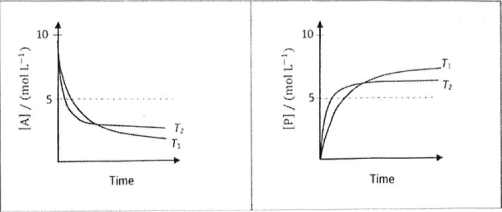
For a reaction,$A \rightleftharpoons P$,the plots of $[A]$ and $[P]$ with time at temperatures $T_1$ and $T_2$ are given below. If $T_2 > T_1$,the correct statement$(s)$ is (are) (Assume $\Delta H^{\ominus}$ and $\Delta S^{\ominus}$ are independent of temperature and ratio of $\ln K$ at $T_1$ to $\ln K$ at $T_2$ is greater than $T_2 / T_1$. Here $H, S, G$ and $K$ are enthalpy,entropy,Gibbs energy and equilibrium constant,respectively.)
$(A)$ $\Delta H^{\ominus} < 0, \Delta S^{\ominus} < 0$
$(B)$ $\Delta G^{\ominus} < 0, \Delta H^{\ominus} > 0$
$(C)$ $\Delta G^{\ominus} < 0, \Delta S^{\ominus} < 0$
$(D)$ $\Delta G^{\ominus} < 0, \Delta S^{\ominus} > 0$
$(A)$ $\Delta H^{\ominus} < 0, \Delta S^{\ominus} < 0$
$(B)$ $\Delta G^{\ominus} < 0, \Delta H^{\ominus} > 0$
$(C)$ $\Delta G^{\ominus} < 0, \Delta S^{\ominus} < 0$
$(D)$ $\Delta G^{\ominus} < 0, \Delta S^{\ominus} > 0$
A
$A, B$
B
$A, C$
C
$A, D$
D
$A, B, C$
Solution
(B) From the graphs,at equilibrium,$[P]_{T_1} > [P]_{T_2}$ and $[A]_{T_1} < [A]_{T_2}$.
Since $K = [P]/[A]$,we have $K_1 > K_2$ at $T_1 < T_2$. This indicates the reaction is exothermic,so $\Delta H^{\ominus} < 0$.
Since the reaction proceeds spontaneously to form product,$\Delta G^{\ominus} < 0$.
Given $\frac{\ln K_1}{\ln K_2} > \frac{T_2}{T_1}$,where $\ln K = \frac{\Delta S^{\ominus}}{R} - \frac{\Delta H^{\ominus}}{RT}$.
Substituting this,we get $\frac{\Delta S^{\ominus} - \Delta H^{\ominus}/T_1}{\Delta S^{\ominus} - \Delta H^{\ominus}/T_2} > \frac{T_2}{T_1}$.
Since $\Delta H^{\ominus} < 0$,let $\Delta H^{\ominus} = -|\Delta H^{\ominus}|$. The inequality simplifies to $(T_2 - T_1) \frac{\Delta S^{\ominus}}{R} < 0$. Since $T_2 > T_1$,we must have $\Delta S^{\ominus} < 0$.
Thus,$\Delta H^{\ominus} < 0, \Delta S^{\ominus} < 0$ (Option $A$) and $\Delta G^{\ominus} < 0, \Delta S^{\ominus} < 0$ (Option $C$) are correct.
Since $K = [P]/[A]$,we have $K_1 > K_2$ at $T_1 < T_2$. This indicates the reaction is exothermic,so $\Delta H^{\ominus} < 0$.
Since the reaction proceeds spontaneously to form product,$\Delta G^{\ominus} < 0$.
Given $\frac{\ln K_1}{\ln K_2} > \frac{T_2}{T_1}$,where $\ln K = \frac{\Delta S^{\ominus}}{R} - \frac{\Delta H^{\ominus}}{RT}$.
Substituting this,we get $\frac{\Delta S^{\ominus} - \Delta H^{\ominus}/T_1}{\Delta S^{\ominus} - \Delta H^{\ominus}/T_2} > \frac{T_2}{T_1}$.
Since $\Delta H^{\ominus} < 0$,let $\Delta H^{\ominus} = -|\Delta H^{\ominus}|$. The inequality simplifies to $(T_2 - T_1) \frac{\Delta S^{\ominus}}{R} < 0$. Since $T_2 > T_1$,we must have $\Delta S^{\ominus} < 0$.
Thus,$\Delta H^{\ominus} < 0, \Delta S^{\ominus} < 0$ (Option $A$) and $\Delta G^{\ominus} < 0, \Delta S^{\ominus} < 0$ (Option $C$) are correct.
0 likes
View Solution225
AdvancedMCQ
The surface of copper gets tarnished by the formation of copper oxide. $N_2$ gas was passed to prevent the oxide formation during heating of copper at $1250 \ K$. However,the $N_2$ gas contains $1 \ \text{mole}\%$ of water vapour as impurity. The water vapour oxidises copper as per the reaction given below:
$2 Cu_{(s)} + H_2O_{(g)} \longrightarrow Cu_2O_{(s)} + H_{2(g)}$
$p_{H_2}$ is the minimum partial pressure of $H_2$ (in $\text{bar}$) needed to prevent the oxidation at $1250 \ K$. The value of $\ln(p_{H_2})$ is . . . . .
(Given: total pressure $= 1 \ \text{bar}$,$R = 8 \ J \ K^{-1} \ mol^{-1}$,$\ln(10) = 2.3$. $Cu_{(s)}$ and $Cu_2O_{(s)}$ are mutually immiscible.
At $1250 \ K$: $2 Cu_{(s)} + 1/2 O_{2(g)} \longrightarrow Cu_2O_{(s)}; \Delta G^\theta = -78,000 \ J \ mol^{-1}$
$H_{2(g)} + 1/2 O_{2(g)} \longrightarrow H_2O_{(g)}; \Delta G^\theta = -1,78,000 \ J \ mol^{-1}$)
$2 Cu_{(s)} + H_2O_{(g)} \longrightarrow Cu_2O_{(s)} + H_{2(g)}$
$p_{H_2}$ is the minimum partial pressure of $H_2$ (in $\text{bar}$) needed to prevent the oxidation at $1250 \ K$. The value of $\ln(p_{H_2})$ is . . . . .
(Given: total pressure $= 1 \ \text{bar}$,$R = 8 \ J \ K^{-1} \ mol^{-1}$,$\ln(10) = 2.3$. $Cu_{(s)}$ and $Cu_2O_{(s)}$ are mutually immiscible.
At $1250 \ K$: $2 Cu_{(s)} + 1/2 O_{2(g)} \longrightarrow Cu_2O_{(s)}; \Delta G^\theta = -78,000 \ J \ mol^{-1}$
$H_{2(g)} + 1/2 O_{2(g)} \longrightarrow H_2O_{(g)}; \Delta G^\theta = -1,78,000 \ J \ mol^{-1}$)
A
$-13.60$
B
$-14.50$
C
$-14.60$
D
$-14.70$
Solution
(C) The given reactions are:
$(i) 2 Cu_{(s)} + 1/2 O_{2(g)} \longrightarrow Cu_2O_{(s)}; \Delta G_1^\theta = -78,000 \ J \ mol^{-1}$
$(ii) H_{2(g)} + 1/2 O_{2(g)} \longrightarrow H_2O_{(g)}; \Delta G_2^\theta = -1,78,000 \ J \ mol^{-1}$
Subtracting $(ii)$ from $(i)$ gives the target reaction:
$2 Cu_{(s)} + H_2O_{(g)} \longrightarrow Cu_2O_{(s)} + H_{2(g)}$
$\Delta G^\theta = \Delta G_1^\theta - \Delta G_2^\theta = -78,000 - (-1,78,000) = 1,00,000 \ J \ mol^{-1}$
To prevent oxidation,$\Delta G \ge 0$. At the threshold (minimum $p_{H_2}$):
$\Delta G = \Delta G^\theta + RT \ln Q = 0$
$1,00,000 + (8 \times 1250) \ln \left( \frac{p_{H_2}}{p_{H_2O}} \right) = 0$
$1,00,000 + 10,000 \ln \left( \frac{p_{H_2}}{p_{H_2O}} \right) = 0$
$10 + \ln(p_{H_2}) - \ln(p_{H_2O}) = 0$
$\ln(p_{H_2}) = \ln(p_{H_2O}) - 10$
Given $p_{H_2O} = 1\% \text{ of } 1 \ \text{bar} = 0.01 \ \text{bar} = 10^{-2} \ \text{bar}$.
$\ln(p_{H_2O}) = \ln(10^{-2}) = -2 \ln(10) = -2 \times 2.3 = -4.6$.
$\ln(p_{H_2}) = -4.6 - 10 = -14.6$.
$(i) 2 Cu_{(s)} + 1/2 O_{2(g)} \longrightarrow Cu_2O_{(s)}; \Delta G_1^\theta = -78,000 \ J \ mol^{-1}$
$(ii) H_{2(g)} + 1/2 O_{2(g)} \longrightarrow H_2O_{(g)}; \Delta G_2^\theta = -1,78,000 \ J \ mol^{-1}$
Subtracting $(ii)$ from $(i)$ gives the target reaction:
$2 Cu_{(s)} + H_2O_{(g)} \longrightarrow Cu_2O_{(s)} + H_{2(g)}$
$\Delta G^\theta = \Delta G_1^\theta - \Delta G_2^\theta = -78,000 - (-1,78,000) = 1,00,000 \ J \ mol^{-1}$
To prevent oxidation,$\Delta G \ge 0$. At the threshold (minimum $p_{H_2}$):
$\Delta G = \Delta G^\theta + RT \ln Q = 0$
$1,00,000 + (8 \times 1250) \ln \left( \frac{p_{H_2}}{p_{H_2O}} \right) = 0$
$1,00,000 + 10,000 \ln \left( \frac{p_{H_2}}{p_{H_2O}} \right) = 0$
$10 + \ln(p_{H_2}) - \ln(p_{H_2O}) = 0$
$\ln(p_{H_2}) = \ln(p_{H_2O}) - 10$
Given $p_{H_2O} = 1\% \text{ of } 1 \ \text{bar} = 0.01 \ \text{bar} = 10^{-2} \ \text{bar}$.
$\ln(p_{H_2O}) = \ln(10^{-2}) = -2 \ln(10) = -2 \times 2.3 = -4.6$.
$\ln(p_{H_2}) = -4.6 - 10 = -14.6$.
0 likes
View Solution226
MediumMCQ
For the following reaction,the equilibrium constant $K_{c}$ at $298 \ K$ is $1.6 \times 10^{17}$.
$Fe^{2+}_{(aq)} + S^{2-}_{(aq)} \rightleftharpoons FeS_{(s)}$
When equal volumes of $0.06 \ M \ Fe^{2+}_{(aq)}$ and $0.2 \ M \ S^{2-}_{(aq)}$ solutions are mixed,the equilibrium concentration of $Fe^{2+}_{(aq)}$ is found to be $Y \times 10^{-17} \ M$. The value of $Y$ is. . . . .
$Fe^{2+}_{(aq)} + S^{2-}_{(aq)} \rightleftharpoons FeS_{(s)}$
When equal volumes of $0.06 \ M \ Fe^{2+}_{(aq)}$ and $0.2 \ M \ S^{2-}_{(aq)}$ solutions are mixed,the equilibrium concentration of $Fe^{2+}_{(aq)}$ is found to be $Y \times 10^{-17} \ M$. The value of $Y$ is. . . . .
A
$8.80$
B
$8.85$
C
$8.93$
D
$8.95$
Solution
(C) The reaction is $Fe^{2+}_{(aq)} + S^{2-}_{(aq)} \rightleftharpoons FeS_{(s)}$.
Since equal volumes are mixed,the new concentrations are $0.03 \ M \ Fe^{2+}$ and $0.1 \ M \ S^{2-}$.
Given $K_{c} = 1.6 \times 10^{17}$,which is very large,the reaction proceeds almost to completion.
Let $y$ be the equilibrium concentration of $Fe^{2+}_{(aq)}$.
Initial concentrations: $[Fe^{2+}] = 0.03 \ M$,$[S^{2-}] = 0.1 \ M$.
At equilibrium: $[Fe^{2+}] = y$,$[S^{2-}] = 0.1 - 0.03 = 0.07 \ M$.
$K_{c} = \frac{1}{[Fe^{2+}][S^{2-}]} = \frac{1}{y \times 0.07} = 1.6 \times 10^{17}$.
$y = \frac{1}{1.6 \times 0.07} \times 10^{-17} = \frac{1}{0.112} \times 10^{-17} \approx 8.928 \times 10^{-17} \ M$.
Thus,$Y \approx 8.93$.
Since equal volumes are mixed,the new concentrations are $0.03 \ M \ Fe^{2+}$ and $0.1 \ M \ S^{2-}$.
Given $K_{c} = 1.6 \times 10^{17}$,which is very large,the reaction proceeds almost to completion.
Let $y$ be the equilibrium concentration of $Fe^{2+}_{(aq)}$.
Initial concentrations: $[Fe^{2+}] = 0.03 \ M$,$[S^{2-}] = 0.1 \ M$.
At equilibrium: $[Fe^{2+}] = y$,$[S^{2-}] = 0.1 - 0.03 = 0.07 \ M$.
$K_{c} = \frac{1}{[Fe^{2+}][S^{2-}]} = \frac{1}{y \times 0.07} = 1.6 \times 10^{17}$.
$y = \frac{1}{1.6 \times 0.07} \times 10^{-17} = \frac{1}{0.112} \times 10^{-17} \approx 8.928 \times 10^{-17} \ M$.
Thus,$Y \approx 8.93$.
0 likes
View Solution227
AdvancedMCQ
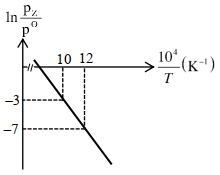
For the reaction $X(s) \rightleftharpoons Y(s) + Z(g)$,the plot of $\ln \frac{p_z}{p^\ominus}$ versus $\frac{10^4}{T}$ is given below,where $p_z$ is the pressure (in bar) of the gas $Z$ at temperature $T$ and $p^\ominus = 1 \ bar$.
(Given,$\frac{d(\ln K)}{d(\frac{1}{T})} = -\frac{\Delta H^\ominus}{R}$,where the equilibrium constant,$K = \frac{p_z}{p^\ominus}$ and the gas constant,$R = 8.314 \ J \ K^{-1} \ mol^{-1}$)
$(1)$ The value of standard enthalpy,$\Delta H^\ominus$ (in $kJ \ mol^{-1}$) for the reaction is. . . . . . .
$(2)$ The value of $\Delta S^\ominus$ (in $J \ K^{-1} \ mol^{-1}$) for the given reaction,at $1000 \ K$ is. . . . . .
Give the answer for $(1)$ and $(2)$
(Given,$\frac{d(\ln K)}{d(\frac{1}{T})} = -\frac{\Delta H^\ominus}{R}$,where the equilibrium constant,$K = \frac{p_z}{p^\ominus}$ and the gas constant,$R = 8.314 \ J \ K^{-1} \ mol^{-1}$)
$(1)$ The value of standard enthalpy,$\Delta H^\ominus$ (in $kJ \ mol^{-1}$) for the reaction is. . . . . . .
$(2)$ The value of $\Delta S^\ominus$ (in $J \ K^{-1} \ mol^{-1}$) for the given reaction,at $1000 \ K$ is. . . . . .
Give the answer for $(1)$ and $(2)$
A
$164.28, 141.32$
B
$166.28, 141.33$
C
$160.28, 141.35$
D
$166.28, 141.34$
Solution
(D) $(1)$ The equilibrium constant $K = \frac{p_z}{p^\ominus}$. The van't Hoff equation is $\ln K = -\frac{\Delta H^\ominus}{RT} + \frac{\Delta S^\ominus}{R}$.
The slope of the plot of $\ln K$ versus $\frac{10^4}{T}$ is given by:
Slope $= \frac{-7 - (-3)}{12 - 10} \times 10^4 = \frac{-4}{2} \times 10^4 = -2 \times 10^4 \ K$.
From the equation,Slope $= -\frac{\Delta H^\ominus}{R} \times 10^{-4}$ (since the x-axis is $\frac{10^4}{T}$).
So,$-\frac{\Delta H^\ominus}{R} \times 10^{-4} = -2 \times 10^4 \implies \Delta H^\ominus = 2 \times 10^8 \times R \times 10^{-4} = 2 \times 10^4 \times 8.314 = 166280 \ J \ mol^{-1} = 166.28 \ kJ \ mol^{-1}$.
$(2)$ At $T = 1000 \ K$,$\frac{10^4}{T} = 10$. From the graph,$\ln K = -3$.
Using $\ln K = -\frac{\Delta H^\ominus}{RT} + \frac{\Delta S^\ominus}{R}$:
$-3 = -\frac{166280}{8.314 \times 1000} + \frac{\Delta S^\ominus}{8.314}$
$-3 = -20 + \frac{\Delta S^\ominus}{8.314}$
$\frac{\Delta S^\ominus}{8.314} = 17 \implies \Delta S^\ominus = 17 \times 8.314 = 141.338 \approx 141.34 \ J \ K^{-1} \ mol^{-1}$.
The slope of the plot of $\ln K$ versus $\frac{10^4}{T}$ is given by:
Slope $= \frac{-7 - (-3)}{12 - 10} \times 10^4 = \frac{-4}{2} \times 10^4 = -2 \times 10^4 \ K$.
From the equation,Slope $= -\frac{\Delta H^\ominus}{R} \times 10^{-4}$ (since the x-axis is $\frac{10^4}{T}$).
So,$-\frac{\Delta H^\ominus}{R} \times 10^{-4} = -2 \times 10^4 \implies \Delta H^\ominus = 2 \times 10^8 \times R \times 10^{-4} = 2 \times 10^4 \times 8.314 = 166280 \ J \ mol^{-1} = 166.28 \ kJ \ mol^{-1}$.
$(2)$ At $T = 1000 \ K$,$\frac{10^4}{T} = 10$. From the graph,$\ln K = -3$.
Using $\ln K = -\frac{\Delta H^\ominus}{RT} + \frac{\Delta S^\ominus}{R}$:
$-3 = -\frac{166280}{8.314 \times 1000} + \frac{\Delta S^\ominus}{8.314}$
$-3 = -20 + \frac{\Delta S^\ominus}{8.314}$
$\frac{\Delta S^\ominus}{8.314} = 17 \implies \Delta S^\ominus = 17 \times 8.314 = 141.338 \approx 141.34 \ J \ K^{-1} \ mol^{-1}$.
0 likes
View Solution228
DifficultMCQ
The thermal dissociation equilibrium of $CaCO_{3(s)}$ is studied under different conditions.
$CaCO_{3(s)} \rightleftharpoons CaO_{(s)} + CO_{2(g)}$
For this equilibrium,the correct statement$(s)$ is (are):
$(A)$ $\Delta H$ is dependent on $T$
$(B)$ $K$ is independent of the initial amount of $CaCO_{3}$
$(C)$ $K$ is dependent on the pressure of $CO_{2}$ at a given $T$
$(D)$ $\Delta H$ is independent of the catalyst,if any
$CaCO_{3(s)} \rightleftharpoons CaO_{(s)} + CO_{2(g)}$
For this equilibrium,the correct statement$(s)$ is (are):
$(A)$ $\Delta H$ is dependent on $T$
$(B)$ $K$ is independent of the initial amount of $CaCO_{3}$
$(C)$ $K$ is dependent on the pressure of $CO_{2}$ at a given $T$
$(D)$ $\Delta H$ is independent of the catalyst,if any
A
$(A, B, C)$
B
$(A, B, D)$
C
$(A, C, D)$
D
$(B, C, D)$
Solution
(B) According to Kirchhoff's law,$\Delta H_{T_2} - \Delta H_{T_1} = \int_{T_1}^{T_2} \Delta C_p \, dT$. Since the heat capacity change $\Delta C_p$ is generally non-zero,$\Delta H$ depends on temperature $T$.
$(B)$ The equilibrium constant $K$ for a heterogeneous reaction depends only on temperature and is independent of the initial amounts of solid reactants or products.
$(C)$ $K$ is a constant at a fixed temperature; it does not depend on the partial pressure of $CO_2$. The partial pressure of $CO_2$ at equilibrium is equal to $K_p$,which is fixed for a given $T$.
$(D)$ $A$ catalyst provides an alternative pathway with a lower activation energy but does not change the enthalpy of reaction $(\Delta H)$ or the equilibrium constant $(K)$.
$(B)$ The equilibrium constant $K$ for a heterogeneous reaction depends only on temperature and is independent of the initial amounts of solid reactants or products.
$(C)$ $K$ is a constant at a fixed temperature; it does not depend on the partial pressure of $CO_2$. The partial pressure of $CO_2$ at equilibrium is equal to $K_p$,which is fixed for a given $T$.
$(D)$ $A$ catalyst provides an alternative pathway with a lower activation energy but does not change the enthalpy of reaction $(\Delta H)$ or the equilibrium constant $(K)$.
0 likes
View Solution229
DifficultMCQ
$A$ vessel at $1000 \ K$ contains $CO_2$ with a pressure of $0.5 \ atm$. Some of $CO_2$ is converted into $CO$ on addition of graphite. If total pressure at equilibrium is $0.8 \ atm$,then $K_P$ is : (in $atm$)
A
$0.18$
B
$1.8$
C
$0.3$
D
$3$
Solution
(B) The chemical reaction is: $CO_{2(g)} + C_{(s)} \rightleftharpoons 2CO_{(g)}$
Initially,the pressure of $CO_2$ is $0.5 \ atm$.
Let $x \ atm$ be the pressure of $CO_2$ that reacts.
At equilibrium,the partial pressures are: $P_{CO_2} = (0.5 - x) \ atm$ and $P_{CO} = 2x \ atm$.
The total pressure at equilibrium is given as $0.8 \ atm$.
$P_{\text{total}} = P_{CO_2} + P_{CO} = (0.5 - x) + 2x = 0.5 + x = 0.8 \ atm$.
Solving for $x$,we get $x = 0.3 \ atm$.
Now,calculate $K_P$:
$K_P = \frac{(P_{CO})^2}{P_{CO_2}} = \frac{(2x)^2}{(0.5 - x)} = \frac{(2 \times 0.3)^2}{(0.5 - 0.3)} = \frac{(0.6)^2}{0.2} = \frac{0.36}{0.2} = 1.8 \ atm$.
Initially,the pressure of $CO_2$ is $0.5 \ atm$.
Let $x \ atm$ be the pressure of $CO_2$ that reacts.
At equilibrium,the partial pressures are: $P_{CO_2} = (0.5 - x) \ atm$ and $P_{CO} = 2x \ atm$.
The total pressure at equilibrium is given as $0.8 \ atm$.
$P_{\text{total}} = P_{CO_2} + P_{CO} = (0.5 - x) + 2x = 0.5 + x = 0.8 \ atm$.
Solving for $x$,we get $x = 0.3 \ atm$.
Now,calculate $K_P$:
$K_P = \frac{(P_{CO})^2}{P_{CO_2}} = \frac{(2x)^2}{(0.5 - x)} = \frac{(2 \times 0.3)^2}{(0.5 - 0.3)} = \frac{(0.6)^2}{0.2} = \frac{0.36}{0.2} = 1.8 \ atm$.
0 likes
View Solution230
MediumMCQ
$37.8 \ g$ $N_2O_5$ was taken in a $1 \ L$ reaction vessel and allowed to undergo the following reaction at $500 \ K$:
$2N_2O_{5(g)} \rightarrow 2N_2O_{4(g)} + O_{2(g)}$
The total pressure at equilibrium was found to be $18.65 \ bar$. Then,$K_p = \text{ . . . . . . } \times 10^{-2}$ [nearest integer].
Assume $N_2O_5$ to behave ideally under these conditions.
Given: $R = 0.082 \ bar \ L \ mol^{-1} \ K^{-1}$
$2N_2O_{5(g)} \rightarrow 2N_2O_{4(g)} + O_{2(g)}$
The total pressure at equilibrium was found to be $18.65 \ bar$. Then,$K_p = \text{ . . . . . . } \times 10^{-2}$ [nearest integer].
Assume $N_2O_5$ to behave ideally under these conditions.
Given: $R = 0.082 \ bar \ L \ mol^{-1} \ K^{-1}$
A
$962$
B
$956$
C
$854$
D
$743$
Solution
(A) Initial moles of $N_2O_5 = \frac{37.8 \ g}{108 \ g/mol} = 0.35 \ mol$.
Initial pressure $P_0 = \frac{nRT}{V} = \frac{0.35 \times 0.082 \times 500}{1} = 14.35 \ bar$.
Reaction: $2N_2O_{5(g)} \rightleftharpoons 2N_2O_{4(g)} + O_{2(g)}$
At $t=0$: $P_0 = 14.35 \ bar$,$0$,$0$
At equilibrium: $(14.35 - 2P)$,$2P$,$P$
Total pressure at equilibrium: $(14.35 - 2P) + 2P + P = 14.35 + P = 18.65 \ bar$.
Therefore,$P = 18.65 - 14.35 = 4.3 \ bar$.
Equilibrium partial pressures:
$P_{N_2O_5} = 14.35 - 2(4.3) = 14.35 - 8.6 = 5.75 \ bar$.
$P_{N_2O_4} = 2(4.3) = 8.6 \ bar$.
$P_{O_2} = 4.3 \ bar$.
$K_p = \frac{(P_{N_2O_4})^2 \times (P_{O_2})}{(P_{N_2O_5})^2} = \frac{(8.6)^2 \times 4.3}{(5.75)^2} = \frac{73.96 \times 4.3}{33.0625} = \frac{318.028}{33.0625} \approx 9.619$.
$K_p = 9.619 = 961.9 \times 10^{-2} \approx 962 \times 10^{-2}$.
Initial pressure $P_0 = \frac{nRT}{V} = \frac{0.35 \times 0.082 \times 500}{1} = 14.35 \ bar$.
Reaction: $2N_2O_{5(g)} \rightleftharpoons 2N_2O_{4(g)} + O_{2(g)}$
At $t=0$: $P_0 = 14.35 \ bar$,$0$,$0$
At equilibrium: $(14.35 - 2P)$,$2P$,$P$
Total pressure at equilibrium: $(14.35 - 2P) + 2P + P = 14.35 + P = 18.65 \ bar$.
Therefore,$P = 18.65 - 14.35 = 4.3 \ bar$.
Equilibrium partial pressures:
$P_{N_2O_5} = 14.35 - 2(4.3) = 14.35 - 8.6 = 5.75 \ bar$.
$P_{N_2O_4} = 2(4.3) = 8.6 \ bar$.
$P_{O_2} = 4.3 \ bar$.
$K_p = \frac{(P_{N_2O_4})^2 \times (P_{O_2})}{(P_{N_2O_5})^2} = \frac{(8.6)^2 \times 4.3}{(5.75)^2} = \frac{73.96 \times 4.3}{33.0625} = \frac{318.028}{33.0625} \approx 9.619$.
$K_p = 9.619 = 961.9 \times 10^{-2} \approx 962 \times 10^{-2}$.
0 likes
View Solution231
DifficultMCQ
For the reaction,$H_{2(g)} + I_{2(g)} \rightleftharpoons 2 HI_{(g)}$,the attainment of equilibrium is predicted correctly by:
A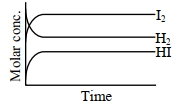
B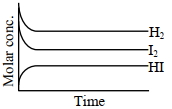
C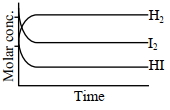
D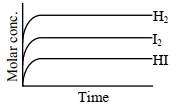
Solution
(A) For the reaction $H_{2(g)} + I_{2(g)} \rightleftharpoons 2 HI_{(g)}$,the reactants $H_2$ and $I_2$ are consumed to form the product $HI$.
Therefore,the molar concentration of reactants ($H_2$ and $I_2$) decreases over time until equilibrium is reached.
Simultaneously,the molar concentration of the product $(HI)$ increases over time until equilibrium is reached.
Once equilibrium is attained,the concentrations of all reactants and products remain constant over time.
This behavior is correctly represented by the graph where the curves for $H_2$ and $I_2$ show a downward trend and the curve for $HI$ shows an upward trend,all leveling off at the same time.
Therefore,the molar concentration of reactants ($H_2$ and $I_2$) decreases over time until equilibrium is reached.
Simultaneously,the molar concentration of the product $(HI)$ increases over time until equilibrium is reached.
Once equilibrium is attained,the concentrations of all reactants and products remain constant over time.
This behavior is correctly represented by the graph where the curves for $H_2$ and $I_2$ show a downward trend and the curve for $HI$ shows an upward trend,all leveling off at the same time.
0 likes
View Solution232
MediumMCQ
Consider the following chemical equilibrium of the gas phase reaction at a constant temperature: $A_{(g)} \rightleftharpoons B_{(g)} + C_{(g)}$. If $p$ is the total pressure,$K_p$ is the equilibrium constant,and $\alpha$ is the degree of dissociation,then which of the following is true at equilibrium?
A
If $p$ value is extremely high compared to $K_p, \alpha \approx 1$
B
When $p$ increases,$\alpha$ decreases
C
If $K_p$ value is extremely high compared to $p, \alpha$ becomes much less than unity
D
When $p$ increases,$\alpha$ increases
Solution
(B) For the reaction $A_{(g)} \rightleftharpoons B_{(g)} + C_{(g)}$:
Initial moles: $A=1, B=0, C=0$
At equilibrium: $A=1-\alpha, B=\alpha, C=\alpha$
Total moles $= (1-\alpha) + \alpha + \alpha = 1+\alpha$
Partial pressures: $P_A = \frac{1-\alpha}{1+\alpha} p, P_B = \frac{\alpha}{1+\alpha} p, P_C = \frac{\alpha}{1+\alpha} p$
$K_p = \frac{P_B \cdot P_C}{P_A} = \frac{(\frac{\alpha}{1+\alpha} p) (\frac{\alpha}{1+\alpha} p)}{\frac{1-\alpha}{1+\alpha} p} = \frac{\alpha^2 p}{1-\alpha^2}$
Rearranging for $\alpha$: $\alpha^2 p = K_p - K_p \alpha^2$ $\Rightarrow \alpha^2(p+K_p) = K_p$ $\Rightarrow \alpha = \sqrt{\frac{K_p}{p+K_p}}$
This expression shows that as the total pressure $p$ increases,the degree of dissociation $\alpha$ decreases.
Initial moles: $A=1, B=0, C=0$
At equilibrium: $A=1-\alpha, B=\alpha, C=\alpha$
Total moles $= (1-\alpha) + \alpha + \alpha = 1+\alpha$
Partial pressures: $P_A = \frac{1-\alpha}{1+\alpha} p, P_B = \frac{\alpha}{1+\alpha} p, P_C = \frac{\alpha}{1+\alpha} p$
$K_p = \frac{P_B \cdot P_C}{P_A} = \frac{(\frac{\alpha}{1+\alpha} p) (\frac{\alpha}{1+\alpha} p)}{\frac{1-\alpha}{1+\alpha} p} = \frac{\alpha^2 p}{1-\alpha^2}$
Rearranging for $\alpha$: $\alpha^2 p = K_p - K_p \alpha^2$ $\Rightarrow \alpha^2(p+K_p) = K_p$ $\Rightarrow \alpha = \sqrt{\frac{K_p}{p+K_p}}$
This expression shows that as the total pressure $p$ increases,the degree of dissociation $\alpha$ decreases.
0 likes
View Solution233
MediumMCQ
Given below are two statements:
Statement $I$: $A$ catalyst cannot alter the equilibrium constant $(K_{C})$ of the reaction,temperature remaining constant.
Statement $II$: $A$ homogenous catalyst can change the equilibrium composition of a system,temperature remaining constant.
In the light of the above statements,choose the correct answer from the options given below:
Statement $I$: $A$ catalyst cannot alter the equilibrium constant $(K_{C})$ of the reaction,temperature remaining constant.
Statement $II$: $A$ homogenous catalyst can change the equilibrium composition of a system,temperature remaining constant.
In the light of the above statements,choose the correct answer from the options given below:
A
Statement $I$ is false but Statement $II$ is true
B
Both Statement $I$ and Statement $II$ are true
C
Both Statement $I$ and Statement $II$ are false
D
Statement $I$ is true but Statement $II$ is false
Solution
(D) catalyst provides an alternative pathway with lower activation energy for both the forward and backward reactions.
It increases the rate of both reactions equally,allowing the system to reach equilibrium faster.
However,it does not affect the equilibrium constant $(K_{C})$,which is a function of temperature only.
Therefore,Statement $I$ is true.
Statement $II$ is false because a catalyst does not change the equilibrium composition of a system at a constant temperature and pressure.
Thus,Statement $I$ is true but Statement $II$ is false.
It increases the rate of both reactions equally,allowing the system to reach equilibrium faster.
However,it does not affect the equilibrium constant $(K_{C})$,which is a function of temperature only.
Therefore,Statement $I$ is true.
Statement $II$ is false because a catalyst does not change the equilibrium composition of a system at a constant temperature and pressure.
Thus,Statement $I$ is true but Statement $II$ is false.
0 likes
View Solution234
MediumMCQ
Which of the following curves is correct?
A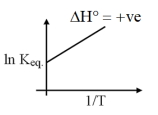
B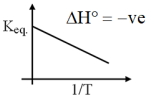
C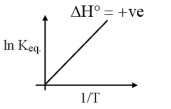
D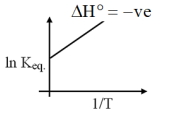
Solution
(D) The relationship between the equilibrium constant $K_{eq}$ and temperature $T$ is given by the van't Hoff equation: $\ln K_{eq} = -\frac{\Delta H^{\circ}}{R} \left( \frac{1}{T} \right) + \frac{\Delta S^{\circ}}{R}$.
Comparing this with the linear equation $y = mx + c$,where $y = \ln K_{eq}$,$x = 1/T$,slope $m = -\frac{\Delta H^{\circ}}{R}$,and intercept $c = \frac{\Delta S^{\circ}}{R}$.
For an endothermic reaction,$\Delta H^{\circ} > 0$,so the slope $m = -\frac{\Delta H^{\circ}}{R}$ is negative.
For an exothermic reaction,$\Delta H^{\circ} < 0$,so the slope $m = -\frac{\Delta H^{\circ}}{R}$ is positive.
Therefore,for $\Delta H^{\circ} = -ve$,the slope is positive,which matches the graph in option $(D)$.
Comparing this with the linear equation $y = mx + c$,where $y = \ln K_{eq}$,$x = 1/T$,slope $m = -\frac{\Delta H^{\circ}}{R}$,and intercept $c = \frac{\Delta S^{\circ}}{R}$.
For an endothermic reaction,$\Delta H^{\circ} > 0$,so the slope $m = -\frac{\Delta H^{\circ}}{R}$ is negative.
For an exothermic reaction,$\Delta H^{\circ} < 0$,so the slope $m = -\frac{\Delta H^{\circ}}{R}$ is positive.
Therefore,for $\Delta H^{\circ} = -ve$,the slope is positive,which matches the graph in option $(D)$.
0 likes
View Solution235
MediumMCQ
$2$ moles each of $A$ and $B$ were taken in a container and the following reaction takes place: $2 \ A_{(g)} + B_{(g)} \rightleftharpoons 2 \ C_{(g)} + D_{(g)}$. When the system attains equilibrium,which of the following is true?
A
$[A] > [B]$
B
$[A] < [B]$
C
$[A] = [B]$
D
Can't predict
Solution
(B) Initially,$2$ moles of both $A$ and $B$ are taken.
According to the stoichiometry of the reaction $2 \ A_{(g)} + B_{(g)} \rightleftharpoons 2 \ C_{(g)} + D_{(g)}$,$2$ moles of $A$ react with $1$ mole of $B$.
Since $A$ is consumed at twice the rate of $B$,the concentration of $A$ decreases faster than $B$.
Therefore,at any time during the reaction or at equilibrium,the concentration of $A$ will be less than the concentration of $B$,i.e.,$[A] < [B]$.
According to the stoichiometry of the reaction $2 \ A_{(g)} + B_{(g)} \rightleftharpoons 2 \ C_{(g)} + D_{(g)}$,$2$ moles of $A$ react with $1$ mole of $B$.
Since $A$ is consumed at twice the rate of $B$,the concentration of $A$ decreases faster than $B$.
Therefore,at any time during the reaction or at equilibrium,the concentration of $A$ will be less than the concentration of $B$,i.e.,$[A] < [B]$.
0 likes
View Solution236
MediumMCQ
Which of the following statements is/are wrong?
$(a)$ At equilibrium,concentrations of reactants and products become constant because the reaction stops.
$(b)$ Addition of catalyst speeds up the forward reaction more than the backward reaction.
$(c)$ Equilibrium constant of an exothermic reaction decreases with increase of temperature.
$(d)$ $K_p$ is always greater than $K_c$.
$(a)$ At equilibrium,concentrations of reactants and products become constant because the reaction stops.
$(b)$ Addition of catalyst speeds up the forward reaction more than the backward reaction.
$(c)$ Equilibrium constant of an exothermic reaction decreases with increase of temperature.
$(d)$ $K_p$ is always greater than $K_c$.
A
$a, b$
B
$b, c, d$
C
$a, b, d$
D
$a, c$
Solution
(C) Wrong: At equilibrium,the reaction does not stop; it is a dynamic process where the rate of forward reaction equals the rate of backward reaction.
$(b)$ Wrong: $A$ catalyst speeds up both the forward and backward reactions equally,reaching equilibrium faster without changing the equilibrium position.
$(c)$ Correct: According to Le Chatelier's principle,for an exothermic reaction,increasing temperature shifts the equilibrium to the left,decreasing the equilibrium constant $K$.
$(d)$ Wrong: $K_p = K_c(RT)^{\Delta n}$. $K_p$ can be less than,equal to,or greater than $K_c$ depending on the value of $\Delta n$.
$(b)$ Wrong: $A$ catalyst speeds up both the forward and backward reactions equally,reaching equilibrium faster without changing the equilibrium position.
$(c)$ Correct: According to Le Chatelier's principle,for an exothermic reaction,increasing temperature shifts the equilibrium to the left,decreasing the equilibrium constant $K$.
$(d)$ Wrong: $K_p = K_c(RT)^{\Delta n}$. $K_p$ can be less than,equal to,or greater than $K_c$ depending on the value of $\Delta n$.
0 likes
View Solution237
MediumMCQ
$A$ reaction mixture containing $H_2, N_2$ and $NH_3$ has partial pressures of $2 \ atm, 1 \ atm$ and $3 \ atm$ respectively at $725 \ K.$ If the value of $K_P$ for the reaction,$N_2(g) + 3H_2(g) \rightleftharpoons 2NH_3(g)$ is $4.28 \times 10^{-5} \ atm^{-2}$ at $725 \ K,$ in which direction will the net reaction proceed?
A
Forward
B
Backward
C
No net reaction
D
Direction of reaction cannot be predicted
Solution
(B) The reaction is $N_2(g) + 3H_2(g) \rightleftharpoons 2NH_3(g).$
The reaction quotient $Q_P$ is given by the expression: $Q_P = \frac{(P_{NH_3})^2}{(P_{N_2})(P_{H_2})^3}.$
Substituting the given partial pressures: $Q_P = \frac{(3)^2}{(1)(2)^3} = \frac{9}{8} = 1.125 \ atm^{-2}.$
Comparing $Q_P$ with $K_P$: $Q_P = 1.125$ and $K_P = 4.28 \times 10^{-5}.$
Since $Q_P > K_P,$ the reaction will proceed in the backward direction to reach equilibrium.
The reaction quotient $Q_P$ is given by the expression: $Q_P = \frac{(P_{NH_3})^2}{(P_{N_2})(P_{H_2})^3}.$
Substituting the given partial pressures: $Q_P = \frac{(3)^2}{(1)(2)^3} = \frac{9}{8} = 1.125 \ atm^{-2}.$
Comparing $Q_P$ with $K_P$: $Q_P = 1.125$ and $K_P = 4.28 \times 10^{-5}.$
Since $Q_P > K_P,$ the reaction will proceed in the backward direction to reach equilibrium.
0 likes
View Solution238
MediumMCQ
$N_2O_{4(g)}$ at $300 \ K$ is kept in a closed container under $1 \ atm$. At equilibrium,$20\%$ of $N_2O_{4(g)}$ is converted to $NO_{2(g)}$.
$N_2O_{4(g)} \rightleftharpoons 2NO_{2(g)}$
Hence,the resultant pressure is: (in $atm$)
$N_2O_{4(g)} \rightleftharpoons 2NO_{2(g)}$
Hence,the resultant pressure is: (in $atm$)
A
$1.2$
B
$2.4$
C
$2.0$
D
$1.0$
Solution
(A) The reaction is: $N_2O_{4(g)} \rightleftharpoons 2NO_{2(g)}$
Initial moles: $1 \ mol$ of $N_2O_4$ and $0 \ mol$ of $NO_2$.
At equilibrium,$20\%$ of $N_2O_4$ dissociates,so $0.2 \ mol$ is consumed.
Remaining moles of $N_2O_4 = 1 - 0.2 = 0.8 \ mol$.
Moles of $NO_2$ formed = $2 \times 0.2 = 0.4 \ mol$.
Total moles at equilibrium = $0.8 + 0.4 = 1.2 \ mol$.
Since $P \propto n$ (at constant $V$ and $T$),the ratio of total pressure to initial pressure is equal to the ratio of total moles to initial moles.
$P_{total} = P_{initial} \times \frac{n_{total}}{n_{initial}} = 1 \ atm \times \frac{1.2}{1} = 1.2 \ atm$.
Initial moles: $1 \ mol$ of $N_2O_4$ and $0 \ mol$ of $NO_2$.
At equilibrium,$20\%$ of $N_2O_4$ dissociates,so $0.2 \ mol$ is consumed.
Remaining moles of $N_2O_4 = 1 - 0.2 = 0.8 \ mol$.
Moles of $NO_2$ formed = $2 \times 0.2 = 0.4 \ mol$.
Total moles at equilibrium = $0.8 + 0.4 = 1.2 \ mol$.
Since $P \propto n$ (at constant $V$ and $T$),the ratio of total pressure to initial pressure is equal to the ratio of total moles to initial moles.
$P_{total} = P_{initial} \times \frac{n_{total}}{n_{initial}} = 1 \ atm \times \frac{1.2}{1} = 1.2 \ atm$.
0 likes
View Solution239
MediumMCQ
The reaction quotient $Q_{C}$ is useful in predicting the direction of the reaction. Which of the following is incorrect?
A
If $Q_{C} > K_{C}$,the reverse reaction is favoured
B
If $Q_{C} < K_{C}$,the forward reaction is favoured
C
If $Q_{C} = K_{C}$,forward reaction is favoured
D
If $Q_{C} > K_{C}$,forward reaction is favoured
Solution
(C, D) The reaction quotient $Q_{C}$ is compared with the equilibrium constant $K_{C}$ to determine the direction of the reaction:
$1$. If $Q_{C} > K_{C}$,the system has excess products,so the reverse reaction is favoured to reach equilibrium.
$2$. If $Q_{C} < K_{C}$,the system has excess reactants,so the forward reaction is favoured to reach equilibrium.
$3$. If $Q_{C} = K_{C}$,the reaction is at equilibrium.
Therefore,statements $C$ and $D$ are incorrect.
$1$. If $Q_{C} > K_{C}$,the system has excess products,so the reverse reaction is favoured to reach equilibrium.
$2$. If $Q_{C} < K_{C}$,the system has excess reactants,so the forward reaction is favoured to reach equilibrium.
$3$. If $Q_{C} = K_{C}$,the reaction is at equilibrium.
Therefore,statements $C$ and $D$ are incorrect.
0 likes
View Solution240
MediumMCQ
Which of the following statements is/are true about equilibrium?
$(a)$ Equilibrium is possible only in a closed system at a given temperature.
$(b)$ All the measurable properties of the system remain constant at equilibrium.
$(c)$ Equilibrium constant for the reverse reaction is the inverse of the equilibrium constant for the reaction in the forward direction.
$(a)$ Equilibrium is possible only in a closed system at a given temperature.
$(b)$ All the measurable properties of the system remain constant at equilibrium.
$(c)$ Equilibrium constant for the reverse reaction is the inverse of the equilibrium constant for the reaction in the forward direction.
A
Only $b$
B
Only $c$
C
$a$,$b$ and $c$
D
Only $a$
Solution
(C) True: Chemical equilibrium can only be attained in a closed system at a constant temperature.
$(b)$ True: At equilibrium,the macroscopic properties like concentration,pressure,and density remain constant over time.
$(c)$ True: If $K_f$ is the equilibrium constant for the forward reaction,then the equilibrium constant for the reverse reaction $K_r$ is given by $K_r = \frac{1}{K_f}$.
$(b)$ True: At equilibrium,the macroscopic properties like concentration,pressure,and density remain constant over time.
$(c)$ True: If $K_f$ is the equilibrium constant for the forward reaction,then the equilibrium constant for the reverse reaction $K_r$ is given by $K_r = \frac{1}{K_f}$.
0 likes
View Solution241
EasyMCQ
At $500 \ K$,for a reversible reaction $A_{2(g)} + B_{2(g)} \rightleftharpoons 2 AB_{(g)}$ in a closed container,$K_C = 2 \times 10^{-5}$. In the presence of a catalyst,the equilibrium is attained $10$ times faster. The equilibrium constant $K_C$ in the presence of a catalyst at the same temperature is:
A
$2 \times 10^{-4}$
B
$2 \times 10^{-6}$
C
$2 \times 10^{-10}$
D
$2 \times 10^{-5}$
Solution
(D) The value of the equilibrium constant $K_C$ depends only on the temperature of the reaction.
Catalysts increase the rate of both the forward and backward reactions equally,allowing the system to reach equilibrium faster,but they do not change the position of the equilibrium or the value of $K_C$.
Since the temperature remains constant at $500 \ K$,the value of $K_C$ remains unchanged.
Therefore,the equilibrium constant $K_C$ in the presence of a catalyst is $2 \times 10^{-5}$.
Catalysts increase the rate of both the forward and backward reactions equally,allowing the system to reach equilibrium faster,but they do not change the position of the equilibrium or the value of $K_C$.
Since the temperature remains constant at $500 \ K$,the value of $K_C$ remains unchanged.
Therefore,the equilibrium constant $K_C$ in the presence of a catalyst is $2 \times 10^{-5}$.
0 likes
View Solution242
MediumMCQ
For the equilibrium:
$CaCO_{3(s)} \rightleftharpoons CaO_{(s)} + CO_{2(g)}$; $K_{p} = 1.64 \ atm$ at $1000 \ K$.
$50 \ g$ of $CaCO_{3}$ in a $10 \ L$ closed vessel is heated to $1000 \ K$. The percentage of $CaCO_{3}$ that remains unreacted at equilibrium is:
(Given $R = 0.082 \ L \ atm \ K^{-1} \ mol^{-1}$)
$CaCO_{3(s)} \rightleftharpoons CaO_{(s)} + CO_{2(g)}$; $K_{p} = 1.64 \ atm$ at $1000 \ K$.
$50 \ g$ of $CaCO_{3}$ in a $10 \ L$ closed vessel is heated to $1000 \ K$. The percentage of $CaCO_{3}$ that remains unreacted at equilibrium is:
(Given $R = 0.082 \ L \ atm \ K^{-1} \ mol^{-1}$)
A
$50$
B
$20$
C
$40$
D
$60$
Solution
(D) The equilibrium reaction is: $CaCO_{3(s)} \rightleftharpoons CaO_{(s)} + CO_{2(g)}$.
Initial moles of $CaCO_{3} = \frac{50 \ g}{100 \ g/mol} = 0.5 \ mol$.
For this reaction,$K_{p} = P_{CO_{2}} = 1.64 \ atm$.
Using the ideal gas equation $PV = nRT$ for $CO_{2}$ gas:
$1.64 \ atm \times 10 \ L = n_{CO_{2}} \times 0.082 \ L \ atm \ K^{-1} \ mol^{-1} \times 1000 \ K$.
$16.4 = n_{CO_{2}} \times 82$.
$n_{CO_{2}} = \frac{16.4}{82} = 0.2 \ mol$.
Since $1 \ mol$ of $CaCO_{3}$ produces $1 \ mol$ of $CO_{2}$,the moles of $CaCO_{3}$ reacted $= 0.2 \ mol$.
Moles of $CaCO_{3}$ remaining $= 0.5 - 0.2 = 0.3 \ mol$.
Percentage of unreacted $CaCO_{3} = \frac{0.3}{0.5} \times 100 = 60 \%$.
Initial moles of $CaCO_{3} = \frac{50 \ g}{100 \ g/mol} = 0.5 \ mol$.
For this reaction,$K_{p} = P_{CO_{2}} = 1.64 \ atm$.
Using the ideal gas equation $PV = nRT$ for $CO_{2}$ gas:
$1.64 \ atm \times 10 \ L = n_{CO_{2}} \times 0.082 \ L \ atm \ K^{-1} \ mol^{-1} \times 1000 \ K$.
$16.4 = n_{CO_{2}} \times 82$.
$n_{CO_{2}} = \frac{16.4}{82} = 0.2 \ mol$.
Since $1 \ mol$ of $CaCO_{3}$ produces $1 \ mol$ of $CO_{2}$,the moles of $CaCO_{3}$ reacted $= 0.2 \ mol$.
Moles of $CaCO_{3}$ remaining $= 0.5 - 0.2 = 0.3 \ mol$.
Percentage of unreacted $CaCO_{3} = \frac{0.3}{0.5} \times 100 = 60 \%$.
0 likes
View Solution243
MediumMCQ
$2 \ mol$ of $N_2O_{4(g)}$ is kept in a closed container at $298 \ K$ and under $1 \ atm$ pressure. It is heated to $596 \ K$ when $20 \%$ by mass of $N_2O_{4(g)}$ decomposes to $NO_2$. The resulting pressure is (in $atm$)
A
$1.2$
B
$4.8$
C
$2.8$
D
$2.4$
Solution
(D) The reaction is $N_2O_{4(g)} \rightleftharpoons 2NO_2(g)$.
Initially,$n_1 = 2 \ mol$ at $T_1 = 298 \ K$ and $P_1 = 1 \ atm$.
$20 \%$ by mass of $N_2O_4$ decomposes. Since molar mass is constant,this corresponds to $20 \%$ of moles decomposing.
Moles of $N_2O_4$ reacted $= 2 \times 0.2 = 0.4 \ mol$.
Moles of $N_2O_4$ remaining $= 2 - 0.4 = 1.6 \ mol$.
Moles of $NO_2$ produced $= 2 \times 0.4 = 0.8 \ mol$.
Total moles at equilibrium,$n_2 = 1.6 + 0.8 = 2.4 \ mol$.
Using the ideal gas law for a constant volume container: $\frac{P_1}{n_1 T_1} = \frac{P_2}{n_2 T_2}$.
$\frac{1}{2 \times 298} = \frac{P_2}{2.4 \times 596}$.
$P_2 = \frac{2.4 \times 596}{2 \times 298} = \frac{2.4 \times 596}{596} = 2.4 \ atm$.
Initially,$n_1 = 2 \ mol$ at $T_1 = 298 \ K$ and $P_1 = 1 \ atm$.
$20 \%$ by mass of $N_2O_4$ decomposes. Since molar mass is constant,this corresponds to $20 \%$ of moles decomposing.
Moles of $N_2O_4$ reacted $= 2 \times 0.2 = 0.4 \ mol$.
Moles of $N_2O_4$ remaining $= 2 - 0.4 = 1.6 \ mol$.
Moles of $NO_2$ produced $= 2 \times 0.4 = 0.8 \ mol$.
Total moles at equilibrium,$n_2 = 1.6 + 0.8 = 2.4 \ mol$.
Using the ideal gas law for a constant volume container: $\frac{P_1}{n_1 T_1} = \frac{P_2}{n_2 T_2}$.
$\frac{1}{2 \times 298} = \frac{P_2}{2.4 \times 596}$.
$P_2 = \frac{2.4 \times 596}{2 \times 298} = \frac{2.4 \times 596}{596} = 2.4 \ atm$.
0 likes
View Solution244
MediumMCQ
Three moles of $PCl_{5}$,three moles of $PCl_{3}$ and two moles of $Cl_{2}$ are taken in a closed vessel. If at equilibrium the vessel has $1.5$ moles of $PCl_{5}$,the number of moles of $PCl_{3}$ present in it is
A
$5$
B
$3$
C
$6$
D
$4.5$
Solution
(D) The chemical equilibrium reaction is: $PCl_{5} \rightleftharpoons PCl_{3} + Cl_{2}$
Initially: $PCl_{5} = 3 \ mol$,$PCl_{3} = 3 \ mol$,$Cl_{2} = 2 \ mol$
At equilibrium: $PCl_{5} = (3 - x) \ mol$,$PCl_{3} = (3 + x) \ mol$,$Cl_{2} = (2 + x) \ mol$
Given that at equilibrium,$PCl_{5} = 1.5 \ mol$:
$3 - x = 1.5$
$x = 1.5$
Therefore,the number of moles of $PCl_{3}$ at equilibrium is:
$PCl_{3} = 3 + x = 3 + 1.5 = 4.5 \ mol$
Initially: $PCl_{5} = 3 \ mol$,$PCl_{3} = 3 \ mol$,$Cl_{2} = 2 \ mol$
At equilibrium: $PCl_{5} = (3 - x) \ mol$,$PCl_{3} = (3 + x) \ mol$,$Cl_{2} = (2 + x) \ mol$
Given that at equilibrium,$PCl_{5} = 1.5 \ mol$:
$3 - x = 1.5$
$x = 1.5$
Therefore,the number of moles of $PCl_{3}$ at equilibrium is:
$PCl_{3} = 3 + x = 3 + 1.5 = 4.5 \ mol$
0 likes
View Solution245
EasyMCQ
$5 \ moles$ of $SO_2$ and $5 \ moles$ of $O_2$ are allowed to react. At equilibrium,it was found that $60\%$ of $SO_2$ is used up. If the partial pressure of the equilibrium mixture is $1 \ atm$,the partial pressure of $O_2$ is (in $atm$)
A
$0.82$
B
$0.52$
C
$0.21$
D
$0.41$
Solution
(D) The reaction is: $2SO_2(g) + O_2(g) \rightleftharpoons 2SO_3(g)$
Initial moles: $SO_2 = 5, O_2 = 5, SO_3 = 0$
$60\%$ of $SO_2$ used up $= 5 \times 0.6 = 3 \ moles$.
At equilibrium:
$SO_2 = 5 - 3 = 2 \ moles$
$O_2 = 5 - (3/2) = 5 - 1.5 = 3.5 \ moles$
$SO_3 = 3 \ moles$
Total moles at equilibrium $= 2 + 3.5 + 3 = 8.5 \ moles$.
Partial pressure of $O_2 = (\text{moles of } O_2 / \text{total moles}) \times \text{Total Pressure}$
$pO_2 = (3.5 / 8.5) \times 1 \ atm = 0.41 \ atm$.
Initial moles: $SO_2 = 5, O_2 = 5, SO_3 = 0$
$60\%$ of $SO_2$ used up $= 5 \times 0.6 = 3 \ moles$.
At equilibrium:
$SO_2 = 5 - 3 = 2 \ moles$
$O_2 = 5 - (3/2) = 5 - 1.5 = 3.5 \ moles$
$SO_3 = 3 \ moles$
Total moles at equilibrium $= 2 + 3.5 + 3 = 8.5 \ moles$.
Partial pressure of $O_2 = (\text{moles of } O_2 / \text{total moles}) \times \text{Total Pressure}$
$pO_2 = (3.5 / 8.5) \times 1 \ atm = 0.41 \ atm$.
0 likes
View Solution246
MediumMCQ
At $T(K)$,the $K_c$ value of the reaction $AO_{2(g)} + BO_{2(g)} \rightleftharpoons AO_{3(g)} + BO_{(g)}$ is $16$. In a closed $1 \ L$ flask,one mole each of $AO_2, BO_2, AO_3$ and $BO$ are taken and heated to $T(K)$. Identify the correct statements about this equilibrium.
$I)$ Total number of moles at equilibrium is $4$
$II)$ At equilibrium,the ratio of moles of $AO_2$ and $AO_3$ is $1:4$
$III)$ Total number of moles of $AO_2$ and $BO_2$ at equilibrium is $0.8$
$I)$ Total number of moles at equilibrium is $4$
$II)$ At equilibrium,the ratio of moles of $AO_2$ and $AO_3$ is $1:4$
$III)$ Total number of moles of $AO_2$ and $BO_2$ at equilibrium is $0.8$
A
$I, II$ only
B
$I, III$ only
C
$II, III$ only
D
$I, II, III$
Solution
(D) The reaction is $AO_{2(g)} + BO_{2(g)} \rightleftharpoons AO_{3(g)} + BO_{(g)}$. The initial moles are $1 \ mol$ each in $1 \ L$ volume,so initial concentrations are $1 \ M$ each. The reaction quotient $Q_c = \frac{[AO_3][BO]}{[AO_2][BO_2]} = \frac{1 \times 1}{1 \times 1} = 1$. Since $Q_c < K_c$ $(1 < 16)$,the reaction proceeds in the forward direction. Let $x$ be the moles reacted at equilibrium. Equilibrium concentrations: $[AO_2] = 1-x, [BO_2] = 1-x, [AO_3] = 1+x, [BO] = 1+x$. $K_c = \frac{(1+x)(1+x)}{(1-x)(1-x)} = 16$. Taking square root: $\frac{1+x}{1-x} = 4$. Solving for $x$: $1+x = 4-4x \implies 5x = 3 \implies x = 0.6$.
At equilibrium: $[AO_2] = 0.4, [BO_2] = 0.4, [AO_3] = 1.6, [BO] = 1.6$.
Statement $I$: Total moles = $0.4 + 0.4 + 1.6 + 1.6 = 4$. (Correct)
Statement $II$: Ratio $[AO_2] : [AO_3] = 0.4 : 1.6 = 1 : 4$. (Correct)
Statement $III$: Total moles of $AO_2 + BO_2 = 0.4 + 0.4 = 0.8$. (Correct)
At equilibrium: $[AO_2] = 0.4, [BO_2] = 0.4, [AO_3] = 1.6, [BO] = 1.6$.
Statement $I$: Total moles = $0.4 + 0.4 + 1.6 + 1.6 = 4$. (Correct)
Statement $II$: Ratio $[AO_2] : [AO_3] = 0.4 : 1.6 = 1 : 4$. (Correct)
Statement $III$: Total moles of $AO_2 + BO_2 = 0.4 + 0.4 = 0.8$. (Correct)
0 likes
View Solution247
DifficultMCQ
$K_{c}$ for the following reaction is $99.0$: $A_{2(g)} \rightleftharpoons B_{2(g)}$. In a $1 \ L$ flask,$2 \ moles$ of $A_{2}$ were heated to $T(K)$ and equilibrium was reached. The concentrations at equilibrium of $A_{2}$ and $B_{2}$ are $C_{1}(A_{2})$ and $C_{2}(B_{2})$ respectively. Now,$1 \ mole$ of $A_{2}$ was added to the flask and heated to $T(K)$ to establish equilibrium again. The concentrations of $A_{2}$ and $B_{2}$ are $C_{3}(A_{2})$ and $C_{4}(B_{2})$ respectively. What is the value of $C_{3}(A_{2})$ in $mol \ L^{-1}$?
A
$0.01$
B
$0.03$
C
$0.02$
D
$2.97$
Solution
(B) The reaction is $A_{2(g)} \rightleftharpoons B_{2(g)}$. Given $K_{c} = \frac{[B_{2}]}{[A_{2}]} = 99.0$.
Initially,$2 \ moles$ of $A_{2}$ are in $1 \ L$,so $[A_{2}] = 2 \ M$.
After adding $1 \ mole$ of $A_{2}$,the total moles of $A_{2}$ becomes $2 + 1 = 3 \ moles$.
Let the amount of $A_{2}$ that reacts to form $B_{2}$ at the new equilibrium be $x \ mol$.
At equilibrium: $[A_{2}] = (3 - x) \ M$ and $[B_{2}] = x \ M$.
Substituting into the equilibrium expression: $\frac{x}{3 - x} = 99.0$.
$x = 99(3 - x) = 297 - 99x$.
$100x = 297$,so $x = 2.97 \ M$.
Therefore,$[A_{2}] = 3 - 2.97 = 0.03 \ M$.
Thus,$C_{3}(A_{2}) = 0.03 \ mol \ L^{-1}$.
Initially,$2 \ moles$ of $A_{2}$ are in $1 \ L$,so $[A_{2}] = 2 \ M$.
After adding $1 \ mole$ of $A_{2}$,the total moles of $A_{2}$ becomes $2 + 1 = 3 \ moles$.
Let the amount of $A_{2}$ that reacts to form $B_{2}$ at the new equilibrium be $x \ mol$.
At equilibrium: $[A_{2}] = (3 - x) \ M$ and $[B_{2}] = x \ M$.
Substituting into the equilibrium expression: $\frac{x}{3 - x} = 99.0$.
$x = 99(3 - x) = 297 - 99x$.
$100x = 297$,so $x = 2.97 \ M$.
Therefore,$[A_{2}] = 3 - 2.97 = 0.03 \ M$.
Thus,$C_{3}(A_{2}) = 0.03 \ mol \ L^{-1}$.
0 likes
View Solution248
MediumMCQ
At $T$ $(K)$,the equilibrium constant for the reaction $H_{2(g)} + Br_{2(g)} \rightleftharpoons 2 HBr_{(g)}$ is $1.6 \times 10^5$. If $10 \ bar$ of $HBr$ is introduced into a sealed vessel at $T$ $(K)$,the equilibrium pressure of $HBr$ (in $bar$) is approximately
A
$10.20$
B
$10.95$
C
$9.95$
D
$11.95$
Solution
(C) The reaction is $H_{2(g)} + Br_{2(g)} \rightleftharpoons 2 HBr_{(g)}$ with $K_p = 1.6 \times 10^5$.
For the reverse reaction $2 HBr_{(g)} \rightleftharpoons H_{2(g)} + Br_{2(g)}$,the equilibrium constant is $K_p' = \frac{1}{K_p} = \frac{1}{1.6 \times 10^5} = 6.25 \times 10^{-6}$.
For the reaction $HBr_{(g)} \rightleftharpoons \frac{1}{2} H_{2(g)} + \frac{1}{2} Br_{2(g)}$,the equilibrium constant is $K_p'' = \sqrt{K_p'} = \sqrt{6.25 \times 10^{-6}} = 2.5 \times 10^{-3}$.
Let the initial pressure of $HBr$ be $10 \ bar$. At equilibrium,let the pressure of $HBr$ be $(10 - x) \ bar$,and the pressures of $H_2$ and $Br_2$ be $\frac{x}{2} \ bar$ each.
Since $K_p''$ is very small,$x$ will be very small,so $10 - x \approx 10$.
$K_p'' = \frac{p_{H_2}^{1/2} \times p_{Br_2}^{1/2}}{p_{HBr}} = \frac{(\frac{x}{2})^{1/2} \times (\frac{x}{2})^{1/2}}{10 - x} = \frac{x/2}{10 - x} \approx \frac{x}{20}$.
$2.5 \times 10^{-3} = \frac{x}{20} \implies x = 0.05 \ bar$.
Thus,the equilibrium pressure of $HBr = 10 - 0.05 = 9.95 \ bar$.
For the reverse reaction $2 HBr_{(g)} \rightleftharpoons H_{2(g)} + Br_{2(g)}$,the equilibrium constant is $K_p' = \frac{1}{K_p} = \frac{1}{1.6 \times 10^5} = 6.25 \times 10^{-6}$.
For the reaction $HBr_{(g)} \rightleftharpoons \frac{1}{2} H_{2(g)} + \frac{1}{2} Br_{2(g)}$,the equilibrium constant is $K_p'' = \sqrt{K_p'} = \sqrt{6.25 \times 10^{-6}} = 2.5 \times 10^{-3}$.
Let the initial pressure of $HBr$ be $10 \ bar$. At equilibrium,let the pressure of $HBr$ be $(10 - x) \ bar$,and the pressures of $H_2$ and $Br_2$ be $\frac{x}{2} \ bar$ each.
Since $K_p''$ is very small,$x$ will be very small,so $10 - x \approx 10$.
$K_p'' = \frac{p_{H_2}^{1/2} \times p_{Br_2}^{1/2}}{p_{HBr}} = \frac{(\frac{x}{2})^{1/2} \times (\frac{x}{2})^{1/2}}{10 - x} = \frac{x/2}{10 - x} \approx \frac{x}{20}$.
$2.5 \times 10^{-3} = \frac{x}{20} \implies x = 0.05 \ bar$.
Thus,the equilibrium pressure of $HBr = 10 - 0.05 = 9.95 \ bar$.
0 likes
View Solution249
MediumMCQ
$15 \ mol$ of $H_2$ and $5.2 \ mol$ of $I_2$ are mixed and allowed to attain equilibrium at $773 \ K$. At equilibrium,the number of moles of $HI$ is found to be $10$. The equilibrium constant for the dissociation of $HI$ is
A
$2 \times 10^{-2}$
B
$50$
C
$2 \times 10^{-1}$
D
$5$
Solution
(A) The reaction is: $H_2(g) + I_2(g) \rightleftharpoons 2HI(g)$
Given that at equilibrium,moles of $HI = 10$,so $2x = 10$,which implies $x = 5$.
Equilibrium moles:
$n(H_2) = 15 - 5 = 10 \ mol$
$n(I_2) = 5.2 - 5 = 0.2 \ mol$
$n(HI) = 10 \ mol$
Let $V$ be the volume of the container in $L$. The equilibrium constant $K_c$ for the formation of $HI$ is:
$K_c = \frac{[HI]^2}{[H_2][I_2]} = \frac{(10/V)^2}{(10/V) \times (0.2/V)} = \frac{100}{2} = 50$
The dissociation of $HI$ is the reverse reaction: $2HI(g) \rightleftharpoons H_2(g) + I_2(g)$.
The equilibrium constant for dissociation,$K'_c = \frac{1}{K_c} = \frac{1}{50} = 0.02 = 2 \times 10^{-2}$.
| Initial moles | $15$ | $5.2$ | $0$ |
| Equilibrium moles | $15 - x$ | $5.2 - x$ | $2x$ |
Given that at equilibrium,moles of $HI = 10$,so $2x = 10$,which implies $x = 5$.
Equilibrium moles:
$n(H_2) = 15 - 5 = 10 \ mol$
$n(I_2) = 5.2 - 5 = 0.2 \ mol$
$n(HI) = 10 \ mol$
Let $V$ be the volume of the container in $L$. The equilibrium constant $K_c$ for the formation of $HI$ is:
$K_c = \frac{[HI]^2}{[H_2][I_2]} = \frac{(10/V)^2}{(10/V) \times (0.2/V)} = \frac{100}{2} = 50$
The dissociation of $HI$ is the reverse reaction: $2HI(g) \rightleftharpoons H_2(g) + I_2(g)$.
The equilibrium constant for dissociation,$K'_c = \frac{1}{K_c} = \frac{1}{50} = 0.02 = 2 \times 10^{-2}$.
0 likes
View Solution250
MediumMCQ
At equilibrium for the reaction $A_{2(g)} + B_{2(g)} \rightleftharpoons 2 AB_{(g)}$,the concentrations of $A_2$,$B_2$,and $AB$ respectively are $1.5 \times 10^{-3} \ M$,$2.1 \times 10^{-3} \ M$,and $1.4 \times 10^{-3} \ M$ in a sealed vessel at $800 \ K$. What will be $K_p$ for the decomposition of $AB$ at the same temperature?
A
$0.62$
B
$1.6$
C
$0.44$
D
$2.27$
Solution
(B) The reaction is $A_{2(g)} + B_{2(g)} \rightleftharpoons 2 AB_{(g)}$.
First,calculate $K_c$ for the formation of $AB$:
$K_c = \frac{[AB]^2}{[A_2][B_2]} = \frac{(1.4 \times 10^{-3})^2}{(1.5 \times 10^{-3})(2.1 \times 10^{-3})} = \frac{1.96 \times 10^{-6}}{3.15 \times 10^{-6}} \approx 0.622$.
Since $\Delta n = 2 - (1 + 1) = 0$,$K_p = K_c(RT)^0 = K_c = 0.622$.
The decomposition of $AB$ is the reverse reaction: $2 AB_{(g)} \rightleftharpoons A_{2(g)} + B_{2(g)}$.
Therefore,$K_p' = \frac{1}{K_p} = \frac{1}{0.622} \approx 1.60$.
First,calculate $K_c$ for the formation of $AB$:
$K_c = \frac{[AB]^2}{[A_2][B_2]} = \frac{(1.4 \times 10^{-3})^2}{(1.5 \times 10^{-3})(2.1 \times 10^{-3})} = \frac{1.96 \times 10^{-6}}{3.15 \times 10^{-6}} \approx 0.622$.
Since $\Delta n = 2 - (1 + 1) = 0$,$K_p = K_c(RT)^0 = K_c = 0.622$.
The decomposition of $AB$ is the reverse reaction: $2 AB_{(g)} \rightleftharpoons A_{2(g)} + B_{2(g)}$.
Therefore,$K_p' = \frac{1}{K_p} = \frac{1}{0.622} \approx 1.60$.
0 likes
View Solution6-1.Equilibrium (Chemical Equilibrium) — Mix Examples- 6-1.Equilibrium (Chemical Equilibrium) · Frequently Asked Questions
1Are these 6-1.Equilibrium (Chemical Equilibrium) questions useful for JEE and NEET?
Yes. All questions in this section are mapped to JEE Main and NEET exam patterns. Previous year questions from JEE Main, NEET, GUJCET and state-level exams are included with full solutions.
2Can I switch to Hindi or Gujarati for these questions?
Yes. Use the language tabs in the hero section or the sidebar to view the same questions and solutions in English, Hindi or Gujarati.
3How do I generate a question paper from this subtopic?
Use the Vedclass Exam Paper Generator — select the chapter and subtopic, set difficulty, and generate Sets A, B, C, D automatically. First 3 chapters of every subject are free.
Vedclass Products
For Students
Vedclass Test Series
Mock tests in real JEE/NEET style with performance analysis. 5-day free trial.
Start Free TrialFor Teachers
Exam Paper Generator
Generate Set A/B/C/D papers from this chapter in 2 minutes. 3 chapters free.
Try FreeFor Institutes
Online Exam Module
Live online exams with unlimited students, 360° analytics & white-label branding.
See DemoFor Teachers & Institutes
Generate a 6-1.Equilibrium (Chemical Equilibrium) Exam Paper in 2 Minutes
Select subtopic & difficulty — Sets A, B, C, D auto-generated with No Repeat logic.
First 3 chapters of every subject are free — no payment required.