
Class 11Chemistry6-1.Equilibrium (Chemical Equilibrium)Mix Examples- 6-1.Equilibrium (Chemical Equilibrium)
DifficultFor the reaction,$H_{2(g)} + I_{2(g)} \rightleftharpoons 2 HI_{(g)}$,the attainment of equilibrium is predicted correctly by:
- A
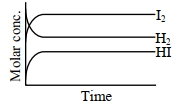
- B
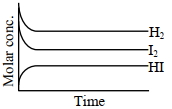
- C
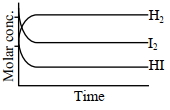
- D
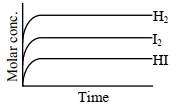
Explore More
Similar Questions
At a certain temperature and total pressure of $10^{5} \ Pa$,iodine vapour contains $40 \%$ by volume of $I$ atoms.
$I_{2(g)} \longleftrightarrow 2I_{(g)}$
Calculate $K_{p}$ for the equilibrium.
$I_{2(g)} \longleftrightarrow 2I_{(g)}$
Calculate $K_{p}$ for the equilibrium.
Medium
View SolutionOne mole of $O_{2(g)}$ and two moles of $SO_{2(g)}$ were heated in a closed vessel of $1 \, L$ capacity at $1098 \, K$. At equilibrium,$1.6 \, moles$ of $SO_{3(g)}$ were found. The equilibrium constant $K_c$ of the reaction would be
DifficultAIEEE 2012
View SolutionIn the reaction $A + 2B \rightleftharpoons 2C$,if $2$ moles of $A$,$3.0$ moles of $B$ and $2.0$ moles of $C$ are placed in a $2.0 \ L$ flask and the equilibrium concentration of $C$ is $0.5 \ mol/L$. The equilibrium constant $K_c$ for the reaction is:
Medium
View SolutionAt a certain temperature,$2HI \rightleftharpoons H_2 + I_2$. If only $50\%$ of $HI$ is dissociated at equilibrium,the equilibrium constant $(K_c)$ is:
Medium
View SolutionFrom the given data of equilibrium constants for the following reactions:
$(1) \ CO_{2(g)} + H_{2(g)} \rightleftharpoons CO_{(g)} + H_2O_{(g)} \ ; \ K_1$
$(2) \ CO_{(g)} + H_2O_{(g)} \rightleftharpoons CO_{2(g)} + H_{2(g)} \ ; \ K_2$
Wait,the provided question text has a typo in the reaction equations. Assuming the standard problem format where we relate equilibrium constants for reverse or combined reactions,if the target reaction is the same as reaction $(1)$,the answer is $K_1$. However,based on the options provided,this is likely a question asking for the relationship between $K_1$ and $K_2$ where reaction $(2)$ is the reverse of reaction $(1)$. If reaction $(2)$ is the reverse of reaction $(1)$,then $K_2 = \frac{1}{K_1}$. Given the options,please re-verify the input. Assuming the question asks for the equilibrium constant of a reaction derived from these,if the target reaction is $CO_{(g)} + H_2O_{(g)} \rightleftharpoons CO_{2(g)} + H_{2(g)}$,the answer is $K_1^{-1}$. Given the options,if we assume the target reaction is the reverse of reaction $(1)$,then $K = \frac{1}{K_1}$.
$(1) \ CO_{2(g)} + H_{2(g)} \rightleftharpoons CO_{(g)} + H_2O_{(g)} \ ; \ K_1$
$(2) \ CO_{(g)} + H_2O_{(g)} \rightleftharpoons CO_{2(g)} + H_{2(g)} \ ; \ K_2$
Wait,the provided question text has a typo in the reaction equations. Assuming the standard problem format where we relate equilibrium constants for reverse or combined reactions,if the target reaction is the same as reaction $(1)$,the answer is $K_1$. However,based on the options provided,this is likely a question asking for the relationship between $K_1$ and $K_2$ where reaction $(2)$ is the reverse of reaction $(1)$. If reaction $(2)$ is the reverse of reaction $(1)$,then $K_2 = \frac{1}{K_1}$. Given the options,please re-verify the input. Assuming the question asks for the equilibrium constant of a reaction derived from these,if the target reaction is $CO_{(g)} + H_2O_{(g)} \rightleftharpoons CO_{2(g)} + H_{2(g)}$,the answer is $K_1^{-1}$. Given the options,if we assume the target reaction is the reverse of reaction $(1)$,then $K = \frac{1}{K_1}$.
Medium
View SolutionVedclass Products
For Students
Vedclass Test Series
Mock tests in real JEE/NEET style with performance analysis. 5-day free trial.
Start Free TrialFor Teachers
Exam Paper Generator
Generate Set A/B/C/D exam papers from 7.5L+ questions in 2 minutes. 3 chapters free.
Try FreeFor Institutes
Online Exam Module
Live online exams with unlimited students, 360° analytics & white-label branding.
See Demo