
A English
Phloem Transport: Flow from Source to Sink Questions in English
Class 11 Biology · Transport in Plants · Phloem Transport: Flow from Source to Sink
146+
Questions
English
Language
100%
With Solutions
Showing 49 of 146 questions in English
51
MediumMCQ
Which of the following statements is correct regarding the transport or conduction of substances in plants?
A
Organic food moves upwardly through xylem.
B
Organic food moves up through phloem.
C
Inorganic food moves upwardly and downwardly through xylem.
D
Organic food moves upwardly and downwardly through phloem.
Solution
(D) The transport of organic food (sucrose) in plants occurs through the phloem tissue.
Unlike xylem,which primarily transports water and minerals in an upward direction (unidirectional),the phloem transports organic nutrients from the source (where they are produced,like leaves) to the sink (where they are stored or used,like roots,fruits,or growing tips).
Because the sink can be located either above or below the source,the movement of organic food through the phloem is bidirectional (upwardly and downwardly).
Unlike xylem,which primarily transports water and minerals in an upward direction (unidirectional),the phloem transports organic nutrients from the source (where they are produced,like leaves) to the sink (where they are stored or used,like roots,fruits,or growing tips).
Because the sink can be located either above or below the source,the movement of organic food through the phloem is bidirectional (upwardly and downwardly).
0 likes
View Solution52
EasyMCQ
Munch's mass flow hypothesis explains
A
Transcription
B
Translocation
C
Transpiration
D
Translation
Solution
(B) The mass flow hypothesis, proposed by $Ernst \text{ Münch}$, explains the mechanism of translocation of organic solutes in plants.
According to this hypothesis, organic food materials move from the source (where they are synthesized, like leaves) to the sink (where they are utilized or stored) through the phloem tissue due to a pressure gradient created by osmotic differences.
According to this hypothesis, organic food materials move from the source (where they are synthesized, like leaves) to the sink (where they are utilized or stored) through the phloem tissue due to a pressure gradient created by osmotic differences.
0 likes
View Solution53
MediumMCQ
In phloem,the flow is always from
A
Sugar source to sugar sink
B
Sugar sink to sugar source
C
Leaf to xylem then the phloem
D
Leaf to a root
Solution
(A) The translocation of solutes in the phloem always occurs from the source to the sink.
$A$ 'source' is defined as the part of the plant that synthesizes food (e.g.,mature leaves),while a 'sink' is the part that needs or stores food (e.g.,roots,fruits,or developing buds).
This movement is driven by a pressure gradient,often referred to as the pressure-flow hypothesis or mass-flow hypothesis.
Therefore,the flow is always from the sugar source to the sugar sink.
$A$ 'source' is defined as the part of the plant that synthesizes food (e.g.,mature leaves),while a 'sink' is the part that needs or stores food (e.g.,roots,fruits,or developing buds).
This movement is driven by a pressure gradient,often referred to as the pressure-flow hypothesis or mass-flow hypothesis.
Therefore,the flow is always from the sugar source to the sugar sink.
0 likes
View Solution54
MediumMCQ
During translocation,the carbohydrates are relatively richer in:
A
Phloem
B
Xylem
C
Leaves
D
All the above
Solution
(A) Carbohydrates are synthesized in the leaves during photosynthesis.
These carbohydrates are then converted into sucrose for transport.
Sucrose is loaded into the phloem,which acts as the primary tissue for the translocation of organic solutes from the source (leaves) to the sink (roots,fruits,etc.).
Therefore,during the process of translocation,the concentration of carbohydrates is relatively higher in the phloem compared to other tissues.
These carbohydrates are then converted into sucrose for transport.
Sucrose is loaded into the phloem,which acts as the primary tissue for the translocation of organic solutes from the source (leaves) to the sink (roots,fruits,etc.).
Therefore,during the process of translocation,the concentration of carbohydrates is relatively higher in the phloem compared to other tissues.
0 likes
View Solution55
MediumMCQ
The transport of food in phloem is:
A
Basipetal
B
Acropetal
C
Both $(a)$ and $(b)$
D
None of these
Solution
(C) The transport of food in phloem is bidirectional.
It occurs from the source (where food is synthesized,e.g.,leaves) to the sink (where food is consumed or stored,e.g.,roots,fruits,or developing buds).
Since the source can be above or below the sink,the movement can be both downward (basipetal) and upward (acropetal).
Therefore,the transport of food in phloem is bidirectional.
It occurs from the source (where food is synthesized,e.g.,leaves) to the sink (where food is consumed or stored,e.g.,roots,fruits,or developing buds).
Since the source can be above or below the sink,the movement can be both downward (basipetal) and upward (acropetal).
Therefore,the transport of food in phloem is bidirectional.
0 likes
View Solution56
EasyMCQ
What is the primary substrate for the translocation of food in plants?
A
$IAA$
B
Abscisic acid
C
Sucrose
D
$K^+$ ion
Solution
(C) The primary substrate for the translocation of food in plants is sucrose.
Plants synthesize glucose during photosynthesis,which is then converted into sucrose for transport through the phloem.
Sucrose is a non-reducing sugar,making it chemically stable and suitable for long-distance transport from the source (leaves) to the sink (roots,fruits,or developing tissues).
Plants synthesize glucose during photosynthesis,which is then converted into sucrose for transport through the phloem.
Sucrose is a non-reducing sugar,making it chemically stable and suitable for long-distance transport from the source (leaves) to the sink (roots,fruits,or developing tissues).
0 likes
View Solution57
MediumMCQ
The prevalent view for the translocation of organic solute in plants is
A
Tension cohesion theory
B
Mass flow or pressure gradient hypothesis
C
Root pressure hypothesis
D
Pulsating activity concept
Solution
(B) The most widely accepted theory for the translocation of organic solutes (sugars) in plants is the $Mass \ flow \ hypothesis$,also known as the $Pressure \ flow \ hypothesis$ or $Munch \ hypothesis$.
According to this theory,glucose produced in the source (leaves) is converted into sucrose and loaded into the phloem sieve tube elements.
This loading creates a high osmotic pressure,causing water to enter the phloem from the adjacent xylem by osmosis.
This results in a high hydrostatic pressure (turgor pressure) at the source,which pushes the sap towards the sink (areas of low pressure),where the solutes are unloaded.
According to this theory,glucose produced in the source (leaves) is converted into sucrose and loaded into the phloem sieve tube elements.
This loading creates a high osmotic pressure,causing water to enter the phloem from the adjacent xylem by osmosis.
This results in a high hydrostatic pressure (turgor pressure) at the source,which pushes the sap towards the sink (areas of low pressure),where the solutes are unloaded.
0 likes
View Solution58
MediumMCQ
The "Cytoplasmic streaming hypothesis" is concerned with
A
Salt absorption
B
Water absorption
C
Phloem transport
D
Movements
Solution
(C) The "Cytoplasmic streaming hypothesis" (also known as the $Munch$ hypothesis or $Pressure-flow$ hypothesis) is a theory proposed to explain the mechanism of $Phloem$ transport in plants.
It suggests that the movement of organic solutes (food) occurs through the $Phloem$ due to a pressure gradient created by the active loading of sugars into the sieve tubes, which leads to the flow of water and the subsequent movement of the sap.
It suggests that the movement of organic solutes (food) occurs through the $Phloem$ due to a pressure gradient created by the active loading of sugars into the sieve tubes, which leads to the flow of water and the subsequent movement of the sap.
0 likes
View Solution59
MediumMCQ
In which form is the food translocated from the endosperm to the plumule of a fatty seed like castor?
A
Fatty acids
B
Fat
C
Glucose
D
Sucrose
Solution
(D) In plants,the translocation of carbohydrates from the source (like endosperm in germinating seeds) to the sink (like the developing plumule) primarily occurs in the form of $Sucrose$.
Even in fatty seeds like castor,where fats are stored as reserve food,they are first converted into carbohydrates (via the glyoxylate cycle and gluconeogenesis) and then transported as $Sucrose$ through the phloem to the growing regions.
Even in fatty seeds like castor,where fats are stored as reserve food,they are first converted into carbohydrates (via the glyoxylate cycle and gluconeogenesis) and then transported as $Sucrose$ through the phloem to the growing regions.
0 likes
View Solution60
MediumMCQ
The direction of the conduction of food through phloem is
A
From below upwards
B
From top to bottom
C
From leaves to roots
D
Phloem never conducts food
Solution
(C) The conduction of food through phloem is bidirectional.
However,the primary movement of food (carbohydrates) occurs from the source (leaves) to the sink (roots,fruits,and storage organs) in the form of sucrose.
Therefore,the most accurate description among the given options is from leaves to roots.
However,the primary movement of food (carbohydrates) occurs from the source (leaves) to the sink (roots,fruits,and storage organs) in the form of sucrose.
Therefore,the most accurate description among the given options is from leaves to roots.
0 likes
View Solution61
EasyMCQ
The chief function of phloem is the conduction of
A
Food
B
Mineral
C
Water
D
Air
Solution
(A) The primary function of the $phloem$ tissue in plants is the translocation of organic nutrients,primarily sucrose,from the source (leaves) to the sink (roots,fruits,or developing tissues).
Therefore,the chief function of $phloem$ is the conduction of food.
Therefore,the chief function of $phloem$ is the conduction of food.
0 likes
View Solution62
MediumMCQ
The food stored in the ripening fruit is derived from
A
Roots
B
Farthest leaves
C
Nearest leaves
D
Aerial stem
Solution
(C) According to the $Munch$ $Pressure-Flow$ $Hypothesis$, the transport of sugars from the source to the sink occurs through the $Phloem$.
$Leaves$ act as the primary source of photosynthesis, producing carbohydrates (sucrose).
$Fruits$ act as the sink where these sugars are stored.
Plants preferentially transport sugars to the nearest sink to minimize energy expenditure and transport distance.
Therefore, the food stored in a ripening fruit is primarily derived from the nearest leaves.
$Leaves$ act as the primary source of photosynthesis, producing carbohydrates (sucrose).
$Fruits$ act as the sink where these sugars are stored.
Plants preferentially transport sugars to the nearest sink to minimize energy expenditure and transport distance.
Therefore, the food stored in a ripening fruit is primarily derived from the nearest leaves.
0 likes
View Solution63
MediumMCQ
Sinks are related to
A
Transport of minerals
B
Stomata
C
Enzymes
D
Phytochrome
Solution
(A) The term $sink$ refers to the region of a plant where organic substances (such as sucrose) are utilized or stored.
In the context of the $Pressure$ $Flow$ $Hypothesis$ (or $Munch$ $Hypothesis$),the transport of organic food occurs from the $source$ (where it is produced,e.g.,leaves) to the $sink$ (where it is consumed or stored,e.g.,roots,fruits,or developing seeds).
While the question mentions minerals,the concept of $source$ and $sink$ is primarily associated with the translocation of organic solutes via the phloem. Among the given options,the transport of minerals is the most relevant process associated with plant transport systems,although the primary focus of $source-sink$ dynamics is organic food.
In the context of the $Pressure$ $Flow$ $Hypothesis$ (or $Munch$ $Hypothesis$),the transport of organic food occurs from the $source$ (where it is produced,e.g.,leaves) to the $sink$ (where it is consumed or stored,e.g.,roots,fruits,or developing seeds).
While the question mentions minerals,the concept of $source$ and $sink$ is primarily associated with the translocation of organic solutes via the phloem. Among the given options,the transport of minerals is the most relevant process associated with plant transport systems,although the primary focus of $source-sink$ dynamics is organic food.
0 likes
View Solution64
MediumMCQ
The supply ends in the transport of solutes are:
A
Green leaves and storage organs
B
Root and stem
C
Xylem and Phloem
D
Hormones and enzymes
Solution
(A) In the context of plant physiology,the transport of solutes (primarily sucrose) occurs from the 'source' to the 'sink'.
The 'source' is the part of the plant that produces or stores food,such as green leaves (where photosynthesis occurs) or storage organs (where starch is stored).
The 'sink' is the part of the plant that requires the food,such as roots,stems,or developing fruits.
Therefore,the supply ends (sources) are green leaves and storage organs.
The 'source' is the part of the plant that produces or stores food,such as green leaves (where photosynthesis occurs) or storage organs (where starch is stored).
The 'sink' is the part of the plant that requires the food,such as roots,stems,or developing fruits.
Therefore,the supply ends (sources) are green leaves and storage organs.
0 likes
View Solution65
EasyMCQ
The movement of materials through the vascular tissue of plants is called
A
Transpiration
B
Translocation
C
Transcription
D
Transduction
Solution
(B) The movement of organic solutes,primarily sucrose,from the source (where they are produced) to the sink (where they are used or stored) through the phloem tissue of plants is known as translocation.
Transpiration is the loss of water vapor from the aerial parts of plants.
Transcription is the process of synthesizing $RNA$ from a $DNA$ template.
Transduction is the process by which foreign $DNA$ is introduced into a cell by a virus.
Transpiration is the loss of water vapor from the aerial parts of plants.
Transcription is the process of synthesizing $RNA$ from a $DNA$ template.
Transduction is the process by which foreign $DNA$ is introduced into a cell by a virus.
0 likes
View Solution66
EasyMCQ
Based on various pieces of evidence,it is known that the downward movement of food in plants takes place through:
A
Phloem
B
Xylem
C
Collenchyma
D
Sclerenchyma
Solution
(A) The transport of food (sucrose) from the source (leaves) to the sink (roots,fruits,or storage organs) occurs through the $Phloem$ tissue. This process is known as translocation. $Xylem$ is primarily responsible for the upward transport of water and minerals,while $Collenchyma$ and $Sclerenchyma$ are mechanical support tissues.
0 likes
View Solution67
MediumMCQ
In sieve tubes, the maximum hydrostatic pressure is found to be: (in $bars$)
A
$60$
B
$80$
C
$20$
D
$3$
Solution
(C) The pressure flow hypothesis explains the translocation of sugars in plants. According to this mechanism, the hydrostatic pressure in the sieve tubes of the phloem is generated by the osmotic movement of water from the xylem into the phloem. The maximum hydrostatic pressure observed in the sieve tubes of plants is approximately $20$ bars.
0 likes
View Solution68
MediumMCQ
The removal of a ring of bark from the trunk of a tree eventually kills it,since
A
Mineral salts cannot go up
B
Water cannot go up
C
Food does not travel down and roots are starved
D
The exposed part becomes infected with fungi
Solution
(C) The process of removing a ring of bark (including the phloem) from the trunk of a tree is known as girdling or ringing.
Phloem is the tissue responsible for the translocation of organic food (sucrose) from the leaves to the roots.
When the phloem is removed,the downward movement of food to the roots is blocked.
As a result,the roots are starved of nutrients and eventually die,which leads to the death of the entire tree.
Phloem is the tissue responsible for the translocation of organic food (sucrose) from the leaves to the roots.
When the phloem is removed,the downward movement of food to the roots is blocked.
As a result,the roots are starved of nutrients and eventually die,which leads to the death of the entire tree.
0 likes
View Solution69
MediumMCQ
Although starch is insoluble in water,it is stored in large quantities in potatoes. Why?
A
By microbes
B
Because it is manufactured in the tuber
C
Because plants use it as food
D
Because it first reaches the tuber as a sugar solution and is then stored as starch
Solution
(D) Starch is a polysaccharide and is insoluble in water,which makes it an ideal storage molecule as it does not affect the osmotic potential of the cell.
Plants transport carbohydrates from the leaves (source) to the storage organs like tubers (sink) in the form of sucrose,which is a soluble sugar.
Once the sucrose reaches the tuber,it is converted into starch for long-term storage.
Therefore,the starch is not transported directly; it is synthesized within the tuber from the incoming sugar solution.
Plants transport carbohydrates from the leaves (source) to the storage organs like tubers (sink) in the form of sucrose,which is a soluble sugar.
Once the sucrose reaches the tuber,it is converted into starch for long-term storage.
Therefore,the starch is not transported directly; it is synthesized within the tuber from the incoming sugar solution.
0 likes
View Solution70
MediumMCQ
After the synthesis of sucrose,into which structure is it actively transported?
A
Sieve tube elements
B
Companion cells
C
Xylem
D
Phloem parenchyma
Solution
(A) $1$. Sucrose is synthesized in the mesophyll cells of the leaves (source) through photosynthesis.
$2$. It is then loaded into the companion cells and subsequently into the sieve tube elements of the phloem by active transport.
$3$. This loading process creates a hypertonic condition in the phloem,which draws water from the adjacent xylem by osmosis.
$4$. This results in the development of a high hydrostatic pressure (turgor pressure) in the phloem,which facilitates the translocation of food to the sink.
$2$. It is then loaded into the companion cells and subsequently into the sieve tube elements of the phloem by active transport.
$3$. This loading process creates a hypertonic condition in the phloem,which draws water from the adjacent xylem by osmosis.
$4$. This results in the development of a high hydrostatic pressure (turgor pressure) in the phloem,which facilitates the translocation of food to the sink.
0 likes
View Solution71
MediumMCQ
In vascular plants,what is the nature of the transport of organic and mineral nutrients in the phloem?
A
Unidirectional from leaves to stem and roots for consumption and storage.
B
Bidirectional from leaves to stem and roots for consumption and storage.
C
Unidirectional from leaves to stem.
D
Bidirectional from stem to other parts of the leaf.
Solution
(B) In vascular plants,the phloem is responsible for the translocation of food (primarily sucrose) from the source (usually leaves) to the sink (roots,fruits,seeds,or growing regions).
Unlike xylem,which transports water and minerals unidirectionally (upwards),phloem transport is bidirectional.
This is because the source and sink relationship can be variable; for example,in early spring,the roots act as a source of stored sugars,which are transported upwards to the developing buds.
Therefore,the transport of organic and mineral nutrients in the phloem is bidirectional.
Unlike xylem,which transports water and minerals unidirectionally (upwards),phloem transport is bidirectional.
This is because the source and sink relationship can be variable; for example,in early spring,the roots act as a source of stored sugars,which are transported upwards to the developing buds.
Therefore,the transport of organic and mineral nutrients in the phloem is bidirectional.
0 likes
View Solution72
MediumMCQ
When does the translocation of phloem sap in the phloem become bidirectional?
A
When food storage is very high.
B
When the buds of the tree are about to wither.
C
When the water content in the xylem is very high.
D
When water is loaded into the phloem from the xylem in large quantities.
Solution
(B) The movement of phloem sap is primarily from source to sink. However,this direction can be bidirectional depending on the seasonal needs of the plant.
Specifically,during the early spring,the sugar stored in roots or stem organs (acting as sources) is moved to the developing buds (acting as sinks) to support new growth.
Therefore,when the buds are about to develop or sprout,the direction of transport reverses or becomes bidirectional to supply nutrients from storage organs to the growing regions.
Specifically,during the early spring,the sugar stored in roots or stem organs (acting as sources) is moved to the developing buds (acting as sinks) to support new growth.
Therefore,when the buds are about to develop or sprout,the direction of transport reverses or becomes bidirectional to supply nutrients from storage organs to the growing regions.
0 likes
View Solution73
MediumMCQ
The translocation of organic solutes in sieve tubes occurs through which of the following mechanisms?
A
By $P-proteins$
B
By mass flow involving carriers and $ATP$
C
By cytoplasmic streaming
D
By root pressure and transpiration pull
Solution
(B) The translocation of organic solutes (primarily sucrose) in the phloem is explained by the $Munch$ pressure-flow hypothesis or mass flow hypothesis.
According to this mechanism,glucose is prepared at the source (leaves) and converted into sucrose.
Sucrose is then loaded into the sieve tube elements of the phloem using $ATP$ (active transport).
This creates a high osmotic pressure in the phloem,causing water to enter from the adjacent xylem,which increases the turgor pressure.
This pressure gradient drives the mass flow of sap from the source to the sink,where sucrose is unloaded and used or stored.
According to this mechanism,glucose is prepared at the source (leaves) and converted into sucrose.
Sucrose is then loaded into the sieve tube elements of the phloem using $ATP$ (active transport).
This creates a high osmotic pressure in the phloem,causing water to enter from the adjacent xylem,which increases the turgor pressure.
This pressure gradient drives the mass flow of sap from the source to the sink,where sucrose is unloaded and used or stored.
0 likes
View Solution74
EasyMCQ
In what form is carbohydrate usually translocated as a nutrient in plants?
A
Glucose
B
Maltose
C
Starch
D
Sucrose
Solution
(D) In plants,carbohydrates are synthesized in the leaves (source) via photosynthesis,primarily as glucose.
However,glucose is highly reactive and not suitable for long-distance transport through the phloem.
Therefore,it is converted into a non-reducing sugar,$Sucrose$,which is chemically stable and less reactive.
$Sucrose$ is then translocated from the source to the sink (roots,fruits,or storage organs) through the phloem sieve tubes.
However,glucose is highly reactive and not suitable for long-distance transport through the phloem.
Therefore,it is converted into a non-reducing sugar,$Sucrose$,which is chemically stable and less reactive.
$Sucrose$ is then translocated from the source to the sink (roots,fruits,or storage organs) through the phloem sieve tubes.
0 likes
View Solution75
MediumMCQ
Which theory best explains the translocation of organic solutes?
A
Imbibition theory
B
Active transport
C
Mass flow hypothesis
D
Transpiration pull
Solution
(C) The translocation of organic solutes (sugars) in plants occurs through the phloem. The most widely accepted theory to explain this process is the $Mass \ flow \ hypothesis$ (also known as the $Pressure \ flow \ hypothesis$),proposed by $Ernst \ Munch$. According to this theory,glucose produced in the leaves (source) is converted into sucrose and loaded into the phloem,creating a high osmotic pressure. This causes water to enter from the xylem,generating a pressure gradient that pushes the sap towards the sink (roots or storage organs).
0 likes
View Solution76
MediumMCQ
Where is the bidirectional transport of minerals observed?
A
Xylem
B
Phloem
C
Parenchyma
D
Meristem
Solution
(B) The transport of minerals occurs through the $Phloem$ in a bidirectional manner (upward and downward). $Phloem$ also facilitates lateral movement of minerals. While $Xylem$ primarily transports water and minerals unidirectionally (upward),$Phloem$ is responsible for the bidirectional translocation of solutes,including minerals.
0 likes
View Solution77
EasyMCQ
In flowering plants,in what form is sugar translocated?
A
Glucose
B
Sucrose
C
Fructose
D
Maltose
Solution
(B) In flowering plants,sugar is synthesized in the leaves during photosynthesis in the form of glucose. However,it is converted into $Sucrose$ for translocation through the phloem. $Sucrose$ is a non-reducing sugar,which makes it chemically stable and less reactive during transport,ensuring it reaches the sink tissues efficiently.
0 likes
View Solution78
MediumMCQ
In higher plants,the translocation of food materials occurs through ..........
A
Tracheids
B
Vessels
C
Sieve elements
D
Companion cells
Solution
(C) In higher plants,the phloem tissue is responsible for the translocation of food materials (primarily sucrose) from source to sink.
Sieve elements (specifically sieve tube elements in angiosperms) are the primary conducting cells of the phloem.
Tracheids and vessels are components of xylem,which is responsible for the conduction of water and minerals.
Companion cells assist the sieve tube elements in the transport process but are not the primary conducting channels themselves.
Sieve elements (specifically sieve tube elements in angiosperms) are the primary conducting cells of the phloem.
Tracheids and vessels are components of xylem,which is responsible for the conduction of water and minerals.
Companion cells assist the sieve tube elements in the transport process but are not the primary conducting channels themselves.
0 likes
View Solution79
MediumMCQ
The function of companion cells is to .........
A
load sucrose into sieve elements.
B
provide energy to sieve elements for active transport.
C
provide water to phloem.
D
load sucrose into sieve elements by passive transport.
Solution
(B) Companion cells are specialized parenchyma cells closely associated with sieve tube elements in the phloem. Their primary function is to maintain the pressure gradient in the sieve tubes. They assist in the active loading of sucrose into the sieve tube elements from the source (leaves) by providing the necessary energy $(ATP)$. This creates a high osmotic pressure in the sieve tubes,which facilitates the translocation of food.
0 likes
View Solution80
MediumMCQ
The function of companion cells is
A
providing energy to sieve elements for active transport
B
providing water to phloem
C
loading of sucrose into sieve elements by passive transport
D
loading of sucrose into sieve elements
Solution
(D) : Companion cells are specialized parenchyma cells associated with sieve tube elements. They play a crucial role in the loading of sucrose into sieve tube elements.
In source tissues like leaves,companion cells use transmembrane proteins to actively transport sugars and amino acids into the sieve tube elements.
This active loading of sugars creates a high solute concentration,which lowers the water potential,thereby facilitating the movement of water and sugars through the phloem.
In source tissues like leaves,companion cells use transmembrane proteins to actively transport sugars and amino acids into the sieve tube elements.
This active loading of sugars creates a high solute concentration,which lowers the water potential,thereby facilitating the movement of water and sugars through the phloem.
0 likes
View Solution81
MediumMCQ
Transport of food material in higher plants takes place through
A
companion cells
B
transfusion tissue
C
tracheids
D
sieve elements
Solution
(D) In higher plants,the transport of food material (photosynthates) occurs through the phloem tissue. The primary conducting cells of the phloem are the sieve elements (sieve tube elements in angiosperms and sieve cells in gymnosperms). These cells are specialized for the translocation of organic nutrients from source to sink. Therefore,the correct option is $D$.
0 likes
View Solution82
MediumMCQ
$A$ few drops of sap were collected by cutting across a plant stem by a suitable method. The sap was tested chemically. Which one of the following test results indicates that it is phloem sap?
A
Acidic
B
Alkaline
C
Low refractive index
D
Absence of sugar
Solution
(B) Phloem sap is the fluid transported through the phloem tissue,which primarily consists of sucrose and other organic solutes.
Chemically,phloem sap is known to be alkaline in nature,typically having a $pH$ ranging from $7.5$ to $8.5$.
In contrast,xylem sap is generally acidic.
Therefore,an alkaline test result indicates that the collected fluid is phloem sap.
Chemically,phloem sap is known to be alkaline in nature,typically having a $pH$ ranging from $7.5$ to $8.5$.
In contrast,xylem sap is generally acidic.
Therefore,an alkaline test result indicates that the collected fluid is phloem sap.
0 likes
View Solution83
MediumMCQ
In a ring girdled plant,
A
the shoot and root die together
B
neither root nor shoot will die
C
the shoot dies first
D
the root dies first.
Solution
(D) : In girdling or ringing experiments,a ring of bark is cut from the stem. This process removes the phloem. Nutrients accumulate above the ring,causing the bark to swell and potentially produce adventitious roots. Growth is vigorous above the ring. The tissues below the ring show a cessation of growth and begin to shrivel. The roots are starved of nutrients and die if the ring is not healed. The death of the roots eventually leads to the death of the entire plant,which demonstrates that the bark or phloem is responsible for the transport of organic solutes toward the roots.
0 likes
View Solution84
MediumMCQ
The translocation of organic solutes in sieve tube members is supported by
A
cytoplasmic streaming
B
root pressure and transpiration pull
C
$P$-proteins
D
mass flow involving a carrier and $ATP$
Solution
(C) $P$-proteins (Phloem proteins) are components found in large amounts in phloem sieve tubes. The main function of these bodies is to seal off the sieve tube element or sieve cell by bringing about the blockage of the sieve plate. These bodies perform this function when the sieve element is injured. These bodies and callose together block the pores of sieve tube elements. $P$-protein bodies and callose form blocking plugs. These bodies remain along the walls of sieve tube elements. $P$-protein bodies are assigned some role in the translocation of food material in the sieve tubes,but this is not universally accepted.
0 likes
View Solution85
MediumMCQ
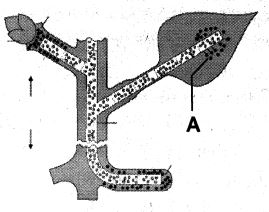
Identify the following process $A$ from the given figure:
A
Sugar leaves sieve tubes,water follows by osmosis
B
Sugar solution flows to region of low turgor pressure
C
Sugar enters sieve tubes,water follows by osmosis
D
Low turgor pressure
Solution
(C) The process shown in the figure represents the Pressure Flow Hypothesis or Mass Flow Hypothesis of phloem transport.
In the source (leaf),sugar is produced via photosynthesis and is actively loaded into the sieve tube elements of the phloem.
This increase in solute concentration inside the sieve tubes decreases the water potential,causing water from the adjacent xylem to enter the sieve tubes by osmosis.
This process increases the turgor pressure in the sieve tubes at the source,which drives the flow of sugar solution towards the sink (where turgor pressure is lower).
Therefore,process $A$ represents the loading of sugar into the sieve tubes,which is followed by the entry of water via osmosis.
In the source (leaf),sugar is produced via photosynthesis and is actively loaded into the sieve tube elements of the phloem.
This increase in solute concentration inside the sieve tubes decreases the water potential,causing water from the adjacent xylem to enter the sieve tubes by osmosis.
This process increases the turgor pressure in the sieve tubes at the source,which drives the flow of sugar solution towards the sink (where turgor pressure is lower).
Therefore,process $A$ represents the loading of sugar into the sieve tubes,which is followed by the entry of water via osmosis.
0 likes
View Solution86
MediumMCQ
Which of the following is responsible for changing the direction of the source and sink in plants?
A
High temperature and season
B
Water availability and plant's needs
C
Season and plant's needs
D
High temperature and water availability
Solution
(C) In plants,the direction of movement of phloem sap (sucrose) is determined by the source and the sink.
The source is the part of the plant that produces sugar (e.g.,leaves),and the sink is the part that consumes or stores it (e.g.,roots,fruits,or developing buds).
This direction is not fixed; it can change depending on the season and the plant's needs.
For example,in early spring,the sugar stored in roots (which act as a source) is moved to the developing buds (which act as a sink) to support new growth.
Therefore,the season and the plant's physiological needs are the primary factors responsible for changing the source-sink relationship.
The source is the part of the plant that produces sugar (e.g.,leaves),and the sink is the part that consumes or stores it (e.g.,roots,fruits,or developing buds).
This direction is not fixed; it can change depending on the season and the plant's needs.
For example,in early spring,the sugar stored in roots (which act as a source) is moved to the developing buds (which act as a sink) to support new growth.
Therefore,the season and the plant's physiological needs are the primary factors responsible for changing the source-sink relationship.
0 likes
View Solution87
MediumMCQ
Transport or translocation of which of these materials cannot occur through the phloem?
A
Hormones,Sugars
B
Amino acids,sucrose
C
Sucrose,Water
D
Glycogen,Insulin
Solution
(D) The phloem is responsible for the translocation of food materials,primarily in the form of sucrose,from source to sink.
It also transports amino acids,hormones,and water.
Glycogen is a storage polysaccharide found in animals and fungi,not in plants.
Insulin is a peptide hormone produced by the pancreas in animals.
Therefore,neither glycogen nor insulin is transported through the phloem in plants.
It also transports amino acids,hormones,and water.
Glycogen is a storage polysaccharide found in animals and fungi,not in plants.
Insulin is a peptide hormone produced by the pancreas in animals.
Therefore,neither glycogen nor insulin is transported through the phloem in plants.
0 likes
View Solution88
MediumMCQ
......... and ......... may be reversed depending on the season or the plant's need.
A
Source,sink
B
Fruits,Root system
C
Stem,flower
D
Root system,flower
Solution
(A) In the process of phloem translocation,the direction of movement of food (sucrose) is from the source to the sink.
The source is defined as the part of the plant that synthesizes food (e.g.,leaves),while the sink is the part that needs or stores food (e.g.,roots,fruits,or developing buds).
However,this relationship is not fixed. Depending on the season or the physiological needs of the plant,the roles can be reversed.
For example,in early spring,the roots act as a source by mobilizing stored sugars to support the growth of new buds,while the buds act as the sink.
Therefore,the roles of source and sink are dynamic and reversible.
The source is defined as the part of the plant that synthesizes food (e.g.,leaves),while the sink is the part that needs or stores food (e.g.,roots,fruits,or developing buds).
However,this relationship is not fixed. Depending on the season or the physiological needs of the plant,the roles can be reversed.
For example,in early spring,the roots act as a source by mobilizing stored sugars to support the growth of new buds,while the buds act as the sink.
Therefore,the roles of source and sink are dynamic and reversible.
0 likes
View Solution89
MediumMCQ
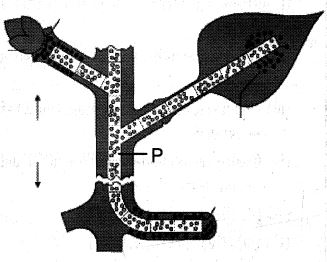
What is correct for $P$ in the given diagram representing the pressure flow hypothesis?
A
Phloem
B
High turgor pressure
C
Xylem
D
Translocation of sugar
Solution
(A) The provided diagram illustrates the pressure flow hypothesis (or mass flow hypothesis) for the translocation of sugars in plants.
In this mechanism,sugars are loaded into the phloem at the source (e.g.,leaves),which creates a hypertonic condition,causing water to enter from the xylem by osmosis.
This increases the turgor pressure in the phloem sieve tubes.
In the diagram,$P$ points to the phloem tissue through which the sugar solution (phloem sap) is being transported from the source to the sink.
Therefore,$P$ represents the phloem.
In this mechanism,sugars are loaded into the phloem at the source (e.g.,leaves),which creates a hypertonic condition,causing water to enter from the xylem by osmosis.
This increases the turgor pressure in the phloem sieve tubes.
In the diagram,$P$ points to the phloem tissue through which the sugar solution (phloem sap) is being transported from the source to the sink.
Therefore,$P$ represents the phloem.
0 likes
View Solution90
EasyMCQ
Bidirectional elements transportation is seen in:
A
Collenchyma
B
Phloem
C
Xylem
D
Meristem tissue
Solution
(B) In plants,the transport of substances occurs through two main vascular tissues: $Xylem$ and $Phloem$.
$Xylem$ is responsible for the unidirectional transport of water and minerals from the roots to the aerial parts of the plant.
$Phloem$ is responsible for the transport of food (sucrose) from the source (leaves) to the sink (roots,fruits,or storage organs).
Since the source and sink can change depending on the plant's needs (e.g.,during spring,stored food moves from roots to developing buds),the transport in $Phloem$ is bidirectional. Therefore,the correct answer is $Phloem$.
$Xylem$ is responsible for the unidirectional transport of water and minerals from the roots to the aerial parts of the plant.
$Phloem$ is responsible for the transport of food (sucrose) from the source (leaves) to the sink (roots,fruits,or storage organs).
Since the source and sink can change depending on the plant's needs (e.g.,during spring,stored food moves from roots to developing buds),the transport in $Phloem$ is bidirectional. Therefore,the correct answer is $Phloem$.
0 likes
View Solution91
MediumMCQ
$A$ few drops of sap were collected by cutting across a plant stem by a suitable method. The sap was tested chemically. Which one of the following test results indicates that it is phloem sap?
A
Acidic
B
Alkaline
C
Low refractive index
D
The absence of sugar
Solution
(B) Phloem sap is the fluid transported through the phloem tissue,which primarily consists of sucrose and other sugars,amino acids,and minerals.
Phloem sap is characteristically alkaline in nature,typically having a $pH$ ranging from $7.5$ to $8.5$.
In contrast,xylem sap is generally acidic.
Therefore,an alkaline test result indicates the presence of phloem sap.
Phloem sap is characteristically alkaline in nature,typically having a $pH$ ranging from $7.5$ to $8.5$.
In contrast,xylem sap is generally acidic.
Therefore,an alkaline test result indicates the presence of phloem sap.
0 likes
View Solution92
MediumMCQ
What is the transport pathway in rooted plants for organic nutrients?
A
Unidirectional
B
Bidirectional
C
Multidirectional
D
Tri-directional
Solution
(B) In rooted plants, the transport of water and minerals is primarily $unidirectional$ (from roots to stems and leaves) via the xylem. However, the transport of organic nutrients (photosynthates) produced in the leaves is $bidirectional$ (from source to sink, and vice versa depending on the season) via the phloem. Since the question refers to the general transport pathway of organic solutes in rooted plants, the correct answer is $bidirectional$.
0 likes
View Solution93
MediumMCQ
Glucose produced by photosynthesis is converted into sucrose,then moved into the companion cells and then into the living phloem sieve tube cells by........
A
Simple diffusion
B
Active transport
C
Facilitated diffusion
D
Imbibition
Solution
(B) Photosynthesis produces glucose,which is then converted into sucrose for transport.
Sucrose is loaded into the companion cells and subsequently into the sieve tube cells of the phloem.
This process occurs against the concentration gradient,requiring metabolic energy in the form of $ATP$.
Therefore,this movement is known as active transport.
Sucrose is loaded into the companion cells and subsequently into the sieve tube cells of the phloem.
This process occurs against the concentration gradient,requiring metabolic energy in the form of $ATP$.
Therefore,this movement is known as active transport.
0 likes
View Solution94
EasyMCQ
The direction of phloem sap in the phloem is ........
A
Bi-directional
B
Unidirectional
C
$A$ and $B$ both
D
None of the above
Solution
(A) The movement of phloem sap is driven by the pressure-flow hypothesis.
Phloem transports food (sucrose) from the source (leaves) to the sink (roots,fruits,or developing buds).
During the growing season,the direction is usually from leaves to roots,but during early spring,stored sugars in the roots move upwards to the developing buds.
Therefore,the movement of phloem sap is bi-directional.
Phloem transports food (sucrose) from the source (leaves) to the sink (roots,fruits,or developing buds).
During the growing season,the direction is usually from leaves to roots,but during early spring,stored sugars in the roots move upwards to the developing buds.
Therefore,the movement of phloem sap is bi-directional.
0 likes
View Solution95
MediumMCQ
Which of the following statements is correct regarding the transport of substances in plants?
A
Organic substances are transported upwards by phloem tissue.
B
Organic substances are transported upwards by xylem tissue.
C
Inorganic food is transported upwards and downwards by xylem tissue.
D
Organic food is transported upwards and downwards by phloem tissue.
Solution
(D) In plants,$Xylem$ is primarily responsible for the transport of water and minerals from roots to other parts of the plant (unidirectional). $Phloem$ is responsible for the translocation of organic solutes (mainly sucrose) from the source (leaves) to the sink (roots,fruits,storage organs,etc.). This transport is bidirectional,meaning it can move upwards and downwards depending on the plant's requirements.
0 likes
View Solution96
MediumMCQ
Phloem loading is related to:
A
Increase of sugar in phloem
B
Increase in length of phloem cells
C
Separation of phloem parenchyma
D
Strengthening of phloem fibers
Solution
(A) Phloem loading is the process of transporting sugars from source tissues (like leaves) into the sieve tube elements of the phloem.
This process increases the concentration of sucrose in the phloem,which leads to a decrease in water potential.
Consequently,water enters the phloem from the adjacent xylem by osmosis,creating a high pressure that drives the bulk flow of sap towards the sink tissues.
This process increases the concentration of sucrose in the phloem,which leads to a decrease in water potential.
Consequently,water enters the phloem from the adjacent xylem by osmosis,creating a high pressure that drives the bulk flow of sap towards the sink tissues.
0 likes
View Solution97
MediumMCQ
The translocation of organic solutes in sieve tubes occurs through which mechanism?
A
By proteins
B
By mass flow involving carriers and $ATP$
C
By cytoplasmic streaming
D
By root pressure and transpiration pull
Solution
(B) The translocation of organic solutes (mainly sucrose) in the phloem sieve tubes occurs via the pressure-flow hypothesis or mass flow hypothesis.
This process involves the active loading of sucrose into the sieve tube elements at the source,which creates a high osmotic pressure.
Water enters the sieve tubes from the adjacent xylem by osmosis,creating a hydrostatic pressure gradient.
This pressure gradient drives the mass flow of the phloem sap from the source to the sink,where the solutes are unloaded.
Thus,it is a mass flow mechanism involving the expenditure of $ATP$ for active transport.
This process involves the active loading of sucrose into the sieve tube elements at the source,which creates a high osmotic pressure.
Water enters the sieve tubes from the adjacent xylem by osmosis,creating a hydrostatic pressure gradient.
This pressure gradient drives the mass flow of the phloem sap from the source to the sink,where the solutes are unloaded.
Thus,it is a mass flow mechanism involving the expenditure of $ATP$ for active transport.
0 likes
View Solution98
MediumMCQ
When a plant stem is cut using a suitable method,a few drops of fluid are obtained. Which of the following tests,when performed on this fluid,confirms that it is phloem sap?
A
Low refractive index
B
Absence of sugar
C
Acidic nature
D
Alkaline nature
Solution
(D) Phloem sap is the fluid transported through the phloem tissue,which primarily consists of sucrose and other organic solutes.
$1$. Phloem sap is known to be rich in sugars (mainly sucrose),so the absence of sugar would indicate it is not phloem sap.
$2$. The pH of phloem sap is typically alkaline (usually between $7.5$ and $8.5$).
$3$. Testing for an alkaline nature is a standard biochemical method to identify phloem sap,as xylem sap is generally acidic.
Therefore,the alkaline nature confirms the presence of phloem sap.
$1$. Phloem sap is known to be rich in sugars (mainly sucrose),so the absence of sugar would indicate it is not phloem sap.
$2$. The pH of phloem sap is typically alkaline (usually between $7.5$ and $8.5$).
$3$. Testing for an alkaline nature is a standard biochemical method to identify phloem sap,as xylem sap is generally acidic.
Therefore,the alkaline nature confirms the presence of phloem sap.
0 likes
View Solution99
MediumMCQ
In what form are carbohydrates generally translocated as nutrients in plants?
A
Glucose
B
Maltose
C
Starch
D
Sucrose
Solution
(D) In plants,carbohydrates are synthesized in the leaves during photosynthesis,primarily in the form of glucose.
However,glucose is highly reactive and cannot be transported efficiently through the phloem.
Therefore,it is converted into sucrose,which is a non-reducing sugar.
Sucrose is chemically stable and soluble,making it the primary form of sugar translocated from the source (leaves) to the sink (roots,fruits,seeds,etc.) through the phloem tissue.
However,glucose is highly reactive and cannot be transported efficiently through the phloem.
Therefore,it is converted into sucrose,which is a non-reducing sugar.
Sucrose is chemically stable and soluble,making it the primary form of sugar translocated from the source (leaves) to the sink (roots,fruits,seeds,etc.) through the phloem tissue.
0 likes
View SolutionTransport in Plants — Phloem Transport: Flow from Source to Sink · Frequently Asked Questions
1Are these Transport in Plants questions useful for JEE and NEET?
Yes. All questions in this section are mapped to JEE Main and NEET exam patterns. Previous year questions from JEE Main, NEET, GUJCET and state-level exams are included with full solutions.
2Can I switch to Hindi or Gujarati for these questions?
Yes. Use the language tabs in the hero section or the sidebar to view the same questions and solutions in English, Hindi or Gujarati.
3How do I generate a question paper from this subtopic?
Use the Vedclass Exam Paper Generator — select the chapter and subtopic, set difficulty, and generate Sets A, B, C, D automatically. First 3 chapters of every subject are free.
Vedclass Products
For Students
Vedclass Test Series
Mock tests in real JEE/NEET style with performance analysis. 5-day free trial.
Start Free TrialFor Teachers
Exam Paper Generator
Generate Set A/B/C/D papers from this chapter in 2 minutes. 3 chapters free.
Try FreeFor Institutes
Online Exam Module
Live online exams with unlimited students, 360° analytics & white-label branding.
See DemoFor Teachers & Institutes
Generate a Transport in Plants Exam Paper in 2 Minutes
Select subtopic & difficulty — Sets A, B, C, D auto-generated with No Repeat logic.
First 3 chapters of every subject are free — no payment required.