
A English
Means of transport Questions in English
Class 11 Biology · Transport in Plants · Means of transport
129+
Questions
English
Language
100%
With Solutions
Showing 50 of 129 questions in English
1
MediumMCQ
Active transport involves:
A
Against concentration gradient and requires $ATP$
B
Against concentration gradient and does not require $ATP$
C
With concentration gradient and does not require $ATP$
D
None of the above
Solution
(A) Active transport is a biological process where molecules or ions are moved across a cell membrane from a region of lower concentration to a region of higher concentration.
This movement occurs against the concentration gradient.
Because this process goes against the natural flow of diffusion,it requires the expenditure of metabolic energy in the form of $ATP$ (Adenosine Triphosphate).
Therefore,active transport is characterized by movement against the concentration gradient and the requirement of $ATP$.
This movement occurs against the concentration gradient.
Because this process goes against the natural flow of diffusion,it requires the expenditure of metabolic energy in the form of $ATP$ (Adenosine Triphosphate).
Therefore,active transport is characterized by movement against the concentration gradient and the requirement of $ATP$.
0 likes
View Solution2
MediumMCQ
Which of the following does not require carrier molecules during transport through cell membranes?
A
Simple diffusion
B
Facilitated diffusion
C
$Na^+$-$K^+$ transport
D
Active transport of sugars and amino acids
Solution
(A) Simple diffusion is a passive process where molecules move across the cell membrane from a region of higher concentration to a region of lower concentration without the assistance of any carrier proteins or energy expenditure.
In contrast,facilitated diffusion,$Na^+$-$K^+$ transport,and active transport of sugars and amino acids all require specific carrier proteins or membrane channels to move substances across the lipid bilayer.
In contrast,facilitated diffusion,$Na^+$-$K^+$ transport,and active transport of sugars and amino acids all require specific carrier proteins or membrane channels to move substances across the lipid bilayer.
0 likes
View Solution3
MediumMCQ
Active transport is affected by
A
Cold
B
Cyanide
C
Absence of $O_2$
D
All of these
Solution
(D) Active transport is the movement of molecules across a cell membrane from a region of lower concentration to a region of higher concentration against the concentration gradient.
This process requires energy in the form of $ATP$.
$1$. Cold temperatures reduce the kinetic energy of molecules and the activity of membrane proteins,thereby slowing down active transport.
$2$. Cyanide is a metabolic inhibitor that blocks the electron transport chain in mitochondria,preventing the production of $ATP$.
$3$. The absence of $O_2$ prevents aerobic respiration,which is necessary for the efficient production of $ATP$.
Since all these factors interfere with energy production or the enzymatic activity required for active transport,the correct answer is all of these.
This process requires energy in the form of $ATP$.
$1$. Cold temperatures reduce the kinetic energy of molecules and the activity of membrane proteins,thereby slowing down active transport.
$2$. Cyanide is a metabolic inhibitor that blocks the electron transport chain in mitochondria,preventing the production of $ATP$.
$3$. The absence of $O_2$ prevents aerobic respiration,which is necessary for the efficient production of $ATP$.
Since all these factors interfere with energy production or the enzymatic activity required for active transport,the correct answer is all of these.
0 likes
View Solution4
EasyMCQ
Exchange of substances between individual cells and their environments takes place by
A
Osmosis
B
Diffusion
C
Active transport
D
All of these
Solution
(D) The exchange of substances between individual cells and their environment occurs through various transport mechanisms.
$1$. $Diffusion$: Movement of molecules from a region of higher concentration to a region of lower concentration.
$2$. $Osmosis$: A special type of diffusion involving the movement of water molecules across a semi-permeable membrane.
$3$. $Active$ $transport$: Movement of molecules against the concentration gradient, requiring energy in the form of $ATP$.
Since all these processes are involved in the exchange of substances at the cellular level, the correct answer is $All$ $of$ $these$.
$1$. $Diffusion$: Movement of molecules from a region of higher concentration to a region of lower concentration.
$2$. $Osmosis$: A special type of diffusion involving the movement of water molecules across a semi-permeable membrane.
$3$. $Active$ $transport$: Movement of molecules against the concentration gradient, requiring energy in the form of $ATP$.
Since all these processes are involved in the exchange of substances at the cellular level, the correct answer is $All$ $of$ $these$.
0 likes
View Solution5
MediumMCQ
Which of the following processes does not occur against the concentration gradient?
A
Transpiration
B
Diffusion
C
Translocation
D
Active transport
Solution
(B) Diffusion is a passive process where molecules move from a region of higher concentration to a region of lower concentration. Since this movement follows the concentration gradient,it is not against the concentration gradient. In contrast,active transport,transpiration (in certain contexts),and translocation often involve energy expenditure to move substances against their concentration gradients.
0 likes
View Solution6
MediumMCQ
$A$ plant with well-washed roots was placed in a beaker of water diluted with red ink. The red colour travelled up the stem and into the leaf veins. Which of the following is the explanation for the uptake of red ink into the roots?
A
The red ink entered the root hairs by osmosis.
B
The molecules of red ink diffuse into the root hairs.
C
The membranes of the root hairs were destroyed and red ink could enter.
D
The molecules of red ink passed from a region of low concentration to one of high concentration.
Solution
(B) The uptake of red ink into the roots occurs because the molecules of the red ink (a solute) move from a region of higher concentration (the beaker) to a region of lower concentration (the interior of the root hair cells) through the process of diffusion.
Since the root hair cell membranes are permeable to these small dye molecules,they move down their concentration gradient into the plant tissues.
Since the root hair cell membranes are permeable to these small dye molecules,they move down their concentration gradient into the plant tissues.
0 likes
View Solution7
MediumMCQ
By what mechanism does water move through the vessels and tracheids of roots, stems, and leaves?
A
Osmotic flow
B
Bulk flow
C
Gravity flow
D
Imbibition
Solution
(B) Water moves through the xylem vessels and tracheids of roots, stems, and leaves primarily via $Bulk \text{ } flow$ (also known as mass flow).
This movement occurs due to the pressure difference created by transpiration pull, which pulls the water column upward as a single unit from the roots to the leaves.
This movement occurs due to the pressure difference created by transpiration pull, which pulls the water column upward as a single unit from the roots to the leaves.
0 likes
View Solution8
MediumMCQ
In cell transport,the difference between permeable transport and bulk transport relates to:
A
Structure of molecules allowed to pass through
B
Solvent system as well as structure of molecules are applicable
C
Solvent system is applicable
D
Molecular weight of atoms allowed to pass through
Solution
(B) Permeable transport (such as diffusion or osmosis) typically involves the movement of individual molecules or ions across a membrane based on their concentration gradient and their ability to pass through the membrane structure (permeability).
In contrast,bulk transport (or mass flow) involves the movement of substances in bulk from one point to another as a result of pressure differences between the two points.
This process is independent of the individual properties of the molecules being transported; rather,it depends on the solvent system (the medium in which substances are dissolved) and the physical force (pressure) acting on the entire bulk of the fluid.
Therefore,the fundamental difference relates to the solvent system as well as the structure of molecules involved in the transport process.
In contrast,bulk transport (or mass flow) involves the movement of substances in bulk from one point to another as a result of pressure differences between the two points.
This process is independent of the individual properties of the molecules being transported; rather,it depends on the solvent system (the medium in which substances are dissolved) and the physical force (pressure) acting on the entire bulk of the fluid.
Therefore,the fundamental difference relates to the solvent system as well as the structure of molecules involved in the transport process.
0 likes
View Solution9
MediumMCQ
Active transport of solute in plants refers to the flow of solutes against a concentration gradient and therefore requires an input of energy. This energy is derived:
A
Always from hydrolysis of $ATP$
B
Not only from $ATP$ hydrolysis but also from the collapse of a proton motive force
C
Partly from the input from $ATP$ hydrolysis and partly from the collapse of a proton motive force
D
From different sources depending on the solutes
Solution
(B) Active transport involves the movement of molecules against their concentration gradient,which requires metabolic energy. In plant cells,this energy is primarily provided by $ATP$ hydrolysis. However,many transport processes,such as the loading of sucrose into phloem sieve tubes,utilize a proton gradient ($H^+$ gradient) established by $H^+-ATPases$. The subsequent movement of solutes (like sucrose) is coupled with the movement of protons down their electrochemical gradient (proton motive force). Therefore,the energy for active transport is derived from both $ATP$ hydrolysis and the collapse of the proton motive force.
0 likes
View Solution10
EasyMCQ
Active transport of molecules from outside to inside across a membrane requires:
A
Cyclic $AMP$
B
Acetylcholine
C
$ATP$
D
Phloroglucinol
Solution
(C) Active transport is the movement of molecules across a cell membrane from a region of lower concentration to a region of higher concentration (against the concentration gradient). This process requires metabolic energy,which is provided by $ATP$ (Adenosine Triphosphate). The energy is typically utilized by membrane-bound carrier proteins or $ATPase$ enzymes to pump solutes across the membrane.
0 likes
View Solution11
MediumMCQ
Which of the following does not require a carrier molecule during transport through cell membranes?
A
Diffusion
B
$Na^+$ and $K^+$ transport
C
Active transport of sugars and amino acids
D
None of the above
Solution
(A) Diffusion is the passive movement of molecules from a region of higher concentration to a region of lower concentration along the concentration gradient.
It does not require any carrier proteins or energy expenditure.
In contrast,$Na^+$ and $K^+$ transport (via pumps) and the active transport of sugars and amino acids require specific carrier proteins and energy $(ATP)$ to move substances against their concentration gradient.
It does not require any carrier proteins or energy expenditure.
In contrast,$Na^+$ and $K^+$ transport (via pumps) and the active transport of sugars and amino acids require specific carrier proteins and energy $(ATP)$ to move substances against their concentration gradient.
0 likes
View Solution12
MediumMCQ
In the light of the carrier concept,the transport of ions across the membrane is:
A
Passive process
B
Non-osmotic process
C
Osmotic process
D
Active process
Solution
(D) The carrier concept explains the movement of ions across the cell membrane against the concentration gradient.
This process requires energy in the form of $ATP$.
Since the transport occurs against the concentration gradient using energy,it is classified as an active process.
This process requires energy in the form of $ATP$.
Since the transport occurs against the concentration gradient using energy,it is classified as an active process.
0 likes
View Solution13
MediumMCQ
According to the well-known theory of transport of solutes across a cell membrane,what happens when sugar is passed through it?
A
$Na^+$ flows in the direction of the sugar
B
$Na^+$ flows independent of sugar molecules
C
$Na^+$ flows against the sugar molecules
D
$Na^+$ ions do not flow at all
Solution
(A) The transport of sugar (like glucose) across the cell membrane often occurs via secondary active transport,specifically through $Na^+$-glucose symporters.
In this mechanism,$Na^+$ ions move down their electrochemical gradient into the cell,and this energy is used to transport sugar molecules into the cell in the same direction.
Therefore,$Na^+$ flows in the direction of the sugar.
In this mechanism,$Na^+$ ions move down their electrochemical gradient into the cell,and this energy is used to transport sugar molecules into the cell in the same direction.
Therefore,$Na^+$ flows in the direction of the sugar.
0 likes
View Solution14
MediumMCQ
Which of the following processes is immediately affected by the loss of $ATP$?
A
Diffusion
B
Osmosis
C
Active uptake
D
Krebs cycle
Solution
(C) $ATP$ (Adenosine Triphosphate) is the primary energy currency of the cell.
Active transport or active uptake of ions and molecules against the concentration gradient requires energy in the form of $ATP$.
Diffusion and osmosis are passive processes that occur along the concentration gradient and do not require $ATP$.
The Krebs cycle is a metabolic pathway that generates $ATP$ but does not require $ATP$ for its immediate operation in the same way active transport does.
Therefore,active uptake is the process immediately affected by the loss of $ATP$.
Active transport or active uptake of ions and molecules against the concentration gradient requires energy in the form of $ATP$.
Diffusion and osmosis are passive processes that occur along the concentration gradient and do not require $ATP$.
The Krebs cycle is a metabolic pathway that generates $ATP$ but does not require $ATP$ for its immediate operation in the same way active transport does.
Therefore,active uptake is the process immediately affected by the loss of $ATP$.
0 likes
View Solution15
MediumMCQ
Active transport is
A
Formation of $ATP$
B
Against the gradient using $ATP$
C
Along gradient without using $ATP$
D
Against the gradient without using $ATP$
Solution
(B) Active transport is the movement of molecules or ions across a cell membrane from a region of lower concentration to a region of higher concentration.
This process requires energy in the form of $ATP$ because it occurs against the concentration gradient.
Therefore,the correct option is $B$.
This process requires energy in the form of $ATP$ because it occurs against the concentration gradient.
Therefore,the correct option is $B$.
0 likes
View Solution16
MediumMCQ
When does the rate of active transport reach its maximum?
A
When all protein transporters are being used.
B
When all protein transporters are used separately.
C
When all protein transporters are saturated.
D
When no protein transporters are used.
Solution
(A) Active transport is carried out by membrane proteins. These proteins are highly specific and require energy in the form of $ATP$. Because the number of protein transporters in the cell membrane is limited,the rate of transport increases with an increase in the concentration of the substance until all the protein transporters are fully occupied or saturated. Once all transporters are in use,the rate of transport reaches its maximum and cannot increase further,even if the concentration of the substance is increased.
0 likes
View Solution17
EasyMCQ
When a molecule moves across a membrane independently of other molecules,the process is called ...........
A
Antiport
B
Uniport
C
Symport
D
Multiport
Solution
(B) In facilitated diffusion and active transport,transport proteins are involved.
When a molecule moves across a membrane independently of other molecules,it is known as $Uniport$.
In $Symport$,two molecules cross the membrane in the same direction.
In $Antiport$,two molecules move in opposite directions.
Therefore,the correct answer is $Uniport$.
When a molecule moves across a membrane independently of other molecules,it is known as $Uniport$.
In $Symport$,two molecules cross the membrane in the same direction.
In $Antiport$,two molecules move in opposite directions.
Therefore,the correct answer is $Uniport$.
0 likes
View Solution18
MediumMCQ
The movement of water through the suberized layer of the endodermis under pressure is called:
A
Apoplastic pathway
B
Symplastic pathway
C
Transmembrane pathway
D
Root pressure
Solution
(C) The movement of water through the endodermis occurs via two main pathways: the apoplastic pathway and the symplastic pathway.
When water reaches the endodermis,the Casparian strips (which are suberized) block the apoplastic movement.
Therefore,water is forced to enter the cytoplasm of the endodermal cells to cross the barrier,which is known as the transmembrane pathway or symplastic pathway.
However,in the context of specific terminology for crossing the suberized barrier,it is referred to as the transmembrane pathway.
When water reaches the endodermis,the Casparian strips (which are suberized) block the apoplastic movement.
Therefore,water is forced to enter the cytoplasm of the endodermal cells to cross the barrier,which is known as the transmembrane pathway or symplastic pathway.
However,in the context of specific terminology for crossing the suberized barrier,it is referred to as the transmembrane pathway.
0 likes
View Solution19
EasyMCQ
In the process of diffusion,in which direction do the molecules of a substance move?
A
From a region of lower concentration to a region of higher concentration.
B
From a region of higher concentration to a region of lower concentration.
C
From a region of higher concentration to a region containing no molecules.
D
From a region containing $ATP$ to a region of lower concentration.
Solution
(B) Diffusion is a passive process where molecules move from a region of their higher concentration to a region of their lower concentration.
This movement occurs due to the random kinetic energy of the molecules until equilibrium is reached.
It does not require the expenditure of energy in the form of $ATP$.
This movement occurs due to the random kinetic energy of the molecules until equilibrium is reached.
It does not require the expenditure of energy in the form of $ATP$.
0 likes
View Solution20
MediumMCQ
The diffusion of any substance across a membrane depends on which of the following?
A
The amount of lipids
B
Its solubility in lipids
C
The size of the lipid molecule
D
Both $(B)$ and $(C)$
Solution
(D) Diffusion is a passive process where substances move from a region of higher concentration to a region of lower concentration.
For a substance to diffuse across a biological membrane (which is primarily a lipid bilayer),it must be able to pass through the lipid phase.
Therefore,the rate of diffusion depends on the solubility of the substance in lipids.
Additionally,the size of the molecule also influences the rate of diffusion,as smaller molecules diffuse more easily than larger ones.
Thus,the diffusion of a substance across a membrane depends on both its solubility in lipids and its molecular size.
For a substance to diffuse across a biological membrane (which is primarily a lipid bilayer),it must be able to pass through the lipid phase.
Therefore,the rate of diffusion depends on the solubility of the substance in lipids.
Additionally,the size of the molecule also influences the rate of diffusion,as smaller molecules diffuse more easily than larger ones.
Thus,the diffusion of a substance across a membrane depends on both its solubility in lipids and its molecular size.
0 likes
View Solution21
MediumMCQ
Water is forced to move through the cell membranes from the endodermis onwards. What is this pathway called?
A
Apoplast pathway
B
Symplast pathway
C
Transmembrane pathway
D
None of the above
Solution
(C) In the root,water moves through the apoplast pathway until it reaches the endodermis.
Due to the presence of the Casparian strip (suberin) in the endodermal cell walls,water is blocked from moving further through the apoplast.
Consequently,water is forced to enter the cell through the plasma membrane (symplast) to cross the endodermis.
This specific movement of water across the cell membranes is known as the transmembrane pathway.
Due to the presence of the Casparian strip (suberin) in the endodermal cell walls,water is blocked from moving further through the apoplast.
Consequently,water is forced to enter the cell through the plasma membrane (symplast) to cross the endodermis.
This specific movement of water across the cell membranes is known as the transmembrane pathway.
0 likes
View Solution22
EasyMCQ
The movement of ions against the concentration gradient is called ........
A
Active transport
B
Osmosis
C
Diffusion
D
All of the above
Solution
(A) Active transport is the process of moving molecules or ions across a cell membrane from a region of lower concentration to a region of higher concentration,which is against the concentration gradient.
This process requires energy in the form of $ATP$ to move substances against their electrochemical gradient.
In contrast,diffusion and osmosis are passive processes that occur along the concentration gradient and do not require energy.
This process requires energy in the form of $ATP$ to move substances against their electrochemical gradient.
In contrast,diffusion and osmosis are passive processes that occur along the concentration gradient and do not require energy.
0 likes
View Solution23
MediumMCQ
The $Na^+/K^+$ pump is an example of ..........
A
Passive transport
B
Active transport
C
Osmosis
D
Simple diffusion
Solution
(B) The $Na^+/K^+$ pump is a transmembrane protein that uses energy in the form of $ATP$ to transport ions against their concentration gradient.
Specifically,it pumps $3$ $Na^+$ ions out of the cell and $2$ $K^+$ ions into the cell.
Since this process requires energy to move substances against the concentration gradient,it is classified as active transport.
Specifically,it pumps $3$ $Na^+$ ions out of the cell and $2$ $K^+$ ions into the cell.
Since this process requires energy to move substances against the concentration gradient,it is classified as active transport.
0 likes
View Solution24
EasyMCQ
Movement against the concentration gradient is called .......
A
Osmosis
B
Active transport
C
Diffusion
D
Passive transport
Solution
(B) Active transport is the movement of molecules across a cell membrane from a region of lower concentration to a region of higher concentration (i.e.,against the concentration gradient).
This process requires energy in the form of $ATP$ and involves specific membrane proteins.
This process requires energy in the form of $ATP$ and involves specific membrane proteins.
0 likes
View Solution25
MediumMCQ
This transport occurs along the concentration gradient.
A
Facilitated diffusion
B
Simple diffusion
C
Active transport
D
Both $A$ and $B$
Solution
(D) Transport along the concentration gradient is known as passive transport.
Both simple diffusion and facilitated diffusion are types of passive transport because they do not require metabolic energy $(ATP)$ and occur from a region of higher concentration to a region of lower concentration.
Active transport,on the other hand,occurs against the concentration gradient and requires energy.
Both simple diffusion and facilitated diffusion are types of passive transport because they do not require metabolic energy $(ATP)$ and occur from a region of higher concentration to a region of lower concentration.
Active transport,on the other hand,occurs against the concentration gradient and requires energy.
0 likes
View Solution26
EasyMCQ
In which type of transport is the mediation of carrier molecules specifically required?
A
Simple diffusion
B
Facilitated diffusion
C
Both $A$ and $B$
D
Active transport
Solution
(B) Simple diffusion is a passive process where molecules move across the membrane without the help of any carrier proteins.
Facilitated diffusion involves the movement of molecules across the membrane with the help of specific carrier proteins or channel proteins.
Active transport also requires carrier proteins (pumps) to move molecules against the concentration gradient using energy $(ATP)$.
However,the term 'facilitated diffusion' specifically highlights the role of carrier proteins to facilitate the movement of hydrophilic substances that cannot pass through the lipid bilayer.
Therefore,facilitated diffusion is the classic example where mediation of carrier molecules is the defining characteristic.
Facilitated diffusion involves the movement of molecules across the membrane with the help of specific carrier proteins or channel proteins.
Active transport also requires carrier proteins (pumps) to move molecules against the concentration gradient using energy $(ATP)$.
However,the term 'facilitated diffusion' specifically highlights the role of carrier proteins to facilitate the movement of hydrophilic substances that cannot pass through the lipid bilayer.
Therefore,facilitated diffusion is the classic example where mediation of carrier molecules is the defining characteristic.
0 likes
View Solution27
MediumMCQ
By which processes does passive transport occur?
A
Simple diffusion and osmosis
B
Facilitated diffusion and osmosis
C
Simple diffusion and facilitated diffusion
D
Osmosis
Solution
(C) Passive transport is the movement of molecules across a cell membrane without the expenditure of metabolic energy $(ATP)$.
It occurs along the concentration gradient.
The two primary mechanisms of passive transport are:
$1$. Simple diffusion: The movement of molecules from a region of higher concentration to a region of lower concentration.
$2$. Facilitated diffusion: The movement of molecules across the membrane with the help of special membrane proteins (carrier proteins or channel proteins) along the concentration gradient.
Osmosis is a specific type of diffusion involving the movement of water molecules across a semi-permeable membrane,which is also a form of passive transport.
However,in the context of general transport mechanisms across the cell membrane,passive transport is broadly categorized into simple and facilitated diffusion.
It occurs along the concentration gradient.
The two primary mechanisms of passive transport are:
$1$. Simple diffusion: The movement of molecules from a region of higher concentration to a region of lower concentration.
$2$. Facilitated diffusion: The movement of molecules across the membrane with the help of special membrane proteins (carrier proteins or channel proteins) along the concentration gradient.
Osmosis is a specific type of diffusion involving the movement of water molecules across a semi-permeable membrane,which is also a form of passive transport.
However,in the context of general transport mechanisms across the cell membrane,passive transport is broadly categorized into simple and facilitated diffusion.
0 likes
View Solution28
EasyMCQ
Which of the following is $NOT$ associated with passive transport?
A
It occurs along the concentration gradient.
B
Water moves across the membrane from a region of lower concentration to higher concentration.
C
Substances move from a region of higher concentration to lower concentration.
D
It does not require energy.
Solution
(B) Passive transport is the movement of molecules across a cell membrane without the expenditure of metabolic energy $(ATP)$.
It occurs along the concentration gradient,meaning substances move from a region of higher concentration to a region of lower concentration.
Option $B$ describes movement from lower to higher concentration,which is characteristic of active transport,not passive transport.
It occurs along the concentration gradient,meaning substances move from a region of higher concentration to a region of lower concentration.
Option $B$ describes movement from lower to higher concentration,which is characteristic of active transport,not passive transport.
0 likes
View Solution29
EasyMCQ
Diffusion occurring along the concentration gradient and mediated by carrier molecules is known as:
A
Simple diffusion
B
Facilitated diffusion
C
Active transport
D
Passive transport
Solution
(B) $1$. Simple diffusion occurs along the concentration gradient but does not require carrier proteins.
$2$. Facilitated diffusion occurs along the concentration gradient and requires specific carrier proteins to transport molecules across the membrane.
$3$. Active transport requires energy $(ATP)$ and moves molecules against the concentration gradient.
$4$. Therefore,diffusion mediated by carrier molecules along the concentration gradient is called Facilitated diffusion.
$2$. Facilitated diffusion occurs along the concentration gradient and requires specific carrier proteins to transport molecules across the membrane.
$3$. Active transport requires energy $(ATP)$ and moves molecules against the concentration gradient.
$4$. Therefore,diffusion mediated by carrier molecules along the concentration gradient is called Facilitated diffusion.
0 likes
View Solution30
EasyMCQ
Transport against the concentration gradient is known as:
A
Simple diffusion
B
Facilitated diffusion
C
Active transport
D
Passive transport
Solution
(C) Active transport is the movement of molecules across a cell membrane from a region of lower concentration to a region of higher concentration (i.e.,against the concentration gradient).
This process requires energy in the form of $ATP$ and specific membrane proteins (pumps).
In contrast,simple diffusion,facilitated diffusion,and passive transport occur along the concentration gradient and do not require metabolic energy.
This process requires energy in the form of $ATP$ and specific membrane proteins (pumps).
In contrast,simple diffusion,facilitated diffusion,and passive transport occur along the concentration gradient and do not require metabolic energy.
0 likes
View Solution31
MediumMCQ
Match the following columns correctly:
| Column-$I$ | Column-$II$ |
| $(a)$ Passive transport | $(p)$ Movement from higher concentration to lower concentration, no energy required |
| $(b)$ Active transport | $(q)$ Movement along the concentration gradient, requiring carrier proteins |
| $(c)$ Facilitated diffusion | $(r)$ Movement against the concentration gradient, requiring energy |
| $(d)$ Osmosis | $(s)$ Diffusion of solvent molecules across a semi-permeable membrane |
A
$(a-p), (b-r), (c-q), (d-s)$
B
$(a-r), (b-q), (c-s), (d-p)$
C
$(a-q), (b-p), (c-r), (d-s)$
D
$(a-s), (b-r), (c-p), (d-q)$
Solution
(A) The correct matches are as follows:
$(a)$ Passive transport: Movement from higher concentration to lower concentration without energy expenditure $(p)$.
$(b)$ Active transport: Movement against the concentration gradient, which requires energy $(r)$.
$(c)$ Facilitated diffusion: Movement along the concentration gradient, which requires specific carrier proteins $(q)$.
$(d)$ Osmosis: The diffusion of solvent molecules (like water) across a semi-permeable membrane $(s)$.
Therefore, the correct sequence is $(a-p), (b-r), (c-q), (d-s)$.
$(a)$ Passive transport: Movement from higher concentration to lower concentration without energy expenditure $(p)$.
$(b)$ Active transport: Movement against the concentration gradient, which requires energy $(r)$.
$(c)$ Facilitated diffusion: Movement along the concentration gradient, which requires specific carrier proteins $(q)$.
$(d)$ Osmosis: The diffusion of solvent molecules (like water) across a semi-permeable membrane $(s)$.
Therefore, the correct sequence is $(a-p), (b-r), (c-q), (d-s)$.
0 likes
View Solution32
MediumMCQ
$S -$ Statement: Energy is consumed during active transport.
$R -$ Reason: This transport occurs against the concentration gradient of the substances.
$R -$ Reason: This transport occurs against the concentration gradient of the substances.
A
$S$ and $R$ are both true,and $R$ is the correct explanation of $S$.
B
$S$ and $R$ are both true,but $R$ is not the correct explanation of $S$.
C
$S$ is true and $R$ is false.
D
$S$ is false and $R$ is true.
Solution
(A) Active transport is a mechanism by which molecules or ions are moved across a cell membrane from a region of lower concentration to a region of higher concentration.
Because this movement is against the concentration gradient,it requires the expenditure of metabolic energy,typically in the form of $ATP$.
Therefore,Statement $S$ is true because energy is consumed,and Reason $R$ is true because it correctly explains why energy is required (movement against the gradient).
Thus,$R$ is the correct explanation of $S$.
Because this movement is against the concentration gradient,it requires the expenditure of metabolic energy,typically in the form of $ATP$.
Therefore,Statement $S$ is true because energy is consumed,and Reason $R$ is true because it correctly explains why energy is required (movement against the gradient).
Thus,$R$ is the correct explanation of $S$.
0 likes
View Solution33
MediumMCQ
$P -$ Statement: Simple diffusion is a process of passive transport.
$Q -$ Reason: Passive transport does not require energy.
$Q -$ Reason: Passive transport does not require energy.
A
$P$ (Statement) and $Q$ (Reason) are both true,and $P$ is the correct explanation of $Q$.
B
$P$ (Statement) and $Q$ (Reason) are both true,but $P$ is not the correct explanation of $Q$.
C
$P$ (Statement) is true and $Q$ (Reason) is false.
D
$P$ (Statement) is false and $Q$ (Reason) is true.
Solution
(A) Simple diffusion is a type of passive transport because it occurs along the concentration gradient without the expenditure of metabolic energy $(ATP)$.
Passive transport is defined as the movement of molecules across a membrane without the requirement of energy $(ATP)$.
Since simple diffusion is a specific example of passive transport,the reason $(Q)$ explains the nature of the process mentioned in the statement $(P)$.
Therefore,both $P$ and $Q$ are true,and $P$ is the correct explanation of $Q$.
Passive transport is defined as the movement of molecules across a membrane without the requirement of energy $(ATP)$.
Since simple diffusion is a specific example of passive transport,the reason $(Q)$ explains the nature of the process mentioned in the statement $(P)$.
Therefore,both $P$ and $Q$ are true,and $P$ is the correct explanation of $Q$.
0 likes
View Solution34
EasyMCQ
What is the main difference between active and passive transport?
A
Active transport is faster.
B
Passive transport is non-selective.
C
Passive transport requires energy.
D
Active transport requires energy.
Solution
(D) Active transport is the movement of molecules across a cell membrane from a region of lower concentration to a region of higher concentration (against the concentration gradient). This process requires the expenditure of metabolic energy in the form of $ATP$.
In contrast,passive transport (such as diffusion or facilitated diffusion) occurs along the concentration gradient (from higher to lower concentration) and does not require energy expenditure.
In contrast,passive transport (such as diffusion or facilitated diffusion) occurs along the concentration gradient (from higher to lower concentration) and does not require energy expenditure.
0 likes
View Solution35
EasyMCQ
$A$: Simple diffusion is a passive transport process.
$R$: Passive transport does not require energy.
$R$: Passive transport does not require energy.
A
$A$ and $R$ are both true and $R$ is the correct explanation of $A$.
B
$A$ and $R$ are both true,but $R$ is not the correct explanation of $A$.
C
$A$ is true and $R$ is false.
D
$A$ is false and $R$ is true.
Solution
(A) Simple diffusion is a type of passive transport where molecules move from a region of higher concentration to a region of lower concentration without the expenditure of metabolic energy $(ATP)$.
Since passive transport is defined by the movement of substances across a membrane without the requirement of energy,the statement $R$ correctly explains why simple diffusion is considered a passive process.
Since passive transport is defined by the movement of substances across a membrane without the requirement of energy,the statement $R$ correctly explains why simple diffusion is considered a passive process.
0 likes
View Solution36
MediumMCQ
Which of the following criteria does not pertain to facilitated transport?
A
Transport saturation
B
Uphill transport
C
Requirement of special membrane proteins
D
High selectivity
Solution
(B) The correct answer is $B$.
Facilitated transport (or facilitated diffusion) is the spontaneous movement of molecules or ions across a biological membrane through specific transmembrane integral proteins.
It is a passive process,meaning it does not require energy $(ATP)$.
Facilitated diffusion is mediated by protein channels and carrier proteins.
Most transport proteins involved in this process are highly selective and only transport specific molecules.
Since it is a passive process,molecules move down their concentration gradient,which is known as 'downhill transport'.
'Uphill transport' refers to active transport,where molecules move against their concentration gradient,requiring energy. Therefore,uphill transport is not a characteristic of facilitated transport.
Facilitated transport (or facilitated diffusion) is the spontaneous movement of molecules or ions across a biological membrane through specific transmembrane integral proteins.
It is a passive process,meaning it does not require energy $(ATP)$.
Facilitated diffusion is mediated by protein channels and carrier proteins.
Most transport proteins involved in this process are highly selective and only transport specific molecules.
Since it is a passive process,molecules move down their concentration gradient,which is known as 'downhill transport'.
'Uphill transport' refers to active transport,where molecules move against their concentration gradient,requiring energy. Therefore,uphill transport is not a characteristic of facilitated transport.
0 likes
View Solution37
MediumMCQ
Which of the following statements is correct?
$(I)$ Rapid uptake of ions into the free space is a passive process.
$(II)$ Apoplast is important for passive processes.
$(III)$ Metabolic energy is required in passive processes.
$(IV)$ In the apoplast,passive processes occur through ion channels.
$(I)$ Rapid uptake of ions into the free space is a passive process.
$(II)$ Apoplast is important for passive processes.
$(III)$ Metabolic energy is required in passive processes.
$(IV)$ In the apoplast,passive processes occur through ion channels.
A
All are correct
B
Only $I$ and $II$ are correct
C
$I, II$ and $IV$ are correct
D
$I, II$ and $III$ are correct
Solution
(C) Statement $(I)$ is correct: The initial uptake of ions into the free space or outer space of cells is a passive process involving diffusion.
Statement $(II)$ is correct: The apoplast pathway (cell wall continuum) is essential for the passive movement of water and ions.
Statement $(III)$ is incorrect: Passive processes do not require metabolic energy $(ATP)$; they occur along the concentration gradient.
Statement $(IV)$ is correct: In the apoplast,the movement of ions often occurs through ion channels or via diffusion through the cell wall matrix.
Therefore,statements $(I), (II)$ and $(IV)$ are correct.
Statement $(II)$ is correct: The apoplast pathway (cell wall continuum) is essential for the passive movement of water and ions.
Statement $(III)$ is incorrect: Passive processes do not require metabolic energy $(ATP)$; they occur along the concentration gradient.
Statement $(IV)$ is correct: In the apoplast,the movement of ions often occurs through ion channels or via diffusion through the cell wall matrix.
Therefore,statements $(I), (II)$ and $(IV)$ are correct.
0 likes
View Solution38
EasyMCQ
In a .....$A$..... both molecules cross the membrane in the same direction,in an ...$B$.... they move in opposite direction :
$A - B$
$A - B$
A
Uniport $-$ Antiport
B
Uniport $-$ Symport
C
Antiport $-$ Symport
D
Symport $-$ Antiport
Solution
(D) In facilitated diffusion,some carrier proteins allow transport only if two types of molecules move together.
$1$. In $Symport$,both molecules cross the membrane in the same direction.
$2$. In $Antiport$,the molecules move in opposite directions.
$3$. In $Uniport$,a molecule moves across a membrane independent of other molecules.
Therefore,$A$ represents $Symport$ and $B$ represents $Antiport$.
$1$. In $Symport$,both molecules cross the membrane in the same direction.
$2$. In $Antiport$,the molecules move in opposite directions.
$3$. In $Uniport$,a molecule moves across a membrane independent of other molecules.
Therefore,$A$ represents $Symport$ and $B$ represents $Antiport$.
0 likes
View Solution39
MediumMCQ
In which transport,carrier molecule is necessary but energy is not utilised?
A
Diffusion
B
Facilitated diffusion
C
Active transport
D
All of the above
Solution
(B) $1$. Diffusion is a passive process that does not require carrier proteins or energy.
$2$. Facilitated diffusion is a type of passive transport where specific carrier proteins are required to move molecules across the membrane,but it does not consume $ATP$ (energy).
$3$. Active transport requires both carrier proteins and energy $(ATP)$ to move molecules against the concentration gradient.
$4$. Therefore,the process that requires a carrier molecule but does not utilize energy is facilitated diffusion.
$2$. Facilitated diffusion is a type of passive transport where specific carrier proteins are required to move molecules across the membrane,but it does not consume $ATP$ (energy).
$3$. Active transport requires both carrier proteins and energy $(ATP)$ to move molecules against the concentration gradient.
$4$. Therefore,the process that requires a carrier molecule but does not utilize energy is facilitated diffusion.
0 likes
View Solution40
EasyMCQ
Symport means...
A
Both molecules cross the membrane in the same direction
B
Both molecules cross the membrane in opposite direction
C
$A$ molecule moves across a membrane independent of another molecule
D
All given
Solution
(A) In $Symport$,both molecules cross the membrane in the same direction.
In $Antiport$,both molecules move in opposite directions.
In $Uniport$,a molecule moves across a membrane independent of other molecules.
Therefore,the correct option is $A$.
In $Antiport$,both molecules move in opposite directions.
In $Uniport$,a molecule moves across a membrane independent of other molecules.
Therefore,the correct option is $A$.
0 likes
View Solution41
MediumMCQ
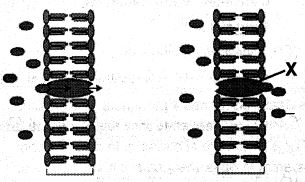
Identify the process shown in the figure and what is correct for $X$?
A
Passive transport,Cell membrane
B
Active transport,Bilayer of lipid
C
Facilitated diffusion,Transport protein
D
Passive transport,Lipid bilayer
Solution
(C) The figure illustrates the movement of molecules across a biological membrane with the help of a specialized protein.
Since the molecules are moving through a protein channel/carrier without the expenditure of energy (moving down the concentration gradient),this process is known as facilitated diffusion.
$X$ represents the transport protein (or carrier protein) embedded in the lipid bilayer that facilitates the passage of hydrophilic molecules.
Therefore,the correct identification is facilitated diffusion and transport protein.
Since the molecules are moving through a protein channel/carrier without the expenditure of energy (moving down the concentration gradient),this process is known as facilitated diffusion.
$X$ represents the transport protein (or carrier protein) embedded in the lipid bilayer that facilitates the passage of hydrophilic molecules.
Therefore,the correct identification is facilitated diffusion and transport protein.
0 likes
View Solution42
MediumMCQ
Which of the following transport mechanisms induces conformational changes in proteins?
A
Simple diffusion
B
Osmosis
C
Facilitated diffusion
D
Plasmolysis
Solution
(C) Facilitated diffusion is a type of passive transport that requires specific membrane proteins to move molecules across the cell membrane.
These proteins,known as carrier proteins,bind to the specific solute molecule.
Upon binding,the carrier protein undergoes a conformational change (a change in its three-dimensional shape) to release the molecule on the other side of the membrane.
Simple diffusion and osmosis do not involve such protein-mediated conformational changes,and plasmolysis is a phenomenon resulting from osmotic water loss.
These proteins,known as carrier proteins,bind to the specific solute molecule.
Upon binding,the carrier protein undergoes a conformational change (a change in its three-dimensional shape) to release the molecule on the other side of the membrane.
Simple diffusion and osmosis do not involve such protein-mediated conformational changes,and plasmolysis is a phenomenon resulting from osmotic water loss.
0 likes
View Solution43
MediumMCQ
Read carefully the given table and choose the option that correctly fills the blanks in it.
Identify the values for $a, b, c, d$.
| Property | Simple Diffusion | Facilitated Transport | Active Transport |
|---|---|---|---|
| Requires special membrane proteins | No | $a$ | Yes |
| Transport saturates | No | Yes | $b$ |
| Uphill transport | $c$ | No | Yes |
| Requires $ATP$ energy | No | No | $d$ |
Identify the values for $a, b, c, d$.
A
$Yes - Yes - Yes - Yes$
B
$No - Yes - Yes - No$
C
$Yes - No - No - Yes$
D
$Yes - Yes - No - Yes$
Solution
(D) To determine the correct values for the blanks,we analyze the characteristics of transport mechanisms in plants:
$1$. $a$ (Facilitated Transport requires special membrane proteins): Yes,facilitated transport relies on specific membrane proteins to move molecules across the membrane.
$2$. $b$ (Active Transport saturates): Yes,active transport involves carrier proteins that can become saturated when all available protein sites are occupied.
$3$. $c$ (Simple Diffusion is uphill transport): No,simple diffusion is a passive process that moves molecules along the concentration gradient (downhill),not against it.
$4$. $d$ (Active Transport requires $ATP$ energy): Yes,active transport requires metabolic energy in the form of $ATP$ to pump molecules against the concentration gradient.
Therefore,the correct sequence is $a = Yes, b = Yes, c = No, d = Yes$.
$1$. $a$ (Facilitated Transport requires special membrane proteins): Yes,facilitated transport relies on specific membrane proteins to move molecules across the membrane.
$2$. $b$ (Active Transport saturates): Yes,active transport involves carrier proteins that can become saturated when all available protein sites are occupied.
$3$. $c$ (Simple Diffusion is uphill transport): No,simple diffusion is a passive process that moves molecules along the concentration gradient (downhill),not against it.
$4$. $d$ (Active Transport requires $ATP$ energy): Yes,active transport requires metabolic energy in the form of $ATP$ to pump molecules against the concentration gradient.
Therefore,the correct sequence is $a = Yes, b = Yes, c = No, d = Yes$.
0 likes
View Solution44
EasyMCQ
Which process is responsible for short distance movement?
A
Ascent of sap
B
Osmotic pressure
C
Diffusion
D
Plasmolysis
Solution
(C) Short distance movement of substances in plants,such as the movement of molecules across a cell membrane or between adjacent cells,occurs primarily through diffusion.
Diffusion is a passive process where molecules move from a region of higher concentration to a region of lower concentration.
Ascent of sap is a long-distance transport process.
Osmotic pressure is a force or property related to osmosis,not the movement process itself.
Plasmolysis is the shrinking of the protoplast due to water loss,not a transport mechanism for movement.
Diffusion is a passive process where molecules move from a region of higher concentration to a region of lower concentration.
Ascent of sap is a long-distance transport process.
Osmotic pressure is a force or property related to osmosis,not the movement process itself.
Plasmolysis is the shrinking of the protoplast due to water loss,not a transport mechanism for movement.
0 likes
View Solution45
MediumMCQ
As cells in the cortex are loosely packed,what is the effect on water movement?
A
There is much resistance along the apoplast pathway.
B
There is not much resistance along the apoplast pathway.
C
Majority of water flow occurs by the symplast pathway.
D
Transmembrane transport does not occur.
Solution
(B) The apoplast pathway consists of the non-living parts of the plant,such as cell walls and intercellular spaces. In the root cortex,the cells are loosely packed,which creates large intercellular spaces. Because these spaces are filled with air or water and offer little obstruction,water can move freely through the apoplast pathway without much resistance. Therefore,the loose arrangement of cortical cells facilitates the apoplastic movement of water.
0 likes
View Solution46
EasyMCQ
In .......... both molecules cross the membrane in the same direction.
A
Symport
B
Antiport
C
Uniport
D
None of these
Solution
(A) In $Symport$,both molecules cross the membrane in the same direction.
In $Antiport$,molecules move in opposite directions.
In $Uniport$,a molecule moves across a membrane independent of other molecules.
In $Antiport$,molecules move in opposite directions.
In $Uniport$,a molecule moves across a membrane independent of other molecules.
0 likes
View Solution47
MediumMCQ
In which movement, transport molecules are necessary but energy is not utilized?
A
Diffusion
B
Facilitated diffusion
C
Active transport
D
All of the above
Solution
(B) In $Facilitated \text{ } diffusion$, specific membrane proteins are required to facilitate the movement of molecules across the membrane.
However, this process occurs along the concentration gradient, meaning molecules move from a region of higher concentration to a region of lower concentration.
Since it follows the concentration gradient, $Facilitated \text{ } diffusion$ does not require the expenditure of metabolic energy $(ATP)$.
In contrast, $Active \text{ } transport$ requires both transport proteins and energy $(ATP)$, while simple $Diffusion$ does not require transport proteins.
However, this process occurs along the concentration gradient, meaning molecules move from a region of higher concentration to a region of lower concentration.
Since it follows the concentration gradient, $Facilitated \text{ } diffusion$ does not require the expenditure of metabolic energy $(ATP)$.
In contrast, $Active \text{ } transport$ requires both transport proteins and energy $(ATP)$, while simple $Diffusion$ does not require transport proteins.
0 likes
View Solution48
MediumMCQ
The transport rate reaches a maximum when:
A
Transport occurs against a concentration gradient.
B
All of the protein transporters are being used.
C
Transport occurs along a concentration gradient.
D
Transport occurs by facilitated diffusion.
Solution
(B) Facilitated diffusion is a process that requires specific membrane proteins to move molecules across the cell membrane.
Because the number of these protein transporters is limited,the transport rate increases with an increase in the concentration gradient up to a point.
Once all the protein transporters are saturated (i.e.,all are occupied by substrate molecules),the transport rate reaches its maximum and cannot increase further,even if the concentration gradient is increased.
This phenomenon is known as saturation kinetics.
Because the number of these protein transporters is limited,the transport rate increases with an increase in the concentration gradient up to a point.
Once all the protein transporters are saturated (i.e.,all are occupied by substrate molecules),the transport rate reaches its maximum and cannot increase further,even if the concentration gradient is increased.
This phenomenon is known as saturation kinetics.
0 likes
View Solution49
MediumMCQ
Choose the correct sentences for diffusion:
$(1)$ In diffusion,molecules move in a random fashion.
$(2)$ Diffusion rates are affected by the gradient of concentration.
$(3)$ Diffusion is a slow process and is dependent on a 'living system'.
$(4)$ Movement by diffusion is passive.
$(1)$ In diffusion,molecules move in a random fashion.
$(2)$ Diffusion rates are affected by the gradient of concentration.
$(3)$ Diffusion is a slow process and is dependent on a 'living system'.
$(4)$ Movement by diffusion is passive.
A
$1, 2$
B
$2, 3, 4$
C
$1, 2, 4$
D
$1, 3, 4$
Solution
(C) Diffusion is the movement of particles from a region of higher concentration to a region of lower concentration.
$(1)$ Molecules move in a random fashion due to kinetic energy,which is correct.
$(2)$ The rate of diffusion is directly proportional to the concentration gradient,which is correct.
$(3)$ Diffusion is a slow process,but it is a physical process and does not depend on a 'living system'. Therefore,this statement is incorrect.
$(4)$ Diffusion is a passive process because it does not require the expenditure of energy $(ATP)$. Therefore,this statement is correct.
Thus,statements $(1), (2),$ and $(4)$ are correct.
$(1)$ Molecules move in a random fashion due to kinetic energy,which is correct.
$(2)$ The rate of diffusion is directly proportional to the concentration gradient,which is correct.
$(3)$ Diffusion is a slow process,but it is a physical process and does not depend on a 'living system'. Therefore,this statement is incorrect.
$(4)$ Diffusion is a passive process because it does not require the expenditure of energy $(ATP)$. Therefore,this statement is correct.
Thus,statements $(1), (2),$ and $(4)$ are correct.
0 likes
View Solution50
MediumMCQ
$A-$ In an antiport,both molecules move in opposite directions.
$R -$ In symport,only one molecule crosses the membrane in the same direction.
$R -$ In symport,only one molecule crosses the membrane in the same direction.
A
$A$ and $R$ are correct.
B
$A$ and $R$ are incorrect.
C
$A$ is correct,$R$ is incorrect.
D
$A$ is incorrect,$R$ is correct.
Solution
(C) $1$. In $antiport$,two types of molecules move in opposite directions across the membrane.
$2$. In $symport$,two types of molecules cross the membrane in the same direction simultaneously.
$3$. The statement $A$ is correct because $antiport$ involves movement in opposite directions.
$4$. The statement $R$ is incorrect because $symport$ involves two molecules moving in the same direction,not just one.
$2$. In $symport$,two types of molecules cross the membrane in the same direction simultaneously.
$3$. The statement $A$ is correct because $antiport$ involves movement in opposite directions.
$4$. The statement $R$ is incorrect because $symport$ involves two molecules moving in the same direction,not just one.
0 likes
View SolutionTransport in Plants — Means of transport · Frequently Asked Questions
1Are these Transport in Plants questions useful for JEE and NEET?
Yes. All questions in this section are mapped to JEE Main and NEET exam patterns. Previous year questions from JEE Main, NEET, GUJCET and state-level exams are included with full solutions.
2Can I switch to Hindi or Gujarati for these questions?
Yes. Use the language tabs in the hero section or the sidebar to view the same questions and solutions in English, Hindi or Gujarati.
3How do I generate a question paper from this subtopic?
Use the Vedclass Exam Paper Generator — select the chapter and subtopic, set difficulty, and generate Sets A, B, C, D automatically. First 3 chapters of every subject are free.
Vedclass Products
For Students
Vedclass Test Series
Mock tests in real JEE/NEET style with performance analysis. 5-day free trial.
Start Free TrialFor Teachers
Exam Paper Generator
Generate Set A/B/C/D papers from this chapter in 2 minutes. 3 chapters free.
Try FreeFor Institutes
Online Exam Module
Live online exams with unlimited students, 360° analytics & white-label branding.
See DemoFor Teachers & Institutes
Generate a Transport in Plants Exam Paper in 2 Minutes
Select subtopic & difficulty — Sets A, B, C, D auto-generated with No Repeat logic.
First 3 chapters of every subject are free — no payment required.