
A English
Phloem Transport: Flow from Source to Sink Questions in English
Class 11 Biology · Transport in Plants · Phloem Transport: Flow from Source to Sink
146+
Questions
English
Language
100%
With Solutions
Showing 45 of 146 questions in English
101
MediumMCQ
What is the direction of movement of sugars in phloem?
A
Non-multidirectional
B
Upward
C
Downward
D
Bi-directional
Solution
(D) The movement of sugars in the phloem is described as $bi-directional$.
This is because the source (where sugars are produced,usually leaves) and the sink (where sugars are consumed or stored,such as roots,fruits,or developing buds) can change depending on the season or the plant's developmental stage.
For example,during spring,sugar stored in roots (acting as a source) moves upward to developing buds (acting as a sink),whereas during summer,sugar produced in leaves (acting as a source) moves downward to roots (acting as a sink).
Therefore,phloem transport is not restricted to a single direction.
This is because the source (where sugars are produced,usually leaves) and the sink (where sugars are consumed or stored,such as roots,fruits,or developing buds) can change depending on the season or the plant's developmental stage.
For example,during spring,sugar stored in roots (acting as a source) moves upward to developing buds (acting as a sink),whereas during summer,sugar produced in leaves (acting as a source) moves downward to roots (acting as a sink).
Therefore,phloem transport is not restricted to a single direction.
0 likes
View Solution102
MediumMCQ
If a stem is girdled,what happens?
A
Root dies first
B
Shoot dies first
C
Both die together
D
None of the above would die
Solution
(A) Girdling involves the removal of a ring of bark (including the phloem) from the stem. Since the phloem is responsible for the translocation of food (sucrose) from the leaves to the roots,girdling prevents this transport. Consequently,the roots are deprived of nutrients and die first,followed by the death of the entire plant.
0 likes
View Solution103
MediumMCQ
Assertion : Long distance flow of photoassimilates in plants occurs through sieve tubes.
Reason : Mature sieve tubes have parietal cytoplasm and perforated sieve plates.
Reason : Mature sieve tubes have parietal cytoplasm and perforated sieve plates.
A
If both Assertion and Reason are correct and the Reason is a correct explanation of the Assertion.
B
If both Assertion and Reason are correct but Reason is not a correct explanation of the Assertion.
C
If the Assertion is correct but Reason is incorrect.
D
If both the Assertion and Reason are incorrect.
Solution
(A) The assertion is correct because sieve tubes are the primary conducting elements for the translocation of photoassimilates (sucrose) in plants.
The reason is also correct because mature sieve tube elements lack a nucleus but retain a thin layer of parietal cytoplasm and possess perforated sieve plates at their end walls.
These structural features facilitate the mass flow of sap from one sieve tube element to the next,making the reason a correct explanation for the assertion.
The reason is also correct because mature sieve tube elements lack a nucleus but retain a thin layer of parietal cytoplasm and possess perforated sieve plates at their end walls.
These structural features facilitate the mass flow of sap from one sieve tube element to the next,making the reason a correct explanation for the assertion.
0 likes
View Solution104
Medium
Explain why xylem transport is unidirectional and phloem transport bi-directional.
Solution
(N/A) During the growth of a plant,its leaves act as the source of food as they carry out photosynthesis. The phloem conducts the food from the source to the sink (the part of the plant requiring or storing food).
During spring,this process is reversed as the food stored in the sink is mobilised toward the growing buds of the plant through the phloem.
Thus,the movement of food in the phloem is bi-directional (i.e.,upward and downward).
The transport of water in the xylem takes place only from the roots to the leaves.
Therefore,the movement of water and minerals in the xylem is unidirectional.
During spring,this process is reversed as the food stored in the sink is mobilised toward the growing buds of the plant through the phloem.
Thus,the movement of food in the phloem is bi-directional (i.e.,upward and downward).
The transport of water in the xylem takes place only from the roots to the leaves.
Therefore,the movement of water and minerals in the xylem is unidirectional.
0 likes
View Solution105
Medium
Explain the pressure flow hypothesis of translocation of sugars in plants.
Solution
(N/A) According to the pressure flow hypothesis,food is prepared in the plant leaves in the form of glucose.
Before moving into the source cells present in the phloem,the prepared food is converted into sucrose.
Water moves from the xylem vessels into the adjacent phloem via osmosis,thereby increasing the hydrostatic pressure in the phloem at the source.
Consequently,the sucrose moves through the sieve tube elements of the phloem towards the sink.
The sucrose already present in the sink region is converted into starch or cellulose,which reduces the osmotic pressure and the hydrostatic pressure in the sink cells.
Hence,the pressure gradient created between the source and the sink cells allows sugars to be translocated from the source to the sink.
Finally,the sugars are removed from the sink cells through active transport.
Before moving into the source cells present in the phloem,the prepared food is converted into sucrose.
Water moves from the xylem vessels into the adjacent phloem via osmosis,thereby increasing the hydrostatic pressure in the phloem at the source.
Consequently,the sucrose moves through the sieve tube elements of the phloem towards the sink.
The sucrose already present in the sink region is converted into starch or cellulose,which reduces the osmotic pressure and the hydrostatic pressure in the sink cells.
Hence,the pressure gradient created between the source and the sink cells allows sugars to be translocated from the source to the sink.
Finally,the sugars are removed from the sink cells through active transport.
0 likes
View Solution106
Medium
Explain phloem transport.
Solution
(N/A) $\Rightarrow$ Source: The part of the plant where food is synthesized,typically the leaves.
$\Rightarrow$ Sink: The part of the plant where food is stored or utilized,such as roots,stems,or developing buds.
$\Rightarrow$ Food,primarily in the form of sucrose,is transported by the vascular tissue phloem from a source to a sink.
$\Rightarrow$ The source-sink relationship is not fixed; it can be reversed depending on the season or the plant's physiological needs.
$\Rightarrow$ For example,sugar stored in roots may be mobilized to become a source of food in early spring to support the growth of developing buds.
$\Rightarrow$ Unlike xylem transport,which is unidirectional,phloem transport is bidirectional.
$\Rightarrow$ Bidirectional movement means that food in the phloem sap can be transported in any required direction,provided there is a source of sugar and a sink capable of using,storing,or removing it.
$\Rightarrow$ Phloem sap consists mainly of water and sucrose,but it also transports other sugars,hormones,and amino acids.
$\Rightarrow$ Sink: The part of the plant where food is stored or utilized,such as roots,stems,or developing buds.
$\Rightarrow$ Food,primarily in the form of sucrose,is transported by the vascular tissue phloem from a source to a sink.
$\Rightarrow$ The source-sink relationship is not fixed; it can be reversed depending on the season or the plant's physiological needs.
$\Rightarrow$ For example,sugar stored in roots may be mobilized to become a source of food in early spring to support the growth of developing buds.
$\Rightarrow$ Unlike xylem transport,which is unidirectional,phloem transport is bidirectional.
$\Rightarrow$ Bidirectional movement means that food in the phloem sap can be transported in any required direction,provided there is a source of sugar and a sink capable of using,storing,or removing it.
$\Rightarrow$ Phloem sap consists mainly of water and sucrose,but it also transports other sugars,hormones,and amino acids.
0 likes
View Solution107
Medium
Explain the flow of food from source to sink in plants.
Solution
(N/A) $\Rightarrow$ Source: The part of the plant where food is synthesized,primarily the leaves.
$\Rightarrow$ Sink: The part of the plant where food is stored or utilized,such as roots,stems,fruits,or developing buds.
$\Rightarrow$ Food,primarily in the form of sucrose,is transported by the vascular tissue $Phloem$ from a source to a sink.
$\Rightarrow$ The source-sink relationship is not fixed; it can be reversed depending on the season or the plant's physiological needs.
$\Rightarrow$ For example,sugar stored in roots during winter may be mobilized to become a source in early spring to support the growth of new buds.
$\Rightarrow$ The direction of movement in $Phloem$ is bidirectional,meaning it can move upwards or downwards depending on the location of the source and the sink.
$\Rightarrow$ $Phloem$ sap consists mainly of water and sucrose,but it also transports other sugars,hormones,and amino acids to regions where they are required.
$\Rightarrow$ Sink: The part of the plant where food is stored or utilized,such as roots,stems,fruits,or developing buds.
$\Rightarrow$ Food,primarily in the form of sucrose,is transported by the vascular tissue $Phloem$ from a source to a sink.
$\Rightarrow$ The source-sink relationship is not fixed; it can be reversed depending on the season or the plant's physiological needs.
$\Rightarrow$ For example,sugar stored in roots during winter may be mobilized to become a source in early spring to support the growth of new buds.
$\Rightarrow$ The direction of movement in $Phloem$ is bidirectional,meaning it can move upwards or downwards depending on the location of the source and the sink.
$\Rightarrow$ $Phloem$ sap consists mainly of water and sucrose,but it also transports other sugars,hormones,and amino acids to regions where they are required.
0 likes
View Solution108
Medium
Explain the pressure flow hypothesis of translocation of sugar in plants.
Solution
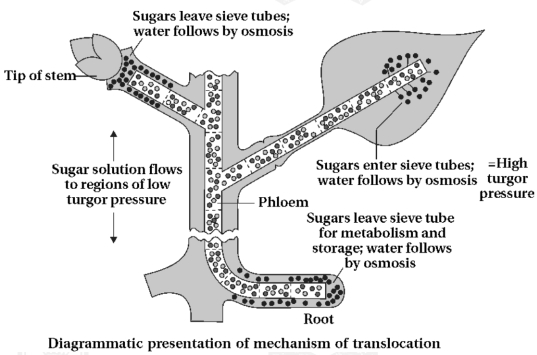
(N/A) $ \Rightarrow $ The accepted mechanism for the translocation of sugars from source to sink is called the pressure flow hypothesis.
$ \Rightarrow $ Glucose is prepared at the source (by photosynthesis) and converted into sucrose (a disaccharide). The sugar is then moved in the form of sucrose into the companion cells and subsequently into the living phloem sieve tube cells by active transport. This process of loading at the source creates a hypertonic condition in the phloem. Water from the adjacent xylem moves into the phloem by osmosis.
$ \Rightarrow $ As osmotic pressure builds up, the phloem sap moves to areas of lower pressure.
$ \Rightarrow $ At the sink, the osmotic pressure must be reduced. Active transport is again necessary to move the sucrose out of the phloem sap. As sugars are removed, water also moves out of the phloem.
$ \Rightarrow $ To summarize, the movement of sugars in the phloem begins at the source, where sugars are loaded into a sieve tube. Loading of the phloem establishes a water potential gradient that facilitates mass movement in the phloem.
$ \Rightarrow $ Structure of Phloem: Phloem tissue is composed of sieve tube cells, which form long columns with perforated end walls called sieve plates. Cytoplasmic strands pass through the holes in the sieve plates, forming continuous filaments. As hydrostatic pressure in the phloem sieve tube increases, pressure flow begins and the sap moves through the phloem. Meanwhile, at the sink, incoming sugars are actively transported out of the phloem and utilized for metabolism or storage. The loss of solute increases the water potential in the phloem, and water eventually passes out, returning to the xylem.
$ \Rightarrow $ Experiment: Girdling
$ \Rightarrow $ $ A $ simple experiment was used to identify the tissues through which food is transported. On the trunk of a tree, a ring of bark up to the depth of the phloem layer can be carefully removed. In the absence of downward movement of food, the portion of the bark above the ring on the stem becomes swollen after a few weeks. This experiment demonstrates that phloem is the tissue responsible for the translocation of food and that transport takes place towards the roots.
$ \Rightarrow $ Glucose is prepared at the source (by photosynthesis) and converted into sucrose (a disaccharide). The sugar is then moved in the form of sucrose into the companion cells and subsequently into the living phloem sieve tube cells by active transport. This process of loading at the source creates a hypertonic condition in the phloem. Water from the adjacent xylem moves into the phloem by osmosis.
$ \Rightarrow $ As osmotic pressure builds up, the phloem sap moves to areas of lower pressure.
$ \Rightarrow $ At the sink, the osmotic pressure must be reduced. Active transport is again necessary to move the sucrose out of the phloem sap. As sugars are removed, water also moves out of the phloem.
$ \Rightarrow $ To summarize, the movement of sugars in the phloem begins at the source, where sugars are loaded into a sieve tube. Loading of the phloem establishes a water potential gradient that facilitates mass movement in the phloem.
$ \Rightarrow $ Structure of Phloem: Phloem tissue is composed of sieve tube cells, which form long columns with perforated end walls called sieve plates. Cytoplasmic strands pass through the holes in the sieve plates, forming continuous filaments. As hydrostatic pressure in the phloem sieve tube increases, pressure flow begins and the sap moves through the phloem. Meanwhile, at the sink, incoming sugars are actively transported out of the phloem and utilized for metabolism or storage. The loss of solute increases the water potential in the phloem, and water eventually passes out, returning to the xylem.
$ \Rightarrow $ Experiment: Girdling
$ \Rightarrow $ $ A $ simple experiment was used to identify the tissues through which food is transported. On the trunk of a tree, a ring of bark up to the depth of the phloem layer can be carefully removed. In the absence of downward movement of food, the portion of the bark above the ring on the stem becomes swollen after a few weeks. This experiment demonstrates that phloem is the tissue responsible for the translocation of food and that transport takes place towards the roots.
0 likes
View Solution109
Medium
Explain: The relationship between source and sink is variable.
Solution
(N/A) The $source$ is defined as the part of the plant that synthesizes food,such as leaves.
The $sink$ is the part of the plant that needs or stores food.
However,the relationship between $source$ and $sink$ is not fixed and can change depending on the season or the plant's needs.
For example,sugars stored in roots during winter act as a $source$ at the beginning of spring.
- At this time,the developing buds of the plant act as the $sink$.
- Energy is required for the growth and development of new photosynthetic parts.
- Thus,the relationship between $source$ and $sink$ is variable.
The $sink$ is the part of the plant that needs or stores food.
However,the relationship between $source$ and $sink$ is not fixed and can change depending on the season or the plant's needs.
For example,sugars stored in roots during winter act as a $source$ at the beginning of spring.
- At this time,the developing buds of the plant act as the $sink$.
- Energy is required for the growth and development of new photosynthetic parts.
- Thus,the relationship between $source$ and $sink$ is variable.
0 likes
View Solution110
Medium
Can girdling experiments be done in monocots? If yes,how? If no,why not?
Solution
(N/A) No,the girdling (or ring) experiment is not possible in monocotyledons. This is because the vascular bundles in the stems of monocotyledons are scattered throughout the ground tissue rather than being arranged in a ring. Since the phloem is distributed within these scattered bundles,it is impossible to remove a continuous ring of phloem without damaging the entire stem,which is necessary to demonstrate the translocation of food.
0 likes
View Solution111
MediumMCQ
What does the xylem and phloem sap contain?
A
Xylem sap contains water and minerals; Phloem sap contains sucrose,hormones,and amino acids.
B
Xylem sap contains sucrose; Phloem sap contains water and minerals.
C
Both contain only water.
D
Both contain only glucose.
Solution
(A) Xylem sap primarily consists of water and dissolved mineral nutrients absorbed from the soil.
Phloem sap is a nutrient-rich fluid that primarily contains sucrose,which is a disaccharide.
Additionally,phloem sap also transports various hormones,amino acids,and other organic compounds throughout the plant.
Phloem sap is a nutrient-rich fluid that primarily contains sucrose,which is a disaccharide.
Additionally,phloem sap also transports various hormones,amino acids,and other organic compounds throughout the plant.
0 likes
View Solution112
Medium
Explain the mass flow hypothesis of transport in phloem.
Solution
(N/A) The mass flow hypothesis,also known as the pressure-flow hypothesis,is the most widely accepted theory for the translocation of sugars in plants.
$1$. Source and Sink: Glucose produced in the leaves (source) is converted into sucrose. This sucrose is loaded into the companion cells and then into the sieve tube elements of the phloem by active transport.
$2$. Osmotic Gradient: The high concentration of sucrose in the phloem creates a hypertonic condition,causing water to move from the adjacent xylem into the phloem by osmosis.
$3$. Hydrostatic Pressure: This influx of water increases the hydrostatic pressure (turgor pressure) within the sieve tubes at the source.
$4$. Mass Flow: The pressure difference between the source and the sink (where sucrose is being utilized or stored) causes the sap to flow through the phloem sieve tubes towards the sink.
$5$. Unloading: At the sink,sucrose is actively removed from the phloem into the cells where it is needed. As the solute concentration decreases,water moves back into the xylem,reducing the hydrostatic pressure at the sink,thus maintaining the pressure gradient.
$1$. Source and Sink: Glucose produced in the leaves (source) is converted into sucrose. This sucrose is loaded into the companion cells and then into the sieve tube elements of the phloem by active transport.
$2$. Osmotic Gradient: The high concentration of sucrose in the phloem creates a hypertonic condition,causing water to move from the adjacent xylem into the phloem by osmosis.
$3$. Hydrostatic Pressure: This influx of water increases the hydrostatic pressure (turgor pressure) within the sieve tubes at the source.
$4$. Mass Flow: The pressure difference between the source and the sink (where sucrose is being utilized or stored) causes the sap to flow through the phloem sieve tubes towards the sink.
$5$. Unloading: At the sink,sucrose is actively removed from the phloem into the cells where it is needed. As the solute concentration decreases,water moves back into the xylem,reducing the hydrostatic pressure at the sink,thus maintaining the pressure gradient.
0 likes
View Solution113
Medium
The radio-labelled carbon in carbon dioxide supplied to potato plants in an experiment was eventually seen in the tuber. Trace the movement of the labelled carbon dioxide.
Solution
(N/A) $1$. During photosynthesis,the potato plant takes up the radio-labelled $CO_2$ $(^{14}CO_2)$.
$2$. This carbon is fixed into organic compounds,primarily glucose $(C_6H_{12}O_6)$,through the Calvin cycle.
$3$. The glucose is then converted into sucrose $(C_{12}H_{22}O_{11})$,which is the primary form of sugar transported in plants.
$4$. This radio-labelled sucrose is translocated from the leaves (source) to the tubers (sink) through the phloem tissue via sieve tube elements.
$5$. The presence of the radio-labelled carbon in the tuber can be detected using the autoradiography technique.
$2$. This carbon is fixed into organic compounds,primarily glucose $(C_6H_{12}O_6)$,through the Calvin cycle.
$3$. The glucose is then converted into sucrose $(C_{12}H_{22}O_{11})$,which is the primary form of sugar transported in plants.
$4$. This radio-labelled sucrose is translocated from the leaves (source) to the tubers (sink) through the phloem tissue via sieve tube elements.
$5$. The presence of the radio-labelled carbon in the tuber can be detected using the autoradiography technique.
0 likes
View Solution114
EasyMCQ
Analogy type questions:
$(1)$ In Xylem : Vessel :: In Phloem : ..........
$(2)$ Synthesis of food : Source :: Regions of need : ...........
$(1)$ In Xylem : Vessel :: In Phloem : ..........
$(2)$ Synthesis of food : Source :: Regions of need : ...........
A
$(1)$ Sieve tube,$(2)$ Sink
B
$(1)$ Tracheid,$(2)$ Source
C
$(1)$ Companion cell,$(2)$ Sink
D
$(1)$ Sieve tube,$(2)$ Source
Solution
(A) $(1)$ In the xylem tissue,the vessel is the primary conducting element. Similarly,in the phloem tissue,the sieve tube is the primary conducting element.
$(2)$ In the context of translocation,the part of the plant where food is synthesized (like leaves) is called the 'Source'. The part of the plant where food is utilized or stored (like roots or fruits) is called the 'Sink'.
$(2)$ In the context of translocation,the part of the plant where food is synthesized (like leaves) is called the 'Source'. The part of the plant where food is utilized or stored (like roots or fruits) is called the 'Sink'.
0 likes
View Solution115
MediumMCQ
Select the incorrect statement.
A
Elements most easily mobilized in plants from one region to another are: phosphorus,sulphur,nitrogen and potassium.
B
Transport of molecules in phloem can be bidirectional.
C
Movement of minerals in xylem is unidirectional.
D
Unloading of sucrose at sink does not involve the utilization of $ATP$.
Solution
(D) The unloading of sucrose at the sink is an active process that requires energy. Therefore,it involves the utilization of $ATP$ to move sucrose from the phloem into the sink cells against the concentration gradient. Thus,the statement that it does not involve the utilization of $ATP$ is incorrect.
0 likes
View Solution116
MediumMCQ
The direction of translocation of organic food or solutes is:
A
Upward
B
Downward
C
Radial
D
All of these
Solution
(D) The translocation of organic food (sucrose) occurs through the phloem.
In plants,food is synthesized in the leaves (source) and transported to the growing regions (sinks) such as roots,fruits,and developing buds.
During the germination of seeds,stored food is transported from the seed to the developing shoot (upward) and root (downward).
Additionally,lateral or radial transport occurs between the xylem and phloem via ray cells.
Therefore,the translocation of organic solutes can occur in all directions depending on the source-sink relationship.
In plants,food is synthesized in the leaves (source) and transported to the growing regions (sinks) such as roots,fruits,and developing buds.
During the germination of seeds,stored food is transported from the seed to the developing shoot (upward) and root (downward).
Additionally,lateral or radial transport occurs between the xylem and phloem via ray cells.
Therefore,the translocation of organic solutes can occur in all directions depending on the source-sink relationship.
0 likes
View Solution117
EasyMCQ
Phloem sap is made up of
A
Water and minerals
B
Water and sucrose
C
Water and glucose
D
Both $(b)$ and $(c)$
Solution
(B) Phloem sap primarily consists of water and organic solutes,mainly sucrose,which is the form in which carbohydrates are transported in plants.
While glucose is the primary product of photosynthesis,it is converted into sucrose for translocation because sucrose is a non-reducing sugar and is more stable for transport.
Therefore,phloem sap is composed of water and sucrose.
While glucose is the primary product of photosynthesis,it is converted into sucrose for translocation because sucrose is a non-reducing sugar and is more stable for transport.
Therefore,phloem sap is composed of water and sucrose.
0 likes
View Solution118
EasyMCQ
Translocation of organic materials in plants is explained by:
A
Active transport
B
Transpiration pull
C
Inhibition theory
D
Mass-flow hypothesis
Solution
(D) The Mass-flow hypothesis (also known as the Pressure-flow hypothesis) was proposed by Munch in $1931$. According to this theory,organic food materials are translocated through the phloem along a concentration gradient from the source (where food is synthesized) to the sink (the site of utilization or storage).
0 likes
View Solution119
EasyMCQ
In which form is the food transported in plants?
A
Sucrose
B
Fructose
C
Glucose
D
Lactose
Solution
(A) In plants,food synthesized during photosynthesis in the leaves is primarily transported through the phloem.
Although glucose is the primary product of photosynthesis,it is highly reactive and osmotically active.
Therefore,plants convert glucose into $Sucrose$ for long-distance transport.
$Sucrose$ is a non-reducing sugar,making it chemically stable and less reactive during transport,which ensures that it reaches the sink tissues (like roots,fruits,and seeds) without being metabolized prematurely.
Although glucose is the primary product of photosynthesis,it is highly reactive and osmotically active.
Therefore,plants convert glucose into $Sucrose$ for long-distance transport.
$Sucrose$ is a non-reducing sugar,making it chemically stable and less reactive during transport,which ensures that it reaches the sink tissues (like roots,fruits,and seeds) without being metabolized prematurely.
0 likes
View Solution120
MediumMCQ
When sugars enter sieve tubes,water flows by osmosis,resulting in:
A
Water potential
B
Osmotic gradient
C
Turgor pressure
D
$DPD$
Solution
(C) The movement of sugars in the phloem begins at the source,where sugars are loaded into the sieve tubes via active transport. This increase in solute concentration lowers the water potential inside the sieve tube,causing water to move from the adjacent xylem into the phloem by osmosis. This influx of water increases the hydrostatic pressure,also known as turgor pressure,within the sieve tube,which drives the mass flow of sap from the source to the sink.
0 likes
View Solution121
EasyMCQ
Transport of different types of solute substances takes place by
A
Bulk flow system
B
Combined response
C
Facilitated diffusion
D
Pressured transport
Solution
(A) Transport of substances over longer distances through vascular tissue is termed as translocation.
This translocation of different substances,whether inorganic minerals or organic substances (like sugar),occurs through a mass or bulk flow system.
This mass flow of substances is unidirectional in the case of water,while it is multidirectional in the case of organic solutes and minerals.
This translocation of different substances,whether inorganic minerals or organic substances (like sugar),occurs through a mass or bulk flow system.
This mass flow of substances is unidirectional in the case of water,while it is multidirectional in the case of organic solutes and minerals.
0 likes
View Solution122
EasyMCQ
Who described the mass flow hypothesis?
A
Munch
B
Sir $JC$ Bose
C
Kursanov
D
Buchmann and Priestly
Solution
(A) The mass flow or pressure flow hypothesis for the translocation of organic food was proposed by Munch $(1930)$.
According to this hypothesis,organic substances are transported from an area of higher osmotic pressure to an area of lower osmotic pressure.
This occurs due to the development of a turgor pressure gradient.
The flow of the organic solution takes place from a region of higher turgor pressure (source) to an area of lower turgor pressure (sink) or the site of utilization.
According to this hypothesis,organic substances are transported from an area of higher osmotic pressure to an area of lower osmotic pressure.
This occurs due to the development of a turgor pressure gradient.
The flow of the organic solution takes place from a region of higher turgor pressure (source) to an area of lower turgor pressure (sink) or the site of utilization.
0 likes
View Solution123
MediumMCQ
Arrange the following events of mass flow of organic material in sequence:
$I$. Sugars are transported from cell to cell in the leaf
$II$. Food is synthesized in form of glucose by leaf cells
$III$. Movement of water takes place into sieve tube elements
$IV$. Downward movement of sugar occurs in the stem
$V$. Solutes are actively transported into the sieve elements
$I$. Sugars are transported from cell to cell in the leaf
$II$. Food is synthesized in form of glucose by leaf cells
$III$. Movement of water takes place into sieve tube elements
$IV$. Downward movement of sugar occurs in the stem
$V$. Solutes are actively transported into the sieve elements
A
$I, II, III, V, IV$
B
$II, I, V, III, IV$
C
$II, III, I, V, IV$
D
$I, II, V, IV, III$
Solution
(B) According to the Munch pressure-flow hypothesis,the transport of organic nutrients from source to sink follows this sequence:
$1$. $II$. Food is synthesized as glucose in the leaf cells.
$2$. $I$. Sugars are transported from cell to cell within the leaf to reach the vicinity of the phloem.
$3$. $V$. Solutes are actively transported into the sieve tube elements.
$4$. $III$. The high solute concentration causes water to move into the sieve tube elements from the adjacent xylem via osmosis.
$5$. $IV$. This creates high turgor pressure,causing the bulk flow (downward movement) of sugar from the source to the sink.
Therefore,the correct sequence is $II, I, V, III, IV$.
$1$. $II$. Food is synthesized as glucose in the leaf cells.
$2$. $I$. Sugars are transported from cell to cell within the leaf to reach the vicinity of the phloem.
$3$. $V$. Solutes are actively transported into the sieve tube elements.
$4$. $III$. The high solute concentration causes water to move into the sieve tube elements from the adjacent xylem via osmosis.
$5$. $IV$. This creates high turgor pressure,causing the bulk flow (downward movement) of sugar from the source to the sink.
Therefore,the correct sequence is $II, I, V, III, IV$.
0 likes
View Solution124
MediumMCQ
Which of the following mechanisms can explain the transport of sucrose from source to sink?
A
Osmotic movement of water into sugar-loaded sieve tube cells,which creates a higher hydrostatic pressure in the source than in the sink.
B
Tension created by differences in pressure potential between source and sink.
C
Active absorption of sucrose through sieve tube membrane driven by a specific pump.
D
Transpiration and active transport of sugar from source to sink.
Solution
(A) Munch $(1930)$ proposed the pressure-flow hypothesis,which best explains the transport of organic nutrients from the source (supply) to the sink (utilization site).
According to this theory,the source has a higher osmotic concentration than the sink.
When organic substances from mesophyll cells (acting as the source) are passed to the sieve tube of the phloem through companion cells by active transport,a high osmotic concentration is developed in the sieve tube,which acts as the source.
Water is absorbed by the sieve tubes from the adjacent xylem,developing a high turgor pressure.
Thus,the translocation of organic nutrients takes place from a region of higher turgor pressure to an area of lower turgor pressure.
According to this theory,the source has a higher osmotic concentration than the sink.
When organic substances from mesophyll cells (acting as the source) are passed to the sieve tube of the phloem through companion cells by active transport,a high osmotic concentration is developed in the sieve tube,which acts as the source.
Water is absorbed by the sieve tubes from the adjacent xylem,developing a high turgor pressure.
Thus,the translocation of organic nutrients takes place from a region of higher turgor pressure to an area of lower turgor pressure.
0 likes
View Solution125
MediumMCQ
If you are given a task to analyse phloem sap chemical,which of the following will be present in least concentration?
A
Water
B
Sugar
C
Minerals and nitrogen
D
Hormones
Solution
(C) Phloem sap primarily consists of water and dissolved organic substances,mainly sucrose (sugar).
It also contains amino acids,hormones,and some minerals.
However,compared to xylem sap,the concentration of minerals and nitrogenous compounds in phloem sap is significantly lower.
Therefore,among the given options,minerals and nitrogen are present in the least concentration.
It also contains amino acids,hormones,and some minerals.
However,compared to xylem sap,the concentration of minerals and nitrogenous compounds in phloem sap is significantly lower.
Therefore,among the given options,minerals and nitrogen are present in the least concentration.
0 likes
View Solution126
MediumMCQ
Why is the transport of organic food through phloem bidirectional?
A
Roots serve as source while leaves are the sink region
B
Source and sink region are irreversible
C
The relationship between the two regions (source and sink) is variable and is dependent on season and plant needs
D
Translocation of organic solute is regulated by energy
Solution
(C) Long-distance transport of substances takes place through a bulk flow system. Organic nutrients are transported over long distances by phloem tissue from the source to the sink region. The direction of transport of these organic nutrients can be upward or downward,i.e.,bidirectional. This is because the relationship between the synthesis region (source) and the utilization region (sink) is not fixed; it varies depending on the season and the specific physiological needs of the plant.
0 likes
View Solution127
MediumMCQ
Consider the following statements and choose the correct option from the codes given below:
$I.$ Loading of phloem is related to the increase of sugar in phloem.
$II.$ Active loading of sugar in the sieve tube of phloem is driven by a proton pump.
$III.$ Pressure may be positive or negative in sieve tube cells.
$IV.$ Water and solutes move through the sieve tube against the pressure gradient.
$V.$ Cytoplasmic strands pass through the holes in sieve plates and form continuous filaments.
$I.$ Loading of phloem is related to the increase of sugar in phloem.
$II.$ Active loading of sugar in the sieve tube of phloem is driven by a proton pump.
$III.$ Pressure may be positive or negative in sieve tube cells.
$IV.$ Water and solutes move through the sieve tube against the pressure gradient.
$V.$ Cytoplasmic strands pass through the holes in sieve plates and form continuous filaments.
A
$I, II, V$ are incorrect,while $III$ and $IV$ are correct.
B
$III$ and $IV$ are incorrect while $I, II$ and $V$ are correct.
C
$I, II$ and $III$ are incorrect while $IV$ and $V$ are correct.
D
$IV$ and $V$ are incorrect while $I, II$ and $III$ are correct.
Solution
(B) Statement $I$ is correct: Phloem loading involves the active transport of sucrose into the sieve tube elements,increasing the sugar concentration.
Statement $II$ is correct: The active transport of sucrose into sieve tubes is mediated by a proton $(H^+)$ pump,which creates a proton gradient.
Statement $III$ is incorrect: In sieve tube cells,the pressure is typically positive (turgor pressure) to facilitate bulk flow; it is not negative.
Statement $IV$ is incorrect: Water and solutes move through the sieve tube along the pressure gradient (from high pressure at the source to low pressure at the sink),not against it.
Statement $V$ is correct: Cytoplasmic strands pass through the sieve plate pores,maintaining continuity between adjacent sieve tube elements.
Therefore,statements $I, II,$ and $V$ are correct,while $III$ and $IV$ are incorrect.
Statement $II$ is correct: The active transport of sucrose into sieve tubes is mediated by a proton $(H^+)$ pump,which creates a proton gradient.
Statement $III$ is incorrect: In sieve tube cells,the pressure is typically positive (turgor pressure) to facilitate bulk flow; it is not negative.
Statement $IV$ is incorrect: Water and solutes move through the sieve tube along the pressure gradient (from high pressure at the source to low pressure at the sink),not against it.
Statement $V$ is correct: Cytoplasmic strands pass through the sieve plate pores,maintaining continuity between adjacent sieve tube elements.
Therefore,statements $I, II,$ and $V$ are correct,while $III$ and $IV$ are incorrect.
0 likes
View Solution128
EasyMCQ
$A$ plant organ having a high concentration of food will serve as a
A
Source
B
Sink
C
Conducting tissue
D
Plasmodesmata
Solution
(A) In the process of translocation of food through the phloem,the plant part where food is synthesized or stored in high concentration is known as the $Source$.
Conversely,the part of the plant that requires food for growth or storage is known as the $Sink$.
Therefore,an organ with a high concentration of food acts as a $Source$.
Conversely,the part of the plant that requires food for growth or storage is known as the $Sink$.
Therefore,an organ with a high concentration of food acts as a $Source$.
0 likes
View Solution129
MediumMCQ
Sucrose moves into sieve tube elements by
A
Diffusion
B
Endosmosis
C
Active transport
D
Exosmosis
Solution
(C) The movement of sucrose from the source into the sieve tube elements is known as phloem loading. Since this process occurs against the concentration gradient,it requires metabolic energy in the form of $ATP$. Therefore,it is an active transport process.
0 likes
View Solution130
EasyMCQ
Translocation of photosynthates occurs in the form of
A
Sucrose
B
Starch
C
Glucose
D
$3-PGA$
Solution
(A) The translocation of photosynthates (sugars) from source to sink occurs primarily in the form of sucrose.
This is because sucrose is a non-reducing sugar.
Being non-reducing,it is chemically less reactive and more stable during long-distance transport through the phloem.
Therefore,this form of disaccharide is preferred for transport in plants.
This is because sucrose is a non-reducing sugar.
Being non-reducing,it is chemically less reactive and more stable during long-distance transport through the phloem.
Therefore,this form of disaccharide is preferred for transport in plants.
0 likes
View Solution131
MediumMCQ
According to the pressure flow hypothesis:
$A.$ Phloem loading produces a hypertonic condition in the sieve tubes.
$B.$ Water potential gradient facilitates the mass movement in the phloem.
$C.$ Phloem unloading is a passive process.
$A.$ Phloem loading produces a hypertonic condition in the sieve tubes.
$B.$ Water potential gradient facilitates the mass movement in the phloem.
$C.$ Phloem unloading is a passive process.
A
$A$ and $B$ are incorrect
B
$B$ and $C$ are incorrect
C
$A$ and $B$ are correct
D
$A$ and $C$ are correct
Solution
(C) According to the pressure flow hypothesis:
$1$. Phloem loading at the source creates a hypertonic condition in the sieve tubes by increasing the solute concentration,which draws water from the adjacent xylem via osmosis. This statement $(A)$ is correct.
$2$. The resulting increase in turgor pressure creates a water potential gradient that facilitates the mass flow of sap from the source to the sink. This statement $(B)$ is correct.
$3$. Phloem unloading at the sink is an active process that requires energy $(ATP)$ to move sugars out of the sieve tubes. Therefore,statement $(C)$ is incorrect because it describes unloading as a passive process.
$1$. Phloem loading at the source creates a hypertonic condition in the sieve tubes by increasing the solute concentration,which draws water from the adjacent xylem via osmosis. This statement $(A)$ is correct.
$2$. The resulting increase in turgor pressure creates a water potential gradient that facilitates the mass flow of sap from the source to the sink. This statement $(B)$ is correct.
$3$. Phloem unloading at the sink is an active process that requires energy $(ATP)$ to move sugars out of the sieve tubes. Therefore,statement $(C)$ is incorrect because it describes unloading as a passive process.
0 likes
View Solution132
MediumMCQ
Although a girdled (up to bast) tree may survive for some time,it will eventually die because:
A
Water will not move upward
B
Water will not move downward
C
Sugars and other organic solutes will not move downward
D
Sugars and other organic solutes will not move upward
Solution
(C) Girdling involves the removal of a ring of bark,which includes the phloem,from the trunk of the tree.
Since the phloem is responsible for the translocation of food (sugars and organic solutes) from the leaves to the rest of the plant,removing it prevents these nutrients from reaching the roots.
As the roots are deprived of food,they eventually die,which leads to the death of the entire tree.
Since the phloem is responsible for the translocation of food (sugars and organic solutes) from the leaves to the rest of the plant,removing it prevents these nutrients from reaching the roots.
As the roots are deprived of food,they eventually die,which leads to the death of the entire tree.
0 likes
View Solution133
MediumMCQ
Phloem loading and unloading processes are respectively:
A
Active,Passive
B
Passive,Active
C
Active,Active
D
Passive,Passive
Solution
(C) Phloem loading is the process of moving sugars from mesophyll cells into the sieve tube elements,which requires metabolic energy $(ATP)$ against the concentration gradient. Similarly,phloem unloading is the process of moving sugars from the sieve tube elements into the sink cells (where food is required),which also requires metabolic energy. Therefore,both processes are active.
0 likes
View Solution134
MediumMCQ
$A$ : The translocation in phloem is bidirectional.
$R$ : The source and sink relationship is variable.
$R$ : The source and sink relationship is variable.
A
Assertion and Reason both are correct and Reason is the correct explanation of Assertion.
B
Assertion and Reason both are correct but Reason is not the correct explanation of Assertion.
C
Assertion is correct,but Reason is incorrect.
D
Both Assertion and Reason are incorrect.
Solution
(A) The translocation of food (sucrose) in phloem is bidirectional because it can move from source to sink in different directions depending on the plant's needs.
$A$ is correct because phloem transport can occur upwards or downwards.
$R$ is correct because the source (where sugar is produced,e.g.,mature leaves) and the sink (where sugar is consumed or stored,e.g.,roots,fruits,or young leaves) relationship is variable; a sink can become a source and vice versa depending on the season or developmental stage of the plant.
Since the direction of translocation depends on the variable source-sink relationship,$R$ is the correct explanation for $A$.
$A$ is correct because phloem transport can occur upwards or downwards.
$R$ is correct because the source (where sugar is produced,e.g.,mature leaves) and the sink (where sugar is consumed or stored,e.g.,roots,fruits,or young leaves) relationship is variable; a sink can become a source and vice versa depending on the season or developmental stage of the plant.
Since the direction of translocation depends on the variable source-sink relationship,$R$ is the correct explanation for $A$.
0 likes
View Solution135
Medium
Movement of substances in xylem is unidirectional, while in phloem it is bidirectional. Explain.
Solution
(N/A) $\Rightarrow$ $Xylem$ transport is unidirectional: It carries water and minerals from the roots to the aerial parts of the plant. This movement is always upwards due to transpiration pull and root pressure.
$\Rightarrow$ $Phloem$ transport is bidirectional: It transports food (sucrose) from the source to the sink.
$\Rightarrow$ $Source$: The part of the plant that synthesizes food, typically the leaves.
$\Rightarrow$ $Sink$: The part of the plant that needs or stores food, such as roots, fruits, or developing buds.
$\Rightarrow$ The source-sink relationship is dynamic and can change based on the season or the plant's physiological needs.
$\Rightarrow$ For example, in early spring, sugar stored in the roots (acting as a source) is mobilized to the developing buds (acting as a sink) for growth.
$\Rightarrow$ Because the source and sink can reverse roles, the movement of organic solutes in the phloem can occur in any direction (upwards or downwards), making it bidirectional.
$\Rightarrow$ $Phloem$ transport is bidirectional: It transports food (sucrose) from the source to the sink.
$\Rightarrow$ $Source$: The part of the plant that synthesizes food, typically the leaves.
$\Rightarrow$ $Sink$: The part of the plant that needs or stores food, such as roots, fruits, or developing buds.
$\Rightarrow$ The source-sink relationship is dynamic and can change based on the season or the plant's physiological needs.
$\Rightarrow$ For example, in early spring, sugar stored in the roots (acting as a source) is mobilized to the developing buds (acting as a sink) for growth.
$\Rightarrow$ Because the source and sink can reverse roles, the movement of organic solutes in the phloem can occur in any direction (upwards or downwards), making it bidirectional.
0 likes
View Solution136
MediumMCQ
"Girdling Experiment" was performed by plant physiologists to identify the plant tissue through which:
A
food is transported
B
both water and food are transported
C
osmosis is observed
D
water is transported
Solution
(A) The "Girdling Experiment" involves removing a ring of bark (including the phloem) from the stem of a tree while leaving the xylem intact.
After some time, it is observed that the portion of the stem above the ring swells due to the accumulation of food material, while the portion below the ring eventually dies.
This experiment demonstrates that the phloem is the tissue responsible for the translocation of food (organic solutes) from the leaves to other parts of the plant.
Since the xylem remains intact, water transport continues, proving that water is transported through the xylem and food through the phloem.
After some time, it is observed that the portion of the stem above the ring swells due to the accumulation of food material, while the portion below the ring eventually dies.
This experiment demonstrates that the phloem is the tissue responsible for the translocation of food (organic solutes) from the leaves to other parts of the plant.
Since the xylem remains intact, water transport continues, proving that water is transported through the xylem and food through the phloem.
0 likes
View Solution137
MediumMCQ
Which structure of the phloem creates a pressure gradient in the sieve tube?
A
Companion cell
B
Phloem fiber
C
Sieve tube element
D
Phloem parenchyma
Solution
(A) The pressure gradient in the phloem is created by the loading of sucrose into the sieve tube elements.
This process is facilitated by the companion cells,which actively transport sucrose into the sieve tubes.
This creates a high osmotic pressure in the sieve tube,causing water to move from the xylem into the phloem,thereby generating a positive pressure gradient that drives the translocation of food.
This process is facilitated by the companion cells,which actively transport sucrose into the sieve tubes.
This creates a high osmotic pressure in the sieve tube,causing water to move from the xylem into the phloem,thereby generating a positive pressure gradient that drives the translocation of food.
0 likes
View Solution138
MediumMCQ
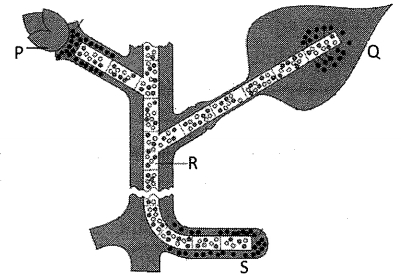
The following figure illustrates the pressure-flow hypothesis. Which of the following represents the source?
A
$P$
B
$Q$
C
$R$
D
$S$
Solution
(B) The pressure-flow hypothesis (or mass flow hypothesis) explains the translocation of sugars in the phloem from a source to a sink.
$1$. $A$ source is any part of the plant that synthesizes food (sucrose),such as mature leaves.
$2$. $A$ sink is any part of the plant that needs or stores food,such as roots,fruits,or developing buds.
$3$. In the given figure,$Q$ represents a mature leaf,which is actively producing sugars (photosynthesis),thus acting as the source.
$4$. $P$ (developing bud) and $S$ (root) are acting as sinks where the sugar is being utilized or stored.
$5$. $R$ represents the phloem tissue through which the translocation occurs.
Therefore,$Q$ is the source.
$1$. $A$ source is any part of the plant that synthesizes food (sucrose),such as mature leaves.
$2$. $A$ sink is any part of the plant that needs or stores food,such as roots,fruits,or developing buds.
$3$. In the given figure,$Q$ represents a mature leaf,which is actively producing sugars (photosynthesis),thus acting as the source.
$4$. $P$ (developing bud) and $S$ (root) are acting as sinks where the sugar is being utilized or stored.
$5$. $R$ represents the phloem tissue through which the translocation occurs.
Therefore,$Q$ is the source.
0 likes
View Solution139
EasyMCQ
The translocation of phloem sap in phloem tissue occurs in $..........$ direction.
A
Unidirectional
B
Polar
C
Bidirectional
D
None of the above
Solution
(C) The translocation of food (phloem sap) in plants occurs through the phloem tissue.
Unlike the xylem,which transports water and minerals in a unidirectional manner (from roots to leaves),the phloem transports organic solutes (sucrose) from the source (leaves) to the sink (roots,fruits,or developing buds).
Depending on the plant's needs and the season,the source and sink can change,meaning the phloem sap can move in both upward and downward directions.
Therefore,the transport of phloem sap is considered to be bidirectional.
Unlike the xylem,which transports water and minerals in a unidirectional manner (from roots to leaves),the phloem transports organic solutes (sucrose) from the source (leaves) to the sink (roots,fruits,or developing buds).
Depending on the plant's needs and the season,the source and sink can change,meaning the phloem sap can move in both upward and downward directions.
Therefore,the transport of phloem sap is considered to be bidirectional.
0 likes
View Solution140
MediumMCQ
Identify the pathway of food transport in plants.
A
Source $\rightarrow$ Companion cell $\rightarrow$ Passive transport $\rightarrow$ Sieve tube $\rightarrow$ Active transport $\rightarrow$ Companion cell $\rightarrow$ Sink
B
Source $\rightarrow$ Companion cell $\rightarrow$ Active transport $\rightarrow$ Sieve tube $\rightarrow$ Active transport $\rightarrow$ Companion cell $\rightarrow$ Sink
C
Sink $\rightarrow$ Companion cell $\rightarrow$ Passive transport $\rightarrow$ Sieve tube $\rightarrow$ Active transport $\rightarrow$ Companion cell $\rightarrow$ Source
D
Sink $\rightarrow$ Companion cell $\rightarrow$ Passive transport $\rightarrow$ Sieve tube $\rightarrow$ Passive transport $\rightarrow$ Companion cell $\rightarrow$ Source
Solution
(B) The transport of food (sucrose) in plants occurs via the phloem,known as the Pressure-Flow Hypothesis or Mass Flow Hypothesis.
$1$. At the source (leaves),sucrose is loaded into the companion cells and then into the sieve tube elements by active transport.
$2$. This creates a high osmotic pressure in the sieve tube,causing water to enter from the xylem.
$3$. The resulting pressure gradient pushes the phloem sap towards the sink.
$4$. At the sink,sucrose is unloaded into the companion cells and then into the sink cells by active transport,followed by the exit of water.
Therefore,the correct pathway is: Source $\rightarrow$ Companion cell $\rightarrow$ Active transport $\rightarrow$ Sieve tube $\rightarrow$ Active transport $\rightarrow$ Companion cell $\rightarrow$ Sink.
$1$. At the source (leaves),sucrose is loaded into the companion cells and then into the sieve tube elements by active transport.
$2$. This creates a high osmotic pressure in the sieve tube,causing water to enter from the xylem.
$3$. The resulting pressure gradient pushes the phloem sap towards the sink.
$4$. At the sink,sucrose is unloaded into the companion cells and then into the sink cells by active transport,followed by the exit of water.
Therefore,the correct pathway is: Source $\rightarrow$ Companion cell $\rightarrow$ Active transport $\rightarrow$ Sieve tube $\rightarrow$ Active transport $\rightarrow$ Companion cell $\rightarrow$ Sink.
0 likes
View Solution141
EasyMCQ
The phloem sap is mainly composed of:
A
Water and sucrose
B
Water and glucose
C
Water and minerals
D
Water and organic components
Solution
(A) The phloem sap is the fluid transported within the phloem tissue of plants.
It primarily consists of water and sucrose,which is the main sugar transported from source (leaves) to sink (roots,fruits,or developing tissues).
While other organic compounds and signaling molecules are present,sucrose is the predominant solute.
It primarily consists of water and sucrose,which is the main sugar transported from source (leaves) to sink (roots,fruits,or developing tissues).
While other organic compounds and signaling molecules are present,sucrose is the predominant solute.
0 likes
View Solution142
MediumMCQ
The girdling experiment proves that $............$.
A
minerals are transported upwards in plants
B
minerals are transported downwards in plants
C
food is transported upwards in plants
D
food is transported downwards in plants
Solution
(D) The girdling experiment involves removing a ring of bark (phloem) from the stem of a plant.
Since the phloem is responsible for the translocation of organic food (sucrose) from the leaves to the roots,removing this tissue blocks the downward movement of food.
As a result,the portion of the stem above the girdle swells due to the accumulation of food,while the roots eventually die due to a lack of nutrients.
Therefore,this experiment proves that phloem is the tissue responsible for the downward translocation of food in plants.
Since the phloem is responsible for the translocation of organic food (sucrose) from the leaves to the roots,removing this tissue blocks the downward movement of food.
As a result,the portion of the stem above the girdle swells due to the accumulation of food,while the roots eventually die due to a lack of nutrients.
Therefore,this experiment proves that phloem is the tissue responsible for the downward translocation of food in plants.
0 likes
View Solution143
EasyMCQ
During translocation of food,at the sink end (root cells),the sugar is used and excess water . . . . . . .
A
is released into soil
B
goes into the xylem
C
is stored in the root cells
D
is evaporated off
Solution
(B) According to the $Munch$ Pressure-Flow Hypothesis,the translocation of food occurs from the source (leaves) to the sink (roots/storage organs).
At the source,sugar is loaded into the phloem,creating a high osmotic pressure that draws water from the adjacent xylem.
At the sink end,sugar is actively removed from the phloem to be used by the cells for metabolism or storage.
As the sugar concentration decreases,the osmotic pressure drops,causing the excess water to move out of the phloem and return to the xylem.
Therefore,the correct option is $B$.
At the source,sugar is loaded into the phloem,creating a high osmotic pressure that draws water from the adjacent xylem.
At the sink end,sugar is actively removed from the phloem to be used by the cells for metabolism or storage.
As the sugar concentration decreases,the osmotic pressure drops,causing the excess water to move out of the phloem and return to the xylem.
Therefore,the correct option is $B$.
0 likes
View Solution144
EasyMCQ
In plants,polymerisation of excess sugar into starch takes place in the . . . . . . at the sink end.
A
root cells
B
chloroplast
C
sieve tube
D
xylem
Solution
(A) According to the $Munch$ $Hypothesis$ (Pressure Flow Hypothesis),the translocation of food occurs from the source to the sink. At the sink end,sucrose is actively transported out of the $sieve$ $tube$ elements into the sink cells (such as root cells or storage organs). Once inside the sink cells,the excess sugar is polymerized into starch. This conversion reduces the osmotic concentration within the sink cells,which facilitates the continuous flow of sap from the source to the sink.
0 likes
View Solution145
EasyMCQ
Match Column-$I$ with Column-$II$.
| Column-$I$ | Column-$II$ |
| $i$. Radial translocation | $a$. Translocation of food from phloem to cortex |
| $ii$. Tangential translocation | $b$. Translocation of food from phloem to pith |
| $iii$. Longitudinal translocation | $c$. Translocation of food from source to sink |
A
$i-a, ii-b, iii-c$
B
$i-b, ii-c, iii-a$
C
$i-a, ii-c, iii-b$
D
$i-b, ii-a, iii-c$
Solution
(D) The translocation of food in plants occurs in different directions:
$1$. Radial translocation: This refers to the movement of food materials from the phloem towards the inner tissues like the pith or outer tissues like the cortex. Specifically,movement towards the pith is radial.
$2$. Tangential translocation: This refers to the movement of food from the phloem to the cortex (tangentially).
$3$. Longitudinal translocation: This is the primary movement of food (sucrose) from the source (leaves) to the sink (roots,fruits,or storage organs) through the sieve tubes of the phloem.
Matching the terms:
- $i$. Radial translocation corresponds to $b$. Translocation of food from phloem to pith.
- $ii$. Tangential translocation corresponds to $a$. Translocation of food from phloem to cortex.
- $iii$. Longitudinal translocation corresponds to $c$. Translocation of food from source to sink.
Thus,the correct match is $i-b, ii-a, iii-c$.
$1$. Radial translocation: This refers to the movement of food materials from the phloem towards the inner tissues like the pith or outer tissues like the cortex. Specifically,movement towards the pith is radial.
$2$. Tangential translocation: This refers to the movement of food from the phloem to the cortex (tangentially).
$3$. Longitudinal translocation: This is the primary movement of food (sucrose) from the source (leaves) to the sink (roots,fruits,or storage organs) through the sieve tubes of the phloem.
Matching the terms:
- $i$. Radial translocation corresponds to $b$. Translocation of food from phloem to pith.
- $ii$. Tangential translocation corresponds to $a$. Translocation of food from phloem to cortex.
- $iii$. Longitudinal translocation corresponds to $c$. Translocation of food from source to sink.
Thus,the correct match is $i-b, ii-a, iii-c$.
0 likes
View SolutionTransport in Plants — Phloem Transport: Flow from Source to Sink · Frequently Asked Questions
1Are these Transport in Plants questions useful for JEE and NEET?
Yes. All questions in this section are mapped to JEE Main and NEET exam patterns. Previous year questions from JEE Main, NEET, GUJCET and state-level exams are included with full solutions.
2Can I switch to Hindi or Gujarati for these questions?
Yes. Use the language tabs in the hero section or the sidebar to view the same questions and solutions in English, Hindi or Gujarati.
3How do I generate a question paper from this subtopic?
Use the Vedclass Exam Paper Generator — select the chapter and subtopic, set difficulty, and generate Sets A, B, C, D automatically. First 3 chapters of every subject are free.
Vedclass Products
For Students
Vedclass Test Series
Mock tests in real JEE/NEET style with performance analysis. 5-day free trial.
Start Free TrialFor Teachers
Exam Paper Generator
Generate Set A/B/C/D papers from this chapter in 2 minutes. 3 chapters free.
Try FreeFor Institutes
Online Exam Module
Live online exams with unlimited students, 360° analytics & white-label branding.
See DemoFor Teachers & Institutes
Generate a Transport in Plants Exam Paper in 2 Minutes
Select subtopic & difficulty — Sets A, B, C, D auto-generated with No Repeat logic.
First 3 chapters of every subject are free — no payment required.