
A English
Scientists and Apparatus concerned Questions in English
Class 11 Biology · Transport in Plants · Scientists and Apparatus concerned
29+
Questions
English
Language
100%
With Solutions
Showing 29 of 29 questions in English
1
MediumMCQ
Position and frequency of stomata can be determined by
A
Calculating the loss of water
B
Cobalt chloride paper method
C
Potometer
D
Porometer
Solution
(B) The $Cobalt$ $chloride$ paper method is used to determine the position and frequency of stomata on the leaf surface.
In its anhydrous state,$Cobalt$ $chloride$ paper is blue in color.
When placed on the leaf surface,it absorbs the water vapor released during transpiration.
As it absorbs moisture,the paper changes its color from blue to pink.
The rate of color change indicates the density and distribution of stomata on the leaf surface.
In its anhydrous state,$Cobalt$ $chloride$ paper is blue in color.
When placed on the leaf surface,it absorbs the water vapor released during transpiration.
As it absorbs moisture,the paper changes its color from blue to pink.
The rate of color change indicates the density and distribution of stomata on the leaf surface.
0 likes
View Solution2
MediumMCQ
Which of the following methods may be used to determine the quantitative loss of water from two surfaces of a dorsi-ventral leaf?
A
Cobalt chloride paper method
B
Four leaf experiment
C
Double bell jar method
D
None of the above
Solution
(A) The $Cobalt$ $chloride$ $paper$ $method$ is used to compare the rate of transpiration from the two surfaces of a leaf. When $Cobalt$ $chloride$ paper is placed on the upper and lower surfaces of a dorsi-ventral leaf,it turns from blue to pink due to the absorption of water vapor. The rate of color change indicates the relative amount of water loss (transpiration) from each surface.
0 likes
View Solution3
MediumMCQ
Unequal loss of water from two surfaces of a dorsi-ventral leaf can be determined by
A
Cobalt chloride paper
B
Ganong's potometer
C
Darwin's potometer
D
None of the above
Solution
(A) The unequal loss of water (transpiration) from the two surfaces of a dorsi-ventral leaf can be determined using $Cobalt \ chloride$ paper.
$Cobalt \ chloride$ paper is blue when dry and turns pink when it absorbs moisture.
By placing this paper on both the upper and lower surfaces of the leaf,the rate of transpiration can be compared based on the speed at which the paper changes color from blue to pink.
$Cobalt \ chloride$ paper is blue when dry and turns pink when it absorbs moisture.
By placing this paper on both the upper and lower surfaces of the leaf,the rate of transpiration can be compared based on the speed at which the paper changes color from blue to pink.
0 likes
View Solution4
EasyMCQ
Stomatal opening and closing is due to the permeability of the guard cell. This fact was revealed by
A
Von Mohl
B
Linsbauer
C
Lloyd
D
Mansfield
Solution
(B) The correct answer is $B$.
Linsbauer $(1916)$ proposed that the opening and closing of stomata are regulated by changes in the permeability of the guard cell membranes.
He suggested that the removal of $CO_2$ during photosynthesis alters the permeability of guard cells to various solutes,which influences the osmotic pressure and leads to stomatal movement.
Linsbauer $(1916)$ proposed that the opening and closing of stomata are regulated by changes in the permeability of the guard cell membranes.
He suggested that the removal of $CO_2$ during photosynthesis alters the permeability of guard cells to various solutes,which influences the osmotic pressure and leads to stomatal movement.
0 likes
View Solution5
EasyMCQ
The pressure bomb technique was used by:
A
Scholander et al.
B
Kramer et al.
C
Dixon et al.
D
None of the above
Solution
(A) The pressure bomb technique,also known as the pressure chamber method,was first developed and used by Scholander et al. in $1965$.
This apparatus is used to measure the water potential of plant tissues by applying external pressure to balance the tension in the xylem sap.
This apparatus is used to measure the water potential of plant tissues by applying external pressure to balance the tension in the xylem sap.
0 likes
View Solution6
MediumMCQ
The principle of working of all potometers is
A
Absorption occurs by stem
B
Absorption is a physical process
C
Absorption is proportional to transpiration
D
Transpiration depends on light
Solution
(C) potometer is an apparatus used to measure the rate of water uptake by a cut shoot.
It is based on the principle that the rate of water absorption by a plant is approximately equal to the rate of transpiration.
As the plant loses water through transpiration,it absorbs an equivalent amount of water from the potometer,which can be measured by the movement of an air bubble in the capillary tube.
It is based on the principle that the rate of water absorption by a plant is approximately equal to the rate of transpiration.
As the plant loses water through transpiration,it absorbs an equivalent amount of water from the potometer,which can be measured by the movement of an air bubble in the capillary tube.
0 likes
View Solution7
EasyMCQ
Who stated that "transpiration is a necessary evil"?
A
Curtis
B
Steward
C
Andersen
D
$J$. $C$. Bose
Solution
(A) The concept that "transpiration is a necessary evil" was proposed by the scientist $Curtis$.
Transpiration is considered 'necessary' because it is essential for the upward movement of water and minerals (ascent of sap) and for cooling the plant surface.
It is considered an 'evil' because excessive transpiration can lead to water stress and wilting in plants, especially under conditions of water scarcity.
Transpiration is considered 'necessary' because it is essential for the upward movement of water and minerals (ascent of sap) and for cooling the plant surface.
It is considered an 'evil' because excessive transpiration can lead to water stress and wilting in plants, especially under conditions of water scarcity.
0 likes
View Solution8
EasyMCQ
An osmoscope is used for:
A
Measuring $OP$
B
Measuring $TP$
C
Measuring $\psi$
D
Demonstration of osmosis
Solution
(D) An osmoscope is a simple laboratory apparatus designed to demonstrate the process of osmosis. It typically consists of a thistle funnel covered with a semi-permeable membrane,which is placed in a beaker containing water. As water enters the funnel due to osmosis,the level of the solution inside the funnel rises,visually demonstrating the movement of solvent molecules across a semi-permeable membrane.
0 likes
View Solution9
EasyMCQ
Which of the following is used to determine the rate of transpiration in plants?
A
Porometer
B
Potometer
C
Auxanometer
D
Tensiometer
Solution
(B) $Potometer$ is an apparatus used to measure the rate of water uptake by a leafy shoot,which is indirectly proportional to the rate of transpiration.
$Porometer$ is used to measure the size of stomatal aperture.
$Auxanometer$ is used to measure the growth in length of a plant.
$Tensiometer$ is used to measure the soil water tension or matric potential.
$Porometer$ is used to measure the size of stomatal aperture.
$Auxanometer$ is used to measure the growth in length of a plant.
$Tensiometer$ is used to measure the soil water tension or matric potential.
0 likes
View Solution10
EasyMCQ
Who devised the apparatus to determine the degree of opening of stomata?
A
Ganong
B
Farmer
C
Darwin
D
All the above
Solution
(C) The apparatus used to measure the rate of transpiration and the degree of stomatal opening is known as the potometer.
Specifically,the porometer,which is a type of potometer used to measure the degree of stomatal opening,was devised by Francis Darwin and $D$.$F$.$M$. Pertz.
Therefore,the correct answer is $Darwin$.
Specifically,the porometer,which is a type of potometer used to measure the degree of stomatal opening,was devised by Francis Darwin and $D$.$F$.$M$. Pertz.
Therefore,the correct answer is $Darwin$.
0 likes
View Solution11
EasyMCQ
Potometer and clinostat are used to study
A
Photosynthesis and respiration
B
Transpiration and growth
C
Phototropism and geotropism
D
Transpiration and geotropism
Solution
(D) $Potometer$ is an apparatus used to measure the rate of $Transpiration$ in a plant.
$A$ $Clinostat$ is a device used to study the effect of gravity on plant growth,specifically $Geotropism$,by rotating the plant to eliminate the directional influence of gravity.
Therefore,the correct pair is $Transpiration$ and $Geotropism$.
$A$ $Clinostat$ is a device used to study the effect of gravity on plant growth,specifically $Geotropism$,by rotating the plant to eliminate the directional influence of gravity.
Therefore,the correct pair is $Transpiration$ and $Geotropism$.
0 likes
View Solution12
EasyMCQ
What does Darwin's potometer determine?
A
Comparison of stomatal and cuticular transpiration
B
Transpiration and absorption ratio
C
Opening of stomata
D
None of these
Solution
(A) Darwin's potometer is a specialized apparatus designed to measure the rate of transpiration in plants. Specifically,it is used to compare the rate of transpiration occurring through the stomata (stomatal transpiration) versus the rate occurring through the cuticle (cuticular transpiration). By using this device,researchers can quantify how much water loss is attributed to each pathway.
0 likes
View Solution13
EasyMCQ
Root pressure in a plant is measured by
A
Potometer
B
Manometer
C
Thermometer
D
Barometer
Solution
(B) Root pressure is a positive pressure that develops in the xylem sap of roots of plants.
It is measured using a device called a manometer.
$A$ manometer consists of a $U$-shaped tube containing a liquid (usually mercury or water) that measures the pressure exerted by the root system.
Therefore,the correct option is $B$.
It is measured using a device called a manometer.
$A$ manometer consists of a $U$-shaped tube containing a liquid (usually mercury or water) that measures the pressure exerted by the root system.
Therefore,the correct option is $B$.
0 likes
View Solution14
EasyMCQ
The shoot pressure is measured by
A
$G$.$M$. Counter
B
Luxmeter
C
Pressure bomb technique
D
Bomb calorimeter
Solution
(C) Scholander et al. $(1965)$ were the first to measure the tension (shoot pressure) directly by using the pressure chamber method or pressure bomb technique.
This apparatus allows for the measurement of the water potential of plant tissues by applying external pressure to a leaf or shoot until the xylem sap is forced to the cut surface.
This apparatus allows for the measurement of the water potential of plant tissues by applying external pressure to a leaf or shoot until the xylem sap is forced to the cut surface.
0 likes
View Solution15
EasyMCQ
Ganong's potometer is used to measure
A
Photosynthesis
B
Respiration
C
Transpiration
D
Guttation
Solution
(C) Ganong's potometer is a laboratory apparatus specifically designed to measure the rate of transpiration in a cut shoot.
It works on the principle that the amount of water absorbed by the plant shoot is approximately equal to the amount of water lost through transpiration.
As the plant loses water through its leaves,it creates a suction pressure that pulls water from the potometer,causing the air bubble in the capillary tube to move,which allows for the calculation of the rate of water loss.
It works on the principle that the amount of water absorbed by the plant shoot is approximately equal to the amount of water lost through transpiration.
As the plant loses water through its leaves,it creates a suction pressure that pulls water from the potometer,causing the air bubble in the capillary tube to move,which allows for the calculation of the rate of water loss.
0 likes
View Solution16
EasyMCQ
Which one of the following theories for ascent of sap was proposed by an eminent Indian scientist $J$.$C$. Bose?
A
Pulsation theory
B
Relay pump theory
C
Transpiration pull theory
D
Root pressure theory
Solution
(A) Sir $J$.$C$. Bose $(1923)$ proposed the Pulsation theory to explain the ascent of sap in plants.
He suggested that the living cells of the innermost layer of the cortex,located just outside the endodermis,exhibit rhythmic pulsations.
These rhythmic contractions and expansions are responsible for pumping water in an upward direction through the plant body.
He suggested that the living cells of the innermost layer of the cortex,located just outside the endodermis,exhibit rhythmic pulsations.
These rhythmic contractions and expansions are responsible for pumping water in an upward direction through the plant body.
0 likes
View Solution17
EasyMCQ
Match the theories given in column-$I$ with the names of scientists listed in column-$II$. Choose the answer which gives the correct combination of the alphabets.
| Column-$I$ (Names of theories) | Column-$II$ (Names of scientists) |
|---|---|
| $(A)$ Relay pump theory | $(p)$ Stocking |
| $(B)$ Transpiration cohesion theory | $(q)$ Sir $J$.$C$. Bose |
| $(C)$ Mass flow | $(r)$ Godlewski |
| $(D)$ Pulsation theory | $(s)$ Dixon and Joly |
| $(t)$ Ernst Munch |
A
$A-r, B-s, C-t, D-q$
B
$A-s, B-r, C-p, D-q$
C
$A-r, B-q, C-t, D-q$
D
$A-q, B-p, C-t, D-r$
Solution
(A) The correct matching is as follows:
$(A)$ Relay pump theory was proposed by Godlewski $(r)$.
$(B)$ Transpiration cohesion theory (Cohesion-Tension theory) was proposed by Dixon and Joly $(s)$.
$(C)$ Mass flow hypothesis (Pressure flow hypothesis) was proposed by Ernst Munch $(t)$.
$(D)$ Pulsation theory was proposed by Sir $J$.$C$. Bose $(q)$.
Therefore,the correct combination is $A-r, B-s, C-t, D-q$.
$(A)$ Relay pump theory was proposed by Godlewski $(r)$.
$(B)$ Transpiration cohesion theory (Cohesion-Tension theory) was proposed by Dixon and Joly $(s)$.
$(C)$ Mass flow hypothesis (Pressure flow hypothesis) was proposed by Ernst Munch $(t)$.
$(D)$ Pulsation theory was proposed by Sir $J$.$C$. Bose $(q)$.
Therefore,the correct combination is $A-r, B-s, C-t, D-q$.
0 likes
View Solution18
EasyMCQ
$A$ potometer works on the principle of:
A
Amount of water absorbed equals the amount transpired
B
Osmotic pressure
C
Root pressure
D
Potential difference between the tip of the tube and that of the plant
Solution
(A) potometer is an apparatus used to measure the rate of transpiration in a leafy shoot. It operates on the principle that the amount of water absorbed by the plant is approximately equal to the amount of water lost through transpiration. By measuring the movement of an air bubble in the capillary tube,we can calculate the volume of water lost by the plant over a specific period.
0 likes
View Solution19
EasyMCQ
Which of the following techniques was used by Mitler for collecting phloem sap?
A
Aphid stylet
B
$C^{14}$
C
$O^{18}$
D
All of the above
Solution
(A) Mitler $(1958)$ used the aphid stylet technique to collect phloem sap.
In this method,aphids feed on the phloem elements by inserting their fine,needle-like mouthparts,known as stylets,into the sieve tubes of the plant.
Once the stylet is inserted,the aphid is carefully severed from its body,leaving the stylet embedded in the phloem.
The phloem sap then exudes through the stylet due to the positive pressure within the sieve tubes,allowing for the collection and analysis of the sap.
In this method,aphids feed on the phloem elements by inserting their fine,needle-like mouthparts,known as stylets,into the sieve tubes of the plant.
Once the stylet is inserted,the aphid is carefully severed from its body,leaving the stylet embedded in the phloem.
The phloem sap then exudes through the stylet due to the positive pressure within the sieve tubes,allowing for the collection and analysis of the sap.
0 likes
View Solution20
EasyMCQ
The rate of transpiration can be measured by which of the following instruments?
A
Potometer
B
Sphygmomanometer
C
Auxanometer
D
Respirometer
Solution
(A) The rate of transpiration is measured using an instrument called a $Potometer$.
$A$ $Potometer$ works on the principle that the amount of water absorbed by a plant shoot is approximately equal to the amount of water lost through transpiration.
$Sphygmomanometer$ is used to measure blood pressure.
$Auxanometer$ is used to measure the rate of growth in plants.
$Respirometer$ is used to measure the rate of respiration.
$A$ $Potometer$ works on the principle that the amount of water absorbed by a plant shoot is approximately equal to the amount of water lost through transpiration.
$Sphygmomanometer$ is used to measure blood pressure.
$Auxanometer$ is used to measure the rate of growth in plants.
$Respirometer$ is used to measure the rate of respiration.
0 likes
View Solution21
EasyMCQ
Who proposed the Pulsation Theory for the ascent of sap?
A
$J$. $C$. Bose
B
Sachs
C
Marcello Malpighi
D
Strasburger
Solution
(A) The Pulsation Theory for the ascent of sap was proposed by $J. C. Bose$. According to this theory,the living cells of the innermost cortical layer of the stem exhibit pulsatory activity,which pumps water upwards through the xylem.
0 likes
View Solution22
EasyMCQ
Which of the following instruments is used to measure the rate of transpiration in plants?
A
Porometer/Hygrometer
B
Potometer
C
Auxanometer
D
Tensiometer/Barometer
Solution
(B) $Potometer$ is an apparatus used to measure the rate of water uptake by a cut shoot,which is directly proportional to the rate of transpiration.
$Auxanometer$ is used to measure the growth in length of a plant.
$Porometer$ is used to measure the size of stomatal apertures.
$Tensiometer$ is used to measure soil water tension.
Therefore,the correct instrument for measuring the rate of transpiration is the $Potometer$.
$Auxanometer$ is used to measure the growth in length of a plant.
$Porometer$ is used to measure the size of stomatal apertures.
$Tensiometer$ is used to measure soil water tension.
Therefore,the correct instrument for measuring the rate of transpiration is the $Potometer$.
0 likes
View Solution23
Medium
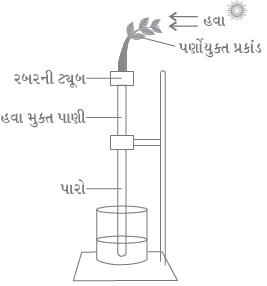
Comment on the experimental setup shown in the image.
What does this setup demonstrate?
What does this setup demonstrate?
Solution
(N/A) The experimental setup shown is a classic demonstration of the transpiration pull theory.
$1$. The setup consists of a leafy shoot attached to a glass tube filled with air-free water,with the lower end immersed in a beaker containing mercury.
$2$. As transpiration occurs from the leaves of the shoot,water is lost in the form of water vapor.
$3$. This loss of water creates a negative pressure or tension (transpiration pull) in the xylem vessels of the shoot.
$4$. This tension is transmitted down to the water column in the tube,which in turn pulls the mercury up into the tube.
$5$. Therefore,this experiment demonstrates that transpiration generates a significant pulling force (transpiration pull) capable of lifting a water column against gravity,which is the primary mechanism for water transport in plants.
$1$. The setup consists of a leafy shoot attached to a glass tube filled with air-free water,with the lower end immersed in a beaker containing mercury.
$2$. As transpiration occurs from the leaves of the shoot,water is lost in the form of water vapor.
$3$. This loss of water creates a negative pressure or tension (transpiration pull) in the xylem vessels of the shoot.
$4$. This tension is transmitted down to the water column in the tube,which in turn pulls the mercury up into the tube.
$5$. Therefore,this experiment demonstrates that transpiration generates a significant pulling force (transpiration pull) capable of lifting a water column against gravity,which is the primary mechanism for water transport in plants.
0 likes
View Solution24
Medium
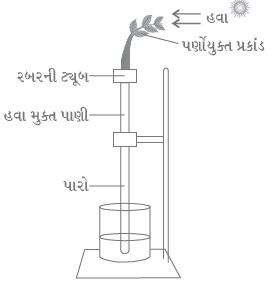
Comment on the experimental setup shown in the image. What will happen to the level of mercury if a blower is placed close to the setup?
Solution
(N/A) The experimental setup shown is a potometer,which is used to measure the rate of transpiration in a leafy shoot.
When a blower is placed close to the setup,it increases the speed of air movement around the leaves.
Increased air movement reduces the humidity around the leaf surface,which in turn increases the rate of transpiration.
As the rate of transpiration increases,the leafy shoot absorbs water more rapidly from the tube.
This increased water uptake creates a stronger pull (transpiration pull),causing the mercury level in the tube to rise.
When a blower is placed close to the setup,it increases the speed of air movement around the leaves.
Increased air movement reduces the humidity around the leaf surface,which in turn increases the rate of transpiration.
As the rate of transpiration increases,the leafy shoot absorbs water more rapidly from the tube.
This increased water uptake creates a stronger pull (transpiration pull),causing the mercury level in the tube to rise.
0 likes
View Solution25
Difficult
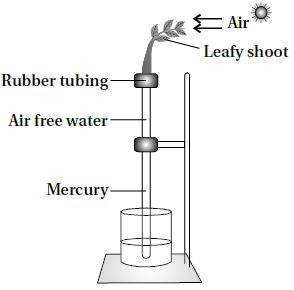
Comment on the experimental setup. Will the mercury level fluctuate (go up/down) if phenyl mercuric acetate is sprayed on leaves?
Solution
(N/A) The experimental setup demonstrates the process of transpiration in plants. As the leafy shoot transpires,it creates a suction pressure (transpiration pull) that draws water up the tube,causing the mercury level to rise. Phenyl mercuric acetate is an anti-transpirant. When sprayed on the leaves,it induces the closure of stomata,thereby significantly reducing the rate of transpiration. Consequently,the transpiration pull decreases,and the mercury level will go down (or fail to rise) compared to the control setup.
0 likes
View Solution26
EasyMCQ
Potometer works on the principle of
A
Amount of water absorbed equals the amount transpired
B
Osmotic pressure
C
Root pressure
D
Potential difference between the tip of the tube and that of the plant
Solution
(A) potometer is a device used to measure the rate of transpiration in plants.
It operates on the principle that the amount of water absorbed by the plant is approximately equal to the amount of water lost through transpiration.
Therefore,by measuring the rate of water uptake,we can indirectly determine the rate of transpiration.
It operates on the principle that the amount of water absorbed by the plant is approximately equal to the amount of water lost through transpiration.
Therefore,by measuring the rate of water uptake,we can indirectly determine the rate of transpiration.
0 likes
View Solution27
EasyMCQ
Transpiration is measured by
A
Potometer
B
Porometer
C
Auxanometer
D
Respirometer
Solution
(A) The rate of transpiration is measured using a $Potometer$ (such as $Farmer's$ $Potometer$ or $Ganong's$ $Potometer$).
These instruments are based on the principle that the rate of water absorption is nearly equal to the rate of transpiration.
$A$ $Porometer$ is used to measure the degree of stomatal opening.
An $Auxanometer$ is used to measure the growth in length of a plant.
$A$ $Respirometer$ is used to measure the rate of respiration.
These instruments are based on the principle that the rate of water absorption is nearly equal to the rate of transpiration.
$A$ $Porometer$ is used to measure the degree of stomatal opening.
An $Auxanometer$ is used to measure the growth in length of a plant.
$A$ $Respirometer$ is used to measure the rate of respiration.
0 likes
View Solution28
EasyMCQ
The term root pressure was coined by . . . . . . .
A
$J$. Priestley
B
$S$. Hales
C
Bohem
D
Dixon and Joly
Solution
(B) The term 'root pressure' was coined by Stephen Hales. It refers to the positive pressure that develops in the xylem sap of the roots of plants as a result of active absorption of mineral nutrients by the root hairs. This pressure is responsible for pushing water up to small heights in the stem.
0 likes
View Solution29
EasyMCQ
Transpiration theory was proposed by . . . . . . .
A
Levitt
B
Bohem
C
Dixon and Jolly
D
$J$. Priestley
Solution
(C) The Cohesion-Tension theory,also known as the Transpiration Pull theory,explains the ascent of sap in plants. This theory was proposed by $Dixon$ and $Jolly$ in $1894$. It suggests that the evaporation of water from the leaves (transpiration) creates a negative pressure (tension) in the xylem,which pulls the water column upwards due to the cohesive and adhesive properties of water molecules.
0 likes
View SolutionTransport in Plants — Scientists and Apparatus concerned · Frequently Asked Questions
1Are these Transport in Plants questions useful for JEE and NEET?
Yes. All questions in this section are mapped to JEE Main and NEET exam patterns. Previous year questions from JEE Main, NEET, GUJCET and state-level exams are included with full solutions.
2Can I switch to Hindi or Gujarati for these questions?
Yes. Use the language tabs in the hero section or the sidebar to view the same questions and solutions in English, Hindi or Gujarati.
3How do I generate a question paper from this subtopic?
Use the Vedclass Exam Paper Generator — select the chapter and subtopic, set difficulty, and generate Sets A, B, C, D automatically. First 3 chapters of every subject are free.
Vedclass Products
For Students
Vedclass Test Series
Mock tests in real JEE/NEET style with performance analysis. 5-day free trial.
Start Free TrialFor Teachers
Exam Paper Generator
Generate Set A/B/C/D papers from this chapter in 2 minutes. 3 chapters free.
Try FreeFor Institutes
Online Exam Module
Live online exams with unlimited students, 360° analytics & white-label branding.
See DemoFor Teachers & Institutes
Generate a Transport in Plants Exam Paper in 2 Minutes
Select subtopic & difficulty — Sets A, B, C, D auto-generated with No Repeat logic.
First 3 chapters of every subject are free — no payment required.