
A English
Anatomy of Earthworm Questions in English
Class 11 Biology · Structural Organisation In Animals · Anatomy of Earthworm
312+
Questions
English
Language
100%
With Solutions
Showing 50 of 312 questions in English
251
Medium
Identify the incorrect statements among the following:
$(a)$ In earthworm,a single male genital pore is present.
$(b)$ Setae help in locomotion of earthworm.
$(c)$ The muscular layer in the body wall of earthworm is made up of only circular muscles.
$(d)$ Typhlosole is a part of the intestine of earthworm.
$(a)$ In earthworm,a single male genital pore is present.
$(b)$ Setae help in locomotion of earthworm.
$(c)$ The muscular layer in the body wall of earthworm is made up of only circular muscles.
$(d)$ Typhlosole is a part of the intestine of earthworm.
Solution
(A, C) The incorrect statements are $(a)$ and $(c)$.
$\Rightarrow$ Correction for $(a)$: Earthworms possess one pair of male genital pores situated on the ventrolateral side of the $18^{th}$ segment.
$\Rightarrow$ Correction for $(c)$: The muscular layer in the body wall of an earthworm consists of an outer layer of circular muscles and an inner layer of longitudinal muscles.
$\Rightarrow$ Statements $(b)$ and $(d)$ are correct. Setae are indeed involved in locomotion,and the typhlosole is a characteristic internal fold of the intestine that increases the surface area for absorption.
$\Rightarrow$ Correction for $(a)$: Earthworms possess one pair of male genital pores situated on the ventrolateral side of the $18^{th}$ segment.
$\Rightarrow$ Correction for $(c)$: The muscular layer in the body wall of an earthworm consists of an outer layer of circular muscles and an inner layer of longitudinal muscles.
$\Rightarrow$ Statements $(b)$ and $(d)$ are correct. Setae are indeed involved in locomotion,and the typhlosole is a characteristic internal fold of the intestine that increases the surface area for absorption.
0 likes
View Solution252
Medium
Why are nephridia in earthworms,which are basically similar in structure,classified into three types? Mention the names of each.
Solution
(N/A) Although nephridia in earthworms are structurally similar,they are classified into three types based on their location and the segments in which they are found. These types are:
$1$. Septal nephridia: These are present on both sides of the intersegmental septa of segment $15$ to the last,which open into the intestine.
$2$. Integumentary nephridia: These are attached to the lining of the body wall of segment $3$ to the last,which open on the body surface.
$3$. Pharyngeal nephridia: These are present as three paired tufts in the $4th$,$5th$,and $6th$ segments.
$1$. Septal nephridia: These are present on both sides of the intersegmental septa of segment $15$ to the last,which open into the intestine.
$2$. Integumentary nephridia: These are attached to the lining of the body wall of segment $3$ to the last,which open on the body surface.
$3$. Pharyngeal nephridia: These are present as three paired tufts in the $4th$,$5th$,and $6th$ segments.
0 likes
View Solution253
Medium
Comment upon the gametic exchange in earthworm during mating. Discuss the physiology of reproduction in earthworms.
Solution
(N/A) $\Rightarrow$ The exchange of reproductive cells and the physiological process of reproduction in earthworms can be described as follows:
$(i)$ Earthworms are protandrous,meaning sperm cells mature before egg cells.
$(ii)$ Mating involves the exchange of sperm between two individuals,followed by external fertilization.
$(iii)$ During mating,two earthworms come together in opposite directions,applying their ventral surfaces against each other.
$(iv)$ They exchange sperm packets known as spermatophores.
$(v)$ During this process,the skin surrounding the male genital pore rises to form temporary papillae,which act like a penis to enter the spermathecal pore and keep it open.
$(vi)$ Once one spermatheca is filled,the earthworms shift their positions to align the male genital pore with the other spermatheca. This process typically takes about one hour.
$(vii)$ Sperm cells are stored in the diverticula of the spermathecae,while the ampulla is associated with the secretion of nutrients for the sperm cells.
$(viii)$ Later,both sperm cells and egg cells are deposited into a cocoon,which is secreted by the clitellar glands.
$(ix)$ Fertilization and development occur within the cocoon,which is an external process.
$(i)$ Earthworms are protandrous,meaning sperm cells mature before egg cells.
$(ii)$ Mating involves the exchange of sperm between two individuals,followed by external fertilization.
$(iii)$ During mating,two earthworms come together in opposite directions,applying their ventral surfaces against each other.
$(iv)$ They exchange sperm packets known as spermatophores.
$(v)$ During this process,the skin surrounding the male genital pore rises to form temporary papillae,which act like a penis to enter the spermathecal pore and keep it open.
$(vi)$ Once one spermatheca is filled,the earthworms shift their positions to align the male genital pore with the other spermatheca. This process typically takes about one hour.
$(vii)$ Sperm cells are stored in the diverticula of the spermathecae,while the ampulla is associated with the secretion of nutrients for the sperm cells.
$(viii)$ Later,both sperm cells and egg cells are deposited into a cocoon,which is secreted by the clitellar glands.
$(ix)$ Fertilization and development occur within the cocoon,which is an external process.
0 likes
View Solution254
MediumMCQ
Identify the correct terms for the following analogy:
$(i)$ Excretory organ in cockroach : Malpighian tubules :: In earthworm : ...........
(ii) Scientific name of cockroach : Periplaneta americana :: Scientific name of earthworm : ...........
$(i)$ Excretory organ in cockroach : Malpighian tubules :: In earthworm : ...........
(ii) Scientific name of cockroach : Periplaneta americana :: Scientific name of earthworm : ...........
A
$(i)$ Nephridia,(ii) Pheretima posthuma
B
$(i)$ Malpighian tubules,(ii) Periplaneta americana
C
$(i)$ Flame cells,(ii) Lumbricus
D
$(i)$ Kidneys,(ii) Hirudinaria
Solution
(A) $(i)$ The primary excretory organs in cockroaches are Malpighian tubules. Similarly,the primary excretory organs in earthworms are nephridia.
(ii) The scientific name of the common cockroach is Periplaneta americana. The scientific name of the common earthworm is Pheretima posthuma (or Lumbricus terrestris).
(ii) The scientific name of the common cockroach is Periplaneta americana. The scientific name of the common earthworm is Pheretima posthuma (or Lumbricus terrestris).
0 likes
View Solution255
EasyMCQ
Choose the correct option for the following statements:
$(i)$ Earthworms have $4$ pairs of lateral hearts.
$(ii)$ The excretory organs of earthworms are nephridia.
$(i)$ Earthworms have $4$ pairs of lateral hearts.
$(ii)$ The excretory organs of earthworms are nephridia.
A
$(i)$ $4$ pairs,$(ii)$ Nephridia
B
$(i)$ $2$ pairs,$(ii)$ Nephridia
C
$(i)$ $4$ pairs,$(ii)$ Malpighian tubules
D
$(i)$ $2$ pairs,$(ii)$ Malpighian tubules
Solution
(A) $(i)$ Earthworms possess $4$ pairs of lateral hearts located in segments $7, 9, 12,$ and $13$.
$(ii)$ The excretory organs in earthworms are segmentally arranged coiled tubules called nephridia.
$(ii)$ The excretory organs in earthworms are segmentally arranged coiled tubules called nephridia.
0 likes
View Solution256
EasyMCQ
What are worm castings?
A
The burrows made by earthworms
B
The faecal deposits of earthworms
C
The eggs laid by earthworms
D
The skin shed by earthworms
Solution
(B) $\Rightarrow$ Earthworms are reddish-brown terrestrial invertebrates.
$\Rightarrow$ They inhabit the upper layer of moist soil.
$\Rightarrow$ During the daytime,they live in burrows made by boring into and swallowing the soil.
$\Rightarrow$ In gardens,their presence can be identified by their faecal deposits,which are known as worm castings.
$\Rightarrow$ They inhabit the upper layer of moist soil.
$\Rightarrow$ During the daytime,they live in burrows made by boring into and swallowing the soil.
$\Rightarrow$ In gardens,their presence can be identified by their faecal deposits,which are known as worm castings.
0 likes
View Solution257
MediumMCQ
Why is the circulatory system of an earthworm called a closed type of circulatory system?
A
Because blood flows through open spaces.
B
Because blood is confined to blood vessels and capillaries.
C
Because it lacks a heart.
D
Because it has an open body cavity.
Solution
(B) The circulatory system of an earthworm is classified as a closed type because the blood is always confined within a network of closed blood vessels and capillaries.
Unlike open circulatory systems where blood flows into body cavities (sinuses),in the earthworm,the blood is pumped by the heart through a series of closed vessels,ensuring efficient transport of nutrients and gases throughout the body.
Unlike open circulatory systems where blood flows into body cavities (sinuses),in the earthworm,the blood is pumped by the heart through a series of closed vessels,ensuring efficient transport of nutrients and gases throughout the body.
0 likes
View Solution258
Medium
Explain the process of mating and the formation of the cocoon in earthworms.
Solution
(N/A) $1$. Mating: Earthworms are hermaphrodites,but they perform cross-fertilization. During mating,two earthworms come in contact with each other,facing opposite directions,such that the male genital pores of one worm come in contact with the spermathecal pores of the other.
$2$. Sperm Exchange: Sperms are exchanged between the two worms and are stored in the spermathecae of the partner.
$3$. Cocoon Formation: After mating,the glandular cells of the clitellum secrete a mucous-like substance that forms a girdle or cocoon around the clitellar segments. As the worm moves forward,this cocoon slides over the anterior segments,collecting eggs from the female genital pores and sperms from the spermathecae (which were received during mating).
$4$. Fertilization: Fertilization and development occur within the cocoon,which is then deposited in the soil.
$2$. Sperm Exchange: Sperms are exchanged between the two worms and are stored in the spermathecae of the partner.
$3$. Cocoon Formation: After mating,the glandular cells of the clitellum secrete a mucous-like substance that forms a girdle or cocoon around the clitellar segments. As the worm moves forward,this cocoon slides over the anterior segments,collecting eggs from the female genital pores and sperms from the spermathecae (which were received during mating).
$4$. Fertilization: Fertilization and development occur within the cocoon,which is then deposited in the soil.
0 likes
View Solution259
MediumMCQ
Mark the correct statement regarding earthworm.
A
One pair of female genital pores are present in $14^{\text{th}}$ segment.
B
Four pairs of spermathecae are located in $6^{\text{th}}-9^{\text{th}}$ segments.
C
Clitellum is present in $13-15$ segments.
D
Four pairs of spermathecae are situated on ventro-lateral sides of the intersegmental grooves i.e. $5^{\text{th}}$ segments.
Solution
(B) In earthworms ($Pheretima$ $posthuma$):
$1$. $A$ single female genital pore is present in the mid-ventral line of the $14^{\text{th}}$ segment.
$2$. Four pairs of spermathecae are located in the $6^{\text{th}}-9^{\text{th}}$ segments (one pair in each segment).
$3$. The clitellum is a prominent glandular and thickened part of the body wall,covering segments $14, 15,$ and $16$.
$4$. Spermathecae are situated on the ventro-lateral sides of the intersegmental grooves,specifically between segments $5/6, 6/7, 7/8,$ and $8/9$.
Therefore,the statement in option $B$ is correct.
$1$. $A$ single female genital pore is present in the mid-ventral line of the $14^{\text{th}}$ segment.
$2$. Four pairs of spermathecae are located in the $6^{\text{th}}-9^{\text{th}}$ segments (one pair in each segment).
$3$. The clitellum is a prominent glandular and thickened part of the body wall,covering segments $14, 15,$ and $16$.
$4$. Spermathecae are situated on the ventro-lateral sides of the intersegmental grooves,specifically between segments $5/6, 6/7, 7/8,$ and $8/9$.
Therefore,the statement in option $B$ is correct.
0 likes
View Solution260
MediumMCQ
Mark the correct one regarding typhlosole.
A
Internal median fold of ventral intestinal wall
B
Extends from $20^{th} - 35^{th}$ segments
C
Increases the surface area for absorption
D
Decreases the surface area for absorption
Solution
(C) The typhlosole is a large,internal,median fold of the dorsal wall of the intestine in earthworms.
It typically extends from the $26^{th}$ segment to the $22^{nd}-25^{th}$ segment before the anus.
The primary function of the typhlosole is to increase the effective surface area for the absorption of digested food within the intestine.
It typically extends from the $26^{th}$ segment to the $22^{nd}-25^{th}$ segment before the anus.
The primary function of the typhlosole is to increase the effective surface area for the absorption of digested food within the intestine.
0 likes
View Solution261
MediumMCQ
Blood circulation in earthworm is:
A
Closed type
B
Open type
C
Hemoglobin is present in $RBC$
D
Oxygen not transported by blood
Solution
(A) The earthworm possesses a closed circulatory system.
In this type of circulation,the blood is confined within blood vessels and does not come into direct contact with the body tissues.
Therefore,the correct answer is $A$ (Closed type).
In this type of circulation,the blood is confined within blood vessels and does not come into direct contact with the body tissues.
Therefore,the correct answer is $A$ (Closed type).
0 likes
View Solution262
EasyMCQ
Which statement is incorrect for earthworm?
A
Two pairs of testes are present in the $10^{th}$ and $11^{th}$ segments.
B
One pair of ovaries is attached at the inter-segmental septum of the $12^{th}$ and $13^{th}$ segments.
C
It is hermaphrodite.
D
Male genital pore is present in the $14^{th}$ segment.
Solution
(D) In earthworms,the male genital pore is located in the $18^{th}$ segment,not in the $14^{th}$ segment. The $14^{th}$ segment contains the female genital pore.
0 likes
View Solution263
EasyMCQ
In $Pheretima$, the number of ring vessels per segment in $12^{\text{th}}$ and $13^{\text{th}}$ segments is: (in $pairs$)
A
$10$
B
$11$
C
$12$
D
$24$
Solution
(C) In $Pheretima$, the ring vessels (also known as commissural vessels) are characteristic circular vessels found in the stomach region, specifically embedded within its muscular coat.
These vessels are present in the segments from $12^{\text{th}}$ to $13^{\text{th}}$ and onwards up to the last segment.
There are approximately $12$ pairs of these ring vessels per segment in the stomach region.
These vessels are present in the segments from $12^{\text{th}}$ to $13^{\text{th}}$ and onwards up to the last segment.
There are approximately $12$ pairs of these ring vessels per segment in the stomach region.
0 likes
View Solution264
EasyMCQ
What is the function of the typhlosole in an earthworm?
A
To secrete digestive juice
B
To slow down the rate of passage of food
C
To increase the absorptive area of the intestinal epithelium
D
It has no function
Solution
(C) The typhlosolar region is a specialized part of the intestine in earthworms,extending from the $26^{\text{th}}$ segment to the last $23-25$ segments before the anus.
In this region,the mid-dorsal wall of the intestine forms a longitudinal fold known as the typhlosole.
The primary function of this fold is to significantly increase the effective surface area for the absorption of digested nutrients.
In this region,the mid-dorsal wall of the intestine forms a longitudinal fold known as the typhlosole.
The primary function of this fold is to significantly increase the effective surface area for the absorption of digested nutrients.
0 likes
View Solution265
MediumMCQ
Which of the following statements is incorrect regarding the anatomy of an earthworm?
A
Ovaries mature first in earthworms.
B
Spermathecae are present in segments $6-9$.
C
Male genital apertures are located on the $18^{th}$ segment.
D
One pair of ovaries is present in the $13^{th}$ segment.
Solution
(A) The earthworm,$Pheretima$ $posthuma$,is a monoecious (hermaphrodite) animal.
In earthworms,cross-fertilization occurs because the male reproductive organs mature before the female reproductive organs,a condition known as protandry.
Therefore,the statement that 'ovaries mature first' is incorrect,as testes mature before ovaries.
In earthworms,cross-fertilization occurs because the male reproductive organs mature before the female reproductive organs,a condition known as protandry.
Therefore,the statement that 'ovaries mature first' is incorrect,as testes mature before ovaries.
0 likes
View Solution266
EasyMCQ
In which segments is the clitellum present in an earthworm?
A
$16$ segments
B
$17-19$ segments
C
$14-16$ segments
D
$5-6$ segments
Solution
(C) The clitellum is a prominent,glandular,and vascularized thickening of the skin in the earthworm.
It is located in the $14^{th}$,$15^{th}$,and $16^{th}$ segments of the body.
This region is responsible for secreting mucus and cocoons for reproduction.
It is located in the $14^{th}$,$15^{th}$,and $16^{th}$ segments of the body.
This region is responsible for secreting mucus and cocoons for reproduction.
0 likes
View Solution267
EasyMCQ
In earthworms,setae are present in all segments,except the
A
First and the last segments
B
First and the clitellum
C
First segments
D
First,clitellum and last segments
Solution
(D) In earthworms,in each body segment,except the first,last,and clitellum,there are rows of $S$-shaped setae,embedded in the epidermal pits in the middle of each segment.
Their principal role is in locomotion.
Their principal role is in locomotion.
0 likes
View Solution268
EasyMCQ
In $Pheretima$,the glands that help in binding the worms during copulation are:
A
Prostate glands
B
Albumin glands
C
Accessory glands
D
Mucous glands
Solution
(C) In $Pheretima$,the accessory glands are present in the $17^{th}$ and $19^{th}$ segments.
These glands secrete a sticky fluid that helps in binding the two worms together during the process of copulation.
These glands secrete a sticky fluid that helps in binding the two worms together during the process of copulation.
0 likes
View Solution269
EasyMCQ
In earthworm,the dorsal wall of the intestine from the $26^{th}$ segment to $95^{th}$ segment forms a median internal fold called
A
Trochophore
B
Typhlosole
C
Clitellum
D
Trachea
Solution
(B) In earthworms,the dorsal wall of the intestine from the $26^{th}$ segment to the $95^{th}$ segment (except the last $23-25$ segments) forms a median internal fold known as the typhlosole.
This structure is a highly glandular and vascular longitudinal ridge.
Its primary function is to increase the effective surface area for the absorption of digested food.
This structure is a highly glandular and vascular longitudinal ridge.
Its primary function is to increase the effective surface area for the absorption of digested food.
0 likes
View Solution270
MediumMCQ
Study the following in $Pheretima$.
$I.$ Dorso-intestinal blood vessels
$II.$ External intestinal plexus
$III.$ Internal intestinal plexus
$IV.$ Ventro-intestinal blood vessel
Arrange the blood vessels in the correct sequence of blood flow from the ventral blood vessel to the dorsal blood vessel.
The correct sequence is:
$I.$ Dorso-intestinal blood vessels
$II.$ External intestinal plexus
$III.$ Internal intestinal plexus
$IV.$ Ventro-intestinal blood vessel
Arrange the blood vessels in the correct sequence of blood flow from the ventral blood vessel to the dorsal blood vessel.
The correct sequence is:
A
$IV \rightarrow II \rightarrow III \rightarrow I$
B
$III \rightarrow I \rightarrow II \rightarrow IV$
C
$II \rightarrow III \rightarrow IV \rightarrow I$
D
$IV \rightarrow II \rightarrow I \rightarrow III$
Solution
(A) In $Pheretima$,the blood circulation in the intestine follows a specific pathway.
$1$. The blood flows from the ventral blood vessel into the ventro-intestinal blood vessels $(IV)$.
$2$. From there,it enters the external intestinal plexus $(II)$ located on the outer wall of the intestine.
$3$. It then moves into the internal intestinal plexus $(III)$ within the intestinal wall.
$4$. Finally,the blood is collected by the dorso-intestinal blood vessels $(I)$ and transported to the dorsal blood vessel.
Therefore,the correct sequence of blood flow is $IV \rightarrow II \rightarrow III \rightarrow I$.
$1$. The blood flows from the ventral blood vessel into the ventro-intestinal blood vessels $(IV)$.
$2$. From there,it enters the external intestinal plexus $(II)$ located on the outer wall of the intestine.
$3$. It then moves into the internal intestinal plexus $(III)$ within the intestinal wall.
$4$. Finally,the blood is collected by the dorso-intestinal blood vessels $(I)$ and transported to the dorsal blood vessel.
Therefore,the correct sequence of blood flow is $IV \rightarrow II \rightarrow III \rightarrow I$.
0 likes
View Solution271
MediumMCQ
Choose the correct combination of labeling from the options given.
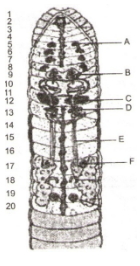
A
$A-$ Testis,$B-$ Spermatheca,$C-$ Seminal vesicle,$D-$ Ovary,$E-$ vas deferens,$F-$ Accessory gland
B
$A-$ Spermatheca,$B-$ Testis,$C-$ Ovary,$D-$ Seminal vesicle,$E-$ vas deferens,$F-$ Accessory gland
C
$A-$ Spermatheca,$B-$ Testis,$C-$ Seminal vesicle,$D-$ Ovary,$E-$ vas deferens,$F-$ Accessory gland
D
$A-$ Spermatheca,$B-$ Testis,$C-$ Accessory gland,$D-$ Ovary,$E-$ vas deferens,$F-$ Seminal vesicle
Solution
(C) Based on the reproductive system of the earthworm (Pheretima):
$A$ represents the Spermathecae,which are located in segments $6-9$.
$B$ represents the Testis sacs,located in segments $10$ and $11$.
$C$ represents the Seminal vesicles,which are large structures in segments $11$ and $12$.
$D$ represents the Ovary,located in segment $13$.
$E$ represents the vas deferens,which runs longitudinally from segment $12$ onwards.
$F$ represents the Accessory glands,located in segments $17$ and $19$.
Therefore,the correct labeling is $A-$ Spermatheca,$B-$ Testis,$C-$ Seminal vesicle,$D-$ Ovary,$E-$ vas deferens,$F-$ Accessory gland.
$A$ represents the Spermathecae,which are located in segments $6-9$.
$B$ represents the Testis sacs,located in segments $10$ and $11$.
$C$ represents the Seminal vesicles,which are large structures in segments $11$ and $12$.
$D$ represents the Ovary,located in segment $13$.
$E$ represents the vas deferens,which runs longitudinally from segment $12$ onwards.
$F$ represents the Accessory glands,located in segments $17$ and $19$.
Therefore,the correct labeling is $A-$ Spermatheca,$B-$ Testis,$C-$ Seminal vesicle,$D-$ Ovary,$E-$ vas deferens,$F-$ Accessory gland.
0 likes
View Solution272
MediumMCQ
$A$ transverse section of $Pheretima$ taken through the $10^{th}$ segment is observed under a microscope. Which of the following structures can be observed in the section?
A
Stomach,dorsal blood vessel,ventral blood vessel,supraoesophageal vessel,anterior loops,ring vessel and micronephridia
B
Stomach,dorsal blood vessel,ventral blood vessel,lateral hearts,ring vessels and pharyngeal nephridia
C
Intestine,dorsal blood vessel,ventral blood vessel,supraoesophageal vessel and septal nephridia
D
Stomach,dorsal blood vessel,sub-neural blood vessel and lateral hearts
Solution
(A) In $Pheretima$,the $10^{th}$ segment contains the stomach.
When a transverse section is taken through the $10^{th}$ segment,the following structures are observed: stomach,dorsal blood vessel,ventral blood vessel,supraoesophageal vessel,anterior loops,ring vessels,and micronephridia.
These structures are characteristic of the anatomy of the $10^{th}$ segment in earthworms.
When a transverse section is taken through the $10^{th}$ segment,the following structures are observed: stomach,dorsal blood vessel,ventral blood vessel,supraoesophageal vessel,anterior loops,ring vessels,and micronephridia.
These structures are characteristic of the anatomy of the $10^{th}$ segment in earthworms.
0 likes
View Solution273
MediumMCQ
$Nephridia$ in the earthworm perform the function similar to flame cells in $Taenia$.
A
Parapodia
B
Nephridia
C
Metameres
D
Ganglia
Solution
(B) In $Taenia$ (a member of $Platyhelminthes$),specialized cells called flame cells are responsible for excretion and osmoregulation.
Similarly,in the earthworm (a member of $Annelida$),coiled,tubular structures called $Nephridia$ perform the function of excretion and osmoregulation.
Similarly,in the earthworm (a member of $Annelida$),coiled,tubular structures called $Nephridia$ perform the function of excretion and osmoregulation.
0 likes
View Solution274
EasyMCQ
Notochord in earthworm is .................... and nerve cord is ..................
A
Dorsal,Ventral
B
Absent,Ventral
C
Ventral,absent
D
Absent,Dorsal
Solution
(B) The notochord is a flexible,rod-like supporting structure that is a characteristic feature of chordates.
Earthworms belong to the phylum $Annelida$,which are non-chordates; therefore,they lack a notochord.
The nerve cord in non-chordates,such as earthworms,is solid,double,and located on the ventral side of the body.
Thus,the notochord is absent,and the nerve cord is ventral.
Earthworms belong to the phylum $Annelida$,which are non-chordates; therefore,they lack a notochord.
The nerve cord in non-chordates,such as earthworms,is solid,double,and located on the ventral side of the body.
Thus,the notochord is absent,and the nerve cord is ventral.
0 likes
View Solution275
EasyMCQ
The body segments in earthworm are called
A
Comb plates
B
Spicules
C
Metameres
D
Ganglia
Solution
(C) Earthworms belong to the phylum $Annelida$. They exhibit metameric segmentation,meaning their body is divided both externally and internally into a series of repeated segments. These segments are known as $metameres$ or $somites$.
0 likes
View Solution276
MediumMCQ
Which of the following types of nephridia are not found in earthworms?
A
Septal nephridia
B
Pharyngeal nephridia
C
Integumentary nephridia
D
Protonephridia
Solution
(D) Earthworms $(Pheretima)$ possess three types of nephridia based on their location:
$1$. Septal nephridia: Present on both sides of the intersegmental septa from the $15^{th}$ segment to the last.
$2$. Integumentary nephridia: Attached to the lining of the body wall of segment $3$ to the last.
$3$. Pharyngeal nephridia: Present as three paired tufts in the $4^{th}, 5^{th},$ and $6^{th}$ segments.
Protonephridia are primitive excretory structures found in organisms like flatworms (Platyhelminthes),not in earthworms.
$1$. Septal nephridia: Present on both sides of the intersegmental septa from the $15^{th}$ segment to the last.
$2$. Integumentary nephridia: Attached to the lining of the body wall of segment $3$ to the last.
$3$. Pharyngeal nephridia: Present as three paired tufts in the $4^{th}, 5^{th},$ and $6^{th}$ segments.
Protonephridia are primitive excretory structures found in organisms like flatworms (Platyhelminthes),not in earthworms.
0 likes
View Solution277
EasyMCQ
Which of the following animal's sensory system does not have eyes but does possess light and touch sensitive organs (receptor cells) to distinguish the light intensities and to feel the vibrations in the ground?
A
Frog
B
Snake
C
Earthworm
D
Cockroach
Solution
(C) The sensory system of an earthworm does not have eyes. However,it possesses light-sensitive receptors (photoreceptors) to distinguish light intensities and touch-sensitive receptors (tactile receptors) to feel vibrations in the ground.
0 likes
View Solution278
MediumMCQ
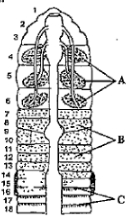
The given figure shows the nephridial system of an earthworm. Identify the endonephric nephridia from the labels $A$,$B$,and $C$.
A
$A$
B
$B$
C
$C$
D
Both $A$ and $C$
Solution
(D) Endonephric nephridia are those nephridia that discharge their collected excretory waste into the alimentary canal,from where it is eventually expelled outside through the anus.
Septal nephridia and pharyngeal nephridia are classified as endonephric nephridia.
Exonephric nephridia are those that discharge their excretory waste directly outside the body wall. Integumentary nephridia are exonephric.
Based on the provided figure:
$A$ = Pharyngeal nephridia (Endonephric)
$B$ = Integumentary nephridia (Exonephric)
$C$ = Septal nephridia (Endonephric)
Therefore,both $A$ and $C$ are endonephric nephridia.
Septal nephridia and pharyngeal nephridia are classified as endonephric nephridia.
Exonephric nephridia are those that discharge their excretory waste directly outside the body wall. Integumentary nephridia are exonephric.
Based on the provided figure:
$A$ = Pharyngeal nephridia (Endonephric)
$B$ = Integumentary nephridia (Exonephric)
$C$ = Septal nephridia (Endonephric)
Therefore,both $A$ and $C$ are endonephric nephridia.
0 likes
View Solution279
EasyMCQ
Spermathecae in $Pheretima$ are located in the segments:
A
$14$ to $18$
B
$10$ to $13$
C
$7$ to $10$
D
$6$ to $9$
Solution
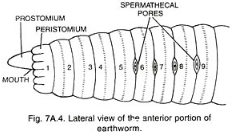
(D) In the earthworm $(Pheretima)$,four pairs of spermathecae are located in the $6^{th}, 7^{th}, 8^{th}$ and $9^{th}$ segments.
These structures are responsible for storing the sperms received from another earthworm during the process of copulation.
These structures are responsible for storing the sperms received from another earthworm during the process of copulation.
0 likes
View Solution280
MediumMCQ
Which of the following statements is correct regarding the female reproductive system of an earthworm?
A
It consists of two large ovaries,lying laterally in the $6^{th}-7^{th}$ abdominal segments.
B
Each ovary is formed of a group of five ovarian tubules or ovarioles,containing a chain of developing ova.
C
$A$ pair of spermatheca is present in the $5^{th}$ segment which opens into the genital chamber.
D
None of the above
Solution
(D) In earthworms,the female reproductive system consists of a pair of ovaries,which are located laterally in the $13^{th}$ segment.
Additionally,there are $4$ pairs of spermathecae located in the $6^{th}$ to $9^{th}$ segments ($1$ pair per segment).
Since none of the provided options ($A$,$B$,or $C$) correctly describe these anatomical features,the correct answer is $D$.
Additionally,there are $4$ pairs of spermathecae located in the $6^{th}$ to $9^{th}$ segments ($1$ pair per segment).
Since none of the provided options ($A$,$B$,or $C$) correctly describe these anatomical features,the correct answer is $D$.
0 likes
View Solution281
MediumMCQ
Following are the statements about the prostomium of an earthworm.
$(a)$ It serves as a covering for the mouth.
$(b)$ It helps to open cracks in the soil into which it can crawl.
$(c)$ It is one of the sensory structures.
$(d)$ It is the first body segment.
Choose the correct answer from the options given below.
$(a)$ It serves as a covering for the mouth.
$(b)$ It helps to open cracks in the soil into which it can crawl.
$(c)$ It is one of the sensory structures.
$(d)$ It is the first body segment.
Choose the correct answer from the options given below.
A
$(a), (b)$ and $(c)$ are correct
B
$(a), (b)$ and $(d)$ are correct
C
$(a), (b), (c)$ and $(d)$ are correct
D
$(b)$ and $(c)$ are correct
Solution
(A) The prostomium is a small fleshy lobe that overhangs the mouth of an earthworm.
Statement $(a)$ is correct as it acts as a covering for the mouth.
Statement $(b)$ is correct as it is used as a wedge to force open cracks in the soil.
Statement $(c)$ is correct as the prostomium is sensory in function.
Statement $(d)$ is incorrect because the first body segment of the earthworm is the peristomium (or buccal segment),not the prostomium. The prostomium is a pre-oral lobe located anterior to the first segment.
Therefore,statements $(a), (b)$ and $(c)$ are correct.
Statement $(a)$ is correct as it acts as a covering for the mouth.
Statement $(b)$ is correct as it is used as a wedge to force open cracks in the soil.
Statement $(c)$ is correct as the prostomium is sensory in function.
Statement $(d)$ is incorrect because the first body segment of the earthworm is the peristomium (or buccal segment),not the prostomium. The prostomium is a pre-oral lobe located anterior to the first segment.
Therefore,statements $(a), (b)$ and $(c)$ are correct.
0 likes
View Solution282
Medium
Give a scientific reason: The blood vascular system of leeches is also called the haemocoelomic system.
Solution
(N/A) $\rightarrow$ In leeches,a true blood vascular system is absent. Instead,the coelomic space and its fluid have been modified to form the circulatory system. Hence,it is called the haemocoelomic system,and the coelomic fluid is referred to as haemocoelomic fluid.
Blood appears red due to the presence of the respiratory pigment haemoglobin or erythrocruorin,which is found dissolved in the plasma.
Free amoeboid blood corpuscles are present,but there are no red blood corpuscles (erythrocytes).
Blood appears red due to the presence of the respiratory pigment haemoglobin or erythrocruorin,which is found dissolved in the plasma.
Free amoeboid blood corpuscles are present,but there are no red blood corpuscles (erythrocytes).
0 likes
View Solution283
EasyMCQ
Select the incorrect statement regarding the earthworm.
A
It is a reddish-brown aquatic vertebrate.
B
It inhabits the upper layer of moist soil.
C
During the day,it lives in burrows made by boring and swallowing the soil.
D
It can be traced by its faecal deposits known as worm castings.
Solution
(A) The earthworm is a reddish-brown terrestrial invertebrate,not an aquatic vertebrate. It belongs to the phylum Annelida. Therefore,statement $A$ is incorrect as it describes the earthworm as an aquatic vertebrate.
0 likes
View Solution284
EasyMCQ
Identify the correct option to distinguish between the dorsal and ventral surfaces of an earthworm.
Ventral surface $\quad\quad\quad$ Dorsal surface
Ventral surface $\quad\quad\quad$ Dorsal surface
A
Presence of genital pores $\quad\quad$ Dark mid-dorsal line
B
Dark mid-dorsal line $\quad\quad$ Presence of genital pores
C
Mouth $\quad\quad$ Anus
D
Anus $\quad\quad$ Mouth
Solution
(A) The dorsal surface of an earthworm is characterized by the presence of a dark mid-dorsal line,which represents the dorsal blood vessel visible through the skin.
The ventral surface is identified by the presence of genital pores and the absence of the dark mid-dorsal line.
Therefore,the ventral surface is marked by genital pores,and the dorsal surface is marked by the dark mid-dorsal line.
The ventral surface is identified by the presence of genital pores and the absence of the dark mid-dorsal line.
Therefore,the ventral surface is marked by genital pores,and the dorsal surface is marked by the dark mid-dorsal line.
0 likes
View Solution285
EasyMCQ
The prostomium is $...............$
A
The first segment of an earthworm
B
The last segment of an earthworm
C
$A$ lobe serving as a covering for the mouth
D
The clitellum
Solution
(C) The prostomium is a small,fleshy,lobe-like structure that overhangs the mouth of an earthworm. It serves as a covering for the mouth and acts as a wedge to force open cracks in the soil into which the earthworm may crawl. It is also sensory in function.
0 likes
View Solution286
EasyMCQ
Match the regions of the earthworm based on the clitellum:
$P$ - Segments $14$ to $16$
$Q$ - Segment $17$ to the last segment
$R$ - Segments $1$ to $13$
Identify the correct sequence for the Pre-clitellar region,Post-clitellar region,and Clitellar region,respectively.
$P$ - Segments $14$ to $16$
$Q$ - Segment $17$ to the last segment
$R$ - Segments $1$ to $13$
Identify the correct sequence for the Pre-clitellar region,Post-clitellar region,and Clitellar region,respectively.
A
$R, P, Q$
B
$Q, R, P$
C
$P, Q, R$
D
$R, Q, P$
Solution
(D) In the earthworm ($Pheretima$ $posthuma$),the body is divided into three distinct regions based on the presence of the clitellum:
$1$. Pre-clitellar region: This region consists of segments $1$ to $13$ $(R)$.
$2$. Clitellar region: This is a glandular,non-segmented region covering segments $14$ to $16$ $(P)$.
$3$. Post-clitellar region: This region includes segment $17$ to the last segment of the body $(Q)$.
Therefore,the correct sequence for Pre-clitellar,Post-clitellar,and Clitellar regions is $R, Q, P$.
$1$. Pre-clitellar region: This region consists of segments $1$ to $13$ $(R)$.
$2$. Clitellar region: This is a glandular,non-segmented region covering segments $14$ to $16$ $(P)$.
$3$. Post-clitellar region: This region includes segment $17$ to the last segment of the body $(Q)$.
Therefore,the correct sequence for Pre-clitellar,Post-clitellar,and Clitellar regions is $R, Q, P$.
0 likes
View Solution287
EasyMCQ
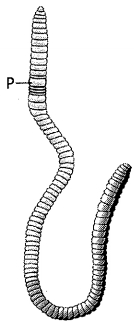
What is the function of the structure labeled $P$ in the given image?
A
Excretion
B
Locomotion
C
Defense
D
Formation of cocoons
Solution
(D) The structure labeled $P$ in the image of the earthworm $(Pheretima)$ is the clitellum.
The clitellum is a glandular,non-segmented,thickened region of the body wall.
Its primary function is the secretion of mucus and albumin,which are essential for the formation of cocoons during the reproductive process of the earthworm.
Therefore,the correct function is the formation of cocoons.
The clitellum is a glandular,non-segmented,thickened region of the body wall.
Its primary function is the secretion of mucus and albumin,which are essential for the formation of cocoons during the reproductive process of the earthworm.
Therefore,the correct function is the formation of cocoons.
0 likes
View Solution288
EasyMCQ
The nephridiopore is the opening of $............$.
A
Malpighian tubule
B
Nephridium
C
Nephron
D
Trachea
Solution
(B) In earthworms,the excretory organs are segmentally arranged coiled tubules called nephridia.
Each nephridium regulates the volume and composition of the body fluids.
These nephridia open to the exterior through a pore called the nephridiopore,which serves as the exit point for nitrogenous wastes.
Each nephridium regulates the volume and composition of the body fluids.
These nephridia open to the exterior through a pore called the nephridiopore,which serves as the exit point for nitrogenous wastes.
0 likes
View Solution289
EasyMCQ
How many genital pores are present in an earthworm?
A
$1$
B
$2$
C
$3$
D
$4$
Solution
(C) In the earthworm (Pheretima),the genital pores are as follows:
$1$. $A$ single female genital pore is present in the mid-ventral line of the $14^{th}$ segment.
$2$. $A$ pair of male genital pores is present on the ventro-lateral sides of the $18^{th}$ segment.
Therefore,there are $1 + 2 = 3$ genital pores in total.
$1$. $A$ single female genital pore is present in the mid-ventral line of the $14^{th}$ segment.
$2$. $A$ pair of male genital pores is present on the ventro-lateral sides of the $18^{th}$ segment.
Therefore,there are $1 + 2 = 3$ genital pores in total.
0 likes
View Solution290
MediumMCQ
Select the incorrect option for the earthworm $(Pheretima)$.
A
It exhibits metameric segmentation.
B
It has an organ-system level of organization.
C
It is a pseudocoelomate animal.
D
It possesses a closed circulatory system.
Solution
(C) The earthworm $(Pheretima)$ belongs to the phylum Annelida.
Annelids are characterized by metameric segmentation (true segmentation).
They exhibit an organ-system level of body organization.
They possess a closed circulatory system.
However,earthworms are true coelomates (eucoelomates),not pseudocoelomates. Pseudocoelomates are characteristic of the phylum Aschelminthes (roundworms). Therefore,the statement that earthworms are pseudocoelomates is incorrect.
Annelids are characterized by metameric segmentation (true segmentation).
They exhibit an organ-system level of body organization.
They possess a closed circulatory system.
However,earthworms are true coelomates (eucoelomates),not pseudocoelomates. Pseudocoelomates are characteristic of the phylum Aschelminthes (roundworms). Therefore,the statement that earthworms are pseudocoelomates is incorrect.
0 likes
View Solution291
EasyMCQ
Identify the correct sequence of organs in the digestive system of an earthworm.
A
Mouth $\rightarrow$ Pharynx $\rightarrow$ Oesophagus $\rightarrow$ Stomach $\rightarrow$ Gizzard $\rightarrow$ Intestine
B
Mouth $\rightarrow$ Pharynx $\rightarrow$ Oesophagus $\rightarrow$ Gizzard $\rightarrow$ Stomach $\rightarrow$ Intestine
C
Mouth $\rightarrow$ Gizzard $\rightarrow$ Pharynx $\rightarrow$ Oesophagus $\rightarrow$ Stomach $\rightarrow$ Intestine
D
Mouth $\rightarrow$ Oesophagus $\rightarrow$ Pharynx $\rightarrow$ Stomach $\rightarrow$ Gizzard $\rightarrow$ Intestine
Solution
(B) The digestive system of an earthworm consists of a straight tube running from the first to the last segment of the body.
The sequence of the organs is as follows:
$1$. Mouth: Opens into the buccal cavity.
$2$. Pharynx: Follows the buccal cavity.
$3$. Oesophagus: $A$ narrow tube that leads to the gizzard.
$4$. Gizzard: Helps in grinding the soil particles and decaying leaves.
$5$. Stomach: Extends from the $9^{th}$ to the $14^{th}$ segment.
$6$. Intestine: Starts from the $15^{th}$ segment onwards.
Therefore,the correct sequence is: Mouth $\rightarrow$ Pharynx $\rightarrow$ Oesophagus $\rightarrow$ Gizzard $\rightarrow$ Stomach $\rightarrow$ Intestine.
The sequence of the organs is as follows:
$1$. Mouth: Opens into the buccal cavity.
$2$. Pharynx: Follows the buccal cavity.
$3$. Oesophagus: $A$ narrow tube that leads to the gizzard.
$4$. Gizzard: Helps in grinding the soil particles and decaying leaves.
$5$. Stomach: Extends from the $9^{th}$ to the $14^{th}$ segment.
$6$. Intestine: Starts from the $15^{th}$ segment onwards.
Therefore,the correct sequence is: Mouth $\rightarrow$ Pharynx $\rightarrow$ Oesophagus $\rightarrow$ Gizzard $\rightarrow$ Stomach $\rightarrow$ Intestine.
0 likes
View Solution292
MediumMCQ
The calciferous glands present in the stomach of an earthworm secrete:
A
Acidic fluid
B
Neutral fluid
C
Alkaline fluid
D
None of these
Solution
(C) In earthworms,the calciferous glands are located in the stomach region.
These glands secrete calcium carbonate $(CaCO_3)$ into the food.
The primary function of these secretions is to neutralize the humic acid present in the decaying organic matter (humus) that the earthworm consumes.
Therefore,the secretion is alkaline in nature to counteract the acidity of the soil/humus.
These glands secrete calcium carbonate $(CaCO_3)$ into the food.
The primary function of these secretions is to neutralize the humic acid present in the decaying organic matter (humus) that the earthworm consumes.
Therefore,the secretion is alkaline in nature to counteract the acidity of the soil/humus.
0 likes
View Solution293
MediumMCQ
State the location of caeca in Earthworm and Cockroach.
A
Between midgut and hindgut,attached to the intestine.
B
Between foregut and midgut,attached to the intestine.
C
Between midgut and hindgut,attached to the intestine.
D
Between foregut and midgut,attached to the junction of foregut and midgut.
Solution
(D) In Earthworms,a pair of short and conical structures called intestinal caeca are found in the $26^{th}$ segment,attached to the intestine. In Cockroaches,$6-8$ long and tubular structures called hepatic caeca are found at the junction of the foregut and midgut. Therefore,in Earthworms,they are attached to the intestine,and in Cockroaches,they are located between the foregut and midgut. Based on the options provided,the correct description for the location of caeca in these organisms is $D$.
0 likes
View Solution294
EasyMCQ
What is the function of the typhlosole in an earthworm?
A
Digestion
B
Absorption
C
Respiration
D
Excretion
Solution
(B) The typhlosole is a longitudinal fold of the inner wall of the intestine in an earthworm $(Pheretima)$.
Its primary function is to increase the effective surface area of the intestine for the absorption of digested food nutrients.
Therefore,the correct option is $B$.
Its primary function is to increase the effective surface area of the intestine for the absorption of digested food nutrients.
Therefore,the correct option is $B$.
0 likes
View Solution295
MediumMCQ
Select the correct option regarding blood plasma/fluid for humans and earthworms.
A
Colorless,Colorless
B
Red,Red
C
Red,Colorless
D
Colorless,Red
Solution
(B) In humans,blood is red due to the presence of hemoglobin inside the red blood cells $(RBCs)$,but the blood plasma itself is straw-colored or yellowish. However,in the context of comparative biology questions regarding the color of blood/fluid,human blood is considered red. In earthworms $(Pheretima)$,hemoglobin is dissolved directly in the blood plasma,which gives the blood a red color. Therefore,both humans and earthworms possess red-colored blood.
0 likes
View Solution296
EasyMCQ
The figure below shows the digestive system of an earthworm. What are $P$ and $Q$?
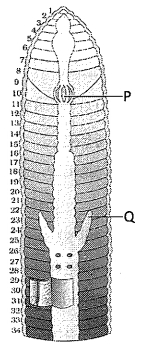
A
Gizzard $\quad\quad$ Intestinal caeca
B
Intestinal caeca $\quad\quad$ Gizzard
C
Gizzard $\quad\quad$ Typhlosole
D
Typhlosole $\quad\quad$ Gizzard
Solution
(A) In the digestive system of an earthworm $(Pheretima)$:
$1$. $P$ points to the gizzard,which is a muscular organ located in the $8^{th}-9^{th}$ segments,responsible for grinding food particles.
$2$. $Q$ points to the intestinal caeca,which are paired,conical,glandular structures arising from the intestine in the $26^{th}$ segment.
Therefore,$P$ is the gizzard and $Q$ is the intestinal caeca.
$1$. $P$ points to the gizzard,which is a muscular organ located in the $8^{th}-9^{th}$ segments,responsible for grinding food particles.
$2$. $Q$ points to the intestinal caeca,which are paired,conical,glandular structures arising from the intestine in the $26^{th}$ segment.
Therefore,$P$ is the gizzard and $Q$ is the intestinal caeca.
0 likes
View Solution297
EasyMCQ
In earthworms,smaller blood vessels deliver blood to the .....
A
Alimentary canal
B
Nerve cord
C
Body wall
D
All of the above
Solution
(D) In earthworms,the circulatory system is of the closed type. Blood is confined to the heart and blood vessels. Contractions of the heart pump blood into the blood vessels. Smaller blood vessels supply the blood to the gut (alimentary canal),nerve cord,and the body wall to ensure the delivery of nutrients and oxygen to these tissues.
0 likes
View Solution298
EasyMCQ
In earthworms,in which segments are the blood glands located?
A
$4, 5, 6$
B
$5, 6, 7$
C
$14, 15, 16$
D
$5, 16, 17$
Solution
(A) In earthworms ($Pheretima$ $posthuma$),the blood glands are located in the $4^{th}$,$5^{th}$,and $6^{th}$ segments. These glands produce blood cells and hemoglobin,which remain dissolved in the blood plasma.
0 likes
View Solution299
EasyMCQ
In earthworms,respiration occurs through $...............$.
A
Moist body surface
B
Nephridia
C
Trachea
D
Malpighian tubules
Solution
(A) In earthworms,the skin is thin,moist,and highly vascularized,which allows for the exchange of gases ($O_2$ and $CO_2$) directly through the body surface by diffusion. This process is known as cutaneous respiration. Therefore,the correct answer is the moist body surface.
0 likes
View Solution300
MediumMCQ
The figure below shows the circulatory system of an earthworm. What are $P, Q$,and $R$?
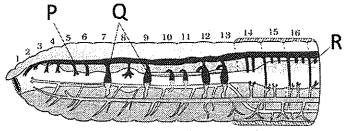
A
$P=$ Ventral vessel,$Q=$ Lateral oesophageal hearts,$R=$ Anterior loops
B
$P=$ Dorsal vessel,$Q=$ Lateral oesophageal hearts,$R=$ Anterior loops
C
$P=$ Ventral vessel,$Q=$ Lateral hearts,$R=$ Commissural vessel
D
$P=$ Dorsal vessel,$Q=$ Lateral hearts,$R=$ Commissural vessel
Solution
(B) In the circulatory system of an earthworm $(Pheretima)$:
$1$. The vessel running along the dorsal side of the alimentary canal is the dorsal vessel $(P)$.
$2$. The lateral oesophageal hearts $(Q)$ are present in segments $7$ and $9$,connecting the dorsal and ventral vessels.
$3$. The anterior loops $(R)$ are present in segments $10-13$,connecting the dorsal and ventral vessels.
Therefore,$P=$ Dorsal vessel,$Q=$ Lateral oesophageal hearts,and $R=$ Anterior loops.
$1$. The vessel running along the dorsal side of the alimentary canal is the dorsal vessel $(P)$.
$2$. The lateral oesophageal hearts $(Q)$ are present in segments $7$ and $9$,connecting the dorsal and ventral vessels.
$3$. The anterior loops $(R)$ are present in segments $10-13$,connecting the dorsal and ventral vessels.
Therefore,$P=$ Dorsal vessel,$Q=$ Lateral oesophageal hearts,and $R=$ Anterior loops.
0 likes
View SolutionStructural Organisation In Animals — Anatomy of Earthworm · Frequently Asked Questions
1Are these Structural Organisation In Animals questions useful for JEE and NEET?
Yes. All questions in this section are mapped to JEE Main and NEET exam patterns. Previous year questions from JEE Main, NEET, GUJCET and state-level exams are included with full solutions.
2Can I switch to Hindi or Gujarati for these questions?
Yes. Use the language tabs in the hero section or the sidebar to view the same questions and solutions in English, Hindi or Gujarati.
3How do I generate a question paper from this subtopic?
Use the Vedclass Exam Paper Generator — select the chapter and subtopic, set difficulty, and generate Sets A, B, C, D automatically. First 3 chapters of every subject are free.
Vedclass Products
For Students
Vedclass Test Series
Mock tests in real JEE/NEET style with performance analysis. 5-day free trial.
Start Free TrialFor Teachers
Exam Paper Generator
Generate Set A/B/C/D papers from this chapter in 2 minutes. 3 chapters free.
Try FreeFor Institutes
Online Exam Module
Live online exams with unlimited students, 360° analytics & white-label branding.
See DemoFor Teachers & Institutes
Generate a Structural Organisation In Animals Exam Paper in 2 Minutes
Select subtopic & difficulty — Sets A, B, C, D auto-generated with No Repeat logic.
First 3 chapters of every subject are free — no payment required.