
A English
Anatomy of Earthworm Questions in English
Class 11 Biology · Structural Organisation In Animals · Anatomy of Earthworm
312+
Questions
English
Language
100%
With Solutions
Showing 12 of 312 questions in English
301
MediumMCQ
Match the following columns regarding the types of nephridia in earthworms:
| Column-$I$ | Column-$II$ |
|---|---|
| $P$. Septal nephridia | $I$. $15^{th}$ segment to the last segment |
| $Q$. Integumentary nephridia | $II$. $4^{th}, 5^{th}$ and $6^{th}$ segments |
| $R$. Pharyngeal nephridia | $III$. $3^{rd}$ segment to the last segment |
A
$P-I, Q-III, R-II$
B
$P-II, Q-III, R-I$
C
$P-I, Q-II, R-III$
D
$P-III, Q-II, R-I$
Solution
(A) In earthworms,nephridia are classified based on their location:
$1$. Septal nephridia $(P)$ are present on both sides of the intersegmental septa of segment $15$ to the last,which open into the intestine $(P-I)$.
$2$. Integumentary nephridia $(Q)$ are attached to the lining of the body wall of segment $3$ to the last,which open on the body surface $(Q-III)$.
$3$. Pharyngeal nephridia $(R)$ are present as three paired tufts in the $4^{th}, 5^{th}$ and $6^{th}$ segments $(R-II)$.
Therefore,the correct matching is $P-I, Q-III, R-II$.
$1$. Septal nephridia $(P)$ are present on both sides of the intersegmental septa of segment $15$ to the last,which open into the intestine $(P-I)$.
$2$. Integumentary nephridia $(Q)$ are attached to the lining of the body wall of segment $3$ to the last,which open on the body surface $(Q-III)$.
$3$. Pharyngeal nephridia $(R)$ are present as three paired tufts in the $4^{th}, 5^{th}$ and $6^{th}$ segments $(R-II)$.
Therefore,the correct matching is $P-I, Q-III, R-II$.
0 likes
View Solution302
MediumMCQ
Select the incorrect statement regarding nephridia in earthworms.
A
They consist of segmentally arranged coiled tubules called nephridia.
B
Nephridia regulate the volume and composition of body fluids.
C
Nephridia are only a part of the digestive system.
D
They discharge waste materials outside the body wall or into the digestive tube.
Solution
(C) In earthworms,nephridia are the primary excretory organs.
$1$. Nephridia are segmentally arranged coiled tubules.
$2$. They perform the function of osmoregulation and excretion,thereby regulating the volume and composition of body fluids.
$3$. Based on their location,they are classified into three types: septal,integumentary,and pharyngeal.
$4$. They discharge waste materials either directly to the exterior or into the digestive tract.
$5$. Option $C$ is incorrect because nephridia are not just part of the digestive system; they are independent excretory organs that function throughout the body segments to maintain homeostasis.
$1$. Nephridia are segmentally arranged coiled tubules.
$2$. They perform the function of osmoregulation and excretion,thereby regulating the volume and composition of body fluids.
$3$. Based on their location,they are classified into three types: septal,integumentary,and pharyngeal.
$4$. They discharge waste materials either directly to the exterior or into the digestive tract.
$5$. Option $C$ is incorrect because nephridia are not just part of the digestive system; they are independent excretory organs that function throughout the body segments to maintain homeostasis.
0 likes
View Solution303
MediumMCQ
Match the following columns regarding the types of nephridia in earthworms:
| Column-$I$ | Column-$II$ |
|---|---|
| $P$. Septal nephridia | $I$. Enteronephric |
| $Q$. Integumentary nephridia | $II$. Exonephric |
| $R$. Pharyngeal nephridia |
A
$(P-II), (Q-I), (R-I)$
B
$(P-I), (Q-II), (R-II)$
C
$(P-I), (Q-II), (R-I)$
D
$(P-II), (Q-II), (R-I)$
Solution
(C) In earthworms,nephridia are classified based on their location and the way they discharge waste:
$1$. Septal nephridia $(P)$ are present on both sides of the intersegmental septa of segment $15$ to the last. They discharge their waste into the intestine,hence they are enteronephric $(I)$.
$2$. Integumentary nephridia $(Q)$ are attached to the lining of the body wall of segment $3$ to the last. They discharge their waste directly to the exterior,hence they are exonephric $(II)$.
$3$. Pharyngeal nephridia $(R)$ are present as three paired tufts in segments $4, 5,$ and $6$. They discharge their waste into the alimentary canal,hence they are enteronephric $(I)$.
Therefore,the correct matching is: $P-I, Q-II, R-I$.
$1$. Septal nephridia $(P)$ are present on both sides of the intersegmental septa of segment $15$ to the last. They discharge their waste into the intestine,hence they are enteronephric $(I)$.
$2$. Integumentary nephridia $(Q)$ are attached to the lining of the body wall of segment $3$ to the last. They discharge their waste directly to the exterior,hence they are exonephric $(II)$.
$3$. Pharyngeal nephridia $(R)$ are present as three paired tufts in segments $4, 5,$ and $6$. They discharge their waste into the alimentary canal,hence they are enteronephric $(I)$.
Therefore,the correct matching is: $P-I, Q-II, R-I$.
0 likes
View Solution304
MediumMCQ
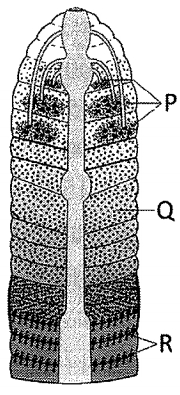
Identify the types of nephridia in the given excretory system of an earthworm.
A
$P=$ Pharyngeal nephridia,$Q=$ Integumentary nephridia,$R=$ Septal nephridia
B
$P=$ Integumentary nephridia,$Q=$ Septal nephridia,$R=$ Pharyngeal nephridia
C
$P=$ Pharyngeal nephridia,$Q=$ Septal nephridia,$R=$ Integumentary nephridia
D
$P=$ Septal nephridia,$Q=$ Integumentary nephridia,$R=$ Pharyngeal nephridia
Solution
(A) In the earthworm ($Pheretima$ $posthuma$),the nephridia are classified based on their location:
$1$. $P$ represents Pharyngeal nephridia,which are present as three paired tufts in the $4^{th}, 5^{th},$ and $6^{th}$ segments.
$2$. $Q$ represents Integumentary nephridia,which are attached to the lining of the body wall of segment $3$ to the last segment.
$3$. $R$ represents Septal nephridia,which are present on both sides of the intersegmental septa of segment $15$ to the last segment.
Therefore,the correct identification is $P=$ Pharyngeal nephridia,$Q=$ Integumentary nephridia,and $R=$ Septal nephridia.
$1$. $P$ represents Pharyngeal nephridia,which are present as three paired tufts in the $4^{th}, 5^{th},$ and $6^{th}$ segments.
$2$. $Q$ represents Integumentary nephridia,which are attached to the lining of the body wall of segment $3$ to the last segment.
$3$. $R$ represents Septal nephridia,which are present on both sides of the intersegmental septa of segment $15$ to the last segment.
Therefore,the correct identification is $P=$ Pharyngeal nephridia,$Q=$ Integumentary nephridia,and $R=$ Septal nephridia.
0 likes
View Solution305
MediumMCQ
Select the incorrect option regarding the nervous system in an earthworm.
A
The nervous system consists of ganglia.
B
The ganglia are arranged segmentally on the double ventral nerve cord.
C
In the anterior region,the nerve cord bifurcates,encircles the pharynx,and joins the cerebral ganglia dorsally to form a nerve ring.
D
The cerebral ganglia,along with other nerves in the nerve ring,integrate sensory inputs and command muscular responses.
Solution
(B) In the earthworm $(Pheretima)$,the nervous system is represented by ganglia arranged segmentally on the double ventral nerve cord. The anterior end (third and fourth segments) has the nerve cord bifurcating and encircling the pharynx to join the cerebral ganglia dorsally,forming a nerve ring. The cerebral ganglia,along with other nerves in the ring,integrate sensory inputs and command muscular responses. Option $B$ is incorrect because the nerve cord in earthworms is ventral,not dorsal.
0 likes
View Solution306
MediumMCQ
Match the following and select the correct option:
| Column-$I$ | Column-$II$ |
|---|---|
| $P$. Testes | $I$. $18^{th}$ segment |
| $Q$. Accessory glands | $II$. $17^{th}$ and $19^{th}$ segments |
| $R$. Male genital pore | $III$. $6^{th}$ to $9^{th}$ segments |
| $S$. Spermathecae | $IV$. $13^{th}$ segment |
| $T$. Ovaries | $V$. $10^{th}$ and $11^{th}$ segments |
A
$(P-III), (Q-II), (R-IV), (S-I), (T-V)$
B
$(P-I), (Q-IV), (R-II), (S-III), (T-V)$
C
$(P-V), (Q-II), (R-I), (S-III), (T-IV)$
D
$(P-IV), (Q-I), (R-III), (S-II), (T-V)$
Solution
(C) In earthworms (Pheretima):
$1$. Testes $(P)$ are located in the $10^{th}$ and $11^{th}$ segments $(V)$.
$2$. Accessory glands $(Q)$ are present in the $17^{th}$ and $19^{th}$ segments $(II)$.
$3$. The male genital pore $(R)$ is situated in the $18^{th}$ segment $(I)$.
$4$. Spermathecae $(S)$ are located in the $6^{th}$ to $9^{th}$ segments $(III)$.
$5$. Ovaries $(T)$ are located in the $13^{th}$ segment $(IV)$.
Therefore,the correct matching is $(P-V), (Q-II), (R-I), (S-III), (T-IV)$.
$1$. Testes $(P)$ are located in the $10^{th}$ and $11^{th}$ segments $(V)$.
$2$. Accessory glands $(Q)$ are present in the $17^{th}$ and $19^{th}$ segments $(II)$.
$3$. The male genital pore $(R)$ is situated in the $18^{th}$ segment $(I)$.
$4$. Spermathecae $(S)$ are located in the $6^{th}$ to $9^{th}$ segments $(III)$.
$5$. Ovaries $(T)$ are located in the $13^{th}$ segment $(IV)$.
Therefore,the correct matching is $(P-V), (Q-II), (R-I), (S-III), (T-IV)$.
0 likes
View Solution307
EasyMCQ
How many baby earthworms emerge from a single cocoon of an earthworm?
A
$2-10$
B
$5-10$
C
$5-22$
D
$2-22$
Solution
(D) In earthworms,fertilization and development occur within cocoons which are deposited in the soil.
Each cocoon contains several embryos,but only a few develop into young earthworms.
Typically,$2-22$ baby earthworms emerge from a single cocoon after a developmental period of about $3$ weeks.
Each cocoon contains several embryos,but only a few develop into young earthworms.
Typically,$2-22$ baby earthworms emerge from a single cocoon after a developmental period of about $3$ weeks.
0 likes
View Solution308
EasyMCQ
Which segments of the earthworm are responsible for the formation of the cocoon?
A
$4, 5, 6$
B
$14, 15, 16$
C
All segments
D
$1, 2, 3$
Solution
(B) In the earthworm ($Pheretima$ $posthuma$),the glandular cells of the clitellum are responsible for the formation of the cocoon.
The clitellum is a prominent dark band of glandular and non-glandular tissue present in segments $14, 15,$ and $16$.
These segments secrete mucus and albumin,which harden to form the cocoon (or ootheca) that protects the developing embryos.
The clitellum is a prominent dark band of glandular and non-glandular tissue present in segments $14, 15,$ and $16$.
These segments secrete mucus and albumin,which harden to form the cocoon (or ootheca) that protects the developing embryos.
0 likes
View Solution309
EasyMCQ
Where does an earthworm store the sperms of its mate?
A
Spermathecae
B
Seminal vesicles
C
Both
D
Ovary
Solution
(A) In earthworms,the spermathecae are the organs responsible for storing the sperms received from another earthworm during the process of copulation.
There are four pairs of spermathecae located in the $6^{th}$ to $9^{th}$ segments.
Seminal vesicles are involved in the maturation and storage of the earthworm's own sperms,not the partner's sperms.
Therefore,the correct answer is Spermathecae.
There are four pairs of spermathecae located in the $6^{th}$ to $9^{th}$ segments.
Seminal vesicles are involved in the maturation and storage of the earthworm's own sperms,not the partner's sperms.
Therefore,the correct answer is Spermathecae.
0 likes
View Solution310
EasyMCQ
What is the function of the female genital pore in an earthworm?
A
It releases sperms.
B
It receives sperms.
C
It releases ova.
D
It receives ova.
Solution
(C) In an earthworm ($Pheretima$ $posthuma$),the female genital pore is a single,median aperture located on the ventral surface of the $14^{th}$ segment.
Its primary function is to release mature ova (eggs) from the ovaries into the cocoon during the process of reproduction.
Therefore,the correct function is the release of ova.
Its primary function is to release mature ova (eggs) from the ovaries into the cocoon during the process of reproduction.
Therefore,the correct function is the release of ova.
0 likes
View Solution311
MediumMCQ
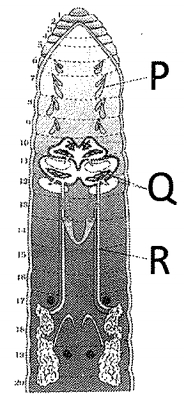
Identify $P, Q,$ and $R$ in the reproductive system of the earthworm shown in the figure.
A
$P=$ Spermathecae,$Q=$ Testis sacs,$R=$ Accessory glands
B
$P=$ Spermathecae,$Q=$ Testis sacs,$R=$ Prostatic duct
C
$P=$ Spermathecae,$Q=$ Testis sacs,$R=$ Vas deferens
D
$P=$ Testis sacs,$Q=$ Spermathecae,$R=$ Oviduct
Solution
(C) In the reproductive system of the earthworm ($Pheretima$ $posthuma$):
$P$ represents the Spermathecae,which are four pairs of small sacs located in segments $6-9$.
$Q$ represents the Testis sacs,which are two pairs of sacs located in segments $10$ and $11$.
$R$ represents the Vas deferens,which are long ducts that run through segments $12-18$ and carry sperm to the male genital pores.
$P$ represents the Spermathecae,which are four pairs of small sacs located in segments $6-9$.
$Q$ represents the Testis sacs,which are two pairs of sacs located in segments $10$ and $11$.
$R$ represents the Vas deferens,which are long ducts that run through segments $12-18$ and carry sperm to the male genital pores.
0 likes
View Solution312
EasyMCQ
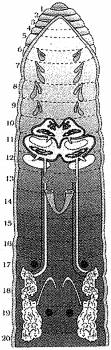
The organism shown in the image is $.....$.
A
Monoecious
B
Bisexual
C
Hermaphrodite
D
All of the above
Solution
(D) The image shows the reproductive system of an earthworm ($Pheretima$ $posthuma$).
Earthworms are organisms that possess both male and female reproductive organs in the same individual.
Such organisms are termed as monoecious,bisexual,or hermaphrodite.
Therefore,all these terms are synonymous and correctly describe the organism shown.
Earthworms are organisms that possess both male and female reproductive organs in the same individual.
Such organisms are termed as monoecious,bisexual,or hermaphrodite.
Therefore,all these terms are synonymous and correctly describe the organism shown.
0 likes
View SolutionStructural Organisation In Animals — Anatomy of Earthworm · Frequently Asked Questions
1Are these Structural Organisation In Animals questions useful for JEE and NEET?
Yes. All questions in this section are mapped to JEE Main and NEET exam patterns. Previous year questions from JEE Main, NEET, GUJCET and state-level exams are included with full solutions.
2Can I switch to Hindi or Gujarati for these questions?
Yes. Use the language tabs in the hero section or the sidebar to view the same questions and solutions in English, Hindi or Gujarati.
3How do I generate a question paper from this subtopic?
Use the Vedclass Exam Paper Generator — select the chapter and subtopic, set difficulty, and generate Sets A, B, C, D automatically. First 3 chapters of every subject are free.
Vedclass Products
For Students
Vedclass Test Series
Mock tests in real JEE/NEET style with performance analysis. 5-day free trial.
Start Free TrialFor Teachers
Exam Paper Generator
Generate Set A/B/C/D papers from this chapter in 2 minutes. 3 chapters free.
Try FreeFor Institutes
Online Exam Module
Live online exams with unlimited students, 360° analytics & white-label branding.
See DemoFor Teachers & Institutes
Generate a Structural Organisation In Animals Exam Paper in 2 Minutes
Select subtopic & difficulty — Sets A, B, C, D auto-generated with No Repeat logic.
First 3 chapters of every subject are free — no payment required.