
A English
Anatomy of Earthworm Questions in English
Class 11 Biology · Structural Organisation In Animals · Anatomy of Earthworm
312+
Questions
English
Language
100%
With Solutions
Showing 50 of 312 questions in English
151
MediumMCQ
Which organ of the earthworm performs a function similar to the liver of humans?
A
Nephridia
B
Testis
C
Clitellum
D
Typhlosole
Solution
(D) In earthworms,the $chloragogen$ cells are found in the intestine. These cells are analogous to the liver of vertebrates because they perform similar functions,such as the storage of glycogen and fats,synthesis of urea,and detoxification of the blood. Among the given options,the intestine is the site where these cells are located and function.
0 likes
View Solution152
EasyMCQ
Which of the following statements is true regarding the earthworm?
A
The blood is blue.
B
The blood is red,but hemoglobin is dissolved in the plasma.
C
The respiratory pigment is hemocyanin.
D
The blood is red,but hemoglobin is dissolved in the $RBC$s.
Solution
(B) In earthworms,the blood is red in color due to the presence of hemoglobin.
Unlike humans,where hemoglobin is contained within red blood cells ($RBC$s),in earthworms,hemoglobin is dissolved directly in the blood plasma.
Therefore,the correct statement is that the blood is red,but hemoglobin is dissolved in the plasma.
Unlike humans,where hemoglobin is contained within red blood cells ($RBC$s),in earthworms,hemoglobin is dissolved directly in the blood plasma.
Therefore,the correct statement is that the blood is red,but hemoglobin is dissolved in the plasma.
0 likes
View Solution153
MediumMCQ
Which structure is typically found in every body segment of an earthworm?
A
Septal nephridia
B
Hearts
C
Genital pores
D
Ganglia
Solution
(A) In an earthworm $(Pheretima)$,the excretory organs are segmentally arranged coiled tubules called nephridia.
There are three types of nephridia based on their location:
$1$. Septal nephridia: These are present on both sides of the intersegmental septa of segment $15$ to the last,which open into the intestine.
$2$. Integumentary nephridia: These are attached to the lining of the body wall of segment $3$ to the last,which open on the body surface.
$3$. Pharyngeal nephridia: These are present as three paired tufts in the $4th$,$5th$,and $6th$ segments.
Among the given options,septal nephridia are the structures that are found in almost every segment from the $15th$ segment to the last,making them a characteristic feature of the body segments.
There are three types of nephridia based on their location:
$1$. Septal nephridia: These are present on both sides of the intersegmental septa of segment $15$ to the last,which open into the intestine.
$2$. Integumentary nephridia: These are attached to the lining of the body wall of segment $3$ to the last,which open on the body surface.
$3$. Pharyngeal nephridia: These are present as three paired tufts in the $4th$,$5th$,and $6th$ segments.
Among the given options,septal nephridia are the structures that are found in almost every segment from the $15th$ segment to the last,making them a characteristic feature of the body segments.
0 likes
View Solution154
EasyMCQ
In which segments of the earthworm are the spermathecae located?
A
$6, 7, 8, 9$
B
$4, 5, 6, 7$
C
$5, 6, 7, 8$
D
$3, 4, 5, 6$
Solution
(A) In the earthworm ($Pheretima$ $posthuma$),there are four pairs of spermathecae located in the $6^{th}$ to $9^{th}$ segments.
These structures are situated in the ventrolateral walls of the segments $6, 7, 8,$ and $9$.
They function to receive and store spermatozoa during the process of copulation.
These structures are situated in the ventrolateral walls of the segments $6, 7, 8,$ and $9$.
They function to receive and store spermatozoa during the process of copulation.
0 likes
View Solution155
EasyMCQ
Which segments of the earthworm contain the clitellum?
A
$13-17$
B
$14-16$
C
$15-19$
D
$14-18$
Solution
(B) In the earthworm ($Pheretima$ $posthuma$),the clitellum is a prominent dark band of glandular and non-glandular tissue.
It is located in the $14^{th}$,$15^{th}$,and $16^{th}$ segments of the body.
This region is responsible for secreting mucus and albumin for cocoon formation.
Therefore,the correct segments are $14-16$.
It is located in the $14^{th}$,$15^{th}$,and $16^{th}$ segments of the body.
This region is responsible for secreting mucus and albumin for cocoon formation.
Therefore,the correct segments are $14-16$.
0 likes
View Solution156
EasyMCQ
In $Pheretima$,sperms are stored in the............
A
Prostate gland
B
Seminal vesicles
C
Testis sac
D
Oviduct
Solution
(B) In $Pheretima$ (earthworm),the testes are located in the $10^{th}$ and $11^{th}$ segments.
These testes are enclosed within testis sacs.
The sperms produced in the testes are released into the testis sacs and then pass into the seminal vesicles.
Seminal vesicles are the structures where the sperms mature and are stored until they are ready for copulation.
Therefore,the correct answer is $B$ (Seminal vesicles).
These testes are enclosed within testis sacs.
The sperms produced in the testes are released into the testis sacs and then pass into the seminal vesicles.
Seminal vesicles are the structures where the sperms mature and are stored until they are ready for copulation.
Therefore,the correct answer is $B$ (Seminal vesicles).
0 likes
View Solution157
MediumMCQ
In which of the following are the nephridial funnels (nephrostomes) present?
A
Septal nephridia
B
Integumentary nephridia
C
Pharyngeal nephridia
D
Both $A$ and $B$
Solution
(A) In earthworms,nephridia are classified based on their location into three types: septal,integumentary,and pharyngeal nephridia.
Septal nephridia are present on both sides of the intersegmental septa of segment $15$ to the last segment.
These septal nephridia possess a nephrostome (nephridial funnel),which helps in collecting coelomic fluid.
Integumentary and pharyngeal nephridia lack nephrostomes.
Therefore,the correct answer is $A$.
Septal nephridia are present on both sides of the intersegmental septa of segment $15$ to the last segment.
These septal nephridia possess a nephrostome (nephridial funnel),which helps in collecting coelomic fluid.
Integumentary and pharyngeal nephridia lack nephrostomes.
Therefore,the correct answer is $A$.
0 likes
View Solution158
EasyMCQ
Which of the following are the types of septal nephridia found in earthworms?
A
Pharyngeal and Septal
B
Septal and Integumentary
C
Integumentary and Pharyngeal
D
Only Integumentary
Solution
(B) In earthworms ($Pheretima$ $posthuma$),nephridia are classified based on their location into three types:
$1$. Septal nephridia: Present on both sides of the intersegmental septa of segment $15$ to the last that open into the intestine.
$2$. Integumentary nephridia: Attached to the lining of the body wall of segment $3$ to the last that open on the body surface.
$3$. Pharyngeal nephridia: Present as three paired tufts in the $4th, 5th,$ and $6th$ segments.
Therefore,the question asks for the types of nephridia,and among the options,the combination of Septal and Integumentary nephridia represents the classification based on location.
$1$. Septal nephridia: Present on both sides of the intersegmental septa of segment $15$ to the last that open into the intestine.
$2$. Integumentary nephridia: Attached to the lining of the body wall of segment $3$ to the last that open on the body surface.
$3$. Pharyngeal nephridia: Present as three paired tufts in the $4th, 5th,$ and $6th$ segments.
Therefore,the question asks for the types of nephridia,and among the options,the combination of Septal and Integumentary nephridia represents the classification based on location.
0 likes
View Solution159
EasyMCQ
In which segments of the earthworm is the clitellum located?
A
Segment $16$
B
Segments $17$ to $19$
C
Segments $14$ to $16$
D
Segments $5$ to $6$
Solution
(C) The body of the earthworm ($Pheretima$ $posthuma$) is segmented.
In the mature earthworm,a prominent dark band of glandular tissue called the clitellum is present.
This clitellum covers segments $14$,$15$,and $16$.
It is responsible for secreting mucus and cocoons for reproduction.
In the mature earthworm,a prominent dark band of glandular tissue called the clitellum is present.
This clitellum covers segments $14$,$15$,and $16$.
It is responsible for secreting mucus and cocoons for reproduction.
0 likes
View Solution160
MediumMCQ
An animal that depends on organic matter,dead insects,and its own cuticle for food is known as a .....
A
Herbivore
B
Detritivore
C
Omnivore
D
Carnivore
Solution
(B) The organism described is a $Detritivore$.
$Detritivores$ are organisms that feed on $detritus$,which includes dead organic matter,decaying plant and animal tissues,and other organic debris.
In many ecosystems,such as soil or leaf litter,organisms like certain insects or mites consume dead insects and organic matter.
Additionally,some organisms consume their own shed $cuticle$ (exoskeleton) to recycle nutrients,which is a characteristic behavior of certain $detritivores$ or $scavengers$.
$Detritivores$ are organisms that feed on $detritus$,which includes dead organic matter,decaying plant and animal tissues,and other organic debris.
In many ecosystems,such as soil or leaf litter,organisms like certain insects or mites consume dead insects and organic matter.
Additionally,some organisms consume their own shed $cuticle$ (exoskeleton) to recycle nutrients,which is a characteristic behavior of certain $detritivores$ or $scavengers$.
0 likes
View Solution161
DifficultMCQ
In which region is the tuft of nephridia found in earthworms?
A
Pharyngeal region
B
Clitellar region
C
Anal region
D
None of the above
Solution
(A) In earthworms $(Pheretima)$,nephridia are classified based on their location.
Pharyngeal nephridia are present as three paired tufts in the 4th,5th,and 6th segments.
These nephridia open into the pharynx and are known as pharyngeal nephridia.
Pharyngeal nephridia are present as three paired tufts in the 4th,5th,and 6th segments.
These nephridia open into the pharynx and are known as pharyngeal nephridia.
0 likes
View Solution162
MediumMCQ
If a living earthworm is pricked with a needle on its outer surface and the alimentary canal is damaged,the fluid that oozes out is .....
A
Excretory fluid
B
Coelomic fluid
C
Haemolymph
D
Viscous mucus
Solution
(B) The body cavity of an earthworm is a true coelom,which is filled with a fluid known as coelomic fluid. This fluid acts as a hydrostatic skeleton and helps in locomotion. When the body wall and the alimentary canal of an earthworm are punctured,this coelomic fluid oozes out from the coelomic cavity.
0 likes
View Solution163
EasyMCQ
In earthworms,the circumpharyngeal connectives connect the . . . . . . .
A
two cerebral ganglia
B
cerebral ganglia with the subpharyngeal ganglia
C
subpharyngeal ganglia and the ventral nerve cord
D
two suprapharyngeal ganglia
Solution
(B) In the earthworm ($Pheretima$ $posthuma$),the nervous system consists of a pair of cerebral ganglia located above the pharynx in the third segment. These are connected to the subpharyngeal ganglia located below the pharynx in the fourth segment by a pair of circumpharyngeal connectives. Thus,the circumpharyngeal connectives serve as a bridge between the cerebral ganglia and the subpharyngeal ganglia.
0 likes
View Solution164
EasyMCQ
In earthworms,fertilization occurs in the ......?
A
Ovary
B
Oviduct
C
Cocoon
D
Sperm duct
Solution
(C) In earthworms,fertilization and development occur within a structure called the $Cocoon$.
The $Cocoon$ is formed by the glandular cells of the $Clitellum$.
During mating,the earthworms exchange sperms,and the eggs are deposited into the $Cocoon$ along with the sperms.
Fertilization takes place inside this $Cocoon$,which is then deposited in the soil.
The $Cocoon$ is formed by the glandular cells of the $Clitellum$.
During mating,the earthworms exchange sperms,and the eggs are deposited into the $Cocoon$ along with the sperms.
Fertilization takes place inside this $Cocoon$,which is then deposited in the soil.
0 likes
View Solution165
EasyMCQ
The brown color of the earthworm's body is due to the presence of . . . . . . .
A
Porphyrin
B
Hemoglobin
C
Earthworm
D
Hemocyanin
Solution
(A) The dorsal surface of the earthworm's body is dark brown in color. This characteristic dark brown coloration is due to the presence of a pigment called $Porphyrin$ in the skin. This pigment helps protect the earthworm from the harmful effects of solar radiation.
0 likes
View Solution166
MediumMCQ
The earthworm does not have a skeleton,but during burrowing,its posterior end becomes turgid and acts as a hydraulic skeleton. This is due to:
A
Peristalsis of the alimentary canal
B
Setae
C
Coelomic fluid
D
Blood
Solution
(C) The earthworm possesses a hydrostatic skeleton,which is essential for its movement and burrowing.
This hydrostatic skeleton is formed by the coelomic fluid present in the coelomic cavity.
The pressure exerted by this fluid against the body wall makes the body turgid,allowing the earthworm to push through the soil during burrowing.
Therefore,the correct answer is $C$ (Coelomic fluid).
This hydrostatic skeleton is formed by the coelomic fluid present in the coelomic cavity.
The pressure exerted by this fluid against the body wall makes the body turgid,allowing the earthworm to push through the soil during burrowing.
Therefore,the correct answer is $C$ (Coelomic fluid).
0 likes
View Solution167
MediumMCQ
Which of the following pores can be found on the dorsal,ventral,and lateral surfaces of an earthworm?
A
Spermathecal pores
B
Mouth
C
Nephridiopores
D
All of the above
Solution
(C) In earthworms,$Nephridiopores$ are the small openings of the nephridia through which nitrogenous wastes are excreted. These pores are found on the dorsal,ventral,and lateral surfaces of the body segments,except for the first few anterior segments. Spermathecal pores are located ventro-laterally in the intersegmental grooves,and the mouth is located ventrally. Therefore,$Nephridiopores$ are the correct answer as they are distributed across the body surfaces.
0 likes
View Solution168
EasyMCQ
What is the function of the clitellum in $Pheretima$?
A
Formation of cocoons
B
Secretion of hormones
C
Providing nutrition to sperms
D
Respiration
Solution
(A) The clitellum is a prominent glandular and vascularized thickening of the glandular epidermis in $Pheretima$ (earthworm),typically found in segments $14-16$.
Its primary function is the secretion of mucus and albumin,which are essential for the formation of cocoons.
These cocoons are used for the deposition of eggs and the subsequent development of the embryos.
Its primary function is the secretion of mucus and albumin,which are essential for the formation of cocoons.
These cocoons are used for the deposition of eggs and the subsequent development of the embryos.
0 likes
View Solution169
MediumMCQ
Which of the following correctly describes the location of body parts in the earthworm Pheretima?
A
Two pairs of accessory glands are present in segments $16-18$.
B
Four pairs of spermathecae are located in segments $4-7$.
C
One pair of ovaries is attached at the intersegmental septum between the $12$th and $13$th segments.
D
One pair of testes is present in the $10$th and $11$th segments.
Solution
(C) In the earthworm $Pheretima$:
$1$. Four pairs of spermathecae are located in segments $6-9$ (one pair in each segment).
$2$. One pair of ovaries is attached at the intersegmental septum between the $12$th and $13$th segments.
$3$. Two pairs of testes are present in the $10$th and $11$th segments (one pair in each).
$4$. Accessory glands are present in segments $17$ and $19$ (one pair in each).
Therefore,option $C$ is the correct description.
$1$. Four pairs of spermathecae are located in segments $6-9$ (one pair in each segment).
$2$. One pair of ovaries is attached at the intersegmental septum between the $12$th and $13$th segments.
$3$. Two pairs of testes are present in the $10$th and $11$th segments (one pair in each).
$4$. Accessory glands are present in segments $17$ and $19$ (one pair in each).
Therefore,option $C$ is the correct description.
0 likes
View Solution170
EasyMCQ
The small longitudinal slit-like aperture present in the $Pygidium$ is known as:
A
Mouth
B
Accessory pore
C
Dorsal pore
D
Anus
Solution
(D) In the earthworm $(Pheretima)$,the body ends in a terminal segment called the $Pygidium$ or anal segment. This segment contains a small longitudinal slit-like aperture known as the $Anus$,through which undigested food particles are egested from the body.
0 likes
View Solution171
MediumMCQ
Pharyngeal and septal nephridia open into the alimentary canal and are of the enteronephric type. This is an adaptation for:
A
Water conservation
B
Heat conservation
C
Temperature regulation
D
Amino acid regulation
Solution
(A) In earthworms, nephridia are classified based on their location and the site of discharge of wastes.
Pharyngeal and septal nephridia discharge their nitrogenous wastes into the alimentary canal, which is known as the $enteronephric$ type.
This mechanism allows the earthworm to reabsorb water from the waste products before they are excreted, which is a crucial adaptation for $water \text{ } conservation$ in terrestrial environments.
Pharyngeal and septal nephridia discharge their nitrogenous wastes into the alimentary canal, which is known as the $enteronephric$ type.
This mechanism allows the earthworm to reabsorb water from the waste products before they are excreted, which is a crucial adaptation for $water \text{ } conservation$ in terrestrial environments.
0 likes
View Solution172
DifficultMCQ
In $Pheretima$,there are red-colored round bodies present above the alimentary canal in the $4^{th}$,$5^{th}$,and $6^{th}$ segments. It is believed that they are involved in:
A
Excretion
B
Digestion
C
Reproduction
D
Production of leucocytes
Solution
(D) In $Pheretima$ (earthworm),the red-colored round bodies found in the $4^{th}$,$5^{th}$,and $6^{th}$ segments above the alimentary canal are known as blood glands.
These blood glands are responsible for the production of blood cells (leucocytes) and hemoglobin,which is dissolved in the blood plasma.
Therefore,they play a significant role in the production of leucocytes.
These blood glands are responsible for the production of blood cells (leucocytes) and hemoglobin,which is dissolved in the blood plasma.
Therefore,they play a significant role in the production of leucocytes.
0 likes
View Solution173
MediumMCQ
Which structure in $Pheretima\ \ posthuma$ functions similarly to the liver of vertebrates?
A
Calciferous glands
B
Glandular cells
C
Chloragogen cells
D
Typhlosole cells
Solution
(C) In $Pheretima\ \ posthuma$ (earthworm),the $Chloragogen$ cells are specialized cells found in the coelomic fluid and surrounding the intestine. These cells perform various metabolic functions such as the synthesis of glycogen and fats,deamination of proteins,and the formation of urea,which are analogous to the functions performed by the liver in vertebrates. Therefore,$Chloragogen$ cells are often referred to as the 'liver' of the earthworm.
0 likes
View Solution174
MediumMCQ
In $Pheretima$,locomotion occurs with the help of ..........
A
Circular muscles
B
Longitudinal muscles and setae
C
Longitudinal and circular muscles and setae
D
Parapodia
Solution
(C) In $Pheretima$ (earthworm),locomotion is achieved through the coordinated action of the body wall muscles and the setae.
$1$. The body wall contains both circular and longitudinal muscles.
$2$. Contraction and relaxation of these muscles cause changes in the body shape,allowing the earthworm to move.
$3$. Setae,which are $S$-shaped chitinous structures embedded in the epidermal pits of each segment (except the first,last,and clitellum),act as anchors to provide grip against the substrate during movement.
$4$. Therefore,the combined action of longitudinal muscles,circular muscles,and setae facilitates locomotion.
$1$. The body wall contains both circular and longitudinal muscles.
$2$. Contraction and relaxation of these muscles cause changes in the body shape,allowing the earthworm to move.
$3$. Setae,which are $S$-shaped chitinous structures embedded in the epidermal pits of each segment (except the first,last,and clitellum),act as anchors to provide grip against the substrate during movement.
$4$. Therefore,the combined action of longitudinal muscles,circular muscles,and setae facilitates locomotion.
0 likes
View Solution175
EasyMCQ
In earthworms,salivary glands are found in the .........
A
Dorsal wall of the buccal cavity
B
Ventral wall of the buccal cavity
C
Wall of the pharynx
D
None of the above
Solution
(A) In earthworms $(Pheretima)$,the alimentary canal is a straight tube. The mouth opens into the buccal cavity ($1^{st}$ to $3^{rd}$ segments). The salivary glands are present in the $4^{th}$ to $6^{th}$ segments,but they are specifically associated with the dorsal wall of the buccal cavity. These glands secrete saliva containing mucin and proteolytic enzymes,which help in the digestion of food.
0 likes
View Solution176
MediumMCQ
Earthworms move with the help of which of the following?
A
Only longitudinal and circular muscles
B
Only chitinous setae
C
Coelomic fluid helps in movement
D
All of the above
Solution
(D) Earthworms exhibit locomotion through a coordinated process involving multiple structures:
$1$. The body wall contains longitudinal and circular muscles that contract and relax to facilitate movement.
$2$. Chitinous setae,embedded in the epidermal pits of each segment (except the first,last,and clitellum),act as anchors to grip the substrate.
$3$. The coelomic fluid acts as a hydrostatic skeleton,providing turgidity and support,which is essential for the muscular contractions to produce effective movement.
Therefore,all these factors work together to enable the earthworm's movement.
$1$. The body wall contains longitudinal and circular muscles that contract and relax to facilitate movement.
$2$. Chitinous setae,embedded in the epidermal pits of each segment (except the first,last,and clitellum),act as anchors to grip the substrate.
$3$. The coelomic fluid acts as a hydrostatic skeleton,providing turgidity and support,which is essential for the muscular contractions to produce effective movement.
Therefore,all these factors work together to enable the earthworm's movement.
0 likes
View Solution177
EasyMCQ
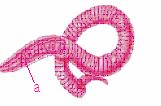
What does the part labeled "a" in the given figure represent?
A
Dorsal blood vessel
B
Ventral blood vessel
C
Blood capillaries
D
Heart
Solution
(A) The given figure shows an earthworm (Pheretima). In the circulatory system of an earthworm, the dorsal blood vessel is the main vessel that runs along the dorsal side of the alimentary canal. The part labeled "a" points to this dorsal blood vessel.
0 likes
View Solution178
EasyMCQ
The locomotory organ of an earthworm is ..........
A
Setae
B
Parapodia
C
Sucker
D
Pseudopodia
Solution
(A) The earthworm $(Pheretima)$ belongs to the phylum $Annelida$.
Locomotion in earthworms is primarily facilitated by $Setae$ (singular: $Seta$).
These are $S$-shaped,chitinous structures embedded in the epidermal pits of each segment (except the first,last,and clitellum).
$Parapodia$ are found in aquatic annelids like $Nereis$.
$Suckers$ are characteristic of leeches $(Hirudinaria)$.
$Pseudopodia$ are locomotory structures in $Amoeba$.
Locomotion in earthworms is primarily facilitated by $Setae$ (singular: $Seta$).
These are $S$-shaped,chitinous structures embedded in the epidermal pits of each segment (except the first,last,and clitellum).
$Parapodia$ are found in aquatic annelids like $Nereis$.
$Suckers$ are characteristic of leeches $(Hirudinaria)$.
$Pseudopodia$ are locomotory structures in $Amoeba$.
0 likes
View Solution179
EasyMCQ
The locomotory organ of an earthworm is:
A
Setae
B
Parapodia
C
Suckers
D
Pseudopodia
Solution
(A) The earthworm $(Pheretima)$ belongs to the phylum $Annelida$.
Locomotion in earthworms is primarily facilitated by $Setae$ (singular: $Seta$),which are small,hair-like chitinous structures embedded in the body wall.
These $Setae$ help in gripping the soil and providing traction during movement.
$Parapodia$ are found in aquatic annelids like $Nereis$,$Suckers$ are found in leeches $(Hirudinaria)$,and $Pseudopodia$ are characteristic of $Amoeba$.
Locomotion in earthworms is primarily facilitated by $Setae$ (singular: $Seta$),which are small,hair-like chitinous structures embedded in the body wall.
These $Setae$ help in gripping the soil and providing traction during movement.
$Parapodia$ are found in aquatic annelids like $Nereis$,$Suckers$ are found in leeches $(Hirudinaria)$,and $Pseudopodia$ are characteristic of $Amoeba$.
0 likes
View Solution180
MediumMCQ
$P$ (Assertion): Earthworms have a closed type of circulatory system.
$Q$ (Reason): Earthworms have hemoglobin dissolved in their blood plasma.
$Q$ (Reason): Earthworms have hemoglobin dissolved in their blood plasma.
A
$P$ and $Q$ are both true,and $P$ is the correct explanation of $Q$.
B
$P$ and $Q$ are both true,but $P$ is not the correct explanation of $Q$.
C
$P$ is true,but $Q$ is false.
D
$P$ is false,but $Q$ is true.
Solution
(B) $1$. Assertion $(P)$: Earthworms $(Pheretima)$ possess a closed circulatory system,which means blood is confined within blood vessels and capillaries. This statement is true.
$2$. Reason $(Q)$: In earthworms,hemoglobin is dissolved in the blood plasma,not contained within red blood cells. This statement is also true.
$3$. Relationship: While both statements are scientifically accurate,the presence of hemoglobin in the plasma is a characteristic of the blood composition,not the direct cause of the circulatory system being 'closed'. Therefore,$P$ is not the correct explanation for $Q$.
$2$. Reason $(Q)$: In earthworms,hemoglobin is dissolved in the blood plasma,not contained within red blood cells. This statement is also true.
$3$. Relationship: While both statements are scientifically accurate,the presence of hemoglobin in the plasma is a characteristic of the blood composition,not the direct cause of the circulatory system being 'closed'. Therefore,$P$ is not the correct explanation for $Q$.
0 likes
View Solution181
MediumMCQ
In earthworms,the nervous system is composed of which of the following?
A
Cerebral ganglia and a double ventral nerve cord
B
Cerebral ganglia and a double dorsal nerve cord
C
Cerebral ganglia and a single ventral nerve cord
D
Cerebral ganglia and a single dorsal nerve cord
Solution
(A) The nervous system of the earthworm $(Pheretima)$ is essentially represented by ganglia arranged segment-wise on the ventral paired nerve cord.
$1$. The nerve cord in the anterior region (3rd and 4th segments) bifurcates,laterally encircling the pharynx and joins the cerebral ganglia dorsally to form a nerve ring.
$2$. The cerebral ganglia,along with other nerves in the ring,integrate sensory input and command muscular responses.
$3$. Therefore,the nervous system consists of cerebral ganglia and a double ventral nerve cord.
$1$. The nerve cord in the anterior region (3rd and 4th segments) bifurcates,laterally encircling the pharynx and joins the cerebral ganglia dorsally to form a nerve ring.
$2$. The cerebral ganglia,along with other nerves in the ring,integrate sensory input and command muscular responses.
$3$. Therefore,the nervous system consists of cerebral ganglia and a double ventral nerve cord.
0 likes
View Solution182
EasyMCQ
In earthworms,where is hemoglobin found?
A
Blood plasma
B
Thrombocytes
C
Erythrocytes
D
Leukocytes
Solution
(A) In earthworms $(Pheretima)$,hemoglobin is dissolved directly in the blood plasma. Unlike vertebrates,earthworms do not possess red blood cells $(erythrocytes)$ to carry hemoglobin. Therefore,the blood appears red because of the hemoglobin present in the plasma.
0 likes
View Solution183
EasyMCQ
What is the function of setae?
A
Feeding
B
Respiration
C
Locomotion
D
Digestion
Solution
(C) Setae are hair-like structures found in many invertebrates,such as earthworms (Annelida). Their primary function is to provide grip and assist in locomotion by anchoring the body to the substrate during movement.
0 likes
View Solution184
EasyMCQ
Earthworms are hermaphrodite animals; therefore,which method of reproduction do they perform?
A
Asexual
B
Self-fertilization
C
Conjugation
D
Cross-fertilization
Solution
(D) Earthworms are hermaphrodites,meaning they possess both male and female reproductive organs in the same individual.
However,they typically avoid self-fertilization to promote genetic diversity.
Instead,they perform cross-fertilization,where two earthworms exchange sperm during mating to fertilize their respective eggs.
However,they typically avoid self-fertilization to promote genetic diversity.
Instead,they perform cross-fertilization,where two earthworms exchange sperm during mating to fertilize their respective eggs.
0 likes
View Solution185
EasyMCQ
What type of digestion is observed in earthworms?
A
Intracellular
B
Extracellular
C
Intracellular and extracellular both
D
None of the above
Solution
(B) In earthworms $(Pheretima)$,digestion is extracellular. The digestive system is a complete tube-like structure extending from the mouth to the anus. Digestive enzymes are secreted into the lumen of the alimentary canal,where the breakdown of complex food particles into simpler absorbable forms occurs outside the cells.
0 likes
View Solution186
EasyMCQ
In earthworms,which of the following statements is true regarding their blood?
A
They lack respiratory pigments.
B
Hemoglobin is dissolved in the blood plasma.
C
Hemoglobin is present in the red blood cells.
D
Hemocyanin is dissolved in the blood plasma.
Solution
(B) In earthworms $(Pheretima)$,the blood is red in color. This red color is due to the presence of the respiratory pigment hemoglobin. Unlike vertebrates,where hemoglobin is contained within red blood cells $(RBCs)$,in earthworms,hemoglobin is dissolved directly in the blood plasma. Therefore,the correct statement is that hemoglobin is dissolved in the blood plasma.
0 likes
View Solution187
EasyMCQ
What is the function of the gizzard in earthworms?
A
Grinding of food
B
Secretion of digestive juices
C
Absorption of food
D
Capturing of food
Solution
(A) In earthworms $(Pheretima)$,the alimentary canal is a straight tube. The gizzard is a muscular,thick-walled structure located in the anterior part of the digestive tract. Its primary function is the grinding of decaying leaves and organic matter (food) into smaller particles,which facilitates easier digestion.
0 likes
View Solution188
MediumMCQ
$A$: Earthworms have a closed type of circulatory system.
$R$: In earthworms,hemoglobin is dissolved in the blood plasma.
$R$: In earthworms,hemoglobin is dissolved in the blood plasma.
A
$A$ and $R$ are both true and $R$ is the correct explanation of $A$.
B
$A$ and $R$ are both true,but $R$ is not the correct explanation of $A$.
C
$A$ is true and $R$ is false.
D
$A$ is false and $R$ is true.
Solution
(B) Assertion $(A)$ is true because earthworms $(Pheretima)$ possess a closed circulatory system where blood is confined to vessels.
Reason $(R)$ is also true because,in earthworms,hemoglobin is dissolved in the blood plasma,not contained within red blood cells.
However,the fact that hemoglobin is dissolved in the plasma is a characteristic of their blood composition,but it is not the reason why their circulatory system is closed. Therefore,$R$ is not the correct explanation of $A$.
Reason $(R)$ is also true because,in earthworms,hemoglobin is dissolved in the blood plasma,not contained within red blood cells.
However,the fact that hemoglobin is dissolved in the plasma is a characteristic of their blood composition,but it is not the reason why their circulatory system is closed. Therefore,$R$ is not the correct explanation of $A$.
0 likes
View Solution189
EasyMCQ
For earthworms,identify the $(i)$ Class,$(ii)$ Genus,$(iii)$ Order,and $(iv)$ Family.
A
$(i)$ Polychaeta,$(ii)$ Pheretima,$(iii)$ Orthoptera,$(iv)$ Megascolecidae
B
$(i)$ Oligochaeta,$(ii)$ Pheretima,$(iii)$ Opisthopora,$(iv)$ Megascolecidae
C
$(i)$ Oligochaeta,$(ii)$ Periplaneta,$(iii)$ Opisthopora,$(iv)$ Blattidae
D
$(i)$ Oligochaeta,$(ii)$ Pheretima,$(iii)$ Orthoptera,$(iv)$ Megascolecidae
Solution
(B) The taxonomic classification of the common earthworm ($Pheretima$ $posthuma$) is as follows:
$(i)$ Class: Oligochaeta (characterized by few setae).
$(ii)$ Genus: Pheretima.
$(iii)$ Order: Opisthopora (refers to the position of the male genital pores).
$(iv)$ Family: Megascolecidae.
Therefore,option $B$ is the correct classification.
$(i)$ Class: Oligochaeta (characterized by few setae).
$(ii)$ Genus: Pheretima.
$(iii)$ Order: Opisthopora (refers to the position of the male genital pores).
$(iv)$ Family: Megascolecidae.
Therefore,option $B$ is the correct classification.
0 likes
View Solution190
EasyMCQ
The scientific name of the earthworm is ...........
A
Rana tigrina
B
Helianthus annuus
C
Pheretima posthuma
D
Periplaneta americana
Solution
(C) The scientific name of the Indian earthworm is $Pheretima$ $posthuma$.
$Rana$ $tigrina$ is the scientific name of the frog.
$Helianthus$ $annuus$ is the scientific name of the sunflower.
$Periplaneta$ $americana$ is the scientific name of the cockroach.
$Rana$ $tigrina$ is the scientific name of the frog.
$Helianthus$ $annuus$ is the scientific name of the sunflower.
$Periplaneta$ $americana$ is the scientific name of the cockroach.
0 likes
View Solution191
EasyMCQ
Megascolecidae,Opisthopora,and Oligochaeta are the various taxonomic categories of which organism?
A
Human
B
Frog
C
Cockroach
D
Earthworm
Solution
(D) The classification of the earthworm is as follows:
Kingdom: Animalia
Phylum: Annelida
Class: Oligochaeta
Order: Opisthopora
Family: Megascolecidae
Therefore,Megascolecidae,Opisthopora,and Oligochaeta are taxonomic categories associated with the earthworm.
Kingdom: Animalia
Phylum: Annelida
Class: Oligochaeta
Order: Opisthopora
Family: Megascolecidae
Therefore,Megascolecidae,Opisthopora,and Oligochaeta are taxonomic categories associated with the earthworm.
0 likes
View Solution192
EasyMCQ
$Pheretima$ and its close relatives derive nourishment from
A
sugarcane roots
B
decaying fallen leaves and soil organic matter
C
soil insects
D
small pieces of fresh fallen leaves of maize,etc.
Solution
(B) $Pheretima$ (earthworm) and its related organisms are detritivores.
They feed upon decaying organic matter,such as fallen leaves and other decomposing plant or animal materials present in the soil.
By consuming this organic matter,they play a crucial role in soil fertility and nutrient cycling.
They feed upon decaying organic matter,such as fallen leaves and other decomposing plant or animal materials present in the soil.
By consuming this organic matter,they play a crucial role in soil fertility and nutrient cycling.
0 likes
View Solution193
MediumMCQ
If a live earthworm is pricked with a needle on its outer surface without damaging its gut,the fluid that comes out is
A
coelomic fluid
B
haemolymph
C
slimy mucus
D
excretory fluid
Solution
(A) : The coelom or body cavity of an earthworm is filled with coelomic fluid.
It is located between the body wall and the alimentary canal.
Therefore,if a live earthworm is pricked with a needle on its outer surface without damaging the gut,only the coelomic fluid will come out.
It is located between the body wall and the alimentary canal.
Therefore,if a live earthworm is pricked with a needle on its outer surface without damaging the gut,only the coelomic fluid will come out.
0 likes
View Solution194
MediumMCQ
One very special feature in the earthworm $(Pheretima)$ is that
A
fertilization of eggs occurs inside the body
B
the typhlosole greatly increases the effective absorption area of the digested food in the intestine
C
the $S$-shaped setae embedded in the integument are the defensive weapons used against the enemies
D
it has a long dorsal tubular heart.
Solution
(B) : In $Pheretima$,the intestine follows the stomach. It is a long,wide,and thin-walled tube extending from the $15^{th}$ segment to the last. The middle part of the intestine,located between the $27^{th}$ segment and the $23-25$ segments in front of the anus,is characterized by the presence of a highly glandular and vascular longitudinal ridge. This ridge arises as a median ingrowth of the dorsal wall of the intestinal cavity and is called the typhlosole. The typhlosole significantly increases the effective surface area for the absorption of digested food in the intestine.
0 likes
View Solution195
MediumMCQ
Which one of the following structures in Pheretima is correctly matched with its function?
A
Clitellum $\to$ Secretes cocoon
B
Gizzard $\to$ Absorbs digested food
C
Setae $\to$ Defence against predators
D
Typhlosole $\to$ Storage of extra nutrients
Solution
(A) : In a mature earthworm,segments $14^{th}-16^{th}$ are covered by a prominent dark band of glandular tissues called clitellum,which secretes cocoon where fertilization and development take place.
In the alimentary canal,the muscular gizzard ($8^{th}-9^{th}$ segments) helps in grinding soil particles and decaying leaves.
The characteristic feature of the intestine between $26^{th}-35^{th}$ segments is the presence of an internal median fold of the dorsal wall called typhlosole,which increases the effective area of absorption.
In each body segment,except the first,last,and clitellum,there are rows of $S$-shaped setae embedded in epidermal pits. Their principal role is in locomotion.
In the alimentary canal,the muscular gizzard ($8^{th}-9^{th}$ segments) helps in grinding soil particles and decaying leaves.
The characteristic feature of the intestine between $26^{th}-35^{th}$ segments is the presence of an internal median fold of the dorsal wall called typhlosole,which increases the effective area of absorption.
In each body segment,except the first,last,and clitellum,there are rows of $S$-shaped setae embedded in epidermal pits. Their principal role is in locomotion.
0 likes
View Solution196
EasyMCQ
Which one of the following correctly describes the location of some body parts in the earthworm $Pheretima$?
A
Four pairs of spermathecae in $4^{th}-7^{th}$ segments
B
One pair of ovaries attached at intersegmental septum of $14^{th}$ and $15^{th}$ segments
C
Two pairs of testes in $10^{th}$ and $11^{th}$ segments
D
Two pairs of accessory glands in $16^{th}-18^{th}$ segments
Solution
(C) : In $Pheretima$,two pairs of testis sacs are situated in the $10^{th}$ and $11^{th}$ segments. Each testis sac of the $10^{th}$ segment encloses a testis and a seminal funnel. Each testis sac of the $11^{th}$ segment encloses a testis,a seminal vesicle,and a seminal funnel.
0 likes
View Solution197
MediumMCQ
Earthworms have no skeleton,but during burrowing,the anterior end becomes turgid and acts as a hydraulic skeleton. It is due to
A
gut peristalsis
B
setae
C
coelomic fluid
D
blood
Solution
(C) The correct answer is $C$.
$A$ hydraulic skeleton is a support system found in soft-bodied invertebrates that relies on the incompressibility of fluids contained within the body cavity.
In earthworms,the coelomic fluid is under pressure within the coelom,which provides structural support for internal organs.
During the process of burrowing,this coelomic fluid makes the anterior end turgid,allowing it to act as a hydraulic skeleton that aids in the movement and penetration of the soil.
$A$ hydraulic skeleton is a support system found in soft-bodied invertebrates that relies on the incompressibility of fluids contained within the body cavity.
In earthworms,the coelomic fluid is under pressure within the coelom,which provides structural support for internal organs.
During the process of burrowing,this coelomic fluid makes the anterior end turgid,allowing it to act as a hydraulic skeleton that aids in the movement and penetration of the soil.
0 likes
View Solution198
MediumMCQ
Earthworms are
A
ammonotelic when plenty of water is available
B
ureotelic when plenty of water is available
C
uricotelic when plenty of water is available
D
uricotelic under conditions of water scarcity
Solution
(A) Earthworms possess excretory organs known as $nephridia$.
When water is abundantly available,they excrete ammonia as their primary nitrogenous waste,making them $ammonotelic$.
However,in terrestrial environments where water may be limited,they can excrete urea,making them $ureotelic$.
Therefore,the correct statement is that they are $ammonotelic$ when plenty of water is available.
When water is abundantly available,they excrete ammonia as their primary nitrogenous waste,making them $ammonotelic$.
However,in terrestrial environments where water may be limited,they can excrete urea,making them $ureotelic$.
Therefore,the correct statement is that they are $ammonotelic$ when plenty of water is available.
0 likes
View Solution199
MediumMCQ
$A$ - Earthworms are farmer's friends.
$R$ - They help in the breakdown of complex organic matter as well as in loosening of the soil.
$R$ - They help in the breakdown of complex organic matter as well as in loosening of the soil.
A
$A$ and $R$ both are correct.
B
$A$ and $R$ both are incorrect.
C
$A$ is correct,$R$ is incorrect.
D
$A$ is incorrect,$R$ is correct.
Solution
(A) Earthworms are commonly referred to as 'farmer's friends' because they play a crucial role in soil health.
They facilitate the breakdown of complex organic matter (detritus) into simpler substances,which is a key part of the decomposition process.
Additionally,their burrowing activity helps in the loosening of the soil,which improves aeration and water infiltration,thereby promoting better plant growth.
Since both the assertion $(A)$ and the reason $(R)$ are scientifically accurate and $R$ correctly explains $A$,the correct choice is that both are correct.
They facilitate the breakdown of complex organic matter (detritus) into simpler substances,which is a key part of the decomposition process.
Additionally,their burrowing activity helps in the loosening of the soil,which improves aeration and water infiltration,thereby promoting better plant growth.
Since both the assertion $(A)$ and the reason $(R)$ are scientifically accurate and $R$ correctly explains $A$,the correct choice is that both are correct.
0 likes
View Solution200
MediumMCQ
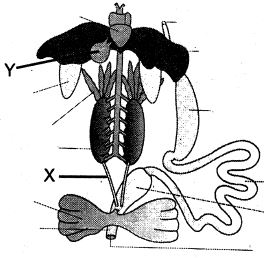
Identify $X$ and $Y$ from the given figure of the reproductive system of an earthworm:
A
Ureno genital duct - Liver
B
Ureter - Gall bladder
C
Kidney - Lungs
D
Prostate gland - Seminal vesicle
Solution
(D) In the provided diagram of the reproductive system of an earthworm,the structure labeled $X$ represents the prostate gland,which is associated with the male reproductive system. The structure labeled $Y$ represents the seminal vesicle,which is responsible for the storage of sperm. Therefore,the correct identification is $X$ as the prostate gland and $Y$ as the seminal vesicle.
0 likes
View SolutionStructural Organisation In Animals — Anatomy of Earthworm · Frequently Asked Questions
1Are these Structural Organisation In Animals questions useful for JEE and NEET?
Yes. All questions in this section are mapped to JEE Main and NEET exam patterns. Previous year questions from JEE Main, NEET, GUJCET and state-level exams are included with full solutions.
2Can I switch to Hindi or Gujarati for these questions?
Yes. Use the language tabs in the hero section or the sidebar to view the same questions and solutions in English, Hindi or Gujarati.
3How do I generate a question paper from this subtopic?
Use the Vedclass Exam Paper Generator — select the chapter and subtopic, set difficulty, and generate Sets A, B, C, D automatically. First 3 chapters of every subject are free.
Vedclass Products
For Students
Vedclass Test Series
Mock tests in real JEE/NEET style with performance analysis. 5-day free trial.
Start Free TrialFor Teachers
Exam Paper Generator
Generate Set A/B/C/D papers from this chapter in 2 minutes. 3 chapters free.
Try FreeFor Institutes
Online Exam Module
Live online exams with unlimited students, 360° analytics & white-label branding.
See DemoFor Teachers & Institutes
Generate a Structural Organisation In Animals Exam Paper in 2 Minutes
Select subtopic & difficulty — Sets A, B, C, D auto-generated with No Repeat logic.
First 3 chapters of every subject are free — no payment required.