
A English
Anatomy of Earthworm Questions in English
Class 11 Biology · Structural Organisation In Animals · Anatomy of Earthworm
312+
Questions
English
Language
100%
With Solutions
Showing 50 of 312 questions in English
201
EasyMCQ
Which of the following parts is not present in an earthworm?
A
Nerve cord
B
Ganglia
C
Nerves
D
Anal cercus
Solution
(D) The nervous system of an earthworm consists of a pair of cerebral ganglia,a nerve ring,and a ventral nerve cord with segmental ganglia and nerves.
Anal cerci are sensory appendages found in insects like cockroaches,not in earthworms.
Therefore,the correct answer is $D$.
Anal cerci are sensory appendages found in insects like cockroaches,not in earthworms.
Therefore,the correct answer is $D$.
0 likes
View Solution202
EasyMCQ
In earthworm,the stomach extends from:
A
$9-14$ segments
B
$10-15$ segments
C
$15^{th}$ segment and continues till the last segments
D
$5^{th}, 6^{th}$ and $7^{th}$ segments
Solution
(A) In the anatomy of an earthworm ($Pheretima$ $posthuma$),the alimentary canal is a straight tube running from the mouth to the anus.
- The pharynx is located in the first $3$ segments.
- The esophagus extends from the $4^{th}$ to the $7^{th}$ segment.
- The gizzard is found in the $8^{th}$ to $9^{th}$ segment.
- The stomach extends from the $9^{th}$ segment to the $14^{th}$ segment.
- Therefore,the correct option is $A$.
- The pharynx is located in the first $3$ segments.
- The esophagus extends from the $4^{th}$ to the $7^{th}$ segment.
- The gizzard is found in the $8^{th}$ to $9^{th}$ segment.
- The stomach extends from the $9^{th}$ segment to the $14^{th}$ segment.
- Therefore,the correct option is $A$.
0 likes
View Solution203
EasyMCQ
Choose the correct pair regarding the anatomy of an earthworm:
| Column-$I$ | Column-$II$ |
| $1$. Spermathecae | $a$. $6^{th}$ to $9^{th}$ segments |
| $2$. Typhlosole | $b$. $1^{st}$ to $3^{rd}$ segments |
| $3$. Buccal cavity | $c$. $26^{th}$ to $35^{th}$ segments in intestine |
| $4$. Pharyngeal nephridia | $d$. $4^{th}$ to $6^{th}$ segment |
A
$1-b, 2-a, 3-d, 4-c$
B
$1-c, 2-a, 3-b, 4-d$
C
$1-a, 2-c, 3-d, 4-b$
D
$1-a, 2-c, 3-b, 4-d$
Solution
(D) The correct anatomical locations in an earthworm are as follows:
$1$. Spermathecae are located in the $6^{th}$ to $9^{th}$ segments $(1-a)$.
$2$. Typhlosole is a fold of the dorsal wall of the intestine,present from the $26^{th}$ to $35^{th}$ segments $(2-c)$.
$3$. The buccal cavity is located in the $1^{st}$ to $3^{rd}$ segments $(3-b)$.
$4$. Pharyngeal nephridia are present as three paired tufts in the $4^{th}, 5^{th},$ and $6^{th}$ segments $(4-d)$.
Therefore,the correct matching is $1-a, 2-c, 3-b, 4-d$.
$1$. Spermathecae are located in the $6^{th}$ to $9^{th}$ segments $(1-a)$.
$2$. Typhlosole is a fold of the dorsal wall of the intestine,present from the $26^{th}$ to $35^{th}$ segments $(2-c)$.
$3$. The buccal cavity is located in the $1^{st}$ to $3^{rd}$ segments $(3-b)$.
$4$. Pharyngeal nephridia are present as three paired tufts in the $4^{th}, 5^{th},$ and $6^{th}$ segments $(4-d)$.
Therefore,the correct matching is $1-a, 2-c, 3-b, 4-d$.
0 likes
View Solution204
EasyMCQ
Which of the following is absent in the circulatory system of an earthworm?
A
Heart
B
Capillary
C
Blood vessel
D
Haemolymph
Solution
(D) The circulatory system of an earthworm $(Pheretima)$ is of the closed type,meaning blood is confined to blood vessels and capillaries.
Earthworms possess hearts (lateral hearts) to pump blood.
However,earthworms do not have haemolymph; instead,they have red blood containing haemoglobin dissolved in the plasma.
Haemolymph is a characteristic fluid found in the open circulatory system of arthropods and some molluscs,not in annelids like earthworms.
Earthworms possess hearts (lateral hearts) to pump blood.
However,earthworms do not have haemolymph; instead,they have red blood containing haemoglobin dissolved in the plasma.
Haemolymph is a characteristic fluid found in the open circulatory system of arthropods and some molluscs,not in annelids like earthworms.
0 likes
View Solution205
EasyMCQ
The first segment of the earthworm is called:
A
Wedge
B
Peristomium
C
Clitellum
D
Nephridia
Solution
(B) The body of the earthworm is divided into many segments called metameres.
The first segment of the earthworm is known as the $Peristomium$ (or buccal segment).
It contains the mouth.
$Clitellum$ is a glandular,non-segmented part found in segments $14-16$.
$Nephridia$ are the excretory organs found in almost all segments.
The first segment of the earthworm is known as the $Peristomium$ (or buccal segment).
It contains the mouth.
$Clitellum$ is a glandular,non-segmented part found in segments $14-16$.
$Nephridia$ are the excretory organs found in almost all segments.
0 likes
View Solution206
EasyMCQ
How many pairs of pores of spermathecae are present in an earthworm (in $pairs$)?
A
$4$
B
$5$
C
$6$
D
$8$
Solution
(A) In the earthworm ($Pheretima$ $posthuma$), there are $4$ pairs of spermathecae located in segments $6$ to $9$.
These spermathecae are responsible for storing sperms received during copulation.
Each pair of spermathecal pores is situated ventro-laterally in the intersegmental grooves between segments $5/6, 6/7, 7/8,$ and $8/9$.
These spermathecae are responsible for storing sperms received during copulation.
Each pair of spermathecal pores is situated ventro-laterally in the intersegmental grooves between segments $5/6, 6/7, 7/8,$ and $8/9$.
0 likes
View Solution207
EasyMCQ
In earthworm,which of the following statements is correct regarding its development?
A
There is no larval stage found.
B
Direct development is not seen.
C
Testes are not present.
D
Ovaries are not present.
Solution
(A) Earthworms ($Pheretima$ $posthuma$) are hermaphrodites,meaning both male and female reproductive organs (testes and ovaries) are present in the same individual.
Development in earthworms is direct,which means there is no larval stage in their life cycle.
The young earthworms resemble the adults and emerge from cocoons.
Therefore,the statement that there is no larval stage found is correct.
Development in earthworms is direct,which means there is no larval stage in their life cycle.
The young earthworms resemble the adults and emerge from cocoons.
Therefore,the statement that there is no larval stage found is correct.
0 likes
View Solution208
EasyMCQ
How many types of nephridia are present in earthworm?
A
$3$
B
$6$
C
$2$
D
$5$
Solution
(A) In earthworms,nephridia are the excretory organs. Based on their location in the body,they are classified into $3$ main types:
$1$. Septal nephridia: Present on both sides of the intersegmental septa of segment $15$ to the last that open into the intestine.
$2$. Integumentary nephridia: Attached to the lining of the body wall of segment $3$ to the last that open on the body surface.
$3$. Pharyngeal nephridia: Present as $3$ paired tufts in the $4th, 5th,$ and $6th$ segments.
$1$. Septal nephridia: Present on both sides of the intersegmental septa of segment $15$ to the last that open into the intestine.
$2$. Integumentary nephridia: Attached to the lining of the body wall of segment $3$ to the last that open on the body surface.
$3$. Pharyngeal nephridia: Present as $3$ paired tufts in the $4th, 5th,$ and $6th$ segments.
0 likes
View Solution209
EasyMCQ
In earthworms,photoreceptor structures are found on the .............
A
Clitellum
B
Many eyes
C
Dorsal surface
D
Lateral sides
Solution
(C) In earthworms $(Pheretima)$,there are no true eyes. However,they possess light-sensitive cells known as photoreceptors. These photoreceptors are primarily concentrated on the dorsal surface of the body,which allows the earthworm to detect light intensity and respond accordingly.
0 likes
View Solution210
MediumMCQ
$Pheretima$ $posthuma$ is very useful as:
A
Their burrows make the soil porous.
B
They make the soil porous and mix their excretory products and organic waste into the soil.
C
They are useful as fish food.
D
They cause biological magnification in birds.
Solution
(B) $Pheretima$ $posthuma$ (earthworm) is known as the 'friend of farmers'.
They make the soil porous by burrowing,which helps in the penetration of air and water into the soil.
Additionally,they enrich the soil by mixing their nitrogenous excretory products (vermicompost) and decaying organic matter into the soil,which increases soil fertility.
They make the soil porous by burrowing,which helps in the penetration of air and water into the soil.
Additionally,they enrich the soil by mixing their nitrogenous excretory products (vermicompost) and decaying organic matter into the soil,which increases soil fertility.
0 likes
View Solution211
EasyMCQ
The blood of $Pheretima$ is:
A
Blue due to hemocyanin in $RBCs$.
B
Blue due to hemocyanin in plasma.
C
Red due to hemoglobin in $RBCs$.
D
Red due to hemoglobin in plasma.
Solution
(D) The blood of $Pheretima$ (earthworm) is red in color.
This red color is due to the presence of hemoglobin dissolved in the plasma.
In earthworms,red blood cells $(RBCs)$ are absent,and hemoglobin is found freely dissolved in the plasma.
Therefore,the correct option is $D$.
This red color is due to the presence of hemoglobin dissolved in the plasma.
In earthworms,red blood cells $(RBCs)$ are absent,and hemoglobin is found freely dissolved in the plasma.
Therefore,the correct option is $D$.
0 likes
View Solution212
EasyMCQ
How many pairs of hearts are found in earthworms (in $pairs$)?
A
$4$
B
$6$
C
$2$
D
$8$
Solution
(A) In earthworms (Pheretima), there are $4$ pairs of specialized hearts. These are located in segments $7, 9, 12,$ and $13$. The lateral hearts are found in segments $7$ and $9$, while the latero-oesophageal hearts are found in segments $12$ and $13$.
0 likes
View Solution213
MediumMCQ
Earthworms do not have an exoskeleton,but when burrowing,the anterior end becomes turgid and acts as a hydraulic skeleton due to the presence of:
A
Coelomic fluid
B
Blood
C
Alimentary canal peristalsis
D
Setae
Solution
(A) Earthworms possess a fluid-filled body cavity known as the coelom.
This coelom contains coelomic fluid,which is incompressible.
When the earthworm burrows,the contraction of body wall muscles exerts pressure on this coelomic fluid.
This pressure makes the anterior end of the body turgid,allowing it to function as a hydrostatic (hydraulic) skeleton,which helps the earthworm in digging and moving through the soil.
This coelom contains coelomic fluid,which is incompressible.
When the earthworm burrows,the contraction of body wall muscles exerts pressure on this coelomic fluid.
This pressure makes the anterior end of the body turgid,allowing it to function as a hydrostatic (hydraulic) skeleton,which helps the earthworm in digging and moving through the soil.
0 likes
View Solution214
MediumMCQ
If a needle is pricked into a living earthworm on its outer surface without damaging the gut,the fluid that comes out is ....
A
Excretory fluid
B
Coelomic fluid
C
Haemolymph
D
Mucus
Solution
(B) The body cavity of an earthworm is a true coelom,which is filled with a fluid known as coelomic fluid.
This fluid acts as a hydrostatic skeleton,providing support and facilitating movement.
When the body wall is punctured without damaging the alimentary canal,this coelomic fluid escapes through the opening.
This fluid acts as a hydrostatic skeleton,providing support and facilitating movement.
When the body wall is punctured without damaging the alimentary canal,this coelomic fluid escapes through the opening.
0 likes
View Solution215
MediumMCQ
$A$ characteristic feature of the earthworm,$Pheretima$,is that:
A
The typhlosole greatly increases the effective absorptive area in the intestine.
B
$S$-shaped setae are embedded in the integument and are used as defensive weapons against enemies.
C
It has a long,dorsal tubular heart.
D
Fertilization of eggs occurs inside the body.
Solution
(A) The correct answer is $A$. In $Pheretima$ (earthworm),the intestine contains a longitudinal fold called the typhlosole. This structure projects into the lumen of the intestine,significantly increasing the surface area for the absorption of digested food. Option $B$ is incorrect because while setae are $S$-shaped and embedded in the integument,they are primarily used for locomotion,not as defensive weapons. Option $C$ is incorrect because earthworms possess lateral hearts,not a single long dorsal tubular heart. Option $D$ is incorrect because fertilization in $Pheretima$ is external,occurring within cocoons deposited outside the body.
0 likes
View Solution216
EasyMCQ
In $Pheretima$,the organisms obtain their nutrition from:
A
Roots of sugarcane
B
Decaying leaves and organic matter of the soil
C
Soil insects
D
Freshly fallen maize leaves
Solution
(B) $Pheretima$ (earthworm) is a detritivore. It feeds on decaying leaves and organic matter present in the soil. As it burrows through the soil,it ingests the soil along with the decaying organic debris,which provides the necessary nutrients for its survival.
0 likes
View Solution217
EasyMCQ
Which of the following correctly describes a part of the body of the earthworm $Pheretima$?
A
Two pairs of accessory glands in the $16-18$ segments.
B
Four pairs of spermathecae in the $4-7$ segments.
C
One pair of ovaries in the $14-15$ intersegmental septum.
D
Two pairs of testes in the $10$ and $11$ segments.
Solution
(D) In $Pheretima$ (earthworm),the reproductive system is organized as follows:
$1$. Two pairs of testes are present in the $10$th and $11$th segments.
$2$. Four pairs of spermathecae are located in the $6$th to $9$th segments.
$3$. One pair of ovaries is attached to the intersegmental septum of the $12$th and $13$th segments.
$4$. Accessory glands are present in the $17$th and $19$th segments.
Therefore,the statement regarding the two pairs of testes in the $10$th and $11$th segments is correct.
$1$. Two pairs of testes are present in the $10$th and $11$th segments.
$2$. Four pairs of spermathecae are located in the $6$th to $9$th segments.
$3$. One pair of ovaries is attached to the intersegmental septum of the $12$th and $13$th segments.
$4$. Accessory glands are present in the $17$th and $19$th segments.
Therefore,the statement regarding the two pairs of testes in the $10$th and $11$th segments is correct.
0 likes
View Solution218
MediumMCQ
In earthworms,the septal nephridia are primarily associated with:
A
Digestion
B
Respiration
C
Osmoregulation
D
Excretion of nitrogenous wastes
Solution
(D) In earthworms ($Pheretima$ $posthuma$),nephridia are the excretory organs.
Septal nephridia are present on both sides of the intersegmental septa of segment $15$ to the last segment.
These nephridia open into the intestine and are primarily responsible for the excretion of nitrogenous waste products like urea and ammonia.
While they play a role in osmoregulation,their primary function is the removal of metabolic nitrogenous wastes.
Septal nephridia are present on both sides of the intersegmental septa of segment $15$ to the last segment.
These nephridia open into the intestine and are primarily responsible for the excretion of nitrogenous waste products like urea and ammonia.
While they play a role in osmoregulation,their primary function is the removal of metabolic nitrogenous wastes.
0 likes
View Solution219
MediumMCQ
Assertion : Typhlosole increases the effective area of absorption in the intestine.
Reason : Typhlosole,present in the intestine,is the characteristic feature of cockroach.
Reason : Typhlosole,present in the intestine,is the characteristic feature of cockroach.
A
If both Assertion and Reason are correct and the Reason is a correct explanation of the Assertion.
B
If both the Assertion and Reason are incorrect.
C
If both Assertion and Reason are correct but Reason is not a correct explanation of the Assertion.
D
If the Assertion is correct but Reason is incorrect.
Solution
(D) The Assertion is correct because the typhlosole is an internal fold of the intestine that increases the surface area for absorption.
However,the Reason is incorrect because the typhlosole is a characteristic feature of the earthworm $(Pheretima)$,not the cockroach.
Therefore,the correct option is $D$.
However,the Reason is incorrect because the typhlosole is a characteristic feature of the earthworm $(Pheretima)$,not the cockroach.
Therefore,the correct option is $D$.
0 likes
View Solution220
EasyMCQ
In earthworms,setae are present in all segments except
A
first and the last segments
B
first segment and the clitellum
C
first segment
D
first,clitellum and last segments
Solution
(D) In earthworms,each segment (except the first,the last,and the clitellar segment) bears a ring of tiny,curved,chitinous structures known as setae. Setae help in locomotion and copulation.
0 likes
View Solution221
EasyMCQ
What is the function of nephridia?
A
Respiration
B
Excretion
C
Digestion
D
Circulation
Solution
(B) Nephridia are the segmentally arranged excretory organs found in earthworms $(Pheretima)$.
Their primary function is to remove metabolic waste products from the body and maintain osmoregulation.
Their primary function is to remove metabolic waste products from the body and maintain osmoregulation.
0 likes
View Solution222
Medium
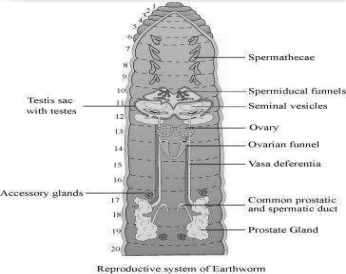
Draw a labelled diagram of the reproductive organs of an earthworm.
Solution
(N/A) Earthworms are hermaphrodites,meaning they possess both male and female reproductive organs in the same individual.
Key components of the reproductive system include:
$1$. Spermathecae: Four pairs located in segments $6-9$,which store spermatozoa received during copulation.
$2$. Testis sacs: Two pairs located in segments $10$ and $11$,containing the testes.
$3$. Seminal vesicles: Two pairs located in segments $11$ and $12$,where sperm mature.
$4$. Spermiducal funnels: Located in segments $10$ and $11$,which collect sperm.
$5$. Vasa deferentia: $A$ pair of ducts running from segment $11$ to $18$ that transport sperm.
$6$. Accessory glands: Present in segments $17$ and $19$.
$7$. Common prostatic and spermatic duct: Opens to the exterior on the $18^{th}$ segment.
$8$. Ovaries: $A$ pair of ovaries is present in the $13^{th}$ segment.
$9$. Ovarian funnels: Located beneath the ovaries,leading into the oviducts which open on the $14^{th}$ segment.
Key components of the reproductive system include:
$1$. Spermathecae: Four pairs located in segments $6-9$,which store spermatozoa received during copulation.
$2$. Testis sacs: Two pairs located in segments $10$ and $11$,containing the testes.
$3$. Seminal vesicles: Two pairs located in segments $11$ and $12$,where sperm mature.
$4$. Spermiducal funnels: Located in segments $10$ and $11$,which collect sperm.
$5$. Vasa deferentia: $A$ pair of ducts running from segment $11$ to $18$ that transport sperm.
$6$. Accessory glands: Present in segments $17$ and $19$.
$7$. Common prostatic and spermatic duct: Opens to the exterior on the $18^{th}$ segment.
$8$. Ovaries: $A$ pair of ovaries is present in the $13^{th}$ segment.
$9$. Ovarian funnels: Located beneath the ovaries,leading into the oviducts which open on the $14^{th}$ segment.
0 likes
View Solution223
Medium
Distinguish between the following: Prostomium and peristomium.
Solution
(N/A)
| Prostomium | Peristomium |
|---|---|
| $1$. It is a small,fleshy,lobe-like structure that overhangs the mouth of an earthworm. | $1$. It is the first body segment of the earthworm,also known as the buccal segment. |
| $2$. It acts as a wedge to force open cracks in the soil and is sensory in function. | $2$. It surrounds the mouth opening and contains the mouth. |
0 likes
View Solution224
Medium
Mention briefly about the circulatory system of earthworm.
Solution
(N/A) Earthworms $(Pheretima)$ possess a closed blood vascular system,which includes the heart,blood vessels,and capillaries.
The heart pumps blood to ensure circulation in a single direction.
Blood is supplied to the gut,nerve cord,and body wall via smaller blood vessels.
Blood glands are located in the $4^{th}, 5^{th},$ and $6^{th}$ segments,which produce blood cells and hemoglobin that remains dissolved in the blood plasma.
The blood cells in earthworms are phagocytic in nature.
The heart pumps blood to ensure circulation in a single direction.
Blood is supplied to the gut,nerve cord,and body wall via smaller blood vessels.
Blood glands are located in the $4^{th}, 5^{th},$ and $6^{th}$ segments,which produce blood cells and hemoglobin that remains dissolved in the blood plasma.
The blood cells in earthworms are phagocytic in nature.
0 likes
View Solution225
Easy
Answer in one word or one line.
How many spermathecae are found in earthworm?
How many spermathecae are found in earthworm?
Solution
(N/A) Four pairs of spermathecae are present in earthworms.
They are located between the $6^{th}$ and the $9^{th}$ segments.
They help in receiving and storing the spermatozoa during copulation.
They are located between the $6^{th}$ and the $9^{th}$ segments.
They help in receiving and storing the spermatozoa during copulation.
0 likes
View Solution226
Easy
Answer the following:
How many types of nephridia are found in earthworm based on their location?
How many types of nephridia are found in earthworm based on their location?
Solution
(3) On the basis of their location,three types of nephridia are found in earthworms. They are:
$1$. Septal nephridia: These are present on both sides of the inter-segmental septa behind the $15^{\text{th}}$ segment. They open into the intestines.
$2$. Integumentary nephridia: These lie attached to the body wall from the $3^{\text{rd}}$ segment to the last segment,which open on the body surface.
$3$. Pharyngeal nephridia: These are present as three paired tufts in the $4^{\text{th}}$,$5^{\text{th}}$,and $6^{\text{th}}$ segments.
$1$. Septal nephridia: These are present on both sides of the inter-segmental septa behind the $15^{\text{th}}$ segment. They open into the intestines.
$2$. Integumentary nephridia: These lie attached to the body wall from the $3^{\text{rd}}$ segment to the last segment,which open on the body surface.
$3$. Pharyngeal nephridia: These are present as three paired tufts in the $4^{\text{th}}$,$5^{\text{th}}$,and $6^{\text{th}}$ segments.
0 likes
View Solution227
Medium
Distinguish between the following: Septal nephridium and pharyngeal nephridium.
Solution
(N/A)
| Septal nephridium | Pharyngeal nephridium |
|---|---|
| They are present on both sides of intersegmental septa behind the $15^{\text{th}}$ segment. They open into the intestine. | They are present as three paired tufts in the $4^{\text{th}}$,$5^{\text{th}}$,and $6^{\text{th}}$ segments. |
0 likes
View Solution228
Medium
Mention the function of the following:
Body wall in earthworm
Body wall in earthworm
Solution
(N/A) The body wall of an earthworm is primarily composed of an outer cuticle,epidermis,two muscle layers (circular and longitudinal),and an inner coelomic epithelium.
Its primary functions are:
$1$. Protection: It protects the internal organs from mechanical injury and desiccation.
$2$. Locomotion: The contraction and relaxation of the circular and longitudinal muscles facilitate movement and burrowing in the soil.
$3$. Respiration: The moist body wall allows for cutaneous respiration,where gaseous exchange occurs directly through the skin.
Its primary functions are:
$1$. Protection: It protects the internal organs from mechanical injury and desiccation.
$2$. Locomotion: The contraction and relaxation of the circular and longitudinal muscles facilitate movement and burrowing in the soil.
$3$. Respiration: The moist body wall allows for cutaneous respiration,where gaseous exchange occurs directly through the skin.
0 likes
View Solution229
Medium
Describe the anatomy of the body wall of an earthworm in short.
Solution
(N/A) The body wall of the earthworm consists of the following layers:
$1$. Cuticle: The body is covered externally by a thin,non-cellular layer called the cuticle.
$2$. Epidermis: Below the cuticle lies the epidermis,which is composed of a single layer of columnar epithelial cells,including secretory gland cells.
$3$. Muscle Layers: Beneath the epidermis,there are two layers of muscles: an outer layer of circular muscles and an inner layer of longitudinal muscles.
$4$. Coelomic Epithelium: The innermost layer is the coelomic epithelium,which lines the body cavity.
$1$. Cuticle: The body is covered externally by a thin,non-cellular layer called the cuticle.
$2$. Epidermis: Below the cuticle lies the epidermis,which is composed of a single layer of columnar epithelial cells,including secretory gland cells.
$3$. Muscle Layers: Beneath the epidermis,there are two layers of muscles: an outer layer of circular muscles and an inner layer of longitudinal muscles.
$4$. Coelomic Epithelium: The innermost layer is the coelomic epithelium,which lines the body cavity.
0 likes
View Solution230
Medium
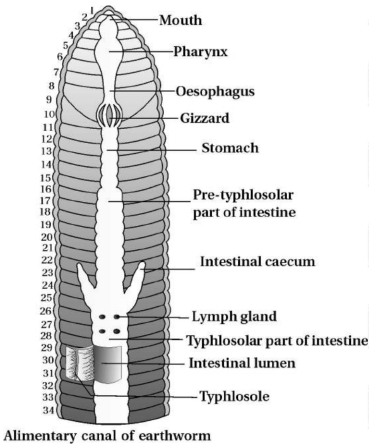
Explain the digestive tract of an earthworm with a diagram.
Solution
(N/A) $\Rightarrow$ The alimentary canal of an earthworm is a straight tube that runs between the first to the last segment of the body.
$\Rightarrow$ Mouth and prostomium: The first body segment of the earthworm contains the mouth. The prostomium is a lobe-like structure in front of the mouth. It serves as a covering for the mouth and as a wedge to force open cracks in the soil into which the earthworm may crawl.
$\Rightarrow$ Pharynx: The pharynx is located in the $4^{th}$ segment.
$\Rightarrow$ Oesophagus: It extends from the $5^{th}$ to the $7^{th}$ segment.
$\Rightarrow$ Gizzard: It is a muscular structure located in the $8^{th}$ segment,which helps in grinding soil particles and decaying leaves.
$\Rightarrow$ Stomach: The stomach extends from the $9^{th}$ to $14^{th}$ segments. Calciferous glands are present in the stomach,which neutralize the humic acid present in humus.
$\Rightarrow$ Intestine: The intestine starts from the $15^{th}$ segment onwards and continues till the last segment.
$\Rightarrow$ Intestinal caecae: $A$ pair of short and conical intestinal caecae project from the intestine on the $26^{th}$ segment.
$\Rightarrow$ Typhlosole: The characteristic feature of the intestine between the $26^{th}$ and $35^{th}$ segments is the presence of an internal median fold of the dorsal wall called the typhlosole. It increases the effective area of absorption in the intestine.
$\Rightarrow$ Digestion of food: The food of the earthworm consists of decaying leaves and organic matter mixed with soil. Digestive enzymes break down complex food into smaller absorbable units.
$\Rightarrow$ Undigested waste is excreted as globules in small heaps,known as worm castings.
$\Rightarrow$ Mouth and prostomium: The first body segment of the earthworm contains the mouth. The prostomium is a lobe-like structure in front of the mouth. It serves as a covering for the mouth and as a wedge to force open cracks in the soil into which the earthworm may crawl.
$\Rightarrow$ Pharynx: The pharynx is located in the $4^{th}$ segment.
$\Rightarrow$ Oesophagus: It extends from the $5^{th}$ to the $7^{th}$ segment.
$\Rightarrow$ Gizzard: It is a muscular structure located in the $8^{th}$ segment,which helps in grinding soil particles and decaying leaves.
$\Rightarrow$ Stomach: The stomach extends from the $9^{th}$ to $14^{th}$ segments. Calciferous glands are present in the stomach,which neutralize the humic acid present in humus.
$\Rightarrow$ Intestine: The intestine starts from the $15^{th}$ segment onwards and continues till the last segment.
$\Rightarrow$ Intestinal caecae: $A$ pair of short and conical intestinal caecae project from the intestine on the $26^{th}$ segment.
$\Rightarrow$ Typhlosole: The characteristic feature of the intestine between the $26^{th}$ and $35^{th}$ segments is the presence of an internal median fold of the dorsal wall called the typhlosole. It increases the effective area of absorption in the intestine.
$\Rightarrow$ Digestion of food: The food of the earthworm consists of decaying leaves and organic matter mixed with soil. Digestive enzymes break down complex food into smaller absorbable units.
$\Rightarrow$ Undigested waste is excreted as globules in small heaps,known as worm castings.
0 likes
View Solution231
Medium
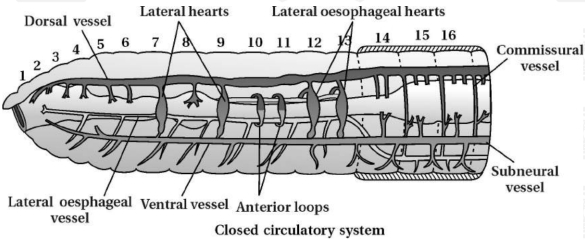
Describe the circulatory system of an earthworm.
Solution
(N/A) $\rightarrow$ The circulatory system of an earthworm is of the closed type,consisting of blood vessels,capillaries,and hearts.
$\rightarrow$ The blood is red,and haemoglobin is dissolved in the blood plasma.
$\rightarrow$ Blood glands are present on the $4^{th}$,$5^{th}$,and $6^{th}$ segments. They produce blood cells and haemoglobin,which is dissolved in the blood plasma. Blood cells are phagocytic in nature.
$\rightarrow$ Due to the closed circulatory system,the blood circulates only within blood capillaries,blood vessels,and hearts.
$\rightarrow$ Due to rhythmic contractions,blood circulates in only one direction. Smaller blood vessels supply the gut,nerve cord,and the body wall.
$\rightarrow$ Respiratory system:
$\rightarrow$ Earthworms lack specialised breathing devices. Respiratory exchange occurs through the moist body surface into their bloodstream. The blood flow picks up $O_{2}$ from there.
$\rightarrow$ The blood is red,and haemoglobin is dissolved in the blood plasma.
$\rightarrow$ Blood glands are present on the $4^{th}$,$5^{th}$,and $6^{th}$ segments. They produce blood cells and haemoglobin,which is dissolved in the blood plasma. Blood cells are phagocytic in nature.
$\rightarrow$ Due to the closed circulatory system,the blood circulates only within blood capillaries,blood vessels,and hearts.
$\rightarrow$ Due to rhythmic contractions,blood circulates in only one direction. Smaller blood vessels supply the gut,nerve cord,and the body wall.
$\rightarrow$ Respiratory system:
$\rightarrow$ Earthworms lack specialised breathing devices. Respiratory exchange occurs through the moist body surface into their bloodstream. The blood flow picks up $O_{2}$ from there.
0 likes
View Solution232
Medium
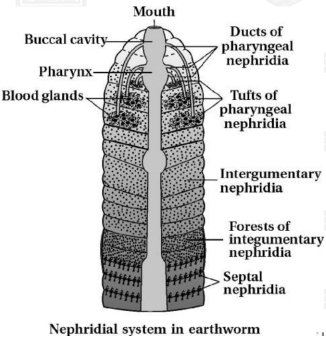
Explain the nephridia of an earthworm.
Solution
(N/A) In earthworms,the excretory organs occur as segmentally arranged coiled tubules called nephridia. They are of three types:
$(i)$ Pharyngeal nephridia: These are located in segments $4$,$5$,and $6$.
(ii) Integumentary nephridia: These are attached to the lining of the body wall of segment $3$ to the last,which open on the body surface.
(iii) Septal nephridia: These are present on both sides of the intersegmental septa of segment $15$ to the last,which open into the intestine.
There are no nephridia present in the first two segments.
Integumentary nephridia excrete the excretory substances onto the body wall. This type of excretion is called exonephric excretion.
Pharyngeal and septal nephridia discharge the excretory substances into the alimentary canal (buccal cavity and intestine). This type of excretion is called enteronephric excretion.
These different types of nephridia are basically similar in structure. Nephridia regulate the volume and composition of the body fluids.
$A$ nephridium starts as a funnel that collects excess fluid from the coelomic chamber. The funnel connects with a tubular part of the nephridium,which delivers the wastes through a pore to the surface of the body wall or into the digestive tube.
$(i)$ Pharyngeal nephridia: These are located in segments $4$,$5$,and $6$.
(ii) Integumentary nephridia: These are attached to the lining of the body wall of segment $3$ to the last,which open on the body surface.
(iii) Septal nephridia: These are present on both sides of the intersegmental septa of segment $15$ to the last,which open into the intestine.
There are no nephridia present in the first two segments.
Integumentary nephridia excrete the excretory substances onto the body wall. This type of excretion is called exonephric excretion.
Pharyngeal and septal nephridia discharge the excretory substances into the alimentary canal (buccal cavity and intestine). This type of excretion is called enteronephric excretion.
These different types of nephridia are basically similar in structure. Nephridia regulate the volume and composition of the body fluids.
$A$ nephridium starts as a funnel that collects excess fluid from the coelomic chamber. The funnel connects with a tubular part of the nephridium,which delivers the wastes through a pore to the surface of the body wall or into the digestive tube.
0 likes
View Solution233
Medium
Describe the nervous system of an earthworm.
Solution
(N/A) $\rightarrow$ The nervous system of an earthworm is ganglionated. Nerve cells unite to form ganglia.
$\rightarrow$ $A$ pair of ganglia is located on the ventral side in each segment after the $5^{\text{th}}$ segment. This is known as the ventral nerve cord.
$\rightarrow$ $A$ pair of ganglia is located on the ventral side in the posterior part of the $3^{\text{rd}}$ segment. It is known as the sub-pharyngeal ganglion.
$\rightarrow$ On the dorsal side of the pharynx,a pair of ganglia is located in the $3^{\text{rd}}$ segment,known as the supra-pharyngeal ganglion (cerebral ganglia).
$\rightarrow$ These ganglia are connected to the sub-pharyngeal ganglia through circum-pharyngeal connectives.
$\rightarrow$ The circum-pharyngeal connectives connect the sub-pharyngeal ganglia and the supra-pharyngeal ganglia to form a nerve ring.
$\rightarrow$ The cerebral ganglia,along with other nerves in the ring,integrate sensory input and command muscular responses of the body.
$\rightarrow$ $A$ pair of ganglia is located on the ventral side in each segment after the $5^{\text{th}}$ segment. This is known as the ventral nerve cord.
$\rightarrow$ $A$ pair of ganglia is located on the ventral side in the posterior part of the $3^{\text{rd}}$ segment. It is known as the sub-pharyngeal ganglion.
$\rightarrow$ On the dorsal side of the pharynx,a pair of ganglia is located in the $3^{\text{rd}}$ segment,known as the supra-pharyngeal ganglion (cerebral ganglia).
$\rightarrow$ These ganglia are connected to the sub-pharyngeal ganglia through circum-pharyngeal connectives.
$\rightarrow$ The circum-pharyngeal connectives connect the sub-pharyngeal ganglia and the supra-pharyngeal ganglia to form a nerve ring.
$\rightarrow$ The cerebral ganglia,along with other nerves in the ring,integrate sensory input and command muscular responses of the body.
0 likes
View Solution234
Medium
Which are the sensory organs of an earthworm? Describe their functions.
Solution
(N/A) $\rightarrow$ Earthworms do not possess eyes,but they have light and touch-sensitive receptor cells that allow them to distinguish light intensities and detect vibrations in the ground.
$\rightarrow$ They possess specialized chemoreceptors that react to chemical stimuli.
$\rightarrow$ These sensory organs are primarily located on the anterior part of the earthworm's body.
$\rightarrow$ They possess specialized chemoreceptors that react to chemical stimuli.
$\rightarrow$ These sensory organs are primarily located on the anterior part of the earthworm's body.
0 likes
View Solution235
Medium
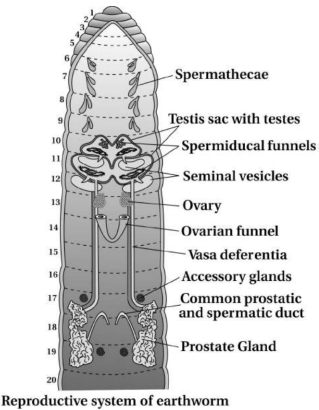
Describe the structure of the reproductive system of an earthworm with a diagram.
Solution
(N/A) $\rightarrow$ Earthworms are hermaphrodites,meaning both testes and ovaries are present in the same individual.
$\rightarrow$ Two pairs of testes are present in the $10^{th}$ and $11^{th}$ segments.
$\rightarrow$ Their vasa deferentia run up to the $18^{th}$ segment,where they join the prostatic duct.
$\rightarrow$ Two pairs of accessory glands are present,one pair each in the $17^{th}$ and $19^{th}$ segments.
$\rightarrow$ The common prostatic and spermatic duct opens to the exterior by a pair of male genital pores on the ventrolateral side of the $18^{th}$ segment.
$\rightarrow$ Four pairs of spermathecae are located in the $6^{th}-9^{th}$ segments (one pair in each segment). They receive and store spermatozoa during copulation.
$\rightarrow$ One pair of ovaries is attached at the intersegmental septum of the $12^{th}$ and $13^{th}$ segments.
$\rightarrow$ Ovarian funnels are present beneath the ovaries,which continue into the oviducts,join together,and open on the ventral side as a single median female genital pore on the $14^{th}$ segment.
$\rightarrow$ Mating: $A$ mutual exchange of sperm occurs between two worms during mating. They mate by juxtaposing opposite gonadal openings.
$\rightarrow$ The male genital pores of one worm come in contact with the spermathecal pores of another earthworm.
$\rightarrow$ In this situation,due to the release of sperm,sperm cells enter the spermathecae of the companion animal.
$\rightarrow$ After the exchange of sperm cells,the companion animals separate.
$\rightarrow$ Formation of Cocoon: After some time,the glands of the clitellum secrete a white,girdle-like structure.
$\rightarrow$ Due to contraction,the girdle/tube slowly moves towards the anterior end.
$\rightarrow$ As the girdle moves towards the anterior end and passes the spermathecal region,the sperm cells stored in the spermathecae enter it.
$\rightarrow$ Now,this tube contains the egg cells of the same animal,the sperm cells of the companion animal,and nutrient fluid.
$\rightarrow$ Both ends of the tube/girdle that come out of the body are closed. This closed tube is the cocoon. Fertilization takes place within it,and the egg cells result in a zygote.
$\rightarrow$ After about $3$ weeks,each cocoon produces two to twenty baby earthworms.
$\rightarrow$ The development of the earthworm is direct,meaning no larval stage occurs during development.
$\rightarrow$ Two pairs of testes are present in the $10^{th}$ and $11^{th}$ segments.
$\rightarrow$ Their vasa deferentia run up to the $18^{th}$ segment,where they join the prostatic duct.
$\rightarrow$ Two pairs of accessory glands are present,one pair each in the $17^{th}$ and $19^{th}$ segments.
$\rightarrow$ The common prostatic and spermatic duct opens to the exterior by a pair of male genital pores on the ventrolateral side of the $18^{th}$ segment.
$\rightarrow$ Four pairs of spermathecae are located in the $6^{th}-9^{th}$ segments (one pair in each segment). They receive and store spermatozoa during copulation.
$\rightarrow$ One pair of ovaries is attached at the intersegmental septum of the $12^{th}$ and $13^{th}$ segments.
$\rightarrow$ Ovarian funnels are present beneath the ovaries,which continue into the oviducts,join together,and open on the ventral side as a single median female genital pore on the $14^{th}$ segment.
$\rightarrow$ Mating: $A$ mutual exchange of sperm occurs between two worms during mating. They mate by juxtaposing opposite gonadal openings.
$\rightarrow$ The male genital pores of one worm come in contact with the spermathecal pores of another earthworm.
$\rightarrow$ In this situation,due to the release of sperm,sperm cells enter the spermathecae of the companion animal.
$\rightarrow$ After the exchange of sperm cells,the companion animals separate.
$\rightarrow$ Formation of Cocoon: After some time,the glands of the clitellum secrete a white,girdle-like structure.
$\rightarrow$ Due to contraction,the girdle/tube slowly moves towards the anterior end.
$\rightarrow$ As the girdle moves towards the anterior end and passes the spermathecal region,the sperm cells stored in the spermathecae enter it.
$\rightarrow$ Now,this tube contains the egg cells of the same animal,the sperm cells of the companion animal,and nutrient fluid.
$\rightarrow$ Both ends of the tube/girdle that come out of the body are closed. This closed tube is the cocoon. Fertilization takes place within it,and the egg cells result in a zygote.
$\rightarrow$ After about $3$ weeks,each cocoon produces two to twenty baby earthworms.
$\rightarrow$ The development of the earthworm is direct,meaning no larval stage occurs during development.
0 likes
View Solution236
MediumMCQ
Mention the relation of earthworm with human life.
A
They are pests that destroy crops.
B
They are known as friends of farmers because they make the soil porous.
C
They are used as a primary source of food for humans.
D
They have no significant relation to human life.
Solution
(B) Earthworms are known as 'friends of farmers' because they make burrows in the soil,which makes the soil porous.
This porosity helps in the respiration of soil organisms and facilitates the easy penetration of developing plant roots.
The process of increasing soil fertility using earthworms is called vermicomposting.
Additionally,earthworms are widely used as bait in game fishing.
This porosity helps in the respiration of soil organisms and facilitates the easy penetration of developing plant roots.
The process of increasing soil fertility using earthworms is called vermicomposting.
Additionally,earthworms are widely used as bait in game fishing.
0 likes
View Solution237
Easy
Give scientific reasons: Earthworm is known as the farmer's friend.
Solution
(N/A) Earthworms are known as the farmer's friend because they perform several beneficial activities for the soil:
$1$. They help in the breakdown of complex organic matter into simpler substances,which increases the fertility of the soil.
$2$. They burrow into the soil,which helps in loosening the soil (aeration),allowing roots to penetrate deeper and improving water drainage.
$3$. Their excreta,known as worm castings,are rich in nutrients,which act as natural fertilizers for crops.
$1$. They help in the breakdown of complex organic matter into simpler substances,which increases the fertility of the soil.
$2$. They burrow into the soil,which helps in loosening the soil (aeration),allowing roots to penetrate deeper and improving water drainage.
$3$. Their excreta,known as worm castings,are rich in nutrients,which act as natural fertilizers for crops.
0 likes
View Solution238
Medium
What is typhlosole? Describe its location and function.
Solution
(N/A) $\rightarrow$ The typhlosole is a characteristic internal median fold of the dorsal wall of the intestine in earthworms.
$1.$ Location: It is present in the intestine between the $26^{th}$ and $35^{th}$ segments.
$2.$ Function: Its primary function is to increase the effective surface area for the absorption of digested food in the intestine.
$(a)$ Pre-typhlosolar region: The part of the intestine extending up to the origin of the intestinal caeca is called the pre-typhlosolar region.
$(b)$ Post-typhlosolar region: The last part of the intestine (approximately the last $23^{rd}$ to $25^{th}$ segments) lacks typhlosoles and is referred to as the post-typhlosolar region,which leads to the anus.
$1.$ Location: It is present in the intestine between the $26^{th}$ and $35^{th}$ segments.
$2.$ Function: Its primary function is to increase the effective surface area for the absorption of digested food in the intestine.
$(a)$ Pre-typhlosolar region: The part of the intestine extending up to the origin of the intestinal caeca is called the pre-typhlosolar region.
$(b)$ Post-typhlosolar region: The last part of the intestine (approximately the last $23^{rd}$ to $25^{th}$ segments) lacks typhlosoles and is referred to as the post-typhlosolar region,which leads to the anus.
0 likes
View Solution239
Easy
How many types of nephridia are there? Mention them.
Solution
(N/A) Nephridia are of three types:
$(i)$ Pharyngeal nephridia: These are located in segments $4, 5,$ and $6$.
$(ii)$ Integumentary nephridia: These are attached to the lining of the body wall of segment $3$ to the last,which open on the body surface.
$(iii)$ Septal nephridia: These are present on both sides of the intersegmental septa of segment $15$ to the last,which open into the intestine.
$(i)$ Pharyngeal nephridia: These are located in segments $4, 5,$ and $6$.
$(ii)$ Integumentary nephridia: These are attached to the lining of the body wall of segment $3$ to the last,which open on the body surface.
$(iii)$ Septal nephridia: These are present on both sides of the intersegmental septa of segment $15$ to the last,which open into the intestine.
0 likes
View Solution240
MediumMCQ
Why is the nerve ring considered the brain of the earthworm?
A
It controls the entire digestive system.
B
It integrates sensory input and commands muscular responses.
C
It is the largest organ in the earthworm.
D
It produces all the hormones for the earthworm.
Solution
(B) $\rightarrow$ The pair of circum-pharyngeal connectives connects the supra-pharyngeal ganglia (cerebral ganglia) with the sub-pharyngeal ganglia,forming a nerve ring around the pharynx.
$\rightarrow$ The cerebral ganglia,located dorsally,act as the brain by integrating sensory inputs from the body and coordinating muscular responses,thus controlling the earthworm's behavior.
$\rightarrow$ The cerebral ganglia,located dorsally,act as the brain by integrating sensory inputs from the body and coordinating muscular responses,thus controlling the earthworm's behavior.
0 likes
View Solution241
Medium
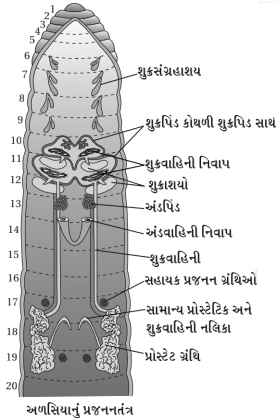
Draw a labeled diagram of the reproductive system of an earthworm.
Solution
(N/A) The reproductive system of an earthworm is hermaphroditic,meaning both male and female reproductive organs are present in the same individual.
$1$. Male Reproductive System: It consists of two pairs of testes present in the $10^{th}$ and $11^{th}$ segments. Two pairs of male genital pores are present on the ventro-lateral side of the $18^{th}$ segment. Prostate glands are present in the $17^{th}-19^{th}$ segments.
$2$. Female Reproductive System: It consists of one pair of ovaries attached at the inter-segmental septum of the $12^{th}$ and $13^{th}$ segments. Ovarian funnels are present beneath the ovaries,which continue into oviducts that join and open on the ventral side as a single median female genital pore on the $14^{th}$ segment.
$3$. Spermathecae: Four pairs of spermathecae are located in the $6^{th}-9^{th}$ segments (one pair in each segment). They receive and store spermatozoa during copulation.
$1$. Male Reproductive System: It consists of two pairs of testes present in the $10^{th}$ and $11^{th}$ segments. Two pairs of male genital pores are present on the ventro-lateral side of the $18^{th}$ segment. Prostate glands are present in the $17^{th}-19^{th}$ segments.
$2$. Female Reproductive System: It consists of one pair of ovaries attached at the inter-segmental septum of the $12^{th}$ and $13^{th}$ segments. Ovarian funnels are present beneath the ovaries,which continue into oviducts that join and open on the ventral side as a single median female genital pore on the $14^{th}$ segment.
$3$. Spermathecae: Four pairs of spermathecae are located in the $6^{th}-9^{th}$ segments (one pair in each segment). They receive and store spermatozoa during copulation.
0 likes
View Solution242
Medium
Explain why the earthworm is considered a friend of the farmer.
Solution
(N/A) Earthworms are known as 'friends of farmers' because they burrow into the soil,making it porous. This porosity facilitates soil aeration and allows for easier penetration of developing plant roots. The process of increasing soil fertility through the action of earthworms is known as vermicomposting. Additionally,they are widely used as bait in game fishing.
1 likes
View Solution243
Medium
Explain the process of mating and the formation of the cocoon in earthworms.
Solution
(N/A) $1$. Mating: Earthworms are hermaphrodites,meaning they possess both male and female reproductive organs. During mating,two earthworms come together and exchange sperm. They lie in opposite directions,with the male genital pores of one worm adjacent to the spermathecal pores of the other. Sperm is exchanged and stored in the spermathecae.
$2$. Cocoon Formation: After mating,the clitellar gland cells secrete a mucous and proteinaceous material. This material forms a girdle or ring around the clitellum. As the worm moves backward,this girdle slides forward. As it passes over the female genital pore,it collects eggs,and as it passes over the spermathecal pores,it collects the stored sperm. Finally,the girdle slips off the anterior end of the worm,and its ends seal to form a cocoon. Fertilization and development occur within this cocoon.
$2$. Cocoon Formation: After mating,the clitellar gland cells secrete a mucous and proteinaceous material. This material forms a girdle or ring around the clitellum. As the worm moves backward,this girdle slides forward. As it passes over the female genital pore,it collects eggs,and as it passes over the spermathecal pores,it collects the stored sperm. Finally,the girdle slips off the anterior end of the worm,and its ends seal to form a cocoon. Fertilization and development occur within this cocoon.
0 likes
View Solution244
Medium
Give scientific reasons: Earthworm is known as farmer's friend.
Solution
(N/A) $\Rightarrow$ Earthworms are known as 'friends of farmers' because they make burrows in the soil,which makes the soil porous.
This porosity helps in the respiration of soil organisms and facilitates the easy penetration of developing plant roots.
Furthermore,earthworms increase soil fertility by breaking down organic matter,a process known as vermicomposting.
They also help in turning over the soil,which improves its nutrient content.
This porosity helps in the respiration of soil organisms and facilitates the easy penetration of developing plant roots.
Furthermore,earthworms increase soil fertility by breaking down organic matter,a process known as vermicomposting.
They also help in turning over the soil,which improves its nutrient content.
0 likes
View Solution245
Easy
Define the following terms:
$(i)$ Endomysium
$(ii)$ Prostomium
$(i)$ Endomysium
$(ii)$ Prostomium
Solution
(N/A) $(i)$ Endomysium is the delicate connective tissue layer that surrounds individual muscle fibers.
$(ii)$ Prostomium is a small,fleshy,lobe-like structure present at the anterior end of an earthworm,which acts as a covering for the mouth and is used as a wedge to force open cracks in the soil.
$(ii)$ Prostomium is a small,fleshy,lobe-like structure present at the anterior end of an earthworm,which acts as a covering for the mouth and is used as a wedge to force open cracks in the soil.
0 likes
View Solution246
Easy
Define the following terms:
$(i)$ Peristomium
$(ii)$ Clitellum
$(i)$ Peristomium
$(ii)$ Clitellum
Solution
(N/A) $(i)$ The first body segment of an earthworm is known as the peristomium.
$(ii)$ Segments $14-16$ of an earthworm are covered by a prominent dark band of glandular tissue called the clitellum.
$(ii)$ Segments $14-16$ of an earthworm are covered by a prominent dark band of glandular tissue called the clitellum.
0 likes
View Solution247
Medium
Definitions / Explanation:
$(i)$ Exonephric
$(ii)$ Enteronephric
$(i)$ Exonephric
$(ii)$ Enteronephric
Solution
(N/A) $(i)$ In earthworm,integumentary nephridia discharge excretory wastes directly to the exterior of the body surface,which is termed as Exonephric.
$(ii)$ In earthworm,septal and pharyngeal nephridia discharge excretory wastes into the alimentary canal,which is termed as Enteronephric.
$(ii)$ In earthworm,septal and pharyngeal nephridia discharge excretory wastes into the alimentary canal,which is termed as Enteronephric.
0 likes
View Solution248
Easy
Define the following terms:
$(i)$ Cocoon
$(ii)$ Worm casting
$(i)$ Cocoon
$(ii)$ Worm casting
Solution
(N/A) $(i)$ Cocoon: It is a protective structure secreted by the clitellar glands of an earthworm,which stores fertilized egg cells or ova for development.
$(ii)$ Worm casting: In earthworms,the undigested food material that is excreted through the anus in the form of small,granular heaps is known as worm castings.
$(ii)$ Worm casting: In earthworms,the undigested food material that is excreted through the anus in the form of small,granular heaps is known as worm castings.
0 likes
View Solution249
Medium
Identify the location and function of the following structures in an earthworm:
$(i)$ Setae
$(ii)$ Typhlosole
$(i)$ Setae
$(ii)$ Typhlosole
Solution
(N/A) $(i)$ Location: $S$-shaped structures made of chitin found in the body wall (epidermis) of the earthworm.
$\Rightarrow$ Function: They provide grip in the soil and assist in locomotion.
$(ii)$ Location: It is an internal median fold of the dorsal wall of the intestine,starting after the $26^{th}$ segment.
$\Rightarrow$ Function: It increases the effective surface area for the absorption of digested nutrients in the intestine.
$\Rightarrow$ Function: They provide grip in the soil and assist in locomotion.
$(ii)$ Location: It is an internal median fold of the dorsal wall of the intestine,starting after the $26^{th}$ segment.
$\Rightarrow$ Function: It increases the effective surface area for the absorption of digested nutrients in the intestine.
0 likes
View Solution250
EasyMCQ
Why is the earthworm called the friend of the farmer?
A
They help in pollination of crops.
B
They make the soil porous and increase its fertility.
C
They kill harmful pests in the soil.
D
They provide nitrogen directly to the plant roots.
Solution
(B) Earthworms are known as the 'friends of farmers' because they burrow into the soil,making it porous.
This porosity facilitates better aeration and allows for easier penetration of developing plant roots.
Furthermore,they contribute to soil fertility by breaking down organic matter,a process often associated with vermicomposting.
They also help in turning over the soil,which improves its overall structure.
This porosity facilitates better aeration and allows for easier penetration of developing plant roots.
Furthermore,they contribute to soil fertility by breaking down organic matter,a process often associated with vermicomposting.
They also help in turning over the soil,which improves its overall structure.
0 likes
View SolutionStructural Organisation In Animals — Anatomy of Earthworm · Frequently Asked Questions
1Are these Structural Organisation In Animals questions useful for JEE and NEET?
Yes. All questions in this section are mapped to JEE Main and NEET exam patterns. Previous year questions from JEE Main, NEET, GUJCET and state-level exams are included with full solutions.
2Can I switch to Hindi or Gujarati for these questions?
Yes. Use the language tabs in the hero section or the sidebar to view the same questions and solutions in English, Hindi or Gujarati.
3How do I generate a question paper from this subtopic?
Use the Vedclass Exam Paper Generator — select the chapter and subtopic, set difficulty, and generate Sets A, B, C, D automatically. First 3 chapters of every subject are free.
Vedclass Products
For Students
Vedclass Test Series
Mock tests in real JEE/NEET style with performance analysis. 5-day free trial.
Start Free TrialFor Teachers
Exam Paper Generator
Generate Set A/B/C/D papers from this chapter in 2 minutes. 3 chapters free.
Try FreeFor Institutes
Online Exam Module
Live online exams with unlimited students, 360° analytics & white-label branding.
See DemoFor Teachers & Institutes
Generate a Structural Organisation In Animals Exam Paper in 2 Minutes
Select subtopic & difficulty — Sets A, B, C, D auto-generated with No Repeat logic.
First 3 chapters of every subject are free — no payment required.