
A English
Anaerobic respiration Questions in English
Class 11 Biology · Respiration in Plants · Anaerobic respiration
160+
Questions
English
Language
100%
With Solutions
Showing 50 of 160 questions in English
101
MediumMCQ
In a hurdle race,which of the following is accumulated in the leg muscles?
A
Performed $ATP$
B
Glycolysis
C
Lactate
D
Oxidative metabolism
Solution
(C) During intense physical activities like a hurdle race,the demand for $ATP$ in the leg muscles exceeds the rate at which oxygen can be supplied for aerobic respiration.
As a result,the muscle cells shift to anaerobic respiration (lactic acid fermentation).
In this process,pyruvate is converted into lactate (lactic acid).
The accumulation of lactate in the muscle tissues leads to muscle fatigue and pain.
As a result,the muscle cells shift to anaerobic respiration (lactic acid fermentation).
In this process,pyruvate is converted into lactate (lactic acid).
The accumulation of lactate in the muscle tissues leads to muscle fatigue and pain.
0 likes
View Solution102
MediumMCQ
Anaerobic respiration generally occurs in
A
Lower organisms,e.g.,bacteria and fungi
B
Higher plants,e.g.,gymnosperms
C
Both $(A)$ and $(B)$
D
None of the above
Solution
(A) Anaerobic respiration is the process of cellular respiration that occurs in the absence of oxygen $(O_2)$.
It is primarily observed in lower organisms such as bacteria and fungi (e.g.,yeast).
In these organisms,glucose is incompletely oxidized to produce ethanol and $CO_2$ or lactic acid,yielding a small amount of energy.
It is primarily observed in lower organisms such as bacteria and fungi (e.g.,yeast).
In these organisms,glucose is incompletely oxidized to produce ethanol and $CO_2$ or lactic acid,yielding a small amount of energy.
0 likes
View Solution103
EasyMCQ
Alcoholic fermentation takes place in the presence of
A
Maltase
B
Zymase
C
Amylase
D
Invertase
Solution
(B) Alcoholic fermentation is a biological process in which sugars such as glucose, fructose, and sucrose are converted into cellular energy and thereby produce ethanol and carbon dioxide as metabolic waste products.
This process is catalyzed by the enzyme complex known as $Zymase$, which is naturally found in yeast $(Saccharomyces \text{ } cerevisiae)$.
This process is catalyzed by the enzyme complex known as $Zymase$, which is naturally found in yeast $(Saccharomyces \text{ } cerevisiae)$.
0 likes
View Solution104
MediumMCQ
In animal cells,like muscle,during exercise when $O_{2}$ is inadequate for cellular respiration,pyruvic acid is reduced into lactic acid by
A
$O_{2}$
B
Carboxylation
C
Lactate dehydrogenase
D
None of the above
Solution
(C) During exercise,when the supply of $O_{2}$ is inadequate for cellular respiration in muscle cells,the cells undergo anaerobic respiration. In this process,pyruvic acid is reduced to lactic acid by the enzyme lactate dehydrogenase,using $NADH + H^+$ as a reducing agent.
0 likes
View Solution105
MediumMCQ
Glucose breakdown takes place ... in fermentation.
A
Partially
B
Completely
C
According to substrate
D
None of these
Solution
(A) Fermentation is an anaerobic process that results in the partial breakdown of glucose into products like ethanol or lactic acid.
In contrast,aerobic respiration involves the complete oxidation of glucose into $CO_{2}$ and $H_{2}O$.
In contrast,aerobic respiration involves the complete oxidation of glucose into $CO_{2}$ and $H_{2}O$.
0 likes
View Solution106
EasyMCQ
In anaerobic respiration,bacteria produce:
A
Lactic acid
B
Formic acid
C
Acetic acid
D
Glutamic acid
Solution
(A) In anaerobic respiration,certain bacteria perform lactic acid fermentation. In this process,pyruvic acid is reduced to lactic acid by the enzyme lactate dehydrogenase,using $NADH + H^+$ as the electron donor.
0 likes
View Solution107
MediumMCQ
How many $ATP$ molecules are obtained from the fermentation of $1$ molecule of glucose?
A
$2$
B
$4$
C
$3$
D
$5$
Solution
(A) During the fermentation of a glucose molecule,the process begins with glycolysis,which produces $2$ molecules of pyruvic acid,$2$ $NADH$,and a net gain of $2$ $ATP$ molecules.
In anaerobic conditions (fermentation),these pyruvic acid molecules are converted into ethanol and $CO_{2}$ (in alcoholic fermentation) or lactic acid (in lactic acid fermentation).
Since the $NADH$ produced during glycolysis is consumed to reduce pyruvic acid,no additional $ATP$ is generated during the fermentation steps.
Therefore,the net gain remains $2$ $ATP$ molecules per glucose molecule.
The overall reaction for alcoholic fermentation is: $C_{6}H_{12}O_{6} + 2ADP + 2Pi \rightarrow 2C_{2}H_{5}OH + 2CO_{2} + 2ATP$.
In anaerobic conditions (fermentation),these pyruvic acid molecules are converted into ethanol and $CO_{2}$ (in alcoholic fermentation) or lactic acid (in lactic acid fermentation).
Since the $NADH$ produced during glycolysis is consumed to reduce pyruvic acid,no additional $ATP$ is generated during the fermentation steps.
Therefore,the net gain remains $2$ $ATP$ molecules per glucose molecule.
The overall reaction for alcoholic fermentation is: $C_{6}H_{12}O_{6} + 2ADP + 2Pi \rightarrow 2C_{2}H_{5}OH + 2CO_{2} + 2ATP$.
0 likes
View Solution108
EasyMCQ
During anaerobic respiration in yeast,what are the end-products?
A
$H_{2}O$ and $CO_{2}$ are end-products
B
$CO_{2}$,ethanol and energy are end-products
C
$CO_{2}$ and $H_{2}O$ are end-products
D
$CO_{2}$,acetic acid and energy are end-products
Solution
(B) In the absence of oxygen,yeast performs anaerobic respiration,also known as fermentation.
During this process,glucose is incompletely broken down into ethanol and carbon dioxide,releasing a small amount of energy.
The chemical equation for this process is:
$C_{6}H_{12}O_{6} \xrightarrow{\text{Zymase}} 2C_{2}H_{5}OH + 2CO_{2} + \text{Energy}$
Thus,the end-products are ethanol $(C_{2}H_{5}OH)$,carbon dioxide $(CO_{2})$,and energy.
During this process,glucose is incompletely broken down into ethanol and carbon dioxide,releasing a small amount of energy.
The chemical equation for this process is:
$C_{6}H_{12}O_{6} \xrightarrow{\text{Zymase}} 2C_{2}H_{5}OH + 2CO_{2} + \text{Energy}$
Thus,the end-products are ethanol $(C_{2}H_{5}OH)$,carbon dioxide $(CO_{2})$,and energy.
0 likes
View Solution109
MediumMCQ
The process by which there is inhibition of anaerobic respiration by atmospheric oxygen is
A
Pasteur's effect
B
Calvin's effect
C
Darwin's effect
D
None of these
Solution
(A) Louis Pasteur observed that yeast cells grew rapidly in air but used little sugar and produced little carbon dioxide and ethanol.
Under anaerobic conditions,they grew slower but used more sugar and produced more carbon dioxide and ethanol.
This phenomenon of inhibition of the breakdown of carbohydrates and the production of ethanol in the presence of oxygen is known as the Pasteur effect.
Biochemically,the Pasteur effect is an allosteric inhibition of the phosphofructokinase enzyme in the presence of oxygen.
Under anaerobic conditions,they grew slower but used more sugar and produced more carbon dioxide and ethanol.
This phenomenon of inhibition of the breakdown of carbohydrates and the production of ethanol in the presence of oxygen is known as the Pasteur effect.
Biochemically,the Pasteur effect is an allosteric inhibition of the phosphofructokinase enzyme in the presence of oxygen.
0 likes
View Solution110
MediumMCQ
What is the net $ATP$ molecules gain,when $4$ molecules of glucose undergo anaerobic respiration in plants (in $ATP$)?
A
$8$
B
$20$
C
$144$
D
$16$
Solution
(A) In anaerobic respiration (fermentation),the process of glycolysis occurs,which yields a net gain of $2$ $ATP$ molecules per molecule of glucose.
Since $4$ molecules of glucose undergo anaerobic respiration,the total net gain of $ATP$ is calculated as $4 \times 2 = 8$ $ATP$ molecules.
Therefore,the correct answer is $8$ $ATP$.
Since $4$ molecules of glucose undergo anaerobic respiration,the total net gain of $ATP$ is calculated as $4 \times 2 = 8$ $ATP$ molecules.
Therefore,the correct answer is $8$ $ATP$.
0 likes
View Solution111
MediumMCQ
Lactic acid is formed in
A
Fermentation
B
Glycolysis
C
$HMP$ pathways
D
None of these
Solution
(A) Lactic acid fermentation is a type of anaerobic respiration.
In this process,pyruvic acid produced during glycolysis is reduced by $NADH$ to form lactic acid.
This reaction is catalyzed by the enzyme lactate dehydrogenase.
This process occurs in some bacteria and in animal muscle cells during intense exercise when oxygen supply is limited.
In this process,pyruvic acid produced during glycolysis is reduced by $NADH$ to form lactic acid.
This reaction is catalyzed by the enzyme lactate dehydrogenase.
This process occurs in some bacteria and in animal muscle cells during intense exercise when oxygen supply is limited.
0 likes
View Solution112
MediumMCQ
In fermentation,$NADH$ is oxidised to $NAD^+$ at a ..... rate.
A
Fast
B
Slow
C
Usual
D
None of these
Solution
(B) In fermentation,the oxidation of $NADH$ to $NAD^+$ occurs at a slow rate.
This is because fermentation is an anaerobic process where the electron transport chain is absent,unlike aerobic respiration where $NADH$ is oxidized very rapidly.
This is because fermentation is an anaerobic process where the electron transport chain is absent,unlike aerobic respiration where $NADH$ is oxidized very rapidly.
0 likes
View Solution113
MediumMCQ
In anaerobic respiration,the correct sequence of catabolism of glucose is:
A
Glycolysis,$TCA$ cycle,oxidative phosphorylation
B
Glycolysis,fermentation
C
Glycolysis,oxidative phosphorylation,$TCA$ cycle
D
Oxidative phosphorylation,$TCA$ cycle,glycolysis
Solution
(B) In anaerobic respiration,which occurs in the absence of $O_{2}$,the process involves glycolysis followed by fermentation.
Glycolysis is the initial step where glucose is broken down into pyruvic acid.
In fermentation,the incomplete oxidation of glucose occurs,where pyruvic acid is converted into products like $CO_{2}$ and ethanol or lactic acid,without the involvement of the $TCA$ cycle or oxidative phosphorylation.
Glycolysis is the initial step where glucose is broken down into pyruvic acid.
In fermentation,the incomplete oxidation of glucose occurs,where pyruvic acid is converted into products like $CO_{2}$ and ethanol or lactic acid,without the involvement of the $TCA$ cycle or oxidative phosphorylation.
0 likes
View Solution114
MediumMCQ
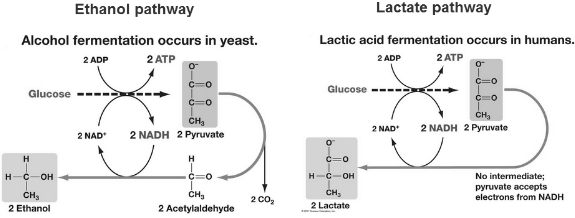
The $2$ $NADH + H^{+}$ produced during glycolysis in anaerobic respiration yield:
A
$6$ $ATP$ molecules
B
$4$ $ATP$ molecules
C
$8$ $ATP$ molecules
D
No $ATP$
Solution
(D) In anaerobic respiration (fermentation),the $2$ $NADH + H^{+}$ molecules produced during glycolysis are consumed to reduce pyruvate to either ethanol or lactic acid.
Specifically,the $NADH + H^{+}$ acts as a reducing agent to convert pyruvate into the final fermentation products.
Therefore,these $NADH + H^{+}$ molecules do not enter the electron transport chain to produce $ATP$ and are instead utilized in the reduction process,resulting in no net gain of $ATP$ from them.
Specifically,the $NADH + H^{+}$ acts as a reducing agent to convert pyruvate into the final fermentation products.
Therefore,these $NADH + H^{+}$ molecules do not enter the electron transport chain to produce $ATP$ and are instead utilized in the reduction process,resulting in no net gain of $ATP$ from them.
0 likes
View Solution115
MediumMCQ
Choose the correct option with respect to anaerobic respiration.
A
The first oxidation step occurs in mitochondria.
B
All reactions occur in the cytoplasm.
C
They require oxygen only at one step.
D
The first step of the reaction occurs in the cytoplasm,then in mitochondria.
Solution
(B) Anaerobic respiration is a process that occurs in the absence of oxygen. In this process,the entire sequence of reactions,including glycolysis and the subsequent fermentation steps,takes place exclusively in the cytoplasm of the cell. Unlike aerobic respiration,it does not involve the mitochondria.
0 likes
View Solution116
MediumMCQ
Products of anaerobic respiration are
A
Ethyl alcohol and lactic acid only
B
Ethyl alcohol and $CO_2$ and metabolic $H_2O$
C
Ethyl alcohol,metabolic $H_2O$,$CO_2$ and lactic acid
D
Ethyl alcohol,$CO_2$ or lactic acid
Solution
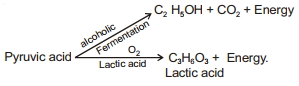
(D) Anaerobic respiration (fermentation) is the process of breaking down glucose in the absence of oxygen.
In many organisms like yeast,pyruvic acid is converted into ethyl alcohol $(C_2H_5OH)$ and $CO_2$ through alcoholic fermentation.
In some bacteria and animal muscle cells,pyruvic acid is converted into lactic acid $(C_3H_6O_3)$ through lactic acid fermentation.
Therefore,the products of anaerobic respiration can be ethyl alcohol and $CO_2$,or lactic acid,depending on the organism and the type of fermentation occurring.
In many organisms like yeast,pyruvic acid is converted into ethyl alcohol $(C_2H_5OH)$ and $CO_2$ through alcoholic fermentation.
In some bacteria and animal muscle cells,pyruvic acid is converted into lactic acid $(C_3H_6O_3)$ through lactic acid fermentation.
Therefore,the products of anaerobic respiration can be ethyl alcohol and $CO_2$,or lactic acid,depending on the organism and the type of fermentation occurring.
0 likes
View Solution117
EasyMCQ
The end product of anaerobic respiration is
A
Phosphoglyceric acid
B
Pyruvic acid
C
Lactic acid
D
Glyceraldehyde phosphate
Solution
(C) Anaerobic respiration is a type of cellular respiration that occurs in the absence of oxygen.
In many microorganisms like yeast,the end product is ethyl alcohol $(C_2H_5OH)$ and $CO_2$.
In animal muscle cells during strenuous exercise,the end product is lactic acid $(C_3H_6O_3)$.
Among the given options,lactic acid is a recognized end product of anaerobic respiration.
In many microorganisms like yeast,the end product is ethyl alcohol $(C_2H_5OH)$ and $CO_2$.
In animal muscle cells during strenuous exercise,the end product is lactic acid $(C_3H_6O_3)$.
Among the given options,lactic acid is a recognized end product of anaerobic respiration.
0 likes
View Solution118
MediumMCQ
After glycolysis,the first step of ethyl alcohol fermentation requires:
A
Dehydrogenation
B
Decarboxylation
C
$FAD$ reduction
D
$Mn^{+2}$ acceptance
Solution
(B) In ethyl alcohol fermentation,the process begins after glycolysis,where pyruvic acid is produced.
The first step involves the conversion of pyruvic acid $(CH_3COCOOH)$ into acetaldehyde $(CH_3CHO)$ and carbon dioxide $(CO_2)$.
This reaction is catalyzed by the enzyme pyruvic acid decarboxylase.
Since a molecule of carbon dioxide is removed from the pyruvic acid,this process is known as decarboxylation.
The reaction is: $2CH_3COCOOH \xrightarrow{\text{pyruvic acid decarboxylase}} 2CH_3CHO + 2CO_2$.
The first step involves the conversion of pyruvic acid $(CH_3COCOOH)$ into acetaldehyde $(CH_3CHO)$ and carbon dioxide $(CO_2)$.
This reaction is catalyzed by the enzyme pyruvic acid decarboxylase.
Since a molecule of carbon dioxide is removed from the pyruvic acid,this process is known as decarboxylation.
The reaction is: $2CH_3COCOOH \xrightarrow{\text{pyruvic acid decarboxylase}} 2CH_3CHO + 2CO_2$.

0 likes
View Solution119
EasyMCQ
Cramps are formed during vigorous exercise; this is due to the production of . . . . . . in muscles.
A
Acetyl coenzyme $A$
B
Ethyl alcohol
C
Lactic acid
D
Acetic acid
Solution
(C) During vigorous exercise,the demand for $O_2$ increases significantly. When the supply of $O_2$ becomes insufficient to meet the energy requirements of the muscle cells,they switch to an anaerobic metabolic pathway. In this process,glucose is broken down into lactic acid,which accumulates in the muscles and causes fatigue and cramps.
0 likes
View Solution120
MediumMCQ
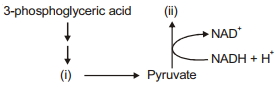
Identify the products marked by $(i)$ and $(ii)$ in the following pathway:
$3$-phosphoglyceric acid $\rightarrow$ $(i)$ $\rightarrow$ Pyruvate $\rightarrow$ $(ii)$ (with $NADH + H^+$ being converted to $NAD^+$)
$3$-phosphoglyceric acid $\rightarrow$ $(i)$ $\rightarrow$ Pyruvate $\rightarrow$ $(ii)$ (with $NADH + H^+$ being converted to $NAD^+$)
A
$(i)$ $2$-phosphoglycerate; $(ii)$ Acetyl $CoA$
B
$(i)$ Phosphoenol pyruvate; $(ii)$ Ethyl alcohol
C
$(i)$ Phosphoenol pyruvate; $(ii)$ Citric acid
D
$(i)$ Phosphoenol pyruvate; $(ii)$ Acetyl $CoA$
Solution
(B) In the glycolytic pathway,$3$-phosphoglyceric acid is converted into $2$-phosphoglycerate,which then forms Phosphoenol pyruvate $(PEP)$ before being converted into Pyruvate.
In the anaerobic respiration pathway (fermentation),Pyruvate is converted into Ethyl alcohol (ethanol) and $CO_2$ in yeast,or Lactic acid in muscles. The step involving the conversion of $NADH + H^+$ to $NAD^+$ indicates the reduction of Pyruvate to Ethyl alcohol.
Therefore,$(i)$ is Phosphoenol pyruvate and $(ii)$ is Ethyl alcohol.
In the anaerobic respiration pathway (fermentation),Pyruvate is converted into Ethyl alcohol (ethanol) and $CO_2$ in yeast,or Lactic acid in muscles. The step involving the conversion of $NADH + H^+$ to $NAD^+$ indicates the reduction of Pyruvate to Ethyl alcohol.
Therefore,$(i)$ is Phosphoenol pyruvate and $(ii)$ is Ethyl alcohol.
0 likes
View Solution121
MediumMCQ
Select the statement which is not related to fermentation.
A
It accounts for only a partial breakdown of glucose.
B
It gives only $2ATP$ as net for glucose degradation up to pyruvic acid.
C
$NADH$ is oxidized slowly as compared to aerobic respiration.
D
$ETS$ gives $11ATP$ for each Krebs cycle.
Solution
(D) Fermentation is an anaerobic process involving the partial breakdown of glucose into ethanol or lactic acid. Option $A$ is correct as it is a partial breakdown. Option $B$ is correct as glycolysis yields a net of $2ATP$. Option $C$ is correct because the regeneration of $NAD^+$ is slow in fermentation compared to the rapid oxidation in the electron transport system. Option $D$ is incorrect because the Electron Transport System $(ETS)$ and the Krebs cycle are components of aerobic respiration,not fermentation.
0 likes
View Solution122
MediumMCQ
The first step of ethyl alcohol fermentation requires:
A
Dehydrogenation
B
Decarboxylation
C
$FMN$
D
$Zn^{2+}$
Solution
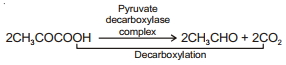
(B) Ethyl alcohol fermentation occurs in two main steps.
In the first step,pyruvic acid $(CH_3COCOOH)$ is converted into acetaldehyde $(CH_3CHO)$ and carbon dioxide $(CO_2)$ by the enzyme pyruvate decarboxylase.
This process involves the removal of a carbon dioxide molecule from the pyruvate,which is known as decarboxylation.
Therefore,the first step of ethyl alcohol fermentation requires decarboxylation.
In the first step,pyruvic acid $(CH_3COCOOH)$ is converted into acetaldehyde $(CH_3CHO)$ and carbon dioxide $(CO_2)$ by the enzyme pyruvate decarboxylase.
This process involves the removal of a carbon dioxide molecule from the pyruvate,which is known as decarboxylation.
Therefore,the first step of ethyl alcohol fermentation requires decarboxylation.
0 likes
View Solution123
MediumMCQ
Slow oxidation of $NADH$ occurs in
A
Fermentation
B
Aerobic respiration
C
Dicarboxylic acid cycle
D
$PPP$
Solution
(A) In fermentation,the oxidation of $NADH$ to $NAD^+$ is a slow process compared to aerobic respiration. This is essential to regenerate $NAD^+$ so that glycolysis can continue in the absence of oxygen. Specifically,in lactic acid fermentation,$NADH$ is oxidized to $NAD^+$ while reducing pyruvate to lactic acid.
0 likes
View Solution124
MediumMCQ
$NADH_2$ generated in glycolysis produces $ATP$ in $ETS$ in the presence of $O_2$. In the absence of $O_2$,this $NADH_2$ functions as:
A
Oxidising agent
B
Phosphorylating agent
C
Reducing agent
D
Carboxylating agent
Solution
(C) In the presence of $O_2$,$NADH_2$ undergoes oxidative phosphorylation in the $ETS$ to produce $ATP$.
However,in the absence of $O_2$ (anaerobic conditions),$NADH_2$ is utilized to reduce pyruvate or acetaldehyde into products like lactic acid or ethanol.
Therefore,it acts as a reducing agent by donating electrons/hydrogen to the substrate.
However,in the absence of $O_2$ (anaerobic conditions),$NADH_2$ is utilized to reduce pyruvate or acetaldehyde into products like lactic acid or ethanol.
Therefore,it acts as a reducing agent by donating electrons/hydrogen to the substrate.
0 likes
View Solution125
MediumMCQ
Inhibition of sugar breakdown due to the presence of $O_2$ under anaerobic conditions is called
A
Pasteur effect
B
Warburg effect
C
Crabtree effect
D
Kutusky effect
Solution
(A) The Pasteur effect is the phenomenon where the rate of glycolysis (sugar breakdown) is inhibited or slowed down by the presence of $O_2$ in cells that are typically performing anaerobic respiration.
This occurs because,in the presence of oxygen,cells switch from fermentation to the more efficient aerobic respiration,which produces more $ATP$ per molecule of glucose,thereby reducing the need for high rates of sugar consumption.
This occurs because,in the presence of oxygen,cells switch from fermentation to the more efficient aerobic respiration,which produces more $ATP$ per molecule of glucose,thereby reducing the need for high rates of sugar consumption.
0 likes
View Solution126
MediumMCQ
In alcohol fermentation, . . . . . . of energy in glucose is released and not all of it is trapped as high energy bonds of $ATP$.
A
Less than $1 \%$
B
More than $10 \%$
C
Less than $7 \%$
D
More than $40 \%$
Solution
(C) In alcoholic fermentation,glucose is incompletely oxidized into ethanol and $CO_2$.
The energy released during this process is very low compared to aerobic respiration.
The net gain is only $2$ $ATP$ molecules per glucose molecule.
This amount of energy represents less than $7 \%$ of the total energy stored in glucose,as most of the energy remains trapped in the chemical bonds of the ethanol produced.
The energy released during this process is very low compared to aerobic respiration.
The net gain is only $2$ $ATP$ molecules per glucose molecule.
This amount of energy represents less than $7 \%$ of the total energy stored in glucose,as most of the energy remains trapped in the chemical bonds of the ethanol produced.
0 likes
View Solution127
MediumMCQ
Carbon dioxide $\left( CO _{2}\right)$ is not released during
A
Aerobic respiration
B
Anaerobic respiration
C
Lactic acid fermentation
D
All of the above
Solution
(C) In aerobic respiration,glucose is completely oxidized to $CO _{2}$ and $H _{2}O$.
In alcoholic fermentation (a type of anaerobic respiration),glucose is converted into ethanol and $CO _{2}$.
In lactic acid fermentation,glucose is converted into lactic acid without the release of $CO _{2}$.
Therefore,$CO _{2}$ is not released during lactic acid fermentation.
In alcoholic fermentation (a type of anaerobic respiration),glucose is converted into ethanol and $CO _{2}$.
In lactic acid fermentation,glucose is converted into lactic acid without the release of $CO _{2}$.
Therefore,$CO _{2}$ is not released during lactic acid fermentation.
0 likes
View Solution128
MediumMCQ
In mature mammalian erythrocytes,the respiration is
A
Aerobic
B
Anaerobic
C
Sometimes aerobic and sometimes anaerobic
D
Absent
Solution
(B) Mature mammalian erythrocytes $(RBCs)$ lack cell organelles,including mitochondria and the nucleus. Since mitochondria are the sites of aerobic respiration,their absence forces mature $RBCs$ to rely exclusively on anaerobic respiration to generate $ATP$.
0 likes
View Solution129
MediumMCQ
Lactic acid in muscles is formed due to
A
Anaerobic breakdown of glycogen
B
Aerobic breakdown of sucrose
C
Anaerobic breakdown of galactose
D
Anaerobic breakdown of fructose
Solution
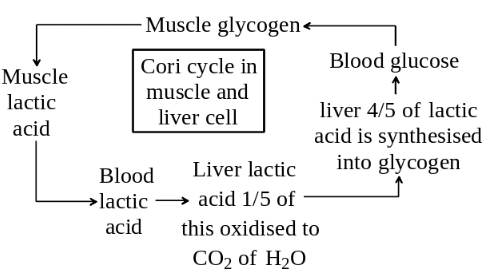
(A) During strenuous exercise,the oxygen supply to the muscle cells becomes insufficient for aerobic respiration. Under these anaerobic conditions,the muscle cells break down stored glycogen into lactic acid through the process of glycolysis followed by fermentation. This process is part of the Cori cycle,where muscle glycogen is converted into lactic acid,which is then transported to the liver to be converted back into glucose or glycogen.
0 likes
View Solution130
MediumMCQ
$80\%$ of the lactic acid is converted to . . . . . . in the liver.
A
Cellulose
B
Acetyl CoA
C
Glycogen
D
Starch
Solution
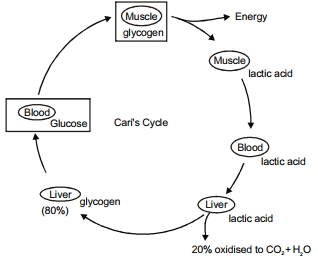
(C) In the liver,$80\%$ of the lactic acid produced during anaerobic muscle contraction is converted back into glycogen through a process known as gluconeogenesis.
This entire metabolic pathway,which involves the cycling of lactate between the muscles and the liver,is known as the 'Cori cycle' (or lactic acid cycle).
This entire metabolic pathway,which involves the cycling of lactate between the muscles and the liver,is known as the 'Cori cycle' (or lactic acid cycle).
0 likes
View Solution131
MediumMCQ
Which type of respiration probably arose first?
A
Aerobic as it releases more energy
B
Anaerobic as it releases more energy
C
Aerobic as it is more complex
D
Anaerobic as early atmosphere contained no free form of oxygen
Solution
(D) The primitive atmosphere of the Earth was reducing in nature and lacked free molecular oxygen $(O_2)$.
Since oxygen was absent,the first living organisms must have been anaerobic,relying on anaerobic respiration to derive energy from organic molecules.
Aerobic respiration evolved only after the accumulation of free oxygen in the atmosphere,which was primarily produced by photosynthetic cyanobacteria.
Since oxygen was absent,the first living organisms must have been anaerobic,relying on anaerobic respiration to derive energy from organic molecules.
Aerobic respiration evolved only after the accumulation of free oxygen in the atmosphere,which was primarily produced by photosynthetic cyanobacteria.
0 likes
View Solution132
MediumMCQ
When does anaerobic respiration occur in man and yeast?
A
During heavy exercise in man and in the presence of oxygen in yeast.
B
During heavy exercise in man and in the absence of oxygen in yeast.
C
During rest in man and in the presence of oxygen in yeast.
D
During rest in man and in the absence of oxygen in yeast.
Solution
(B) In humans,during intense physical exercise,the demand for $O_{2}$ exceeds the supply,leading to a deficit. Under these anaerobic conditions,pyruvic acid is converted into lactic acid by the enzyme lactate dehydrogenase.
$(b)$ In yeast,anaerobic respiration (fermentation) occurs in the complete absence of $O_{2}$. Pyruvic acid is converted into $CO_{2}$ and ethanol through the action of enzymes pyruvic acid decarboxylase and alcohol dehydrogenase.
$(b)$ In yeast,anaerobic respiration (fermentation) occurs in the complete absence of $O_{2}$. Pyruvic acid is converted into $CO_{2}$ and ethanol through the action of enzymes pyruvic acid decarboxylase and alcohol dehydrogenase.
0 likes
View Solution133
MediumMCQ
What amount of energy is released from glucose during lactic acid fermentation?
A
More than $18\%$
B
About $10\%$
C
Less than $7\%$
D
Approximately $15\%$
Solution
(C) In lactic acid fermentation,glucose is incompletely oxidized into lactic acid.
This process is anaerobic and yields only $2$ molecules of $ATP$ per molecule of glucose.
Since the total energy available in one molecule of glucose is much higher (equivalent to $36-38$ $ATP$ in aerobic respiration),the energy released during fermentation is very low.
Specifically,less than $7\%$ of the energy present in glucose is released as $ATP$ during this process.
This process is anaerobic and yields only $2$ molecules of $ATP$ per molecule of glucose.
Since the total energy available in one molecule of glucose is much higher (equivalent to $36-38$ $ATP$ in aerobic respiration),the energy released during fermentation is very low.
Specifically,less than $7\%$ of the energy present in glucose is released as $ATP$ during this process.
0 likes
View Solution134
MediumMCQ
In human skeletal muscle,anaerobic respiration leads to the formation of $.....P.....$,and in yeast cells,anaerobic respiration leads to the formation of $.....Q.....$.
A
$P -$ Lactic acid,$Q -$ Ethanol,$CO_2$
B
$P -$ Ethanol,$CO_2, Q -$ Lactic acid
C
$P -$ Ethanol,$Q -$ Lactic acid,$CO_2$
D
$P -$ Lactic acid,$CO_2, Q -$ Ethanol
Solution
(A) In human skeletal muscle cells,during intense exercise when oxygen supply is limited,anaerobic respiration (lactic acid fermentation) occurs,producing $P -$ Lactic acid.
In yeast cells,anaerobic respiration (alcoholic fermentation) occurs,which produces $Q -$ Ethanol and $CO_2$ as byproducts.
Therefore,the correct match is $P -$ Lactic acid and $Q -$ Ethanol,$CO_2$.
In yeast cells,anaerobic respiration (alcoholic fermentation) occurs,which produces $Q -$ Ethanol and $CO_2$ as byproducts.
Therefore,the correct match is $P -$ Lactic acid and $Q -$ Ethanol,$CO_2$.
0 likes
View Solution135
MediumMCQ
Which type of respiration occurs in the muscle cells of animals during vigorous exercise?
A
Alcoholic fermentation
B
Lactic acid fermentation
C
Aerobic respiration
D
All of the above
Solution
(B) During vigorous exercise, the demand for $ATP$ in muscle cells increases significantly.
When the oxygen supply becomes insufficient to meet this demand, the muscle cells shift from aerobic respiration to anaerobic respiration.
Specifically, they undergo $Lactic$ $acid$ $fermentation$, where pyruvate is converted into lactic acid by the enzyme lactate dehydrogenase.
This process allows the cells to regenerate $NAD^+$ to continue glycolysis and produce a small amount of $ATP$ in the absence of oxygen.
When the oxygen supply becomes insufficient to meet this demand, the muscle cells shift from aerobic respiration to anaerobic respiration.
Specifically, they undergo $Lactic$ $acid$ $fermentation$, where pyruvate is converted into lactic acid by the enzyme lactate dehydrogenase.
This process allows the cells to regenerate $NAD^+$ to continue glycolysis and produce a small amount of $ATP$ in the absence of oxygen.
0 likes
View Solution136
MediumMCQ
How much energy is released during fermentation?
A
Less than $7 \%$ of the energy in glucose
B
Less than $45 \%$ of the energy in glucose
C
Less than $13 \%$ of the energy in glucose
D
None of these
Solution
(A) Fermentation is an anaerobic process where glucose is incompletely oxidized into ethanol and carbon dioxide.
In this process,the energy trapped in the chemical bonds of glucose is not fully released as $ATP$.
Only a small fraction of the energy present in glucose is released during fermentation.
Specifically,less than $7 \%$ of the energy in glucose is released and not all of it is trapped as high-energy bonds of $ATP$.
In this process,the energy trapped in the chemical bonds of glucose is not fully released as $ATP$.
Only a small fraction of the energy present in glucose is released during fermentation.
Specifically,less than $7 \%$ of the energy in glucose is released and not all of it is trapped as high-energy bonds of $ATP$.
0 likes
View Solution137
MediumMCQ
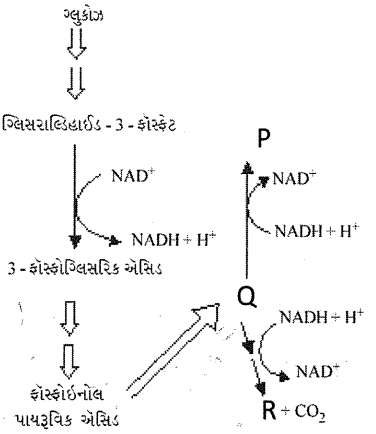
The following diagram shows the main pathways of anaerobic respiration. What are $P, Q$ and $R$?
A
Ethanol,Pyruvic acid,Lactic acid
B
Lactic acid,Pyruvic acid,Ethanol
C
Pyruvic acid,Ethanol,Lactic acid
D
Pyruvic acid,Lactic acid,Ethanol
Solution
(D) In the given pathway of anaerobic respiration:
$1$. Glucose is converted into $3$-phosphoglyceric acid and then into Phosphoenolpyruvic acid.
$2$. Phosphoenolpyruvic acid is converted into $P$ (Pyruvic acid).
$3$. Pyruvic acid is then converted into $Q$ (Acetaldehyde) by the removal of $CO_2$.
$4$. Finally,Acetaldehyde is reduced to $R$ (Ethanol) using $NADH + H^+$.
Therefore,$P$ is Pyruvic acid,$Q$ is Acetaldehyde,and $R$ is Ethanol. However,looking at the options provided,the sequence $P$ = Pyruvic acid,$Q$ = Acetaldehyde (often simplified in diagrams),and $R$ = Ethanol matches the logic of alcoholic fermentation. Among the given choices,option $D$ is the most appropriate representation of the sequence of products in anaerobic pathways.
$1$. Glucose is converted into $3$-phosphoglyceric acid and then into Phosphoenolpyruvic acid.
$2$. Phosphoenolpyruvic acid is converted into $P$ (Pyruvic acid).
$3$. Pyruvic acid is then converted into $Q$ (Acetaldehyde) by the removal of $CO_2$.
$4$. Finally,Acetaldehyde is reduced to $R$ (Ethanol) using $NADH + H^+$.
Therefore,$P$ is Pyruvic acid,$Q$ is Acetaldehyde,and $R$ is Ethanol. However,looking at the options provided,the sequence $P$ = Pyruvic acid,$Q$ = Acetaldehyde (often simplified in diagrams),and $R$ = Ethanol matches the logic of alcoholic fermentation. Among the given choices,option $D$ is the most appropriate representation of the sequence of products in anaerobic pathways.
0 likes
View Solution138
MediumMCQ
What is the total number of $ATP$ molecules produced during alcoholic fermentation?
A
$10$
B
$2$
C
$4$
D
$8$
Solution
(B) In alcoholic fermentation,glucose is first broken down into two molecules of pyruvate through the process of glycolysis.
Glycolysis yields a net gain of $2$ $ATP$ molecules and $2$ $NADH$ molecules.
During the subsequent fermentation steps,pyruvate is converted into ethanol and carbon dioxide.
Since no additional $ATP$ is produced during the conversion of pyruvate to ethanol,the total net gain of $ATP$ from the entire process of alcoholic fermentation is $2$ $ATP$ molecules.
Glycolysis yields a net gain of $2$ $ATP$ molecules and $2$ $NADH$ molecules.
During the subsequent fermentation steps,pyruvate is converted into ethanol and carbon dioxide.
Since no additional $ATP$ is produced during the conversion of pyruvate to ethanol,the total net gain of $ATP$ from the entire process of alcoholic fermentation is $2$ $ATP$ molecules.
0 likes
View Solution139
MediumMCQ
What is the net number of $ATP$ molecules produced during lactic acid fermentation?
A
$10$
B
$2$
C
$4$
D
$8$
Solution
(B) Lactic acid fermentation is an anaerobic process occurring in certain bacteria and muscle cells.
In this process,glucose is first broken down into two molecules of pyruvic acid through glycolysis,which yields a net gain of $2$ $ATP$ molecules.
The pyruvic acid is then converted into lactic acid by the enzyme lactate dehydrogenase,using $NADH$ produced during glycolysis.
Since no additional $ATP$ is generated during the conversion of pyruvic acid to lactic acid,the net gain of $ATP$ remains $2$ per glucose molecule.
In this process,glucose is first broken down into two molecules of pyruvic acid through glycolysis,which yields a net gain of $2$ $ATP$ molecules.
The pyruvic acid is then converted into lactic acid by the enzyme lactate dehydrogenase,using $NADH$ produced during glycolysis.
Since no additional $ATP$ is generated during the conversion of pyruvic acid to lactic acid,the net gain of $ATP$ remains $2$ per glucose molecule.
0 likes
View Solution140
MediumMCQ
Identify the enzyme for the following reaction:
$CH_3COCOOH \longrightarrow CH_3CHO + CO_2$
$CH_3COCOOH \longrightarrow CH_3CHO + CO_2$
A
Pyruvate decarboxylase
B
Alcohol decarboxylase
C
Lactic decarboxylase
D
Alcohol carboxylase
Solution
(A) The given reaction is the conversion of pyruvate into acetaldehyde and carbon dioxide,which is a key step in alcoholic fermentation.
This reaction is catalyzed by the enzyme $Pyruvate \ decarboxylase$.
In this process,the carboxyl group $(-COOH)$ is removed from the pyruvate molecule,releasing $CO_2$.
This reaction is catalyzed by the enzyme $Pyruvate \ decarboxylase$.
In this process,the carboxyl group $(-COOH)$ is removed from the pyruvate molecule,releasing $CO_2$.
0 likes
View Solution141
MediumMCQ
Identify the enzyme for the following reaction:
$CH_3CHO + NADH_2 \longrightarrow CH_3CH_2OH + NAD$
$CH_3CHO + NADH_2 \longrightarrow CH_3CH_2OH + NAD$
A
Lactate dehydrogenase
B
Alcohol dehydrogenase
C
Pyruvate decarboxylase
D
Pyruvate dehydrogenase
Solution
(B) The given reaction is the reduction of acetaldehyde $(CH_3CHO)$ to ethanol $(CH_3CH_2OH)$ using $NADH_2$ as a reducing agent.
This reaction occurs during alcoholic fermentation in yeast.
The enzyme that catalyzes the reduction of acetaldehyde to ethanol by transferring hydrogen from $NADH_2$ is Alcohol dehydrogenase.
Therefore,the correct option is $B$.
This reaction occurs during alcoholic fermentation in yeast.
The enzyme that catalyzes the reduction of acetaldehyde to ethanol by transferring hydrogen from $NADH_2$ is Alcohol dehydrogenase.
Therefore,the correct option is $B$.
0 likes
View Solution142
MediumMCQ
Identify the enzyme for the following reaction:
$CH_3COCOOH + NADH_2 \longrightarrow CH_3CHOHCOOH + NAD$
$CH_3COCOOH + NADH_2 \longrightarrow CH_3CHOHCOOH + NAD$
A
Lactate dehydrogenase
B
Alcohol dehydrogenase
C
Pyruvate decarboxylase
D
Pyruvate dehydrogenase
Solution
(A) The given reaction represents the reduction of pyruvate $(CH_3COCOOH)$ to lactic acid $(CH_3CHOHCOOH)$ in the presence of $NADH_2$.
This process is known as lactic acid fermentation.
The enzyme responsible for catalyzing the reduction of pyruvate to lactate is $Lactate \text{ } dehydrogenase$.
Therefore, the correct option is $A$.
This process is known as lactic acid fermentation.
The enzyme responsible for catalyzing the reduction of pyruvate to lactate is $Lactate \text{ } dehydrogenase$.
Therefore, the correct option is $A$.
0 likes
View Solution143
MediumMCQ
During anaerobic respiration in a eukaryotic cell,the net gain of $ATP$ molecules from one molecule of glucose is $..........$.
A
$36$
B
$38$
C
$2$
D
$4$
Solution
(C) In anaerobic respiration (fermentation),glucose undergoes glycolysis in the cytoplasm,which produces $2$ molecules of pyruvate,$2$ molecules of $NADH + H^+$,and a net gain of $2$ $ATP$ molecules.
Since there is no oxygen available,the $NADH + H^+$ is used to reduce pyruvate into ethanol or lactic acid,and no further $ATP$ is generated through the electron transport chain.
Therefore,the net gain of $ATP$ molecules from one molecule of glucose in anaerobic respiration is $2$ $ATP$.
Since there is no oxygen available,the $NADH + H^+$ is used to reduce pyruvate into ethanol or lactic acid,and no further $ATP$ is generated through the electron transport chain.
Therefore,the net gain of $ATP$ molecules from one molecule of glucose in anaerobic respiration is $2$ $ATP$.
0 likes
View Solution144
MediumMCQ
During anaerobic respiration in a prokaryotic cell,what is the net gain of $ATP$ molecules from one molecule of glucose?
A
$36$
B
$38$
C
$2$
D
$4$
Solution
(C) In anaerobic respiration (fermentation),glucose undergoes glycolysis in the cytoplasm.
Glycolysis produces a net gain of $2$ $ATP$ molecules per glucose molecule.
Since anaerobic respiration does not involve the electron transport chain or the Krebs cycle,no additional $ATP$ is produced.
Therefore,the net gain of $ATP$ in anaerobic respiration is $2$ $ATP$ molecules.
Glycolysis produces a net gain of $2$ $ATP$ molecules per glucose molecule.
Since anaerobic respiration does not involve the electron transport chain or the Krebs cycle,no additional $ATP$ is produced.
Therefore,the net gain of $ATP$ in anaerobic respiration is $2$ $ATP$ molecules.
0 likes
View Solution145
MediumMCQ
In animal cells,the anaerobic respiration of glycogen produces.......
A
Lactic acid $+ CO_2$
B
Alcohol $+ CO_2$
C
Lactic acid
D
Alcohol
Solution
(C) In animal cells,when oxygen is limited or absent,glycogen undergoes anaerobic respiration (glycolysis followed by lactic acid fermentation).
Glycogen is first broken down into glucose units.
Glucose is then converted into pyruvate via glycolysis.
In the absence of oxygen,pyruvate is reduced to lactic acid by the enzyme lactate dehydrogenase.
Therefore,the end product of anaerobic respiration in animal cells is lactic acid.
Glycogen is first broken down into glucose units.
Glucose is then converted into pyruvate via glycolysis.
In the absence of oxygen,pyruvate is reduced to lactic acid by the enzyme lactate dehydrogenase.
Therefore,the end product of anaerobic respiration in animal cells is lactic acid.
0 likes
View Solution146
MediumMCQ
Which is not a product of fermentation?
A
$CO_2$
B
$FAD^{+}$
C
$NAD^{+}$
D
Alcohol
Solution
(B) Fermentation is an anaerobic process where glucose is partially oxidized to produce energy.
In alcoholic fermentation,glucose is converted into ethanol and $CO_2$.
During this process,$NADH$ is oxidized back to $NAD^{+}$ to allow glycolysis to continue.
$FAD^{+}$ is a coenzyme involved in the Krebs cycle (aerobic respiration) and the electron transport chain,not in the fermentation pathway.
Therefore,$FAD^{+}$ is not a product of fermentation.
In alcoholic fermentation,glucose is converted into ethanol and $CO_2$.
During this process,$NADH$ is oxidized back to $NAD^{+}$ to allow glycolysis to continue.
$FAD^{+}$ is a coenzyme involved in the Krebs cycle (aerobic respiration) and the electron transport chain,not in the fermentation pathway.
Therefore,$FAD^{+}$ is not a product of fermentation.
0 likes
View Solution147
MediumMCQ
Conversion of pyruvic acid into ethyl alcohol requires the presence of $:-$
A
Carboxylase
B
Dehydrogenase only
C
Decarboxylase and dehydrogenase
D
Phosphatase
Solution
(C) In anaerobic respiration (fermentation),pyruvic acid is converted into ethyl alcohol and $CO_2$ in two steps:
$1$. Pyruvic acid is first decarboxylated to acetaldehyde by the enzyme $Pyruvate \ decarboxylase$.
$2$. Acetaldehyde is then reduced to ethyl alcohol by the enzyme $Alcohol \ dehydrogenase$ using $NADH + H^+$ as a reducing agent.
Therefore,both decarboxylase and dehydrogenase enzymes are required for this conversion.
$1$. Pyruvic acid is first decarboxylated to acetaldehyde by the enzyme $Pyruvate \ decarboxylase$.
$2$. Acetaldehyde is then reduced to ethyl alcohol by the enzyme $Alcohol \ dehydrogenase$ using $NADH + H^+$ as a reducing agent.
Therefore,both decarboxylase and dehydrogenase enzymes are required for this conversion.
0 likes
View Solution148
EasyMCQ
Identify the correct statement regarding anaerobic respiration.
A
The process requires oxygen only in one step.
B
The first part occurs in mitochondria.
C
All reactions occur in cytoplasm.
D
No energy is evolved in this process.
Solution
(C) Anaerobic respiration involves the breakdown of glucose into ethanol or lactic acid without the use of oxygen. In this process,both glycolysis (the breakdown of glucose to pyruvate) and the subsequent fermentation steps occur entirely within the cytoplasm of the cell. Unlike aerobic respiration,it does not involve the mitochondria.
0 likes
View Solution149
EasyMCQ
In animal muscle cells,lactic acid fermentation occurs when there is poor supply of . . . . . . .
A
$CO_2$
B
glucose
C
$O_2$
D
lactose
Solution
(C) Lactic acid fermentation is an anaerobic process that occurs in animal muscle cells during intense physical activity.
When the demand for energy $(ATP)$ exceeds the supply of oxygen $(O_2)$ provided by the circulatory system,the muscle cells shift from aerobic respiration to anaerobic respiration.
In this process,pyruvic acid is reduced to lactic acid by the enzyme lactate dehydrogenase,using $NADH$ as a reducing agent.
Therefore,this fermentation occurs specifically due to a poor supply of $O_2$.
When the demand for energy $(ATP)$ exceeds the supply of oxygen $(O_2)$ provided by the circulatory system,the muscle cells shift from aerobic respiration to anaerobic respiration.
In this process,pyruvic acid is reduced to lactic acid by the enzyme lactate dehydrogenase,using $NADH$ as a reducing agent.
Therefore,this fermentation occurs specifically due to a poor supply of $O_2$.
0 likes
View Solution150
EasyMCQ
Accumulation of which acid in muscle fibres leads to cramps in muscles?
A
Pyruvic acid
B
Oxaloacetic acid
C
Lactic acid
D
Succinic acid
Solution
(C) During strenuous exercise,the demand for $O_2$ in muscle cells exceeds the supply.
Under these anaerobic conditions,the muscle cells perform lactic acid fermentation.
In this process,pyruvic acid is reduced to lactic acid by the enzyme lactate dehydrogenase.
The accumulation of lactic acid in the muscle fibres causes fatigue and muscle cramps.
Under these anaerobic conditions,the muscle cells perform lactic acid fermentation.
In this process,pyruvic acid is reduced to lactic acid by the enzyme lactate dehydrogenase.
The accumulation of lactic acid in the muscle fibres causes fatigue and muscle cramps.
0 likes
View SolutionRespiration in Plants — Anaerobic respiration · Frequently Asked Questions
1Are these Respiration in Plants questions useful for JEE and NEET?
Yes. All questions in this section are mapped to JEE Main and NEET exam patterns. Previous year questions from JEE Main, NEET, GUJCET and state-level exams are included with full solutions.
2Can I switch to Hindi or Gujarati for these questions?
Yes. Use the language tabs in the hero section or the sidebar to view the same questions and solutions in English, Hindi or Gujarati.
3How do I generate a question paper from this subtopic?
Use the Vedclass Exam Paper Generator — select the chapter and subtopic, set difficulty, and generate Sets A, B, C, D automatically. First 3 chapters of every subject are free.
Vedclass Products
For Students
Vedclass Test Series
Mock tests in real JEE/NEET style with performance analysis. 5-day free trial.
Start Free TrialFor Teachers
Exam Paper Generator
Generate Set A/B/C/D papers from this chapter in 2 minutes. 3 chapters free.
Try FreeFor Institutes
Online Exam Module
Live online exams with unlimited students, 360° analytics & white-label branding.
See DemoFor Teachers & Institutes
Generate a Respiration in Plants Exam Paper in 2 Minutes
Select subtopic & difficulty — Sets A, B, C, D auto-generated with No Repeat logic.
First 3 chapters of every subject are free — no payment required.