
A English
Kreb's cycle Questions in English
Class 11 Biology · Respiration in Plants · Kreb's cycle
232+
Questions
English
Language
100%
With Solutions
Showing 48 of 232 questions in English
1
MediumMCQ
In prokaryotes,mitochondria are absent. Even then,the Krebs cycle takes place. What is the site of the Krebs cycle in bacteria?
A
Ribosomes
B
Nucleoid
C
Cytoplasm
D
Mesosomes
Solution
(D) In prokaryotes,mitochondria are absent.
However,the plasma membrane forms specialized infoldings known as mesosomes.
These mesosomes contain respiratory enzymes and are functionally analogous to mitochondria,serving as the site for the Krebs cycle and oxidative phosphorylation in bacteria.
However,the plasma membrane forms specialized infoldings known as mesosomes.
These mesosomes contain respiratory enzymes and are functionally analogous to mitochondria,serving as the site for the Krebs cycle and oxidative phosphorylation in bacteria.
0 likes
View Solution2
MediumMCQ
Respiratory enzymes are present in
A
Mitochondria
B
Chloroplasts
C
Golgi bodies
D
Lysosomes
Solution
(A) Mitochondria are known as the powerhouses of the cell because they are the sites of aerobic respiration.
They contain enzymes required for the Krebs cycle (in the matrix) and the electron transport chain (on the inner mitochondrial membrane) to produce $ATP$.
They contain enzymes required for the Krebs cycle (in the matrix) and the electron transport chain (on the inner mitochondrial membrane) to produce $ATP$.
0 likes
View Solution3
MediumMCQ
In which of the following parts of the mitochondria is the succinic dehydrogenase enzyme located?
A
Outer membrane
B
Inner membrane
C
Perimitochondrial space
D
Matrix
Solution
(B) Succinic dehydrogenase is an enzyme that catalyzes the oxidation of succinate to fumarate in the $Krebs$ cycle.
Unlike other enzymes of the $Krebs$ cycle which are found in the mitochondrial matrix,succinic dehydrogenase is embedded in the inner mitochondrial membrane.
It also functions as $Complex$ $II$ of the electron transport chain $(ETC)$.
Unlike other enzymes of the $Krebs$ cycle which are found in the mitochondrial matrix,succinic dehydrogenase is embedded in the inner mitochondrial membrane.
It also functions as $Complex$ $II$ of the electron transport chain $(ETC)$.
0 likes
View Solution4
MediumMCQ
Which mineral element is essential for the activity of the aconitase enzyme?
A
Magnesium
B
Manganese
C
Calcium
D
Iron
Solution
(D) The enzyme $aconitase$ is a key enzyme in the $Krebs$ cycle (citric acid cycle) that catalyzes the isomerization of citrate to isocitrate.
This enzyme contains an iron-sulfur cluster $([4Fe-4S]^{2+})$ at its active site,which is essential for its catalytic activity.
Therefore,$Iron$ $(Fe)$ is the essential mineral element required for the activity of the $aconitase$ enzyme.
This enzyme contains an iron-sulfur cluster $([4Fe-4S]^{2+})$ at its active site,which is essential for its catalytic activity.
Therefore,$Iron$ $(Fe)$ is the essential mineral element required for the activity of the $aconitase$ enzyme.
0 likes
View Solution5
MediumMCQ
Degradation of sugar and fat to Acetyl $CoA$ will not take place if the following organelle is not present in a eukaryotic cell.
A
Golgi apparatus
B
Mitochondrion
C
Ribosome
D
Nucleus
Solution
(B) The degradation of sugar (via glycolysis and pyruvate oxidation) and fat (via $\beta$-oxidation) leads to the formation of Acetyl $CoA$.
In eukaryotic cells,the conversion of pyruvate to Acetyl $CoA$ occurs within the mitochondrial matrix.
Furthermore,the subsequent processing of Acetyl $CoA$ through the Krebs cycle (Tricarboxylic Acid Cycle) also takes place exclusively in the mitochondrial matrix.
Therefore,if the mitochondrion is absent,the aerobic respiration pathway cannot proceed,and the degradation of these substrates to Acetyl $CoA$ and their further oxidation will not occur.
In eukaryotic cells,the conversion of pyruvate to Acetyl $CoA$ occurs within the mitochondrial matrix.
Furthermore,the subsequent processing of Acetyl $CoA$ through the Krebs cycle (Tricarboxylic Acid Cycle) also takes place exclusively in the mitochondrial matrix.
Therefore,if the mitochondrion is absent,the aerobic respiration pathway cannot proceed,and the degradation of these substrates to Acetyl $CoA$ and their further oxidation will not occur.
0 likes
View Solution6
MediumMCQ
Which of the following forms the connecting link between glycolysis and Kreb's cycle?
A
Glucose
B
Ethyl alcohol
C
Lactic acid
D
Pyruvic acid
Solution
(D) The end product of glycolysis is pyruvic acid.
Pyruvic acid undergoes oxidative decarboxylation to form acetyl $CoA$.
Acetyl $CoA$ acts as the connecting link because it is the substrate that enters the Kreb's cycle ($TCA$ cycle) for further oxidation.
Pyruvic acid undergoes oxidative decarboxylation to form acetyl $CoA$.
Acetyl $CoA$ acts as the connecting link because it is the substrate that enters the Kreb's cycle ($TCA$ cycle) for further oxidation.
0 likes
View Solution7
MediumMCQ
Which of the following is involved in the catalysis of the link reaction during aerobic respiration?
A
Vitamin $A$
B
Vitamin $B_1$
C
Vitamin $B_6$
D
Vitamin $K$
Solution
(B) The link reaction (also known as the transition reaction or oxidative decarboxylation of pyruvate) connects glycolysis to the Krebs cycle by converting pyruvic acid into acetyl $CoA$.
This reaction is catalyzed by the pyruvate dehydrogenase complex,which requires several cofactors to function,including thiamine pyrophosphate $(TPP)$,which is a derivative of Vitamin $B_1$ (thiamine),as well as $NAD^+$,$CoA$,lipoic acid,and $Mg^{2+}$ ions.
Therefore,Vitamin $B_1$ is essential for the catalysis of this reaction.
This reaction is catalyzed by the pyruvate dehydrogenase complex,which requires several cofactors to function,including thiamine pyrophosphate $(TPP)$,which is a derivative of Vitamin $B_1$ (thiamine),as well as $NAD^+$,$CoA$,lipoic acid,and $Mg^{2+}$ ions.
Therefore,Vitamin $B_1$ is essential for the catalysis of this reaction.
0 likes
View Solution8
MediumMCQ
Pyruvate (pyruvic acid) dehydrogenase is used in converting
A
Pyruvate to glucose
B
Glucose to pyruvate
C
Pyruvic acid to lactic acid
D
Pyruvate (pyruvic acid) to acetyl $CoA$
Solution
(D) The enzyme complex $Pyruvate$ dehydrogenase catalyzes the oxidative decarboxylation of $Pyruvate$ (a $3$-carbon molecule) into $Acetyl$ $CoA$ (a $2$-carbon molecule).
This reaction occurs in the mitochondrial matrix and serves as a crucial link between glycolysis and the $Krebs$ cycle.
During this process, one molecule of $CO_2$ is released and $NAD^+$ is reduced to $NADH + H^+$.
This reaction occurs in the mitochondrial matrix and serves as a crucial link between glycolysis and the $Krebs$ cycle.
During this process, one molecule of $CO_2$ is released and $NAD^+$ is reduced to $NADH + H^+$.
0 likes
View Solution9
EasyMCQ
Hans Krebs was awarded the Nobel Prize in $1953$ for explaining which of the following?
A
Energy-forming process in the cell
B
$ATP$ metabolism
C
The Citric Acid Cycle (Krebs cycle)
D
Oxidation of cytoplasm
Solution
(C) Hans Krebs was awarded the Nobel Prize in Physiology or Medicine in $1953$ for his discovery of the Citric Acid Cycle,also known as the Krebs cycle or the Tricarboxylic Acid $(TCA)$ cycle.
This cycle is a series of chemical reactions used by all aerobic organisms to release stored energy through the oxidation of acetyl-$CoA$ derived from carbohydrates,fats,and proteins into carbon dioxide and chemical energy in the form of $ATP$.
This cycle is a series of chemical reactions used by all aerobic organisms to release stored energy through the oxidation of acetyl-$CoA$ derived from carbohydrates,fats,and proteins into carbon dioxide and chemical energy in the form of $ATP$.
0 likes
View Solution10
EasyMCQ
The product formed by malate dehydrogenase is
A
Maleic acid
B
Fumaric acid
C
Oxaloacetic acid
D
Succinic acid
Solution
(C) Malate dehydrogenase is an enzyme that catalyzes the reversible oxidation of malate to oxaloacetate in the citric acid cycle (Krebs cycle).
During this reaction,$NAD^+$ is reduced to $NADH + H^+$.
Therefore,the product formed by the action of malate dehydrogenase on malate is oxaloacetic acid.
During this reaction,$NAD^+$ is reduced to $NADH + H^+$.
Therefore,the product formed by the action of malate dehydrogenase on malate is oxaloacetic acid.
0 likes
View Solution11
MediumMCQ
$TCA$ cycle is a
A
Direct oxidation pathway
B
Indirect oxidation pathway
C
Both $(a)$ and $(b)$
D
None of the above
Solution
(B) The $TCA$ cycle (Tricarboxylic Acid cycle),also known as the $Krebs$ cycle,is an indirect oxidation pathway.
In this process,the acetyl group of acetyl-$CoA$ is oxidized to $CO_2$ and $H_2O$.
It is considered an indirect oxidation pathway because the oxidation of the substrate does not occur directly by oxygen; instead,electrons are transferred to electron carriers like $NAD^+$ and $FAD$ to form $NADH$ and $FADH_2$,which are later oxidized in the electron transport chain.
In this process,the acetyl group of acetyl-$CoA$ is oxidized to $CO_2$ and $H_2O$.
It is considered an indirect oxidation pathway because the oxidation of the substrate does not occur directly by oxygen; instead,electrons are transferred to electron carriers like $NAD^+$ and $FAD$ to form $NADH$ and $FADH_2$,which are later oxidized in the electron transport chain.
0 likes
View Solution12
MediumMCQ
Hydrogen of malate is accepted by
A
$FAD$
B
$FMN$
C
$NAD^+$
D
$CoQ$
Solution
(C) During the process of dehydrogenation in the Krebs cycle,the enzyme malate dehydrogenase catalyzes the conversion of malic acid (malate) into oxaloacetic acid.
In this reaction,a pair of hydrogen atoms is removed from malate.
These hydrogen atoms are transferred to the coenzyme $NAD^+$,which acts as an electron acceptor.
Consequently,$NAD^+$ is reduced to $NADH + H^+$.
In this reaction,a pair of hydrogen atoms is removed from malate.
These hydrogen atoms are transferred to the coenzyme $NAD^+$,which acts as an electron acceptor.
Consequently,$NAD^+$ is reduced to $NADH + H^+$.
0 likes
View Solution13
MediumMCQ
Which intermediate compound is involved in the synthesis of amino acids?
A
Malic acid
B
Citric acid
C
$\alpha$-ketoglutaric acid
D
Isocitric acid
Solution
(C) The correct answer is $(c)$. $\alpha$-ketoglutaric acid is a key intermediate in the Krebs cycle ($TCA$ cycle). It serves as a precursor for the synthesis of amino acids,particularly glutamate,through the process of reductive amination. Similarly,oxaloacetic acid $(OAA)$ acts as a precursor for the synthesis of aspartate. These organic acids link the respiratory pathway to amino acid metabolism.
0 likes
View Solution14
EasyMCQ
The process by which the energy of glucose is released under aerobic respiration was discovered by
A
Hopkins
B
Lister
C
Krebs
D
Pasteur
Solution
(C) The process by which the energy of glucose is released during aerobic respiration is known as the $Krebs$ cycle (or Citric Acid Cycle).
This metabolic pathway was discovered by Sir Hans $Krebs$ in $1937$.
Therefore,the correct option is $C$.
This metabolic pathway was discovered by Sir Hans $Krebs$ in $1937$.
Therefore,the correct option is $C$.
0 likes
View Solution15
MediumMCQ
The Krebs cycle is termed as the aerobic phase of respiration because
A
It consumes oxygen
B
Oxygen acts as a catalyst
C
Aerobic conditions are essential for the continued operation of the electron transport system
D
All the above
Solution
(C) The Krebs cycle (also known as the Citric Acid Cycle) occurs in the mitochondrial matrix. While the cycle itself does not directly use $O_2$ as a reactant,it is considered an aerobic process because it relies on the continuous operation of the Electron Transport System $(ETS)$. The $ETS$ requires $O_2$ as the final electron acceptor to regenerate $NAD^+$ and $FAD$ from $NADH$ and $FADH_2$. If $O_2$ is absent,the $ETS$ stops,leading to the accumulation of $NADH$ and $FADH_2$,which inhibits the enzymes of the Krebs cycle. Thus,aerobic conditions are essential for the continued operation of the cycle.
0 likes
View Solution16
MediumMCQ
Between which of the following stages is $GTP$ formed by substrate-level phosphorylation in the $Krebs$ cycle?
A
Succinate to fumarate
B
Succinyl-$CoA$ to succinate
C
Oxalosuccinate to $\alpha$-ketoglutarate
D
Fumarate to malate
Solution
(B) In the $Krebs$ cycle,the conversion of succinyl-$CoA$ to succinate is catalyzed by the enzyme succinyl-$CoA$ synthetase. During this reaction,the energy released from the cleavage of the high-energy thioester bond of succinyl-$CoA$ is used to synthesize a high-energy phosphate molecule. In animal cells,this process results in the formation of $GTP$ (guanosine triphosphate) from $GDP$ and inorganic phosphate $(Pi)$ via substrate-level phosphorylation. $GTP$ can subsequently transfer its terminal phosphate to $ADP$ to form $ATP$.
0 likes
View Solution17
MediumMCQ
Which of the following is not a part of the $Kreb's$ cycle?
A
Dehydrogenation
B
Acetylation
C
Oxidative phosphorylation
D
Decarboxylation
Solution
(C) $Kreb's$ cycle involves various enzymatic reactions including dehydrogenation and decarboxylation.
$Acetylation$ of pyruvate to form $Acetyl-CoA$ is a preparatory step for the cycle.
$Oxidative$ phosphorylation is a distinct process that occurs in the electron transport system $(ETS)$ located in the inner mitochondrial membrane,where $ATP$ is synthesized using the energy from electron transfer.
$Acetylation$ of pyruvate to form $Acetyl-CoA$ is a preparatory step for the cycle.
$Oxidative$ phosphorylation is a distinct process that occurs in the electron transport system $(ETS)$ located in the inner mitochondrial membrane,where $ATP$ is synthesized using the energy from electron transfer.
0 likes
View Solution18
MediumMCQ
The number of steps required for the complete oxidation of one molecule of pyruvic acid in the Krebs cycle is
A
$5$
B
$6$
C
$8$
D
$12$
Solution
(C) The Krebs cycle (also known as the Citric Acid Cycle) involves a series of enzymatic reactions to oxidize one molecule of acetyl-CoA (derived from one molecule of pyruvic acid) into $CO_2$ and $H_2O$.
$1$. Citrate synthase: Acetyl-CoA + Oxaloacetate $\rightarrow$ Citrate.
$2$. Aconitase: Citrate $\rightarrow$ Isocitrate.
$3$. Isocitrate dehydrogenase: Isocitrate $\rightarrow$ $\alpha$-Ketoglutarate.
$4$. $\alpha$-Ketoglutarate dehydrogenase: $\alpha$-Ketoglutarate $\rightarrow$ Succinyl-CoA.
$5$. Succinyl-CoA synthetase: Succinyl-CoA $\rightarrow$ Succinate.
$6$. Succinate dehydrogenase: Succinate $\rightarrow$ Fumarate.
$7$. Fumarase: Fumarate $\rightarrow$ Malate.
$8$. Malate dehydrogenase: Malate $\rightarrow$ Oxaloacetate.
Thus,there are $8$ distinct enzymatic steps in the cycle.
$1$. Citrate synthase: Acetyl-CoA + Oxaloacetate $\rightarrow$ Citrate.
$2$. Aconitase: Citrate $\rightarrow$ Isocitrate.
$3$. Isocitrate dehydrogenase: Isocitrate $\rightarrow$ $\alpha$-Ketoglutarate.
$4$. $\alpha$-Ketoglutarate dehydrogenase: $\alpha$-Ketoglutarate $\rightarrow$ Succinyl-CoA.
$5$. Succinyl-CoA synthetase: Succinyl-CoA $\rightarrow$ Succinate.
$6$. Succinate dehydrogenase: Succinate $\rightarrow$ Fumarate.
$7$. Fumarase: Fumarate $\rightarrow$ Malate.
$8$. Malate dehydrogenase: Malate $\rightarrow$ Oxaloacetate.
Thus,there are $8$ distinct enzymatic steps in the cycle.
0 likes
View Solution19
MediumMCQ
Kreb's cycle is also known as
A
Glyoxylate cycle
B
$EMP$ pathway
C
Citric acid cycle
D
Glycolate cycle
Solution
(C) The $Kreb's$ cycle is also known as the Citric acid cycle or Tricarboxylic acid $(TCA)$ cycle.
This is because the first stable product formed in this cycle is citric acid,which is a tricarboxylic acid containing three carboxyl groups.
This is because the first stable product formed in this cycle is citric acid,which is a tricarboxylic acid containing three carboxyl groups.
0 likes
View Solution20
MediumMCQ
Most of the energy in the cell is liberated by the oxidation of carbohydrates when:
A
Pyruvic acid is converted into $CO_2$ and $H_2O$
B
Pyruvic acid is converted into Acetyl $CoA$
C
Sugar is converted into pyruvic acid
D
Glucose is converted into alcohol and $CO_2$
Solution
(A) The complete oxidation of carbohydrates occurs during aerobic respiration,which involves the Krebs cycle and the Electron Transport System $(ETS)$.
In the Krebs cycle,the acetyl group of Acetyl $CoA$ is completely oxidized to $CO_2$ and $H_2O$,releasing a significant amount of energy in the form of $NADH$ and $FADH_2$.
These electron carriers then donate electrons to the $ETS$,where the majority of $ATP$ is synthesized through oxidative phosphorylation.
Therefore,the liberation of most of the energy occurs when pyruvic acid (after conversion to Acetyl $CoA$) is completely oxidized to $CO_2$ and $H_2O$.
In the Krebs cycle,the acetyl group of Acetyl $CoA$ is completely oxidized to $CO_2$ and $H_2O$,releasing a significant amount of energy in the form of $NADH$ and $FADH_2$.
These electron carriers then donate electrons to the $ETS$,where the majority of $ATP$ is synthesized through oxidative phosphorylation.
Therefore,the liberation of most of the energy occurs when pyruvic acid (after conversion to Acetyl $CoA$) is completely oxidized to $CO_2$ and $H_2O$.
0 likes
View Solution21
MediumMCQ
The link between glycolysis and the Kreb's cycle is:
A
Citric acid
B
Acetyl $CoA$
C
Succinic acid
D
Oxaloacetic acid
Solution
(B) The link between glycolysis and the Kreb's cycle is Acetyl $CoA$.
Glycolysis occurs in the cytoplasm and produces pyruvate.
This pyruvate is then transported into the mitochondria,where it undergoes oxidative decarboxylation to form Acetyl $CoA$.
Acetyl $CoA$ acts as a connecting link because it is the substrate that enters the Kreb's cycle ($TCA$ cycle) for further oxidation.
Glycolysis occurs in the cytoplasm and produces pyruvate.
This pyruvate is then transported into the mitochondria,where it undergoes oxidative decarboxylation to form Acetyl $CoA$.
Acetyl $CoA$ acts as a connecting link because it is the substrate that enters the Kreb's cycle ($TCA$ cycle) for further oxidation.
0 likes
View Solution22
MediumMCQ
The reactions of the $Krebs$ cycle take place in:
A
In cytoplasm
B
In endoplasmic reticulum
C
In the matrix of mitochondria
D
On the surface of the mitochondrion
Solution
(C) The $Krebs$ cycle,also known as the citric acid cycle or $TCA$ cycle,is a series of chemical reactions used by all aerobic organisms to generate energy.
In eukaryotic cells,the enzymes required for the $Krebs$ cycle are located within the mitochondrial matrix.
Therefore,the entire process of the $Krebs$ cycle occurs in the matrix of the mitochondria.
In eukaryotic cells,the enzymes required for the $Krebs$ cycle are located within the mitochondrial matrix.
Therefore,the entire process of the $Krebs$ cycle occurs in the matrix of the mitochondria.
0 likes
View Solution23
MediumMCQ
The largest amount of phosphate bond energy is produced in the process of respiration during
A
Anaerobic respiration
B
Glycolysis
C
Kreb's cycle
D
None of the above
Solution
(C) The largest amount of $ATP$ is produced during aerobic respiration.
In the complete oxidation of one molecule of glucose,$38$ $ATP$ molecules are produced in prokaryotes (or $36$ $ATP$ in eukaryotes).
Glycolysis produces a net gain of $2$ $ATP$ and $2$ $NADH_2$.
The Kreb's cycle ($TCA$ cycle) is the major stage where the majority of high-energy electron carriers ($NADH_2$ and $FADH_2$) are generated,which subsequently yield the largest amount of $ATP$ through the Electron Transport System $(ETS)$.
Therefore,the Kreb's cycle is the primary metabolic pathway associated with the production of the largest amount of phosphate bond energy.
In the complete oxidation of one molecule of glucose,$38$ $ATP$ molecules are produced in prokaryotes (or $36$ $ATP$ in eukaryotes).
Glycolysis produces a net gain of $2$ $ATP$ and $2$ $NADH_2$.
The Kreb's cycle ($TCA$ cycle) is the major stage where the majority of high-energy electron carriers ($NADH_2$ and $FADH_2$) are generated,which subsequently yield the largest amount of $ATP$ through the Electron Transport System $(ETS)$.
Therefore,the Kreb's cycle is the primary metabolic pathway associated with the production of the largest amount of phosphate bond energy.
0 likes
View Solution24
MediumMCQ
In Kreb's cycle,the hydrogen atoms removed at the succinate level are accepted by:
A
$FAD$
B
$ADP$
C
$ATP$
D
$NAD$
Solution
(A) In the Krebs cycle,the enzyme succinate dehydrogenase catalyzes the oxidation of succinate to fumarate. During this dehydrogenation process,a pair of hydrogen atoms is removed from succinate. These hydrogen atoms are accepted by $FAD$ (Flavin Adenine Dinucleotide) to form $FADH_2$.
0 likes
View Solution25
MediumMCQ
The Krebs cycle starts with the formation of a six-carbon compound by the reaction between:
A
Maleic acid and acetyl $CoA$
B
Succinic acid and pyruvic acid
C
Fumaric acid and pyruvic acid
D
Acetyl $CoA$ and oxaloacetic acid
Solution
(D) The Krebs cycle (also known as the citric acid cycle) begins with the condensation reaction of an acetyl group from acetyl $CoA$ $(2C)$ with oxaloacetic acid $(4C)$ and water to form citric acid $(6C)$.
This reaction is catalyzed by the enzyme citrate synthase.
The reaction is: $\text{Acetyl } CoA + \text{Oxaloacetic acid} + H_2O \xrightarrow{\text{Citrate synthase}} \text{Citric acid} + CoA$.
This reaction is catalyzed by the enzyme citrate synthase.
The reaction is: $\text{Acetyl } CoA + \text{Oxaloacetic acid} + H_2O \xrightarrow{\text{Citrate synthase}} \text{Citric acid} + CoA$.
0 likes
View Solution26
MediumMCQ
Respiratory enzymes are located in
A
Mitochondrial matrix
B
Perimitochondrial space
C
Cristae
D
Outer membrane
Solution
(A) The respiratory enzymes involved in the $Krebs$ cycle are located in the mitochondrial matrix.
While the electron transport chain components are located on the cristae (inner mitochondrial membrane),the enzymes for the $Krebs$ cycle and the link reaction are found in the matrix.
While the electron transport chain components are located on the cristae (inner mitochondrial membrane),the enzymes for the $Krebs$ cycle and the link reaction are found in the matrix.
0 likes
View Solution27
MediumMCQ
The cycle in which pyruvic acid is broken down in the presence of oxygen is known as
A
Glycolysis
B
Kreb's cycle
C
Anaerobic respiration
D
None of the above
Solution
(B) The correct answer is $B$.
In aerobic respiration,the pyruvic acid produced during glycolysis enters the mitochondrial matrix.
Inside the mitochondria,it undergoes oxidative decarboxylation to form Acetyl-$CoA$,which then enters the Kreb's cycle (also known as the Citric Acid Cycle or $TCA$ cycle).
In this cycle,pyruvic acid is completely oxidized in the presence of oxygen to release $CO_2$,$H_2O$,and energy in the form of $ATP$,$NADH$,and $FADH_2$.
In aerobic respiration,the pyruvic acid produced during glycolysis enters the mitochondrial matrix.
Inside the mitochondria,it undergoes oxidative decarboxylation to form Acetyl-$CoA$,which then enters the Kreb's cycle (also known as the Citric Acid Cycle or $TCA$ cycle).
In this cycle,pyruvic acid is completely oxidized in the presence of oxygen to release $CO_2$,$H_2O$,and energy in the form of $ATP$,$NADH$,and $FADH_2$.
0 likes
View Solution28
MediumMCQ
Which of the following is the correct sequence in the $Krebs$ cycle?
A
Isocitric acid $\to$ Oxalosuccinic acid $\to$ $\alpha$-ketoglutaric acid
B
Oxalosuccinic acid $\to$ Isocitric acid $\to$ $\alpha$-ketoglutaric acid
C
$\alpha$-ketoglutaric acid $\to$ Isocitric acid $\to$ Oxalosuccinic acid
D
Isocitric acid $\to$ $\alpha$-ketoglutaric acid $\to$ Oxalosuccinic acid
Solution
(A) In the $Krebs$ cycle,the enzyme $isocitrate$ $dehydrogenase$ catalyzes the oxidation of $isocitric$ $acid$ to $oxalosuccinic$ $acid$ (an unstable intermediate) in the presence of $NAD^+$.
Subsequently,$oxalosuccinic$ $acid$ undergoes $decarboxylation$ to form $\alpha$-ketoglutaric $acid$.
Therefore,the correct sequence is: $Isocitric$ $acid$ $\to$ $Oxalosuccinic$ $acid$ $\to$ $\alpha$-ketoglutaric $acid$.
Subsequently,$oxalosuccinic$ $acid$ undergoes $decarboxylation$ to form $\alpha$-ketoglutaric $acid$.
Therefore,the correct sequence is: $Isocitric$ $acid$ $\to$ $Oxalosuccinic$ $acid$ $\to$ $\alpha$-ketoglutaric $acid$.
0 likes
View Solution29
MediumMCQ
Oxidation of succinate to fumarate in the Kreb's cycle is due to
A
Loss of electron from it
B
Removal of hydrogen from it
C
Addition of oxygen to it
D
None of the above
Solution
(B) In the Kreb's cycle,the enzyme succinate dehydrogenase catalyzes the oxidation of succinate to fumarate.
This reaction involves the removal of two hydrogen atoms (dehydrogenation) from succinate,which are transferred to $FAD$ to form $FADH_2$.
Since oxidation is defined as the removal of hydrogen or the loss of electrons,the removal of hydrogen from succinate results in its oxidation to fumarate.
This reaction involves the removal of two hydrogen atoms (dehydrogenation) from succinate,which are transferred to $FAD$ to form $FADH_2$.
Since oxidation is defined as the removal of hydrogen or the loss of electrons,the removal of hydrogen from succinate results in its oxidation to fumarate.
0 likes
View Solution30
MediumMCQ
The membrane-bound enzyme involved in the Kreb's cycle is:
A
Malate dehydrogenase
B
Fumarase
C
cis-Aconitase
D
Succinate dehydrogenase
Solution
(D) The correct answer is $D$.
Succinate dehydrogenase is the only enzyme of the Kreb's cycle that is embedded in the inner mitochondrial membrane.
It acts as a mitochondrial marker enzyme and functions as Complex $II$ of the electron transport chain.
Succinate dehydrogenase is the only enzyme of the Kreb's cycle that is embedded in the inner mitochondrial membrane.
It acts as a mitochondrial marker enzyme and functions as Complex $II$ of the electron transport chain.
0 likes
View Solution31
MediumMCQ
Biological oxidation in Krebs cycle involves
A
$N_2$
B
$CO_2$
C
$O_2$
D
$SO_2$
Solution
(C) The Krebs cycle (also known as the Citric Acid Cycle) is a series of chemical reactions used by all aerobic organisms to release stored energy through the oxidation of acetyl-CoA derived from carbohydrates,fats,and proteins into carbon dioxide and chemical energy in the form of $ATP$.
Biological oxidation in this context refers to the removal of electrons and hydrogen atoms from substrates (like isocitrate,alpha-ketoglutarate,etc.) by dehydrogenases,which are then transferred to coenzymes like $NAD^+$ and $FAD$.
Although the Krebs cycle is part of aerobic respiration,the cycle itself does not directly use $O_2$ as a reactant. However,the process is dependent on the presence of $O_2$ because the electron transport system $(ETS)$ requires $O_2$ as the final electron acceptor to regenerate $NAD^+$ and $FAD$ from $NADH$ and $FADH_2$. Among the given options,$O_2$ is the most relevant factor associated with the aerobic nature of biological oxidation in the context of cellular respiration.
Biological oxidation in this context refers to the removal of electrons and hydrogen atoms from substrates (like isocitrate,alpha-ketoglutarate,etc.) by dehydrogenases,which are then transferred to coenzymes like $NAD^+$ and $FAD$.
Although the Krebs cycle is part of aerobic respiration,the cycle itself does not directly use $O_2$ as a reactant. However,the process is dependent on the presence of $O_2$ because the electron transport system $(ETS)$ requires $O_2$ as the final electron acceptor to regenerate $NAD^+$ and $FAD$ from $NADH$ and $FADH_2$. Among the given options,$O_2$ is the most relevant factor associated with the aerobic nature of biological oxidation in the context of cellular respiration.
0 likes
View Solution32
MediumMCQ
The mineral activator required for the carboxylase enzymes of the $TCA$ cycle is
A
$Mg^{++}$
B
$Fe^{+++}$
C
$Mo^{++}$
D
$Mn^{++}$
Solution
(D) The $TCA$ cycle (also known as the Krebs cycle or Citric Acid cycle) involves several enzymes that require metal ion cofactors for their catalytic activity.
Specifically,the carboxylase enzymes involved in the $TCA$ cycle,such as isocitrate dehydrogenase and $\alpha$-ketoglutarate dehydrogenase,utilize $Mn^{++}$ (manganous ions) as a crucial mineral activator to facilitate the decarboxylation reactions.
Therefore,$Mn^{++}$ is the correct mineral activator.
Specifically,the carboxylase enzymes involved in the $TCA$ cycle,such as isocitrate dehydrogenase and $\alpha$-ketoglutarate dehydrogenase,utilize $Mn^{++}$ (manganous ions) as a crucial mineral activator to facilitate the decarboxylation reactions.
Therefore,$Mn^{++}$ is the correct mineral activator.
0 likes
View Solution33
MediumMCQ
The Krebs cycle involves the formation of:
A
Lactic acid from glucose
B
Change of pyruvic acid to energy transformation
C
Pyruvic acid from glucose
D
$ATP$ from $ADP$
Solution
(D) The Krebs cycle,also known as the citric acid cycle,is a series of chemical reactions used by all aerobic organisms to release stored energy through the oxidation of acetyl-CoA derived from carbohydrates,fats,and proteins into carbon dioxide and chemical energy in the form of $ATP$ (or $GTP$). During this process,$ADP$ is phosphorylated to form $ATP$ via substrate-level phosphorylation. Therefore,the formation of $ATP$ from $ADP$ is a key outcome of the cycle.
0 likes
View Solution34
MediumMCQ
The $Krebs$ cycle begins with the condensation of which of the following compounds with $Oxaloacetic$ $acid$ $(OAA)$?
A
Pyruvic acid
B
Hydrochloric acid
C
Corticosteroids
D
Lysine
Solution
(A) The $Krebs$ cycle,also known as the $Tricarboxylic$ $Acid$ $(TCA)$ cycle or $Citric$ $Acid$ cycle,begins with the condensation of an $Acetyl$ $CoA$ molecule $(2C)$ with $Oxaloacetic$ $acid$ ($OAA$,$4C$) in the presence of water to form $Citric$ $acid$ $(6C)$.
Since $Acetyl$ $CoA$ is derived from the oxidative decarboxylation of $Pyruvic$ $acid$,$Pyruvic$ $acid$ is the primary substrate that initiates the sequence leading into the cycle.
Since $Acetyl$ $CoA$ is derived from the oxidative decarboxylation of $Pyruvic$ $acid$,$Pyruvic$ $acid$ is the primary substrate that initiates the sequence leading into the cycle.
0 likes
View Solution35
EasyMCQ
Kreb's cycle is also called
A
$TCA$ cycle
B
Citric acid cycle
C
Tricarboxylic acid cycle
D
All the above
Solution
(D) The $Kreb's$ cycle is a series of chemical reactions used by all aerobic organisms to release stored energy through the oxidation of acetyl-$CoA$ derived from carbohydrates,fats,and proteins into carbon dioxide and chemical energy in the form of $ATP$.
It is also known as the $TCA$ (Tricarboxylic Acid) cycle because the first stable product formed is citric acid,which contains three carboxylic acid groups.
Therefore,all the given options are correct names for the $Kreb's$ cycle.
It is also known as the $TCA$ (Tricarboxylic Acid) cycle because the first stable product formed is citric acid,which contains three carboxylic acid groups.
Therefore,all the given options are correct names for the $Kreb's$ cycle.
0 likes
View Solution36
EasyMCQ
The Krebs cycle occurs in:
A
Anaerobic respiration
B
Photorespiration
C
Photosynthesis
D
Aerobic respiration
Solution
(D) The Krebs cycle,also known as the Citric Acid Cycle or Tricarboxylic Acid $(TCA)$ cycle,is a series of chemical reactions used by all aerobic organisms to release stored energy through the oxidation of acetyl-$CoA$ derived from carbohydrates,fats,and proteins into carbon dioxide and chemical energy in the form of $ATP$.
Since this process requires oxygen to function as the final electron acceptor in the electron transport chain,it is an integral part of aerobic respiration.
Therefore,the correct option is $D$.
Since this process requires oxygen to function as the final electron acceptor in the electron transport chain,it is an integral part of aerobic respiration.
Therefore,the correct option is $D$.
0 likes
View Solution37
MediumMCQ
The importance of Kreb's cycle is in the production of
A
Acetyl $CoA$
B
Water
C
$ATP$
D
$ADP$
Solution
(C) The Kreb's cycle,also known as the citric acid cycle,is a crucial stage of aerobic respiration.
It occurs in the mitochondrial matrix.
The primary significance of the Kreb's cycle is the generation of high-energy electron carriers ($NADH$ and $FADH_2$),which subsequently drive the production of a significant amount of $ATP$ through oxidative phosphorylation in the electron transport chain.
Therefore,the production of $ATP$ (via the electron transport chain linked to the cycle) is the main functional importance of this metabolic pathway.
It occurs in the mitochondrial matrix.
The primary significance of the Kreb's cycle is the generation of high-energy electron carriers ($NADH$ and $FADH_2$),which subsequently drive the production of a significant amount of $ATP$ through oxidative phosphorylation in the electron transport chain.
Therefore,the production of $ATP$ (via the electron transport chain linked to the cycle) is the main functional importance of this metabolic pathway.
0 likes
View Solution38
MediumMCQ
In $Kreb's$ cycle, $FAD$ acts as an electron acceptor during the conversion of:
A
Succinyl $CoA$ to succinic acid
B
$alpha$-ketoglutarate to succinyl $CoA$
C
Fumaric acid to malic acid
D
Succinic acid to fumaric acid
Solution
(D) In the $Kreb's$ cycle (also known as the Citric Acid Cycle), the conversion of succinic acid to fumaric acid is catalyzed by the enzyme succinate dehydrogenase.
During this specific reaction, $FAD$ (Flavin Adenine Dinucleotide) acts as an electron acceptor and is reduced to $FADH_2$.
This is the only step in the $Kreb's$ cycle where $FAD$ is used as an electron carrier instead of $NAD^+$.
Therefore, the correct option is $D$.
During this specific reaction, $FAD$ (Flavin Adenine Dinucleotide) acts as an electron acceptor and is reduced to $FADH_2$.
This is the only step in the $Kreb's$ cycle where $FAD$ is used as an electron carrier instead of $NAD^+$.
Therefore, the correct option is $D$.
0 likes
View Solution39
MediumMCQ
The pyruvic acid formed in Glycolysis is oxidized to $CO_2$ and $H_2O$ in a cycle called
A
Calvin cycle
B
Hill reaction
C
Kreb's cycle
D
Nitrogen cycle
Solution
(C) Glycolysis occurs in the cytoplasm,where glucose is broken down into two molecules of pyruvic acid.
In aerobic respiration,these pyruvic acid molecules enter the mitochondrial matrix.
Here,they undergo oxidative decarboxylation to form Acetyl-$CoA$,which then enters the Kreb's cycle (also known as the Citric Acid Cycle or $TCA$ cycle).
In the Kreb's cycle,the acetyl group is completely oxidized to $CO_2$ and $H_2O$,releasing energy in the form of $ATP$,$NADH$,and $FADH_2$.
In aerobic respiration,these pyruvic acid molecules enter the mitochondrial matrix.
Here,they undergo oxidative decarboxylation to form Acetyl-$CoA$,which then enters the Kreb's cycle (also known as the Citric Acid Cycle or $TCA$ cycle).
In the Kreb's cycle,the acetyl group is completely oxidized to $CO_2$ and $H_2O$,releasing energy in the form of $ATP$,$NADH$,and $FADH_2$.
0 likes
View Solution40
MediumMCQ
Which one of the following energy-storing compounds is formed when succinyl $CoA$ is converted into succinic acid?
A
$ADP$
B
$ATP$
C
$AMP$
D
$GTP$
Solution
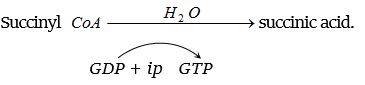
(D) During the Krebs cycle,the conversion of succinyl $CoA$ to succinic acid is catalyzed by the enzyme succinyl $CoA$ synthetase.
This reaction is coupled with the phosphorylation of guanosine diphosphate $(GDP)$ to guanosine triphosphate $(GTP)$ in the presence of inorganic phosphate $(Pi)$.
Therefore,$GTP$ is the energy-storing compound formed during this step.
This reaction is coupled with the phosphorylation of guanosine diphosphate $(GDP)$ to guanosine triphosphate $(GTP)$ in the presence of inorganic phosphate $(Pi)$.
Therefore,$GTP$ is the energy-storing compound formed during this step.
0 likes
View Solution41
EasyMCQ
The Krebs cycle takes place in
A
Chloroplast
B
Peroxisomes
C
Mitochondria
D
Cytoplasm
Solution
(C) The Krebs cycle,also known as the citric acid cycle or $TCA$ cycle,takes place in the mitochondrial matrix. It is a key metabolic pathway in aerobic respiration that generates energy by oxidizing acetyl-CoA derived from carbohydrates,fats,and proteins.
0 likes
View Solution42
MediumMCQ
$FADH_2$ is produced during which of the following reactions?
A
Succinic acid to fumaric acid
B
Fumaric acid to malic acid
C
Succinyl $CoA$ to succinic acid
D
Isocitric acid to oxaloacetic acid
Solution
(A) In the $Kreb's$ cycle of aerobic respiration,the enzyme succinate dehydrogenase catalyzes the oxidation of succinic acid to fumaric acid. During this process,$FAD$ is reduced to $FADH_2$.
0 likes
View Solution43
MediumMCQ
In which one of the following do the two names refer to one and the same thing?
A
Tricarboxylic acid cycle and urea cycle
B
Kreb's cycle and Calvin cycle
C
Tricarboxylic acid cycle and citric acid cycle
D
Citric acid cycle and Calvin cycle
Solution
(C) The $Tricarboxylic$ $acid$ $cycle$ ($TCA$ $cycle$) is another name for the $Citric$ $acid$ $cycle$. Both terms refer to the same metabolic pathway that occurs in the mitochondrial matrix,where acetyl-$CoA$ is oxidized to produce $CO_2$,$ATP$,$NADH$,and $FADH_2$. This cycle is also commonly known as the $Krebs$ $cycle$ in honor of Sir Hans Krebs.
0 likes
View Solution44
EasyMCQ
The $Kreb's$ cycle is also known as:
A
Tricarboxylic acid cycle
B
Oxidative phosphorylation
C
$EMP$ pathway
D
Glycolysis
Solution
(A) The $Kreb's$ cycle is also known as the $Tricarboxylic$ $acid$ $cycle$ ($TCA$ cycle) because the first stable product formed in this cycle is citric acid,which is a tricarboxylic acid.
It is also referred to as the $Citric$ $acid$ $cycle$.
It is also referred to as the $Citric$ $acid$ $cycle$.
0 likes
View Solution45
EasyMCQ
Which of the following is produced during Kreb's cycle?
A
Citric acid
B
Lactic acid
C
Acetyl coenzyme-$A$
D
Acetic acid
Solution
(A) The Kreb's cycle,also known as the Citric Acid Cycle or Tricarboxylic Acid $(TCA)$ cycle,begins with the condensation of Acetyl coenzyme-$A$ $(2C)$ with oxaloacetic acid $(4C)$ to form Citric acid $(6C)$.
Therefore,Citric acid is the first stable intermediate product formed during the Kreb's cycle.
Therefore,Citric acid is the first stable intermediate product formed during the Kreb's cycle.
0 likes
View Solution46
MediumMCQ
Activity of succinic dehydrogenase involves the following in $TCA$ cycle:
A
$NAD$
B
$FAD$
C
$GDP$
D
$ATP$
Solution
(B) In the $TCA$ cycle,the enzyme succinate dehydrogenase catalyzes the oxidation of succinate to fumarate.
During this reaction,two hydrogen atoms are removed from succinate and transferred to the electron acceptor $FAD$ (flavin adenine dinucleotide).
This results in the reduction of $FAD$ to $FADH_2$.
During this reaction,two hydrogen atoms are removed from succinate and transferred to the electron acceptor $FAD$ (flavin adenine dinucleotide).
This results in the reduction of $FAD$ to $FADH_2$.
0 likes
View Solution47
MediumMCQ
Which of the following is not an intermediate of the $Kreb's$ cycle?
A
Acetyl $CoA$
B
Citric acid
C
Succinic acid
D
Lactic acid
Solution
(D) The $Kreb's$ cycle (also known as the Citric Acid Cycle or $TCA$ cycle) involves a series of enzymatic reactions that oxidize acetyl groups to $CO_2$.
$1$. Acetyl $CoA$ is the starting substrate that enters the cycle by condensing with oxaloacetate.
$2$. Citric acid is the first stable product formed in the cycle.
$3$. Succinic acid is an intermediate formed during the conversion of succinyl-$CoA$ to fumarate.
$4$. Lactic acid is the product of lactic acid fermentation,which occurs in the cytoplasm under anaerobic conditions,not in the $Kreb's$ cycle.
$1$. Acetyl $CoA$ is the starting substrate that enters the cycle by condensing with oxaloacetate.
$2$. Citric acid is the first stable product formed in the cycle.
$3$. Succinic acid is an intermediate formed during the conversion of succinyl-$CoA$ to fumarate.
$4$. Lactic acid is the product of lactic acid fermentation,which occurs in the cytoplasm under anaerobic conditions,not in the $Kreb's$ cycle.
0 likes
View Solution48
MediumMCQ
In aerobic respiration,the citric acid cycle takes place in:
A
Cytosol
B
Mitochondria
C
Peroxisomes
D
Endoplasmic reticulum
Solution
(B) The citric acid cycle,also known as the Krebs cycle,occurs in the mitochondrial matrix of eukaryotic cells.
During aerobic respiration,pyruvate produced in the cytosol enters the mitochondria,where it is converted into acetyl-CoA.
This acetyl-CoA then enters the citric acid cycle to produce $NADH$,$FADH_2$,and $ATP$ through a series of enzymatic reactions.
Therefore,the correct location for the citric acid cycle is the mitochondria.
During aerobic respiration,pyruvate produced in the cytosol enters the mitochondria,where it is converted into acetyl-CoA.
This acetyl-CoA then enters the citric acid cycle to produce $NADH$,$FADH_2$,and $ATP$ through a series of enzymatic reactions.
Therefore,the correct location for the citric acid cycle is the mitochondria.
0 likes
View SolutionRespiration in Plants — Kreb's cycle · Frequently Asked Questions
1Are these Respiration in Plants questions useful for JEE and NEET?
Yes. All questions in this section are mapped to JEE Main and NEET exam patterns. Previous year questions from JEE Main, NEET, GUJCET and state-level exams are included with full solutions.
2Can I switch to Hindi or Gujarati for these questions?
Yes. Use the language tabs in the hero section or the sidebar to view the same questions and solutions in English, Hindi or Gujarati.
3How do I generate a question paper from this subtopic?
Use the Vedclass Exam Paper Generator — select the chapter and subtopic, set difficulty, and generate Sets A, B, C, D automatically. First 3 chapters of every subject are free.
Vedclass Products
For Students
Vedclass Test Series
Mock tests in real JEE/NEET style with performance analysis. 5-day free trial.
Start Free TrialFor Teachers
Exam Paper Generator
Generate Set A/B/C/D papers from this chapter in 2 minutes. 3 chapters free.
Try FreeFor Institutes
Online Exam Module
Live online exams with unlimited students, 360° analytics & white-label branding.
See DemoFor Teachers & Institutes
Generate a Respiration in Plants Exam Paper in 2 Minutes
Select subtopic & difficulty — Sets A, B, C, D auto-generated with No Repeat logic.
First 3 chapters of every subject are free — no payment required.