
A English
Anaerobic respiration Questions in English
Class 11 Biology · Respiration in Plants · Anaerobic respiration
160+
Questions
English
Language
100%
With Solutions
Showing 10 of 160 questions in English
151
EasyMCQ
Given below are two statements.
$Statement-I$ - Skeletal muscles usually derive energy by anaerobic respiration.
$Statement-II$ - After vigorous exercise,lactic acid accumulates in muscle fibres,leading to muscle fatigue.
In the light of the above statements,choose the most appropriate answer from the options given below:
$Statement-I$ - Skeletal muscles usually derive energy by anaerobic respiration.
$Statement-II$ - After vigorous exercise,lactic acid accumulates in muscle fibres,leading to muscle fatigue.
In the light of the above statements,choose the most appropriate answer from the options given below:
A
Both $Statement-I$ and $Statement-II$ are correct.
B
Both $Statement-I$ and $Statement-II$ are incorrect.
C
Statement $I$ is correct but statement $II$ is incorrect.
D
Statement $I$ is incorrect but statement $II$ is correct.
Solution
(D) $Statement-I$ is incorrect because skeletal muscles primarily derive energy through aerobic respiration under normal conditions. Anaerobic respiration occurs only during intense activity when oxygen supply is insufficient.
$Statement-II$ is correct because during vigorous exercise,the demand for oxygen exceeds the supply,leading to anaerobic glycolysis. This results in the accumulation of lactic acid in muscle fibres,which causes muscle fatigue.
$Statement-II$ is correct because during vigorous exercise,the demand for oxygen exceeds the supply,leading to anaerobic glycolysis. This results in the accumulation of lactic acid in muscle fibres,which causes muscle fatigue.
0 likes
View Solution152
EasyMCQ
Hydrogen acceptor in alcohol fermentation is . . . . . . .
A
Acetaldehyde
B
$NADP$
C
Pyruvic acid
D
$PGA$
Solution
(A) In alcohol fermentation,pyruvic acid is first converted into acetaldehyde and $CO_2$.
Subsequently,acetaldehyde acts as the final hydrogen acceptor.
It is reduced by $NADH + H^+$ to form ethanol,while $NAD^+$ is regenerated for glycolysis.
Subsequently,acetaldehyde acts as the final hydrogen acceptor.
It is reduced by $NADH + H^+$ to form ethanol,while $NAD^+$ is regenerated for glycolysis.
0 likes
View Solution153
EasyMCQ
Identify the correct combination of $A$, $B$, and $C$ involved in lactic acid fermentation.
$C_6H_{12}O_6 \rightarrow A + B \rightarrow$ Lactic acid + $C$
$C_6H_{12}O_6 \rightarrow A + B \rightarrow$ Lactic acid + $C$
A
| Option | $A, B, C$ Combination |
|---|---|
| $A$ | $A: 2 \ NADH + H^+, B: 2 \ NAD^+, C: \text{Pyruvic acid}$ |
B
| Option | $A, B, C$ Combination |
|---|---|
| $B$ | $A: 2 \ NADH + H^+, B: \text{Pyruvic acid}, C: 2 \ NAD^+$ |
C
| Option | $A, B, C$ Combination |
|---|---|
| $C$ | $A: \text{Pyruvic acid}, B: 2 \ NADH + H^+, C: 2 \ NAD^+$ |
D
| Option | $A, B, C$ Combination |
|---|---|
| $D$ | $A: \text{Pyruvic acid}, B: 2 \ NAD^+, C: 2 \ NADH + H^+$ |
Solution
(C) In lactic acid fermentation, glucose $(C_6H_{12}O_6)$ first undergoes glycolysis to produce $2$ molecules of pyruvic acid along with $2 \ NADH + H^+$ and $2 \ ATP$.
Therefore, the first step is $C_6H_{12}O_6 \rightarrow 2 \ \text{Pyruvic acid} + 2 \ NADH + H^+$.
In the second step, pyruvic acid is reduced to lactic acid by the enzyme lactate dehydrogenase.
During this reduction, $NADH + H^+$ is oxidized back to $NAD^+$.
The reaction is: $2 \ \text{Pyruvic acid} + 2 \ NADH + H^+ \rightarrow 2 \ \text{Lactic acid} + 2 \ NAD^+$.
Comparing this with the given equation $C_6H_{12}O_6 \rightarrow A + B \rightarrow \text{Lactic acid} + C$, we identify:
$A = \text{Pyruvic acid}$
$B = 2 \ NADH + H^+$
$C = 2 \ NAD^+$
Thus, option $C$ represents the correct sequence.
Therefore, the first step is $C_6H_{12}O_6 \rightarrow 2 \ \text{Pyruvic acid} + 2 \ NADH + H^+$.
In the second step, pyruvic acid is reduced to lactic acid by the enzyme lactate dehydrogenase.
During this reduction, $NADH + H^+$ is oxidized back to $NAD^+$.
The reaction is: $2 \ \text{Pyruvic acid} + 2 \ NADH + H^+ \rightarrow 2 \ \text{Lactic acid} + 2 \ NAD^+$.
Comparing this with the given equation $C_6H_{12}O_6 \rightarrow A + B \rightarrow \text{Lactic acid} + C$, we identify:
$A = \text{Pyruvic acid}$
$B = 2 \ NADH + H^+$
$C = 2 \ NAD^+$
Thus, option $C$ represents the correct sequence.
0 likes
View Solution154
EasyMCQ
The anaerobic process that occurs after glycolysis during lactic acid formation is called:
A
Fermentation
B
Citric acid cycle
C
$HSK$ pathway
D
Calvin cycle
Solution
(A) In the absence of oxygen,the pyruvic acid produced during glycolysis is reduced to lactic acid in animal cells and some bacteria. This process is a type of anaerobic respiration known as fermentation. During this process,$NADH + H^+$ is oxidized back to $NAD^+$,which is essential for the continuation of glycolysis.
0 likes
View Solution155
EasyMCQ
During anaerobic respiration,the number of $ATP$ molecules generated by the breakdown of $20$ glucose molecules is . . . . . . .
A
$90$
B
$60$
C
$40$
D
$20$
Solution
(C) During anaerobic respiration,the breakdown of one glucose molecule produces a net gain of $2$ $ATP$ molecules.
This occurs because,during glycolysis,a total of $4$ $ATP$ molecules are produced,but $2$ $ATP$ molecules are consumed in the preparatory phase,resulting in a net gain of $2$ $ATP$ molecules.
Since anaerobic respiration does not involve the electron transport chain or oxidative phosphorylation,no additional $ATP$ molecules are generated beyond those produced during glycolysis.
Therefore,the number of $ATP$ molecules generated by the breakdown of $20$ glucose molecules is calculated as: $20 \text{ glucose molecules} \times 2 \text{ } ATP \text{ molecules/glucose} = 40 \text{ } ATP \text{ molecules}$.
Thus,the correct answer is $40$ $ATP$ molecules.
This occurs because,during glycolysis,a total of $4$ $ATP$ molecules are produced,but $2$ $ATP$ molecules are consumed in the preparatory phase,resulting in a net gain of $2$ $ATP$ molecules.
Since anaerobic respiration does not involve the electron transport chain or oxidative phosphorylation,no additional $ATP$ molecules are generated beyond those produced during glycolysis.
Therefore,the number of $ATP$ molecules generated by the breakdown of $20$ glucose molecules is calculated as: $20 \text{ glucose molecules} \times 2 \text{ } ATP \text{ molecules/glucose} = 40 \text{ } ATP \text{ molecules}$.
Thus,the correct answer is $40$ $ATP$ molecules.
0 likes
View Solution156
EasyMCQ
During anaerobic respiration,the conversion of pyruvate into acetaldehyde,along with coenzyme $TPP$,the cofactor required is
A
$Mg^{2+}$
B
$Mn^{2+}$
C
$Fe^{2+}$
D
$Zn^{2+}$
Solution
(A) In anaerobic respiration (specifically in alcoholic fermentation),the enzyme pyruvate decarboxylase catalyzes the conversion of pyruvate into acetaldehyde and carbon dioxide.
This enzyme requires thiamine pyrophosphate $(TPP)$ as a coenzyme and a divalent metal ion as a cofactor.
The specific metal ion required as a cofactor for pyruvate decarboxylase is $Mg^{2+}$ (magnesium ion).
Therefore,the correct option is $A$.
This enzyme requires thiamine pyrophosphate $(TPP)$ as a coenzyme and a divalent metal ion as a cofactor.
The specific metal ion required as a cofactor for pyruvate decarboxylase is $Mg^{2+}$ (magnesium ion).
Therefore,the correct option is $A$.
0 likes
View Solution157
EasyMCQ
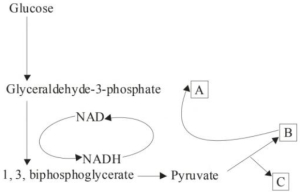
Choose the correct combination of labelling the molecules involved in the pathway of anaerobic respiration in Yeast.
A
$A$-Acetaldehyde,$B-CO_2$,$C$-Ethanol
B
$A$-Ethanol,$B-CO_2$,$C$-Acetaldehyde
C
$A$-Ethanol,$B$-Acetaldehyde,$C-CO_2$
D
$A-CO_2$,$B$-Ethanol,$C$-Acetaldehyde
Solution
(C) In the anaerobic respiration pathway in yeast,pyruvate is first converted into acetaldehyde and $CO_2$ by the enzyme pyruvate decarboxylase.
Then,acetaldehyde is reduced to ethanol by the enzyme alcohol dehydrogenase,using $NADH$ as a reducing agent.
Looking at the provided pathway diagram:
$1$. Pyruvate is converted to $C$ $(CO_2)$ and $B$ (Acetaldehyde).
$2$. Acetaldehyde $(B)$ is then converted to $A$ (Ethanol).
Therefore,the correct labels are $A$-Ethanol,$B$-Acetaldehyde,and $C-CO_2$.
Then,acetaldehyde is reduced to ethanol by the enzyme alcohol dehydrogenase,using $NADH$ as a reducing agent.
Looking at the provided pathway diagram:
$1$. Pyruvate is converted to $C$ $(CO_2)$ and $B$ (Acetaldehyde).
$2$. Acetaldehyde $(B)$ is then converted to $A$ (Ethanol).
Therefore,the correct labels are $A$-Ethanol,$B$-Acetaldehyde,and $C-CO_2$.
0 likes
View Solution158
EasyMCQ
Select a suitable name for the following process: $C_6H_{12}O_6 + 2ADP + 2Pi \rightarrow 2C_2H_5OH + 2ATP + 2CO_2\uparrow$

A
Alcoholic fermentation
B
Photorespiration
C
Lactate fermentation
D
Aerobic respiration
Solution
(A) Alcoholic fermentation.
The equation provided represents the process of alcoholic fermentation,where glucose $(C_6H_{12}O_6)$ is converted into ethanol $(2C_2H_5OH)$,carbon dioxide $(2CO_2)$,and a small amount of $ATP$ $(2ATP)$.
This is an anaerobic process that occurs in yeast and some bacteria,where ethanol and carbon dioxide are produced as byproducts.
The equation provided represents the process of alcoholic fermentation,where glucose $(C_6H_{12}O_6)$ is converted into ethanol $(2C_2H_5OH)$,carbon dioxide $(2CO_2)$,and a small amount of $ATP$ $(2ATP)$.
This is an anaerobic process that occurs in yeast and some bacteria,where ethanol and carbon dioxide are produced as byproducts.
0 likes
View Solution159
EasyMCQ
The number of $ATP$ produced when a molecule of glucose undergoes fermentation is
A
$4$
B
$36$
C
$2$
D
$38$
Solution
(C) The correct answer is $C$.
During fermentation,whether it is lactic acid fermentation or alcoholic fermentation,only $2$ $ATP$ molecules are produced per molecule of glucose.
This is because fermentation is an anaerobic process,which only includes glycolysis.
Glycolysis results in a net gain of $2$ $ATP$ molecules,as the subsequent steps of fermentation do not produce any additional $ATP$.
During fermentation,whether it is lactic acid fermentation or alcoholic fermentation,only $2$ $ATP$ molecules are produced per molecule of glucose.
This is because fermentation is an anaerobic process,which only includes glycolysis.
Glycolysis results in a net gain of $2$ $ATP$ molecules,as the subsequent steps of fermentation do not produce any additional $ATP$.
0 likes
View Solution160
EasyMCQ
During lactic acid fermentation, . . . . . .
A
$O_2$ is used,$CO_2$ is liberated
B
neither $O_2$ is used,nor $CO_2$ is liberated
C
$O_2$ is used,$CO_2$ is not liberated
D
$O_2$ is not used,$CO_2$ is liberated
Solution
(B) neither $O_2$ is used,nor $CO_2$ is liberated.
During lactic acid fermentation,oxygen is not consumed,and carbon dioxide is not produced.
This is an anaerobic process where glucose is converted into lactic acid without the involvement of oxygen or the release of carbon dioxide.
The chemical equation is:
$C_6H_{12}O_6 \longrightarrow 2C_3H_6O_3 + 2ATP$
During lactic acid fermentation,oxygen is not consumed,and carbon dioxide is not produced.
This is an anaerobic process where glucose is converted into lactic acid without the involvement of oxygen or the release of carbon dioxide.
The chemical equation is:
$C_6H_{12}O_6 \longrightarrow 2C_3H_6O_3 + 2ATP$
0 likes
View SolutionRespiration in Plants — Anaerobic respiration · Frequently Asked Questions
1Are these Respiration in Plants questions useful for JEE and NEET?
Yes. All questions in this section are mapped to JEE Main and NEET exam patterns. Previous year questions from JEE Main, NEET, GUJCET and state-level exams are included with full solutions.
2Can I switch to Hindi or Gujarati for these questions?
Yes. Use the language tabs in the hero section or the sidebar to view the same questions and solutions in English, Hindi or Gujarati.
3How do I generate a question paper from this subtopic?
Use the Vedclass Exam Paper Generator — select the chapter and subtopic, set difficulty, and generate Sets A, B, C, D automatically. First 3 chapters of every subject are free.
Vedclass Products
For Students
Vedclass Test Series
Mock tests in real JEE/NEET style with performance analysis. 5-day free trial.
Start Free TrialFor Teachers
Exam Paper Generator
Generate Set A/B/C/D papers from this chapter in 2 minutes. 3 chapters free.
Try FreeFor Institutes
Online Exam Module
Live online exams with unlimited students, 360° analytics & white-label branding.
See DemoFor Teachers & Institutes
Generate a Respiration in Plants Exam Paper in 2 Minutes
Select subtopic & difficulty — Sets A, B, C, D auto-generated with No Repeat logic.
First 3 chapters of every subject are free — no payment required.