
A English
Amphibolic Pathway Questions in English
Class 11 Biology · Respiration in Plants · Amphibolic Pathway
64+
Questions
English
Language
100%
With Solutions
Showing 47 of 64 questions in English
1
MediumMCQ
$A$ huge amount of starch is deposited in potato tubers due to:
A
Chemical condensation of sugars
B
Enzymatic transformations
C
Synthesis of starch in tubers
D
Absorption of nutrients
Solution
(C) Potato tubers are modified stems that act as storage organs. The starch deposited in these tubers is primarily synthesized within the tuber cells from sugars (sucrose) that are translocated from the leaves via the phloem. This process involves the enzymatic conversion of sucrose into starch,which is then stored as starch grains within amyloplasts. Therefore,the accumulation is a result of the synthesis of starch within the tubers.
0 likes
View Solution2
MediumMCQ
Protein is used as a respiratory substrate only when:
A
Carbohydrates are absent
B
Fats are absent
C
Both are exhausted
D
Fats and carbohydrates are abundant
Solution
(C) The primary respiratory substrate in living organisms is carbohydrates,which are utilized first for energy production.
When carbohydrates are depleted,fats are used as the secondary respiratory substrate.
Proteins are used as a respiratory substrate only under starvation conditions or when both carbohydrates and fats are exhausted,as they are essential structural components of the cell.
When carbohydrates are depleted,fats are used as the secondary respiratory substrate.
Proteins are used as a respiratory substrate only under starvation conditions or when both carbohydrates and fats are exhausted,as they are essential structural components of the cell.
0 likes
View Solution3
MediumMCQ
The connecting link among glycolysis,Kreb's cycle,and beta-oxidation of fatty acid is:
A
Pyruvic acid
B
Acetyl $CoA$
C
Acetaldehyde
D
Citric acid
Solution
(B) Glycolysis produces pyruvic acid,which is converted into Acetyl $CoA$ before entering the Kreb's cycle.
Beta-oxidation of fatty acids breaks down fatty acids into Acetyl $CoA$ units.
Therefore,Acetyl $CoA$ serves as the common metabolic intermediate or connecting link between carbohydrate metabolism (glycolysis and Kreb's cycle) and lipid metabolism (beta-oxidation).
Beta-oxidation of fatty acids breaks down fatty acids into Acetyl $CoA$ units.
Therefore,Acetyl $CoA$ serves as the common metabolic intermediate or connecting link between carbohydrate metabolism (glycolysis and Kreb's cycle) and lipid metabolism (beta-oxidation).
0 likes
View Solution4
MediumMCQ
Which of the following pairs is a combination of the highest and lowest energy molecules?
A
Glucose and pyruvic acid
B
Palmitic acid and acetyl $CoA$
C
Glucose and maleic acid
D
Maleic acid and acetyl $CoA$
Solution
(B) The energy content of a molecule is determined by the amount of $ATP$ produced upon its complete oxidation.
$1$. Palmitic acid is a fatty acid with a long carbon chain $(C_{16}H_{32}O_2)$. Upon complete oxidation, one mole of palmitic acid yields approximately $129$ $ATP$ molecules.
$2$. Acetyl $CoA$ is a two-carbon compound. Upon complete oxidation in the $TCA$ cycle, one mole of acetyl $CoA$ yields $12$ $ATP$ molecules.
Therefore, palmitic acid represents the highest energy molecule, and acetyl $CoA$ represents the lowest energy molecule among the given options.
Thus, the correct pair is $Palmitic \text{ acid and acetyl } CoA$.
$1$. Palmitic acid is a fatty acid with a long carbon chain $(C_{16}H_{32}O_2)$. Upon complete oxidation, one mole of palmitic acid yields approximately $129$ $ATP$ molecules.
$2$. Acetyl $CoA$ is a two-carbon compound. Upon complete oxidation in the $TCA$ cycle, one mole of acetyl $CoA$ yields $12$ $ATP$ molecules.
Therefore, palmitic acid represents the highest energy molecule, and acetyl $CoA$ represents the lowest energy molecule among the given options.
Thus, the correct pair is $Palmitic \text{ acid and acetyl } CoA$.
0 likes
View Solution5
MediumMCQ
During prolonged fasting,which of the following is the correct order of utilization of energy sources in the human body?
A
The first to be used up are carbohydrates,next fat is withdrawn and proteins are metabolised at the last.
B
The first to be used up are the fats,next carbohydrates are withdrawn from stored glycogen in the liver and muscles and proteins are withdrawn at the last.
C
First lipids are used up,then proteins and finally carbohydrate.
D
None of these.
Solution
(A) During prolonged fasting,the body follows a specific hierarchy to maintain energy homeostasis.
$1$. First,the body utilizes readily available blood glucose and glycogen stores (carbohydrates) from the liver and muscles.
$2$. Once glycogen stores are depleted,the body shifts to mobilizing adipose tissue to break down stored fats (lipids) into fatty acids and glycerol for energy.
$3$. Proteins are the last resort for energy production,as they are essential structural components of the body. They are broken down into amino acids through gluconeogenesis only when other energy reserves are exhausted.
$1$. First,the body utilizes readily available blood glucose and glycogen stores (carbohydrates) from the liver and muscles.
$2$. Once glycogen stores are depleted,the body shifts to mobilizing adipose tissue to break down stored fats (lipids) into fatty acids and glycerol for energy.
$3$. Proteins are the last resort for energy production,as they are essential structural components of the body. They are broken down into amino acids through gluconeogenesis only when other energy reserves are exhausted.
0 likes
View Solution6
DifficultMCQ
The respiratory pathway can be appropriately defined as a/an ....... pathway.
A
Anabolic
B
Amphibolic
C
Catabolic
D
Metabolic
Solution
(B) The respiratory pathway is involved in both the breakdown of substrates (catabolism) to produce energy and the synthesis of various intermediates for the formation of other cellular components (anabolism). Because it involves both catabolic and anabolic processes,it is termed an $Amphibolic$ pathway. Therefore,the correct option is $B$.
0 likes
View Solution7
MediumMCQ
The maximum amount of energy / $ATP$ is released during the oxidation of which of the following?
A
Fats
B
Proteins
C
Starch
D
Vitamins
Solution
(A) The energy yield from the oxidation of respiratory substrates depends on their chemical composition.
Fats (lipids) are highly reduced compounds containing a large number of $C-H$ bonds.
Upon oxidation,fats release significantly more energy per unit weight compared to carbohydrates (like starch) or proteins.
Specifically,the oxidation of $1 \ g$ of fat yields approximately $9 \ kcal$ of energy,whereas $1 \ g$ of carbohydrate or protein yields approximately $4 \ kcal$ of energy.
Therefore,fats provide the maximum amount of energy per unit mass.
Fats (lipids) are highly reduced compounds containing a large number of $C-H$ bonds.
Upon oxidation,fats release significantly more energy per unit weight compared to carbohydrates (like starch) or proteins.
Specifically,the oxidation of $1 \ g$ of fat yields approximately $9 \ kcal$ of energy,whereas $1 \ g$ of carbohydrate or protein yields approximately $4 \ kcal$ of energy.
Therefore,fats provide the maximum amount of energy per unit mass.
0 likes
View Solution8
MediumMCQ
$\beta$-oxidation occurs in .........
A
Cell membrane
B
Mitochondrial matrix
C
Oxysome head
D
Perimitochondrial space
Solution
(B) $\beta$-oxidation is the metabolic process by which fatty acid molecules are broken down to generate acetyl-CoA,which then enters the citric acid cycle. In eukaryotic cells,this process primarily takes place in the mitochondrial matrix. The enzymes required for the $\beta$-oxidation of fatty acids are located within the matrix of the mitochondria.
0 likes
View Solution9
EasyMCQ
The sequence of food substances consumed during starvation is:
A
Carbohydrates $\to$ Fats $\to$ Proteins
B
Carbohydrates $\to$ Proteins $\to$ Fats
C
Proteins $\to$ Fats $\to$ Carbohydrates
D
Fats $\to$ Proteins $\to$ Carbohydrates
Solution
(A) During starvation,the body utilizes its stored energy reserves in a specific order to maintain metabolic functions.
$1$. First,the body consumes readily available carbohydrates (like glycogen) stored in the liver and muscles.
$2$. Once carbohydrates are depleted,the body shifts to utilizing stored fats (adipose tissue) as the primary energy source.
$3$. Finally,if starvation persists,the body begins to break down structural proteins from muscles and other tissues to meet its energy requirements.
Therefore,the correct sequence is Carbohydrates $\to$ Fats $\to$ Proteins.
$1$. First,the body consumes readily available carbohydrates (like glycogen) stored in the liver and muscles.
$2$. Once carbohydrates are depleted,the body shifts to utilizing stored fats (adipose tissue) as the primary energy source.
$3$. Finally,if starvation persists,the body begins to break down structural proteins from muscles and other tissues to meet its energy requirements.
Therefore,the correct sequence is Carbohydrates $\to$ Fats $\to$ Proteins.
0 likes
View Solution10
MediumMCQ
Which of the following links carbohydrate and fat metabolism?
A
$CO_2$
B
Acetyl $CoA$
C
Pyruvic acid
D
Citric acid
Solution
(B) The respiratory pathway is an amphibolic pathway because it involves both catabolism and anabolism.
Acetyl $CoA$ acts as a common metabolic intermediate that links the metabolism of carbohydrates,fats,and proteins.
During carbohydrate metabolism,glucose is broken down into pyruvic acid,which is then converted into Acetyl $CoA$.
During fat metabolism,fatty acids are broken down into Acetyl $CoA$ through beta-oxidation.
Thus,Acetyl $CoA$ serves as the junction point for these pathways.
Acetyl $CoA$ acts as a common metabolic intermediate that links the metabolism of carbohydrates,fats,and proteins.
During carbohydrate metabolism,glucose is broken down into pyruvic acid,which is then converted into Acetyl $CoA$.
During fat metabolism,fatty acids are broken down into Acetyl $CoA$ through beta-oxidation.
Thus,Acetyl $CoA$ serves as the junction point for these pathways.
0 likes
View Solution11
MediumMCQ
Proteins act as respiratory substrates only when:
A
Carbohydrates are absent
B
Fats are absent
C
Both $1$ and $2$ are absent
D
Fats and carbohydrates are in abundance
Solution
(C) In cellular respiration,carbohydrates are the preferred respiratory substrates. When carbohydrates are exhausted,fats are utilized as the next source of energy. Proteins are used as respiratory substrates only when both carbohydrates and fats are absent in the cell. This is because proteins are primarily required for structural and functional roles in the body,and their breakdown for energy is a last resort.
0 likes
View Solution12
MediumMCQ
During prolonged fasting,the sequence of utilization of energy sources in the body is:
A
First carbohydrates are used,followed by fats and finally proteins.
B
First fats are used,followed by carbohydrates from the liver and muscles,and finally proteins.
C
First lipids are used,followed by proteins and finally carbohydrates.
D
None of the above.
Solution
(A) During prolonged fasting,the body utilizes its stored energy reserves in a specific order to maintain homeostasis.
$1$. First,the body consumes available $Glycogen$ (carbohydrates) stored in the liver and muscles to maintain blood glucose levels.
$2$. Once glycogen stores are depleted,the body shifts to $Lipids$ (fats) stored in adipose tissue,which are broken down into fatty acids and glycerol for energy.
$3$. Finally,if fasting continues for an extended period,the body begins to break down $Proteins$ (from muscles and other tissues) into amino acids to be used for gluconeogenesis to support vital organs.
$1$. First,the body consumes available $Glycogen$ (carbohydrates) stored in the liver and muscles to maintain blood glucose levels.
$2$. Once glycogen stores are depleted,the body shifts to $Lipids$ (fats) stored in adipose tissue,which are broken down into fatty acids and glycerol for energy.
$3$. Finally,if fasting continues for an extended period,the body begins to break down $Proteins$ (from muscles and other tissues) into amino acids to be used for gluconeogenesis to support vital organs.
0 likes
View Solution13
MediumMCQ
Which of the following biomolecules is common to respiration-mediated breakdown of fats,carbohydrates,and proteins?
A
Glucose$-6-$phosphate
B
Fructose $1,6-$bisphosphate
C
Pyruvic acid
D
Acetyl CoA
Solution
(D) The correct answer is $(d)$. Carbohydrates are usually first converted into glucose before they are used for respiration.
Fats are broken down into glycerol and fatty acids. Fatty acids are degraded to acetyl CoA to enter the respiratory pathway,while glycerol is converted to $3-$phosphoglyceraldehyde $(PGAL)$.
Proteins are degraded by proteases into individual amino acids. After deamination,these amino acids enter the respiratory pathway at different stages,such as pyruvate,acetyl CoA,or intermediates of the Krebs' cycle.
Thus,acetyl CoA acts as a common metabolic intermediate for the breakdown of all three major biomolecules (carbohydrates,proteins,and fats),making the respiratory pathway an amphibolic pathway.
Fats are broken down into glycerol and fatty acids. Fatty acids are degraded to acetyl CoA to enter the respiratory pathway,while glycerol is converted to $3-$phosphoglyceraldehyde $(PGAL)$.
Proteins are degraded by proteases into individual amino acids. After deamination,these amino acids enter the respiratory pathway at different stages,such as pyruvate,acetyl CoA,or intermediates of the Krebs' cycle.
Thus,acetyl CoA acts as a common metabolic intermediate for the breakdown of all three major biomolecules (carbohydrates,proteins,and fats),making the respiratory pathway an amphibolic pathway.
0 likes
View Solution14
MediumMCQ
Aerobic respiratory pathway is appropriately termed
A
parabolic
B
amphibolic
C
anabolic
D
catabolic
Solution
(B) : $A$ biochemical pathway that serves both anabolic and catabolic processes is known as an amphibolic pathway.
Aerobic respiration involves both the catabolism of carbohydrates,fats,and proteins to release energy and the synthesis of various metabolic intermediates that act as precursors for the biosynthesis of amino acids,fatty acids,and other secondary metabolites.
Because it functions in both the breakdown (catabolism) and synthesis (anabolism) of molecules,it is appropriately termed an amphibolic pathway.
Aerobic respiration involves both the catabolism of carbohydrates,fats,and proteins to release energy and the synthesis of various metabolic intermediates that act as precursors for the biosynthesis of amino acids,fatty acids,and other secondary metabolites.
Because it functions in both the breakdown (catabolism) and synthesis (anabolism) of molecules,it is appropriately termed an amphibolic pathway.
0 likes
View Solution15
MediumMCQ
If protein enters into the amphibolic pathway,the amino acid is converted into........
A
Pyruvic acid
B
Acetic acid
C
Acetyl co-$A$
D
$DHAP$
Solution
(C) The amphibolic pathway refers to the metabolic pathway that involves both catabolism and anabolism.
Proteins are broken down by proteases into amino acids.
These amino acids are deaminated to form various intermediates of the Krebs cycle (Tricarboxylic Acid Cycle) or are converted into pyruvate or acetyl co-$A$ depending on their structure.
Specifically,when proteins enter the respiratory pathway,they are first broken down into amino acids,which are then converted into pyruvate,acetyl co-$A$,or other intermediates of the Krebs cycle to be oxidized for energy production.
Proteins are broken down by proteases into amino acids.
These amino acids are deaminated to form various intermediates of the Krebs cycle (Tricarboxylic Acid Cycle) or are converted into pyruvate or acetyl co-$A$ depending on their structure.
Specifically,when proteins enter the respiratory pathway,they are first broken down into amino acids,which are then converted into pyruvate,acetyl co-$A$,or other intermediates of the Krebs cycle to be oxidized for energy production.
0 likes
View Solution16
MediumMCQ
How many substrate-level $ATP$ molecules are formed if one molecule of amino acid is oxidized via the amphibolic pathway?
A
$1$
B
$12$
C
$14$
D
$2$
Solution
(A) The oxidation of amino acids via the amphibolic pathway involves their conversion into intermediates of the $Krebs$ cycle (e.g.,$Pyruvate$,$Acetyl-CoA$,$\alpha-Ketoglutarate$).
When an amino acid enters the $Krebs$ cycle,it undergoes reactions that produce $ATP$ (or $GTP$) via substrate-level phosphorylation.
Specifically,the conversion of $Succinyl-CoA$ to $Succinate$ in the $Krebs$ cycle results in the formation of one molecule of $GTP$,which is equivalent to one $ATP$.
Therefore,for one molecule of amino acid oxidized through this pathway,$1$ substrate-level $ATP$ is formed.
When an amino acid enters the $Krebs$ cycle,it undergoes reactions that produce $ATP$ (or $GTP$) via substrate-level phosphorylation.
Specifically,the conversion of $Succinyl-CoA$ to $Succinate$ in the $Krebs$ cycle results in the formation of one molecule of $GTP$,which is equivalent to one $ATP$.
Therefore,for one molecule of amino acid oxidized through this pathway,$1$ substrate-level $ATP$ is formed.
0 likes
View Solution17
MediumMCQ
$A-$ Glycolysis involves only catabolic process.
$R-$ Amphibolic pathway involves both catabolic and anabolic processes.
$R-$ Amphibolic pathway involves both catabolic and anabolic processes.
A
$A$ and $R$ both are correct.
B
$A$ and $R$ both are incorrect.
C
$A$ is correct,$R$ is incorrect.
D
$A$ is incorrect,$R$ is correct.
Solution
(D) is incorrect because glycolysis is not strictly catabolic; it is part of an amphibolic pathway where intermediates can be used for biosynthesis (anabolic).
$R$ is correct because an amphibolic pathway is defined as a metabolic pathway that involves both catabolic (breakdown) and anabolic (synthesis) processes.
Since glycolysis provides precursors for the synthesis of amino acids and fatty acids,it is considered an amphibolic pathway.
Therefore,the correct option is $D$.
$R$ is correct because an amphibolic pathway is defined as a metabolic pathway that involves both catabolic (breakdown) and anabolic (synthesis) processes.
Since glycolysis provides precursors for the synthesis of amino acids and fatty acids,it is considered an amphibolic pathway.
Therefore,the correct option is $D$.
0 likes
View Solution18
MediumMCQ
To enter into the respiratory pathway,protein molecules must be converted into:
A
Amino acids
B
Pyruvic acid
C
Glucose
D
Glycerol
Solution
(A) Proteins are complex macromolecules composed of amino acids.
Before they can be utilized in the respiratory pathway for energy production,they are first broken down by proteases into their constituent amino acids.
These amino acids are then deaminated and converted into various intermediates of the respiratory pathway,such as pyruvic acid,acetyl-CoA,or other intermediates of the Krebs cycle,depending on the specific amino acid structure.
Therefore,the primary conversion required for proteins to enter the respiratory pathway is into amino acids.
Before they can be utilized in the respiratory pathway for energy production,they are first broken down by proteases into their constituent amino acids.
These amino acids are then deaminated and converted into various intermediates of the respiratory pathway,such as pyruvic acid,acetyl-CoA,or other intermediates of the Krebs cycle,depending on the specific amino acid structure.
Therefore,the primary conversion required for proteins to enter the respiratory pathway is into amino acids.
0 likes
View Solution19
MediumMCQ
In an amphibolic pathway,fatty acids would be first degraded into..........
A
$PGAL$
B
$DHAP$
C
Pyruvic acid
D
Acetyl $CoA$
Solution
(D) An amphibolic pathway is one that involves both catabolism and anabolism.
Fatty acids are broken down through the process of $\beta$-oxidation.
During this process,fatty acids are first degraded into Acetyl $CoA$,which then enters the Krebs cycle ($TCA$ cycle) to produce energy.
Therefore,Acetyl $CoA$ acts as a common intermediate between the breakdown of fats and the respiratory pathway.
Fatty acids are broken down through the process of $\beta$-oxidation.
During this process,fatty acids are first degraded into Acetyl $CoA$,which then enters the Krebs cycle ($TCA$ cycle) to produce energy.
Therefore,Acetyl $CoA$ acts as a common intermediate between the breakdown of fats and the respiratory pathway.
0 likes
View Solution20
MediumMCQ
Choose the incorrect sentence$(s)$ regarding the amphibolic pathway.
$(1)$ Carbohydrates are generally used as substrates for respiration.
$(2)$ Fatty acids can first be degraded into acetyl $CoA$,which enters the respiratory pathway.
$(3)$ In the case of proteins,they are first broken down into amino acids,which are later converted into pyruvic acid and enter the respiratory pathway.
$(4)$ The respiratory pathway is involved in both anabolism and catabolism.
$(5)$ Glycerol would enter the pathway after being converted to $PGAL$.
$(1)$ Carbohydrates are generally used as substrates for respiration.
$(2)$ Fatty acids can first be degraded into acetyl $CoA$,which enters the respiratory pathway.
$(3)$ In the case of proteins,they are first broken down into amino acids,which are later converted into pyruvic acid and enter the respiratory pathway.
$(4)$ The respiratory pathway is involved in both anabolism and catabolism.
$(5)$ Glycerol would enter the pathway after being converted to $PGAL$.
A
$1, 3, 4$
B
Only $3$
C
$2, 3, 5$
D
None
Solution
(D) The respiratory pathway is considered an amphibolic pathway because it involves both catabolism (breakdown of substrates like carbohydrates,fats,and proteins for energy) and anabolism (synthesis of precursors for other molecules).
$(1)$ Carbohydrates are indeed the most common respiratory substrates.
$(2)$ Fatty acids are broken down into acetyl $CoA$ via $\beta$-oxidation and enter the cycle.
$(3)$ Proteins are broken down into amino acids,which are then deaminated to enter the pathway at various points (e.g.,pyruvic acid,acetyl $CoA$,or Krebs cycle intermediates),not just pyruvic acid.
$(4)$ The definition of an amphibolic pathway is that it involves both anabolism and catabolism.
$(5)$ Glycerol is converted to $DHAP$ and then to $PGAL$ before entering the glycolytic pathway.
Since all statements $(1), (2), (3), (4),$ and $(5)$ are scientifically correct descriptions of the respiratory pathway,there is no incorrect sentence among the options provided.
$(1)$ Carbohydrates are indeed the most common respiratory substrates.
$(2)$ Fatty acids are broken down into acetyl $CoA$ via $\beta$-oxidation and enter the cycle.
$(3)$ Proteins are broken down into amino acids,which are then deaminated to enter the pathway at various points (e.g.,pyruvic acid,acetyl $CoA$,or Krebs cycle intermediates),not just pyruvic acid.
$(4)$ The definition of an amphibolic pathway is that it involves both anabolism and catabolism.
$(5)$ Glycerol is converted to $DHAP$ and then to $PGAL$ before entering the glycolytic pathway.
Since all statements $(1), (2), (3), (4),$ and $(5)$ are scientifically correct descriptions of the respiratory pathway,there is no incorrect sentence among the options provided.
0 likes
View Solution21
MediumMCQ
$A-$ Breaking down processes within the living organism is anabolism and synthesis is catabolism.
$R-$ The proteins would be degraded by proteases and the individual amino acids (after deamination) depending on their structure would enter the pathway at some stage within the Kreb's cycle or even as pyruvate or acetyl $CoA$.
$R-$ The proteins would be degraded by proteases and the individual amino acids (after deamination) depending on their structure would enter the pathway at some stage within the Kreb's cycle or even as pyruvate or acetyl $CoA$.
A
$A$ and $R$ both are correct.
B
$A$ and $R$ both are incorrect.
C
$A$ is correct,$R$ is incorrect.
D
$A$ is incorrect,$R$ is correct.
Solution
(D) Assertion $(A)$ is incorrect because the definitions are swapped: the breakdown of complex molecules into simpler ones is called catabolism,while the synthesis of complex molecules from simpler ones is called anabolism.
Reason $(R)$ is correct. Proteins are broken down into amino acids by proteases. These amino acids undergo deamination (removal of the amino group) and the remaining carbon skeleton enters the respiratory pathway at various stages,such as pyruvate,acetyl $CoA$,or intermediates of the Kreb's cycle (citric acid cycle),depending on their chemical structure.
Reason $(R)$ is correct. Proteins are broken down into amino acids by proteases. These amino acids undergo deamination (removal of the amino group) and the remaining carbon skeleton enters the respiratory pathway at various stages,such as pyruvate,acetyl $CoA$,or intermediates of the Kreb's cycle (citric acid cycle),depending on their chemical structure.
0 likes
View Solution22
MediumMCQ
Where is $NADP^+$ reduced to $NADPH$?
A
$HMP$ pathway
B
Calvin cycle
C
Glycolysis
D
$EMP$ pathway
Solution
(A) In the process of photosynthesis,specifically during the light-dependent reactions,$NADP^+$ is reduced to $NADPH$ by the enzyme $NADP^+$ reductase.
However,in the context of metabolic pathways provided in the options,the $HMP$ (Hexose Monophosphate) pathway,also known as the Pentose Phosphate Pathway $(PPP)$,is the primary pathway where $NADP^+$ is reduced to $NADPH$.
$NADPH$ produced in this pathway serves as a crucial reducing agent for biosynthetic reactions,such as fatty acid synthesis.
Therefore,the correct option is $A$.
However,in the context of metabolic pathways provided in the options,the $HMP$ (Hexose Monophosphate) pathway,also known as the Pentose Phosphate Pathway $(PPP)$,is the primary pathway where $NADP^+$ is reduced to $NADPH$.
$NADPH$ produced in this pathway serves as a crucial reducing agent for biosynthetic reactions,such as fatty acid synthesis.
Therefore,the correct option is $A$.
0 likes
View Solution23
MediumMCQ
The link between glycolysis,the Krebs cycle,and the $\beta$-oxidation of fatty acids/carbohydrate and fat metabolism is ...........
A
Oxaloacetic acid
B
Succinic acid
C
Citric acid
D
Acetyl $CoA$
Solution
(D) Glycolysis converts glucose into pyruvate,which is then converted into Acetyl $CoA$ by the link reaction.
$
$Fatty acids undergo $\beta$-oxidation to produce Acetyl $CoA$.
$
$Acetyl $CoA$ acts as the common substrate that enters the Krebs cycle ($TCA$ cycle) for further oxidation.
$
$Therefore,Acetyl $CoA$ serves as the metabolic bridge or link between carbohydrate metabolism (glycolysis) and fat metabolism ($\beta$-oxidation) and the Krebs cycle.
$
$Fatty acids undergo $\beta$-oxidation to produce Acetyl $CoA$.
$
$Acetyl $CoA$ acts as the common substrate that enters the Krebs cycle ($TCA$ cycle) for further oxidation.
$
$Therefore,Acetyl $CoA$ serves as the metabolic bridge or link between carbohydrate metabolism (glycolysis) and fat metabolism ($\beta$-oxidation) and the Krebs cycle.
0 likes
View Solution24
MediumMCQ
Which of the following yields the maximum energy $(ATP)$ upon oxidation?
A
Fats
B
Proteins
C
Starch
D
Vitamins
Solution
(A) The energy yield from the oxidation of respiratory substrates depends on their chemical structure and the amount of hydrogen atoms available for oxidation.
Fats (lipids) are highly reduced molecules compared to carbohydrates (like starch) or proteins.
Upon complete oxidation,$1 \ g$ of fat yields approximately $9 \ kcal$ of energy,whereas $1 \ g$ of carbohydrates or proteins yields approximately $4 \ kcal$ of energy.
Therefore,fats yield the maximum energy per unit mass through the process of $\beta$-oxidation and the subsequent entry of acetyl-$CoA$ into the Krebs cycle.
Fats (lipids) are highly reduced molecules compared to carbohydrates (like starch) or proteins.
Upon complete oxidation,$1 \ g$ of fat yields approximately $9 \ kcal$ of energy,whereas $1 \ g$ of carbohydrates or proteins yields approximately $4 \ kcal$ of energy.
Therefore,fats yield the maximum energy per unit mass through the process of $\beta$-oxidation and the subsequent entry of acetyl-$CoA$ into the Krebs cycle.
0 likes
View Solution25
MediumMCQ
Which term is used to describe the respiratory pathway?
A
Parabolic
B
Amphibolic
C
Anabolic
D
Catabolic
Solution
(B) The respiratory pathway is involved in both the breakdown of substrates (catabolism) to release energy and the synthesis of precursors for other biosynthetic pathways (anabolism). Because it involves both catabolic and anabolic processes,it is referred to as an $Amphibolic$ pathway.
0 likes
View Solution26
MediumMCQ
Which metabolite is common in the respiratory breakdown of fats,carbohydrates,and proteins?
A
Acetyl $CoA$
B
Glucose $6$-phosphate
C
Fructose $1, 6$-bisphosphate
D
Pyruvic acid
Solution
(A) The respiratory breakdown of different substrates like carbohydrates,fats,and proteins converges at a common point in the respiratory pathway.
Carbohydrates are broken down into glucose,which enters glycolysis to form pyruvic acid,which is then converted to Acetyl $CoA$.
Fats are broken down into fatty acids and glycerol; fatty acids undergo beta-oxidation to form Acetyl $CoA$.
Proteins are broken down into amino acids,which are deaminated to enter the respiratory pathway at various points,including Acetyl $CoA$.
Thus,Acetyl $CoA$ acts as a common metabolic intermediate for all three major classes of respiratory substrates.
Carbohydrates are broken down into glucose,which enters glycolysis to form pyruvic acid,which is then converted to Acetyl $CoA$.
Fats are broken down into fatty acids and glycerol; fatty acids undergo beta-oxidation to form Acetyl $CoA$.
Proteins are broken down into amino acids,which are deaminated to enter the respiratory pathway at various points,including Acetyl $CoA$.
Thus,Acetyl $CoA$ acts as a common metabolic intermediate for all three major classes of respiratory substrates.
0 likes
View Solution27
MediumMCQ
Which of the following biological molecules is common in the respiratory breakdown of fats,carbohydrates,and proteins?
A
Pyruvic acid
B
Acetyl $CoA$
C
Glucose-$6$-phosphate
D
Fructose-$1, 6$-bisphosphate
Solution
(B) In cellular respiration,carbohydrates,fats,and proteins enter the respiratory pathway at different stages.
Carbohydrates are broken down into glucose,which enters glycolysis to form pyruvic acid,eventually converting into Acetyl $CoA$.
Fats are broken down into fatty acids and glycerol; fatty acids are converted into Acetyl $CoA$ through $\beta$-oxidation.
Proteins are broken down into amino acids,which are deaminated and enter the respiratory pathway as pyruvate,Acetyl $CoA$,or intermediates of the Krebs cycle.
Acetyl $CoA$ acts as a common metabolic intermediate for the entry of all three major respiratory substrates into the Krebs cycle.
Carbohydrates are broken down into glucose,which enters glycolysis to form pyruvic acid,eventually converting into Acetyl $CoA$.
Fats are broken down into fatty acids and glycerol; fatty acids are converted into Acetyl $CoA$ through $\beta$-oxidation.
Proteins are broken down into amino acids,which are deaminated and enter the respiratory pathway as pyruvate,Acetyl $CoA$,or intermediates of the Krebs cycle.
Acetyl $CoA$ acts as a common metabolic intermediate for the entry of all three major respiratory substrates into the Krebs cycle.
0 likes
View Solution28
MediumMCQ
In a prolonged fast,the organic substances are used by the body in which of the following sequences?
A
First proteins,second lipids,and finally carbohydrates
B
First carbohydrates,second lipids,and finally proteins
C
First lipids,second carbohydrates,and finally proteins
D
First carbohydrates,second proteins,and finally lipids
Solution
(B) During a prolonged fast,the body follows a specific metabolic hierarchy to maintain energy homeostasis.
$1$. First,the body utilizes readily available $Glycogen$ (a carbohydrate) stored in the liver and muscles to maintain blood glucose levels.
$2$. Once glycogen stores are depleted,the body shifts to burning stored $Lipids$ (fats) through the process of lipolysis and beta-oxidation.
$3$. Finally,if the fast continues for an extended period,the body begins to break down structural $Proteins$ (from muscles) into amino acids to be used for gluconeogenesis to support vital organs.
$1$. First,the body utilizes readily available $Glycogen$ (a carbohydrate) stored in the liver and muscles to maintain blood glucose levels.
$2$. Once glycogen stores are depleted,the body shifts to burning stored $Lipids$ (fats) through the process of lipolysis and beta-oxidation.
$3$. Finally,if the fast continues for an extended period,the body begins to break down structural $Proteins$ (from muscles) into amino acids to be used for gluconeogenesis to support vital organs.
0 likes
View Solution29
MediumMCQ
Which of the metabolites is common to respiration mediated breakdown of fats,carbohydrates and proteins?
A
Fructose $1, 6$-bisphosphate
B
Pyruvic acid
C
Acetyl $CoA$
D
Glucose-$6$-phosphate
Solution
(C) Acetyl $CoA$ is the common metabolite in the respiratory breakdown of fats,carbohydrates,and proteins.
Fats are broken down into fatty acids and glycerol; fatty acids are then degraded into Acetyl $CoA$.
Proteins are first degraded by proteases into individual amino acids,which are deaminated to form pyruvic acid or other intermediates,and eventually converted into Acetyl $CoA$ to enter the Krebs cycle.
Fats are broken down into fatty acids and glycerol; fatty acids are then degraded into Acetyl $CoA$.
Proteins are first degraded by proteases into individual amino acids,which are deaminated to form pyruvic acid or other intermediates,and eventually converted into Acetyl $CoA$ to enter the Krebs cycle.
0 likes
View Solution30
Difficult
Discuss "The respiratory pathway is an amphibolic pathway".
Solution
(N/A) Respiration is generally considered a catabolic process because various substrates are broken down to release energy.
Carbohydrates are broken down into glucose before entering the respiratory pathway.
Fats are converted into fatty acids and glycerol, and fatty acids are further converted into acetyl $CoA$ before entering the respiratory pathway.
Similarly, proteins are broken down into amino acids, which enter the respiratory pathway after deamination.
However, during the synthesis of fatty acids, acetyl $CoA$ is withdrawn from the respiratory pathway.
Likewise, during the synthesis of proteins, respiratory intermediates are withdrawn for the synthesis of amino acids.
Since the respiratory pathway is involved in both the breakdown (catabolism) and the synthesis (anabolism) of substrates, it is termed an amphibolic pathway.
Carbohydrates are broken down into glucose before entering the respiratory pathway.
Fats are converted into fatty acids and glycerol, and fatty acids are further converted into acetyl $CoA$ before entering the respiratory pathway.
Similarly, proteins are broken down into amino acids, which enter the respiratory pathway after deamination.
However, during the synthesis of fatty acids, acetyl $CoA$ is withdrawn from the respiratory pathway.
Likewise, during the synthesis of proteins, respiratory intermediates are withdrawn for the synthesis of amino acids.
Since the respiratory pathway is involved in both the breakdown (catabolism) and the synthesis (anabolism) of substrates, it is termed an amphibolic pathway.
0 likes
View Solution31
Medium
Describe the amphibolic pathway.
Solution
(N/A) Glucose is the favoured substrate for respiration.
All carbohydrates are usually first converted into glucose before they are used for respiration.
Other substrates can also be respired,but they do not enter the respiratory pathway at the first step.
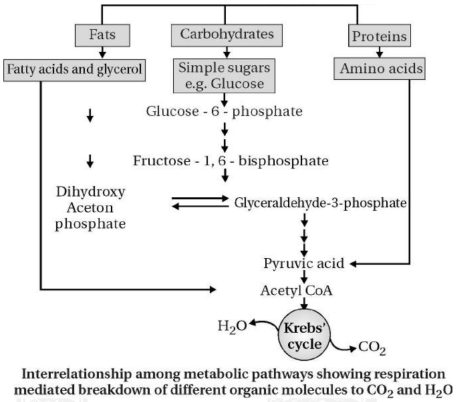
As shown in the figure,fats must first be broken down into glycerol and fatty acids. If fatty acids are to be respired,they are first degraded to acetyl $CoA$ and enter the pathway.
Glycerol enters the pathway after being converted to $PGAL$.
Proteins are degraded by proteases,and the individual amino acids,depending on their structure,enter the pathway at some stage within the Krebs' cycle or as pyruvate or acetyl $CoA$.
Since respiration involves the breakdown of substrates,the respiratory process has traditionally been considered a catabolic process and the respiratory pathway as a catabolic pathway.
However,various compounds are withdrawn from the respiratory pathway for the synthesis of these substrates. For example,when an organism needs to synthesize fatty acids,acetyl $CoA$ is withdrawn from the respiratory pathway.
Hence,the respiratory pathway is involved in both the breakdown (catabolism) and synthesis (anabolism) of fatty acids and proteins.
Because the respiratory pathway is involved in both anabolism and catabolism,it is better to consider it an amphibolic pathway rather than just a catabolic one.
All carbohydrates are usually first converted into glucose before they are used for respiration.
Other substrates can also be respired,but they do not enter the respiratory pathway at the first step.
As shown in the figure,fats must first be broken down into glycerol and fatty acids. If fatty acids are to be respired,they are first degraded to acetyl $CoA$ and enter the pathway.
Glycerol enters the pathway after being converted to $PGAL$.
Proteins are degraded by proteases,and the individual amino acids,depending on their structure,enter the pathway at some stage within the Krebs' cycle or as pyruvate or acetyl $CoA$.
Since respiration involves the breakdown of substrates,the respiratory process has traditionally been considered a catabolic process and the respiratory pathway as a catabolic pathway.
However,various compounds are withdrawn from the respiratory pathway for the synthesis of these substrates. For example,when an organism needs to synthesize fatty acids,acetyl $CoA$ is withdrawn from the respiratory pathway.
Hence,the respiratory pathway is involved in both the breakdown (catabolism) and synthesis (anabolism) of fatty acids and proteins.
Because the respiratory pathway is involved in both anabolism and catabolism,it is better to consider it an amphibolic pathway rather than just a catabolic one.
0 likes
View Solution32
Medium
Describe the metabolic processes of the respiratory pathway.
Solution
(N/A) Glucose is the favored substrate for respiration.
All carbohydrates are usually first converted into glucose before they are used for respiration.
Other substrates can also be respired,but they do not enter the respiratory pathway at the first step.
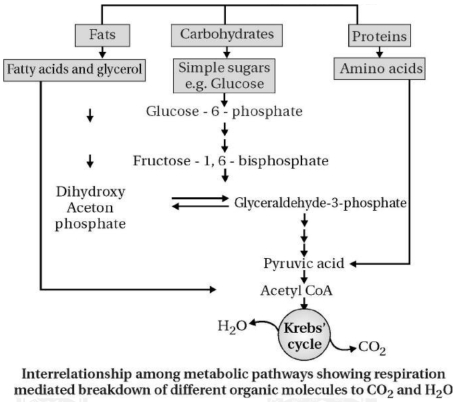
As shown in the figure,fats must first be broken down into glycerol and fatty acids.
If fatty acids are to be respired,they are first degraded to acetyl $CoA$ and then enter the pathway.
Glycerol enters the pathway after being converted to $PGAL$ (phosphoglyceraldehyde).
Proteins are degraded by proteases into individual amino acids,which,depending on their structure,enter the pathway at various stages within the Krebs' cycle or as pyruvate or acetyl $CoA$.
Since respiration involves the breakdown of substrates,it has traditionally been considered a catabolic process,and the respiratory pathway as a catabolic pathway.
However,the respiratory pathway is also involved in the synthesis of fatty acids,where acetyl $CoA$ is withdrawn from the pathway.
Similarly,during the synthesis of proteins,respiratory intermediates form the link.
Breaking down processes within the living organism is catabolism,and synthesis is anabolism.
Because the respiratory pathway is involved in both anabolism and catabolism,it is more appropriate to consider the respiratory pathway as an amphibolic pathway rather than just a catabolic one.
All carbohydrates are usually first converted into glucose before they are used for respiration.
Other substrates can also be respired,but they do not enter the respiratory pathway at the first step.
As shown in the figure,fats must first be broken down into glycerol and fatty acids.
If fatty acids are to be respired,they are first degraded to acetyl $CoA$ and then enter the pathway.
Glycerol enters the pathway after being converted to $PGAL$ (phosphoglyceraldehyde).
Proteins are degraded by proteases into individual amino acids,which,depending on their structure,enter the pathway at various stages within the Krebs' cycle or as pyruvate or acetyl $CoA$.
Since respiration involves the breakdown of substrates,it has traditionally been considered a catabolic process,and the respiratory pathway as a catabolic pathway.
However,the respiratory pathway is also involved in the synthesis of fatty acids,where acetyl $CoA$ is withdrawn from the pathway.
Similarly,during the synthesis of proteins,respiratory intermediates form the link.
Breaking down processes within the living organism is catabolism,and synthesis is anabolism.
Because the respiratory pathway is involved in both anabolism and catabolism,it is more appropriate to consider the respiratory pathway as an amphibolic pathway rather than just a catabolic one.
0 likes
View Solution33
Medium
Give scientific reasons:
$(1)$ Krebs' cycle is an important process.
$(2)$ Sometimes an amphibolic pathway is seen in respiration.
$(1)$ Krebs' cycle is an important process.
$(2)$ Sometimes an amphibolic pathway is seen in respiration.
Solution
(N/A) $(1)$ In aerobic respiration,the Krebs' cycle is essential for the complete oxidation of pyruvate derived from glucose. It generates high-energy electron carriers,specifically $NADH_2$ and $FADH_2$. These carriers subsequently donate electrons to the electron transport chain,facilitating the synthesis of $ATP$ through oxidative phosphorylation. Furthermore,the cycle provides intermediates for various biosynthetic pathways.
$(2)$ Respiration is traditionally viewed as a catabolic process involving the breakdown of glucose. However,it also serves as a source of precursors for the synthesis of other molecules. For instance,when fats are used as respiratory substrates,they are broken down into fatty acids and glycerol. Fatty acids are converted into acetyl $CoA$,which enters the Krebs' cycle. Conversely,when the cell needs to synthesize fatty acids,acetyl $CoA$ is withdrawn from the respiratory pathway. Since the respiratory pathway is involved in both the breakdown (catabolism) and the synthesis (anabolism) of substances,it is referred to as an amphibolic pathway.
$(2)$ Respiration is traditionally viewed as a catabolic process involving the breakdown of glucose. However,it also serves as a source of precursors for the synthesis of other molecules. For instance,when fats are used as respiratory substrates,they are broken down into fatty acids and glycerol. Fatty acids are converted into acetyl $CoA$,which enters the Krebs' cycle. Conversely,when the cell needs to synthesize fatty acids,acetyl $CoA$ is withdrawn from the respiratory pathway. Since the respiratory pathway is involved in both the breakdown (catabolism) and the synthesis (anabolism) of substances,it is referred to as an amphibolic pathway.
0 likes
View Solution34
MediumMCQ
Write the functional characteristics of endodermal cells.
A
They are impermeable to all solutes.
B
They contain transport proteins that regulate solute movement into the xylem.
C
They are dead cells that provide structural support.
D
They actively synthesize starch for long-term storage.
Solution
(B) $\Rightarrow$ Like all cells,the endodermal cells have many transport proteins embedded in their plasma membrane.
$\Rightarrow$ They allow some solutes to cross the membrane,but not others,due to the presence of the Casparian strip and selective transport proteins.
$\Rightarrow$ Transport proteins of endodermal cells act as control points,where a plant adjusts the quantity and types of solutes that reach the xylem.
$\Rightarrow$ They allow some solutes to cross the membrane,but not others,due to the presence of the Casparian strip and selective transport proteins.
$\Rightarrow$ Transport proteins of endodermal cells act as control points,where a plant adjusts the quantity and types of solutes that reach the xylem.
0 likes
View Solution35
Medium
How are photosynthesis and respiration related to each other?
Solution
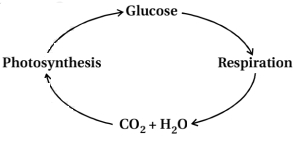
(N/A) Photosynthesis and respiration are complementary processes that are fundamentally linked in the energy cycle of living organisms.
$1$. In photosynthesis, plants capture solar energy to synthesize glucose from $CO_2$ and $H_2O$. The chemical equation is: $6CO_2 + 12H_2O + \text{Light Energy} \rightarrow C_6H_{12}O_6 + 6O_2 + 6H_2O$.
$2$. In respiration, the glucose produced during photosynthesis is oxidized to release energy in the form of $ATP$. The chemical equation is: $C_6H_{12}O_6 + 6O_2 \rightarrow 6CO_2 + 6H_2O + \text{Energy (ATP)}$.
$3$. These processes are interdependent: the products of photosynthesis ($glucose$ and $O_2$) serve as the reactants for respiration, while the products of respiration ($CO_2$ and $H_2O$) are utilized by plants as raw materials for photosynthesis. This creates a continuous cycle of energy and matter transformation.
$1$. In photosynthesis, plants capture solar energy to synthesize glucose from $CO_2$ and $H_2O$. The chemical equation is: $6CO_2 + 12H_2O + \text{Light Energy} \rightarrow C_6H_{12}O_6 + 6O_2 + 6H_2O$.
$2$. In respiration, the glucose produced during photosynthesis is oxidized to release energy in the form of $ATP$. The chemical equation is: $C_6H_{12}O_6 + 6O_2 \rightarrow 6CO_2 + 6H_2O + \text{Energy (ATP)}$.
$3$. These processes are interdependent: the products of photosynthesis ($glucose$ and $O_2$) serve as the reactants for respiration, while the products of respiration ($CO_2$ and $H_2O$) are utilized by plants as raw materials for photosynthesis. This creates a continuous cycle of energy and matter transformation.
0 likes
View Solution36
Medium
Why is the respiratory pathway referred to as an amphibolic pathway?
Solution
(N/A) Glucose is the favoured substrate for respiration.
All carbohydrates are usually first converted into glucose before they are used for respiration.
Other substrates can also be respired,but they do not enter the respiratory pathway at the first step.
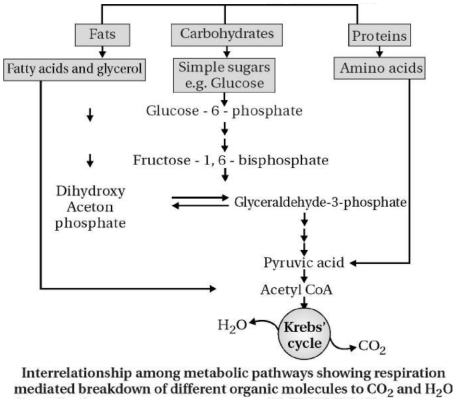
As shown in the figure,fats need to be broken down into glycerol and fatty acids first.
If fatty acids are to be respired,they are first degraded to acetyl $CoA$ and enter the pathway.
Glycerol enters the pathway after being converted to $PGAL$.
Proteins are degraded by proteases,and the individual amino acids,depending on their structure,enter the pathway at some stage within the Krebs' cycle or as pyruvate or acetyl $CoA$.
Since respiration involves the breakdown of substrates,the respiratory process has traditionally been considered a catabolic process and the respiratory pathway as a catabolic pathway.
However,compounds are also withdrawn from the respiratory pathway for the synthesis of these substrates.
When the organism needs to synthesize fatty acids,acetyl $CoA$ is withdrawn from the respiratory pathway for it.
Similarly,during the breakdown and synthesis of proteins,respiratory intermediates form the link.
Breaking down processes within the living organism is catabolism,and synthesis is anabolism.
Because the respiratory pathway is involved in both anabolism and catabolism,it is better to consider the respiratory pathway as an amphibolic pathway rather than just a catabolic one.
All carbohydrates are usually first converted into glucose before they are used for respiration.
Other substrates can also be respired,but they do not enter the respiratory pathway at the first step.
As shown in the figure,fats need to be broken down into glycerol and fatty acids first.
If fatty acids are to be respired,they are first degraded to acetyl $CoA$ and enter the pathway.
Glycerol enters the pathway after being converted to $PGAL$.
Proteins are degraded by proteases,and the individual amino acids,depending on their structure,enter the pathway at some stage within the Krebs' cycle or as pyruvate or acetyl $CoA$.
Since respiration involves the breakdown of substrates,the respiratory process has traditionally been considered a catabolic process and the respiratory pathway as a catabolic pathway.
However,compounds are also withdrawn from the respiratory pathway for the synthesis of these substrates.
When the organism needs to synthesize fatty acids,acetyl $CoA$ is withdrawn from the respiratory pathway for it.
Similarly,during the breakdown and synthesis of proteins,respiratory intermediates form the link.
Breaking down processes within the living organism is catabolism,and synthesis is anabolism.
Because the respiratory pathway is involved in both anabolism and catabolism,it is better to consider the respiratory pathway as an amphibolic pathway rather than just a catabolic one.
0 likes
View Solution37
Medium
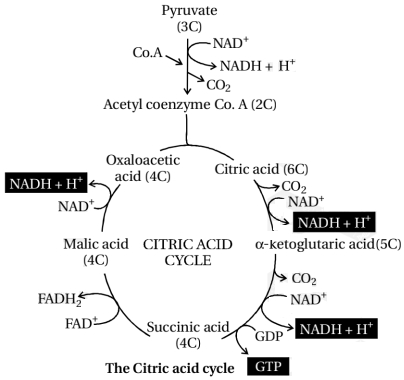
Respiratory pathway is believed to be a catabolic pathway. However,the nature of the $TCA$ cycle is amphibolic. Explain.
Solution
(N/A) The respiratory pathway is traditionally considered a catabolic pathway because it involves the breakdown of complex organic molecules like glucose and fats to release energy in the form of $ATP$.
However,the $TCA$ cycle (Tricarboxylic Acid cycle) is termed an amphibolic pathway because it serves both catabolic and anabolic functions.
$1$. Catabolic role: It breaks down acetyl $CoA$ (derived from carbohydrates,fats,and proteins) into $CO_2$ and water,generating energy-rich molecules like $NADH$,$FADH_2$,and $GTP/ATP$.
$2$. Anabolic role: Many intermediates of the $TCA$ cycle are used as precursors for the biosynthesis of other essential cellular components. For example:
- Acetyl $CoA$ is used for the synthesis of fatty acids,steroids,carotenoids,and terpenes.
- $\alpha$-ketoglutarate is a precursor for the synthesis of amino acids like glutamate.
- Oxaloacetate is used for the synthesis of aspartate and other amino acids.
- Succinyl $CoA$ is used in the synthesis of chlorophyll and cytochromes.
Since the cycle involves both the breakdown of substrates (catabolism) and the synthesis of precursors for other biomolecules (anabolism),it is correctly described as an amphibolic pathway.
However,the $TCA$ cycle (Tricarboxylic Acid cycle) is termed an amphibolic pathway because it serves both catabolic and anabolic functions.
$1$. Catabolic role: It breaks down acetyl $CoA$ (derived from carbohydrates,fats,and proteins) into $CO_2$ and water,generating energy-rich molecules like $NADH$,$FADH_2$,and $GTP/ATP$.
$2$. Anabolic role: Many intermediates of the $TCA$ cycle are used as precursors for the biosynthesis of other essential cellular components. For example:
- Acetyl $CoA$ is used for the synthesis of fatty acids,steroids,carotenoids,and terpenes.
- $\alpha$-ketoglutarate is a precursor for the synthesis of amino acids like glutamate.
- Oxaloacetate is used for the synthesis of aspartate and other amino acids.
- Succinyl $CoA$ is used in the synthesis of chlorophyll and cytochromes.
Since the cycle involves both the breakdown of substrates (catabolism) and the synthesis of precursors for other biomolecules (anabolism),it is correctly described as an amphibolic pathway.
0 likes
View Solution38
MediumMCQ
Maximum amount of energy/$ATP$ is liberated on the oxidation of:
A
Fats
B
Proteins
C
Starch
D
Vitamins
Solution
(A) The oxidation of fats yields the maximum amount of energy per unit mass compared to carbohydrates (starch) and proteins. Fats are highly reduced molecules,and their complete oxidation through the process of beta-oxidation and the Krebs cycle releases a significantly higher number of $ATP$ molecules (approximately $9.4 \ kcal/g$) compared to carbohydrates $(4.1 \ kcal/g)$ or proteins $(4.1 \ kcal/g)$.
0 likes
View Solution39
MediumMCQ
Before entering into the respiratory pathway,fats break down into:
A
Fatty acid and glycerol
B
Fatty acid and ascorbic acid
C
Fatty acid and amino acid
D
Glucose and glycerol
Solution
(A) Fats are complex molecules that must be broken down into simpler components before they can be utilized in cellular respiration. They are hydrolyzed by the enzyme lipase into fatty acids and glycerol. Glycerol is converted into $DHAP$ (dihydroxyacetone phosphate),which enters the glycolytic pathway,while fatty acids are converted into acetyl-$CoA$ through $\beta$-oxidation and enter the $Krebs$ cycle.
0 likes
View Solution40
MediumMCQ
Which of the following substrates can enter into the respiration process?
A
Glucose
B
Amino acid
C
Fatty acid
D
All of these
Solution
(D) The respiratory pathway is involved in both anabolism and catabolism,which is why it is regarded as an amphibolic pathway.
In the respiratory pathway,not only glucose but also amino acids and fatty acids can be used as respiratory substrates or intermediate substances.
In the respiratory pathway,not only glucose but also amino acids and fatty acids can be used as respiratory substrates or intermediate substances.
0 likes
View Solution41
MediumMCQ
Protein cannot be used directly as a respiratory substrate; it breaks down into which of the following?
A
Amino acid
B
Fatty acid
C
Glycolytic acid
D
Fumaric acid
Solution
(A) Proteins are complex macromolecules that cannot be directly utilized in the respiratory pathway.
They are first broken down by proteases into their constituent monomers,which are amino acids.
These amino acids are then deaminated and enter the respiratory pathway at various stages,such as pyruvate,acetyl-CoA,or intermediates of the Krebs cycle,to be oxidized for energy production.
They are first broken down by proteases into their constituent monomers,which are amino acids.
These amino acids are then deaminated and enter the respiratory pathway at various stages,such as pyruvate,acetyl-CoA,or intermediates of the Krebs cycle,to be oxidized for energy production.
0 likes
View Solution42
MediumMCQ
When acting as a respiratory substrate,which of the following would be broken down to acetyl Co-$A$?
A
Fatty acid
B
Protein
C
Carbohydrate
D
All of these
Solution
(D) Respiratory substrates are organic substances that are oxidized during respiration to release energy.
Carbohydrates are first broken down into glucose,which enters glycolysis to form pyruvate,which is then converted into acetyl Co-$A$.
Fats are broken down into fatty acids and glycerol; fatty acids undergo $\beta$-oxidation to form acetyl Co-$A$.
Proteins are broken down into amino acids,which are deaminated and converted into various intermediates of the Krebs cycle,including acetyl Co-$A$.
Therefore,all of these substrates can be broken down into acetyl Co-$A$ before entering the respiratory pathway.
Carbohydrates are first broken down into glucose,which enters glycolysis to form pyruvate,which is then converted into acetyl Co-$A$.
Fats are broken down into fatty acids and glycerol; fatty acids undergo $\beta$-oxidation to form acetyl Co-$A$.
Proteins are broken down into amino acids,which are deaminated and converted into various intermediates of the Krebs cycle,including acetyl Co-$A$.
Therefore,all of these substrates can be broken down into acetyl Co-$A$ before entering the respiratory pathway.
0 likes
View Solution43
MediumMCQ
Before entering the respiratory pathway,amino acids are:
A
Decarboxylated
B
Hydrolysed
C
Deaminated
D
Phosphorylated
Solution
(C) Before amino acids can enter the respiratory pathway to be oxidized for energy,they must first undergo deamination. Deamination is the process of removing the amino group $(-NH_2)$ from the amino acid molecule. The remaining carbon skeleton can then be converted into various intermediates of the Krebs cycle (such as pyruvate or acetyl-CoA) to participate in cellular respiration.
0 likes
View Solution44
MediumMCQ
Read the following statements and choose the correct option:
A
Respiration is purely a catabolic process.
B
Reduction of food results in the release of energy.
C
Chemical energy is broken down during respiration to release energy.
D
Fungi can make their own food and derive the energy by respiration.
Solution
(C) Respiration is an amphibolic process,not purely catabolic. Food is oxidized,not reduced,to release energy. Fungi are heterotrophs and cannot make their own food. The correct statement is that chemical energy stored in the bonds of respiratory substrates is broken down during respiration to release energy in the form of $ATP$.
0 likes
View Solution45
MediumMCQ
Maximum energy can be obtained from the oxidation of which respiratory substrate?
A
Fat
B
Proteins
C
Carbohydrates
D
Organic acid
Solution
(A) The energy content of respiratory substrates varies. Fats provide the highest amount of energy per unit mass upon oxidation,yielding approximately $9 \ kcal/g$,whereas carbohydrates and proteins yield approximately $4 \ kcal/g$. Therefore,fats are the most energy-dense respiratory substrates.
0 likes
View Solution46
MediumMCQ
The intermediate common to both protein and carbohydrate oxidation is:
A
Pyruvate
B
Glycerol
C
Oxaloacetate
D
Succinate
Solution
(A) The respiratory pathway is an amphibolic pathway because it involves both catabolism and anabolism. Carbohydrates are broken down into glucose,which enters the glycolytic pathway to form $Pyruvate$. Proteins are degraded by proteases into amino acids,which are then deaminated to enter the respiratory pathway at various stages,including $Pyruvate$ or other intermediates of the $Krebs$ cycle. $Pyruvate$ serves as a key junction point for the oxidation of both carbohydrates and proteins.
0 likes
View Solution47
MediumMCQ
Common molecule formed from all food stuffs during aerobic respiration is
A
Glucose
B
$PGAL$
C
Pyruvic acid
D
Acetyl $CoA$
Solution
(D) During aerobic respiration,all major food components such as carbohydrates,proteins,and fats are broken down into simpler intermediates.
Carbohydrates are converted into glucose and then into pyruvic acid,while proteins are broken down into amino acids and fats into fatty acids and glycerol.
Ultimately,these diverse pathways converge as all these food stuffs are converted into Acetyl $CoA$ before entering the Kreb's cycle ($TCA$ cycle).
Therefore,Acetyl $CoA$ acts as the common metabolic intermediate for all food stuffs.
Carbohydrates are converted into glucose and then into pyruvic acid,while proteins are broken down into amino acids and fats into fatty acids and glycerol.
Ultimately,these diverse pathways converge as all these food stuffs are converted into Acetyl $CoA$ before entering the Kreb's cycle ($TCA$ cycle).
Therefore,Acetyl $CoA$ acts as the common metabolic intermediate for all food stuffs.
0 likes
View SolutionRespiration in Plants — Amphibolic Pathway · Frequently Asked Questions
1Are these Respiration in Plants questions useful for JEE and NEET?
Yes. All questions in this section are mapped to JEE Main and NEET exam patterns. Previous year questions from JEE Main, NEET, GUJCET and state-level exams are included with full solutions.
2Can I switch to Hindi or Gujarati for these questions?
Yes. Use the language tabs in the hero section or the sidebar to view the same questions and solutions in English, Hindi or Gujarati.
3How do I generate a question paper from this subtopic?
Use the Vedclass Exam Paper Generator — select the chapter and subtopic, set difficulty, and generate Sets A, B, C, D automatically. First 3 chapters of every subject are free.
Vedclass Products
For Students
Vedclass Test Series
Mock tests in real JEE/NEET style with performance analysis. 5-day free trial.
Start Free TrialFor Teachers
Exam Paper Generator
Generate Set A/B/C/D papers from this chapter in 2 minutes. 3 chapters free.
Try FreeFor Institutes
Online Exam Module
Live online exams with unlimited students, 360° analytics & white-label branding.
See DemoFor Teachers & Institutes
Generate a Respiration in Plants Exam Paper in 2 Minutes
Select subtopic & difficulty — Sets A, B, C, D auto-generated with No Repeat logic.
First 3 chapters of every subject are free — no payment required.