
A English
Anaerobic respiration Questions in English
Class 11 Biology · Respiration in Plants · Anaerobic respiration
160+
Questions
English
Language
100%
With Solutions
Showing 49 of 160 questions in English
51
EasyMCQ
The first type of respiration that arose on Earth was:
A
Anaerobic
B
Aerobic
C
Both $(a)$ and $(b)$
D
Cellular respiration
Solution
(A) The early Earth's atmosphere was reducing in nature and lacked free molecular oxygen $(O_2)$.
As the first primitive life forms evolved in this environment,they relied on anaerobic processes to generate energy.
Therefore,the first type of respiration to arise was anaerobic respiration,which does not require oxygen.
As the first primitive life forms evolved in this environment,they relied on anaerobic processes to generate energy.
Therefore,the first type of respiration to arise was anaerobic respiration,which does not require oxygen.
0 likes
View Solution52
MediumMCQ
When sugar is used as a raw material, the end products obtained from fermentation are ......... .
A
Alcohol and $CO_2$
B
Alcohol, pyruvate
C
$CO_2$
D
Alcohol
Solution
(A) Fermentation is an anaerobic process where glucose (sugar) is incompletely oxidized into ethanol and carbon dioxide in the presence of enzymes like zymase, which are produced by yeast.
The chemical equation for alcoholic fermentation is: $C_6H_{12}O_6 \rightarrow 2C_2H_5OH + 2CO_2 + \text{Energy}$.
Therefore, the end products of fermentation using sugar as a raw material are alcohol (ethanol) and $CO_2$.
The chemical equation for alcoholic fermentation is: $C_6H_{12}O_6 \rightarrow 2C_2H_5OH + 2CO_2 + \text{Energy}$.
Therefore, the end products of fermentation using sugar as a raw material are alcohol (ethanol) and $CO_2$.
0 likes
View Solution53
MediumMCQ
Anaerobic respiration occurs in the ......
A
Ribosomes
B
Nucleus
C
Cytoplasm
D
Vacuole
Solution
(C) Anaerobic respiration is a process of cellular respiration that occurs in the absence of oxygen.
In eukaryotic cells,the process of glycolysis,which is the initial stage of both aerobic and anaerobic respiration,takes place in the cytoplasm.
Since anaerobic respiration (such as fermentation) relies on the products of glycolysis and does not involve the mitochondria,the entire process occurs within the cytoplasm of the cell.
In eukaryotic cells,the process of glycolysis,which is the initial stage of both aerobic and anaerobic respiration,takes place in the cytoplasm.
Since anaerobic respiration (such as fermentation) relies on the products of glycolysis and does not involve the mitochondria,the entire process occurs within the cytoplasm of the cell.
0 likes
View Solution54
MediumMCQ
Fermentation is a/an ...... process.
A
Anaerobic respiration
B
Incomplete oxidation
C
Excretory process
D
None of the above
Solution
(A) Fermentation is a type of anaerobic respiration where glucose is incompletely oxidized into products like ethanol or lactic acid. Since it occurs in the absence of oxygen and involves the partial breakdown of respiratory substrates,both $A$ and $B$ are technically correct descriptions. However,in the context of standard biology textbooks,fermentation is primarily defined as a form of anaerobic respiration. Therefore,$A$ is the most appropriate answer.
0 likes
View Solution55
EasyMCQ
The number of $ATP$ molecules produced in anaerobic respiration is .........
A
$1$
B
$2$
C
$3$
D
$8$
Solution
(B) In anaerobic respiration (fermentation),glucose is incompletely oxidized into ethanol and $CO_2$ (in yeast) or lactic acid (in muscles).
During this process,glycolysis occurs,which yields a net gain of $2$ $ATP$ molecules per glucose molecule.
Since the Krebs cycle and electron transport system do not occur in anaerobic respiration,no additional $ATP$ is produced.
Therefore,the total number of $ATP$ molecules produced is $2$.
During this process,glycolysis occurs,which yields a net gain of $2$ $ATP$ molecules per glucose molecule.
Since the Krebs cycle and electron transport system do not occur in anaerobic respiration,no additional $ATP$ is produced.
Therefore,the total number of $ATP$ molecules produced is $2$.
0 likes
View Solution56
MediumMCQ
Which of the following is the most common organism that can respire even in the absence of $O_2$?
A
Fish
B
Yeast
C
Potato
D
Chlorella
Solution
(B) Yeast $(Saccharomyces)$ $\text{ } cerevisiae$ is a facultative anaerobe.
It is a unicellular fungus that can perform fermentation in the absence of $O_2$ to produce ethanol and $CO_2$.
This process is known as anaerobic respiration or alcoholic fermentation.
Therefore, yeast is the most common organism among the given options that can respire without $O_2$.
It is a unicellular fungus that can perform fermentation in the absence of $O_2$ to produce ethanol and $CO_2$.
This process is known as anaerobic respiration or alcoholic fermentation.
Therefore, yeast is the most common organism among the given options that can respire without $O_2$.
0 likes
View Solution57
EasyMCQ
The inhibitory effect of $O_2$ on the rate of anaerobic respiration is known as:
A
Warburg effect
B
Pasteur effect
C
Emerson effect
D
Oxygen effect
Solution
(B) The Pasteur effect is the inhibitory effect of oxygen on the process of fermentation (anaerobic respiration). When oxygen is introduced to an anaerobic culture,the rate of glucose consumption decreases significantly because the organism switches to the more efficient aerobic respiration pathway,which produces more $ATP$ per molecule of glucose.
0 likes
View Solution58
MediumMCQ
In alcoholic fermentation,which of the following statements is correct regarding electron transfer?
A
Triose phosphate is the electron donor,while acetaldehyde is the electron acceptor.
B
Triose phosphate is the electron donor,while pyruvic acid is the electron acceptor.
C
Triose phosphate is the electron donor,while acetyl $CoA$ is the electron acceptor.
D
Oxygen is the electron acceptor.
Solution
(A) In alcoholic fermentation,glucose is broken down into two molecules of pyruvic acid through glycolysis,producing $NADH$.
In the subsequent steps,pyruvic acid is converted into acetaldehyde by the enzyme pyruvate decarboxylase.
Finally,acetaldehyde acts as the terminal electron acceptor,receiving electrons from $NADH$ (via the oxidation of triose phosphate intermediates) to be reduced into ethanol by the enzyme alcohol dehydrogenase.
Therefore,triose phosphate acts as the electron donor (indirectly via $NADH$) and acetaldehyde acts as the electron acceptor.
In the subsequent steps,pyruvic acid is converted into acetaldehyde by the enzyme pyruvate decarboxylase.
Finally,acetaldehyde acts as the terminal electron acceptor,receiving electrons from $NADH$ (via the oxidation of triose phosphate intermediates) to be reduced into ethanol by the enzyme alcohol dehydrogenase.
Therefore,triose phosphate acts as the electron donor (indirectly via $NADH$) and acetaldehyde acts as the electron acceptor.
0 likes
View Solution59
EasyMCQ
Anaerobic respiration occurs in .........
A
Ribosomes
B
Nucleus
C
Cytoplasm
D
Vacuole
Solution
(C) Anaerobic respiration is a type of respiration that does not require oxygen. In eukaryotic cells,the process of glycolysis,which is the first step of both aerobic and anaerobic respiration,takes place in the cytoplasm. Since anaerobic respiration (such as fermentation) involves the breakdown of glucose into ethanol or lactic acid without entering the mitochondria,the entire process occurs within the cytoplasm.
0 likes
View Solution60
EasyMCQ
The end product of fermentation is ......... .
A
$O_2$
B
$N_2O$
C
$H_2O$
D
$C_2H_5OH$
Solution
(D) Fermentation is an anaerobic process where glucose is partially oxidized. In yeast,fermentation results in the production of ethanol $(C_2H_5OH)$ and carbon dioxide $(CO_2)$. Therefore,$C_2H_5OH$ is one of the primary end products of alcoholic fermentation.
0 likes
View Solution61
EasyMCQ
What is produced as a result of the incomplete breakdown of sugar in anaerobic respiration?
A
Fructose and water
B
Glucose and carbon dioxide
C
Alcohol and $CO_2$
D
Water and $CO_2$
Solution
(C) Anaerobic respiration is a type of cellular respiration that occurs in the absence of oxygen.
In many microorganisms like yeast, sugar (glucose) undergoes incomplete breakdown through fermentation.
The chemical equation for this process is: $C_6H_{12}O_6 \rightarrow 2C_2H_5OH + 2CO_2 + \text{Energy}$.
As shown in the equation, the products formed are ethanol (alcohol) and carbon dioxide $(CO_2)$.
Therefore, the correct option is $C$.
In many microorganisms like yeast, sugar (glucose) undergoes incomplete breakdown through fermentation.
The chemical equation for this process is: $C_6H_{12}O_6 \rightarrow 2C_2H_5OH + 2CO_2 + \text{Energy}$.
As shown in the equation, the products formed are ethanol (alcohol) and carbon dioxide $(CO_2)$.
Therefore, the correct option is $C$.
0 likes
View Solution62
MediumMCQ
An energy-releasing metabolic process in which a substrate is oxidized without an external electron acceptor is called ........
A
Glycolysis
B
Fermentation
C
Aerobic respiration
D
Photorespiration
Solution
(B) Fermentation is an anaerobic metabolic process that converts sugar into acids,gases,or alcohol in yeast,bacteria,and oxygen-starved muscle cells.
In this process,the oxidation of the substrate occurs without the involvement of an external electron acceptor,unlike aerobic respiration where oxygen acts as the final electron acceptor.
Therefore,the correct answer is $B$.
In this process,the oxidation of the substrate occurs without the involvement of an external electron acceptor,unlike aerobic respiration where oxygen acts as the final electron acceptor.
Therefore,the correct answer is $B$.
0 likes
View Solution63
EasyMCQ
In anaerobic respiration,the respiration of seeds occurs in ......... .
A
Presence of $O_2$
B
Presence of $CO_2$
C
Absence of $O_2$
D
Absence of $CO_2$
Solution
(C) Anaerobic respiration is a type of cellular respiration that occurs in the absence of oxygen $(O_2)$.
In this process,organic molecules like glucose are incompletely oxidized to produce energy.
Since seeds can undergo anaerobic respiration when oxygen is limited (e.g.,in waterlogged soil),the correct condition is the absence of $O_2$.
In this process,organic molecules like glucose are incompletely oxidized to produce energy.
Since seeds can undergo anaerobic respiration when oxygen is limited (e.g.,in waterlogged soil),the correct condition is the absence of $O_2$.
0 likes
View Solution64
EasyMCQ
Which of the following is a product of glucose fermentation by yeast?
A
$C_6H_{12}O_6$
B
$C_2H_5OH$
C
$(C_6H_{10}O_5)_n$
D
$CH_2OH$
Solution
(B) In yeast, fermentation is an anaerobic process where glucose is converted into ethanol and carbon dioxide.
The chemical equation for the fermentation of glucose by yeast is:
$C_6H_{12}O_6 \rightarrow 2C_2H_5OH + 2CO_2 + \text{Energy}$.
Here, $C_2H_5OH$ represents ethanol, which is the primary organic product of this process.
Therefore, the correct option is $B$.
The chemical equation for the fermentation of glucose by yeast is:
$C_6H_{12}O_6 \rightarrow 2C_2H_5OH + 2CO_2 + \text{Energy}$.
Here, $C_2H_5OH$ represents ethanol, which is the primary organic product of this process.
Therefore, the correct option is $B$.
0 likes
View Solution65
MediumMCQ
The conversion of pyruvic acid into ethyl alcohol is mediated by which of the following enzymes?
A
Phosphatase
B
Dehydrogenase
C
Decarboxylase and Dehydrogenase
D
Catalase
Solution
(C) In anaerobic respiration (fermentation) in yeast, pyruvic acid is converted into ethyl alcohol and $CO_2$ through two main steps:
$1$. Pyruvic acid is first decarboxylated to acetaldehyde by the enzyme $pyruvate \text{ } decarboxylase$.
$2$. Acetaldehyde is then reduced to ethyl alcohol (ethanol) by the enzyme $alcohol \text{ } dehydrogenase$, using $NADH + H^+$ as a reducing agent.
Therefore, both $pyruvate \text{ } decarboxylase$ and $alcohol \text{ } dehydrogenase$ are involved in this process.
$1$. Pyruvic acid is first decarboxylated to acetaldehyde by the enzyme $pyruvate \text{ } decarboxylase$.
$2$. Acetaldehyde is then reduced to ethyl alcohol (ethanol) by the enzyme $alcohol \text{ } dehydrogenase$, using $NADH + H^+$ as a reducing agent.
Therefore, both $pyruvate \text{ } decarboxylase$ and $alcohol \text{ } dehydrogenase$ are involved in this process.
0 likes
View Solution66
MediumMCQ
The enzyme involved in alcoholic fermentation is .........
A
Pyruvate decarboxylase
B
Lactate dehydrogenase
C
Hexo isomerase
D
Both decarboxylase and dehydrogenase
Solution
(D) In alcoholic fermentation,$Pyruvate$ is converted into $Ethanol$ and $CO_2$.
This process involves two main steps catalyzed by specific enzymes:
$1$. $Pyruvate$ is converted to $Acetaldehyde$ by the enzyme $Pyruvate$ $decarboxylase$.
$2$. $Acetaldehyde$ is then reduced to $Ethanol$ by the enzyme $Alcohol$ $dehydrogenase$.
Therefore,both $Pyruvate$ $decarboxylase$ and $Alcohol$ $dehydrogenase$ are involved in the process of alcoholic fermentation.
This process involves two main steps catalyzed by specific enzymes:
$1$. $Pyruvate$ is converted to $Acetaldehyde$ by the enzyme $Pyruvate$ $decarboxylase$.
$2$. $Acetaldehyde$ is then reduced to $Ethanol$ by the enzyme $Alcohol$ $dehydrogenase$.
Therefore,both $Pyruvate$ $decarboxylase$ and $Alcohol$ $dehydrogenase$ are involved in the process of alcoholic fermentation.
0 likes
View Solution67
EasyMCQ
Which of the following exhibits anaerobic respiration?
A
Earthworm
B
Rabbit
C
Echinoderm
D
Tapeworm
Solution
(D) Anaerobic respiration is a type of respiration that occurs in the absence of oxygen.
Among the given options,the tapeworm ($Taenia$ $solium$) is an endoparasite that lives in the intestine of its host.
Since the environment inside the intestine is largely devoid of oxygen,the tapeworm has adapted to perform anaerobic respiration to generate energy.
Earthworms,rabbits,and echinoderms are aerobic organisms that require oxygen for their metabolic processes.
Among the given options,the tapeworm ($Taenia$ $solium$) is an endoparasite that lives in the intestine of its host.
Since the environment inside the intestine is largely devoid of oxygen,the tapeworm has adapted to perform anaerobic respiration to generate energy.
Earthworms,rabbits,and echinoderms are aerobic organisms that require oxygen for their metabolic processes.
0 likes
View Solution68
MediumMCQ
When two molecules of lactic acid are produced from glucose through anaerobic respiration,it results in:
A
Loss of $1 \ ATP$
B
Loss of $3 \ ATP$
C
Loss of $6 \ ATP$
D
None of these
Solution
(D) In anaerobic respiration (lactic acid fermentation),one molecule of glucose $(C_6H_{12}O_6)$ is broken down into two molecules of lactic acid $(C_3H_6O_3)$.
During glycolysis,which is the first step of this process,$2 \ ATP$ molecules are produced as a net gain.
Since no further $ATP$ is produced during the conversion of pyruvic acid to lactic acid,the net gain of the entire process is $2 \ ATP$.
None of the options provided ($1 \ ATP$ loss,$3 \ ATP$ loss,or $6 \ ATP$ loss) represent the actual energy yield or loss.
Therefore,the correct answer is 'None of these'.
During glycolysis,which is the first step of this process,$2 \ ATP$ molecules are produced as a net gain.
Since no further $ATP$ is produced during the conversion of pyruvic acid to lactic acid,the net gain of the entire process is $2 \ ATP$.
None of the options provided ($1 \ ATP$ loss,$3 \ ATP$ loss,or $6 \ ATP$ loss) represent the actual energy yield or loss.
Therefore,the correct answer is 'None of these'.
0 likes
View Solution69
MediumMCQ
Fermentation is carried out by $.........$.
A
All bacteria
B
All fungi
C
Some fungi,some bacteria
D
All microorganisms
Solution
(C) Fermentation is an anaerobic process where organic compounds are broken down by microorganisms.
It is not a universal process for all microorganisms.
For example,yeast ($Saccharomyces$ $cerevisiae$),which is a fungus,performs alcoholic fermentation.
Many bacteria,such as $Lactobacillus$,perform lactic acid fermentation.
However,many other bacteria and fungi are obligate aerobes and cannot perform fermentation.
Therefore,fermentation is carried out by only some fungi and some bacteria.
It is not a universal process for all microorganisms.
For example,yeast ($Saccharomyces$ $cerevisiae$),which is a fungus,performs alcoholic fermentation.
Many bacteria,such as $Lactobacillus$,perform lactic acid fermentation.
However,many other bacteria and fungi are obligate aerobes and cannot perform fermentation.
Therefore,fermentation is carried out by only some fungi and some bacteria.
0 likes
View Solution70
MediumMCQ
Which equation represents fermentation?
A
$C_6H_{12}O_6 + 6O_2 \rightarrow 6CO_2 + 6H_2O + 673 \text{ kcal}$
B
$C_6H_{12}O_6 \rightarrow 2C_2H_5OH + 2CO_2$
C
$6CO_2 + 12H_2O \rightarrow C_6H_{12}O_6 + 6H_2O + 6O_2$
D
$6CO_2 + 6H_2O \xrightarrow{\text{light, chlorophyll}} C_6H_{12}O_6 + 6O_2$
Solution
(B) Fermentation is a type of anaerobic respiration where glucose is incompletely broken down into ethanol and carbon dioxide in the absence of oxygen.
The chemical equation for alcoholic fermentation is: $C_6H_{12}O_6 \rightarrow 2C_2H_5OH + 2CO_2$.
Option $A$ represents aerobic respiration.
Option $C$ and $D$ represent photosynthesis.
Therefore,option $B$ is the correct representation of fermentation.
The chemical equation for alcoholic fermentation is: $C_6H_{12}O_6 \rightarrow 2C_2H_5OH + 2CO_2$.
Option $A$ represents aerobic respiration.
Option $C$ and $D$ represent photosynthesis.
Therefore,option $B$ is the correct representation of fermentation.
0 likes
View Solution71
MediumMCQ
Alcoholic fermentation occurs in the presence of which enzyme?
A
Maltase
B
Zymase
C
Amylase
D
Invertase
Solution
(B) Alcoholic fermentation is a biological process in which sugars such as glucose,fructose,and sucrose are converted into cellular energy and thereby produce ethanol and carbon dioxide as metabolic waste products.
This process is carried out by yeast and some bacteria.
The enzyme complex responsible for this conversion is known as $Zymase$.
$Zymase$ catalyzes the fermentation of sugar into ethanol and carbon dioxide.
This process is carried out by yeast and some bacteria.
The enzyme complex responsible for this conversion is known as $Zymase$.
$Zymase$ catalyzes the fermentation of sugar into ethanol and carbon dioxide.
0 likes
View Solution72
EasyMCQ
Anaerobic respiration was first demonstrated by whom?
A
Pasteur
B
Kostychev
C
Klein
D
Pfeffer
Solution
(A) Anaerobic respiration,also known as fermentation,was first demonstrated by Louis Pasteur. He observed that yeast could ferment sugar in the absence of oxygen,a phenomenon he famously described as 'life without air'. Therefore,the correct option is $A$.
0 likes
View Solution73
MediumMCQ
Which type of respiration do methanogenic bacteria exhibit?
A
Aerobic
B
Anaerobic
C
Both $A$ and $B$
D
Aerobic in the presence of $O_2$ and anaerobic in the absence of $O_2$
Solution
(B) Methanogens are a group of bacteria that produce methane $(CH_4)$ as a metabolic byproduct in anoxic (oxygen-free) conditions. These bacteria are strictly anaerobic,meaning they can only survive and perform respiration in the absence of oxygen. They are commonly found in the rumen of cattle and in anaerobic sludge during sewage treatment.
0 likes
View Solution74
MediumMCQ
In which one of the following processes $CO_2$ is not released?
A
Aerobic respiration in plants
B
Aerobic respiration in animals
C
Alcoholic fermentation
D
Lactate fermentation
Solution
(D) The correct answer is $(d)$.
Anaerobic respiration or fermentation is of two main types: lactate fermentation and alcoholic (ethanol) fermentation.
In lactate fermentation,pyruvic acid produced during glycolysis is directly reduced by $NADH$ to form lactic acid. This process does not involve the decarboxylation step,and therefore,no $CO_2$ is released.
In contrast,alcoholic fermentation involves the conversion of pyruvate to acetaldehyde and then to ethanol,a process that releases $CO_2$.
Aerobic respiration in both plants and animals involves the Krebs cycle and the electron transport system,which release $CO_2$ as a byproduct.
Anaerobic respiration or fermentation is of two main types: lactate fermentation and alcoholic (ethanol) fermentation.
In lactate fermentation,pyruvic acid produced during glycolysis is directly reduced by $NADH$ to form lactic acid. This process does not involve the decarboxylation step,and therefore,no $CO_2$ is released.
In contrast,alcoholic fermentation involves the conversion of pyruvate to acetaldehyde and then to ethanol,a process that releases $CO_2$.
Aerobic respiration in both plants and animals involves the Krebs cycle and the electron transport system,which release $CO_2$ as a byproduct.
0 likes
View Solution75
MediumMCQ
The energy-releasing metabolic process in which substrate is oxidized without an external electron acceptor is called:
A
glycolysis
B
fermentation
C
aerobic respiration
D
photorespiration
Solution
(B) : Fermentation is an energy-releasing metabolic process in which organic substrates,such as carbohydrates,are oxidized without the involvement of an external electron acceptor.
In this process,an endogenous electron acceptor (usually an organic compound) is used.
This is in contrast to aerobic respiration,where electrons are transferred to an exogenous electron acceptor,such as oxygen,via an electron transport chain.
In this process,an endogenous electron acceptor (usually an organic compound) is used.
This is in contrast to aerobic respiration,where electrons are transferred to an exogenous electron acceptor,such as oxygen,via an electron transport chain.
0 likes
View Solution76
EasyMCQ
Incomplete breakdown of glucose in anaerobic respiration will produce.....
A
$CO_2$ and water.
B
$DHAP$ and $PGAL$
C
Fructose and water
D
Alcohol and $CO_2$
Solution
(D) Anaerobic respiration is a type of cellular respiration that occurs in the absence of oxygen.
In many microorganisms like yeast, glucose undergoes fermentation to produce ethanol (alcohol) and carbon dioxide $(CO_2)$.
The chemical equation for this process is: $C_6H_{12}O_6 \rightarrow 2C_2H_5OH + 2CO_2 + \text{Energy}$.
Since oxygen is not utilized, the glucose molecule is not completely oxidized into $CO_2$ and water, leading to the formation of alcohol as a byproduct.
In many microorganisms like yeast, glucose undergoes fermentation to produce ethanol (alcohol) and carbon dioxide $(CO_2)$.
The chemical equation for this process is: $C_6H_{12}O_6 \rightarrow 2C_2H_5OH + 2CO_2 + \text{Energy}$.
Since oxygen is not utilized, the glucose molecule is not completely oxidized into $CO_2$ and water, leading to the formation of alcohol as a byproduct.
0 likes
View Solution77
EasyMCQ
How many $ATPs$ are produced when a glucose molecule is oxidized by anaerobic cellular respiration in the muscle cells of animals?
A
$8$
B
$2$
C
$10$
D
$36$
Solution
(B) In animal muscle cells,during anaerobic respiration (also known as lactic acid fermentation),glucose is broken down into lactic acid.
During this process,the glycolysis pathway occurs,which produces a net gain of $2$ $ATPs$ per glucose molecule.
Since anaerobic respiration does not involve the Krebs cycle or the electron transport chain,no additional $ATPs$ are generated beyond those produced in glycolysis.
Therefore,the total yield is $2$ $ATPs$.
During this process,the glycolysis pathway occurs,which produces a net gain of $2$ $ATPs$ per glucose molecule.
Since anaerobic respiration does not involve the Krebs cycle or the electron transport chain,no additional $ATPs$ are generated beyond those produced in glycolysis.
Therefore,the total yield is $2$ $ATPs$.
0 likes
View Solution78
MediumMCQ
Alcoholic fermentation is shown in.............
A
Yeast and endoparasites
B
Bacteria and yeast
C
Animal muscles and bacteria
D
None of these
Solution
(B) Alcoholic fermentation is a type of anaerobic respiration where glucose is converted into ethanol and $CO_2$ in the presence of enzymes like zymase.
This process is characteristic of yeast ($Saccharomyces$ $cerevisiae$) and some bacteria.
Endoparasites typically perform lactic acid fermentation,and animal muscles also undergo lactic acid fermentation under anaerobic conditions.
Therefore,the correct option is $B$.
This process is characteristic of yeast ($Saccharomyces$ $cerevisiae$) and some bacteria.
Endoparasites typically perform lactic acid fermentation,and animal muscles also undergo lactic acid fermentation under anaerobic conditions.
Therefore,the correct option is $B$.
0 likes
View Solution79
MediumMCQ
What is incorrect for fermentation?
A
Pyruvic acid is converted to $CO_2$ and ethanol
B
Glucose is oxidised incompletely
C
Glucose is oxidised completely
D
Less energy is produced than Aerobic respiration
Solution
(C) Fermentation is an anaerobic process where glucose is incompletely oxidized.
In this process,pyruvic acid is converted into $CO_2$ and ethanol (in yeast) or lactic acid (in muscles).
Since the breakdown of glucose is incomplete,the energy yield is significantly lower compared to aerobic respiration.
Therefore,the statement that 'Glucose is oxidised completely' is incorrect,as complete oxidation occurs only during aerobic respiration.
In this process,pyruvic acid is converted into $CO_2$ and ethanol (in yeast) or lactic acid (in muscles).
Since the breakdown of glucose is incomplete,the energy yield is significantly lower compared to aerobic respiration.
Therefore,the statement that 'Glucose is oxidised completely' is incorrect,as complete oxidation occurs only during aerobic respiration.
0 likes
View Solution80
MediumMCQ
What occurs in anaerobic respiration?
A
Complete oxidation of glucose
B
Incomplete oxidation of glucose
C
Anabolic reaction
D
$TCA$ cycle
Solution
(B) Anaerobic respiration is a process of cellular respiration that occurs in the absence of oxygen.
In this process,glucose is not completely broken down into $CO_2$ and $H_2O$.
Instead,it undergoes incomplete oxidation,resulting in products like ethanol and $CO_2$ (in yeast) or lactic acid (in muscles).
Therefore,the correct answer is incomplete oxidation of glucose.
In this process,glucose is not completely broken down into $CO_2$ and $H_2O$.
Instead,it undergoes incomplete oxidation,resulting in products like ethanol and $CO_2$ (in yeast) or lactic acid (in muscles).
Therefore,the correct answer is incomplete oxidation of glucose.
0 likes
View Solution81
MediumMCQ
The conversion of glucose into lactic acid is a process known as:
A
Photosynthesis
B
Anabolism
C
Catabolism
D
Biosynthetic
Solution
(C) The conversion of glucose into lactic acid is a form of anaerobic respiration or fermentation.
Metabolic pathways are broadly classified into two types: Anabolism and Catabolism.
Anabolism involves the synthesis of complex molecules from simpler ones,which requires energy.
Catabolism involves the breakdown of complex molecules into simpler ones,which releases energy.
Since the breakdown of glucose $(C_6H_{12}O_6)$ into lactic acid $(C_3H_6O_3)$ is a degradative process that releases energy,it is classified as a catabolic process.
Metabolic pathways are broadly classified into two types: Anabolism and Catabolism.
Anabolism involves the synthesis of complex molecules from simpler ones,which requires energy.
Catabolism involves the breakdown of complex molecules into simpler ones,which releases energy.
Since the breakdown of glucose $(C_6H_{12}O_6)$ into lactic acid $(C_3H_6O_3)$ is a degradative process that releases energy,it is classified as a catabolic process.
0 likes
View Solution82
MediumMCQ
What is produced in our muscles during the anaerobic respiratory phase?
A
Lactic acid
B
Pyruvic acid
C
Carbonic acid
D
Acetic acid
Solution
(A) During intense physical exercise,when the oxygen supply to the muscle cells is insufficient,the cells undergo anaerobic respiration.
In this process,the $Pyruvic \ acid$ produced during glycolysis is reduced to $Lactic \ acid$ by the enzyme $Lactate \ dehydrogenase$.
This reaction also regenerates $NAD^+$ from $NADH$,allowing glycolysis to continue and providing a limited amount of $ATP$ for muscle contraction.
Therefore,the correct product formed in our muscles during anaerobic respiration is $Lactic \ acid$.
In this process,the $Pyruvic \ acid$ produced during glycolysis is reduced to $Lactic \ acid$ by the enzyme $Lactate \ dehydrogenase$.
This reaction also regenerates $NAD^+$ from $NADH$,allowing glycolysis to continue and providing a limited amount of $ATP$ for muscle contraction.
Therefore,the correct product formed in our muscles during anaerobic respiration is $Lactic \ acid$.
0 likes
View Solution83
MediumMCQ
Life without air is ........
A
Reductive.
B
Free from oxidative injury.
C
Impossible.
D
Anaerobic.
Solution
(C) Life as we know it on Earth is primarily dependent on aerobic respiration,which requires $O_2$ to efficiently produce $ATP$ through the electron transport chain. Without air (specifically $O_2$),the complex metabolic processes required to sustain multicellular life cannot occur. While some microorganisms are obligate anaerobes,for the vast majority of living organisms,life without air is impossible.
0 likes
View Solution84
MediumMCQ
The products of fermentation in yeast are .........
A
$H_2O + CO_2$
B
Methyl alcohol + $CO_2$
C
Methyl alcohol + $H_2O$
D
Ethyl alcohol + $CO_2$
Solution
(D) In yeast, fermentation is an anaerobic process where glucose is incompletely oxidized in the absence of oxygen.
This process is catalyzed by enzymes like pyruvic acid decarboxylase and alcohol dehydrogenase.
The chemical reaction is: $C_6H_{12}O_6 \rightarrow 2C_2H_5OH + 2CO_2 + \text{Energy}$.
Thus, the end products of fermentation in yeast are ethyl alcohol $(C_2H_5OH)$ and carbon dioxide $(CO_2)$.
This process is catalyzed by enzymes like pyruvic acid decarboxylase and alcohol dehydrogenase.
The chemical reaction is: $C_6H_{12}O_6 \rightarrow 2C_2H_5OH + 2CO_2 + \text{Energy}$.
Thus, the end products of fermentation in yeast are ethyl alcohol $(C_2H_5OH)$ and carbon dioxide $(CO_2)$.
0 likes
View Solution85
MediumMCQ
Fermentation is an anaerobic respiration process. Which products are obtained in this process?
A
Proteins,Acetic acid
B
Alcohol,Lactic acid or similar compounds
C
Ethers and Acetones
D
Alcohol and Lipoproteins
Solution
(B) Fermentation is a type of anaerobic respiration that occurs in the absence of oxygen.
In this process,glucose is incompletely oxidized into various products depending on the organism.
Common products of fermentation include ethanol (alcohol),lactic acid,or other organic compounds like butyric acid.
Therefore,option $B$ is the correct answer.
In this process,glucose is incompletely oxidized into various products depending on the organism.
Common products of fermentation include ethanol (alcohol),lactic acid,or other organic compounds like butyric acid.
Therefore,option $B$ is the correct answer.
0 likes
View Solution86
MediumMCQ
In alcoholic fermentation,..........
A
Oxygen is the electron acceptor.
B
Triose phosphate is the electron donor,while acetaldehyde is the electron acceptor.
C
Triose phosphate is the electron donor,while pyruvic acid is the electron acceptor.
D
There is no electron donor.
Solution
(B) In alcoholic fermentation,glucose is broken down into pyruvic acid via glycolysis,producing $NADH + H^+$.
In the subsequent steps,pyruvic acid is converted into acetaldehyde,which then acts as the final electron acceptor.
Acetaldehyde accepts electrons from $NADH + H^+$ (which originated from the oxidation of triose phosphate during glycolysis) to form ethanol.
Thus,triose phosphate acts as the ultimate electron donor,and acetaldehyde acts as the electron acceptor.
In the subsequent steps,pyruvic acid is converted into acetaldehyde,which then acts as the final electron acceptor.
Acetaldehyde accepts electrons from $NADH + H^+$ (which originated from the oxidation of triose phosphate during glycolysis) to form ethanol.
Thus,triose phosphate acts as the ultimate electron donor,and acetaldehyde acts as the electron acceptor.
0 likes
View Solution87
MediumMCQ
In an energy-releasing process,what is the term for an acceptor that receives external electrons without being oxidized?
A
Glycolysis
B
Fermentation
C
Aerobic respiration
D
Photorespiration
Solution
(B) In the process of fermentation,organic compounds act as the final electron acceptors. Unlike aerobic respiration where oxygen is the external electron acceptor and gets reduced,in fermentation,the organic molecule (like pyruvate or acetaldehyde) accepts electrons from $NADH$ to regenerate $NAD^+$,without the molecule itself being oxidized in the process. This allows glycolysis to continue under anaerobic conditions.
0 likes
View Solution88
MediumMCQ
In which of the following processes is $CO_2$ $NOT$ produced?
A
Aerobic respiration in plants
B
Aerobic respiration in animals
C
Alcoholic fermentation
D
Lactic acid fermentation
Solution
(D) In aerobic respiration (both in plants and animals),glucose is completely oxidized to produce $CO_2$,$H_2O$,and energy.
In alcoholic fermentation,pyruvic acid is converted into ethanol and $CO_2$.
In lactic acid fermentation,pyruvic acid is reduced to lactic acid by the enzyme lactate dehydrogenase,and no $CO_2$ is released during this process.
In alcoholic fermentation,pyruvic acid is converted into ethanol and $CO_2$.
In lactic acid fermentation,pyruvic acid is reduced to lactic acid by the enzyme lactate dehydrogenase,and no $CO_2$ is released during this process.
0 likes
View Solution89
MediumMCQ
In alcoholic fermentation,$NAD^+$ is produced during the
A
reduction of acetaldehyde to ethanol
B
oxidation of glucose
C
oxidation of pyruvate to acetyl $CoA$
D
hydrolysis of $ATP$ to $ADP$
Solution
(A) Alcoholic fermentation is an anaerobic process where glucose is converted into ethanol and carbon dioxide.
In the final step of this pathway,acetaldehyde is reduced to ethanol by the enzyme alcohol dehydrogenase.
During this specific reduction reaction,$NADH + H^+$ is oxidized back to $NAD^+$.
This regeneration of $NAD^+$ is crucial for the continuation of glycolysis.
In the final step of this pathway,acetaldehyde is reduced to ethanol by the enzyme alcohol dehydrogenase.
During this specific reduction reaction,$NADH + H^+$ is oxidized back to $NAD^+$.
This regeneration of $NAD^+$ is crucial for the continuation of glycolysis.
0 likes
View Solution90
Easy
Describe the process of fermentation in detail.
Solution
(N/A) In fermentation by yeast,the incomplete oxidation of glucose is achieved under anaerobic conditions through a series of reactions where pyruvic acid is converted into $CO_{2}$ and ethanol.
$C_{6}H_{12}O_{6} \longrightarrow 2CH_{3}COCOOH \longrightarrow 2C_{2}H_{5}OH + 2CO_{2}$
The enzymes pyruvic acid decarboxylase and alcohol dehydrogenase catalyze these reactions.
Other organisms,such as certain bacteria,produce lactic acid from pyruvic acid.
In animal cells,such as muscles during intense exercise,when oxygen is inadequate for cellular respiration,pyruvic acid is reduced to lactic acid by the enzyme lactate dehydrogenase.
The reducing agent is $NADH + H^{+}$,which is reoxidized to $NAD^{+}$ in both processes. In both lactic acid and alcohol fermentation,very little energy is released.
Less than $7\%$ of the energy in glucose is released,and not all of it is trapped as high-energy bonds of $ATP$.
Furthermore,these processes can be hazardous to the cells.
In this pathway,a net gain of $2ATP$ molecules is achieved (as $4ATP$ are formed and $2ATP$ are consumed).
When the concentration of alcohol exceeds $13\%$,it becomes toxic to yeast,leading to its death.
In contrast,aerobic respiration in eukaryotes occurs within the mitochondria and requires $O_{2}$. This process leads to the complete oxidation of organic substances in the presence of oxygen,releasing $CO_{2}$,water,and a large amount of energy.
$C_{6}H_{12}O_{6} \longrightarrow 2CH_{3}COCOOH \longrightarrow 2C_{2}H_{5}OH + 2CO_{2}$
The enzymes pyruvic acid decarboxylase and alcohol dehydrogenase catalyze these reactions.
Other organisms,such as certain bacteria,produce lactic acid from pyruvic acid.
In animal cells,such as muscles during intense exercise,when oxygen is inadequate for cellular respiration,pyruvic acid is reduced to lactic acid by the enzyme lactate dehydrogenase.
The reducing agent is $NADH + H^{+}$,which is reoxidized to $NAD^{+}$ in both processes. In both lactic acid and alcohol fermentation,very little energy is released.
Less than $7\%$ of the energy in glucose is released,and not all of it is trapped as high-energy bonds of $ATP$.
Furthermore,these processes can be hazardous to the cells.
In this pathway,a net gain of $2ATP$ molecules is achieved (as $4ATP$ are formed and $2ATP$ are consumed).
When the concentration of alcohol exceeds $13\%$,it becomes toxic to yeast,leading to its death.
In contrast,aerobic respiration in eukaryotes occurs within the mitochondria and requires $O_{2}$. This process leads to the complete oxidation of organic substances in the presence of oxygen,releasing $CO_{2}$,water,and a large amount of energy.
0 likes
View Solution91
MediumMCQ
In muscle cells,which product is formed during anaerobic respiration?
A
Lactic acid
B
Ethanol
C
Acetic acid
D
Citric acid
Solution
(A) During anaerobic respiration in muscle cells,glucose is broken down into lactic acid. This process occurs when oxygen supply is insufficient,such as during intense physical exercise. The reaction is: $C_6H_{12}O_6 \rightarrow 2C_3H_6O_3 + 2ATP$ (Lactic acid).
0 likes
View Solution92
MediumMCQ
The process of formation of lactic acid from glucose is known as:
A
Krebs cycle
B
Glycolysis
C
Fermentation
D
Electron transport system
Solution
(C) The process where glucose is broken down into lactic acid is a type of anaerobic respiration known as fermentation. Specifically,in muscle cells or certain bacteria,glucose undergoes glycolysis to form pyruvate,which is then converted into lactic acid. While glycolysis is the initial step,the overall pathway leading to lactic acid is categorized as lactic acid fermentation.
0 likes
View Solution93
Medium
The energy yield in terms of $ATP$ is higher in aerobic respiration than during anaerobic respiration. Why does anaerobic respiration occur even in organisms that live in aerobic conditions,such as human beings and angiosperms?
Solution
(N/A) Although aerobic respiration is more efficient in producing $ATP$,anaerobic respiration serves as a vital survival mechanism under specific physiological conditions.
$1$. In human beings: During intense physical exercise,the demand for $ATP$ in muscle cells increases rapidly. The rate of oxygen supply via the circulatory system may become insufficient to meet this high demand. In such cases,muscle cells temporarily switch to anaerobic respiration (lactic acid fermentation) to generate $ATP$ quickly,allowing the muscles to continue functioning despite the oxygen deficit.
$2$. In angiosperms (plants): Under conditions like waterlogging or soil compaction,roots may experience oxygen deficiency (hypoxia). To survive these temporary anaerobic conditions,plant cells can perform anaerobic respiration (alcoholic fermentation) to maintain basic metabolic processes until oxygen levels are restored.
$1$. In human beings: During intense physical exercise,the demand for $ATP$ in muscle cells increases rapidly. The rate of oxygen supply via the circulatory system may become insufficient to meet this high demand. In such cases,muscle cells temporarily switch to anaerobic respiration (lactic acid fermentation) to generate $ATP$ quickly,allowing the muscles to continue functioning despite the oxygen deficit.
$2$. In angiosperms (plants): Under conditions like waterlogging or soil compaction,roots may experience oxygen deficiency (hypoxia). To survive these temporary anaerobic conditions,plant cells can perform anaerobic respiration (alcoholic fermentation) to maintain basic metabolic processes until oxygen levels are restored.
0 likes
View Solution94
MediumMCQ
Respiration requires $O_2$. How did the first cells on the earth manage to survive in an atmosphere that lacked $O_2$?
A
They performed photosynthesis.
B
They performed anaerobic respiration.
C
They performed aerobic respiration.
D
They did not respire.
Solution
(B) Respiration does not always require $O_2$.
- Some living organisms survive in the absence of $O_2$ by performing anaerobic respiration.
- The first cells on Earth,such as early prokaryotic organisms,obtained energy through anaerobic processes or by breaking down inorganic substances.
- For example,in chemosynthetic bacteria (like sulphur bacteria),chemosynthesis occurs as follows: $12H_2S + 6CO_2 \rightarrow C_6H_{12}O_6 + 6H_2O + 12S \downarrow$.
- Some living organisms survive in the absence of $O_2$ by performing anaerobic respiration.
- The first cells on Earth,such as early prokaryotic organisms,obtained energy through anaerobic processes or by breaking down inorganic substances.
- For example,in chemosynthetic bacteria (like sulphur bacteria),chemosynthesis occurs as follows: $12H_2S + 6CO_2 \rightarrow C_6H_{12}O_6 + 6H_2O + 12S \downarrow$.
0 likes
View Solution95
Medium
In the following flow chart, replace the symbols $a$, $b$, $c$ and $d$ with appropriate terms. Briefly explain the process and give any two applications of it.
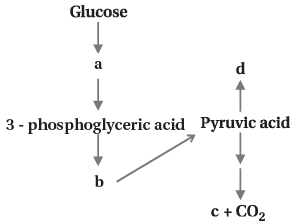
Solution
(N/A) The symbols in the flow chart represent the steps of glycolysis and fermentation:
$a = \text{Glucose-6-phosphate}$
$b = \text{Phosphoenolpyruvate (PEP)}$
$c = \text{Ethanol}$
$d = \text{Lactic acid}$
Explanation: The process shown is glycolysis followed by anaerobic respiration (fermentation). Glycolysis is the breakdown of glucose into pyruvic acid, occurring in the cytoplasm. Under anaerobic conditions, pyruvic acid is converted into either ethanol and $CO_2$ (in yeast) or lactic acid (in muscle cells/bacteria).
Applications:
$1$. Brewing Industry: Used in the production of alcoholic beverages like wine and beer.
$2$. Baking Industry: Used in bread making where $CO_2$ released makes the dough rise.
$a = \text{Glucose-6-phosphate}$
$b = \text{Phosphoenolpyruvate (PEP)}$
$c = \text{Ethanol}$
$d = \text{Lactic acid}$
Explanation: The process shown is glycolysis followed by anaerobic respiration (fermentation). Glycolysis is the breakdown of glucose into pyruvic acid, occurring in the cytoplasm. Under anaerobic conditions, pyruvic acid is converted into either ethanol and $CO_2$ (in yeast) or lactic acid (in muscle cells/bacteria).
Applications:
$1$. Brewing Industry: Used in the production of alcoholic beverages like wine and beer.
$2$. Baking Industry: Used in bread making where $CO_2$ released makes the dough rise.
0 likes
View Solution96
Easy
Radha was running on a treadmill at a great speed for $15$ minutes continuously. She stopped the treadmill and abruptly came out. For the next few minutes,she was breathing heavily/fast. Answer the following questions.
$(a)$ What happened to her muscles when she did strenuous exercise?
$(b)$ How did her breathing rate change?
$(a)$ What happened to her muscles when she did strenuous exercise?
$(b)$ How did her breathing rate change?
Solution
(N/A) Due to continuous strenuous exercise,her muscles undergo anaerobic respiration because the oxygen supply is insufficient to meet the high energy demand. This leads to the accumulation of lactic acid in the skeletal muscles,causing muscle fatigue and pain.
$(b)$ Her breathing rate increases significantly from the normal resting rate. During exercise,the muscles require more $O_2$ for the production of $ATP$ through aerobic respiration. Therefore,the breathing rate increases to intake more $O_2$ from the atmosphere and to eliminate the excess $CO_2$ produced.
$(b)$ Her breathing rate increases significantly from the normal resting rate. During exercise,the muscles require more $O_2$ for the production of $ATP$ through aerobic respiration. Therefore,the breathing rate increases to intake more $O_2$ from the atmosphere and to eliminate the excess $CO_2$ produced.
0 likes
View Solution97
MediumMCQ
Acidic $pH$ of muscles is due to -
A
Lactic acid
B
$CO_{2}$
C
Arginine
D
Ketones
Solution
(A) When oxygen is present in limiting conditions,the breakdown of glucose or glycogen occurs via anaerobic respiration.
This process leads to the production of lactic acid in the muscle cells.
The accumulation of lactic acid increases the concentration of hydrogen ions,which causes the $pH$ of the muscles to become acidic.
This process leads to the production of lactic acid in the muscle cells.
The accumulation of lactic acid increases the concentration of hydrogen ions,which causes the $pH$ of the muscles to become acidic.
0 likes
View Solution98
MediumMCQ
What is the fate of pyruvic acid under anaerobic conditions in our body?
A
It gets converted into methyl alcohol
B
It gets converted into acetyl $CoA$
C
It gets converted into lactic acid
D
It gets converted into glycogen
Solution
(C) Under anaerobic conditions,such as during intense physical exercise,the oxygen supply to muscle cells becomes insufficient.
In these conditions,pyruvic acid is reduced by $NADH$ to form lactic acid.
This reaction is catalyzed by the enzyme lactate dehydrogenase.
This process allows for the regeneration of $NAD^+$ so that glycolysis can continue to produce a small amount of $ATP$.
In these conditions,pyruvic acid is reduced by $NADH$ to form lactic acid.
This reaction is catalyzed by the enzyme lactate dehydrogenase.
This process allows for the regeneration of $NAD^+$ so that glycolysis can continue to produce a small amount of $ATP$.
0 likes
View Solution99
EasyMCQ
Incomplete breakdown of sugar in anaerobic respiration forms:
A
Glucose and carbon dioxide
B
Alcohol and carbon dioxide
C
Water and carbon dioxide
D
Fructose and water
Solution
(B) In anaerobic respiration,glucose is incompletely broken down in the absence of oxygen. In yeast,this process is known as fermentation,which results in the production of ethanol (alcohol) and carbon dioxide $(CO_2)$.
0 likes
View SolutionRespiration in Plants — Anaerobic respiration · Frequently Asked Questions
1Are these Respiration in Plants questions useful for JEE and NEET?
Yes. All questions in this section are mapped to JEE Main and NEET exam patterns. Previous year questions from JEE Main, NEET, GUJCET and state-level exams are included with full solutions.
2Can I switch to Hindi or Gujarati for these questions?
Yes. Use the language tabs in the hero section or the sidebar to view the same questions and solutions in English, Hindi or Gujarati.
3How do I generate a question paper from this subtopic?
Use the Vedclass Exam Paper Generator — select the chapter and subtopic, set difficulty, and generate Sets A, B, C, D automatically. First 3 chapters of every subject are free.
Vedclass Products
For Students
Vedclass Test Series
Mock tests in real JEE/NEET style with performance analysis. 5-day free trial.
Start Free TrialFor Teachers
Exam Paper Generator
Generate Set A/B/C/D papers from this chapter in 2 minutes. 3 chapters free.
Try FreeFor Institutes
Online Exam Module
Live online exams with unlimited students, 360° analytics & white-label branding.
See DemoFor Teachers & Institutes
Generate a Respiration in Plants Exam Paper in 2 Minutes
Select subtopic & difficulty — Sets A, B, C, D auto-generated with No Repeat logic.
First 3 chapters of every subject are free — no payment required.