
A English
Seeds Questions in English
Class 11 Biology · Morphology of Flowering Plants · Seeds
93+
Questions
English
Language
100%
With Solutions
Showing 43 of 93 questions in English
51
MediumMCQ
In which of the following is the seed coat not thin and membranous?
A
Maize
B
Coconut
C
Groundnut
D
Gram
Solution
(D) In most monocots like maize $(Zea \, mays)$, the seed coat is membranous and generally fused with the fruit wall. In dicots like gram $(Cicer \, arietinum)$, groundnut $(Arachis \, hypogaea)$, and coconut $(Cocos \, nucifera)$, the seed coat is distinct, thick, and not membranous. However, specifically in the context of $NCERT$ biology, the seed coat of maize is described as membranous and fused with the fruit wall. Among the given options, the seed coat of maize is thin and membranous, whereas in gram, groundnut, and coconut, it is not thin and membranous. Given the standard textbook phrasing, the question asks for the exception where the seed coat is not thin and membranous. Since maize is the classic example of a membranous seed coat, the other options (gram, groundnut, coconut) fit the criteria of having a non-membranous seed coat. However, in many competitive exams, 'Maize' is the correct answer for having a thin, membranous seed coat. If the question asks where it is $NOT$ thin and membranous, any of the others would technically be correct. Based on standard curriculum, 'Maize' is the intended answer for having a membranous seed coat.
0 likes
View Solution52
MediumMCQ
In a grain of wheat,the embryo has one large shield-shaped cotyledon. What is it called?
A
Epiblast
B
Scutellum
C
Coleorhiza
D
Coleoptile
Solution
(B) In monocotyledonous seeds like wheat,the embryo consists of a single cotyledon.
This large,shield-shaped cotyledon is known as the $Scutellum$.
It is situated towards one side of the embryonal axis.
The $Coleoptile$ is the protective sheath covering the plumule,and the $Coleorhiza$ is the protective sheath covering the radicle.
Therefore,the correct answer is $B$.
This large,shield-shaped cotyledon is known as the $Scutellum$.
It is situated towards one side of the embryonal axis.
The $Coleoptile$ is the protective sheath covering the plumule,and the $Coleorhiza$ is the protective sheath covering the radicle.
Therefore,the correct answer is $B$.
0 likes
View Solution53
MediumMCQ
What is the cotyledon of a maize grain called?
A
Coleorhiza
B
Coleoptile
C
Scutellum
D
Plumule
Solution
(C) In monocotyledonous seeds like maize,the embryo consists of a single large,shield-shaped cotyledon known as the $Scutellum$.
It is situated towards one side of the embryonal axis.
$Coleorhiza$ is the sheath covering the radicle,while $Coleoptile$ is the sheath covering the plumule.
It is situated towards one side of the embryonal axis.
$Coleorhiza$ is the sheath covering the radicle,while $Coleoptile$ is the sheath covering the plumule.
0 likes
View Solution54
MediumMCQ
Identify the parts labeled $A, B, C, D,$ and $E$ in the given diagram of a dicot seed.
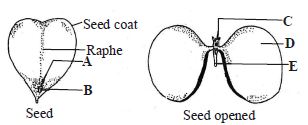
A
$A -$ Hilum,$B -$ Micropyle,$C -$ Radicle,$D -$ Cotyledon,$E -$ Plumule
B
$A -$ Hilum,$B -$ Micropyle,$C -$ Plumule,$D -$ Cotyledon,$E -$ Radicle
C
$A -$ Micropyle,$B -$ Hilum,$C -$ Plumule,$D -$ Cotyledon,$E -$ Radicle
D
$A -$ Hilum,$B -$ Micropyle,$C -$ Plumule,$D -$ Radicle,$E -$ Cotyledon
Solution
(B) Based on the structure of a typical dicot seed (like a bean or pea):
$A$ represents the Hilum,which is the scar on the seed coat through which the developing seeds were attached to the fruit.
$B$ represents the Micropyle,a small pore located above the hilum.
When the seed is opened,the internal structure reveals:
$C$ is the Plumule,which gives rise to the shoot system.
$D$ is the Cotyledon,which stores food.
$E$ is the Radicle,which gives rise to the root system.
Therefore,the correct labeling is $A -$ Hilum,$B -$ Micropyle,$C -$ Plumule,$D -$ Cotyledon,$E -$ Radicle.
$A$ represents the Hilum,which is the scar on the seed coat through which the developing seeds were attached to the fruit.
$B$ represents the Micropyle,a small pore located above the hilum.
When the seed is opened,the internal structure reveals:
$C$ is the Plumule,which gives rise to the shoot system.
$D$ is the Cotyledon,which stores food.
$E$ is the Radicle,which gives rise to the root system.
Therefore,the correct labeling is $A -$ Hilum,$B -$ Micropyle,$C -$ Plumule,$D -$ Cotyledon,$E -$ Radicle.
0 likes
View Solution55
EasyMCQ
Cocoa is the plant from which chocolate is made. Which part is used to extract it?
A
Flower
B
Fruit
C
Seeds
D
Bark
Solution
(C) Cocoa is obtained from the seeds of the cocoa plant, $Theobroma$ $cacao$. It belongs to the family $Sterculiaceae$. This plant is a native of tropical America, and its seeds are fermented, dried, and roasted to prepare cocoa and chocolate.
0 likes
View Solution56
Difficult
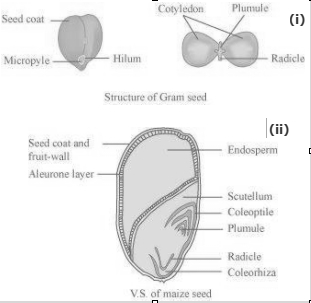
Draw the labelled diagram of the following:
$(i)$ Gram seed
$(ii)$ $V.S.$ of maize seed
$(i)$ Gram seed
$(ii)$ $V.S.$ of maize seed
Solution
(N/A) The labelled diagrams are as follows:
$(i)$ Gram seed: The structure consists of a seed coat,hilum,micropyle,cotyledons,plumule,and radicle.
$(ii)$ $V.S.$ of maize seed: The structure consists of the seed coat and fruit wall,aleurone layer,endosperm,scutellum,coleoptile,plumule,radicle,and coleorhiza.
$(i)$ Gram seed: The structure consists of a seed coat,hilum,micropyle,cotyledons,plumule,and radicle.
$(ii)$ $V.S.$ of maize seed: The structure consists of the seed coat and fruit wall,aleurone layer,endosperm,scutellum,coleoptile,plumule,radicle,and coleorhiza.
0 likes
View Solution57
Easy
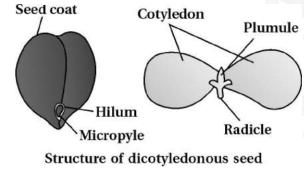
What is a seed? Describe the structure of dicotyledonous and monocotyledonous seeds with a diagram.
Solution
(N/A) $\rightarrow$ Seed: The ovules after fertilisation develop into seeds.
$\rightarrow$ $A$ seed is made up of a seed coat and an embryo.
$\rightarrow$ The embryo is made up of a radicle,an embryonal axis,and one (as in wheat,maize) or two cotyledons (as in gram and pea).
$(a)$ Structure of a Dicotyledonous seed:
$\rightarrow$ The outermost covering of a seed is the seed coat.
$\rightarrow$ The seed coat has two layers,the outer testa and the inner tegmen.
$\rightarrow$ The hilum is a scar on the seed coat through which the developing seeds were attached to the fruit.
$\rightarrow$ Above the hilum is a small pore called the micropyle.
$\rightarrow$ Within the seed coat is the embryo,consisting of an embryonal axis and two cotyledons. The cotyledons are often fleshy and full of reserve food materials.
$\rightarrow$ At the two ends of the embryonal axis are present the radicle and the plumule.
$\rightarrow$ In some seeds such as castor,the endosperm formed as a result of double fertilisation is a food-storing tissue.
$\rightarrow$ In plants such as bean,gram,and pea,the endosperm is not present in mature seeds and such seeds are called non-endospermous.
$(b)$ Structure of a Monocotyledonous seed:
$\rightarrow$ Generally,monocotyledonous seeds are endospermic,but some,as in orchids,are non-endospermic.
$\rightarrow$ In the seeds of cereals such as maize,the seed coat is membranous and generally fused with the fruit wall.
$\rightarrow$ The endosperm is bulky and stores food. The outer covering of the endosperm separates the embryo by a proteinaceous layer called the aleurone layer.
$\rightarrow$ The embryo is small and situated in a groove at one end of the endosperm. It consists of one large and shield-shaped cotyledon known as the scutellum and a short axis with a plumule and a radicle.
$\rightarrow$ The plumule and radicle are enclosed in sheaths which are called coleoptile and coleorhiza,respectively.
$\rightarrow$ $A$ seed is made up of a seed coat and an embryo.
$\rightarrow$ The embryo is made up of a radicle,an embryonal axis,and one (as in wheat,maize) or two cotyledons (as in gram and pea).
$(a)$ Structure of a Dicotyledonous seed:
$\rightarrow$ The outermost covering of a seed is the seed coat.
$\rightarrow$ The seed coat has two layers,the outer testa and the inner tegmen.
$\rightarrow$ The hilum is a scar on the seed coat through which the developing seeds were attached to the fruit.
$\rightarrow$ Above the hilum is a small pore called the micropyle.
$\rightarrow$ Within the seed coat is the embryo,consisting of an embryonal axis and two cotyledons. The cotyledons are often fleshy and full of reserve food materials.
$\rightarrow$ At the two ends of the embryonal axis are present the radicle and the plumule.
$\rightarrow$ In some seeds such as castor,the endosperm formed as a result of double fertilisation is a food-storing tissue.
$\rightarrow$ In plants such as bean,gram,and pea,the endosperm is not present in mature seeds and such seeds are called non-endospermous.
$(b)$ Structure of a Monocotyledonous seed:
$\rightarrow$ Generally,monocotyledonous seeds are endospermic,but some,as in orchids,are non-endospermic.
$\rightarrow$ In the seeds of cereals such as maize,the seed coat is membranous and generally fused with the fruit wall.
$\rightarrow$ The endosperm is bulky and stores food. The outer covering of the endosperm separates the embryo by a proteinaceous layer called the aleurone layer.
$\rightarrow$ The embryo is small and situated in a groove at one end of the endosperm. It consists of one large and shield-shaped cotyledon known as the scutellum and a short axis with a plumule and a radicle.
$\rightarrow$ The plumule and radicle are enclosed in sheaths which are called coleoptile and coleorhiza,respectively.
0 likes
View Solution58
Easy
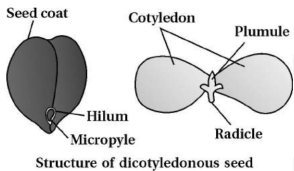
Explain the structure of a dicotyledonous seed.
Solution
(N/A) $\rightarrow$ The outermost covering of a seed is the seed coat.
$\rightarrow$ The seed coat has two layers, the outer testa and the inner tegmen.
$\rightarrow$ The hilum is a scar on the seed coat through which the developing seeds were attached to the fruit.
$\rightarrow$ Above the hilum is a small pore called the micropyle.
$\rightarrow$ Within the seed coat is the embryo, consisting of an embryonal axis and two cotyledons. The cotyledons are often fleshy and full of reserve food materials.
$\rightarrow$ At the two ends of the embryonal axis are present the radicle and the plumule.
$\rightarrow$ In some seeds such as castor, the endosperm, formed as a result of double fertilisation, is a food-storing tissue.
$\rightarrow$ In plants such as bean, gram, and pea, the endosperm is not present in mature seeds and such seeds are called non-endospermous.
$\rightarrow$ The seed coat has two layers, the outer testa and the inner tegmen.
$\rightarrow$ The hilum is a scar on the seed coat through which the developing seeds were attached to the fruit.
$\rightarrow$ Above the hilum is a small pore called the micropyle.
$\rightarrow$ Within the seed coat is the embryo, consisting of an embryonal axis and two cotyledons. The cotyledons are often fleshy and full of reserve food materials.
$\rightarrow$ At the two ends of the embryonal axis are present the radicle and the plumule.
$\rightarrow$ In some seeds such as castor, the endosperm, formed as a result of double fertilisation, is a food-storing tissue.
$\rightarrow$ In plants such as bean, gram, and pea, the endosperm is not present in mature seeds and such seeds are called non-endospermous.
0 likes
View Solution59
Medium
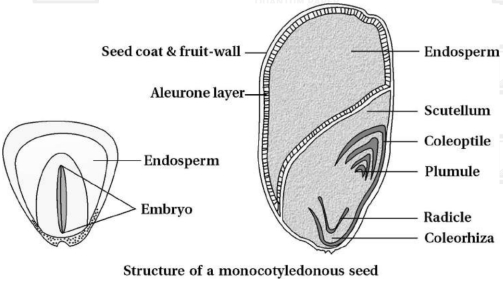
Explain the structure of a monocotyledonous seed.
Solution
(N/A) $\rightarrow$ Generally, monocotyledonous seeds are endospermic, but some, as in orchids, are non-endospermic.
$\rightarrow$ In the seeds of cereals such as maize, the seed coat is membranous and generally fused with the fruit wall.
$\rightarrow$ The endosperm is bulky and stores food.
$\rightarrow$ The outer covering of the endosperm separates the embryo by a proteinous layer called the aleurone layer. It is made up of square or rectangular cells, and protein granules are stored in its cells.
$\rightarrow$ The embryo is small and situated in a groove at one end of the endosperm. It consists of one large and shield-shaped cotyledon known as the scutellum and a short axis with a plumule and a radicle.
$\rightarrow$ The plumule and radicle are enclosed in sheaths which are called the coleoptile and coleorhiza, respectively.
$\rightarrow$ In the seeds of cereals such as maize, the seed coat is membranous and generally fused with the fruit wall.
$\rightarrow$ The endosperm is bulky and stores food.
$\rightarrow$ The outer covering of the endosperm separates the embryo by a proteinous layer called the aleurone layer. It is made up of square or rectangular cells, and protein granules are stored in its cells.
$\rightarrow$ The embryo is small and situated in a groove at one end of the endosperm. It consists of one large and shield-shaped cotyledon known as the scutellum and a short axis with a plumule and a radicle.
$\rightarrow$ The plumule and radicle are enclosed in sheaths which are called the coleoptile and coleorhiza, respectively.
0 likes
View Solution60
Easy
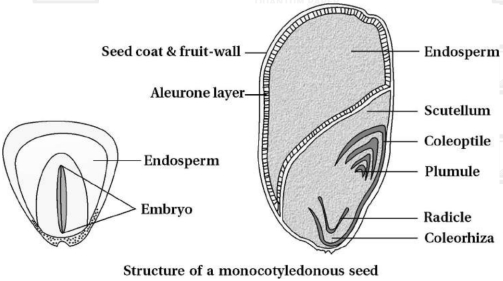
Explain the diagram of the longitudinal section of a maize seed.
Solution
(N/A) $\rightarrow$ Generally,monocotyledonous seeds are endospermic,but some,as in orchids,are non-endospermic.
$\rightarrow$ In the seeds of cereals such as maize,the seed coat is membranous and generally fused with the fruit wall.
$\rightarrow$ The endosperm is bulky and stores food.
$\rightarrow$ The outer covering of the endosperm separates the embryo by a proteinous layer called the aleurone layer. It is made up of square or rectangular cells,and protein granules are stored in its cells.
$\rightarrow$ The embryo is small and situated in a groove at one end of the endosperm. It consists of one large and shield-shaped cotyledon known as the scutellum and a short axis with a plumule and a radicle.
$\rightarrow$ The plumule and radicle are enclosed in sheaths which are called the coleoptile and coleorhiza,respectively.
$\rightarrow$ In the seeds of cereals such as maize,the seed coat is membranous and generally fused with the fruit wall.
$\rightarrow$ The endosperm is bulky and stores food.
$\rightarrow$ The outer covering of the endosperm separates the embryo by a proteinous layer called the aleurone layer. It is made up of square or rectangular cells,and protein granules are stored in its cells.
$\rightarrow$ The embryo is small and situated in a groove at one end of the endosperm. It consists of one large and shield-shaped cotyledon known as the scutellum and a short axis with a plumule and a radicle.
$\rightarrow$ The plumule and radicle are enclosed in sheaths which are called the coleoptile and coleorhiza,respectively.
0 likes
View Solution61
Easy
Give differences between Gram seed and Maize seed.
Solution
(N/A)
| Gram seed | Maize seed |
|---|---|
| $(1)$ It is a typical example of a dicot seed. | $(1)$ It is a typical example of a monocot seed. |
| $(2)$ It contains two cotyledons. | $(2)$ It contains only one cotyledon. |
| $(3)$ It is non-endospermic (exalbuminous) as food is stored in cotyledons. | $(3)$ It is endospermic (albuminous) as food is stored in the endosperm. |
0 likes
View Solution62
Medium
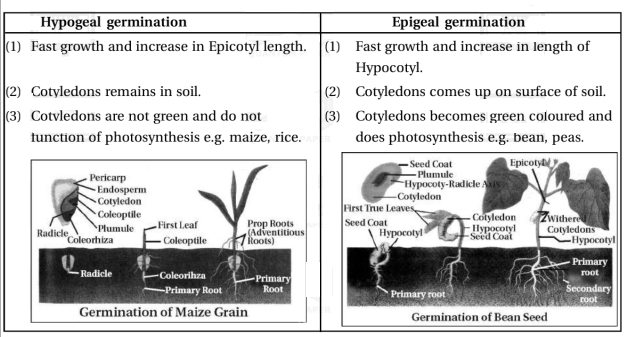
How do you distinguish between hypogeal germination and epigeal germination? What is the role of cotyledon$(s)$ and the endosperm in the germination of seeds?
Solution
(N/A) The differences between hypogeal and epigeal germination are as follows:
| Feature | Hypogeal Germination | Epigeal Germination |
| :--- | :--- | :--- |
| Growth | Rapid growth of the epicotyl. | Rapid growth of the hypocotyl. |
| Cotyledons | Remain in the soil. | Come up above the soil surface. |
| Photosynthesis | Cotyledons are not green and do not perform photosynthesis. | Cotyledons become green and perform photosynthesis. |
| Examples | Maize,Rice | Bean,Peas |
Role of cotyledons and endosperm in seed germination:
$1$. Storage: Both cotyledons and endosperm act as storage organs for food (starch,proteins,and fats) required for the developing embryo.
$2$. Imbibition: Seeds absorb water (imbibition),which activates dormant enzymes.
$3$. Hydrolysis: Enzymes break down stored complex food materials into simpler,soluble forms (like glucose) that are easily transported to the growing radicle and plumule to provide energy and building materials for germination.
| Feature | Hypogeal Germination | Epigeal Germination |
| :--- | :--- | :--- |
| Growth | Rapid growth of the epicotyl. | Rapid growth of the hypocotyl. |
| Cotyledons | Remain in the soil. | Come up above the soil surface. |
| Photosynthesis | Cotyledons are not green and do not perform photosynthesis. | Cotyledons become green and perform photosynthesis. |
| Examples | Maize,Rice | Bean,Peas |
Role of cotyledons and endosperm in seed germination:
$1$. Storage: Both cotyledons and endosperm act as storage organs for food (starch,proteins,and fats) required for the developing embryo.
$2$. Imbibition: Seeds absorb water (imbibition),which activates dormant enzymes.
$3$. Hydrolysis: Enzymes break down stored complex food materials into simpler,soluble forms (like glucose) that are easily transported to the growing radicle and plumule to provide energy and building materials for germination.
0 likes
View Solution63
MediumMCQ
Find the odd one out.
A
Radicle
B
Embryonic root
C
Plumule
D
Root tip
Solution
(D) In the context of plant embryology,the $Radicle$ is the embryonic root that develops into the primary root.
$Embryonic root$ is simply another term for the $Radicle$.
$Plumule$ is the embryonic shoot that develops into the stem and leaves.
$Root tip$ is a general anatomical structure found in mature roots,not a specific embryonic part like the others.
Therefore,$Root tip$ is the odd one out.
$Embryonic root$ is simply another term for the $Radicle$.
$Plumule$ is the embryonic shoot that develops into the stem and leaves.
$Root tip$ is a general anatomical structure found in mature roots,not a specific embryonic part like the others.
Therefore,$Root tip$ is the odd one out.
0 likes
View Solution64
MediumMCQ
How many cotyledons does the embryo of a grass have?
A
One
B
Two
C
Three
D
Four
Solution
(A) The embryo of a grass belongs to the family $Poaceae$ (monocots).
In monocotyledonous embryos,there is only one cotyledon.
In the grass family,this single cotyledon is specifically called the $scutellum$,which is situated towards one side (lateral) of the embryonal axis.
In monocotyledonous embryos,there is only one cotyledon.
In the grass family,this single cotyledon is specifically called the $scutellum$,which is situated towards one side (lateral) of the embryonal axis.
0 likes
View Solution65
MediumMCQ
The coleoptile covers which structure?
A
Leaf
B
Shoot apex
C
Radicle
D
Root cap
Solution
(B) In the embryo of a monocotyledonous seed (like grass),the shoot apex and a few leaf primordia are enclosed in a hollow foliar structure called the coleoptile. The radicle and root cap are enclosed in an undifferentiated sheath called the coleorhiza.
0 likes
View Solution66
DifficultMCQ
Which of the following is not found in maize seed?
A
Coleorhiza
B
Coleoptile
C
Scutellum
D
Perisperm
Solution
(D) The $Perisperm$ is the persistent nucellus that surrounds the embryo in some seeds. In maize $(Zea \, mays)$, the seed is endospermic, but it does not contain $Perisperm$. $Coleorhiza$, $Coleoptile$, and $Scutellum$ are all characteristic structures found in the monocotyledonous embryo of maize.
0 likes
View Solution67
MediumMCQ
Vivipary is seen in
A
Mangroves
B
Xerophytes
C
Hydrophytes
D
Mesophytes
Solution
(A) Vivipary is a phenomenon where the seed germinates while still attached to the parent plant,before being shed.
This is a characteristic adaptation of mangrove plants,which grow in saline,marshy,or anaerobic soil conditions.
By germinating on the parent plant,the seedling can quickly establish itself in the soft mud once it falls,preventing it from being washed away by tides.
This is a characteristic adaptation of mangrove plants,which grow in saline,marshy,or anaerobic soil conditions.
By germinating on the parent plant,the seedling can quickly establish itself in the soft mud once it falls,preventing it from being washed away by tides.
0 likes
View Solution68
MediumMCQ
In a cereal grain,the single cotyledon of embryo is represented by
A
Coleorhiza
B
Scutellum
C
Prophyll
D
Coleoptile
Solution
(B) In a cereal grain (e.g.,wheat or maize),the embryo consists of one large,shield-shaped cotyledon known as the Scutellum.
This structure is situated towards one side of the embryonal axis.
The primary function of the Scutellum is to absorb nutrients from the endosperm and transfer them to the developing embryo during germination.
This structure is situated towards one side of the embryonal axis.
The primary function of the Scutellum is to absorb nutrients from the endosperm and transfer them to the developing embryo during germination.
0 likes
View Solution69
MediumMCQ
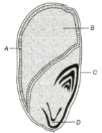
Identify $A, B, C$ and $D$ in the given diagram of a maize grain.
A
$A$-Aleurone layer,$B$-Endosperm,$C$-Coleoptile,$D$-Coleorhiza
B
$A$-Aleurone layer,$B$-Coleoptile,$C$-Endosperm,$D$-Coleorhiza
C
$A$-Coleoptile,$B$-Aleurone layer,$C$-Endosperm,$D$-Coleorhiza
D
$A$-Coleoptile,$B$-Aleurone layer,$C$-Coleorhiza,$D$-Endosperm
Solution
(A) The given diagram represents the structure of a monocotyledonous seed (maize grain).
In this structure:
$A$ represents the Aleurone layer,which is the outer proteinaceous layer of the endosperm.
$B$ represents the Endosperm,which is the food-storing tissue.
$C$ represents the Coleoptile,which is the protective sheath covering the plumule.
$D$ represents the Coleorhiza,which is the protective sheath covering the radicle.
Therefore,the correct identification is $A$-Aleurone layer,$B$-Endosperm,$C$-Coleoptile,$D$-Coleorhiza.
In this structure:
$A$ represents the Aleurone layer,which is the outer proteinaceous layer of the endosperm.
$B$ represents the Endosperm,which is the food-storing tissue.
$C$ represents the Coleoptile,which is the protective sheath covering the plumule.
$D$ represents the Coleorhiza,which is the protective sheath covering the radicle.
Therefore,the correct identification is $A$-Aleurone layer,$B$-Endosperm,$C$-Coleoptile,$D$-Coleorhiza.
0 likes
View Solution70
EasyMCQ
Vivipary is observed in:
A
Banyan
B
Bryophyllum
C
Ipomea
D
Rhizophora
Solution
(D) Vivipary is a phenomenon where seeds germinate while still attached to the parent plant.
This is a common adaptation in plants growing in saline or marshy areas,such as mangroves.
Among the given options,$Rhizophora$ is a well-known mangrove plant that exhibits vivipary.
The embryo develops into a seedling while attached to the parent tree,which helps it establish itself quickly in the soft,unstable mud once it falls.
This is a common adaptation in plants growing in saline or marshy areas,such as mangroves.
Among the given options,$Rhizophora$ is a well-known mangrove plant that exhibits vivipary.
The embryo develops into a seedling while attached to the parent tree,which helps it establish itself quickly in the soft,unstable mud once it falls.
0 likes
View Solution71
MediumMCQ
$A$ dicot embryo consists of:
A
Radicle and plumule
B
Radicle,plumule,cotyledons and sometimes endosperm
C
Radicle,plumule,cotyledons and embryonal axis
D
Radicle,plumule,cotyledons,tegmen and testa
Solution
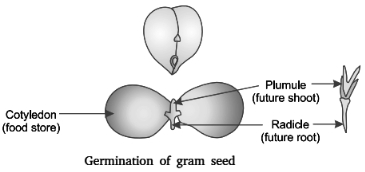
(C) typical dicotyledonous embryo consists of an embryonal axis and two cotyledons.
The portion of the embryonal axis above the level of cotyledons is the epicotyl,which terminates with the plumule or stem tip.
The cylindrical portion below the level of cotyledons is the hypocotyl that terminates at its lower end in the radicle or root tip.
The portion of the embryonal axis above the level of cotyledons is the epicotyl,which terminates with the plumule or stem tip.
The cylindrical portion below the level of cotyledons is the hypocotyl that terminates at its lower end in the radicle or root tip.
0 likes
View Solution72
MediumMCQ
Coleorhiza is:
A
Lower end of embryonal axis in monocots
B
Lower end of embryonal axis in dicots
C
Lower end of embryonal axis in potato family
D
Lower end of embryonal axis in Mango
Solution
(A) Coleorhiza is the lower end of the embryonal axis in monocots.
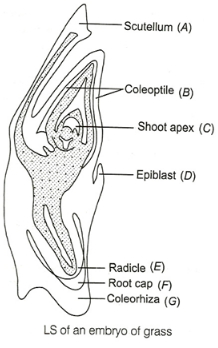
Embryos of monocotyledons possess only one cotyledon. In the grass family,the cotyledon is called the scutellum,which is situated toward one side (lateral) of the embryonal axis.
At its lower end,the embryonal axis has the radicle and root cap enclosed in an undifferentiated sheath called the coleorhiza.
The portion of the embryonal axis above the level of attachment of the scutellum is the epicotyl. The epicotyl has a shoot apex and a few leaf primordia enclosed in a hollow structure called the coleoptile.
Embryos of monocotyledons possess only one cotyledon. In the grass family,the cotyledon is called the scutellum,which is situated toward one side (lateral) of the embryonal axis.
At its lower end,the embryonal axis has the radicle and root cap enclosed in an undifferentiated sheath called the coleorhiza.
The portion of the embryonal axis above the level of attachment of the scutellum is the epicotyl. The epicotyl has a shoot apex and a few leaf primordia enclosed in a hollow structure called the coleoptile.
0 likes
View Solution73
MediumMCQ
The cylindrical portion below the cotyledons is $A$ that terminates to $B$ and tip called $C$. $A$,$B$ and $C$ here refer to:
A
$A-$radicle,$B-$hypocotyl,$C-$root cap
B
$A-$root cap,$B-$radicle,$C-$hypocotyl
C
$A-$hypocotyl,$B-$root cap,$C-$radicle
D
$A-$hypocotyl,$B-$radicle,$C-$root cap
Solution
(D) In the embryo of a dicotyledonous seed,the portion of the embryonal axis below the level of cotyledons is known as the hypocotyl $(A)$.
This hypocotyl terminates in its lower end in the radicle $(B)$,which is the embryonic root.
The radicle is covered at its tip by a protective structure called the root cap $(C)$.
This hypocotyl terminates in its lower end in the radicle $(B)$,which is the embryonic root.
The radicle is covered at its tip by a protective structure called the root cap $(C)$.
0 likes
View Solution74
EasyMCQ
Cellulose fibre is obtained from $Gossypium$.
A
Stem surface
B
Seed hair
C
Leaf surface
D
Root hair
Solution
(B) Cotton is the seed surface fibre of $Gossypium$.
Its processing involves ginning,baling,picking,lapping,carding,and twisting.
It is widely used in the textile industry.
Its processing involves ginning,baling,picking,lapping,carding,and twisting.
It is widely used in the textile industry.
0 likes
View Solution75
EasyMCQ
Which is a useful product of epidermal origin?
A
Saffron
B
Cotton fibres
C
Clove
D
Jute
Solution
(B) Cotton is obtained from the epidermal hair present on the surface of seeds of $Gossypium$ $sp.$
These fibres are composed of pure cellulose.
They are classified into two types: extractable lint and non-extractable fluffy fuzz.
Cotton fibres are primarily used in the textile industry,as well as for manufacturing celluloid,cellophane,rayon,and paper pulp.
These fibres are composed of pure cellulose.
They are classified into two types: extractable lint and non-extractable fluffy fuzz.
Cotton fibres are primarily used in the textile industry,as well as for manufacturing celluloid,cellophane,rayon,and paper pulp.
0 likes
View Solution76
MediumMCQ
Cotton fibre is basically a type of
A
Trichome
B
Scale
C
Seed Fibre
D
Glandular hair
Solution
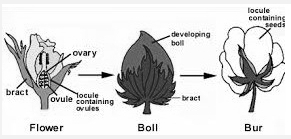
(A) Cotton fibres are epidermal outgrowths of the seed coat,which are technically known as trichomes. These are unicellular,elongated structures that develop from the seed coat of the cotton plant. Therefore,cotton fibre is basically a type of trichome.
0 likes
View Solution77
MediumMCQ
Which structure emerges first from the seed during seed germination?
A
Radicle
B
Plumule
C
Stem
D
Leaf
Solution
(A) During the process of seed germination,the $Radicle$ is the first structure to emerge from the seed.
It grows downwards into the soil to form the primary root system,which helps in the absorption of water and minerals.
Following the emergence of the $Radicle$,the $Plumule$ emerges and grows upwards to form the shoot system.
It grows downwards into the soil to form the primary root system,which helps in the absorption of water and minerals.
Following the emergence of the $Radicle$,the $Plumule$ emerges and grows upwards to form the shoot system.
0 likes
View Solution78
MediumMCQ
...... is the point of attachment of the developing seed to the fruit.
A
Hilum
B
Micropyle
C
Endosperm
D
Both $A$ and $B$
Solution
(A) The $Hilum$ is a scar on the seed coat through which the developing seeds were attached to the fruit.
It serves as the point of attachment between the seed and the fruit wall (pericarp) via the funicle.
$Micropyle$ is a small pore present above the hilum,which facilitates the entry of water and oxygen during seed germination.
$Endosperm$ is the nutritive tissue formed during double fertilization.
It serves as the point of attachment between the seed and the fruit wall (pericarp) via the funicle.
$Micropyle$ is a small pore present above the hilum,which facilitates the entry of water and oxygen during seed germination.
$Endosperm$ is the nutritive tissue formed during double fertilization.
0 likes
View Solution79
MediumMCQ
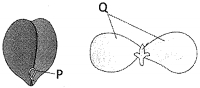
What are $P$ and $Q$ in the given dicot seed?
$P \quad\quad Q$
$P \quad\quad Q$
A
Micropyle $\quad$ Cotyledon
B
Hilum $\quad$ Cotyledon
C
Hilum $\quad$ Seed coat
D
Micropyle $\quad$ Seed coat
Solution
(B) In the structure of a dicot seed (like a bean seed):
$1$. The small pore through which the pollen tube enters the ovule during fertilization is called the micropyle. However,the structure labeled $P$ in the diagram represents the hilum,which is a scar on the seed coat through which the developing seeds were attached to the fruit.
$2$. The structure labeled $Q$ represents the cotyledons,which are the seed leaves that store food for the developing embryo.
$3$. Therefore,$P$ is the hilum and $Q$ is the cotyledon.
$1$. The small pore through which the pollen tube enters the ovule during fertilization is called the micropyle. However,the structure labeled $P$ in the diagram represents the hilum,which is a scar on the seed coat through which the developing seeds were attached to the fruit.
$2$. The structure labeled $Q$ represents the cotyledons,which are the seed leaves that store food for the developing embryo.
$3$. Therefore,$P$ is the hilum and $Q$ is the cotyledon.
0 likes
View Solution80
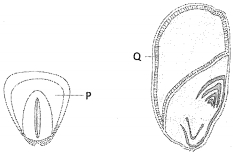
MediumMCQ
What are $P$ and $Q$ in the given monocot seed?
$P \quad Q$
$P \quad Q$
A
Endosperm $\quad$ Aleurone layer
B
Embryo $\quad$ Hull
C
Endosperm $\quad$ Hull
D
Embryo $\quad$ Aleurone layer
Solution
(A) In the provided diagram of a monocot seed (maize grain),the label $P$ points to the large,starchy region known as the endosperm,which stores food for the developing embryo.
The label $Q$ points to the outer proteinaceous layer surrounding the endosperm,known as the aleurone layer.
Therefore,$P$ is the endosperm and $Q$ is the aleurone layer.
The label $Q$ points to the outer proteinaceous layer surrounding the endosperm,known as the aleurone layer.
Therefore,$P$ is the endosperm and $Q$ is the aleurone layer.
0 likes
View Solution81
MediumMCQ
Seed coat $+$ Fruit wall $= .......$
A
Endosperm
B
Scutellum
C
Embryo
D
Pericarp/Hull
Solution
(D) In many monocotyledonous seeds,such as maize,the seed coat is membranous and generally fused with the fruit wall. This combined structure is known as the hull or husk (pericarp). Therefore,the correct answer is $D$.
0 likes
View Solution82
MediumMCQ
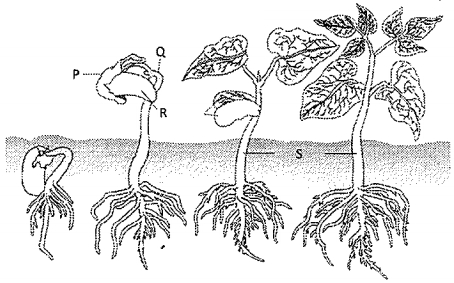
The given figure shows the germination of a bean seed. Label $P, Q, R$ and $S$.
A
Seed coat,Epicotyl,Plumule,Cotyledon,Hypocotyl
B
Seed coat,Epicotyl,Plumule,Cotyledon,Hypocotyl
C
Seed coat,Hypocotyl,Plumule,Cotyledon,Epicotyl
D
Cotyledon,Epicotyl,Plumule,Seed coat,Hypocotyl
Solution
(B) In the process of epigeal germination of a bean seed:
$P$ represents the Seed coat,which is the protective outer covering of the seed.
$Q$ represents the Epicotyl,the portion of the embryonic axis above the cotyledons.
$R$ represents the Plumule,the embryonic shoot.
$S$ represents the Hypocotyl,the portion of the embryonic axis below the cotyledons that elongates to push the cotyledons above the soil surface.
$P$ represents the Seed coat,which is the protective outer covering of the seed.
$Q$ represents the Epicotyl,the portion of the embryonic axis above the cotyledons.
$R$ represents the Plumule,the embryonic shoot.
$S$ represents the Hypocotyl,the portion of the embryonic axis below the cotyledons that elongates to push the cotyledons above the soil surface.
0 likes
View Solution83
MediumMCQ
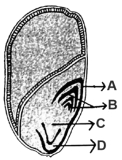
Identify the part of the seed from the given figure which is destined to form the root when the seed germinates.
A
$B$
B
$C$
C
$D$
D
$A$
Solution
(B) In a seed,the radicle is the embryonic part that is destined to develop into the root system upon germination.
Looking at the provided diagram of a maize grain (monocot seed):
- $A$ represents the coleoptile.
- $B$ represents the plumule.
- $C$ represents the radicle.
- $D$ represents the coleorhiza.
Therefore,the part labeled '$C$' is the radicle,which forms the root.
Looking at the provided diagram of a maize grain (monocot seed):
- $A$ represents the coleoptile.
- $B$ represents the plumule.
- $C$ represents the radicle.
- $D$ represents the coleorhiza.
Therefore,the part labeled '$C$' is the radicle,which forms the root.
0 likes
View Solution84
MediumMCQ
Single shield-shaped cotyledon of a maize seed is called$:-$
A
Coleorrhiza
B
Coleoptile
C
Scutellum
D
Epiblast
Solution
(C) In monocotyledonous seeds like maize,the embryo consists of a single large cotyledon known as the $Scutellum$.
This $Scutellum$ is shield-shaped and is situated towards one side of the embryonal axis.
$Coleorrhiza$ is the protective sheath covering the radicle.
$Coleoptile$ is the protective sheath covering the plumule.
$Epiblast$ is a small,scale-like structure found in some grasses,representing the vestigial second cotyledon.
Therefore,the correct answer is $Scutellum$.
This $Scutellum$ is shield-shaped and is situated towards one side of the embryonal axis.
$Coleorrhiza$ is the protective sheath covering the radicle.
$Coleoptile$ is the protective sheath covering the plumule.
$Epiblast$ is a small,scale-like structure found in some grasses,representing the vestigial second cotyledon.
Therefore,the correct answer is $Scutellum$.
0 likes
View Solution85
MediumMCQ
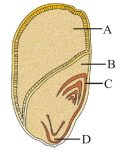
Given below is the diagram of a monocotyledonous seed. Identify the parts labelled $A, B, C,$ and $D$.
A
Part $A \rightarrow$ Endosperm,Part $B \rightarrow$ Scutellum,Part $C \rightarrow$ Coleoptile,Part $D \rightarrow$ Coleorhiza
B
Part $A \rightarrow$ Scutellum,Part $B \rightarrow$ Endosperm,Part $C \rightarrow$ Coleorhiza,Part $D \rightarrow$ Coleoptile
C
Part $A \rightarrow$ Scutellum,Part $B \rightarrow$ Coleorhiza,Part $C \rightarrow$ Coleoptile,Part $D \rightarrow$ Endosperm
D
Part $A \rightarrow$ Coleorhiza,Part $B \rightarrow$ Coleoptile,Part $C \rightarrow$ Scutellum,Part $D \rightarrow$ Endosperm
Solution
(A) In the provided diagram of a monocotyledonous seed (e.g.,maize grain):
- Part $A$ represents the Endosperm,which is the food-storing tissue.
- Part $B$ represents the Scutellum,which is a large,shield-shaped cotyledon.
- Part $C$ represents the Coleoptile,which is the protective sheath covering the plumule.
- Part $D$ represents the Coleorhiza,which is the protective sheath covering the radicle.
Therefore,the correct identification is: Part $A \rightarrow$ Endosperm,Part $B \rightarrow$ Scutellum,Part $C \rightarrow$ Coleoptile,Part $D \rightarrow$ Coleorhiza.
- Part $A$ represents the Endosperm,which is the food-storing tissue.
- Part $B$ represents the Scutellum,which is a large,shield-shaped cotyledon.
- Part $C$ represents the Coleoptile,which is the protective sheath covering the plumule.
- Part $D$ represents the Coleorhiza,which is the protective sheath covering the radicle.
Therefore,the correct identification is: Part $A \rightarrow$ Endosperm,Part $B \rightarrow$ Scutellum,Part $C \rightarrow$ Coleoptile,Part $D \rightarrow$ Coleorhiza.
0 likes
View Solution86
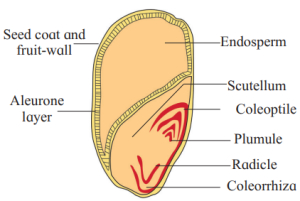
EasyMCQ
Which part of a seed shown in the given figure indicates the future root?
A
Coleoptile
B
Coleorrhiza
C
Plumule
D
Radicle
Solution
(D) In a seed,the $Radicle$ is the embryonic part that develops into the future root system of the plant.
Conversely,the $Plumule$ is the embryonic part that develops into the future shoot system.
The $Coleoptile$ is a protective sheath that covers the $Plumule$.
The $Coleorrhiza$ is a protective sheath that covers the $Radicle$.
Conversely,the $Plumule$ is the embryonic part that develops into the future shoot system.
The $Coleoptile$ is a protective sheath that covers the $Plumule$.
The $Coleorrhiza$ is a protective sheath that covers the $Radicle$.
0 likes
View Solution87
EasyMCQ
After germination of a dicotyledonous endospermic seed,the cotyledons act as . . . . . . organ.
A
food storage
B
photosynthetic
C
germinating
D
haustorial
Solution
(B) In many dicotyledonous seeds,especially those that are endospermic (like castor),the cotyledons are thin and papery. Upon germination,they emerge from the seed coat and turn green,functioning as the first photosynthetic organs to produce food for the developing seedling until the true leaves are formed.
0 likes
View Solution88
EasyMCQ
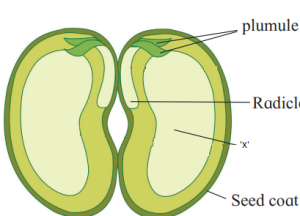
Identify the part '$X$' marked in the diagram of an open bean seed.
A
Endosperm
B
Cotyledon
C
Epicotyl
D
Hypocotyl
Solution
(B) The provided diagram shows the internal structure of a dicotyledonous seed,specifically a bean seed.
In a dicot seed,the embryo consists of an embryonal axis and two cotyledons.
The cotyledons are fleshy and store food reserves,which are utilized during seed germination.
In the diagram,the large,fleshy structure labeled as '$X$' represents the cotyledon.
Therefore,the correct option is $B$.
In a dicot seed,the embryo consists of an embryonal axis and two cotyledons.
The cotyledons are fleshy and store food reserves,which are utilized during seed germination.
In the diagram,the large,fleshy structure labeled as '$X$' represents the cotyledon.
Therefore,the correct option is $B$.
0 likes
View Solution89
EasyMCQ
During hypogeal germination, . . . . . . elongates quickly.
A
Hypocotyl
B
Epicotyl
C
Cotyledon
D
Tigellum
Solution
(B) In hypogeal germination, the $epicotyl$ elongates rapidly while the $hypocotyl$ remains short.
As a result, the cotyledons remain below the soil surface.
This is commonly observed in monocots like maize and some dicots like pea $(Pisum \text{ } sativum)$.
As a result, the cotyledons remain below the soil surface.
This is commonly observed in monocots like maize and some dicots like pea $(Pisum \text{ } sativum)$.
0 likes
View Solution90
EasyMCQ
$A$ type of seed germination in which the epicotyl region of the embryo elongates rapidly to pull the plumule out of the soil surface is called . . . . . . germination.
A
hypogeal
B
epigeal
C
viviparous
D
in vitro
Solution
(A) In $hypogeal$ germination,the $epicotyl$ elongates while the $hypocotyl$ remains short. As a result,the cotyledons remain below the soil surface,and the $plumule$ is pushed out of the soil. This is characteristic of monocots like maize and some dicots like pea.
0 likes
View Solution91
EasyMCQ
Which among the following seeds has a scutellum?
A
Beans
B
Black gram
C
Maize
D
Green gram
Solution
(C) The scutellum is a modified,shield-shaped cotyledon found in the embryos of monocotyledonous seeds.
Among the given options,$A$ (Beans),$B$ (Black gram),and $D$ (Green gram) are dicotyledonous seeds,which possess two cotyledons.
$C$ (Maize) is a monocotyledonous seed,which contains a single large cotyledon known as the scutellum.
Therefore,the correct option is $C$.
Among the given options,$A$ (Beans),$B$ (Black gram),and $D$ (Green gram) are dicotyledonous seeds,which possess two cotyledons.
$C$ (Maize) is a monocotyledonous seed,which contains a single large cotyledon known as the scutellum.
Therefore,the correct option is $C$.
0 likes
View Solution92
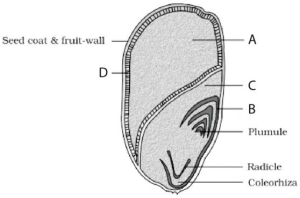
EasyMCQ
The diagram of the section of a maize grain is given below. Identify the parts labelled $A$,$B$,$C$ and $D$.
A
$A$-endosperm,$B$-coleoptile,$C$-scutellum,$D$-aleurone layer
B
$A$-endosperm,$B$-coleorhiza,$C$-scutellum,$D$-aleurone layer
C
$A$-endosperm,$B$-cotyledon,$C$-scutellum,$D$-aleurone layer
D
$A$-cotyledon,$B$-coleoptile,$C$-scutellum,$D$-aleurone layer
Solution
(A) The correct answer is $A$.
In the diagram of the maize grain:
$A$ represents the endosperm,which is the food-storing tissue.
$B$ represents the coleoptile,which is a protective sheath covering the plumule.
$C$ represents the scutellum,which is a large,shield-shaped cotyledon in monocots that absorbs nutrients from the endosperm.
$D$ represents the aleurone layer,which is the protein-rich outer layer of the endosperm.
In the diagram of the maize grain:
$A$ represents the endosperm,which is the food-storing tissue.
$B$ represents the coleoptile,which is a protective sheath covering the plumule.
$C$ represents the scutellum,which is a large,shield-shaped cotyledon in monocots that absorbs nutrients from the endosperm.
$D$ represents the aleurone layer,which is the protein-rich outer layer of the endosperm.
0 likes
View Solution93
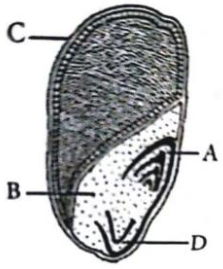
EasyMCQ
In the given diagram of a maize grain,identify the parts labelled as $A, B, C$ and $D$.
A
$A$-Coleoptile,$B$-Scutellum,$C$-Pericarp,$D$-Coleorrhiza
B
$A$-Coleoptile,$B$-Scutellum,$C$-Coleorrhiza,$D$-Pericarp
C
$A$-Pericarp,$B$-Coleorrhiza,$C$-Scutellum,$D$-Pericarp
D
$A$-Coleorrhiza,$B$-Coleoptile,$C$-Scutellum,$D$-Pericarp
Solution
(A) The given diagram represents the structure of a monocotyledonous seed (maize grain).
$A$ points to the coleoptile,which is the protective sheath covering the plumule.
$B$ points to the scutellum,which is a large,shield-shaped cotyledon.
$C$ points to the pericarp,which is the outer wall of the fruit fused with the seed coat.
$D$ points to the coleorrhiza,which is the protective sheath covering the radicle.
Therefore,the correct identification is $A$-Coleoptile,$B$-Scutellum,$C$-Pericarp,$D$-Coleorrhiza.
$A$ points to the coleoptile,which is the protective sheath covering the plumule.
$B$ points to the scutellum,which is a large,shield-shaped cotyledon.
$C$ points to the pericarp,which is the outer wall of the fruit fused with the seed coat.
$D$ points to the coleorrhiza,which is the protective sheath covering the radicle.
Therefore,the correct identification is $A$-Coleoptile,$B$-Scutellum,$C$-Pericarp,$D$-Coleorrhiza.
0 likes
View SolutionMorphology of Flowering Plants — Seeds · Frequently Asked Questions
1Are these Morphology of Flowering Plants questions useful for JEE and NEET?
Yes. All questions in this section are mapped to JEE Main and NEET exam patterns. Previous year questions from JEE Main, NEET, GUJCET and state-level exams are included with full solutions.
2Can I switch to Hindi or Gujarati for these questions?
Yes. Use the language tabs in the hero section or the sidebar to view the same questions and solutions in English, Hindi or Gujarati.
3How do I generate a question paper from this subtopic?
Use the Vedclass Exam Paper Generator — select the chapter and subtopic, set difficulty, and generate Sets A, B, C, D automatically. First 3 chapters of every subject are free.
Vedclass Products
For Students
Vedclass Test Series
Mock tests in real JEE/NEET style with performance analysis. 5-day free trial.
Start Free TrialFor Teachers
Exam Paper Generator
Generate Set A/B/C/D papers from this chapter in 2 minutes. 3 chapters free.
Try FreeFor Institutes
Online Exam Module
Live online exams with unlimited students, 360° analytics & white-label branding.
See DemoFor Teachers & Institutes
Generate a Morphology of Flowering Plants Exam Paper in 2 Minutes
Select subtopic & difficulty — Sets A, B, C, D auto-generated with No Repeat logic.
First 3 chapters of every subject are free — no payment required.