
A English
Root Questions in English
Class 11 Biology · Morphology of Flowering Plants · Root
299+
Questions
English
Language
100%
With Solutions
Showing 49 of 299 questions in English
201
MediumMCQ
Sweet potato is a modified
A
Rhizome
B
Adventitious root
C
Tap root
D
Stem
Solution
(B) Sweet potato $(Ipomoea \text{ } batatas)$ is a modified adventitious root.
These roots become swollen and fleshy to store food, primarily in the form of starch.
Unlike tap roots, which develop from the radicle, adventitious roots arise from parts of the plant other than the radicle, such as the stem or leaves.
Other examples of modified adventitious roots include $Cassava$ and $Dahlia$.
These roots become swollen and fleshy to store food, primarily in the form of starch.
Unlike tap roots, which develop from the radicle, adventitious roots arise from parts of the plant other than the radicle, such as the stem or leaves.
Other examples of modified adventitious roots include $Cassava$ and $Dahlia$.
0 likes
View Solution202
EasyMCQ
Which among the following is a rootless plant?
A
Nymphaea
B
Sagittaria
C
Ceratophyllum
D
Vallisneria
Solution
(C) Nymphaea,Sagittaria,Ceratophyllum,and Vallisneria are hydrophytes that grow in water.
Nymphaea,Sagittaria,and Vallisneria are rooted hydrophytes,meaning they are anchored in the mud.
Ceratophyllum is a submerged,free-floating hydrophyte.
It remains completely underwater but is not rooted in the mud.
Ceratophyllum lacks roots even during its embryonic stage.
Nymphaea,Sagittaria,and Vallisneria are rooted hydrophytes,meaning they are anchored in the mud.
Ceratophyllum is a submerged,free-floating hydrophyte.
It remains completely underwater but is not rooted in the mud.
Ceratophyllum lacks roots even during its embryonic stage.
0 likes
View Solution203
EasyMCQ
Velamen present in orchids helps in
A
absorbing water from support
B
respiration
C
absorption of moisture from air
D
synthesizing food
Solution
(C) Orchids are epiphytes that possess aerial roots. These roots contain a specialized spongy tissue called velamen. The primary function of velamen is to absorb moisture from the atmosphere or air,which is essential for the survival of these plants as they do not grow in soil.
0 likes
View Solution204
Medium
What is meant by modification of root? What type of modification of root is found in the:
$(a)$ Banyan tree
$(b)$ Turnip
$(c)$ Mangrove trees
$(a)$ Banyan tree
$(b)$ Turnip
$(c)$ Mangrove trees
Solution
(N/A) Modification of root refers to the structural changes in roots to perform functions other than the primary functions of absorption and conduction of water and minerals. These functions include food storage,mechanical support,and respiration.
$(a)$ Banyan tree: These plants exhibit prop roots. These are adventitious roots that arise from the branches and grow downwards to provide mechanical support to the heavy,spreading tree.
$(b)$ Turnip: These plants exhibit storage roots. The tap root becomes fleshy and swollen to store food reserves.
$(c)$ Mangrove trees: These plants exhibit pneumatophores. These are specialized roots that grow vertically upwards (negatively geotropic) from the soil to facilitate the exchange of gases (respiration) in waterlogged,anaerobic soil conditions.
$(a)$ Banyan tree: These plants exhibit prop roots. These are adventitious roots that arise from the branches and grow downwards to provide mechanical support to the heavy,spreading tree.
$(b)$ Turnip: These plants exhibit storage roots. The tap root becomes fleshy and swollen to store food reserves.
$(c)$ Mangrove trees: These plants exhibit pneumatophores. These are specialized roots that grow vertically upwards (negatively geotropic) from the soil to facilitate the exchange of gases (respiration) in waterlogged,anaerobic soil conditions.
0 likes
View Solution205
Medium
Differentiate between fibrous roots and adventitious roots.
Solution
(N/A)
| Fibrous root | Adventitious root |
|---|---|
| $(1)$ In monocots,the primary root which develops from the radicle of the seed is short-lived and is replaced by a large number of roots arising from the base of the stem. | $(1)$ These roots arise from any part of the plant other than the radicle of the seed. |
| $(2)$ It is found in wheat and other cereals. | $(2)$ It is found in banyan,Monstera,and other plants. |
0 likes
View Solution206
Medium
Give the types and functions of the root system based on its origin.
Solution
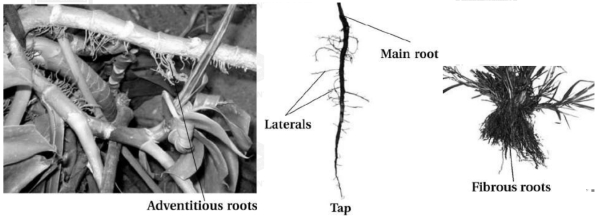
(N/A) The root system is classified into three types based on its origin:
$1$. Tap Root System: In most dicotyledonous plants,the direct elongation of the radicle leads to the formation of the primary root,which grows inside the soil. It bears lateral roots of several orders that are referred to as secondary,tertiary,etc. roots. Example: Mustard plant.
$2$. Fibrous Root System: In monocotyledonous plants,the primary root is short-lived and is replaced by a large number of roots. These roots originate from the base of the stem and constitute the fibrous root system. Example: Wheat plant.
$3$. Adventitious Root System: In some plants,like grass,Monstera,and the banyan tree,roots arise from parts of the plant other than the radicle and are called adventitious roots.
Functions of the root system:
$(i)$ Absorption of water and minerals from the soil.
(ii) Providing a proper anchorage to the plant parts.
(iii) Storing reserve food material.
(iv) Synthesis of plant growth regulators.
$1$. Tap Root System: In most dicotyledonous plants,the direct elongation of the radicle leads to the formation of the primary root,which grows inside the soil. It bears lateral roots of several orders that are referred to as secondary,tertiary,etc. roots. Example: Mustard plant.
$2$. Fibrous Root System: In monocotyledonous plants,the primary root is short-lived and is replaced by a large number of roots. These roots originate from the base of the stem and constitute the fibrous root system. Example: Wheat plant.
$3$. Adventitious Root System: In some plants,like grass,Monstera,and the banyan tree,roots arise from parts of the plant other than the radicle and are called adventitious roots.
Functions of the root system:
$(i)$ Absorption of water and minerals from the soil.
(ii) Providing a proper anchorage to the plant parts.
(iii) Storing reserve food material.
(iv) Synthesis of plant growth regulators.
0 likes
View Solution207
Easy
Explain the regions of the root with a diagram.
Solution
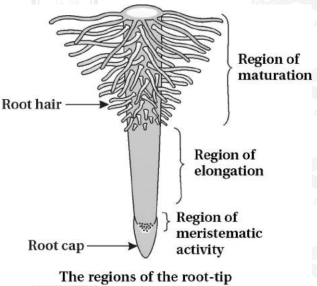
(N/A) The root tip is divided into several distinct regions:
$\rightarrow$ Root Cap: The root is covered at the apex by a thimble-like structure called the root cap. It protects the tender apex of the root as it makes its way through the soil.
$\rightarrow$ Region of Meristematic Activity: The cells of this region are very small,thin-walled,and have dense protoplasm. They divide repeatedly.
$\rightarrow$ Region of Elongation: The cells proximal to the meristematic region undergo rapid elongation and enlargement and are responsible for the growth of the root in length.
$\rightarrow$ Region of Maturation: The cells of the elongation zone gradually differentiate and mature. This zone,proximal to the region of elongation,is called the region of maturation. Some epidermal cells in this region form very fine and delicate,thread-like structures called root hairs.
$\rightarrow$ Root Cap: The root is covered at the apex by a thimble-like structure called the root cap. It protects the tender apex of the root as it makes its way through the soil.
$\rightarrow$ Region of Meristematic Activity: The cells of this region are very small,thin-walled,and have dense protoplasm. They divide repeatedly.
$\rightarrow$ Region of Elongation: The cells proximal to the meristematic region undergo rapid elongation and enlargement and are responsible for the growth of the root in length.
$\rightarrow$ Region of Maturation: The cells of the elongation zone gradually differentiate and mature. This zone,proximal to the region of elongation,is called the region of maturation. Some epidermal cells in this region form very fine and delicate,thread-like structures called root hairs.
0 likes
View Solution208
Easy
Describe the modifications of roots for specific functions.
Solution
(N/A) $\rightarrow$ Roots in some plants change their shape and structure to perform functions other than absorption and conduction of water and minerals. These are called modifications of roots.
$\rightarrow$ Roots are modified for support, storage of food, and respiration.
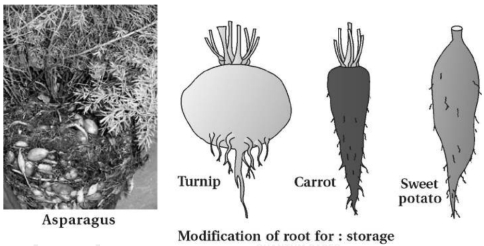
$\rightarrow$ Modifications for food storage:
$(a)$ Tap root modifications: In carrot, the tap root stores food and becomes cone-shaped (conical). In radish, it becomes spindle-shaped (fusiform). In turnip and beet root, it becomes top-shaped (napiform).
$(b)$ Adventitious root modifications: In sweet potato, adventitious roots become swollen due to food storage, known as simple tuberous roots. In Asparagus and Dahlia, clusters of swollen roots are formed, known as fasciculated tuberous roots.
$\rightarrow$ Modifications for support:
$(a)$ Stilt roots: These are supporting roots that come out of the lower nodes of the stem in plants like maize and sugarcane to provide mechanical support.
$(b)$ Prop roots: These are hanging structures that support the tree, e.g., Banyan tree.
$\rightarrow$ Roots are modified for support, storage of food, and respiration.
$\rightarrow$ Modifications for food storage:
$(a)$ Tap root modifications: In carrot, the tap root stores food and becomes cone-shaped (conical). In radish, it becomes spindle-shaped (fusiform). In turnip and beet root, it becomes top-shaped (napiform).
$(b)$ Adventitious root modifications: In sweet potato, adventitious roots become swollen due to food storage, known as simple tuberous roots. In Asparagus and Dahlia, clusters of swollen roots are formed, known as fasciculated tuberous roots.
$\rightarrow$ Modifications for support:
$(a)$ Stilt roots: These are supporting roots that come out of the lower nodes of the stem in plants like maize and sugarcane to provide mechanical support.
$(b)$ Prop roots: These are hanging structures that support the tree, e.g., Banyan tree.
0 likes
View Solution209
Easy
What are the main functions of the root system?
Solution
(N/A) The main functions of the root system are as follows:
$(i)$ Absorption of water and minerals from the soil.
$(ii)$ Providing proper anchorage to the plant parts.
$(iii)$ Storing reserve food material.
$(iv)$ Synthesis of plant growth regulators.
$(i)$ Absorption of water and minerals from the soil.
$(ii)$ Providing proper anchorage to the plant parts.
$(iii)$ Storing reserve food material.
$(iv)$ Synthesis of plant growth regulators.
0 likes
View Solution210
Easy
Draw a labelled diagram showing various regions of a root.
Solution
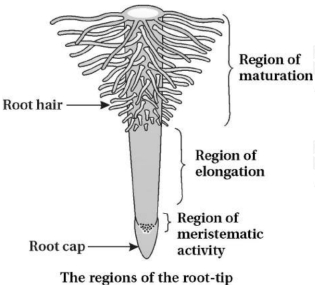
(N/A) The root tip is divided into three main regions based on the activity of the cells:
$1$. Region of Meristematic Activity: This is located a few millimeters above the root cap. The cells in this region are very small,thin-walled,and with dense protoplasm. They divide repeatedly.
$2$. Region of Elongation: This region is located just above the meristematic region. The cells here undergo rapid elongation and enlargement,which is responsible for the growth of the root in length.
$3$. Region of Maturation: This region is proximal to the elongation region. The cells in this zone gradually differentiate and mature. Some of the epidermal cells in this region form very fine,delicate,thread-like structures called root hairs,which absorb water and minerals from the soil.
$1$. Region of Meristematic Activity: This is located a few millimeters above the root cap. The cells in this region are very small,thin-walled,and with dense protoplasm. They divide repeatedly.
$2$. Region of Elongation: This region is located just above the meristematic region. The cells here undergo rapid elongation and enlargement,which is responsible for the growth of the root in length.
$3$. Region of Maturation: This region is proximal to the elongation region. The cells in this zone gradually differentiate and mature. Some of the epidermal cells in this region form very fine,delicate,thread-like structures called root hairs,which absorb water and minerals from the soil.
0 likes
View Solution211
Easy
Describe the modifications of plant roots for food storage.
Solution
(N/A) $\Rightarrow$ Modifications of roots for food storage:
$(a)$ Storage in tap roots: In carrots,the tap root stores food and becomes conical in shape. In radish,it stores food and becomes fusiform (spindle-shaped). In turnip and beet,the root stores food and becomes napiform (top-shaped).
$(b)$ Storage in adventitious roots: In sweet potato,the adventitious roots store food and become swollen and irregular in shape. These are called simple tuberous roots.
$\Rightarrow$ In asparagus and dahlia,the roots store food and occur in clusters. These are called fasciculated tuberous roots.
$(a)$ Storage in tap roots: In carrots,the tap root stores food and becomes conical in shape. In radish,it stores food and becomes fusiform (spindle-shaped). In turnip and beet,the root stores food and becomes napiform (top-shaped).
$(b)$ Storage in adventitious roots: In sweet potato,the adventitious roots store food and become swollen and irregular in shape. These are called simple tuberous roots.
$\Rightarrow$ In asparagus and dahlia,the roots store food and occur in clusters. These are called fasciculated tuberous roots.
0 likes
View Solution212
Easy
Describe the modifications of roots for support.
Solution
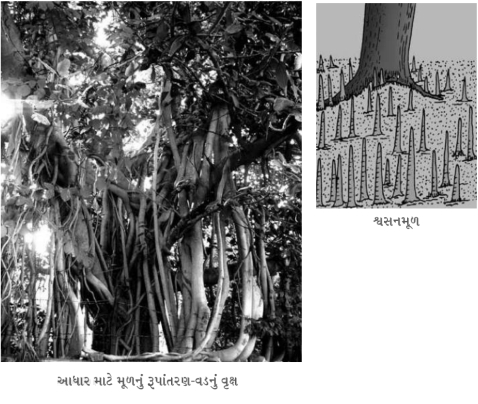
(N/A) Modifications of roots for support include Prop roots and Stilt roots.
$(a)$ Prop roots: In Banyan trees (Ficus benghalensis),roots arise from the branches and grow downwards into the soil,providing mechanical support to the tree. These are called prop roots.
$(b)$ Stilt roots: In plants like Maize and Sugarcane,adventitious roots arise from the lower nodes of the stem,grow obliquely downwards,and enter the soil to provide mechanical support. These are called stilt roots.
Note: Pneumatophores (Respiratory roots) are modifications for respiration,not support. These are found in plants growing in swampy areas (e.g.,Rhizophora),where roots grow vertically upwards out of the soil to obtain oxygen.
$(a)$ Prop roots: In Banyan trees (Ficus benghalensis),roots arise from the branches and grow downwards into the soil,providing mechanical support to the tree. These are called prop roots.
$(b)$ Stilt roots: In plants like Maize and Sugarcane,adventitious roots arise from the lower nodes of the stem,grow obliquely downwards,and enter the soil to provide mechanical support. These are called stilt roots.
Note: Pneumatophores (Respiratory roots) are modifications for respiration,not support. These are found in plants growing in swampy areas (e.g.,Rhizophora),where roots grow vertically upwards out of the soil to obtain oxygen.
0 likes
View Solution213
Easy
Give differences: Tap root system and Fibrous root system.
Solution
(N/A)
| Tap root system | Fibrous root system |
|---|---|
| $(1)$ Generally present in dicot plants. | $(1)$ Generally present in monocot plants. |
| $(2)$ Develops from the radicle of the embryo. | $(2)$ The primary root is short-lived and replaced by a large number of roots originating from the base of the stem. |
| $(3)$ Consists of a primary root and its branches (secondary,tertiary,etc.). | $(3)$ Consists of a cluster of roots arising from the base of the stem; no distinct primary root is visible. |
| $(4)$ The main root (tap root) can be clearly identified. | $(4)$ No single main root can be identified as they are all similar in size. |
| $(5)$ It penetrates deep into the soil. | $(5)$ These roots are shallow and do not penetrate deep into the soil. |
0 likes
View Solution214
Medium
Give scientific reasons: The root of the $Rhizophora$ plant is called a breathing root.
Solution
(N/A) $\rightarrow$ Plants that grow in muddy and saline soil along the seashore are known as mangroves. $Rhizophora$ is a classic example of a mangrove plant.
In such environments,the soil is waterlogged and saline,which significantly reduces the availability of oxygen for the root system.
To overcome this oxygen deficiency,$Rhizophora$ develops specialized roots that grow vertically upwards,against the direction of gravity (negatively geotropic),emerging above the soil surface.
These roots,known as pneumatophores or breathing roots,contain small pores called lenticels.
These pores facilitate the exchange of gases,allowing the plant to absorb $O_2$ directly from the atmosphere to support the metabolic activities of the root system.
In such environments,the soil is waterlogged and saline,which significantly reduces the availability of oxygen for the root system.
To overcome this oxygen deficiency,$Rhizophora$ develops specialized roots that grow vertically upwards,against the direction of gravity (negatively geotropic),emerging above the soil surface.
These roots,known as pneumatophores or breathing roots,contain small pores called lenticels.
These pores facilitate the exchange of gases,allowing the plant to absorb $O_2$ directly from the atmosphere to support the metabolic activities of the root system.
0 likes
View Solution215
Easy
Provide definitions/explanations for the following terms:
$(i)$ Leaf
$(ii)$ Root
$(i)$ Leaf
$(ii)$ Root
Solution
(N/A) $(i)$ The leaf is a lateral,generally flattened structure borne on the stem. It develops at the node and bears a bud in its axil.
$(ii)$ The root is the underground part of the plant that typically grows towards gravity (geotropism),soil,and water (hydrotropism),and away from sunlight and air.
$(ii)$ The root is the underground part of the plant that typically grows towards gravity (geotropism),soil,and water (hydrotropism),and away from sunlight and air.
0 likes
View Solution216
Medium
Give two examples of roots that develop from different parts of the angiospermic plant other than the radicle.
Solution
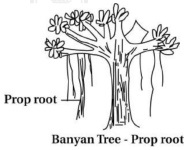
(N/A) $(i)$ In banyan tree,prop roots are produced from branches and grow downwards towards the soil. These roots provide support to the tree.
$(ii)$ In sugarcane and maize,stilt roots are produced from the lower nodes of the stem. These roots enter the soil and provide support to the plant,protecting it against strong winds.
$(ii)$ In sugarcane and maize,stilt roots are produced from the lower nodes of the stem. These roots enter the soil and provide support to the plant,protecting it against strong winds.
0 likes
View Solution217
Easy
The essential functions of roots are anchorage and absorption of water and minerals in terrestrial plants. What functions are associated with the roots of aquatic plants? How are the roots of aquatic plants and terrestrial plants different?
Solution
(N/A) $\rightarrow$ Generally, terrestrial roots show a network of branches that function to absorb water and minerals from the soil and to provide anchorage.
$\rightarrow$ In aquatic plants, modifications of their normal functions and deviations are seen. For example, in plants like $Trapa$ and $Tinospora$, roots are green and much-branched, which increases the surface area for photosynthesis. In plants like $Jussiaea$, roots become balloon-like (aerenchyma) to store air, allowing the plant to float on water and facilitating gas exchange.
$\rightarrow$ Differences between Aquatic Roots and Terrestrial Roots:
$\rightarrow$ In aquatic plants, modifications of their normal functions and deviations are seen. For example, in plants like $Trapa$ and $Tinospora$, roots are green and much-branched, which increases the surface area for photosynthesis. In plants like $Jussiaea$, roots become balloon-like (aerenchyma) to store air, allowing the plant to float on water and facilitating gas exchange.
$\rightarrow$ Differences between Aquatic Roots and Terrestrial Roots:
| $1$. Aquatic Root | $1$. Terrestrial Root |
| $1$. Roots may be absent (e.g., $Wolffia$). If present, they are poorly developed, thin, and adventitious. | $1$. Roots are well-developed with root caps, root hairs, and branches. |
| $2$. Vascular tissues are less developed. | $2$. Vascular bundles are well-developed. |
| $3$. Modified for photosynthesis, buoyancy, and gas exchange. | $3$. Primarily for fixation and absorption of water and minerals from the soil. |
0 likes
View Solution218
Medium
Explain the stages of root formation.
Solution
(N/A) Root formation,or root development,occurs in several distinct stages starting from the embryo within the seed:
$1$. Germination and Radicle Emergence: Upon imbibition of water,the embryo activates. The radicle is the first part to emerge from the seed,establishing the primary root system.
$2$. Cell Division (Meristematic Zone): At the root tip,the root apical meristem undergoes rapid mitosis,producing new cells that contribute to root growth.
$3$. Cell Elongation (Elongation Zone): Cells produced by the meristem undergo rapid expansion in length,which is the primary driver of root penetration into the soil.
$4$. Cell Differentiation (Maturation Zone): Cells differentiate into specialized tissues such as the epidermis (with root hairs for absorption),cortex,endodermis,and vascular cylinder (xylem and phloem) for transport.
$1$. Germination and Radicle Emergence: Upon imbibition of water,the embryo activates. The radicle is the first part to emerge from the seed,establishing the primary root system.
$2$. Cell Division (Meristematic Zone): At the root tip,the root apical meristem undergoes rapid mitosis,producing new cells that contribute to root growth.
$3$. Cell Elongation (Elongation Zone): Cells produced by the meristem undergo rapid expansion in length,which is the primary driver of root penetration into the soil.
$4$. Cell Differentiation (Maturation Zone): Cells differentiate into specialized tissues such as the epidermis (with root hairs for absorption),cortex,endodermis,and vascular cylinder (xylem and phloem) for transport.
0 likes
View Solution219
MediumMCQ
Identify the correct terms for the following analogy questions:
$(i)$ In wheat : Fibrous root :: In Banyan tree : ..........
(ii) In Rhizophora : Respiratory root :: In Turnip : ........
$(i)$ In wheat : Fibrous root :: In Banyan tree : ..........
(ii) In Rhizophora : Respiratory root :: In Turnip : ........
A
$(i)$ Tap root,(ii) Storage root
B
$(i)$ Adventitious root,(ii) Storage root
C
$(i)$ Tap root,(ii) Prop root
D
$(i)$ Adventitious root,(ii) Prop root
Solution
(B) $(i)$ In wheat,the primary root is short-lived and is replaced by a large number of roots that originate from the base of the stem,known as fibrous roots. In the Banyan tree,roots arise from the branches,which are known as adventitious roots (specifically prop roots).
(ii) In Rhizophora,roots grow vertically upwards out of the ground to get oxygen for respiration,known as respiratory roots (pneumatophores). In Turnip,the roots are modified for the storage of food,known as storage roots.
(ii) In Rhizophora,roots grow vertically upwards out of the ground to get oxygen for respiration,known as respiratory roots (pneumatophores). In Turnip,the roots are modified for the storage of food,known as storage roots.
0 likes
View Solution220
MediumMCQ
Roots obtain oxygen from air in the soil for respiration. In the absence or deficiency of $O_{2}$,root growth is restricted or completely stopped. How do the plants growing in marsh lands or swamps obtain their $O_{2}$ required for respiration?
A
By developing adventitious roots
B
By developing pneumatophores
C
By developing tap roots
D
By developing prop roots
Solution
(B) Plants growing in marshy areas or swamps face a deficiency of oxygen in the soil due to waterlogging.
To overcome this,these plants develop special roots called pneumatophores or breathing roots.
These roots grow vertically upwards (negatively geotropic) out of the soil and water to absorb oxygen from the atmosphere through small pores called lenticels.
An example of such a plant is $Rhizophora$.
To overcome this,these plants develop special roots called pneumatophores or breathing roots.
These roots grow vertically upwards (negatively geotropic) out of the soil and water to absorb oxygen from the atmosphere through small pores called lenticels.
An example of such a plant is $Rhizophora$.
0 likes
View Solution221
MediumMCQ
In swampy areas like the Sunderbans in West Bengal,plants bear special kinds of roots called $.......$
A
Prop roots
B
Stilt roots
C
Pneumatophores
D
Storage roots
Solution
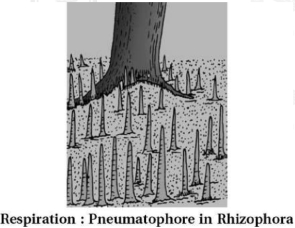
(C) $\rightarrow$ Pneumatophores: Plants growing in swampy,saline,and humid areas near the seashore are known as Mangroves.
$\rightarrow$ Many roots of these plants grow vertically upwards,opposite to the direction of gravity,emerging directly from the soil.
$\rightarrow$ Such roots are porous and unbranched. They help the plant obtain oxygen for respiration in waterlogged,oxygen-deficient soil. These are called Pneumatophores or respiratory roots.
$\rightarrow$ Many roots of these plants grow vertically upwards,opposite to the direction of gravity,emerging directly from the soil.
$\rightarrow$ Such roots are porous and unbranched. They help the plant obtain oxygen for respiration in waterlogged,oxygen-deficient soil. These are called Pneumatophores or respiratory roots.
0 likes
View Solution222
EasyMCQ
The roots that originate from the base of the stem are:
A
Lateral roots
B
Fibrous roots
C
Primary roots
D
Prop roots
Solution
(B) In monocotyledonous plants,the primary root is short-lived and is replaced by a large number of roots. These roots originate from the base of the stem and constitute the fibrous root system,as seen in wheat and grass.
0 likes
View Solution223
EasyMCQ
Pneumatophores are usually present in
A
Murraya
B
Eichhornia
C
Avicennia
D
None of these
Solution
(C) Pneumatophores are specialized negatively geotropic roots that grow vertically upwards out of the soil or water to facilitate gaseous exchange in plants growing in swampy or saline areas (mangroves).
Examples of such plants include Avicennia,Rhizophora,and Sonneratia.
Examples of such plants include Avicennia,Rhizophora,and Sonneratia.
0 likes
View Solution224
MediumMCQ
Respiratory roots are found in
A
Rhizopus
B
Orchids
C
Vallisneria
D
Mangrove plants
Solution
(D) Respiratory roots,also known as pneumatophores,are specialized root structures that grow vertically upwards (negatively geotropic) to facilitate gaseous exchange in oxygen-deficient,waterlogged soil.
These roots are characteristic of halophytic plants that grow in tidal swamps,such as mangrove plants (e.g.,$Rhizophora$).
These roots are characteristic of halophytic plants that grow in tidal swamps,such as mangrove plants (e.g.,$Rhizophora$).
0 likes
View Solution225
MediumMCQ
Prop roots are the modification for
A
Support
B
Respiration
C
Storage of food
D
Increasing mass
Solution
(A) Prop roots, also known as pillar roots, are specialized adventitious roots that grow downwards from the horizontal branches of trees, such as the banyan tree $(Ficus \text{ } benghalensis)$.
These roots initially grow in the air and are hygroscopic in nature.
Once they reach the soil, they penetrate it, become thick, and develop a pillar-like structure.
Their primary function is to provide mechanical support to the heavy, spreading branches of the tree.
These roots initially grow in the air and are hygroscopic in nature.
Once they reach the soil, they penetrate it, become thick, and develop a pillar-like structure.
Their primary function is to provide mechanical support to the heavy, spreading branches of the tree.
0 likes
View Solution226
MediumMCQ
The edible part of the sweet potato is a modified
A
Stem
B
Root
C
Leaf
D
Flower
Solution
(B) The sweet potato $(Ipomoea \text{ } batatas)$ is a classic example of a tuberous adventitious root.
In sweet potatoes, the adventitious roots become swollen and fleshy to store food.
Unlike the potato, which is a modified stem (tuber), the sweet potato is a modified root.
In sweet potatoes, the adventitious roots become swollen and fleshy to store food.
Unlike the potato, which is a modified stem (tuber), the sweet potato is a modified root.
0 likes
View Solution227
MediumMCQ
The region of the root present just above the root cap is called the region of
A
Elongation
B
Meristematic activity
C
Root hair
D
Maturation
Solution
(B) The correct answer is $B$ (Meristematic activity).
$A$ typical root possesses four distinct regions:
$(i)$ Root Cap: The root is covered at the apex by a thimble-like structure called the root cap. It protects the tender apex of the root as it makes its way through the soil.
$(ii)$ Region of Meristematic Activity: This region is located a few millimeters above the root cap. The cells of this region are very small,thin-walled,and contain dense protoplasm. They divide repeatedly.
$(iii)$ Region of Elongation: The cells proximal to the meristematic zone undergo rapid elongation and enlargement,which is responsible for the growth of the root in length.
$(iv)$ Region of Maturation: The cells of the elongation zone gradually differentiate and mature. This zone lies just proximal to the region of elongation.
$A$ typical root possesses four distinct regions:
$(i)$ Root Cap: The root is covered at the apex by a thimble-like structure called the root cap. It protects the tender apex of the root as it makes its way through the soil.
$(ii)$ Region of Meristematic Activity: This region is located a few millimeters above the root cap. The cells of this region are very small,thin-walled,and contain dense protoplasm. They divide repeatedly.
$(iii)$ Region of Elongation: The cells proximal to the meristematic zone undergo rapid elongation and enlargement,which is responsible for the growth of the root in length.
$(iv)$ Region of Maturation: The cells of the elongation zone gradually differentiate and mature. This zone lies just proximal to the region of elongation.
0 likes
View Solution228
MediumMCQ
Roots arising from parts of the plant other than the radicle are called:
A
Adventitious root
B
Stilt root
C
Nodal root
D
Intermodal root
Solution
(A) Roots that develop from any part of the plant other than the radicle are known as adventitious roots.
Examples include grass,$Monstera$,and the banyan tree.
Examples include grass,$Monstera$,and the banyan tree.
0 likes
View Solution229
MediumMCQ
If a primary root continues to grow,the type of root system will be known as
A
Secondary
B
fibrous
C
tap
D
stilt
Solution
(C) When the primary root,which develops from the radicle of the embryo,remains as the main root throughout the life of the plant and grows straight downward into the soil,it is called a tap root. This type of root system is characteristic of dicotyledonous plants.
0 likes
View Solution230
MediumMCQ
Root hairs are found in:
A
The zone of elongation
B
Adventitious roots
C
The root cap
D
The zone of maturation
Solution
(D) The root system is divided into different regions: the root cap,the region of meristematic activity,the region of elongation,and the region of maturation.
Root hairs are unicellular,tubular extensions of the epidermal cells (epiblema) found specifically in the region of maturation.
These hairs are responsible for the absorption of water and minerals from the soil.
Therefore,the correct option is $D$.
Root hairs are unicellular,tubular extensions of the epidermal cells (epiblema) found specifically in the region of maturation.
These hairs are responsible for the absorption of water and minerals from the soil.
Therefore,the correct option is $D$.
0 likes
View Solution231
MediumMCQ
Water and minerals absorption from the soil is the function of:
A
Root hair
B
Root cap
C
Stilt root
D
Prop roots
Solution
(A) The root hairs are tubular extensions of the epidermal cells of the root.
They significantly increase the surface area available for the absorption of water and minerals from the soil.
Root hairs are unicellular and are found in the maturation zone of the root.
They significantly increase the surface area available for the absorption of water and minerals from the soil.
Root hairs are unicellular and are found in the maturation zone of the root.
0 likes
View Solution232
MediumMCQ
Select the correct statements.
$I$. From the region of elongation,some of the epidermal cells form root hairs.
$II$. Pneumatophores are seen in $Rhizophora$.
$III$. Adventitious roots are seen in the banyan tree.
$IV$. Maize and sugarcane have prop roots.
$I$. From the region of elongation,some of the epidermal cells form root hairs.
$II$. Pneumatophores are seen in $Rhizophora$.
$III$. Adventitious roots are seen in the banyan tree.
$IV$. Maize and sugarcane have prop roots.
A
$I$ and $IV$
B
$I$,$III$ and $IV$
C
$III$ and $IV$
D
$II$ and $III$
Solution
(D) Statement $I$ is incorrect because root hairs arise from the region of maturation,not the region of elongation.
Statement $II$ is correct; $Rhizophora$ plants growing in swampy areas possess pneumatophores (respiratory roots) that grow vertically upwards to obtain oxygen.
Statement $III$ is correct; the banyan tree exhibits adventitious roots that arise from the branches.
Statement $IV$ is incorrect; maize and sugarcane possess stilt roots,not prop roots. Prop roots are specifically found in the banyan tree. Therefore,statements $II$ and $III$ are correct.
Statement $II$ is correct; $Rhizophora$ plants growing in swampy areas possess pneumatophores (respiratory roots) that grow vertically upwards to obtain oxygen.
Statement $III$ is correct; the banyan tree exhibits adventitious roots that arise from the branches.
Statement $IV$ is incorrect; maize and sugarcane possess stilt roots,not prop roots. Prop roots are specifically found in the banyan tree. Therefore,statements $II$ and $III$ are correct.
0 likes
View Solution233
MediumMCQ
$A$ fibrous root system is excellent for
A
food storage
B
nitrogen fixation
C
absorbing water from deeper layer of soil
D
providing good anchorage for the plant
Solution
(D) fibrous root system consists of a dense network of roots that originate from the base of the stem. Unlike the tap root system,which penetrates deep into the soil,the fibrous root system spreads horizontally near the soil surface. This extensive network of fine roots binds the soil particles together effectively,thereby providing excellent anchorage for the plant.
0 likes
View Solution234
MediumMCQ
Which one of the following conditions is seen in the roots of a plant having submerged assimilatory roots and spongy petioles?
A
Triarch
B
Monarch
C
Tetrarch
D
Diarch
Solution
(B) $Trapa$ $\text{natans}$ is a hydrophyte. It possesses a $monarch$ condition (a single xylem strand) in its slender roots and spongy petioles.
0 likes
View Solution235
MediumMCQ
Fibrous root system originates from the base of
A
Root
B
Stem
C
Leaves
D
Lamina
Solution
(B) In monocotyledonous plants,the primary root is short-lived and is replaced by a large number of roots. These roots originate from the base of the stem and constitute the fibrous root system,as seen in wheat or rice plants.
0 likes
View Solution236
MediumMCQ
The smallest region of the root is:
A
Root cap
B
Region of elongation
C
Region of meristematic activity
D
Region of maturation
Solution
(C) The smallest region of the root is the region of meristematic activity,also known as the growing point.
In this region,the cells are very small,thin-walled,and possess dense cytoplasm.
These cells are actively dividing to produce new cells for the growth of the root.
In this region,the cells are very small,thin-walled,and possess dense cytoplasm.
These cells are actively dividing to produce new cells for the growth of the root.
0 likes
View Solution237
MediumMCQ
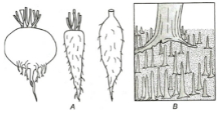
Which of the following is incorrect about the diagrams $A$ and $B$?
A
Tap roots of carrot,turnip and adventitious root of sweet potato get swollen and store food.
B
Pneumatophores help to get oxygen for respiration.
C
Pneumatophores are found in the plants that grow in sandy soil.
D
$A$ represents underground roots,but $B$ grows vertically upwards.
Solution
(C) Diagram $A$ shows modified roots for food storage (carrot,turnip,sweet potato). Diagram $B$ shows pneumatophores,which are specialized roots found in plants growing in swampy or marshy areas (e.g.,$Rhizophora$). These roots grow vertically upwards out of the ground to obtain oxygen for respiration. Therefore,the statement that they are found in sandy soil is incorrect.
0 likes
View Solution238
MediumMCQ
Which of the following is a correct statement?
A
Orchid has palmate fleshy roots
B
Pandanus has stilt roots
C
Sweet potato has root tubers
D
All of the above
Solution
(D) Orchids possess epiphytic roots,which are covered by a hygroscopic velamen tissue to absorb moisture from the atmosphere.
Sweet potato roots are irregularly swollen and are known as root tubers.
Stilt roots are adventitious roots that arise from the lower nodes of the main stem to provide additional support to the plant,as seen in $Pandanus$ and $Rhizophora$.
Since both statements $B$ and $C$ are correct,and statement $A$ is incorrect (orchids have epiphytic roots,not palmate fleshy roots),the question options provided are slightly ambiguous. However,based on standard botanical facts,$B$ and $C$ are correct. Given the structure,if this is a multiple-choice question,it is likely intended to test the identification of correct root modifications.
Sweet potato roots are irregularly swollen and are known as root tubers.
Stilt roots are adventitious roots that arise from the lower nodes of the main stem to provide additional support to the plant,as seen in $Pandanus$ and $Rhizophora$.
Since both statements $B$ and $C$ are correct,and statement $A$ is incorrect (orchids have epiphytic roots,not palmate fleshy roots),the question options provided are slightly ambiguous. However,based on standard botanical facts,$B$ and $C$ are correct. Given the structure,if this is a multiple-choice question,it is likely intended to test the identification of correct root modifications.
0 likes
View Solution239
MediumMCQ
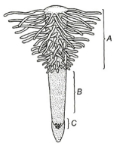
Identify $A, B$ and $C$ in the given diagram.
A
$A$-Region of maturation,$B$-Region of elongation,$C$-Region of meristematic activity
B
$A$-Region of elongation,$B$-Region of maturation,$C$-Region of meristematic activity
C
$A$-Region of meristematic,$B$-Region of maturation,$C$-Region of elongation activity
D
$A$-Region of meristematic,$B$-Region of elongation,$C$-Region of maturation
Solution
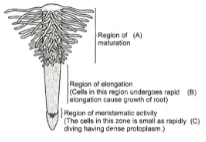
(A) In the given diagram of a root tip:
$A$ represents the Region of maturation,which is characterized by the presence of root hairs.
$B$ represents the Region of elongation,where cells undergo rapid elongation and enlargement,responsible for the growth of the root in length.
$C$ represents the Region of meristematic activity,located just above the root cap,where cells are small,thin-walled,and with dense protoplasm,dividing repeatedly.
Therefore,the correct sequence is $A$-Region of maturation,$B$-Region of elongation,$C$-Region of meristematic activity.
$A$ represents the Region of maturation,which is characterized by the presence of root hairs.
$B$ represents the Region of elongation,where cells undergo rapid elongation and enlargement,responsible for the growth of the root in length.
$C$ represents the Region of meristematic activity,located just above the root cap,where cells are small,thin-walled,and with dense protoplasm,dividing repeatedly.
Therefore,the correct sequence is $A$-Region of maturation,$B$-Region of elongation,$C$-Region of meristematic activity.
0 likes
View Solution240
MediumMCQ
The root system growing near the base of the radicle in monocots is
A
Haptera
B
Anchoring roots
C
Clinging roots
D
Seminal roots
Solution
(D) In monocots,the primary root degenerates early.
Seminal roots are the roots that arise from the base of the radicle.
These are temporary roots that develop during the early stages of germination.
Fibrous root systems,which replace the primary root,also typically arise from the base of the radicle and lower nodes of the stem.
Seminal roots are the roots that arise from the base of the radicle.
These are temporary roots that develop during the early stages of germination.
Fibrous root systems,which replace the primary root,also typically arise from the base of the radicle and lower nodes of the stem.
0 likes
View Solution241
MediumMCQ
Primary root is the direct elongation of the
A
Pedicel
B
Radicle
C
Plumule
D
Stamen
Solution
(B) The primary root is the direct elongation of the radicle during seed germination. The radicle is the embryonic root of the plant.
0 likes
View Solution242
MediumMCQ
The type of roots present in mustard plant is
A
Fibrous roots
B
Adventitious roots
C
Tap roots
D
Nodulated roots
Solution
(C) The mustard plant $(Brassica \text{ } campestris)$ is a dicotyledonous plant.
In dicotyledonous plants, the direct elongation of the radicle leads to the formation of the primary root, which grows inside the soil.
This primary root along with its branches constitutes the tap root system.
Therefore, the type of roots present in the mustard plant is tap roots.
In dicotyledonous plants, the direct elongation of the radicle leads to the formation of the primary root, which grows inside the soil.
This primary root along with its branches constitutes the tap root system.
Therefore, the type of roots present in the mustard plant is tap roots.
0 likes
View Solution243
MediumMCQ
Which of the following is not a lateral branch of the roots?
A
Tertiary roots
B
Secondary roots
C
Primary root
D
More than one option is correct
Solution
(C) In a tap root system,the primary root is the direct continuation of the radicle.
Secondary and tertiary roots arise from the primary root as lateral branches.
Therefore,the primary root is not a lateral branch,but rather the main axis from which lateral branches originate.
Secondary and tertiary roots arise from the primary root as lateral branches.
Therefore,the primary root is not a lateral branch,but rather the main axis from which lateral branches originate.
0 likes
View Solution244
MediumMCQ
In wheat plant . . . . . . root system is present.
A
Nodulated
B
Tap
C
Fibrous
D
Prop
Solution
(C) In wheat plants,the primary root is short-lived and is replaced by a large number of roots. These roots originate from the base of the stem and constitute the fibrous root system. Wheat,being a monocotyledonous plant,characteristically exhibits this type of root system.
0 likes
View Solution245
MediumMCQ
Which of the following is not the main function of the root system?
A
Provide anchorage to the plant parts
B
Synthesis of $PGRs$
C
Absorption of water and minerals from soil
D
Photosynthesis
Solution
(D) The primary functions of the root system include the absorption of water and minerals from the soil,providing proper anchorage to the plant parts,storing reserve food materials,and the synthesis of plant growth regulators $(PGRs)$.
Photosynthesis is the process by which green plants synthesize their food using sunlight,which primarily occurs in the leaves,not the roots.
Photosynthesis is the process by which green plants synthesize their food using sunlight,which primarily occurs in the leaves,not the roots.
0 likes
View Solution246
MediumMCQ
$A$ root grows in length; which region of the root is responsible for this growth?
A
Root cap
B
Region of meristematic activity
C
Region of elongation
D
Region of maturation
Solution
(C) The root grows in length primarily due to the activity of the region of elongation. In this region,the cells undergo rapid enlargement and expansion,which pushes the root tip forward into the soil.
0 likes
View Solution247
MediumMCQ
Root hairs are present in/on:
A
Region of elongation
B
Region of maturation
C
Region of meristematic activity
D
Root cap
Solution
(B) The root system is divided into different zones based on cellular activity.
$1$. The region of meristematic activity consists of small,thin-walled cells with dense protoplasm that divide repeatedly.
$2$. The region of elongation is where cells undergo rapid enlargement and elongation,responsible for the growth of the root in length.
$3$. The region of maturation contains cells that differentiate and mature. In this zone,some epidermal cells form very fine,delicate,thread-like structures called root hairs. These root hairs are responsible for the absorption of water and minerals from the soil.
$1$. The region of meristematic activity consists of small,thin-walled cells with dense protoplasm that divide repeatedly.
$2$. The region of elongation is where cells undergo rapid enlargement and elongation,responsible for the growth of the root in length.
$3$. The region of maturation contains cells that differentiate and mature. In this zone,some epidermal cells form very fine,delicate,thread-like structures called root hairs. These root hairs are responsible for the absorption of water and minerals from the soil.
0 likes
View Solution248
MediumMCQ
The region or part of the root that increases the surface area for water absorption is:
A
Root cap
B
Zone of elongation
C
Meristematic zone
D
Root hair
Solution
(D) The root hair zone is the region of maturation in a root.
Root hairs are unicellular,tubular extensions of the epidermal cells (epiblema) of the root.
These structures significantly increase the surface area of the root,which facilitates the maximum absorption of water and minerals from the soil.
Root hairs are unicellular,tubular extensions of the epidermal cells (epiblema) of the root.
These structures significantly increase the surface area of the root,which facilitates the maximum absorption of water and minerals from the soil.
0 likes
View Solution249
MediumMCQ
The tap roots of . . . . . . get modified to store food.
A
Carrot
B
Onion
C
Ginger
D
Sweet potato
Solution
(A) The tap roots of carrot get modified to store food. In some plants,the primary root (tap root) becomes fleshy and swollen due to the storage of food materials,which helps the plant survive during unfavorable conditions. Carrot is a classic example of a tap root modification for food storage.
0 likes
View SolutionMorphology of Flowering Plants — Root · Frequently Asked Questions
1Are these Morphology of Flowering Plants questions useful for JEE and NEET?
Yes. All questions in this section are mapped to JEE Main and NEET exam patterns. Previous year questions from JEE Main, NEET, GUJCET and state-level exams are included with full solutions.
2Can I switch to Hindi or Gujarati for these questions?
Yes. Use the language tabs in the hero section or the sidebar to view the same questions and solutions in English, Hindi or Gujarati.
3How do I generate a question paper from this subtopic?
Use the Vedclass Exam Paper Generator — select the chapter and subtopic, set difficulty, and generate Sets A, B, C, D automatically. First 3 chapters of every subject are free.
Vedclass Products
For Students
Vedclass Test Series
Mock tests in real JEE/NEET style with performance analysis. 5-day free trial.
Start Free TrialFor Teachers
Exam Paper Generator
Generate Set A/B/C/D papers from this chapter in 2 minutes. 3 chapters free.
Try FreeFor Institutes
Online Exam Module
Live online exams with unlimited students, 360° analytics & white-label branding.
See DemoFor Teachers & Institutes
Generate a Morphology of Flowering Plants Exam Paper in 2 Minutes
Select subtopic & difficulty — Sets A, B, C, D auto-generated with No Repeat logic.
First 3 chapters of every subject are free — no payment required.