
A English
Root Questions in English
Class 11 Biology · Morphology of Flowering Plants · Root
299+
Questions
English
Language
100%
With Solutions
Showing 49 of 299 questions in English
251
MediumMCQ
Adventitious roots of . . . . . . get swollen and store food.
A
Carrot
B
Turnip
C
Radish
D
Sweet potato
Solution
(D) Adventitious roots are roots that arise from parts of the plant other than the radicle. In $Sweet \text{ } potato$ $(Ipomoea \text{ } batatas)$, the adventitious roots become swollen and store food, serving as a storage organ for the plant. In contrast, $Carrot$, $Turnip$, and $Radish$ possess tap roots that become modified for food storage.
0 likes
View Solution252
MediumMCQ
Supporting roots coming out of the lower nodes of the sugarcane stem are called
A
Prop roots
B
Stilt roots
C
Pneumatophores
D
Fusiform roots
Solution
(B) Supporting roots that emerge from the lower nodes of the stem in plants like sugarcane and maize are known as stilt roots. These roots provide additional mechanical support to the plant,preventing it from falling over due to its height or external forces.
0 likes
View Solution253
MediumMCQ
In $Rhizophora$,roots are modified to form
A
Tuberous roots
B
Pneumatophores
C
Stilt roots
D
Storage roots
Solution
(B) In $Rhizophora$,which grows in swampy areas,roots are modified into specialized structures called pneumatophores.
These roots grow vertically upwards (negatively geotropic) to help in the respiration of the plant by absorbing oxygen from the atmosphere.
These roots grow vertically upwards (negatively geotropic) to help in the respiration of the plant by absorbing oxygen from the atmosphere.
0 likes
View Solution254
EasyMCQ
The hanging structures that support the banyan tree are called:
A
Prop roots
B
Stilt roots
C
Pneumatophores
D
Root hair
Solution
(A) The hanging structures that grow from the branches of the banyan tree $(Ficus \text{ } benghalensis)$ towards the ground to provide mechanical support are known as prop roots. These are a type of adventitious root.
0 likes
View Solution255
MediumMCQ
The origin of root hairs and lateral roots is
A
Exogenous and endogenous respectively
B
Endogenous and exogenous respectively
C
Both endogenously
D
Both exogenously
Solution
(A) Root hairs are unicellular outgrowths of the epidermis (epiblema) of the root,making their origin exogenous.
Lateral roots originate from the pericycle,which is an internal layer of the root,making their origin endogenous.
Lateral roots originate from the pericycle,which is an internal layer of the root,making their origin endogenous.
0 likes
View Solution256
MediumMCQ
Find the odd one out with respect to radicle leaves (leaves arising from the root).
A
Maize
B
Radish
C
Carrot
D
Turnip
Solution
(A) Radicle leaves are leaves that arise directly from the root system (often associated with taproot modifications).
Radish,carrot,and turnip are examples of plants with taproot systems where leaves arise from the root base (radicle).
Maize is a monocotyledonous plant that possesses a fibrous root system and does not produce radicle leaves.
Therefore,maize is the odd one out.
Radish,carrot,and turnip are examples of plants with taproot systems where leaves arise from the root base (radicle).
Maize is a monocotyledonous plant that possesses a fibrous root system and does not produce radicle leaves.
Therefore,maize is the odd one out.
0 likes
View Solution257
EasyMCQ
$Cuscuta$,$Viscum$ and $Orobanche$ are similar in having
A
Hygroscopic roots
B
Assimilatory roots
C
Epiphyllous roots
D
Haustorial roots
Solution
(D) $Cuscuta$,$Viscum$ and $Orobanche$ are parasitic plants.
These plants possess specialized root structures known as haustorial roots (or haustoria).
These roots penetrate the tissues of the host plant to absorb nutrients,water,and minerals directly from the host's vascular system.
These plants possess specialized root structures known as haustorial roots (or haustoria).
These roots penetrate the tissues of the host plant to absorb nutrients,water,and minerals directly from the host's vascular system.
0 likes
View Solution258
MediumMCQ
Match the following:
| Column-$I$ | Column-$II$ |
| $(a)$. Cuscuta | $(i)$. Hygroscopic root |
| $(b)$. Rhizophora | $(ii)$. Stilt root |
| $(c)$. Vanda | $(iii)$. Haustorial root |
| $(d)$. Pandanus | $(iv)$. Respiratory root |
A
$a(i), b(iii), c(iv), d(ii)$
B
$a(iii), b(iv), c(i), d(ii)$
C
$a(iii), b(i), c(iv), d(ii)$
D
$a(ii), b(iv), c(i), d(iii)$
Solution
(B) $Cuscuta$ is a parasitic plant that develops haustorial roots to absorb nutrients from the host plant.
$Rhizophora$ grows in swampy areas and develops respiratory roots (pneumatophores) for gas exchange.
$Vanda$ is an epiphytic orchid that possesses hygroscopic roots (velamen roots) to absorb moisture from the atmosphere.
$Pandanus$ (screw pine) develops stilt roots that arise from the lower nodes of the stem to provide mechanical support.
Therefore, the correct matching is $a(iii), b(iv), c(i), d(ii)$.
$Rhizophora$ grows in swampy areas and develops respiratory roots (pneumatophores) for gas exchange.
$Vanda$ is an epiphytic orchid that possesses hygroscopic roots (velamen roots) to absorb moisture from the atmosphere.
$Pandanus$ (screw pine) develops stilt roots that arise from the lower nodes of the stem to provide mechanical support.
Therefore, the correct matching is $a(iii), b(iv), c(i), d(ii)$.
0 likes
View Solution259
MediumMCQ
$A$: Prop roots are rope-like showing oblique growth.
$R$: Prop roots are adventitious roots for extra support and assimilation.
$R$: Prop roots are adventitious roots for extra support and assimilation.
A
Assertion and Reason both are correct and Reason is the correct explanation of Assertion.
B
Assertion and Reason both are correct but Reason is not the correct explanation of Assertion.
C
Assertion is correct,but Reason is incorrect.
D
Both Assertion and Reason are incorrect.
Solution
(D) The Assertion is incorrect because prop roots (e.g.,in Banyan tree) are pillar-like and show vertical growth,not oblique growth.
The Reason is partially correct in stating that prop roots are adventitious roots for extra support,but they are primarily for mechanical support,not assimilation. Therefore,the statement as a whole is considered incorrect in the context of standard botanical definitions where prop roots are strictly for support.
The Reason is partially correct in stating that prop roots are adventitious roots for extra support,but they are primarily for mechanical support,not assimilation. Therefore,the statement as a whole is considered incorrect in the context of standard botanical definitions where prop roots are strictly for support.
0 likes
View Solution260
MediumMCQ
$A$: Epiphyllous roots arise from the margins of leaf lamina.
$R$: Epiphyllous roots help in vegetative reproduction.
$R$: Epiphyllous roots help in vegetative reproduction.
A
Assertion and Reason both are correct and Reason is the correct explanation of Assertion.
B
Assertion and Reason both are correct but Reason is not the correct explanation of Assertion.
C
Assertion is correct,but Reason is incorrect.
D
Both Assertion and Reason are incorrect.
Solution
(A) Assertion $(A)$ is correct: Epiphyllous roots (also known as foliar roots) are adventitious roots that develop from the margins of the leaf lamina,as seen in plants like $Bryophyllum$.
Reason $(R)$ is correct: These roots serve as a mechanism for vegetative propagation,allowing the plant to produce new plantlets from the leaf margins when they come in contact with the soil.
Since the formation of these roots is specifically an adaptation for vegetative reproduction,the Reason correctly explains the Assertion.
Reason $(R)$ is correct: These roots serve as a mechanism for vegetative propagation,allowing the plant to produce new plantlets from the leaf margins when they come in contact with the soil.
Since the formation of these roots is specifically an adaptation for vegetative reproduction,the Reason correctly explains the Assertion.
0 likes
View Solution261
MediumMCQ
Which of the functions in the given options does not belong to the monocot root?
A
Conduction of water from the root hairs to the inner tissue
B
Storage of food
C
The outermost layer or layers of the cortex produce protective exodermis in the older roots
D
Presence of secondary growth
Solution
(D) Monocot roots do not exhibit secondary growth because they lack vascular cambium. Vascular cambium is responsible for secondary growth in dicot roots and stems,which is absent in monocots.
0 likes
View Solution262
EasyMCQ
Velamen and spongy tissue is found in
A
Breathing roots
B
Parasitic roots
C
Tuberous roots
D
Epiphytic roots
Solution
(D) Velamen and spongy tissues are found in the epiphytic roots. These tissues are hygroscopic in nature and help the plant to absorb moisture and water vapor directly from the atmosphere.
0 likes
View Solution263
MediumMCQ
Root hairs are the:
A
Multicellular elongations of epidermal cells
B
Unicellular elongations of epidermal cells
C
Acellular elongations of epidermal cells
D
Multicellular elongations of endodermal cells
Solution
(B) Root hairs are tubular extensions of the epidermal cells of the root.
They are unicellular structures that increase the surface area for the absorption of water and minerals from the soil.
They are unicellular structures that increase the surface area for the absorption of water and minerals from the soil.
0 likes
View Solution264
EasyMCQ
Both minerals and water are absorbed by
A
Zone of elongation in root
B
Growing point in root
C
Root hair zone
D
Zone of mature cells
Solution
(C) In plants,water and minerals are primarily absorbed by the root hairs located in the root hair zone.
This region is also known as the zone of differentiation or maturation.
The cells in this zone undergo maturation and differentiate into various types of primary tissues of the roots,which facilitates the efficient uptake of water and dissolved minerals from the soil.
This region is also known as the zone of differentiation or maturation.
The cells in this zone undergo maturation and differentiate into various types of primary tissues of the roots,which facilitates the efficient uptake of water and dissolved minerals from the soil.
0 likes
View Solution265
EasyMCQ
What is the most efficient region of water absorption in roots?
A
Root cap
B
Growing point
C
Zone of elongation
D
Zone of differentiation
Solution
(D) Plants can absorb water through their entire surface. However,water is primarily found in the soil,and the root system,which is positively geotropic,is specialized for water absorption. Within the root system,the most efficient region for water absorption is the root hair zone,also known as the zone of differentiation.
0 likes
View Solution266
MediumMCQ
Which one is not the job of the zone of cell differentiation in roots?
A
Mineral uptake
B
Water uptake
C
$CO_{2}$ uptake
D
$O_{2}$ uptake
Solution
(C) The zone of cell differentiation (also known as the root hair zone) in roots is primarily responsible for the absorption of water and minerals from the soil.
Root cells in this zone are non-photosynthetic because they lack chlorophyll,meaning they cannot perform photosynthesis.
Since photosynthesis does not occur,these cells do not take up $CO_{2}$ for carbon fixation.
However,these cells do require $O_{2}$ for cellular respiration to generate energy for active transport processes.
Root cells in this zone are non-photosynthetic because they lack chlorophyll,meaning they cannot perform photosynthesis.
Since photosynthesis does not occur,these cells do not take up $CO_{2}$ for carbon fixation.
However,these cells do require $O_{2}$ for cellular respiration to generate energy for active transport processes.
0 likes
View Solution267
EasyMCQ
The organ in $Viscum$ that absorbs nutrients is known as:
A
Haustoria
B
Rhizophore
C
Roots
D
None of these
Solution
(A) $Viscum$ is a hemiparasitic plant that derives water and minerals from the host plant.
It develops specialized structures called $Haustoria$ that penetrate the host tissues to absorb nutrients.
It develops specialized structures called $Haustoria$ that penetrate the host tissues to absorb nutrients.
0 likes
View Solution268
MediumMCQ
Pneumatophores have lenticels for
A
Excretion
B
Gaseous exchange
C
Reproduction
D
All of these
Solution
(B) number of mangrove plants possess small,negatively geotropic vertical roots called pneumatophores.
Pneumatophores have lenticels for gaseous exchange.
They are connected with internal aerenchymatous tissue.
It is a plant adaptation to a saline environment.
Pneumatophores have lenticels for gaseous exchange.
They are connected with internal aerenchymatous tissue.
It is a plant adaptation to a saline environment.
0 likes
View Solution269
MediumMCQ
Which one of the following expressions is associated with a 'mangrove plant'?
A
Capable of absorbing water rapidly and retaining it
B
Capable of minimizing water loss and facilitating aeration to underground parts
C
Capable of reducing transpiration and able to store absorbed water
D
Presence of well organized leaves that are adapted to absorb nitrogenous matter
Solution
(B) Mangrove plants grow in saline,waterlogged,and oxygen-deficient soils. To survive in these conditions,they have developed specialized adaptations. They minimize water loss through thick,waxy leaves and facilitate aeration to their underground root systems through specialized roots called pneumatophores (respiratory roots),which grow vertically upwards to absorb oxygen from the atmosphere.
0 likes
View Solution270
EasyMCQ
Plants which are attached to the rocks are called
A
Lithophytes
B
Aerophytes
C
Halophytes
D
Psammophytes
Solution
(A) Plants that grow on or are attached to rocks are known as lithophytes.
- Lithophytes derive their nutrients from the surrounding environment,such as rain,air,and decaying organic matter that accumulates in rock crevices.
- Aerophytes are air plants that grow on other plants.
- Halophytes are plants adapted to grow in high-salinity environments.
- Psammophytes are plants that grow in sandy soils.
- Lithophytes derive their nutrients from the surrounding environment,such as rain,air,and decaying organic matter that accumulates in rock crevices.
- Aerophytes are air plants that grow on other plants.
- Halophytes are plants adapted to grow in high-salinity environments.
- Psammophytes are plants that grow in sandy soils.
0 likes
View Solution271
Medium
Name the body part modified for food storage in the following:
$(a)$ Carrot
$(b)$ Colocasia
$(c)$ Sweet potato
$(d)$ Asparagus
$(e)$ Radish
$(f)$ Potato
$(g)$ Dahlia
$(h)$ Turmeric
$(i)$ Gladiolus
$(j)$ Ginger
$(k)$ Portulaca
$(a)$ Carrot
$(b)$ Colocasia
$(c)$ Sweet potato
$(d)$ Asparagus
$(e)$ Radish
$(f)$ Potato
$(g)$ Dahlia
$(h)$ Turmeric
$(i)$ Gladiolus
$(j)$ Ginger
$(k)$ Portulaca
Solution
(N/A) Carrot: Tap root
$(b)$ Colocasia: Stem (Corm)
$(c)$ Sweet potato: Adventitious root
$(d)$ Asparagus: Adventitious root
$(e)$ Radish: Tap root
$(f)$ Potato: Stem (Tuber)
$(g)$ Dahlia: Adventitious root (Fasciculated)
$(h)$ Turmeric: Stem (Rhizome)
$(i)$ Gladiolus: Stem (Corm)
$(j)$ Ginger: Stem (Rhizome)
$(k)$ Portulaca: Adventitious root
$(b)$ Colocasia: Stem (Corm)
$(c)$ Sweet potato: Adventitious root
$(d)$ Asparagus: Adventitious root
$(e)$ Radish: Tap root
$(f)$ Potato: Stem (Tuber)
$(g)$ Dahlia: Adventitious root (Fasciculated)
$(h)$ Turmeric: Stem (Rhizome)
$(i)$ Gladiolus: Stem (Corm)
$(j)$ Ginger: Stem (Rhizome)
$(k)$ Portulaca: Adventitious root
0 likes
View Solution272
EasyMCQ
In dicotyledonous plants and monocotyledonous plants, the root systems are of the ...... and ...... types, respectively.
A
Tap root, Fibrous root
B
Fibrous root, Tap root
C
Tap root, Tap root
D
Fibrous root, Fibrous root
Solution
(A) In dicotyledonous plants, the direct elongation of the radicle leads to the formation of the primary root which grows inside the soil. It bears lateral roots of several orders that are referred to as secondary, tertiary, etc. roots. The primary roots and their branches constitute the $Tap \text{ root system}$.
In monocotyledonous plants, the primary root is short-lived and is replaced by a large number of roots. These roots originate from the base of the stem and constitute the $Fibrous \text{ root system}$.
Therefore, dicotyledonous plants have a $Tap \text{ root system}$ and monocotyledonous plants have a $Fibrous \text{ root system}$.
In monocotyledonous plants, the primary root is short-lived and is replaced by a large number of roots. These roots originate from the base of the stem and constitute the $Fibrous \text{ root system}$.
Therefore, dicotyledonous plants have a $Tap \text{ root system}$ and monocotyledonous plants have a $Fibrous \text{ root system}$.
0 likes
View Solution273
MediumMCQ
What are the roots called that originate from parts of the plant other than the radicle?
A
Tap root
B
Fibrous root
C
Adventitious root
D
All of the above
Solution
(C) In many plants,roots develop from parts of the plant other than the radicle and are called adventitious roots.
- Tap roots develop directly from the radicle.
- Fibrous roots develop from the base of the stem in monocots.
- Adventitious roots can arise from stems,leaves,or other parts of the plant.
- Tap roots develop directly from the radicle.
- Fibrous roots develop from the base of the stem in monocots.
- Adventitious roots can arise from stems,leaves,or other parts of the plant.
0 likes
View Solution274
EasyMCQ
How many of the following statements are consistent with the functions of the root?
$I$ - Absorption of water and minerals from the soil
$II$ - Providing a proper anchorage to the plant parts
$III$ - Storing reserve food material
$IV$ - Synthesis of plant growth regulators
$I$ - Absorption of water and minerals from the soil
$II$ - Providing a proper anchorage to the plant parts
$III$ - Storing reserve food material
$IV$ - Synthesis of plant growth regulators
A
$1$
B
$2$
C
$3$
D
$4$
Solution
(D) The primary functions of the root system are:
$1$. Absorption of water and minerals from the soil ($I$ is correct).
$2$. Providing a proper anchorage to the plant parts ($II$ is correct).
$3$. Storing reserve food material ($III$ is correct).
$4$. Synthesis of plant growth regulators ($IV$ is correct).
All four statements are correct functions of the root system. Therefore,the total number of correct statements is $4$.
$1$. Absorption of water and minerals from the soil ($I$ is correct).
$2$. Providing a proper anchorage to the plant parts ($II$ is correct).
$3$. Storing reserve food material ($III$ is correct).
$4$. Synthesis of plant growth regulators ($IV$ is correct).
All four statements are correct functions of the root system. Therefore,the total number of correct statements is $4$.
0 likes
View Solution275
EasyMCQ
Choose the correct option for the root.
A
Underground
B
Non-green (Achlorophyllous)
C
Develops from the radicle
D
All of the above
Solution
(D) The root is primarily the underground part of the plant.
It generally lacks chlorophyll (Achlorophyllous),so it does not perform photosynthesis.
The root develops from the radicle of the seed.
Therefore,all the given options represent the characteristics of the root.
Thus,the correct answer is $D$.
It generally lacks chlorophyll (Achlorophyllous),so it does not perform photosynthesis.
The root develops from the radicle of the seed.
Therefore,all the given options represent the characteristics of the root.
Thus,the correct answer is $D$.
0 likes
View Solution276
MediumMCQ
How many of the following plants possess adventitious roots?
Mustard,Grass,Banyan tree,Monstera
Mustard,Grass,Banyan tree,Monstera
A
$1$
B
$2$
C
$3$
D
$4$
Solution
(C) $1$. Mustard ($Brassica$ $campestris$) has a tap root system,which develops from the radicle.
$2$. Grass,Banyan tree ($Ficus$ $benghalensis$),and Monstera possess adventitious roots.
$3$. Adventitious roots are those that arise from parts of the plant other than the radicle (e.g.,stem or leaves).
$4$. Therefore,out of the four plants listed,$3$ plants (Grass,Banyan tree,and Monstera) have adventitious roots.
$2$. Grass,Banyan tree ($Ficus$ $benghalensis$),and Monstera possess adventitious roots.
$3$. Adventitious roots are those that arise from parts of the plant other than the radicle (e.g.,stem or leaves).
$4$. Therefore,out of the four plants listed,$3$ plants (Grass,Banyan tree,and Monstera) have adventitious roots.
0 likes
View Solution277
MediumMCQ
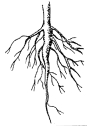
In which of the following plants is the root system shown in the image found?
A
Mustard
B
Wheat
C
Grass
D
All of the above
Solution
(A) The image shows a tap root system,which is characteristic of dicotyledonous plants.
In a tap root system,the primary root (radicle) continues to grow and gives rise to lateral roots of several orders.
Among the given options,Mustard (Brassica campestris) is a dicotyledonous plant and possesses a tap root system.
Wheat and grass are monocotyledonous plants,which typically possess a fibrous root system.
In a tap root system,the primary root (radicle) continues to grow and gives rise to lateral roots of several orders.
Among the given options,Mustard (Brassica campestris) is a dicotyledonous plant and possesses a tap root system.
Wheat and grass are monocotyledonous plants,which typically possess a fibrous root system.
0 likes
View Solution278
EasyMCQ
Choose the correct sequence of regions of the root from the root tip to the base of the root:
A
Region of Maturation $\rightarrow$ Region of Meristematic Activity $\rightarrow$ Region of Elongation $\rightarrow$ Root Cap
B
Root Cap $\rightarrow$ Region of Elongation $\rightarrow$ Region of Meristematic Activity $\rightarrow$ Region of Maturation
C
Region of Maturation $\rightarrow$ Region of Elongation $\rightarrow$ Region of Meristematic Activity $\rightarrow$ Root Cap
D
Root Cap $\rightarrow$ Region of Meristematic Activity $\rightarrow$ Region of Elongation $\rightarrow$ Region of Maturation
Solution
(D) The root is covered at the apex by a thimble-like structure called the root cap.
Just above the root cap is the region of meristematic activity,where cells are very small,thin-walled,and with dense protoplasm.
Following this is the region of elongation,where cells undergo rapid elongation and enlargement.
Finally,the region of maturation is located proximal to the elongation region,where cells differentiate and mature.
Therefore,the correct sequence from the root tip to the base is: Root Cap $\rightarrow$ Region of Meristematic Activity $\rightarrow$ Region of Elongation $\rightarrow$ Region of Maturation.
Just above the root cap is the region of meristematic activity,where cells are very small,thin-walled,and with dense protoplasm.
Following this is the region of elongation,where cells undergo rapid elongation and enlargement.
Finally,the region of maturation is located proximal to the elongation region,where cells differentiate and mature.
Therefore,the correct sequence from the root tip to the base is: Root Cap $\rightarrow$ Region of Meristematic Activity $\rightarrow$ Region of Elongation $\rightarrow$ Region of Maturation.
0 likes
View Solution279
MediumMCQ
The cells of this region of the root are the smallest.
A
Root cap
B
Region of maturation
C
Region of elongation
D
Region of meristematic activity
Solution
(D) The root is divided into three main regions: the region of meristematic activity,the region of elongation,and the region of maturation.
$1$. The region of meristematic activity is located a few millimeters above the root cap.
$2$. The cells in this region are very small,thin-walled,and have dense protoplasm.
$3$. These cells divide repeatedly to produce new cells for the growth of the root.
Therefore,the correct answer is the region of meristematic activity.
$1$. The region of meristematic activity is located a few millimeters above the root cap.
$2$. The cells in this region are very small,thin-walled,and have dense protoplasm.
$3$. These cells divide repeatedly to produce new cells for the growth of the root.
Therefore,the correct answer is the region of meristematic activity.
0 likes
View Solution280
MediumMCQ
Which region contains undifferentiated cells?
A
Root cap
B
Region of elongation
C
Region of meristematic activity
D
Region of maturation
Solution
(C) The root system is divided into different zones starting from the tip:
$1$. The root cap protects the tender apex of the root.
$2$. The region of meristematic activity consists of small,thin-walled cells with dense protoplasm that divide repeatedly. These are undifferentiated,actively dividing cells.
$3$. The region of elongation is where cells undergo rapid enlargement and growth.
$4$. The region of maturation contains differentiated cells that have matured into specific tissues.
Therefore,the region containing undifferentiated cells is the region of meristematic activity.
$1$. The root cap protects the tender apex of the root.
$2$. The region of meristematic activity consists of small,thin-walled cells with dense protoplasm that divide repeatedly. These are undifferentiated,actively dividing cells.
$3$. The region of elongation is where cells undergo rapid enlargement and growth.
$4$. The region of maturation contains differentiated cells that have matured into specific tissues.
Therefore,the region containing undifferentiated cells is the region of meristematic activity.
0 likes
View Solution281
MediumMCQ
The root hairs in plant roots are formed from which cells?
A
Hypodermal cells
B
Epiblema cells
C
Cortex cells
D
Endodermal cells
Solution
(B) The root hairs are unicellular,tubular extensions of the epidermal cells of the root,which are specifically known as the $Epiblema$ or $Piliferous$ layer.
These hairs are responsible for the absorption of water and minerals from the soil.
Therefore,the correct option is $B$.
These hairs are responsible for the absorption of water and minerals from the soil.
Therefore,the correct option is $B$.
1 likes
View Solution282
MediumMCQ
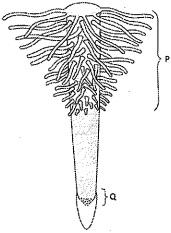
The figure below shows the tip of a root. What are the regions $P$ and $Q$?
$P \quad Q$
$P \quad Q$
A
Region of maturation $\quad$ Root cap
B
Region of maturation $\quad$ Region of meristematic activity
C
Region of elongation $\quad$ Region of meristematic activity
D
Region of elongation $\quad$ Root cap
Solution
(B) The root tip consists of several distinct regions starting from the apex:
$1$. The $Root \ cap$ is the protective covering at the very tip.
$2$. The $Region \ of \ meristematic \ activity$ lies just above the root cap, where cells divide rapidly.
$3$. The $Region \ of \ elongation$ is where cells undergo rapid enlargement and growth.
$4$. The $Region \ of \ maturation$ is the region where cells differentiate and mature, characterized by the presence of root hairs.
In the provided diagram:
- $P$ indicates the region with root hairs, which is the $Region \ of \ maturation$.
- $Q$ indicates the region just above the root cap, which is the $Region \ of \ meristematic \ activity$.
Therefore, $P$ is the region of maturation and $Q$ is the region of meristematic activity.
$1$. The $Root \ cap$ is the protective covering at the very tip.
$2$. The $Region \ of \ meristematic \ activity$ lies just above the root cap, where cells divide rapidly.
$3$. The $Region \ of \ elongation$ is where cells undergo rapid enlargement and growth.
$4$. The $Region \ of \ maturation$ is the region where cells differentiate and mature, characterized by the presence of root hairs.
In the provided diagram:
- $P$ indicates the region with root hairs, which is the $Region \ of \ maturation$.
- $Q$ indicates the region just above the root cap, which is the $Region \ of \ meristematic \ activity$.
Therefore, $P$ is the region of maturation and $Q$ is the region of meristematic activity.
0 likes
View Solution283
MediumMCQ
Match the following columns:
| Column-$I$ | Column-$II$ |
|---|---|
| $P$. Stilt root | $I$. Sweet potato |
| $Q$. Prop root | $II$. Banyan tree |
| $R$. Food storage root | $III$. Rhizophora |
| $S$. Respiratory root | $IV$. Maize/Sugarcane |
A
$(P-IV), (Q-II), (R-I), (S-III)$
B
$(P-I), (Q-II), (R-III), (S-IV)$
C
$(P-II), (Q-IV), (R-I), (S-III)$
D
$(P-IV), (Q-II), (R-III), (S-I)$
Solution
(A) $P$. Stilt roots are adventitious roots that arise from the lower nodes of the stem to provide support,as seen in maize and sugarcane $(IV)$.
$Q$. Prop roots are aerial roots that grow downwards from branches to provide mechanical support,characteristic of the banyan tree $(II)$.
$R$. Food storage roots are modified to store nutrients,such as in sweet potato $(I)$.
$S$. Respiratory roots (pneumatophores) are found in plants growing in swampy areas,such as Rhizophora $(III)$,to help in gaseous exchange.
Therefore,the correct matching is $(P-IV), (Q-II), (R-I), (S-III)$.
$Q$. Prop roots are aerial roots that grow downwards from branches to provide mechanical support,characteristic of the banyan tree $(II)$.
$R$. Food storage roots are modified to store nutrients,such as in sweet potato $(I)$.
$S$. Respiratory roots (pneumatophores) are found in plants growing in swampy areas,such as Rhizophora $(III)$,to help in gaseous exchange.
Therefore,the correct matching is $(P-IV), (Q-II), (R-I), (S-III)$.
0 likes
View Solution284
MediumMCQ
How many of the following plants possess adventitious roots?
Carrot,Turnip,Sweet potato,Banyan tree,Sugarcane,Maize
Carrot,Turnip,Sweet potato,Banyan tree,Sugarcane,Maize
A
$2$
B
$3$
C
$4$
D
$5$
Solution
(C) Adventitious roots are those that arise from parts of the plant other than the radicle.
$1$. Carrot: Tap root (modified for storage).
$2$. Turnip: Tap root (modified for storage).
$3$. Sweet potato: Adventitious root (modified for storage).
$4$. Banyan tree: Adventitious root (prop roots).
$5$. Sugarcane: Adventitious root (stilt roots).
$6$. Maize: Adventitious root (stilt roots).
The plants with adventitious roots are Sweet potato,Banyan tree,Sugarcane,and Maize.
Therefore,the total count is $4$.
$1$. Carrot: Tap root (modified for storage).
$2$. Turnip: Tap root (modified for storage).
$3$. Sweet potato: Adventitious root (modified for storage).
$4$. Banyan tree: Adventitious root (prop roots).
$5$. Sugarcane: Adventitious root (stilt roots).
$6$. Maize: Adventitious root (stilt roots).
The plants with adventitious roots are Sweet potato,Banyan tree,Sugarcane,and Maize.
Therefore,the total count is $4$.
0 likes
View Solution285
MediumMCQ
The roots of this plant grow negatively geotropic.
A
Sugarcane
B
Sweet potato
C
Carrot
D
Rhizophora
Solution
(D) Roots are typically positively geotropic,meaning they grow towards the direction of gravity.
However,in certain plants like $Rhizophora$ (mangroves) growing in swampy areas,the roots grow vertically upwards out of the ground to obtain oxygen for respiration.
These specialized roots are known as pneumatophores.
Since they grow against the direction of gravity,they are considered negatively geotropic.
However,in certain plants like $Rhizophora$ (mangroves) growing in swampy areas,the roots grow vertically upwards out of the ground to obtain oxygen for respiration.
These specialized roots are known as pneumatophores.
Since they grow against the direction of gravity,they are considered negatively geotropic.
0 likes
View Solution286
MediumMCQ
Identify the odd root based on its function.
A
Carrot
B
Turnip
C
Sweet potato
D
Maize
Solution
(D) The roots of $Carrot$, $Turnip$, and $Sweet \ potato$ are modified for the storage of food. These are tap roots ($Carrot$, $Turnip$) or adventitious roots ($Sweet \ potato$) that store nutrients. In contrast, the roots of $Maize$ are stilt roots, which provide mechanical support to the plant rather than storing food. Therefore, $Maize$ is the odd one out.
0 likes
View Solution287
MediumMCQ
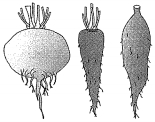
Identify the types of roots shown in the image below.
A
Tap root,Tap root,Adventitious root
B
Tap root,Tap root,Tap root
C
Adventitious root,Adventitious root,Adventitious root
D
Adventitious root,Tap root,Tap root
Solution
(B) The image shows three types of modified tap roots used for food storage:
$1$. Napiform root (e.g.,Turnip)
$2$. Conical root (e.g.,Carrot)
$3$. Fusiform root (e.g.,Radish)
All three are modifications of the tap root system,which develops from the radicle. Therefore,all three are tap roots.
$1$. Napiform root (e.g.,Turnip)
$2$. Conical root (e.g.,Carrot)
$3$. Fusiform root (e.g.,Radish)
All three are modifications of the tap root system,which develops from the radicle. Therefore,all three are tap roots.
0 likes
View Solution288
MediumMCQ
Select the correct option based on the number of cells in root hairs and stem hairs (trichomes).
A
Root hair = Multicellular,Stem hair = Multicellular
B
Root hair = Unicellular,Stem hair = Unicellular
C
Root hair = Multicellular,Stem hair = Unicellular
D
Root hair = Unicellular,Stem hair = Multicellular
Solution
(D) Root hairs are tubular extensions of the epidermal cells of the root and are unicellular in nature.
Stem hairs,also known as trichomes,are epidermal outgrowths on the stem. They are usually multicellular and may be branched or unbranched,and soft or stiff.
Stem hairs,also known as trichomes,are epidermal outgrowths on the stem. They are usually multicellular and may be branched or unbranched,and soft or stiff.
0 likes
View Solution289
EasyMCQ
In which region of the root does the maximum absorption of water occur?
A
Region of elongation
B
Root cap
C
Meristematic region
D
Region of maturation
Solution
(D) The root system is divided into four distinct regions: the root cap,the meristematic region,the region of elongation,and the region of maturation.
$1$. The root cap protects the delicate root tip.
$2$. The meristematic region is responsible for cell division.
$3$. The region of elongation is responsible for the growth of the root in length.
$4$. The region of maturation contains root hairs,which are unicellular extensions of epidermal cells. These root hairs significantly increase the surface area for the absorption of water and minerals from the soil. Therefore,the maximum absorption of water occurs in the region of maturation.
$1$. The root cap protects the delicate root tip.
$2$. The meristematic region is responsible for cell division.
$3$. The region of elongation is responsible for the growth of the root in length.
$4$. The region of maturation contains root hairs,which are unicellular extensions of epidermal cells. These root hairs significantly increase the surface area for the absorption of water and minerals from the soil. Therefore,the maximum absorption of water occurs in the region of maturation.
0 likes
View Solution290
MediumMCQ
Read the following statements with respect to the functions of the roots and select the incorrect option.
A
Absorption of water and minerals.
B
Generally,roots carry nodes and buds.
C
Provides anchorage to plant parts.
D
Stores reserve food material.
Solution
(B) The primary functions of roots include the absorption of water and minerals from the soil,providing proper anchorage to the plant parts,and storing reserve food material. Roots are characterized by the absence of nodes and internodes,which are features specific to stems. Therefore,the statement that roots carry nodes and buds is incorrect.
0 likes
View Solution291
EasyMCQ
Velamen tissue is useful for absorption of water vapours from atmosphere in . . . . . . .
A
xerophytes
B
mesophytes
C
hydrophytes
D
epiphytes
Solution
(D) Epiphytic plants,such as orchids,grow on other plants for support but do not derive nutrients from them. They possess specialized aerial roots known as epiphytic roots. These roots contain a spongy,multi-layered tissue called velamen,which is capable of absorbing moisture and water vapours directly from the atmosphere.
0 likes
View Solution292
EasyMCQ
Given below are two statements.
$Statement-I$: In root hair, the outer layer of the cell wall is composed of pectin.
$Statement-II$: In root hair, the inner layer of the cell wall is composed of chitin.
Choose the correct answer from the options given below with reference to the structure of root hair.
$Statement-I$: In root hair, the outer layer of the cell wall is composed of pectin.
$Statement-II$: In root hair, the inner layer of the cell wall is composed of chitin.
Choose the correct answer from the options given below with reference to the structure of root hair.
A
$Statement-I$ is correct but $Statement-II$ is incorrect.
B
Both $Statement-I$ and $Statement-II$ are incorrect.
C
Both $Statement-I$ and $Statement-II$ are correct.
D
$Statement-I$ is incorrect but $Statement-II$ is correct.
Solution
(A) The cell wall of root hairs is composed of two layers: the outer layer is made of pectin, which is sticky and helps in soil particle adhesion, while the inner layer is composed of cellulose, which provides structural strength. Therefore, $Statement-I$ is correct, and $Statement-II$ is incorrect because the inner layer is made of cellulose, not chitin.
0 likes
View Solution293
EasyMCQ
Given below are two statements.
$Statement-I$: Root hair is colorless and delicate.
$Statement-II$: Root hair is long-lived and branched.
In light of above statements, select the correct answer from the option given below.
$Statement-I$: Root hair is colorless and delicate.
$Statement-II$: Root hair is long-lived and branched.
In light of above statements, select the correct answer from the option given below.
A
$Statement-I$ is incorrect and $Statement-II$ is correct.
B
Both $Statement-I$ and $Statement-II$ are correct.
C
Both $Statement-I$ and $Statement-II$ are incorrect.
D
$Statement-I$ is correct and $Statement-II$ is incorrect.
Solution
$(D)$ Root hairs are unicellular, tubular extensions of the epidermal cells of the root.
They are colorless, delicate, and thin-walled structures.
Root hairs are short-lived and unbranched.
Therefore, $Statement-I$ is correct because root hairs are indeed colorless and delicate.
$Statement-II$ is incorrect because root hairs are short-lived and unbranched, not long-lived and branched.
They are colorless, delicate, and thin-walled structures.
Root hairs are short-lived and unbranched.
Therefore, $Statement-I$ is correct because root hairs are indeed colorless and delicate.
$Statement-II$ is incorrect because root hairs are short-lived and unbranched, not long-lived and branched.
0 likes
View Solution294
EasyMCQ
The number of regions in the structure of a typical root are . . . . . . .
A
$3$
B
$4$
C
$5$
D
$2$
Solution
(B) The structure of a typical root consists of four distinct regions:
$1$. Root cap region.
$2$. Region of meristematic activity.
$3$. Region of elongation.
$4$. Region of maturation (which includes root hairs).
$1$. Root cap region.
$2$. Region of meristematic activity.
$3$. Region of elongation.
$4$. Region of maturation (which includes root hairs).
0 likes
View Solution295
EasyMCQ
In which zone or region do root hairs occur?
A
Zone of elongation
B
Zone of maturation
C
Meristematic region
D
Zone of absorption
Solution
(B) The root tip is divided into three distinct zones: the meristematic zone,the zone of elongation,and the zone of maturation.
$1$. The meristematic zone is responsible for cell division.
$2$. The zone of elongation is responsible for the growth of the root in length.
$3$. The zone of maturation is the region where cells differentiate and mature.
Root hairs are unicellular extensions of epidermal cells (epiblema) found specifically in the zone of maturation. These hairs are responsible for the absorption of water and minerals from the soil.
$1$. The meristematic zone is responsible for cell division.
$2$. The zone of elongation is responsible for the growth of the root in length.
$3$. The zone of maturation is the region where cells differentiate and mature.
Root hairs are unicellular extensions of epidermal cells (epiblema) found specifically in the zone of maturation. These hairs are responsible for the absorption of water and minerals from the soil.
0 likes
View Solution296
EasyMCQ
Given below are two statements.
Statement-$I$: In root hair,the outer layer of the cell wall is composed of pectin.
Statement-$II$: In root hair,the inner layer of the cell wall is composed of cellulose.
Choose the correct answer from the options given below with reference to the structure of root hair.
Statement-$I$: In root hair,the outer layer of the cell wall is composed of pectin.
Statement-$II$: In root hair,the inner layer of the cell wall is composed of cellulose.
Choose the correct answer from the options given below with reference to the structure of root hair.
A
Statement-$I$ is correct but Statement-$II$ is incorrect.
B
Statement-$I$ is incorrect but Statement-$II$ is correct.
C
Both Statement-$I$ and Statement-$II$ are correct.
D
Both Statement-$I$ and Statement-$II$ are incorrect.
Solution
(C) Root hairs are tubular extensions of the epidermal cells of the root.
The cell wall of a root hair is differentiated into two layers:
$1$. The outer layer is composed of pectin,which is a sticky substance that helps in the adhesion of the root hair to soil particles.
$2$. The inner layer is composed of cellulose,which provides structural strength and rigidity to the root hair.
Since both statements accurately describe the composition of the root hair cell wall layers,both Statement-$I$ and Statement-$II$ are correct.
The cell wall of a root hair is differentiated into two layers:
$1$. The outer layer is composed of pectin,which is a sticky substance that helps in the adhesion of the root hair to soil particles.
$2$. The inner layer is composed of cellulose,which provides structural strength and rigidity to the root hair.
Since both statements accurately describe the composition of the root hair cell wall layers,both Statement-$I$ and Statement-$II$ are correct.
0 likes
View Solution297
EasyMCQ
In plants,lateral roots arise from
A
epidermis
B
hypodermis
C
endodermis
D
pericycle
Solution
(D) The correct answer is $D$.
In plants,lateral roots are endogenous in origin,meaning they arise from internal tissues.
Specifically,they originate from the pericycle,which is a layer of cells located just inside the endodermis in the root.
The pericycle cells undergo division to form the root primordium,which eventually pushes through the cortex and epidermis to emerge as a lateral root.
In plants,lateral roots are endogenous in origin,meaning they arise from internal tissues.
Specifically,they originate from the pericycle,which is a layer of cells located just inside the endodermis in the root.
The pericycle cells undergo division to form the root primordium,which eventually pushes through the cortex and epidermis to emerge as a lateral root.
0 likes
View Solution298
EasyMCQ
Find out the wrong statement about angiosperm roots.
A
Cuticle is absent in young stages.
B
The apex is protected by root cap.
C
Vascular bundle are collateral.
D
Xylem is centripetal in growth in the young roots.
Solution
(C) The correct answer is $C$. In angiosperm roots,the vascular bundles are radial,not collateral.
In a radial arrangement,$Xylem$ and $Phloem$ are present in separate bundles along different radii.
In contrast,a collateral arrangement (found in stems) involves $Xylem$ and $Phloem$ being arranged together in a single bundle along the same radius.
In a radial arrangement,$Xylem$ and $Phloem$ are present in separate bundles along different radii.
In contrast,a collateral arrangement (found in stems) involves $Xylem$ and $Phloem$ being arranged together in a single bundle along the same radius.
0 likes
View Solution299
EasyMCQ
In angiosperms,root hairs arise from which one of the following regions of the root?
A
The region of elongation
B
The region of meristematic activity
C
The region of maturation
D
The root cap zone
Solution
(C) Root hairs are unicellular extensions of the epidermal cells (epiblema) found in the region of maturation of the root. They are responsible for the absorption of water and minerals from the soil.
0 likes
View SolutionMorphology of Flowering Plants — Root · Frequently Asked Questions
1Are these Morphology of Flowering Plants questions useful for JEE and NEET?
Yes. All questions in this section are mapped to JEE Main and NEET exam patterns. Previous year questions from JEE Main, NEET, GUJCET and state-level exams are included with full solutions.
2Can I switch to Hindi or Gujarati for these questions?
Yes. Use the language tabs in the hero section or the sidebar to view the same questions and solutions in English, Hindi or Gujarati.
3How do I generate a question paper from this subtopic?
Use the Vedclass Exam Paper Generator — select the chapter and subtopic, set difficulty, and generate Sets A, B, C, D automatically. First 3 chapters of every subject are free.
Vedclass Products
For Students
Vedclass Test Series
Mock tests in real JEE/NEET style with performance analysis. 5-day free trial.
Start Free TrialFor Teachers
Exam Paper Generator
Generate Set A/B/C/D papers from this chapter in 2 minutes. 3 chapters free.
Try FreeFor Institutes
Online Exam Module
Live online exams with unlimited students, 360° analytics & white-label branding.
See DemoFor Teachers & Institutes
Generate a Morphology of Flowering Plants Exam Paper in 2 Minutes
Select subtopic & difficulty — Sets A, B, C, D auto-generated with No Repeat logic.
First 3 chapters of every subject are free — no payment required.