
A English
Nitrogen Cycle Questions in English
Class 11 Biology · Mineral Nutrition · Nitrogen Cycle
83+
Questions
English
Language
100%
With Solutions
Showing 50 of 83 questions in English
1
EasyMCQ
The nature of $Bacillus \ rimosus$ is:
A
Nitrifying
B
Denitrifying
C
Ammonifying
D
All the above
Solution
(C) $Bacillus \ rimosus$ is a soil bacterium known for its role in the nitrogen cycle.
Specifically,it is classified as an ammonifying bacterium.
Ammonifying bacteria break down organic nitrogenous compounds (like proteins and amino acids) from dead plants and animals into ammonia $(NH_3)$ or ammonium ions $(NH_4^+)$,which can then be utilized by other organisms or further processed in the nitrogen cycle.
Specifically,it is classified as an ammonifying bacterium.
Ammonifying bacteria break down organic nitrogenous compounds (like proteins and amino acids) from dead plants and animals into ammonia $(NH_3)$ or ammonium ions $(NH_4^+)$,which can then be utilized by other organisms or further processed in the nitrogen cycle.
0 likes
View Solution2
MediumMCQ
The conversion of ammonia into nitrate by microorganisms is called:
A
Ammonification
B
Nitrification
C
Denitrification
D
Nitrogen fixation
Solution
(B) The process of converting ammonia $(NH_3)$ into nitrite $(NO_2^-)$ and then into nitrate $(NO_3^-)$ by soil bacteria is known as Nitrification.
This process is carried out by chemoautotrophic bacteria such as $Nitrosomonas$ and $Nitrobacter$.
Ammonification is the conversion of organic nitrogen into ammonia.
Denitrification is the reduction of nitrate back into gaseous nitrogen $(N_2)$.
Nitrogen fixation is the conversion of atmospheric nitrogen $(N_2)$ into ammonia.
This process is carried out by chemoautotrophic bacteria such as $Nitrosomonas$ and $Nitrobacter$.
Ammonification is the conversion of organic nitrogen into ammonia.
Denitrification is the reduction of nitrate back into gaseous nitrogen $(N_2)$.
Nitrogen fixation is the conversion of atmospheric nitrogen $(N_2)$ into ammonia.
0 likes
View Solution3
EasyMCQ
Nitrifying bacteria,$Nitrosomonas$ and $Nitrobacter$,perform which of the following functions?
A
Convert (oxidise) ammonia or ammonium compounds into nitrates.
B
Convert nitrate into nitrogen.
C
Convert nitrogen into nitrates.
D
Convert carbon dioxide into carbohydrates.
Solution
(A) Nitrifying bacteria are chemoautotrophs that play a crucial role in the nitrogen cycle.
$Nitrosomonas$ oxidizes ammonia $(NH_3)$ into nitrite $(NO_2^-)$.
$Nitrobacter$ further oxidizes nitrite $(NO_2^-)$ into nitrate $(NO_3^-)$.
Therefore,these bacteria collectively convert ammonia or ammonium compounds into nitrates.
$Nitrosomonas$ oxidizes ammonia $(NH_3)$ into nitrite $(NO_2^-)$.
$Nitrobacter$ further oxidizes nitrite $(NO_2^-)$ into nitrate $(NO_3^-)$.
Therefore,these bacteria collectively convert ammonia or ammonium compounds into nitrates.
0 likes
View Solution4
EasyMCQ
What does the term 'denitrification' mean?
A
Reduction of $NO_2^-$ to ammonia by bacteria in the soil
B
Oxidation of ammonia to nitrate
C
Conversion of ammonia to amino acids
D
Conversion of nitrates and ammonia to gaseous nitrogen in the soil
Solution
(D) Denitrification is a biological process in which nitrate $(NO_3^-)$ or nitrite $(NO_2^-)$ is reduced to gaseous nitrogen $(N_2)$ or nitrous oxide $(N_2O)$.
This process is carried out by denitrifying bacteria such as $Pseudomonas$ and $Thiobacillus$ in the soil under anaerobic conditions.
It is a crucial step in the nitrogen cycle that returns nitrogen to the atmosphere.
This process is carried out by denitrifying bacteria such as $Pseudomonas$ and $Thiobacillus$ in the soil under anaerobic conditions.
It is a crucial step in the nitrogen cycle that returns nitrogen to the atmosphere.
0 likes
View Solution5
EasyMCQ
The bacteria which convert $NO_3^- \rightarrow$ free $N_2$ are called as:
A
Nitrifying bacteria
B
Ammonifying bacteria
C
Denitrifying bacteria
D
None of these
Solution
(C) Denitrification is the process by which certain bacteria reduce nitrates $(NO_3^-)$ back into gaseous nitrogen $(N_2)$.
These bacteria are known as denitrifying bacteria.
The sequence of reduction is: $NO_3^- \rightarrow NO_2^- \rightarrow NO \rightarrow N_2O \rightarrow N_2$.
Examples include $Pseudomonas$ and $Thiobacillus$.
These bacteria are known as denitrifying bacteria.
The sequence of reduction is: $NO_3^- \rightarrow NO_2^- \rightarrow NO \rightarrow N_2O \rightarrow N_2$.
Examples include $Pseudomonas$ and $Thiobacillus$.
0 likes
View Solution6
MediumMCQ
Nitrifying bacteria are those which can convert
A
Atmospheric nitrogen into ammonia
B
Ammonia into nitrites
C
Nitrites into nitrates
D
Both $B$ and $C$
Solution
(D) Nitrifying bacteria are chemoautotrophic organisms that oxidize ammonia to nitrites and then to nitrates.
$1$. Ammonia $(NH_3)$ is oxidized to nitrite $(NO_2^-)$ by bacteria such as $Nitrosomonas$ and $Nitrococcus$.
$2$. Nitrite $(NO_2^-)$ is further oxidized to nitrate $(NO_3^-)$ by bacteria such as $Nitrobacter$.
Since both steps are part of the nitrification process,the correct answer is that they convert ammonia into nitrites and nitrites into nitrates.
$1$. Ammonia $(NH_3)$ is oxidized to nitrite $(NO_2^-)$ by bacteria such as $Nitrosomonas$ and $Nitrococcus$.
$2$. Nitrite $(NO_2^-)$ is further oxidized to nitrate $(NO_3^-)$ by bacteria such as $Nitrobacter$.
Since both steps are part of the nitrification process,the correct answer is that they convert ammonia into nitrites and nitrites into nitrates.
0 likes
View Solution7
MediumMCQ
Which of the following soil microorganisms breaks down plant and animal protein into ammonia?
A
Bacillus vulgaris
B
Nitrosomonas
C
Pseudomonas
D
None of the above
Solution
(A) The process of breaking down complex organic nitrogenous compounds like proteins into ammonia is known as ammonification.
This process is carried out by various soil microorganisms,including bacteria such as $Bacillus$ species (e.g.,$Bacillus$ $mycoides$,$Bacillus$ $vulgaris$) and fungi.
$Nitrosomonas$ is involved in the process of nitrification (converting ammonia to nitrite),not ammonification.
$Pseudomonas$ is primarily involved in denitrification.
Therefore,$Bacillus$ $vulgaris$ is a known ammonifying bacterium.
This process is carried out by various soil microorganisms,including bacteria such as $Bacillus$ species (e.g.,$Bacillus$ $mycoides$,$Bacillus$ $vulgaris$) and fungi.
$Nitrosomonas$ is involved in the process of nitrification (converting ammonia to nitrite),not ammonification.
$Pseudomonas$ is primarily involved in denitrification.
Therefore,$Bacillus$ $vulgaris$ is a known ammonifying bacterium.
0 likes
View Solution8
EasyMCQ
Which bacteria convert ammonium salts into nitrite?
A
Nitrobacter
B
Nitrosomonas
C
Azotobacter
D
None of these
Solution
(B) The process of nitrification occurs in two steps:
$1$. Ammonium salts $(NH_4^+)$ are oxidized to nitrite $(NO_2^-)$ by bacteria such as $Nitrosomonas$ or $Nitrococcus$.
$2$. Nitrite $(NO_2^-)$ is further oxidized to nitrate $(NO_3^-)$ by the bacterium $Nitrobacter$.
Therefore,the bacteria that convert ammonium salts into nitrite is $Nitrosomonas$.
$1$. Ammonium salts $(NH_4^+)$ are oxidized to nitrite $(NO_2^-)$ by bacteria such as $Nitrosomonas$ or $Nitrococcus$.
$2$. Nitrite $(NO_2^-)$ is further oxidized to nitrate $(NO_3^-)$ by the bacterium $Nitrobacter$.
Therefore,the bacteria that convert ammonium salts into nitrite is $Nitrosomonas$.
0 likes
View Solution9
EasyMCQ
Which bacteria is responsible for the reduction of nitrates into nitrogen in soil?
A
Nitrosomonas
B
Pseudomonas
C
Rhizobium
D
Clostridium
Solution
(B) The process of converting nitrates $(NO_3^-)$ present in the soil into gaseous nitrogen $(N_2)$ is known as denitrification.
This process is carried out by denitrifying bacteria.
$Pseudomonas$ and $Thiobacillus$ are the primary examples of bacteria that perform denitrification in the soil.
Therefore,the correct option is $B$.
This process is carried out by denitrifying bacteria.
$Pseudomonas$ and $Thiobacillus$ are the primary examples of bacteria that perform denitrification in the soil.
Therefore,the correct option is $B$.
0 likes
View Solution10
EasyMCQ
Most of the plants obtain or absorb nitrogen from the soil in the form of
A
Free nitrogen gas
B
Nitric acid
C
Nitrite
D
Nitrates
Solution
(D) Plants generally absorb nitrogen from the soil primarily in the form of nitrates $(NO_3^-)$.
Although some plants can also absorb nitrogen as nitrites $(NO_2^-)$ or ammonium ions $(NH_4^+)$,nitrates are the most common and preferred form for uptake.
These ions are derived from the nitrogen cycle processes occurring in the soil,where atmospheric nitrogen is converted into usable forms by nitrogen-fixing bacteria and other soil microorganisms.
Although some plants can also absorb nitrogen as nitrites $(NO_2^-)$ or ammonium ions $(NH_4^+)$,nitrates are the most common and preferred form for uptake.
These ions are derived from the nitrogen cycle processes occurring in the soil,where atmospheric nitrogen is converted into usable forms by nitrogen-fixing bacteria and other soil microorganisms.
0 likes
View Solution11
EasyMCQ
One of the ways in which the nitrogen of the atmosphere is converted into nitrate for plants is by the action of
A
Temperature
B
Lightning
C
Denitrifying bacteria
D
Decay
Solution
(B) Atmospheric nitrogen is chemically inert and cannot be directly utilized by plants.
One of the natural ways to fix atmospheric nitrogen into nitrogenous compounds (like nitrates) is through physical processes.
During lightning (electric discharge),the high temperature and pressure cause nitrogen $(N_2)$ and oxygen $(O_2)$ in the atmosphere to react,forming nitrogen oxides.
These oxides subsequently dissolve in rainwater to form nitric acid,which reaches the soil and is converted into nitrates,which are then absorbed by plants.
Therefore,$10\%$ of natural nitrogen fixation occurs due to lightning.
One of the natural ways to fix atmospheric nitrogen into nitrogenous compounds (like nitrates) is through physical processes.
During lightning (electric discharge),the high temperature and pressure cause nitrogen $(N_2)$ and oxygen $(O_2)$ in the atmosphere to react,forming nitrogen oxides.
These oxides subsequently dissolve in rainwater to form nitric acid,which reaches the soil and is converted into nitrates,which are then absorbed by plants.
Therefore,$10\%$ of natural nitrogen fixation occurs due to lightning.
0 likes
View Solution12
EasyMCQ
Nitrates are converted to nitrogen by
A
Nitrogen fixing bacteria
B
Ammonification bacteria
C
Denitrifying bacteria
D
Nitrifying bacteria
Solution
(C) The process of converting nitrates $(NO_3^-)$ back into atmospheric nitrogen $(N_2)$ is known as denitrification.
This process is carried out by specific soil bacteria known as denitrifying bacteria.
Examples of such bacteria include $Thiobacillus \ denitrificans$,$Pseudomonas \ aeruginosa$,and $Micrococcus \ denitrificans$.
These bacteria reduce nitrates present in the soil into gaseous nitrogen,which then returns to the atmosphere.
This process is carried out by specific soil bacteria known as denitrifying bacteria.
Examples of such bacteria include $Thiobacillus \ denitrificans$,$Pseudomonas \ aeruginosa$,and $Micrococcus \ denitrificans$.
These bacteria reduce nitrates present in the soil into gaseous nitrogen,which then returns to the atmosphere.
0 likes
View Solution13
EasyMCQ
The conversion of ammonia into nitrites and nitrates is called
A
Ammonification
B
Nitrification
C
Denitrification
D
All of these
Solution
(B) The process of converting ammonia $(NH_3)$ into nitrites $(NO_2^-)$ and subsequently into nitrates $(NO_3^-)$ by soil bacteria is known as Nitrification.
$1.$ Ammonia is first oxidized to nitrite by bacteria such as $Nitrosomonas$ or $Nitrococcus$.
$2.$ The nitrite is then further oxidized to nitrate by the bacterium $Nitrobacter$.
These steps are crucial for the nitrogen cycle as they make nitrogen available for plant uptake.
$1.$ Ammonia is first oxidized to nitrite by bacteria such as $Nitrosomonas$ or $Nitrococcus$.
$2.$ The nitrite is then further oxidized to nitrate by the bacterium $Nitrobacter$.
These steps are crucial for the nitrogen cycle as they make nitrogen available for plant uptake.
0 likes
View Solution14
EasyMCQ
The conversion of nitrate to nitrous oxide and nitrogen gas is termed as
A
Nitrification
B
Denitrification
C
Nitrogen-fixation
D
None of these
Solution
(B) In water-logged soils and other anaerobic areas,some bacteria utilize the oxygen of nitrates for meeting their metabolic requirements.
This process reduces nitrate into gaseous forms of nitrogen,such as nitrous oxide $(N_2O)$ and nitrogen gas $(N_2)$,which escape into the atmosphere.
This biological phenomenon is known as denitrification.
This process reduces nitrate into gaseous forms of nitrogen,such as nitrous oxide $(N_2O)$ and nitrogen gas $(N_2)$,which escape into the atmosphere.
This biological phenomenon is known as denitrification.
0 likes
View Solution15
MediumMCQ
In the nitrogen cycle,which of the following plays an important role?
A
Rhizopus
B
Nitrobacter
C
Mucor
D
All green algae
Solution
(B) $Nitrobacter$ plays a crucial role in the nitrogen cycle. It is a chemoautotrophic bacterium that oxidizes nitrites $(NO_2^-)$ into nitrates $(NO_3^-)$,which are the forms of nitrogen most easily absorbed by plants.
This process is a vital part of nitrification,ensuring that nitrogen is available in the soil for plant uptake.
Once plants absorb these nitrates,nitrogen enters the food chain and moves from producers to consumers (herbivores and carnivores),thus maintaining the nitrogen cycle.
This process is a vital part of nitrification,ensuring that nitrogen is available in the soil for plant uptake.
Once plants absorb these nitrates,nitrogen enters the food chain and moves from producers to consumers (herbivores and carnivores),thus maintaining the nitrogen cycle.
0 likes
View Solution16
EasyMCQ
The nitrogen cycle involves bacteria capable of converting proteins into ammonia,which are known as:
A
Bacteria of decay
B
Denitrifying bacteria
C
Nitrogen-fixing bacteria
D
Ammonifying bacteria
Solution
(D) The process of converting organic nitrogen (such as proteins and amino acids from dead plants and animals) into ammonia $(NH_3)$ or ammonium ions $(NH_4^+)$ is known as ammonification.
Bacteria that perform this conversion are called ammonifying bacteria.
These bacteria break down complex organic nitrogenous compounds into simpler inorganic forms,which can then be utilized by other soil microbes or plants.
Therefore,the correct term for these bacteria is ammonifying bacteria.
Bacteria that perform this conversion are called ammonifying bacteria.
These bacteria break down complex organic nitrogenous compounds into simpler inorganic forms,which can then be utilized by other soil microbes or plants.
Therefore,the correct term for these bacteria is ammonifying bacteria.
0 likes
View Solution17
MediumMCQ
The organisms which participate most actively in the nitrogen cycle in nature are
A
Saprophytic angiosperms
B
Parasitic angiosperms
C
Bacteria
D
Legumes
Solution
(C) The correct answer is $C$. Bacteria play the most active role in the nitrogen cycle through various processes:
$1$. Nitrification: Ammonium compounds are oxidized into nitrates in two stages. First,nitrite bacteria (e.g.,$Nitrosomonas$) oxidize ammonia into $NO_2^-$. Second,nitrate bacteria (e.g.,$Nitrobacter$) oxidize $NO_2^-$ into $NO_3^-$,which plants can absorb.
$2$. Nitrogen Fixation: Bacteria like $Rhizobium$ (in root nodules of legumes),$Azotobacter$,and cyanobacteria fix atmospheric nitrogen into organic forms.
$3$. Denitrification: Bacteria like $Pseudomonas$ convert nitrates back into atmospheric nitrogen $(N_2)$,completing the cycle.
$1$. Nitrification: Ammonium compounds are oxidized into nitrates in two stages. First,nitrite bacteria (e.g.,$Nitrosomonas$) oxidize ammonia into $NO_2^-$. Second,nitrate bacteria (e.g.,$Nitrobacter$) oxidize $NO_2^-$ into $NO_3^-$,which plants can absorb.
$2$. Nitrogen Fixation: Bacteria like $Rhizobium$ (in root nodules of legumes),$Azotobacter$,and cyanobacteria fix atmospheric nitrogen into organic forms.
$3$. Denitrification: Bacteria like $Pseudomonas$ convert nitrates back into atmospheric nitrogen $(N_2)$,completing the cycle.
0 likes
View Solution18
MediumMCQ
Non-biological nitrogen fixation is:
A
Electrochemical
B
Photochemical
C
Both $(a)$ and $(b)$
D
None of these
Solution
(C) Non-biological nitrogen fixation occurs through physical processes in the atmosphere.
$1$. Electrochemical fixation: During lightning,the high temperature and electrical discharge cause atmospheric nitrogen $(N_2)$ to react with oxygen $(O_2)$ to form nitrogen oxides.
$2$. Photochemical fixation: High-energy solar radiation can also facilitate the reaction between nitrogen and oxygen in the atmosphere.
These nitrogen oxides dissolve in rainwater to form nitric acid and nitrous acid,which reach the soil and are converted into nitrates,thus becoming available to plants. Therefore,both electrochemical and photochemical processes contribute to non-biological nitrogen fixation.
$1$. Electrochemical fixation: During lightning,the high temperature and electrical discharge cause atmospheric nitrogen $(N_2)$ to react with oxygen $(O_2)$ to form nitrogen oxides.
$2$. Photochemical fixation: High-energy solar radiation can also facilitate the reaction between nitrogen and oxygen in the atmosphere.
These nitrogen oxides dissolve in rainwater to form nitric acid and nitrous acid,which reach the soil and are converted into nitrates,thus becoming available to plants. Therefore,both electrochemical and photochemical processes contribute to non-biological nitrogen fixation.
0 likes
View Solution19
MediumMCQ
Degradation of proteins plays a part in
A
Calvin cycle
B
Water cycle
C
Sulphur cycle
D
Nitrogen cycle
Solution
(D) Plants and animals contain nitrogen in their body proteins. After death,the proteins of dead bodies are decomposed by microorganisms into amino acids and ammonia. This process is a crucial step in the nitrogen cycle,where organic nitrogen is converted back into inorganic forms like ammonia,which can then be converted into nitrates or released as free nitrogen gas into the atmosphere.
0 likes
View Solution20
EasyMCQ
The amount of nitrogen fixed electrochemically and photochemically is:
A
$35 \ mg/m^2/yr$
B
$78 \ mg/m^2/yr$
C
$15 \ mg/m^2/yr$
D
$140 \ mg/m^2/yr$
Solution
(A) Nitrogen fixation occurs through biological,industrial,and atmospheric processes.
Atmospheric nitrogen fixation occurs via electrochemical and photochemical reactions during lightning and ultraviolet radiation.
The estimated amount of nitrogen fixed annually through these atmospheric (electrochemical and photochemical) processes is approximately $35 \ mg/m^2/yr$.
Atmospheric nitrogen fixation occurs via electrochemical and photochemical reactions during lightning and ultraviolet radiation.
The estimated amount of nitrogen fixed annually through these atmospheric (electrochemical and photochemical) processes is approximately $35 \ mg/m^2/yr$.
0 likes
View Solution21
MediumMCQ
The limiting factor in the process of nitrification in soil is:
A
$pH$
B
Temperature
C
Light
D
Air
Solution
(A) Nitrification is a biological process carried out by chemoautotrophic bacteria such as $Nitrosomonas$ and $Nitrobacter$.
These bacteria are highly sensitive to environmental conditions.
The process of nitrification is significantly influenced by the $pH$ of the soil.
Nitrification occurs most efficiently in neutral to slightly alkaline soils ($pH$ $7.0$ to $8.5$).
In acidic soils,the activity of nitrifying bacteria is severely inhibited,making $pH$ the primary limiting factor for this process.
These bacteria are highly sensitive to environmental conditions.
The process of nitrification is significantly influenced by the $pH$ of the soil.
Nitrification occurs most efficiently in neutral to slightly alkaline soils ($pH$ $7.0$ to $8.5$).
In acidic soils,the activity of nitrifying bacteria is severely inhibited,making $pH$ the primary limiting factor for this process.
0 likes
View Solution22
MediumMCQ
The nitrogen content of the biosphere remains constant due to:
A
Nitrogen fixation
B
Nitrogen cycle
C
Industrial pollution
D
Absorption of nitrogen
Solution
(B) The nitrogen content of the biosphere remains constant due to the $Nitrogen \ cycle$.
This cycle involves a series of biological and physical processes such as nitrogen fixation,nitrification,assimilation,ammonification,and denitrification.
These processes ensure that nitrogen is continuously recycled between the atmosphere,soil,and living organisms,maintaining a dynamic equilibrium in the biosphere.
This cycle involves a series of biological and physical processes such as nitrogen fixation,nitrification,assimilation,ammonification,and denitrification.
These processes ensure that nitrogen is continuously recycled between the atmosphere,soil,and living organisms,maintaining a dynamic equilibrium in the biosphere.
0 likes
View Solution23
EasyMCQ
Which of the following is present in the maximum amount in the atmosphere?
A
Oxygen
B
Nitrogen
C
Carbon dioxide
D
Hydrogen
Solution
(B) The atmosphere is composed of various gases. Nitrogen $(N_2)$ is the most abundant gas,making up approximately $78.03\%$ of the Earth's atmosphere by volume.
Oxygen $(O_2)$ accounts for about $21\%$,while other gases like Argon,Carbon dioxide $(CO_2)$,and trace gases make up the remainder.
Nitrogen is continuously cycled through the atmosphere via processes such as nitrogen fixation,volcanic eruptions,erosion of sedimentary rocks,and denitrification.
Oxygen $(O_2)$ accounts for about $21\%$,while other gases like Argon,Carbon dioxide $(CO_2)$,and trace gases make up the remainder.
Nitrogen is continuously cycled through the atmosphere via processes such as nitrogen fixation,volcanic eruptions,erosion of sedimentary rocks,and denitrification.
0 likes
View Solution24
EasyMCQ
Nitrates are transformed into nitrogen by
A
Ammonifying bacteria
B
Nitrifying bacteria
C
Denitrifying bacteria
D
Both $(a)$ and $(b)$
Solution
(C) The correct answer is $(c)$.
Denitrifying bacteria,such as $Pseudomonas$ $aeruginosa$ and $Thiobacillus$ $denitrificans$,are responsible for the process of denitrification.
In this process,these bacteria reduce nitrates $(NO_3^-)$ present in the soil into gaseous nitrogen $(N_2)$,which then escapes into the atmosphere,completing the nitrogen cycle.
Denitrifying bacteria,such as $Pseudomonas$ $aeruginosa$ and $Thiobacillus$ $denitrificans$,are responsible for the process of denitrification.
In this process,these bacteria reduce nitrates $(NO_3^-)$ present in the soil into gaseous nitrogen $(N_2)$,which then escapes into the atmosphere,completing the nitrogen cycle.
0 likes
View Solution25
MediumMCQ
Fishing and Guano birds assist the cycling of
A
Nitrogen
B
Phosphorus
C
Carbon
D
$N_2$ and carbon both
Solution
(B) Guano is the excrement of seabirds,cave-dwelling bats,and seals. It is rich in phosphorus and nitrogen. Fishing and guano birds play a significant role in the phosphorus cycle by transporting phosphorus from the ocean back to the land through their droppings (guano),which are then used as fertilizer.
0 likes
View Solution26
MediumMCQ
The concentration of nitrogen in the atmosphere remains constant due to:
A
Nitrogen cycle
B
Thundering and lightning
C
Enzymes
D
Both $(a)$ and $(b)$
Solution
(A) The concentration of nitrogen in the atmosphere remains constant primarily due to the nitrogen cycle.
The nitrogen cycle involves various processes such as nitrogen fixation,nitrification,assimilation,ammonification,and denitrification,which balance the nitrogen levels.
While thundering and lightning contribute to nitrogen fixation by converting atmospheric nitrogen into nitrogen oxides,the overall stability of nitrogen concentration is maintained by the complete nitrogen cycle.
The nitrogen cycle involves various processes such as nitrogen fixation,nitrification,assimilation,ammonification,and denitrification,which balance the nitrogen levels.
While thundering and lightning contribute to nitrogen fixation by converting atmospheric nitrogen into nitrogen oxides,the overall stability of nitrogen concentration is maintained by the complete nitrogen cycle.
0 likes
View Solution27
MediumMCQ
The process of conversion of complex organic substances into inorganic substances is attributed to which of the following?
A
Pseudomonas
B
Rhizobium
C
Nitrobacter
D
Nitrosomonas
Solution
(A) The process of converting complex organic nitrogenous compounds into inorganic forms like ammonia $(NH_3)$ is known as ammonification. This process is carried out by various saprophytic bacteria and fungi,such as $Pseudomonas$ species,which decompose organic matter in the soil. $Rhizobium$ is involved in nitrogen fixation,while $Nitrobacter$ and $Nitrosomonas$ are involved in the process of nitrification (converting ammonia to nitrites and nitrates). Therefore,$Pseudomonas$ is the correct answer.
0 likes
View Solution28
EasyMCQ
The process of reducing nitrate to gaseous nitrogen is known as:
A
Denitrification
B
Nitrification
C
Ammonification
D
Lightning
Solution
(A) The process of reducing nitrate $(NO_3^-)$ to gaseous nitrogen $(N_2)$ is called denitrification.
This process is carried out by bacteria such as $Pseudomonas$ and $Thiobacillus$.
It is a key step in the nitrogen cycle that returns nitrogen to the atmosphere.
This process is carried out by bacteria such as $Pseudomonas$ and $Thiobacillus$.
It is a key step in the nitrogen cycle that returns nitrogen to the atmosphere.
0 likes
View Solution29
EasyMCQ
Which bacteria are responsible for the conversion of ammonia into nitrite ions and nitrite into nitrate ions,respectively?
A
$Nitrosomonas$,$Nitrobacter$
B
$Nitrobacter$,$Nitrosomonas$
C
$Nitrosomonas$,$Pseudomonas$
D
$Azotobacter$,$Pseudomonas$
Solution
(A) The process of nitrification involves two steps carried out by specific chemoautotrophic bacteria:
$1$. Ammonia $(NH_3)$ is oxidized to nitrite $(NO_2^-)$ by bacteria such as $Nitrosomonas$ and $Nitrosococcus$.
$2$. Nitrite $(NO_2^-)$ is further oxidized to nitrate $(NO_3^-)$ by the bacterium $Nitrobacter$.
Therefore,the correct sequence is $Nitrosomonas$ for the first step and $Nitrobacter$ for the second step.
$1$. Ammonia $(NH_3)$ is oxidized to nitrite $(NO_2^-)$ by bacteria such as $Nitrosomonas$ and $Nitrosococcus$.
$2$. Nitrite $(NO_2^-)$ is further oxidized to nitrate $(NO_3^-)$ by the bacterium $Nitrobacter$.
Therefore,the correct sequence is $Nitrosomonas$ for the first step and $Nitrobacter$ for the second step.
0 likes
View Solution30
EasyMCQ
What is the process of conversion of $NH_3$ to $NO_3^-$ by microorganisms called?
A
$N_2$ fixation
B
Nitrification
C
Denitrification
D
Eutrophication
Solution
(B) The conversion of ammonia $(NH_3)$ into nitrate $(NO_3^-)$ by soil bacteria is known as nitrification.
This process occurs in two steps:
$1$. Ammonia is first oxidized to nitrite $(NO_2^-)$ by bacteria such as $Nitrosomonas$ and $Nitrococcus$.
$2$. The nitrite is then further oxidized to nitrate $(NO_3^-)$ by the bacterium $Nitrobacter$.
These nitrifying bacteria are chemoautotrophs.
This process occurs in two steps:
$1$. Ammonia is first oxidized to nitrite $(NO_2^-)$ by bacteria such as $Nitrosomonas$ and $Nitrococcus$.
$2$. The nitrite is then further oxidized to nitrate $(NO_3^-)$ by the bacterium $Nitrobacter$.
These nitrifying bacteria are chemoautotrophs.
0 likes
View Solution31
MediumMCQ
What is the function of denitrifying bacteria?
A
Nitrogen is converted into nitrates.
B
Nitrates are converted into nitrites.
C
$NH_3$ is converted into nitrates.
D
Nitrates are reduced to gaseous nitrogen and released into the atmosphere.
Solution
(D) Denitrification is a biological process carried out by denitrifying bacteria such as $Pseudomonas$ and $Thiobacillus$.
In this process,nitrates $(NO_3^-)$ present in the soil are reduced to gaseous nitrogen $(N_2)$ or nitrous oxide $(N_2O)$.
This gaseous nitrogen is then released back into the atmosphere,completing the nitrogen cycle.
Therefore,the correct function is the reduction of nitrates to gaseous nitrogen.
In this process,nitrates $(NO_3^-)$ present in the soil are reduced to gaseous nitrogen $(N_2)$ or nitrous oxide $(N_2O)$.
This gaseous nitrogen is then released back into the atmosphere,completing the nitrogen cycle.
Therefore,the correct function is the reduction of nitrates to gaseous nitrogen.
0 likes
View Solution32
EasyMCQ
Nitrifying bacteria........
A
oxidize ammonia to nitrate.
B
convert free nitrogen into nitrogenous compounds.
C
convert proteins into ammonia.
D
reduce nitrate to free nitrogen.
Solution
(A) Nitrifying bacteria are chemoautotrophic organisms that play a crucial role in the nitrogen cycle.
They oxidize ammonia $(NH_3)$ to nitrite $(NO_2^-)$ and then to nitrate $(NO_3^-)$.
Examples include $Nitrosomonas$ (which oxidizes ammonia to nitrite) and $Nitrobacter$ (which oxidizes nitrite to nitrate).
Therefore,the correct statement is that they oxidize ammonia to nitrate.
They oxidize ammonia $(NH_3)$ to nitrite $(NO_2^-)$ and then to nitrate $(NO_3^-)$.
Examples include $Nitrosomonas$ (which oxidizes ammonia to nitrite) and $Nitrobacter$ (which oxidizes nitrite to nitrate).
Therefore,the correct statement is that they oxidize ammonia to nitrate.
0 likes
View Solution33
MediumMCQ
Which organisms actively participate in the nitrogen cycle in nature?
A
Bacteria
B
Leguminous plants
C
Parasitic algae
D
Fungi
Solution
(A) In nature,the nitrogen cycle is primarily driven by various microorganisms,especially bacteria.
$1$. Nitrogen-fixing bacteria (e.g.,$Rhizobium$,$Azotobacter$) convert atmospheric nitrogen into ammonia.
$2$. Nitrifying bacteria (e.g.,$Nitrosomonas$,$Nitrobacter$) convert ammonia into nitrites and nitrates.
$3$. Denitrifying bacteria (e.g.,$Pseudomonas$,$Thiobacillus$) convert nitrates back into atmospheric nitrogen.
Therefore,bacteria are the most active participants in the nitrogen cycle.
$1$. Nitrogen-fixing bacteria (e.g.,$Rhizobium$,$Azotobacter$) convert atmospheric nitrogen into ammonia.
$2$. Nitrifying bacteria (e.g.,$Nitrosomonas$,$Nitrobacter$) convert ammonia into nitrites and nitrates.
$3$. Denitrifying bacteria (e.g.,$Pseudomonas$,$Thiobacillus$) convert nitrates back into atmospheric nitrogen.
Therefore,bacteria are the most active participants in the nitrogen cycle.
0 likes
View Solution34
MediumMCQ
Nitrifying bacteria perform which of the following processes?
A
Oxidation of ammonia to nitrates.
B
Conversion of free nitrogen into nitrogenous compounds.
C
Conversion of proteins into ammonia.
D
Reduction of nitrates into free nitrogen.
Solution
(A) Nitrifying bacteria,such as $Nitrosomonas$ and $Nitrobacter$,are chemoautotrophic organisms that play a crucial role in the nitrogen cycle.
They convert ammonia $(NH_3)$ into nitrites $(NO_2^-)$ and subsequently into nitrates $(NO_3^-)$ through the process of oxidation.
This process is known as nitrification,which makes nitrogen available in a form that plants can easily absorb from the soil.
Therefore,the correct process performed by nitrifying bacteria is the oxidation of ammonia to nitrates.
They convert ammonia $(NH_3)$ into nitrites $(NO_2^-)$ and subsequently into nitrates $(NO_3^-)$ through the process of oxidation.
This process is known as nitrification,which makes nitrogen available in a form that plants can easily absorb from the soil.
Therefore,the correct process performed by nitrifying bacteria is the oxidation of ammonia to nitrates.
0 likes
View Solution35
MediumMCQ
Which of the following is true for nitrogen fixation?
A
Nitrogen to Ammonia
B
Nitrogen to Nitrate
C
Nitrogen to Amino acids
D
Both $(A)$ and $(B)$
Solution
(D) Biological nitrogen fixation is the process by which atmospheric nitrogen $(N_2)$ is converted into ammonia $(NH_3)$ by living organisms,primarily bacteria like $Rhizobium$,$Azotobacter$,etc.
Some bacteria also convert nitrogen into nitrates $(NO_3^-)$ through the process of nitrification,which is a part of the nitrogen cycle.
Therefore,both the conversion of nitrogen to ammonia (fixation) and the conversion to nitrates (nitrification) are essential steps in the nitrogen cycle related to nitrogen availability for plants.
Thus,the correct option is $D$.
Some bacteria also convert nitrogen into nitrates $(NO_3^-)$ through the process of nitrification,which is a part of the nitrogen cycle.
Therefore,both the conversion of nitrogen to ammonia (fixation) and the conversion to nitrates (nitrification) are essential steps in the nitrogen cycle related to nitrogen availability for plants.
Thus,the correct option is $D$.
0 likes
View Solution36
MediumMCQ
Which two distinct microbial processes are responsible for the release of fixed nitrogen as dinitrogen gas $(N_2)$ to the atmosphere?
A
Aerobic nitrate oxidation and nitrite reduction
B
Decomposition of organic nitrogen and conversion of dinitrogen to ammonium compounds
C
Enteric fermentation in cattle and nitrogen fixation by Rhizobium in root nodules of legumes
D
Anaerobic ammonium oxidation and denitrification
Solution
(D) The correct answer is $(D)$.
Denitrification is a biological process in which nitrates $(NO_3^-)$ in the soil are reduced to molecular nitrogen $(N_2)$ gas,which is then released into the atmosphere. This process is carried out by denitrifying bacteria such as $Pseudomonas$ $denitrificans$ and $Thiobacillus$ $denitrificans$.
Anaerobic ammonium oxidation (often referred to as $ANAMMOX$) is another microbial process where ammonium $(NH_4^+)$ is oxidized to dinitrogen gas $(N_2)$ under anaerobic conditions,contributing to the nitrogen cycle by returning $N_2$ to the atmosphere.
Denitrification is a biological process in which nitrates $(NO_3^-)$ in the soil are reduced to molecular nitrogen $(N_2)$ gas,which is then released into the atmosphere. This process is carried out by denitrifying bacteria such as $Pseudomonas$ $denitrificans$ and $Thiobacillus$ $denitrificans$.
Anaerobic ammonium oxidation (often referred to as $ANAMMOX$) is another microbial process where ammonium $(NH_4^+)$ is oxidized to dinitrogen gas $(N_2)$ under anaerobic conditions,contributing to the nitrogen cycle by returning $N_2$ to the atmosphere.
0 likes
View Solution37
EasyMCQ
Nitrifying bacteria:
A
oxidize ammonia to nitrates
B
convert free nitrogen to nitrogen compounds
C
convert proteins into ammonia
D
reduce nitrates to free nitrogen
Solution
(A) $Nitrifying$ bacteria perform the process of nitrification,which involves the oxidation of ammonia to nitrates.
This process occurs in two steps:
$1$. Nitrite bacteria (e.g.,$Nitrosomonas$ and $Nitrococcus$) convert ammonia $(NH_3)$ into nitrites $(NO_2^-)$.
$2$. Nitrate bacteria (e.g.,$Nitrobacter$ and $Nitrocystis$) convert nitrites $(NO_2^-)$ into nitrates $(NO_3^-)$.
Therefore,the correct function is the oxidation of ammonia to nitrates.
This process occurs in two steps:
$1$. Nitrite bacteria (e.g.,$Nitrosomonas$ and $Nitrococcus$) convert ammonia $(NH_3)$ into nitrites $(NO_2^-)$.
$2$. Nitrate bacteria (e.g.,$Nitrobacter$ and $Nitrocystis$) convert nitrites $(NO_2^-)$ into nitrates $(NO_3^-)$.
Therefore,the correct function is the oxidation of ammonia to nitrates.
0 likes
View Solution38
MediumMCQ
Study the nitrogen cycle process shown below and select the option that correctly identifies the four blanks $A, B, C,$ and $D$ in the context of nitrogen transformation.
A
$A$-Nitrification,$B$-Ammonification,$C$-Animals,$D$-Plants
B
$A$-Denitrification,$B$-Ammonification,$C$-Animals,$D$-Plants
C
$A$-Nitrification,$B$-Denitrification,$C$-Animals,$D$-Plants
D
$A$-Denitrification,$B$-Nitrification,$C$-Plants,$D$-Animals
Solution
(B) The nitrogen cycle involves several key processes:
$1$. $A$ represents Denitrification,where nitrates in the soil are converted back into atmospheric nitrogen $(N_2)$ by bacteria like $Pseudomonas$.
$2$. $B$ represents Ammonification,where organic nitrogen from dead plants and animals is converted into ammonia $(NH_3)$ by decomposers.
$3$. $C$ represents Animals,which consume organic nitrogen from plants.
$4$. $D$ represents Plants,which absorb nitrogenous compounds from the soil.
Therefore,option $B$ is the correct sequence.
$1$. $A$ represents Denitrification,where nitrates in the soil are converted back into atmospheric nitrogen $(N_2)$ by bacteria like $Pseudomonas$.
$2$. $B$ represents Ammonification,where organic nitrogen from dead plants and animals is converted into ammonia $(NH_3)$ by decomposers.
$3$. $C$ represents Animals,which consume organic nitrogen from plants.
$4$. $D$ represents Plants,which absorb nitrogenous compounds from the soil.
Therefore,option $B$ is the correct sequence.
0 likes
View Solution39
MediumMCQ
Which two distinct microbial processes are responsible for the release of fixed nitrogen as dinitrogen gas $(N_2)$ to the atmosphere?
A
Aerobic nitrate oxidation and nitrite reduction
B
Decomposition of organic nitrogen and conversion of dinitrogen to ammonium compounds
C
Enteric fermentation in cattle and nitrogen fixation by Rhizobium in root nodules of legumes
D
Anaerobic ammonium oxidation and denitrification.
Solution
(D) : Denitrification is a biological process in which nitrates $(NO_3^-)$ in the soil are reduced to molecular nitrogen $(N_2)$ gas, which is then released into the atmosphere. This process is carried out by denitrifying bacteria such as $Pseudomonas \text{ } denitrificans$ and $Thiobacillus \text{ } denitrificans$. Additionally, the anaerobic oxidation of ammonium $(NH_4^+)$, also known as the $Anammox$ process, involves the conversion of ammonium and nitrite directly into dinitrogen gas $(N_2)$ under anaerobic conditions.
0 likes
View Solution40
MediumMCQ
Select the correct pair:
A
Nitrogen - Important component of carbohydrates
B
Ammonification - Ammonia is converted into nitrite
C
Nitrification - Nitrobacter
D
Denitrification - Nitrococcus
Solution
(C) $1$. Nitrogen is a vital component of amino acids,proteins,nucleic acids,and vitamins,not carbohydrates.
$2$. Ammonification is the process of decomposition of organic nitrogen (proteins/amino acids) into ammonia $(NH_3)$.
$3$. Nitrification involves the oxidation of ammonia to nitrite $(NO_2^-)$ by $Nitrosomonas$ or $Nitrococcus$,and then nitrite to nitrate $(NO_3^-)$ by $Nitrobacter$.
$4$. Denitrification is the process where nitrate is reduced to nitrogen gas $(N_2)$ by bacteria like $Pseudomonas$ and $Thiobacillus$.
$5$. Therefore,the pair 'Nitrification - Nitrobacter' is correct because $Nitrobacter$ is involved in the conversion of nitrite to nitrate during the nitrification process.
$2$. Ammonification is the process of decomposition of organic nitrogen (proteins/amino acids) into ammonia $(NH_3)$.
$3$. Nitrification involves the oxidation of ammonia to nitrite $(NO_2^-)$ by $Nitrosomonas$ or $Nitrococcus$,and then nitrite to nitrate $(NO_3^-)$ by $Nitrobacter$.
$4$. Denitrification is the process where nitrate is reduced to nitrogen gas $(N_2)$ by bacteria like $Pseudomonas$ and $Thiobacillus$.
$5$. Therefore,the pair 'Nitrification - Nitrobacter' is correct because $Nitrobacter$ is involved in the conversion of nitrite to nitrate during the nitrification process.
0 likes
View Solution41
EasyMCQ
Decomposition of organic nitrogen of dead plants and animals into ammonia is called.
A
Mineralisation
B
Ammonification
C
Nitrification
D
Humification
Solution
(B) The process of decomposition of organic nitrogenous compounds (found in dead plants and animals) into ammonia is known as $Ammonification$.
$1$. $Ammonification$: Bacteria like $Bacillus$ and $Actinomycetes$ break down organic nitrogen into ammonia $(NH_3)$.
$2$. $Nitrification$: Ammonia is further oxidized to nitrite $(NO_2^-)$ and then to nitrate $(NO_3^-)$ by bacteria like $Nitrosomonas$ and $Nitrobacter$.
$3$. $Mineralisation$: This is a broader term referring to the release of inorganic nutrients from organic matter.
$4$. $Humification$: This is the process of formation of dark-colored amorphous substance called humus from organic matter.
$1$. $Ammonification$: Bacteria like $Bacillus$ and $Actinomycetes$ break down organic nitrogen into ammonia $(NH_3)$.
$2$. $Nitrification$: Ammonia is further oxidized to nitrite $(NO_2^-)$ and then to nitrate $(NO_3^-)$ by bacteria like $Nitrosomonas$ and $Nitrobacter$.
$3$. $Mineralisation$: This is a broader term referring to the release of inorganic nutrients from organic matter.
$4$. $Humification$: This is the process of formation of dark-colored amorphous substance called humus from organic matter.
0 likes
View Solution42
EasyMCQ
Denitrification is carried out by bacteria $......$ and $......$.
A
$Nitrococcus, Pseudomonas$
B
$Thiobacillus, Nitrobacter$
C
$Pseudomonas, Thiobacillus$
D
$Thiobacillus, Nitrosomonas$
Solution
(C) Denitrification is the process of reduction of nitrates present in the soil back into gaseous nitrogen $(N_2)$.
This process is carried out by specific denitrifying bacteria.
The most common examples of bacteria involved in denitrification are $Pseudomonas$ and $Thiobacillus$.
Therefore,the correct option is $C$.
This process is carried out by specific denitrifying bacteria.
The most common examples of bacteria involved in denitrification are $Pseudomonas$ and $Thiobacillus$.
Therefore,the correct option is $C$.
0 likes
View Solution43
EasyMCQ
$NO_2^- \rightarrow NO_3^-$
The above mentioned reaction occurs in the presence of .....
The above mentioned reaction occurs in the presence of .....
A
Rhizobium
B
Agrobacterium
C
Nitrobacter
D
Nitrosomonas
Solution
(C) The conversion of nitrite $(NO_2^-)$ to nitrate $(NO_3^-)$ is a key step in the process of nitrification.
This specific oxidation reaction is carried out by the chemoautotrophic bacterium $Nitrobacter$.
$Nitrosomonas$ is responsible for the oxidation of ammonia $(NH_3)$ to nitrite $(NO_2^-)$.
Therefore,the correct organism for the given reaction is $Nitrobacter$.
This specific oxidation reaction is carried out by the chemoautotrophic bacterium $Nitrobacter$.
$Nitrosomonas$ is responsible for the oxidation of ammonia $(NH_3)$ to nitrite $(NO_2^-)$.
Therefore,the correct organism for the given reaction is $Nitrobacter$.
0 likes
View Solution44
MediumMCQ
Choose the correct pair:
| Column-$I$ | Column-$II$ |
| $I$. Nitrosomonas | Nitrite to nitrate |
| $II$. Thiobacillus | Denitrification |
| $III$. Nostoc | Free-living nitrogen fixer |
| $IV$. Azotobacter | Anaerobic nitrogen fixer |
A
$I$ and $II$
B
$III$ and $IV$
C
$II$ and $III$
D
$II$ and $IV$
Solution
(C) Let's analyze each pair:
$1$. $I$. Nitrosomonas: This bacterium converts ammonia to nitrite $(NH_3 \rightarrow NO_2^-)$,not nitrite to nitrate. Thus,this is incorrect.
$2$. $II$. Thiobacillus: This bacterium is involved in denitrification,where it converts nitrates back into nitrogen gas $(N_2)$. This is correct.
$3$. $III$. Nostoc: This is a cyanobacterium that acts as a free-living nitrogen fixer. This is correct.
$4$. $IV$. Azotobacter: This is an aerobic,free-living nitrogen-fixing bacterium,not anaerobic. Thus,this is incorrect.
Therefore,the correct pairs are $II$ and $III$.
$1$. $I$. Nitrosomonas: This bacterium converts ammonia to nitrite $(NH_3 \rightarrow NO_2^-)$,not nitrite to nitrate. Thus,this is incorrect.
$2$. $II$. Thiobacillus: This bacterium is involved in denitrification,where it converts nitrates back into nitrogen gas $(N_2)$. This is correct.
$3$. $III$. Nostoc: This is a cyanobacterium that acts as a free-living nitrogen fixer. This is correct.
$4$. $IV$. Azotobacter: This is an aerobic,free-living nitrogen-fixing bacterium,not anaerobic. Thus,this is incorrect.
Therefore,the correct pairs are $II$ and $III$.
0 likes
View Solution45
MediumMCQ
Which option is correct to match section $A$ with section $B$?
| Section $A$ | Section $B$ |
| $(i)$ Nitrosomonas | $(a)$ Nitrite $\rightarrow$ Nitrate |
| $(ii)$ Agrobacterium | $(b)$ Nitrogen fixative bacteria |
| $(iii)$ Rhizobium | $(c)$ $NO_3^- \rightarrow N_2$ |
| $(iv)$ Nitrobacter | $(d)$ Ammonia $\rightarrow$ Nitrite |
| $(e)$ Denitrifying bacteria |
A
$(i-d), (ii-c), (iii-a), (iv-b)$
B
$(i-d), (ii-e), (iii-b), (iv-a)$
C
$(i-d), (ii-c), (iii-b), (iv-a)$
D
$(i-d), (ii-e), (iii-a), (iv-b)$
Solution
(C) The correct matching is as follows:
$(i)$ Nitrosomonas: Converts Ammonia $(NH_3)$ to Nitrite $(NO_2^-)$. Thus, $(i-d)$.
$(ii)$ Agrobacterium: Some species are involved in denitrification, converting Nitrate $(NO_3^-)$ to Nitrogen gas $(N_2)$. Thus, $(ii-c)$.
$(iii)$ Rhizobium: $A$ well-known symbiotic nitrogen-fixing bacterium found in the root nodules of legumes. Thus, $(iii-b)$.
$(iv)$ Nitrobacter: Converts Nitrite $(NO_2^-)$ to Nitrate $(NO_3^-)$. Thus, $(iv-a)$.
Therefore, the correct sequence is $(i-d), (ii-c), (iii-b), (iv-a)$.
$(i)$ Nitrosomonas: Converts Ammonia $(NH_3)$ to Nitrite $(NO_2^-)$. Thus, $(i-d)$.
$(ii)$ Agrobacterium: Some species are involved in denitrification, converting Nitrate $(NO_3^-)$ to Nitrogen gas $(N_2)$. Thus, $(ii-c)$.
$(iii)$ Rhizobium: $A$ well-known symbiotic nitrogen-fixing bacterium found in the root nodules of legumes. Thus, $(iii-b)$.
$(iv)$ Nitrobacter: Converts Nitrite $(NO_2^-)$ to Nitrate $(NO_3^-)$. Thus, $(iv-a)$.
Therefore, the correct sequence is $(i-d), (ii-c), (iii-b), (iv-a)$.
0 likes
View Solution46
EasyMCQ
What is the function of $Pseudomonas$ and $Thiobacillus$ in the $N_2$ cycle?
A
Ammonification
B
Formation of root nodules
C
Oxidation
D
Denitrification
Solution
(D) The $N_2$ cycle involves several processes carried out by specific bacteria.
$Pseudomonas$ and $Thiobacillus$ are well-known denitrifying bacteria.
These bacteria reduce nitrates $(NO_3^-)$ present in the soil back into gaseous nitrogen $(N_2)$,which is released into the atmosphere.
This process is known as denitrification.
Therefore,the correct option is $D$.
$Pseudomonas$ and $Thiobacillus$ are well-known denitrifying bacteria.
These bacteria reduce nitrates $(NO_3^-)$ present in the soil back into gaseous nitrogen $(N_2)$,which is released into the atmosphere.
This process is known as denitrification.
Therefore,the correct option is $D$.
0 likes
View Solution47
MediumMCQ
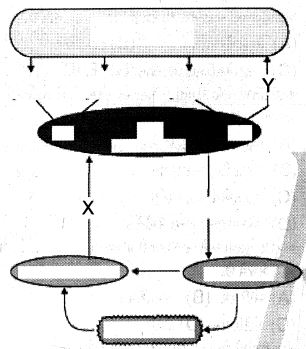
Identify $X$ and $Y$ in the given nitrogen cycle chart.
A
$X -$ Denitrification,$Y -$ Ammonification
B
$X -$ Nitrification,$Y -$ Ammonification
C
$X -$ Ammonification,$Y -$ Denitrification
D
$X -$ Denitrification,$Y -$ Nitrification
Solution
(A) In the nitrogen cycle,the process of converting ammonia into nitrates is called nitrification. The process of converting organic nitrogen (from dead plants and animals) into ammonia is called ammonification. Based on the standard nitrogen cycle diagram:
$1$. $X$ represents the conversion of nitrates back into atmospheric nitrogen,which is known as denitrification.
$2$. $Y$ represents the conversion of organic nitrogenous compounds into ammonia,which is known as ammonification.
Therefore,$X$ is Denitrification and $Y$ is Ammonification.
$1$. $X$ represents the conversion of nitrates back into atmospheric nitrogen,which is known as denitrification.
$2$. $Y$ represents the conversion of organic nitrogenous compounds into ammonia,which is known as ammonification.
Therefore,$X$ is Denitrification and $Y$ is Ammonification.
0 likes
View Solution48
EasyMCQ
Nitrite is converted into nitrate by ........ bacteria.
A
Nitrosomonas
B
Nitrococcus
C
Nitrobacter
D
None of these
Solution
(C) The process of nitrification involves the oxidation of ammonia to nitrite and then to nitrate.
$1$. Ammonia $(NH_3)$ is oxidized to nitrite $(NO_2^-)$ by bacteria such as $Nitrosomonas$ and $Nitrococcus$.
$2$. Nitrite $(NO_2^-)$ is then oxidized to nitrate $(NO_3^-)$ by the bacterium $Nitrobacter$.
Therefore,the conversion of nitrite to nitrate is carried out by $Nitrobacter$.
$1$. Ammonia $(NH_3)$ is oxidized to nitrite $(NO_2^-)$ by bacteria such as $Nitrosomonas$ and $Nitrococcus$.
$2$. Nitrite $(NO_2^-)$ is then oxidized to nitrate $(NO_3^-)$ by the bacterium $Nitrobacter$.
Therefore,the conversion of nitrite to nitrate is carried out by $Nitrobacter$.
0 likes
View Solution49
MediumMCQ
Complete the nitrification process equation:
........... $+$ .......... $\rightarrow 2NO_2^- + 2H^+ + 2H_2O$
........... $+$ .......... $\rightarrow 2NO_2^- + 2H^+ + 2H_2O$
A
$2 NO_2^- + O_2$
B
$3 NO_2^- + O_2$
C
$2 NH_3 + 3O_2$
D
$2 NH_3 + 2O_2$
Solution
(C) Nitrification is a two-step biological process where ammonia is oxidized to nitrate.
In the first step,ammonia $(NH_3)$ is oxidized to nitrite $(NO_2^-)$ by bacteria such as $Nitrosomonas$ or $Nitrococcus$.
The balanced chemical equation for this step is:
$2NH_3 + 3O_2 \rightarrow 2NO_2^- + 2H^+ + 2H_2O$.
Therefore,the missing reactants are $2NH_3$ and $3O_2$.
In the first step,ammonia $(NH_3)$ is oxidized to nitrite $(NO_2^-)$ by bacteria such as $Nitrosomonas$ or $Nitrococcus$.
The balanced chemical equation for this step is:
$2NH_3 + 3O_2 \rightarrow 2NO_2^- + 2H^+ + 2H_2O$.
Therefore,the missing reactants are $2NH_3$ and $3O_2$.
0 likes
View Solution50
MediumMCQ
Match the following:
| Column-$I$ | Column-$II$ |
| $(a)$ Free living aerobic nitrogen fixer | $(1)$ Frankia |
| $(b)$ Denitrification | $(2)$ Anabaena |
| $(c)$ Free living anaerobic nitrogen fixer | $(3)$ Thiobacillus |
| $(d)$ Symbionts | $(4)$ Beijerinckia |
A
$(a-1), (b-3), (c-4), (d-2)$
B
$(a-4), (b-3), (c-2), (d-1)$
C
$(a-4), (b-3), (c-1), (d-2)$
D
$(a-3), (b-2), (c-1), (d-4)$
Solution
(B) The correct matches are as follows:
$(a)$ Free living aerobic nitrogen fixer: $Beijerinckia$ is a free-living aerobic bacterium that fixes nitrogen.
$(b)$ Denitrification: $Thiobacillus$ is a denitrifying bacterium that converts nitrates back into nitrogen gas.
$(c)$ Free living anaerobic nitrogen fixer: $Anabaena$ (specifically in its heterocysts) can fix nitrogen under anaerobic conditions while living freely.
$(d)$ Symbionts: $Frankia$ is a symbiotic nitrogen-fixing bacterium that forms root nodules in non-leguminous plants like $Alnus$.
Therefore,the correct sequence is $(a-4), (b-3), (c-2), (d-1)$.
$(a)$ Free living aerobic nitrogen fixer: $Beijerinckia$ is a free-living aerobic bacterium that fixes nitrogen.
$(b)$ Denitrification: $Thiobacillus$ is a denitrifying bacterium that converts nitrates back into nitrogen gas.
$(c)$ Free living anaerobic nitrogen fixer: $Anabaena$ (specifically in its heterocysts) can fix nitrogen under anaerobic conditions while living freely.
$(d)$ Symbionts: $Frankia$ is a symbiotic nitrogen-fixing bacterium that forms root nodules in non-leguminous plants like $Alnus$.
Therefore,the correct sequence is $(a-4), (b-3), (c-2), (d-1)$.
0 likes
View SolutionMineral Nutrition — Nitrogen Cycle · Frequently Asked Questions
1Are these Mineral Nutrition questions useful for JEE and NEET?
Yes. All questions in this section are mapped to JEE Main and NEET exam patterns. Previous year questions from JEE Main, NEET, GUJCET and state-level exams are included with full solutions.
2Can I switch to Hindi or Gujarati for these questions?
Yes. Use the language tabs in the hero section or the sidebar to view the same questions and solutions in English, Hindi or Gujarati.
3How do I generate a question paper from this subtopic?
Use the Vedclass Exam Paper Generator — select the chapter and subtopic, set difficulty, and generate Sets A, B, C, D automatically. First 3 chapters of every subject are free.
Vedclass Products
For Students
Vedclass Test Series
Mock tests in real JEE/NEET style with performance analysis. 5-day free trial.
Start Free TrialFor Teachers
Exam Paper Generator
Generate Set A/B/C/D papers from this chapter in 2 minutes. 3 chapters free.
Try FreeFor Institutes
Online Exam Module
Live online exams with unlimited students, 360° analytics & white-label branding.
See DemoFor Teachers & Institutes
Generate a Mineral Nutrition Exam Paper in 2 Minutes
Select subtopic & difficulty — Sets A, B, C, D auto-generated with No Repeat logic.
First 3 chapters of every subject are free — no payment required.