
A English
METHODS TO STUDY THE MINERAL REQUIREMENTS OF PLANTS Questions in English
Class 11 Biology · Mineral Nutrition · METHODS TO STUDY THE MINERAL REQUIREMENTS OF PLANTS
40+
Questions
English
Language
100%
With Solutions
Showing 40 of 40 questions in English
1
EasyMCQ
What is hydroponics?
A
Growing of aquatic plants
B
Growing of floating aquatic plants
C
Growing of plants in sand
D
Growing of plants in an aqueous balanced nutrient solution
Solution
(D) Hydroponics is the technique of growing plants in a nutrient solution without soil.
This method involves the use of an aqueous solution containing all essential mineral elements in the correct proportions to support plant growth.
Therefore,it is defined as the cultivation of plants in an aqueous balanced nutrient solution.
This method involves the use of an aqueous solution containing all essential mineral elements in the correct proportions to support plant growth.
Therefore,it is defined as the cultivation of plants in an aqueous balanced nutrient solution.
0 likes
View Solution2
EasyMCQ
How are the mineral contents of a plant determined?
A
Titrimetric method
B
Calorimetric method
C
Ash analysis
D
All of the above
Solution
(C) The mineral content of a plant is determined through a process called $Ash \ analysis$.
In this method,plant tissue is dried to remove water,and then it is burned at a high temperature.
The organic matter is oxidized and released as gases,leaving behind the inorganic mineral elements in the form of $Ash$.
This $Ash$ is then analyzed to identify and quantify the mineral elements present in the plant.
In this method,plant tissue is dried to remove water,and then it is burned at a high temperature.
The organic matter is oxidized and released as gases,leaving behind the inorganic mineral elements in the form of $Ash$.
This $Ash$ is then analyzed to identify and quantify the mineral elements present in the plant.
0 likes
View Solution3
EasyMCQ
Hydroponics is a method of
A
Study of the development of soil
B
Study of soil protection
C
Growth of plants in liquid culture medium
D
Growing plants in laboratory
Solution
(C) Hydroponics is a technique of growing plants in a nutrient solution (liquid culture medium) without soil. This method allows for the precise control of nutrient availability and is used to identify essential elements required for plant growth.
0 likes
View Solution4
EasyMCQ
Which one of the following scientists used the nutrient culture solution in hydroponic cultures?
A
Sachs
B
Webster
C
Wallace
D
Knop
Solution
(D) The correct answer is $D$.
Julius von Sachs $(1860)$ demonstrated for the first time that plants could be grown to maturity in a defined nutrient solution in complete absence of soil.
However,the specific nutrient culture solution composition commonly used in hydroponic studies was proposed by Knop $(1865)$ and later refined by Arnon and Hoagland $(1940)$.
Julius von Sachs $(1860)$ demonstrated for the first time that plants could be grown to maturity in a defined nutrient solution in complete absence of soil.
However,the specific nutrient culture solution composition commonly used in hydroponic studies was proposed by Knop $(1865)$ and later refined by Arnon and Hoagland $(1940)$.
0 likes
View Solution5
MediumMCQ
The charcoal culture experiment is better than the water culture experiment because:
A
Plants get support
B
The problem of aeration is removed
C
Charcoal is an inert substance
D
All the above
Solution
(D) The charcoal culture experiment is considered superior to the water culture (hydroponics) experiment for several reasons:
$1$. Support: Charcoal provides a solid medium that offers physical support to the plant roots,which is often lacking in simple water culture setups.
$2$. Aeration: Charcoal is porous,which facilitates better gas exchange and prevents the roots from suffocating due to lack of oxygen,thereby solving the problem of aeration.
$3$. Inert nature: Charcoal is chemically inert,meaning it does not react with the nutrient solution,ensuring that the mineral availability remains controlled and consistent.
$1$. Support: Charcoal provides a solid medium that offers physical support to the plant roots,which is often lacking in simple water culture setups.
$2$. Aeration: Charcoal is porous,which facilitates better gas exchange and prevents the roots from suffocating due to lack of oxygen,thereby solving the problem of aeration.
$3$. Inert nature: Charcoal is chemically inert,meaning it does not react with the nutrient solution,ensuring that the mineral availability remains controlled and consistent.
0 likes
View Solution6
EasyMCQ
The technique of growing plants without soil in nutrient solutions is called:
A
Parthenogenesis
B
Hydroponics
C
Aquaculture
D
Tissue culture
Solution
(B) Hydroponics is a method of growing plants in a nutrient-rich water solution instead of soil.
This technique allows for the precise control of nutrient availability,$pH$,and aeration for the plant roots.
It is widely used in research and commercial agriculture to study plant mineral requirements.
This technique allows for the precise control of nutrient availability,$pH$,and aeration for the plant roots.
It is widely used in research and commercial agriculture to study plant mineral requirements.
0 likes
View Solution7
EasyMCQ
Hydroponics is a
A
Soilless culture
B
Water less culture
C
Airless culture
D
None of these
Solution
(A) Hydroponics is a technique of growing plants in a nutrient solution in the absence of soil.
It is also known as soilless culture.
In this method,plants are grown in a defined nutrient solution,which provides all the essential minerals required for plant growth.
Therefore,the correct option is $A$.
It is also known as soilless culture.
In this method,plants are grown in a defined nutrient solution,which provides all the essential minerals required for plant growth.
Therefore,the correct option is $A$.
0 likes
View Solution8
EasyMCQ
Cultivation by sand culture is also called
A
Soilless cultivation
B
Greenhouse effect
C
Photorespiration
D
None of these
Solution
(A) Sand culture is a method of growing plants in an inert medium like sand,which is supplied with a nutrient solution.
Since the plants are grown without soil,this technique is commonly referred to as soilless cultivation.
This method provides the roots with a natural environment and ensures proper aeration,which is beneficial for plant growth.
Since the plants are grown without soil,this technique is commonly referred to as soilless cultivation.
This method provides the roots with a natural environment and ensures proper aeration,which is beneficial for plant growth.
0 likes
View Solution9
EasyMCQ
What is a hydroponic solution?
A
Liquid
B
Water
C
Soil culture
D
$A$ saturated solution containing nutrients
Solution
(D) Hydroponics is a technique of growing plants in a nutrient solution.
This method involves growing plants in a defined nutrient solution rather than soil.
This solution contains essential mineral nutrients required for the growth and development of the plant.
Therefore,a hydroponic solution is a nutrient-rich solution used for soil-less cultivation.
This method involves growing plants in a defined nutrient solution rather than soil.
This solution contains essential mineral nutrients required for the growth and development of the plant.
Therefore,a hydroponic solution is a nutrient-rich solution used for soil-less cultivation.
0 likes
View Solution10
EasyMCQ
Hydroponics has been successfully employed as a technique for the commercial production of......
A
Tomato
B
Seedless cucumber
C
Lettuce
D
All of the above
Solution
(D) Hydroponics is a technique of growing plants in a nutrient solution.
It has been successfully employed as a technique for the commercial production of vegetables such as tomato,seedless cucumber,and lettuce.
This method allows for controlled growth conditions,efficient use of water and nutrients,and higher yields in a smaller space.
It has been successfully employed as a technique for the commercial production of vegetables such as tomato,seedless cucumber,and lettuce.
This method allows for controlled growth conditions,efficient use of water and nutrients,and higher yields in a smaller space.
0 likes
View Solution11
MediumMCQ
Hydroponics will not be used for which of the following purposes?
A
Re-fixation of elements
B
Removing of weeds
C
Protection against soil-borne infections
D
Limited use of water
Solution
(B) Hydroponics is a technique of growing plants in a nutrient solution.
It is primarily used to identify essential elements required by plants and their deficiency symptoms.
Advantages of hydroponics include:
$1$. It allows for the control of nutrient supply.
$2$. It protects plants from soil-borne pathogens and infections.
$3$. It is highly efficient in terms of water usage.
However,hydroponics is not a method used for the removal of weeds,as weeds are unwanted plants that grow in soil-based agriculture. Therefore,option $B$ is the correct answer.
It is primarily used to identify essential elements required by plants and their deficiency symptoms.
Advantages of hydroponics include:
$1$. It allows for the control of nutrient supply.
$2$. It protects plants from soil-borne pathogens and infections.
$3$. It is highly efficient in terms of water usage.
However,hydroponics is not a method used for the removal of weeds,as weeds are unwanted plants that grow in soil-based agriculture. Therefore,option $B$ is the correct answer.
0 likes
View Solution12
EasyMCQ
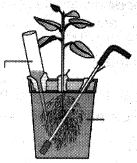
What does the given experimental set-up depict?
Choose the correct option.
Choose the correct option.
A
$O_2$ evolves during photosynthesis
B
$CO_2$ is required during photosynthesis
C
Measurement of the growth of a plant
D
Nutrient solution culture setup
Solution
(D) The given experimental set-up represents the technique of hydroponics or nutrient solution culture.
In this method,plants are grown in a defined nutrient solution.
This setup includes a tube for adding water and nutrients,and an aerating tube to provide oxygen to the roots,which is essential for proper plant growth and mineral uptake.
Therefore,it is used to study the mineral requirements of plants.
In this method,plants are grown in a defined nutrient solution.
This setup includes a tube for adding water and nutrients,and an aerating tube to provide oxygen to the roots,which is essential for proper plant growth and mineral uptake.
Therefore,it is used to study the mineral requirements of plants.
0 likes
View Solution13
EasyMCQ
The technique of growing plants to maturity in a defined nutrient solution in the complete absence of soil is known as.............
A
Farming
B
Cultivation
C
Germination
D
Hydroponics
Solution
(D) Hydroponics is a technique of growing plants in a nutrient solution instead of soil.
This method was first demonstrated by Julius von Sachs in $1860$.
In this technique,plants are grown in a container with a defined nutrient solution that provides all the essential minerals required for the plant's growth and development.
This method is widely used for the commercial production of vegetables like tomatoes,seedless cucumbers,and lettuce.
This method was first demonstrated by Julius von Sachs in $1860$.
In this technique,plants are grown in a container with a defined nutrient solution that provides all the essential minerals required for the plant's growth and development.
This method is widely used for the commercial production of vegetables like tomatoes,seedless cucumbers,and lettuce.
0 likes
View Solution14
EasyMCQ
Hydroponics is
A
nutrient less culture
B
water less culture
C
soilless culture
D
none of these
Solution
(C) Cultivation of plants by placing the roots in a nutrient solution without any soil is called hydroponics.
It is also known as soilless culture,water culture,or solution culture.
This technique is used to determine which mineral elements are essential for plant growth and to observe the symptoms produced by the absence or deficiency of these essential elements.
It is also known as soilless culture,water culture,or solution culture.
This technique is used to determine which mineral elements are essential for plant growth and to observe the symptoms produced by the absence or deficiency of these essential elements.
0 likes
View Solution15
Medium
Why is purification of water and nutrient salts so important in studies involving mineral nutrition using hydroponics?
Solution
(N/A) Hydroponics is the technique of growing plants in a nutrient solution in the absence of soil.
Since the plant roots are exposed to a limited volume of the solution,any impurities in the water or nutrient salts can lead to toxicity or nutrient imbalance.
Furthermore,to ensure that only the specific minerals being studied are affecting the plant's growth,it is essential to use highly purified water and nutrient salts.
This prevents contamination and ensures that the observed physiological responses are solely due to the experimental variables,thereby maintaining optimum plant growth.
Since the plant roots are exposed to a limited volume of the solution,any impurities in the water or nutrient salts can lead to toxicity or nutrient imbalance.
Furthermore,to ensure that only the specific minerals being studied are affecting the plant's growth,it is essential to use highly purified water and nutrient salts.
This prevents contamination and ensures that the observed physiological responses are solely due to the experimental variables,thereby maintaining optimum plant growth.
0 likes
View Solution16
Medium
Mention the methods to study the mineral requirements in plants.
Solution
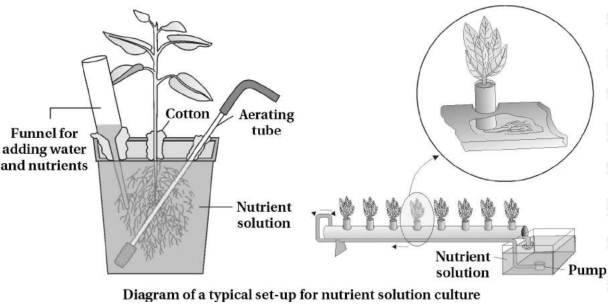
(N/A) $\Rightarrow$ Julius von Sachs,a prominent German botanist,demonstrated for the first time that plants could be grown to maturity in a defined nutrient solution.
$\Rightarrow$ The technique of growing plants in a nutrient solution is known as hydroponics.
$\Rightarrow$ Since then,a number of improvised methods have been employed to try and determine the mineral nutrients essential for plants.
$\Rightarrow$ The essence of all these methods involves the culture of plants in a soil-free,defined mineral solution.
$\Rightarrow$ These methods require purified water and mineral nutrient salts.
$\Rightarrow$ After a series of experiments in which the roots of the plants were immersed in nutrient solutions and wherein an element was added/removed or given in varied concentrations,a mineral solution suitable for plant growth was obtained.
$\Rightarrow$ By this method,essential elements were identified and their deficiency symptoms were discovered.
$\Rightarrow$ Hydroponics has been successfully employed as a technique for the commercial production of vegetables such as tomato,seedless cucumber,and lettuce.
$\Rightarrow$ It must be emphasized that the nutrient solutions must be adequately aerated to obtain optimum growth.
$\Rightarrow$ The technique of growing plants in a nutrient solution is known as hydroponics.
$\Rightarrow$ Since then,a number of improvised methods have been employed to try and determine the mineral nutrients essential for plants.
$\Rightarrow$ The essence of all these methods involves the culture of plants in a soil-free,defined mineral solution.
$\Rightarrow$ These methods require purified water and mineral nutrient salts.
$\Rightarrow$ After a series of experiments in which the roots of the plants were immersed in nutrient solutions and wherein an element was added/removed or given in varied concentrations,a mineral solution suitable for plant growth was obtained.
$\Rightarrow$ By this method,essential elements were identified and their deficiency symptoms were discovered.
$\Rightarrow$ Hydroponics has been successfully employed as a technique for the commercial production of vegetables such as tomato,seedless cucumber,and lettuce.
$\Rightarrow$ It must be emphasized that the nutrient solutions must be adequately aerated to obtain optimum growth.
0 likes
View Solution17
Medium
Give differences: Soil culture and Hydroponics.
Solution
(N/A)
| Soil Culture | Hydroponics |
|---|---|
| $(1)$ The method of growing plants in soil. | $(1)$ The technique of growing plants in a nutrient-rich solution. |
| $(2)$ Soil acts as a complex reservoir of minerals,making it difficult to maintain a precise nutrient balance. | $(2)$ Nutrient solutions are prepared artificially,allowing for precise control and maintenance of nutrient balance. |
| $(3)$ There is a high risk of soil-borne pathogens and diseases. | $(3)$ It provides protection against soil-borne pathogens and diseases. |
| $(4)$ There is a high possibility of weed growth alongside the crop. | $(4)$ It offers significant relief from weed growth. |
| $(5)$ It is difficult to study the specific deficiency symptoms of individual mineral elements. | $(5)$ It is highly effective for studying the deficiency symptoms of specific mineral elements. |
0 likes
View Solution18
Medium
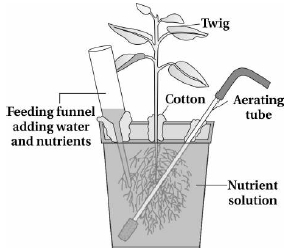
Carefully observe the following figure.
$(a)$ Name the technique shown in the figure and the scientist who demonstrated this technique for the first time.
$(b)$ Name at least three plants for which this technique can be employed for their commercial production.
$(c)$ What is the significance of the aerating tube and feeding funnel in this setup?
$(a)$ Name the technique shown in the figure and the scientist who demonstrated this technique for the first time.
$(b)$ Name at least three plants for which this technique can be employed for their commercial production.
$(c)$ What is the significance of the aerating tube and feeding funnel in this setup?
Solution
(N/A) The technique shown is Hydroponics,which was first demonstrated by Julius Von Sachs in $1860$.
$(b)$ Three plants for which this technique can be employed for commercial production are:
$(i)$ Solanum lycopersicum (Tomato)
$(ii)$ Hibiscus esculentus (Okra)
$(iii)$ Solanum melongena (Brinjal)
$(c)$ The significance of the components is as follows:
- Aerating tube: It provides air (oxygen) to the nutrient solution,which is essential for the respiration and optimum growth of roots.
- Feeding funnel: It is used to add water and nutrient salts to the solution as per the requirement of the plant.
$(b)$ Three plants for which this technique can be employed for commercial production are:
$(i)$ Solanum lycopersicum (Tomato)
$(ii)$ Hibiscus esculentus (Okra)
$(iii)$ Solanum melongena (Brinjal)
$(c)$ The significance of the components is as follows:
- Aerating tube: It provides air (oxygen) to the nutrient solution,which is essential for the respiration and optimum growth of roots.
- Feeding funnel: It is used to add water and nutrient salts to the solution as per the requirement of the plant.
0 likes
View Solution19
MediumMCQ
Hydroponics has been shown to be a successful technique for growing plants. Yet,most crops are still grown on land. Why?
A
High cost of setup and maintenance.
B
Risk of rapid spread of water-borne diseases.
C
Lack of technical knowledge among farmers.
D
All of the above.
Solution
(D) Hydroponics is not widely adopted for commercial crop production due to several reasons:
$(1)$ Economic factors: The initial setup cost and ongoing maintenance of hydroponic systems are significantly higher compared to traditional soil-based farming.
$(2)$ Disease management: In hydroponic systems,water-borne pathogens can spread rapidly throughout the entire crop,leading to significant losses.
$(3)$ Knowledge gap: Many farmers lack the specialized technical knowledge required to manage nutrient solutions and environmental parameters effectively.
$(4)$ Environmental sensitivity: Plants grown hydroponically can be less resilient to extreme environmental fluctuations. In hot seasons or conditions with low $O_2$ availability,both the yield and quality of the produce may decrease significantly.
$(1)$ Economic factors: The initial setup cost and ongoing maintenance of hydroponic systems are significantly higher compared to traditional soil-based farming.
$(2)$ Disease management: In hydroponic systems,water-borne pathogens can spread rapidly throughout the entire crop,leading to significant losses.
$(3)$ Knowledge gap: Many farmers lack the specialized technical knowledge required to manage nutrient solutions and environmental parameters effectively.
$(4)$ Environmental sensitivity: Plants grown hydroponically can be less resilient to extreme environmental fluctuations. In hot seasons or conditions with low $O_2$ availability,both the yield and quality of the produce may decrease significantly.
0 likes
View Solution20
EasyMCQ
The nutrient solution in flowering culture hydroponics:
A
Is constantly recycled using a pump
B
Flows back into the loam soil in which the plant grows
C
Drains into a bucket for disposal
D
None of the above
Solution
(A) In hydroponics,specifically in systems designed for flowering cultures,the nutrient solution is not discarded. Instead,it is constantly recycled using a pump to ensure that the plants receive a continuous supply of essential minerals and oxygenated water.
0 likes
View Solution21
EasyMCQ
Who demonstrated the concept of hydroponics for the first time?
A
Hewitt
B
Julius von Sachs
C
Dalton
D
None of these
Solution
(B) In $1860$,Julius von Sachs,a prominent German botanist,demonstrated for the first time that plants could be grown to maturity in a defined nutrient solution in the complete absence of soil.
0 likes
View Solution22
EasyMCQ
$I.$ The practice of growing plants in nutrient-enriched water without soil is called....
$II.$ The system of growing plants with their roots bathed in nutrient mist (a cloud of moisture in air) is called....
Complete the given statements ($I$ and $II$) with the correct pair of options given below.
$II.$ The system of growing plants with their roots bathed in nutrient mist (a cloud of moisture in air) is called....
Complete the given statements ($I$ and $II$) with the correct pair of options given below.
A
Hydroponics and aeroponics
B
Aeroponics and hydroponics
C
Hydroponics and fogponics
D
Agroponics and hydroponics
Solution
(A) The practice of growing plants in a nutrient-enriched water solution without soil is known as hydroponics.
The system of growing plants where the roots are suspended in the air and sprayed with a nutrient-rich mist is known as aeroponics.
The system of growing plants where the roots are suspended in the air and sprayed with a nutrient-rich mist is known as aeroponics.
0 likes
View Solution23
MediumMCQ
Which of the following methods is close to hydroponics and has the same principle?
A
Aeroponics
B
Geoponics
C
Planting
D
None of these
Solution
(A) Aeroponics is a method of growing plants in an air or mist environment without the use of soil or an aggregate medium.
Like hydroponics,it relies on providing nutrients directly to the roots,but instead of a liquid nutrient solution,it uses a fine mist,making it a closely related technique based on the same principle of soil-less cultivation.
Like hydroponics,it relies on providing nutrients directly to the roots,but instead of a liquid nutrient solution,it uses a fine mist,making it a closely related technique based on the same principle of soil-less cultivation.
0 likes
View Solution24
EasyMCQ
Hydroponics is the growth of plants in
A
Pure water
B
Air
C
Water containing essential nutrients
D
Soil
Solution
(C) Hydroponics is the technique of growing plants in a nutrient solution without soil. In this method,plants are raised in tanks filled with a water solution containing appropriate quantities of all essential mineral elements. This technique is widely used for the commercial production of vegetables like tomatoes,seedless cucumbers,and lettuce,as well as for flower culture.
0 likes
View Solution25
EasyMCQ
Hydroponics is a technique of growing plants in a
A
Soil solution
B
Nutrient solution
C
Both $(a)$ and $(b)$
D
None of the above
Solution
(B) Hydroponics is a technique of growing plants in a nutrient solution.
This method involves growing plants in a defined nutrient solution in the absence of soil.
This technique is widely used to identify the essential mineral elements required for plant growth and to study their deficiency symptoms.
This method involves growing plants in a defined nutrient solution in the absence of soil.
This technique is widely used to identify the essential mineral elements required for plant growth and to study their deficiency symptoms.
0 likes
View Solution26
MediumMCQ
Major disadvantages of hydroponics include
A
Expense to set up
B
High technical knowledge
C
Both $(A)$ and $(B)$
D
None of the above
Solution
(C) The major disadvantages of hydroponics are as follows:
$(i)$ It requires a high initial investment for setting up the infrastructure,such as nutrient delivery systems,lighting,and climate control.
$(ii)$ It demands specialized technical knowledge and constant monitoring of nutrient solutions,$pH$ levels,and environmental conditions to ensure plant health.
Therefore,both $(A)$ and $(B)$ are correct.
$(i)$ It requires a high initial investment for setting up the infrastructure,such as nutrient delivery systems,lighting,and climate control.
$(ii)$ It demands specialized technical knowledge and constant monitoring of nutrient solutions,$pH$ levels,and environmental conditions to ensure plant health.
Therefore,both $(A)$ and $(B)$ are correct.
0 likes
View Solution27
EasyMCQ
Name the technique used by researchers to explore plant nutrient deficiencies.
A
Sun exposure
B
Hyperbasic chambers
C
Crop rotation
D
Hydroponics
Solution
(D) Hydroponics is a technique of growing plants in a nutrient solution.
It is a useful technique for identifying essential mineral elements required by plants.
By using this method,researchers can control the nutrient supply to the plants,which allows them to identify specific essential elements and observe their deficiency symptoms.
It is a useful technique for identifying essential mineral elements required by plants.
By using this method,researchers can control the nutrient supply to the plants,which allows them to identify specific essential elements and observe their deficiency symptoms.
0 likes
View Solution28
MediumMCQ
Soilless culture helps in knowing:
A
Toxicity caused by an element
B
Deficiency symptoms caused by an element
C
Essentiality of an element
D
All of the above
Solution
(D) Soilless culture,also known as hydroponics,allows researchers to control the exact nutrient composition of the growth medium.
By systematically removing or adding specific minerals,scientists can determine the essentiality of an element for plant growth.
Furthermore,by varying the concentration of these elements,it is possible to observe and document the specific deficiency symptoms caused by the lack of an element and the toxicity symptoms caused by an excess of an element.
Therefore,all of the above options are correct.
By systematically removing or adding specific minerals,scientists can determine the essentiality of an element for plant growth.
Furthermore,by varying the concentration of these elements,it is possible to observe and document the specific deficiency symptoms caused by the lack of an element and the toxicity symptoms caused by an excess of an element.
Therefore,all of the above options are correct.
0 likes
View Solution29
EasyMCQ
While producing hydroponic plants,which of the following metals is added along with $EDTA$?
A
Nitrogen
B
Copper
C
Iron
D
None of these
Solution
(C) In hydroponics,iron is often added in the form of a chelate,specifically ferric $EDTA$ (Ethylenediaminetetraacetic acid).
This is because iron is prone to precipitation in nutrient solutions,especially at higher $pH$ levels.
$EDTA$ acts as a chelating agent that keeps the iron in a soluble form,making it readily available for plant uptake.
This is because iron is prone to precipitation in nutrient solutions,especially at higher $pH$ levels.
$EDTA$ acts as a chelating agent that keeps the iron in a soluble form,making it readily available for plant uptake.
0 likes
View Solution30
MediumMCQ
Which of the following statements are not correct in reference to hydroponics?
$I.$ It determines the mineral nutrients essential for the plants.
$II.$ The hydroponics involves the culture of plants in a soil with,defined mineral solution.
$III.$ Hydroponics requires purified water with non-defined mineral nutrient salts.
$IV.$ In the hydroponics technique,plants are grown in sandy soil with nutrient solution.
$V.$ By this method,essential elements required for the growth of plants can be identified and their deficiency symptoms can also be discovered.
Choose the correct options.
$I.$ It determines the mineral nutrients essential for the plants.
$II.$ The hydroponics involves the culture of plants in a soil with,defined mineral solution.
$III.$ Hydroponics requires purified water with non-defined mineral nutrient salts.
$IV.$ In the hydroponics technique,plants are grown in sandy soil with nutrient solution.
$V.$ By this method,essential elements required for the growth of plants can be identified and their deficiency symptoms can also be discovered.
Choose the correct options.
A
Only $IV$
B
Only $V$
C
Only $III$
D
$II, III, IV$
Solution
(D) Hydroponics is the technique of growing plants in a nutrient solution. This method is used to determine the mineral nutrients essential for plants.
Statement $I$ is correct as it is the primary purpose of this technique.
Statement $II$ is incorrect because hydroponics involves the culture of plants in a soil-free,defined mineral solution,not in soil.
Statement $III$ is incorrect because it requires purified water and defined (not non-defined) mineral nutrient salts.
Statement $IV$ is incorrect because plants are grown in a soil-free medium,not sandy soil.
Statement $V$ is correct as this method helps in identifying essential elements and their deficiency symptoms.
Therefore,statements $II, III,$ and $IV$ are incorrect.
Statement $I$ is correct as it is the primary purpose of this technique.
Statement $II$ is incorrect because hydroponics involves the culture of plants in a soil-free,defined mineral solution,not in soil.
Statement $III$ is incorrect because it requires purified water and defined (not non-defined) mineral nutrient salts.
Statement $IV$ is incorrect because plants are grown in a soil-free medium,not sandy soil.
Statement $V$ is correct as this method helps in identifying essential elements and their deficiency symptoms.
Therefore,statements $II, III,$ and $IV$ are incorrect.
0 likes
View Solution31
EasyMCQ
Hydroponics are of three types: $A$,a film system,and $B$. Choose the correct pair from the options given below.
A
$A-$ in vitro; $B-$ tube system
B
$A-$ tube system; $B-$ tank system
C
$A-$ tank system; $B-$ aeroponics
D
$A-$ plant tissue culture; $B-$ tube system
Solution
(C) Hydroponics is classified into three main types: tank system,film system,and aeroponics.
In the tank system,roots are submerged in a nutrient solution,and air is bubbled through the solution to provide oxygen.
In the film system,plants are grown in a tube containing a thin film of recirculated nutrient solution.
In aeroponics,roots are suspended in the air over the nutrient solution,which is converted into a nutrient mist by a rotor.
In the tank system,roots are submerged in a nutrient solution,and air is bubbled through the solution to provide oxygen.
In the film system,plants are grown in a tube containing a thin film of recirculated nutrient solution.
In aeroponics,roots are suspended in the air over the nutrient solution,which is converted into a nutrient mist by a rotor.
0 likes
View Solution32
EasyMCQ
Hydroponics refers to growing plants in
A
Macronutrients culture medium
B
Water
C
Solution of mineral nutrients
D
Soil
Solution
(C) Hydroponics is a technique of growing plants in a nutrient solution rather than in soil. In this method,the roots of the plants are immersed in a solution containing essential mineral nutrients,which allows for the study of plant growth and mineral requirements under controlled conditions.
0 likes
View Solution33
MediumMCQ
Growing plants in a nutrient solution,known as hydroponics:
A
Involves the use of a chelating agent $Na-EDTA$ to keep iron available to plants.
B
Was first demonstrated by Arnon and Hoagland.
C
Also allows the growth of algae in containers.
D
Requires the prevention of light reaction with roots.
Solution
(D) Hydroponics is the technique of growing plants in a nutrient solution.
To ensure successful growth,the nutrient solution must be aerated to provide oxygen to the roots.
Furthermore,it is essential to prevent light from reaching the roots to inhibit the growth of algae,which would otherwise compete with the plants for nutrients and oxygen.
Therefore,the containers are often covered or painted to block light.
To ensure successful growth,the nutrient solution must be aerated to provide oxygen to the roots.
Furthermore,it is essential to prevent light from reaching the roots to inhibit the growth of algae,which would otherwise compete with the plants for nutrients and oxygen.
Therefore,the containers are often covered or painted to block light.
0 likes
View Solution34
MediumMCQ
$A$: Jar for nutrient solution culture contains a split cover with holes which hold a bent tube for aeration.
$R$: Regular aeration of culture solution is necessary for proper growth and activities of roots.
$R$: Regular aeration of culture solution is necessary for proper growth and activities of roots.
A
Assertion and Reason both are correct and Reason is the correct explanation of Assertion.
B
Assertion and Reason both are correct but Reason is not the correct explanation of Assertion.
C
Assertion is correct,but Reason is incorrect.
D
Both Assertion and Reason are incorrect.
Solution
(A) In hydroponics or nutrient solution culture,the roots of plants are submerged in a nutrient solution.
For the roots to remain healthy and perform their metabolic activities,such as the uptake of minerals and water,they require a continuous supply of oxygen for respiration.
If the solution is not aerated,the roots may suffer from oxygen deficiency,leading to stunted growth or root decay.
Therefore,a bent tube is provided in the jar to facilitate the aeration of the nutrient solution.
Thus,both the Assertion and the Reason are correct,and the Reason provides the correct explanation for the Assertion.
For the roots to remain healthy and perform their metabolic activities,such as the uptake of minerals and water,they require a continuous supply of oxygen for respiration.
If the solution is not aerated,the roots may suffer from oxygen deficiency,leading to stunted growth or root decay.
Therefore,a bent tube is provided in the jar to facilitate the aeration of the nutrient solution.
Thus,both the Assertion and the Reason are correct,and the Reason provides the correct explanation for the Assertion.
0 likes
View Solution35
EasyMCQ
Hydroponics is a system of growing plants in
A
Soil-less culture or solution culture
B
Acidic soil
C
Soil-less culture with alkaline $pH$
D
Soil-less culture with acidic $pH$
Solution
(A) The term '$Hydroponics$' is derived from two Greek words: '$Hydro$' meaning '$water$' and '$ponos$' meaning '$labor$'.
It is a technique of growing plants in a nutrient-rich solution without the use of soil.
This method is also known as soil-less culture or solution culture.
Therefore, the correct option is $A$.
It is a technique of growing plants in a nutrient-rich solution without the use of soil.
This method is also known as soil-less culture or solution culture.
Therefore, the correct option is $A$.
0 likes
View Solution36
EasyMCQ
Who demonstrated that plants could be grown to maturity in a defined nutrient solution in the absence of soil?
A
German botanist - Jan Ingenhousz
B
British botanist - Jan Ingenhousz
C
British botanist - Julius von Sachs
D
German botanist - Julius von Sachs
Solution
(D) In $1860$,the prominent German botanist Julius von Sachs demonstrated for the first time that plants could be grown to maturity in a defined nutrient solution in the complete absence of soil. This technique of growing plants in a nutrient solution is known as hydroponics.
0 likes
View Solution37
EasyMCQ
Hydroponics is $............$
A
$A$ technique of growing plants in a nutrient solution
B
Increase in water
C
$A$ technique of growing plants without soil
D
Both $A$ and $C$
Solution
(D) Hydroponics is a method of growing plants in a nutrient-rich aqueous solution without the use of soil.
This technique allows for the controlled supply of essential minerals directly to the plant roots.
Since both options $A$ (growing plants in a nutrient solution) and $C$ (growing plants without soil) describe the definition of hydroponics,the correct answer is $D$.
This technique allows for the controlled supply of essential minerals directly to the plant roots.
Since both options $A$ (growing plants in a nutrient solution) and $C$ (growing plants without soil) describe the definition of hydroponics,the correct answer is $D$.
0 likes
View Solution38
EasyMCQ
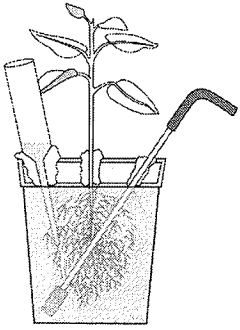
The figure given below shows $..............$.
A
Hydroponics
B
Soil culture
C
Aeroponics
D
All of the above
Solution
(A) The figure shows a plant growing in a nutrient solution with an aeration tube,which is the standard experimental setup for $Hydroponics$.
$Hydroponics$ is the technique of growing plants in a nutrient solution.
This method requires purified water with mineral nutrient salts.
Therefore,the correct option is $A$.
$Hydroponics$ is the technique of growing plants in a nutrient solution.
This method requires purified water with mineral nutrient salts.
Therefore,the correct option is $A$.
0 likes
View Solution39
MediumMCQ
State the uses of hydroponics.
A
Tomatoes,seedless cucumbers,and lettuce can be grown successfully for commercial production.
B
The effect of deficiency of each mineral element can be studied using this method.
C
The effect of mineral toxicity on plants can be studied.
D
All of the above.
Solution
(D) Hydroponics is a technique of growing plants in a nutrient solution.
Its uses include:
$1$. Commercial production of vegetables like tomatoes,seedless cucumbers,and lettuce.
$2$. It allows for the identification of essential elements and their deficiency symptoms by omitting specific minerals from the solution.
$3$. It helps in studying the effects of mineral toxicity on plant growth.
Therefore,all the given options are correct uses of hydroponics.
Its uses include:
$1$. Commercial production of vegetables like tomatoes,seedless cucumbers,and lettuce.
$2$. It allows for the identification of essential elements and their deficiency symptoms by omitting specific minerals from the solution.
$3$. It helps in studying the effects of mineral toxicity on plant growth.
Therefore,all the given options are correct uses of hydroponics.
0 likes
View Solution40
EasyMCQ
Growing of plants in a nutrient solution on terrace or balcony is called
A
Sericulture
B
Suspension culture
C
Hydroponics
D
Agriculture
Solution
(C) Hydroponics is the technique of growing plants in a nutrient-rich solution instead of soil. This method allows for the cultivation of plants in controlled environments,such as terraces or balconies,by providing essential minerals directly to the roots through water.
0 likes
View SolutionMineral Nutrition — METHODS TO STUDY THE MINERAL REQUIREMENTS OF PLANTS · Frequently Asked Questions
1Are these Mineral Nutrition questions useful for JEE and NEET?
Yes. All questions in this section are mapped to JEE Main and NEET exam patterns. Previous year questions from JEE Main, NEET, GUJCET and state-level exams are included with full solutions.
2Can I switch to Hindi or Gujarati for these questions?
Yes. Use the language tabs in the hero section or the sidebar to view the same questions and solutions in English, Hindi or Gujarati.
3How do I generate a question paper from this subtopic?
Use the Vedclass Exam Paper Generator — select the chapter and subtopic, set difficulty, and generate Sets A, B, C, D automatically. First 3 chapters of every subject are free.
Vedclass Products
For Students
Vedclass Test Series
Mock tests in real JEE/NEET style with performance analysis. 5-day free trial.
Start Free TrialFor Teachers
Exam Paper Generator
Generate Set A/B/C/D papers from this chapter in 2 minutes. 3 chapters free.
Try FreeFor Institutes
Online Exam Module
Live online exams with unlimited students, 360° analytics & white-label branding.
See DemoFor Teachers & Institutes
Generate a Mineral Nutrition Exam Paper in 2 Minutes
Select subtopic & difficulty — Sets A, B, C, D auto-generated with No Repeat logic.
First 3 chapters of every subject are free — no payment required.