
A English
Nitrogen Cycle Questions in English
Class 11 Biology · Mineral Nutrition · Nitrogen Cycle
83+
Questions
English
Language
100%
With Solutions
Showing 33 of 83 questions in English
51
MediumMCQ
$A-$ In nature,lightning and ultraviolet radiation provide enough energy to convert nitrogen to nitrogen oxides.
$R-$ Industrial combustion,forest fires,automobile exhausts,and power-generating stations are also sources of atmospheric nitrogen oxides.
$R-$ Industrial combustion,forest fires,automobile exhausts,and power-generating stations are also sources of atmospheric nitrogen oxides.
A
$A$ and $R$ both are correct.
B
$A$ and $R$ both are incorrect.
C
$A$ is correct and $R$ is incorrect.
D
$A$ is incorrect and $R$ is correct.
Solution
(A) Statement $A$ is correct: During lightning,the high temperature and electrical discharge provide sufficient energy to break the strong triple bond of atmospheric nitrogen $(N_2)$,allowing it to react with oxygen to form nitrogen oxides $(NO_x)$. Ultraviolet radiation also contributes to this process.
Statement $R$ is correct: Human activities such as industrial combustion,forest fires,automobile exhausts,and power-generating stations release significant amounts of nitrogen oxides into the atmosphere,acting as anthropogenic sources of nitrogen fixation and atmospheric nitrogen compounds.
Therefore,both statements are correct.
Statement $R$ is correct: Human activities such as industrial combustion,forest fires,automobile exhausts,and power-generating stations release significant amounts of nitrogen oxides into the atmosphere,acting as anthropogenic sources of nitrogen fixation and atmospheric nitrogen compounds.
Therefore,both statements are correct.
0 likes
View Solution52
EasyMCQ
What is the function of nitrifying bacteria?
A
Oxidize ammonia to form nitrates
B
Convert free nitrogen into nitrogenous compounds
C
Convert proteins into ammonia
D
Decompose nitrates to release free nitrogen
Solution
(A) Nitrifying bacteria,such as $Nitrosomonas$ and $Nitrobacter$,play a crucial role in the nitrogen cycle.
They oxidize ammonia $(NH_3)$ into nitrites $(NO_2^-)$ and subsequently into nitrates $(NO_3^-)$.
This process is essential for plants as they absorb nitrogen primarily in the form of nitrates from the soil.
Therefore,the correct function is the oxidation of ammonia to form nitrates.
They oxidize ammonia $(NH_3)$ into nitrites $(NO_2^-)$ and subsequently into nitrates $(NO_3^-)$.
This process is essential for plants as they absorb nitrogen primarily in the form of nitrates from the soil.
Therefore,the correct function is the oxidation of ammonia to form nitrates.
0 likes
View Solution53
EasyMCQ
Thiobacillus is a group of bacteria helpful in carrying out
A
Nitrogen fixation
B
Chemoautotrophic fixation
C
Nitrification
D
Denitrification
Solution
(D) Thiobacillus is a genus of bacteria known for its role in the nitrogen cycle,specifically in the process of denitrification.
Denitrification is the process by which nitrate $(NO_3^-)$ is reduced to nitrogen gas $(N_2)$ or nitrous oxide $(N_2O)$.
This process is carried out by denitrifying bacteria such as Pseudomonas and Thiobacillus in soil,which helps in returning nitrogen to the atmosphere.
Denitrification is the process by which nitrate $(NO_3^-)$ is reduced to nitrogen gas $(N_2)$ or nitrous oxide $(N_2O)$.
This process is carried out by denitrifying bacteria such as Pseudomonas and Thiobacillus in soil,which helps in returning nitrogen to the atmosphere.
0 likes
View Solution54
EasyMCQ
Which of the following bacteria reduce nitrate in soil into nitrogen?
A
Nitrobacter
B
Nitrococcus
C
Thiobacillus
D
Nitrosomonas
Solution
(C) The process of converting nitrate $(NO_3^-)$ present in the soil into gaseous nitrogen $(N_2)$ is known as denitrification.
This process is carried out by denitrifying bacteria.
Among the given options,$Thiobacillus$ and $Pseudomonas$ are well-known examples of denitrifying bacteria.
$Nitrobacter$ and $Nitrococcus$ are involved in the process of nitrification (converting nitrite to nitrate).
$Nitrosomonas$ is involved in the conversion of ammonia to nitrite.
Therefore,the correct answer is $Thiobacillus$.
This process is carried out by denitrifying bacteria.
Among the given options,$Thiobacillus$ and $Pseudomonas$ are well-known examples of denitrifying bacteria.
$Nitrobacter$ and $Nitrococcus$ are involved in the process of nitrification (converting nitrite to nitrate).
$Nitrosomonas$ is involved in the conversion of ammonia to nitrite.
Therefore,the correct answer is $Thiobacillus$.
0 likes
View Solution55
Medium
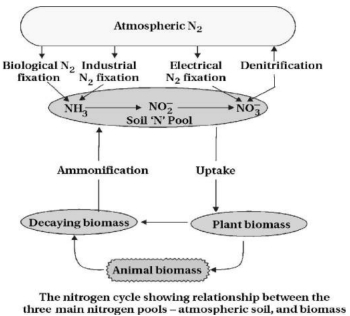
Describe the Nitrogen Cycle.
Solution
(N/A) $\Rightarrow$ Apart from carbon,hydrogen,and oxygen,nitrogen is the most prevalent element in living organisms.
$\Rightarrow$ Nitrogen is a constituent of amino acids,proteins,hormones,chlorophylls,and many vitamins.
$\Rightarrow$ Plants compete with microbes for the limited nitrogen available in the soil.
$\Rightarrow$ Thus,nitrogen is a limiting nutrient for both natural and agricultural ecosystems.
$\Rightarrow$ Nitrogen exists as two nitrogen atoms joined by a very strong triple covalent bond $(N \equiv N)$.
$\Rightarrow$ The process of conversion of nitrogen $(N_2)$ to ammonia is termed as nitrogen fixation.
$\Rightarrow$ In nature,lightning and ultraviolet radiation provide enough energy to convert nitrogen to nitrogen oxides $(NO, NO_2, N_2O)$. Industrial combustions,forest fires,automobile exhausts,and power-generating stations are also sources of atmospheric nitrogen oxides.
$\Rightarrow$ Decomposition of organic nitrogen of dead plants and animals into ammonia is called ammonification.
$\Rightarrow$ Some of this ammonia volatilises and re-enters the atmosphere.
$\Rightarrow$ Most of it is converted into nitrate by soil bacteria in the following steps:
$\Rightarrow$ Ammonia is first oxidised to nitrite by the bacteria Nitrosomonas and/or Nitrococcus.
$\Rightarrow$ The nitrite is further oxidised to nitrate with the help of the bacterium Nitrobacter.
$\Rightarrow$ These steps are called nitrification.
$\Rightarrow$ Ammonia $\xrightarrow{\text{Oxidation}}$ Nitrite
$\Rightarrow$ Nitrite $\xrightarrow[\text{Oxidation}]{\text{Nitrobacter}}$ Nitrate
$\Rightarrow$ These nitrifying bacteria are chemoautotrophs.
$\Rightarrow$ The nitrate thus formed is absorbed by plants and transported to the leaves.
$\Rightarrow$ In leaves,it is reduced to form ammonia.
$\Rightarrow$ Nitrate $\rightarrow$ leaves $\xrightarrow{\text{Reduction}}$ Ammonia $\rightarrow$ Amino acid
$\Rightarrow$ It finally forms the amine group of amino acids. Nitrate present in the soil is also reduced to nitrogen by the process of denitrification.
$\Rightarrow$ Nitrate $\xrightarrow{\text{Denitrification}}$ Nitrogen
$\Rightarrow$ This process is carried out by bacteria like Pseudomonas and Thiobacillus.
$\Rightarrow$ Nitrogen is a constituent of amino acids,proteins,hormones,chlorophylls,and many vitamins.
$\Rightarrow$ Plants compete with microbes for the limited nitrogen available in the soil.
$\Rightarrow$ Thus,nitrogen is a limiting nutrient for both natural and agricultural ecosystems.
$\Rightarrow$ Nitrogen exists as two nitrogen atoms joined by a very strong triple covalent bond $(N \equiv N)$.
$\Rightarrow$ The process of conversion of nitrogen $(N_2)$ to ammonia is termed as nitrogen fixation.
$\Rightarrow$ In nature,lightning and ultraviolet radiation provide enough energy to convert nitrogen to nitrogen oxides $(NO, NO_2, N_2O)$. Industrial combustions,forest fires,automobile exhausts,and power-generating stations are also sources of atmospheric nitrogen oxides.
$\Rightarrow$ Decomposition of organic nitrogen of dead plants and animals into ammonia is called ammonification.
$\Rightarrow$ Some of this ammonia volatilises and re-enters the atmosphere.
$\Rightarrow$ Most of it is converted into nitrate by soil bacteria in the following steps:
$\Rightarrow$ Ammonia is first oxidised to nitrite by the bacteria Nitrosomonas and/or Nitrococcus.
$\Rightarrow$ The nitrite is further oxidised to nitrate with the help of the bacterium Nitrobacter.
$\Rightarrow$ These steps are called nitrification.
$\Rightarrow$ Ammonia $\xrightarrow{\text{Oxidation}}$ Nitrite
$\Rightarrow$ Nitrite $\xrightarrow[\text{Oxidation}]{\text{Nitrobacter}}$ Nitrate
$\Rightarrow$ These nitrifying bacteria are chemoautotrophs.
$\Rightarrow$ The nitrate thus formed is absorbed by plants and transported to the leaves.
$\Rightarrow$ In leaves,it is reduced to form ammonia.
$\Rightarrow$ Nitrate $\rightarrow$ leaves $\xrightarrow{\text{Reduction}}$ Ammonia $\rightarrow$ Amino acid
$\Rightarrow$ It finally forms the amine group of amino acids. Nitrate present in the soil is also reduced to nitrogen by the process of denitrification.
$\Rightarrow$ Nitrate $\xrightarrow{\text{Denitrification}}$ Nitrogen
$\Rightarrow$ This process is carried out by bacteria like Pseudomonas and Thiobacillus.
0 likes
View Solution56
Medium
List and describe the main phases of the nitrogen cycle.
Solution
(N/A) The nitrogen cycle is a biogeochemical process by which nitrogen is converted into various chemical forms as it circulates among the atmosphere,terrestrial,and marine ecosystems. The main phases are:
$1$. Nitrogen Fixation: The process of converting atmospheric nitrogen $(N_2)$ into ammonia $(NH_3)$ or other nitrogenous compounds. This can occur through biological fixation (by microbes like $Rhizobium$,$Azotobacter$),industrial fixation,or atmospheric fixation (lightning).
$2$. Nitrification: The process where ammonia is oxidized to nitrite $(NO_2^-)$ by bacteria like $Nitrosomonas$ and $Nitrococcus$,and then further oxidized to nitrate $(NO_3^-)$ by $Nitrobacter$.
$3$. Assimilation: Plants absorb nitrate or ammonia from the soil and incorporate them into organic molecules like amino acids and proteins.
$4$. Ammonification: The decomposition of organic nitrogenous compounds (from dead plants and animals) back into ammonia by decomposers like bacteria and fungi.
$5$. Denitrification: The process where nitrate in the soil is reduced back to gaseous nitrogen $(N_2)$ by denitrifying bacteria such as $Pseudomonas$ and $Thiobacillus$,returning it to the atmosphere.
$1$. Nitrogen Fixation: The process of converting atmospheric nitrogen $(N_2)$ into ammonia $(NH_3)$ or other nitrogenous compounds. This can occur through biological fixation (by microbes like $Rhizobium$,$Azotobacter$),industrial fixation,or atmospheric fixation (lightning).
$2$. Nitrification: The process where ammonia is oxidized to nitrite $(NO_2^-)$ by bacteria like $Nitrosomonas$ and $Nitrococcus$,and then further oxidized to nitrate $(NO_3^-)$ by $Nitrobacter$.
$3$. Assimilation: Plants absorb nitrate or ammonia from the soil and incorporate them into organic molecules like amino acids and proteins.
$4$. Ammonification: The decomposition of organic nitrogenous compounds (from dead plants and animals) back into ammonia by decomposers like bacteria and fungi.
$5$. Denitrification: The process where nitrate in the soil is reduced back to gaseous nitrogen $(N_2)$ by denitrifying bacteria such as $Pseudomonas$ and $Thiobacillus$,returning it to the atmosphere.
0 likes
View Solution57
Easy
Define the following terms:
$(1)$ Ammonification
$(2)$ Nitrogen Fixation
$(1)$ Ammonification
$(2)$ Nitrogen Fixation
Solution
(N/A) $(1)$ Ammonification: The process of decomposition of organic nitrogenous compounds from dead plants and animals into ammonia is known as ammonification.
$(2)$ Nitrogen Fixation: The process of conversion of atmospheric nitrogen $(N_2)$ into ammonia $(NH_3)$ is termed as nitrogen fixation.
$(2)$ Nitrogen Fixation: The process of conversion of atmospheric nitrogen $(N_2)$ into ammonia $(NH_3)$ is termed as nitrogen fixation.
0 likes
View Solution58
Medium
How are organisms like Pseudomonas and Thiobacillus of great significance in the nitrogen cycle?
Solution
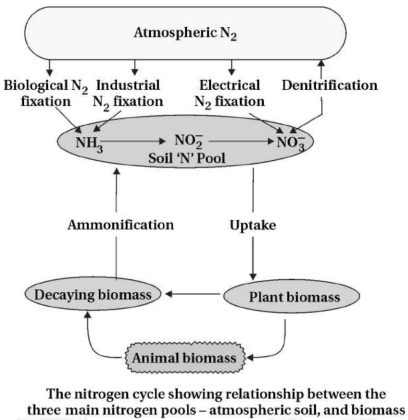
Organisms like Pseudomonas and Thiobacillus are significant because they perform the process of denitrification.
In this process,these bacteria reduce nitrates $(NO_{3}^{-})$ and nitrites $(NO_{2}^{-})$ present in the soil back into gaseous nitrogen $(N_{2})$.
This nitrogen is then released back into the atmosphere,thereby completing the nitrogen cycle.
In this process,these bacteria reduce nitrates $(NO_{3}^{-})$ and nitrites $(NO_{2}^{-})$ present in the soil back into gaseous nitrogen $(N_{2})$.
This nitrogen is then released back into the atmosphere,thereby completing the nitrogen cycle.
0 likes
View Solution59
MediumMCQ
Match the organisms given in Column $I$ to their functions given in Column $II$ and choose the correct option.
Codes:
$A \quad B \quad C \quad D$
| Column $I$ | Column $II$ |
| $A$. Thiobacillus | $1$. Free-living nitrogen-fixing cyanobacteria |
| $B$. Nitrosomonas | $2$. Denitrification |
| $C$. Nostoc | $3$. Free-living aerobic nitrogen-fixing bacteria |
| $D$. Azotobacter | $4$. $NH_{3}$ to Nitrite |
Codes:
$A \quad B \quad C \quad D$
A
$2 \quad 4 \quad 1 \quad 3$
B
$4 \quad 1 \quad 3 \quad 2$
C
$2 \quad 4 \quad 1 \quad 3$ (Correction: $A-2, B-4, C-1, D-3$)
D
$3 \quad 2 \quad 4 \quad 1$
Solution
$(C)$. Thiobacillus performs denitrification, which is the process of converting nitrates back into nitrogen gas $(2)$.
$B$. Nitrosomonas is a nitrifying bacterium that oxidizes $NH_{3}$ to nitrite $(4)$.
$C$. Nostoc is a free-living nitrogen-fixing cyanobacterium $(1)$.
$D$. Azotobacter is a free-living aerobic nitrogen-fixing bacterium $(3)$.
Therefore, the correct matching is $A-2, B-4, C-1, D-3$.
$B$. Nitrosomonas is a nitrifying bacterium that oxidizes $NH_{3}$ to nitrite $(4)$.
$C$. Nostoc is a free-living nitrogen-fixing cyanobacterium $(1)$.
$D$. Azotobacter is a free-living aerobic nitrogen-fixing bacterium $(3)$.
Therefore, the correct matching is $A-2, B-4, C-1, D-3$.
0 likes
View Solution60
EasyMCQ
The conversion of nitrate to nitrogen is called
A
Nitrification
B
Denitrification
C
Ammonification
D
Nitrogen fixation
Solution
(B) Denitrification is the reduction of nitrate $(NO_3^-)$ to gaseous nitrogen $(N_2)$ or other gaseous nitrogen compounds.
Under anaerobic conditions, certain microorganisms use nitrate and other oxidized ions as a source of oxygen for respiration.
Examples of such bacteria include $Pseudomonas \, denitrificans$, $Thiobacillus \, denitrificans$, and $Micrococcus \, denitrificans$.
Under anaerobic conditions, certain microorganisms use nitrate and other oxidized ions as a source of oxygen for respiration.
Examples of such bacteria include $Pseudomonas \, denitrificans$, $Thiobacillus \, denitrificans$, and $Micrococcus \, denitrificans$.
0 likes
View Solution61
EasyMCQ
Nitrifying bacteria
A
Convert free nitrogen to nitrogen compounds
B
Convert proteins into ammonia
C
Reduce nitrates to free nitrogen
D
Oxidize ammonia to nitrates
Solution
(D) Nitrifying bacteria are chemosynthetic autotrophs that obtain energy by oxidizing inorganic nitrogen compounds.
They perform the process in two steps:
$1$. Ammonia $(NH_3)$ is oxidized to nitrite $(NO_2^-)$ by bacteria such as $Nitrosomonas$ and $Nitrosococcus$.
$2$. Nitrite $(NO_2^-)$ is further oxidized to nitrate $(NO_3^-)$ by bacteria such as $Nitrobacter$ and $Nitrocystis$.
Thus,the overall process is the oxidation of ammonia to nitrates.
They perform the process in two steps:
$1$. Ammonia $(NH_3)$ is oxidized to nitrite $(NO_2^-)$ by bacteria such as $Nitrosomonas$ and $Nitrosococcus$.
$2$. Nitrite $(NO_2^-)$ is further oxidized to nitrate $(NO_3^-)$ by bacteria such as $Nitrobacter$ and $Nitrocystis$.
Thus,the overall process is the oxidation of ammonia to nitrates.
0 likes
View Solution62
MediumMCQ
The source of energy for non-biological nitrogen fixation is
A
By ionizing events such as lightning and effect of cosmic rays
B
Ferredoxin enzyme and nitrogenase
C
By reduction of proteins to ammonia
D
By oxidation of ammonia to protein
Solution
(A) Non-biological nitrogen fixation occurs through physical processes in the atmosphere.
Lightning and cosmic radiation provide the high energy required to break the strong triple covalent bonds of atmospheric nitrogen $(N_2)$.
This energy allows nitrogen to react with oxygen to form nitrogen oxides,which eventually dissolve in rainwater to form nitrates,contributing to the nitrogen cycle.
Lightning and cosmic radiation provide the high energy required to break the strong triple covalent bonds of atmospheric nitrogen $(N_2)$.
This energy allows nitrogen to react with oxygen to form nitrogen oxides,which eventually dissolve in rainwater to form nitrates,contributing to the nitrogen cycle.
0 likes
View Solution63
EasyMCQ
Nitrite is converted to nitrate by
A
Nitrosomonas
B
Nitrobacter
C
Pseudomonas
D
Clostridium
Solution
(B) Nitrification is the biological process of converting ammonia into nitrates.
In the first step,ammonium ions $(NH_4^+)$ are oxidized to nitrites $(NO_2^-)$ by bacteria such as $Nitrosomonas$ and $Nitrosococcus$.
In the second step,nitrites $(NO_2^-)$ are oxidized to nitrates $(NO_3^-)$ by bacteria such as $Nitrobacter$ and $Nitrocystis$.
In the first step,ammonium ions $(NH_4^+)$ are oxidized to nitrites $(NO_2^-)$ by bacteria such as $Nitrosomonas$ and $Nitrosococcus$.
In the second step,nitrites $(NO_2^-)$ are oxidized to nitrates $(NO_3^-)$ by bacteria such as $Nitrobacter$ and $Nitrocystis$.
0 likes
View Solution64
EasyMCQ
The ultimate source of nitrogen is
A
Atmospheric nitrogen
B
Nitrogen present in soil
C
Nitrogen that comes from water
D
Nitrogen fixed by the process of photosynthesis
Solution
(A) The atmosphere contains approximately $78\%$ nitrogen gas $(N_2)$. Although plants cannot directly utilize this atmospheric nitrogen, it serves as the primary reservoir from which nitrogen is fixed by biological and physical processes into forms that plants can absorb. Therefore, the atmosphere is considered the ultimate source of nitrogen.
0 likes
View Solution65
EasyMCQ
Which of the following is a limiting nutrient for both natural and agricultural ecosystems?
A
Nitrogen oxides
B
Nitrogen
C
Ammonia
D
Hydrogen
Solution
(B) Nitrogen is a critical element required by plants in large amounts. It is often the most limiting nutrient in both natural and agricultural ecosystems because,although it is abundant in the atmosphere as $N_2$ gas,plants cannot directly utilize it. It must be converted into usable forms like $NH_4^+$ or $NO_3^-$ through biological or industrial nitrogen fixation.
0 likes
View Solution66
EasyMCQ
Which of the following is a bacterium involved in denitrification?
A
Nitrococcus
B
Nitrosomonas
C
Pseudomonas
D
Nitrobacter
Solution
(C) Denitrification is the process of reduction of nitrates present in the soil back into gaseous nitrogen $(N_2)$.
This process is carried out by denitrifying bacteria such as $Pseudomonas$ and $Thiobacillus$.
$Nitrococcus$,$Nitrosomonas$,and $Nitrobacter$ are involved in the process of nitrification,where ammonia is converted into nitrites and then into nitrates.
This process is carried out by denitrifying bacteria such as $Pseudomonas$ and $Thiobacillus$.
$Nitrococcus$,$Nitrosomonas$,and $Nitrobacter$ are involved in the process of nitrification,where ammonia is converted into nitrites and then into nitrates.
0 likes
View Solution67
EasyMCQ
Nitrogen is present in the soil in the form of
$I.$ Nitrates $II.$ Ammonium salts
$III.$ Nitrite $IV.$ None of these
$I.$ Nitrates $II.$ Ammonium salts
$III.$ Nitrite $IV.$ None of these
A
Only $I$
B
Only $III$
C
$I$ and $II$
D
Only $IV$
Solution
(C) The ultimate source of nitrogen is the atmosphere.
It is fixed into usable forms by several biological and non-biological processes.
Plants primarily absorb nitrogen from the soil in the form of nitrates $(NO_3^-)$ and ammonium salts $(NH_4^+)$.
Therefore,nitrogen is present in the soil in the form of nitrates and ammonium salts.
It is fixed into usable forms by several biological and non-biological processes.
Plants primarily absorb nitrogen from the soil in the form of nitrates $(NO_3^-)$ and ammonium salts $(NH_4^+)$.
Therefore,nitrogen is present in the soil in the form of nitrates and ammonium salts.
0 likes
View Solution68
MediumMCQ
Select the correct matches.
$I$ Nitrosomonas - Nitrite to nitrate
$II$ Thiobacillus - Denitrification
$III$ Nostoc - Free-living nitrogen-fixer
$IV$ Azotobacter - Anaerobic nitrogen-fixer
$I$ Nitrosomonas - Nitrite to nitrate
$II$ Thiobacillus - Denitrification
$III$ Nostoc - Free-living nitrogen-fixer
$IV$ Azotobacter - Anaerobic nitrogen-fixer
A
$I$ and $II$
B
$III$ and $IV$
C
$II$ and $III$
D
$II$ and $IV$
Solution
(C) $1$. $I$ Nitrosomonas: This bacterium oxidizes $NH_3$ to nitrite,not nitrite to nitrate. Nitrite to nitrate conversion is performed by Nitrobacter.
$2$. $II$ Thiobacillus: This bacterium is involved in the process of denitrification,where nitrate is reduced to nitrogen gas. This is a correct match.
$3$. $III$ Nostoc: This is a cyanobacterium that acts as a free-living nitrogen-fixer. This is a correct match.
$4$. $IV$ Azotobacter: This is a free-living nitrogen-fixing aerobic microbe,not anaerobic. Therefore,this is an incorrect match.
Thus,$II$ and $III$ are the correct matches.
$2$. $II$ Thiobacillus: This bacterium is involved in the process of denitrification,where nitrate is reduced to nitrogen gas. This is a correct match.
$3$. $III$ Nostoc: This is a cyanobacterium that acts as a free-living nitrogen-fixer. This is a correct match.
$4$. $IV$ Azotobacter: This is a free-living nitrogen-fixing aerobic microbe,not anaerobic. Therefore,this is an incorrect match.
Thus,$II$ and $III$ are the correct matches.
0 likes
View Solution69
MediumMCQ
Which of the following diagrams correctly depicts the $N_{2}$-cycle?
A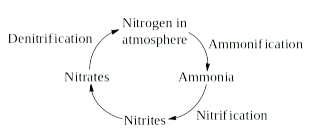
B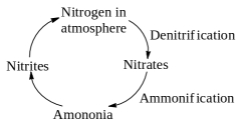
C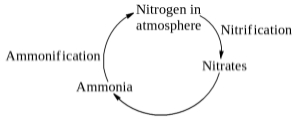
D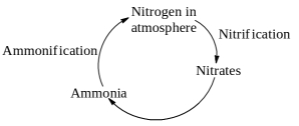
Solution
(A) The nitrogen cycle is a biogeochemical process by which nitrogen is converted into various chemical forms as it circulates among the atmosphere,terrestrial,and marine ecosystems.
$1$. Nitrogen fixation converts atmospheric nitrogen $(N_{2})$ into ammonia $(NH_{3})$.
$2$. Nitrification is the process where ammonia is converted into nitrites $(NO_{2}^{-})$ and then into nitrates $(NO_{3}^{-})$ by nitrifying bacteria.
$3$. Assimilation involves plants taking up these nitrates to form organic nitrogen compounds.
$4$. Ammonification is the process where organic nitrogen from dead organisms is converted back into ammonia by decomposers.
$5$. Denitrification is the process where nitrates are reduced back into atmospheric nitrogen $(N_{2})$ by denitrifying bacteria.
Looking at the options,option $A$ correctly represents the sequence: Atmospheric Nitrogen $\rightarrow$ Ammonia (via fixation) $\rightarrow$ Nitrites $\rightarrow$ Nitrates $\rightarrow$ Atmospheric Nitrogen (via denitrification).
$1$. Nitrogen fixation converts atmospheric nitrogen $(N_{2})$ into ammonia $(NH_{3})$.
$2$. Nitrification is the process where ammonia is converted into nitrites $(NO_{2}^{-})$ and then into nitrates $(NO_{3}^{-})$ by nitrifying bacteria.
$3$. Assimilation involves plants taking up these nitrates to form organic nitrogen compounds.
$4$. Ammonification is the process where organic nitrogen from dead organisms is converted back into ammonia by decomposers.
$5$. Denitrification is the process where nitrates are reduced back into atmospheric nitrogen $(N_{2})$ by denitrifying bacteria.
Looking at the options,option $A$ correctly represents the sequence: Atmospheric Nitrogen $\rightarrow$ Ammonia (via fixation) $\rightarrow$ Nitrites $\rightarrow$ Nitrates $\rightarrow$ Atmospheric Nitrogen (via denitrification).
0 likes
View Solution70
EasyMCQ
$A$ prokaryote responsible for converting ammonia to nitrites is
A
Nitrosomonas
B
Nitrobacter
C
Nitrocystis
D
Rhizobium
Solution
(A) The process of nitrification involves the oxidation of ammonia to nitrites and then to nitrates.
$Nitrosomonas$ and $Nitrococcus$ are chemoautotrophic bacteria that oxidize ammonia to nitrites $(NO_{2}^{-})$.
$Nitrobacter$ is responsible for the further oxidation of nitrites to nitrates $(NO_{3}^{-})$.
The chemical reaction for the conversion of ammonia to nitrites is:
$2NH_{3} + 3O_{2} \xrightarrow{\text{Nitrosomonas}} 2NO_{2}^{-} + 2H^{+} + 2H_{2}O + \text{Energy}$
$Nitrosomonas$ and $Nitrococcus$ are chemoautotrophic bacteria that oxidize ammonia to nitrites $(NO_{2}^{-})$.
$Nitrobacter$ is responsible for the further oxidation of nitrites to nitrates $(NO_{3}^{-})$.
The chemical reaction for the conversion of ammonia to nitrites is:
$2NH_{3} + 3O_{2} \xrightarrow{\text{Nitrosomonas}} 2NO_{2}^{-} + 2H^{+} + 2H_{2}O + \text{Energy}$
0 likes
View Solution71
EasyMCQ
Conversion of $NH_{3} \rightarrow NO_{2}^{-} \rightarrow NO_{3}^{-}$ is called:
A
Ammonification
B
Nitrification
C
Denitrification
D
Biological $N_{2}$-fixation
Solution
(B) The process of converting ammonia $(NH_{3})$ into nitrite $(NO_{2}^{-})$ and subsequently into nitrate $(NO_{3}^{-})$ is known as nitrification.
This process is carried out by soil bacteria such as $Nitrosomonas$ and $Nitrobacter$.
This process is carried out by soil bacteria such as $Nitrosomonas$ and $Nitrobacter$.
0 likes
View Solution72
MediumMCQ
Reaction carried out by $N_{2}$ metabolising microbes include:
$I.$ $2 NH_{3} + 3 O_{2} \rightarrow 2 NO_{2}^{-} + 2 H^{+} + 2 H_{2} O$
$II.$ $2 NO_{2}^{-} + O_{2} \rightarrow 2 NO_{3}^{-}$
Which of the following statements about these equations is not true?
$I.$ $2 NH_{3} + 3 O_{2} \rightarrow 2 NO_{2}^{-} + 2 H^{+} + 2 H_{2} O$
$II.$ $2 NO_{2}^{-} + O_{2} \rightarrow 2 NO_{3}^{-}$
Which of the following statements about these equations is not true?
A
Step $I$ is carried out by Nitrosomonas or Nitrococcus
B
Step $II$ is carried out by Nitrobacter
C
Both steps $I$ and $II$ can be called nitrification
D
Bacteria carrying out these steps are usually photoautotrophs
Solution
(D) The reactions provided represent the process of nitrification,which is the conversion of ammonia into nitrates.
Step $I$ $(2 NH_{3} + 3 O_{2} \rightarrow 2 NO_{2}^{-} + 2 H^{+} + 2 H_{2} O)$ is performed by bacteria such as $Nitrosomonas$ or $Nitrococcus$.
Step $II$ $(2 NO_{2}^{-} + O_{2} \rightarrow 2 NO_{3}^{-})$ is performed by $Nitrobacter$.
Both steps together are collectively known as nitrification.
The bacteria involved in these processes are chemoautotrophs,not photoautotrophs,as they obtain energy by oxidizing inorganic substances rather than using light energy. Therefore,the statement that they are photoautotrophs is incorrect.
Step $I$ $(2 NH_{3} + 3 O_{2} \rightarrow 2 NO_{2}^{-} + 2 H^{+} + 2 H_{2} O)$ is performed by bacteria such as $Nitrosomonas$ or $Nitrococcus$.
Step $II$ $(2 NO_{2}^{-} + O_{2} \rightarrow 2 NO_{3}^{-})$ is performed by $Nitrobacter$.
Both steps together are collectively known as nitrification.
The bacteria involved in these processes are chemoautotrophs,not photoautotrophs,as they obtain energy by oxidizing inorganic substances rather than using light energy. Therefore,the statement that they are photoautotrophs is incorrect.
0 likes
View Solution73
EasyMCQ
The process of conversion of $2 NO_{3}^{-} \rightarrow 2 NO_{2}^{-} \rightarrow 2 NO \rightarrow N_{2}O \rightarrow N_{2}$ is called and is carried out by:
A
Nitrification,Nitrosomonas
B
Denitrification,Pseudomonas
C
Nitrate assimilation,Nitrogenase
D
Ammonification,Bacillus
Solution
(B) The process of converting nitrate $(NO_{3}^{-})$ into gaseous nitrogen $(N_{2})$ is known as denitrification.
This process is carried out by denitrifying bacteria such as $Pseudomonas$ and $Thiobacillus$.
Therefore,the correct option is $B$.
This process is carried out by denitrifying bacteria such as $Pseudomonas$ and $Thiobacillus$.
Therefore,the correct option is $B$.
0 likes
View Solution74
MediumMCQ
$A$: Ammonia is oxidized first to nitrite and then to nitrate by the action of $Nitrosomonas$ and $Nitrobacter$ respectively.
$R$: Nitrite thus formed is absorbed by leaves.
$R$: Nitrite thus formed is absorbed by leaves.
A
Assertion and Reason both are correct and Reason is the correct explanation of Assertion.
B
Assertion and Reason both are correct but Reason is not the correct explanation of Assertion.
C
Assertion is correct,but Reason is incorrect.
D
Both Assertion and Reason are incorrect.
Solution
(D) The Assertion is incorrect because the process of nitrification involves the oxidation of ammonia $(NH_3)$ to nitrite $(NO_2^-)$ by $Nitrosomonas$ and $Nitrococcus$,and then nitrite is oxidized to nitrate $(NO_3^-)$ by $Nitrobacter$. The statement in the Assertion reverses the order of products.
The Reason is also incorrect because plants primarily absorb nitrogen in the form of nitrate $(NO_3^-)$ or ammonium $(NH_4^+)$ through their roots,not through their leaves. Once absorbed,nitrate is transported to the leaves where it is reduced back to ammonia to be incorporated into amino acids.
The Reason is also incorrect because plants primarily absorb nitrogen in the form of nitrate $(NO_3^-)$ or ammonium $(NH_4^+)$ through their roots,not through their leaves. Once absorbed,nitrate is transported to the leaves where it is reduced back to ammonia to be incorporated into amino acids.
0 likes
View Solution75
MediumMCQ
Match Column $- I$ with Column $- II.$
Choose the correct answer from the options given below.
| Column $- I$ | Column $- II$ |
| $(a)$ Nitrococcus | $(i)$ Denitrification |
| $(b)$ Rhizobium | $(ii)$ Conversion of ammonia to nitrite |
| $(c)$ Thiobacillus | $(iii)$ Conversion of nitrite to nitrate |
| $(d)$ Nitrobacter | $(iv)$ Conversion of atmospheric nitrogen to ammonia |
Choose the correct answer from the options given below.
A
$(a)-(ii), (b)-(iv), (c)-(i), (d)-(iii)$
B
$(a)-(i), (b)-(ii), (c)-(iii), (d)-(iv)$
C
$(a)-(iii), (b)-(i), (c)-(iv), (d)-(ii)$
D
$(a)-(iv), (b)-(iii), (c)-(ii), (d)-(i)$
Solution
$(A)$ The correct matching is as follows:
$(a)$ Nitrococcus: It is a nitrifying bacterium that converts ammonia to nitrite. So, $(a)-(ii)$.
$(b)$ Rhizobium: It is a symbiotic nitrogen-fixing bacterium that converts atmospheric nitrogen to ammonia. So, $(b)-(iv)$.
$(c)$ Thiobacillus: It is a denitrifying bacterium that converts nitrates back into atmospheric nitrogen (denitrification). So, $(c)-(i)$.
$(d)$ Nitrobacter: It is a nitrifying bacterium that converts nitrite to nitrate. So, $(d)-(iii)$.
Therefore, the correct sequence is $(a)-(ii), (b)-(iv), (c)-(i), (d)-(iii)$.
$(a)$ Nitrococcus: It is a nitrifying bacterium that converts ammonia to nitrite. So, $(a)-(ii)$.
$(b)$ Rhizobium: It is a symbiotic nitrogen-fixing bacterium that converts atmospheric nitrogen to ammonia. So, $(b)-(iv)$.
$(c)$ Thiobacillus: It is a denitrifying bacterium that converts nitrates back into atmospheric nitrogen (denitrification). So, $(c)-(i)$.
$(d)$ Nitrobacter: It is a nitrifying bacterium that converts nitrite to nitrate. So, $(d)-(iii)$.
Therefore, the correct sequence is $(a)-(ii), (b)-(iv), (c)-(i), (d)-(iii)$.
0 likes
View Solution76
Medium
Write the nutrition method of nitrifying bacteria.
Solution
(N/A) $\Rightarrow$ Nitrifying bacteria are chemoautotrophs.
$\Rightarrow$ They obtain energy by oxidizing inorganic substances like ammonia $(NH_3)$ or nitrite $(NO_2^-)$ into nitrate $(NO_3^-)$.
$\Rightarrow$ This energy is used to fix carbon dioxide $(CO_2)$ into organic compounds.
$\Rightarrow$ The nitrate formed is absorbed by plants and transported to the leaves.
$\Rightarrow$ In the leaves,it is reduced to form ammonia,which is then incorporated into amino acids.
$\Rightarrow$ The pathway is: $\text{Nitrate} \rightarrow \text{Leaves} \xrightarrow{\text{Reduction}} \text{Ammonia} \rightarrow \text{Amino acid}$.
$\Rightarrow$ They obtain energy by oxidizing inorganic substances like ammonia $(NH_3)$ or nitrite $(NO_2^-)$ into nitrate $(NO_3^-)$.
$\Rightarrow$ This energy is used to fix carbon dioxide $(CO_2)$ into organic compounds.
$\Rightarrow$ The nitrate formed is absorbed by plants and transported to the leaves.
$\Rightarrow$ In the leaves,it is reduced to form ammonia,which is then incorporated into amino acids.
$\Rightarrow$ The pathway is: $\text{Nitrate} \rightarrow \text{Leaves} \xrightarrow{\text{Reduction}} \text{Ammonia} \rightarrow \text{Amino acid}$.
0 likes
View Solution77
EasyMCQ
The process of conversion of nitrogen gas into ammonia is called $P$,and the process of decomposition of organic nitrogen in plants and animals into ammonia is called $Q$.
A
Nitrogen fixation,Ammonification
B
Ammonification,Nitrogen fixation
C
Ammonification,Ammonification
D
Nitrogen fixation,Nitrogen fixation
Solution
(A) The conversion of atmospheric nitrogen $(N_2)$ into ammonia $(NH_3)$ is known as Nitrogen fixation $(P)$.
Decomposition of organic nitrogen (from dead plants and animals) into ammonia is known as Ammonification $(Q)$.
Therefore,$P$ is Nitrogen fixation and $Q$ is Ammonification.
Decomposition of organic nitrogen (from dead plants and animals) into ammonia is known as Ammonification $(Q)$.
Therefore,$P$ is Nitrogen fixation and $Q$ is Ammonification.
0 likes
View Solution78
MediumMCQ
The reaction $2 NH_3 + 3 O_2 \rightarrow 2 NO_2^- + 2 H^+ + 2 H_2O$ is carried out by which of the following microorganisms?
A
Nitrosomonas
B
Nitrococcus
C
Nitrobacter
D
Both $A$ and $B$
Solution
(D) The given reaction represents the oxidation of ammonia $(NH_3)$ to nitrite $(NO_2^-)$. This process is known as nitrification. The bacteria responsible for this specific step are Nitrosomonas and Nitrococcus. Nitrobacter is responsible for the subsequent oxidation of nitrite to nitrate $(NO_3^-)$. Therefore,both Nitrosomonas and Nitrococcus perform this reaction.
0 likes
View Solution79
EasyMCQ
The reaction $2 NO_2^{-} + O_2 \rightarrow 2 NO_3^{-}$ is carried out by which of the following microorganisms?
A
Nitrosomonas
B
Nitrococcus
C
Nitrobacter
D
Both $A$ and $B$
Solution
(C) The process of nitrification involves the oxidation of ammonia to nitrite and then nitrite to nitrate.
$1$. Ammonia is oxidized to nitrite $(NO_2^{-})$ by bacteria such as $Nitrosomonas$ and $Nitrococcus$.
$2$. Nitrite is further oxidized to nitrate $(NO_3^{-})$ by the bacterium $Nitrobacter$.
Therefore,the reaction $2 NO_2^{-} + O_2 \rightarrow 2 NO_3^{-}$ is specifically carried out by $Nitrobacter$.
$1$. Ammonia is oxidized to nitrite $(NO_2^{-})$ by bacteria such as $Nitrosomonas$ and $Nitrococcus$.
$2$. Nitrite is further oxidized to nitrate $(NO_3^{-})$ by the bacterium $Nitrobacter$.
Therefore,the reaction $2 NO_2^{-} + O_2 \rightarrow 2 NO_3^{-}$ is specifically carried out by $Nitrobacter$.
0 likes
View Solution80
MediumMCQ
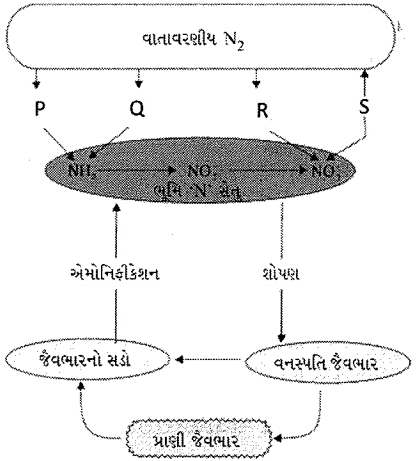
In the given nitrogen cycle,which process represents denitrification?
A
$P$
B
$Q$
C
$R$
D
$S$
Solution
(D) In the nitrogen cycle,denitrification is the process by which nitrates $(NO_3^-)$ are reduced back into atmospheric nitrogen $(N_2)$.
Looking at the provided diagram,the arrow labeled $S$ represents the conversion of soil nitrates $(NO_3^-)$ back into atmospheric nitrogen $(N_2)$.
Therefore,$S$ represents the process of denitrification.
Looking at the provided diagram,the arrow labeled $S$ represents the conversion of soil nitrates $(NO_3^-)$ back into atmospheric nitrogen $(N_2)$.
Therefore,$S$ represents the process of denitrification.
0 likes
View Solution81
EasyMCQ
Which of the following bacteria are responsible for the process of denitrification?
A
Pseudomonas
B
Thiobacillus
C
Nitrobacter
D
Both $A$ and $B$
Solution
(D) Denitrification is the process of reducing nitrate $(NO_3^-)$ to gaseous nitrogen $(N_2)$.
This process is carried out by denitrifying bacteria such as $Pseudomonas$ and $Thiobacillus$.
$Nitrobacter$ is involved in the process of nitrification,where it converts nitrite $(NO_2^-)$ to nitrate $(NO_3^-)$.
Therefore,both $Pseudomonas$ and $Thiobacillus$ are responsible for denitrification.
This process is carried out by denitrifying bacteria such as $Pseudomonas$ and $Thiobacillus$.
$Nitrobacter$ is involved in the process of nitrification,where it converts nitrite $(NO_2^-)$ to nitrate $(NO_3^-)$.
Therefore,both $Pseudomonas$ and $Thiobacillus$ are responsible for denitrification.
0 likes
View Solution82
EasyMCQ
Plants usually absorb Nitrogen in the form of nitrates because Nitrogen is . . . . . . .
A
very reactive
B
non-reactive
C
not very essential
D
having a strong triple covalent bond
Solution
(D) Atmospheric nitrogen $(N_2)$ consists of two nitrogen atoms held together by a strong triple covalent bond $(N \equiv N)$.
This bond requires a significant amount of energy to break, making the molecule chemically inert or non-reactive under normal biological conditions.
Therefore, plants cannot directly utilize atmospheric nitrogen and must absorb it in the form of nitrates $(NO_3^-)$ or ammonium ions $(NH_4^+)$ from the soil, which are more reactive and biologically available.
This bond requires a significant amount of energy to break, making the molecule chemically inert or non-reactive under normal biological conditions.
Therefore, plants cannot directly utilize atmospheric nitrogen and must absorb it in the form of nitrates $(NO_3^-)$ or ammonium ions $(NH_4^+)$ from the soil, which are more reactive and biologically available.
0 likes
View Solution83
EasyMCQ
Nitrates of soil are also leached deep into the Earth by . . . . . . .
A
amination
B
transamination
C
denitrification
D
sedimentation
Solution
(D) By $sedimentation$, nitrates of the soil are washed away to the sea or leached deep into the earth along with percolating water.
0 likes
View SolutionMineral Nutrition — Nitrogen Cycle · Frequently Asked Questions
1Are these Mineral Nutrition questions useful for JEE and NEET?
Yes. All questions in this section are mapped to JEE Main and NEET exam patterns. Previous year questions from JEE Main, NEET, GUJCET and state-level exams are included with full solutions.
2Can I switch to Hindi or Gujarati for these questions?
Yes. Use the language tabs in the hero section or the sidebar to view the same questions and solutions in English, Hindi or Gujarati.
3How do I generate a question paper from this subtopic?
Use the Vedclass Exam Paper Generator — select the chapter and subtopic, set difficulty, and generate Sets A, B, C, D automatically. First 3 chapters of every subject are free.
Vedclass Products
For Students
Vedclass Test Series
Mock tests in real JEE/NEET style with performance analysis. 5-day free trial.
Start Free TrialFor Teachers
Exam Paper Generator
Generate Set A/B/C/D papers from this chapter in 2 minutes. 3 chapters free.
Try FreeFor Institutes
Online Exam Module
Live online exams with unlimited students, 360° analytics & white-label branding.
See DemoFor Teachers & Institutes
Generate a Mineral Nutrition Exam Paper in 2 Minutes
Select subtopic & difficulty — Sets A, B, C, D auto-generated with No Repeat logic.
First 3 chapters of every subject are free — no payment required.