
A English
METABOLISM OF NITROGEN Questions in English
Class 11 Biology · Mineral Nutrition · METABOLISM OF NITROGEN
28+
Questions
English
Language
100%
With Solutions
Showing 28 of 28 questions in English
1
EasyMCQ
Which one of the following enzymes contains $Mo$ as a prosthetic group?
A
Phosphatase
B
Dehydrogenase
C
Isomerase
D
Nitrate reductase
Solution
(D) $Mo$ (Molybdenum) is an essential micronutrient for plants. It acts as a vital component of the enzyme $Nitrate$ $reductase$. This enzyme is responsible for the reduction of nitrate to nitrite during the process of nitrogen assimilation. In this enzyme, $Mo$ functions as a prosthetic group, which is necessary for its catalytic activity.
0 likes
View Solution2
EasyMCQ
Nitrate reductase enzyme is responsible for the formation of
A
$N_2$
B
$NO_2^-$
C
$NO_3^-$
D
Ammonia
Solution
(B) The enzyme nitrate reductase catalyzes the reduction of nitrate $(NO_3^-)$ to nitrite $(NO_2^-)$.
This is the first step in the process of nitrate assimilation in plants,where nitrogen is converted into a form that can be incorporated into organic compounds.
This is the first step in the process of nitrate assimilation in plants,where nitrogen is converted into a form that can be incorporated into organic compounds.
0 likes
View Solution3
EasyMCQ
The first enzyme that reduces nitrates into nitrites in plants is
A
Nitrate reductase
B
Nitrite reductase
C
Glutamine synthetase
D
Glutamate dehydrogenase
Solution
(A) In plants, the process of nitrogen assimilation begins with the reduction of nitrate $(NO_3^-)$ to nitrite $(NO_2^-)$.
This reaction is catalyzed by the enzyme $Nitrate \text{ } reductase$.
Subsequently, the nitrite is reduced to ammonia $(NH_3)$ by the enzyme $Nitrite \text{ } reductase$.
Therefore, the first enzyme involved in this pathway is $Nitrate \text{ } reductase$.
This reaction is catalyzed by the enzyme $Nitrate \text{ } reductase$.
Subsequently, the nitrite is reduced to ammonia $(NH_3)$ by the enzyme $Nitrite \text{ } reductase$.
Therefore, the first enzyme involved in this pathway is $Nitrate \text{ } reductase$.
0 likes
View Solution4
MediumMCQ
Negative nitrogen balance means
A
No nitrogen is utilized
B
Nitrogen intake exceeds excretion
C
Nitrogen intake is less than nitrogen excretion
D
Nitrogen intake equals excretion
Solution
(C) Nitrogen balance is a measure of nitrogen input versus nitrogen output.
Negative nitrogen balance occurs when the amount of nitrogen excreted from the body (primarily through urine in the form of urea) exceeds the amount of nitrogen ingested through dietary proteins.
This state typically indicates that the body is breaking down more tissue protein than it is synthesizing,which can occur during starvation,malnutrition,or severe illness.
Negative nitrogen balance occurs when the amount of nitrogen excreted from the body (primarily through urine in the form of urea) exceeds the amount of nitrogen ingested through dietary proteins.
This state typically indicates that the body is breaking down more tissue protein than it is synthesizing,which can occur during starvation,malnutrition,or severe illness.
0 likes
View Solution5
EasyMCQ
The removal of an amino group from an amino acid to transform it into a keto acid is known as:
A
Transamination
B
Ammonification
C
Deamination
D
None of these
Solution
(C) Deamination is the biochemical process in which an amino group $(-NH_2)$ is removed from an amino acid molecule.
This process results in the formation of a keto acid and ammonia $(NH_3)$.
Transamination involves the transfer of an amino group from one amino acid to a keto acid,whereas deamination specifically refers to the removal of the amino group.
This process results in the formation of a keto acid and ammonia $(NH_3)$.
Transamination involves the transfer of an amino group from one amino acid to a keto acid,whereas deamination specifically refers to the removal of the amino group.
0 likes
View Solution6
MediumMCQ
In transamination,the main donor of the amino group is .....
A
Glutamic acid
B
$α$-ketoglutaric acid
C
$Nif$ gene
D
Ammonia
Solution
(A) Transamination is a chemical reaction that transfers an amino group to a ketoacid to form new amino acids.
In this process,glutamic acid acts as the main donor of the amino group.
The amino group is transferred from glutamic acid to the keto group of a keto acid (such as $α$-ketoglutaric acid) to form the corresponding amino acid.
Therefore,the correct answer is glutamic acid.
In this process,glutamic acid acts as the main donor of the amino group.
The amino group is transferred from glutamic acid to the keto group of a keto acid (such as $α$-ketoglutaric acid) to form the corresponding amino acid.
Therefore,the correct answer is glutamic acid.
0 likes
View Solution7
EasyMCQ
In reductive amination,which of the following reacts with ammonia?
A
Glutamic acid
B
Alpha-ketoglutaric acid
C
Glyceric acid
D
Inorganic acid
Solution
(B) In the process of reductive amination,$\alpha$-ketoglutaric acid reacts with ammonia in the presence of the enzyme glutamate dehydrogenase and $NADPH$ to form glutamic acid.
The reaction is represented as: $\alpha$-ketoglutaric acid + $NH_4^+$ + $NADPH \xrightarrow{\text{glutamate dehydrogenase}}$ Glutamic acid + $H_2O$ + $NADP^+$.
Therefore,the correct option is $B$.
The reaction is represented as: $\alpha$-ketoglutaric acid + $NH_4^+$ + $NADPH \xrightarrow{\text{glutamate dehydrogenase}}$ Glutamic acid + $H_2O$ + $NADP^+$.
Therefore,the correct option is $B$.
0 likes
View Solution8
EasyMCQ
In reductive amination,which of the following occurs?
A
Transaminase enzyme is involved.
B
Glutamic acid acts as the main donor of the amino group.
C
Glutamate dehydrogenase enzyme is involved.
D
The amino group is removed from an amino acid and transferred to the keto group of a keto acid.
Solution
(C) Reductive amination is a key process in nitrogen assimilation in plants.
In this reaction,ammonia $(NH_3)$ reacts with $\alpha$-ketoglutaric acid and $NADPH$ in the presence of the enzyme $Glutamate \ dehydrogenase$ to form glutamic acid.
The reaction is: $\alpha$-ketoglutaric acid + $NH_4^+$ + $NADPH \xrightarrow{Glutamate \ dehydrogenase} \text{Glutamate} + H_2O + NADP^+$.
Therefore,the enzyme $Glutamate \ dehydrogenase$ is involved in this process.
In this reaction,ammonia $(NH_3)$ reacts with $\alpha$-ketoglutaric acid and $NADPH$ in the presence of the enzyme $Glutamate \ dehydrogenase$ to form glutamic acid.
The reaction is: $\alpha$-ketoglutaric acid + $NH_4^+$ + $NADPH \xrightarrow{Glutamate \ dehydrogenase} \text{Glutamate} + H_2O + NADP^+$.
Therefore,the enzyme $Glutamate \ dehydrogenase$ is involved in this process.
0 likes
View Solution9
EasyMCQ
Which mineral element plays a crucial role in nitrogen metabolism?
A
Boron
B
Zinc
C
Molybdenum
D
Chlorine
Solution
(C) Molybdenum $(Mo)$ is an essential micronutrient that plays a critical role in nitrogen metabolism.
It is a key component of the enzyme nitrogenase,which is responsible for biological nitrogen fixation in plants.
Additionally,it is a component of nitrate reductase,an enzyme that catalyzes the reduction of nitrate to nitrite,which is the first step in the assimilation of nitrogen by plants.
It is a key component of the enzyme nitrogenase,which is responsible for biological nitrogen fixation in plants.
Additionally,it is a component of nitrate reductase,an enzyme that catalyzes the reduction of nitrate to nitrite,which is the first step in the assimilation of nitrogen by plants.
0 likes
View Solution10
MediumMCQ
Transaminase is responsible for
A
Reductive amination
B
Amino acids synthesis other than glutamic acid
C
Biological $N_2$ fixation
D
Denitrification
Solution
(B) Transamination is a process involving the transfer of an amino group from one amino acid to the keto group of a keto acid.
This reaction is catalyzed by enzymes known as transaminases.
Through this process,the amino group from glutamic acid is transferred to other keto acids to synthesize various other amino acids required by the plant.
Therefore,transaminase is responsible for the synthesis of amino acids other than glutamic acid.
This reaction is catalyzed by enzymes known as transaminases.
Through this process,the amino group from glutamic acid is transferred to other keto acids to synthesize various other amino acids required by the plant.
Therefore,transaminase is responsible for the synthesis of amino acids other than glutamic acid.
0 likes
View Solution11
MediumMCQ
Which is the appropriate sequence for the amino acid synthesis?
A
$\alpha$-Ketoglutaric acid $\rightarrow$ Aspartic acid $\rightarrow$ Glutamic acid
B
Glutamic acid $\rightarrow$ Aspartic acid $\rightarrow$ Asparagine
C
Glutamic acid $\rightarrow$ Asparagine $\rightarrow$ Glutamine
D
Glutamine $\rightarrow$ Histidine $\rightarrow$ Urea
Solution
(B) In plants,ammonia is converted into amino acids through two main processes: reductive amination and transamination.
$1$. In reductive amination,ammonia reacts with $\alpha$-ketoglutaric acid and $NADPH$ to form glutamic acid.
$2$. In transamination,the amino group $(NH_2)$ is transferred from one amino acid (usually glutamic acid) to a keto acid to form a new amino acid.
$3$. Aspartic acid is formed from oxaloacetic acid via transamination,and asparagine is formed from aspartic acid by the addition of another amino group. Thus,the sequence Glutamic acid $\rightarrow$ Aspartic acid $\rightarrow$ Asparagine represents a logical pathway for amino acid synthesis and interconversion.
$1$. In reductive amination,ammonia reacts with $\alpha$-ketoglutaric acid and $NADPH$ to form glutamic acid.
$2$. In transamination,the amino group $(NH_2)$ is transferred from one amino acid (usually glutamic acid) to a keto acid to form a new amino acid.
$3$. Aspartic acid is formed from oxaloacetic acid via transamination,and asparagine is formed from aspartic acid by the addition of another amino group. Thus,the sequence Glutamic acid $\rightarrow$ Aspartic acid $\rightarrow$ Asparagine represents a logical pathway for amino acid synthesis and interconversion.
0 likes
View Solution12
MediumMCQ
Amino acids are mostly synthesised from
A
Mineral salts
B
fatty acids
C
volatile acids
D
$\alpha -$ ketoglutaric acid
Solution
(D) Amino acids are primarily synthesized from $\alpha -$ ketoglutaric acid through the process of reductive amination and transamination.
In plants,ammonia $(NH_3)$ reacts with $\alpha -$ ketoglutaric acid in the presence of the enzyme glutamate dehydrogenase to form glutamic acid (glutamate).
This glutamic acid then serves as the main amino group donor for the synthesis of other amino acids via transamination,where the amino group is transferred to other keto acids.
In plants,ammonia $(NH_3)$ reacts with $\alpha -$ ketoglutaric acid in the presence of the enzyme glutamate dehydrogenase to form glutamic acid (glutamate).
This glutamic acid then serves as the main amino group donor for the synthesis of other amino acids via transamination,where the amino group is transferred to other keto acids.
0 likes
View Solution13
MediumMCQ
Complete the equation.
$\alpha -$ Ketoglutaric acid $+ NH_4^+ +$ ...$A$.... $\xrightarrow[\text{Dehydrogenase}]{\text{glutamate}} $ ...$B$... $+ H_2O + NADP$
Identify $A$ and $B$.
$\alpha -$ Ketoglutaric acid $+ NH_4^+ +$ ...$A$.... $\xrightarrow[\text{Dehydrogenase}]{\text{glutamate}} $ ...$B$... $+ H_2O + NADP$
Identify $A$ and $B$.
A
$ATP, -$ ammonia
B
$NADP, -$ glutamate
C
$NADPH, -$ glutamate
D
$NADP, - \alpha -$ Ketoglutaric acid
Solution
(C) The reaction provided is the reductive amination process, which is a key mechanism for the assimilation of ammonia in plants.
In this reaction, $\alpha -$ Ketoglutaric acid reacts with ammonia $(NH_4^+)$ and a reducing agent, $NADPH$, in the presence of the enzyme glutamate dehydrogenase.
The products formed are glutamate, water $(H_2O)$, and $NADP^+$.
The balanced equation is:
$\alpha -$ Ketoglutaric acid $+ NH_4^+ + NADPH \xrightarrow[\text{Dehydrogenase}]{\text{glutamate}} \text{Glutamate} + H_2O + NADP^+$.
Comparing this with the given equation:
$A = NADPH$
$B = \text{Glutamate}$
Therefore, the correct option is $C$.
In this reaction, $\alpha -$ Ketoglutaric acid reacts with ammonia $(NH_4^+)$ and a reducing agent, $NADPH$, in the presence of the enzyme glutamate dehydrogenase.
The products formed are glutamate, water $(H_2O)$, and $NADP^+$.
The balanced equation is:
$\alpha -$ Ketoglutaric acid $+ NH_4^+ + NADPH \xrightarrow[\text{Dehydrogenase}]{\text{glutamate}} \text{Glutamate} + H_2O + NADP^+$.
Comparing this with the given equation:
$A = NADPH$
$B = \text{Glutamate}$
Therefore, the correct option is $C$.
0 likes
View Solution14
Medium
Give differences: Reductive Amination and Transamination.
Solution
(N/A)
| Reductive Amination | Transamination |
|---|---|
| $1$. In this process,ammonia reacts with $\alpha$-ketoglutaric acid to form glutamic acid. | $1$. It involves the transfer of an amino group from one amino acid to the keto group of a keto acid. |
| $2$. The main substrate is $\alpha$-ketoglutaric acid. | $2$. The main donor of the amino group is glutamic acid. |
| $3$. The enzyme responsible for this is glutamate dehydrogenase. | $3$. The enzyme responsible for this is transaminase. |
| $4$. Only glutamic acid is formed in this process. | $4$. Other $17$ types of amino acids are produced through this process. |
0 likes
View Solution15
MediumMCQ
An analysis of the xylem exudates shows that much of the nitrogen travels as
A
Inorganic ions
B
Nitrate and nitrites
C
Organic form i.e.,amino acids and amides
D
Molecular nitrogen
Solution
(C) The analysis of xylem exudates reveals that nitrogen is primarily transported in plants in organic forms. These organic forms mainly consist of amino acids and amides,which are synthesized from the nitrogen absorbed by the roots. While some nitrogen is absorbed as inorganic ions (nitrates and nitrites),it is converted into organic compounds before being translocated through the xylem to other parts of the plant.
0 likes
View Solution16
EasyMCQ
Which form of nitrogen enters into the plants?
A
Free form
B
Fixed form
C
Reduced form
D
Oxidised form
Solution
(D) The correct answer is $D$.
Plants primarily absorb nitrogen from the soil in the form of nitrate $(NO_3^-)$,which is an oxidised form of nitrogen.
Although some plants can also absorb ammonium $(NH_4^+)$,nitrate is the most common and preferred source for most terrestrial plants.
Plants primarily absorb nitrogen from the soil in the form of nitrate $(NO_3^-)$,which is an oxidised form of nitrogen.
Although some plants can also absorb ammonium $(NH_4^+)$,nitrate is the most common and preferred source for most terrestrial plants.
0 likes
View Solution17
MediumMCQ
The following reaction represents:
$\alpha$-ketoglutaric acid $+ NH_{4}^{+} + NADPH \xrightarrow{\text{Glutamate dehydrogenase}} \text{Glutamate} + H_{2}O + NADP$
$\alpha$-ketoglutaric acid $+ NH_{4}^{+} + NADPH \xrightarrow{\text{Glutamate dehydrogenase}} \text{Glutamate} + H_{2}O + NADP$
A
Reductive amination
B
Transamination
C
Amination
D
Nitrification
Solution
$(A)$ The organic acid, $\alpha$-ketoglutaric acid, plays a key role in the synthesis of amino acids.
In this process, ammonia $(NH_{4}^{+})$ formed by nitrogen assimilation reacts with $\alpha$-ketoglutaric acid to form an amino acid, i.e., glutamic acid (glutamate).
This reaction is catalyzed by the enzyme glutamate dehydrogenase.
Since the reaction involves the addition of an amino group and the reduction of the substrate using $NADPH$, it is known as reductive amination.
In this process, ammonia $(NH_{4}^{+})$ formed by nitrogen assimilation reacts with $\alpha$-ketoglutaric acid to form an amino acid, i.e., glutamic acid (glutamate).
This reaction is catalyzed by the enzyme glutamate dehydrogenase.
Since the reaction involves the addition of an amino group and the reduction of the substrate using $NADPH$, it is known as reductive amination.
0 likes
View Solution18
MediumMCQ
Which of the following is an example of a nutrient in its reduced form?
A
Hydrogen in $H_{2}O$
B
Carbon in $CO_{2}$
C
Nitrogen in $NH_{3}$
D
Sulphur in $SO_{2}$
Solution
(C) In chemistry,oxidation states indicate the degree of oxidation of an atom in a chemical compound.
Nitrogen in $NH_{3}$ (ammonia) has an oxidation state of $-3$,which is its most reduced form.
In contrast,nitrogen in $NO_{3}^{-}$ (nitrate) has an oxidation state of $+5$,which is its most oxidized form.
Therefore,nitrogen in $NH_{3}$ is the correct example of a nutrient in its reduced form.
Nitrogen in $NH_{3}$ (ammonia) has an oxidation state of $-3$,which is its most reduced form.
In contrast,nitrogen in $NO_{3}^{-}$ (nitrate) has an oxidation state of $+5$,which is its most oxidized form.
Therefore,nitrogen in $NH_{3}$ is the correct example of a nutrient in its reduced form.
0 likes
View Solution19
MediumMCQ
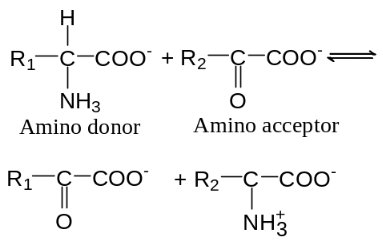
What does the given reaction show?
Choose the correct option.
Choose the correct option.
A
Oxidative deamination
B
Reductive amination
C
Transamination
D
Deamination
Solution
(C) The given reaction represents the transfer of an amino group $(-NH_3^+)$ from an amino donor to the carbonyl position $(C=O)$ of an amino acceptor. This process is known as transamination.
In this reaction,the amino group is transferred from one amino acid to a keto acid,resulting in the formation of a new amino acid and a new keto acid. This is a key mechanism in nitrogen metabolism in plants.
In this reaction,the amino group is transferred from one amino acid to a keto acid,resulting in the formation of a new amino acid and a new keto acid. This is a key mechanism in nitrogen metabolism in plants.
0 likes
View Solution20
EasyMCQ
An element essential for nitrogen metabolism is
A
$K$
B
$Mo$
C
$Mg$
D
$Mn$
Solution
(B) Molybdenum $(Mo)$ is an essential micronutrient for nitrogen metabolism. It is a key component of the enzyme nitrogenase,which catalyzes the biological nitrogen fixation process. Nitrogenase consists of two subunits: the $Fe$-protein and the $Mo-Fe$ protein.
0 likes
View Solution21
EasyMCQ
Which of the following is an amide involved in nitrogen metabolism by plants?
A
Glutamate
B
Cysteine
C
Serine
D
Asparagine
Solution
(D) Asparagine and glutamine are the two most important amides found in plants. These are structural parts of proteins and are formed from two amino acids,namely aspartic acid and glutamic acid,respectively,by the addition of another amino group to each. Since amides contain more nitrogen than amino acids,they are transported to other parts of the plant via xylem vessels.
0 likes
View Solution22
MediumMCQ
The processes of nitrification and nitrate assimilation are:
A
Oxidation and reduction respectively
B
Reduction and oxidation respectively
C
Both are oxidation
D
Both are reduction
Solution
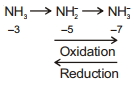
(A) Nitrification is the process of converting ammonia $(NH_3)$ into nitrate $(NO_3^-)$. This involves the loss of electrons,which is an oxidation process.
Nitrate assimilation is the process by which plants take up nitrate $(NO_3^-)$ and convert it back into ammonia $(NH_3)$ to be incorporated into amino acids. This involves the gain of electrons,which is a reduction process.
Therefore,nitrification is an oxidation process and nitrate assimilation is a reduction process.
Nitrate assimilation is the process by which plants take up nitrate $(NO_3^-)$ and convert it back into ammonia $(NH_3)$ to be incorporated into amino acids. This involves the gain of electrons,which is a reduction process.
Therefore,nitrification is an oxidation process and nitrate assimilation is a reduction process.
0 likes
View Solution23
MediumMCQ
The conversion of $NO_{3}^{-} \rightarrow NO_{2}^{-} \rightarrow NH_{3}$ is called and is catalysed by:
A
Nitrate assimilation,nitrate and nitrite reductase
B
Nitrification,nitrate and nitrite reductase
C
Ammonification,glutamate dehydrogenase
D
Denitrification,transaminase
Solution
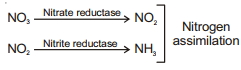
(A) The process of converting nitrate $(NO_{3}^{-})$ into ammonia $(NH_{3})$ in plants is known as nitrate assimilation.
This process occurs in two steps:
$1$. Nitrate $(NO_{3}^{-})$ is reduced to nitrite $(NO_{2}^{-})$ by the enzyme nitrate reductase.
$2$. Nitrite $(NO_{2}^{-})$ is further reduced to ammonia $(NH_{3})$ by the enzyme nitrite reductase.
Therefore,the correct answer is nitrate assimilation,catalysed by nitrate and nitrite reductase.
This process occurs in two steps:
$1$. Nitrate $(NO_{3}^{-})$ is reduced to nitrite $(NO_{2}^{-})$ by the enzyme nitrate reductase.
$2$. Nitrite $(NO_{2}^{-})$ is further reduced to ammonia $(NH_{3})$ by the enzyme nitrite reductase.
Therefore,the correct answer is nitrate assimilation,catalysed by nitrate and nitrite reductase.
0 likes
View Solution24
MediumMCQ
Most common form of nitrogen uptake and usable forms for plants are respectively
A
$NO_{3}^{-}; NO_{2}^{-}$
B
$NO_{3}^{-}; NH_{3}$
C
$NH_{3}; NO_{3}^{-}$
D
$NO_{3}^{-}; NO_{3}^{-}$
Solution
(B) Plants primarily absorb nitrogen from the soil in the form of nitrates $(NO_{3}^{-})$,although some nitrogen is also absorbed as nitrites $(NO_{2}^{-})$ or ammonium ions $(NH_{4}^{+})$.
Once absorbed,nitrogen is assimilated into organic compounds,and the most usable form for the synthesis of amino acids and other nitrogenous compounds within the plant is ammonia $(NH_{3})$.
Therefore,the most common form of uptake is $NO_{3}^{-}$ and the usable form is $NH_{3}$.
Once absorbed,nitrogen is assimilated into organic compounds,and the most usable form for the synthesis of amino acids and other nitrogenous compounds within the plant is ammonia $(NH_{3})$.
Therefore,the most common form of uptake is $NO_{3}^{-}$ and the usable form is $NH_{3}$.
0 likes
View Solution25
EasyMCQ
The amino acid which plays a central role in nitrogen metabolism is/are:
A
Glutamic acid
B
$\alpha-$ketoglutaric acid
C
Aspartic acid
D
Double aminated keto acids
Solution
(A) Glutamic acid plays a central role in nitrogen metabolism. It acts as the primary amino acid from which other amino acids are synthesized through the process of transamination. In this process,the amino group $(NH_2)$ is transferred from glutamic acid to other keto acids to form different amino acids.
0 likes
View Solution26
MediumMCQ
Complete the equation for reductive amination.
A
$\alpha$-ketoglutaric acid + $NH_4^+$ + $NADPH$
B
Pyruvic acid + $NH_4^+$ + $NADPH$
C
Oxaloacetic acid + $NH_4^+$ + $NADPH$
D
Succinic acid + $NH_4^+$ + $NADPH$
Solution
(A) The process of reductive amination involves the reaction of ammonia with an $\alpha$-keto acid to form an amino acid,facilitated by the enzyme glutamate dehydrogenase and the coenzyme $NAD(P)H$.
The primary reaction is:
$\alpha$-ketoglutaric acid + $NH_4^+$ + $NAD(P)H \xrightarrow{\text{Glutamate dehydrogenase}}$ Glutamate + $H_2O$ + $NAD(P)$
In this reaction,$\alpha$-ketoglutaric acid acts as the substrate that accepts the ammonium ion to synthesize glutamate.
The primary reaction is:
$\alpha$-ketoglutaric acid + $NH_4^+$ + $NAD(P)H \xrightarrow{\text{Glutamate dehydrogenase}}$ Glutamate + $H_2O$ + $NAD(P)$
In this reaction,$\alpha$-ketoglutaric acid acts as the substrate that accepts the ammonium ion to synthesize glutamate.
0 likes
View Solution27
EasyMCQ
Identify the chemical reaction and the enzyme involved in the following process:
$\alpha$-Ketoglutaric acid + $NH_4^+ + NADPH \rightarrow$ Glutamate + $H_2O + NADP$
$\alpha$-Ketoglutaric acid + $NH_4^+ + NADPH \rightarrow$ Glutamate + $H_2O + NADP$
A
Reductive amination - Glutamate dehydrogenase
B
Transamination - Transaminase
C
Reductive amination - Transaminase
D
Transamination - Glutamate dehydrogenase
Solution
(A) The given reaction is: $\alpha$-Ketoglutaric acid + $NH_4^+ + NADPH \rightarrow$ Glutamate + $H_2O + NADP$.
This process is known as reductive amination.
In this reaction,ammonia $(NH_4^+)$ reacts with $\alpha$-ketoglutaric acid in the presence of the enzyme glutamate dehydrogenase to form glutamic acid (glutamate).
This is a key step in the assimilation of ammonia in plants.
This process is known as reductive amination.
In this reaction,ammonia $(NH_4^+)$ reacts with $\alpha$-ketoglutaric acid in the presence of the enzyme glutamate dehydrogenase to form glutamic acid (glutamate).
This is a key step in the assimilation of ammonia in plants.
0 likes
View Solution28
MediumMCQ
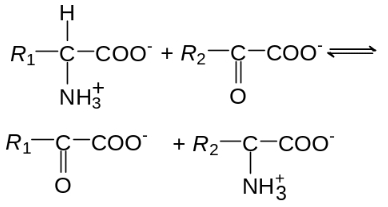
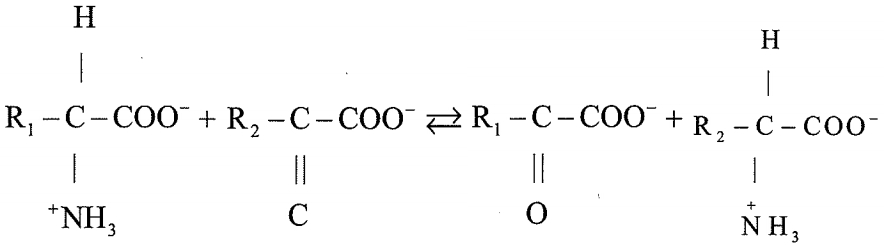
Identify the chemical reaction and the enzyme involved in the given process.
A
Reductive amination - Glutamate dehydrogenase
B
Transamination - Transaminase
C
Reductive amination - Transaminase
D
Transamination - Glutamate dehydrogenase
Solution
(B) The given chemical reaction shows the transfer of an amino group $(-NH_3^+)$ from one amino acid to the keto group of a keto acid.
This process is known as transamination.
The enzyme that catalyzes this transfer of the amino group is called transaminase.
Therefore,the correct reaction is transamination and the enzyme is transaminase.
This process is known as transamination.
The enzyme that catalyzes this transfer of the amino group is called transaminase.
Therefore,the correct reaction is transamination and the enzyme is transaminase.
0 likes
View SolutionMineral Nutrition — METABOLISM OF NITROGEN · Frequently Asked Questions
1Are these Mineral Nutrition questions useful for JEE and NEET?
Yes. All questions in this section are mapped to JEE Main and NEET exam patterns. Previous year questions from JEE Main, NEET, GUJCET and state-level exams are included with full solutions.
2Can I switch to Hindi or Gujarati for these questions?
Yes. Use the language tabs in the hero section or the sidebar to view the same questions and solutions in English, Hindi or Gujarati.
3How do I generate a question paper from this subtopic?
Use the Vedclass Exam Paper Generator — select the chapter and subtopic, set difficulty, and generate Sets A, B, C, D automatically. First 3 chapters of every subject are free.
Vedclass Products
For Students
Vedclass Test Series
Mock tests in real JEE/NEET style with performance analysis. 5-day free trial.
Start Free TrialFor Teachers
Exam Paper Generator
Generate Set A/B/C/D papers from this chapter in 2 minutes. 3 chapters free.
Try FreeFor Institutes
Online Exam Module
Live online exams with unlimited students, 360° analytics & white-label branding.
See DemoFor Teachers & Institutes
Generate a Mineral Nutrition Exam Paper in 2 Minutes
Select subtopic & difficulty — Sets A, B, C, D auto-generated with No Repeat logic.
First 3 chapters of every subject are free — no payment required.