
A English
TRANSLOCATION OF SOLUTES Questions in English
Class 11 Biology · Mineral Nutrition · TRANSLOCATION OF SOLUTES
15+
Questions
English
Language
100%
With Solutions
Showing 15 of 15 questions in English
1
MediumMCQ
Which of the following substances is mobile among cells in plants?
A
$Cl^-$
B
$Malate^{2-}$
C
$K^+$
D
None of the above
Solution
(C) In plants,certain ions and organic molecules are known to be highly mobile and can be transported from one cell to another through the phloem or symplastic pathways.
$K^+$ (potassium ions) are well-documented as being highly mobile within plant tissues,moving from older,senescing parts to younger,developing parts of the plant.
While $Cl^-$ and $Malate^{2-}$ can also move,$K^+$ is the most prominent example of a highly mobile nutrient in plant physiology.
$K^+$ (potassium ions) are well-documented as being highly mobile within plant tissues,moving from older,senescing parts to younger,developing parts of the plant.
While $Cl^-$ and $Malate^{2-}$ can also move,$K^+$ is the most prominent example of a highly mobile nutrient in plant physiology.
0 likes
View Solution2
EasyMCQ
Which one of the following elements in plants is not remobilised?
A
Phosphorus
B
Calcium
C
Potassium
D
Sulphur
Solution
(B) Elements that are actively mobilized within plants are exported from older,senescing tissues to younger developing tissues. Elements such as $Phosphorus$,$Potassium$,$Sulphur$,and $Nitrogen$ are highly mobile.
However,elements that are structural components of the cell,such as $Calcium$,are not remobilized. $Calcium$ is a component of the cell wall (as $Calcium$ pectate) and is therefore not transported out of mature tissues to younger ones.
However,elements that are structural components of the cell,such as $Calcium$,are not remobilized. $Calcium$ is a component of the cell wall (as $Calcium$ pectate) and is therefore not transported out of mature tissues to younger ones.
0 likes
View Solution3
EasyMCQ
Which one of the following elements in plants is not remobilised?
A
$P$
B
$Ca$
C
$K$
D
$S$
Solution
(B) In plants,certain elements are highly mobile and are transported from older,senescing parts to younger,developing tissues. These include elements like $P$ (Phosphorus),$K$ (Potassium),and $S$ (Sulphur).
However,some elements,such as $Ca$ (Calcium),are structural components of the cell wall and are not remobilised. Therefore,they are not transported from older tissues to younger ones,and deficiency symptoms for these elements first appear in the younger tissues.
However,some elements,such as $Ca$ (Calcium),are structural components of the cell wall and are not remobilised. Therefore,they are not transported from older tissues to younger ones,and deficiency symptoms for these elements first appear in the younger tissues.
0 likes
View Solution4
Medium
Explain the translocation of solutes in plants.
Solution
(N/A) $\Rightarrow$ Mineral salts are translocated through the xylem along with the ascending stream of water,which is pulled up through the plant by the transpirational pull.
$\Rightarrow$ Analysis of xylem sap confirms the presence of mineral salts within it.
$\Rightarrow$ The use of radioisotopes of mineral elements further substantiates the view that they are transported through the xylem.
$\Rightarrow$ Analysis of xylem sap confirms the presence of mineral salts within it.
$\Rightarrow$ The use of radioisotopes of mineral elements further substantiates the view that they are transported through the xylem.
0 likes
View Solution5
Medium
Explain: Translocation of mineral ions.
Solution
(N/A) After the ions have reached the xylem through active or passive uptake,or a combination of the two,their further transport up the stem to all parts of the plant occurs through the transpiration stream.
Transport route/pathway:
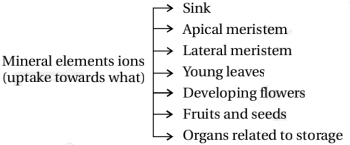
The chief sinks for the mineral elements are the growing regions of the plant,such as $(1)$ apical meristems,$(2)$ lateral meristems,$(3)$ young leaves,$(4)$ developing flowers,$(5)$ fruits and seeds,and storage organs.
Unloading of mineral ions occurs at the fine vein endings through diffusion and active uptake by these cells.
Mineral ions are frequently remobilized,particularly from older,senescing parts.
Older dying leaves export much of their mineral content to younger leaves.
Similarly,before leaf fall in deciduous plants,minerals are removed to other parts.
Dying leaves $\xrightarrow{\text{mineral elements}}$ New leaves
An analysis of the xylem exudates shows that:
Though some of the nitrogen travels as inorganic ions,much of it is carried in the organic form as amino acids and related compounds.
In addition,a small amount of exchange of materials does take place between xylem and phloem.
Hence,it is not possible to make a clear distinction and say categorically that xylem transports only inorganic nutrients while phloem transports only organic materials.
Transport route/pathway:
The chief sinks for the mineral elements are the growing regions of the plant,such as $(1)$ apical meristems,$(2)$ lateral meristems,$(3)$ young leaves,$(4)$ developing flowers,$(5)$ fruits and seeds,and storage organs.
Unloading of mineral ions occurs at the fine vein endings through diffusion and active uptake by these cells.
Mineral ions are frequently remobilized,particularly from older,senescing parts.
Older dying leaves export much of their mineral content to younger leaves.
Similarly,before leaf fall in deciduous plants,minerals are removed to other parts.
Dying leaves $\xrightarrow{\text{mineral elements}}$ New leaves
An analysis of the xylem exudates shows that:
Though some of the nitrogen travels as inorganic ions,much of it is carried in the organic form as amino acids and related compounds.
In addition,a small amount of exchange of materials does take place between xylem and phloem.
Hence,it is not possible to make a clear distinction and say categorically that xylem transports only inorganic nutrients while phloem transports only organic materials.
0 likes
View Solution6
Medium
Explain the significance of mineral nutrients in plants.
Solution
(N/A) Plants absorb mineral nutrients from the soil through their roots. These nutrients are then transported from the stems to the leaves and to the actively growing regions of the plant.
When a part of the plant reaches senescence or aging,the nutrients are remobilized from these older tissues and transported to the younger,actively growing regions of the plant.
When a part of the plant reaches senescence or aging,the nutrients are remobilized from these older tissues and transported to the younger,actively growing regions of the plant.
0 likes
View Solution7
Medium
Based on the provided information,explain the extent to which minerals are transported in plants.
Solution
(N/A) Minerals in plants are transported based on their mobility within the plant body:
$1$. Mobile Minerals: Minerals like $Phosphorus$,$Sulphur$,$Nitrogen$,and $Potassium$ are highly mobile. They are readily mobilized from older,senescing parts (like dying leaves) to younger,developing parts (like new leaves) of the plant.
$2$. Immobile Minerals: Minerals like $Calcium$ are structural components of the plant cell wall and are not remobilized. Therefore,they are not transported from older parts to younger parts once they are incorporated into the structure.
$1$. Mobile Minerals: Minerals like $Phosphorus$,$Sulphur$,$Nitrogen$,and $Potassium$ are highly mobile. They are readily mobilized from older,senescing parts (like dying leaves) to younger,developing parts (like new leaves) of the plant.
$2$. Immobile Minerals: Minerals like $Calcium$ are structural components of the plant cell wall and are not remobilized. Therefore,they are not transported from older parts to younger parts once they are incorporated into the structure.
0 likes
View Solution8
Medium
Define the following terms:
$(1)$ Mobilised elements
$(2)$ Immobilised elements
$(1)$ Mobilised elements
$(2)$ Immobilised elements
Solution
(N/A) $(1)$ Mobilised elements: These are mineral elements that are actively mobilised within the plants,moving from older,senescing parts to young,developing tissues.
$(2)$ Immobilised elements: These are mineral elements that are relatively immobile and are not transported out of mature organs to younger tissues,often becoming structural components of the cell.
$(2)$ Immobilised elements: These are mineral elements that are relatively immobile and are not transported out of mature organs to younger tissues,often becoming structural components of the cell.
0 likes
View Solution9
MediumMCQ
If one wants to find minerals and the form in which they are mobilized in the plant,how will an analysis of the xylem exudate help?
A
It identifies the soil composition.
B
It reveals the chemical form of minerals being transported.
C
It shows the rate of transpiration.
D
It measures the total biomass of the plant.
Solution
(B) $\Rightarrow$ Xylem sap (exudate) is a mixture of water,minerals,and some organic compounds.
By performing a chemical analysis of this exudate,we can determine the specific chemical forms in which minerals are transported from the roots to the rest of the plant.
For example,nitrogen is primarily absorbed from the soil as $NO_2^-$ and $NO_3^-$ ions and is transported in these forms or as organic nitrogen (amino acids/amides).
Similarly,sulfur is absorbed as sulfate ions $(SO_4^{2-})$ and is transported in the same form.
Thus,analyzing the exudate provides direct evidence of the mobile forms of mineral nutrients.
By performing a chemical analysis of this exudate,we can determine the specific chemical forms in which minerals are transported from the roots to the rest of the plant.
For example,nitrogen is primarily absorbed from the soil as $NO_2^-$ and $NO_3^-$ ions and is transported in these forms or as organic nitrogen (amino acids/amides).
Similarly,sulfur is absorbed as sulfate ions $(SO_4^{2-})$ and is transported in the same form.
Thus,analyzing the exudate provides direct evidence of the mobile forms of mineral nutrients.
0 likes
View Solution10
MediumMCQ
Which of the following cells are studied during the translocation of solutes?
A
Sieve tube cells
B
Companion cells
C
Phloem fibre
D
Xylem fibre
Solution
(A) Sieve tube cells are the primary conducting elements of the phloem.
They are studied during the translocation of solutes because they possess an interconnected lumen that facilitates the long-distance transport of organic food (sucrose) from source to sink.
Companion cells assist sieve tubes,but the actual translocation occurs through the sieve tube elements.
They are studied during the translocation of solutes because they possess an interconnected lumen that facilitates the long-distance transport of organic food (sucrose) from source to sink.
Companion cells assist sieve tubes,but the actual translocation occurs through the sieve tube elements.
0 likes
View Solution11
EasyMCQ
Remobilised minerals become available to
A
Chlorotic leaves
B
Dried leaves
C
Young leaves
D
Older parts of plant
Solution
(C) Elements that are structural components like calcium are not remobilised. However,elements like phosphorus,sulphur,nitrogen,and potassium are readily mobilised from older,senescing parts of the plant to younger,developing tissues. Therefore,the major sink for these remobilised minerals is the young and growing organs of the plant.
0 likes
View Solution12
MediumMCQ
Find the odd one with respect to the chief sink for mineral elements.
A
Apical and lateral meristem
B
Young leaves
C
Fruits and seeds
D
Mature or older leaves
Solution
(D) Sinks are the plant parts where the concentration of nutrients is low and the metabolic requirement is very high.
Apical and lateral meristems,young leaves,and fruits and seeds are actively growing parts of the plant.
These regions require a constant supply of minerals and food,therefore they serve as primary sinks.
In contrast,mature or older leaves have a lower metabolic rate and often act as sources rather than sinks,as they export nutrients before senescence.
Apical and lateral meristems,young leaves,and fruits and seeds are actively growing parts of the plant.
These regions require a constant supply of minerals and food,therefore they serve as primary sinks.
In contrast,mature or older leaves have a lower metabolic rate and often act as sources rather than sinks,as they export nutrients before senescence.
0 likes
View Solution13
MediumMCQ
Select the incorrect statement with respect to the translocation of mineral ions.
A
The chief sinks for the mineral elements are the apical and lateral meristems.
B
Most readily mobilised elements are $N, P, K$.
C
Most of the nitrogen travels as inorganic ions through xylem.
D
Small amounts of $P$ and $S$ are carried as organic compounds through xylem.
Solution
(C) The incorrect statement is that nitrogen travels as inorganic ions through the xylem. In reality,nitrogen is primarily transported in organic forms,such as amino acids,amides,and related compounds. The other statements are correct: apical and lateral meristems are indeed the primary sinks for minerals,$N, P,$ and $K$ are highly mobile,and $P$ and $S$ are partially transported as organic compounds.
0 likes
View Solution14
MediumMCQ
The translocation of solute is
A
Equal to the rate of translocation of water
B
Dependent on transpiration pull
C
Through xylem vessel
D
All of these
Solution
(D) The translocation of solutes,specifically minerals,occurs through the $xylem$ vessels.
This process is primarily driven by the transpiration pull generated in the leaves,which creates a negative pressure gradient to move water and dissolved minerals upward.
Therefore,the translocation of solutes is dependent on the transpiration pull and occurs through the $xylem$ vessels,making the rate of solute translocation closely linked to the rate of water translocation.
This process is primarily driven by the transpiration pull generated in the leaves,which creates a negative pressure gradient to move water and dissolved minerals upward.
Therefore,the translocation of solutes is dependent on the transpiration pull and occurs through the $xylem$ vessels,making the rate of solute translocation closely linked to the rate of water translocation.
0 likes
View Solution15
MediumMCQ
Identify the mineral elements that are remobilized and those that are not remobilized from senescing leaves to the growing parts of the plant.
| Remobilized | Not Remobilized | |
| $A$ | $P, S, N, K$ | $Ca$ |
| $B$ | $Ca$ | $P, S, N, K$ |
| $C$ | $P, S, Ca, K$ | $N$ |
| $D$ | $N$ | $P, S, Ca, K$ |
A
$A$
B
$B$
C
$C$
D
$D$
Solution
$(A)$ Elements that are actively mobilized within the plants, particularly from older senescing leaves to younger developing tissues, include phosphorus $(P)$, sulfur $(S)$, nitrogen $(N)$, and potassium $(K)$.
Elements that are structural components of the cell wall, such as calcium $(Ca)$, are not remobilized and remain in the older leaves until they fall off.
Therefore, the correct classification is that $P, S, N,$ and $K$ are remobilized, while $Ca$ is not remobilized. This corresponds to option $A$.
Elements that are structural components of the cell wall, such as calcium $(Ca)$, are not remobilized and remain in the older leaves until they fall off.
Therefore, the correct classification is that $P, S, N,$ and $K$ are remobilized, while $Ca$ is not remobilized. This corresponds to option $A$.
0 likes
View SolutionMineral Nutrition — TRANSLOCATION OF SOLUTES · Frequently Asked Questions
1Are these Mineral Nutrition questions useful for JEE and NEET?
Yes. All questions in this section are mapped to JEE Main and NEET exam patterns. Previous year questions from JEE Main, NEET, GUJCET and state-level exams are included with full solutions.
2Can I switch to Hindi or Gujarati for these questions?
Yes. Use the language tabs in the hero section or the sidebar to view the same questions and solutions in English, Hindi or Gujarati.
3How do I generate a question paper from this subtopic?
Use the Vedclass Exam Paper Generator — select the chapter and subtopic, set difficulty, and generate Sets A, B, C, D automatically. First 3 chapters of every subject are free.
Vedclass Products
For Students
Vedclass Test Series
Mock tests in real JEE/NEET style with performance analysis. 5-day free trial.
Start Free TrialFor Teachers
Exam Paper Generator
Generate Set A/B/C/D papers from this chapter in 2 minutes. 3 chapters free.
Try FreeFor Institutes
Online Exam Module
Live online exams with unlimited students, 360° analytics & white-label branding.
See DemoFor Teachers & Institutes
Generate a Mineral Nutrition Exam Paper in 2 Minutes
Select subtopic & difficulty — Sets A, B, C, D auto-generated with No Repeat logic.
First 3 chapters of every subject are free — no payment required.