
A English
Mix Example-Cell: The Unit of Life Questions in English
Class 11 Biology · Cell: The Unit of Life · Mix Example-Cell: The Unit of Life
300+
Questions
English
Language
100%
With Solutions
Showing 49 of 300 questions in English
201
MediumMCQ
Which of the following is not true for a eukaryotic cell?
A
It has $80S$ type of ribosome present in the mitochondria.
B
It has $80S$ type of ribosome present in the cytoplasm.
C
Mitochondria contains circular $DNA$.
D
Membrane-bound organelles are present.
Solution
(A) Eukaryotic cells contain $80S$ ribosomes in the cytoplasm and $70S$ ribosomes in their organelles like mitochondria and chloroplasts.
Option $A$ states that mitochondria have $80S$ ribosomes,which is incorrect because mitochondria contain $70S$ ribosomes.
Option $B$ is correct as $80S$ ribosomes are found in the cytoplasm.
Option $C$ is correct because mitochondria possess their own circular $DNA$.
Option $D$ is correct as eukaryotic cells are characterized by the presence of membrane-bound organelles.
Option $A$ states that mitochondria have $80S$ ribosomes,which is incorrect because mitochondria contain $70S$ ribosomes.
Option $B$ is correct as $80S$ ribosomes are found in the cytoplasm.
Option $C$ is correct because mitochondria possess their own circular $DNA$.
Option $D$ is correct as eukaryotic cells are characterized by the presence of membrane-bound organelles.
0 likes
View Solution202
MediumMCQ
Choose the correct option by matching the items in Column-$I$ with Column-$II$.
| $A$. Glycoprotein | $i$. Hydrolase |
| $B$. Lysosome | $ii$. Form of food storage in animal |
| $C$. Starch | $iii$. Golgi body |
| $D$. Glycogen | $iv$. Form of food storage in plant |
A
$(A-iv), (B-iii), (C-i), (D-ii)$
B
$(A-ii), (B-iii), (C-i), (D-iv)$
C
$(A-iii), (B-i), (C-iv), (D-ii)$
D
$(A-i), (B-ii), (C-iii), (D-iv)$
Solution
(C) The correct matching is as follows:
$1$. Glycoprotein: These are proteins modified by the addition of carbohydrate chains,a process that primarily occurs in the Golgi body $(A-iii)$.
$2$. Lysosome: These organelles contain various digestive enzymes,including hydrolases,which break down waste materials and cellular debris $(B-i)$.
$3$. Starch: This is the primary form of carbohydrate storage in plants $(C-iv)$.
$4$. Glycogen: This is the primary form of carbohydrate storage in animals $(D-ii)$.
Therefore,the correct sequence is $(A-iii), (B-i), (C-iv), (D-ii)$.
$1$. Glycoprotein: These are proteins modified by the addition of carbohydrate chains,a process that primarily occurs in the Golgi body $(A-iii)$.
$2$. Lysosome: These organelles contain various digestive enzymes,including hydrolases,which break down waste materials and cellular debris $(B-i)$.
$3$. Starch: This is the primary form of carbohydrate storage in plants $(C-iv)$.
$4$. Glycogen: This is the primary form of carbohydrate storage in animals $(D-ii)$.
Therefore,the correct sequence is $(A-iii), (B-i), (C-iv), (D-ii)$.
0 likes
View Solution203
EasyMCQ
Cell organelles can be isolated independently by which of the following methods?
A
Chromatography
B
$X$-ray diffraction
C
Differential centrifugation
D
Autoradiography
Solution
(C) Differential centrifugation is a technique used to separate cell organelles based on their size,shape,and density.
In this process,cell homogenate is subjected to increasing speeds of centrifugation.
As the speed increases,organelles with higher sedimentation coefficients (like nuclei) settle down first,followed by mitochondria,lysosomes,and microsomes.
Therefore,it is the standard method for isolating cell organelles independently.
In this process,cell homogenate is subjected to increasing speeds of centrifugation.
As the speed increases,organelles with higher sedimentation coefficients (like nuclei) settle down first,followed by mitochondria,lysosomes,and microsomes.
Therefore,it is the standard method for isolating cell organelles independently.
0 likes
View Solution204
MediumMCQ
In a compound microscope,the magnification is $NOT$ consistent with which of the following?
A
Numerical aperture
B
Focal length of the objective lens
C
Focal length of the eyepiece
D
Tube length
Solution
(A) The total magnification $(M)$ of a compound microscope is given by the formula: $M = (L/f_o) \times (D/f_e)$,where $L$ is the tube length,$f_o$ is the focal length of the objective lens,$f_e$ is the focal length of the eyepiece,and $D$ is the least distance of distinct vision.
Numerical aperture $(NA)$ is a measure of the light-gathering ability and resolving power of the lens,defined as $NA = n \sin(\theta)$.
While magnification depends on the focal lengths of the lenses and the tube length,the numerical aperture is primarily related to the resolution of the microscope,not the magnification itself.
Numerical aperture $(NA)$ is a measure of the light-gathering ability and resolving power of the lens,defined as $NA = n \sin(\theta)$.
While magnification depends on the focal lengths of the lenses and the tube length,the numerical aperture is primarily related to the resolution of the microscope,not the magnification itself.
0 likes
View Solution205
EasyMCQ
What is the resolving power of a microscope?
A
The ability to distinguish between two close points.
B
The ability to distinguish between two close objects.
C
The ability to separate organelles.
D
The ability to magnify images.
Solution
(A) Resolving power is defined as the ability of an optical instrument,such as a microscope,to distinguish between two closely placed points or objects as separate entities. It determines the clarity and detail of the image produced.
0 likes
View Solution206
EasyMCQ
Which of the following is an endomembrane system component?
A
Golgi apparatus
B
Endoplasmic reticulum
C
Microfilaments
D
Microtubules
Solution
(A, B) The endomembrane system includes organelles that work together to modify,package,and transport lipids and proteins. These include the endoplasmic reticulum,Golgi apparatus,lysosomes,and vacuoles. Microfilaments and microtubules are part of the cytoskeleton and are not part of the endomembrane system. Since both $A$ and $B$ are components of the endomembrane system,this question typically refers to the system as a whole. However,in many contexts,the endoplasmic reticulum is considered the starting point of this system.
0 likes
View Solution207
MediumMCQ
In an animal cell,protein synthesis occurs in . . . . . . .
A
Only in the cytoplasm
B
Nucleolus as well as cytoplasm
C
Cytoplasm as well as mitochondria
D
Ribosomes attached to the nucleus
Solution
(C) In eukaryotic animal cells,protein synthesis is primarily carried out by ribosomes.
Ribosomes are found in the cytoplasm (either free or attached to the rough endoplasmic reticulum) and also within the mitochondria (mitochondrial ribosomes).
Therefore,protein synthesis occurs in both the cytoplasm and the mitochondria.
Ribosomes are found in the cytoplasm (either free or attached to the rough endoplasmic reticulum) and also within the mitochondria (mitochondrial ribosomes).
Therefore,protein synthesis occurs in both the cytoplasm and the mitochondria.
0 likes
View Solution208
EasyMCQ
Which of the following organelles is single-membrane bound?
A
Nucleus
B
Cell wall
C
Mitochondria
D
Sphaerosomes
Solution
(D) $1$. The $Nucleus$ and $Mitochondria$ are double-membrane bound organelles.
$2$. The $Cell wall$ is a non-membranous structure (it is a cell boundary).
$3$. $Sphaerosomes$ are small, spherical, single-membrane bound organelles found in plant cells, primarily involved in the storage and synthesis of lipids.
$2$. The $Cell wall$ is a non-membranous structure (it is a cell boundary).
$3$. $Sphaerosomes$ are small, spherical, single-membrane bound organelles found in plant cells, primarily involved in the storage and synthesis of lipids.
0 likes
View Solution209
MediumMCQ
$A$ student wants to study cell structure using a light microscope with a $10 \times$ eyepiece and a $45 \times$ objective lens. Which of the following light sources should they use to obtain the best resolution?
A
Blue
B
Green
C
Yellow
D
Red
Solution
(A) The resolution $(d)$ of a light microscope is determined by the formula $d = 0.61 \lambda / NA$,where $\lambda$ is the wavelength of light used and $NA$ is the numerical aperture of the objective lens.
To obtain the best resolution,the value of $d$ must be as small as possible.
Since $d$ is directly proportional to the wavelength $(\lambda)$,using light with the shortest wavelength will result in the smallest $d$,thereby providing the highest resolution.
Among the given options,blue light has the shortest wavelength (approximately $450-495 \ nm$) compared to green,yellow,and red light.
Therefore,blue light provides the best resolution.
To obtain the best resolution,the value of $d$ must be as small as possible.
Since $d$ is directly proportional to the wavelength $(\lambda)$,using light with the shortest wavelength will result in the smallest $d$,thereby providing the highest resolution.
Among the given options,blue light has the shortest wavelength (approximately $450-495 \ nm$) compared to green,yellow,and red light.
Therefore,blue light provides the best resolution.
0 likes
View Solution210
MediumMCQ
Select the incorrect statement from the following.
A
Thylakoid system is present in mitochondria.
B
Both chloroplasts and mitochondria contain $DNA$.
C
Chloroplasts are generally larger than mitochondria.
D
Both chloroplasts and mitochondria possess inner and outer membranes.
Solution
(A) The correct answer is $A$.
$1$. Mitochondria and chloroplasts are semi-autonomous organelles.
$2$. Both possess double membranes (inner and outer).
$3$. Both contain their own circular $DNA$ and $70S$ ribosomes.
$4$. Chloroplasts are typically larger $(5-10 \ \mu m)$ than mitochondria $(1-4 \ \mu m)$.
$5$. The thylakoid system is a characteristic feature of chloroplasts,not mitochondria. Mitochondria contain cristae,which are infoldings of the inner membrane. Therefore,the statement that the thylakoid system is present in mitochondria is incorrect.
$1$. Mitochondria and chloroplasts are semi-autonomous organelles.
$2$. Both possess double membranes (inner and outer).
$3$. Both contain their own circular $DNA$ and $70S$ ribosomes.
$4$. Chloroplasts are typically larger $(5-10 \ \mu m)$ than mitochondria $(1-4 \ \mu m)$.
$5$. The thylakoid system is a characteristic feature of chloroplasts,not mitochondria. Mitochondria contain cristae,which are infoldings of the inner membrane. Therefore,the statement that the thylakoid system is present in mitochondria is incorrect.
0 likes
View Solution211
MediumMCQ
Match the following columns:
| $(a)$ Centrosome | $(i)$ Infoldings in mitochondria |
| $(b)$ Chlorophyll | $(ii)$ Thylakoids |
| $(c)$ Cristae | $(iii)$ Nucleic acid |
| $(d)$ Ribozyme | $(iv)$ Basal body of cilia or flagella |
A
$(a-iv), (b-ii), (c-i), (d-iii)$
B
$(a-i), (b-ii), (c-iv), (d-iii)$
C
$(a-i), (b-iii), (c-ii), (d-iv)$
D
$(a-iv), (b-iii), (c-i), (d-ii)$
Solution
(A) The correct matches are as follows:
$(a)$ Centrosome: It forms the basal body of cilia and flagella, which helps in cell movement. Hence, $(a-iv)$.
$(b)$ Chlorophyll: It is the photosynthetic pigment present in the thylakoids of chloroplasts. Hence, $(b-ii)$.
$(c)$ Cristae: These are the infoldings of the inner mitochondrial membrane that increase the surface area for $ATP$ production. Hence, $(c-i)$.
$(d)$ Ribozyme: These are $RNA$ molecules that possess catalytic activity, thus acting as enzymes. Hence, $(d-iii)$.
Therefore, the correct sequence is $(a-iv), (b-ii), (c-i), (d-iii)$.
$(a)$ Centrosome: It forms the basal body of cilia and flagella, which helps in cell movement. Hence, $(a-iv)$.
$(b)$ Chlorophyll: It is the photosynthetic pigment present in the thylakoids of chloroplasts. Hence, $(b-ii)$.
$(c)$ Cristae: These are the infoldings of the inner mitochondrial membrane that increase the surface area for $ATP$ production. Hence, $(c-i)$.
$(d)$ Ribozyme: These are $RNA$ molecules that possess catalytic activity, thus acting as enzymes. Hence, $(d-iii)$.
Therefore, the correct sequence is $(a-iv), (b-ii), (c-i), (d-iii)$.
0 likes
View Solution212
EasyMCQ
Which of the following are membrane-bound cell organelles?
A
Nucleolus,ribosomes,and mitochondria
B
Chromosomes,ribosomes,and endoplasmic reticulum
C
Endoplasmic reticulum,ribosomes,and nucleolus
D
Lysosomes,Golgi apparatus,and mitochondria
Solution
(D) Membrane-bound organelles are those structures within a cell that are enclosed by a lipid bilayer membrane.
$1$. Mitochondria,lysosomes,Golgi apparatus,endoplasmic reticulum,vacuoles,and chloroplasts are membrane-bound organelles.
$2$. Ribosomes are non-membrane-bound organelles found in both prokaryotic and eukaryotic cells.
$3$. The nucleolus is a dense region within the nucleus and is not considered a membrane-bound organelle.
$4$. Chromosomes are structures made of $DNA$ and proteins,not membrane-bound organelles.
Therefore,option $D$ (Lysosomes,Golgi apparatus,and mitochondria) consists entirely of membrane-bound organelles.
$1$. Mitochondria,lysosomes,Golgi apparatus,endoplasmic reticulum,vacuoles,and chloroplasts are membrane-bound organelles.
$2$. Ribosomes are non-membrane-bound organelles found in both prokaryotic and eukaryotic cells.
$3$. The nucleolus is a dense region within the nucleus and is not considered a membrane-bound organelle.
$4$. Chromosomes are structures made of $DNA$ and proteins,not membrane-bound organelles.
Therefore,option $D$ (Lysosomes,Golgi apparatus,and mitochondria) consists entirely of membrane-bound organelles.
0 likes
View Solution213
MediumMCQ
Match Column-$I$ with Column-$II$ and select the correct option.
| Column-$I$ | Column-$II$ |
|---|---|
| $(a)$ Thylakoids | $(i)$ Disc-shaped sacs in Golgi apparatus |
| $(b)$ Cristae | $(ii)$ Condensed structure of $DNA$ |
| $(c)$ Cisternae | $(iii)$ Flat membranous sacs in stroma |
| $(d)$ Chromatin | $(iv)$ Infoldings in mitochondria |
A
$(a-iii), (b-iv), (c-ii), (d-i)$
B
$(a-iii), (b-iv), (c-i), (d-ii)$
C
$(a-iv), (b-iii), (c-i), (d-ii)$
D
$(a-iii), (b-i), (c-iv), (d-ii)$
Solution
(B) The correct matching is as follows:
$(a)$ Thylakoids: These are flattened membranous sacs found within the stroma of chloroplasts,involved in light-dependent reactions $(a-iii)$.
$(b)$ Cristae: These are the infoldings of the inner mitochondrial membrane that increase the surface area for cellular respiration $(b-iv)$.
$(c)$ Cisternae: These are the disc-shaped,flattened sacs that make up the Golgi apparatus $(c-i)$.
$(d)$ Chromatin: This refers to the complex of $DNA$ and proteins that forms the condensed structure of chromosomes within the nucleus $(d-ii)$.
Therefore,the correct sequence is $(a-iii), (b-iv), (c-i), (d-ii)$.
$(a)$ Thylakoids: These are flattened membranous sacs found within the stroma of chloroplasts,involved in light-dependent reactions $(a-iii)$.
$(b)$ Cristae: These are the infoldings of the inner mitochondrial membrane that increase the surface area for cellular respiration $(b-iv)$.
$(c)$ Cisternae: These are the disc-shaped,flattened sacs that make up the Golgi apparatus $(c-i)$.
$(d)$ Chromatin: This refers to the complex of $DNA$ and proteins that forms the condensed structure of chromosomes within the nucleus $(d-ii)$.
Therefore,the correct sequence is $(a-iii), (b-iv), (c-i), (d-ii)$.
0 likes
View Solution214
MediumMCQ
Mitochondria and chloroplasts:
$(a)$ Are semi-autonomous organelles.
$(b)$ Are formed by the division of pre-existing organelles. They contain $DNA$,but lack protein-synthesizing machinery.
Which of the following options is correct?
$(a)$ Are semi-autonomous organelles.
$(b)$ Are formed by the division of pre-existing organelles. They contain $DNA$,but lack protein-synthesizing machinery.
Which of the following options is correct?
A
$(b)$ is correct,while $(a)$ is incorrect.
B
$(a)$ is correct,but $(b)$ is incorrect.
C
Both $(a)$ and $(b)$ are incorrect.
D
Both $(a)$ and $(b)$ are correct.
Solution
(B) Mitochondria and chloroplasts are known as semi-autonomous organelles because they possess their own $DNA$ and ribosomes.
Statement $(a)$ is correct as they are semi-autonomous.
Statement $(b)$ is incorrect because,although they contain $DNA$,they also contain ribosomes (specifically $70S$ ribosomes in prokaryotic-like fashion) which are the machinery for protein synthesis.
Therefore,$(a)$ is correct,but $(b)$ is incorrect.
Statement $(a)$ is correct as they are semi-autonomous.
Statement $(b)$ is incorrect because,although they contain $DNA$,they also contain ribosomes (specifically $70S$ ribosomes in prokaryotic-like fashion) which are the machinery for protein synthesis.
Therefore,$(a)$ is correct,but $(b)$ is incorrect.
0 likes
View Solution215
MediumMCQ
Where does protein synthesis occur in animal cells?
A
Only in the cytoplasm.
B
In the nucleolus and cytoplasm.
C
In the cytoplasm and mitochondria.
D
In the ribosomes attached to the nucleus.
Solution
(C) In animal cells,protein synthesis occurs primarily in the cytoplasm on ribosomes,which may be free or attached to the rough endoplasmic reticulum. Additionally,mitochondria contain their own $DNA$,$RNA$,and ribosomes,allowing them to perform protein synthesis independently within the organelle. Therefore,protein synthesis takes place in both the cytoplasm and mitochondria.
0 likes
View Solution216
EasyMCQ
Which of the following pairs of organelles does not contain $DNA$?
A
Mitochondria and Lysosomes
B
Chloroplast and Vacuoles
C
Lysosomes and Vacuoles
D
Nuclear envelope and Mitochondria
Solution
(C) In eukaryotic cells,$DNA$ is primarily found in the nucleus.
Additionally,semi-autonomous organelles like mitochondria and chloroplasts contain their own circular $DNA$.
Lysosomes are membrane-bound vesicles containing digestive enzymes and do not possess $DNA$.
Vacuoles are storage sacs surrounded by a membrane called the tonoplast and also do not contain $DNA$.
Therefore,the pair consisting of lysosomes and vacuoles is the correct answer as neither contains $DNA$.
Additionally,semi-autonomous organelles like mitochondria and chloroplasts contain their own circular $DNA$.
Lysosomes are membrane-bound vesicles containing digestive enzymes and do not possess $DNA$.
Vacuoles are storage sacs surrounded by a membrane called the tonoplast and also do not contain $DNA$.
Therefore,the pair consisting of lysosomes and vacuoles is the correct answer as neither contains $DNA$.
1 likes
View Solution217
MediumMCQ
$i.$ The shape of the cells may vary with the function they perform.
$ii.$ Human $RBC$ is about $7.0 \, \mu m$ in diameter.
$iii.$ Cytoplasm is the main arena of cellular activities.
$iv.$ Various chemical reactions occur in cytoplasm to keep the cell in the living state.
$ii.$ Human $RBC$ is about $7.0 \, \mu m$ in diameter.
$iii.$ Cytoplasm is the main arena of cellular activities.
$iv.$ Various chemical reactions occur in cytoplasm to keep the cell in the living state.
A
All are correct
B
Only $i$ and $ii$ are correct
C
Only $iv$ is correct
D
All are wrong
Solution
(A) $i.$ Cells exhibit diverse shapes such as disc-like,polygonal,columnar,cuboid,thread-like,or even irregular,which are adapted to their specific functions.
$ii.$ The diameter of a human red blood cell $(RBC)$ is approximately $7.0 \, \mu m$.
$iii.$ The cytoplasm is a semi-fluid matrix that occupies the volume of the cell and serves as the primary site for various cellular metabolic activities.
$iv.$ The cytoplasm contains various organelles and molecules where chemical reactions take place,ensuring the cell remains in a living state.
Therefore,all the given statements are correct.
$ii.$ The diameter of a human red blood cell $(RBC)$ is approximately $7.0 \, \mu m$.
$iii.$ The cytoplasm is a semi-fluid matrix that occupies the volume of the cell and serves as the primary site for various cellular metabolic activities.
$iv.$ The cytoplasm contains various organelles and molecules where chemical reactions take place,ensuring the cell remains in a living state.
Therefore,all the given statements are correct.
0 likes
View Solution218
MediumMCQ
Genes present in the cytoplasm of eukaryotic cells are found in:
A
mitochondria and inherited via egg cytoplasm
B
lysosomes and peroxisomes
C
Golgi bodies and smooth endoplasmic reticulum
D
plastids and inherited via male gamete
Solution
(A) In eukaryotic cells,extranuclear $DNA$ is primarily found in mitochondria and chloroplasts (plastids). These organelles contain their own genome. Mitochondrial $DNA$ is inherited through the egg cytoplasm because the egg provides the bulk of the cytoplasm to the zygote,whereas the sperm contributes primarily nuclear $DNA$.
0 likes
View Solution219
MediumMCQ
Choose the incorrect match.
A
Nucleus $—$ $RNA$
B
Lysosome $—$ Protein synthesis
C
Mitochondria $—$ Respiration
D
Cytoskeleton $—$ Microtubules
Solution
(B) Protein synthesis occurs in ribosomes,which are attached to the surface of the endoplasmic reticulum by ribophorin-$I$ and ribophorin-$II$.
Lysosomes contain about $50$ different types of hydrolytic enzymes,including proteases,nucleases,glycosidases,lipases,phospholipases,phosphatases,and sulphatases.
These enzymes are acid hydrolases and are optimally active at $pH$ $5.0$.
Therefore,the match 'Lysosome $—$ Protein synthesis' is incorrect because lysosomes are involved in intracellular digestion,not protein synthesis.
Lysosomes contain about $50$ different types of hydrolytic enzymes,including proteases,nucleases,glycosidases,lipases,phospholipases,phosphatases,and sulphatases.
These enzymes are acid hydrolases and are optimally active at $pH$ $5.0$.
Therefore,the match 'Lysosome $—$ Protein synthesis' is incorrect because lysosomes are involved in intracellular digestion,not protein synthesis.
0 likes
View Solution220
MediumMCQ
Which of the following statements are correct?
$(i)$ In prokaryotic cells,a special membranous structure formed by the extension of the plasma membrane into the cell is known as polysome.
$(ii)$ The smooth endoplasmic reticulum is the major site for synthesis of glycoproteins.
$(iii)$ $RuBisCO$ is the most abundant protein in the whole biosphere.
$(iv)$ Mitochondria,chloroplasts,and peroxisomes are not considered as part of the endomembrane system.
$(i)$ In prokaryotic cells,a special membranous structure formed by the extension of the plasma membrane into the cell is known as polysome.
$(ii)$ The smooth endoplasmic reticulum is the major site for synthesis of glycoproteins.
$(iii)$ $RuBisCO$ is the most abundant protein in the whole biosphere.
$(iv)$ Mitochondria,chloroplasts,and peroxisomes are not considered as part of the endomembrane system.
A
$(iii)$ and $(iv)$
B
$(i)$ and $(ii)$
C
$(ii)$ and $(iii)$
D
$(i)$ and $(iv)$
Solution
(A) Statement $(i)$ is incorrect because the special membranous structure formed by the extension of the plasma membrane in prokaryotes is called a mesosome,not a polysome. $A$ polysome is a chain of ribosomes attached to a single $mRNA$ molecule.
Statement $(ii)$ is incorrect because the smooth endoplasmic reticulum $(SER)$ is the major site for lipid synthesis,whereas the rough endoplasmic reticulum $(RER)$ is the site for protein and glycoprotein synthesis.
Statement $(iii)$ is correct because $RuBisCO$ (Ribulose bisphosphate carboxylase-oxygenase) is the most abundant protein in the biosphere.
Statement $(iv)$ is correct because the endomembrane system includes only the endoplasmic reticulum,Golgi complex,lysosomes,and vacuoles. Mitochondria,chloroplasts,and peroxisomes are not part of this system.
Therefore,statements $(iii)$ and $(iv)$ are correct.
Statement $(ii)$ is incorrect because the smooth endoplasmic reticulum $(SER)$ is the major site for lipid synthesis,whereas the rough endoplasmic reticulum $(RER)$ is the site for protein and glycoprotein synthesis.
Statement $(iii)$ is correct because $RuBisCO$ (Ribulose bisphosphate carboxylase-oxygenase) is the most abundant protein in the biosphere.
Statement $(iv)$ is correct because the endomembrane system includes only the endoplasmic reticulum,Golgi complex,lysosomes,and vacuoles. Mitochondria,chloroplasts,and peroxisomes are not part of this system.
Therefore,statements $(iii)$ and $(iv)$ are correct.
0 likes
View Solution221
EasyMCQ
Match the Column-$I$ with Column-$II$.
Choose the right match from the options given below.
| Column-$I$ | Column-$II$ |
|---|---|
| $(a)$ Golgi apparatus | $(i)$ Synthesis of protein |
| $(b)$ Lysosomes | $(ii)$ Trap waste and excretory products |
| $(c)$ Vacuoles | $(iii)$ Formation of glycoproteins and glycolipids |
| $(d)$ Ribosomes | $(iv)$ Digesting biomolecules |
Choose the right match from the options given below.
A
$(a)-(iii), (b)-(iv), (c)-(ii), (d)-(i)$
B
$(a)-(iv), (b)-(iii), (c)-(i), (d)-(ii)$
C
$(a)-(iii), (b)-(ii), (c)-(iv), (d)-(i)$
D
$(a)-(i), (b)-(ii), (c)-(iv), (d)-(iii)$
Solution
(A) The correct matches are as follows:
$1$. Golgi apparatus $(a)$ is responsible for the formation of glycoproteins and glycolipids $(iii)$.
$2$. Lysosomes $(b)$ contain hydrolytic enzymes and are involved in digesting biomolecules $(iv)$.
$3$. Vacuoles $(c)$ in plant cells store water,sap,and excretory products,effectively trapping waste $(ii)$.
$4$. Ribosomes $(d)$ are the sites of protein synthesis $(i)$.
Therefore,the correct sequence is $(a)-(iii), (b)-(iv), (c)-(ii), (d)-(i)$.
$1$. Golgi apparatus $(a)$ is responsible for the formation of glycoproteins and glycolipids $(iii)$.
$2$. Lysosomes $(b)$ contain hydrolytic enzymes and are involved in digesting biomolecules $(iv)$.
$3$. Vacuoles $(c)$ in plant cells store water,sap,and excretory products,effectively trapping waste $(ii)$.
$4$. Ribosomes $(d)$ are the sites of protein synthesis $(i)$.
Therefore,the correct sequence is $(a)-(iii), (b)-(iv), (c)-(ii), (d)-(i)$.
0 likes
View Solution222
EasyMCQ
Match the following:
| Organelle Structure | Description |
|---|---|
| $(a)$ Cristae | $(i)$ Flat membranous sacs in stroma |
| $(b)$ Cisternae | $(ii)$ Infoldings in mitochondria |
| $(c)$ Thylakoids | $(iii)$ Disc-shaped sacs in Golgi apparatus |
A
$a-ii, b-iii, c-i$
B
$a-i, b-ii, c-iii$
C
$a-iii, b-ii, c-i$
D
$a-ii, b-i, c-iii$
Solution
(A) The correct matches are as follows:
$1$. $(a)$ Cristae: These are the infoldings of the inner mitochondrial membrane that increase the surface area for biochemical reactions.
$2$. $(b)$ Cisternae: These are the flattened,disc-shaped membranous sacs that make up the Golgi apparatus.
$3$. $(c)$ Thylakoids: These are the flattened,sac-like structures found within the stroma of chloroplasts,which are involved in light-dependent reactions.
Therefore,the correct matching is $a-ii, b-iii, c-i$.
$1$. $(a)$ Cristae: These are the infoldings of the inner mitochondrial membrane that increase the surface area for biochemical reactions.
$2$. $(b)$ Cisternae: These are the flattened,disc-shaped membranous sacs that make up the Golgi apparatus.
$3$. $(c)$ Thylakoids: These are the flattened,sac-like structures found within the stroma of chloroplasts,which are involved in light-dependent reactions.
Therefore,the correct matching is $a-ii, b-iii, c-i$.
0 likes
View Solution223
Difficult
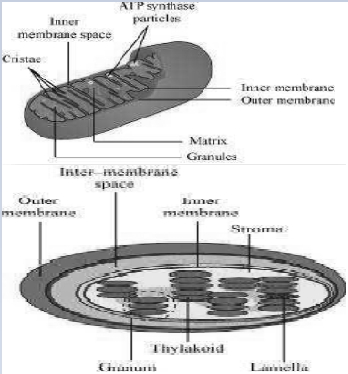
Name two cell-organelles that are double membrane-bound. What are the characteristics of these two organelles? State their functions and draw labelled diagrams of both.
Solution
(N/A) Mitochondria and chloroplasts are the two organelles that are double-membrane-bound.
Characteristics of the mitochondria:
Mitochondria are double-membrane-bound structures. The membrane is divided into inner and outer membranes,creating two aqueous compartments: the outer and inner compartments. The outer membrane is very porous,while the inner membrane is deeply folded into structures known as cristae. Cristae increase the surface area for $ATP$-generating chemical reactions. Mitochondria contain their own $DNA$ and ribosomes,allowing them to synthesize their own proteins,which is why they are considered semi-autonomous organelles.
Characteristics of chloroplasts:
Chloroplasts are double-membrane-bound structures divided into two distinct regions:
$(i)$ Grana: Stacks of flattened,disc-like membranous sacs called thylakoids,which contain chlorophyll. Adjacent grana are connected by membranous tubules called stroma lamellae.
$(ii)$ Stroma: $A$ homogenous fluid in which grana are embedded. It contains enzymes for carbohydrate and protein synthesis,as well as its own $DNA$ and ribosomes.
Functions of the mitochondria:
$(i)$ They are the sites for aerobic cellular respiration.
$(ii)$ They provide energy in the form of $ATP$ for all vital cellular activities.
$(iii)$ They act as semi-autonomous organelles due to the presence of their own $DNA$ and ribosomes.
$(iv)$ They contain enzymes required for the synthesis of various chemicals like fatty acids and amino acids.
Functions of chloroplasts:
$(i)$ They trap solar energy and utilize it for manufacturing food for plants through photosynthesis.
$(ii)$ They contain enzymes required for the synthesis of carbohydrates and proteins.
Characteristics of the mitochondria:
Mitochondria are double-membrane-bound structures. The membrane is divided into inner and outer membranes,creating two aqueous compartments: the outer and inner compartments. The outer membrane is very porous,while the inner membrane is deeply folded into structures known as cristae. Cristae increase the surface area for $ATP$-generating chemical reactions. Mitochondria contain their own $DNA$ and ribosomes,allowing them to synthesize their own proteins,which is why they are considered semi-autonomous organelles.
Characteristics of chloroplasts:
Chloroplasts are double-membrane-bound structures divided into two distinct regions:
$(i)$ Grana: Stacks of flattened,disc-like membranous sacs called thylakoids,which contain chlorophyll. Adjacent grana are connected by membranous tubules called stroma lamellae.
$(ii)$ Stroma: $A$ homogenous fluid in which grana are embedded. It contains enzymes for carbohydrate and protein synthesis,as well as its own $DNA$ and ribosomes.
Functions of the mitochondria:
$(i)$ They are the sites for aerobic cellular respiration.
$(ii)$ They provide energy in the form of $ATP$ for all vital cellular activities.
$(iii)$ They act as semi-autonomous organelles due to the presence of their own $DNA$ and ribosomes.
$(iv)$ They contain enzymes required for the synthesis of various chemicals like fatty acids and amino acids.
Functions of chloroplasts:
$(i)$ They trap solar energy and utilize it for manufacturing food for plants through photosynthesis.
$(ii)$ They contain enzymes required for the synthesis of carbohydrates and proteins.
1 likes
View Solution224
Difficult
Describe the structure of the following with the help of labelled diagrams.
$(i)$ Nucleus
$(ii)$ Centrosome
$(i)$ Nucleus
$(ii)$ Centrosome
Solution
(N/A) $(i)$ Nucleus
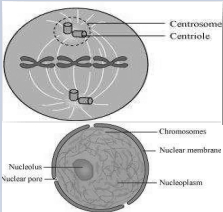
Nucleus controls all the cellular activities of the cell. It is spherical in shape. It is composed of the following structures:
Nuclear membrane: It is a double membrane separating the contents of the nucleus from the cytoplasm. The narrow space between the two membranes is called the perinuclear space. The nuclear membrane has tiny holes called nuclear pores. These holes allow specific substances to be transferred into and out of the nucleus.
Nucleoplasm/Nuclear matrix: It is a homogenous granular fluid present inside the nucleus. It contains the nucleolus and chromatin. The nucleolus is a spherical structure that is not bound by any membrane. It is rich in protein and $RNA$ molecules and is the site for ribosome formation. Chromatin is an entangled mass of thread-like structures. It contains $DNA$ and some basic proteins called histones.
$(ii)$ Centrosome
Centrosome consists of two cylindrical structures called centrioles. Centrioles lie perpendicular to each other. Each has a cartwheel-like organisation. $A$ centriole is made up of microtubule triplets that are evenly spaced in a ring. The adjacent triplets are linked together. There is a proteinaceous hub in the central part of a centriole. The hub is connected to the triplets via radial spokes. These centrioles help in organising the spindle fibres and astral rays during cell division. They form the basal body of cilia and flagella.
Nucleus controls all the cellular activities of the cell. It is spherical in shape. It is composed of the following structures:
Nuclear membrane: It is a double membrane separating the contents of the nucleus from the cytoplasm. The narrow space between the two membranes is called the perinuclear space. The nuclear membrane has tiny holes called nuclear pores. These holes allow specific substances to be transferred into and out of the nucleus.
Nucleoplasm/Nuclear matrix: It is a homogenous granular fluid present inside the nucleus. It contains the nucleolus and chromatin. The nucleolus is a spherical structure that is not bound by any membrane. It is rich in protein and $RNA$ molecules and is the site for ribosome formation. Chromatin is an entangled mass of thread-like structures. It contains $DNA$ and some basic proteins called histones.
$(ii)$ Centrosome
Centrosome consists of two cylindrical structures called centrioles. Centrioles lie perpendicular to each other. Each has a cartwheel-like organisation. $A$ centriole is made up of microtubule triplets that are evenly spaced in a ring. The adjacent triplets are linked together. There is a proteinaceous hub in the central part of a centriole. The hub is connected to the triplets via radial spokes. These centrioles help in organising the spindle fibres and astral rays during cell division. They form the basal body of cilia and flagella.
0 likes
View Solution225
Easy
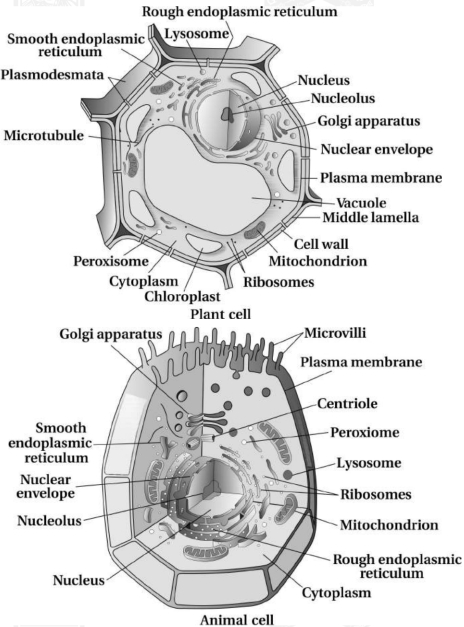
Describe the difference between plant cell and animal cell with a diagram.
Solution
(N/A) Eukaryotes include all protozoa,plants,animals,protists,and fungi.
Characteristics of Eukaryotic Cells: In eukaryotic cells,there is extensive compartmentalization of the cytoplasm through the presence of membrane-bound organelles. Eukaryotic cells possess an organized nucleus with a nuclear envelope. In addition,eukaryotic cells have a variety of complex locomotory and cytoskeletal structures. Their genetic material is organized into chromosomes.
The differences between plant and animal cells are as follows:
$1$. Plant cells possess a cell wall,plastids,and a large central vacuole,which are absent in animal cells.
$2$. Animal cells possess centrioles,which are generally absent in higher plant cells.
Characteristics of Eukaryotic Cells: In eukaryotic cells,there is extensive compartmentalization of the cytoplasm through the presence of membrane-bound organelles. Eukaryotic cells possess an organized nucleus with a nuclear envelope. In addition,eukaryotic cells have a variety of complex locomotory and cytoskeletal structures. Their genetic material is organized into chromosomes.
The differences between plant and animal cells are as follows:
$1$. Plant cells possess a cell wall,plastids,and a large central vacuole,which are absent in animal cells.
$2$. Animal cells possess centrioles,which are generally absent in higher plant cells.
0 likes
View Solution226
Medium
What is meant by the Endomembrane system? Which cell organelles are included in it? Provide brief information.
Solution
(N/A) $\Rightarrow$ Each of the membranous organelles is distinct in terms of its structure and function,but many of these are considered together as an endomembrane system because their functions are coordinated.
$\Rightarrow$ The endomembrane system includes the endoplasmic reticulum $(ER)$,Golgi complex,lysosomes,and vacuoles.
$\Rightarrow$ The functions of the mitochondria,chloroplasts,and peroxisomes are not coordinated with the endomembrane system,hence they are not included in it.
$\Rightarrow$ The endomembrane system includes the endoplasmic reticulum $(ER)$,Golgi complex,lysosomes,and vacuoles.
$\Rightarrow$ The functions of the mitochondria,chloroplasts,and peroxisomes are not coordinated with the endomembrane system,hence they are not included in it.
0 likes
View Solution227
Medium
Differentiate between a prokaryotic cell and a eukaryotic cell.
Solution
(N/A)
| Prokaryotic cell | Eukaryotic cell |
|---|---|
| $(1)$ It lacks an organized nucleus. | $(1)$ It possesses an organized nucleus. |
| $(2)$ Nuclear membrane is absent. | $(2)$ Nuclear membrane is present. |
| $(3)$ $DNA$ does not form a complex with histone proteins. | $(3)$ $DNA$ forms a complex with histone proteins to form chromatin. |
| $(4)$ Membrane-bound organelles are absent. | $(4)$ It possesses membrane-bound organelles like mitochondria and chloroplasts. |
| $(5)$ Cytoplasmic streaming (cyclosis) is absent. | $(5)$ Cytoplasmic streaming is observed. |
| $(6)$ Cell division does not occur via mitosis or meiosis. | $(6)$ Cell division occurs via mitosis or meiosis. |
1 likes
View Solution228
Easy
Differentiate between a plant cell and an animal cell.
Solution
(N/A)
| Plant cell | Animal cell |
| $(1)$ Cell wall is present. | $(1)$ Cell wall is absent. |
| $(2)$ Plastids are present. | $(2)$ Plastids are absent. |
| $(3)$ Centrioles are absent. | $(3)$ Centrioles are present. |
| $(4)$ Starch is the stored food. | $(4)$ Glycogen is the stored food. |
0 likes
View Solution229
Easy
Identify the location and function of the following cell components:
$(i)$ Middle lamella
$(ii)$ Leucoplast
$(iii)$ Kinetochore
$(i)$ Middle lamella
$(ii)$ Leucoplast
$(iii)$ Kinetochore
Solution
(N/A) $(i)$ Middle lamella:
Location: It is a layer primarily composed of calcium pectate found between the walls of adjacent plant cells.
Function: It acts as a cementing layer that holds neighboring cells together.
$(ii)$ Leucoplast:
Location: Found in plant cells,particularly in non-photosynthetic tissues.
Function: These are plastids that store nutrients such as starch (amyloplasts),fats (elaioplasts),and proteins (aleuroplasts).
$(iii)$ Kinetochore:
Location: These are disc-shaped structures present on the sides of the centromere of a chromosome.
Function: They serve as attachment sites for spindle fibers during cell division.
Location: It is a layer primarily composed of calcium pectate found between the walls of adjacent plant cells.
Function: It acts as a cementing layer that holds neighboring cells together.
$(ii)$ Leucoplast:
Location: Found in plant cells,particularly in non-photosynthetic tissues.
Function: These are plastids that store nutrients such as starch (amyloplasts),fats (elaioplasts),and proteins (aleuroplasts).
$(iii)$ Kinetochore:
Location: These are disc-shaped structures present on the sides of the centromere of a chromosome.
Function: They serve as attachment sites for spindle fibers during cell division.
0 likes
View Solution230
Easy
Is extragenomic $DNA$ present in prokaryotes and eukaryotes? If yes,indicate their location in both the types of organisms.
Solution
(N/A) Yes,extragenomic $DNA$ is present in both prokaryotes and eukaryotes.
In eukaryotes,extragenomic $DNA$ is found in organelles such as mitochondria and plastids (e.g.,chloroplasts).
In prokaryotes,extragenomic $DNA$ is primarily found in the form of plasmids. Plasmids are small,circular,double-stranded $DNA$ molecules that are distinct from the chromosomal $DNA$ and provide unique phenotypic characteristics,such as antibiotic resistance,to bacterial cells.
In eukaryotes,extragenomic $DNA$ is found in organelles such as mitochondria and plastids (e.g.,chloroplasts).
In prokaryotes,extragenomic $DNA$ is primarily found in the form of plasmids. Plasmids are small,circular,double-stranded $DNA$ molecules that are distinct from the chromosomal $DNA$ and provide unique phenotypic characteristics,such as antibiotic resistance,to bacterial cells.
0 likes
View Solution231
Medium
Eukaryotic cells have organelles which may:
$(a)$ not be bound by a membrane
$(b)$ be bound by a single membrane
$(c)$ be bound by a double membrane
Group the various sub-cellular organelles into these three categories.
$(a)$ not be bound by a membrane
$(b)$ be bound by a single membrane
$(c)$ be bound by a double membrane
Group the various sub-cellular organelles into these three categories.
Solution
(A-D) Membraneless cell organelles include ribosomes. They are found attached to the surface of the Endoplasmic Reticulum or freely in the cytoplasmic matrix.
$(b)$ Single membrane-bound structures include lysosomes,vacuoles,and microbodies. Lysosomes are typically found in animal cells and protozoans. Prokaryotic cells do not contain lysosomes.
$(c)$ Double membrane-bound structures include the mitochondria,chloroplasts,and the nucleus. In mitochondria,the inner membrane is folded into structures called cristae,which increase the surface area.
$(b)$ Single membrane-bound structures include lysosomes,vacuoles,and microbodies. Lysosomes are typically found in animal cells and protozoans. Prokaryotic cells do not contain lysosomes.
$(c)$ Double membrane-bound structures include the mitochondria,chloroplasts,and the nucleus. In mitochondria,the inner membrane is folded into structures called cristae,which increase the surface area.
0 likes
View Solution232
Medium
Write the functions of the following:
$(a)$ Centromere
$(b)$ Cell wall
$(c)$ Smooth $ER$
$(d)$ Golgi apparatus
$(e)$ Centrioles
$(a)$ Centromere
$(b)$ Cell wall
$(c)$ Smooth $ER$
$(d)$ Golgi apparatus
$(e)$ Centrioles
Solution
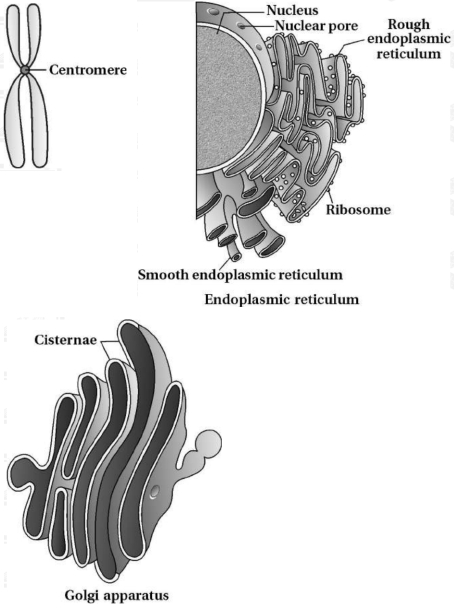
(N/A) Centromere: It is the site where two sister chromatids are held together. During cell division,it serves as the attachment site for spindle fibers via the kinetochore.
$(b)$ Cell wall: It provides a definite shape to the cell,protects it from mechanical injury and infection,facilitates cell-to-cell interaction,and acts as a barrier to undesirable macromolecules.
$(c)$ Smooth $ER$: It is the major site for lipid synthesis,carbohydrate metabolism,and the storage of $Ca^{++}$ ions. It also plays a crucial role in the detoxification of drugs and poisons.
$(d)$ Golgi apparatus: It is involved in the packaging of materials to be delivered to the intracellular targets or secreted outside the cell. It is the site for the formation of glycoproteins and glycolipids.
$(e)$ Centrioles: They form the basal body of cilia or flagella and facilitate spindle fiber formation during cell division in animal cells.
$(b)$ Cell wall: It provides a definite shape to the cell,protects it from mechanical injury and infection,facilitates cell-to-cell interaction,and acts as a barrier to undesirable macromolecules.
$(c)$ Smooth $ER$: It is the major site for lipid synthesis,carbohydrate metabolism,and the storage of $Ca^{++}$ ions. It also plays a crucial role in the detoxification of drugs and poisons.
$(d)$ Golgi apparatus: It is involved in the packaging of materials to be delivered to the intracellular targets or secreted outside the cell. It is the site for the formation of glycoproteins and glycolipids.
$(e)$ Centrioles: They form the basal body of cilia or flagella and facilitate spindle fiber formation during cell division in animal cells.
0 likes
View Solution233
MediumMCQ
Identify the correct terms for the given analogy-based questions:
$(i)$ Plant cell : Cell wall :: Animal cell : .....
(ii) Protein synthesis : Rough Endoplasmic Reticulum :: Lipid synthesis : .....
$(i)$ Plant cell : Cell wall :: Animal cell : .....
(ii) Protein synthesis : Rough Endoplasmic Reticulum :: Lipid synthesis : .....
A
$(i)$ Cell membrane,(ii) Smooth Endoplasmic Reticulum
B
$(i)$ Nucleus,(ii) Golgi apparatus
C
$(i)$ Mitochondria,(ii) Lysosome
D
$(i)$ Vacuole,(ii) Ribosome
Solution
(A) $(i)$ The correct term is $Cell \, membrane$. Plant cells possess a rigid cell wall outside the plasma membrane, whereas animal cells lack a cell wall and have the cell membrane as their outermost boundary.
(ii) The correct term is $Smooth \, Endoplasmic \, Reticulum$ $(SER)$. The $Rough \, Endoplasmic \, Reticulum$ $(RER)$ is associated with protein synthesis due to the presence of ribosomes, while the $Smooth \, Endoplasmic \, Reticulum$ $(SER)$ is the primary site for lipid synthesis.
(ii) The correct term is $Smooth \, Endoplasmic \, Reticulum$ $(SER)$. The $Rough \, Endoplasmic \, Reticulum$ $(RER)$ is associated with protein synthesis due to the presence of ribosomes, while the $Smooth \, Endoplasmic \, Reticulum$ $(SER)$ is the primary site for lipid synthesis.
0 likes
View Solution234
MediumMCQ
Select the correct option for the following statements:
$(i)$ $A$ chromosome in which the centromere is situated near the middle is called a metacentric / submetacentric chromosome.
$(ii)$ The air vacuole / contractile vacuole helps in osmoregulation.
$(i)$ $A$ chromosome in which the centromere is situated near the middle is called a metacentric / submetacentric chromosome.
$(ii)$ The air vacuole / contractile vacuole helps in osmoregulation.
A
$(i)$ Metacentric,$(ii)$ Air vacuole
B
$(i)$ Submetacentric,$(ii)$ Contractile vacuole
C
$(i)$ Metacentric,$(ii)$ Contractile vacuole
D
$(i)$ Submetacentric,$(ii)$ Air vacuole
Solution
(B) $(i)$ $A$ chromosome with the centromere situated near the middle is called a submetacentric chromosome. If the centromere is exactly in the middle,it is called metacentric.
$(ii)$ The contractile vacuole is responsible for osmoregulation and excretion in many protists like Amoeba. Air vacuoles are found in prokaryotes and provide buoyancy.
$(ii)$ The contractile vacuole is responsible for osmoregulation and excretion in many protists like Amoeba. Air vacuoles are found in prokaryotes and provide buoyancy.
0 likes
View Solution235
MediumMCQ
Select the correct option for the following statements:
$(i)$ The $9 + 2$ arrangement of microtubules is found in the cilia/flagella.
$(ii)$ The enzymes of the Krebs cycle are located in the outer membrane/inner membrane of the mitochondria.
$(i)$ The $9 + 2$ arrangement of microtubules is found in the cilia/flagella.
$(ii)$ The enzymes of the Krebs cycle are located in the outer membrane/inner membrane of the mitochondria.
A
$(i)$ Cilia/Flagella,$(ii)$ Outer membrane
B
$(i)$ Cilia/Flagella,$(ii)$ Inner membrane
C
$(i)$ Centriole,$(ii)$ Outer membrane
D
$(i)$ Centriole,$(ii)$ Inner membrane
Solution
(B) $(i)$ The $9 + 2$ arrangement of microtubules is a characteristic feature of eukaryotic cilia and flagella.
$(ii)$ The enzymes of the Krebs cycle ($TCA$ cycle) are located in the mitochondrial matrix,which is enclosed by the inner mitochondrial membrane. Therefore,the inner membrane is the correct site associated with these enzymes.
$(ii)$ The enzymes of the Krebs cycle ($TCA$ cycle) are located in the mitochondrial matrix,which is enclosed by the inner mitochondrial membrane. Therefore,the inner membrane is the correct site associated with these enzymes.
0 likes
View Solution236
EasyMCQ
What is the full form of $EM$?
A
Electron microscope
B
Electromagnetic machine
C
Energy metabolism
D
Enzyme molecule
Solution
(A) The full form of $EM$ is $Electron \ microscope$.
An $Electron \ microscope$ is a type of microscope that uses a beam of electrons to create an image of the specimen.
It is capable of much higher magnifications and has a greater resolving power than a light microscope.
An $Electron \ microscope$ is a type of microscope that uses a beam of electrons to create an image of the specimen.
It is capable of much higher magnifications and has a greater resolving power than a light microscope.
0 likes
View Solution237
MediumMCQ
Which organelle increases in quantity within cancerous cells?
A
Golgi apparatus
B
Mitochondria
C
Ribosomes
D
Both $A$ and $C$
Solution
(D) Cancerous cells exhibit uncontrolled cell division and high metabolic activity to support rapid proliferation.
To sustain this,they require increased protein synthesis for structural components and signaling molecules.
Ribosomes are the sites of protein synthesis,and their number increases significantly to meet this demand.
The Golgi apparatus is responsible for modifying,sorting,and packaging these proteins,so its activity and quantity also increase to process the high volume of synthesized proteins.
Therefore,both the Golgi apparatus and ribosomes increase in cancerous cells.
To sustain this,they require increased protein synthesis for structural components and signaling molecules.
Ribosomes are the sites of protein synthesis,and their number increases significantly to meet this demand.
The Golgi apparatus is responsible for modifying,sorting,and packaging these proteins,so its activity and quantity also increase to process the high volume of synthesized proteins.
Therefore,both the Golgi apparatus and ribosomes increase in cancerous cells.
0 likes
View Solution238
EasyMCQ
Match the following columns and select the correct option.
| Column $I$ | Column $II$ |
|---|---|
| $(a)$ Smooth endoplasmic reticulum | $(i)$ Protein synthesis |
| $(b)$ Rough endoplasmic reticulum | $(ii)$ Lipid synthesis |
| $(c)$ Golgi complex | $(iii)$ Glycosylation |
| $(d)$ Centriole | $(iv)$ Spindle formation |
A
$(a)-(i), (b)-(ii), (c)-(iii), (d)-(iv)$
B
$(a)-(ii), (b)-(i), (c)-(iii), (d)-(iv)$
C
$(a)-(iii), (b)-(i), (c)-(ii), (d)-(iv)$
D
$(a)-(iv), (b)-(ii), (c)-(i), (d)-(iii)$
Solution
(B) The correct matches are as follows:
$(a)$ Smooth Endoplasmic Reticulum $(SER)$ is primarily responsible for lipid synthesis.
$(b)$ Rough Endoplasmic Reticulum $(RER)$ contains ribosomes on its surface and is responsible for protein synthesis.
$(c)$ Golgi complex is involved in the modification of proteins and lipids,specifically through the process of glycosylation.
$(d)$ Centriole plays a crucial role in the organization of the mitotic spindle during cell division.
Therefore,the correct matching is: $(a)-(ii), (b)-(i), (c)-(iii), (d)-(iv)$.
$(a)$ Smooth Endoplasmic Reticulum $(SER)$ is primarily responsible for lipid synthesis.
$(b)$ Rough Endoplasmic Reticulum $(RER)$ contains ribosomes on its surface and is responsible for protein synthesis.
$(c)$ Golgi complex is involved in the modification of proteins and lipids,specifically through the process of glycosylation.
$(d)$ Centriole plays a crucial role in the organization of the mitotic spindle during cell division.
Therefore,the correct matching is: $(a)-(ii), (b)-(i), (c)-(iii), (d)-(iv)$.
0 likes
View Solution239
MediumMCQ
Match the following:
| $(a)$ Protein | $(i)$ $SER$ |
| $(b)$ Lipid | $(ii)$ Golgi body |
| $(c)$ Glycoprotein | $(iii)$ Lysosome |
| $(d)$ Hydrolytic enzyme | $(iv)$ $RER$ |
A
$a-i, b-ii, c-iii, d-iv$
B
$a-iv, b-ii, c-i, d-iii$
C
$a-i, b-iii, c-ii, d-iv$
D
$a-iv, b-i, c-ii, d-iii$
Solution
(D) The correct option is $(D)$.
$(a)$ Protein is synthesized by the Rough Endoplasmic Reticulum $(RER)$ due to the presence of ribosomes on its surface.
$(b)$ Lipid is synthesized by the Smooth Endoplasmic Reticulum $(SER)$.
$(c)$ Glycoprotein formation occurs in the Golgi apparatus,where proteins are modified by adding carbohydrate chains.
$(d)$ Hydrolytic enzymes are characteristic components of lysosomes,which are responsible for intracellular digestion.
Therefore,the correct matching is $a-iv, b-i, c-ii, d-iii$.
$(a)$ Protein is synthesized by the Rough Endoplasmic Reticulum $(RER)$ due to the presence of ribosomes on its surface.
$(b)$ Lipid is synthesized by the Smooth Endoplasmic Reticulum $(SER)$.
$(c)$ Glycoprotein formation occurs in the Golgi apparatus,where proteins are modified by adding carbohydrate chains.
$(d)$ Hydrolytic enzymes are characteristic components of lysosomes,which are responsible for intracellular digestion.
Therefore,the correct matching is $a-iv, b-i, c-ii, d-iii$.
0 likes
View Solution240
MediumMCQ
Microtubules are absent in
A
mitochondria
B
centriole
C
flagella
D
spindle fibres
Solution
(A) Microtubules are cylindrical,rod-like structures that form the cytoskeleton of eukaryotic cells. They are composed of tubulin proteins. Microtubules are present in structures such as cilia,flagella,basal bodies,centrioles,astral rays,and spindle fibres. Mitochondria are double-membrane-bound organelles that contain their own $DNA$ and ribosomes but do not contain microtubules as part of their structure. Therefore,microtubules are absent in mitochondria.
0 likes
View Solution241
EasyMCQ
Which of the following pairs lacks a unit membrane?
A
Nucleus and $E$.$R$.
B
Mitochondria and chloroplast
C
Ribosome and nucleolus
D
Golgi body and lysosome
Solution
(C) Cell organelles like ribosomes and nucleolus lack a unit membrane.
Ribosomes are found individually in the cytoplasm and also line the membranes of the rough endoplasmic reticulum. They are composed of $RNA$ and ribosomal proteins.
The nucleolus is a dense,spherical structure within the nucleus,characterized by the absence of a limiting membrane,and is composed of chromatin,$RNA$,and proteins.
Ribosomes are found individually in the cytoplasm and also line the membranes of the rough endoplasmic reticulum. They are composed of $RNA$ and ribosomal proteins.
The nucleolus is a dense,spherical structure within the nucleus,characterized by the absence of a limiting membrane,and is composed of chromatin,$RNA$,and proteins.
0 likes
View Solution242
MediumMCQ
You are asked to examine a cell using a powerful light microscope. The image you see has a clearly defined nucleus and mitochondria. It also has a large central vacuole and chloroplasts. From what group of organisms did this cell most likely come?
A
Bacteria
B
Protists
C
Fungi
D
Plants
Solution
(D) We can eliminate $Bacteria$ because they are prokaryotic and lack membrane-bound organelles.
$Protists$ and $Fungi$ are eukaryotic but generally lack $Chloroplasts$ (with some exceptions like certain algae,but they do not possess a large central vacuole characteristic of plants).
The presence of a clearly defined nucleus,mitochondria,a large central vacuole,and chloroplasts are definitive characteristics of a plant cell.
Therefore,the cell most likely came from the group $Plants$.
$Protists$ and $Fungi$ are eukaryotic but generally lack $Chloroplasts$ (with some exceptions like certain algae,but they do not possess a large central vacuole characteristic of plants).
The presence of a clearly defined nucleus,mitochondria,a large central vacuole,and chloroplasts are definitive characteristics of a plant cell.
Therefore,the cell most likely came from the group $Plants$.
0 likes
View Solution243
MediumMCQ
The following diagram shows a plant cell with some structures marked as $A, B, C, D$ and $E$. Choose the option with their correct names.
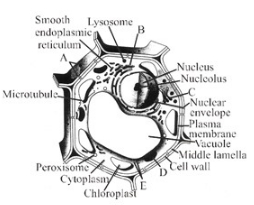
A
$A -$ Plasmodesmata,$B -$ Rough endoplasmic reticulum,$C -$ Golgi apparatus,$D -$ Mitochondrion,$E -$ Ribosomes
B
$A -$ Desmosome,$B -$ Rough endoplasmic reticulum,$C -$ Golgi apparatus,$D -$ Mitochondrion,$E -$ Ribosomes
C
$A -$ Plasmodesmata,$B -$ Smooth endoplasmic reticulum,$C -$ Golgi apparatus,$D -$ Mitochondrion,$E -$ Ribosomes
D
$A -$ Tight junction,$B -$ Rough endoplasmic reticulum,$C -$ Golgi apparatus,$D -$ Mitochondrion,$E -$ Ribosomes
Solution
(A) In the given figure of a plant cell,the structures marked as $A, B, C, D$ and $E$ are identified as follows:
$A$: Plasmodesmata (channels that traverse the cell walls of plant cells).
$B$: Rough endoplasmic reticulum (studded with ribosomes).
$C$: Golgi apparatus (involved in packaging and secretion).
$D$: Mitochondrion (the powerhouse of the cell).
$E$: Ribosomes (sites of protein synthesis).
Therefore,the correct option is $A$.
$A$: Plasmodesmata (channels that traverse the cell walls of plant cells).
$B$: Rough endoplasmic reticulum (studded with ribosomes).
$C$: Golgi apparatus (involved in packaging and secretion).
$D$: Mitochondrion (the powerhouse of the cell).
$E$: Ribosomes (sites of protein synthesis).
Therefore,the correct option is $A$.
0 likes
View Solution244
MediumMCQ
The given figures show two types of cells. Which structures are common to both the cells?
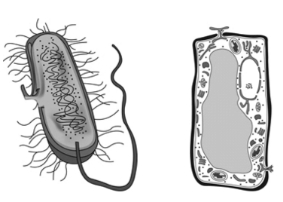
A
Nucleus and cell wall
B
Nucleus and cytoplasm
C
Ribosomes and flagella
D
Ribosomes and cell wall
Solution
(D) Cell $1$ is a prokaryotic (bacterial) cell,and cell $2$ is a eukaryotic (plant) cell.
Both plant cells and bacterial cells possess a cell wall and ribosomes.
Bacterial cells lack a membrane-bound nucleus,whereas plant cells have a well-defined nucleus.
Therefore,ribosomes and the cell wall are the structures common to both.
Both plant cells and bacterial cells possess a cell wall and ribosomes.
Bacterial cells lack a membrane-bound nucleus,whereas plant cells have a well-defined nucleus.
Therefore,ribosomes and the cell wall are the structures common to both.
0 likes
View Solution245
EasyMCQ
Which of the following cell organelles were discovered after the introduction of electron microscope?
A
Mitochondria
B
Endoplasmic reticulum
C
Ribosomes
D
Both $(b)$ and $(c)$
Solution
(D) The electron microscope allowed for the visualization of much smaller cellular structures that were previously invisible under light microscopes. Both the endoplasmic reticulum and ribosomes were discovered and characterized only after the introduction of the electron microscope.
0 likes
View Solution246
MediumMCQ
Match column-$I$ with column-$II$ and choose the correct option.
| Column-$I$ | Column-$II$ |
| $A$. Tonoplast | $I$. Contain digestive enzyme |
| $B$. Contractile vacuole | $II$. Store metabolic gases |
| $C$. Food vacuole | $III$. Excretion |
| $D$. Air vacuole | $IV$. Transport of ions in plants |
A
$A-IV; B-III; C-I; D-II$
B
$A-II; B-III; C-IV; D-I$
C
$A-IV; B-II; C-III; D-I$
D
$A-I; B-III; C-II; D-IV$
Solution
$(A)$ Tonoplast is the membrane that separates the vacuole from the surrounding cytoplasm in a plant cell. It facilitates the transport of ions and other materials against concentration gradients into the vacuole, thus maintaining the concentration gradient $(A-IV)$.
Contractile vacuole is a specialized organelle found in many freshwater protists like Amoeba. It is responsible for osmoregulation and excretion by collecting excess water and waste from the cytoplasm and expelling it out of the cell $(B-III)$.
Food vacuole is formed by the engulfment of food particles through phagocytosis. It contains digestive enzymes that break down the food material $(C-I)$.
Air vacuole (or gas vacuole) is a structure found in certain prokaryotes (like blue-green algae) that stores metabolic gases and provides buoyancy $(D-II)$.
Therefore, the correct matching is $A-IV, B-III, C-I, D-II$.
Contractile vacuole is a specialized organelle found in many freshwater protists like Amoeba. It is responsible for osmoregulation and excretion by collecting excess water and waste from the cytoplasm and expelling it out of the cell $(B-III)$.
Food vacuole is formed by the engulfment of food particles through phagocytosis. It contains digestive enzymes that break down the food material $(C-I)$.
Air vacuole (or gas vacuole) is a structure found in certain prokaryotes (like blue-green algae) that stores metabolic gases and provides buoyancy $(D-II)$.
Therefore, the correct matching is $A-IV, B-III, C-I, D-II$.
0 likes
View Solution247
MediumMCQ
Match the items given in column-$I$ with their role given in column-$II$ and choose the correct option.
| Column-$I$ | Column-$II$ |
| $A$. $SER$ | $I$. Increase the surface area |
| $B$. Golgi apparatus | $II$. Store oils or fats |
| $C$. Cristae | $III$. Excretion |
| $D$. Peroxisome | $IV$. Photorespiration |
| $E$. Elaioplasts | $V$. Synthesis of lipid |
A
$A-V, B-III, C-I, D-IV, E-II$
B
$A-V, B-III, C-II, D-IV, E-I$
C
$A-II, B-II, C-I, D-IV, E-V$
D
$A-II, B-IV, C-I, D-V, E-II$
Solution
$(A)$. $SER$ (Smooth Endoplasmic Reticulum) is primarily responsible for the synthesis of lipids.
$B$. Golgi apparatus is involved in the packaging and transport of materials, and it plays a role in secretion (excretion of cellular products).
$C$. Cristae are the infoldings of the inner mitochondrial membrane, which increase the surface area for biochemical reactions like cellular respiration.
$D$. Peroxisomes are organelles involved in various metabolic processes, including photorespiration in plants.
$E$. Elaioplasts are a type of leucoplast specialized for the storage of oils or fats.
Therefore, the correct matching is $A-V, B-III, C-I, D-IV, E-II$.
$B$. Golgi apparatus is involved in the packaging and transport of materials, and it plays a role in secretion (excretion of cellular products).
$C$. Cristae are the infoldings of the inner mitochondrial membrane, which increase the surface area for biochemical reactions like cellular respiration.
$D$. Peroxisomes are organelles involved in various metabolic processes, including photorespiration in plants.
$E$. Elaioplasts are a type of leucoplast specialized for the storage of oils or fats.
Therefore, the correct matching is $A-V, B-III, C-I, D-IV, E-II$.
0 likes
View Solution248
MediumMCQ
Match column $I$ (cell type) with column $II$ (size) and choose the correct option.
| Column-$I$ (Cell type) | Column-$II$ (Size) |
| $A$. Viruses | $I$. $1-2 \; \mu m$ |
| $B$. $PPLO$ | $II$. $10-20 \; \mu m$ |
| $C$. Eukaryotic cell | $III$. About $0.1 \; \mu m$ |
| $D$. Bacterium | $IV$. $0.02-0.2 \; \mu m$ |
A
$A-I, B-II, C-III, D-IV$
B
$A-IV, B-III, C-II, D-I$
C
$A-I, B-III, C-II, D-IV$
D
$A-IV, B-II, C-II, D-I$
Solution
(B) The correct matches are as follows:
$1$. Viruses: $0.02-0.2 \; \mu m$ $(A-IV)$
$2$. $PPLO$ (Pleuro Pneumonia-like Organisms): About $0.1 \; \mu m$ $(B-III)$
$3$. Eukaryotic cells: $10-20 \; \mu m$ $(C-II)$
$4$. Bacterium: $1-2 \; \mu m$ $(D-I)$
Therefore, the correct option is $A-IV, B-III, C-II, D-I$.
$1$. Viruses: $0.02-0.2 \; \mu m$ $(A-IV)$
$2$. $PPLO$ (Pleuro Pneumonia-like Organisms): About $0.1 \; \mu m$ $(B-III)$
$3$. Eukaryotic cells: $10-20 \; \mu m$ $(C-II)$
$4$. Bacterium: $1-2 \; \mu m$ $(D-I)$
Therefore, the correct option is $A-IV, B-III, C-II, D-I$.
0 likes
View Solution249
MediumMCQ
Match Column-$I$ (cell organelle) with Column-$II$ (membrane) and select the correct option from the codes given below.
| Column-$I$ | Column-$II$ |
| $A$. Mitochondria | $I$. Without membrane |
| $B$. Lysosomes | $II$. Single membrane |
| $C$. Ribosomes | $III$. Double membrane |
A
$A-I, B-II, C-III$
B
$A-III, B-I, C-II$
C
$A-III, B-II, C-I$
D
$A-II, B-III, C-I$
Solution
(C) Mitochondria are double-membrane cell organelles consisting of an outer membrane and an inner membrane.
Lysosomes are single-membrane-bound vesicular structures. They contain many hydrolytic enzymes and are commonly called the 'suicidal bags' of the cell.
Ribosomes are granular structures without a membrane. They consist of $RNA$ and proteins and serve as the protein synthesizers of the cell.
Therefore, the correct matching is: $A-III, B-II, C-I$.
Lysosomes are single-membrane-bound vesicular structures. They contain many hydrolytic enzymes and are commonly called the 'suicidal bags' of the cell.
Ribosomes are granular structures without a membrane. They consist of $RNA$ and proteins and serve as the protein synthesizers of the cell.
Therefore, the correct matching is: $A-III, B-II, C-I$.
0 likes
View SolutionCell: The Unit of Life — Mix Example-Cell: The Unit of Life · Frequently Asked Questions
1Are these Cell: The Unit of Life questions useful for JEE and NEET?
Yes. All questions in this section are mapped to JEE Main and NEET exam patterns. Previous year questions from JEE Main, NEET, GUJCET and state-level exams are included with full solutions.
2Can I switch to Hindi or Gujarati for these questions?
Yes. Use the language tabs in the hero section or the sidebar to view the same questions and solutions in English, Hindi or Gujarati.
3How do I generate a question paper from this subtopic?
Use the Vedclass Exam Paper Generator — select the chapter and subtopic, set difficulty, and generate Sets A, B, C, D automatically. First 3 chapters of every subject are free.
Vedclass Products
For Students
Vedclass Test Series
Mock tests in real JEE/NEET style with performance analysis. 5-day free trial.
Start Free TrialFor Teachers
Exam Paper Generator
Generate Set A/B/C/D papers from this chapter in 2 minutes. 3 chapters free.
Try FreeFor Institutes
Online Exam Module
Live online exams with unlimited students, 360° analytics & white-label branding.
See DemoFor Teachers & Institutes
Generate a Cell: The Unit of Life Exam Paper in 2 Minutes
Select subtopic & difficulty — Sets A, B, C, D auto-generated with No Repeat logic.
First 3 chapters of every subject are free — no payment required.