
A English
An Overview of cell Questions in English
Class 11 Biology · Cell: The Unit of Life · An Overview of cell
28+
Questions
English
Language
100%
With Solutions
Showing 27 of 28 questions in English
1
EasyMCQ
Non-living substances of the protoplasm are collectively known as
A
Deutoplasm
B
Plasma gel
C
Mesoplasm
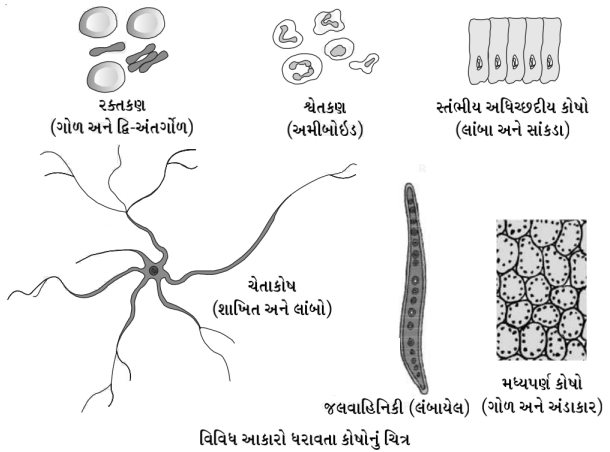
D
Cytoplasm
Solution
(A) The protoplasm consists of living components (like organelles) and non-living inclusions.
Non-living substances found within the protoplasm,such as reserve food materials (starch,glycogen,fats),secretory products,and excretory products,are collectively referred to as $Deutoplasm$ or ergastic substances.
Therefore,the correct option is $A$.
Non-living substances found within the protoplasm,such as reserve food materials (starch,glycogen,fats),secretory products,and excretory products,are collectively referred to as $Deutoplasm$ or ergastic substances.
Therefore,the correct option is $A$.
0 likes
View Solution2
EasyMCQ
Cell organelles are embedded in
A
Nucleolus
B
Mitochondria
C
Protoplasm
D
Cytoplasmic membrane
Solution
(C) The protoplasm is the living content of the cell,which includes both the cytoplasm and the nucleus.
Cell organelles such as mitochondria,ribosomes,and the endoplasmic reticulum are suspended or embedded within the cytoplasm,which is a major component of the protoplasm.
Therefore,the protoplasm serves as the medium in which these organelles are embedded.
Cell organelles such as mitochondria,ribosomes,and the endoplasmic reticulum are suspended or embedded within the cytoplasm,which is a major component of the protoplasm.
Therefore,the protoplasm serves as the medium in which these organelles are embedded.
0 likes
View Solution3
EasyMCQ
The substance which makes up about $80\%$ of cytoplasm and has a unique structure is:
A
Proteins
B
Fats
C
Minerals
D
Water
Solution
(D) The cytoplasm is a jelly-like substance that fills the cell.
Water is the most abundant component of the cytoplasm,accounting for approximately $70\%$ to $90\%$ of its total volume.
It acts as a universal solvent,providing a medium for various biochemical reactions to occur within the cell.
Therefore,the correct answer is $D$.
Water is the most abundant component of the cytoplasm,accounting for approximately $70\%$ to $90\%$ of its total volume.
It acts as a universal solvent,providing a medium for various biochemical reactions to occur within the cell.
Therefore,the correct answer is $D$.
0 likes
View Solution4
EasyMCQ
The physical basis of life is known as .......
A
Nucleus
B
Sex chromosome
C
Protoplasm
D
$DNA$
Solution
(C) The physical basis of life is $Protoplasm$. This term was coined by $Huxley$ to describe the living content of the cell, which includes the cytoplasm and the nucleus. It is the fundamental substance in which all metabolic activities of life occur.
0 likes
View Solution5
MediumMCQ
Which theory is most widely accepted for the physical structure of protoplasm?
A
Granular theory
B
Reticular theory
C
Alveolar theory
D
Colloidal theory
Solution
(D) The physical structure of protoplasm is best explained by the $Colloidal$ $theory$. Protoplasm is a complex polyphasic colloidal system consisting of various organic and inorganic substances dispersed in water. This theory accounts for the dynamic properties of protoplasm, such as sol-gel transformation, which is essential for cellular activities.
0 likes
View Solution6
MediumMCQ
How many types of cells are known based on their organization?
A
One
B
Two
C
Three
D
Four
Solution
(B) Based on the organization of the nucleus and cellular components, cells are primarily classified into two types:
$1$. $Prokaryotic$ cells: These cells lack a well-defined nucleus and membrane-bound organelles (e.g., bacteria).
$2$. $Eukaryotic$ cells: These cells possess a well-defined nucleus and membrane-bound organelles (e.g., plants, animals, fungi, and protists).
Therefore, the correct answer is $Two$.
$1$. $Prokaryotic$ cells: These cells lack a well-defined nucleus and membrane-bound organelles (e.g., bacteria).
$2$. $Eukaryotic$ cells: These cells possess a well-defined nucleus and membrane-bound organelles (e.g., plants, animals, fungi, and protists).
Therefore, the correct answer is $Two$.
0 likes
View Solution7
MediumMCQ
Which of the following is the living substance found in a cell?
A
Nucleoplasm
B
Protoplasm
C
Cytoplasm
D
Ooplasm
Solution
(B) The living substance of the cell is known as $Protoplasm$.
$Protoplasm$ includes both the $Cytoplasm$ and the $Nucleus$ (containing $Nucleoplasm$).
It is often referred to as the physical basis of life.
$Protoplasm$ includes both the $Cytoplasm$ and the $Nucleus$ (containing $Nucleoplasm$).
It is often referred to as the physical basis of life.
1 likes
View Solution8
MediumMCQ
Which of the following is the smallest cell?
A
Bacteria
B
Parenchyma
C
$P.P.L.O.$
D
Virus
Solution
(C) The $P.P.L.O.$ (Pleuro Pneumonia-Like Organisms),also known as Mycoplasma,are the smallest known living cells. They lack a cell wall and can survive without oxygen. Their size is approximately $0.1 \ \mu m$ in length. Viruses are not considered true cells as they lack cellular machinery and require a host to replicate.
0 likes
View Solution9
EasyMCQ
The jelly-like substance present inside the cell is known as:
A
Nucleolus
B
Cell wall
C
Cytoplasm
D
Mitochondria
Solution
(C) The jelly-like substance that fills the cell and surrounds the organelles is called the $Cytoplasm$. It provides a medium for chemical reactions to occur within the cell.
0 likes
View Solution10
MediumMCQ
Which of the following statements is inconsistent with the cytoplasm?
A
It is a jelly-like substance.
B
Most of the cell's metabolic activities occur within it.
C
It is located inside the cell.
D
It is composed entirely of water.
Solution
(D) The cytoplasm is a jelly-like substance found inside the cell,located between the nucleus and the cell membrane.
It serves as the primary site for most of the cell's metabolic activities.
Although it is primarily composed of water,it also contains dissolved proteins,enzymes,salts,carbohydrates,and other organic molecules.
Therefore,the statement that it is 'entirely' composed of water is incorrect,making it an inconsistent statement.
It serves as the primary site for most of the cell's metabolic activities.
Although it is primarily composed of water,it also contains dissolved proteins,enzymes,salts,carbohydrates,and other organic molecules.
Therefore,the statement that it is 'entirely' composed of water is incorrect,making it an inconsistent statement.
0 likes
View Solution11
EasyMCQ
Which of the following contains cellular genes and ribosomes?
A
Cytoskeleton
B
Cytoplasmic region
C
Appendages
D
Cell envelope
Solution
(B) The cytoplasmic region (or cytoplasm) of a cell contains the genetic material (in prokaryotes,the nucleoid region) and ribosomes,which are essential for protein synthesis. The cytoplasm serves as the site for most metabolic activities and houses various cellular components.
0 likes
View Solution12
MediumMCQ
What is formed by the organization of macromolecules?
A
Molecule
B
Macromolecule
C
Membranous organelle
D
Cell
Solution
(C) The hierarchy of biological organization starts from atoms and molecules.
Macromolecules (like proteins,nucleic acids,polysaccharides,and lipids) organize to form supramolecular complexes,which further organize to form membranous organelles.
These organelles then assemble to form a cell,which is the basic structural and functional unit of life.
Therefore,the organization of macromolecules leads to the formation of membranous organelles.
Macromolecules (like proteins,nucleic acids,polysaccharides,and lipids) organize to form supramolecular complexes,which further organize to form membranous organelles.
These organelles then assemble to form a cell,which is the basic structural and functional unit of life.
Therefore,the organization of macromolecules leads to the formation of membranous organelles.
0 likes
View Solution13
MediumMCQ
The characteristics of a cell depend on which of the following?
A
Structure of organelles
B
Molecular interactions of organelles
C
Function of organelles
D
Molecular structure of organelles
Solution
(B) The characteristics of a cell are not merely the sum of its constituent parts but arise from the interactions between them.
These molecular interactions result in emergent properties at the level of the cell,which define its specific characteristics and functions.
Therefore,the characteristics of a cell depend on the molecular interactions of its organelles and components.
These molecular interactions result in emergent properties at the level of the cell,which define its specific characteristics and functions.
Therefore,the characteristics of a cell depend on the molecular interactions of its organelles and components.
0 likes
View Solution14
EasyMCQ
$(P) \rightarrow$ Subatomic particles $\rightarrow$ Atoms $\rightarrow$ Molecules $\rightarrow (Q) \rightarrow$ Cells $\rightarrow$ Tissues. Which levels do $(P)$ and $(Q)$ represent in the given hierarchy of biological organization?
A
Organ,Subatomic particles
B
Organelles,Subatomic particles
C
Subatomic particles,Organelles
D
Membrane,Subatomic particles
Solution
(C) The biological hierarchy of organization starts from the simplest level and progresses to more complex structures.
$1$. The sequence is: $(P)$ (Subatomic particles) $\rightarrow$ Atoms $\rightarrow$ Molecules $\rightarrow (Q)$ (Organelles) $\rightarrow$ Cells $\rightarrow$ Tissues.
$2$. Subatomic particles (protons,neutrons,electrons) combine to form atoms.
$3$. Atoms combine to form molecules.
$4$. Molecules organize to form organelles (like mitochondria,ribosomes,etc.).
$5$. Organelles function together within a cell.
$6$. Cells group together to form tissues.
Therefore,$(P)$ represents Subatomic particles and $(Q)$ represents Organelles.
$1$. The sequence is: $(P)$ (Subatomic particles) $\rightarrow$ Atoms $\rightarrow$ Molecules $\rightarrow (Q)$ (Organelles) $\rightarrow$ Cells $\rightarrow$ Tissues.
$2$. Subatomic particles (protons,neutrons,electrons) combine to form atoms.
$3$. Atoms combine to form molecules.
$4$. Molecules organize to form organelles (like mitochondria,ribosomes,etc.).
$5$. Organelles function together within a cell.
$6$. Cells group together to form tissues.
Therefore,$(P)$ represents Subatomic particles and $(Q)$ represents Organelles.
0 likes
View Solution15
MediumMCQ
The main area of various types of activities of a cell is
A
plasma membrane
B
mitochondrion
C
cytoplasm
D
nucleus
Solution
(C) : Cytoplasm is a granular,crystallo-colloidal complex that forms the living protoplasm of a cell,excluding its nucleus. It consists of proteins,nucleic acids,fats,carbohydrates,vitamins,minerals,waste metabolites,and all the cell organelles. It serves as the main site for various cellular activities such as respiration,nutrition,and storage.
0 likes
View Solution16
MediumMCQ
Size of a typical eukaryotic cell is
A
$1-2 \, \mu m$
B
$10-20 \, \mu m$
C
About $0.1 \, \mu m$
D
$0.02 - 0.2 \, \mu m$
Solution
(B) According to the $NCERT$ textbook,cells vary greatly in size,shape,and activities.
Typical bacteria measure $1-2 \, \mu m$ in length.
Typical eukaryotic cells are much larger,generally ranging from $10-20 \, \mu m$ in diameter.
Mycoplasmas are the smallest cells,measuring about $0.3 \, \mu m$ in length,while viruses are even smaller,ranging from $0.02 - 0.2 \, \mu m$.
Typical bacteria measure $1-2 \, \mu m$ in length.
Typical eukaryotic cells are much larger,generally ranging from $10-20 \, \mu m$ in diameter.
Mycoplasmas are the smallest cells,measuring about $0.3 \, \mu m$ in length,while viruses are even smaller,ranging from $0.02 - 0.2 \, \mu m$.
0 likes
View Solution17
MediumMCQ
An electron microscope has a higher resolving power than a light microscope. This is due to:
A
The use of electromagnetic lenses.
B
The very short wavelength of the electron beam.
C
The use of a light source with a short wavelength.
D
The use of glass lenses with a high numerical aperture.
Solution
(B) The resolving power of a microscope is inversely proportional to the wavelength of the radiation used for illumination $(Resolving Power \propto 1/\lambda)$.
Visible light has a relatively long wavelength,limiting the resolution of light microscopes.
In contrast,electron beams behave like waves with extremely short wavelengths (much smaller than visible light).
Because the wavelength of an electron beam is significantly shorter,the electron microscope can resolve much smaller details,resulting in a much higher resolving power.
Visible light has a relatively long wavelength,limiting the resolution of light microscopes.
In contrast,electron beams behave like waves with extremely short wavelengths (much smaller than visible light).
Because the wavelength of an electron beam is significantly shorter,the electron microscope can resolve much smaller details,resulting in a much higher resolving power.
0 likes
View Solution18
MediumMCQ
Which structure primarily exhibits the various types of activities of a cell?
A
Plasma membrane
B
Mitochondria
C
Cytoplasm
D
Nucleus
Solution
(C) The $Cytoplasm$ is the jelly-like substance that fills the cell and is the site of most cellular activities.
It contains various cell organelles such as mitochondria, ribosomes, and the endoplasmic reticulum, where metabolic reactions, protein synthesis, and other vital processes occur.
While the nucleus controls the activities, the cytoplasm is the primary medium where these activities are physically carried out.
It contains various cell organelles such as mitochondria, ribosomes, and the endoplasmic reticulum, where metabolic reactions, protein synthesis, and other vital processes occur.
While the nucleus controls the activities, the cytoplasm is the primary medium where these activities are physically carried out.
0 likes
View Solution19
Medium
Explain the diversity found in the size,shape,and structure of cells.
Solution
(N/A) Cells exhibit great diversity in size,shape,and activities.
$1$. Size of the cell: Cells vary significantly in size. Mycoplasmas,the smallest cells,are only $0.1$ to $0.3 \mu m$ in length. Bacteria are $3$ to $5 \mu m$. The largest isolated single cell is the egg of an ostrich. Generally,the size of cells in multicellular organisms ranges from $5$ to $100 \mu m$. Some cells are exceptionally long,such as human nerve cells,which can reach up to $90 \ cm$ in length. Human red blood cells are about $7.0 \mu m$ in diameter.
$2$. Shape of the cell: Cells also vary greatly in their shape. They may be disc-like,polygonal,columnar,cuboid,thread-like,or even irregular (e.g.,amoeboid). The shape of the cell often correlates with the specific function they perform.
$1$. Size of the cell: Cells vary significantly in size. Mycoplasmas,the smallest cells,are only $0.1$ to $0.3 \mu m$ in length. Bacteria are $3$ to $5 \mu m$. The largest isolated single cell is the egg of an ostrich. Generally,the size of cells in multicellular organisms ranges from $5$ to $100 \mu m$. Some cells are exceptionally long,such as human nerve cells,which can reach up to $90 \ cm$ in length. Human red blood cells are about $7.0 \mu m$ in diameter.
$2$. Shape of the cell: Cells also vary greatly in their shape. They may be disc-like,polygonal,columnar,cuboid,thread-like,or even irregular (e.g.,amoeboid). The shape of the cell often correlates with the specific function they perform.
0 likes
View Solution20
MediumMCQ
What is seen in the cytoplasm?
A
$A$ semi-fluid matrix
B
Only organelles
C
Only genetic material
D
$A$ rigid cell wall
Solution
(A) $\Rightarrow$ In both prokaryotic and eukaryotic cells,a semi-fluid matrix called cytoplasm occupies the volume of the cell.
$\Rightarrow$ The cytoplasm is the main arena of cellular activities in both plant and animal cells. Various chemical reactions occur in it to keep the cell in the 'living state'.
$\Rightarrow$ The cytoplasm is the main arena of cellular activities in both plant and animal cells. Various chemical reactions occur in it to keep the cell in the 'living state'.
0 likes
View Solution21
EasyMCQ
What is the full form of the unit $(1) \, \text{nm}$?
A
Nanomolar
B
Nanometer
C
Nanomole
D
None of these
Solution
(B) The unit $(1) \, \text{nm}$ stands for $1 \, \text{nanometer}$.
$1 \, \text{nm} = 10^{-9} \, \text{meters}$.
It is a unit of length commonly used in biology to measure the size of organelles, viruses, and molecules.
$1 \, \text{nm} = 10^{-9} \, \text{meters}$.
It is a unit of length commonly used in biology to measure the size of organelles, viruses, and molecules.
0 likes
View Solution22
EasyMCQ
Which of the following cells is round and biconcave in shape?
A
WBCs
B
RBCs
C
Epithelial Cells
D
Nerve Cells
Solution
(B) The correct answer is $RBCs$ (Red Blood Cells).
$RBCs$ are circular and biconcave in shape,which increases their surface area to volume ratio,facilitating the efficient exchange of gases like $O_2$ and $CO_2$.
$RBCs$ are circular and biconcave in shape,which increases their surface area to volume ratio,facilitating the efficient exchange of gases like $O_2$ and $CO_2$.
0 likes
View Solution23
EasyMCQ
The largest egg is of
A
$PPLO$
B
$Ostrich$
C
$Hydra$
D
$Periplaneta\; americana$
Solution
(B) The largest single cell (egg) known is the egg of an $Ostrich$. It is significantly larger than the eggs of other birds and organisms listed.
0 likes
View Solution24
MediumMCQ
The size of the cells that transport oxygen in humans is $........... \mu m$.
A
$3-5$
B
$0.3$
C
$7$
D
$20$
Solution
(C) In humans,red blood cells $(RBCs)$ are responsible for the transport of oxygen.
The diameter of a typical human red blood cell is approximately $7 \mu m$.
Therefore,the correct option is $C$.
The diameter of a typical human red blood cell is approximately $7 \mu m$.
Therefore,the correct option is $C$.
0 likes
View Solution25
MediumMCQ
Which of the following structures occupies the largest volume in a cell?
A
Nucleus
B
Cytoplasm
C
Plasma membrane
D
Ribosomes
Solution
(B) The $Cytoplasm$ is the jelly-like substance that fills the cell and surrounds the organelles.
It occupies the largest volume within the cell compared to other structures like the $Nucleus$, $Plasma \text{ } membrane$, or $Ribosomes$.
While the $Nucleus$ is a prominent organelle, the $Cytoplasm$ constitutes the bulk of the intracellular space.
It occupies the largest volume within the cell compared to other structures like the $Nucleus$, $Plasma \text{ } membrane$, or $Ribosomes$.
While the $Nucleus$ is a prominent organelle, the $Cytoplasm$ constitutes the bulk of the intracellular space.
0 likes
View Solution26
MediumMCQ
What is the shape of the cells that transport $O_2$ in our body?
A
Amoeboid
B
Long and narrow
C
Round and biconcave
D
Round and oval
Solution
(C) The cells responsible for transporting $O_2$ in our body are Red Blood Cells $(RBCs)$,also known as erythrocytes.
These cells have a characteristic round and biconcave shape.
This specific shape increases the surface area-to-volume ratio,which facilitates the efficient diffusion of $O_2$ and $CO_2$ across the cell membrane.
These cells have a characteristic round and biconcave shape.
This specific shape increases the surface area-to-volume ratio,which facilitates the efficient diffusion of $O_2$ and $CO_2$ across the cell membrane.
0 likes
View Solution27
MediumMCQ
Assertion : Cytoplasm is the main arena of cellular activity in both plant and animal cells.
Reason : Various chemical reactions occur in cytoplasm to keep the cell in the living state.
Reason : Various chemical reactions occur in cytoplasm to keep the cell in the living state.
A
Both Assertion and Reason are True and the Reason is a correct explanation of the Assertion.
B
Both Assertion and Reason are True but Reason is not a correct explanation of the Assertion.
C
Assertion is True but the Reason is False.
D
Both Assertion and Reason are False.
Solution
(A) The cytoplasm is a jelly-like substance that fills the cell and is the site of most cellular activities in both plant and animal cells.
It contains various organelles and enzymes that facilitate numerous metabolic pathways.
These chemical reactions are essential for maintaining the cell in a living state, providing energy, and synthesizing necessary molecules.
Therefore, the cytoplasm acts as the main arena for these activities, and the reason correctly explains why it holds this status.
It contains various organelles and enzymes that facilitate numerous metabolic pathways.
These chemical reactions are essential for maintaining the cell in a living state, providing energy, and synthesizing necessary molecules.
Therefore, the cytoplasm acts as the main arena for these activities, and the reason correctly explains why it holds this status.
0 likes
View SolutionCell: The Unit of Life — An Overview of cell · Frequently Asked Questions
1Are these Cell: The Unit of Life questions useful for JEE and NEET?
Yes. All questions in this section are mapped to JEE Main and NEET exam patterns. Previous year questions from JEE Main, NEET, GUJCET and state-level exams are included with full solutions.
2Can I switch to Hindi or Gujarati for these questions?
Yes. Use the language tabs in the hero section or the sidebar to view the same questions and solutions in English, Hindi or Gujarati.
3How do I generate a question paper from this subtopic?
Use the Vedclass Exam Paper Generator — select the chapter and subtopic, set difficulty, and generate Sets A, B, C, D automatically. First 3 chapters of every subject are free.
Vedclass Products
For Students
Vedclass Test Series
Mock tests in real JEE/NEET style with performance analysis. 5-day free trial.
Start Free TrialFor Teachers
Exam Paper Generator
Generate Set A/B/C/D papers from this chapter in 2 minutes. 3 chapters free.
Try FreeFor Institutes
Online Exam Module
Live online exams with unlimited students, 360° analytics & white-label branding.
See DemoFor Teachers & Institutes
Generate a Cell: The Unit of Life Exam Paper in 2 Minutes
Select subtopic & difficulty — Sets A, B, C, D auto-generated with No Repeat logic.
First 3 chapters of every subject are free — no payment required.