
A English
Eukaryotic Cell - Introduction Questions in English
Class 11 Biology · Cell: The Unit of Life · Eukaryotic Cell - Introduction
11+
Questions
English
Language
100%
With Solutions
Showing 11 of 11 questions in English
1
MediumMCQ
Membrane-bound cell organelles are found in
A
Bacterial cells
B
Cyanobacterial cells
C
Prokaryotic cells
D
Eukaryotic cells
Solution
(D) Membrane-bound cell organelles such as mitochondria,Golgi complex,endoplasmic reticulum $(ER)$,and lysosomes are characteristic features of eukaryotic cells.
Prokaryotic cells,such as bacteria and cyanobacteria,lack these membrane-bound organelles.
Prokaryotic cells,such as bacteria and cyanobacteria,lack these membrane-bound organelles.
0 likes
View Solution2
MediumMCQ
Which of the following represents the complexity of cellular organization?
A
Prokaryotic or Eukaryotic
B
Unicellular or Multicellular
C
Unicellular or Acellular
D
Anucleate or Eukaryotic
Solution
(A) The complexity of cellular organization is primarily defined by the presence or absence of a well-defined nucleus and membrane-bound organelles.
Prokaryotic cells are simpler,lacking a membrane-bound nucleus and organelles.
Eukaryotic cells are more complex,possessing a distinct nucleus and various membrane-bound organelles.
Therefore,the distinction between Prokaryotic and Eukaryotic cells represents the fundamental complexity of cellular organization.
Prokaryotic cells are simpler,lacking a membrane-bound nucleus and organelles.
Eukaryotic cells are more complex,possessing a distinct nucleus and various membrane-bound organelles.
Therefore,the distinction between Prokaryotic and Eukaryotic cells represents the fundamental complexity of cellular organization.
0 likes
View Solution3
MediumMCQ
Eukaryotic cells possess:
A
$A$ single chromatin thread.
B
$A$ well-defined nucleus.
C
$A$ primitive nucleus.
D
None of these.
Solution
(B) Eukaryotic cells are defined by the presence of a well-organized,membrane-bound nucleus that contains the genetic material $(DNA)$ organized into chromosomes. Unlike prokaryotic cells,which have a primitive or incipient nucleus (nucleoid) lacking a nuclear envelope,eukaryotic cells possess a distinct,membrane-bound nucleus. Therefore,the correct characteristic is that they have a well-defined nucleus.
0 likes
View Solution4
MediumMCQ
Membrane-bound organelles are found in . . . . . . .
A
Amoeba
B
Bacteria
C
Eukaryotic cells
D
Viruses
Solution
(C) Membrane-bound organelles (such as mitochondria,endoplasmic reticulum,Golgi apparatus,etc.) are characteristic features of eukaryotic cells.
Prokaryotic cells,such as bacteria,lack these membrane-bound organelles.
Viruses are not considered true cells as they lack cellular machinery.
Amoeba is a type of eukaryotic organism,but 'Eukaryotic cells' is the more comprehensive and scientifically accurate category that defines the presence of membrane-bound organelles.
Prokaryotic cells,such as bacteria,lack these membrane-bound organelles.
Viruses are not considered true cells as they lack cellular machinery.
Amoeba is a type of eukaryotic organism,but 'Eukaryotic cells' is the more comprehensive and scientifically accurate category that defines the presence of membrane-bound organelles.
0 likes
View Solution5
MediumMCQ
How do prokaryotes differ from eukaryotes in terms of their structure?
A
Pigments and nucleus
B
Cell wall and $DNA$
C
$DNA$ and mitochondria
D
Cell membrane and nucleus
Solution
(C) Prokaryotic cells are characterized by the absence of a well-defined nucleus and membrane-bound organelles such as mitochondria,chloroplasts,and the endoplasmic reticulum.
In contrast,eukaryotic cells possess a distinct nucleus enclosed by a nuclear envelope and various membrane-bound organelles.
Therefore,the fundamental structural difference lies in the presence of a membrane-bound nucleus and other organelles in eukaryotes,which are absent in prokaryotes.
Among the given options,the most accurate distinction regarding structural components is the presence of a nucleus and membrane-bound organelles (like mitochondria) in eukaryotes.
In contrast,eukaryotic cells possess a distinct nucleus enclosed by a nuclear envelope and various membrane-bound organelles.
Therefore,the fundamental structural difference lies in the presence of a membrane-bound nucleus and other organelles in eukaryotes,which are absent in prokaryotes.
Among the given options,the most accurate distinction regarding structural components is the presence of a nucleus and membrane-bound organelles (like mitochondria) in eukaryotes.
0 likes
View Solution6
MediumMCQ
On the basis of organelles,which types of cells are found?
A
Prokaryotic and Eukaryotic
B
Plant and Animal
C
Unicellular and Multicellular
D
Autotrophic and Heterotrophic
Solution
(A) $\Rightarrow$ Cells are the fundamental structural and functional units of all living organisms.
$\Rightarrow$ Based on the presence or absence of membrane-bound organelles and a well-defined nucleus,cells are classified into two main types:
$(a)$ Prokaryotic cells: These lack a membrane-bound nucleus and membrane-bound organelles.
$(b)$ Eukaryotic cells: These possess a well-defined nucleus and various membrane-bound organelles like the endoplasmic reticulum,Golgi complex,lysosomes,mitochondria,and vacuoles.
$\Rightarrow$ Eukaryotic cells are further categorized into plant cells and animal cells based on the presence or absence of a cell wall and other specific organelles like plastids.
$\Rightarrow$ Ribosomes are non-membrane-bound organelles found in both prokaryotic and eukaryotic cells.
$\Rightarrow$ Based on the presence or absence of membrane-bound organelles and a well-defined nucleus,cells are classified into two main types:
$(a)$ Prokaryotic cells: These lack a membrane-bound nucleus and membrane-bound organelles.
$(b)$ Eukaryotic cells: These possess a well-defined nucleus and various membrane-bound organelles like the endoplasmic reticulum,Golgi complex,lysosomes,mitochondria,and vacuoles.
$\Rightarrow$ Eukaryotic cells are further categorized into plant cells and animal cells based on the presence or absence of a cell wall and other specific organelles like plastids.
$\Rightarrow$ Ribosomes are non-membrane-bound organelles found in both prokaryotic and eukaryotic cells.
0 likes
View Solution7
Medium
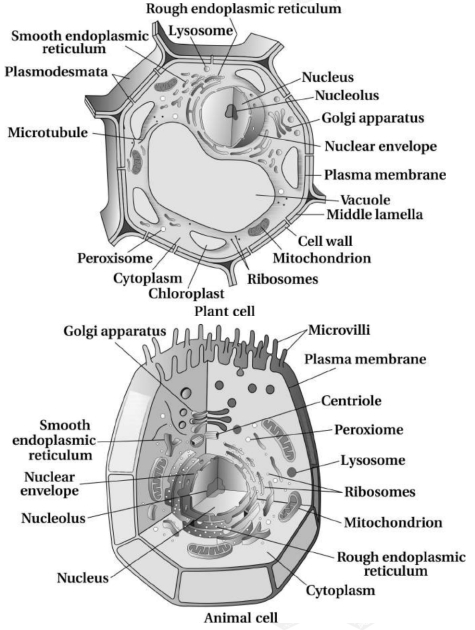
What is included in eukaryotic cells? Explain.
Solution
(N/A) $ \Rightarrow $ Eukaryotic cells include all protists, plants, animals, and fungi.
$ \Rightarrow $ Characteristics of Eukaryotic Cells: In eukaryotic cells, there is extensive compartmentalization of the cytoplasm through the presence of membrane-bound organelles. Eukaryotic cells possess an organized nucleus with a nuclear envelope. In addition, eukaryotic cells have a variety of complex locomotory and cytoskeletal structures. Their genetic material is organized into chromosomes.
$ \Rightarrow $ Differences between plant and animal cells:
$ \Rightarrow $ Plant and animal cells are different from each other: Plant cells possess a cell wall, plastids, and a large central vacuole.
$ \Rightarrow $ Animal cells lack these structures but possess centrioles, which are absent in plant cells.
$ \Rightarrow $ Characteristics of Eukaryotic Cells: In eukaryotic cells, there is extensive compartmentalization of the cytoplasm through the presence of membrane-bound organelles. Eukaryotic cells possess an organized nucleus with a nuclear envelope. In addition, eukaryotic cells have a variety of complex locomotory and cytoskeletal structures. Their genetic material is organized into chromosomes.
$ \Rightarrow $ Differences between plant and animal cells:
$ \Rightarrow $ Plant and animal cells are different from each other: Plant cells possess a cell wall, plastids, and a large central vacuole.
$ \Rightarrow $ Animal cells lack these structures but possess centrioles, which are absent in plant cells.
0 likes
View Solution8
Medium
Give characteristics of eukaryotic cells.
Solution
(N/A) $\Rightarrow$ In eukaryotic cells,there is an extensive compartmentalization of the cytoplasm through the presence of membrane-bound organelles.
$\Rightarrow$ Eukaryotic cells possess an organized nucleus with a nuclear envelope.
$\Rightarrow$ In addition,eukaryotic cells have a variety of complex locomotory and cytoskeletal structures.
$\Rightarrow$ Their genetic material is organized into chromosomes.
$\Rightarrow$ Eukaryotic cells possess an organized nucleus with a nuclear envelope.
$\Rightarrow$ In addition,eukaryotic cells have a variety of complex locomotory and cytoskeletal structures.
$\Rightarrow$ Their genetic material is organized into chromosomes.
0 likes
View Solution9
MediumMCQ
The best way to identify a cell as either prokaryotic or eukaryotic is to determine whether
A
it came from a single-celled or multicellular organism.
B
it has a well-defined nucleus.
C
it has a plasma membrane.
D
it has cytosol.
Solution
(B) The fundamental difference between prokaryotic and eukaryotic cells is the organization of their genetic material. Eukaryotic cells possess a well-defined nucleus enclosed by a nuclear envelope,whereas prokaryotic cells lack a membrane-bound nucleus and instead have a nucleoid region. Other features like the plasma membrane and cytosol are common to both cell types,making them unsuitable for distinguishing between the two.
0 likes
View Solution10
MediumMCQ
Explain why the above-mentioned parts belong to a eukaryotic cell and not a prokaryotic cell?
A
Because eukaryotic cells have membrane-bound organelles due to an internal membrane system.
B
Eukaryotic cells have a single membrane system.
C
Eukaryotic cells are smaller and multiply more rapidly than prokaryotic cells.
D
Eukaryotic cells are primitive in origin.
Solution
(A) The samples belong to eukaryotic cells because eukaryotic cells are characterized by the presence of membrane-bound organelles and a well-defined nucleus.
Both mitochondria and chloroplasts are membrane-bound organelles,which are absent in prokaryotic cells.
Prokaryotic cells are morphologically primitive,lack a membrane-bound nucleus,and do not contain membrane-bound organelles.
Furthermore,prokaryotic cells are generally smaller in size and multiply more rapidly than eukaryotic cells.
Both mitochondria and chloroplasts are membrane-bound organelles,which are absent in prokaryotic cells.
Prokaryotic cells are morphologically primitive,lack a membrane-bound nucleus,and do not contain membrane-bound organelles.
Furthermore,prokaryotic cells are generally smaller in size and multiply more rapidly than eukaryotic cells.
0 likes
View Solution11
MediumMCQ
Which of the following is not true for a eukaryotic cell?
A
Mitochondria contain ds circular naked $DNA$
B
Membrane-bound cell organelles are present
C
Cell wall is made up of peptidoglycan
D
It has $80S$ type of ribosome present in the cytoplasm
Solution
(C) Eukaryotic cells are characterized by the presence of a membrane-bound nucleus and other membrane-bound organelles.
$A$. Mitochondria and chloroplasts are semi-autonomous organelles that contain their own $ds$ circular naked $DNA$,which is a true statement.
$B$. Eukaryotic cells possess membrane-bound organelles like the endoplasmic reticulum,Golgi apparatus,and lysosomes,which is a true statement.
$C$. The cell wall of eukaryotic plants is made of cellulose,and in fungi,it is made of chitin. Peptidoglycan is a characteristic component of the bacterial (prokaryotic) cell wall,not eukaryotic cells. Therefore,this statement is false.
$D$. Eukaryotic cells contain $80S$ ribosomes in the cytoplasm,which is a true statement.
$A$. Mitochondria and chloroplasts are semi-autonomous organelles that contain their own $ds$ circular naked $DNA$,which is a true statement.
$B$. Eukaryotic cells possess membrane-bound organelles like the endoplasmic reticulum,Golgi apparatus,and lysosomes,which is a true statement.
$C$. The cell wall of eukaryotic plants is made of cellulose,and in fungi,it is made of chitin. Peptidoglycan is a characteristic component of the bacterial (prokaryotic) cell wall,not eukaryotic cells. Therefore,this statement is false.
$D$. Eukaryotic cells contain $80S$ ribosomes in the cytoplasm,which is a true statement.
0 likes
View SolutionCell: The Unit of Life — Eukaryotic Cell - Introduction · Frequently Asked Questions
1Are these Cell: The Unit of Life questions useful for JEE and NEET?
Yes. All questions in this section are mapped to JEE Main and NEET exam patterns. Previous year questions from JEE Main, NEET, GUJCET and state-level exams are included with full solutions.
2Can I switch to Hindi or Gujarati for these questions?
Yes. Use the language tabs in the hero section or the sidebar to view the same questions and solutions in English, Hindi or Gujarati.
3How do I generate a question paper from this subtopic?
Use the Vedclass Exam Paper Generator — select the chapter and subtopic, set difficulty, and generate Sets A, B, C, D automatically. First 3 chapters of every subject are free.
Vedclass Products
For Students
Vedclass Test Series
Mock tests in real JEE/NEET style with performance analysis. 5-day free trial.
Start Free TrialFor Teachers
Exam Paper Generator
Generate Set A/B/C/D papers from this chapter in 2 minutes. 3 chapters free.
Try FreeFor Institutes
Online Exam Module
Live online exams with unlimited students, 360° analytics & white-label branding.
See DemoFor Teachers & Institutes
Generate a Cell: The Unit of Life Exam Paper in 2 Minutes
Select subtopic & difficulty — Sets A, B, C, D auto-generated with No Repeat logic.
First 3 chapters of every subject are free — no payment required.