
A English
Mix Example-Cell: The Unit of Life Questions in English
Class 11 Biology · Cell: The Unit of Life · Mix Example-Cell: The Unit of Life
300+
Questions
English
Language
100%
With Solutions
Showing 50 of 300 questions in English
151
MediumMCQ
Select the correct match for $X$ and $Y$:
| Column $X$ | Column $Y$ |
| $(1)$ Endoplasmic Reticulum | $(P)$ Provides energy for various cell functions |
| $(2)$ Golgi apparatus | $(Q)$ Involved in the formation of basal bodies |
| $(3)$ Chloroplast | $(R)$ Surrounded by a single membrane |
| $(4)$ Mitochondria | $(S)$ Site of synthesis of glycolipids and glycoproteins |
| $(5)$ Lysosomes | $(T)$ Performs photosynthesis |
| $(6)$ Centriole | $(U)$ Synthesis of lipids |
A
$(1-R), (2-Q), (3-P), (4-T), (5-S), (6-U)$
B
$(1-U), (2-T), (3-S), (4-R), (5-Q), (6-P)$
C
$(1-U), (2-S), (3-T), (4-P), (5-R), (6-Q)$
D
$(1-P), (2-S), (3-R), (4-Q), (5-T), (6-U)$
Solution
(C) The correct matches are as follows:
$(1)$ Endoplasmic Reticulum: $(U)$ Synthesis of lipids (specifically Smooth $ER$).
$(2)$ Golgi apparatus: $(S)$ Site of synthesis of glycolipids and glycoproteins.
$(3)$ Chloroplast: $(T)$ Performs photosynthesis.
$(4)$ Mitochondria: $(P)$ Provides energy $(ATP)$ for various cell functions.
$(5)$ Lysosomes: $(R)$ Surrounded by a single membrane.
$(6)$ Centriole: $(Q)$ Involved in the formation of basal bodies.
Thus, the correct sequence is $(1-U), (2-S), (3-T), (4-P), (5-R), (6-Q)$.
$(1)$ Endoplasmic Reticulum: $(U)$ Synthesis of lipids (specifically Smooth $ER$).
$(2)$ Golgi apparatus: $(S)$ Site of synthesis of glycolipids and glycoproteins.
$(3)$ Chloroplast: $(T)$ Performs photosynthesis.
$(4)$ Mitochondria: $(P)$ Provides energy $(ATP)$ for various cell functions.
$(5)$ Lysosomes: $(R)$ Surrounded by a single membrane.
$(6)$ Centriole: $(Q)$ Involved in the formation of basal bodies.
Thus, the correct sequence is $(1-U), (2-S), (3-T), (4-P), (5-R), (6-Q)$.
0 likes
View Solution152
MediumMCQ
Select the correct match for $X$ and $Y$.
| Column $X$ | Column $Y$ |
| $(1)$ Microfilament | $(P)$ Glycocalyx |
| $(2)$ Microtubule | $(Q)$ Actin |
| $(3)$ Flagella | $(R)$ Tubulin |
| $(4)$ Bacterial outer layer | $(S)$ Flagellin |
A
$(1-Q), (2-R), (3-S), (4-P)$
B
$(1-R), (2-Q), (3-S), (4-P)$
C
$(1-P), (2-R), (3-Q), (4-S)$
D
$(1-S), (2-P), (3-R), (4-Q)$
Solution
(A) The correct matches are as follows:
$(1)$ Microfilaments are composed of the protein $Actin$ $(Q)$.
$(2)$ Microtubules are composed of the protein $Tubulin$ $(R)$.
$(3)$ Bacterial flagella are composed of the protein $Flagellin$ $(S)$.
$(4)$ The bacterial outer layer is known as the $Glycocalyx$ $(P)$.
Therefore, the correct sequence is $(1-Q), (2-R), (3-S), (4-P)$.
$(1)$ Microfilaments are composed of the protein $Actin$ $(Q)$.
$(2)$ Microtubules are composed of the protein $Tubulin$ $(R)$.
$(3)$ Bacterial flagella are composed of the protein $Flagellin$ $(S)$.
$(4)$ The bacterial outer layer is known as the $Glycocalyx$ $(P)$.
Therefore, the correct sequence is $(1-Q), (2-R), (3-S), (4-P)$.
0 likes
View Solution153
MediumMCQ
Select the correct match for $X$ and $Y$:
| Column $X$ | Column $Y$ |
| $(1)$ Motile bacteria | $(P)$ Slime layer |
| $(2)$ Glycocalyx | $(Q)$ Ribosomes |
| $(3)$ Gas vacuole | $(R)$ Flagellin protein |
| $(4)$ $20 \, nm$ diameter | $(S)$ Autotrophic bacteria |
A
$(1-R), (2-P), (3-S), (4-Q)$
B
$(1-S), (2-P), (3-Q), (4-R)$
C
$(1-S), (2-R), (3-Q), (4-P)$
D
$(1-R), (2-S), (3-P), (4-Q)$
Solution
(A) The correct matches are as follows:
$(1)$ Motile bacteria possess flagella, which are composed of the protein flagellin. Thus, $(1-R)$.
$(2)$ Glycocalyx in bacteria can exist as a loose sheath called the slime layer or a thick, tough layer called the capsule. Thus, $(2-P)$.
$(3)$ Gas vacuoles are found in prokaryotes like blue-green algae and purple and green photosynthetic bacteria (autotrophic bacteria) to provide buoyancy. Thus, $(3-S)$.
$(4)$ Ribosomes in prokaryotes are $70S$ type, and their diameter is approximately $20 \, nm$. Thus, $(4-Q)$.
Therefore, the correct sequence is $(1-R), (2-P), (3-S), (4-Q)$.
$(1)$ Motile bacteria possess flagella, which are composed of the protein flagellin. Thus, $(1-R)$.
$(2)$ Glycocalyx in bacteria can exist as a loose sheath called the slime layer or a thick, tough layer called the capsule. Thus, $(2-P)$.
$(3)$ Gas vacuoles are found in prokaryotes like blue-green algae and purple and green photosynthetic bacteria (autotrophic bacteria) to provide buoyancy. Thus, $(3-S)$.
$(4)$ Ribosomes in prokaryotes are $70S$ type, and their diameter is approximately $20 \, nm$. Thus, $(4-Q)$.
Therefore, the correct sequence is $(1-R), (2-P), (3-S), (4-Q)$.
0 likes
View Solution154
MediumMCQ
Select the correct match for $X$ and $Y$:
| Column $X$ | Column $Y$ |
| $(1)$ Mitochondria | $(P)$ Suicide bags |
| $(2)$ Chloroplast | $(Q)$ Synthesis of steroids |
| $(3)$ Lysosome | $(R)$ Photosynthesis |
| $(4)$ Smooth Endoplasmic Reticulum | $(S)$ Powerhouse of the cell |
A
$(1-Q), (2-P), (3-S), (4-R)$
B
$(1-S), (2-R), (3-Q), (4-P)$
C
$(1-P), (2-Q), (3-R), (4-S)$
D
$(1-S), (2-R), (3-P), (4-Q)$
Solution
(D) The correct matches are as follows:
$(1)$ Mitochondria are known as the 'Powerhouse of the cell' because they generate $ATP$, so $(1-S)$.
$(2)$ Chloroplasts are the sites of photosynthesis in plants, so $(2-R)$.
$(3)$ Lysosomes contain hydrolytic enzymes and are known as 'Suicide bags', so $(3-P)$.
$(4)$ Smooth Endoplasmic Reticulum $(SER)$ is primarily involved in the synthesis of lipids and steroids, so $(4-Q)$.
Therefore, the correct sequence is $(1-S), (2-R), (3-P), (4-Q)$.
$(1)$ Mitochondria are known as the 'Powerhouse of the cell' because they generate $ATP$, so $(1-S)$.
$(2)$ Chloroplasts are the sites of photosynthesis in plants, so $(2-R)$.
$(3)$ Lysosomes contain hydrolytic enzymes and are known as 'Suicide bags', so $(3-P)$.
$(4)$ Smooth Endoplasmic Reticulum $(SER)$ is primarily involved in the synthesis of lipids and steroids, so $(4-Q)$.
Therefore, the correct sequence is $(1-S), (2-R), (3-P), (4-Q)$.
0 likes
View Solution155
MediumMCQ
Select the correct match for $X$ and $Y$:
| Column $X$ | Column $Y$ |
| $(1)$ Vacuole | $(P)$ Absent in human erythrocytes |
| $(2)$ Nucleus | $(Q)$ Perinuclear space absent |
| $(3)$ Nuclear envelope | $(R)$ Synthesis of $rRNA$ |
| $(4)$ Nucleolus | $(S)$ Maintains turgor pressure in cells |
A
$(1-S), (2-P), (3-Q), (4-R)$
B
$(1-P), (2-S), (3-R), (4-Q)$
C
$(1-Q), (2-R), (3-P), (4-S)$
D
$(1-R), (2-Q), (3-P), (4-S)$
Solution
(A) The correct matching is as follows:
$(1)$ Vacuole: Maintains turgor pressure in plant cells $(S)$.
$(2)$ Nucleus: It is absent in mature human erythrocytes (RBCs) $(P)$.
$(3)$ Nuclear envelope: It is a double membrane structure; however, prokaryotes lack a defined nucleus and thus lack a nuclear envelope $(Q)$.
$(4)$ Nucleolus: It is the site for active synthesis of $rRNA$ $(R)$.
Therefore, the correct sequence is $(1-S), (2-P), (3-Q), (4-R)$.
$(1)$ Vacuole: Maintains turgor pressure in plant cells $(S)$.
$(2)$ Nucleus: It is absent in mature human erythrocytes (RBCs) $(P)$.
$(3)$ Nuclear envelope: It is a double membrane structure; however, prokaryotes lack a defined nucleus and thus lack a nuclear envelope $(Q)$.
$(4)$ Nucleolus: It is the site for active synthesis of $rRNA$ $(R)$.
Therefore, the correct sequence is $(1-S), (2-P), (3-Q), (4-R)$.
0 likes
View Solution156
MediumMCQ
$A$: All organelles in a eukaryotic cell are membrane-bound.
$R$: Organelles in a prokaryotic cell are membrane-less.
$R$: Organelles in a prokaryotic cell are membrane-less.
A
$A$ and $R$ are both true and $R$ is the correct explanation of $A$.
B
$A$ and $R$ are both true,but $R$ is not the correct explanation of $A$.
C
$A$ is true and $R$ is false.
D
$A$ is false and $R$ is true.
Solution
(D) Assertion $(A)$ is false because not all organelles in a eukaryotic cell are membrane-bound; for example,ribosomes are non-membrane-bound organelles found in eukaryotic cells.
Reason $(R)$ is true because prokaryotic cells lack membrane-bound organelles,and their structures like ribosomes are also non-membrane-bound.
Therefore,$A$ is false and $R$ is true.
Reason $(R)$ is true because prokaryotic cells lack membrane-bound organelles,and their structures like ribosomes are also non-membrane-bound.
Therefore,$A$ is false and $R$ is true.
0 likes
View Solution157
EasyMCQ
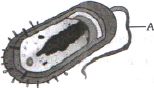
What is the structure labeled as $A$ in the given figure made of?
A
Carbohydrate
B
Lipid
C
Protein
D
Sugar
Solution
(C) The figure shows a bacterial cell. The structure labeled as $A$ is the flagellum.
Bacterial flagella are primarily composed of a protein called flagellin.
Therefore,the correct answer is protein.
Bacterial flagella are primarily composed of a protein called flagellin.
Therefore,the correct answer is protein.
0 likes
View Solution158
EasyMCQ
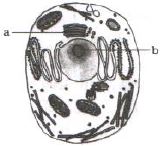
Which option correctly identifies the parts labeled $a$ and $b$ in the given figure?
A
$a -$ Lysosome,$b -$ Ribosome
B
$a -$ Golgi apparatus,$b -$ Nucleolus
C
$a -$ Nucleus,$b -$ Mitochondrion
D
$a -$ Centriole,$b -$ Vacuole
Solution
(B) In the provided diagram of an animal cell:
$1$. Label $a$ points to the stack of flattened,membrane-bound sacs known as the Golgi apparatus.
$2$. Label $b$ points to the dense,spherical structure located inside the nucleus,which is the nucleolus.
Therefore,the correct identification is $a -$ Golgi apparatus and $b -$ Nucleolus.
$1$. Label $a$ points to the stack of flattened,membrane-bound sacs known as the Golgi apparatus.
$2$. Label $b$ points to the dense,spherical structure located inside the nucleus,which is the nucleolus.
Therefore,the correct identification is $a -$ Golgi apparatus and $b -$ Nucleolus.
0 likes
View Solution159
MediumMCQ
Assertion $(X)$: The cell is a wonderful marvel of the world.
Reason $(Y)$: It converts nutrients into free energy and contains its own information in the form of genetic material.
Reason $(Y)$: It converts nutrients into free energy and contains its own information in the form of genetic material.
A
Assertion $(X)$ is true and Reason $(Y)$ is the correct explanation for Assertion $(X)$.
B
Assertion $(X)$ is true but Reason $(Y)$ is not the correct explanation for Assertion $(X)$.
C
Assertion $(X)$ is true but Reason $(Y)$ is false.
D
Assertion $(X)$ is false but Reason $(Y)$ is true.
Solution
(A) The cell is considered the fundamental unit of life and a biological marvel because it possesses the ability to perform metabolic activities,such as converting nutrients into free energy $(ATP)$ through processes like cellular respiration.
Additionally,the cell contains genetic material $(DNA)$ which stores the information necessary for its structure,function,and reproduction.
Therefore,both the assertion and the reason are scientifically accurate,and the reason provides a valid explanation for why the cell is considered a marvel of life.
Additionally,the cell contains genetic material $(DNA)$ which stores the information necessary for its structure,function,and reproduction.
Therefore,both the assertion and the reason are scientifically accurate,and the reason provides a valid explanation for why the cell is considered a marvel of life.
0 likes
View Solution160
MediumMCQ
Which of the following statements is incorrect?
A
Flagella are structures that arise from the basal body.
B
Flagella are found in both prokaryotic and eukaryotic cells.
C
Pili are structures that arise from the basal body.
D
Cilia are structures that arise from the basal body.
Solution
(C) The correct answer is $C$.
$1$. Flagella are hair-like extensions of the cell membrane that arise from the basal body in both prokaryotic and eukaryotic cells.
$2$. Cilia are also hair-like outgrowths of the cell membrane that arise from the basal body.
$3$. Pili are elongated tubular structures made of a special protein called pilin,which are found in bacteria. They are surface appendages and do not arise from a basal body.
Therefore,the statement that pili arise from the basal body is incorrect.
$1$. Flagella are hair-like extensions of the cell membrane that arise from the basal body in both prokaryotic and eukaryotic cells.
$2$. Cilia are also hair-like outgrowths of the cell membrane that arise from the basal body.
$3$. Pili are elongated tubular structures made of a special protein called pilin,which are found in bacteria. They are surface appendages and do not arise from a basal body.
Therefore,the statement that pili arise from the basal body is incorrect.
0 likes
View Solution161
MediumMCQ
Select the correct option for the following matches:
| Column-$I$ | Column-$II$ |
| $(1)$ Mesosome | $(a)$ Not a component of the endomembrane system |
| $(2)$ Peroxisome | $(b)$ Many ribosomes associated with a single $m-RNA$ |
| $(3)$ Polysome | $(c)$ Single membrane-bound system |
| $(4)$ Lysosome | $(d)$ Infoldings of the cell membrane |
A
$1-d, 2-a, 3-b, 4-c$
B
$1-d, 2-a, 3-c, 4-b$
C
$1-b, 2-c, 3-a, 4-d$
D
$1-a, 2-d, 3-b, 4-c$
Solution
(A) The correct matching is as follows:
$(1)$ Mesosome: These are infoldings of the cell membrane in prokaryotes,which help in respiration and cell wall formation. Thus,$(1-d)$.
$(2)$ Peroxisome: These are microbodies that are not part of the endomembrane system. Thus,$(2-a)$.
$(3)$ Polysome: $A$ structure formed when many ribosomes are associated with a single $m-RNA$ molecule. Thus,$(3-b)$.
$(4)$ Lysosome: These are membrane-bound vesicular structures formed by the process of packaging in the Golgi apparatus and are single membrane-bound organelles. Thus,$(4-c)$.
Therefore,the correct sequence is $(1-d, 2-a, 3-b, 4-c)$.
$(1)$ Mesosome: These are infoldings of the cell membrane in prokaryotes,which help in respiration and cell wall formation. Thus,$(1-d)$.
$(2)$ Peroxisome: These are microbodies that are not part of the endomembrane system. Thus,$(2-a)$.
$(3)$ Polysome: $A$ structure formed when many ribosomes are associated with a single $m-RNA$ molecule. Thus,$(3-b)$.
$(4)$ Lysosome: These are membrane-bound vesicular structures formed by the process of packaging in the Golgi apparatus and are single membrane-bound organelles. Thus,$(4-c)$.
Therefore,the correct sequence is $(1-d, 2-a, 3-b, 4-c)$.
0 likes
View Solution162
MediumMCQ
Which of the following organelles are not part of the endomembrane system?
A
Mitochondria,Golgi complex
B
Chloroplasts,Lysosomes
C
Peroxisomes,Mitochondria
D
Endoplasmic reticulum,Chloroplasts
Solution
(C) The endomembrane system includes organelles whose functions are coordinated,such as the endoplasmic reticulum $(ER)$,Golgi complex,lysosomes,and vacuoles.
Organelles like mitochondria,chloroplasts,and peroxisomes are not part of the endomembrane system because their functions are not coordinated with the above-mentioned components.
In option $C$,both peroxisomes and mitochondria are not part of the endomembrane system.
Organelles like mitochondria,chloroplasts,and peroxisomes are not part of the endomembrane system because their functions are not coordinated with the above-mentioned components.
In option $C$,both peroxisomes and mitochondria are not part of the endomembrane system.
0 likes
View Solution163
MediumMCQ
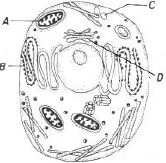
Which of the following organelles is not a part of the endomembrane system?
A
$A$
B
$B$
C
$C$
D
$D$
Solution
(A) The endomembrane system includes the endoplasmic reticulum,Golgi complex,lysosomes,and vacuoles.
In the given diagram:
$A$ represents the mitochondria.
$B$ represents the rough endoplasmic reticulum.
$C$ represents the plasma membrane (or a vesicle).
$D$ represents the Golgi apparatus.
Since the mitochondria are not part of the endomembrane system,the correct option is $A$.
In the given diagram:
$A$ represents the mitochondria.
$B$ represents the rough endoplasmic reticulum.
$C$ represents the plasma membrane (or a vesicle).
$D$ represents the Golgi apparatus.
Since the mitochondria are not part of the endomembrane system,the correct option is $A$.
0 likes
View Solution164
EasyMCQ
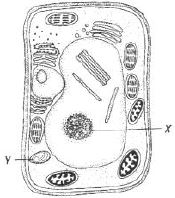
Identify $X$ and $Y$ in the given figure.
A
Crystals,Starch grains
B
Nucleus,Chloroplast
C
Nucleus,Mitochondria
D
Mitochondria,Chloroplast
Solution
(B) In the provided diagram of a plant cell,the label $X$ points to the dense,central structure within the cell,which is the nucleus. The label $Y$ points to an organelle containing internal lamellar structures characteristic of a chloroplast,which is the site of photosynthesis in plant cells. Therefore,$X$ is the nucleus and $Y$ is the chloroplast.
0 likes
View Solution165
MediumMCQ
Statement $P$: The middle lamella is composed of cellulose plates.
Statement $Q$: During the formation of gametes,cell division occurs by mitosis.
Statement $Q$: During the formation of gametes,cell division occurs by mitosis.
A
Statement $P$ is true and Statement $Q$ is false.
B
Both Statement $P$ and $Q$ are false.
C
Both Statement $P$ and $Q$ are true.
D
Statement $P$ is false and Statement $Q$ is true.
Solution
(B) Statement $P$ is false because the middle lamella is primarily composed of calcium and magnesium pectates,not cellulose.
Statement $Q$ is false because the formation of gametes (gametogenesis) typically involves meiosis,not mitosis,to ensure the reduction of chromosome number to haploid $(n)$.
Therefore,both statements are false.
Statement $Q$ is false because the formation of gametes (gametogenesis) typically involves meiosis,not mitosis,to ensure the reduction of chromosome number to haploid $(n)$.
Therefore,both statements are false.
0 likes
View Solution166
EasyMCQ
Which structures participate in the formation of a cell?
A
Organelle
B
Organelles
C
Biomolecule
D
Organelles and biomolecules
Solution
(D) cell is the fundamental structural and functional unit of life. It is composed of various organelles (such as mitochondria,ribosomes,endoplasmic reticulum,etc.) which are specialized structures that perform specific functions. These organelles are themselves built from complex biomolecules (such as proteins,lipids,carbohydrates,and nucleic acids). Therefore,both organelles and biomolecules are essential components that participate in the formation and maintenance of a cell.
0 likes
View Solution167
MediumMCQ
Name the cellular organelle that is composed of nucleoproteins.
A
Nucleus
B
Chromosome
C
Ribosome
D
All of the above
Solution
(D) Nucleoproteins are proteins that are structurally associated with nucleic acids (either $DNA$ or $RNA$).
$1$. The $Nucleus$ contains chromatin, which is a complex of $DNA$ and histone proteins.
$2$. $Chromosomes$ are condensed forms of chromatin, consisting of $DNA$ and proteins.
$3$. $Ribosomes$ are composed of ribosomal $RNA$ $(rRNA)$ and ribosomal proteins.
Since all three structures are composed of nucleoproteins, the correct answer is $D$.
$1$. The $Nucleus$ contains chromatin, which is a complex of $DNA$ and histone proteins.
$2$. $Chromosomes$ are condensed forms of chromatin, consisting of $DNA$ and proteins.
$3$. $Ribosomes$ are composed of ribosomal $RNA$ $(rRNA)$ and ribosomal proteins.
Since all three structures are composed of nucleoproteins, the correct answer is $D$.
0 likes
View Solution168
MediumMCQ
In the given hierarchy of biological organization: $(P) \rightarrow \text{Subatomic particles} \rightarrow \text{Atoms} \rightarrow \text{Molecules} \rightarrow (Q) \rightarrow \text{Cells} \rightarrow \text{Tissues}$,what do $(P)$ and $(Q)$ represent respectively?
A
Organ,Subatomic particle
B
Organelles,Subatomic particle
C
Subatomic particles,Organelles
D
Membrane,Subatomic particles
Solution
(C) The biological hierarchy of organization starts from the simplest level and progresses to more complex levels.
$1$. The sequence is: $\text{Subatomic particles} \rightarrow \text{Atoms} \rightarrow \text{Molecules} \rightarrow \text{Organelles} \rightarrow \text{Cells} \rightarrow \text{Tissues} \rightarrow \text{Organs} \rightarrow \text{Organ systems} \rightarrow \text{Organism}$.
$2$. Comparing this with the given sequence $(P) \rightarrow \text{Subatomic particles} \rightarrow \text{Atoms} \rightarrow \text{Molecules} \rightarrow (Q) \rightarrow \text{Cells} \rightarrow \text{Tissues}$,it is clear that the sequence provided in the question is slightly different in its starting point.
$3$. However,looking at the options,$(P)$ represents the fundamental components (Subatomic particles) and $(Q)$ represents the structure formed after molecules but before cells,which is Organelles.
$4$. Therefore,$(P)$ is Subatomic particles and $(Q)$ is Organelles.
$1$. The sequence is: $\text{Subatomic particles} \rightarrow \text{Atoms} \rightarrow \text{Molecules} \rightarrow \text{Organelles} \rightarrow \text{Cells} \rightarrow \text{Tissues} \rightarrow \text{Organs} \rightarrow \text{Organ systems} \rightarrow \text{Organism}$.
$2$. Comparing this with the given sequence $(P) \rightarrow \text{Subatomic particles} \rightarrow \text{Atoms} \rightarrow \text{Molecules} \rightarrow (Q) \rightarrow \text{Cells} \rightarrow \text{Tissues}$,it is clear that the sequence provided in the question is slightly different in its starting point.
$3$. However,looking at the options,$(P)$ represents the fundamental components (Subatomic particles) and $(Q)$ represents the structure formed after molecules but before cells,which is Organelles.
$4$. Therefore,$(P)$ is Subatomic particles and $(Q)$ is Organelles.
0 likes
View Solution169
MediumMCQ
Which components are responsible for the organization of a cell?
A
Membrane
B
Membranous organelles
C
Tissue
D
Organs
Solution
(B) The cell is the fundamental structural and functional unit of life. The organization of a cell is primarily maintained by its plasma membrane,which acts as a selective barrier,and various membranous organelles (such as the nucleus,mitochondria,endoplasmic reticulum,etc.) that compartmentalize cellular functions. Tissues and organs are higher levels of biological organization formed by groups of cells,not components of a single cell's internal organization.
0 likes
View Solution170
MediumMCQ
Mitochondria and chloroplast are
$(A)$ semi-autonomous organelles
$(B)$ formed by division of pre-existing organelles and they contain $DNA$ but lack protein synthesising machinery.
Which one of the following options is correct?
$(A)$ semi-autonomous organelles
$(B)$ formed by division of pre-existing organelles and they contain $DNA$ but lack protein synthesising machinery.
Which one of the following options is correct?
A
$(A)$ is true but $(B)$ is false.
B
Both $(A)$ and $(B)$ are false.
C
Both $(A)$ and $(B)$ are correct.
D
$(B)$ is true but $(A)$ is false.
Solution
(A) Statement $(A)$ is true: Mitochondria and chloroplasts are known as semi-autonomous organelles because they possess their own genetic material $(DNA)$ and ribosomes.
Statement $(B)$ is false: While these organelles are formed by the division of pre-existing organelles,they do not lack protein-synthesizing machinery. They contain their own $DNA$,$mRNA$,$tRNA$,$rRNA$,and ribosomes,which allow them to synthesize some of their own proteins.
Therefore,$(A)$ is true but $(B)$ is false.
Statement $(B)$ is false: While these organelles are formed by the division of pre-existing organelles,they do not lack protein-synthesizing machinery. They contain their own $DNA$,$mRNA$,$tRNA$,$rRNA$,and ribosomes,which allow them to synthesize some of their own proteins.
Therefore,$(A)$ is true but $(B)$ is false.
0 likes
View Solution171
EasyMCQ
Match the columns and identify the correct option.
| Column $I$ | Column $II$ |
| $A$. Thylakoids | $(i)$ Disc-shaped sacs in Golgi apparatus |
| $B$. Cristae | $(ii)$ Condensed structure of $DNA$ |
| $C$. Cisternae | $(iii)$ Flat membranous sacs in stroma |
| $D$. Chromatin | $(iv)$ Infoldings in mitochondria |
A
$A-(iii), B-(i), C-(iv), D-(ii)$
B
$A-(iii), B-(iv), C-(ii), D-(i)$
C
$A-(iv), B-(iii), C-(i), D-(ii)$
D
$A-(iii), B-(iv), C-(i), D-(ii)$
Solution
(D) The correct matching is as follows:
$A$. Thylakoids: These are flattened membranous sacs found within the stroma of chloroplasts,involved in light-dependent reactions $(iii)$.
$B$. Cristae: These are the infoldings of the inner mitochondrial membrane that increase the surface area for cellular respiration $(iv)$.
$C$. Cisternae: These are the disc-shaped,flattened sacs that make up the Golgi apparatus $(i)$.
$D$. Chromatin: This is the condensed,thread-like structure of $DNA$ and proteins found in the nucleus $(ii)$.
Therefore,the correct sequence is $A-(iii), B-(iv), C-(i), D-(ii)$.
$A$. Thylakoids: These are flattened membranous sacs found within the stroma of chloroplasts,involved in light-dependent reactions $(iii)$.
$B$. Cristae: These are the infoldings of the inner mitochondrial membrane that increase the surface area for cellular respiration $(iv)$.
$C$. Cisternae: These are the disc-shaped,flattened sacs that make up the Golgi apparatus $(i)$.
$D$. Chromatin: This is the condensed,thread-like structure of $DNA$ and proteins found in the nucleus $(ii)$.
Therefore,the correct sequence is $A-(iii), B-(iv), C-(i), D-(ii)$.
0 likes
View Solution172
EasyMCQ
Which of the following cellular organelles are membrane-bound?
A
Endoplasmic reticulum,ribosomes,and nuclei
B
Lysosomes,Golgi apparatus,and mitochondria
C
Nuclei,ribosomes,and mitochondria
D
Chromosomes,ribosomes,and endoplasmic reticulum
Solution
(B) The correct answer is $B$.
Membrane-bound organelles include the endoplasmic reticulum,nuclei,lysosomes,Golgi apparatus,and mitochondria.
Ribosomes are non-membrane-bound ribonucleoprotein particles.
Chromosomes are structures composed of $DNA$ and proteins found within the nucleus and are not considered membrane-bound organelles.
Membrane-bound organelles include the endoplasmic reticulum,nuclei,lysosomes,Golgi apparatus,and mitochondria.
Ribosomes are non-membrane-bound ribonucleoprotein particles.
Chromosomes are structures composed of $DNA$ and proteins found within the nucleus and are not considered membrane-bound organelles.
0 likes
View Solution173
MediumMCQ
Match the following and select the correct answer.
| $(A)$ Centriole | $(i)$ Infoldings in mitochondria |
| $(B)$ Chlorophyll | $(ii)$ Thylakoids |
| $(C)$ Cristae | $(iii)$ Nucleic acids |
| $(D)$ Ribozymes | $(iv)$ Basal body of cilia or flagella |
A
$(A)-(iv), (B)-(ii), (C)-(i), (D)-(iii)$
B
$(A)-(i), (B)-(ii), (C)-(iv), (D)-(iii)$
C
$(A)-(i), (B)-(iii), (C)-(ii), (D)-(iv)$
D
$(A)-(iv), (B)-(iii), (C)-(i), (D)-(ii)$
Solution
(A) The correct matches are as follows:
$1$. $(A)$ Centriole: It forms the basal body of cilia or flagella $(iv)$.
$2$. $(B)$ Chlorophyll: It is present in the thylakoids of chloroplasts $(ii)$.
$3$. $(C)$ Cristae: These are the infoldings of the inner mitochondrial membrane $(i)$.
$4$. $(D)$ Ribozymes: These are catalytic $RNA$ molecules, which are nucleic acids $(iii)$.
Therefore, the correct sequence is $(A)-(iv), (B)-(ii), (C)-(i), (D)-(iii)$.
$1$. $(A)$ Centriole: It forms the basal body of cilia or flagella $(iv)$.
$2$. $(B)$ Chlorophyll: It is present in the thylakoids of chloroplasts $(ii)$.
$3$. $(C)$ Cristae: These are the infoldings of the inner mitochondrial membrane $(i)$.
$4$. $(D)$ Ribozymes: These are catalytic $RNA$ molecules, which are nucleic acids $(iii)$.
Therefore, the correct sequence is $(A)-(iv), (B)-(ii), (C)-(i), (D)-(iii)$.
0 likes
View Solution174
MediumMCQ
Which one of the following cellular parts is correctly described?
A
Thylakoids - flattened membranous sacs forming the grana of chloroplasts
B
Centrioles - sites for active $RNA$ synthesis
C
Ribosomes - those on chloroplasts are larger $(80S)$ while those in the cytoplasm are smaller $(70S)$
D
Lysosomes - optimally active at a $pH$ of about $8.5$
Solution
(A) : Thylakoids are the flattened sac-like membranous structures that are stacked on top of one another to form the grana of plant chloroplasts.
Chlorophyll and other photosynthetic pigments are situated in the thylakoid membranes,which are the site for the light-dependent reactions of photosynthesis.
$B$ is incorrect because centrioles are involved in spindle formation during cell division,not $RNA$ synthesis.
$C$ is incorrect because chloroplast ribosomes are $70S$ and cytoplasmic ribosomes are $80S$.
$D$ is incorrect because lysosomes contain hydrolytic enzymes that are optimally active at an acidic $pH$ (about $5.0$).
Chlorophyll and other photosynthetic pigments are situated in the thylakoid membranes,which are the site for the light-dependent reactions of photosynthesis.
$B$ is incorrect because centrioles are involved in spindle formation during cell division,not $RNA$ synthesis.
$C$ is incorrect because chloroplast ribosomes are $70S$ and cytoplasmic ribosomes are $80S$.
$D$ is incorrect because lysosomes contain hydrolytic enzymes that are optimally active at an acidic $pH$ (about $5.0$).
0 likes
View Solution175
EasyMCQ
Which one of the following is not considered as a part of the endomembrane system?
A
Golgi complex
B
Peroxisome
C
Vacuole
D
Lysosome
Solution
(B) The correct answer is $B$.
While each of the membranous organelles is distinct in terms of its structure and function,many of these are considered together as an endomembrane system because their functions are coordinated.
The endomembrane system includes the endoplasmic reticulum $(ER)$,Golgi complex,lysosomes,and vacuoles.
Since the functions of the mitochondria,chloroplasts,and peroxisomes are not coordinated with the above-mentioned components,they are not considered part of the endomembrane system.
While each of the membranous organelles is distinct in terms of its structure and function,many of these are considered together as an endomembrane system because their functions are coordinated.
The endomembrane system includes the endoplasmic reticulum $(ER)$,Golgi complex,lysosomes,and vacuoles.
Since the functions of the mitochondria,chloroplasts,and peroxisomes are not coordinated with the above-mentioned components,they are not considered part of the endomembrane system.
0 likes
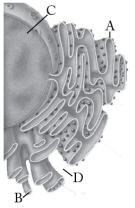
View Solution176
EasyMCQ
Identify the components labelled $A, B, C$ and $D$ in the diagram below from the list $(i)$ to $(viii)$ given along with:
Components:
$(i)$ Cristae of mitochondria
$(ii)$ Inner membrane of mitochondria
$(iii)$ Cytoplasm
$(iv)$ Smooth endoplasmic reticulum
$(v)$ Rough endoplasmic reticulum
$(vi)$ Mitochondrial matrix
$(vii)$ Cell vacuole
$(viii)$ Nucleus
The correct components are:
Components:
$(i)$ Cristae of mitochondria
$(ii)$ Inner membrane of mitochondria
$(iii)$ Cytoplasm
$(iv)$ Smooth endoplasmic reticulum
$(v)$ Rough endoplasmic reticulum
$(vi)$ Mitochondrial matrix
$(vii)$ Cell vacuole
$(viii)$ Nucleus
The correct components are:
A
$(A)-(v), (B)-(iv), (C)-(viii), (D)-(iii)$
B
$(A)-(i), (B)-(iv), (C)-(viii), (D)-(vi)$
C
$(A)-(vi), (B)-(v), (C)-(iv), (D)-(vii)$
D
$(A)-(v), (B)-(i), (C)-(iii), (D)-(ii)$
Solution
(A) Based on the provided diagram:
$A$ points to the Rough Endoplasmic Reticulum $(RER)$,which is studded with ribosomes.
$B$ points to the Smooth Endoplasmic Reticulum $(SER)$,which lacks ribosomes.
$C$ points to the Nucleus,which is the large central organelle.
$D$ points to the Cytoplasm,the fluid surrounding the organelles.
Therefore,the correct matching is:
$A - (v)$ (Rough endoplasmic reticulum)
$B - (iv)$ (Smooth endoplasmic reticulum)
$C - (viii)$ (Nucleus)
$D - (iii)$ (Cytoplasm)
Thus,the correct option is $(A)$.
$A$ points to the Rough Endoplasmic Reticulum $(RER)$,which is studded with ribosomes.
$B$ points to the Smooth Endoplasmic Reticulum $(SER)$,which lacks ribosomes.
$C$ points to the Nucleus,which is the large central organelle.
$D$ points to the Cytoplasm,the fluid surrounding the organelles.
Therefore,the correct matching is:
$A - (v)$ (Rough endoplasmic reticulum)
$B - (iv)$ (Smooth endoplasmic reticulum)
$C - (viii)$ (Nucleus)
$D - (iii)$ (Cytoplasm)
Thus,the correct option is $(A)$.
0 likes
View Solution177
MediumMCQ
Select the wrong statement from the following.
A
Both chloroplasts and mitochondria have an internal compartment,the thylakoid space bounded by the thylakoid membrane.
B
Both chloroplasts and mitochondria contain $DNA$.
C
The chloroplasts are generally much larger than mitochondria.
D
Both chloroplasts and mitochondria contain an inner and an outer membrane.
Solution
(A) is the incorrect statement.
$1$. Mitochondria and chloroplasts are semi-autonomous organelles. They contain their own $DNA$,which encodes for $mRNA$,$tRNA$,and $rRNA$.
$2$. Both organelles possess their own ribosomes,allowing them to synthesize some of their own proteins.
$3$. The thylakoid space and thylakoid membrane are specific to chloroplasts,not mitochondria. Mitochondria have an inner membrane folded into cristae,enclosing the matrix.
$4$. Both organelles are double-membrane bound structures,and chloroplasts are typically larger than mitochondria.
$1$. Mitochondria and chloroplasts are semi-autonomous organelles. They contain their own $DNA$,which encodes for $mRNA$,$tRNA$,and $rRNA$.
$2$. Both organelles possess their own ribosomes,allowing them to synthesize some of their own proteins.
$3$. The thylakoid space and thylakoid membrane are specific to chloroplasts,not mitochondria. Mitochondria have an inner membrane folded into cristae,enclosing the matrix.
$4$. Both organelles are double-membrane bound structures,and chloroplasts are typically larger than mitochondria.
0 likes
View Solution178
MediumMCQ
Adult human $RBCs$ are enucleate. Which of the following statement$(s)$ is/are most appropriate explanation for this feature?
$(1)$ They do not need to reproduce.
$(2)$ They are somatic cells.
$(3)$ They do not metabolise.
$(4)$ All their internal space is available for oxygen transport.
$(1)$ They do not need to reproduce.
$(2)$ They are somatic cells.
$(3)$ They do not metabolise.
$(4)$ All their internal space is available for oxygen transport.
A
Only $(1)$
B
$(1), (3)$ and $(4)$
C
$(2)$ and $(3)$
D
Only $(4)$
Solution
(D) The correct answer is $(d)$.
Adult human red blood cells $(RBCs)$ are enucleated,meaning they lack a nucleus and other cell organelles like mitochondria,ribosomes,and Golgi bodies.
The primary advantage of this structural adaptation is that it maximizes the internal space within the cell.
By removing the nucleus and organelles,the cell can accommodate a significantly larger amount of haemoglobin,which is the oxygen-carrying pigment.
This allows for more efficient transport of oxygen throughout the body.
Adult human red blood cells $(RBCs)$ are enucleated,meaning they lack a nucleus and other cell organelles like mitochondria,ribosomes,and Golgi bodies.
The primary advantage of this structural adaptation is that it maximizes the internal space within the cell.
By removing the nucleus and organelles,the cell can accommodate a significantly larger amount of haemoglobin,which is the oxygen-carrying pigment.
This allows for more efficient transport of oxygen throughout the body.
0 likes
View Solution179
EasyMCQ
Which of the following structures between two adjacent cells forms an effective transport pathway?
A
Plasmodesmata
B
Plastoquinones
C
Endoplasmic reticulum
D
Sarcoplasma
Solution
(A) Plasmodesmata are microscopic channels that traverse the cell walls of plant cells and some algal cells,enabling transport and communication between them.
These structures connect the cytoplasm of adjacent cells,forming a continuous cytoplasmic network known as the symplast.
This pathway allows for the movement of water,ions,and various molecules between cells,making it an effective transport pathway in plants.
These structures connect the cytoplasm of adjacent cells,forming a continuous cytoplasmic network known as the symplast.
This pathway allows for the movement of water,ions,and various molecules between cells,making it an effective transport pathway in plants.
0 likes
View Solution180
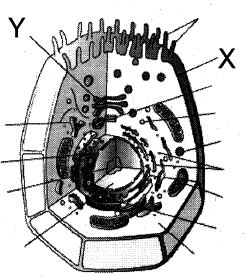
MediumMCQ
Identify $X$ and $Y$ from the figure.
A
Cell membrane - Lysosome
B
Golgi body - Cell membrane
C
Microvilli - Cell membrane
D
Cell membrane - Golgi body
Solution
(D) In the provided diagram of an animal cell:
$1$. The label $X$ points to the outermost boundary of the cell,which is the cell membrane.
$2$. The label $Y$ points to the stack of flattened,membrane-bound sacs known as the Golgi body (or Golgi apparatus).
Therefore,$X$ represents the cell membrane and $Y$ represents the Golgi body.
$1$. The label $X$ points to the outermost boundary of the cell,which is the cell membrane.
$2$. The label $Y$ points to the stack of flattened,membrane-bound sacs known as the Golgi body (or Golgi apparatus).
Therefore,$X$ represents the cell membrane and $Y$ represents the Golgi body.
0 likes
View Solution181
MediumMCQ
Identify the correct sequence starting from the synthesis of protein to its transportation and packaging.
A
$RER$ - Golgi body - Nucleus - Lysosomes
B
$SER$ - Golgi body - Lysosomes
C
$RER$ - Golgi body - Lysosomes
D
Lysosomes - Golgi body - $ER$
Solution
(C) The process of protein synthesis and packaging follows a specific pathway within the cell:
$1$. Proteins are synthesized on the ribosomes attached to the Rough Endoplasmic Reticulum $(RER)$.
$2$. These proteins are then transported to the Golgi apparatus (Golgi body) via transport vesicles.
$3$. In the Golgi body,these proteins are modified,sorted,and packaged into vesicles.
$4$. Finally,these vesicles may become lysosomes or be secreted out of the cell.
Therefore,the correct sequence is $RER$ - Golgi body - Lysosomes.
$1$. Proteins are synthesized on the ribosomes attached to the Rough Endoplasmic Reticulum $(RER)$.
$2$. These proteins are then transported to the Golgi apparatus (Golgi body) via transport vesicles.
$3$. In the Golgi body,these proteins are modified,sorted,and packaged into vesicles.
$4$. Finally,these vesicles may become lysosomes or be secreted out of the cell.
Therefore,the correct sequence is $RER$ - Golgi body - Lysosomes.
0 likes
View Solution182
MediumMCQ
Which of the following show phagocytosis?
A
Amoeba
B
$WBC$
C
None
D
$A$ and $B$ are correct
Solution
(D) Phagocytosis is a process by which a cell engulfs large particles or microorganisms.
$Amoeba$ uses pseudopodia to perform phagocytosis for feeding.
$WBCs$ (White Blood Cells),specifically neutrophils and macrophages,use phagocytosis to engulf and destroy pathogens as part of the immune response.
Therefore,both $Amoeba$ and $WBC$ exhibit phagocytosis.
$Amoeba$ uses pseudopodia to perform phagocytosis for feeding.
$WBCs$ (White Blood Cells),specifically neutrophils and macrophages,use phagocytosis to engulf and destroy pathogens as part of the immune response.
Therefore,both $Amoeba$ and $WBC$ exhibit phagocytosis.
0 likes
View Solution183
MediumMCQ
Identify the correct matching:
| Column-$I$ | Column-$II$ |
| $a$. Pinocytosis | $1$. Animal cell |
| $b$. Lysosomes | $2$. Cell wall |
| $c$. $ER$ | $3$. Acidic pH |
| $d$. Centriole | $4$. Ribosomes |
| $5$. Liquid food |
A
$a-5, b-1, c-4, d-1$
B
$a-5, b-3, c-2, d-1$
C
$a-4, b-1, c-5, d-2$
D
$a-5, b-3, c-4, d-1$
Solution
(D) The correct matching is as follows:
$a$. Pinocytosis is the process of ingestion of liquid materials into the cell,often referred to as 'cell drinking'. Thus,$a-5$.
$b$. Lysosomes contain hydrolytic enzymes that function optimally at an acidic pH. Thus,$b-3$.
$c$. Endoplasmic Reticulum $(ER)$ is often associated with ribosomes (Rough $ER$). Thus,$c-4$.
$d$. Centrioles are present in animal cells and are absent in most plant cells. Thus,$d-1$.
Therefore,the correct sequence is $a-5, b-3, c-4, d-1$.
$a$. Pinocytosis is the process of ingestion of liquid materials into the cell,often referred to as 'cell drinking'. Thus,$a-5$.
$b$. Lysosomes contain hydrolytic enzymes that function optimally at an acidic pH. Thus,$b-3$.
$c$. Endoplasmic Reticulum $(ER)$ is often associated with ribosomes (Rough $ER$). Thus,$c-4$.
$d$. Centrioles are present in animal cells and are absent in most plant cells. Thus,$d-1$.
Therefore,the correct sequence is $a-5, b-3, c-4, d-1$.
0 likes
View Solution184
MediumMCQ
Identify the odd one out from the following cell components.
A
Golgi body
B
Lysosomes
C
Endoplasmic reticulum $(ER)$
D
Cytoplasm
Solution
(D) The correct answer is $D$ (Cytoplasm).
$A$,$B$,and $C$ (Golgi body,Lysosomes,and $ER$) are all membrane-bound cell organelles found within the eukaryotic cell.
$D$ (Cytoplasm) is the jelly-like substance that fills the cell and surrounds these organelles,rather than being an organelle itself.
$A$,$B$,and $C$ (Golgi body,Lysosomes,and $ER$) are all membrane-bound cell organelles found within the eukaryotic cell.
$D$ (Cytoplasm) is the jelly-like substance that fills the cell and surrounds these organelles,rather than being an organelle itself.
0 likes
View Solution185
MediumMCQ
Read Column-$A$ and Column-$B$ and select the correct option.
| $1$. Mycoplasma | $p$. plant cell |
| $2$. Mesophyll cells | $q$. filament,hook and basal body |
| $3$. Capsule | $r$. Prokaryotic cell |
| $4$. Flagella | $s$. Glycocalyx |
A
$1-p, 2-q, 3-r, 4-s$
B
$1-q, 2-r, 3-p, 4-s$
C
$1-r, 2-p, 3-s, 4-q$
D
$1-s, 2-p, 3-q, 4-r$
Solution
(C) $1$. Mycoplasma is a type of prokaryotic cell lacking a cell wall $(1-r)$.
$2$. Mesophyll cells are specialized cells found in leaves,which are plant cells $(2-p)$.
$3$. Capsule is a type of glycocalyx layer found in some bacteria $(3-s)$.
$4$. Flagella in bacteria consist of three parts: filament,hook,and basal body $(4-q)$.
Therefore,the correct matching is $1-r, 2-p, 3-s, 4-q$.
$2$. Mesophyll cells are specialized cells found in leaves,which are plant cells $(2-p)$.
$3$. Capsule is a type of glycocalyx layer found in some bacteria $(3-s)$.
$4$. Flagella in bacteria consist of three parts: filament,hook,and basal body $(4-q)$.
Therefore,the correct matching is $1-r, 2-p, 3-s, 4-q$.
0 likes
View Solution186
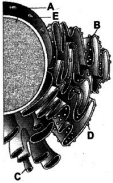
MediumMCQ
Identify the labels $A, B, C, D$ and $E$ in the given diagram. The following components are listed:
$(i)$ $SER$
$(ii)$ Ribosome
$(iii)$ Nucleus
$(iv)$ Nuclear pore
$(v)$ $RER$
$(i)$ $SER$
$(ii)$ Ribosome
$(iii)$ Nucleus
$(iv)$ Nuclear pore
$(v)$ $RER$
A
$A-v, B-i, C-ii, D-iv, E-iii$
B
$A-i, B-iii, C-ii, D-v, E-iv$
C
$A-iii, B-v, C-i, D-ii, E-iv$
D
$A-iii, B-i, C-ii, D-v, E-iv$
Solution
(C) Based on the provided diagram of the endomembrane system:
$A$ points to the central organelle,which is the Nucleus $(iii)$.
$B$ points to the Rough Endoplasmic Reticulum $(RER)$ $(v)$.
$C$ points to the Smooth Endoplasmic Reticulum $(SER)$ $(i)$.
$D$ points to the Ribosomes $(ii)$ attached to the $RER$.
$E$ points to the Nuclear pore $(iv)$ on the nuclear envelope.
Therefore,the correct matching is $A-iii, B-v, C-i, D-ii, E-iv$.
$A$ points to the central organelle,which is the Nucleus $(iii)$.
$B$ points to the Rough Endoplasmic Reticulum $(RER)$ $(v)$.
$C$ points to the Smooth Endoplasmic Reticulum $(SER)$ $(i)$.
$D$ points to the Ribosomes $(ii)$ attached to the $RER$.
$E$ points to the Nuclear pore $(iv)$ on the nuclear envelope.
Therefore,the correct matching is $A-iii, B-v, C-i, D-ii, E-iv$.
0 likes
View Solution187
EasyMCQ
Which organelle given below is not a part of the endomembrane system?
A
Ribosome
B
$ER$
C
Lysosome
D
Vacuole
Solution
(A) The endomembrane system includes organelles whose functions are coordinated,such as the Endoplasmic Reticulum $(ER)$,Golgi complex,lysosomes,and vacuoles.
Ribosomes are not membrane-bound organelles and are not part of the endomembrane system because they are involved in protein synthesis rather than the transport or processing pathways defined by the endomembrane system.
Ribosomes are not membrane-bound organelles and are not part of the endomembrane system because they are involved in protein synthesis rather than the transport or processing pathways defined by the endomembrane system.
0 likes
View Solution188
MediumMCQ
Match the following.
| Column-$I$ | Column-$II$ |
| $A$. Vacuole | $i$. Krebs cycle |
| $B$. Mitochondria | $ii$. Photosynthesis |
| $C$. Golgi body | $iii$. Excretion |
| $D$. Chloroplast | $iv$. Synthesis site of glycolipid and glycoprotein |
A
$(A-iv), (B-iii), (C-ii), (D-i)$
B
$(A-iii), (B-i), (C-iv), (D-ii)$
C
$(A-ii), (B-i), (C-iv), (D-i)$
D
$(A-i), (B-iv), (C-iii), (D-ii)$
Solution
(B) The correct matches are as follows:
$A$. Vacuole: Involved in storage and excretion of waste products $(iii)$.
$B$. Mitochondria: The site of aerobic respiration,specifically the Krebs cycle $(i)$.
$C$. Golgi body: Acts as the site for the synthesis and packaging of glycolipids and glycoproteins $(iv)$.
$D$. Chloroplast: The site of photosynthesis in plant cells $(ii)$.
Therefore,the correct matching is $(A-iii), (B-i), (C-iv), (D-ii)$.
$A$. Vacuole: Involved in storage and excretion of waste products $(iii)$.
$B$. Mitochondria: The site of aerobic respiration,specifically the Krebs cycle $(i)$.
$C$. Golgi body: Acts as the site for the synthesis and packaging of glycolipids and glycoproteins $(iv)$.
$D$. Chloroplast: The site of photosynthesis in plant cells $(ii)$.
Therefore,the correct matching is $(A-iii), (B-i), (C-iv), (D-ii)$.
0 likes
View Solution189
MediumMCQ
Identify the correct pair from the following.
A
Fungi - Contractile vacuole
B
Lysosome - Suicidal body
C
Mitochondria - Cisternae
D
$RER$ - Synthesis of glycolipid
Solution
(B) The correct pair is $B$ (Lysosome - Suicidal body).
$1$. Lysosomes contain hydrolytic enzymes (hydrolases) that can digest cellular components,earning them the name 'suicidal bags' or 'suicidal bodies'.
$2$. Fungi do not typically possess contractile vacuoles; these are common in freshwater protists like Amoeba for osmoregulation.
$3$. Mitochondria contain cristae (folds of the inner membrane),not cisternae (which are found in the Golgi apparatus).
$4$. $RER$ (Rough Endoplasmic Reticulum) is primarily involved in protein synthesis,while the synthesis of glycolipids and glycoproteins occurs in the Golgi apparatus.
$1$. Lysosomes contain hydrolytic enzymes (hydrolases) that can digest cellular components,earning them the name 'suicidal bags' or 'suicidal bodies'.
$2$. Fungi do not typically possess contractile vacuoles; these are common in freshwater protists like Amoeba for osmoregulation.
$3$. Mitochondria contain cristae (folds of the inner membrane),not cisternae (which are found in the Golgi apparatus).
$4$. $RER$ (Rough Endoplasmic Reticulum) is primarily involved in protein synthesis,while the synthesis of glycolipids and glycoproteins occurs in the Golgi apparatus.
0 likes
View Solution190
MediumMCQ
Match the following.
| $A$. Microfilament | $i$. Cellulose |
| $B$. Microtubules | $ii$. Cytoskeleton |
| $C$. Intermediate filament | $iii$. In cilia and flagella |
| $D$. Cell wall | $iv$. Durable protein |
A
$(A-ii), (B-iii), (C-iv), (D-i)$
B
$(A-i), (B-ii), (C-iv), (D-iii)$
C
$(A-i), (B-iii), (C-i), (D-iv)$
D
$(A-iv), (B-i), (C-iii), (D-ii)$
Solution
(A) . Microfilaments are components of the cytoskeleton.
$B$. Microtubules are structural components found in cilia and flagella.
$C$. Intermediate filaments are composed of durable proteins that provide mechanical strength.
$D$. The cell wall in plants is primarily composed of cellulose.
Therefore,the correct matching is $(A-ii), (B-iii), (C-iv), (D-i)$.
$B$. Microtubules are structural components found in cilia and flagella.
$C$. Intermediate filaments are composed of durable proteins that provide mechanical strength.
$D$. The cell wall in plants is primarily composed of cellulose.
Therefore,the correct matching is $(A-ii), (B-iii), (C-iv), (D-i)$.
0 likes
View Solution191
MediumMCQ
Which of the following statements is correct?
A
Virchow first explained that the thin outer layer of an animal cell is the plasma membrane.
B
Cell division occurs very rapidly in prokaryotic cells.
C
Free ribosomes in the cytoplasm perform lipid synthesis.
D
Particles that store starch are known as phosphate particles.
Solution
(B) The correct statement is that cell division occurs very rapidly in prokaryotic cells $(B)$.
- Option $A$ is incorrect because Schwann reported that cells have a thin outer layer which is today known as the plasma membrane.
- Option $C$ is incorrect because free ribosomes are responsible for protein synthesis,while smooth endoplasmic reticulum $(SER)$ is responsible for lipid synthesis.
- Option $D$ is incorrect because particles that store starch are known as amyloplasts,not phosphate particles.
- Option $A$ is incorrect because Schwann reported that cells have a thin outer layer which is today known as the plasma membrane.
- Option $C$ is incorrect because free ribosomes are responsible for protein synthesis,while smooth endoplasmic reticulum $(SER)$ is responsible for lipid synthesis.
- Option $D$ is incorrect because particles that store starch are known as amyloplasts,not phosphate particles.
0 likes
View Solution192
MediumMCQ
Match the following.
| $A$. Microfilament | $i$. Glycocalyx |
| $B$. Microtubule | $ii$. Actin |
| $C$. Flagella | $iii$. Tubulin |
| $D$. Outer layer of bacteria | $iv$. Outer compartment |
A
$(A-ii), (B-iii), (C-iv), (D-i)$
B
$(A-iii), (B-ii), (C-iv), (D-i)$
C
$(A-ii), (B-iii), (C-i), (D-iv)$
D
$(A-iv), (B-i), (C-iii), (D-ii)$
Solution
(A) The correct matches are as follows:
$1$. Microfilaments are composed of the protein $Actin$ $(A-ii)$.
$2$. Microtubules are composed of the protein $Tubulin$ $(B-iii)$.
$3$. Flagella in eukaryotes are associated with the outer compartment or extension of the cell membrane $(C-iv)$.
$4$. The outer layer of bacteria is known as the $Glycocalyx$ $(D-i)$.
Therefore,the correct sequence is $(A-ii), (B-iii), (C-iv), (D-i)$.
$1$. Microfilaments are composed of the protein $Actin$ $(A-ii)$.
$2$. Microtubules are composed of the protein $Tubulin$ $(B-iii)$.
$3$. Flagella in eukaryotes are associated with the outer compartment or extension of the cell membrane $(C-iv)$.
$4$. The outer layer of bacteria is known as the $Glycocalyx$ $(D-i)$.
Therefore,the correct sequence is $(A-ii), (B-iii), (C-iv), (D-i)$.
0 likes
View Solution193
MediumMCQ
Identify the incorrect pair.
A
Egg of ostrich - largest cell
B
Mycoplasma - smallest cell
C
Kinetochore - organelle without membrane
D
Mantle - present on cytoplasmic region
Solution
(D) $1$. The egg of an ostrich is the largest isolated single cell.
$2$. Mycoplasma are the smallest living cells,measuring about $0.3 \mu m$ in length.
$3$. $A$ Kinetochore is a protein structure on chromatids where spindle fibers attach during cell division; it is not an organelle,and the term 'organelle without membrane' usually refers to structures like ribosomes or centrioles.
$4$. The 'Mantle' is not a standard term for a structure present in the cytoplasmic region of a cell in the context of cell biology. Therefore,option $D$ is the incorrect pair.
$2$. Mycoplasma are the smallest living cells,measuring about $0.3 \mu m$ in length.
$3$. $A$ Kinetochore is a protein structure on chromatids where spindle fibers attach during cell division; it is not an organelle,and the term 'organelle without membrane' usually refers to structures like ribosomes or centrioles.
$4$. The 'Mantle' is not a standard term for a structure present in the cytoplasmic region of a cell in the context of cell biology. Therefore,option $D$ is the incorrect pair.
0 likes
View Solution194
EasyMCQ
Which organelle has a single membrane?
A
Lysosome
B
Golgi bodies
C
Nucleus
D
Endoplasmic reticulum
Solution
(A) The organelles are classified based on the number of membranes they possess:
$1$. Double-membrane bound organelles: Nucleus,Mitochondria,and Chloroplasts.
$2$. Single-membrane bound organelles: Lysosomes,Golgi bodies,Endoplasmic reticulum,and Vacuoles.
$3$. Non-membrane bound organelles: Ribosomes and Centrosomes.
Since the question asks for an organelle with a single membrane,options $A$,$B$,and $D$ are all technically single-membrane bound. However,in many standard biology contexts,Lysosomes are the most classic example of single-membrane organelles. Given the options provided,all $A$,$B$,and $D$ are correct. If this is a single-choice question,Lysosomes are often cited as the primary example.
$1$. Double-membrane bound organelles: Nucleus,Mitochondria,and Chloroplasts.
$2$. Single-membrane bound organelles: Lysosomes,Golgi bodies,Endoplasmic reticulum,and Vacuoles.
$3$. Non-membrane bound organelles: Ribosomes and Centrosomes.
Since the question asks for an organelle with a single membrane,options $A$,$B$,and $D$ are all technically single-membrane bound. However,in many standard biology contexts,Lysosomes are the most classic example of single-membrane organelles. Given the options provided,all $A$,$B$,and $D$ are correct. If this is a single-choice question,Lysosomes are often cited as the primary example.
0 likes
View Solution195
MediumMCQ
In the following,which is not common for chloroplasts and mitochondria?
A
Both are present in animal cells.
B
Both have their own genetic material.
C
Both are present in eukaryotic cells.
D
Both are self-replicating.
Solution
(A) Chloroplasts and mitochondria are both semi-autonomous organelles found in eukaryotic cells.
$1$. Both contain their own circular $DNA$ and ribosomes,allowing them to synthesize some of their own proteins.
$2$. Both are capable of self-replication through binary fission.
$3$. However,chloroplasts are primarily found in plant cells and some protists (like algae) to perform photosynthesis,whereas they are absent in animal cells. Mitochondria are found in almost all eukaryotic cells,including animal cells.
Therefore,being present in animal cells is not a common feature.
$1$. Both contain their own circular $DNA$ and ribosomes,allowing them to synthesize some of their own proteins.
$2$. Both are capable of self-replication through binary fission.
$3$. However,chloroplasts are primarily found in plant cells and some protists (like algae) to perform photosynthesis,whereas they are absent in animal cells. Mitochondria are found in almost all eukaryotic cells,including animal cells.
Therefore,being present in animal cells is not a common feature.
0 likes
View Solution196
MediumMCQ
Match the following.
| Column-$I$ | Column-$II$ |
| $a$. Cristae | $i$. Flattened membrane sacs like structure present in stroma |
| $b$. Cisternae | $ii$. Infolding of mitochondria |
| $c$. Thylakoids | $iii$. Disc-shaped sacs |
| $d$. Kinetochores | $iv$. Disc-shaped structure present in chromosome |
A
$(a-ii), (b-iii), (c-i), (d-iv)$
B
$(a-ii), (b-i), (c-iii), (d-iv)$
C
$(a-iii), (b-i), (c-ii), (d-iv)$
D
$(a-i), (b-iii), (c-ii), (d-iv)$
Solution
(A) . Cristae are the infoldings of the inner mitochondrial membrane,which increase the surface area for biochemical reactions. Thus,$a-ii$.
$b$. Cisternae are the flattened,disc-shaped sacs found in the Golgi apparatus. Thus,$b-iii$.
$c$. Thylakoids are flattened,sac-like structures present in the stroma of chloroplasts,which are the sites of light-dependent reactions. Thus,$c-i$.
$d$. Kinetochores are disc-shaped protein structures associated with the centromere of a chromosome,where spindle fibers attach during cell division. Thus,$d-iv$.
Therefore,the correct matching is $(a-ii), (b-iii), (c-i), (d-iv)$.
$b$. Cisternae are the flattened,disc-shaped sacs found in the Golgi apparatus. Thus,$b-iii$.
$c$. Thylakoids are flattened,sac-like structures present in the stroma of chloroplasts,which are the sites of light-dependent reactions. Thus,$c-i$.
$d$. Kinetochores are disc-shaped protein structures associated with the centromere of a chromosome,where spindle fibers attach during cell division. Thus,$d-iv$.
Therefore,the correct matching is $(a-ii), (b-iii), (c-i), (d-iv)$.
0 likes
View Solution197
MediumMCQ
Choose the correct pair:
A
Prokaryotic cell $\rightarrow$ Ostrich's egg
B
Animal cell $\rightarrow$ Cell wall present
C
Plant cell $\rightarrow$ Presence of centriole
D
Eukaryotic cell $\rightarrow$ Presence of Nuclear membrane
Solution
(D) The correct pair is $D$.
$A$ is incorrect because an Ostrich's egg is a single eukaryotic cell,not a prokaryotic cell.
$B$ is incorrect because animal cells lack a cell wall; they only have a cell membrane.
$C$ is incorrect because plant cells typically lack centrioles,which are characteristic of animal cells.
$D$ is correct because a defining feature of eukaryotic cells is the presence of a well-defined nucleus enclosed by a nuclear membrane.
$A$ is incorrect because an Ostrich's egg is a single eukaryotic cell,not a prokaryotic cell.
$B$ is incorrect because animal cells lack a cell wall; they only have a cell membrane.
$C$ is incorrect because plant cells typically lack centrioles,which are characteristic of animal cells.
$D$ is correct because a defining feature of eukaryotic cells is the presence of a well-defined nucleus enclosed by a nuclear membrane.
0 likes
View Solution198
MediumMCQ
Match the following.
| Column-$I$ | Column-$II$ |
| $(1)$ Typical bacterial | $(p)$ Site of protein synthesis |
| $(2)$ Ribosome | $(q)$ $1-2 \ \mu m$ |
| $(3)$ Long and branched | $(r)$ Control of bacterial transformation |
| $(4)$ Plasmid | $(s)$ Nerve cell |
A
$(1-p), (2-q), (3-r), (4-s)$
B
$(1-q), (2-p), (3-s), (4-r)$
C
$(1-r), (2-s), (3-p), (4-q)$
D
$(1-s), (2-r), (3-q), (4-p)$
Solution
(B) The correct matches are as follows:
$(1)$ Typical bacterial cell size is generally $1-2 \ \mu m$. Thus,$(1-q)$.
$(2)$ Ribosomes are the sites of protein synthesis in the cell. Thus,$(2-p)$.
$(3)$ Nerve cells are characterized as long and branched structures for signal transmission. Thus,$(3-s)$.
$(4)$ Plasmids are small,circular,extrachromosomal $DNA$ molecules in bacteria that often carry genes for antibiotic resistance or other traits,involved in bacterial transformation. Thus,$(4-r)$.
Therefore,the correct sequence is $(1-q), (2-p), (3-s), (4-r)$.
$(1)$ Typical bacterial cell size is generally $1-2 \ \mu m$. Thus,$(1-q)$.
$(2)$ Ribosomes are the sites of protein synthesis in the cell. Thus,$(2-p)$.
$(3)$ Nerve cells are characterized as long and branched structures for signal transmission. Thus,$(3-s)$.
$(4)$ Plasmids are small,circular,extrachromosomal $DNA$ molecules in bacteria that often carry genes for antibiotic resistance or other traits,involved in bacterial transformation. Thus,$(4-r)$.
Therefore,the correct sequence is $(1-q), (2-p), (3-s), (4-r)$.
0 likes
View Solution199
MediumMCQ
Choose the correct option regarding cell structure and components:
A
$a-$ Some mature cells,$e.g.$,erythrocytes of many mammals,lack a nucleus.
$b-$ Sieve tube cells of vascular plants have a nucleus.
$b-$ Sieve tube cells of vascular plants have a nucleus.
B
$a-$ Centrioles are surrounded by a cell membrane.
$b-$ Pairs of microtubules are present in a centriole.
$b-$ Pairs of microtubules are present in a centriole.
C
$a-$ Cytoskeleton contains microfilaments made up of protein.
$b-$ $70S$ ribosomes are present in chloroplasts.
$b-$ $70S$ ribosomes are present in chloroplasts.
D
$a-$ The color of plants is due to aleuroplasts.
$b-$ Vacuoles can occupy up to $90\%$ of the volume of the animal cell.
$b-$ Vacuoles can occupy up to $90\%$ of the volume of the animal cell.
Solution
(C) Let us analyze the statements:
$a-$ Erythrocytes of many mammals (like humans) are enucleated at maturity. This is correct.
$b-$ Sieve tube cells of vascular plants lack a nucleus at maturity. This is incorrect.
$c-$ Centrioles are not membrane-bound organelles. This is incorrect.
$d-$ Centrioles consist of triplets of microtubules,not pairs. This is incorrect.
$e-$ The cytoskeleton is composed of microfilaments,intermediate filaments,and microtubules,which are proteinaceous. This is correct.
$f-$ Chloroplasts contain $70S$ ribosomes (prokaryotic type). This is correct.
$g-$ Aleuroplasts store proteins,not pigments. Chloroplasts and chromoplasts are responsible for plant color. This is incorrect.
$h-$ Vacuoles occupy up to $90\%$ of the volume of plant cells,not animal cells. This is incorrect.
Therefore,option $C$ contains two correct statements.
$a-$ Erythrocytes of many mammals (like humans) are enucleated at maturity. This is correct.
$b-$ Sieve tube cells of vascular plants lack a nucleus at maturity. This is incorrect.
$c-$ Centrioles are not membrane-bound organelles. This is incorrect.
$d-$ Centrioles consist of triplets of microtubules,not pairs. This is incorrect.
$e-$ The cytoskeleton is composed of microfilaments,intermediate filaments,and microtubules,which are proteinaceous. This is correct.
$f-$ Chloroplasts contain $70S$ ribosomes (prokaryotic type). This is correct.
$g-$ Aleuroplasts store proteins,not pigments. Chloroplasts and chromoplasts are responsible for plant color. This is incorrect.
$h-$ Vacuoles occupy up to $90\%$ of the volume of plant cells,not animal cells. This is incorrect.
Therefore,option $C$ contains two correct statements.
0 likes
View Solution200
MediumMCQ
Choose the incorrect option.
A
Centriole - Composed of tubulin
B
Ribosomes - Contain $rRNA$
C
Centriole - Present in all plants and animals
D
Ribozymes - Acts as an enzyme
Solution
(C) The correct answer is $C$.
Centrioles are cylindrical structures composed of microtubule triplets made of tubulin protein.
They are typically found in animal cells and some lower plant cells (like certain algae and bryophytes),but they are absent in the cells of higher plants (angiosperms and gymnosperms).
Therefore,the statement that centrioles are present in all plants and animals is incorrect.
Ribosomes are composed of $rRNA$ and proteins.
Ribozymes are $RNA$ molecules that possess catalytic activity,thus acting as enzymes.
Centrioles are cylindrical structures composed of microtubule triplets made of tubulin protein.
They are typically found in animal cells and some lower plant cells (like certain algae and bryophytes),but they are absent in the cells of higher plants (angiosperms and gymnosperms).
Therefore,the statement that centrioles are present in all plants and animals is incorrect.
Ribosomes are composed of $rRNA$ and proteins.
Ribozymes are $RNA$ molecules that possess catalytic activity,thus acting as enzymes.
0 likes
View SolutionCell: The Unit of Life — Mix Example-Cell: The Unit of Life · Frequently Asked Questions
1Are these Cell: The Unit of Life questions useful for JEE and NEET?
Yes. All questions in this section are mapped to JEE Main and NEET exam patterns. Previous year questions from JEE Main, NEET, GUJCET and state-level exams are included with full solutions.
2Can I switch to Hindi or Gujarati for these questions?
Yes. Use the language tabs in the hero section or the sidebar to view the same questions and solutions in English, Hindi or Gujarati.
3How do I generate a question paper from this subtopic?
Use the Vedclass Exam Paper Generator — select the chapter and subtopic, set difficulty, and generate Sets A, B, C, D automatically. First 3 chapters of every subject are free.
Vedclass Products
For Students
Vedclass Test Series
Mock tests in real JEE/NEET style with performance analysis. 5-day free trial.
Start Free TrialFor Teachers
Exam Paper Generator
Generate Set A/B/C/D papers from this chapter in 2 minutes. 3 chapters free.
Try FreeFor Institutes
Online Exam Module
Live online exams with unlimited students, 360° analytics & white-label branding.
See DemoFor Teachers & Institutes
Generate a Cell: The Unit of Life Exam Paper in 2 Minutes
Select subtopic & difficulty — Sets A, B, C, D auto-generated with No Repeat logic.
First 3 chapters of every subject are free — no payment required.