
A English
Mix Example-Cell: The Unit of Life Questions in English
Class 11 Biology · Cell: The Unit of Life · Mix Example-Cell: The Unit of Life
300+
Questions
English
Language
100%
With Solutions
Showing 50 of 300 questions in English
101
MediumMCQ
The cell is considered one of the wonders of the world because...
A
It reproduces as per requirement.
B
It contains genetic material responsible for heredity.
C
It can perform specific functions through energy transformation.
D
All of the above.
Solution
(D) The cell is the fundamental structural and functional unit of life. It is considered a wonder because:
$1$. It possesses the ability to reproduce (cell division) to maintain life and growth.
$2$. It contains $DNA$,which acts as the genetic material responsible for heredity and protein synthesis.
$3$. It performs complex metabolic activities and specific functions by transforming energy (e.g.,$ATP$ production in mitochondria).
Since all these statements are correct,the correct option is $D$.
$1$. It possesses the ability to reproduce (cell division) to maintain life and growth.
$2$. It contains $DNA$,which acts as the genetic material responsible for heredity and protein synthesis.
$3$. It performs complex metabolic activities and specific functions by transforming energy (e.g.,$ATP$ production in mitochondria).
Since all these statements are correct,the correct option is $D$.
0 likes
View Solution102
EasyMCQ
Except for bacteria,what do all cells contain within their cell membrane?
A
Cytoplasm and cell membrane
B
Nucleus and cell wall
C
Cytoplasm and nucleus
D
None of the above
Solution
(C) All cells (except bacteria) are eukaryotic cells.
Eukaryotic cells contain a membrane-bound nucleus and other membrane-bound organelles.
The cytoplasm is the semi-fluid matrix that occupies the volume of the cell.
Therefore,all cells contain cytoplasm and a nucleus within their cell membrane.
Eukaryotic cells contain a membrane-bound nucleus and other membrane-bound organelles.
The cytoplasm is the semi-fluid matrix that occupies the volume of the cell.
Therefore,all cells contain cytoplasm and a nucleus within their cell membrane.
0 likes
View Solution103
EasyMCQ
Match the following columns correctly.
| Column-$I$ | Column-$II$ |
| $(a)$ Membrane-bound organelle | $(p)$ Ribosomes |
| $(b)$ Non-membrane-bound organelle | $(q)$ Mitochondria |
| $(c)$ Largest cell | $(r)$ Mycoplasma |
| $(d)$ Smallest cell | $(s)$ Ostrich egg |
A
$(a-p), (b-r), (c-s), (d-q)$
B
$(a-s), (b-q), (c-r), (d-p)$
C
$(a-r), (b-s), (c-p), (d-q)$
D
$(a-q), (b-p), (c-s), (d-r)$
Solution
(D) Membrane-bound organelle: Mitochondria $(q)$ is a double-membrane-bound organelle.
$(b)$ Non-membrane-bound organelle: Ribosomes $(p)$ are organelles found in both prokaryotic and eukaryotic cells that lack a membrane.
$(c)$ Largest cell: The egg of an ostrich $(s)$ is the largest isolated single cell.
$(d)$ Smallest cell: Mycoplasma $(r)$ are the smallest known cells.
Therefore, the correct matching is $(a-q), (b-p), (c-s), (d-r)$.
$(b)$ Non-membrane-bound organelle: Ribosomes $(p)$ are organelles found in both prokaryotic and eukaryotic cells that lack a membrane.
$(c)$ Largest cell: The egg of an ostrich $(s)$ is the largest isolated single cell.
$(d)$ Smallest cell: Mycoplasma $(r)$ are the smallest known cells.
Therefore, the correct matching is $(a-q), (b-p), (c-s), (d-r)$.
0 likes
View Solution104
EasyMCQ
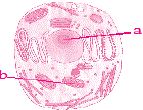
In the given figure,what do the labeled parts 'a' and 'b' represent respectively?
A
Mitochondria,Nucleus
B
Nucleoplasm,Mitochondria
C
Nucleolus,Mitochondria
D
Chloroplast,Nucleolus
Solution
(C) In the provided diagram of the animal cell:
- The label 'a' points to the dense,spherical structure inside the nucleus,which is the nucleolus.
- The label 'b' points to the rod-shaped or oval organelle known as the mitochondria,which is responsible for cellular respiration and $ATP$ production.
- Therefore,'a' represents the nucleolus and 'b' represents the mitochondria.
- The label 'a' points to the dense,spherical structure inside the nucleus,which is the nucleolus.
- The label 'b' points to the rod-shaped or oval organelle known as the mitochondria,which is responsible for cellular respiration and $ATP$ production.
- Therefore,'a' represents the nucleolus and 'b' represents the mitochondria.
0 likes
View Solution105
EasyMCQ
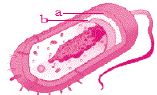
In the given figure,what do the parts labeled '$a$' and '$b$' represent respectively?
A
Cell wall,Ribosomes
B
Capsule,Nucleoid
C
Capsule,Cell wall
D
Nucleoid,Cell wall
Solution
(C) The provided figure represents a bacterial cell.
In the bacterial cell envelope,the outermost layer is the capsule (labeled '$a$'),which provides protection.
The layer immediately beneath the capsule is the cell wall (labeled '$b$'),which provides structural support and shape to the cell.
In the bacterial cell envelope,the outermost layer is the capsule (labeled '$a$'),which provides protection.
The layer immediately beneath the capsule is the cell wall (labeled '$b$'),which provides structural support and shape to the cell.
0 likes
View Solution106
EasyMCQ
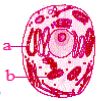
In the given figure,what do $a$ and $b$ represent respectively?
A
Rough Endoplasmic Reticulum,Mitochondrion
B
Mitochondrion,Ribosome
C
Nucleolus,Golgi apparatus
D
Smooth Endoplasmic Reticulum,Ribosome
Solution
(A) In the provided diagram of a cell,the structure labeled '$a$' represents the Rough Endoplasmic Reticulum $(RER)$,which is characterized by the presence of ribosomes on its surface.
The structure labeled '$b$' represents the Mitochondrion,which is an oval-shaped organelle with internal folds known as cristae.
Therefore,'$a$' is the Rough Endoplasmic Reticulum and '$b$' is the Mitochondrion.
The structure labeled '$b$' represents the Mitochondrion,which is an oval-shaped organelle with internal folds known as cristae.
Therefore,'$a$' is the Rough Endoplasmic Reticulum and '$b$' is the Mitochondrion.
0 likes
View Solution107
MediumMCQ
In the given figure,what do $a$ and $b$ represent respectively?

A
Starch grain,Mitochondrion
B
Vacuole,Nucleus
C
Mitochondrion,Golgi body
D
Crystals,Starch grain
Solution
(A) The provided figure represents a plant cell.
In the diagram,label '$a$' points to a large,prominent structure within the cell,which is the nucleus.
Label '$b$' points to a smaller,dense organelle located in the cytoplasm,which represents a starch grain (amyloplast).
Therefore,'$a$' represents the nucleus and '$b$' represents a starch grain.
However,looking at the options provided and the standard representation of such diagrams in biology textbooks,'$a$' is often identified as a starch grain and '$b$' as a mitochondrion in specific contexts of plant cell ultrastructure diagrams.
Given the options,option $A$ is the most appropriate identification.
In the diagram,label '$a$' points to a large,prominent structure within the cell,which is the nucleus.
Label '$b$' points to a smaller,dense organelle located in the cytoplasm,which represents a starch grain (amyloplast).
Therefore,'$a$' represents the nucleus and '$b$' represents a starch grain.
However,looking at the options provided and the standard representation of such diagrams in biology textbooks,'$a$' is often identified as a starch grain and '$b$' as a mitochondrion in specific contexts of plant cell ultrastructure diagrams.
Given the options,option $A$ is the most appropriate identification.
0 likes
View Solution108
EasyMCQ
Which of the following statements are correct?
$I$. $PPLO$ is the smallest cell.
$II$. Prokaryotic cells are smaller than eukaryotic cells.
$III$. Cell division in prokaryotic cells is slow.
$IV$. All bacteria show solitary and colonial forms.
$V$. Cell division in prokaryotic cells is very rapid.
$I$. $PPLO$ is the smallest cell.
$II$. Prokaryotic cells are smaller than eukaryotic cells.
$III$. Cell division in prokaryotic cells is slow.
$IV$. All bacteria show solitary and colonial forms.
$V$. Cell division in prokaryotic cells is very rapid.
A
$I, III, V$
B
$I, II, V$
C
$II, IV, V$
D
$II, III, IV$
Solution
(B) $1$. $PPLO$ (Pleuro Pneumonia-Like Organisms) are indeed the smallest known cells $(0.1 \ \mu m)$. Thus,statement $I$ is correct.
$2$. Prokaryotic cells are generally smaller and multiply much more rapidly than eukaryotic cells. Thus,statement $II$ is correct and statement $III$ is incorrect.
$3$. Statement $IV$ is incorrect because while many bacteria are solitary or colonial,some are filamentous; the statement 'all' is too restrictive.
$4$. Statement $V$ is correct as prokaryotic cells divide very rapidly due to their simple structure and lack of complex organelles.
$5$. Combining the correct statements $(I, II, V)$,the correct option is $B$.
$2$. Prokaryotic cells are generally smaller and multiply much more rapidly than eukaryotic cells. Thus,statement $II$ is correct and statement $III$ is incorrect.
$3$. Statement $IV$ is incorrect because while many bacteria are solitary or colonial,some are filamentous; the statement 'all' is too restrictive.
$4$. Statement $V$ is correct as prokaryotic cells divide very rapidly due to their simple structure and lack of complex organelles.
$5$. Combining the correct statements $(I, II, V)$,the correct option is $B$.
0 likes
View Solution109
MediumMCQ
Which of the following is $NOT$ formed due to the extension of the plasma membrane?
A
Mesosomes
B
Vacuoles
C
Mitochondria
D
Tubules
Solution
(C) The plasma membrane of prokaryotic cells can extend into the cytoplasm to form structures like $Mesosomes$,$Tubules$,and $Lamellae$. Vacuoles in some prokaryotes are also membrane-bound structures derived from the plasma membrane. However,$Mitochondria$ are double-membrane-bound organelles found only in eukaryotic cells. They are not formed by the extension of the plasma membrane of the cell.
0 likes
View Solution110
EasyMCQ
Which of the following is absent in an animal cell?
A
Cell wall
B
Plastids
C
Large central vacuole
D
All of the above
Solution
(D) Animal cells differ from plant cells in several ways.
$1$. Animal cells lack a rigid cell wall,which is a characteristic feature of plant cells.
$2$. Animal cells do not contain plastids (such as chloroplasts),which are responsible for photosynthesis in plants.
$3$. While animal cells may contain small,temporary vacuoles,they lack the large,permanent central vacuole found in mature plant cells.
Therefore,all the listed structures are absent in a typical animal cell.
$1$. Animal cells lack a rigid cell wall,which is a characteristic feature of plant cells.
$2$. Animal cells do not contain plastids (such as chloroplasts),which are responsible for photosynthesis in plants.
$3$. While animal cells may contain small,temporary vacuoles,they lack the large,permanent central vacuole found in mature plant cells.
Therefore,all the listed structures are absent in a typical animal cell.
0 likes
View Solution111
MediumMCQ
Which of the following is $NOT$ a characteristic of a eukaryotic cell?
A
They possess three distinct regions.
B
They are larger in size than prokaryotic cells.
C
Specific metabolic activities occur within membrane-bound organelles.
D
They contain a nucleus enclosed by a nuclear envelope.
Solution
(A) Eukaryotic cells are characterized by the presence of a well-defined nucleus enclosed by a nuclear envelope and the presence of various membrane-bound organelles like mitochondria,endoplasmic reticulum,and Golgi apparatus,which compartmentalize metabolic activities. They are generally larger and more complex than prokaryotic cells. The statement that they possess 'three distinct regions' is not a standard defining characteristic of eukaryotic cells,whereas the other options are fundamental features.
0 likes
View Solution112
MediumMCQ
Which group of organelles is not part of the endomembrane system?
A
Mitochondria,Chloroplast,Peroxisome
B
Golgi complex,Chloroplast,Lysosome
C
Vacuole,Lysosome,Golgi complex
D
Mitochondria,Peroxisome,Vacuole
Solution
(A) The endomembrane system includes organelles whose functions are coordinated,such as the endoplasmic reticulum $(ER)$,Golgi complex,lysosomes,and vacuoles.
Organelles like mitochondria,chloroplasts,and peroxisomes are not part of the endomembrane system because their functions are not coordinated with the components of the endomembrane system.
In option $A$,mitochondria,chloroplasts,and peroxisomes are all excluded from the endomembrane system.
Organelles like mitochondria,chloroplasts,and peroxisomes are not part of the endomembrane system because their functions are not coordinated with the components of the endomembrane system.
In option $A$,mitochondria,chloroplasts,and peroxisomes are all excluded from the endomembrane system.
0 likes
View Solution113
MediumMCQ
Which of the following organelles is not considered a component of the endomembrane system?
A
Endoplasmic reticulum
B
Golgi complex
C
Vacuole
D
Mitochondria
Solution
(D) The endomembrane system includes organelles whose functions are coordinated. These include the endoplasmic reticulum,Golgi complex,lysosomes,and vacuoles. Mitochondria,chloroplasts,and peroxisomes are not part of the endomembrane system because their functions are not coordinated with the components of this system.
0 likes
View Solution114
EasyMCQ
Which of the following is an incorrect pair?
A
Lysosome - Intracellular digestion
B
Vacuole - Non-cytoplasmic region
C
Cristae - Site of $Kreb's$ cycle
D
Mitochondria - Powerhouse of the cell
Solution
(C) The correct answer is $C$.
$1$. Lysosomes are known as 'suicide bags' and are involved in intracellular digestion.
$2$. Vacuoles are membrane-bound spaces found in the cytoplasm that contain water,sap,and excretory products,often considered distinct from the active cytoplasm.
$3$. Cristae are the infoldings of the inner mitochondrial membrane,which increase the surface area for the electron transport chain $(ETC)$. The $Kreb's$ cycle ($TCA$ cycle) occurs in the mitochondrial matrix,not on the cristae.
$4$. Mitochondria are known as the 'powerhouse of the cell' because they produce $ATP$ through aerobic respiration.
$1$. Lysosomes are known as 'suicide bags' and are involved in intracellular digestion.
$2$. Vacuoles are membrane-bound spaces found in the cytoplasm that contain water,sap,and excretory products,often considered distinct from the active cytoplasm.
$3$. Cristae are the infoldings of the inner mitochondrial membrane,which increase the surface area for the electron transport chain $(ETC)$. The $Kreb's$ cycle ($TCA$ cycle) occurs in the mitochondrial matrix,not on the cristae.
$4$. Mitochondria are known as the 'powerhouse of the cell' because they produce $ATP$ through aerobic respiration.
0 likes
View Solution115
MediumMCQ
Identify the mismatched pair:
A
Algae - Contractile vacuole
B
Mitochondria - Photophosphorylation
C
$RER$ - Synthesis of glycolipids
D
Lysosome - Single membrane
Solution
(B, C) The correct answer is $B$ and $C$.
$1$. Mitochondria are the sites of oxidative phosphorylation,not photophosphorylation (which occurs in chloroplasts).
$2$. $RER$ (Rough Endoplasmic Reticulum) is involved in protein synthesis,whereas $SER$ (Smooth Endoplasmic Reticulum) is involved in lipid and glycolipid synthesis.
$3$. Contractile vacuoles are found in many freshwater algae/protists for osmoregulation.
$4$. Lysosomes are single-membrane-bound organelles.
$1$. Mitochondria are the sites of oxidative phosphorylation,not photophosphorylation (which occurs in chloroplasts).
$2$. $RER$ (Rough Endoplasmic Reticulum) is involved in protein synthesis,whereas $SER$ (Smooth Endoplasmic Reticulum) is involved in lipid and glycolipid synthesis.
$3$. Contractile vacuoles are found in many freshwater algae/protists for osmoregulation.
$4$. Lysosomes are single-membrane-bound organelles.
0 likes
View Solution116
EasyMCQ
Which of the following structures is formed by the collective functioning of all membranous organelles in terms of their structure and function?
A
Cytoplasm
B
Cytosol
C
Exomembrane system
D
Endomembrane system
Solution
(D) Many membranous organelles are considered together as an $Endomembrane$ $system$ because their functions are coordinated. The $Endomembrane$ $system$ includes the $Endoplasmic$ $reticulum$ $(ER)$,$Golgi$ $complex$,$lysosomes$,and $vacuoles$. Since the functions of the mitochondria,chloroplast,and peroxisomes are not coordinated with the above components,they are not considered part of the $Endomembrane$ $system$.
0 likes
View Solution117
MediumMCQ
Which of the following is not a component of the endomembrane system?
A
Endoplasmic reticulum
B
Mitochondria
C
Golgi complex
D
Lysosomes
Solution
(B) The endomembrane system includes organelles whose functions are coordinated. These include the endoplasmic reticulum,Golgi complex,lysosomes,and vacuoles. Mitochondria,chloroplasts,and peroxisomes are not part of the endomembrane system because their functions are not coordinated with the above-mentioned components. Therefore,the correct answer is $B$.
0 likes
View Solution118
MediumMCQ
Which of the following lacks a nucleus?
A
Paramecium
B
Red blood cell
C
Sieve tube element
D
Both $(B)$ and $(C)$
Solution
(D) In mature mammalian red blood cells $(RBCs)$,the nucleus is absent to provide more space for hemoglobin,which increases the oxygen-carrying capacity of the cell.
Similarly,in mature sieve tube elements of angiosperms,the nucleus is absent to facilitate the efficient transport of food materials (phloem sap) through the plant body.
Therefore,both $(B)$ and $(C)$ lack a nucleus.
Similarly,in mature sieve tube elements of angiosperms,the nucleus is absent to facilitate the efficient transport of food materials (phloem sap) through the plant body.
Therefore,both $(B)$ and $(C)$ lack a nucleus.
0 likes
View Solution119
MediumMCQ
Match the following columns:
| Column $I$ (Organelle) | Column $II$ (Function) |
| $(a)$ Golgi apparatus | $(i)$ Maintains turgor pressure in cells |
| $(b)$ Lysosomes | $(ii)$ Cellular respiration |
| $(c)$ Vacuoles | $(iii)$ Photosynthesis |
| $(d)$ Mitochondria | $(iv)$ Synthesis of glycolipids and glycoproteins |
| $(v)$ Phagocytosis and pinocytosis |
A
$ (a)-(iv), (b)-(v), (c)-(i), (d)-(ii) $
B
$ (a)-(v), (b)-(iv), (c)-(ii), (d)-(i) $
C
$ (a)-(ii), (b)-(iii), (c)-(iv), (d)-(v) $
D
$ (a)-(i), (b)-(v), (c)-(iii), (d)-(ii) $
Solution
(A) The correct matches are as follows:
$(a)$ Golgi apparatus: It is the site for the synthesis of glycolipids and glycoproteins $(iv)$.
$(b)$ Lysosomes: These contain hydrolytic enzymes and are involved in phagocytosis and pinocytosis $(v)$.
$(c)$ Vacuoles: These are membrane-bound spaces that store water and solutes, helping to maintain turgor pressure in plant cells $(i)$.
$(d)$ Mitochondria: These are the sites of aerobic respiration and produce energy in the form of $ATP$ $(ii)$.
Therefore, the correct sequence is $(a)-(iv), (b)-(v), (c)-(i), (d)-(ii)$.
$(a)$ Golgi apparatus: It is the site for the synthesis of glycolipids and glycoproteins $(iv)$.
$(b)$ Lysosomes: These contain hydrolytic enzymes and are involved in phagocytosis and pinocytosis $(v)$.
$(c)$ Vacuoles: These are membrane-bound spaces that store water and solutes, helping to maintain turgor pressure in plant cells $(i)$.
$(d)$ Mitochondria: These are the sites of aerobic respiration and produce energy in the form of $ATP$ $(ii)$.
Therefore, the correct sequence is $(a)-(iv), (b)-(v), (c)-(i), (d)-(ii)$.
0 likes
View Solution120
MediumMCQ
$S$ - Statement: Mitochondria are associated with the process of respiration.
$R$ - Reason: Chloroplasts are associated with the process of photosynthesis.
$R$ - Reason: Chloroplasts are associated with the process of photosynthesis.
A
$S$ and $R$ are both true,but $R$ is not the correct explanation of $S$.
B
$S$ and $R$ are both true,and $R$ is the correct explanation of $S$.
C
$S$ is true and $R$ is false.
D
$S$ is false and $R$ is true.
Solution
(A) $1$. Mitochondria are known as the 'powerhouse of the cell' because they are the sites of aerobic respiration,where $ATP$ is produced.
$2$. Chloroplasts are specialized organelles in plant cells that contain chlorophyll and are the sites of photosynthesis,where light energy is converted into chemical energy.
$3$. Both statements are scientifically accurate facts regarding cell organelles.
$4$. However,the function of the chloroplast $(R)$ does not explain why mitochondria are involved in respiration $(S)$. They are two distinct organelles performing different metabolic functions.
$5$. Therefore,both statements are true,but $R$ is not the correct explanation for $S$.
$2$. Chloroplasts are specialized organelles in plant cells that contain chlorophyll and are the sites of photosynthesis,where light energy is converted into chemical energy.
$3$. Both statements are scientifically accurate facts regarding cell organelles.
$4$. However,the function of the chloroplast $(R)$ does not explain why mitochondria are involved in respiration $(S)$. They are two distinct organelles performing different metabolic functions.
$5$. Therefore,both statements are true,but $R$ is not the correct explanation for $S$.
0 likes
View Solution121
MediumMCQ
$S$ - Statement: The nucleolus is the regulatory center for various activities occurring in the cell.
$R$ - Reason: Rudolf Virchow coined the term 'cell'.
$R$ - Reason: Rudolf Virchow coined the term 'cell'.
A
$S$ and $R$ are both true,and $R$ is the correct explanation of $S$.
B
$S$ and $R$ are both true,but $R$ is not the correct explanation of $S$.
C
$S$ is true and $R$ is false.
D
$S$ and $R$ are both false.
Solution
(D) Statement $S$ is false because the nucleus (not the nucleolus) is the regulatory center of the cell. The nucleolus is primarily involved in ribosome synthesis.
Statement $R$ is false because Robert Hooke coined the term 'cell' in $1665$,not Rudolf Virchow. Rudolf Virchow is known for the concept 'Omnis cellula-e cellula' (all cells arise from pre-existing cells).
Therefore,both statements $S$ and $R$ are false.
Statement $R$ is false because Robert Hooke coined the term 'cell' in $1665$,not Rudolf Virchow. Rudolf Virchow is known for the concept 'Omnis cellula-e cellula' (all cells arise from pre-existing cells).
Therefore,both statements $S$ and $R$ are false.
0 likes
View Solution122
EasyMCQ
Which of the following is an incorrect pair?
A
Middle lamella : Pectin
B
$SER$ : Synthesis of lipids like steroid hormones
C
Lysosome : Suicidal bag
D
$F_1$ particle : Krebs cycle
Solution
(D) The correct answer is $D$.
$1$. The middle lamella is primarily composed of calcium and magnesium pectates (pectin),which is a correct statement.
$2$. Smooth Endoplasmic Reticulum $(SER)$ is the major site for the synthesis of lipid-like steroid hormones,which is a correct statement.
$3$. Lysosomes contain hydrolytic enzymes and are known as suicidal bags of the cell,which is a correct statement.
$4$. $F_1$ particles (or $F_0-F_1$ complex) are involved in $ATP$ synthesis during oxidative phosphorylation in the mitochondria,not the Krebs cycle. The enzymes for the Krebs cycle are located in the mitochondrial matrix. Therefore,the pair '$F_1$ particle : Krebs cycle' is incorrect.
$1$. The middle lamella is primarily composed of calcium and magnesium pectates (pectin),which is a correct statement.
$2$. Smooth Endoplasmic Reticulum $(SER)$ is the major site for the synthesis of lipid-like steroid hormones,which is a correct statement.
$3$. Lysosomes contain hydrolytic enzymes and are known as suicidal bags of the cell,which is a correct statement.
$4$. $F_1$ particles (or $F_0-F_1$ complex) are involved in $ATP$ synthesis during oxidative phosphorylation in the mitochondria,not the Krebs cycle. The enzymes for the Krebs cycle are located in the mitochondrial matrix. Therefore,the pair '$F_1$ particle : Krebs cycle' is incorrect.
0 likes
View Solution123
EasyMCQ
Which of the following is the odd one out?
A
Metacentric
B
Telocentric
C
Acrocentric
D
Lysosome
Solution
(D) The options $A$,$B$,and $C$ (Metacentric,Telocentric,and Acrocentric) are types of chromosomes classified based on the position of the centromere.
Option $D$ (Lysosome) is a membrane-bound cell organelle containing digestive enzymes,which is not a type of chromosome.
Therefore,Lysosome is the odd one out.
Option $D$ (Lysosome) is a membrane-bound cell organelle containing digestive enzymes,which is not a type of chromosome.
Therefore,Lysosome is the odd one out.
0 likes
View Solution124
EasyMCQ
Select the mismatched pair from the following:
A
Cilia and flagella: Associated with movement.
B
Centriole: Associated with the formation of basal bodies,cilia,and flagella.
C
Mitochondria: Suicidal organelle.
D
Golgi apparatus: Site of synthesis of glycolipids and glycoproteins.
Solution
(C) The correct answer is $C$.
$A$. Cilia and flagella are hair-like outgrowths of the cell membrane responsible for cell movement or movement of surrounding fluid.
$B$. Centrioles form the basal body of cilia and flagella.
$C$. Mitochondria are known as the 'powerhouse of the cell' because they produce energy in the form of $ATP$. Lysosomes are known as 'suicidal bags' or 'suicidal organelles' because they contain hydrolytic enzymes that can digest the cell itself. Therefore,this pair is mismatched.
$D$. Golgi apparatus is the principal site for the packaging of materials and the synthesis of glycoproteins and glycolipids.
$A$. Cilia and flagella are hair-like outgrowths of the cell membrane responsible for cell movement or movement of surrounding fluid.
$B$. Centrioles form the basal body of cilia and flagella.
$C$. Mitochondria are known as the 'powerhouse of the cell' because they produce energy in the form of $ATP$. Lysosomes are known as 'suicidal bags' or 'suicidal organelles' because they contain hydrolytic enzymes that can digest the cell itself. Therefore,this pair is mismatched.
$D$. Golgi apparatus is the principal site for the packaging of materials and the synthesis of glycoproteins and glycolipids.
0 likes
View Solution125
MediumMCQ
Which of the following pairs regarding cell structure and its function is mismatched?
A
Cell wall - Support,protection
B
Cilia - Site for diffusion
C
Chromosome - Carrier of genetic material
D
Mitochondria - Powerhouse of the cell
Solution
(B) The correct answer is $B$.
$A$. Cell wall provides structural support and protection to plant cells.
$B$. Cilia and flagella are hair-like outgrowths of the cell membrane responsible for cell movement or moving surrounding fluid,not primarily for diffusion.
$C$. Chromosomes contain $DNA$ and are the carriers of genetic information.
$D$. Mitochondria are known as the 'powerhouse of the cell' because they produce $ATP$ through cellular respiration.
$A$. Cell wall provides structural support and protection to plant cells.
$B$. Cilia and flagella are hair-like outgrowths of the cell membrane responsible for cell movement or moving surrounding fluid,not primarily for diffusion.
$C$. Chromosomes contain $DNA$ and are the carriers of genetic information.
$D$. Mitochondria are known as the 'powerhouse of the cell' because they produce $ATP$ through cellular respiration.
0 likes
View Solution126
MediumMCQ
Which group of cell organelles contains $DNA$?
A
Mitochondria,Ribosomes,and Chloroplasts
B
Nucleus,Mitochondria,and Chloroplasts
C
Nucleus,Ribosomes,and Mitochondria
D
Nucleus,Ribosomes,and Chloroplasts
Solution
(B) The cell organelles that contain their own $DNA$ are the nucleus,mitochondria,and chloroplasts.
$1$. The nucleus contains the majority of the cell's genetic material in the form of chromosomes.
$2$. Mitochondria and chloroplasts are semi-autonomous organelles that possess their own circular $DNA$ and ribosomes,which support the endosymbiotic theory.
$3$. Ribosomes are composed of $rRNA$ and proteins,but they do not contain $DNA$.
$1$. The nucleus contains the majority of the cell's genetic material in the form of chromosomes.
$2$. Mitochondria and chloroplasts are semi-autonomous organelles that possess their own circular $DNA$ and ribosomes,which support the endosymbiotic theory.
$3$. Ribosomes are composed of $rRNA$ and proteins,but they do not contain $DNA$.
0 likes
View Solution127
MediumMCQ
Which of the following organelles are membrane-bound?
A
Chromosomes,nucleolus,and mitochondria
B
Cytoplasm,chloroplast,and mitochondria
C
Cytoplasm,nucleolus,and amyloplast
D
Chromosomes,chloroplast,and amyloplast
Solution
(B) In a eukaryotic cell,organelles can be classified based on the presence or absence of a membrane.
$1$. Membrane-bound organelles include the nucleus,mitochondria,chloroplasts,endoplasmic reticulum,Golgi apparatus,lysosomes,and vacuoles.
$2$. Non-membrane-bound structures include chromosomes ($DNA$-protein complex),nucleolus (a region within the nucleus),ribosomes,and the cytoplasm (the fluid matrix).
$3$. In the given options:
- Option $A$: Chromosomes and nucleolus are non-membrane-bound.
- Option $B$: Cytoplasm is not an organelle but a matrix; however,chloroplasts and mitochondria are membrane-bound. This option is often considered in the context of identifying membrane-bound organelles among the choices.
- Option $C$: Cytoplasm and nucleolus are non-membrane-bound.
- Option $D$: Chromosomes are non-membrane-bound.
Note: If the question implies identifying a set containing membrane-bound organelles,$B$ is the most appropriate choice as chloroplasts and mitochondria are double-membrane-bound organelles.
$1$. Membrane-bound organelles include the nucleus,mitochondria,chloroplasts,endoplasmic reticulum,Golgi apparatus,lysosomes,and vacuoles.
$2$. Non-membrane-bound structures include chromosomes ($DNA$-protein complex),nucleolus (a region within the nucleus),ribosomes,and the cytoplasm (the fluid matrix).
$3$. In the given options:
- Option $A$: Chromosomes and nucleolus are non-membrane-bound.
- Option $B$: Cytoplasm is not an organelle but a matrix; however,chloroplasts and mitochondria are membrane-bound. This option is often considered in the context of identifying membrane-bound organelles among the choices.
- Option $C$: Cytoplasm and nucleolus are non-membrane-bound.
- Option $D$: Chromosomes are non-membrane-bound.
Note: If the question implies identifying a set containing membrane-bound organelles,$B$ is the most appropriate choice as chloroplasts and mitochondria are double-membrane-bound organelles.
0 likes
View Solution128
EasyMCQ
Which of the following organelles is not a part of the endomembrane system?
A
Chloroplast
B
Endoplasmic reticulum
C
Lysosomes
D
Vacuole
Solution
(A) The endomembrane system includes organelles whose functions are coordinated. These include the endoplasmic reticulum,Golgi complex,lysosomes,and vacuoles.
Chloroplasts and mitochondria are not considered part of the endomembrane system because their functions are not coordinated with the aforementioned components.
Chloroplasts and mitochondria are not considered part of the endomembrane system because their functions are not coordinated with the aforementioned components.
0 likes
View Solution129
MediumMCQ
Column-$I$ lists organelles and Column-$II$ lists their functions. Select the correct option:
| Column-$I$ | Column-$II$ |
| $(A)$ Mitochondria | $(i)$ Suicidal bag |
| $(B)$ Chloroplast | $(ii)$ Synthesis of steroids |
| $(C)$ Lysosome | $(iii)$ Photosynthesis |
| $(D)$ Smooth Endoplasmic Reticulum | $(iv)$ $ATP$ production |
A
$(A-ii), (B-i), (C-iv), (D-iii)$
B
$(A-iv), (B-iii), (C-ii), (D-i)$
C
$(A-i), (B-ii), (C-iii), (D-iv)$
D
$(A-iv), (B-iii), (C-i), (D-ii)$
Solution
(D) The correct matching is as follows:
$(A)$ Mitochondria: Known as the powerhouse of the cell,it is responsible for $(iv)$ $ATP$ production.
$(B)$ Chloroplast: It is the site of $(iii)$ photosynthesis in plant cells.
$(C)$ Lysosome: Known as the $(i)$ suicidal bag of the cell due to its hydrolytic enzymes.
$(D)$ Smooth Endoplasmic Reticulum $(SER)$: It is primarily involved in $(ii)$ the synthesis of lipids and steroids.
Therefore,the correct sequence is $(A-iv), (B-iii), (C-i), (D-ii)$.
$(A)$ Mitochondria: Known as the powerhouse of the cell,it is responsible for $(iv)$ $ATP$ production.
$(B)$ Chloroplast: It is the site of $(iii)$ photosynthesis in plant cells.
$(C)$ Lysosome: Known as the $(i)$ suicidal bag of the cell due to its hydrolytic enzymes.
$(D)$ Smooth Endoplasmic Reticulum $(SER)$: It is primarily involved in $(ii)$ the synthesis of lipids and steroids.
Therefore,the correct sequence is $(A-iv), (B-iii), (C-i), (D-ii)$.
0 likes
View Solution130
EasyMCQ
Column-$I$ represents the organelle and Column-$II$ represents its structure. Select the correct option:
| Column-$I$ | Column-$II$ |
| $(A)$ Mitochondria | $(i)$ Single membrane-bound structure |
| $(B)$ Lysosome | $(ii)$ Non-membrane-bound structure |
| $(C)$ Nucleolus | $(iii)$ Double membrane-bound structure |
A
$(A-iii), (B-i), (C-ii)$
B
$(A-ii), (B-iii), (C-i)$
C
$(A-i), (B-ii), (C-iii)$
D
$(A-ii), (B-i), (C-iii)$
Solution
(A) The correct matching is as follows:
$1$. Mitochondria $(A)$ are double membrane-bound organelles,which corresponds to $(iii)$.
$2$. Lysosomes $(B)$ are single membrane-bound organelles containing hydrolytic enzymes,which corresponds to $(i)$.
$3$. Nucleolus $(C)$ is a non-membrane-bound structure present inside the nucleus,which corresponds to $(ii)$.
Therefore,the correct sequence is $(A-iii), (B-i), (C-ii)$.
$1$. Mitochondria $(A)$ are double membrane-bound organelles,which corresponds to $(iii)$.
$2$. Lysosomes $(B)$ are single membrane-bound organelles containing hydrolytic enzymes,which corresponds to $(i)$.
$3$. Nucleolus $(C)$ is a non-membrane-bound structure present inside the nucleus,which corresponds to $(ii)$.
Therefore,the correct sequence is $(A-iii), (B-i), (C-ii)$.
0 likes
View Solution131
MediumMCQ
Select the correct option that matches the cell organelle with its function:
| Cell Organelle | Function |
| $(A)$ Endoplasmic Reticulum | $(i)$ Powerhouse of the cell |
| $(B)$ Free Ribosomes | $(ii)$ Involved in osmoregulation and excretion |
| $(C)$ Mitochondria | $(iii)$ Lipid synthesis |
| $(D)$ Contractile Vacuole | $(iv)$ Protein synthesis |
A
$A-iii, B-iv, C-i, D-ii$
B
$A-i, B-ii, C-iv, D-iii$
C
$A-iii, B-iv, C-ii, D-i$
D
$A-iii, B-ii, C-i, D-iv$
Solution
(A) The correct matching is as follows:
$1$. $(A)$ Endoplasmic Reticulum: Specifically, the Smooth Endoplasmic Reticulum $(SER)$ is primarily responsible for lipid synthesis.
$2$. $(B)$ Free Ribosomes: These are the sites of protein synthesis within the cytoplasm.
$3$. $(C)$ Mitochondria: Known as the powerhouse of the cell because they produce $ATP$ through cellular respiration.
$4$. $(D)$ Contractile Vacuole: These organelles are found in many protists and are essential for osmoregulation and excretion of excess water.
Therefore, the correct sequence is $A-iii, B-iv, C-i, D-ii$.
$1$. $(A)$ Endoplasmic Reticulum: Specifically, the Smooth Endoplasmic Reticulum $(SER)$ is primarily responsible for lipid synthesis.
$2$. $(B)$ Free Ribosomes: These are the sites of protein synthesis within the cytoplasm.
$3$. $(C)$ Mitochondria: Known as the powerhouse of the cell because they produce $ATP$ through cellular respiration.
$4$. $(D)$ Contractile Vacuole: These organelles are found in many protists and are essential for osmoregulation and excretion of excess water.
Therefore, the correct sequence is $A-iii, B-iv, C-i, D-ii$.
0 likes
View Solution132
MediumMCQ
Which of the following statements is incorrect?
A
Chloroplasts and mitochondria have internal compartments. The thylakoid space is not enclosed by the thylakoid membrane.
B
Both chloroplasts and mitochondria contain $DNA$.
C
Generally,chloroplasts are larger than mitochondria.
D
Both chloroplasts and mitochondria have inner and outer membranes.
Solution
(A) The correct answer is $A$.
$1$. Chloroplasts and mitochondria are semi-autonomous organelles that possess internal compartments.
$2$. The thylakoid space (lumen) is indeed enclosed by the thylakoid membrane,which is essential for establishing a proton gradient during photosynthesis. Therefore,the statement that the thylakoid space is not enclosed by the thylakoid membrane is incorrect.
$3$. Both organelles contain their own circular $DNA$ and ribosomes.
$4$. Chloroplasts are typically larger than mitochondria in size.
$5$. Both are double-membrane-bound organelles.
$1$. Chloroplasts and mitochondria are semi-autonomous organelles that possess internal compartments.
$2$. The thylakoid space (lumen) is indeed enclosed by the thylakoid membrane,which is essential for establishing a proton gradient during photosynthesis. Therefore,the statement that the thylakoid space is not enclosed by the thylakoid membrane is incorrect.
$3$. Both organelles contain their own circular $DNA$ and ribosomes.
$4$. Chloroplasts are typically larger than mitochondria in size.
$5$. Both are double-membrane-bound organelles.
0 likes
View Solution133
EasyMCQ
Which of the following is not considered a part of the endomembrane system?
A
Golgi complex
B
Peroxisome
C
Vacuole
D
Lysosome
Solution
(B) The endomembrane system includes organelles whose functions are coordinated. These include the endoplasmic reticulum $(ER)$,Golgi complex,lysosomes,and vacuoles.
Peroxisomes are small,membrane-bound organelles involved in oxidative reactions,but they are not part of the endomembrane system because their functions are not coordinated with the $ER$ and Golgi complex.
Peroxisomes are small,membrane-bound organelles involved in oxidative reactions,but they are not part of the endomembrane system because their functions are not coordinated with the $ER$ and Golgi complex.
0 likes
View Solution134
MediumMCQ
Which one of the following is correctly described as a cell part?
A
Centrioles $\rightarrow$ Sites for active $RNA$ synthesis.
B
Lysosomes $\rightarrow$ Optimally active at a $pH$ of $8.5$ or higher.
C
Thylakoids $\rightarrow$ Flattened membranous sacs forming the grana in chloroplasts.
D
Ribosomes $\rightarrow$ Those on chloroplasts are larger $(80S)$ while those in the cytoplasm are smaller $(70S)$.
Solution
(C) $1$. Centrioles are involved in spindle formation during cell division,not $RNA$ synthesis. $RNA$ synthesis occurs in the nucleolus.
$2$. Lysosomes contain hydrolytic enzymes that are optimally active at acidic $pH$ (around $5.0$),not $8.5$.
$3$. Thylakoids are flattened,sac-like structures found inside chloroplasts. Stacks of thylakoids are called grana. This statement is correct.
$4$. Ribosomes in the cytoplasm of eukaryotic cells are $80S$,while those in chloroplasts and mitochondria are $70S$. The statement provided is reversed.
$2$. Lysosomes contain hydrolytic enzymes that are optimally active at acidic $pH$ (around $5.0$),not $8.5$.
$3$. Thylakoids are flattened,sac-like structures found inside chloroplasts. Stacks of thylakoids are called grana. This statement is correct.
$4$. Ribosomes in the cytoplasm of eukaryotic cells are $80S$,while those in chloroplasts and mitochondria are $70S$. The statement provided is reversed.
0 likes
View Solution135
MediumMCQ
Match the scientists in Column-$I$ with their contributions in Column-$II$:
| Column-$I$ | Column-$II$ |
| $1.$ Robert Brown | $p.$ Final shape of Cell Theory |
| $2.$ Virchow | $q.$ Bacterial staining method |
| $3.$ Gram | $r.$ Unit membrane concept |
| $4.$ Robertson | $s.$ Discovery of nucleus |
A
$ (1-s), (2-p), (3-q), (4-r)$
B
$ (1-r), (2-p), (3-q), (4-s)$
C
$ (1-q), (2-s), (3-p), (4-r)$
D
$ (1-s), (2-q), (3-p), (4-r)$
Solution
(A) The correct matches are as follows:
$1.$ Robert Brown discovered the nucleus in $1831$ $(1-s)$.
$2.$ Rudolf Virchow explained that cells divide and new cells are formed from pre-existing cells ($Omnis$ $cellula-e$ $cellula$), which gave the final shape to the Cell Theory $(2-p)$.
$3.$ Hans Christian Gram developed the bacterial staining method, known as Gram staining $(3-q)$.
$4.$ $J.D.$ Robertson proposed the unit membrane concept for the structure of the plasma membrane $(4-r)$.
Thus, the correct sequence is $(1-s), (2-p), (3-q), (4-r)$.
$1.$ Robert Brown discovered the nucleus in $1831$ $(1-s)$.
$2.$ Rudolf Virchow explained that cells divide and new cells are formed from pre-existing cells ($Omnis$ $cellula-e$ $cellula$), which gave the final shape to the Cell Theory $(2-p)$.
$3.$ Hans Christian Gram developed the bacterial staining method, known as Gram staining $(3-q)$.
$4.$ $J.D.$ Robertson proposed the unit membrane concept for the structure of the plasma membrane $(4-r)$.
Thus, the correct sequence is $(1-s), (2-p), (3-q), (4-r)$.
0 likes
View Solution136
MediumMCQ
Assertion $A$: Organelles in eukaryotic cells are membrane-bound.
Reason $R$: Organelles in prokaryotic cells are non-membrane-bound.
Which option is correct for Assertion $A$ and Reason $R$?
Reason $R$: Organelles in prokaryotic cells are non-membrane-bound.
Which option is correct for Assertion $A$ and Reason $R$?
A
$A$ and $R$ are both true and $R$ is the correct explanation of $A$.
B
$A$ and $R$ are both true but $R$ is not the correct explanation of $A$.
C
$A$ is true and $R$ is false.
D
$A$ is false and $R$ is true.
Solution
(B) $1$. Eukaryotic cells contain membrane-bound organelles such as the nucleus,mitochondria,endoplasmic reticulum,and Golgi apparatus,which allow for compartmentalization of cellular functions.
$2$. Prokaryotic cells lack membrane-bound organelles. While they contain structures like ribosomes,these are not enclosed by a membrane.
$3$. Both statements are scientifically accurate. However,the presence of membrane-bound organelles in eukaryotes is a distinct feature of their complexity,and the absence of such organelles in prokaryotes is a distinct feature of their simplicity. The reason $R$ does not explain why eukaryotes have membrane-bound organelles; it merely states a fact about prokaryotes.
$4$. Therefore,both $A$ and $R$ are true,but $R$ is not the correct explanation of $A$.
$2$. Prokaryotic cells lack membrane-bound organelles. While they contain structures like ribosomes,these are not enclosed by a membrane.
$3$. Both statements are scientifically accurate. However,the presence of membrane-bound organelles in eukaryotes is a distinct feature of their complexity,and the absence of such organelles in prokaryotes is a distinct feature of their simplicity. The reason $R$ does not explain why eukaryotes have membrane-bound organelles; it merely states a fact about prokaryotes.
$4$. Therefore,both $A$ and $R$ are true,but $R$ is not the correct explanation of $A$.
0 likes
View Solution137
DifficultMCQ
Match the following columns:
| Column $I$ | Column $II$ |
| $I.$ Motile bacteria | $p.$ Mucilage layer |
| $II.$ Glycocalyx | $q.$ Ribosomes |
| $III.$ Gas vacuole | $s.$ Photosynthetic bacteria |
| $IV.$ $20 \, nm$ diameter | $r.$ Flagellin protein |
A
$I-r, II-p, III-s, IV-q$
B
$I-s, II-p, III-q, IV-r$
C
$I-s, II-r, III-q, IV-p$
D
$I-r, II-s, III-p, IV-q$
Solution
(A) The correct matches are as follows:
$I.$ Motile bacteria possess flagella, which are composed of $r.$ Flagellin protein.
$II.$ Glycocalyx is a protective layer in bacteria, which can be in the form of a $p.$ Mucilage layer (slime layer) or capsule.
$III.$ Gas vacuoles are found in $s.$ Photosynthetic bacteria (like Cyanobacteria) to provide buoyancy.
$IV.$ Ribosomes in prokaryotes have a diameter of approximately $20 \, nm$ ($q.$ Ribosomes).
Thus, the correct sequence is $I-r, II-p, III-s, IV-q$.
$I.$ Motile bacteria possess flagella, which are composed of $r.$ Flagellin protein.
$II.$ Glycocalyx is a protective layer in bacteria, which can be in the form of a $p.$ Mucilage layer (slime layer) or capsule.
$III.$ Gas vacuoles are found in $s.$ Photosynthetic bacteria (like Cyanobacteria) to provide buoyancy.
$IV.$ Ribosomes in prokaryotes have a diameter of approximately $20 \, nm$ ($q.$ Ribosomes).
Thus, the correct sequence is $I-r, II-p, III-s, IV-q$.
0 likes
View Solution138
MediumMCQ
Which of the following pairs is mismatched?
A
Nuclear envelope : Perinuclear space
B
Assistance for sperm entry into the ovum : Lysosome
C
Synthesis of cholesterol : Golgi apparatus
D
Absence of nucleus : Human $RBC$
Solution
(C) The correct answer is $C$.
$1$. The nuclear envelope consists of two membranes with a space between them called the perinuclear space. This is a correct match.
$2$. The acrosome of the sperm,which is a modified lysosome,contains enzymes that help in the penetration of the ovum. This is a correct match.
$3$. The synthesis of cholesterol and steroid hormones primarily occurs in the Smooth Endoplasmic Reticulum $(SER)$,not the Golgi apparatus. The Golgi apparatus is mainly involved in packaging and modification of proteins and lipids. Thus,this is a mismatched pair.
$4$. Mature human red blood cells $(RBCs)$ lack a nucleus to provide more space for hemoglobin. This is a correct match.
$1$. The nuclear envelope consists of two membranes with a space between them called the perinuclear space. This is a correct match.
$2$. The acrosome of the sperm,which is a modified lysosome,contains enzymes that help in the penetration of the ovum. This is a correct match.
$3$. The synthesis of cholesterol and steroid hormones primarily occurs in the Smooth Endoplasmic Reticulum $(SER)$,not the Golgi apparatus. The Golgi apparatus is mainly involved in packaging and modification of proteins and lipids. Thus,this is a mismatched pair.
$4$. Mature human red blood cells $(RBCs)$ lack a nucleus to provide more space for hemoglobin. This is a correct match.
0 likes
View Solution139
MediumMCQ
Which of the following is an incorrect pair?
A
Centriole: $(9 + 0)$
B
Fimbriae: Conjugation
C
Microtubules: Strong and durable protein filaments
D
Differentiated cells: Sclerenchyma cells of plants
Solution
(B) $1$. Centrioles exhibit a $(9 + 0)$ arrangement of microtubules,which is correct.
$2$. Fimbriae are surface structures in bacteria involved in attachment to rocks or host tissues,not in conjugation (which is the function of pili). Thus,this pair is incorrect.
$3$. Microtubules are structural components of the cytoskeleton,providing support and shape,often described as durable protein filaments.
$4$. Differentiated cells,such as sclerenchyma in plants,have lost the ability to divide and perform specific functions,which is correct.
$2$. Fimbriae are surface structures in bacteria involved in attachment to rocks or host tissues,not in conjugation (which is the function of pili). Thus,this pair is incorrect.
$3$. Microtubules are structural components of the cytoskeleton,providing support and shape,often described as durable protein filaments.
$4$. Differentiated cells,such as sclerenchyma in plants,have lost the ability to divide and perform specific functions,which is correct.
0 likes
View Solution140
MediumMCQ
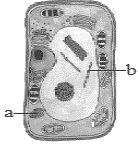
In the given figure,what do the labeled parts '$a$' and '$b$' represent respectively?
A
Vacuole,Plastid
B
Plastid,Raphide crystals
C
Vacuole,Crystals
D
Starch grain,Raphide crystals
Solution
(B) The provided figure represents a plant cell.
Part '$a$' points to a plastid (specifically a chloroplast,given its characteristic structure).
Part '$b$' points to needle-like structures within the large central vacuole,which are identified as raphide crystals (calcium oxalate crystals).
Therefore,'$a$' represents a plastid and '$b$' represents raphide crystals.
Part '$a$' points to a plastid (specifically a chloroplast,given its characteristic structure).
Part '$b$' points to needle-like structures within the large central vacuole,which are identified as raphide crystals (calcium oxalate crystals).
Therefore,'$a$' represents a plastid and '$b$' represents raphide crystals.
0 likes
View Solution141
MediumMCQ
Which of the following statements is false?
A
Not all cells possess a true nucleus.
B
All living plant cells contain chlorophyll.
C
The cell wall is generally composed of cellulose.
D
Respiration occurs in the mitochondria.
Solution
(B) The statement 'All living plant cells contain chlorophyll' is false.
Chlorophyll is primarily found in chloroplasts,which are present in green plant cells (like those in leaves).
However,non-green plant cells,such as those in roots,tubers,and some parts of the stem,do not contain chlorophyll and are therefore incapable of photosynthesis.
Prokaryotic cells lack a true nucleus (Option $A$ is true).
Cell walls in plants are primarily made of cellulose (Option $C$ is true).
Mitochondria are the sites of aerobic respiration (Option $D$ is true).
Chlorophyll is primarily found in chloroplasts,which are present in green plant cells (like those in leaves).
However,non-green plant cells,such as those in roots,tubers,and some parts of the stem,do not contain chlorophyll and are therefore incapable of photosynthesis.
Prokaryotic cells lack a true nucleus (Option $A$ is true).
Cell walls in plants are primarily made of cellulose (Option $C$ is true).
Mitochondria are the sites of aerobic respiration (Option $D$ is true).
0 likes
View Solution142
EasyMCQ
Match the items in Column-$I$ with Column-$II$ and select the correct option:
| Column-$I$ | Column-$II$ |
| $(A)$ Typical animal cell | $(i)$ Multinucleate |
| $(B)$ Zygote | $(ii)$ Uninucleate |
| $(C)$ Human $RBC$ | $(iii)$ Binucleate |
| $(D)$ Plant endosperm | $(iv)$ Enucleated |
A
$(A-ii), (B-iii), (C-iv), (D-i)$
B
$(A-iii), (B-ii), (C-i), (D-iv)$
C
$(A-iii), (B-i), (C-iv), (D-ii)$
D
$(A-i), (B-ii), (C-iv), (D-iii)$
Solution
(A) The correct matches are as follows:
$(A)$ Typical animal cell: Most animal cells are uninucleate (contain a single nucleus).
$(B)$ Zygote: $A$ zygote is formed by the fusion of two gametes, and in some specific developmental stages or organisms, it may show binucleate conditions, though typically it is uninucleate. However, based on the provided options, the best fit is $(A-ii), (B-iii), (C-iv), (D-i)$. Wait, let's re-evaluate:
$(A)$ Typical animal cell is $(ii)$ Uninucleate.
$(B)$ Zygote is $(iii)$ Binucleate (in some contexts like early development or specific organisms).
$(C)$ Human $RBC$ is $(iv)$ Enucleated (lacks a nucleus at maturity).
$(D)$ Plant endosperm is $(i)$ Multinucleate (often free-nuclear endosperm).
Therefore, the correct sequence is $(A-ii), (B-iii), (C-iv), (D-i)$.
$(A)$ Typical animal cell: Most animal cells are uninucleate (contain a single nucleus).
$(B)$ Zygote: $A$ zygote is formed by the fusion of two gametes, and in some specific developmental stages or organisms, it may show binucleate conditions, though typically it is uninucleate. However, based on the provided options, the best fit is $(A-ii), (B-iii), (C-iv), (D-i)$. Wait, let's re-evaluate:
$(A)$ Typical animal cell is $(ii)$ Uninucleate.
$(B)$ Zygote is $(iii)$ Binucleate (in some contexts like early development or specific organisms).
$(C)$ Human $RBC$ is $(iv)$ Enucleated (lacks a nucleus at maturity).
$(D)$ Plant endosperm is $(i)$ Multinucleate (often free-nuclear endosperm).
Therefore, the correct sequence is $(A-ii), (B-iii), (C-iv), (D-i)$.
0 likes
View Solution143
EasyMCQ
Match the items in Column-$I$ with Column-$II$ and select the correct option:
| Column-$I$ | Column-$II$ |
| $(A)$ Microfilament | $(i)$ Glycocalyx |
| $(B)$ Microtubule | $(ii)$ Actin |
| $(C)$ Flagella | $(iii)$ Tubulin |
| $(D)$ Bacterial cell envelope | $(iv)$ Flagellin |
A
$(A-ii), (B-iii), (C-iv), (D-i)$
B
$(A-iii), (B-ii), (C-iv), (D-i)$
C
$(A-i), (B-iii), (C-ii), (D-iv)$
D
$(A-iv), (B-i), (C-iii), (D-ii)$
Solution
$(A)$ The correct matches are as follows:
$1$. Microfilaments are composed of the protein $Actin$ $(A-ii)$.
$2$. Microtubules are composed of the protein $Tubulin$ $(B-iii)$.
$3$. Bacterial flagella are composed of the protein $Flagellin$ $(C-iv)$.
$4$. The bacterial cell envelope includes the $Glycocalyx$ layer $(D-i)$.
Therefore, the correct sequence is $(A-ii), (B-iii), (C-iv), (D-i)$.
$1$. Microfilaments are composed of the protein $Actin$ $(A-ii)$.
$2$. Microtubules are composed of the protein $Tubulin$ $(B-iii)$.
$3$. Bacterial flagella are composed of the protein $Flagellin$ $(C-iv)$.
$4$. The bacterial cell envelope includes the $Glycocalyx$ layer $(D-i)$.
Therefore, the correct sequence is $(A-ii), (B-iii), (C-iv), (D-i)$.
0 likes
View Solution144
EasyMCQ
Column $-I$ represents scientists and Column $-II$ represents their discoveries. Choose the correct option:
| Column $-I$ | Column $-II$ |
| $(A)$ Robert Hooke | $(i)$ Cell Theory |
| $(B)$ Robert Brown | $(ii)$ Golgi apparatus |
| $(C)$ Schleiden and Schwann | $(iii)$ Cell |
| $(D)$ Camillo Golgi | $(iv)$ Nucleus |
A
$(A-i), (B-ii), (C-iv), (D-iii)$
B
$(A-ii), (B-i), (C-iii), (D-iv)$
C
$(A-iii), (B-iv), (C-i), (D-ii)$
D
$(A-iv), (B-ii), (C-i), (D-iii)$
Solution
$(C)$ The correct matches are as follows:
$1$. Robert Hooke discovered the cell in $1665$ by observing cork slices under a microscope $(A-iii)$.
$2$. Robert Brown discovered the nucleus in the orchid root cells $(B-iv)$.
$3$. Schleiden and Schwann proposed the cell theory $(C-i)$.
$4$. Camillo Golgi first observed and described the Golgi apparatus $(D-ii)$.
Thus, the correct matching is $(A-iii), (B-iv), (C-i), (D-ii)$.
$1$. Robert Hooke discovered the cell in $1665$ by observing cork slices under a microscope $(A-iii)$.
$2$. Robert Brown discovered the nucleus in the orchid root cells $(B-iv)$.
$3$. Schleiden and Schwann proposed the cell theory $(C-i)$.
$4$. Camillo Golgi first observed and described the Golgi apparatus $(D-ii)$.
Thus, the correct matching is $(A-iii), (B-iv), (C-i), (D-ii)$.
0 likes
View Solution145
MediumMCQ
Read the following statements and identify the correct option:
$(A)$ Prokaryotic cells lack a nuclear membrane,chloroplasts,mitochondria,microtubules,and pili.
$(B)$ Eukaryotic cells contain a nuclear membrane,chloroplasts,mitochondria,microtubules,and pili.
$(C)$ Many bacterial cells have small circular $DNA$ outside the genomic $DNA$.
$(A)$ Prokaryotic cells lack a nuclear membrane,chloroplasts,mitochondria,microtubules,and pili.
$(B)$ Eukaryotic cells contain a nuclear membrane,chloroplasts,mitochondria,microtubules,and pili.
$(C)$ Many bacterial cells have small circular $DNA$ outside the genomic $DNA$.
A
$A$ and $B$ are incorrect. $C$ is correct.
B
$A$ is correct. $B$ and $C$ are incorrect.
C
$A$ and $C$ are correct. $B$ is incorrect.
D
$A, B, C$ are incorrect.
Solution
(C) Statement $(A)$ is correct: Prokaryotic cells lack membrane-bound organelles like mitochondria,chloroplasts,and a defined nucleus. They also lack microtubules and pili (though some bacteria have pili,they are not a universal feature of all prokaryotes in the same way organelles are defined).
Statement $(B)$ is incorrect: While eukaryotic cells contain a nuclear membrane,mitochondria,and microtubules,they do not possess pili. Pili are characteristic structures of prokaryotic cells.
Statement $(C)$ is correct: Many bacteria possess small,circular,extrachromosomal $DNA$ molecules known as plasmids,which exist outside the genomic $DNA$.
Therefore,statements $(A)$ and $(C)$ are correct,while $(B)$ is incorrect.
Statement $(B)$ is incorrect: While eukaryotic cells contain a nuclear membrane,mitochondria,and microtubules,they do not possess pili. Pili are characteristic structures of prokaryotic cells.
Statement $(C)$ is correct: Many bacteria possess small,circular,extrachromosomal $DNA$ molecules known as plasmids,which exist outside the genomic $DNA$.
Therefore,statements $(A)$ and $(C)$ are correct,while $(B)$ is incorrect.
1 likes
View Solution146
EasyMCQ
Which of the following organelles contain ribosomes?
A
Mitochondria
B
Chloroplast
C
Both $(A)$ and $(B)$
D
None of these
Solution
(C) Ribosomes are found in the cytoplasm,as well as within certain organelles that possess their own genetic material. Mitochondria and chloroplasts are semi-autonomous organelles that contain their own $DNA$ and $70S$ ribosomes,which are used for protein synthesis within these organelles. Therefore,both mitochondria and chloroplasts contain ribosomes.
0 likes
View Solution147
MediumMCQ
$70S$ type of ribosomes are found in ..........
A
Ribosomes of prokaryotic cells
B
Cytoplasmic ribosomes of eukaryotic cells
C
Ribosomes of chloroplasts
D
Both $(A)$ and $(C)$
Solution
(D) $70S$ ribosomes are characteristic of prokaryotic cells.
In eukaryotic cells,the cytoplasmic ribosomes are of the $80S$ type.
However,organelles like mitochondria and chloroplasts in eukaryotic cells contain $70S$ ribosomes,which is evidence supporting the endosymbiotic theory.
Therefore,$70S$ ribosomes are found in both prokaryotic cells and the organelles (like chloroplasts) of eukaryotic cells.
Thus,the correct option is $(D)$.
In eukaryotic cells,the cytoplasmic ribosomes are of the $80S$ type.
However,organelles like mitochondria and chloroplasts in eukaryotic cells contain $70S$ ribosomes,which is evidence supporting the endosymbiotic theory.
Therefore,$70S$ ribosomes are found in both prokaryotic cells and the organelles (like chloroplasts) of eukaryotic cells.
Thus,the correct option is $(D)$.
0 likes
View Solution148
EasyMCQ
Which of the following structures contains enzymes?
A
Lysosome
B
Microbody
C
Both $(A)$ and $(B)$
D
Vacuole
Solution
(C) Lysosomes are membrane-bound vesicular structures formed by the process of packaging in the Golgi apparatus. They are rich in almost all types of hydrolytic enzymes (hydrolases - lipases,proteases,carbohydrases) optimally active at the acidic pH.
Microbodies are membrane-bound minute vesicles that contain various enzymes,such as peroxisomes (containing catalase and peroxidase) and glyoxysomes (containing enzymes for the glyoxylate cycle).
Since both lysosomes and microbodies contain various types of enzymes,the correct option is $(C)$.
Microbodies are membrane-bound minute vesicles that contain various enzymes,such as peroxisomes (containing catalase and peroxidase) and glyoxysomes (containing enzymes for the glyoxylate cycle).
Since both lysosomes and microbodies contain various types of enzymes,the correct option is $(C)$.
0 likes
View Solution149
MediumMCQ
Select the correct match for $X$ and $Y$:
| Column $X$ | Column $Y$ |
| $(1)$ Plant cell wall | $(P)$ Protein |
| $(2)$ Bacterial cell wall | $(Q)$ Cellulose |
| $(3)$ Fungal cell wall | $(R)$ Amino sugars (Peptidoglycan) |
| $(4)$ Viral capsid | $(S)$ Chitin |
A
$(1-Q), (2-R), (3-S), (4-P)$
B
$(1-Q), (2-R), (3-P), (4-S)$
C
$(1-S), (2-P), (3-R), (4-Q)$
D
$(1-P), (2-Q), (3-R), (4-S)$
Solution
(A) The correct matches are as follows:
$(1)$ Plant cell wall is primarily composed of cellulose $(Q)$.
$(2)$ Bacterial cell wall is composed of peptidoglycan, which contains amino sugars $(R)$.
$(3)$ Fungal cell wall is composed of chitin $(S)$.
$(4)$ Viruses are not cells and do not have a cell wall; their genetic material is enclosed in a protein coat called a capsid $(P)$.
Therefore, the correct matching is $(1-Q), (2-R), (3-S), (4-P)$.
$(1)$ Plant cell wall is primarily composed of cellulose $(Q)$.
$(2)$ Bacterial cell wall is composed of peptidoglycan, which contains amino sugars $(R)$.
$(3)$ Fungal cell wall is composed of chitin $(S)$.
$(4)$ Viruses are not cells and do not have a cell wall; their genetic material is enclosed in a protein coat called a capsid $(P)$.
Therefore, the correct matching is $(1-Q), (2-R), (3-S), (4-P)$.
0 likes
View Solution150
MediumMCQ
Select the correct match for $X$ and $Y$:
| Column $X$ | Column $Y$ |
| $(1)$ Typical animal cell | $(P)$ Multinucleate |
| $(2)$ Zygote | $(Q)$ Uninucleate |
| $(3)$ Human $RBC$ | $(R)$ Binucleate |
| $(4)$ Plant embryo sac | $(S)$ Enucleate |
A
$(1-Q), (2-R), (3-S), (4-P)$
B
$(1-R), (2-Q), (3-S), (4-P)$
C
$(1-R), (2-P), (3-S), (4-Q)$
D
$(1-P), (2-Q), (3-S), (4-R)$
Solution
(A) The correct matches are as follows:
$(1)$ $A$ typical animal cell is generally uninucleate, containing one nucleus $(1-Q)$.
$(2)$ $A$ zygote is formed by the fusion of two gametes (male and female), initially containing two nuclei that fuse, often described as binucleate during the fusion process $(2-R)$.
$(3)$ Mature human red blood cells $(RBCs)$ are enucleate, meaning they lack a nucleus to provide more space for hemoglobin $(3-S)$.
$(4)$ The plant embryo sac (specifically the central cell) is multinucleate (often $8-$nucleate at maturity) $(4-P)$.
Therefore, the correct sequence is $(1-Q), (2-R), (3-S), (4-P)$.
$(1)$ $A$ typical animal cell is generally uninucleate, containing one nucleus $(1-Q)$.
$(2)$ $A$ zygote is formed by the fusion of two gametes (male and female), initially containing two nuclei that fuse, often described as binucleate during the fusion process $(2-R)$.
$(3)$ Mature human red blood cells $(RBCs)$ are enucleate, meaning they lack a nucleus to provide more space for hemoglobin $(3-S)$.
$(4)$ The plant embryo sac (specifically the central cell) is multinucleate (often $8-$nucleate at maturity) $(4-P)$.
Therefore, the correct sequence is $(1-Q), (2-R), (3-S), (4-P)$.
0 likes
View SolutionCell: The Unit of Life — Mix Example-Cell: The Unit of Life · Frequently Asked Questions
1Are these Cell: The Unit of Life questions useful for JEE and NEET?
Yes. All questions in this section are mapped to JEE Main and NEET exam patterns. Previous year questions from JEE Main, NEET, GUJCET and state-level exams are included with full solutions.
2Can I switch to Hindi or Gujarati for these questions?
Yes. Use the language tabs in the hero section or the sidebar to view the same questions and solutions in English, Hindi or Gujarati.
3How do I generate a question paper from this subtopic?
Use the Vedclass Exam Paper Generator — select the chapter and subtopic, set difficulty, and generate Sets A, B, C, D automatically. First 3 chapters of every subject are free.
Vedclass Products
For Students
Vedclass Test Series
Mock tests in real JEE/NEET style with performance analysis. 5-day free trial.
Start Free TrialFor Teachers
Exam Paper Generator
Generate Set A/B/C/D papers from this chapter in 2 minutes. 3 chapters free.
Try FreeFor Institutes
Online Exam Module
Live online exams with unlimited students, 360° analytics & white-label branding.
See DemoFor Teachers & Institutes
Generate a Cell: The Unit of Life Exam Paper in 2 Minutes
Select subtopic & difficulty — Sets A, B, C, D auto-generated with No Repeat logic.
First 3 chapters of every subject are free — no payment required.