
A English
Mix Example-Cell: The Unit of Life Questions in English
Class 11 Biology · Cell: The Unit of Life · Mix Example-Cell: The Unit of Life
300+
Questions
English
Language
100%
With Solutions
Showing 50 of 300 questions in English
251
MediumMCQ
Match column-$I$ with column-$II$ and select the correct option.
| Column-$I$ | Column-$II$ |
| $A$. Golgi apparatus | $I$. Storage |
| $B$. Mitochondria | $II$. Photosynthesis |
| $C$. Vacuoles | $III$. Transport |
| $D$. Grana | $IV$. Secretion |
| $V$. Respiration |
A
$A-IV, B-V, C-I, D-II$
B
$A-I, B-II, C-IV, D-III$
C
$A-IV, B-I, C-II, D-III$
D
$A-I, B-II, C-III, D-IV$
Solution
$(A)$ The Golgi apparatus is a cellular organelle involved in the modification, sorting, and packaging of proteins for secretion $(A-IV)$.
Mitochondria are known as the powerhouse of the cell as they are the site of aerobic respiration, where energy is transferred from organic compounds into $ATP$ $(B-V)$.
Vacuoles are membrane-bound organelles that store water, nutrients, and waste products $(C-I)$.
Grana are stacked membranous structures within the chloroplasts that contain chlorophyll and are the site of the light-dependent reactions of photosynthesis $(D-II)$.
Therefore, the correct matching is $A-IV, B-V, C-I, D-II$.
Mitochondria are known as the powerhouse of the cell as they are the site of aerobic respiration, where energy is transferred from organic compounds into $ATP$ $(B-V)$.
Vacuoles are membrane-bound organelles that store water, nutrients, and waste products $(C-I)$.
Grana are stacked membranous structures within the chloroplasts that contain chlorophyll and are the site of the light-dependent reactions of photosynthesis $(D-II)$.
Therefore, the correct matching is $A-IV, B-V, C-I, D-II$.
0 likes
View Solution252
MediumMCQ
Match column-$I$ with column-$II$ and select the correct option.
| Column-$I$ | Column-$II$ |
| $A$. $RER$ | $I$. Intracellular and extracellular digestion |
| $B$. Cell wall | $II$. Provide structural support to the cell |
| $C$. Flagella | $III$. Protein synthesis and secretion |
| $D$. Lysosomes | $IV$. Responsible for cell movement |
A
$A-III, B-II, C-IV, D-I$
B
$A-II, B-II, C-IV, D-I$
C
$A-I, B-III, C-II, D-IV$
D
$A-IV, B-II, C-III, D-I$
Solution
$(A)$ $RER$ (Rough Endoplasmic Reticulum) has ribosomes on its surface and is primarily involved in protein synthesis and secretion.
Cell wall provides structural support, rigidity, and protection to the cell.
Flagella are whip-like appendages that enable cell movement.
Lysosomes are membrane-bound organelles containing hydrolytic enzymes, responsible for intracellular and extracellular digestion.
Cell wall provides structural support, rigidity, and protection to the cell.
Flagella are whip-like appendages that enable cell movement.
Lysosomes are membrane-bound organelles containing hydrolytic enzymes, responsible for intracellular and extracellular digestion.
0 likes
View Solution253
MediumMCQ
Match column-$I$ and column-$II$ and select the correct answer.
| Column-$I$ | Column-$II$ |
| $A$. Bacteria without walls | $I$. Lysosome |
| $B$. Small circular $DNA$ | $II$. Mycoplasma cells |
| $C$. Flattened sacs in a chloroplast | $III$. Thylakoid |
| $D$. $A$ vesicle in which hydrolytic enzymes are stored | $IV$. Plasmid |
A
$A-III, B-IV, C-II, D-I$
B
$A-II, B-IV, C-III, D-I$
C
$A-I, B-II, C-III, D-IV$
D
$A-IV, B-III, C-I, D-II$
Solution
$(B)$. Mycoplasma cells are bacteria that lack a cell wall.
$B$. Plasmid is a small, circular, extrachromosomal $DNA$ molecule found in bacteria.
$C$. Thylakoids are flattened, sac-like structures found inside chloroplasts that form the grana.
$D$. Lysosomes are membrane-bound vesicles containing hydrolytic enzymes, often referred to as the 'suicidal bags' of the cell.
Therefore, the correct matching is $A-II, B-IV, C-III, D-I$.
$B$. Plasmid is a small, circular, extrachromosomal $DNA$ molecule found in bacteria.
$C$. Thylakoids are flattened, sac-like structures found inside chloroplasts that form the grana.
$D$. Lysosomes are membrane-bound vesicles containing hydrolytic enzymes, often referred to as the 'suicidal bags' of the cell.
Therefore, the correct matching is $A-II, B-IV, C-III, D-I$.
0 likes
View Solution254
MediumMCQ
Which of the following pairs are correctly matched?
A
$A, B$ and $C$
B
$A$ and $B$
C
$A$ only
D
$A$ and $C$
Solution
(C) Pair $A$ is correct: Microtubules are structural components of cilia and flagella.
Pair $B$ is incorrect: Centrioles are involved in spindle formation during cell division. Lysosomes are the organelles that store hydrolytic enzymes.
Pair $C$ is incorrect: Amyloplasts specifically store starch. Elaioplasts store oils and fats,while Aleuroplasts store proteins.
Therefore,only $A$ is correctly matched.
Pair $B$ is incorrect: Centrioles are involved in spindle formation during cell division. Lysosomes are the organelles that store hydrolytic enzymes.
Pair $C$ is incorrect: Amyloplasts specifically store starch. Elaioplasts store oils and fats,while Aleuroplasts store proteins.
Therefore,only $A$ is correctly matched.
0 likes
View Solution255
MediumMCQ
Which one of the following pairs is $NOT$ correctly matched?
A
Cristae - The tubular or shelf-like structures formed by the folding of the inner membrane of the mitochondrion.
B
Plasmodesmata - The membrane surrounding the vacuole in plants.
C
Grana - Membrane-bound discs in chloroplasts that contain chlorophylls and carotenoids.
D
Middle lamella - Layer between adjacent cell walls in plants derived from the cell plate.
Solution
(B) The correct answer is $B$. Plasmodesmata are cytoplasmic bridges that connect the cytoplasm of adjacent plant cells, allowing for transport and communication. The membrane surrounding the vacuole in plants is known as the tonoplast, not plasmodesmata.
0 likes
View Solution256
MediumMCQ
Which of the following pairs are correctly matched?
$(I)$ Amyloplasts - Store proteins
$(II)$ Mitochondrion - 'Power house' of the cell
$(III)$ Stroma - Chlorophyll pigment
$(IV)$ Axoneme $- 9+2$ array
$(I)$ Amyloplasts - Store proteins
$(II)$ Mitochondrion - 'Power house' of the cell
$(III)$ Stroma - Chlorophyll pigment
$(IV)$ Axoneme $- 9+2$ array
A
$(I)$ and $(III)$ only
B
$(II), (III)$ and $(IV)$ only
C
$(III)$ and $(IV)$ only
D
$(II)$ and $(IV)$ only
Solution
(D) Amyloplasts store carbohydrates (starch),$e.g$.,potato,whereas proteins are stored by aleuroplasts. Therefore,$(I)$ is incorrect.
Mitochondria are known as the 'Power house' of the cell because they produce energy in the form of $ATP$. Therefore,$(II)$ is correct.
Chlorophyll pigments are present in the thylakoids,not in the stroma. The stroma contains enzymes for the dark reaction. Therefore,$(III)$ is incorrect.
Axoneme,the core of cilia and flagella,consists of a $9+2$ arrangement of microtubules. Therefore,$(IV)$ is correct.
Thus,the correctly matched pairs are $(II)$ and $(IV)$.
Mitochondria are known as the 'Power house' of the cell because they produce energy in the form of $ATP$. Therefore,$(II)$ is correct.
Chlorophyll pigments are present in the thylakoids,not in the stroma. The stroma contains enzymes for the dark reaction. Therefore,$(III)$ is incorrect.
Axoneme,the core of cilia and flagella,consists of a $9+2$ arrangement of microtubules. Therefore,$(IV)$ is correct.
Thus,the correctly matched pairs are $(II)$ and $(IV)$.
0 likes
View Solution257
MediumMCQ
Match Column $I$ with Column $II$ and choose the correct option.
| Column $I$ | Column $II$ |
| $A$. Centrioles | $I$. Non-membrane bound organelle which helps in cell division |
| $B$. Fimbriae | $II$. Special structure of bacteria which help them to attach to rocks in streams |
| $C$. Endomembrane system | $III$. Includes those organelles whose functions are coordinated |
| $D$. Mitochondria | $IV$. Divide by fission and site of aerobic respiration |
A
$A-I, B-II, C-III, D-IV$
B
$A-III, B-I, C-II, D-IV$
C
$A-III, B-I, C-IV, D-II$
D
$A-I, B-IV, C-III, D-II$
Solution
$(A)$ Centrioles are non-membrane bound organelles that help in cell division. They are composed mainly of a protein called tubulin.
Fimbriae are special structures found in bacteria. These are small bristle-like fibers sprouting out of the cell that help bacteria attach to rocks in streams and also to host tissues.
The endomembrane system includes those organelles (like $ER$, Golgi complex, lysosomes, and vacuoles) whose functions are coordinated.
Mitochondria are double-membrane cell organelles that divide by fission and are the site of aerobic respiration.
Fimbriae are special structures found in bacteria. These are small bristle-like fibers sprouting out of the cell that help bacteria attach to rocks in streams and also to host tissues.
The endomembrane system includes those organelles (like $ER$, Golgi complex, lysosomes, and vacuoles) whose functions are coordinated.
Mitochondria are double-membrane cell organelles that divide by fission and are the site of aerobic respiration.
0 likes
View Solution258
MediumMCQ
Which of the following terms is $NOT$ correctly matched with its feature?
A
Osmosis - Movement of water by diffusion.
B
Nucleoplasm - Site of active synthesis of ribosomal $RNA$.
C
Mesosome - Infolding of cell membrane and characteristics of eukaryotes.
D
Pili - Elongated tubular surface structures (made of special protein) of bacteria.
Solution
(C) Mesosomes are specialized structures formed by the extensions of the plasma membrane into the cell.
They are characteristic features of prokaryotes,not eukaryotes.
Mesosomes assist in cell wall formation,$DNA$ replication,and distribution to daughter cells.
They also facilitate respiration,secretion processes,and increase the surface area of the plasma membrane and enzymatic content.
They are characteristic features of prokaryotes,not eukaryotes.
Mesosomes assist in cell wall formation,$DNA$ replication,and distribution to daughter cells.
They also facilitate respiration,secretion processes,and increase the surface area of the plasma membrane and enzymatic content.
0 likes
View Solution259
MediumMCQ
Which of the following statements is false?
A
The ribosomes of a polysome translate the $RNA$ into protein.
B
Mitochondria divide by fragmentation.
C
All cells arise from pre-existing cells.
D
The lipid component of the membrane mainly consists of phosphoglycerides.
Solution
(B) The statement that 'Mitochondria divide by fragmentation' is false. In reality,mitochondria divide by a process called binary fission,which is similar to the division of bacteria. The other statements are correct: ribosomes in a polysome translate $mRNA$ into proteins,the cell theory states that all cells arise from pre-existing cells,and the lipid bilayer of the cell membrane is primarily composed of phosphoglycerides.
0 likes
View Solution260
MediumMCQ
Which of the following statements is incorrect?
A
Mycoplasma is the smallest cell.
B
Bacteria are $3$ to $5\; \mu m$ in size.
C
The largest cell is the egg of an ostrich.
D
Nerve cells are some of the smallest cells.
Solution
(D) Mycoplasma are the smallest cells ($0.3\; \mu m$ in length).
Bacteria typically range from $3$ to $5\; \mu m$ in size.
The egg of an ostrich is the largest isolated single cell.
Nerve cells are not the smallest; in fact,they are among the longest cells in the human body.
Therefore,the statement that nerve cells are some of the smallest cells is incorrect.
Bacteria typically range from $3$ to $5\; \mu m$ in size.
The egg of an ostrich is the largest isolated single cell.
Nerve cells are not the smallest; in fact,they are among the longest cells in the human body.
Therefore,the statement that nerve cells are some of the smallest cells is incorrect.
0 likes
View Solution261
MediumMCQ
Which of the following statements is/are correct?
$(i)$ The shape of the cells may vary with the function they perform.
$(ii)$ Human $RBC$ is about $7.0 \; \mu m$ in diameter.
$(iii)$ Cytoplasm is the main area of cellular activities.
$(iv)$ Various chemical reactions occur in cytoplasm to keep the cell in the living state.
$(i)$ The shape of the cells may vary with the function they perform.
$(ii)$ Human $RBC$ is about $7.0 \; \mu m$ in diameter.
$(iii)$ Cytoplasm is the main area of cellular activities.
$(iv)$ Various chemical reactions occur in cytoplasm to keep the cell in the living state.
A
$(i), (ii), (iii)$ and $(iv)$
B
Only $(i)$ and $(ii)$
C
Only $(iv)$
D
None of the above
Solution
(A) $(i)$ Cells exhibit diverse shapes such as disc-like, polygonal, columnar, cuboid, thread-like, or even irregular, depending on the specific function they perform.
$(ii)$ Human red blood cells $(RBCs)$ are approximately $7.0 \; \mu m$ in diameter. (Note: The original question stated $7.0 \; mm$, which is corrected to $7.0 \; \mu m$ for scientific accuracy).
$(iii)$ The cytoplasm is a semi-fluid matrix that occupies the volume of the cell and serves as the primary site for various cellular activities.
$(iv)$ The cytoplasm contains various chemical reactions that are essential to maintain the cell in a living state.
Therefore, all the given statements are correct.
$(ii)$ Human red blood cells $(RBCs)$ are approximately $7.0 \; \mu m$ in diameter. (Note: The original question stated $7.0 \; mm$, which is corrected to $7.0 \; \mu m$ for scientific accuracy).
$(iii)$ The cytoplasm is a semi-fluid matrix that occupies the volume of the cell and serves as the primary site for various cellular activities.
$(iv)$ The cytoplasm contains various chemical reactions that are essential to maintain the cell in a living state.
Therefore, all the given statements are correct.
0 likes
View Solution262
MediumMCQ
Which of the following statements are incorrect?
$(i)$ Plant cells have centrioles which are absent in almost all animal cells.
$(ii)$ Ribosomes are the site of protein synthesis.
$(iii)$ The middle lamella is a layer mainly of calcium carbonate which holds the different neighbouring cells together.
$(iv)$ In animal cells, steroidal hormones are synthesized by smooth endoplasmic reticulum.
Of the above statements:
$(i)$ Plant cells have centrioles which are absent in almost all animal cells.
$(ii)$ Ribosomes are the site of protein synthesis.
$(iii)$ The middle lamella is a layer mainly of calcium carbonate which holds the different neighbouring cells together.
$(iv)$ In animal cells, steroidal hormones are synthesized by smooth endoplasmic reticulum.
Of the above statements:
A
$(i)$ and $(iii)$
B
$(iii)$ and $(iv)$
C
$(ii)$ and $(iv)$
D
$(i)$ and $(iv)$
Solution
(A) Statement $(i)$ is incorrect because centrioles are present in almost all animal cells and are typically absent in plant cells.
Statement $(ii)$ is correct; ribosomes are indeed the sites of protein synthesis.
Statement $(iii)$ is incorrect because the middle lamella is primarily composed of calcium and magnesium pectates, not calcium carbonate.
Statement $(iv)$ is correct; the smooth endoplasmic reticulum $(SER)$ is the primary site for the synthesis of lipids and steroidal hormones in animal cells.
Therefore, statements $(i)$ and $(iii)$ are incorrect.
Statement $(ii)$ is correct; ribosomes are indeed the sites of protein synthesis.
Statement $(iii)$ is incorrect because the middle lamella is primarily composed of calcium and magnesium pectates, not calcium carbonate.
Statement $(iv)$ is correct; the smooth endoplasmic reticulum $(SER)$ is the primary site for the synthesis of lipids and steroidal hormones in animal cells.
Therefore, statements $(i)$ and $(iii)$ are incorrect.
0 likes
View Solution263
MediumMCQ
Which of the following statements is/are correct?
$(i)$ The endomembrane system includes plasma membrane,$ER$,Golgi complex,lysosomes and vacuoles.
$(ii)$ $ER$ helps in the transport of substances,synthesis of proteins,lipoproteins and glycogen.
$(iii)$ Ribosomes are involved in protein synthesis.
$(iv)$ Mitochondria help in oxidative phosphorylation and generation of $ATP$.
$(i)$ The endomembrane system includes plasma membrane,$ER$,Golgi complex,lysosomes and vacuoles.
$(ii)$ $ER$ helps in the transport of substances,synthesis of proteins,lipoproteins and glycogen.
$(iii)$ Ribosomes are involved in protein synthesis.
$(iv)$ Mitochondria help in oxidative phosphorylation and generation of $ATP$.
A
$(ii), (iii)$ and $(iv)$
B
$(i)$ only
C
$(ii)$ only
D
$(iii)$ only
Solution
(A) Statement $(i)$ is incorrect because the plasma membrane is not considered part of the endomembrane system.
Statement $(ii)$ is correct as the Endoplasmic Reticulum $(ER)$ is involved in the transport of materials,protein synthesis (Rough $ER$),and lipid/glycogen synthesis (Smooth $ER$).
Statement $(iii)$ is correct as ribosomes are the sites of protein synthesis.
Statement $(iv)$ is correct as mitochondria are the sites of aerobic respiration,oxidative phosphorylation,and $ATP$ production.
Therefore,statements $(ii), (iii),$ and $(iv)$ are correct.
Statement $(ii)$ is correct as the Endoplasmic Reticulum $(ER)$ is involved in the transport of materials,protein synthesis (Rough $ER$),and lipid/glycogen synthesis (Smooth $ER$).
Statement $(iii)$ is correct as ribosomes are the sites of protein synthesis.
Statement $(iv)$ is correct as mitochondria are the sites of aerobic respiration,oxidative phosphorylation,and $ATP$ production.
Therefore,statements $(ii), (iii),$ and $(iv)$ are correct.
0 likes
View Solution264
MediumMCQ
Consider the following statements and choose the correct statement.
$(i)$ The endomembrane system includes mitochondria,chloroplast and peroxisomes.
$(ii)$ Smooth endoplasmic reticulum is the major site for synthesis of lipid.
$(iii)$ Rough endoplasmic reticulum is actively involved in protein synthesis.
$(iv)$ Mitochondrial matrix possesses single circular $DNA$,a few $RNA$ and $80\; S$ ribosomes.
Which of the above statements are correct?
$(i)$ The endomembrane system includes mitochondria,chloroplast and peroxisomes.
$(ii)$ Smooth endoplasmic reticulum is the major site for synthesis of lipid.
$(iii)$ Rough endoplasmic reticulum is actively involved in protein synthesis.
$(iv)$ Mitochondrial matrix possesses single circular $DNA$,a few $RNA$ and $80\; S$ ribosomes.
Which of the above statements are correct?
A
$(i)$ and $(iii)$
B
$(ii)$ and $(iv)$
C
$(iii)$ and $(iv)$
D
$(ii)$ and $(iii)$
Solution
(D) Statement $(i)$ is incorrect because the endomembrane system includes the endoplasmic reticulum $(ER)$,Golgi complex,lysosomes,and vacuoles. Mitochondria,chloroplasts,and peroxisomes are not part of the endomembrane system as their functions are not coordinated with these organelles.
Statement $(ii)$ is correct. Smooth endoplasmic reticulum $(SER)$ is the major site for lipid synthesis.
Statement $(iii)$ is correct. Rough endoplasmic reticulum $(RER)$ contains ribosomes on its surface and is actively involved in protein synthesis.
Statement $(iv)$ is incorrect. The mitochondrial matrix contains a single circular $DNA$ molecule,a few $RNA$ molecules,and $70\; S$ ribosomes,not $80\; S$ ribosomes.
Therefore,statements $(ii)$ and $(iii)$ are correct.
Statement $(ii)$ is correct. Smooth endoplasmic reticulum $(SER)$ is the major site for lipid synthesis.
Statement $(iii)$ is correct. Rough endoplasmic reticulum $(RER)$ contains ribosomes on its surface and is actively involved in protein synthesis.
Statement $(iv)$ is incorrect. The mitochondrial matrix contains a single circular $DNA$ molecule,a few $RNA$ molecules,and $70\; S$ ribosomes,not $80\; S$ ribosomes.
Therefore,statements $(ii)$ and $(iii)$ are correct.
0 likes
View Solution265
MediumMCQ
Which of the following statements are correct?
A
$Na^+/K^+$ pump is an example of active transport.
B
In plant cells,lipid-like steroidal hormones are synthesized in $SER$.
C
In plant cells,the vacuoles can occupy up to $10\%$ of the volume of the cell.
D
Chlorophyll and leucoplast are responsible for trapping light energy essential for photosynthesis.
Solution
(A) Statement $A$ is correct: The $Na^+/K^+$ pump uses $ATP$ to transport ions against their concentration gradient,which is a classic example of active transport.
Statement $B$ is incorrect: In animal cells,lipid-like steroidal hormones are synthesized in the $SER$ (Smooth Endoplasmic Reticulum).
Statement $C$ is incorrect: In plant cells,the vacuoles can occupy up to $90\%$ of the volume of the cell.
Statement $D$ is incorrect: Chlorophyll and carotenoid pigments are responsible for trapping light energy essential for photosynthesis,not leucoplasts (which are primarily for storage).
Statement $B$ is incorrect: In animal cells,lipid-like steroidal hormones are synthesized in the $SER$ (Smooth Endoplasmic Reticulum).
Statement $C$ is incorrect: In plant cells,the vacuoles can occupy up to $90\%$ of the volume of the cell.
Statement $D$ is incorrect: Chlorophyll and carotenoid pigments are responsible for trapping light energy essential for photosynthesis,not leucoplasts (which are primarily for storage).
0 likes
View Solution266
MediumMCQ
Read the following statements:
$(i)$. Membrane-bounded inclusion bodies are not found in prokaryotic cells.
$(ii)$. Ribosomes are the site of protein synthesis.
$(iii)$. Pili are the surface structure of the bacteria which may play a role in motility.
$(iv)$. The cell membrane of prokaryotes is structurally similar to the eukaryotes.
Choose the option with the correct statements.
$(i)$. Membrane-bounded inclusion bodies are not found in prokaryotic cells.
$(ii)$. Ribosomes are the site of protein synthesis.
$(iii)$. Pili are the surface structure of the bacteria which may play a role in motility.
$(iv)$. The cell membrane of prokaryotes is structurally similar to the eukaryotes.
Choose the option with the correct statements.
A
$(i), (ii), (iii)$ and $(iv)$
B
$(ii), (iii)$ and $(iv)$
C
$(i), (ii)$ and $(iv)$
D
$(i), (iii)$ and $(iv)$
Solution
(C) The correct statements are $(i), (ii)$ and $(iv)$.
$(i)$ Statement $(i)$ is correct because prokaryotic cells lack membrane-bound organelles,including membrane-bound inclusion bodies.
$(ii)$ Statement $(ii)$ is correct as ribosomes are the universal site for protein synthesis in both prokaryotes and eukaryotes.
$(iii)$ Statement $(iii)$ is incorrect because pili are surface appendages that facilitate conjugation (transfer of genetic material) and attachment,but they do not play a role in motility. Flagella are the structures responsible for motility in bacteria.
$(iv)$ Statement $(iv)$ is correct because the cell membrane of prokaryotes is a lipid bilayer with embedded proteins,which is structurally similar to that of eukaryotic cells.
$(i)$ Statement $(i)$ is correct because prokaryotic cells lack membrane-bound organelles,including membrane-bound inclusion bodies.
$(ii)$ Statement $(ii)$ is correct as ribosomes are the universal site for protein synthesis in both prokaryotes and eukaryotes.
$(iii)$ Statement $(iii)$ is incorrect because pili are surface appendages that facilitate conjugation (transfer of genetic material) and attachment,but they do not play a role in motility. Flagella are the structures responsible for motility in bacteria.
$(iv)$ Statement $(iv)$ is correct because the cell membrane of prokaryotes is a lipid bilayer with embedded proteins,which is structurally similar to that of eukaryotic cells.
0 likes
View Solution267
EasyMCQ
Which of the following cell organelles is not considered as a part of an endomembrane system?
A
$Mitochondria$
B
$Endoplasmic\; Reticulum\; (ER)$
C
$Golgi\; complex$
D
$Lysosomes$
Solution
(A) The endomembrane system includes the Endoplasmic Reticulum $(ER)$,Golgi complex,Lysosomes,and Vacuoles because their functions are coordinated.
$Mitochondria$ is not considered a part of the endomembrane system because its functions are not coordinated with these organelles.
$Mitochondria$ is not considered a part of the endomembrane system because its functions are not coordinated with these organelles.
0 likes
View Solution268
EasyMCQ
What is common in mitochondria,chloroplast and nucleus?
A
They are double membrane bound organelles
B
They are single membrane bound organelles
C
They are included in endomembrane system
D
They have $80S$ ribosomes.
Solution
(A) Mitochondria,chloroplasts,and the nucleus are all cell organelles that are enclosed by a double membrane structure.
- Mitochondria and chloroplasts are semi-autonomous organelles containing their own $DNA$ and $70S$ ribosomes.
- The nucleus is the control center of the cell,bounded by the nuclear envelope (double membrane).
- They are not part of the endomembrane system,which includes the endoplasmic reticulum,Golgi complex,lysosomes,and vacuoles.
- Mitochondria and chloroplasts are semi-autonomous organelles containing their own $DNA$ and $70S$ ribosomes.
- The nucleus is the control center of the cell,bounded by the nuclear envelope (double membrane).
- They are not part of the endomembrane system,which includes the endoplasmic reticulum,Golgi complex,lysosomes,and vacuoles.
0 likes
View Solution269
MediumMCQ
Match the column $I$ with column $II$.
| Column-$I$ | Column-$II$ |
| $(a)$. Glyoxysome | $(i)$. Plant lysosomes |
| $(b)$. Sphaerosome | $(ii)$. Glyoxylate cycle |
| $(c)$. Mitochondria | $(iii)$. Photorespiration |
| $(d)$. Peroxisome | $(iv)$. Succinate dehydrogenase |
A
$a(ii), b(i), c(iv), d(iii)$
B
$a(ii), b(i), c(iii), d(iv)$
C
$a(iii), b(i), c(iv), d(ii)$
D
$a(i), b(ii), c(iv), d(iii)$
Solution
$(a)$. Glyoxysomes are specialized peroxisomes found in plants that contain enzymes for the glyoxylate cycle, which converts stored fats into carbohydrates.
$(b)$. Sphaerosomes are small, spherical organelles in plant cells that are often considered equivalent to lysosomes as they contain hydrolytic enzymes.
$(c)$. Mitochondria are the sites of aerobic respiration and contain the enzyme succinate dehydrogenase in the inner mitochondrial membrane.
$(d)$. Peroxisomes are involved in photorespiration in plants, where they work in conjunction with chloroplasts and mitochondria.
Therefore, the correct matching is $a(ii), b(i), c(iv), d(iii)$.
$(b)$. Sphaerosomes are small, spherical organelles in plant cells that are often considered equivalent to lysosomes as they contain hydrolytic enzymes.
$(c)$. Mitochondria are the sites of aerobic respiration and contain the enzyme succinate dehydrogenase in the inner mitochondrial membrane.
$(d)$. Peroxisomes are involved in photorespiration in plants, where they work in conjunction with chloroplasts and mitochondria.
Therefore, the correct matching is $a(ii), b(i), c(iv), d(iii)$.
0 likes
View Solution270
MediumMCQ
Mark the mismatched pair.
A
Peroxisomes - Catalase
B
Ribosomes - Palade particles
C
Glyoxylate enzymes - Plants and animals
D
Massule - $MTG$
Solution
(C) The correct answer is $C$.
$1$. Peroxisomes contain enzymes like catalase,which break down hydrogen peroxide into water and oxygen. This is a correct match.
$2$. Ribosomes were first observed by George Palade,hence they are often called Palade particles. This is a correct match.
$3$. Glyoxylate enzymes are found in glyoxysomes,which are specialized peroxisomes present in plants (specifically in germinating seeds) but are $NOT$ found in animals. Therefore,this is the mismatched pair.
$4$. Massules (or microtubule organizing centers) are associated with $MTG$ (Microtubule Organizing Centers or MTOCs). This is a correct match.
$1$. Peroxisomes contain enzymes like catalase,which break down hydrogen peroxide into water and oxygen. This is a correct match.
$2$. Ribosomes were first observed by George Palade,hence they are often called Palade particles. This is a correct match.
$3$. Glyoxylate enzymes are found in glyoxysomes,which are specialized peroxisomes present in plants (specifically in germinating seeds) but are $NOT$ found in animals. Therefore,this is the mismatched pair.
$4$. Massules (or microtubule organizing centers) are associated with $MTG$ (Microtubule Organizing Centers or MTOCs). This is a correct match.
0 likes
View Solution271
MediumMCQ
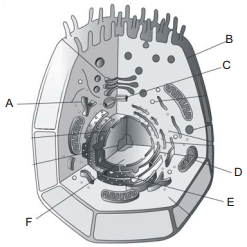
Identify the correct statements w.r.t. the given cell diagram:
$A$. Concerned with lipid and steroidal hormone synthesis.
$B$. Outer non-living rigid structure which gives shape to the cell and protects from mechanical damage and infection.
$C$. Both lie perpendicular to each other and each has an organisation like the cart wheel.
$D$. Responsible for trapping light energy for the synthesis of sugar.
$E$. Present in cells actively involved in protein synthesis and secretion.
$F$. Spherical structures,rich in hydrolytic enzymes.
$A$. Concerned with lipid and steroidal hormone synthesis.
$B$. Outer non-living rigid structure which gives shape to the cell and protects from mechanical damage and infection.
$C$. Both lie perpendicular to each other and each has an organisation like the cart wheel.
$D$. Responsible for trapping light energy for the synthesis of sugar.
$E$. Present in cells actively involved in protein synthesis and secretion.
$F$. Spherical structures,rich in hydrolytic enzymes.
A
$A, D$ and $E$
B
$B, C$ and $D$
C
$A, C$ and $E$
D
$A, B, C$ and $F$
Solution
(C) Based on the provided cell diagram:
$A$ points to the Smooth Endoplasmic Reticulum $(SER)$,which is involved in lipid and steroid hormone synthesis.
$B$ points to the Cell Wall (in a plant cell),which is a non-living rigid structure providing shape and protection.
$C$ points to the Centrioles,which lie perpendicular to each other and have a cartwheel-like organization.
$D$ points to the Mitochondria,which are involved in cellular respiration,not light trapping (that is the function of chloroplasts).
$E$ points to the Rough Endoplasmic Reticulum $(RER)$,which is involved in protein synthesis.
$F$ points to Lysosomes,which are spherical structures rich in hydrolytic enzymes.
Therefore,the statements $A, C,$ and $E$ are correct descriptions of the labeled organelles in the context of the cell structure provided.
$A$ points to the Smooth Endoplasmic Reticulum $(SER)$,which is involved in lipid and steroid hormone synthesis.
$B$ points to the Cell Wall (in a plant cell),which is a non-living rigid structure providing shape and protection.
$C$ points to the Centrioles,which lie perpendicular to each other and have a cartwheel-like organization.
$D$ points to the Mitochondria,which are involved in cellular respiration,not light trapping (that is the function of chloroplasts).
$E$ points to the Rough Endoplasmic Reticulum $(RER)$,which is involved in protein synthesis.
$F$ points to Lysosomes,which are spherical structures rich in hydrolytic enzymes.
Therefore,the statements $A, C,$ and $E$ are correct descriptions of the labeled organelles in the context of the cell structure provided.
0 likes
View Solution272
EasyMCQ
Find the correct set of structures/organelles not surrounded by membrane.
A
Ribosome,centrosome,lysosome
B
Peroxisome,nucleolus,ribosome
C
Ribosome,nucleolus,centriole
D
Nucleolus,spherosome,ribosome
Solution
(C) In a cell, certain structures are not bound by any membrane.
$1$. $Ribosome$: These are protein-synthesizing machineries found in both prokaryotes and eukaryotes, lacking a membrane.
$2$. $Nucleolus$: A dense spherical body present inside the nucleus, which is not membrane-bound.
$3$. $Centriole$ ($Centrosome$): These are cylindrical structures involved in cell division, which are also non-membranous.
Therefore, the correct set is $Ribosome$, $Nucleolus$, and $Centriole$.
$1$. $Ribosome$: These are protein-synthesizing machineries found in both prokaryotes and eukaryotes, lacking a membrane.
$2$. $Nucleolus$: A dense spherical body present inside the nucleus, which is not membrane-bound.
$3$. $Centriole$ ($Centrosome$): These are cylindrical structures involved in cell division, which are also non-membranous.
Therefore, the correct set is $Ribosome$, $Nucleolus$, and $Centriole$.
0 likes
View Solution273
MediumMCQ
Consider the following statements and choose the incorrect option:
$a$. Large and more numerous nucleoli are present in cells actively carrying out protein synthesis.
$b$. Nuclear pores allow bidirectional movement of molecules.
$c$. Cytoskeleton is a glycolipid structure for mechanical support,motility and maintenance of the shape of the cell.
$d$. Steroidal hormones are synthesized by Golgi complex.
$a$. Large and more numerous nucleoli are present in cells actively carrying out protein synthesis.
$b$. Nuclear pores allow bidirectional movement of molecules.
$c$. Cytoskeleton is a glycolipid structure for mechanical support,motility and maintenance of the shape of the cell.
$d$. Steroidal hormones are synthesized by Golgi complex.
A
$a$ and $b$
B
$b$ and $c$
C
$c$ and $d$
D
$a$ and $d$
Solution
(C) Statement $a$ is correct: Cells actively involved in protein synthesis require more ribosomes,thus they possess larger and more numerous nucleoli.
Statement $b$ is correct: Nuclear pores act as channels for the bidirectional movement of $RNA$ and protein molecules between the nucleus and the cytoplasm.
Statement $c$ is incorrect: The cytoskeleton is a proteinaceous structure (composed of microtubules,microfilaments,and intermediate filaments),not a glycolipid structure.
Statement $d$ is incorrect: Steroidal hormones are synthesized by the Smooth Endoplasmic Reticulum $(SER)$,not the Golgi complex.
Therefore,statements $c$ and $d$ are incorrect.
Statement $b$ is correct: Nuclear pores act as channels for the bidirectional movement of $RNA$ and protein molecules between the nucleus and the cytoplasm.
Statement $c$ is incorrect: The cytoskeleton is a proteinaceous structure (composed of microtubules,microfilaments,and intermediate filaments),not a glycolipid structure.
Statement $d$ is incorrect: Steroidal hormones are synthesized by the Smooth Endoplasmic Reticulum $(SER)$,not the Golgi complex.
Therefore,statements $c$ and $d$ are incorrect.
0 likes
View Solution274
MediumMCQ
Eukaryotic cells have a well-organized nucleus and:
$a$. Both $70S$ and $80S$ types of ribosomes
$b$. Flagella associated with $9+2$ organization
$c$. Shows cytoplasmic streaming
$d$. Their $DNA$ is complexed with histones to constitute the chromatin
$a$. Both $70S$ and $80S$ types of ribosomes
$b$. Flagella associated with $9+2$ organization
$c$. Shows cytoplasmic streaming
$d$. Their $DNA$ is complexed with histones to constitute the chromatin
A
All are correct
B
Only $a$ is correct
C
Only $c$ and $d$ are correct
D
Both $b$ and $c$ are incorrect
Solution
(A) All the given statements are correct for eukaryotic cells.
$a$. Eukaryotic cells contain $80S$ ribosomes in the cytoplasm and $70S$ ribosomes within organelles like mitochondria and chloroplasts.
$b$. Eukaryotic flagella and cilia exhibit a characteristic $9+2$ microtubule arrangement.
$c$. Cytoplasmic streaming (cyclosis) is a common feature observed in eukaryotic cells.
$d$. In eukaryotic cells,$DNA$ is wrapped around histone proteins to form chromatin,which further condenses into chromosomes.
$a$. Eukaryotic cells contain $80S$ ribosomes in the cytoplasm and $70S$ ribosomes within organelles like mitochondria and chloroplasts.
$b$. Eukaryotic flagella and cilia exhibit a characteristic $9+2$ microtubule arrangement.
$c$. Cytoplasmic streaming (cyclosis) is a common feature observed in eukaryotic cells.
$d$. In eukaryotic cells,$DNA$ is wrapped around histone proteins to form chromatin,which further condenses into chromosomes.
0 likes
View Solution275
EasyMCQ
$A$ chemical substance that,when irradiated with $UV$ rays,absorbs radiation and emits visible light is called:
A
Luminescent
B
Fluorochrome
C
Bioluminescence
D
Metachrome
Solution
(B) chemical substance that absorbs radiation when irradiated with $UV$ rays and subsequently emits visible light is known as a fluorochrome. This property is widely used in fluorescence microscopy to label specific biological molecules.
0 likes
View Solution276
MediumMCQ
Cytoplasmic streaming movement is the characteristic of
A
Prokaryotes
B
Eukaryotes
C
Virus
D
All of these
Solution
(B) Cytoplasmic streaming movement is also known as cyclosis.
Cyclosis is the directed flow of cytosol and organelles around the large central vacuole of a plant cell or along the paths of the cytoskeleton in other eukaryotic cells.
It facilitates the distribution of nutrients,proteins,and organelles within the cell.
This process is a characteristic feature of eukaryotic cells and is absent in prokaryotes and viruses.
Cyclosis is the directed flow of cytosol and organelles around the large central vacuole of a plant cell or along the paths of the cytoskeleton in other eukaryotic cells.
It facilitates the distribution of nutrients,proteins,and organelles within the cell.
This process is a characteristic feature of eukaryotic cells and is absent in prokaryotes and viruses.
0 likes
View Solution277
MediumMCQ
Match List-$I$ with List-$II$.
Choose the correct answer from the options given below.
| List-$I$ | List-$II$ |
| $(a)$ Cristae | $(i)$ Primary constriction in chromosome |
| $(b)$ Thylakoids | $(ii)$ Disc-shaped sacs in Golgi apparatus |
| $(c)$ Centromere | $(iii)$ Infoldings in mitochondria |
| $(d)$ Cisternae | $(iv)$ Flattened membranous sacs in stroma of plastids |
Choose the correct answer from the options given below.
A
$(iv)-(iii)-(ii)-(i)$
B
$(iii)-(iv)-(i)-(ii)$
C
$(i)-(iv)-(iii)-(ii)$
D
$(ii)-(iii)-(iv)-(i)$
Solution
(B) The correct matches are as follows:
$(a)$ Cristae: These are the infoldings of the inner mitochondrial membrane that increase the surface area for biochemical reactions. Hence,$(a)-(iii)$.
$(b)$ Thylakoids: These are flattened,disc-like membranous sacs found within the stroma of chloroplasts,which are the sites of light-dependent reactions. Hence,$(b)-(iv)$.
$(c)$ Centromere: This is the primary constriction region on a chromosome where spindle fibers attach during cell division. Hence,$(c)-(i)$.
$(d)$ Cisternae: These are the flattened,disc-shaped sacs that make up the Golgi apparatus. Hence,$(d)-(ii)$.
Therefore,the correct sequence is $(a)-(iii), (b)-(iv), (c)-(i), (d)-(ii)$.
$(a)$ Cristae: These are the infoldings of the inner mitochondrial membrane that increase the surface area for biochemical reactions. Hence,$(a)-(iii)$.
$(b)$ Thylakoids: These are flattened,disc-like membranous sacs found within the stroma of chloroplasts,which are the sites of light-dependent reactions. Hence,$(b)-(iv)$.
$(c)$ Centromere: This is the primary constriction region on a chromosome where spindle fibers attach during cell division. Hence,$(c)-(i)$.
$(d)$ Cisternae: These are the flattened,disc-shaped sacs that make up the Golgi apparatus. Hence,$(d)-(ii)$.
Therefore,the correct sequence is $(a)-(iii), (b)-(iv), (c)-(i), (d)-(ii)$.
0 likes
View Solution278
DifficultMCQ
Which of the following statements is incorrect?
A
Microbodies are present in both plants and animals.
B
Mature sieve tube elements possess a conspicuous nucleus and usual cytoplasmic organelles.
C
The perinuclear space forms a barrier between the materials present inside the nucleus and those of the cytoplasm.
D
Nuclear pores act as passages for proteins and $RNA$ molecules in both directions between the nucleus and the cytoplasm.
Solution
(B) The correct answer is $B$.
Mature sieve tube elements in angiosperms are specialized cells that lose their nucleus,ribosomes,vacuoles,and other organelles at maturity to facilitate the efficient transport of food (phloem sap).
Therefore,the statement that they possess a conspicuous nucleus and usual cytoplasmic organelles is incorrect.
Microbodies (like peroxisomes) are found in both plant and animal cells.
The perinuclear space (the space between the two nuclear membranes) acts as a barrier between the nucleoplasm and the cytoplasm.
Nuclear pores are complex structures that regulate the movement of $RNA$ and proteins between the nucleus and the cytoplasm in both directions.
Mature sieve tube elements in angiosperms are specialized cells that lose their nucleus,ribosomes,vacuoles,and other organelles at maturity to facilitate the efficient transport of food (phloem sap).
Therefore,the statement that they possess a conspicuous nucleus and usual cytoplasmic organelles is incorrect.
Microbodies (like peroxisomes) are found in both plant and animal cells.
The perinuclear space (the space between the two nuclear membranes) acts as a barrier between the nucleoplasm and the cytoplasm.
Nuclear pores are complex structures that regulate the movement of $RNA$ and proteins between the nucleus and the cytoplasm in both directions.
0 likes
View Solution279
MediumMCQ
Which of the following organelles are membrane-less?
A
Nucleolus,Nucleus,Lysosomes
B
Ribosomes,Nucleus,Lysosomes
C
Ribosomes,Nucleus,Centrosome
D
Ribosomes,Nucleolus,Centrosome
Solution
(D) In eukaryotic cells,most organelles are membrane-bound. However,some organelles lack a membrane.
$1$. $Ribosomes$: These are protein-synthesizing machineries made of $RNA$ and proteins,and they are not enclosed by any membrane.
$2$. $Nucleolus$: This is a dense,spherical structure present inside the nucleus where ribosomal $RNA$ is synthesized; it is also membrane-less.
$3$. $Centrosome$: This is an organelle involved in cell division,consisting of two centrioles surrounded by amorphous pericentriolar material,and it lacks a membrane.
Therefore,$Ribosomes$,$Nucleolus$,and $Centrosome$ are membrane-less organelles.
$1$. $Ribosomes$: These are protein-synthesizing machineries made of $RNA$ and proteins,and they are not enclosed by any membrane.
$2$. $Nucleolus$: This is a dense,spherical structure present inside the nucleus where ribosomal $RNA$ is synthesized; it is also membrane-less.
$3$. $Centrosome$: This is an organelle involved in cell division,consisting of two centrioles surrounded by amorphous pericentriolar material,and it lacks a membrane.
Therefore,$Ribosomes$,$Nucleolus$,and $Centrosome$ are membrane-less organelles.
0 likes
View Solution280
MediumMCQ
Which of the following cells possesses only a single outer membrane?
A
Plant cell
B
Animal cell
C
Bacteria
D
Fungi
Solution
(B) An $Animal \text{ cell}$ is bounded only by the plasma membrane (cell membrane) as its outermost boundary.
In contrast, $Plant \text{ cells}$, $Bacteria$, and $Fungi$ possess a rigid cell wall outside the plasma membrane, which acts as an additional outer layer.
Therefore, the $Animal \text{ cell}$ is the only one among the given options that lacks a cell wall and has only a single outer membrane.
In contrast, $Plant \text{ cells}$, $Bacteria$, and $Fungi$ possess a rigid cell wall outside the plasma membrane, which acts as an additional outer layer.
Therefore, the $Animal \text{ cell}$ is the only one among the given options that lacks a cell wall and has only a single outer membrane.
0 likes
View Solution281
MediumMCQ
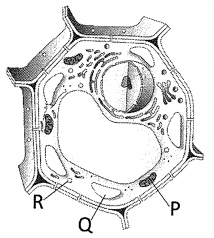
What are $P, Q,$ and $R$ in the given plant cell?
A
Chloroplast,Mitochondrion,Peroxisome
B
Chloroplast,Mitochondrion,Ribosomes
C
Mitochondrion,Chloroplast,Peroxisome
D
Mitochondrion,Chloroplast,Ribosomes
Solution
(C) In the provided diagram of a plant cell:
$1$. $P$ represents the Mitochondrion,which is characterized by its double-membrane structure with inner folds called cristae.
$2$. $Q$ represents the Chloroplast,which is a large,oval-shaped organelle typical of plant cells.
$3$. $R$ represents a Peroxisome,which is a small,spherical,single-membrane-bound organelle involved in metabolic processes.
Therefore,the correct identification is $P =$ Mitochondrion,$Q =$ Chloroplast,and $R =$ Peroxisome.
$1$. $P$ represents the Mitochondrion,which is characterized by its double-membrane structure with inner folds called cristae.
$2$. $Q$ represents the Chloroplast,which is a large,oval-shaped organelle typical of plant cells.
$3$. $R$ represents a Peroxisome,which is a small,spherical,single-membrane-bound organelle involved in metabolic processes.
Therefore,the correct identification is $P =$ Mitochondrion,$Q =$ Chloroplast,and $R =$ Peroxisome.
0 likes
View Solution282
MediumMCQ
How many of the following structures are membrane-bound?
Endoplasmic reticulum,Golgi apparatus,Ribosomes,Lysosomes,Mitochondria,Microbodies,Centrioles,Nucleolus,Vacuoles
Endoplasmic reticulum,Golgi apparatus,Ribosomes,Lysosomes,Mitochondria,Microbodies,Centrioles,Nucleolus,Vacuoles
A
$4$
B
$5$
C
$6$
D
$7$
Solution
(C) To determine the number of membrane-bound structures,we classify each organelle:
$1$. Endoplasmic reticulum: Membrane-bound (Single membrane).
$2$. Golgi apparatus: Membrane-bound (Single membrane).
$3$. Ribosomes: Non-membrane-bound.
$4$. Lysosomes: Membrane-bound (Single membrane).
$5$. Mitochondria: Membrane-bound (Double membrane).
$6$. Microbodies: Membrane-bound (Single membrane).
$7$. Centrioles: Non-membrane-bound.
$8$. Nucleolus: Non-membrane-bound.
$9$. Vacuoles: Membrane-bound (Single membrane,Tonoplast).
Counting the membrane-bound structures: Endoplasmic reticulum,Golgi apparatus,Lysosomes,Mitochondria,Microbodies,and Vacuoles.
Total count = $6$.
$1$. Endoplasmic reticulum: Membrane-bound (Single membrane).
$2$. Golgi apparatus: Membrane-bound (Single membrane).
$3$. Ribosomes: Non-membrane-bound.
$4$. Lysosomes: Membrane-bound (Single membrane).
$5$. Mitochondria: Membrane-bound (Double membrane).
$6$. Microbodies: Membrane-bound (Single membrane).
$7$. Centrioles: Non-membrane-bound.
$8$. Nucleolus: Non-membrane-bound.
$9$. Vacuoles: Membrane-bound (Single membrane,Tonoplast).
Counting the membrane-bound structures: Endoplasmic reticulum,Golgi apparatus,Lysosomes,Mitochondria,Microbodies,and Vacuoles.
Total count = $6$.
0 likes
View Solution283
MediumMCQ
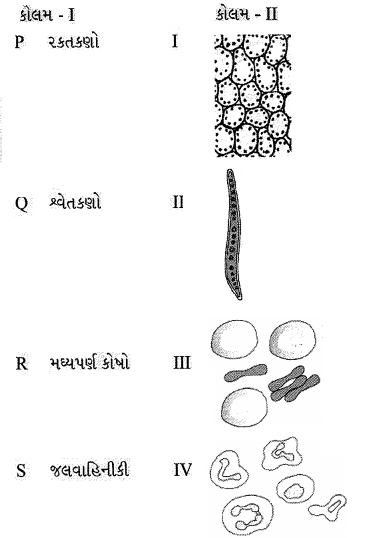
Match the following columns based on the cell types shown in the image.
A
$(P-III), (Q-IV), (R-II), (S-I)$
B
$(P-IV), (Q-III), (R-II), (S-I)$
C
$(P-IV), (Q-III), (R-I), (S-II)$
D
$(P-III), (Q-IV), (R-I), (S-II)$
Solution
(D) Based on the biological structures provided in the image:
$P$ (Red blood cells) correspond to image $III$ (round and biconcave).
$Q$ (White blood cells) correspond to image $IV$ (irregular shape).
$R$ (Mesophyll cells) correspond to image $I$ (round and oval cells).
$S$ (Tracheid) corresponds to image $II$ (elongated structure).
Therefore,the correct matching is $(P-III), (Q-IV), (R-I), (S-II)$.
$P$ (Red blood cells) correspond to image $III$ (round and biconcave).
$Q$ (White blood cells) correspond to image $IV$ (irregular shape).
$R$ (Mesophyll cells) correspond to image $I$ (round and oval cells).
$S$ (Tracheid) corresponds to image $II$ (elongated structure).
Therefore,the correct matching is $(P-III), (Q-IV), (R-I), (S-II)$.
0 likes
View Solution284
EasyMCQ
Which of the following is not a part of the endomembrane system?
A
Vacuole
B
Chloroplast
C
Golgi apparatus
D
Endoplasmic reticulum
Solution
(B) The endomembrane system includes organelles that work together to modify,package,and transport lipids and proteins.
These include the endoplasmic reticulum,Golgi apparatus,lysosomes,and vacuoles.
Chloroplasts and mitochondria are not part of the endomembrane system because their functions are not coordinated with the endomembrane system in the same way.
These include the endoplasmic reticulum,Golgi apparatus,lysosomes,and vacuoles.
Chloroplasts and mitochondria are not part of the endomembrane system because their functions are not coordinated with the endomembrane system in the same way.
0 likes
View Solution285
MediumMCQ
How many of the following organelles are part of the endomembrane system: Vacuoles,Peroxisomes,Mitochondria,Chloroplasts,Golgi complex?
A
$1$
B
$2$
C
$3$
D
$4$
Solution
(B) The endomembrane system includes organelles whose functions are coordinated. These include the Endoplasmic Reticulum $(ER)$,Golgi complex,Lysosomes,and Vacuoles.
$1$. Vacuoles: Part of the endomembrane system.
$2$. Peroxisomes: Not part of the endomembrane system.
$3$. Mitochondria: Not part of the endomembrane system (semi-autonomous).
$4$. Chloroplasts: Not part of the endomembrane system (semi-autonomous).
$5$. Golgi complex: Part of the endomembrane system.
Therefore,only $2$ organelles (Vacuoles and Golgi complex) are part of the endomembrane system.
$1$. Vacuoles: Part of the endomembrane system.
$2$. Peroxisomes: Not part of the endomembrane system.
$3$. Mitochondria: Not part of the endomembrane system (semi-autonomous).
$4$. Chloroplasts: Not part of the endomembrane system (semi-autonomous).
$5$. Golgi complex: Part of the endomembrane system.
Therefore,only $2$ organelles (Vacuoles and Golgi complex) are part of the endomembrane system.
0 likes
View Solution286
MediumMCQ
Match the following columns:
| Column-$I$ (Cell) | Column-$II$ (Number of Nuclei) |
| $P$. Sieve tube element | $I$. Binucleate |
| $Q$. Paramecium | $II$. Uninucleate |
| $R$. Typical cell | $III$. Enucleated |
| $S$. Skeletal muscle cell | $IV$. Multinucleate |
A
$P-III, Q-IV, R-II, S-I$
B
$P-III, Q-I, R-II, S-IV$
C
$P-IV, Q-I, R-II, S-III$
D
$P-IV, Q-II, R-I, S-III$
Solution
(B) The correct matches are as follows:
$1$. Sieve tube elements $(P)$ are mature cells that lack a nucleus, hence they are enucleated $(III)$.
$2$. Paramecium $(Q)$ is a ciliate protozoan that contains two types of nuclei (macronucleus and micronucleus), making it binucleate $(I)$.
$3$. A typical cell $(R)$ generally contains a single nucleus, making it uninucleate $(II)$.
$4$. Skeletal muscle cells $(S)$ are formed by the fusion of multiple cells, resulting in a syncytium, which is multinucleate $(IV)$.
Thus, the correct sequence is $P-III, Q-I, R-II, S-IV$.
$1$. Sieve tube elements $(P)$ are mature cells that lack a nucleus, hence they are enucleated $(III)$.
$2$. Paramecium $(Q)$ is a ciliate protozoan that contains two types of nuclei (macronucleus and micronucleus), making it binucleate $(I)$.
$3$. A typical cell $(R)$ generally contains a single nucleus, making it uninucleate $(II)$.
$4$. Skeletal muscle cells $(S)$ are formed by the fusion of multiple cells, resulting in a syncytium, which is multinucleate $(IV)$.
Thus, the correct sequence is $P-III, Q-I, R-II, S-IV$.
0 likes
View Solution287
EasyMCQ
In which of the following are porins found?
A
Plastids
B
Mitochondria
C
Bacteria
D
All of the above
Solution
(D) Porins are large protein channels present in the outer membranes of plastids,mitochondria,and some bacteria.
These proteins allow molecules of the size of small proteins to pass through the membrane.
Therefore,all the given options contain porins in their outer membranes.
These proteins allow molecules of the size of small proteins to pass through the membrane.
Therefore,all the given options contain porins in their outer membranes.
0 likes
View Solution288
MediumMCQ
Which of the following are $NOT$ considered as the part of endomembrane system?
$A$. Mitochondria $B$. Endoplasmic reticulum $C$. Chloroplasts
$D$. Golgi complex $E$. Peroxisomes
Choose the most appropriate answer from the options given below:
$A$. Mitochondria $B$. Endoplasmic reticulum $C$. Chloroplasts
$D$. Golgi complex $E$. Peroxisomes
Choose the most appropriate answer from the options given below:
A
$A$, $C$ and $E$ only
B
$B$ and $D$ only
C
$A$, $D$ and $E$ only
D
$A$ and $D$ only
Solution
(A) The endomembrane system includes the endoplasmic reticulum $(ER)$, Golgi complex, lysosomes, and vacuoles.
Since the functions of the mitochondria, chloroplasts, and peroxisomes are not coordinated with the above-mentioned components, they are not considered part of the endomembrane system.
Therefore, the organelles that are $NOT$ part of the endomembrane system are mitochondria $(A)$, chloroplasts $(C)$, and peroxisomes $(E)$.
Since the functions of the mitochondria, chloroplasts, and peroxisomes are not coordinated with the above-mentioned components, they are not considered part of the endomembrane system.
Therefore, the organelles that are $NOT$ part of the endomembrane system are mitochondria $(A)$, chloroplasts $(C)$, and peroxisomes $(E)$.
0 likes
View Solution289
MediumMCQ
Match List $I$ with List $II$:
Choose the correct answer from the options given below:
| List $I$ | List $II$ |
| $A$. Nucleolus | $I$. Site of formation of glycolipid |
| $B$. Centriole | $II$. Organization like the cartwheel |
| $C$. Golgi apparatus | $III$. Site for active ribosomal $RNA$ synthesis |
| $D$. Leucoplast | $IV$. For storing nutrients |
Choose the correct answer from the options given below:
A
$A-III, B-II, C-I, D-IV$
B
$A-III, B-IV, C-II, D-I$
C
$A-I, B-II, C-III, D-IV$
D
$A-III, B-II, C-IV, D-I$
Solution
(A) The correct matching is as follows:
- Nucleolus $(A)$: It is the site for active ribosomal $RNA$ $(rRNA)$ synthesis $(III)$.
- Centriole $(B)$: Centrioles are organelles that possess an organization like the cartwheel $(II)$.
- Golgi apparatus $(C)$: It is the primary site for the formation of glycoproteins and glycolipids $(I)$.
- Leucoplast $(D)$: These are colourless plastids that are primarily responsible for storing nutrients such as starch,oil,or proteins $(IV)$.
Therefore,the correct sequence is $A-III, B-II, C-I, D-IV$.
- Nucleolus $(A)$: It is the site for active ribosomal $RNA$ $(rRNA)$ synthesis $(III)$.
- Centriole $(B)$: Centrioles are organelles that possess an organization like the cartwheel $(II)$.
- Golgi apparatus $(C)$: It is the primary site for the formation of glycoproteins and glycolipids $(I)$.
- Leucoplast $(D)$: These are colourless plastids that are primarily responsible for storing nutrients such as starch,oil,or proteins $(IV)$.
Therefore,the correct sequence is $A-III, B-II, C-I, D-IV$.
0 likes
View Solution290
MediumMCQ
Match List $I$ with List $II$:
Choose the correct answer from the options given below:
| List $I$ | List $II$ |
|---|---|
| $A$. Axoneme | $I$. Centriole |
| $B$. Cartwheel pattern | $II$. Cilia and flagella |
| $C$. Crista | $III$. Chromosome |
| $D$. Satellite | $IV$. Mitochondria |
Choose the correct answer from the options given below:
A
$A-IV, B-II, C-III, D-I$
B
$A-II, B-IV, C-I, D-III$
C
$A-II, B-I, C-IV, D-III$
D
$A-IV, B-III, C-II, D-I$
Solution
(C) - Axoneme is the core structure found in cilia and flagella $(A-II)$.
- Centriole exhibits a characteristic cartwheel pattern in its cross-section $(B-I)$.
- Crista refers to the infoldings of the inner mitochondrial membrane $(C-IV)$.
- Satellite is a small fragment of chromosome separated from the main body by a secondary constriction $(D-III)$.
- Therefore,the correct matching is $A-II, B-I, C-IV, D-III$.
- Centriole exhibits a characteristic cartwheel pattern in its cross-section $(B-I)$.
- Crista refers to the infoldings of the inner mitochondrial membrane $(C-IV)$.
- Satellite is a small fragment of chromosome separated from the main body by a secondary constriction $(D-III)$.
- Therefore,the correct matching is $A-II, B-I, C-IV, D-III$.
0 likes
View Solution291
MediumMCQ
Given below are two statements:
Statement $I$: Mitochondria and chloroplasts are both double-membrane-bound organelles.
Statement $II$: The inner membrane of mitochondria is relatively more permeable compared to the inner membrane of chloroplasts.
In the light of the above statements,choose the most appropriate answer from the options given below:
Statement $I$: Mitochondria and chloroplasts are both double-membrane-bound organelles.
Statement $II$: The inner membrane of mitochondria is relatively more permeable compared to the inner membrane of chloroplasts.
In the light of the above statements,choose the most appropriate answer from the options given below:
A
Both Statement $I$ and Statement $II$ are incorrect.
B
Statement $I$ is correct but Statement $II$ is incorrect.
C
Statement $I$ is incorrect but Statement $II$ is correct.
D
Both Statement $I$ and Statement $II$ are correct.
Solution
(D) Statement $I$ is correct: Both mitochondria and chloroplasts are semi-autonomous cell organelles bounded by a double-membrane system.
Statement $II$ is correct: The inner membrane of mitochondria contains specific transport proteins that allow the movement of various ions and metabolites,making it relatively more permeable. In contrast,the inner membrane of chloroplasts is highly selective and relatively impermeable to most ions and metabolites,requiring specific transporters for their movement.
Therefore,both statements are correct.
Statement $II$ is correct: The inner membrane of mitochondria contains specific transport proteins that allow the movement of various ions and metabolites,making it relatively more permeable. In contrast,the inner membrane of chloroplasts is highly selective and relatively impermeable to most ions and metabolites,requiring specific transporters for their movement.
Therefore,both statements are correct.
0 likes
View Solution292
MediumMCQ
Match List $- I$ with List $- II.$
Choose the correct answer from the options given below:
| List $- I$ | List $- II$ |
|---|---|
| $A$. Centromere | $I$. Mitochondrion |
| $B$. Cilium | $II$. Cell division |
| $C$. Cristae | $III$. Cell movement |
| $D$. Cell membrane | $IV$. Phospholipid Bilayer |
Choose the correct answer from the options given below:
A
$A-I, B-II, C-III, D-IV$
B
$A-II, B-I, C-IV, D-III$
C
$A-IV, B-II, C-III, D-I$
D
$A-II, B-III, C-I, D-IV$
Solution
(D) The correct matches are as follows:
$A$. Centromere is the site of attachment for spindle fibers during $Cell \text{ } division$ $(II)$.
$B$. Cilium is a hair-like outgrowth of the cell membrane involved in $Cell \text{ } movement$ $(III)$.
$C$. Cristae are the infoldings of the inner membrane of the $Mitochondrion$ $(I)$.
$D$. Cell membrane is primarily composed of a $Phospholipid \text{ } Bilayer$ $(IV)$.
Therefore,the correct sequence is $A-II, B-III, C-I, D-IV$.
$A$. Centromere is the site of attachment for spindle fibers during $Cell \text{ } division$ $(II)$.
$B$. Cilium is a hair-like outgrowth of the cell membrane involved in $Cell \text{ } movement$ $(III)$.
$C$. Cristae are the infoldings of the inner membrane of the $Mitochondrion$ $(I)$.
$D$. Cell membrane is primarily composed of a $Phospholipid \text{ } Bilayer$ $(IV)$.
Therefore,the correct sequence is $A-II, B-III, C-I, D-IV$.
0 likes
View Solution293
DifficultMCQ
Read the following statements carefully:
$(A)$ Lipid component of the plasma membrane mainly consists of phosphoglycerides.
$(B)$ Polar molecules can pass through the lipid bilayer of plasma membrane,therefore they do not require carrier proteins to facilitate their transport.
$(C)$ Secondary wall is capable of growth and it is formed on the outer side of the cell.
$(D)$ Quasifluid nature of lipid enables lateral movement of proteins within the overall lipid bilayer of plasma membrane.
$(E)$ Middle lamella glues the different neighbouring cells together.
How many statements are incorrect?
$(A)$ Lipid component of the plasma membrane mainly consists of phosphoglycerides.
$(B)$ Polar molecules can pass through the lipid bilayer of plasma membrane,therefore they do not require carrier proteins to facilitate their transport.
$(C)$ Secondary wall is capable of growth and it is formed on the outer side of the cell.
$(D)$ Quasifluid nature of lipid enables lateral movement of proteins within the overall lipid bilayer of plasma membrane.
$(E)$ Middle lamella glues the different neighbouring cells together.
How many statements are incorrect?
A
$3$
B
$5$
C
$4$
D
$2$
Solution
(D) Let us analyze each statement:
$(A)$ Correct: The lipid component of the plasma membrane is primarily composed of phosphoglycerides.
$(B)$ Incorrect: Polar molecules cannot pass through the non-polar lipid bilayer easily; they require carrier proteins or channel proteins for transport.
$(C)$ Incorrect: The secondary wall is formed on the inner side of the primary wall and it is generally not capable of growth (it is rigid).
$(D)$ Correct: The quasi-fluid nature of the lipid bilayer allows for the lateral movement of proteins within the membrane (Fluid Mosaic Model).
$(E)$ Correct: The middle lamella is a layer primarily made of calcium pectate that acts as a glue to hold neighbouring cells together.
Thus,statements $(B)$ and $(C)$ are incorrect. The total number of incorrect statements is $2$.
$(A)$ Correct: The lipid component of the plasma membrane is primarily composed of phosphoglycerides.
$(B)$ Incorrect: Polar molecules cannot pass through the non-polar lipid bilayer easily; they require carrier proteins or channel proteins for transport.
$(C)$ Incorrect: The secondary wall is formed on the inner side of the primary wall and it is generally not capable of growth (it is rigid).
$(D)$ Correct: The quasi-fluid nature of the lipid bilayer allows for the lateral movement of proteins within the membrane (Fluid Mosaic Model).
$(E)$ Correct: The middle lamella is a layer primarily made of calcium pectate that acts as a glue to hold neighbouring cells together.
Thus,statements $(B)$ and $(C)$ are incorrect. The total number of incorrect statements is $2$.
0 likes
View Solution294
EasyMCQ
Which of the given cell organelles is not correctly matched with the given information?
A
Centriole $\longrightarrow$ It gives cart-wheel appearance
B
Mitochondria $\longrightarrow$ Powerhouse of cell
C
Ribosome $\longrightarrow$ Also found in other cell organelles
D
$RER$ $\longrightarrow$ Synthesis of steroidal hormones
Solution
(D) The correct answer is $D$.
$A$. Centrioles are composed of nine evenly spaced peripheral fibrils of tubulin protein,which gives a cart-wheel appearance. This is correct.
$B$. Mitochondria are known as the powerhouse of the cell because they produce energy in the form of $ATP$. This is correct.
$C$. Ribosomes are found in the cytoplasm,as well as in other organelles like mitochondria and chloroplasts. This is correct.
$D$. $RER$ (Rough Endoplasmic Reticulum) is involved in protein synthesis. $SER$ (Smooth Endoplasmic Reticulum) is the major site for the synthesis of lipid-like steroidal hormones. Therefore,the matching for $RER$ is incorrect.
$A$. Centrioles are composed of nine evenly spaced peripheral fibrils of tubulin protein,which gives a cart-wheel appearance. This is correct.
$B$. Mitochondria are known as the powerhouse of the cell because they produce energy in the form of $ATP$. This is correct.
$C$. Ribosomes are found in the cytoplasm,as well as in other organelles like mitochondria and chloroplasts. This is correct.
$D$. $RER$ (Rough Endoplasmic Reticulum) is involved in protein synthesis. $SER$ (Smooth Endoplasmic Reticulum) is the major site for the synthesis of lipid-like steroidal hormones. Therefore,the matching for $RER$ is incorrect.
0 likes
View Solution295
MediumMCQ
Assertion : Both Endoplasmic reticulum and vacuoles are the part of endomembrane system.
Reason : Functions of both endoplasmic reticulum and vacuoles are not coordinated.
Reason : Functions of both endoplasmic reticulum and vacuoles are not coordinated.
A
Both Assertion and Reason are true and Reason is a correct explanation of the Assertion.
B
Both Assertion and Reason are true but Reason is not a correct explanation of the Assertion.
C
Assertion is true but the Reason is False.
D
Both Assertion and Reason are False.
Solution
(C) The endomembrane system includes the endoplasmic reticulum $(ER)$,Golgi complex,lysosomes,and vacuoles.
These organelles are considered part of the endomembrane system because their functions are coordinated.
Therefore,the Assertion is true,but the Reason is false because the functions of these organelles are indeed coordinated.
These organelles are considered part of the endomembrane system because their functions are coordinated.
Therefore,the Assertion is true,but the Reason is false because the functions of these organelles are indeed coordinated.
0 likes
View Solution296
MediumMCQ
How many statements are correct?
$(A)$ Animal cells contain membrane-bound organelle called centriole which help in cell division.
$(B)$ Lipids are arranged within the plasma membrane with the polar head towards the inner sides and the hydrophobic tails towards the outer side.
$(C)$ The cell wall and middle lamellae may be traversed by plasmodesmata which connect the cytoplasm of neighboring plant cells.
$(D)$ The quasi-fluid nature of lipid enables lateral movement of proteins within the overall bilayer.
$(A)$ Animal cells contain membrane-bound organelle called centriole which help in cell division.
$(B)$ Lipids are arranged within the plasma membrane with the polar head towards the inner sides and the hydrophobic tails towards the outer side.
$(C)$ The cell wall and middle lamellae may be traversed by plasmodesmata which connect the cytoplasm of neighboring plant cells.
$(D)$ The quasi-fluid nature of lipid enables lateral movement of proteins within the overall bilayer.
A
$1$
B
$2$
C
$3$
D
$4$
Solution
(B) Let us analyze each statement:
$(A)$ Incorrect. Centrioles are non-membrane-bound organelles.
$(B)$ Incorrect. In the plasma membrane,the polar heads are towards the outer sides and the hydrophobic tails are towards the inner side.
$(C)$ Correct. Plasmodesmata are channels that traverse the cell walls of plant cells and some algal cells,enabling transport and communication between them.
$(D)$ Correct. The quasi-fluid nature of the lipid bilayer allows for the lateral movement of proteins within the membrane,as described by the fluid mosaic model.
Thus,only statements $(C)$ and $(D)$ are correct. The total number of correct statements is $2$.
$(A)$ Incorrect. Centrioles are non-membrane-bound organelles.
$(B)$ Incorrect. In the plasma membrane,the polar heads are towards the outer sides and the hydrophobic tails are towards the inner side.
$(C)$ Correct. Plasmodesmata are channels that traverse the cell walls of plant cells and some algal cells,enabling transport and communication between them.
$(D)$ Correct. The quasi-fluid nature of the lipid bilayer allows for the lateral movement of proteins within the membrane,as described by the fluid mosaic model.
Thus,only statements $(C)$ and $(D)$ are correct. The total number of correct statements is $2$.
0 likes
View Solution297
MediumMCQ
$[A]$ Anything less than a complete structure of a cell does not ensure independent living.
$[B]$ In eukaryotic cells,there is an extensive compartmentalization of cytoplasm through the presence of membrane-bound organelles.
$[C]$ The mitochondria divide by fission.
$[D]$ The vacuole is the membrane-bound space found in the cytoplasm.
$[B]$ In eukaryotic cells,there is an extensive compartmentalization of cytoplasm through the presence of membrane-bound organelles.
$[C]$ The mitochondria divide by fission.
$[D]$ The vacuole is the membrane-bound space found in the cytoplasm.
A
Statement $A, C$ and $D$ are wrong
B
Statement $A, B$ and $D$ are not correct
C
Statement $A, B, C$ and $D$ are correct
D
Statement $B, C$ and $D$ are not correct
Solution
(C) Statement $A$ is correct: According to the Cell Theory,a cell is the fundamental unit of life,and anything less than a complete cell cannot exhibit all life processes independently.
Statement $B$ is correct: Eukaryotic cells contain membrane-bound organelles like the nucleus,mitochondria,and endoplasmic reticulum,which create distinct compartments within the cytoplasm.
Statement $C$ is correct: Mitochondria are semi-autonomous organelles that replicate independently of the cell cycle through a process similar to binary fission.
Statement $D$ is correct: The vacuole is a membrane-bound space found in the cytoplasm,containing water,sap,excretory products,and other materials not useful for the cell.
Since all statements $A, B, C,$ and $D$ are scientifically accurate,option $C$ is the correct answer.
Statement $B$ is correct: Eukaryotic cells contain membrane-bound organelles like the nucleus,mitochondria,and endoplasmic reticulum,which create distinct compartments within the cytoplasm.
Statement $C$ is correct: Mitochondria are semi-autonomous organelles that replicate independently of the cell cycle through a process similar to binary fission.
Statement $D$ is correct: The vacuole is a membrane-bound space found in the cytoplasm,containing water,sap,excretory products,and other materials not useful for the cell.
Since all statements $A, B, C,$ and $D$ are scientifically accurate,option $C$ is the correct answer.
0 likes
View Solution298
EasyMCQ
Which one of the following is not included under the endomembrane system?
A
Endoplasmic reticulum
B
Mitochondria
C
Lysosome
D
Vacuole
Solution
(B) The correct answer is $B$ (Mitochondria).
The endomembrane system includes organelles whose functions are coordinated,such as the endoplasmic reticulum $(ER)$,Golgi complex,lysosomes,and vacuoles.
Organelles like mitochondria,chloroplasts,and peroxisomes are not considered part of the endomembrane system because their functions are not coordinated with the endomembrane components,and they do not participate in the same vesicular transport pathway.
The endomembrane system includes organelles whose functions are coordinated,such as the endoplasmic reticulum $(ER)$,Golgi complex,lysosomes,and vacuoles.
Organelles like mitochondria,chloroplasts,and peroxisomes are not considered part of the endomembrane system because their functions are not coordinated with the endomembrane components,and they do not participate in the same vesicular transport pathway.
0 likes
View Solution299
EasyMCQ
Which of the following statements is correct?
A
The core of cilium or flagellum is the basal body.
B
Elaioplasts store starch whereas aleuroplasts store proteins.
C
Membranous extensions into the cytoplasm in cyanobacteria which contain pigments are called chromatophores.
D
Acrocentric chromosomes have only one arm.
Solution
(C) Option $C$ is correct. In some prokaryotes like cyanobacteria,there are other membranous extensions into the cytoplasm called chromatophores which contain pigments.
Explanation of other options:
- Option $A$: The core of a cilium or flagellum is called the axoneme,not the basal body.
- Option $B$: Elaioplasts store oils and fats,while amyloplasts store starch. Aleuroplasts store proteins.
- Option $D$: Acrocentric chromosomes have two arms,one very short and one very long,with the centromere situated close to one end.
Explanation of other options:
- Option $A$: The core of a cilium or flagellum is called the axoneme,not the basal body.
- Option $B$: Elaioplasts store oils and fats,while amyloplasts store starch. Aleuroplasts store proteins.
- Option $D$: Acrocentric chromosomes have two arms,one very short and one very long,with the centromere situated close to one end.
0 likes
View Solution300
MediumMCQ
Choose the correct statements regarding cell organelles and their inclusions.
$A$. The endomembrane system includes Golgi complex,endoplasmic reticulum and mitochondria.
$B$. Rough endoplasmic reticulum bears ribosomes on its surface.
$C$. Both mitochondria and plastids have circular $DNA$.
$D$. $A$ network of microtubules,microfilaments and intermediate filaments present in the cytoplasm is called cytoskeleton.
$E$. Mitochondrion is a single membrane-bound structure.
Choose the correct answer from the options given below:
$A$. The endomembrane system includes Golgi complex,endoplasmic reticulum and mitochondria.
$B$. Rough endoplasmic reticulum bears ribosomes on its surface.
$C$. Both mitochondria and plastids have circular $DNA$.
$D$. $A$ network of microtubules,microfilaments and intermediate filaments present in the cytoplasm is called cytoskeleton.
$E$. Mitochondrion is a single membrane-bound structure.
Choose the correct answer from the options given below:
A
$(1)$ $A, B$ and $C$ only
B
$(2)$ $C, D$ and $E$ only
C
$(3)$ $A$ and $B$ only
D
$(4)$ $B, C$ and $D$ only
Solution
(D) Statement $A$ is incorrect because the endomembrane system consists of the endoplasmic reticulum,Golgi complex,lysosomes,and vacuoles; mitochondria are not part of it.
Statement $B$ is correct because rough endoplasmic reticulum $(RER)$ has ribosomes attached to its surface.
Statement $C$ is correct because both mitochondria and plastids are semi-autonomous organelles containing circular $DNA$.
Statement $D$ is correct because the cytoskeleton is an elaborate network of proteinaceous filaments consisting of microtubules,microfilaments,and intermediate filaments.
Statement $E$ is incorrect because mitochondria are double-membrane bound structures.
Thus,statements $B, C,$ and $D$ are correct.
Statement $B$ is correct because rough endoplasmic reticulum $(RER)$ has ribosomes attached to its surface.
Statement $C$ is correct because both mitochondria and plastids are semi-autonomous organelles containing circular $DNA$.
Statement $D$ is correct because the cytoskeleton is an elaborate network of proteinaceous filaments consisting of microtubules,microfilaments,and intermediate filaments.
Statement $E$ is incorrect because mitochondria are double-membrane bound structures.
Thus,statements $B, C,$ and $D$ are correct.
0 likes
View SolutionCell: The Unit of Life — Mix Example-Cell: The Unit of Life · Frequently Asked Questions
1Are these Cell: The Unit of Life questions useful for JEE and NEET?
Yes. All questions in this section are mapped to JEE Main and NEET exam patterns. Previous year questions from JEE Main, NEET, GUJCET and state-level exams are included with full solutions.
2Can I switch to Hindi or Gujarati for these questions?
Yes. Use the language tabs in the hero section or the sidebar to view the same questions and solutions in English, Hindi or Gujarati.
3How do I generate a question paper from this subtopic?
Use the Vedclass Exam Paper Generator — select the chapter and subtopic, set difficulty, and generate Sets A, B, C, D automatically. First 3 chapters of every subject are free.
Vedclass Products
For Students
Vedclass Test Series
Mock tests in real JEE/NEET style with performance analysis. 5-day free trial.
Start Free TrialFor Teachers
Exam Paper Generator
Generate Set A/B/C/D papers from this chapter in 2 minutes. 3 chapters free.
Try FreeFor Institutes
Online Exam Module
Live online exams with unlimited students, 360° analytics & white-label branding.
See DemoFor Teachers & Institutes
Generate a Cell: The Unit of Life Exam Paper in 2 Minutes
Select subtopic & difficulty — Sets A, B, C, D auto-generated with No Repeat logic.
First 3 chapters of every subject are free — no payment required.