
A English
M Phase Questions in English
Class 11 Biology · Cell Cycle and Cell Division · M Phase
360+
Questions
English
Language
100%
With Solutions
Showing 50 of 360 questions in English
201
MediumMCQ
Match the following and select the correct option:
$List-I$ (Phase) | $List-II$ (Event)
$(A)$ Prophase | $(i)$ Centromere attaches to spindle fibers
$(B)$ Metaphase | $(ii)$ Spindle fibers disappear
$(C)$ Anaphase | $(iii)$ Formation of spindle fibers
$(D)$ Telophase | $(iv)$ Spindle fibers shorten
$List-I$ (Phase) | $List-II$ (Event)
$(A)$ Prophase | $(i)$ Centromere attaches to spindle fibers
$(B)$ Metaphase | $(ii)$ Spindle fibers disappear
$(C)$ Anaphase | $(iii)$ Formation of spindle fibers
$(D)$ Telophase | $(iv)$ Spindle fibers shorten
A
$A-ii, B-i, C-iii, D-iv$
B
$A-iii, B-i, C-iv, D-ii$
C
$A-iv, B-ii, C-i, D-ii$
D
$A-ii, B-iii, C-iv, D-i$
Solution
(B) The correct matching is as follows:
$(A)$ Prophase: During prophase,the chromatin condenses into chromosomes and the mitotic spindle fibers begin to form. Thus,$(A-iii)$.
$(B)$ Metaphase: During metaphase,chromosomes align at the equator and the centromeres of chromosomes attach to the spindle fibers. Thus,$(B-i)$.
$(C)$ Anaphase: During anaphase,the centromeres split and the spindle fibers shorten,pulling the sister chromatids towards opposite poles. Thus,$(C-iv)$.
$(D)$ Telophase: During telophase,the chromosomes reach the poles and the spindle fibers disappear as the nuclear envelope reforms. Thus,$(D-ii)$.
Therefore,the correct sequence is $A-iii, B-i, C-iv, D-ii$.
$(A)$ Prophase: During prophase,the chromatin condenses into chromosomes and the mitotic spindle fibers begin to form. Thus,$(A-iii)$.
$(B)$ Metaphase: During metaphase,chromosomes align at the equator and the centromeres of chromosomes attach to the spindle fibers. Thus,$(B-i)$.
$(C)$ Anaphase: During anaphase,the centromeres split and the spindle fibers shorten,pulling the sister chromatids towards opposite poles. Thus,$(C-iv)$.
$(D)$ Telophase: During telophase,the chromosomes reach the poles and the spindle fibers disappear as the nuclear envelope reforms. Thus,$(D-ii)$.
Therefore,the correct sequence is $A-iii, B-i, C-iv, D-ii$.
0 likes
View Solution202
EasyMCQ
The term $Karyokinesis$ is used for:
A
The dissolution of the nuclear membrane during prophase.
B
The movement of chromosomes towards opposite poles during anaphase.
C
The events occurring during interphase.
D
All the changes occurring in the nucleus during cell division.
Solution
(D) The term $Karyokinesis$ is derived from the Greek words '$karyon$' (nucleus) and '$kinesis$' (movement/division).
It specifically refers to the division of the nucleus during the $M$ phase of the cell cycle.
While prophase,metaphase,anaphase,and telophase are individual stages of nuclear division,the collective term for all these nuclear changes is $Karyokinesis$.
Therefore,it encompasses all the structural and functional changes that occur within the nucleus to ensure the equal distribution of genetic material into two daughter nuclei.
It specifically refers to the division of the nucleus during the $M$ phase of the cell cycle.
While prophase,metaphase,anaphase,and telophase are individual stages of nuclear division,the collective term for all these nuclear changes is $Karyokinesis$.
Therefore,it encompasses all the structural and functional changes that occur within the nucleus to ensure the equal distribution of genetic material into two daughter nuclei.
0 likes
View Solution203
EasyMCQ
What is observed in chromosomes at the end of prophase?
A
Each has two chromatids.
B
Each has a single centromere.
C
Chromosomes are spread throughout the cell.
D
All of $(a), (b),$ and $(c)$.
Solution
(D) At the end of prophase,the following events are observed:
$1$. Chromosomes condense and become visible as two sister chromatids held together at the centromere.
$2$. Each chromosome possesses a single centromere.
$3$. The nuclear envelope and nucleolus disappear,and chromosomes are dispersed throughout the cytoplasm of the cell.
Therefore,all the given statements are correct.
$1$. Chromosomes condense and become visible as two sister chromatids held together at the centromere.
$2$. Each chromosome possesses a single centromere.
$3$. The nuclear envelope and nucleolus disappear,and chromosomes are dispersed throughout the cytoplasm of the cell.
Therefore,all the given statements are correct.
0 likes
View Solution204
MediumMCQ
In mitosis,which of the following statements is correct regarding the attachment of spindle fibers?
A
Spindle fibers are attached to the kinetochores of each chromosome.
B
The centromere of each chromosome is attached to the centriole of one pole by a spindle fiber.
C
Each chromosome is attached to the centrioles of both poles by spindle fibers.
D
None of these.
Solution
(A) During the metaphase stage of mitosis,the spindle fibers from both poles of the cell attach to the kinetochores of the chromosomes. The kinetochore is a disc-shaped structure present on the surface of the centromeres. This attachment ensures that the sister chromatids are pulled toward opposite poles during the anaphase stage. Therefore,the correct statement is that spindle fibers are attached to the kinetochores of each chromosome.
0 likes
View Solution205
MediumMCQ
During anaphase,the chromatids move towards the poles due to which of the following?
A
Splitting of the centromere
B
Contraction of spindle fibers
C
Contraction of the bipolar spindle
D
All of the above $(a), (b)$ and $(c)$
Solution
(D) During anaphase,the centromere of each chromosome splits,allowing the two sister chromatids to separate.
Following this,the spindle fibers attached to the kinetochores of the chromatids undergo shortening (contraction).
This contraction of the spindle fibers pulls the chromatids towards the opposite poles of the cell.
Therefore,the movement is a result of the splitting of the centromere and the subsequent contraction of the spindle fibers.
Following this,the spindle fibers attached to the kinetochores of the chromatids undergo shortening (contraction).
This contraction of the spindle fibers pulls the chromatids towards the opposite poles of the cell.
Therefore,the movement is a result of the splitting of the centromere and the subsequent contraction of the spindle fibers.
0 likes
View Solution206
MediumMCQ
The equatorial plate is formed by which of the following?
A
All spindle fibers
B
Chromosomal fibers
C
Chromosomes
D
The middle part of the bipolar spindle
Solution
(C) During the metaphase stage of mitosis,the chromosomes align themselves at the equator of the cell. This plane of alignment is known as the equatorial plate or metaphase plate. The chromosomes are moved to this position by the spindle fibers,but the plate itself is composed of the chromosomes arranged in a single line.
0 likes
View Solution207
EasyMCQ
What is the state of chromosomes at the end of prophase?
A
Short and condensed
B
Each chromosome consists of one centromere and two chromatids
C
Possess kinetochore structures on the surface of the centromere
D
All of the above $(a), (b),$ and $(c)$
Solution
(D) At the end of prophase,the following events occur:
$1$. Chromatin material condenses into compact mitotic chromosomes. These chromosomes are seen to be composed of two chromatids attached together at the centromere.
$2$. The initiation of the assembly of the mitotic spindle occurs,and the microtubules,the proteinaceous components of the cell cytoplasm,help in the process.
$3$. Small disc-shaped structures at the surface of the centromeres are called kinetochores. These structures serve as the sites of attachment of spindle fibers to the chromosomes.
Therefore,all the given statements are correct.
$1$. Chromatin material condenses into compact mitotic chromosomes. These chromosomes are seen to be composed of two chromatids attached together at the centromere.
$2$. The initiation of the assembly of the mitotic spindle occurs,and the microtubules,the proteinaceous components of the cell cytoplasm,help in the process.
$3$. Small disc-shaped structures at the surface of the centromeres are called kinetochores. These structures serve as the sites of attachment of spindle fibers to the chromosomes.
Therefore,all the given statements are correct.
0 likes
View Solution208
EasyMCQ
How does $Telophase$ differ from $Anaphase$?
A
Chromosome movement is completed.
B
The number of chromosomes is the same,but the number of chromatids is different.
C
The number of chromatids is the same,but the number of centromeres is different.
D
None of these.
Solution
(A) In $Anaphase$,the centromeres split and chromatids separate,moving towards opposite poles. At this stage,each chromatid is considered a separate chromosome.
In $Telophase$,the chromosomes have reached their respective poles and begin to decondense. The key difference is that in $Anaphase$,the movement of chromosomes is active and ongoing,whereas in $Telophase$,the movement is completed,and the nuclear envelope begins to reform around the clusters of chromosomes at each pole.
In $Telophase$,the chromosomes have reached their respective poles and begin to decondense. The key difference is that in $Anaphase$,the movement of chromosomes is active and ongoing,whereas in $Telophase$,the movement is completed,and the nuclear envelope begins to reform around the clusters of chromosomes at each pole.
0 likes
View Solution209
MediumMCQ
Identify the correct sequence of stages in mitotic cell division.
A
Prophase $\rightarrow$ Anaphase $\rightarrow$ Metaphase $\rightarrow$ Telophase $\rightarrow$ Cytokinesis
B
Prophase $\rightarrow$ Metaphase $\rightarrow$ Anaphase $\rightarrow$ Telophase $\rightarrow$ Cytokinesis
C
Prophase $\rightarrow$ Cytokinesis $\rightarrow$ Telophase $\rightarrow$ Anaphase $\rightarrow$ Metaphase
D
Prophase $\rightarrow$ Telophase $\rightarrow$ Metaphase $\rightarrow$ Anaphase $\rightarrow$ Cytokinesis
Solution
(B) Mitosis ($M$ phase) is divided into four main stages of nuclear division (karyokinesis) followed by cytoplasmic division (cytokinesis).
$1$. Prophase: Chromatin condenses into chromosomes.
$2$. Metaphase: Chromosomes align at the equatorial plate.
$3$. Anaphase: Sister chromatids separate and move towards opposite poles.
$4$. Telophase: Chromosomes decondense at the poles and nuclear envelopes reform.
$5$. Cytokinesis: The physical division of the cytoplasm into two daughter cells.
Therefore,the correct sequence is Prophase $\rightarrow$ Metaphase $\rightarrow$ Anaphase $\rightarrow$ Telophase $\rightarrow$ Cytokinesis.
$1$. Prophase: Chromatin condenses into chromosomes.
$2$. Metaphase: Chromosomes align at the equatorial plate.
$3$. Anaphase: Sister chromatids separate and move towards opposite poles.
$4$. Telophase: Chromosomes decondense at the poles and nuclear envelopes reform.
$5$. Cytokinesis: The physical division of the cytoplasm into two daughter cells.
Therefore,the correct sequence is Prophase $\rightarrow$ Metaphase $\rightarrow$ Anaphase $\rightarrow$ Telophase $\rightarrow$ Cytokinesis.
0 likes
View Solution210
MediumMCQ
In which phase of the cell cycle are the structures known as kinetochores observed on chromosomes?
A
Prophase
B
Anaphase
C
Metaphase
D
Telophase
Solution
(C) Kinetochores are small disc-shaped structures present at the surface of the centromeres of chromosomes.
These structures serve as the sites of attachment for spindle fibers (microtubules) to the chromosomes.
Although kinetochores begin to form during prophase, they become clearly visible and functional during $Metaphase$, as this is when the chromosomes align at the equatorial plate and spindle fibers attach to them to facilitate their movement.
These structures serve as the sites of attachment for spindle fibers (microtubules) to the chromosomes.
Although kinetochores begin to form during prophase, they become clearly visible and functional during $Metaphase$, as this is when the chromosomes align at the equatorial plate and spindle fibers attach to them to facilitate their movement.
0 likes
View Solution211
EasyMCQ
Chromosomes become long and thin,eventually turning into chromatin material,and the nucleolus and nuclear envelope reappear. In which phase are these changes observed?
A
Prophase
B
Telophase
C
Interphase
D
Metaphase
Solution
(B) The changes described,such as chromosomes becoming long and thin (decondensing into chromatin),and the reappearance of the nucleolus and nuclear envelope,are characteristic events of $Telophase$.
During $Telophase$,the chromosomes reach their respective poles and lose their individuality as discrete elements.
The nuclear envelope reforms around the chromosome clusters at each pole,and the nucleolus,Golgi complex,and endoplasmic reticulum reform.
During $Telophase$,the chromosomes reach their respective poles and lose their individuality as discrete elements.
The nuclear envelope reforms around the chromosome clusters at each pole,and the nucleolus,Golgi complex,and endoplasmic reticulum reform.
0 likes
View Solution212
MediumMCQ
Statement $P$ : Small disc-shaped structures called kinetochores are present on the surface of the centromeres.
Statement $Q$ : Spindle fibers attach to the centromeres of the chromosomes.
Statement $Q$ : Spindle fibers attach to the centromeres of the chromosomes.
A
Both Statement $P$ and $Q$ are true,and Statement $P$ is the correct explanation of Statement $Q$.
B
Both Statement $P$ and $Q$ are false.
C
Statement $P$ is false and Statement $Q$ is true.
D
Both Statement $P$ and $Q$ are true.
Solution
(A) Statement $P$ is true because kinetochores are indeed disc-shaped protein structures located on the centromeres of chromosomes where spindle fibers attach during cell division.
Statement $Q$ is technically true in a general sense,as spindle fibers attach to the centromeric region,but specifically,they attach to the kinetochores located on the centromeres.
Since the attachment of spindle fibers to the chromosomes is mediated by the kinetochores,Statement $P$ provides the structural basis for the process described in Statement $Q$. Therefore,both statements are true,and $P$ explains $Q$.
Statement $Q$ is technically true in a general sense,as spindle fibers attach to the centromeric region,but specifically,they attach to the kinetochores located on the centromeres.
Since the attachment of spindle fibers to the chromosomes is mediated by the kinetochores,Statement $P$ provides the structural basis for the process described in Statement $Q$. Therefore,both statements are true,and $P$ explains $Q$.
0 likes
View Solution213
MediumMCQ
How do the chromosomes appear in the given figure?

A
Single-stranded
B
Consisting of two chromatids
C
Both $(A)$ and $(B)$
D
None of these
Solution
(B) The provided figure shows a cell in the prophase stage of mitosis. During the $S$-phase of interphase,$DNA$ replication occurs,resulting in each chromosome consisting of two identical sister chromatids joined at the centromere. Therefore,in the prophase stage,chromosomes appear as structures consisting of two chromatids.
0 likes
View Solution214
MediumMCQ
Which stage is indicated by the given figure?

A
Prophase
B
Metaphase
C
Anaphase
D
Interphase $(G_2)$
Solution
(A) The provided figure shows a cell in the early stages of division where the chromatin material is condensing into chromosomes,and the nuclear envelope is beginning to disappear. This is characteristic of the Prophase stage of mitosis. In Prophase,the chromatin condenses into compact mitotic chromosomes,the centrosomes move to opposite poles,and the nuclear membrane starts to break down.
0 likes
View Solution215
EasyMCQ
Which stage is indicated by the given figure?
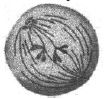
A
Early Prophase
B
Metaphase
C
Late Prophase
D
Anaphase
Solution
(D) The given figure shows chromosomes being pulled towards the opposite poles of the cell by spindle fibers. This characteristic movement of sister chromatids (now daughter chromosomes) separating and moving towards opposite poles is the hallmark of $Anaphase$.
0 likes
View Solution216
MediumMCQ
Which stage is indicated by the given figure?

A
Early Prophase
B
Anaphase
C
Telophase
D
Metaphase
Solution
(B) The given figure shows the chromosomes being pulled towards the opposite poles of the cell. This characteristic movement of chromosomes away from the equatorial plate towards the poles is the hallmark of the $Anaphase$ stage of mitosis. During this stage,the centromere splits and chromatids separate.
0 likes
View Solution217
MediumMCQ
In which phase do the chromosomes spread throughout the cell?
A
Metaphase
B
Prophase
C
Anaphase
D
Telophase
Solution
(B) During the $Prophase$ stage of mitosis,the chromatin material condenses into compact mitotic chromosomes.
As the $Prophase$ progresses,these chromosomes appear to spread throughout the cytoplasm of the cell as the nuclear envelope begins to disintegrate and the nucleolus disappears.
Therefore,the spreading of chromosomes throughout the cell is a characteristic feature observed during $Prophase$.
As the $Prophase$ progresses,these chromosomes appear to spread throughout the cytoplasm of the cell as the nuclear envelope begins to disintegrate and the nucleolus disappears.
Therefore,the spreading of chromosomes throughout the cell is a characteristic feature observed during $Prophase$.
0 likes
View Solution218
MediumMCQ
In which stage does a chromatid become known as a chromosome?
A
Prophase
B
Metaphase
C
Anaphase
D
Telophase
Solution
(C) During the $S$-phase of the cell cycle,$DNA$ replication occurs,resulting in two sister chromatids held together by a centromere. During $Anaphase$,the centromeres split,and the sister chromatids separate. Once the sister chromatids separate and move toward opposite poles,each individual chromatid is referred to as a chromosome.
0 likes
View Solution219
EasyMCQ
In which phase do the $Golgi$ complex and endoplasmic reticulum reform?
A
Prophase
B
Metaphase
C
Anaphase
D
Telophase
Solution
(D) During $Telophase$,the chromosomes cluster at opposite spindle poles and their identity is lost as discrete elements. The nuclear envelope assembles around the chromosome clusters. The nucleolus,$Golgi$ complex,and endoplasmic reticulum reform.
0 likes
View Solution220
EasyMCQ
What do $A$ and $B$ represent in the given figure?

A
$A = \text{Chromatid}, B = \text{Centromere}$
B
$A = \text{Chromosome}, B = \text{Centromere}$
C
$A = \text{Centromere}, B = \text{Arm}$
D
$A = \text{Kinetochore}, B = \text{Arm}$
Solution
(A) In the given figure of a chromosome:
$A$ points to one of the two identical halves of a replicated chromosome,which is known as a chromatid.
$B$ points to the constricted region where the two sister chromatids are joined,known as the centromere.
Therefore,$A$ represents the chromatid and $B$ represents the centromere.
$A$ points to one of the two identical halves of a replicated chromosome,which is known as a chromatid.
$B$ points to the constricted region where the two sister chromatids are joined,known as the centromere.
Therefore,$A$ represents the chromatid and $B$ represents the centromere.
0 likes
View Solution221
MediumMCQ
In the given figure,what is the structure $X$ composed of?
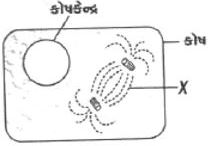
A
Flagellin
B
Glycocalyx
C
Tubulin
D
Actin
Solution
(C) The figure shows a cell with a nucleus and a pair of centrioles forming the spindle apparatus during cell division. The structure labeled $X$ represents the spindle fibers.
Spindle fibers are composed of microtubules.
Microtubules are proteinaceous structures made up of polymerized subunits of the protein tubulin.
Therefore,the correct answer is tubulin.
Spindle fibers are composed of microtubules.
Microtubules are proteinaceous structures made up of polymerized subunits of the protein tubulin.
Therefore,the correct answer is tubulin.
0 likes
View Solution222
MediumMCQ
Anaphase Promoting Complex $(APC)$ is a protein degradation machinery necessary for proper mitosis of animal cell. If $APC$ is defective in a human cell,which of the following is expected to occur?
A
Chromosomes will be fragmented.
B
Chromosomes will not segregate.
C
Recombination of chromosome arms will occur.
D
Chromosomes will not condense.
Solution
(B) $APC$ (Anaphase Promoting Complex) is an E3 ubiquitin ligase that triggers the transition from metaphase to anaphase by tagging specific proteins (like securin and cyclin $B$) for degradation.
Securin degradation releases the enzyme separase,which cleaves the cohesin proteins holding sister chromatids together.
If $APC$ is defective,these proteins are not degraded,cohesin remains intact,and sister chromatids fail to separate.
Therefore,the chromosomes will not segregate to opposite poles.
Securin degradation releases the enzyme separase,which cleaves the cohesin proteins holding sister chromatids together.
If $APC$ is defective,these proteins are not degraded,cohesin remains intact,and sister chromatids fail to separate.
Therefore,the chromosomes will not segregate to opposite poles.
0 likes
View Solution223
EasyMCQ
During cell growth,$DNA$ synthesis takes place on
A
$S$-phase
B
$G_1$-phase
C
$G_2$-phase
D
$M$-phase
Solution
(A) : In the $S$-phase (synthetic phase) of the cell cycle,chromosomes replicate. For this,their $DNA$ molecules function as templates and form carbon copies. The $DNA$ content doubles,i.e.,from $1C$ to $2C$ for haploid cells and from $2C$ to $4C$ for diploid cells. As a result,duplicate sets of genes are formed. Along with the replication of $DNA$,new chromatin fibers are formed which remain attached in pairs,and the number of chromosomes does not increase. Since chromatin fibers are elongated chromosomes,each chromosome comes to have two chromatin threads or sister chromatids which remain attached at a common point called the centromere.
0 likes
View Solution224
EasyMCQ
Spindle fibres attach on to
A
centromere of the chromosome
B
kinetosome of the chromosome
C
telomere of the chromosome
D
kinetochore of the chromosome
Solution
(D) The correct answer is $D$.
Small disc-shaped structures present on the surface of the centromeres are called kinetochores.
These structures serve as the sites of attachment for spindle fibres to the chromosomes,which are then moved into position at the centre of the cell during cell division.
While the centromere is the primary constriction of the chromosome,the kinetochore is the specific protein complex where the microtubules of the spindle apparatus attach.
Small disc-shaped structures present on the surface of the centromeres are called kinetochores.
These structures serve as the sites of attachment for spindle fibres to the chromosomes,which are then moved into position at the centre of the cell during cell division.
While the centromere is the primary constriction of the chromosome,the kinetochore is the specific protein complex where the microtubules of the spindle apparatus attach.
0 likes
View Solution225
MediumMCQ
$A$ stage in cell division is shown in the figure. Select the answer which gives correct identification of the stage with its characteristics.
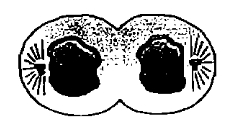
A
Cytokinesis $\Rightarrow$ Cell plate formed,mitochondria distributed between two daughter cells.
B
Telophase $\Rightarrow$ Endoplasmic reticulum and nucleolus not reformed yet.
C
Telophase $\Rightarrow$ Nuclear envelope reforms,Golgi complex reforms.
D
Late anaphase $\Rightarrow$ Chromosomes move away from equatorial plate,Golgi complex not present.
Solution
(C) The figure shows the telophase stage of mitotic cell division.
In this stage,the following key events occur:
- Chromosomes cluster at opposite spindle poles and their identity is lost as discrete elements.
- Nuclear envelope assembles around the chromosome clusters.
- Nucleolus,Golgi complex,and $ER$ reform.
In this stage,the following key events occur:
- Chromosomes cluster at opposite spindle poles and their identity is lost as discrete elements.
- Nuclear envelope assembles around the chromosome clusters.
- Nucleolus,Golgi complex,and $ER$ reform.
0 likes
View Solution226
MediumMCQ
During the metaphase stage of mitosis,spindle fibres attach to chromosomes at
A
kinetochore
B
both centromere and kinetochore
C
centromere,kinetochore and areas adjoining centromere
D
centromere
Solution
(A) During the metaphase stage of mitosis,chromosomes consisting of two sister chromatids align at the equatorial plate.
Discontinuous spindle fibres radiate from the two spindle poles and connect to the disc-shaped protein structures located on the surface of the centromere,known as kinetochores.
These fibres are referred to as chromosomal fibres or tractile fibrils.
$A$ kinetochore acts as a complex protein assembly that serves as the attachment point for spindle microtubules,facilitating the movement of chromosomes during cell division.
Discontinuous spindle fibres radiate from the two spindle poles and connect to the disc-shaped protein structures located on the surface of the centromere,known as kinetochores.
These fibres are referred to as chromosomal fibres or tractile fibrils.
$A$ kinetochore acts as a complex protein assembly that serves as the attachment point for spindle microtubules,facilitating the movement of chromosomes during cell division.
0 likes
View Solution227
EasyMCQ
$A$ stage of mitosis is shown in the diagram. Which stage is it and what are its characteristics?
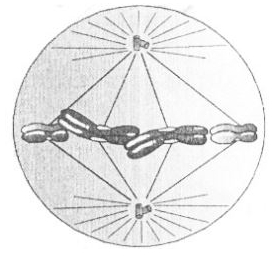
A
Metaphase - Spindle fibers attached to kinetochores,centromeres split and chromatids separate.
B
Metaphase - Chromosomes moved to spindle equator,chromosomes made up of two sister chromatids.
C
Anaphase - Centromeres split and chromatids separate and start moving away.
D
Late prophase - Chromosomes move to spindle equator.
Solution
(B) : In metaphase,chromosomes consisting of two sister chromatids get arranged at the equator. Discontinuous fibers radiate out from two spindle poles and get connected to the disc-shaped structure at the surface of the centromere called kinetochores. These are known as chromosome fibers or tractile fibrils. $A$ kinetochore is a complex protein structure that is analogous to a ring for the microtubule hook; it is the point where microtubules attach themselves.
0 likes
View Solution228
MediumMCQ
Select the correct option with respect to mitosis.
A
Chromatids separate but remain in the centre of the cell in anaphase.
B
Chromatids start moving towards opposite poles in telophase.
C
Golgi complex and endoplasmic reticulum are still visible at the end of prophase.
D
Chromosomes move to the spindle equator and get aligned along equatorial plate in metaphase.
Solution
(D) : The plane of alignment of the chromosomes at metaphase is referred to as the metaphase plate.
The key features of metaphase are:
$(1)$ Spindle fibres attach to kinetochores of chromosomes.
$(2)$ Chromosomes are moved to the spindle equator and get aligned along the metaphase plate through spindle fibres connected to both poles.
The key features of metaphase are:
$(1)$ Spindle fibres attach to kinetochores of chromosomes.
$(2)$ Chromosomes are moved to the spindle equator and get aligned along the metaphase plate through spindle fibres connected to both poles.
0 likes
View Solution229
MediumMCQ
At metaphase,chromosomes are attached to the spindle fibres by their
A
satellites
B
secondary constrictions
C
kinetochores
D
centromeres
Solution
(C) During metaphase,the chromosomes align at the equatorial plate.
Spindle fibres attach to the chromosomes specifically at structures called kinetochores.
Kinetochores are disc-shaped protein structures located on the surface of the centromeres.
These structures serve as the attachment sites for spindle fibres,which are essential for the movement and segregation of chromosomes during cell division.
Spindle fibres attach to the chromosomes specifically at structures called kinetochores.
Kinetochores are disc-shaped protein structures located on the surface of the centromeres.
These structures serve as the attachment sites for spindle fibres,which are essential for the movement and segregation of chromosomes during cell division.
0 likes
View Solution230
MediumMCQ
During mitosis,$ER$ and nucleolus begin to disappear at
A
late prophase
B
early metaphase
C
late metaphase
D
early prophase
Solution
(D) During the early prophase of mitosis,the nucleus and the cell become spherical. The viscosity and refractivity of the cytoplasm increase. $DNA$ molecules condense to form shortened chromosomes. The endoplasmic reticulum $(ER)$ and the nucleolus begin to disappear.
0 likes
View Solution231
EasyMCQ
In which phase are chromosomes most easily observed?
A
Metaphase
B
Prophase
C
Interphase
D
Cytokinesis
Solution
(A) During the $M$-phase of the cell cycle,specifically in $Metaphase$,chromosomes reach their maximum degree of condensation.
This high level of condensation makes them clearly visible under a light microscope.
Therefore,$Metaphase$ is the best stage to study chromosome morphology.
This high level of condensation makes them clearly visible under a light microscope.
Therefore,$Metaphase$ is the best stage to study chromosome morphology.
0 likes
View Solution232
MediumMCQ
Identify the given diagram.
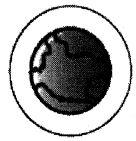
A
Early prophase
B
Late prophase
C
Metaphase
D
Anaphase
Solution
(A) The given diagram shows a cell in the early stages of mitosis where the chromatin material is just beginning to condense into distinct chromosomes,and the nuclear envelope is still intact. This stage is characteristic of early prophase. In late prophase,the nuclear envelope disappears and chromosomes become more condensed. Metaphase is characterized by the alignment of chromosomes at the equatorial plate. Anaphase is characterized by the splitting of centromeres and the movement of sister chromatids towards opposite poles. Therefore,the correct option is $A$.
0 likes
View Solution233
MediumMCQ
Select the correct option on the basis of the following events:
$(I)$ Chromosomes cluster at opposite spindle poles.
$(II)$ Nuclear envelope assembles around the chromosome clusters.
$(III)$ Golgi complex and $ER$ reform.
$(I)$ Chromosomes cluster at opposite spindle poles.
$(II)$ Nuclear envelope assembles around the chromosome clusters.
$(III)$ Golgi complex and $ER$ reform.
A
Telophase
B
Metaphase
C
Prophase
D
Anaphase
Solution
(A) The events described are characteristic of the final stage of mitosis,known as Telophase.
During Telophase:
$1$. Chromosomes that have reached their respective poles decondense and lose their individuality.
$2$. The nuclear envelope reforms around each chromosome cluster.
$3$. The nucleolus,Golgi complex,and endoplasmic reticulum $(ER)$ reform.
Therefore,the correct option is $A$.
During Telophase:
$1$. Chromosomes that have reached their respective poles decondense and lose their individuality.
$2$. The nuclear envelope reforms around each chromosome cluster.
$3$. The nucleolus,Golgi complex,and endoplasmic reticulum $(ER)$ reform.
Therefore,the correct option is $A$.
0 likes
View Solution234
MediumMCQ
Match the following:
| Column-$I$ | Column-$II$ |
| $1$. Metaphase | $p$. Chromosomal material condensed |
| $2$. Prophase | $q$. Nucleolus reform |
| $3$. Anaphase | $r$. Spindle fibre attach to kinetochores |
| $4$. Telophase | $s$. Chromatids move to opposite poles |
A
$(1-p), (2-q), (3-r), (4-s)$
B
$(1-r), (2-p), (3-s), (4-q)$
C
$(1-q), (2-s), (3-r), (4-p)$
D
$(1-s), (2-p), (3-q), (4-r)$
Solution
(B) The correct matching is as follows:
$1$. Metaphase: During metaphase,the spindle fibres attach to the kinetochores of the chromosomes $(1-r)$.
$2$. Prophase: During prophase,the chromatin material condenses to form compact mitotic chromosomes $(2-p)$.
$3$. Anaphase: During anaphase,the centromeres split and the chromatids (now daughter chromosomes) move to opposite poles $(3-s)$.
$4$. Telophase: During telophase,the nucleolus,Golgi complex,and $ER$ reform,and the chromosomes decondense $(4-q)$.
Therefore,the correct sequence is $(1-r), (2-p), (3-s), (4-q)$.
$1$. Metaphase: During metaphase,the spindle fibres attach to the kinetochores of the chromosomes $(1-r)$.
$2$. Prophase: During prophase,the chromatin material condenses to form compact mitotic chromosomes $(2-p)$.
$3$. Anaphase: During anaphase,the centromeres split and the chromatids (now daughter chromosomes) move to opposite poles $(3-s)$.
$4$. Telophase: During telophase,the nucleolus,Golgi complex,and $ER$ reform,and the chromosomes decondense $(4-q)$.
Therefore,the correct sequence is $(1-r), (2-p), (3-s), (4-q)$.
0 likes
View Solution235
MediumMCQ
Select the incorrect statement regarding the phases of mitosis.
A
Prophase - Centrioles move towards opposite poles.
B
Metaphase - Chromosomes are moved to the spindle equator.
C
Anaphase - Chromatids move to opposite poles.
D
Telophase - Spindle fibers attach to chromosomes.
Solution
(D) In $Prophase$,the centrioles move towards opposite poles of the cell.
In $Metaphase$,chromosomes align at the spindle equator.
In $Anaphase$,the centromeres split,and chromatids (now daughter chromosomes) move to opposite poles.
In $Telophase$,the chromosomes cluster at opposite spindle poles and their identity is lost as discrete elements. The attachment of spindle fibers to chromosomes occurs during $Prometaphase$ or $Metaphase$,not $Telophase$. Therefore,option $D$ is incorrect.
In $Metaphase$,chromosomes align at the spindle equator.
In $Anaphase$,the centromeres split,and chromatids (now daughter chromosomes) move to opposite poles.
In $Telophase$,the chromosomes cluster at opposite spindle poles and their identity is lost as discrete elements. The attachment of spindle fibers to chromosomes occurs during $Prometaphase$ or $Metaphase$,not $Telophase$. Therefore,option $D$ is incorrect.
0 likes
View Solution236
MediumMCQ
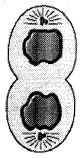
Identify the following diagram.
A
Telophase
B
Anaphase
C
Prophase
D
Metaphase
Solution
(A) The provided diagram shows two distinct nuclei forming at opposite poles of the cell,which is a characteristic feature of the telophase stage of mitosis.
During telophase,the chromosomes arrive at their respective poles and decondense into chromatin.
The nuclear envelope reforms around each set of chromosomes,and the nucleolus,Golgi complex,and endoplasmic reticulum reform.
Therefore,the correct option is $A$.
During telophase,the chromosomes arrive at their respective poles and decondense into chromatin.
The nuclear envelope reforms around each set of chromosomes,and the nucleolus,Golgi complex,and endoplasmic reticulum reform.
Therefore,the correct option is $A$.
0 likes
View Solution237
MediumMCQ
At the beginning of this stage,the chromosomes that have reached their respective poles decondense and lose their individuality.
A
Telophase
B
Cytokinesis
C
Prophase
D
Metaphase
Solution
(A) In $Telophase$,the chromosomes that have reached their respective poles decondense and lose their individuality.
Individual chromosomes can no longer be seen and chromatin material tends to collect in a mass in the two poles.
This stage is essentially the reverse of $Prophase$.
Individual chromosomes can no longer be seen and chromatin material tends to collect in a mass in the two poles.
This stage is essentially the reverse of $Prophase$.
0 likes
View Solution238
MediumMCQ
Telophase shows the following key events:
$1.$ Chromosomes cluster at opposite spindle poles
$2.$ Spindle fibres attach to kinetochores of chromosomes
$3.$ Nuclear envelope assembles around the chromosome clusters.
$1.$ Chromosomes cluster at opposite spindle poles
$2.$ Spindle fibres attach to kinetochores of chromosomes
$3.$ Nuclear envelope assembles around the chromosome clusters.
A
$2, 3$
B
$1, 2$
C
$1, 3$
D
All correct
Solution
(C) Telophase is the final stage of mitosis.
Key events of Telophase include:
$1.$ Chromosomes cluster at opposite spindle poles and their identity is lost as discrete elements.
$2.$ Nuclear envelope assembles around the chromosome clusters at each pole,forming two daughter nuclei.
$3.$ Nucleolus,Golgi complex,and Endoplasmic Reticulum reform.
Statement $2$ describes an event that occurs during Prometaphase,where spindle fibres attach to the kinetochores of chromosomes.
Therefore,statements $1$ and $3$ are the correct events for Telophase.
Key events of Telophase include:
$1.$ Chromosomes cluster at opposite spindle poles and their identity is lost as discrete elements.
$2.$ Nuclear envelope assembles around the chromosome clusters at each pole,forming two daughter nuclei.
$3.$ Nucleolus,Golgi complex,and Endoplasmic Reticulum reform.
Statement $2$ describes an event that occurs during Prometaphase,where spindle fibres attach to the kinetochores of chromosomes.
Therefore,statements $1$ and $3$ are the correct events for Telophase.
0 likes
View Solution239
EasyMCQ
.... serve as the sites of attachment of spindle fibres to the chromosomes.
A
Kinetochore
B
Chiasmata
C
Chromatids
D
All correct
Solution
(A) During cell division,the spindle fibres attach to the chromosomes at specific disc-shaped structures present on the surface of the centromeres,known as kinetochores.
These structures are essential for the movement of chromosomes towards the poles during anaphase.
Chiasmata are the sites of crossing over during meiosis,and chromatids are the two identical halves of a replicated chromosome.
These structures are essential for the movement of chromosomes towards the poles during anaphase.
Chiasmata are the sites of crossing over during meiosis,and chromatids are the two identical halves of a replicated chromosome.
0 likes
View Solution240
EasyMCQ
Centromere splits and chromatids separate; this is a characteristic of which phase?
A
Anaphase
B
Prophase
C
Telophase
D
Cytokinesis
Solution
(A) During $Anaphase$,the centromere of each chromosome splits,allowing the two sister chromatids to separate.
These separated chromatids are then pulled towards opposite poles of the cell by the shortening of spindle fibers.
This process ensures that each daughter cell receives an identical set of chromosomes.
These separated chromatids are then pulled towards opposite poles of the cell by the shortening of spindle fibers.
This process ensures that each daughter cell receives an identical set of chromosomes.
0 likes
View Solution241
MediumMCQ
Select the correct statement regarding $S-$phase of interphase.
$I.$ Occurs between $G_1$ and $G_2$ phase.
$II.$ $DNA$ replication begins in the nucleus.
$III.$ Centrioles duplicate in the cytoplasm.
$IV.$ As $DNA$ is doubled,the number of chromosomes also doubles.
$I.$ Occurs between $G_1$ and $G_2$ phase.
$II.$ $DNA$ replication begins in the nucleus.
$III.$ Centrioles duplicate in the cytoplasm.
$IV.$ As $DNA$ is doubled,the number of chromosomes also doubles.
A
$IV$ and $III$
B
$I, II,$ and $III$
C
$II, III$ and $IV$
D
$I, II, III$ and $IV$
Solution
(B) The $S-$phase (Synthesis phase) is a critical stage of the cell cycle.
$I.$ It occurs between $G_1$ and $G_2$ phases,which is correct.
$II.$ $DNA$ replication takes place within the nucleus,which is correct.
$III.$ In animal cells,the centrioles duplicate in the cytoplasm during this phase,which is correct.
$IV.$ During $S-$phase,the amount of $DNA$ per cell doubles ($2C$ to $4C$),but the number of chromosomes remains the same (e.g.,$2n$ remains $2n$). Therefore,statement $IV$ is incorrect.
Thus,statements $I, II,$ and $III$ are correct.
$I.$ It occurs between $G_1$ and $G_2$ phases,which is correct.
$II.$ $DNA$ replication takes place within the nucleus,which is correct.
$III.$ In animal cells,the centrioles duplicate in the cytoplasm during this phase,which is correct.
$IV.$ During $S-$phase,the amount of $DNA$ per cell doubles ($2C$ to $4C$),but the number of chromosomes remains the same (e.g.,$2n$ remains $2n$). Therefore,statement $IV$ is incorrect.
Thus,statements $I, II,$ and $III$ are correct.
0 likes
View Solution242
EasyMCQ
During mitosis, the $ER$ and nucleolus begin to disappear at:
A
early prophase
B
late anaphase
C
late metaphase
D
late prophase
Solution
(D) During the process of mitosis, the $Prophase$ stage is characterized by the initiation of condensation of chromosomal material.
As the cell progresses into $late prophase$, the nuclear envelope, nucleolus, Golgi complex, and endoplasmic reticulum $(ER)$ begin to disappear.
These structures completely disintegrate by the end of $prophase$ to allow the spindle fibers to attach to the kinetochores of the chromosomes.
As the cell progresses into $late prophase$, the nuclear envelope, nucleolus, Golgi complex, and endoplasmic reticulum $(ER)$ begin to disappear.
These structures completely disintegrate by the end of $prophase$ to allow the spindle fibers to attach to the kinetochores of the chromosomes.
0 likes
View Solution243
EasyMCQ
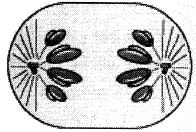
Identify the stage of mitosis shown in the figure.
A
Early prophase
B
Metaphase
C
Telophase
D
Anaphase
Solution
(D) The figure shows the chromosomes being pulled apart towards the opposite poles of the cell by the spindle fibers. This characteristic movement of sister chromatids (now daughter chromosomes) moving towards opposite poles is the defining feature of the $Anaphase$ stage of mitosis.
0 likes
View Solution244
EasyMCQ
In which stage is the kinetochore structure clearly seen?
A
Prophase
B
Telophase
C
Metaphase
D
Anaphase
Solution
(C) The kinetochore is a complex protein structure that forms on the centromere of a chromosome during cell division.
It serves as the point of attachment for spindle fibers (microtubules).
During $Metaphase$,the chromosomes align at the equatorial plate,and the kinetochores become fully developed and clearly visible as they attach to the spindle fibers from opposite poles.
Therefore,the correct stage is $Metaphase$.
It serves as the point of attachment for spindle fibers (microtubules).
During $Metaphase$,the chromosomes align at the equatorial plate,and the kinetochores become fully developed and clearly visible as they attach to the spindle fibers from opposite poles.
Therefore,the correct stage is $Metaphase$.
0 likes
View Solution245
MediumMCQ
At the beginning of telophase,what undergoes decondensation?
A
Chromosome
B
Cytoplasm
C
Centromere
D
Kinetochore
Solution
(A) During the $M$ phase of the cell cycle,specifically in telophase,the chromosomes that reached their respective poles begin to decondense.
Decondensation is the process where chromosomes lose their individual identity and become a mass of chromatin material.
Therefore,the correct answer is $A$ (Chromosome).
Decondensation is the process where chromosomes lose their individual identity and become a mass of chromatin material.
Therefore,the correct answer is $A$ (Chromosome).
0 likes
View Solution246
MediumMCQ
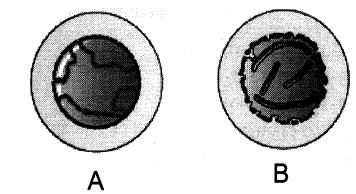
Identify the figures ($A$ and $B$).
A
$A -$ Metaphase,$B -$ Early prophase.
B
$A -$ Late prophase,$B -$ Metaphase.
C
$A -$ Early prophase,$B -$ Late prophase.
D
$A -$ Interphase,$B -$ Metaphase.
Solution
(C) In the given figures,$A$ represents the early prophase stage of mitosis,where the chromatin material begins to condense into compact mitotic chromosomes.
In figure $B$,the chromosomes are more distinct and condensed,representing the late prophase stage,where the nucleolus and nuclear envelope begin to disappear.
Therefore,$A$ is early prophase and $B$ is late prophase.
In figure $B$,the chromosomes are more distinct and condensed,representing the late prophase stage,where the nucleolus and nuclear envelope begin to disappear.
Therefore,$A$ is early prophase and $B$ is late prophase.
0 likes
View Solution247
EasyMCQ
Which one of the following is the best stage to observe the shape,size,and number of chromosomes in a cell?
A
Metaphase
B
Prophase
C
Telophase
D
Interphase
Solution
(A) During the $M$-phase of the cell cycle,chromosomes undergo maximum condensation.
Specifically,during $Metaphase$,the chromosomes align at the equatorial plate and are most distinct,compact,and clearly visible under a microscope.
This stage is ideal for studying chromosome morphology,including their shape,size,and total count,because the chromosomes are at their highest level of condensation and are not obscured by the nuclear envelope.
Specifically,during $Metaphase$,the chromosomes align at the equatorial plate and are most distinct,compact,and clearly visible under a microscope.
This stage is ideal for studying chromosome morphology,including their shape,size,and total count,because the chromosomes are at their highest level of condensation and are not obscured by the nuclear envelope.
0 likes
View Solution248
MediumMCQ
Spindle fibers and kinetochores are two important structures for
A
Cell movement
B
Organelles movement
C
Chromosome movements
D
None of the above
Solution
(C) During cell division,specifically in mitosis and meiosis,the spindle fibers (composed of microtubules) attach to the kinetochores located on the centromeres of chromosomes.
This interaction is essential for the alignment of chromosomes at the metaphase plate and their subsequent separation toward opposite poles during anaphase.
Therefore,these structures are primarily responsible for chromosome movements.
This interaction is essential for the alignment of chromosomes at the metaphase plate and their subsequent separation toward opposite poles during anaphase.
Therefore,these structures are primarily responsible for chromosome movements.
0 likes
View Solution249
EasyMCQ
In which phase of mitosis does the centromere split?
A
Anaphase
B
Telophase
C
Prophase
D
Metaphase
Solution
(A) During the $Anaphase$ stage of mitosis,the centromere of each chromosome splits,and the chromatids separate.
These separated chromatids,now referred to as daughter chromosomes,begin to move towards opposite poles of the cell.
This process ensures that each daughter cell receives an identical set of chromosomes.
These separated chromatids,now referred to as daughter chromosomes,begin to move towards opposite poles of the cell.
This process ensures that each daughter cell receives an identical set of chromosomes.
0 likes
View Solution250
EasyMCQ
Which part of cells disintegrate at the end of prophase?
A
Cytoplasm
B
Chromosomal material
C
Nuclear membrane and nucleolus
D
All above
Solution
(C) During the late prophase stage of mitosis,the cell undergoes several structural changes to prepare for chromosome segregation.
Specifically,the nuclear envelope (nuclear membrane) begins to break down,and the nucleolus disappears.
These events mark the transition from prophase to prometaphase,allowing the spindle fibers to interact with the chromosomes.
Therefore,the correct answer is the nuclear membrane and nucleolus.
Specifically,the nuclear envelope (nuclear membrane) begins to break down,and the nucleolus disappears.
These events mark the transition from prophase to prometaphase,allowing the spindle fibers to interact with the chromosomes.
Therefore,the correct answer is the nuclear membrane and nucleolus.
0 likes
View SolutionCell Cycle and Cell Division — M Phase · Frequently Asked Questions
1Are these Cell Cycle and Cell Division questions useful for JEE and NEET?
Yes. All questions in this section are mapped to JEE Main and NEET exam patterns. Previous year questions from JEE Main, NEET, GUJCET and state-level exams are included with full solutions.
2Can I switch to Hindi or Gujarati for these questions?
Yes. Use the language tabs in the hero section or the sidebar to view the same questions and solutions in English, Hindi or Gujarati.
3How do I generate a question paper from this subtopic?
Use the Vedclass Exam Paper Generator — select the chapter and subtopic, set difficulty, and generate Sets A, B, C, D automatically. First 3 chapters of every subject are free.
Vedclass Products
For Students
Vedclass Test Series
Mock tests in real JEE/NEET style with performance analysis. 5-day free trial.
Start Free TrialFor Teachers
Exam Paper Generator
Generate Set A/B/C/D papers from this chapter in 2 minutes. 3 chapters free.
Try FreeFor Institutes
Online Exam Module
Live online exams with unlimited students, 360° analytics & white-label branding.
See DemoFor Teachers & Institutes
Generate a Cell Cycle and Cell Division Exam Paper in 2 Minutes
Select subtopic & difficulty — Sets A, B, C, D auto-generated with No Repeat logic.
First 3 chapters of every subject are free — no payment required.