
A English
M Phase Questions in English
Class 11 Biology · Cell Cycle and Cell Division · M Phase
360+
Questions
English
Language
100%
With Solutions
Showing 50 of 360 questions in English
301
EasyMCQ
During mitosis,$ER$,nucleolus,and other cell organelles begin to disappear at
A
Late prophase
B
Early metaphase
C
Late metaphase
D
Early prophase
Solution
(D) In mitosis,prophase is the longest phase of karyokinesis.
In early prophase,the nuclear membrane and nucleolus start disintegrating.
Cell cytoskeleton,Golgi complex,$ER$,and other organelles also begin to disappear during this stage.
In early prophase,the nuclear membrane and nucleolus start disintegrating.
Cell cytoskeleton,Golgi complex,$ER$,and other organelles also begin to disappear during this stage.
0 likes
View Solution302
MediumMCQ
Karyokinesis refers to the division of
A
The cytoplasm
B
The nucleus
C
Cytoplasm and nucleus
D
all constituents of the cell
Solution
(B) Cell division involves two distinct processes: $1$. Karyokinesis,which is the division of the nucleus,and $2$. Cytokinesis,which is the division of the cytoplasm. Karyokinesis typically precedes cytokinesis to ensure that each daughter cell receives a complete set of genetic material.
0 likes
View Solution303
MediumMCQ
Mitosis is divided into
A
Five stages
B
Three stages
C
Four stages
D
Six stages
Solution
(C) Mitosis is the process of somatic cell division,which is divided into four main stages based on the behavior of chromosomes and the nuclear envelope.
The four stages are:
$1.$ Prophase
$2.$ Metaphase
$3.$ Anaphase
$4.$ Telophase
Therefore,the correct answer is four stages.
The four stages are:
$1.$ Prophase
$2.$ Metaphase
$3.$ Anaphase
$4.$ Telophase
Therefore,the correct answer is four stages.
0 likes
View Solution304
MediumMCQ
The anaphase promoting complex $(APC/C)$ is activated by
A
$M-cdk-cyclin$
B
$G_{1}-cdk-cyclin$
C
$S-cdk-cyclin$
D
Transcription factor
Solution
(A) The anaphase promoting complex $(APC/C)$ is a protein complex that triggers the transition from metaphase to anaphase during the cell cycle.
It is activated by the $M-cdk-cyclin$ complex (also known as $Cyclin B-Cdk1$ or $MPF$ - Maturation Promoting Factor).
Once activated,$APC/C$ tags specific proteins like securin and cyclin $B$ for degradation,which allows the separation of sister chromatids.
It is activated by the $M-cdk-cyclin$ complex (also known as $Cyclin B-Cdk1$ or $MPF$ - Maturation Promoting Factor).
Once activated,$APC/C$ tags specific proteins like securin and cyclin $B$ for degradation,which allows the separation of sister chromatids.
0 likes
View Solution305
MediumMCQ
Which of the following statements (events) is/are true for mitotic telophase?
A
Nucleolus,$GB$ and $ER$ reform
B
$NM$ assembles around each chromosome cluster
C
Arrival of chromosome clusters at opposite poles and loss of their identity as discrete elements
D
All of the above
Solution
(D) Telophase is the final stage of mitosis and is essentially the reverse of prophase.
During this phase,the following events occur:
$1$. Chromosomes arrive at opposite poles and lose their individuality as discrete elements,becoming chromatin material.
$2$. The nuclear membrane $(NM)$ reassembles around each chromosome cluster.
$3$. The nucleolus,Golgi bodies $(GB)$,and endoplasmic reticulum $(ER)$ reform.
Therefore,all the given statements are correct.
During this phase,the following events occur:
$1$. Chromosomes arrive at opposite poles and lose their individuality as discrete elements,becoming chromatin material.
$2$. The nuclear membrane $(NM)$ reassembles around each chromosome cluster.
$3$. The nucleolus,Golgi bodies $(GB)$,and endoplasmic reticulum $(ER)$ reform.
Therefore,all the given statements are correct.
0 likes
View Solution306
MediumMCQ
Choose the correct combination of options to select the correct statement for prophase:
$I.$ Chromosomal material condenses to form compact mitotic chromosomes.
$II.$ The assembly of mitotic spindle is initiated by the microtubules.
$III.$ Cells do not show organelles when viewed under the prophase.
$IV.$ The nucleolus or nucleoli degenerate completely.
$I.$ Chromosomal material condenses to form compact mitotic chromosomes.
$II.$ The assembly of mitotic spindle is initiated by the microtubules.
$III.$ Cells do not show organelles when viewed under the prophase.
$IV.$ The nucleolus or nucleoli degenerate completely.
A
$I$ only
B
$II$ and $III$
C
$I$ and $II$
D
All of these
Solution
(D) During prophase,the following events occur:
$I.$ Chromosomal material condenses to form compact mitotic chromosomes,which is a hallmark of prophase.
$II.$ The assembly of the mitotic spindle is initiated by the microtubules,which are proteinaceous components of the cell cytoplasm.
$III.$ When observed under a microscope,cells at the late stage of prophase do not show cell organelles like the Golgi complex,endoplasmic reticulum,nucleolus,and nuclear envelope.
$IV.$ The nucleolus or nucleoli degenerate and disappear during prophase.
Since all the statements $(I, II, III, IV)$ are correct characteristics of prophase,the correct option is $D$.
$I.$ Chromosomal material condenses to form compact mitotic chromosomes,which is a hallmark of prophase.
$II.$ The assembly of the mitotic spindle is initiated by the microtubules,which are proteinaceous components of the cell cytoplasm.
$III.$ When observed under a microscope,cells at the late stage of prophase do not show cell organelles like the Golgi complex,endoplasmic reticulum,nucleolus,and nuclear envelope.
$IV.$ The nucleolus or nucleoli degenerate and disappear during prophase.
Since all the statements $(I, II, III, IV)$ are correct characteristics of prophase,the correct option is $D$.
0 likes
View Solution307
MediumMCQ
At which stage of the cell cycle does colchicine arrest the spindle?
A
Anaphase
B
Prophase
C
Telophase
D
Metaphase
Solution
(D) Colchicine is an antimitotic drug (alkaloid) obtained from $Colchicum$ (family $Liliaceae$).
It binds to tubulin molecules and prevents their polymerization into microtubules.
The depolymerization of tubulin leads to the disappearance of the mitotic spindle.
As a result,the cell is unable to proceed from metaphase to anaphase,effectively arresting the cell cycle at the metaphase stage.
It binds to tubulin molecules and prevents their polymerization into microtubules.
The depolymerization of tubulin leads to the disappearance of the mitotic spindle.
As a result,the cell is unable to proceed from metaphase to anaphase,effectively arresting the cell cycle at the metaphase stage.
0 likes
View Solution308
MediumMCQ
Which of the following $CdKs$ and cyclins comes under the $G_{2}$ checkpoint?
A
$CdK_{4} / Cyclin\; B$
B
$CdK_{2} / Cyclin\; B$
C
$CdK_{6} / Cyclin\; B$
D
$CdK_{2} / Cyclin\; D$
Solution
(B) The correct answer is $CdK_{2} / Cyclin\; B$.
The cell cycle is regulated by enzymes known as cyclin-dependent kinases $(CdKs)$.
$CdKs$ phosphorylate specific amino acids,such as serine and threonine,which either initiate or inhibit cell cycle activities.
Key checkpoints in the cell cycle include:
$1$. The $G_{1}$ checkpoint (entry into $S$ phase) is controlled by $CdK_{4} / Cyclin\; D$ and $CdK_{6} / Cyclin\; D$.
$2$. The $G_{2}$ checkpoint (entry into $M$ phase,involving the Maturation Promoting Factor or $MPF$) is controlled by $CdK_{2} / Cyclin\; B$.
$3$. The Metaphase checkpoint (Spindle assembly checkpoint) is controlled by the degradation of $Cyclin\; B$.
The cell cycle is regulated by enzymes known as cyclin-dependent kinases $(CdKs)$.
$CdKs$ phosphorylate specific amino acids,such as serine and threonine,which either initiate or inhibit cell cycle activities.
Key checkpoints in the cell cycle include:
$1$. The $G_{1}$ checkpoint (entry into $S$ phase) is controlled by $CdK_{4} / Cyclin\; D$ and $CdK_{6} / Cyclin\; D$.
$2$. The $G_{2}$ checkpoint (entry into $M$ phase,involving the Maturation Promoting Factor or $MPF$) is controlled by $CdK_{2} / Cyclin\; B$.
$3$. The Metaphase checkpoint (Spindle assembly checkpoint) is controlled by the degradation of $Cyclin\; B$.
0 likes
View Solution309
EasyMCQ
Colchicine arrests spindle at
A
Anaphase
B
Prophase
C
Telophase
D
Metaphase
Solution
(D) The drug colchicine is obtained from $Colchicum$ $autumnale$.
It inhibits the polymerization of tubulin protein into microtubules.
As a result, it prevents the formation of the spindle apparatus, effectively arresting the cell cycle at the metaphase stage.
It inhibits the polymerization of tubulin protein into microtubules.
As a result, it prevents the formation of the spindle apparatus, effectively arresting the cell cycle at the metaphase stage.
0 likes
View Solution310
MediumMCQ
After the separation of centromeres during mitosis,the chromatids move towards opposite poles of the spindle. Name the term used for these chromatids.
A
Daughter chromosomes
B
Kinetochores
C
Half spindles
D
Centrosomes
Solution
(A) Chromosomes that result from the separation of sister chromatids during cell division are called daughter chromosomes.
During the $Anaphase$ stage of mitosis,the centromeres split,and the paired sister chromatids separate to form individual daughter chromosomes.
Each daughter chromosome then migrates,with the centromere leading,toward the opposite poles of the cell.
At the end of cell division,these chromosomes are partitioned into two distinct daughter cells.
During the $Anaphase$ stage of mitosis,the centromeres split,and the paired sister chromatids separate to form individual daughter chromosomes.
Each daughter chromosome then migrates,with the centromere leading,toward the opposite poles of the cell.
At the end of cell division,these chromosomes are partitioned into two distinct daughter cells.
0 likes
View Solution311
MediumMCQ
The most dramatic period of the cell cycle is:
A
$G_1$ phase
B
$G_2$ phase
C
$S$ phase
D
$M$ phase
Solution
(D) The $M$ phase (Mitotic phase) is considered the most dramatic period of the cell cycle because it involves the complex process of nuclear division (karyokinesis) and cytoplasmic division (cytokinesis).
During this phase,significant structural changes occur,including the condensation of chromatin into visible chromosomes,the alignment of chromosomes at the equatorial plate,and the separation of sister chromatids to opposite poles,which are clearly observable under a microscope.
During this phase,significant structural changes occur,including the condensation of chromatin into visible chromosomes,the alignment of chromosomes at the equatorial plate,and the separation of sister chromatids to opposite poles,which are clearly observable under a microscope.
0 likes
View Solution312
MediumMCQ
The first phase of mitosis which follows interphase is
A
Metaphase
B
Prophase
C
Telophase
D
Anaphase
Solution
(B) Mitosis is divided into four main stages: Prophase,Metaphase,Anaphase,and Telophase.
Interphase is the preparatory phase of the cell cycle.
The first stage of mitosis that occurs immediately after the completion of the $G_2$ phase of interphase is Prophase.
During Prophase,chromatin condenses into visible chromosomes and the nuclear envelope begins to disintegrate.
Interphase is the preparatory phase of the cell cycle.
The first stage of mitosis that occurs immediately after the completion of the $G_2$ phase of interphase is Prophase.
During Prophase,chromatin condenses into visible chromosomes and the nuclear envelope begins to disintegrate.
0 likes
View Solution313
EasyMCQ
Initiation of condensation of chromatin material occurs in
A
Prophase
B
Anaphase
C
Telophase
D
Metaphase
Solution
(A) During the $Prophase$ stage of the cell cycle,the chromatin material,which exists as a loose network of $DNA$ and proteins in the interphase nucleus,begins to undergo condensation. This process transforms the chromatin into compact,distinct,and thread-like structures known as chromosomes.
0 likes
View Solution314
EasyMCQ
Mitotic spindle initiates during
A
Telophase
B
Anaphase
C
Prophase
D
Metaphase
Solution
(C) During the late $Prophase$ stage of mitosis, the condensation of chromatin material is completed, and the mitotic spindle begins to organize from the centrosomes, which move towards opposite poles of the cell.
0 likes
View Solution315
EasyMCQ
Nucleolus and nuclear membrane disappear during
A
Anaphase
B
Interphase
C
Telophase
D
Prophase
Solution
(D) During the process of mitosis,the $Prophase$ stage is characterized by the condensation of chromatin into compact mitotic chromosomes. As $Prophase$ progresses,the nucleolus and the nuclear envelope begin to disintegrate and eventually disappear by the end of this phase,allowing the spindle fibers to interact with the chromosomes.
0 likes
View Solution316
MediumMCQ
The chromosomes are shortest and thickest during
A
Anaphase
B
Metaphase
C
Telophase
D
Interphase
Solution
(B) During the $M$ phase of the cell cycle,specifically in metaphase,chromosomes reach their maximum level of condensation.
This process of condensation,which begins in prophase,is completed by metaphase.
As a result,the chromosomes appear shortest and thickest during this stage,making them the most suitable for microscopic study of chromosome morphology.
This process of condensation,which begins in prophase,is completed by metaphase.
As a result,the chromosomes appear shortest and thickest during this stage,making them the most suitable for microscopic study of chromosome morphology.

0 likes
View Solution317
EasyMCQ
The chromosomes align at the equator during
A
Interphase
B
Prophase
C
Metaphase
D
Telophase
Solution
(C) During $Metaphase$,the chromosomes condense and move to the center of the cell.
They align themselves along the equatorial plane of the cell,which is known as the $Metaphase$ plate or equatorial plate.
They align themselves along the equatorial plane of the cell,which is known as the $Metaphase$ plate or equatorial plate.
0 likes
View Solution318
MediumMCQ
Read the following statements:
$(a)$ Complete disintegration of the nuclear envelope marks the start of the second phase of mitosis.
$(b)$ Metaphase chromosome is made up of one sister chromatid.
$(a)$ Complete disintegration of the nuclear envelope marks the start of the second phase of mitosis.
$(b)$ Metaphase chromosome is made up of one sister chromatid.
A
Only $(b)$ is correct
B
Both $(a) \& (b)$ are incorrect
C
Only $(a)$ is correct
D
Both $(a) \& (b)$ are correct
Solution
(C) Statement $(a)$ is correct: The complete disintegration of the nuclear envelope marks the transition from prophase to metaphase,which is the second phase of mitosis.
Statement $(b)$ is incorrect: $A$ metaphase chromosome consists of two sister chromatids held together at the centromere.
Statement $(b)$ is incorrect: $A$ metaphase chromosome consists of two sister chromatids held together at the centromere.
0 likes
View Solution319
EasyMCQ
The morphology of the chromosomes is studied during
A
Metaphase
B
Interphase
C
Prophase
D
Telophase
Solution
(A) During $Metaphase$,chromosomes reach their maximum level of condensation.
They become the shortest and thickest in this stage,which makes them clearly visible under a microscope.
Therefore,the morphology of chromosomes is best studied during $Metaphase$.
They become the shortest and thickest in this stage,which makes them clearly visible under a microscope.
Therefore,the morphology of chromosomes is best studied during $Metaphase$.
0 likes
View Solution320
EasyMCQ
The point of attachment of microtubules on the chromosome is called as
A
Centromere
B
Kinetochore
C
Chromatid
D
Spindle
Solution
(B) The kinetochore is a complex,trilamellar proteinaceous structure located on the surface of the centromere. During cell division,spindle microtubules attach to the kinetochore to facilitate the movement of chromosomes toward the poles.
0 likes
View Solution321
MediumMCQ
Chromosomes move towards the poles during:
A
Prophase
B
Metaphase
C
Telophase
D
Anaphase
Solution
(D) During $Anaphase$, the centromere of each chromosome splits, and the chromatids (now referred to as chromosomes of the future daughter nuclei) separate.
These chromatids are pulled towards opposite poles by the shortening of spindle fibers attached to the kinetochores.
This poleward movement is characteristic of $Anaphase$ and is often referred to as anaphasic movement.
These chromatids are pulled towards opposite poles by the shortening of spindle fibers attached to the kinetochores.
This poleward movement is characteristic of $Anaphase$ and is often referred to as anaphasic movement.

0 likes
View Solution322
EasyMCQ
The centromere splits during
A
Anaphase
B
Telophase
C
Interphase
D
Prophase
Solution
(A) During $Anaphase$,the centromere of each chromosome splits,allowing the sister chromatids to separate. These separated chromatids,now referred to as daughter chromosomes,are pulled towards opposite poles of the cell by the spindle fibers.
0 likes
View Solution323
EasyMCQ
The chromosomes cluster at opposite poles and their identity is lost as discrete elements during
A
Telophase
B
Anaphase
C
Metaphase
D
Prophase
Solution
(A) During Telophase,the chromosomes that have reached their respective poles decondense and lose their individuality. The individual chromosomes can no longer be seen as discrete elements,and the chromatin material tends to collect in a mass of the chromatin network.

0 likes
View Solution324
MediumMCQ
The mitotic spindle disappears in
A
Prophase
B
Metaphase
C
Anaphase
D
Telophase
Solution
(D) During $Telophase$,the chromosomes reach their respective poles and decondense. Since the proper division and distribution of $DNA$ has been completed,the spindle apparatus is no longer required and therefore disappears.
0 likes
View Solution325
MediumMCQ
Decondensation of chromosomes occurs during
A
Prophase
B
Metaphase
C
Anaphase
D
Telophase
Solution
(D) During $Telophase$,the chromosomes that reached their respective poles decondense and lose their individuality.
Individual chromosomes can no longer be seen,and chromatin material tends to collect in a mass of chromatin threads.
This process is the reverse of $Prophase$.
Individual chromosomes can no longer be seen,and chromatin material tends to collect in a mass of chromatin threads.
This process is the reverse of $Prophase$.
0 likes
View Solution326
MediumMCQ
The nuclear envelope reassembles during
A
Prophase
B
Telophase
C
Anaphase
D
Metaphase
Solution
(B) Telophase is the final stage of mitosis. During this phase,the chromosomes cluster at opposite spindle poles and their identity is lost as discrete elements. The nuclear envelope reassembles around the chromosome clusters at each pole,leading to the formation of two daughter nuclei.
0 likes
View Solution327
MediumMCQ
Maturation promoting factor $(MPF)$ formation triggers the cell to cross which phase transition?
A
$G_1 \rightarrow S$
B
$S \rightarrow G_2$
C
$G_2 \rightarrow M$
D
$M \rightarrow G_1$
Solution
(C) The Maturation Promoting Factor $(MPF)$ is a complex consisting of mitotic cyclin and $cdc2$ kinase. It acts as a key regulatory switch that triggers the transition of a cell from the $G_2$ phase into the $M$ (Mitosis) phase by phosphorylating various target proteins involved in nuclear envelope breakdown,chromosome condensation,and spindle assembly.
0 likes
View Solution328
MediumMCQ
Higher plants differ from animals in having:
A
Spindle microtubule
B
Anastral mitosis
C
Kinetochores
D
Disappearance of nucleolus during prophase
Solution
(B) In higher plants,the cell division is characterized by the absence of centrioles. Since centrioles are responsible for the formation of astral rays,the mitosis in plants is termed as anastral mitosis. In contrast,animal cells contain centrioles,which lead to the formation of astral rays (amphiastral mitosis).
0 likes
View Solution329
EasyMCQ
Which of the following phases are the longest and shortest in mitosis?
A
Metaphase,Anaphase
B
Prophase,Anaphase
C
Telophase,Anaphase
D
Prophase,Telophase
Solution
(B) In mitosis,the $Prophase$ is the longest phase because it involves complex processes like chromatin condensation,nuclear envelope breakdown,and spindle formation.
$Anaphase$ is the shortest phase because it involves the rapid separation of sister chromatids towards opposite poles.
$Anaphase$ is the shortest phase because it involves the rapid separation of sister chromatids towards opposite poles.
0 likes
View Solution330
MediumMCQ
Select the correct match.
A
Reformation of $ER$ and golgi complex - Telophase
B
Invisible phase of cell cycle - Metaphase
C
Polar movement of chromatids - $S$-phase
D
Recombination nodules formation - Zygotene
Solution
(A) The correct match is: Reformation of $ER$ and golgi complex - Telophase.
- $ER$ (Endoplasmic Reticulum) and Golgi complex reform during Telophase.
- The invisible phase of the cell cycle is Interphase,not Metaphase.
- Polar movement of chromatids occurs during Anaphase,not $S$-phase.
- Recombination nodules are formed during Pachytene,not Zygotene.
- $ER$ (Endoplasmic Reticulum) and Golgi complex reform during Telophase.
- The invisible phase of the cell cycle is Interphase,not Metaphase.
- Polar movement of chromatids occurs during Anaphase,not $S$-phase.
- Recombination nodules are formed during Pachytene,not Zygotene.
0 likes
View Solution331
EasyMCQ
The spireme stage of chromosomes is associated with:
A
Early prophase
B
Late prophase
C
Metaphase
D
Telophase
Solution
(A) During the early prophase of mitosis,the chromatin material condenses into long,thin,thread-like structures that appear tangled,resembling a ball of wool. This specific appearance is referred to as the spireme stage.
0 likes
View Solution332
MediumMCQ
Select an incorrect statement w.r.t. metaphase.
A
Spindle fibres are attached to small disc-shaped structures at the surface of centromeres called kinetochores.
B
The plane of alignment of the homologous pair of chromosomes at metaphase is referred to as the metaphasic plate.
C
Chromosome appears to be made up of two sister chromatids.
D
The size of chromosomes can be studied in this phase.
Solution
(B) In mitosis,chromosomes align at the equator to form a single metaphasic plate. The term 'homologous pair' is specific to meiosis $I$,where bivalents align to form a double metaphasic plate. Therefore,stating that homologous pairs align at the metaphasic plate during general metaphase (implying mitosis) is incorrect.
0 likes
View Solution333
MediumMCQ
$A$: The complete disintegration of the nuclear envelope marks the start of metaphase.
$R$: Chromosomes are distinct with two chromatids at this stage.
$R$: Chromosomes are distinct with two chromatids at this stage.
A
Assertion and Reason both are correct and Reason is the correct explanation of Assertion.
B
Assertion and Reason both are correct but Reason is not the correct explanation of Assertion.
C
Assertion is correct,but Reason is incorrect.
D
Both Assertion and Reason are incorrect.
Solution
(A) The complete disintegration of the nuclear envelope is the characteristic feature that marks the transition from prophase to metaphase.
During metaphase,the chromosomes are clearly visible under a microscope and consist of two sister chromatids held together at the centromere.
Therefore,both the Assertion and the Reason are correct,and the Reason provides a correct description of the state of chromosomes during this phase.
During metaphase,the chromosomes are clearly visible under a microscope and consist of two sister chromatids held together at the centromere.
Therefore,both the Assertion and the Reason are correct,and the Reason provides a correct description of the state of chromosomes during this phase.
0 likes
View Solution334
MediumMCQ
The bipolar spindle fibers attach to which part of the chromosome?
A
Centromere
B
Kinetochore
C
Arm
D
Any part of the chromosome
Solution
(B) During cell division,specifically in metaphase,the spindle fibers attach to the $kinetochore$ of the chromosome.
$Kinetochores$ are complex protein structures that assemble on the $centromere$ of a chromosome.
They serve as the site of attachment for spindle microtubules,which are responsible for the movement of chromosomes during mitosis and meiosis.
Therefore,the correct option is $B$.
$Kinetochores$ are complex protein structures that assemble on the $centromere$ of a chromosome.
They serve as the site of attachment for spindle microtubules,which are responsible for the movement of chromosomes during mitosis and meiosis.
Therefore,the correct option is $B$.
0 likes
View Solution335
MediumMCQ
$A$ cell spends less than $......\%$ of the total duration of the cell cycle in the $M$ phase.
A
$5$
B
$10$
C
$90$
D
$95$
Solution
(A) The cell cycle is divided into two main phases: Interphase and $M$ phase (Mitosis phase).
Interphase lasts for more than $95\%$ of the total duration of the cell cycle.
Consequently,the $M$ phase,which involves actual cell division,occupies a very small portion of the total cell cycle,typically less than $5\%$ of the total time.
Interphase lasts for more than $95\%$ of the total duration of the cell cycle.
Consequently,the $M$ phase,which involves actual cell division,occupies a very small portion of the total cell cycle,typically less than $5\%$ of the total time.
0 likes
View Solution336
MediumMCQ
Select the correct option for a chromosome in prophase,representing the number of centromeres,chromatids,and kinetochores respectively.
A
$1, 2, 2$
B
$1, 1, 1$
C
$2, 2, 2$
D
$1, 2, 1$
Solution
(A) During the prophase stage of mitosis,the $DNA$ has already replicated during the $S$-phase of interphase.
Each chromosome consists of two sister chromatids held together at a single centromere.
Each chromatid has its own kinetochore,which is a protein structure on the centromere where spindle fibers attach.
Therefore,for a single chromosome in prophase:
- Number of centromeres = $1$
- Number of chromatids = $2$
- Number of kinetochores = $2$
Thus,the correct sequence is $1, 2, 2$.
Each chromosome consists of two sister chromatids held together at a single centromere.
Each chromatid has its own kinetochore,which is a protein structure on the centromere where spindle fibers attach.
Therefore,for a single chromosome in prophase:
- Number of centromeres = $1$
- Number of chromatids = $2$
- Number of kinetochores = $2$
Thus,the correct sequence is $1, 2, 2$.
0 likes
View Solution337
EasyMCQ
All chromosomes align at the metaphase plate during which phase of mitosis?
A
Prophase
B
Metaphase
C
Anaphase
D
Telophase
Solution
(B) During $Metaphase$,the chromosomes are condensed to their maximum extent and align themselves at the equator of the cell,which is known as the $Metaphase$ plate. This alignment is essential for the equal distribution of sister chromatids to the daughter cells. Therefore,the correct phase is $Metaphase$.
0 likes
View Solution338
EasyMCQ
To which part of the chromosome do the spindle fibers attach?
A
Centromere
B
Kinetochores
C
Arm
D
All of the above
Solution
(B) During cell division,spindle fibers attach to the $kinetochores$,which are disc-shaped structures present on the surface of the $centromere$ of each chromosome.
While the $centromere$ is the primary constriction point of the chromosome,the specific protein complex where the spindle fibers actually bind is the $kinetochore$.
While the $centromere$ is the primary constriction point of the chromosome,the specific protein complex where the spindle fibers actually bind is the $kinetochore$.
0 likes
View Solution339
EasyMCQ
In which phase does the centromere split and the chromatids move towards opposite poles?
A
Prophase
B
Metaphase
C
Anaphase
D
Telophase
Solution
(C) During $Anaphase$, the centromere of each chromosome splits, and the chromatids (now referred to as daughter chromosomes) separate.
These daughter chromosomes are then pulled towards opposite poles of the cell due to the shortening of spindle fibers attached to the kinetochores.
Therefore, the correct phase is $Anaphase$.
These daughter chromosomes are then pulled towards opposite poles of the cell due to the shortening of spindle fibers attached to the kinetochores.
Therefore, the correct phase is $Anaphase$.
0 likes
View Solution340
MediumMCQ
This stage is known as the reverse prophase.
A
Prophase
B
Metaphase
C
Anaphase
D
Telophase
Solution
(D) Telophase is often referred to as the reverse prophase because the events that occur during this stage are essentially the reverse of those that occur during prophase.
During prophase,the nuclear envelope breaks down,the nucleolus disappears,and chromosomes condense.
Conversely,during telophase,the nuclear envelope reforms around the chromosome clusters,the nucleolus reappears,and the chromosomes decondense into chromatin.
During prophase,the nuclear envelope breaks down,the nucleolus disappears,and chromosomes condense.
Conversely,during telophase,the nuclear envelope reforms around the chromosome clusters,the nucleolus reappears,and the chromosomes decondense into chromatin.
0 likes
View Solution341
MediumMCQ
In which phase are two nuclei formed?
A
Prophase
B
Metaphase
C
Anaphase
D
Telophase
Solution
(D) Telophase is the final stage of mitosis. During this phase,the chromosomes that have reached their respective poles decondense and lose their individuality. The nuclear envelope reforms around each cluster of chromosomes,resulting in the formation of two daughter nuclei at opposite poles of the cell. Thus,the correct answer is $D$.
0 likes
View Solution342
EasyMCQ
The morphology,size,and structure of chromosomes can be best studied during this stage.
A
Prophase
B
Metaphase
C
Anaphase
D
Telophase
Solution
(B) During $Metaphase$,the chromosomes are highly condensed and aligned at the equatorial plate (metaphase plate).
This stage provides the most clear view of the chromosome morphology,size,and structure,making it the ideal phase for karyotyping and chromosomal analysis.
This stage provides the most clear view of the chromosome morphology,size,and structure,making it the ideal phase for karyotyping and chromosomal analysis.
0 likes
View Solution343
MediumMCQ
Identify the stage of mitosis shown below.
A
Early Prophase
B
Late Prophase
C
Metaphase
D
Telophase
Solution
(C) The stage shown is Metaphase.
During Metaphase,the chromosomes align at the equatorial plate (metaphase plate) of the cell.
The spindle fibers from both poles are attached to the kinetochores of the chromosomes.
This alignment is a characteristic feature of Metaphase.
During Metaphase,the chromosomes align at the equatorial plate (metaphase plate) of the cell.
The spindle fibers from both poles are attached to the kinetochores of the chromosomes.
This alignment is a characteristic feature of Metaphase.
0 likes
View Solution344
MediumMCQ
In which phase is the cell shown below?
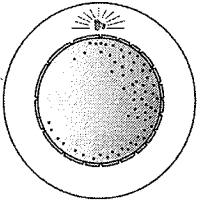
A
Prophase
B
Metaphase
C
Interphase
D
Telophase
Solution
(A) The provided image shows a cell where the nuclear envelope is breaking down (indicated by the dashed line) and chromatin is condensing. This is characteristic of the Prophase stage of mitosis. During Prophase,the chromatin material condenses into compact mitotic chromosomes,and the nuclear envelope begins to disintegrate.
0 likes
View Solution345
MediumMCQ
Which of the following is incorrect for the telophase stage of mitosis?
A
Chromosomes lose their individual identity.
B
Nuclear envelope reforms.
C
Two nuclei are formed in the cell.
D
Nucleolus,Golgi complex and $ER$ disappear.
Solution
(D) Telophase is the final stage of mitosis. During this phase,the events that occurred during prophase are reversed. Chromosomes reach the opposite poles and lose their individual identity (they decondense into chromatin fibers). The nuclear envelope,nucleolus,Golgi complex,and $ER$ (endoplasmic reticulum) reform. Option $D$ is incorrect because these organelles do not disappear; rather,they reappear or reform during telophase.
0 likes
View Solution346
EasyMCQ
What is the structure of the bipolar spindle composed of?
A
Carbohydrates
B
Lipids
C
Nucleic acids
D
Proteins
Solution
(D) The bipolar spindle,which is essential for chromosome segregation during cell division,is primarily composed of microtubules. Microtubules are dynamic polymers made of the protein tubulin. Therefore,the spindle apparatus is essentially a proteinaceous structure.
0 likes
View Solution347
MediumMCQ
The condensation of chromatin material starts in which phase of the cell cycle?
A
Prophase
B
Metaphase
C
Anaphase
D
Telophase
Solution
(A) The process of cell division involves several stages.
During the $Prophase$ stage,the chromatin material,which is usually diffuse in the interphase nucleus,begins to condense into compact mitotic chromosomes.
This condensation is a hallmark of the initiation of $Prophase$ in mitosis.
Therefore,the correct answer is $Prophase$.
During the $Prophase$ stage,the chromatin material,which is usually diffuse in the interphase nucleus,begins to condense into compact mitotic chromosomes.
This condensation is a hallmark of the initiation of $Prophase$ in mitosis.
Therefore,the correct answer is $Prophase$.
0 likes
View Solution348
EasyMCQ
Identify the stages of the $M$ phase in the correct sequence.
A
Prophase $\rightarrow$ Metaphase $\rightarrow$ Telophase $\rightarrow$ Anaphase
B
Prophase $\rightarrow$ Anaphase $\rightarrow$ Metaphase $\rightarrow$ Telophase
C
Prophase $\rightarrow$ Metaphase $\rightarrow$ Anaphase $\rightarrow$ Telophase
D
Prophase $\rightarrow$ Telophase $\rightarrow$ Metaphase $\rightarrow$ Anaphase
Solution
(C) The $M$ phase (Mitosis) consists of four main stages that occur in a specific sequence:
$1$. Prophase: Chromatin condenses into chromosomes and the nuclear envelope begins to disintegrate.
$2$. Metaphase: Chromosomes align at the equatorial plate.
$3$. Anaphase: Sister chromatids separate and move towards opposite poles.
$4$. Telophase: Chromosomes reach the poles and the nuclear envelope reforms.
Therefore,the correct sequence is Prophase $\rightarrow$ Metaphase $\rightarrow$ Anaphase $\rightarrow$ Telophase.
$1$. Prophase: Chromatin condenses into chromosomes and the nuclear envelope begins to disintegrate.
$2$. Metaphase: Chromosomes align at the equatorial plate.
$3$. Anaphase: Sister chromatids separate and move towards opposite poles.
$4$. Telophase: Chromosomes reach the poles and the nuclear envelope reforms.
Therefore,the correct sequence is Prophase $\rightarrow$ Metaphase $\rightarrow$ Anaphase $\rightarrow$ Telophase.
0 likes
View Solution349
MediumMCQ
In higher plants,the bipolar spindle is formed from which of the following?
A
Centriole
B
Cytoskeleton
C
Chloroplast
D
Mitochondria
Solution
(B) In higher plants,centrioles are absent. The spindle fibers,which form the bipolar spindle during cell division,are composed of microtubules. These microtubules are organized by the cytoskeleton components present in the cytoplasm. Therefore,the bipolar spindle is formed from the cytoskeleton.
0 likes
View Solution350
MediumMCQ
In which phase do the bipolar spindle fibers shorten?
A
Prophase
B
Metaphase
C
Anaphase
D
Telophase
Solution
(C) During $Anaphase$,the centromeres split and the chromatids separate. The spindle fibers attached to the kinetochores shorten,pulling the daughter chromosomes towards opposite poles. This shortening of spindle fibers is a characteristic feature of $Anaphase$.
0 likes
View SolutionCell Cycle and Cell Division — M Phase · Frequently Asked Questions
1Are these Cell Cycle and Cell Division questions useful for JEE and NEET?
Yes. All questions in this section are mapped to JEE Main and NEET exam patterns. Previous year questions from JEE Main, NEET, GUJCET and state-level exams are included with full solutions.
2Can I switch to Hindi or Gujarati for these questions?
Yes. Use the language tabs in the hero section or the sidebar to view the same questions and solutions in English, Hindi or Gujarati.
3How do I generate a question paper from this subtopic?
Use the Vedclass Exam Paper Generator — select the chapter and subtopic, set difficulty, and generate Sets A, B, C, D automatically. First 3 chapters of every subject are free.
Vedclass Products
For Students
Vedclass Test Series
Mock tests in real JEE/NEET style with performance analysis. 5-day free trial.
Start Free TrialFor Teachers
Exam Paper Generator
Generate Set A/B/C/D papers from this chapter in 2 minutes. 3 chapters free.
Try FreeFor Institutes
Online Exam Module
Live online exams with unlimited students, 360° analytics & white-label branding.
See DemoFor Teachers & Institutes
Generate a Cell Cycle and Cell Division Exam Paper in 2 Minutes
Select subtopic & difficulty — Sets A, B, C, D auto-generated with No Repeat logic.
First 3 chapters of every subject are free — no payment required.