
A English
M Phase Questions in English
Class 11 Biology · Cell Cycle and Cell Division · M Phase
360+
Questions
English
Language
100%
With Solutions
Showing 50 of 360 questions in English
101
MediumMCQ
Which of the following is true for the $G_2$ phase?
A
Chromatids separate.
B
Microtubules are synthesized.
C
Centrioles duplicate.
D
It is the initial phase of interphase.
Solution
(B) The $G_2$ phase (Gap $2$ phase) is the second growth phase of the cell cycle,occurring after $DNA$ replication ($S$ phase) and before mitosis ($M$ phase).
During this phase,the cell continues to grow,synthesizes proteins,and produces microtubules necessary for the formation of the spindle apparatus during cell division.
Option $A$ is incorrect as chromatids separate during Anaphase.
Option $C$ is incorrect as centrioles duplicate during the $S$ phase.
Option $D$ is incorrect as $G_1$ is the initial phase of interphase.
During this phase,the cell continues to grow,synthesizes proteins,and produces microtubules necessary for the formation of the spindle apparatus during cell division.
Option $A$ is incorrect as chromatids separate during Anaphase.
Option $C$ is incorrect as centrioles duplicate during the $S$ phase.
Option $D$ is incorrect as $G_1$ is the initial phase of interphase.
0 likes
View Solution102
EasyMCQ
Which of the following phases is not a part of interphase?
A
$G_1$ phase
B
$S$ phase
C
$G_2$ phase
D
$M$ phase (Mitotic phase)
Solution
(D) The cell cycle is divided into two main phases: Interphase and $M$ phase (Mitotic phase).
Interphase is the period of preparation for cell division and consists of three sub-phases: $G_1$ phase (Gap $1$),$S$ phase (Synthesis),and $G_2$ phase (Gap $2$).
The $M$ phase is the phase where actual cell division occurs.
Therefore,the $M$ phase is not a part of interphase.
Interphase is the period of preparation for cell division and consists of three sub-phases: $G_1$ phase (Gap $1$),$S$ phase (Synthesis),and $G_2$ phase (Gap $2$).
The $M$ phase is the phase where actual cell division occurs.
Therefore,the $M$ phase is not a part of interphase.
0 likes
View Solution103
EasyMCQ
In which phase do the sister chromatids separate?
A
$G_1$ phase
B
$M$ phase
C
$G_2$ phase
D
$S$ phase
Solution
(B) The separation of sister chromatids occurs during the $M$ phase of the cell cycle,specifically during the $Anaphase$ stage of mitosis.
During $Anaphase$,the centromere of each chromosome splits,and the sister chromatids (now referred to as daughter chromosomes) are pulled apart toward opposite poles of the cell by the spindle fibers.
$G_1$,$S$,and $G_2$ phases are part of Interphase,where the cell prepares for division but does not undergo chromosome separation.
During $Anaphase$,the centromere of each chromosome splits,and the sister chromatids (now referred to as daughter chromosomes) are pulled apart toward opposite poles of the cell by the spindle fibers.
$G_1$,$S$,and $G_2$ phases are part of Interphase,where the cell prepares for division but does not undergo chromosome separation.
0 likes
View Solution104
EasyMCQ
The phase of mitosis is:
A
$G_1$ phase
B
$G_2$ phase
C
$S$ phase
D
$M$ phase
Solution
(D) The cell cycle is divided into two main phases: Interphase and the $M$ phase (Mitotic phase).
Interphase consists of three sub-phases: $G_1$ phase,$S$ phase,and $G_2$ phase.
The $M$ phase is the actual period of cell division,which includes mitosis (karyokinesis) and cytokinesis.
Therefore,the $M$ phase represents the mitotic phase.
Interphase consists of three sub-phases: $G_1$ phase,$S$ phase,and $G_2$ phase.
The $M$ phase is the actual period of cell division,which includes mitosis (karyokinesis) and cytokinesis.
Therefore,the $M$ phase represents the mitotic phase.
0 likes
View Solution105
EasyMCQ
Which of the following events occurs during the $M$ phase (Mitosis)?
A
Karyokinesis
B
Cytokinesis
C
$DNA$ replication
D
Both $(A)$ and $(B)$
Solution
(D) The $M$ phase (Mitosis phase) represents the phase where the actual cell division occurs.
It consists of two main processes:
$1$. Karyokinesis: The division of the nucleus.
$2$. Cytokinesis: The division of the cytoplasm.
$DNA$ replication occurs during the $S$ phase of Interphase,not during the $M$ phase.
Therefore,both Karyokinesis and Cytokinesis are events of the $M$ phase.
It consists of two main processes:
$1$. Karyokinesis: The division of the nucleus.
$2$. Cytokinesis: The division of the cytoplasm.
$DNA$ replication occurs during the $S$ phase of Interphase,not during the $M$ phase.
Therefore,both Karyokinesis and Cytokinesis are events of the $M$ phase.
0 likes
View Solution106
EasyMCQ
When does $RNA$ synthesis stop during the cell cycle?
A
$G_1$-phase
B
$G_2$-phase
C
$S$-phase
D
$M$-phase
Solution
(D) During the $M$-phase (mitotic phase) of the cell cycle,the cell undergoes nuclear division (karyokinesis) and cytoplasmic division (cytokinesis). During this phase,the chromatin condenses into highly compact chromosomes,which makes the $DNA$ inaccessible for transcription. Consequently,$RNA$ synthesis is significantly reduced or completely stopped during the $M$-phase to ensure the accurate segregation of genetic material.
0 likes
View Solution107
EasyMCQ
Which of the following statements is correct?
A
$DNA$ replication occurs in the $G_1$ phase.
B
The duration of the interphase is shorter than the $M$ phase.
C
$G_2$ phase follows the $M$ phase.
D
$DNA$ replication occurs in the $S$ phase.
Solution
(D) The cell cycle is divided into two main phases: Interphase and $M$ phase (Mitosis).
Interphase is further divided into $G_1$,$S$,and $G_2$ phases.
$1$. $G_1$ phase: The cell grows and prepares for $DNA$ replication.
$2$. $S$ phase (Synthesis phase): This is the phase where $DNA$ replication occurs,meaning the amount of $DNA$ per cell doubles.
$3$. $G_2$ phase: The cell prepares for mitosis by synthesizing proteins and organelles.
$4$. $M$ phase: The actual cell division occurs.
Therefore,the statement '$DNA$ replication occurs in the $S$ phase' is correct.
Interphase is further divided into $G_1$,$S$,and $G_2$ phases.
$1$. $G_1$ phase: The cell grows and prepares for $DNA$ replication.
$2$. $S$ phase (Synthesis phase): This is the phase where $DNA$ replication occurs,meaning the amount of $DNA$ per cell doubles.
$3$. $G_2$ phase: The cell prepares for mitosis by synthesizing proteins and organelles.
$4$. $M$ phase: The actual cell division occurs.
Therefore,the statement '$DNA$ replication occurs in the $S$ phase' is correct.
0 likes
View Solution108
MediumMCQ
In a eukaryotic cell,during which phase does the synthesis of histone proteins occur?
A
During the $G_2$ phase of interphase
B
During the $S$ phase
C
During the entire interphase
D
During the telophase
Solution
(B) In eukaryotic cells,the synthesis of histone proteins is tightly coupled with $DNA$ replication. Since $DNA$ replication occurs during the $S$ phase (Synthesis phase) of the cell cycle,histone proteins are also synthesized during this phase to ensure that the newly formed $DNA$ can be immediately packaged into chromatin.
0 likes
View Solution109
EasyMCQ
In which phase is cell division arrested for the study of chromosomes?
A
Telophase
B
Anaphase
C
Metaphase
D
Prophase
Solution
(C) For the study of chromosomes,the cell division is arrested at the $Metaphase$ stage.
During $Metaphase$,chromosomes are most condensed and clearly visible under a microscope.
Scientists use chemicals like $Colchicine$ to inhibit the spindle fiber formation,which arrests the cell in $Metaphase$ to facilitate karyotyping and chromosomal analysis.
During $Metaphase$,chromosomes are most condensed and clearly visible under a microscope.
Scientists use chemicals like $Colchicine$ to inhibit the spindle fiber formation,which arrests the cell in $Metaphase$ to facilitate karyotyping and chromosomal analysis.
0 likes
View Solution110
EasyMCQ
What are the bipolar spindle fibers made of?
A
Proteins
B
Cellulose
C
Lipids
D
Chitin
Solution
(A) The spindle fibers are composed of microtubules,which are primarily made of a protein called $tubulin$. These fibers are essential for the movement of chromosomes during cell division (mitosis and meiosis). Therefore,spindle fibers are proteinaceous in nature.
0 likes
View Solution111
EasyMCQ
In which phase do the centrosomes move towards opposite poles of the cell?
A
Prophase
B
Metaphase
C
Interphase
D
Cytokinesis
Solution
(A) During the $Prophase$ of mitosis,the centrosomes,which were duplicated during the $S$-phase of interphase,begin to move towards opposite poles of the cell. This movement is facilitated by the polymerization of microtubules,which form the mitotic spindle apparatus.
0 likes
View Solution112
EasyMCQ
Which of the following structures reform at the end of telophase?
A
Nuclear envelope
B
Endoplasmic reticulum
C
Golgi complex
D
All of the above
Solution
(D) Telophase is the final stage of mitosis. During this phase,the chromosomes cluster at opposite spindle poles and their identity is lost as discrete elements.
Nuclear envelope assembles around the chromosome clusters.
Nucleolus,Golgi complex,and endoplasmic reticulum reform.
Nuclear envelope assembles around the chromosome clusters.
Nucleolus,Golgi complex,and endoplasmic reticulum reform.
0 likes
View Solution113
EasyMCQ
In mitosis, at which stage do the sister chromatids separate?
A
Telophase
B
Anaphase
C
Prophase
D
Metaphase
Solution
(B) In mitosis, the process of cell division involves several phases.
During $Anaphase$, the centromere of each chromosome splits, allowing the sister chromatids to separate.
These separated chromatids, now referred to as daughter chromosomes, are pulled towards opposite poles of the cell by the shortening of spindle fibers.
Therefore, the correct stage for the separation of sister chromatids is $Anaphase$.
During $Anaphase$, the centromere of each chromosome splits, allowing the sister chromatids to separate.
These separated chromatids, now referred to as daughter chromosomes, are pulled towards opposite poles of the cell by the shortening of spindle fibers.
Therefore, the correct stage for the separation of sister chromatids is $Anaphase$.
0 likes
View Solution114
EasyMCQ
Which of the following is $NOT$ applicable to Anaphase?
A
Centromeres attach to spindle fibers.
B
Spindle fibers begin to shorten.
C
Chromatids separate.
D
Centromeres split.
Solution
(A) Anaphase is a stage of mitosis characterized by the following events:
$1$. The centromere of each chromosome splits,allowing the two sister chromatids to separate.
$2$. These chromatids,now referred to as daughter chromosomes,move towards opposite poles as the spindle fibers shorten.
$3$. Option $A$ is incorrect for Anaphase because the attachment of centromeres to spindle fibers occurs during Prometaphase/Metaphase,not Anaphase.
$1$. The centromere of each chromosome splits,allowing the two sister chromatids to separate.
$2$. These chromatids,now referred to as daughter chromosomes,move towards opposite poles as the spindle fibers shorten.
$3$. Option $A$ is incorrect for Anaphase because the attachment of centromeres to spindle fibers occurs during Prometaphase/Metaphase,not Anaphase.
0 likes
View Solution115
EasyMCQ
During telophase, the chromosomes cluster at opposite spindle poles and their identity is lost as discrete elements. What do they transform into at the end of this phase?
A
Chromatin material
B
Cytoplasm
C
Cellular material
D
Nucleoplasm
Solution
(A) During the telophase stage of mitosis, the chromosomes that have reached their respective poles decondense and lose their individuality.
They gradually uncoil and lengthen to form a network of fine threads known as chromatin material.
This process marks the transition back to the interphase state of the nucleus.
They gradually uncoil and lengthen to form a network of fine threads known as chromatin material.
This process marks the transition back to the interphase state of the nucleus.
0 likes
View Solution116
EasyMCQ
In which phase of mitosis does the chromatin network become visible as chromosomes?
A
Anaphase
B
Metaphase
C
Prophase
D
Telophase
Solution
(C) During the $Prophase$ stage of mitosis,the chromatin material,which exists as a loose network in the interphase nucleus,undergoes condensation. This process of condensation makes the chromatin fibers visible as distinct,compact chromosomes. Therefore,the chromatin network becomes visible as chromosomes at the beginning of $Prophase$.
0 likes
View Solution117
MediumMCQ
During anaphase,each chromatid with an independent centromere is known as a .........
A
Chromatid
B
Chromosome
C
Chromatin
D
Chromonema
Solution
(B) During the process of mitosis,specifically in anaphase,the centromeres split,and the chromatids separate. Once the chromatids separate and possess their own independent centromere,they are officially referred to as daughter chromosomes. These chromosomes then migrate towards opposite poles of the cell.
0 likes
View Solution118
EasyMCQ
In which phase do new nuclei come into existence?
A
Telophase
B
Anaphase
C
Metaphase
D
Prophase
Solution
(A) During $Telophase$,the chromosomes that have reached their respective poles decondense and lose their individuality. The individual chromosomes can no longer be seen and chromatin material tends to collect in a mass at the two poles. This is the stage which shows the following key events:
$1$. Nuclear envelope assembles around the chromosome clusters.
$2$. Nucleolus,Golgi complex,and $ER$ reform.
Thus,two new daughter nuclei are formed at the end of $Telophase$.
$1$. Nuclear envelope assembles around the chromosome clusters.
$2$. Nucleolus,Golgi complex,and $ER$ reform.
Thus,two new daughter nuclei are formed at the end of $Telophase$.
0 likes
View Solution119
MediumMCQ
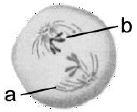
In the given figure,what do $a$ and $b$ represent respectively?
A
Kinetochore,Daughter chromatids
B
Chromatids,Kinetochores
C
Spindle fibers,Kinetochore
D
Kinetochores,Chromatids
Solution
(C) The provided figure shows a cell in the anaphase stage of mitosis.
In this stage,the centromeres split and the chromatids separate.
Label '$a$' points to the spindle fibers that are pulling the chromosomes towards the poles.
Label '$b$' points to the kinetochore,which is the protein structure on the centromere where the spindle fibers attach.
In this stage,the centromeres split and the chromatids separate.
Label '$a$' points to the spindle fibers that are pulling the chromosomes towards the poles.
Label '$b$' points to the kinetochore,which is the protein structure on the centromere where the spindle fibers attach.
0 likes
View Solution120
MediumMCQ
What is the number of chromosomes that reach each pole at the end of anaphase?
A
Half the number of chromosomes in the parent cell
B
Double the number of chromosomes in the parent cell
C
Equal to the number of chromosomes in the parent cell
D
Three times the number of chromosomes in the parent cell
Solution
(C) During $Anaphase$,the centromere of each chromosome splits,and the chromatids separate. These chromatids,now referred to as daughter chromosomes,move towards opposite poles. Since each original chromosome splits into two,the number of chromosomes reaching each pole is equal to the number of chromosomes present in the parent cell.
0 likes
View Solution121
EasyMCQ
Which structure present on the chromosome serves as the site for the attachment of spindle fibers?
A
Metaphase plate
B
Kinetochores
C
Nucleolar organizer region
D
Satellite
Solution
(B) During cell division,specifically in the mitotic phase,spindle fibers attach to the chromosomes at a specialized proteinaceous structure called the $Kinetochore$.
These structures are located on the surface of the centromeres.
They play a crucial role in the movement of chromosomes toward the poles during anaphase.
These structures are located on the surface of the centromeres.
They play a crucial role in the movement of chromosomes toward the poles during anaphase.
0 likes
View Solution122
EasyMCQ
At the end of which phase does the nuclear envelope disappear?
A
Metaphase
B
Interphase
C
Prophase
D
Telophase
Solution
(C) The process of mitosis begins with $Prophase$. During the late $Prophase$,the nuclear envelope,nucleolus,Golgi complex,and endoplasmic reticulum disappear. This marks the transition from $Prophase$ to $Metaphase$,allowing the chromosomes to align at the equatorial plate.
0 likes
View Solution123
EasyMCQ
During which phase do kinetochores attach to spindle fibers?
A
Telophase
B
Metaphase
C
Anaphase
D
Prophase
Solution
(B) The process of mitosis involves several stages. During $Prophase$, chromosomes condense. During $Metaphase$, the chromosomes align at the equatorial plate, and the spindle fibers from the poles attach to the $Kinetochores$ of the chromosomes. Therefore, the attachment of kinetochores to spindle fibers is a characteristic event of $Metaphase$.
0 likes
View Solution124
EasyMCQ
At the end of prophase, which of the following structures disperses throughout the cell?
A
Spindle fibers
B
Nucleolus
C
Nuclear envelope
D
Chromosomes
Solution
(B) During the late prophase of mitosis, the $nucleolus$ and the $nuclear \text{ } envelope$ begin to disintegrate. By the end of prophase, the $nuclear \text{ } envelope$ completely disappears, and the $nucleolus$ disperses throughout the cell. This allows the spindle fibers to interact with the chromosomes in the cytoplasm.
0 likes
View Solution125
EasyMCQ
Which phase of mitosis begins with the condensation of chromosomes along their longitudinal axis?
A
Telophase
B
Metaphase
C
Interphase
D
Prophase
Solution
(D) Prophase is the first stage of mitosis. It is characterized by the initiation of condensation of chromosomal material. The chromosomal material becomes untangled during the process of chromatin condensation. Each chromosome is seen to be composed of two chromatids attached together at the centromere.
0 likes
View Solution126
MediumMCQ
Which of the following is true for Prophase?
A
Nucleolus becomes visible.
B
Chromatin condenses into chromosomes.
C
New nuclei are formed.
D
Centrioles move towards opposite poles.
Solution
(D) Prophase is the first stage of mitosis. During this phase,the following events occur:
$1$. Chromatin material condenses to form compact mitotic chromosomes.
$2$. The centrosome,which had undergone duplication during the $S$-phase of interphase,begins to move towards opposite poles of the cell.
$3$. The nucleolus and nuclear envelope begin to disappear.
$4$. Therefore,the movement of centrioles towards opposite poles is a characteristic feature of prophase.
$1$. Chromatin material condenses to form compact mitotic chromosomes.
$2$. The centrosome,which had undergone duplication during the $S$-phase of interphase,begins to move towards opposite poles of the cell.
$3$. The nucleolus and nuclear envelope begin to disappear.
$4$. Therefore,the movement of centrioles towards opposite poles is a characteristic feature of prophase.
0 likes
View Solution127
EasyMCQ
In which phase of mitosis do the spindle fibers shorten,causing the centromere to split?
A
Metaphase
B
Telophase
C
Anaphase
D
Prophase
Solution
(C) During $Anaphase$,the centromere of each chromosome splits,and the chromatids separate. The spindle fibers attached to the kinetochores shorten,pulling the daughter chromosomes toward opposite poles of the cell. This movement is facilitated by the depolymerization of microtubules.
0 likes
View Solution128
EasyMCQ
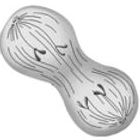
Which stage of mitosis is indicated by the following figure?
A
Metaphase
B
Anaphase
C
Telophase
D
Prophase
Solution
(B) The figure shows chromosomes being pulled towards opposite poles of the cell. This characteristic movement of sister chromatids (now daughter chromosomes) away from the equatorial plate towards the poles is the defining feature of $Anaphase$ in mitosis. During this stage,the centromeres split and chromatids separate.
0 likes
View Solution129
EasyMCQ
How many main stages are there in mitosis?
A
$3$
B
$5$
C
$4$
D
$6$
Solution
(C) Mitosis ($M$ phase) is divided into four main stages based on the behavior of chromosomes and the nuclear envelope.
These stages are:
$1$. Prophase: Chromatin condenses into chromosomes and the nuclear envelope begins to disappear.
$2$. Metaphase: Chromosomes align at the equatorial plate.
$3$. Anaphase: Sister chromatids separate and move towards opposite poles.
$4$. Telophase: Chromosomes reach the poles and the nuclear envelope reforms.
Therefore,the correct answer is $4$.
These stages are:
$1$. Prophase: Chromatin condenses into chromosomes and the nuclear envelope begins to disappear.
$2$. Metaphase: Chromosomes align at the equatorial plate.
$3$. Anaphase: Sister chromatids separate and move towards opposite poles.
$4$. Telophase: Chromosomes reach the poles and the nuclear envelope reforms.
Therefore,the correct answer is $4$.
0 likes
View Solution130
EasyMCQ
When can chromosomes be clearly observed under a microscope during cell division?
A
When chromosomes are extended
B
When chromosomes are fully condensed
C
When the centromere attaches to the chromosome
D
When spindle fibers are formed
Solution
(B) During the process of cell division,specifically in the $Metaphase$ stage of $Mitosis$,chromosomes reach their maximum level of condensation.
This high degree of condensation makes them distinct,compact,and clearly visible under a light microscope.
Therefore,the correct condition for observing chromosomes clearly is when they are fully condensed.
This high degree of condensation makes them distinct,compact,and clearly visible under a light microscope.
Therefore,the correct condition for observing chromosomes clearly is when they are fully condensed.
0 likes
View Solution131
EasyMCQ
Which of the following is $NOT$ true for telophase?
A
Nucleolus reforms.
B
Chromosomes decondense into chromatin.
C
Chromosomes undergo decondensation.
D
Chromosomes undergo complete condensation.
Solution
(D) Telophase is the final stage of cell division. During this stage,the events that occurred in prophase are reversed. The chromosomes that condensed during prophase undergo decondensation and return to their chromatin state. The nuclear envelope and nucleolus reform. Therefore,the statement 'Chromosomes undergo complete condensation' is incorrect,as the process of condensation occurs during prophase.
0 likes
View Solution132
MediumMCQ
The onset of metaphase is marked by the...
A
complete disappearance of the nucleus and nucleolus.
B
appearance of the nuclear envelope and disappearance of the nucleolus.
C
disappearance of the nuclear envelope and appearance of the nucleolus.
D
complete disappearance of the nuclear envelope and nucleolus.
Solution
(D) Metaphase is the second stage of mitosis. The onset of metaphase is characterized by the complete disintegration of the nuclear envelope and the nucleolus. This allows the spindle fibers to attach to the kinetochores of the chromosomes,which then align at the metaphase plate (equatorial plane).
0 likes
View Solution133
EasyMCQ
Which of the following phases is not a part of mitosis?
A
Interphase
B
Telophase
C
Anaphase
D
Metaphase
Solution
(A) The cell cycle is divided into two main phases: $Interphase$ and $M$ phase (Mitosis).
$Interphase$ is the preparatory phase where the cell grows and replicates its $DNA$,consisting of $G_1$,$S$,and $G_2$ phases.
$Mitosis$ ($M$ phase) consists of four stages: $Prophase$,$Metaphase$,$Anaphase$,and $Telophase$.
Therefore,$Interphase$ is not a part of mitosis.
$Interphase$ is the preparatory phase where the cell grows and replicates its $DNA$,consisting of $G_1$,$S$,and $G_2$ phases.
$Mitosis$ ($M$ phase) consists of four stages: $Prophase$,$Metaphase$,$Anaphase$,and $Telophase$.
Therefore,$Interphase$ is not a part of mitosis.
0 likes
View Solution134
EasyMCQ
In which of the following phases does the formation of spindle fibers around the centrosome occur?
A
Prophase
B
Metaphase
C
Anaphase
D
Telophase
Solution
(A) During $Prophase$,the chromatin condenses into chromosomes,and the centrosomes,which duplicated during the $S$ phase,begin to move towards opposite poles of the cell. As they move,they radiate microtubules,which form the mitotic spindle fibers. Therefore,the initiation and formation of spindle fibers around the centrosomes occur during $Prophase$.
0 likes
View Solution135
MediumMCQ
Into how many stages is mitosis divided?
A
$4$
B
$2$
C
$3$
D
$6$
Solution
(A) Mitosis ($M$ phase) is divided into four main stages based on the nuclear changes:
$1$. Prophase: Chromatin condenses into chromosomes.
$2$. Metaphase: Chromosomes align at the equatorial plate.
$3$. Anaphase: Sister chromatids separate and move to opposite poles.
$4$. Telophase: Chromosomes decondense and nuclear envelopes reform.
$1$. Prophase: Chromatin condenses into chromosomes.
$2$. Metaphase: Chromosomes align at the equatorial plate.
$3$. Anaphase: Sister chromatids separate and move to opposite poles.
$4$. Telophase: Chromosomes decondense and nuclear envelopes reform.
0 likes
View Solution136
MediumMCQ
Which of the following is not a phase of mitosis?
A
Prophase
B
Metaphase
C
Interphase
D
Telophase
Solution
(C) The cell cycle is divided into two main phases: $Interphase$ and $M$ phase (Mitosis).
$Interphase$ is the preparatory phase where the cell grows and replicates its $DNA$, but it is not a part of mitosis.
Mitosis ($M$ phase) consists of four stages: $Prophase$, $Metaphase$, $Anaphase$, and $Telophase$.
Therefore, $Interphase$ is not a phase of mitosis.
$Interphase$ is the preparatory phase where the cell grows and replicates its $DNA$, but it is not a part of mitosis.
Mitosis ($M$ phase) consists of four stages: $Prophase$, $Metaphase$, $Anaphase$, and $Telophase$.
Therefore, $Interphase$ is not a phase of mitosis.
0 likes
View Solution137
MediumMCQ
Identify the stage of mitosis shown below:
A
Prophase
B
Metaphase
C
Anaphase
D
All of the above
Solution
(B) In mitosis,the stages are characterized by specific chromosomal movements and cellular changes.
$1$. Prophase: Chromatin condenses into chromosomes,and the nuclear envelope begins to disappear.
$2$. Metaphase: Chromosomes align at the equatorial plate (metaphase plate).
$3$. Anaphase: Centromeres split,and sister chromatids move toward opposite poles.
Since the question refers to a visual representation (implied),the correct identification depends on the specific characteristics of the diagram provided. In standard biology assessments,if the chromosomes are aligned at the center,it is Metaphase.
$1$. Prophase: Chromatin condenses into chromosomes,and the nuclear envelope begins to disappear.
$2$. Metaphase: Chromosomes align at the equatorial plate (metaphase plate).
$3$. Anaphase: Centromeres split,and sister chromatids move toward opposite poles.
Since the question refers to a visual representation (implied),the correct identification depends on the specific characteristics of the diagram provided. In standard biology assessments,if the chromosomes are aligned at the center,it is Metaphase.
0 likes
View Solution138
MediumMCQ
Which phase begins with the condensation of chromosomes along their longitudinal axis?
A
Prophase
B
Metaphase
C
Telophase
D
Anaphase
Solution
(A) Prophase is the first stage of mitosis. During prophase,the chromatin material condenses to form compact mitotic chromosomes. These chromosomes are seen to be composed of two chromatids attached together at the centromere. This condensation process occurs along the longitudinal axis of the chromosomes,marking the initiation of the prophase stage.
0 likes
View Solution139
MediumMCQ
At the end of which phase does each chromosome appear to consist of two chromatids joined by a centromere?
A
Telophase
B
Interphase
C
Prophase
D
Metaphase
Solution
(C) During the $S$-phase of Interphase,$DNA$ replication occurs,resulting in the duplication of genetic material. However,the chromosomes remain in a condensed,thread-like state. By the end of Prophase,the chromosomes become highly condensed and clearly visible under a microscope. Each chromosome is observed to consist of two sister chromatids held together at the centromere.
0 likes
View Solution140
EasyMCQ
At the end of which phase do the nuclear envelope and nucleolus disappear?
A
Metaphase
B
Prophase
C
Anaphase
D
Telophase
Solution
(B) During the $Prophase$ stage of mitosis,the chromatin condenses into chromosomes. As $Prophase$ progresses towards its end,the nuclear envelope and the nucleolus begin to disintegrate and eventually disappear. This allows the spindle fibers to interact with the chromosomes.
0 likes
View Solution141
MediumMCQ
Which of the following processes is not associated with prophase?
A
Formation of radial spindle
B
Centrioles move towards opposite poles of the cell
C
Chromosomes begin to condense along their longitudinal axis
D
Nuclear envelope and nucleolus disappear completely
Solution
(D) Prophase is the first stage of mitosis. During prophase,chromatin condenses into chromosomes,centrioles move to opposite poles,and the spindle apparatus begins to form. The nuclear envelope and nucleolus start to disintegrate during late prophase and disappear completely by the end of prophase or the beginning of prometaphase. However,the complete disappearance of the nuclear envelope and nucleolus is typically considered the transition point to prometaphase. Among the given options,the complete disappearance of the nuclear envelope and nucleolus is the process that marks the end of prophase and the transition to the next phase,making it the least associated with the active prophase stage compared to the others.
0 likes
View Solution142
MediumMCQ
Which of the following processes is associated with Prophase?
A
Chromosomes spread throughout the cell.
B
Chromosomes duplicate.
C
Synthesis of $RNA$ and proteins occurs.
D
Centrioles duplicate.
Solution
(A) Prophase is the first stage of mitosis. During this phase,the chromatin material condenses into compact mitotic chromosomes. The chromosomes are seen to be composed of two chromatids attached together at the centromere. The initiation of the assembly of the mitotic spindle,the microtubules,and the components of the cytoplasm also takes place. Option $A$ describes the condensation and organization of chromosomes,which is a characteristic feature of Prophase. Options $B$,$C$,and $D$ occur during the $S$ phase and $G_2$ phase of Interphase,not during Prophase.
0 likes
View Solution143
EasyMCQ
In which stage can chromosomes be clearly observed under a microscope?
A
Prophase
B
Metaphase
C
Telophase
D
Anaphase
Solution
(B) During the $Metaphase$ stage of mitosis,chromosomes are most condensed and aligned at the equatorial plate. This maximum condensation makes them clearly visible and distinct under a light microscope,which is why $Metaphase$ is the ideal stage for studying chromosome morphology and counting.
0 likes
View Solution144
MediumMCQ
During which stage of cell division do kinetochores attach to spindle fibers?
A
Telophase
B
Anaphase
C
Metaphase
D
Prophase
Solution
(C) During the process of mitosis,the $Prophase$ stage involves the condensation of chromatin into chromosomes.
Following this,during $Metaphase$,the chromosomes align at the equatorial plate.
It is specifically during the transition from $Prophase$ to $Metaphase$ (often referred to as $Prometaphase$) that the spindle fibers attach to the $Kinetochores$ of the chromosomes.
Among the given options,$Metaphase$ is the stage where the attachment is fully established and chromosomes are aligned,making it the most appropriate answer for when kinetochores are attached to spindle fibers.
Following this,during $Metaphase$,the chromosomes align at the equatorial plate.
It is specifically during the transition from $Prophase$ to $Metaphase$ (often referred to as $Prometaphase$) that the spindle fibers attach to the $Kinetochores$ of the chromosomes.
Among the given options,$Metaphase$ is the stage where the attachment is fully established and chromosomes are aligned,making it the most appropriate answer for when kinetochores are attached to spindle fibers.
0 likes
View Solution145
EasyMCQ
Which of the following structures serves as the site of attachment for spindle fibers?
A
Kinetochores
B
Centromere
C
Chromatin
D
Chromatid
Solution
(A) During cell division,specifically in metaphase,spindle fibers attach to small disc-shaped structures present on the sides of the centromere known as kinetochores. These structures are essential for the movement of chromosomes toward the poles.
0 likes
View Solution146
EasyMCQ
During metaphase,the spindle fibers attach to the centromere of the chromosomes and align them at the central region of the cell. What is this region called?
A
Metaphase plate
B
Polar plate
C
Equatorial plate
D
Chromosomal plate
Solution
(A) During the metaphase stage of mitosis,the chromosomes align themselves at the equator of the cell. This specific plane of alignment is known as the $Metaphase \ plate$ or $Equatorial \ plate$. The spindle fibers from both poles attach to the kinetochores of the centromeres,ensuring that the chromosomes are positioned precisely at the center of the cell before they are pulled apart during anaphase.
0 likes
View Solution147
MediumMCQ
What is the metaphase plate?
A
Alignment of chromosomes at the equatorial plane of the cell during metaphase.
B
Alignment of chromosomes at the poles of the cell during metaphase.
C
Alignment of chromosomes at the equatorial plane of the cell during prophase.
D
Contraction of spindle fibers towards the poles.
Solution
(A) During the metaphase stage of mitosis,the chromosomes align themselves at the equator of the cell. This plane of alignment is referred to as the metaphase plate. This alignment is crucial for the equal distribution of sister chromatids to the daughter cells.
0 likes
View Solution148
MediumMCQ
By what other name is the equatorial plane of the cell known?
A
Division region
B
Division axis
C
Chromosomal plane
D
Metaphase plate
Solution
(D) During the metaphase stage of mitosis,the chromosomes align themselves at the equator of the cell. This plane of alignment is referred to as the metaphase plate. Therefore,the equatorial plane of the cell is known as the metaphase plate.
0 likes
View Solution149
EasyMCQ
During which of the following phases does the centromere split?
A
Prophase
B
Telophase
C
Metaphase
D
Anaphase
Solution
(D) The process of mitosis consists of several phases: Prophase, Metaphase, Anaphase, and Telophase.
During $Anaphase$, the centromere of each chromosome splits, and the chromatids separate.
These chromatids, now referred to as daughter chromosomes, move towards opposite poles of the cell.
Therefore, the correct phase is $Anaphase$.
During $Anaphase$, the centromere of each chromosome splits, and the chromatids separate.
These chromatids, now referred to as daughter chromosomes, move towards opposite poles of the cell.
Therefore, the correct phase is $Anaphase$.
0 likes
View Solution150
MediumMCQ
Which of the following events is associated with anaphase?
A
Chromosomes align at the equatorial plate
B
Formation of the bipolar spindle
C
Reappearance of the nucleolus
D
Splitting of centromeres and separation of chromatids
Solution
(D) Anaphase is a stage of mitosis characterized by the following events:
$1$. The centromere of each chromosome splits,allowing the two sister chromatids to separate.
$2$. These chromatids,now referred to as daughter chromosomes,begin to move towards opposite poles of the cell.
$3$. As they move,the centromeres lead the way,while the arms of the chromosomes trail behind.
Therefore,the splitting of centromeres and the separation of chromatids is the defining event of anaphase.
$1$. The centromere of each chromosome splits,allowing the two sister chromatids to separate.
$2$. These chromatids,now referred to as daughter chromosomes,begin to move towards opposite poles of the cell.
$3$. As they move,the centromeres lead the way,while the arms of the chromosomes trail behind.
Therefore,the splitting of centromeres and the separation of chromatids is the defining event of anaphase.
0 likes
View SolutionCell Cycle and Cell Division — M Phase · Frequently Asked Questions
1Are these Cell Cycle and Cell Division questions useful for JEE and NEET?
Yes. All questions in this section are mapped to JEE Main and NEET exam patterns. Previous year questions from JEE Main, NEET, GUJCET and state-level exams are included with full solutions.
2Can I switch to Hindi or Gujarati for these questions?
Yes. Use the language tabs in the hero section or the sidebar to view the same questions and solutions in English, Hindi or Gujarati.
3How do I generate a question paper from this subtopic?
Use the Vedclass Exam Paper Generator — select the chapter and subtopic, set difficulty, and generate Sets A, B, C, D automatically. First 3 chapters of every subject are free.
Vedclass Products
For Students
Vedclass Test Series
Mock tests in real JEE/NEET style with performance analysis. 5-day free trial.
Start Free TrialFor Teachers
Exam Paper Generator
Generate Set A/B/C/D papers from this chapter in 2 minutes. 3 chapters free.
Try FreeFor Institutes
Online Exam Module
Live online exams with unlimited students, 360° analytics & white-label branding.
See DemoFor Teachers & Institutes
Generate a Cell Cycle and Cell Division Exam Paper in 2 Minutes
Select subtopic & difficulty — Sets A, B, C, D auto-generated with No Repeat logic.
First 3 chapters of every subject are free — no payment required.