
A English
M Phase Questions in English
Class 11 Biology · Cell Cycle and Cell Division · M Phase
360+
Questions
English
Language
100%
With Solutions
Showing 50 of 360 questions in English
151
EasyMCQ
In which phase of cell division do the chromosomes split and move towards the poles?
A
Telophase
B
Anaphase
C
Metaphase
D
Prophase
Solution
(B) During $Anaphase$,the centromere of each chromosome splits,and the chromatids separate.
These separated chromatids,now referred to as daughter chromosomes,are pulled towards opposite poles by the shortening of spindle fibers.
Therefore,the movement of chromosomes towards the poles is a characteristic feature of $Anaphase$.
These separated chromatids,now referred to as daughter chromosomes,are pulled towards opposite poles by the shortening of spindle fibers.
Therefore,the movement of chromosomes towards the poles is a characteristic feature of $Anaphase$.
0 likes
View Solution152
MediumMCQ
In which phase of mitosis do chromatids,each possessing an independent centromere,form?
A
Anaphase
B
Metaphase
C
Telophase
D
Prophase
Solution
(A) During $Anaphase$,the centromere of each chromosome splits,and the two sister chromatids separate. Once separated,each chromatid possesses its own independent centromere and is now considered an individual chromosome. These chromosomes then begin to move towards opposite poles of the cell.
0 likes
View Solution153
MediumMCQ
At the end of which phase is the number of chromosomes at each pole equal to the number of chromosomes in the parent cell?
A
Telophase
B
Prophase
C
Anaphase
D
Metaphase
Solution
(C) During $Anaphase$,the centromere of each chromosome splits,and the chromatids separate.
These chromatids,now referred to as daughter chromosomes,move towards opposite poles.
By the end of $Anaphase$,each pole receives a complete set of chromosomes,which is equal to the number of chromosomes present in the parent cell.
Therefore,the correct phase is $Anaphase$.
These chromatids,now referred to as daughter chromosomes,move towards opposite poles.
By the end of $Anaphase$,each pole receives a complete set of chromosomes,which is equal to the number of chromosomes present in the parent cell.
Therefore,the correct phase is $Anaphase$.
0 likes
View Solution154
EasyMCQ
Which organelles are reformed at the end of $Telophase$?
A
Nuclear envelope
B
Golgi complex
C
Endoplasmic reticulum
D
All of the above
Solution
(D) During $Telophase$,the chromosomes cluster at opposite spindle poles and their identity is lost as discrete elements.
Nuclear envelope assembles around the chromosome clusters.
Nucleolus,Golgi complex,and Endoplasmic reticulum reform.
Therefore,all the mentioned organelles are reformed at the end of $Telophase$.
Nuclear envelope assembles around the chromosome clusters.
Nucleolus,Golgi complex,and Endoplasmic reticulum reform.
Therefore,all the mentioned organelles are reformed at the end of $Telophase$.
0 likes
View Solution155
EasyMCQ
In which phase of cell division do the nuclei formed at both polar regions appear?
A
Telophase
B
Anaphase
C
Prophase
D
Metaphase
Solution
(A) Telophase is the final stage of mitosis. During this phase,the chromosomes that have reached their respective poles decondense and lose their individuality. The nuclear envelope reforms around each group of chromosomes,resulting in the formation of two daughter nuclei at the opposite poles of the cell.
0 likes
View Solution156
MediumMCQ
Which of the following statements is associated with $Telophase$?
A
Chromatids acquire their own centromere.
B
Two new nuclei appear at the polar regions.
C
Chromosomes align at the equatorial plate.
D
Spindle fibers are formed.
Solution
(B) $Telophase$ is the final stage of mitosis. During this phase:
$1$. The chromosomes that have reached their respective poles decondense and lose their individuality.
$2$. The nuclear envelope reforms around the chromosome clusters at each pole.
$3$. Nucleolus,Golgi complex,and endoplasmic reticulum reform.
$4$. Thus,two daughter nuclei are formed at the opposite poles of the cell.
$1$. The chromosomes that have reached their respective poles decondense and lose their individuality.
$2$. The nuclear envelope reforms around the chromosome clusters at each pole.
$3$. Nucleolus,Golgi complex,and endoplasmic reticulum reform.
$4$. Thus,two daughter nuclei are formed at the opposite poles of the cell.
0 likes
View Solution157
MediumMCQ
The formation of the nucleolus at the nucleolar organizer region is associated with which phase?
A
Cytokinesis
B
Interphase
C
Telophase
D
Prophase
Solution
(C) During $Telophase$, the chromosomes decondense and lose their individuality. The nuclear envelope reforms around the chromosome clusters. The nucleolus, Golgi complex, and endoplasmic reticulum reform at the nucleolar organizer region of specific chromosomes. Thus, the nucleolus reappears during $Telophase$.
0 likes
View Solution158
EasyMCQ
During which phase does chromosome decondensation occur?
A
Anaphase
B
Telophase
C
Prophase
D
Metaphase
Solution
(B) During $Telophase$,the chromosomes that reached the opposite poles begin to decondense (uncoil) and lose their individual identity.
They form a chromatin network,and the nuclear envelope reforms around the chromosome clusters to form two daughter nuclei.
They form a chromatin network,and the nuclear envelope reforms around the chromosome clusters to form two daughter nuclei.
0 likes
View Solution159
MediumMCQ
In which stage does the chromatin network condense into chromosomes?
A
Prophase
B
Metaphase
C
Anaphase
D
Telophase
Solution
(A) During the $Prophase$ stage of mitosis,the chromatin material,which exists as a loose network in the interphase nucleus,undergoes condensation to form compact,distinct $Chromosomes$. This process involves the coiling and folding of $DNA$ and histone proteins,making the genetic material visible under a light microscope.
0 likes
View Solution160
MediumMCQ
Which of the following events is not associated with telophase?
A
Chromatin material is observed.
B
Nucleolus is reformed.
C
Chromosomes in pairs separate.
D
Two new nuclei are formed at the poles.
Solution
(C) Telophase is the final stage of mitosis. During this phase,the following events occur:
$1$. Chromosomes cluster at opposite spindle poles and their identity is lost as discrete elements.
$2$. Chromatin material collects in a mass of chromatin.
$3$. Nuclear envelope assembles around the chromatin clusters.
$4$. Nucleolus,Golgi complex,and $ER$ reform.
Option $C$ describes the separation of homologous chromosomes,which occurs during Anaphase $I$ of meiosis,not during telophase of mitosis. Therefore,it is not associated with telophase.
$1$. Chromosomes cluster at opposite spindle poles and their identity is lost as discrete elements.
$2$. Chromatin material collects in a mass of chromatin.
$3$. Nuclear envelope assembles around the chromatin clusters.
$4$. Nucleolus,Golgi complex,and $ER$ reform.
Option $C$ describes the separation of homologous chromosomes,which occurs during Anaphase $I$ of meiosis,not during telophase of mitosis. Therefore,it is not associated with telophase.
0 likes
View Solution161
MediumMCQ
$S$ - Statement: During anaphase,the paired chromatids separate.
$R$ - Reason: During anaphase,the spindle fibers shorten,and the centromere splits.
$R$ - Reason: During anaphase,the spindle fibers shorten,and the centromere splits.
A
$S$ and $R$ are both true,and $R$ is the correct explanation of $S$.
B
$S$ and $R$ are both true,but $R$ is not the correct explanation of $S$.
C
$S$ is true and $R$ is false.
D
$S$ is false and $R$ is true.
Solution
(A) During the anaphase stage of mitosis,the centromere of each chromosome splits,allowing the sister chromatids to separate.
These separated chromatids are then pulled towards opposite poles due to the shortening of the spindle fibers attached to the kinetochores.
Therefore,both the statement $(S)$ and the reason $(R)$ are correct,and $(R)$ provides the correct explanation for $(S)$.
These separated chromatids are then pulled towards opposite poles due to the shortening of the spindle fibers attached to the kinetochores.
Therefore,both the statement $(S)$ and the reason $(R)$ are correct,and $(R)$ provides the correct explanation for $(S)$.
0 likes
View Solution162
MediumMCQ
Which of the following is an incorrect pair?
A
Prophase - Chromosomes begin to condense along their longitudinal axis.
B
Metaphase - Chromosomes align at the equatorial plate of the cell.
C
Anaphase - Chromatin network is observed.
D
Telophase - Nucleolus is reformed.
Solution
(C) In $Anaphase$, the centromeres split and chromatids separate, moving towards opposite poles. The $Chromatin$ $network$ is a characteristic feature of the $Interphase$ nucleus, not $Anaphase$. Therefore, the pair $Anaphase - \text{Chromatin network is observed}$ is incorrect.
0 likes
View Solution163
EasyMCQ
In which of the following conditions can a cell be said to be in metaphase?
A
Chromosomes appear as chromatin network
B
Chromosomes move towards the poles
C
Chromosomes align at the equatorial plate
D
Nucleolus disappears
Solution
(C) Metaphase is the second stage of mitosis. During this stage,the nuclear envelope completely disintegrates,and the chromosomes condense and align themselves at the equatorial plane (also known as the metaphase plate) of the cell. This alignment is facilitated by spindle fibers attached to the kinetochores of the chromosomes. Therefore,the characteristic feature of metaphase is the alignment of chromosomes at the equatorial plate.
0 likes
View Solution164
EasyMCQ
Which stage of cell division is best for studying the morphology of chromosomes?
A
Metaphase
B
Anaphase
C
Interphase
D
Telophase
Solution
(A) During $Metaphase$,the chromosomes are most condensed and clearly visible under a light microscope.
They align at the equatorial plate,making it the ideal stage to observe their morphology,size,and number.
They align at the equatorial plate,making it the ideal stage to observe their morphology,size,and number.
0 likes
View Solution165
EasyMCQ
In which phase do chromosomes separate and move towards opposite poles?
A
Prophase
B
Metaphase
C
Anaphase
D
Telophase
Solution
(C) During $Anaphase$,the centromere of each chromosome splits,and the chromatids (now referred to as daughter chromosomes) separate. These daughter chromosomes are then pulled towards opposite poles of the cell by the shortening of spindle fibers attached to the kinetochores. This movement is a characteristic feature of $Anaphase$.
0 likes
View Solution166
EasyMCQ
What is the correct sequence of phases in mitosis?
A
Prophase,Metaphase,Anaphase,Telophase
B
Interphase,Anaphase,Telophase,Metaphase
C
Prophase,Anaphase,Interphase,Metaphase,Telophase
D
Prophase,Metaphase,Interphase,Anaphase,Telophase
Solution
(A) Mitosis is the process of nuclear division in eukaryotic cells. The correct sequence of the mitotic phases is:
$1$. $Prophase$: Chromatin condenses into chromosomes.
$2$. $Metaphase$: Chromosomes align at the equatorial plate.
$3$. $Anaphase$: Sister chromatids separate and move to opposite poles.
$4$. $Telophase$: Chromosomes decondense and nuclear envelopes reform.
Note: $Interphase$ is the period between cell divisions,not a phase of mitosis itself. Among the given options,$A$ represents the correct sequence of mitotic stages.
$1$. $Prophase$: Chromatin condenses into chromosomes.
$2$. $Metaphase$: Chromosomes align at the equatorial plate.
$3$. $Anaphase$: Sister chromatids separate and move to opposite poles.
$4$. $Telophase$: Chromosomes decondense and nuclear envelopes reform.
Note: $Interphase$ is the period between cell divisions,not a phase of mitosis itself. Among the given options,$A$ represents the correct sequence of mitotic stages.
0 likes
View Solution167
MediumMCQ
Mitosis is essentially...
A
Reduction in the number of chromosomes.
B
Division of the nucleus only.
C
Division of the cytoplasm only.
D
Division of both the nucleus and the cytoplasm.
Solution
(B) Mitosis,or $M$-phase,is the process of cell division where a parent cell divides to produce two identical daughter cells.
Strictly speaking,mitosis refers to the division of the nucleus (karyokinesis),which ensures that each daughter cell receives an identical set of chromosomes.
However,in the broader context of the cell cycle,the division of the nucleus is followed by cytokinesis (division of the cytoplasm).
Therefore,mitosis is defined as the process of nuclear division that results in two genetically identical nuclei.
Strictly speaking,mitosis refers to the division of the nucleus (karyokinesis),which ensures that each daughter cell receives an identical set of chromosomes.
However,in the broader context of the cell cycle,the division of the nucleus is followed by cytokinesis (division of the cytoplasm).
Therefore,mitosis is defined as the process of nuclear division that results in two genetically identical nuclei.
0 likes
View Solution168
EasyMCQ
From which of the following do spindle fibers originate?
A
Centriole
B
Centromere
C
Nucleus
D
Mitochondria
Solution
(A) Spindle fibers are composed of microtubules. During cell division in animal cells,these microtubules originate from the centrosome,which contains a pair of centrioles. The centrioles act as the organizing center for the formation of the spindle apparatus. Therefore,the correct answer is $A$ (Centriole).
0 likes
View Solution169
EasyMCQ
Chromosomes are attached to the spindle fibers by which of the following structures?
A
Chromomere
B
Kinetochore
C
Satellite region
D
Centrosome
Solution
(B) During cell division,specifically in metaphase,the spindle fibers attach to the chromosomes at a disc-shaped structure called the $Kinetochore$.
$Kinetochores$ are small disc-shaped structures present at the surface of the $Centromeres$.
These structures serve as the site of attachment for spindle fibers to the chromosomes,which helps in the movement of chromosomes toward the poles during anaphase.
$Kinetochores$ are small disc-shaped structures present at the surface of the $Centromeres$.
These structures serve as the site of attachment for spindle fibers to the chromosomes,which helps in the movement of chromosomes toward the poles during anaphase.
0 likes
View Solution170
EasyMCQ
Mitosis begins with which phase?
A
Telophase
B
Anaphase
C
Prophase
D
Metaphase
Solution
(C) Mitosis ($M$ phase) is the process of cell division that follows the $G_2$ phase of interphase.
It consists of four main stages: Prophase,Metaphase,Anaphase,and Telophase.
Prophase is the first and the initial stage of mitosis,characterized by the condensation of chromatin into compact chromosomes and the initiation of the mitotic spindle formation.
Therefore,mitosis begins with Prophase.
It consists of four main stages: Prophase,Metaphase,Anaphase,and Telophase.
Prophase is the first and the initial stage of mitosis,characterized by the condensation of chromatin into compact chromosomes and the initiation of the mitotic spindle formation.
Therefore,mitosis begins with Prophase.
0 likes
View Solution171
EasyMCQ
In which phase of mitosis does the nucleolus disappear and the chromosomes become distinct?
A
Interphase
B
Metaphase
C
Anaphase
D
Prophase
Solution
(D) During $Prophase$,the chromatin material condenses to form compact mitotic chromosomes. The nucleolus,along with the nuclear envelope and other organelles like the Golgi complex and endoplasmic reticulum,disappears by the end of this phase. Therefore,the correct answer is $Prophase$.
0 likes
View Solution172
EasyMCQ
During mitosis,the nuclear envelope disappears at which stage?
A
Early prophase
B
Late prophase
C
Metaphase
D
Anaphase
Solution
(B) During the process of mitosis,the nuclear envelope and the nucleolus begin to disintegrate and disappear completely by the end of prophase. This transition marks the end of prophase and allows the spindle fibers to attach to the kinetochores of the chromosomes during the subsequent prometaphase or early metaphase. Therefore,the nuclear envelope is considered to have disappeared by the end of prophase.
0 likes
View Solution173
MediumMCQ
Which of the following structures disappear during the $M$ phase of mitosis?
A
Plastids and mitochondria
B
Nuclear envelope and nucleolus
C
Cell wall and cell membrane
D
Cell wall and nucleolus
Solution
(B) During the prophase stage of mitosis, the cell undergoes several structural changes to prepare for chromosome segregation.
$1$. The chromatin condenses into compact mitotic chromosomes.
$2$. The nuclear envelope (nuclear membrane) begins to disintegrate.
$3$. The nucleolus disappears as ribosomal $RNA$ synthesis ceases.
$4$. The Golgi complex and endoplasmic reticulum also tend to disappear or become less distinct.
Therefore, the nuclear envelope and nucleolus are the primary structures that disappear during the early stages of mitosis.
$1$. The chromatin condenses into compact mitotic chromosomes.
$2$. The nuclear envelope (nuclear membrane) begins to disintegrate.
$3$. The nucleolus disappears as ribosomal $RNA$ synthesis ceases.
$4$. The Golgi complex and endoplasmic reticulum also tend to disappear or become less distinct.
Therefore, the nuclear envelope and nucleolus are the primary structures that disappear during the early stages of mitosis.
0 likes
View Solution174
MediumMCQ
In mitosis,the stage where chromosomes align at the equatorial plate and then split is known as .......
A
Prophase
B
Metaphase
C
Anaphase
D
Telophase
Solution
(C) In mitosis,the process of chromosome alignment at the equatorial plate occurs during $Metaphase$.
However,the specific event where the centromeres split and the sister chromatids separate to move towards opposite poles is known as $Anaphase$.
Since the question refers to the stage where they align and then split (initiating the separation),$Anaphase$ is the correct phase where the splitting of centromeres and separation of chromatids occurs.
However,the specific event where the centromeres split and the sister chromatids separate to move towards opposite poles is known as $Anaphase$.
Since the question refers to the stage where they align and then split (initiating the separation),$Anaphase$ is the correct phase where the splitting of centromeres and separation of chromatids occurs.
0 likes
View Solution175
EasyMCQ
In which phase of cell division do the chromosomes align at the equatorial plate?
A
Anaphase
B
Prophase
C
Metaphase
D
Telophase
Solution
(C) During $Metaphase$,the chromosomes align themselves at the equatorial plate,which is also known as the metaphase plate. This alignment is a characteristic feature of this phase,ensuring that the sister chromatids are correctly oriented for separation during the subsequent Anaphase.
0 likes
View Solution176
EasyMCQ
In which stage can chromosomes be counted?
A
Prophase
B
Metaphase
C
Anaphase
D
Telophase
Solution
(B) During $Metaphase$, chromosomes are at their most condensed state.
They align at the equatorial plate, making them clearly visible and distinct under a microscope.
Therefore, $Metaphase$ is the best stage to count the number of chromosomes in a cell.
They align at the equatorial plate, making them clearly visible and distinct under a microscope.
Therefore, $Metaphase$ is the best stage to count the number of chromosomes in a cell.
0 likes
View Solution177
MediumMCQ
In which phase of mitosis does the nuclear envelope disappear and spindle fibers become visible?
A
Early Prophase
B
Prometaphase
C
Late Telophase
D
Late Prophase
Solution
(B) During the process of mitosis, the $Prophase$ stage is characterized by the condensation of chromatin into chromosomes.
As the cell progresses into $Prometaphase$ (often considered the transition between $Prophase$ and $Metaphase$), the nuclear envelope completely disintegrates or disappears.
Simultaneously, the spindle fibers (microtubules) attach to the kinetochores of the chromosomes, making them visible under a microscope.
Therefore, the disappearance of the nuclear envelope and the formation of spindle fibers are hallmark events of $Prometaphase$.
As the cell progresses into $Prometaphase$ (often considered the transition between $Prophase$ and $Metaphase$), the nuclear envelope completely disintegrates or disappears.
Simultaneously, the spindle fibers (microtubules) attach to the kinetochores of the chromosomes, making them visible under a microscope.
Therefore, the disappearance of the nuclear envelope and the formation of spindle fibers are hallmark events of $Prometaphase$.
0 likes
View Solution178
MediumMCQ
During anaphase,the movement of chromosomes is:
A
Dependent on the attachment of spindle fibers to the kinetochore.
B
Independent of spindle fibers.
C
Due to high $ATP$ production in mitochondria.
D
Due to cytoplasmic streaming.
Solution
(A) During the $Anaphase$ stage of cell division,the centromere of each chromosome splits,and the sister chromatids separate. The movement of these separated chromatids (now daughter chromosomes) toward the opposite poles is facilitated by the shortening of spindle fibers (microtubules) that are attached to the $Kinetochore$ of the chromosomes. Therefore,this movement is dependent on the attachment of spindle fibers to the kinetochore.
0 likes
View Solution179
EasyMCQ
During which phase of cell division do the chromatids move towards opposite poles?
A
Prophase
B
Anaphase
C
Metaphase
D
Telophase
Solution
(B) During $Anaphase$, the centromere of each chromosome splits, and the chromatids (now referred to as daughter chromosomes) separate.
These daughter chromosomes are then pulled towards opposite poles of the cell by the shortening of spindle fibers attached to the kinetochores.
Therefore, the correct phase is $Anaphase$.
These daughter chromosomes are then pulled towards opposite poles of the cell by the shortening of spindle fibers attached to the kinetochores.
Therefore, the correct phase is $Anaphase$.
0 likes
View Solution180
EasyMCQ
The separation of two chromatids of each chromosome,which is observed in anaphase,is initiated by:
A
Interaction of chromosomal fibers with centrioles.
B
Elongation of spindle fibers.
C
Splitting force at the kinetochore.
D
All of the above.
Solution
(C) During $Anaphase$,the centromere of each chromosome splits,and the two sister chromatids separate. This process is initiated by the splitting force generated at the $kinetochore$ due to the tension exerted by the spindle fibers. This force pulls the chromatids toward opposite poles.
0 likes
View Solution181
MediumMCQ
In which phase of mitosis do the chromatids of each chromosome separate from each other?
A
Anaphase
B
Telophase
C
Metaphase
D
Prophase
Solution
(A) During $Anaphase$,the centromere of each chromosome splits,and the chromatids separate. These chromatids,now referred to as chromosomes of the future daughter nuclei,move towards opposite poles of the cell. This is the characteristic event of $Anaphase$.
0 likes
View Solution182
EasyMCQ
What happens during the telophase of mitosis?
A
It is the final stage of karyokinesis.
B
It is more or less the reverse of prophase.
C
Spindle fibers are absorbed into the cytoplasm.
D
All of the above.
Solution
(D) Telophase is the final stage of mitosis (karyokinesis).
During this phase,the chromosomes cluster at opposite spindle poles and their identity is lost as discrete elements.
Nuclear envelope assembles around the chromosome clusters at each pole,forming two daughter nuclei.
Nucleolus,Golgi complex,and $ER$ reform.
Thus,telophase is essentially the reverse of prophase.
Additionally,the spindle fibers depolymerize and are absorbed into the cytoplasm.
Therefore,all the given statements are correct.
During this phase,the chromosomes cluster at opposite spindle poles and their identity is lost as discrete elements.
Nuclear envelope assembles around the chromosome clusters at each pole,forming two daughter nuclei.
Nucleolus,Golgi complex,and $ER$ reform.
Thus,telophase is essentially the reverse of prophase.
Additionally,the spindle fibers depolymerize and are absorbed into the cytoplasm.
Therefore,all the given statements are correct.
0 likes
View Solution183
EasyMCQ
In which of the following stages is the number,size,and shape of chromosomes most clearly visible?
A
Prophase
B
Metaphase
C
Telophase
D
Interphase
Solution
(B) During the $Metaphase$ stage of mitosis,chromosomes are highly condensed and align at the equatorial plate. This maximum condensation makes them most distinct,allowing for the clear observation of their number,size,and shape under a microscope. Therefore,$Metaphase$ is the ideal stage for karyotyping.
0 likes
View Solution184
EasyMCQ
In which of the following stages does the formation of spindle fibers around the centrosome occur?
A
Prophase
B
Metaphase
C
Anaphase
D
Telophase
Solution
(A) The formation of spindle fibers begins during the $Prophase$ stage of mitosis. During this phase,the centrosomes,which duplicated during the $S$-phase of interphase,begin to move towards opposite poles of the cell. As they move,they organize the microtubule proteins to form the mitotic spindle apparatus,which is essential for the separation of chromosomes.
0 likes
View Solution185
EasyMCQ
In which phase of cell division do the nuclear envelope and nucleolus reappear?
A
Prophase
B
Metaphase
C
Anaphase
D
Telophase
Solution
(D) Telophase is the final stage of mitosis. During this phase,the chromosomes that have reached their respective poles decondense and lose their individuality. The nuclear envelope assembles around each chromosome cluster,and the nucleolus,Golgi complex,and endoplasmic reticulum reform.
0 likes
View Solution186
EasyMCQ
During which phase of mitosis do the nuclear envelope and nucleolus completely disappear?
A
Prophase
B
Metaphase
C
Anaphase
D
Telophase
Solution
(A) In the process of mitosis,the $Prophase$ is the first stage. During the late $Prophase$,the nuclear envelope and the nucleolus begin to disintegrate and eventually disappear completely. This allows the chromosomes to move freely within the cytoplasm to align at the equatorial plate during the subsequent $Metaphase$.
0 likes
View Solution187
EasyMCQ
What is the correct sequence of stages in mitosis (karyokinesis)?
A
Prophase,Anaphase,Metaphase,Telophase
B
Prophase,Metaphase,Anaphase,Telophase
C
Prophase,Telophase,Metaphase,Anaphase
D
Prophase,Metaphase,Telophase,Anaphase
Solution
(B) Mitosis or karyokinesis is the process of nuclear division in eukaryotic cells. It occurs in four distinct stages in the following order:
$1$. Prophase: Chromatin condenses into chromosomes.
$2$. Metaphase: Chromosomes align at the equatorial plate.
$3$. Anaphase: Sister chromatids separate and move towards opposite poles.
$4$. Telophase: Chromosomes reach the poles and nuclear envelopes reform.
Therefore,the correct sequence is Prophase $\rightarrow$ Metaphase $\rightarrow$ Anaphase $\rightarrow$ Telophase.
$1$. Prophase: Chromatin condenses into chromosomes.
$2$. Metaphase: Chromosomes align at the equatorial plate.
$3$. Anaphase: Sister chromatids separate and move towards opposite poles.
$4$. Telophase: Chromosomes reach the poles and nuclear envelopes reform.
Therefore,the correct sequence is Prophase $\rightarrow$ Metaphase $\rightarrow$ Anaphase $\rightarrow$ Telophase.
0 likes
View Solution188
MediumMCQ
Identify the structure labeled as $A$ and state the phase shown in the image.
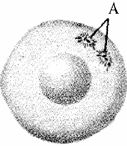
A
Centrioles,Interphase
B
Centromere,Prophase
C
Centrioles,Prophase
D
Centromere,Interphase
Solution
(C) In the provided image,the structure labeled as $A$ represents the centrioles.
During the prophase of mitosis,the centrioles,which duplicated during the $S$-phase of interphase,begin to move towards opposite poles of the cell.
Therefore,the structure is centrioles and the phase is prophase.
During the prophase of mitosis,the centrioles,which duplicated during the $S$-phase of interphase,begin to move towards opposite poles of the cell.
Therefore,the structure is centrioles and the phase is prophase.
0 likes
View Solution189
MediumMCQ
Which stage is represented by the given figure?
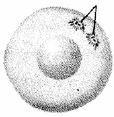
A
Early Prophase
B
Late Prophase
C
Interphase
D
Telophase
Solution
(A) The figure shows a cell where the centrosomes have duplicated and are beginning to move towards opposite poles of the cell. This is a characteristic feature of the early prophase stage of mitosis. In early prophase,the chromatin condenses into compact mitotic chromosomes,and the centrosomes,which underwent duplication during the $S$-phase of interphase,begin to move towards opposite poles. Therefore,the correct option is $A$.
0 likes
View Solution190
EasyMCQ
Which stage of cell division is shown in the given figure?
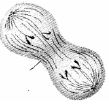
A
Anaphase
B
Telophase
C
Interphase
D
Metaphase
Solution
(A) The figure shows the chromosomes being pulled apart towards the opposite poles of the cell by spindle fibers. This characteristic movement of sister chromatids (now daughter chromosomes) away from the equatorial plate towards the poles is the defining feature of Anaphase. Therefore,the correct stage is Anaphase.
0 likes
View Solution191
MediumMCQ
Which stage is represented by the given figure?
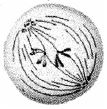
A
Interphase
B
Metaphase
C
Early Prophase
D
Anaphase
Solution
(D) The figure shows chromosomes being pulled towards opposite poles of the cell by spindle fibers. This characteristic movement of sister chromatids (now daughter chromosomes) separating and moving towards opposite poles is the defining feature of $Anaphase$ in mitosis.
0 likes
View Solution192
MediumMCQ
What happens during the metaphase stage of mitosis?
A
Crossing over occurs.
B
Chromosomes divide.
C
Chromosomes become thread-like and condense.
D
Chromosomes split into chromatids and align at the equator.
Solution
(D) During the $Metaphase$ stage of mitosis,the following events occur:
$1$. The nuclear envelope completely disintegrates.
$2$. The chromosomes are fully condensed and become clearly visible under a microscope.
$3$. The spindle fibers attach to the $Kinetochores$ of the chromosomes.
$4$. The chromosomes align themselves at the equatorial plate (metaphase plate) of the cell.
Therefore,option $D$ is the correct description of the events during metaphase.
$1$. The nuclear envelope completely disintegrates.
$2$. The chromosomes are fully condensed and become clearly visible under a microscope.
$3$. The spindle fibers attach to the $Kinetochores$ of the chromosomes.
$4$. The chromosomes align themselves at the equatorial plate (metaphase plate) of the cell.
Therefore,option $D$ is the correct description of the events during metaphase.
0 likes
View Solution193
EasyMCQ
If you are provided with a root tip of an onion in your class and asked to count the chromosomes,which of the following stages would be most suitable for observing the chromosomes?
A
Anaphase
B
Prophase
C
Metaphase
D
Telophase
Solution
(C) The $Metaphase$ stage of mitosis is the most suitable for observing chromosomes.
During $Metaphase$,chromosomes align at the equatorial plate (metaphase plate).
At this stage,chromosomes are at their most condensed and compact state,making them clearly visible and easy to count under a microscope.
During $Metaphase$,chromosomes align at the equatorial plate (metaphase plate).
At this stage,chromosomes are at their most condensed and compact state,making them clearly visible and easy to count under a microscope.
0 likes
View Solution194
EasyMCQ
At which region do the spindle fibers attach to the chromosome?
A
Centrosome
B
Chromatid
C
Centriole
D
Kinetochore
Solution
(D) During cell division,spindle fibers attach to the chromosomes at a disc-shaped structure present on the surface of the centromere,known as the kinetochore.
These kinetochores serve as the sites of attachment for spindle fibers to the chromosomes,which helps in the movement of chromosomes towards the poles during anaphase.
These kinetochores serve as the sites of attachment for spindle fibers to the chromosomes,which helps in the movement of chromosomes towards the poles during anaphase.
0 likes
View Solution195
EasyMCQ
In which stage of cell division do the chromosomes align at the equator?
A
Prophase
B
Metaphase
C
Anaphase
D
Telophase
Solution
(B) During $Metaphase$,the chromosomes condense and align themselves at the equatorial plate (also known as the metaphase plate) of the cell. This alignment is facilitated by the spindle fibers attached to the kinetochores of the chromosomes.
0 likes
View Solution196
EasyMCQ
During cell division,the site where spindle fibers attach to the chromosomes is called:
A
Chromocenter
B
Kinetochore
C
Centriole
D
Chromomere
Solution
(B) During cell division,specifically in the metaphase stage,spindle fibers attach to the chromosomes at a disc-shaped structure known as the $Kinetochore$.
This structure is located on the surface of the centromere.
It acts as the attachment point for microtubules,which pull the sister chromatids apart during anaphase.
This structure is located on the surface of the centromere.
It acts as the attachment point for microtubules,which pull the sister chromatids apart during anaphase.
0 likes
View Solution197
EasyMCQ
During mitosis,when does the endoplasmic reticulum and nucleolus begin to disappear?
A
Late Prophase
B
Metaphase
C
Anaphase
D
Early Prophase
Solution
(A) Mitosis begins with the $Prophase$ stage.
During the early $Prophase$,the chromatin material condenses to form compact mitotic chromosomes.
As the cell progresses into the late $Prophase$,the $Endoplasmic Reticulum$ $(ER)$,$Golgi$ complex,and $Nucleolus$ begin to disappear.
By the end of $Prophase$,these structures are completely absent,marking the transition to $Metaphase$.
During the early $Prophase$,the chromatin material condenses to form compact mitotic chromosomes.
As the cell progresses into the late $Prophase$,the $Endoplasmic Reticulum$ $(ER)$,$Golgi$ complex,and $Nucleolus$ begin to disappear.
By the end of $Prophase$,these structures are completely absent,marking the transition to $Metaphase$.
0 likes
View Solution198
EasyMCQ
During metaphase,chromosomes are attached to spindle fibers by which of the following structures?
A
Satellites
B
Secondary constrictions
C
Kinetochores
D
Centromere
Solution
(C) During the metaphase stage of cell division,the spindle fibers attach to the chromosomes at specific disc-shaped structures present on the surface of the centromeres,known as $Kinetochores$.
These structures serve as the site of attachment for spindle fibers to the chromosomes,facilitating their movement and alignment at the metaphase plate.
These structures serve as the site of attachment for spindle fibers to the chromosomes,facilitating their movement and alignment at the metaphase plate.
0 likes
View Solution199
MediumMCQ
In which stage of meiosis do the two cells have single-stranded chromatids at their equatorial plane?
A
Anaphase-$I$
B
Anaphase-$II$
C
Metaphase-$I$
D
Metaphase-$II$
Solution
(D) In $Metaphase-II$, the chromosomes align at the equatorial plane. Each chromosome consists of two sister chromatids held together at the centromere. However, the question refers to the state where the chromatids are single-stranded at the equator. This specifically occurs during $Metaphase-II$ where the individual chromosomes (each consisting of two chromatids) are arranged on the equatorial plate. In $Metaphase-I$, homologous pairs are arranged. Therefore, $Metaphase-II$ is the correct stage where individual chromosomes align at the equator.
0 likes
View Solution200
MediumMCQ
$P -$ Statement: Small disc-shaped structures called kinetochores are present on the surface of centromeres.
$Q -$ Statement: Spindle fibers attach to the centromeres of chromosomes.
$Q -$ Statement: Spindle fibers attach to the centromeres of chromosomes.
A
Both statements $P$ and $Q$ are correct,and statement $P$ is the correct explanation of statement $Q$.
B
Both statements $P$ and $Q$ are incorrect.
C
Statement $P$ is incorrect. Statement $Q$ is correct.
D
Both statements $P$ and $Q$ are correct.
Solution
(D) Statement $P$ is correct because kinetochores are indeed disc-shaped protein structures located on the centromeres of chromosomes where spindle fibers attach during cell division.
Statement $Q$ is technically correct in the context of general biology,as spindle fibers attach to the kinetochores which are located on the centromeres. Therefore,the attachment is mediated by the kinetochore on the centromere.
Since both statements are factually accurate and describe the mechanism of chromosome movement during mitosis,the correct option is $D$.
Statement $Q$ is technically correct in the context of general biology,as spindle fibers attach to the kinetochores which are located on the centromeres. Therefore,the attachment is mediated by the kinetochore on the centromere.
Since both statements are factually accurate and describe the mechanism of chromosome movement during mitosis,the correct option is $D$.
0 likes
View SolutionCell Cycle and Cell Division — M Phase · Frequently Asked Questions
1Are these Cell Cycle and Cell Division questions useful for JEE and NEET?
Yes. All questions in this section are mapped to JEE Main and NEET exam patterns. Previous year questions from JEE Main, NEET, GUJCET and state-level exams are included with full solutions.
2Can I switch to Hindi or Gujarati for these questions?
Yes. Use the language tabs in the hero section or the sidebar to view the same questions and solutions in English, Hindi or Gujarati.
3How do I generate a question paper from this subtopic?
Use the Vedclass Exam Paper Generator — select the chapter and subtopic, set difficulty, and generate Sets A, B, C, D automatically. First 3 chapters of every subject are free.
Vedclass Products
For Students
Vedclass Test Series
Mock tests in real JEE/NEET style with performance analysis. 5-day free trial.
Start Free TrialFor Teachers
Exam Paper Generator
Generate Set A/B/C/D papers from this chapter in 2 minutes. 3 chapters free.
Try FreeFor Institutes
Online Exam Module
Live online exams with unlimited students, 360° analytics & white-label branding.
See DemoFor Teachers & Institutes
Generate a Cell Cycle and Cell Division Exam Paper in 2 Minutes
Select subtopic & difficulty — Sets A, B, C, D auto-generated with No Repeat logic.
First 3 chapters of every subject are free — no payment required.