
A English
M Phase Questions in English
Class 11 Biology · Cell Cycle and Cell Division · M Phase
360+
Questions
English
Language
100%
With Solutions
Showing 49 of 360 questions in English
251
MediumMCQ
What stage occurs before the cell enters mitosis?
A
$G_1$
B
$G_2$
C
$S$
D
Prophase
Solution
(B) The cell cycle consists of two main phases: Interphase and $M$-phase (Mitosis).
Interphase is further divided into three stages: $G_1$ phase,$S$ phase,and $G_2$ phase.
$G_1$ phase is the first growth phase,$S$ phase is the synthesis phase where $DNA$ replication occurs,and $G_2$ phase is the second growth phase.
The $G_2$ phase is the final stage of interphase,which occurs immediately before the cell enters the $M$-phase (mitosis).
Therefore,the stage before the cell enters mitosis is the $G_2$ phase.
Interphase is further divided into three stages: $G_1$ phase,$S$ phase,and $G_2$ phase.
$G_1$ phase is the first growth phase,$S$ phase is the synthesis phase where $DNA$ replication occurs,and $G_2$ phase is the second growth phase.
The $G_2$ phase is the final stage of interphase,which occurs immediately before the cell enters the $M$-phase (mitosis).
Therefore,the stage before the cell enters mitosis is the $G_2$ phase.
0 likes
View Solution252
MediumMCQ
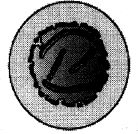
Identify the phase of mitosis shown in the figure.
A
Metaphase
B
Telophase
C
Late prophase
D
Interphase $(G_1)$
Solution
(C) The figure shows a cell where the nuclear envelope is beginning to disintegrate,and the chromatin is condensing into distinct,visible chromosomes. This is characteristic of the late prophase stage of mitosis. In prophase,the chromosomal material condenses to form compact mitotic chromosomes,and the nucleolus and nuclear envelope disappear.
0 likes
View Solution253
MediumMCQ
Choose the correct sentences for $telophase$.
$1.$ Chromosomes are arranged at the equator.
$2.$ Formation of nuclear membrane.
$3.$ At the end of this phase,nuclear membrane,Golgi complex,and endoplasmic reticulum are reformed.
$4.$ End of contraction of chromosome.
$5.$ This phase starts with chromosomes according to their vertical contraction.
$1.$ Chromosomes are arranged at the equator.
$2.$ Formation of nuclear membrane.
$3.$ At the end of this phase,nuclear membrane,Golgi complex,and endoplasmic reticulum are reformed.
$4.$ End of contraction of chromosome.
$5.$ This phase starts with chromosomes according to their vertical contraction.
A
$1, 2$
B
$2, 3$
C
$4, 5$
D
$2, 4$
Solution
(D) $Telophase$ is the final stage of mitosis.
$1.$ Chromosomes are arranged at the equator during $metaphase$,not $telophase$.
$2.$ During $telophase$,the nuclear envelope reforms around the chromosome clusters at each pole.
$3.$ At the end of $telophase$,the nucleolus,Golgi complex,and endoplasmic reticulum reform.
$4.$ The chromosomes decondense (end of contraction) and lose their individuality.
$5.$ The condensation of chromosomes occurs during $prophase$,not $telophase$.
Therefore,statements $2, 3,$ and $4$ are correct. Since the option $2, 4$ is provided as the best fit among the choices,it is the correct answer.
$1.$ Chromosomes are arranged at the equator during $metaphase$,not $telophase$.
$2.$ During $telophase$,the nuclear envelope reforms around the chromosome clusters at each pole.
$3.$ At the end of $telophase$,the nucleolus,Golgi complex,and endoplasmic reticulum reform.
$4.$ The chromosomes decondense (end of contraction) and lose their individuality.
$5.$ The condensation of chromosomes occurs during $prophase$,not $telophase$.
Therefore,statements $2, 3,$ and $4$ are correct. Since the option $2, 4$ is provided as the best fit among the choices,it is the correct answer.
0 likes
View Solution254
MediumMCQ
Choose the correct statement regarding mitosis.
A
Chromatids move to opposite poles in telophase.
B
Golgi complex and endoplasmic reticulum can be seen in anaphase.
C
In metaphase,spindle fibers are attached to kinetochores.
D
Chromatids are differentiated in anaphase but are present in the center of the cell.
Solution
(C) In mitosis,the process of cell division involves specific stages:
$1$. During $Metaphase$,the chromosomes align at the equatorial plate,and the spindle fibers from the poles attach to the $Kinetochores$ of the chromosomes.
$2$. In $Anaphase$,the centromeres split,and the chromatids (now daughter chromosomes) move toward opposite poles.
$3$. $Telophase$ is characterized by the reformation of the nuclear envelope and the disappearance of the spindle apparatus.
$4$. Golgi complex and endoplasmic reticulum typically reform during $Telophase$,not $Anaphase$.
Therefore,the correct statement is that in $Metaphase$,spindle fibers are attached to kinetochores.
$1$. During $Metaphase$,the chromosomes align at the equatorial plate,and the spindle fibers from the poles attach to the $Kinetochores$ of the chromosomes.
$2$. In $Anaphase$,the centromeres split,and the chromatids (now daughter chromosomes) move toward opposite poles.
$3$. $Telophase$ is characterized by the reformation of the nuclear envelope and the disappearance of the spindle apparatus.
$4$. Golgi complex and endoplasmic reticulum typically reform during $Telophase$,not $Anaphase$.
Therefore,the correct statement is that in $Metaphase$,spindle fibers are attached to kinetochores.
0 likes
View Solution255
MediumMCQ
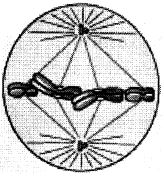
The following is true for the given figure,except that,
A
Kinetochore of chromosome attached with spindle fiber.
B
The cells become centrally located around chromosomes.
C
Chromosomes are arranged on equator plate.
D
Morphology of chromosomes is most easily studied.
Solution
(B) The given figure represents the metaphase stage of mitosis.
During metaphase,the following events occur:
$1$. The spindle fibers attach to the kinetochores of the chromosomes.
$2$. The chromosomes align themselves at the equator plate (metaphase plate).
$3$. This stage is the best stage to study the morphology of chromosomes.
Option $B$ states that 'The cells become centrally located around chromosomes',which is scientifically incorrect. In reality,the chromosomes align at the equatorial plane of the cell.
During metaphase,the following events occur:
$1$. The spindle fibers attach to the kinetochores of the chromosomes.
$2$. The chromosomes align themselves at the equator plate (metaphase plate).
$3$. This stage is the best stage to study the morphology of chromosomes.
Option $B$ states that 'The cells become centrally located around chromosomes',which is scientifically incorrect. In reality,the chromosomes align at the equatorial plane of the cell.
0 likes
View Solution256
MediumMCQ
Why are chromosomes extended in the cytoplasm during metaphase?
A
Nuclear envelope
B
Nucleolus develops
C
Cytoplasm develops
D
Nuclear envelope disappearance
Solution
(D) During the process of cell division,specifically at the end of prophase and the beginning of metaphase,the nuclear envelope undergoes disintegration or disappearance. This event allows the chromosomes,which have condensed,to be released from the nucleus and spread out into the cytoplasm,where they can then align at the metaphase plate.
0 likes
View Solution257
MediumMCQ
The $M-$phase of the cell cycle involves....
A
$G_1, S$ and $G_2$ phase
B
Prophase,metaphase,anaphase,telophase
C
Interphase,prophase,metaphase,anaphase,telophase
D
Only prophase
Solution
(B) The cell cycle is divided into two main phases: Interphase and the $M-$phase (Mitotic phase).
Interphase consists of $G_1, S,$ and $G_2$ phases.
The $M-$phase represents the period of actual cell division.
It involves nuclear division (karyokinesis) and cytoplasmic division (cytokinesis).
Nuclear division is further divided into four stages: Prophase,Metaphase,Anaphase,and Telophase.
Therefore,the $M-$phase involves these four stages.
Interphase consists of $G_1, S,$ and $G_2$ phases.
The $M-$phase represents the period of actual cell division.
It involves nuclear division (karyokinesis) and cytoplasmic division (cytokinesis).
Nuclear division is further divided into four stages: Prophase,Metaphase,Anaphase,and Telophase.
Therefore,the $M-$phase involves these four stages.
0 likes
View Solution258
MediumMCQ
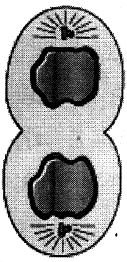
Identify the given figure.
A
Metaphase
B
Telophase
C
Late prophase
D
Interphase,$G_1$
Solution
(B) The provided figure shows a cell in the final stage of mitosis,known as telophase.
Key features observed in the image include:
$1$. Two distinct daughter nuclei are formed at opposite poles of the cell.
$2$. The chromosomes have reached the poles and are beginning to decondense.
$3$. The nuclear envelope is reforming around each set of chromosomes.
$4$. The cell is undergoing cytokinesis (cleavage furrow formation),which typically begins during late anaphase or telophase.
Key features observed in the image include:
$1$. Two distinct daughter nuclei are formed at opposite poles of the cell.
$2$. The chromosomes have reached the poles and are beginning to decondense.
$3$. The nuclear envelope is reforming around each set of chromosomes.
$4$. The cell is undergoing cytokinesis (cleavage furrow formation),which typically begins during late anaphase or telophase.
0 likes
View Solution259
MediumMCQ
In the $24$ hour average duration of the cell cycle of a human cell,how long does the cell division proper ($M$ phase) last?
A
Cell division proper lasts for only $6$ hours.
B
Cell division proper lasts for only $8$ hours.
C
Cell division proper lasts for only $1$ hour.
D
Cell division proper lasts for more than $1$ hour.
Solution
(C) The cell cycle in human cells is typically completed in about $24$ hours.
This cycle is divided into two main phases: Interphase and $M$ phase (Mitosis/Meiosis).
Interphase is the preparatory phase which lasts for about $23$ hours.
The $M$ phase,or cell division proper,is a relatively short phase that lasts for approximately $1$ hour.
Therefore,the correct duration for cell division proper is $1$ hour.
This cycle is divided into two main phases: Interphase and $M$ phase (Mitosis/Meiosis).
Interphase is the preparatory phase which lasts for about $23$ hours.
The $M$ phase,or cell division proper,is a relatively short phase that lasts for approximately $1$ hour.
Therefore,the correct duration for cell division proper is $1$ hour.
0 likes
View Solution260
MediumMCQ
How does anaphase differ from metaphase in mitosis?
A
The number of chromosomes is the same and the number of chromatids is the same.
B
The number of chromosomes is halved and the number of chromatids is halved.
C
The number of chromosomes is halved and the number of chromatids is the same.
D
The number of chromosomes is the same and the number of chromatids is halved.
Solution
(D) In $metaphase$, each chromosome consists of two sister chromatids attached at the centromere. Therefore, if a cell has $2n$ chromosomes, it contains $4n$ chromatids.
In $anaphase$, the centromeres split, and the sister chromatids separate. These separated chromatids are now considered individual chromosomes.
As a result, the number of chromosomes doubles (becomes $4n$) while the number of chromatids per chromosome becomes $1$, effectively halving the total number of chromatids per chromosome compared to the metaphase state, or more accurately, the chromatids are now independent chromosomes.
In $anaphase$, the centromeres split, and the sister chromatids separate. These separated chromatids are now considered individual chromosomes.
As a result, the number of chromosomes doubles (becomes $4n$) while the number of chromatids per chromosome becomes $1$, effectively halving the total number of chromatids per chromosome compared to the metaphase state, or more accurately, the chromatids are now independent chromosomes.
0 likes
View Solution261
EasyMCQ
Which is the best stage to observe the number, size, and shape of chromosomes?
A
Interphase
B
Metaphase
C
Prophase
D
Telophase
Solution
(B) During $Metaphase$, chromosomes are highly condensed and align at the equatorial plate of the cell. This stage provides the clearest view of the chromosome structure, allowing for the accurate observation of their number, size, and morphology (shape). Therefore, $Metaphase$ is considered the best stage for karyotyping and chromosomal analysis.
0 likes
View Solution262
EasyMCQ
Which structure is generally not observed in the dividing cells of higher plants?
A
Cell plate
B
Centriole
C
Centromere
D
Spindle fibers
Solution
(B) In higher plants,cell division occurs without the presence of centrioles.
Centrioles are characteristic of animal cells and some lower plant groups (like certain algae and bryophytes).
During mitosis in higher plants,the spindle apparatus is formed by microtubules organized by microtubule-organizing centers (MTOCs) that lack centrioles.
Cell plates are formed during cytokinesis,centromeres are present on chromosomes,and spindle fibers are essential for chromosome movement,all of which are observed in higher plants.
Centrioles are characteristic of animal cells and some lower plant groups (like certain algae and bryophytes).
During mitosis in higher plants,the spindle apparatus is formed by microtubules organized by microtubule-organizing centers (MTOCs) that lack centrioles.
Cell plates are formed during cytokinesis,centromeres are present on chromosomes,and spindle fibers are essential for chromosome movement,all of which are observed in higher plants.
0 likes
View Solution263
MediumMCQ
During cell division,the nuclear envelope reforms at which stage?
A
Metaphase
B
Anaphase
C
Telophase
D
Cytokinesis
Solution
(C) During the process of mitosis,the $Telophase$ stage is characterized by the reformation of the nuclear envelope around the daughter chromosomes at each pole. The nucleolus,Golgi complex,and endoplasmic reticulum also reform during this stage. Therefore,the correct option is $C$.
0 likes
View Solution264
EasyMCQ
During cell division,what is the structure called where spindle fibers attach to the chromosomes?
A
Chromocenter
B
Kinetochore
C
Centriole
D
Chromomere
Solution
(B) During cell division,the spindle fibers attach to the chromosomes at a specific disc-shaped protein structure located on the centromere known as the $Kinetochore$.
These structures are essential for the proper alignment and segregation of chromosomes during mitosis and meiosis.
These structures are essential for the proper alignment and segregation of chromosomes during mitosis and meiosis.
0 likes
View Solution265
MediumMCQ
What happens if a diploid cell is treated with colchicine?
A
Triploid
B
Tetraploid
C
Diploid
D
Haploid
Solution
(B) Colchicine is a chemical agent that inhibits the formation of the spindle apparatus during cell division by binding to tubulin proteins.
When a diploid cell $(2n)$ undergoes mitosis in the presence of colchicine,the chromosomes replicate,but the spindle fibers fail to form,preventing the separation of sister chromatids.
As a result,the cell fails to divide,and the chromosome number doubles within the same nucleus,leading to a tetraploid $(4n)$ state.
When a diploid cell $(2n)$ undergoes mitosis in the presence of colchicine,the chromosomes replicate,but the spindle fibers fail to form,preventing the separation of sister chromatids.
As a result,the cell fails to divide,and the chromosome number doubles within the same nucleus,leading to a tetraploid $(4n)$ state.
0 likes
View Solution266
EasyMCQ
Spindle fibers are primarily composed of which protein?
A
Actin
B
Myosin
C
Tubulin
D
Myoglobin
Solution
(C) Spindle fibers are essential structures formed during cell division (mitosis and meiosis) to separate chromosomes. These fibers are composed of microtubules. Microtubules are dynamic polymers made primarily of the protein $Tubulin$ (specifically $\alpha$-tubulin and $\beta$-tubulin dimers). Therefore, the correct answer is $C$.
0 likes
View Solution267
MediumMCQ
Which of the following events is associated with the formation of the nuclear envelope during the $M$ phase of the cell cycle?
A
The nuclear envelope forms as chromosomes decondense.
B
Transcription occurs from chromosomes and the nuclear envelope forms.
C
$A$ contractile ring forms and a phragmoplast is created.
D
$A$ contractile ring forms and transcription occurs from chromosomes.
Solution
(A) During the $M$ phase,specifically at the end of telophase,the nuclear envelope reforms around the daughter chromosomes. This process is initiated as the chromosomes begin to decondense (lose their condensed state) and become chromatin again. The nuclear lamina and nuclear pore complexes assemble to enclose the genetic material,effectively reforming the nuclear envelope.
0 likes
View Solution268
MediumMCQ
If you are provided with root tips of an onion and are asked to count the chromosomes,which stage of mitosis would you look for?
A
Metaphase
B
Telophase
C
Anaphase
D
Prophase
Solution
(A) To count the number of chromosomes in a cell,the best stage is $Metaphase$.
During $Metaphase$,the chromosomes align at the equatorial plate (metaphase plate) of the cell.
At this stage,the chromosomes are most condensed,clearly visible,and distinct,making it the ideal phase for morphological study and counting of chromosomes.
During $Metaphase$,the chromosomes align at the equatorial plate (metaphase plate) of the cell.
At this stage,the chromosomes are most condensed,clearly visible,and distinct,making it the ideal phase for morphological study and counting of chromosomes.
0 likes
View Solution269
MediumMCQ
In a eukaryotic cell,during which phase does the synthesis of histone proteins occur?
A
During the $G_2$ phase of interphase
B
During the $S$ phase
C
During the entire interphase
D
During the $M$ phase
Solution
(B) In eukaryotic cells,$DNA$ replication occurs during the $S$ phase (Synthesis phase) of the cell cycle.
Since histone proteins are essential for packaging the newly synthesized $DNA$ into chromatin,their synthesis is tightly coupled with $DNA$ replication.
Therefore,the synthesis of histone proteins occurs primarily during the $S$ phase of the cell cycle.
Since histone proteins are essential for packaging the newly synthesized $DNA$ into chromatin,their synthesis is tightly coupled with $DNA$ replication.
Therefore,the synthesis of histone proteins occurs primarily during the $S$ phase of the cell cycle.
0 likes
View Solution270
MediumMCQ
The centromere is required for ..............
A
Movement of chromosomes towards poles
B
Cytoplasmic cleavage
C
Crossing over
D
Transcription
Solution
(A) The centromere is a specialized $DNA$ sequence of a chromosome that links a pair of sister chromatids. During cell division,the spindle fibers attach to the kinetochore,which is a protein complex assembled on the centromere. This attachment is essential for the movement of chromosomes towards the opposite poles during the anaphase stage of mitosis and meiosis.
0 likes
View Solution271
MediumMCQ
The space is found between which of the following?
A
$m-RNA$ and ribosomes
B
Spindle fibers and centromere
C
Two homologous chromosomes
D
Male and female gametes
Solution
(B) The question refers to the kinetochore,which is a proteinaceous structure found on the centromere of chromosomes.
During cell division,spindle fibers attach to the kinetochore.
Therefore,the physical interaction or space where the attachment occurs is between the spindle fibers and the centromere (specifically the kinetochore region).
During cell division,spindle fibers attach to the kinetochore.
Therefore,the physical interaction or space where the attachment occurs is between the spindle fibers and the centromere (specifically the kinetochore region).
0 likes
View Solution272
MediumMCQ
During mitosis,the $ER$ and nucleolus begin to disappear during . . . . . . .
A
Late prophase
B
Metaphase
C
Anaphase
D
Early prophase
Solution
(A) During the process of mitosis,the first stage is prophase.
Prophase is characterized by the initiation of condensation of chromosomal material.
During the late prophase,the nuclear envelope,nucleolus,Golgi complex,and endoplasmic reticulum $(ER)$ begin to disappear as the cell prepares for the alignment of chromosomes.
Prophase is characterized by the initiation of condensation of chromosomal material.
During the late prophase,the nuclear envelope,nucleolus,Golgi complex,and endoplasmic reticulum $(ER)$ begin to disappear as the cell prepares for the alignment of chromosomes.
0 likes
View Solution273
MediumMCQ
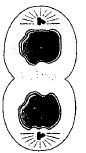
The figure shows a stage of cell division. Identify the correct stage and its characteristic feature.
A
Telophase - Endoplasmic reticulum and nucleolus have not yet reformed.
B
Telophase - Re-formation of nuclear envelope and Golgi complex.
C
Anaphase - Chromosomes move away from the equatorial region,Golgi complex is absent.
D
Cytokinesis - Cell plate formation,mitochondria distributed into two daughter cells.
Solution
(B) The provided image shows two distinct nuclei at opposite poles of the cell,which is the characteristic feature of Telophase. During Telophase,the chromosomes cluster at opposite spindle poles and their identity is lost as discrete elements. The nuclear envelope assembles around the chromosome clusters. Nucleolus,Golgi complex,and Endoplasmic Reticulum reform.
0 likes
View Solution274
EasyMCQ
During cell growth,where does $DNA$ synthesis occur?
A
$G_2$ phase
B
$M$ phase
C
$S$ phase
D
$G_1$ phase
Solution
(C) The cell cycle is divided into two main phases: Interphase and $M$ phase (Mitosis).
Interphase is further divided into three sub-phases: $G_1$ phase,$S$ phase,and $G_2$ phase.
During the $S$ phase (Synthesis phase),the replication of $DNA$ takes place.
In this phase,the amount of $DNA$ per cell doubles,although the chromosome number remains the same.
Interphase is further divided into three sub-phases: $G_1$ phase,$S$ phase,and $G_2$ phase.
During the $S$ phase (Synthesis phase),the replication of $DNA$ takes place.
In this phase,the amount of $DNA$ per cell doubles,although the chromosome number remains the same.
0 likes
View Solution275
MediumMCQ
Which checkpoint must be activated when $DNA$ replication is incomplete in a cell?
A
$M$
B
Both $G_2/M$ and $M$
C
$G_1/S$
D
$G_2/M$
Solution
(D) The cell cycle is regulated by specific checkpoints that ensure the fidelity of cell division.
$G_1/S$ checkpoint checks for cell size,nutrients,and $DNA$ damage before replication.
$G_2/M$ checkpoint ensures that $DNA$ replication is complete and accurate before the cell enters mitosis.
If $DNA$ replication is incomplete,the $G_2/M$ checkpoint is activated to halt the cycle and prevent the cell from entering the $M$ phase,thereby preventing the formation of daughter cells with damaged or incomplete genetic material.
$G_1/S$ checkpoint checks for cell size,nutrients,and $DNA$ damage before replication.
$G_2/M$ checkpoint ensures that $DNA$ replication is complete and accurate before the cell enters mitosis.
If $DNA$ replication is incomplete,the $G_2/M$ checkpoint is activated to halt the cycle and prevent the cell from entering the $M$ phase,thereby preventing the formation of daughter cells with damaged or incomplete genetic material.
0 likes
View Solution276
EasyMCQ
Spindle fibers attach to the .......... of the chromosome.
A
Kinetochore of the chromosome
B
Centromere of the chromosome
C
Kinetosome of the chromosome
D
Telomere of the chromosome
Solution
(A) During the process of cell division,specifically in metaphase,the spindle fibers (microtubules) attach to the kinetochores.
Kinetochores are complex protein structures that assemble on the centromere of each sister chromatid.
They serve as the site of attachment for spindle fibers,which pull the sister chromatids apart toward opposite poles during anaphase.
Therefore,the correct answer is the kinetochore.
Kinetochores are complex protein structures that assemble on the centromere of each sister chromatid.
They serve as the site of attachment for spindle fibers,which pull the sister chromatids apart toward opposite poles during anaphase.
Therefore,the correct answer is the kinetochore.
0 likes
View Solution277
EasyMCQ
Which one of the following precedes the reformation of the nuclear envelope during the $M-$phase of the cell cycle?
A
Decondensation of chromosomes and reassembly of the nuclear lamina
B
Transcription from chromosomes and reassembly of the nuclear lamina
C
Formation of the contractile ring and formation of the phragmoplast
D
Formation of the contractile ring and transcription from chromosomes
Solution
(A) During the $M-$phase of the cell cycle,specifically during telophase,the nuclear envelope begins to reform around the daughter chromosomes.
Before this reformation,the chromosomes,which were highly condensed during metaphase and anaphase,must undergo decondensation to return to their chromatin state.
Simultaneously,the nuclear lamina,which is a dense fibrillar network inside the nucleus,must reassemble to provide structural support to the newly forming nuclear envelope.
Therefore,the decondensation of chromosomes and the reassembly of the nuclear lamina are the critical events that precede the reformation of the nuclear envelope.
Before this reformation,the chromosomes,which were highly condensed during metaphase and anaphase,must undergo decondensation to return to their chromatin state.
Simultaneously,the nuclear lamina,which is a dense fibrillar network inside the nucleus,must reassemble to provide structural support to the newly forming nuclear envelope.
Therefore,the decondensation of chromosomes and the reassembly of the nuclear lamina are the critical events that precede the reformation of the nuclear envelope.
0 likes
View Solution278
MediumMCQ
Describe the changes observed during the synthesis phase ($S$-phase).
A
$DNA$ replication occurs.
B
$DNA$ content doubles.
C
Chromosome number remains the same.
D
All of the above.
Solution
(D) During the $S$-phase (synthesis phase),the following events occur:
$1$. $DNA$ replication takes place,leading to the doubling of the amount of $DNA$ per cell.
$2$. If the initial amount of $DNA$ is $2C$,it increases to $4C$.
$3$. However,the number of chromosomes does not increase. If the cell had $2n$ chromosomes at the $G_1$ phase,the number of chromosomes remains $2n$ at the end of the $S$-phase.
$4$. Histone proteins are synthesized to package the newly replicated $DNA$.
$5$. In animal cells,the centriole duplicates in the cytoplasm alongside $DNA$ replication.
$1$. $DNA$ replication takes place,leading to the doubling of the amount of $DNA$ per cell.
$2$. If the initial amount of $DNA$ is $2C$,it increases to $4C$.
$3$. However,the number of chromosomes does not increase. If the cell had $2n$ chromosomes at the $G_1$ phase,the number of chromosomes remains $2n$ at the end of the $S$-phase.
$4$. Histone proteins are synthesized to package the newly replicated $DNA$.
$5$. In animal cells,the centriole duplicates in the cytoplasm alongside $DNA$ replication.
0 likes
View Solution279
Medium
Explain $G_{2}$ phase in short.
Solution
(N/A) $\Rightarrow$ During the $G_{2}$ phase,the cell continues to grow and prepares for mitosis by synthesizing necessary proteins.
$\Rightarrow$ $DNA$ replication does not occur in this phase,but the synthesis of $RNA$ and proteins continues.
$\Rightarrow$ Microtubules are formed,which are essential for the formation of the mitotic spindle during cell division.
$\Rightarrow$ $DNA$ replication does not occur in this phase,but the synthesis of $RNA$ and proteins continues.
$\Rightarrow$ Microtubules are formed,which are essential for the formation of the mitotic spindle during cell division.
0 likes
View Solution280
Medium
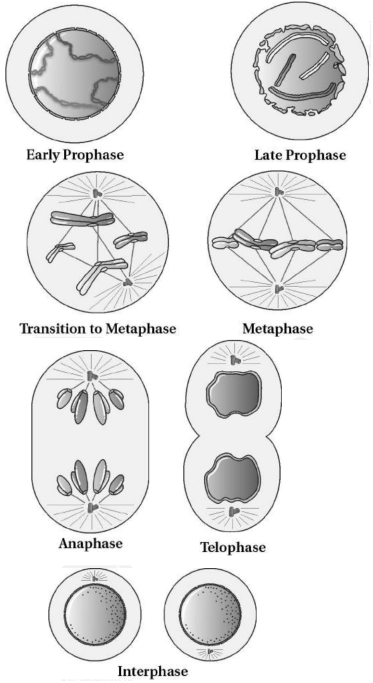
Describe the various phases of mitosis in detail with a diagram.
Solution
(N/A) Mitosis is a process of cell division where a single cell divides into two identical daughter cells. It consists of two main events: Karyokinesis (nuclear division) and Cytokinesis (cytoplasmic division).
$1$. Karyokinesis:
It is divided into four main stages:
$(a)$ Prophase: This is the first stage. Chromatin material condenses into compact mitotic chromosomes. Centrioles move to opposite poles. The nucleolus,Golgi bodies,$ER$,and nuclear envelope disappear.
$(b)$ Metaphase: The nuclear envelope completely disintegrates. Chromosomes align at the equator,forming the metaphase plate. Spindle fibers attach to the kinetochores of chromosomes.
$(c)$ Anaphase: Centromeres split,and sister chromatids separate. These daughter chromatids move towards opposite poles,with the centromere leading and arms trailing.
$(d)$ Telophase: Chromosomes reach the poles and decondense. The nuclear envelope,nucleolus,Golgi complex,and $ER$ reform around the chromosome clusters.
$2$. Cytokinesis:
This is the division of the cytoplasm.
- In animal cells: $A$ cleavage furrow forms in the plasma membrane,which deepens to divide the cell into two.
- In plant cells: $A$ cell plate forms in the center and grows outward to meet the existing cell walls,as the cell wall is inextensible.
$1$. Karyokinesis:
It is divided into four main stages:
$(a)$ Prophase: This is the first stage. Chromatin material condenses into compact mitotic chromosomes. Centrioles move to opposite poles. The nucleolus,Golgi bodies,$ER$,and nuclear envelope disappear.
$(b)$ Metaphase: The nuclear envelope completely disintegrates. Chromosomes align at the equator,forming the metaphase plate. Spindle fibers attach to the kinetochores of chromosomes.
$(c)$ Anaphase: Centromeres split,and sister chromatids separate. These daughter chromatids move towards opposite poles,with the centromere leading and arms trailing.
$(d)$ Telophase: Chromosomes reach the poles and decondense. The nuclear envelope,nucleolus,Golgi complex,and $ER$ reform around the chromosome clusters.
$2$. Cytokinesis:
This is the division of the cytoplasm.
- In animal cells: $A$ cleavage furrow forms in the plasma membrane,which deepens to divide the cell into two.
- In plant cells: $A$ cell plate forms in the center and grows outward to meet the existing cell walls,as the cell wall is inextensible.
0 likes
View Solution281
Medium
Write a note on prophase of mitosis.
Solution
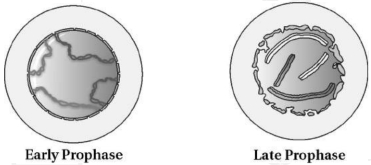
(N/A) $ \Rightarrow $ Prophase, which is the first stage of mitosis, follows the $S$ and $G_{2}$ phases of interphase.
$ \Rightarrow $ In the $S$ and $G_{2}$ phases, the new $DNA$ molecules formed are not distinct but intertwined.
$ \Rightarrow $ Prophase is marked by the initiation of condensation of chromosomal material. The chromosomal material becomes untangled during the process of chromatin condensation.
$ \Rightarrow $ The centriole, which had undergone duplication during the $S$ phase of interphase, now begins to move towards opposite poles of the cell.
$ \Rightarrow $ The completion of prophase can be marked by the following characteristic events:
$ \Rightarrow $ Chromosomal material condenses to form compact mitotic chromosomes. Chromosomes are seen to be composed of two chromatids attached together at the centromere.
$ \Rightarrow $ Initiation of the assembly of the mitotic spindle; the microtubules, the proteinaceous components of the cell cytoplasm, help in the process.
$ \Rightarrow $ Although plant cells lack centrioles, the mitotic spindle is still formed.
$ \Rightarrow $ At the end of prophase, the nucleolus, Golgi bodies, endoplasmic reticulum, and nuclear envelope are not seen.
$ \Rightarrow $ Chromosomes spread throughout the cell.
$ \Rightarrow $ In the $S$ and $G_{2}$ phases, the new $DNA$ molecules formed are not distinct but intertwined.
$ \Rightarrow $ Prophase is marked by the initiation of condensation of chromosomal material. The chromosomal material becomes untangled during the process of chromatin condensation.
$ \Rightarrow $ The centriole, which had undergone duplication during the $S$ phase of interphase, now begins to move towards opposite poles of the cell.
$ \Rightarrow $ The completion of prophase can be marked by the following characteristic events:
$ \Rightarrow $ Chromosomal material condenses to form compact mitotic chromosomes. Chromosomes are seen to be composed of two chromatids attached together at the centromere.
$ \Rightarrow $ Initiation of the assembly of the mitotic spindle; the microtubules, the proteinaceous components of the cell cytoplasm, help in the process.
$ \Rightarrow $ Although plant cells lack centrioles, the mitotic spindle is still formed.
$ \Rightarrow $ At the end of prophase, the nucleolus, Golgi bodies, endoplasmic reticulum, and nuclear envelope are not seen.
$ \Rightarrow $ Chromosomes spread throughout the cell.
0 likes
View Solution282
Medium
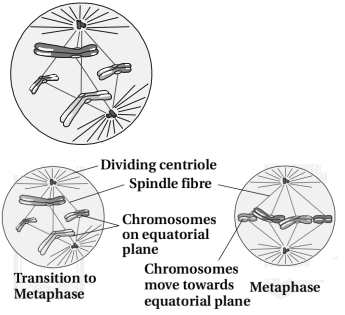
Label the diagram and also determine the stage at which this structure is visible.
Solution
(N/A) The provided diagram illustrates the transition phase from prophase to metaphase during mitosis.
In the transition phase,the chromosomes are seen moving towards the equatorial plane,guided by the spindle fibres attached to the kinetochores.
The key structures labeled are:
$1$. Dividing centriole: These move to opposite poles to form the spindle apparatus.
$2$. Spindle fibre: Microtubules that attach to the kinetochores of chromosomes.
$3$. Chromosomes on the equatorial plane: This represents the final alignment stage of metaphase.
$4$. Chromosomes moving towards the equatorial plane: This is the characteristic feature of the transition from prophase to metaphase.
In the transition phase,the chromosomes are seen moving towards the equatorial plane,guided by the spindle fibres attached to the kinetochores.
The key structures labeled are:
$1$. Dividing centriole: These move to opposite poles to form the spindle apparatus.
$2$. Spindle fibre: Microtubules that attach to the kinetochores of chromosomes.
$3$. Chromosomes on the equatorial plane: This represents the final alignment stage of metaphase.
$4$. Chromosomes moving towards the equatorial plane: This is the characteristic feature of the transition from prophase to metaphase.
0 likes
View Solution283
Medium
Comment on the statement: $Telophase$ is the reverse of $Prophase$.
Solution
(N/A) The statement that $Telophase$ is the reverse of $Prophase$ is correct because the events occurring in $Telophase$ are essentially the opposite of those in $Prophase$.
$1$. $Prophase$: During this phase,chromatin material condenses to form compact mitotic chromosomes. The nuclear envelope,nucleolus,$Golgi$ complex,and $Endoplasmic$ $Reticulum$ $(ER)$ disappear. Spindle fibers begin to assemble.
$2$. $Telophase$: This phase marks the reversal of $Prophase$ events. Chromosomes decondense and lose their individuality to form chromatin. The nuclear envelope,nucleolus,$Golgi$ complex,and $ER$ reform around the daughter chromosome clusters at the poles. Spindle fibers depolymerize and disappear.
$1$. $Prophase$: During this phase,chromatin material condenses to form compact mitotic chromosomes. The nuclear envelope,nucleolus,$Golgi$ complex,and $Endoplasmic$ $Reticulum$ $(ER)$ disappear. Spindle fibers begin to assemble.
$2$. $Telophase$: This phase marks the reversal of $Prophase$ events. Chromosomes decondense and lose their individuality to form chromatin. The nuclear envelope,nucleolus,$Golgi$ complex,and $ER$ reform around the daughter chromosome clusters at the poles. Spindle fibers depolymerize and disappear.
0 likes
View Solution284
MediumMCQ
Choose the correct option regarding the duplication of organelles during the cell cycle:
$(1)$ Mitochondria and centrioles duplicate during the $(G_0 / G_1 / G_2)$ phase of interphase.
$(1)$ Mitochondria and centrioles duplicate during the $(G_0 / G_1 / G_2)$ phase of interphase.
A
$G_0$ phase
B
$G_1$ phase
C
$G_2$ phase
D
None of the above
Solution
(C) During the cell cycle,the $G_2$ phase (Gap $2$ phase) is characterized by the synthesis of proteins and the duplication of certain organelles.
Specifically,mitochondria and centrioles undergo duplication during the $G_2$ phase to ensure that each daughter cell receives an adequate supply of these organelles after cell division.
Therefore,the correct phase is the $G_2$ phase.
Specifically,mitochondria and centrioles undergo duplication during the $G_2$ phase to ensure that each daughter cell receives an adequate supply of these organelles after cell division.
Therefore,the correct phase is the $G_2$ phase.
0 likes
View Solution285
MediumMCQ
What is reformed during telophase?
A
Nuclear envelope
B
Nucleolus
C
Golgi complex and $ER$
D
All of the above
Solution
(D) $(i)$ Chromosomes cluster at opposite spindle poles and their identity is lost as discrete elements.
$(ii)$ Nuclear envelope assembles around the chromosome clusters.
$(iii)$ Nucleolus,golgi complex and $ER$ reform.
$(ii)$ Nuclear envelope assembles around the chromosome clusters.
$(iii)$ Nucleolus,golgi complex and $ER$ reform.
0 likes
View Solution286
EasyMCQ
Attachment of spindle fibers to kinetochores of chromosomes becomes evident in
A
Metaphase
B
Anaphase
C
Telophase
D
Prophase
Solution
(A) During the $M$ phase of the cell cycle,the condensation of chromosomes is completed by the end of prophase.
In metaphase,the chromosomes align at the equatorial plate.
It is during this stage that the spindle fibers from both poles of the cell attach to the kinetochores of the chromosomes.
Therefore,the attachment of spindle fibers to kinetochores becomes clearly evident in metaphase.
In metaphase,the chromosomes align at the equatorial plate.
It is during this stage that the spindle fibers from both poles of the cell attach to the kinetochores of the chromosomes.
Therefore,the attachment of spindle fibers to kinetochores becomes clearly evident in metaphase.
0 likes
View Solution287
MediumMCQ
In which stage of cell division are chromosomes most condensed?
A
Prophase
B
Metaphase
C
Anaphase
D
Telophase
Solution
(B) During $Metaphase$,chromosomes reach their maximum level of condensation and appear shortest and thickest.
They align themselves at the equatorial plane,known as the $Metaphase$ plate.
Because of this high degree of condensation and their distinct arrangement,$Metaphase$ is the ideal stage to study the morphology,structure,size,and number of chromosomes.
They align themselves at the equatorial plane,known as the $Metaphase$ plate.
Because of this high degree of condensation and their distinct arrangement,$Metaphase$ is the ideal stage to study the morphology,structure,size,and number of chromosomes.
0 likes
View Solution288
EasyMCQ
In the cell cycle,during which phase are chromosomes arranged at the equatorial plate?
A
Metaphase
B
Anaphase
C
Telophase
D
Prophase
Solution
(A) Metaphase,in both mitosis and meiosis,is characterized by the alignment of chromosomes at the equatorial plate of the cell. During this phase,the spindle fibers attach to the kinetochores of the chromosomes,pulling them to the center of the cell,which is known as the metaphase plate or equatorial plate.
0 likes
View Solution289
MediumMCQ
Congression is a phenomenon of
A
Movement of sister chromatids towards the poles
B
Pairing of homologous chromosomes
C
Separation of paired chromosomes
D
Bringing the chromosomes on equator of spindle apparatus
Solution
(D) Congression is the process during the metaphase stage of cell division where chromosomes are aligned at the metaphase plate (equator of the spindle apparatus). This movement is facilitated by the attachment of spindle fibers to the kinetochores of the chromosomes.
0 likes
View Solution290
EasyMCQ
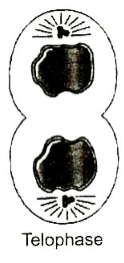
Chromosomes reach their respective poles in which of the following stages of mitosis?
A
Cytokinesis
B
Interphase
C
$S$-phase
D
Telophase
Solution
(D) At the beginning of the final stage of mitosis,i.e.,telophase,the chromosomes that have reached their respective poles decondense and lose their individuality.
The individual chromosomes can no longer be seen and chromatin material tends to collect in a mass at the two poles.
Therefore,the stage where chromosomes reach their respective poles is telophase.
The individual chromosomes can no longer be seen and chromatin material tends to collect in a mass at the two poles.
Therefore,the stage where chromosomes reach their respective poles is telophase.
0 likes
View Solution291
MediumMCQ
The major event that occurs during the $Anaphase$ of mitosis,which brings about the equal distribution of chromosomes is
A
Replication of the genetic material
B
Splitting of the chromatids
C
Splitting of the centromeres
D
Condensation of the chromatin
Solution
(C) $Anaphase$ is characterized by the splitting of the centromeres and the separation of sister chromatids.
Each chromatid,now referred to as a chromosome,moves toward the opposite poles of the cell from the equatorial plate.
This process ensures that each daughter cell receives an identical and equal set of chromosomes.
Each chromatid,now referred to as a chromosome,moves toward the opposite poles of the cell from the equatorial plate.
This process ensures that each daughter cell receives an identical and equal set of chromosomes.
0 likes
View Solution292
MediumMCQ
The complete disintegration of the nuclear envelope in a cell cycle marks the
A
Start of prophase of mitosis
B
Start of metaphase of mitosis
C
End of anaphase of mitosis
D
Start of telophase of mitosis
Solution
(B) The complete disintegration of the nuclear envelope marks the transition from prophase to metaphase.
Specifically,it signifies the start of the metaphase of mitosis.
At this stage,the chromosomes are spread through the cytoplasm of the cell.
By this stage,the condensation of chromosomes is completed,and they can be observed clearly under the microscope.
This is the stage at which the morphology of chromosomes is most easily studied.
At this stage,metaphase chromosomes are made up of two sister chromatids,which are held together by the centromere.
Specifically,it signifies the start of the metaphase of mitosis.
At this stage,the chromosomes are spread through the cytoplasm of the cell.
By this stage,the condensation of chromosomes is completed,and they can be observed clearly under the microscope.
This is the stage at which the morphology of chromosomes is most easily studied.
At this stage,metaphase chromosomes are made up of two sister chromatids,which are held together by the centromere.
0 likes
View Solution293
MediumMCQ
The plane of alignment of chromosomes at the metaphase stage of the cell cycle is referred to as the
A
Prophase plate
B
Metaphase plate
C
Anaphase plate
D
Telophase plate
Solution
(B) The plane of alignment of the chromosomes at metaphase is referred to as the metaphase plate.
The key features of metaphase are:
$(i)$ Spindle fibres attach to kinetochores of chromosomes.
$(ii)$ Chromosomes are moved to the spindle equator and get aligned along the metaphase plate through spindle fibres to both poles.
The key features of metaphase are:
$(i)$ Spindle fibres attach to kinetochores of chromosomes.
$(ii)$ Chromosomes are moved to the spindle equator and get aligned along the metaphase plate through spindle fibres to both poles.
0 likes
View Solution294
MediumMCQ
Small disc-shaped structures at the surface of the centromeres that appear during metaphase are
A
Kinetochores
B
Metaphase plate
C
Spindle fibres
D
Chromatid
Solution
(A) Kinetochores are small disc-shaped structures present at the surface of the centromeres.
These structures serve as the sites of attachment for spindle fibres to the chromosomes.
During metaphase,these fibres pull the chromosomes to align them at the equator of the cell,known as the metaphase plate.
These structures serve as the sites of attachment for spindle fibres to the chromosomes.
During metaphase,these fibres pull the chromosomes to align them at the equator of the cell,known as the metaphase plate.
0 likes
View Solution295
EasyMCQ
The proteins involved in the movement of chromosomes towards the poles during cell division are
A
Actin
B
Myosin
C
Tubulin
D
Elastin
Solution
(C) During cell division,the spindle apparatus is responsible for the movement of chromosomes towards the poles.
This apparatus is composed of microtubules.
Microtubules are proteinaceous structures made up of polymerized subunits of the protein tubulin,specifically $\alpha$-tubulin and $\beta$-tubulin.
Therefore,tubulin is the protein involved in chromosome movement.
This apparatus is composed of microtubules.
Microtubules are proteinaceous structures made up of polymerized subunits of the protein tubulin,specifically $\alpha$-tubulin and $\beta$-tubulin.
Therefore,tubulin is the protein involved in chromosome movement.
0 likes
View Solution296
EasyMCQ
The term,mitosis was coined by
A
Flemming
B
Strasburger
C
Remak
D
Moore
Solution
(A) The term '$mitosis$' was coined by Walther Flemming in $1882$. He observed the process of cell division in animal cells and described the stages of nuclear division.
0 likes
View Solution297
EasyMCQ
Which of the following serves as a mitotic spindle poison?
A
$Ca^{2+}$
B
$Mg^{2+}$
C
Tubulin
D
Colchicine
Solution
(D) Colchicine is a chemical substance that acts as a mitotic spindle poison.
It binds to tubulin dimers,preventing their polymerization into microtubules.
This inhibits the formation of the mitotic spindle during cell division,thereby arresting the cell cycle at the metaphase stage.
It binds to tubulin dimers,preventing their polymerization into microtubules.
This inhibits the formation of the mitotic spindle during cell division,thereby arresting the cell cycle at the metaphase stage.
0 likes
View Solution298
MediumMCQ
The given diagram indicates which of the following phases of mitosis? Choose the correct option.
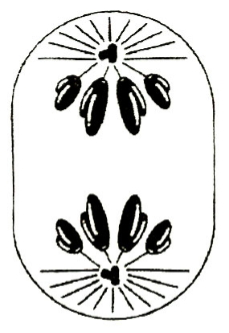
A
Interphase
B
Prophase
C
Metaphase
D
Anaphase
Solution
(D) The provided diagram shows the separation of sister chromatids moving towards opposite poles,which is the characteristic feature of the anaphase stage of mitosis.
At the onset of anaphase,each chromosome arranged at the metaphase plate is split simultaneously,and the two daughter chromatids,now referred to as chromosomes of the future daughter nuclei,begin their migration towards the two opposite poles.
As each chromosome moves away from the equatorial plate,the centromere of each chromosome is towards the pole and hence at the leading edge,with the arms of the chromosome trailing behind.
Thus,the anaphase stage is characterized by the following key events:
$1.$ Centromeres split and chromatids separate.
$2.$ Chromatids move to opposite poles.
At the onset of anaphase,each chromosome arranged at the metaphase plate is split simultaneously,and the two daughter chromatids,now referred to as chromosomes of the future daughter nuclei,begin their migration towards the two opposite poles.
As each chromosome moves away from the equatorial plate,the centromere of each chromosome is towards the pole and hence at the leading edge,with the arms of the chromosome trailing behind.
Thus,the anaphase stage is characterized by the following key events:
$1.$ Centromeres split and chromatids separate.
$2.$ Chromatids move to opposite poles.
0 likes
View Solution299
MediumMCQ
When dividing cells are examined under a light microscope,chromosomes become visible in
A
Interphase
B
$S$-phase
C
Prophase
D
$G_{1}$-phase
Solution
(C) The $S$ and $G_{2}$ phases of interphase are followed by prophase.
Prophase is marked by the initiation of condensation of chromosomal material.
The chromosomal material becomes untangled during the process of chromatin condensation.
Centrioles begin to move towards opposite poles of the cell.
Therefore,when dividing cells are examined under a light microscope,chromosomes become visible only during prophase.
Prophase is marked by the initiation of condensation of chromosomal material.
The chromosomal material becomes untangled during the process of chromatin condensation.
Centrioles begin to move towards opposite poles of the cell.
Therefore,when dividing cells are examined under a light microscope,chromosomes become visible only during prophase.
0 likes
View SolutionCell Cycle and Cell Division — M Phase · Frequently Asked Questions
1Are these Cell Cycle and Cell Division questions useful for JEE and NEET?
Yes. All questions in this section are mapped to JEE Main and NEET exam patterns. Previous year questions from JEE Main, NEET, GUJCET and state-level exams are included with full solutions.
2Can I switch to Hindi or Gujarati for these questions?
Yes. Use the language tabs in the hero section or the sidebar to view the same questions and solutions in English, Hindi or Gujarati.
3How do I generate a question paper from this subtopic?
Use the Vedclass Exam Paper Generator — select the chapter and subtopic, set difficulty, and generate Sets A, B, C, D automatically. First 3 chapters of every subject are free.
Vedclass Products
For Students
Vedclass Test Series
Mock tests in real JEE/NEET style with performance analysis. 5-day free trial.
Start Free TrialFor Teachers
Exam Paper Generator
Generate Set A/B/C/D papers from this chapter in 2 minutes. 3 chapters free.
Try FreeFor Institutes
Online Exam Module
Live online exams with unlimited students, 360° analytics & white-label branding.
See DemoFor Teachers & Institutes
Generate a Cell Cycle and Cell Division Exam Paper in 2 Minutes
Select subtopic & difficulty — Sets A, B, C, D auto-generated with No Repeat logic.
First 3 chapters of every subject are free — no payment required.