
A English
Cytokinesis Questions in English
Class 11 Biology · Cell Cycle and Cell Division · Cytokinesis
61+
Questions
English
Language
100%
With Solutions
Showing 50 of 61 questions in English
1
MediumMCQ
The condition where a large number of nuclei are found due to the absence of cytoplasmic division (which usually occurs after the $Telophase$ stage) is called:
A
Polyploidy
B
Syncytium
C
Heterokaryon
D
None of these
Solution
(B) In a typical cell cycle,$Karyokinesis$ (division of the nucleus) is followed by $Cytokinesis$ (division of the cytoplasm).
When $Karyokinesis$ occurs repeatedly without being followed by $Cytokinesis$,it results in a single cell containing multiple nuclei.
This multinucleate condition is known as a $Syncytium$ (e.g.,liquid endosperm in coconut).
$Polyploidy$ refers to having more than two sets of chromosomes,and a $Heterokaryon$ is a cell with genetically different nuclei.
When $Karyokinesis$ occurs repeatedly without being followed by $Cytokinesis$,it results in a single cell containing multiple nuclei.
This multinucleate condition is known as a $Syncytium$ (e.g.,liquid endosperm in coconut).
$Polyploidy$ refers to having more than two sets of chromosomes,and a $Heterokaryon$ is a cell with genetically different nuclei.
0 likes
View Solution2
MediumMCQ
Cytokinesis in plants takes place by the formation of
A
Sphaeroblasts
B
Equatorial cell plate
C
Idioblasts
D
Cell budding
Solution
(B) In plant cells,cytokinesis is different from animal cells.
Plant cells are enclosed by a relatively inextensible cell wall,therefore they do not undergo furrowing.
Instead,cytokinesis is achieved by the formation of a cell plate that grows outward to meet the existing lateral walls.
This cell plate represents the middle lamella between the walls of two adjacent cells.
Plant cells are enclosed by a relatively inextensible cell wall,therefore they do not undergo furrowing.
Instead,cytokinesis is achieved by the formation of a cell plate that grows outward to meet the existing lateral walls.
This cell plate represents the middle lamella between the walls of two adjacent cells.
0 likes
View Solution3
MediumMCQ
Which of the following structures is the base for defining the formation site of the cell plate at the end of nuclear division?
A
Microtubules
B
Vesicles
C
Endoplasmic reticulum
D
Golgi body
Solution
(B) At the end of nuclear division (telophase),the formation of the cell plate begins in plant cells.
$1$. The $Golgi$ apparatus produces $vesicles$ containing cell wall precursors.
$2$. These $vesicles$ migrate to the equatorial plane of the cell.
$3$. They fuse together to form a structure known as the $phragmoplast$.
$4$. The $phragmoplast$ eventually develops into the cell plate,which grows from the center towards the periphery to divide the cytoplasm.
$1$. The $Golgi$ apparatus produces $vesicles$ containing cell wall precursors.
$2$. These $vesicles$ migrate to the equatorial plane of the cell.
$3$. They fuse together to form a structure known as the $phragmoplast$.
$4$. The $phragmoplast$ eventually develops into the cell plate,which grows from the center towards the periphery to divide the cytoplasm.
0 likes
View Solution4
MediumMCQ
In animal cells,cytokinesis takes place by:
A
Cell furrow method
B
Cell plate method
C
Both $(a)$ and $(b)$
D
No cytokinesis takes place
Solution
(A) In animal cells,cytokinesis occurs by the formation of a cleavage furrow in the plasma membrane. This furrow gradually deepens and ultimately joins in the center,dividing the cell cytoplasm into two. This process is known as the cell furrow method or cleavage method. In contrast,plant cells undergo cytokinesis by the cell plate method due to the presence of a rigid cell wall.
0 likes
View Solution5
EasyMCQ
Phragmoplast is the precursor of
A
Cell plate
B
Chloroplast
C
Chromoplast
D
Leucoplast
Solution
(A) During cytokinesis in plant cells,the Golgi apparatus vesicles accumulate at the equatorial plane of the dividing cell to form a structure known as the phragmoplast.
The phragmoplast serves as a scaffold for the assembly of the cell plate,which eventually develops into the new cell wall separating the two daughter cells.
Therefore,the phragmoplast is the precursor of the cell plate.
The phragmoplast serves as a scaffold for the assembly of the cell plate,which eventually develops into the new cell wall separating the two daughter cells.
Therefore,the phragmoplast is the precursor of the cell plate.
0 likes
View Solution6
EasyMCQ
Cell plate is referred to as
A
Germplast
B
Idioblast
C
Phragmoplast
D
Middle lamella
Solution
(C) During cytokinesis in plant cells,a structure called the cell plate is formed in the center of the dividing cell.
This structure is derived from the fusion of Golgi-derived vesicles and is known as the phragmoplast.
Eventually,the cell plate matures to form the middle lamella,which acts as the cementing layer between the primary cell walls of two adjacent daughter cells.
This structure is derived from the fusion of Golgi-derived vesicles and is known as the phragmoplast.
Eventually,the cell plate matures to form the middle lamella,which acts as the cementing layer between the primary cell walls of two adjacent daughter cells.
0 likes
View Solution7
MediumMCQ
Cytokinesis refers to
A
Division of chromosomes
B
Division of cytoplasm
C
Division of nucleus
D
None of these
Solution
(B) Cytokinesis is the physical process of cell division,which divides the cytoplasm of a parental cell into two daughter cells.
It occurs after the completion of nuclear division (karyokinesis).
Therefore,the correct option is $B$.
It occurs after the completion of nuclear division (karyokinesis).
Therefore,the correct option is $B$.
0 likes
View Solution8
MediumMCQ
Which of the following is the method of cytokinesis in plant cells?
A
By the formation of a cell plate
B
By constriction
C
By furrow formation
D
Both $(A)$ and $(B)$
Solution
(A) In plant cells,cytokinesis occurs differently compared to animal cells.
Plant cells are enclosed by a relatively inextensible cell wall,so they cannot undergo cytokinesis by the furrowing or constriction method.
Instead,during cytokinesis,vesicles derived from the Golgi apparatus accumulate at the equator of the cell.
These vesicles fuse to form a structure called the cell plate,which grows outward to meet the existing lateral cell walls,eventually dividing the cytoplasm into two daughter cells.
Plant cells are enclosed by a relatively inextensible cell wall,so they cannot undergo cytokinesis by the furrowing or constriction method.
Instead,during cytokinesis,vesicles derived from the Golgi apparatus accumulate at the equator of the cell.
These vesicles fuse to form a structure called the cell plate,which grows outward to meet the existing lateral cell walls,eventually dividing the cytoplasm into two daughter cells.
0 likes
View Solution9
EasyMCQ
In animals,cytokinesis is ..........
A
Centrifugal
B
Centripetal
C
Irregular
D
Branched
Solution
(B) In animal cells,cytokinesis occurs by the formation of a cleavage furrow in the plasma membrane.
This furrow deepens from the periphery towards the center of the cell,eventually pinching the parent cell into two daughter cells.
Since the process moves from the outside (periphery) towards the center,it is known as centripetal cytokinesis.
In contrast,plant cells undergo cytokinesis by the formation of a cell plate,which grows from the center towards the periphery,known as centrifugal cytokinesis.
This furrow deepens from the periphery towards the center of the cell,eventually pinching the parent cell into two daughter cells.
Since the process moves from the outside (periphery) towards the center,it is known as centripetal cytokinesis.
In contrast,plant cells undergo cytokinesis by the formation of a cell plate,which grows from the center towards the periphery,known as centrifugal cytokinesis.
0 likes
View Solution10
MediumMCQ
The cell plate,which appears during cytokinesis,eventually transforms into the .......
A
Middle lamella
B
Primary wall
C
Secondary wall
D
Cell membrane
Solution
(A) During cytokinesis in plant cells,wall formation starts in the center of the cell and grows outward to meet the existing lateral walls. The formation of the new cell wall begins with the formation of a simple precursor,called the cell plate,that represents the middle lamella between the walls of two adjacent cells. At the time of cytoplasmic division,the organelles like mitochondria and plastids get distributed between the two daughter cells. The cell plate eventually matures into the middle lamella.
0 likes
View Solution11
MediumMCQ
How does cytokinesis occur in plant cells?
A
Centripetal
B
Centrifugal
C
Oblique
D
Intermediate
Solution
(B) In plant cells,cytokinesis occurs by the formation of a cell plate.
The Golgi apparatus produces vesicles that move to the center of the cell and fuse to form the cell plate.
This cell plate grows outward from the center towards the periphery of the cell,which is known as centrifugal growth.
Therefore,cytokinesis in plant cells is described as centrifugal.
The Golgi apparatus produces vesicles that move to the center of the cell and fuse to form the cell plate.
This cell plate grows outward from the center towards the periphery of the cell,which is known as centrifugal growth.
Therefore,cytokinesis in plant cells is described as centrifugal.
0 likes
View Solution12
MediumMCQ
When is the $Phragmoplast$ formed?
A
At the beginning of $Anaphase$
B
At the end of $Anaphase$
C
At the beginning of $Telophase$
D
At the end of $Telophase$
Solution
(C) The $Phragmoplast$ is a plant cell-specific structure that forms during the late stages of cell division.
It is a scaffold-like assembly of microtubules,microfilaments,and endoplasmic reticulum that develops in the equatorial region of the cell.
It serves as the site for the deposition of the cell plate,which eventually matures into the new cell wall.
This process begins during the early stages of $Telophase$ as the chromosomes reach the poles and the nuclear envelope begins to reform.
It is a scaffold-like assembly of microtubules,microfilaments,and endoplasmic reticulum that develops in the equatorial region of the cell.
It serves as the site for the deposition of the cell plate,which eventually matures into the new cell wall.
This process begins during the early stages of $Telophase$ as the chromosomes reach the poles and the nuclear envelope begins to reform.
0 likes
View Solution13
MediumMCQ
During cytokinesis,the formation of a contractile furrow occurs in which of the following?
A
Animals
B
Higher plants
C
Fungi
D
Algae
Solution
(A) In animal cells,cytokinesis occurs by the formation of a cleavage furrow in the plasma membrane. This furrow gradually deepens and ultimately joins in the center,dividing the cell cytoplasm into two. This process is known as the contractile ring mechanism. In contrast,plant cells undergo cytokinesis through the formation of a cell plate because their rigid cell walls prevent the formation of a furrow.
0 likes
View Solution14
MediumMCQ
When does the formation of a multinucleate condition occur?
A
If cytokinesis does not occur after karyokinesis.
B
If karyokinesis does not occur after cytokinesis.
C
If karyokinesis does not occur at all.
D
If both cytokinesis and karyokinesis are inhibited.
Solution
(A) Karyokinesis is the process of nuclear division,while cytokinesis is the process of cytoplasmic division.
Normally,karyokinesis is followed by cytokinesis to produce two daughter cells.
If karyokinesis occurs repeatedly without being followed by cytokinesis,the cell will contain multiple nuclei within a single cytoplasm.
This condition is known as a multinucleate condition or syncytium (e.g.,in liquid endosperm of coconut).
Normally,karyokinesis is followed by cytokinesis to produce two daughter cells.
If karyokinesis occurs repeatedly without being followed by cytokinesis,the cell will contain multiple nuclei within a single cytoplasm.
This condition is known as a multinucleate condition or syncytium (e.g.,in liquid endosperm of coconut).
0 likes
View Solution15
MediumMCQ
Which type of division results in a coenocytic condition?
A
Cryptomitosis
B
Endomitosis
C
Free nuclear division
D
Dinomitosis
Solution
(C) coenocytic condition is a state where a single cell contains multiple nuclei. This occurs when the nucleus undergoes repeated divisions (karyokinesis) without being followed by cytoplasmic division (cytokinesis). This process is known as free nuclear division. $A$ classic example is the formation of the liquid endosperm in coconut.
0 likes
View Solution16
EasyMCQ
Which independent event completes the process of cell division?
A
Prophase
B
Metaphase
C
Telophase
D
Cytokinesis
Solution
(D) Cell division consists of two main stages: $Karyokinesis$ (division of the nucleus) and $Cytokinesis$ (division of the cytoplasm).
$Karyokinesis$ involves stages like $Prophase$, $Metaphase$, $Anaphase$, and $Telophase$.
However, the process of cell division is only considered complete after the physical division of the cytoplasm, which is known as $Cytokinesis$.
Therefore, $Cytokinesis$ is the independent event that completes the cell division process.
$Karyokinesis$ involves stages like $Prophase$, $Metaphase$, $Anaphase$, and $Telophase$.
However, the process of cell division is only considered complete after the physical division of the cytoplasm, which is known as $Cytokinesis$.
Therefore, $Cytokinesis$ is the independent event that completes the cell division process.
0 likes
View Solution17
EasyMCQ
During which phase are organelles like mitochondria and chloroplasts distributed equally between the two daughter cells?
A
Prophase
B
Cytokinesis
C
Metaphase
D
Telophase
Solution
(B) During the cell cycle,the division of the cytoplasm is known as $Cytokinesis$. While $Karyokinesis$ (division of the nucleus) ensures the equal distribution of genetic material,$Cytokinesis$ ensures that the organelles,including mitochondria and chloroplasts,are distributed between the two daughter cells. This process typically occurs at the end of the cell division cycle.
0 likes
View Solution18
EasyMCQ
Which of the following is true for cytokinesis?
A
Formation of two cells from one cell
B
Re-establishment of the Golgi complex
C
Formation of new nuclei
D
Separation of chromatids
Solution
(A) Cytokinesis is the physical process of cell division,which divides the cytoplasm of a parental cell into two daughter cells.
It occurs after karyokinesis (division of the nucleus).
Therefore,the correct statement is that it results in the formation of two cells from one cell.
It occurs after karyokinesis (division of the nucleus).
Therefore,the correct statement is that it results in the formation of two cells from one cell.
0 likes
View Solution19
MediumMCQ
What condition arises if karyokinesis occurs without cytokinesis?
A
Multiple fission
B
Multinucleate condition (Syncytium)
C
Polyploidy
D
Multicellularity
Solution
(B) Karyokinesis is the process of nuclear division,while cytokinesis is the process of cytoplasmic division.
If karyokinesis occurs without being followed by cytokinesis,the cell will contain multiple nuclei within a single cytoplasm.
This condition is known as a multinucleate condition or $Syncytium$ (e.g.,liquid endosperm in coconut).
If karyokinesis occurs without being followed by cytokinesis,the cell will contain multiple nuclei within a single cytoplasm.
This condition is known as a multinucleate condition or $Syncytium$ (e.g.,liquid endosperm in coconut).
0 likes
View Solution20
MediumMCQ
In plant cells,what is formed on both sides of the middle lamella?
A
Nucleus
B
Nucleolus
C
Cytoplasm
D
Cell wall
Solution
(D) In plant cells,cytokinesis occurs through the formation of a cell plate.
During the late telophase of mitosis,the Golgi apparatus vesicles accumulate at the equatorial plane of the cell.
These vesicles fuse to form the cell plate,which represents the precursor of the middle lamella.
Subsequently,the cell wall material (cellulose,hemicellulose,and pectin) is deposited on both sides of the middle lamella to form the primary cell wall of the two daughter cells.
During the late telophase of mitosis,the Golgi apparatus vesicles accumulate at the equatorial plane of the cell.
These vesicles fuse to form the cell plate,which represents the precursor of the middle lamella.
Subsequently,the cell wall material (cellulose,hemicellulose,and pectin) is deposited on both sides of the middle lamella to form the primary cell wall of the two daughter cells.
0 likes
View Solution21
EasyMCQ
In plant cells,where does cytokinesis occur?
A
From the center of the cell
B
From the nucleolus region
C
From the periphery of the cell
D
From the cell plate region
Solution
(A) In plant cells,cytokinesis is achieved by the formation of a cell plate.
This cell plate formation begins at the center of the cell and grows outward towards the existing lateral walls.
Therefore,cytokinesis in plant cells occurs from the center of the cell towards the periphery.
This cell plate formation begins at the center of the cell and grows outward towards the existing lateral walls.
Therefore,cytokinesis in plant cells occurs from the center of the cell towards the periphery.
0 likes
View Solution22
EasyMCQ
In animal cells,where does the process of cleavage furrow formation begin?
A
From the nuclear region
B
From the peripheral region of the cell
C
From the middle lamella
D
From the nucleolus
Solution
(B) In animal cells,cytokinesis occurs by the formation of a cleavage furrow in the plasma membrane.
This process begins at the periphery of the cell and moves inward towards the center.
The furrow deepens gradually and ultimately joins in the center,dividing the cell cytoplasm into two distinct daughter cells.
This process begins at the periphery of the cell and moves inward towards the center.
The furrow deepens gradually and ultimately joins in the center,dividing the cell cytoplasm into two distinct daughter cells.
0 likes
View Solution23
MediumMCQ
Which event completes cell division even though it is not a part of mitosis?
A
Interphase
B
Telophase
C
Prophase
D
Cytokinesis
Solution
(D) Mitosis (karyokinesis) refers to the division of the nucleus.
Cytokinesis is the process of division of the cytoplasm,which physically separates the parent cell into two daughter cells.
Although cytokinesis is not a part of mitosis (karyokinesis),it is essential to complete the process of cell division.
Cytokinesis is the process of division of the cytoplasm,which physically separates the parent cell into two daughter cells.
Although cytokinesis is not a part of mitosis (karyokinesis),it is essential to complete the process of cell division.
0 likes
View Solution24
MediumMCQ
How does cytokinesis occur in an animal cell?
A
From the periphery of the cell towards the center
B
From the center of the cell towards the periphery
C
From the center of the cell towards the periphery
D
Towards the center of the cell
Solution
(A) In animal cells,cytokinesis occurs by the formation of a cleavage furrow in the plasma membrane.
This furrow gradually deepens and ultimately joins in the center,dividing the cell cytoplasm into two.
Therefore,the process proceeds from the periphery of the cell towards the center.
This furrow gradually deepens and ultimately joins in the center,dividing the cell cytoplasm into two.
Therefore,the process proceeds from the periphery of the cell towards the center.
0 likes
View Solution25
EasyMCQ
In animal cells,cytokinesis is initiated by which process?
A
Diffusion
B
Contraction
C
Cleavage furrow formation
D
Relaxation
Solution
(C) In animal cells,cytokinesis occurs by the appearance of a furrow in the plasma membrane. This process is known as cleavage or the formation of a cleavage furrow. The furrow gradually deepens and ultimately joins in the center,dividing the cell cytoplasm into two daughter cells.
0 likes
View Solution26
MediumMCQ
How does cytokinesis occur in a plant cell?
A
From the periphery towards the center
B
From the center towards the periphery
C
In the peripheral region of the cell
D
In the central region of the cell
Solution
(B) In plant cells,cytokinesis occurs by the formation of a cell plate.
This cell plate begins to form at the center of the cell and grows outwards towards the existing lateral walls (periphery).
This process is known as centrifugal growth.
Therefore,the correct direction of cytokinesis in plant cells is from the center towards the periphery.
This cell plate begins to form at the center of the cell and grows outwards towards the existing lateral walls (periphery).
This process is known as centrifugal growth.
Therefore,the correct direction of cytokinesis in plant cells is from the center towards the periphery.
0 likes
View Solution27
EasyMCQ
Which event results in the formation of two cells from a single cell?
A
Karyokinesis
B
Telophase
C
Cytokinesis
D
Interphase
Solution
(C) The process of cell division consists of two main stages: $1.$ Karyokinesis (division of the nucleus) and $2.$ Cytokinesis (division of the cytoplasm).
While Karyokinesis ensures that each daughter nucleus receives an identical set of chromosomes,it is the process of Cytokinesis that physically divides the cytoplasm,organelles,and cell membrane to form two distinct daughter cells.
Therefore,Cytokinesis is the specific event that completes the formation of two separate cells from one parent cell.
While Karyokinesis ensures that each daughter nucleus receives an identical set of chromosomes,it is the process of Cytokinesis that physically divides the cytoplasm,organelles,and cell membrane to form two distinct daughter cells.
Therefore,Cytokinesis is the specific event that completes the formation of two separate cells from one parent cell.
0 likes
View Solution28
EasyMCQ
The plate-like structure made of pectin formed in a plant cell during cytokinesis is called:
A
Plasma membrane
B
Middle lamella
C
Cell wall
D
Nuclear membrane
Solution
(B) During cytokinesis in plant cells,wall formation starts in the center of the cell and grows outward to meet the existing lateral walls.
This process begins with the formation of a precursor called the cell plate.
The cell plate represents the middle lamella between the walls of two adjacent cells.
It is primarily composed of calcium and magnesium pectates.
This process begins with the formation of a precursor called the cell plate.
The cell plate represents the middle lamella between the walls of two adjacent cells.
It is primarily composed of calcium and magnesium pectates.
0 likes
View Solution29
MediumMCQ
What is formed on both sides of the cell plate in a plant cell?
A
Cell wall
B
Plasma membrane
C
New plant cell
D
Cytoplasm
Solution
(A) During cytokinesis in plant cells,wall formation starts in the center of the cell and grows outward to meet the existing lateral walls.
This process begins with the formation of a precursor called the cell plate,which represents the middle lamella between the walls of two adjacent cells.
As the cell plate grows,new cell wall material is deposited on both sides of the cell plate,eventually leading to the formation of two distinct daughter cells.
This process begins with the formation of a precursor called the cell plate,which represents the middle lamella between the walls of two adjacent cells.
As the cell plate grows,new cell wall material is deposited on both sides of the cell plate,eventually leading to the formation of two distinct daughter cells.
0 likes
View Solution30
MediumMCQ
In which direction does the cell plate form?
A
From pole to equator
B
From equator to pole
C
From center to periphery
D
From periphery to center
Solution
(C) In plant cells,cytokinesis occurs through the formation of a cell plate.
During the late telophase,the Golgi apparatus vesicles accumulate at the equatorial plane of the cell.
These vesicles fuse to form the cell plate,which grows outward from the center of the cell toward the existing cell walls at the periphery.
Therefore,the cell plate formation proceeds from the center to the periphery.
During the late telophase,the Golgi apparatus vesicles accumulate at the equatorial plane of the cell.
These vesicles fuse to form the cell plate,which grows outward from the center of the cell toward the existing cell walls at the periphery.
Therefore,the cell plate formation proceeds from the center to the periphery.
0 likes
View Solution31
EasyMCQ
During which phase does the distribution of organelles like mitochondria and chloroplasts into daughter cells occur?
A
Karyokinesis
B
Cytokinesis
C
Interphase
D
Prophase
Solution
(B) Cytokinesis is the process of physical division of the cytoplasm of a parent cell into two daughter cells. During this phase,the organelles,including mitochondria and chloroplasts,are distributed into the daughter cells to ensure both cells have the necessary machinery for metabolic activities.
0 likes
View Solution32
EasyMCQ
Which of the following is not a part of mitosis?
A
Prophase
B
Anaphase
C
Telophase
D
Cytokinesis
Solution
(D) Mitosis ($M$ phase) is divided into four stages: Prophase,Metaphase,Anaphase,and Telophase.
Cytokinesis is the process of division of the cytoplasm,which occurs after the completion of nuclear division (karyokinesis).
Therefore,Cytokinesis is not a stage of mitosis itself,but a separate process that follows it.
Cytokinesis is the process of division of the cytoplasm,which occurs after the completion of nuclear division (karyokinesis).
Therefore,Cytokinesis is not a stage of mitosis itself,but a separate process that follows it.
0 likes
View Solution33
EasyMCQ
Which of the following processes is associated with cytokinesis?
A
$DNA$ synthesis
B
Attachment of spindle fibers to kinetochores
C
Formation of cell plate
D
Reformation of endoplasmic reticulum
Solution
(C) Cytokinesis is the physical process of cell division,which divides the cytoplasm of a parental cell into two daughter cells.
In plant cells,cytokinesis occurs through the formation of a cell plate.
The cell plate represents the future middle lamella between the cell walls of two adjacent daughter cells.
$DNA$ synthesis occurs during the $S$-phase of interphase.
Attachment of spindle fibers to kinetochores occurs during prometaphase.
Reformation of the endoplasmic reticulum and nuclear envelope occurs during telophase.
In plant cells,cytokinesis occurs through the formation of a cell plate.
The cell plate represents the future middle lamella between the cell walls of two adjacent daughter cells.
$DNA$ synthesis occurs during the $S$-phase of interphase.
Attachment of spindle fibers to kinetochores occurs during prometaphase.
Reformation of the endoplasmic reticulum and nuclear envelope occurs during telophase.
0 likes
View Solution34
MediumMCQ
$S$ - Statement: Cell division is an essential and important process observed in living organisms.
$R$ - Reason: In plant cells,cytokinesis begins from the central region of the cell.
$R$ - Reason: In plant cells,cytokinesis begins from the central region of the cell.
A
$S$ and $R$ are both true,and $R$ is the correct explanation of $S$.
B
$S$ and $R$ are both true,but $R$ is not the correct explanation of $S$.
C
$S$ is true and $R$ is false.
D
$S$ is false and $R$ is true.
Solution
(A) Statement $S$ is true because cell division is fundamental for growth,repair,and reproduction in all living organisms.
Reason $R$ is true because in plant cells,cytokinesis occurs through the formation of a cell plate that starts from the center and grows outward towards the existing lateral walls,unlike animal cells where it occurs by cleavage from the periphery.
Reason $R$ is true because in plant cells,cytokinesis occurs through the formation of a cell plate that starts from the center and grows outward towards the existing lateral walls,unlike animal cells where it occurs by cleavage from the periphery.
0 likes
View Solution35
MediumMCQ
Which of the following is a difference between plant cell division and animal cell division?
A
Formation of spindle fibers
B
Formation of chromosomes
C
Movement of chromosomes from the equatorial plate
D
Cytokinesis (Cell plate formation vs. Cleavage furrow)
Solution
(D) The primary difference between plant and animal cell division lies in the process of cytokinesis. In animal cells,cytokinesis occurs through the formation of a cleavage furrow at the plasma membrane,which progresses from the outside towards the center. In contrast,due to the presence of a rigid cell wall in plant cells,a cell plate is formed in the center of the cell,which grows from the inside towards the outside. Therefore,the correct option is $D$.
0 likes
View Solution36
EasyMCQ
During which phase does the formation of the cell plate begin?
A
$G_1$ phase
B
Anaphase
C
Telophase
D
Metaphase
Solution
(C) In plant cells,cytokinesis occurs through the formation of a cell plate.
This process begins during $Telophase$.
The cell plate represents the middle lamella between the walls of two adjacent cells.
It originates from the fusion of Golgi vesicles at the center of the cell and grows outward towards the existing lateral walls.
This process begins during $Telophase$.
The cell plate represents the middle lamella between the walls of two adjacent cells.
It originates from the fusion of Golgi vesicles at the center of the cell and grows outward towards the existing lateral walls.
0 likes
View Solution37
EasyMCQ
In mitosis,karyokinesis is usually followed by cytokinesis,but this is not always the case. If a cell undergoes mitosis but cytokinesis does not occur,what is the result?
A
The cell contains a single large nucleus.
B
The cell becomes multinucleate.
C
The cells have irregular small nuclei.
D
The cells maintain genetic uniformity.
Solution
(B) Mitosis consists of two main stages: $1.$ Karyokinesis (division of the nucleus) and $2.$ Cytokinesis (division of the cytoplasm).
If karyokinesis occurs without cytokinesis,the cell will contain multiple nuclei within a single cytoplasm.
This condition is known as a multinucleate state or a syncytium (e.g.,in liquid endosperm of coconut).
Therefore,the correct result is that the cell becomes multinucleate.
If karyokinesis occurs without cytokinesis,the cell will contain multiple nuclei within a single cytoplasm.
This condition is known as a multinucleate state or a syncytium (e.g.,in liquid endosperm of coconut).
Therefore,the correct result is that the cell becomes multinucleate.
0 likes
View Solution38
MediumMCQ
Which of the following is a difference between cell division in plant cells and animal cells?
A
Formation of spindle fibers
B
Formation of cell plate
C
Movement of chromosomes to the equatorial plate
D
Coiling of chromosomes
Solution
(B) In animal cells,cytokinesis occurs by the formation of a cleavage furrow in the plasma membrane,which deepens centripetally until the cell is divided into two. In contrast,plant cells are enclosed by a rigid cell wall,so they cannot undergo furrowing. Instead,cytokinesis in plant cells occurs by the formation of a cell plate that grows centrifugally from the center toward the cell walls.
0 likes
View Solution39
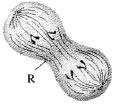
MediumMCQ
In the given figure, what does the part labeled "$R$" represent?
A
Cleavage furrow
B
Kinetochore
C
Spindle fibers
D
Cytoplasm
Solution
(A) The provided figure shows the process of cytokinesis in an animal cell.
In animal cells, cytokinesis is achieved by the appearance of a furrow in the plasma membrane.
This furrow gradually deepens and ultimately joins in the center, dividing the cell cytoplasm into two.
This structure is known as the cleavage furrow.
Therefore, the part labeled "$R$" represents the cleavage furrow.
In animal cells, cytokinesis is achieved by the appearance of a furrow in the plasma membrane.
This furrow gradually deepens and ultimately joins in the center, dividing the cell cytoplasm into two.
This structure is known as the cleavage furrow.
Therefore, the part labeled "$R$" represents the cleavage furrow.
0 likes
View Solution40
EasyMCQ
Which stage is indicated by the given figure?

A
Prophase
B
Metaphase
C
Anaphase
D
Telophase
Solution
(D) The provided figure shows a cell undergoing cytokinesis,where the nuclear envelope has reformed around the two sets of chromosomes at opposite poles. This is characteristic of the final stage of mitosis,known as Telophase. During Telophase,the chromosomes cluster at opposite spindle poles and their identity is lost as discrete elements,while the nuclear envelope assembles around each chromosome cluster.
0 likes
View Solution41
MediumMCQ
In animal cells,where does the constriction of the cytoplasm begin during cytokinesis?
A
From the peripheral region
B
From the central region
C
From the cell wall
D
From the plasma membrane
Solution
(A) In animal cells,cytokinesis is achieved by the appearance of a furrow in the plasma membrane.
This furrow gradually deepens and ultimately joins in the center,dividing the cell cytoplasm into two.
This process begins from the periphery (the outer edge) of the cell and moves towards the center.
Therefore,the constriction of the cytoplasm starts from the peripheral region.
This furrow gradually deepens and ultimately joins in the center,dividing the cell cytoplasm into two.
This process begins from the periphery (the outer edge) of the cell and moves towards the center.
Therefore,the constriction of the cytoplasm starts from the peripheral region.
0 likes
View Solution42
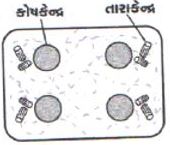
MediumMCQ
What does the following figure represent?
A
Synapsis
B
Syncytium
C
Zipper
D
All of the above
Solution
(B) The figure shows a single cell containing multiple nuclei (karyokinesis without cytokinesis). This condition,where a cell has multiple nuclei,is known as a syncytium. Examples include the liquid endosperm in coconut.
0 likes
View Solution43
MediumMCQ
It is not a part of Mitosis but it completes cell division.
A
Prophase
B
Cytokinesis
C
Metaphase
D
Telophase
Solution
(B) Mitosis (karyokinesis) is the process of nuclear division,which consists of four stages: Prophase,Metaphase,Anaphase,and Telophase.
Cytokinesis is the process of cytoplasmic division that follows nuclear division.
Although Cytokinesis is not a part of Mitosis (karyokinesis),it is essential for the completion of cell division,resulting in two daughter cells.
Cytokinesis is the process of cytoplasmic division that follows nuclear division.
Although Cytokinesis is not a part of Mitosis (karyokinesis),it is essential for the completion of cell division,resulting in two daughter cells.
0 likes
View Solution44
EasyMCQ
During this phase,organelles like mitochondria and plastids are distributed between the two daughter cells.
A
Cytokinesis
B
Interphase
C
Pachytene
D
Leptotene
Solution
(A) Cytokinesis is the process of physical division of the cytoplasm of a parent cell into two daughter cells. During this phase,the cell organelles,such as mitochondria and plastids,are distributed between the two daughter cells to ensure both cells have the necessary machinery for survival and function.
0 likes
View Solution45
MediumMCQ
$A$ student observed a plant cell from a field in the telophase stage. He informed his teacher that the cell appeared different from other cells in telophase. The formation of the cell plate was not observed. Consequently,the cell contained a higher number of chromosomes compared to other dividing cells. This phenomenon results in $..........$.
A
Polyploidy
B
Somaclonal variation
C
Polyteny
D
Aneuploidy
Solution
(A) In plant cells,cytokinesis occurs through the formation of a cell plate.
If the cell plate fails to form during telophase,the cytoplasm does not divide,even though the chromosomes have replicated and segregated.
This results in a single cell containing multiple sets of chromosomes,a condition known as polyploidy.
Polyploidy is the state of having more than two complete sets of chromosomes ($3n, 4n$,etc.).
Therefore,the failure of cytokinesis leads to polyploidy.
If the cell plate fails to form during telophase,the cytoplasm does not divide,even though the chromosomes have replicated and segregated.
This results in a single cell containing multiple sets of chromosomes,a condition known as polyploidy.
Polyploidy is the state of having more than two complete sets of chromosomes ($3n, 4n$,etc.).
Therefore,the failure of cytokinesis leads to polyploidy.
0 likes
View Solution46
MediumMCQ
How does cytokinesis in plant cells differ from that in animal cells?
A
Plant cells undergo cleavage,while animal cells form a cell plate.
B
Plant cells form a cell plate,while animal cells undergo cleavage.
C
Both undergo cleavage.
D
Both form a cell plate.
Solution
(B)
| Cytokinesis in plant cells | Cytokinesis in animal cells |
|---|---|
| $(i)$ The division of the cytoplasm takes place by cell plate formation. | $(i)$ The division of the cytoplasm takes place by cleavage (furrowing). |
| $(ii)$ Cell plate formation starts at the centre of the cell and grows outward,toward the lateral walls. | $(ii)$ Cleavage starts at the periphery and then moves inward,dividing the cell into two parts. |
0 likes
View Solution47
Medium
Differentiate between Karyokinesis and Cytokinesis.
Solution
(N/A)
| Karyokinesis | Cytokinesis |
| $(i)$ It consists of distinct sub-phases (Prophase,Metaphase,Anaphase,Telophase). | $(i)$ It has no sub-phases; it is a continuous process. |
| $(ii)$ It is the process of nuclear division. | $(ii)$ It is the process of cytoplasmic division. |
| $(iii)$ It occurs in both mitosis and meiosis. | $(iii)$ In plant cells,it occurs via cell plate formation; in animal cells,it occurs via cleavage furrow. |
| $(iv)$ It ensures the distribution of genetic material into two nuclei. | $(iv)$ It ensures the physical separation of the cytoplasm to form two daughter cells. |
0 likes
View Solution48
Medium
$(1)$ Definition / Explanation: Karyokinesis
$(2)$ Definition / Explanation: Cytokinesis
$(2)$ Definition / Explanation: Cytokinesis
Solution
(N/A) $(1)$ Karyokinesis is the process of division of the nucleus during cell division,which occurs in both mitosis and meiosis.
$(2)$ Cytokinesis is the process of division of the cytoplasm,which marks the completion of cell division. In animal cells,cytoplasmic division occurs by the formation of a cleavage furrow from the periphery to the center. In plant cells,it occurs by the formation of a cell plate starting from the center and extending towards the periphery,eventually leading to the formation of the nuclear membrane and two daughter cells.
$(2)$ Cytokinesis is the process of division of the cytoplasm,which marks the completion of cell division. In animal cells,cytoplasmic division occurs by the formation of a cleavage furrow from the periphery to the center. In plant cells,it occurs by the formation of a cell plate starting from the center and extending towards the periphery,eventually leading to the formation of the nuclear membrane and two daughter cells.
0 likes
View Solution49
Easy
How does cytokinesis in plant cells differ from that in animal cells?
Solution
(N/A) $\Rightarrow$ Due to the presence of a rigid cell wall,cytoplasmic division (cytokinesis) differs significantly in plant cells compared to animal cells.
$\Rightarrow$ In animal cells,a contractile ring of microfilaments forms a cleavage furrow that pinches the cell from the periphery towards the center.
$\Rightarrow$ In contrast,plant cells cannot undergo furrowing due to the cell wall. Instead,they form a cell plate in the middle of the cell.
$\Rightarrow$ Golgi bodies release vesicles containing cell wall precursors. These vesicles fuse to form the cell plate at the equatorial plane.
$\Rightarrow$ Cytokinesis in plant cells proceeds centrifugally,starting from the center and extending outward until it fuses with the existing lateral cell walls.
$\Rightarrow$ In animal cells,a contractile ring of microfilaments forms a cleavage furrow that pinches the cell from the periphery towards the center.
$\Rightarrow$ In contrast,plant cells cannot undergo furrowing due to the cell wall. Instead,they form a cell plate in the middle of the cell.
$\Rightarrow$ Golgi bodies release vesicles containing cell wall precursors. These vesicles fuse to form the cell plate at the equatorial plane.
$\Rightarrow$ Cytokinesis in plant cells proceeds centrifugally,starting from the center and extending outward until it fuses with the existing lateral cell walls.
0 likes
View Solution50
Medium
How does cytokinesis take place in animal cells?
Solution
(N/A) $\Rightarrow$ In an animal cell,cytokinesis is achieved by the appearance of a cleavage furrow in the plasma membrane.
$\Rightarrow$ This furrow gradually deepens and ultimately joins in the center,dividing the cell cytoplasm into two distinct daughter cells.
$\Rightarrow$ In contrast,plant cells are enclosed by a relatively inextensible cell wall,which prevents the formation of a furrow.
$\Rightarrow$ Therefore,plant cells undergo cytokinesis through the formation of a cell plate.
$\Rightarrow$ This furrow gradually deepens and ultimately joins in the center,dividing the cell cytoplasm into two distinct daughter cells.
$\Rightarrow$ In contrast,plant cells are enclosed by a relatively inextensible cell wall,which prevents the formation of a furrow.
$\Rightarrow$ Therefore,plant cells undergo cytokinesis through the formation of a cell plate.
0 likes
View SolutionCell Cycle and Cell Division — Cytokinesis · Frequently Asked Questions
1Are these Cell Cycle and Cell Division questions useful for JEE and NEET?
Yes. All questions in this section are mapped to JEE Main and NEET exam patterns. Previous year questions from JEE Main, NEET, GUJCET and state-level exams are included with full solutions.
2Can I switch to Hindi or Gujarati for these questions?
Yes. Use the language tabs in the hero section or the sidebar to view the same questions and solutions in English, Hindi or Gujarati.
3How do I generate a question paper from this subtopic?
Use the Vedclass Exam Paper Generator — select the chapter and subtopic, set difficulty, and generate Sets A, B, C, D automatically. First 3 chapters of every subject are free.
Vedclass Products
For Students
Vedclass Test Series
Mock tests in real JEE/NEET style with performance analysis. 5-day free trial.
Start Free TrialFor Teachers
Exam Paper Generator
Generate Set A/B/C/D papers from this chapter in 2 minutes. 3 chapters free.
Try FreeFor Institutes
Online Exam Module
Live online exams with unlimited students, 360° analytics & white-label branding.
See DemoFor Teachers & Institutes
Generate a Cell Cycle and Cell Division Exam Paper in 2 Minutes
Select subtopic & difficulty — Sets A, B, C, D auto-generated with No Repeat logic.
First 3 chapters of every subject are free — no payment required.