
A English
Mix Examples- Body Fluids and Circulations Questions in English
Class 11 Biology · Body Fluids and Circulations · Mix Examples- Body Fluids and Circulations
79+
Questions
English
Language
100%
With Solutions
Showing 29 of 79 questions in English
51
MediumMCQ
Which of the following statements are wrong?
$(i)$ Leucocytes disintegrate in the spleen and liver.
$(ii)$ $RBC$,$WBC$ and blood platelets are produced by bone marrow.
$(iii)$ Neutrophils bring about destruction and detoxification of toxins of protein origin.
$(iv)$ The important function of lymphocytes is to produce antibodies.
$(i)$ Leucocytes disintegrate in the spleen and liver.
$(ii)$ $RBC$,$WBC$ and blood platelets are produced by bone marrow.
$(iii)$ Neutrophils bring about destruction and detoxification of toxins of protein origin.
$(iv)$ The important function of lymphocytes is to produce antibodies.
A
$(i)$ and $(ii)$ only
B
$(i)$ and $(iv)$ only
C
$(i)$ and $(iii)$ only
D
$(ii)$ and $(iii)$ only
Solution
(C) Statement $(i)$ is wrong because erythrocytes (RBCs),not leucocytes (WBCs),disintegrate in the spleen and liver (the 'graveyard' of RBCs).
Statement $(ii)$ is correct as all formed elements ($RBC$,$WBC$,and platelets) are produced in the bone marrow.
Statement $(iii)$ is wrong because eosinophils,not neutrophils,are responsible for the destruction and detoxification of toxins of protein origin and are associated with allergic reactions.
Statement $(iv)$ is correct as lymphocytes are responsible for the immune response by producing antibodies.
Therefore,statements $(i)$ and $(iii)$ are incorrect.
Statement $(ii)$ is correct as all formed elements ($RBC$,$WBC$,and platelets) are produced in the bone marrow.
Statement $(iii)$ is wrong because eosinophils,not neutrophils,are responsible for the destruction and detoxification of toxins of protein origin and are associated with allergic reactions.
Statement $(iv)$ is correct as lymphocytes are responsible for the immune response by producing antibodies.
Therefore,statements $(i)$ and $(iii)$ are incorrect.
0 likes
View Solution52
Easy
Match column $I$ with column $II$:
| Column $I$ | Column $II$ |
| $(a)$ Eosinophils | $(i)$ Coagulation |
| $(b)$ $RBC$ | $(ii)$ Universal Recipient |
| $(c)$ $AB$ Group | $(iii)$ Resist Infections |
| $(d)$ Platelets | $(iv)$ Contraction of Heart |
| $(e)$ Systole | $(v)$ Gas transport |
Solution
(A) The correct matches are as follows:
$(a)$ Eosinophils: $(iii)$ Resist Infections (They are involved in allergic reactions and defense against parasites).
$(b)$ $RBC$: $(v)$ Gas transport (They contain hemoglobin which transports $O_2$ and $CO_2$).
$(c)$ $AB$ Group: $(ii)$ Universal Recipient (Individuals with $AB$ blood group lack anti-$A$ and anti-$B$ antibodies).
$(d)$ Platelets: $(i)$ Coagulation (They release factors that initiate blood clotting).
$(e)$ Systole: $(iv)$ Contraction of Heart (It refers to the phase of cardiac contraction).
$(a)$ Eosinophils: $(iii)$ Resist Infections (They are involved in allergic reactions and defense against parasites).
$(b)$ $RBC$: $(v)$ Gas transport (They contain hemoglobin which transports $O_2$ and $CO_2$).
$(c)$ $AB$ Group: $(ii)$ Universal Recipient (Individuals with $AB$ blood group lack anti-$A$ and anti-$B$ antibodies).
$(d)$ Platelets: $(i)$ Coagulation (They release factors that initiate blood clotting).
$(e)$ Systole: $(iv)$ Contraction of Heart (It refers to the phase of cardiac contraction).
0 likes
View Solution53
EasyMCQ
What is the need for a circulatory system?
A
To transport nutrients and oxygen to cells.
B
To remove waste products from cells.
C
Both $A$ and $B$.
D
To provide structural support to the body.
Solution
(C) All living cells require a constant supply of nutrients,$O_{2}$,and other essential substances to survive and function.
Additionally,metabolic waste products and harmful substances produced within the cells must be efficiently removed to prevent toxicity.
Therefore,a specialized circulatory system is essential to provide mechanisms for the transport of these substances to and from the cells.
Additionally,metabolic waste products and harmful substances produced within the cells must be efficiently removed to prevent toxicity.
Therefore,a specialized circulatory system is essential to provide mechanisms for the transport of these substances to and from the cells.
0 likes
View Solution54
Medium
Describe the events in the cardiac cycle. Explain 'double circulation'.
Solution
(N/A) The cardiac cycle consists of the sequential events in the heart which are cyclically repeated. It involves the following phases:
$1$. Atrial Systole: The $SA$ node generates an action potential,stimulating both atria to undergo simultaneous contraction. This increases the flow of blood into the ventricles by about $30\%$.
$2$. Ventricular Systole: The action potential reaches the ventricles via the $AV$ node and Bundle of His,causing ventricular contraction. This leads to the closure of $AV$ valves (producing the first heart sound,'$lub$') and the opening of semilunar valves,forcing blood into the aorta and pulmonary artery.
$3$. Joint Diastole: Both atria and ventricles are in a relaxed state. The semilunar valves close (producing the second heart sound,'$dub$'),and the $AV$ valves open,allowing blood to flow from the atria into the ventricles.
Double circulation refers to the pathway where blood passes through the heart twice in one complete cycle:
$1$. Pulmonary Circulation: Deoxygenated blood is pumped from the right ventricle to the lungs for oxygenation and returned to the left atrium.
$2$. Systemic Circulation: Oxygenated blood is pumped from the left ventricle to all body tissues and returned as deoxygenated blood to the right atrium.
$1$. Atrial Systole: The $SA$ node generates an action potential,stimulating both atria to undergo simultaneous contraction. This increases the flow of blood into the ventricles by about $30\%$.
$2$. Ventricular Systole: The action potential reaches the ventricles via the $AV$ node and Bundle of His,causing ventricular contraction. This leads to the closure of $AV$ valves (producing the first heart sound,'$lub$') and the opening of semilunar valves,forcing blood into the aorta and pulmonary artery.
$3$. Joint Diastole: Both atria and ventricles are in a relaxed state. The semilunar valves close (producing the second heart sound,'$dub$'),and the $AV$ valves open,allowing blood to flow from the atria into the ventricles.
Double circulation refers to the pathway where blood passes through the heart twice in one complete cycle:
$1$. Pulmonary Circulation: Deoxygenated blood is pumped from the right ventricle to the lungs for oxygenation and returned to the left atrium.
$2$. Systemic Circulation: Oxygenated blood is pumped from the left ventricle to all body tissues and returned as deoxygenated blood to the right atrium.
0 likes
View Solution55
EasyMCQ
Analogy type questions:
$(1)$ Fish : Single circulation :: Amphibians : ...........
$(2)$ Between right atrium and right ventricle : Tricuspid valve :: Between left atrium and left ventricle : .............
$(1)$ Fish : Single circulation :: Amphibians : ...........
$(2)$ Between right atrium and right ventricle : Tricuspid valve :: Between left atrium and left ventricle : .............
A
$1$. Incomplete double circulation,$2$. Bicuspid valve
B
$1$. Double circulation,$2$. Mitral valve
C
$1$. Single circulation,$2$. Semilunar valve
D
$1$. Incomplete double circulation,$2$. Tricuspid valve
Solution
(A) $(1)$ In fish,the heart pumps deoxygenated blood to the gills for oxygenation,which then passes directly to the body tissues. This is known as single circulation.
In amphibians,the heart has two atria and one ventricle. The oxygenated and deoxygenated blood mix in the ventricle before being pumped out,which is known as incomplete double circulation.
$(2)$ The tricuspid valve is located between the right atrium and the right ventricle to prevent backflow of blood.
The bicuspid valve (also known as the mitral valve) is located between the left atrium and the left ventricle to prevent backflow of blood.
In amphibians,the heart has two atria and one ventricle. The oxygenated and deoxygenated blood mix in the ventricle before being pumped out,which is known as incomplete double circulation.
$(2)$ The tricuspid valve is located between the right atrium and the right ventricle to prevent backflow of blood.
The bicuspid valve (also known as the mitral valve) is located between the left atrium and the left ventricle to prevent backflow of blood.
0 likes
View Solution56
EasyMCQ
Select the correct option:
$(1)$ $AB / O$ blood group is the universal recipient.
$(2)$ Mitral valve / Semilunar valve is located between the atrium and the ventricle.
$(1)$ $AB / O$ blood group is the universal recipient.
$(2)$ Mitral valve / Semilunar valve is located between the atrium and the ventricle.
A
$(1)$ $AB$,$(2)$ Mitral valve
B
$(1)$ $O$,$(2)$ Semilunar valve
C
$(1)$ $AB$,$(2)$ Semilunar valve
D
$(1)$ $O$,$(2)$ Mitral valve
Solution
(A) $(1)$ The $AB$ blood group is known as the universal recipient because individuals with this blood type have both $A$ and $B$ antigens on their red blood cells and no antibodies against $A$ or $B$ in their plasma.
$(2)$ The mitral valve (also known as the bicuspid valve) is located between the left atrium and the left ventricle,regulating blood flow between these chambers.
$(2)$ The mitral valve (also known as the bicuspid valve) is located between the left atrium and the left ventricle,regulating blood flow between these chambers.
0 likes
View Solution57
EasyMCQ
Choose the correct option:
$(1)$ Depolarization of the ventricles induces the $QRS$ / $T$ waves.
$(2)$ Incomplete double circulation is seen in reptiles / birds.
$(1)$ Depolarization of the ventricles induces the $QRS$ / $T$ waves.
$(2)$ Incomplete double circulation is seen in reptiles / birds.
A
$(1) QRS, (2) \text{Reptiles}$
B
$(1) T, (2) \text{Reptiles}$
C
$(1) QRS, (2) \text{Birds}$
D
$(1) T, (2) \text{Birds}$
Solution
(A) $(1)$ The $QRS$ complex represents the depolarization of the ventricles, which initiates ventricular contraction.
$(2)$ Incomplete double circulation (where oxygenated and deoxygenated blood mix in the single ventricle) is characteristic of amphibians and most reptiles (except crocodiles).
$(2)$ Incomplete double circulation (where oxygenated and deoxygenated blood mix in the single ventricle) is characteristic of amphibians and most reptiles (except crocodiles).
0 likes
View Solution58
Medium
Differentiate between closed circulatory system and open circulatory system.
Solution
(N/A)
| Closed circulatory system | Open circulatory system |
| $(1)$ Blood is circulated through a closed network of blood vessels. | $(1)$ Blood is pumped into body cavities or sinuses. |
| $(2)$ Blood capillaries are present to facilitate exchange. | $(2)$ Blood capillaries are absent. |
| $(3)$ Respiratory pigments are usually present within $RBCs$ or dissolved in plasma. | $(3)$ Respiratory pigments are always dissolved in the blood plasma. |
| $(4)$ Lymph acts as an intermediate medium between blood and cells. | $(4)$ Direct exchange occurs between blood and tissues. |
| $(5)$ Example: Earthworm,Humans. | $(5)$ Example: Cockroach,Molluscs. |
0 likes
View Solution59
EasyMCQ
The organ that acts as a filter for blood is:
A
Bone marrow
B
Liver
C
Spleen
D
Thymus
Solution
(C) The $Spleen$ is a large,bean-shaped organ that acts as a filter for the blood.
It removes old or damaged red blood cells from circulation.
It also stores blood and acts as a reservoir for white blood cells and platelets,playing a crucial role in the immune system.
It removes old or damaged red blood cells from circulation.
It also stores blood and acts as a reservoir for white blood cells and platelets,playing a crucial role in the immune system.
0 likes
View Solution60
MediumMCQ
Which of the following statements is correct regarding the composition of blood and lymph?
A
$Blood = Plasma + RBCs + WBCs + \text{Blood platelets}$
B
$Plasma = Blood - \text{Formed elements}$
C
$Lymph = \text{Plasma} - \text{Large proteins} - \text{RBCs}$
D
Both $(a)$ and $(b)$ are correct.
Solution
(D) Blood is a specialized connective tissue consisting of a fluid matrix, plasma, and formed elements. The formed elements include RBCs (erythrocytes), WBCs (leukocytes), and blood platelets (thrombocytes). Therefore, $Blood = Plasma + \text{Formed elements}$ (RBCs + WBCs + Platelets). This makes option $(a)$ correct.
Plasma is the straw-colored, viscous fluid constituting the matrix of the blood. If we remove the formed elements from the blood, we are left with plasma. Thus, $Plasma = Blood - \text{Formed elements}$. This makes option $(b)$ correct.
Lymph is a fluid that lacks RBCs and large proteins compared to blood plasma. Therefore, option $(c)$ is incorrect as it includes RBCs.
Since both $(a)$ and $(b)$ are correct, the final answer is $(d)$.
Plasma is the straw-colored, viscous fluid constituting the matrix of the blood. If we remove the formed elements from the blood, we are left with plasma. Thus, $Plasma = Blood - \text{Formed elements}$. This makes option $(b)$ correct.
Lymph is a fluid that lacks RBCs and large proteins compared to blood plasma. Therefore, option $(c)$ is incorrect as it includes RBCs.
Since both $(a)$ and $(b)$ are correct, the final answer is $(d)$.
0 likes
View Solution61
EasyMCQ
In normal humans,the time taken for normal blood clotting is:
A
$5-25\; min$
B
$30-50\; min$
C
$4-10\; min$
D
Few seconds
Solution
(C) The process of blood clotting,also known as coagulation,is a mechanism to prevent excessive loss of blood from the body.
In normal healthy humans,the time taken for the blood to clot typically ranges from $4-10\; min$.
In normal healthy humans,the time taken for the blood to clot typically ranges from $4-10\; min$.
0 likes
View Solution62
MediumMCQ
What is the correct order of events occurring in blood clotting?
$I.$ Conversion of fibrinogen to fibrin
$II.$ Formation of clot
$III.$ Thromboplastin formation
$IV.$ Conversion of prothrombin to thrombin
Choose the correct option.
$I.$ Conversion of fibrinogen to fibrin
$II.$ Formation of clot
$III.$ Thromboplastin formation
$IV.$ Conversion of prothrombin to thrombin
Choose the correct option.
A
$III, II, I$ and $IV$
B
$III, IV, I$ and $II$
C
$III, IV, II$ and $I$
D
$IV, I, III$ and $II$
Solution
(B) The process of blood clotting follows a specific cascade mechanism:
$1$. First,injury to the tissue leads to the formation of thromboplastin $(III)$.
$2$. Thromboplastin then triggers the conversion of inactive prothrombin into active thrombin $(IV)$.
$3$. Thrombin acts as an enzyme to convert soluble fibrinogen into insoluble fibrin threads $(I)$.
$4$. Finally,these fibrin threads form a mesh that traps blood cells to create a clot $(II)$.
Therefore,the correct sequence is $III, IV, I, II$.
$1$. First,injury to the tissue leads to the formation of thromboplastin $(III)$.
$2$. Thromboplastin then triggers the conversion of inactive prothrombin into active thrombin $(IV)$.
$3$. Thrombin acts as an enzyme to convert soluble fibrinogen into insoluble fibrin threads $(I)$.
$4$. Finally,these fibrin threads form a mesh that traps blood cells to create a clot $(II)$.
Therefore,the correct sequence is $III, IV, I, II$.
0 likes
View Solution63
MediumMCQ
Which of the following is correct regarding blood coagulation?
$I$. Vitamin-$K$ is necessary for the formation of prothrombin.
$II$. Conversion of fibrinogen to fibrin is done by thrombin.
$III$. Conversion of prothrombin to thrombin is done by the enzyme complex prothrombinase.
The option with the correct combination is:
$I$. Vitamin-$K$ is necessary for the formation of prothrombin.
$II$. Conversion of fibrinogen to fibrin is done by thrombin.
$III$. Conversion of prothrombin to thrombin is done by the enzyme complex prothrombinase.
The option with the correct combination is:
A
$I$ and $II$
B
$II$ and $III$
C
$I$,$II$ and $III$
D
None of these
Solution
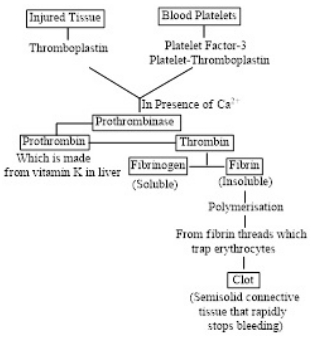
(C) Statement $I$ is correct: Vitamin-$K$ is essential for the synthesis of prothrombin in the liver.
Statement $II$ is correct: The enzyme thrombin converts soluble fibrinogen into insoluble fibrin threads.
Statement $III$ is correct: The enzyme complex prothrombinase (formed by thromboplastin and platelet factors in the presence of $Ca^{2+}$) converts inactive prothrombin into active thrombin.
Since all statements $I$,$II$,and $III$ are correct,none of the provided options $A$,$B$,or $C$ are fully accurate if they exclude one of the correct statements. However,based on the standard interpretation of such questions,if all are correct,the answer is $I$,$II$,and $III$.
Statement $II$ is correct: The enzyme thrombin converts soluble fibrinogen into insoluble fibrin threads.
Statement $III$ is correct: The enzyme complex prothrombinase (formed by thromboplastin and platelet factors in the presence of $Ca^{2+}$) converts inactive prothrombin into active thrombin.
Since all statements $I$,$II$,and $III$ are correct,none of the provided options $A$,$B$,or $C$ are fully accurate if they exclude one of the correct statements. However,based on the standard interpretation of such questions,if all are correct,the answer is $I$,$II$,and $III$.
0 likes
View Solution64
MediumMCQ
Which one of the following is a matching pair of a certain body feature and its value/count in a normal human adult?
A
Urea - $5-10\; mg/100\; mL$ of blood
B
Blood sugar - $70-100\; mg/100\; mL$ (fasting)
C
Total blood volume - $5-6\; L$
D
$ESR$ in Wintrobe - $9-15\; mm$ in males and $20-34\; mm$ in females
Solution
(B) Blood sugar refers to glucose,which is regulated by insulin and glucagon. The normal fasting blood glucose level in a healthy adult is typically in the range of $70-100\; mg/100\; mL$ (or $70-100\; mg/dL$).
Option $A$ is incorrect as normal blood urea is $15-40\; mg/100\; mL$.
Option $C$ is incorrect as it lacks the unit $(L)$.
Option $D$ is incorrect as the standard $ESR$ (Erythrocyte Sedimentation Rate) values for males are $0-15\; mm/hr$ and for females are $0-20\; mm/hr$.
Option $A$ is incorrect as normal blood urea is $15-40\; mg/100\; mL$.
Option $C$ is incorrect as it lacks the unit $(L)$.
Option $D$ is incorrect as the standard $ESR$ (Erythrocyte Sedimentation Rate) values for males are $0-15\; mm/hr$ and for females are $0-20\; mm/hr$.
0 likes
View Solution65
MediumMCQ
Which of the following flowcharts correctly represents the process of blood clotting?
A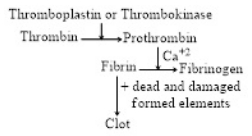
B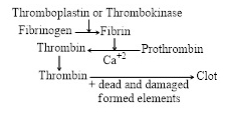
C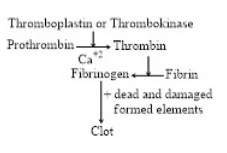
D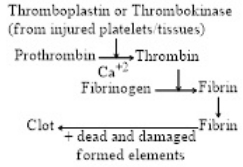
Solution
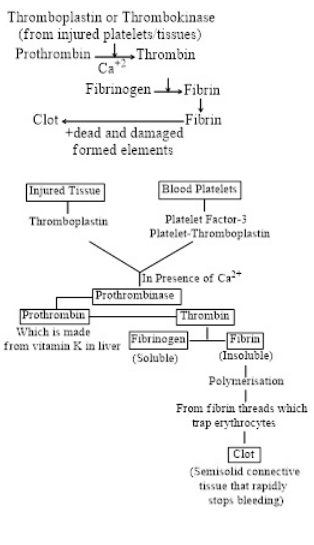
(D) The process of blood clotting (coagulation) involves a cascade of enzymatic reactions.
$1$. Injury to tissues or platelets releases $Thromboplastin$ (or $Thrombokinase$).
$2$. In the presence of $Ca^{+2}$ ions, $Thromboplastin$ converts inactive $Prothrombin$ into active $Thrombin$.
$3$. $Thrombin$ then converts soluble $Fibrinogen$ into insoluble $Fibrin$ threads.
$4$. These $Fibrin$ threads form a network that traps dead and damaged formed elements of blood to form a clot.
Option $D$ correctly depicts this sequence: $Prothrombin \xrightarrow{Thromboplastin/Thrombokinase, Ca^{+2}} Thrombin \xrightarrow{Fibrinogen} Fibrin \xrightarrow{+ \text{dead and damaged formed elements}} \text{Clot}$.
$1$. Injury to tissues or platelets releases $Thromboplastin$ (or $Thrombokinase$).
$2$. In the presence of $Ca^{+2}$ ions, $Thromboplastin$ converts inactive $Prothrombin$ into active $Thrombin$.
$3$. $Thrombin$ then converts soluble $Fibrinogen$ into insoluble $Fibrin$ threads.
$4$. These $Fibrin$ threads form a network that traps dead and damaged formed elements of blood to form a clot.
Option $D$ correctly depicts this sequence: $Prothrombin \xrightarrow{Thromboplastin/Thrombokinase, Ca^{+2}} Thrombin \xrightarrow{Fibrinogen} Fibrin \xrightarrow{+ \text{dead and damaged formed elements}} \text{Clot}$.
0 likes
View Solution66
MediumMCQ
$A$: 'Dub' is a long and sharp sound.
$R$: It is caused by the closing of atrioventricular valves.
$R$: It is caused by the closing of atrioventricular valves.
A
Assertion and Reason both are correct and Reason is the correct explanation of Assertion.
B
Assertion and Reason both are correct but Reason is not the correct explanation of Assertion.
C
Assertion is correct,but Reason is incorrect.
D
Both Assertion and Reason are incorrect.
Solution
(D) The heart sounds are $Lubb$ and $Dub$.
$Lubb$ is the first heart sound,which is low-pitched and of longer duration,caused by the closure of the atrioventricular $(AV)$ valves.
$Dub$ is the second heart sound,which is high-pitched and of shorter duration,caused by the closure of the semilunar valves.
Therefore,the Assertion is incorrect because 'Dub' is short and sharp,and the Reason is incorrect because 'Dub' is caused by semilunar valves,not $AV$ valves.
$Lubb$ is the first heart sound,which is low-pitched and of longer duration,caused by the closure of the atrioventricular $(AV)$ valves.
$Dub$ is the second heart sound,which is high-pitched and of shorter duration,caused by the closure of the semilunar valves.
Therefore,the Assertion is incorrect because 'Dub' is short and sharp,and the Reason is incorrect because 'Dub' is caused by semilunar valves,not $AV$ valves.
0 likes
View Solution67
MediumMCQ
$A$: $A$ portal system consists of veins that start from capillaries and end into capillaries.
$R$: All vertebrates have a hepatic portal system.
$R$: All vertebrates have a hepatic portal system.
A
Assertion and Reason both are correct and Reason is the correct explanation of Assertion.
B
Assertion and Reason both are correct but Reason is not the correct explanation of Assertion.
C
Assertion is correct,but Reason is incorrect.
D
Both Assertion and Reason are incorrect.
Solution
(C) The Assertion is correct because a portal system is defined as a system of veins that begins in the capillaries of one organ and ends in the capillaries of another organ.
The Reason is incorrect because,while the hepatic portal system is present in most vertebrates,it is not present in all vertebrates (e.g.,it is absent in cyclostomes and some fish).
Therefore,the correct option is $C$.
The Reason is incorrect because,while the hepatic portal system is present in most vertebrates,it is not present in all vertebrates (e.g.,it is absent in cyclostomes and some fish).
Therefore,the correct option is $C$.
0 likes
View Solution68
MediumMCQ
$A$: Elevated levels of $Na^+$ decrease the heart rate and contractility.
$R$: Elevated $Na^+$ levels increase the excitability of the $SA$ node.
$R$: Elevated $Na^+$ levels increase the excitability of the $SA$ node.
A
Assertion and Reason both are correct and Reason is the correct explanation of Assertion.
B
Assertion and Reason both are correct but Reason is not the correct explanation of Assertion.
C
Assertion is correct,but Reason is incorrect.
D
Both Assertion and Reason are incorrect.
Solution
(D) Elevated levels of $Na^+$ (sodium ions) in the blood interfere with the influx of $Ca^{2+}$ ions into the cardiac muscle cells.
Since $Ca^{2+}$ is essential for the contraction of cardiac muscles,an excess of $Na^+$ inhibits this process,leading to a decrease in heart rate and contractility.
Therefore,the Assertion is incorrect.
Furthermore,elevated $Na^+$ levels do not increase the excitability of the $SA$ node; in fact,they tend to depress cardiac function.
Thus,the Reason is also incorrect.
Since $Ca^{2+}$ is essential for the contraction of cardiac muscles,an excess of $Na^+$ inhibits this process,leading to a decrease in heart rate and contractility.
Therefore,the Assertion is incorrect.
Furthermore,elevated $Na^+$ levels do not increase the excitability of the $SA$ node; in fact,they tend to depress cardiac function.
Thus,the Reason is also incorrect.
0 likes
View Solution69
MediumMCQ
Select the correct option regarding the clotting of body fluids in a test tube.
A
Lymph kept in a test tube does not clot.
B
Blood kept in a test tube clots.
C
Serum kept in a test tube does not clot.
D
All of the above.
Solution
(D) $1$. Blood contains clotting factors (like fibrinogen) and platelets,which cause it to clot when exposed to a surface like a test tube.
$2$. Lymph is essentially blood plasma without large proteins and red blood cells. While it contains some clotting factors,it lacks the concentration of platelets and specific factors required for rapid clotting in a test tube,so it does not clot easily.
$3$. Serum is the fluid remaining after blood has clotted and the clot has been removed. Since the clotting factors have already been consumed during the formation of the clot,serum cannot clot further.
$4$. Therefore,all the given statements are correct.
$2$. Lymph is essentially blood plasma without large proteins and red blood cells. While it contains some clotting factors,it lacks the concentration of platelets and specific factors required for rapid clotting in a test tube,so it does not clot easily.
$3$. Serum is the fluid remaining after blood has clotted and the clot has been removed. Since the clotting factors have already been consumed during the formation of the clot,serum cannot clot further.
$4$. Therefore,all the given statements are correct.
0 likes
View Solution70
MediumMCQ
Select the correct option regarding the circulatory system.
A
In an open circulatory system,blood is pumped out of the heart into blood vessels that open into body cavities (sinuses).
B
$A$ closed circulatory system is more advantageous as the flow of fluid can be more precisely regulated.
C
In a closed circulatory system,blood flow can be easily controlled.
D
All of the above.
Solution
(D) In an open circulatory system,blood is pumped out of the heart into blood vessels that open into body cavities called sinuses,where tissues are bathed in blood.
In a closed circulatory system,blood flows through a network of vessels,which is more efficient for transport.
In a closed circulatory system,the flow of blood can be precisely regulated by the contraction and relaxation of blood vessels.
Therefore,all the given statements are correct.
In a closed circulatory system,blood flows through a network of vessels,which is more efficient for transport.
In a closed circulatory system,the flow of blood can be precisely regulated by the contraction and relaxation of blood vessels.
Therefore,all the given statements are correct.
0 likes
View Solution71
MediumMCQ
Select the correct option for myogenic and neurogenic hearts.
A
Myogenic heart - Cockroach
Neurogenic heart - Human,Earthworm
Neurogenic heart - Human,Earthworm
B
Myogenic heart - Human,Earthworm
Neurogenic heart - Cockroach
Neurogenic heart - Cockroach
C
Myogenic heart - Earthworm,Cockroach
Neurogenic heart - Human
Neurogenic heart - Human
D
Myogenic heart - Human
Neurogenic heart - Earthworm,Cockroach
Neurogenic heart - Earthworm,Cockroach
Solution
(B) myogenic heart is one where the heartbeat is initiated by a specialized group of muscle cells (e.g.,the $SA$ node in humans). In humans,the heart is myogenic.
An earthworm also possesses a myogenic heart,as its lateral hearts are muscular and initiate their own contractions.
$A$ neurogenic heart is one where the heartbeat is initiated by nerve impulses from a ganglion (e.g.,in arthropods like the cockroach).
Therefore,the correct classification is: Myogenic heart - Human,Earthworm; Neurogenic heart - Cockroach.
An earthworm also possesses a myogenic heart,as its lateral hearts are muscular and initiate their own contractions.
$A$ neurogenic heart is one where the heartbeat is initiated by nerve impulses from a ganglion (e.g.,in arthropods like the cockroach).
Therefore,the correct classification is: Myogenic heart - Human,Earthworm; Neurogenic heart - Cockroach.
0 likes
View Solution72
MediumMCQ
Match the Column-$I$ and Column-$II$.
Choose the correct answer from the options given below:
| Column-$I$ | Column-$II$ |
| $a.$ Joint diastole | $(i)$ $0.8$ second |
| $b.$ Heart beat | $(ii)$ All four chambers of heart are relaxed. |
| $c.$ Cardiac cycle | $(iii)$ $72$ times/min |
| $d.$ Stroke volume | $(iv)$ $70$ mL |
Choose the correct answer from the options given below:
A
$a-(i), b-(ii), c-(iii), d-(iv)$
B
$a-(ii), b-(iii), c-(i), d-(iv)$
C
$a-(iii), b-(ii), c-(i), d-(iv)$
D
$a-(iv), b-(iii), c-(ii), d-(i)$
Solution
(B) The correct matching is as follows:
$a.$ Joint diastole: In this phase,all four chambers of the heart are in a relaxed state. This corresponds to $(ii)$.
$b.$ Heart beat: The normal heart rate is approximately $72$ times per minute. This corresponds to $(iii)$.
$c.$ Cardiac cycle: The duration of one complete cardiac cycle is $0.8$ seconds. This corresponds to $(i)$.
$d.$ Stroke volume: The volume of blood pumped out by each ventricle per beat is approximately $70$ mL. This corresponds to $(iv)$.
Thus,the correct sequence is $a-(ii), b-(iii), c-(i), d-(iv)$.
$a.$ Joint diastole: In this phase,all four chambers of the heart are in a relaxed state. This corresponds to $(ii)$.
$b.$ Heart beat: The normal heart rate is approximately $72$ times per minute. This corresponds to $(iii)$.
$c.$ Cardiac cycle: The duration of one complete cardiac cycle is $0.8$ seconds. This corresponds to $(i)$.
$d.$ Stroke volume: The volume of blood pumped out by each ventricle per beat is approximately $70$ mL. This corresponds to $(iv)$.
Thus,the correct sequence is $a-(ii), b-(iii), c-(i), d-(iv)$.
0 likes
View Solution73
MediumMCQ
Cardiac output is determined by.
A
heart rate
B
stroke volume
C
blood flow
D
both $(1)$ and $(2)$
Solution
(D) Cardiac output is defined as the volume of blood pumped by each ventricle per minute.
It is calculated by the formula: $\text{Cardiac Output} = \text{Stroke Volume} \times \text{Heart Rate}$.
Stroke volume is the amount of blood pumped by the ventricle in one beat (approximately $70 \text{ mL}$).
Heart rate is the number of beats per minute (approximately $72 \text{ beats/min}$).
Therefore, cardiac output depends on both heart rate and stroke volume.
It is calculated by the formula: $\text{Cardiac Output} = \text{Stroke Volume} \times \text{Heart Rate}$.
Stroke volume is the amount of blood pumped by the ventricle in one beat (approximately $70 \text{ mL}$).
Heart rate is the number of beats per minute (approximately $72 \text{ beats/min}$).
Therefore, cardiac output depends on both heart rate and stroke volume.
0 likes
View Solution74
MediumMCQ
Statement-$I$: The first heart sound $(lub)$ is associated with the opening of the tricuspid and bicuspid valves.
Statement-$II$: Cardiac output of an athlete is much higher than that of an ordinary man.
Statement-$II$: Cardiac output of an athlete is much higher than that of an ordinary man.
A
Statement $I$ and $II$ both are correct
B
Statement $I$ and $II$ both are incorrect
C
Only statement $I$ is correct
D
Only statement $II$ is correct
Solution
(D) Statement-$I$ is incorrect because the first heart sound $(lub)$ is produced by the closure of the tricuspid and bicuspid valves at the beginning of ventricular systole,not their opening.
Statement-$II$ is correct because athletes have a higher stroke volume and better cardiovascular efficiency,leading to a higher cardiac output compared to an ordinary person.
Therefore,only statement $II$ is correct.
Statement-$II$ is correct because athletes have a higher stroke volume and better cardiovascular efficiency,leading to a higher cardiac output compared to an ordinary person.
Therefore,only statement $II$ is correct.
0 likes
View Solution75
MediumMCQ
Statement-$I$ :- The body has the ability to alter the stroke volume as well as heart rate and thereby the cardiac output.
Statement-$II$ :- During each cardiac cycle two prominent sounds are produced which can not be easily heard through a stethoscope.
Statement-$II$ :- During each cardiac cycle two prominent sounds are produced which can not be easily heard through a stethoscope.
A
Statement-$I$ is correct but statement-$II$ is incorrect.
B
Statement-$II$ is correct but statement-$I$ is incorrect.
C
Both statement-$I$ and statement-$II$ are correct.
D
Both statement-$I$ and statement-$II$ are incorrect.
Solution
(A) Statement-$I$ is correct. The cardiac output is defined as the volume of blood pumped out by each ventricle per minute and is equal to the product of stroke volume and heart rate. The body can alter these parameters to regulate cardiac output.
Statement-$II$ is incorrect. During each cardiac cycle,two prominent sounds are produced ($Lubb$ and $Dupp$). These sounds can be easily heard through a stethoscope,which is a medical instrument used for listening to internal body sounds.
Statement-$II$ is incorrect. During each cardiac cycle,two prominent sounds are produced ($Lubb$ and $Dupp$). These sounds can be easily heard through a stethoscope,which is a medical instrument used for listening to internal body sounds.
0 likes
View Solution76
EasyMCQ
Which of the following are the pulse points of the lower limb?
$I$. Brachial $\quad$ $II$. Radial
$III$. Posterior tibial $\quad$ $IV$. Dorsalis pedis
$V$. Femoral $\quad$ $VI$. Popliteal
Select the correct option.
$I$. Brachial $\quad$ $II$. Radial
$III$. Posterior tibial $\quad$ $IV$. Dorsalis pedis
$V$. Femoral $\quad$ $VI$. Popliteal
Select the correct option.
A
$I, III$ and $VI$ only
B
$II, IV$ and $V$ only
C
$III, IV, V$ and $VI$ only
D
$I, II, III$ and $IV$ only
Solution
(C) The pulse points are locations where an artery can be palpated against a bone. The pulse points of the lower limb are as follows:
$1$. Femoral artery (in the groin area).
$2$. Popliteal artery (behind the knee).
$3$. Posterior tibial artery (near the ankle).
$4$. Dorsalis pedis artery (on the top of the foot).
Brachial and Radial arteries are pulse points of the upper limb.
Therefore,the correct pulse points of the lower limb are $III, IV, V$ and $VI$.
$1$. Femoral artery (in the groin area).
$2$. Popliteal artery (behind the knee).
$3$. Posterior tibial artery (near the ankle).
$4$. Dorsalis pedis artery (on the top of the foot).
Brachial and Radial arteries are pulse points of the upper limb.
Therefore,the correct pulse points of the lower limb are $III, IV, V$ and $VI$.
0 likes
View Solution77
EasyMCQ
If cardiac output is $4200 \text{ ml/min}$,then $x$ beats/min is the heart rate and $y$ is the term for pulse rate.
A
$x - 50, y - \text{tachycardia}$
B
$x - 72, y - \text{bradycardia}$
C
$x - 60, y - \text{bradycardia}$
D
$x - 70, y - \text{tachycardia}$
Solution
(C) Cardiac output is defined as the volume of blood pumped by each ventricle per minute. It is calculated as: $\text{Cardiac Output} = \text{Stroke Volume} \times \text{Heart Rate}$.
Assuming an average stroke volume of $70 \text{ ml}$,if the cardiac output is $4200 \text{ ml/min}$,then the heart rate $(x)$ is $4200 / 70 = 60 \text{ beats/min}$.
When the heart rate falls below the normal range $(60-100 \text{ beats/min})$,the condition is known as bradycardia $(y)$.
Therefore,$x = 60$ and $y = \text{bradycardia}$.
Assuming an average stroke volume of $70 \text{ ml}$,if the cardiac output is $4200 \text{ ml/min}$,then the heart rate $(x)$ is $4200 / 70 = 60 \text{ beats/min}$.
When the heart rate falls below the normal range $(60-100 \text{ beats/min})$,the condition is known as bradycardia $(y)$.
Therefore,$x = 60$ and $y = \text{bradycardia}$.
0 likes
View Solution78
EasyMCQ
Which of the following is $NOT$ a character of open circulation?
A
Blood flows with low pressure.
B
Respiratory pigment is usually absent.
C
Presence of blood capillaries.
D
Presence of haemocoel.
Solution
(C) In an open circulatory system,blood is pumped by the heart into body cavities,where tissues are surrounded by the blood.
This system lacks a complete network of blood vessels,meaning blood capillaries are absent.
Key features of open circulation include:
$1$. Blood flows at low pressure.
$2$. The body cavity is known as the haemocoel.
$3$. Respiratory pigments are often absent or dissolved in the plasma rather than contained in cells.
Therefore,the presence of blood capillaries is a characteristic of a closed circulatory system,not an open one.
This system lacks a complete network of blood vessels,meaning blood capillaries are absent.
Key features of open circulation include:
$1$. Blood flows at low pressure.
$2$. The body cavity is known as the haemocoel.
$3$. Respiratory pigments are often absent or dissolved in the plasma rather than contained in cells.
Therefore,the presence of blood capillaries is a characteristic of a closed circulatory system,not an open one.
0 likes
View Solution79
EasyMCQ
Compare the statements $A$ and $B$.
$Statement A$: Blood sugar level falls rapidly after hepatectomy.
$Statement B$: The glycogen of the liver is the principle source of blood sugar.
Select the correct description:
$Statement A$: Blood sugar level falls rapidly after hepatectomy.
$Statement B$: The glycogen of the liver is the principle source of blood sugar.
Select the correct description:
A
$Statement A$ is wrong and $B$ is correct.
B
Both the statement $A$ and $B$ are correct and $B$ is not the reason for $A$.
C
Both the statements $A$ and $B$ are correct and $B$ is the reason for $A$.
D
$Statement A$ is correct and $B$ is wrong.
Solution
(C) Both the statements $A$ and $B$ are correct and $B$ is the reason for $A$.
After hepatectomy,which involves the removal of a part or the whole liver,there is a rapid drop in blood sugar levels $(Statement A)$ because the liver's glycogen,which is the primary source of blood sugar $(Statement B)$,is no longer available to maintain blood glucose homeostasis.
After hepatectomy,which involves the removal of a part or the whole liver,there is a rapid drop in blood sugar levels $(Statement A)$ because the liver's glycogen,which is the primary source of blood sugar $(Statement B)$,is no longer available to maintain blood glucose homeostasis.
0 likes
View SolutionBody Fluids and Circulations — Mix Examples- Body Fluids and Circulations · Frequently Asked Questions
1Are these Body Fluids and Circulations questions useful for JEE and NEET?
Yes. All questions in this section are mapped to JEE Main and NEET exam patterns. Previous year questions from JEE Main, NEET, GUJCET and state-level exams are included with full solutions.
2Can I switch to Hindi or Gujarati for these questions?
Yes. Use the language tabs in the hero section or the sidebar to view the same questions and solutions in English, Hindi or Gujarati.
3How do I generate a question paper from this subtopic?
Use the Vedclass Exam Paper Generator — select the chapter and subtopic, set difficulty, and generate Sets A, B, C, D automatically. First 3 chapters of every subject are free.
Vedclass Products
For Students
Vedclass Test Series
Mock tests in real JEE/NEET style with performance analysis. 5-day free trial.
Start Free TrialFor Teachers
Exam Paper Generator
Generate Set A/B/C/D papers from this chapter in 2 minutes. 3 chapters free.
Try FreeFor Institutes
Online Exam Module
Live online exams with unlimited students, 360° analytics & white-label branding.
See DemoFor Teachers & Institutes
Generate a Body Fluids and Circulations Exam Paper in 2 Minutes
Select subtopic & difficulty — Sets A, B, C, D auto-generated with No Repeat logic.
First 3 chapters of every subject are free — no payment required.